




Abstract
Theoretical foundations are fundamental to research in health and physical education. They reflect historical and cultural ideas and values. In this article, we seek to introduce the philosophy of Bildung from the Nordic-German cultural region to an English-speaking audience as one theoretical foundation for student-centered teaching. Bildung focuses on the student and his or her self-formation processes in health and physical education. Bildung refers to the holistic development of cognitive, physical, emotional, social, and esthetic capacities. It is an active and reflective process that centers on the inner development of individuality and is realized by individuals as they perceive, interpret, and respond to their realities and, in turn, shape the world in which they live. In this article, we also discuss parallels with social-constructivist approaches to health and physical education, especially with the concept of social and emotional learning.
Keywords
Introduction
In this article, we introduce theoretical foundations and practical conceptualizations for student-centered approaches to physical education (PE) pedagogy as they are used in German sport pedagogy with regard to theories of Bildung. 1 To determine the potential of a student-centered approach to education, one must consider the current social developments and challenges that students face in their lifeworlds, which are becoming increasingly unpredictable and complex (Luhmann, 1992; Marotzki, 1990; Millar et al., 2018). In interpretivist theory, lifeworlds refer to the lived experiences of individuals. From a developmental perspective, students need to develop their capacities for perceiving, interpreting, and responding to new information and challenges as they arise to cope with the uncertainty in their lives. Students’ ability to handle uncertainty and contradictions in their precarious lifeworlds is indispensable. This stands in an inseparable relation to understanding the construction of social structures and being able to critically reflect on them in order to use the capacities in different contexts. Such a task cannot be attributed “to an isolated individual, but always has to do with the individual-in-context” (Biesta and Lawy, 2006: 74).
From the Bildung view, educators should adopt an approach that enables their students to self-actively deal with their complex social situations. Self-activity, which refers to autonomous self-formation, is considered effective because it empowers students to meet life's challenges independently and opens up multiple opportunities for their futures. Learning opportunities that enable such activities are intentionally provided when pedagogical practices are aligned with the German concept of Bildung (Benner, 2015; Klafki, 1963).
To illuminate this concept and its practical implications, we first outline the idea of Bildung from a general education, non-PE perspective and then connect Bildung specifically to its impact on students, highlighting the impossibility of influencing Bildung directly. Second, we discuss the meaning of Bildung in PE and present educational PE as an approach that rests on the philosophy of Bildung. An illustrating example and a section on parallel concepts in the English-speaking discourses are provided in conclusion.
What is Bildung?
In Wilhelm von Humboldt's neo-humanist approach to education, Bildung involves the intellectual handling of the elements and values of a culture and extends beyond the purely goal-oriented acquisition of knowledge and skills in the sense of social utility (Klafki, 2000). While the concept of Bildung originated in Germany most of the Nordic countries acknowledge Bildung as part of their educational history and curriculum development (Horlacher, 2016). Furthermore, it has been employed in and appropriated by international pedagogical research over the past few years (e.g. Beck et al., 2015; Biesta, 2011; Ryen and Jøsok, 2021; Siljander et al., 2012; Sjöström et al., 2017; Uljens and Ylimaki, 2017).
Bildung is not merely educating or teaching but instead “commonly refers to the subtler aspects of education” (Beck et al., 2015: 2) as the focus is on reaching intellectual maturity. Formally, this intellectual focus might bear the danger of excluding other relevant aspects such as physical or social-emotional capacities that are inevitably bound to health and PE. This has been critically discussed and considered in theories of education by Benner (2015) and Klafki (2001). The process of Bildung requires an individual's Selbsttätigkeit (the German word is translated into English as the concept of “self-activity”). Self-active learning is inseparably bound to reasonable decision-making and actions as an enduring process: “We learn continuously during our whole life” (Uljens and Ylimaki, 2017: 74). A potentially resulting and aspired maturity enables the individual not only to apply his or her knowledge and skills but also to question his or her capacities and knowledge regularly. Therefore, the added value of the concept is its critical function which implies to also scrutinize all well-intended objectives in educational contexts. 2 In line with ideas stemming from the Enlightenment (Klafki, 2000; Uljens and Ylimaki, 2017), the critique of social conditions and reform created space for progressive pedagogical models for PE in Germany (for an overview, see Gaum, 2019). These models underline the importance of critical reflection for achieving maturity, which is only possible by breaking routines and gaining new perspectives on concepts that are formally well known and widely accepted (Ehni, 1977; Prohl, 2012). Unexpected experiences resulting from complex problems create the necessary conditions and opportunities for Bildung to take place. Such problem-solving experiences result in tasks that are not predictable and do not have one specific solution. This focus on dealing with uncertainty and ambiguity seems relevant when taking the future challenge of education into account. In a complex and unpredictable world, the stabilization of thinking patterns or courses of action is not a satisfactory educational style because it cannot ensure the attainment of current or future educational aims. The promise of certainty (in education) is deceptive. However, embracing uncertainty is desirable in the Bildung educational setting.
We highlight the following elements that have been derived from general education assumptions about Bildung:
3
Bildung is a holistic development of cognitive, physical, emotional, social, and esthetic capacities; Bildung is an active and reflective process that focuses on the inner development of individuality; this process is often called “self-cultivation” (Westbury, 2000); and Bildung is a process realized by individuals as they perceive, interpret, and respond to their realities and, in turn, shape the world in which they live. Education can be planned and deliberate (intentional) or unintentional and spontaneous; Education can be obtained from people (parents, teachers, significant others), groups (political parties, religious groups, non-governmental organizations), or institutions (media, school); and Education cannot “produce” Bildung technically but can empower learners and lead to self-cultivation (Bildung) in a self-determined way.
Importantly, Nordic and German pedagogy makes a distinction between Bildung and education. Therefore, in contrast, the term education refers to an externally determined influence and is characterized as follows:
The relationship between Bildung and education
Before a student-centered approach to PE pedagogy can be derived from a particular philosophy of education, the relationship between Bildung and education must be clarified to determine whether (and if so, how) a theoretical concept is desirable and feasible in practice. The question remains as to how the process of Bildung is initiated. Although Bildung is an individual and autonomous process, teachers and educational tasks are needed to provide students with opportunities for active confrontation with elements and values of culture and society. The courage, willingness, and ability to use one's understanding are indeed prerequisites for Bildung; however, the capacity to develop those qualities is not an inevitable occurrence and cannot be assumed to happen simply by setting up student-centered tasks. The general need for intentional educational influence remains fundamental. Benner (2015: 82) calls this slightly paradoxical principle “to influence a summons to self-activity”. In other words, the initiation of the process (Bildung) needs external encouragement (education); at the same time, an individual's self-cultivation cannot be engendered externally or developed with a production mentality.
However, Bildung provides a valuable benefit on the theoretical level for the legitimation of the subject of PE. To justify including a subject at school, that subject must make an irreplaceable contribution to a student's development at both personal and societal levels (e.g. Fend, 1980; Klafki, 1963). Therefore, we pose the question “What is the irreplaceable contribution of PE to individuals and society?”. We argue that it is essential to continue to explore the reasons (why) for including PE as a school subject, particularly as the curriculum (what) and distinctive methods (how) in PE are changeable and depend on the answers to the first question.
The importance of Bildung in PE: The “why”
To promote Bildung in PE, the curricular contents must merge with personal (e.g. social, emotional, value related) development because Bildung education aims toward self-cultivation. A student-centered approach to PE should involve covering curricular content in a way that will enhance students’ abilities and techniques and empower them to make appropriate decisions about their practices and to change them if necessary. As Kurz (2008) states, one not only learns how to run but also learns something through running. This leads to the integration of two dimensions in educational philosophy—content relevance (material Bildung) and personal development (formal Bildung). While the “material” theories were emphasizing the importance of learning the content in order to be socialized into the culture, “formal” approaches focused on education as being about the development of general capacities to reflect, solve problems, and deliberate (Uljens and Ylimaki, 2017: 29). As Benner (2015: 157) states, neither part alone meets the requirements of the term Bildung: There is no such thing as basic human powers in an ontological sense, which exist independently of the acquisition of material world contents and are merely awakened and practised in confrontation with them, nor is it possible to identify material contents which, as educational contents, have a direct meaning and task-oriented relevance for sports education practice.
Concerning the educational potential of PE, the type of sport 4 practiced is not arbitrary, nor is learning specific sports a guarantee for Bildung. For example, boxing, synchronized swimming, ultimate frisbee, or ballet can awaken very different basic forces depending on the educational style and are not pedagogically legitimated only due to their tradition or social significance. For this reason, Benner (2015) suggests taking into consideration societal needs, which should be determined through regular and thorough investigation to ensure the pedagogical premises of PE programs are relevant for learners. He calls this principle the “pedagogical transformation of societal influences” (Benner, 2015: 108). The added value of Bildung in PE can be addressed by its task to describe normative ideas about the contribution and the aim of teaching (Madsen and Aggerholm, 2020) and to critically reflect on these. For example, in the relation of health to PE, one has to ask about the inherent norms in health conceptions and body images. Teaching from a Bildung perspective means aiming at the understanding of what a healthy lifestyle is, how students could realize it, and supporting their reflection “on the role they want it to play in their lives in an emancipatory manner” (Ruin and Stibbe, 2021: 136).
Bildung as a pedagogical approach and framework for teaching students is central to the concept of educational PE (Bähr and Wibowo, 2012; Gröben and Prohl, 2012), which is embedded in German PE curricula. The concept claims to enable the synthesis of conveying the content and personal development, thus ensuring the pedagogical relevance of PE.
The two main objectives of the German concept of educational PE
Educational PE centers on two main objectives: education toward sport (movement-oriented) 5 and education through sport (personality-oriented). In an educational PE in the German discourse, both objectives are two sides of the same coin and cannot be separated.
In a seminal essay on sport pedagogy in Germany, educational theorist Klafki emphasized this interwovenness when mentioning the importance of physical activity for education. Developing one's personality involves “the development of a pleasurable and playful treatment and awareness of one's own body” (Klafki, 2001: 22). Education toward sport is geared toward the potential experience of movement culture, and it aims to show children and youths various kinds of positive experiences they can have by cultivating their movements.
To achieve this, the challenges of movement tasks in sport contexts in both classical sports (e.g. football and gymnastics) and newer movement practices (e.g. Le Parkour and spikeball) need to be addressed. A rationale founded on Klafki's philosophy of education concerning the content of sports programs is that children and youths should be given the opportunity to experience a feeling of completeness and to recognize its relevance with a view to future challenges. This understanding of the importance of sport in PE requires the ability to see beyond the present to the long-term challenges of physical movements. What familiar needs should be challenged to broaden one's ability to handle movement-related issues in effective ways? The purpose of current teaching methods in Germany is to activate learning processes that ultimately facilitate self-activity within the scope of movement processes. Dealing with something new and unfamiliar is considered necessary for self-activity. For individuals, the reward is found not only in the intended result (i.e. the ability to perform various movements successfully) but also in experiencing the means taken to achieve the result (generally the movement actions), which increases in value to the extent to which achieving the aim of the action is unpredictable. Prohl (2012) calls this the esthetic 6 core of PE.
The second main objective of educational PE is to help students develop their character and personality by teaching them key methods for acquiring important life skills through sport (Prohl, 2012). Orientation toward Klafki's concept of general education serves as a common basis, irrespective of different curricular conceptualizations. Klafki (2000) understands education to be the development of a combination of self-determination, co-determination, and solidarity—three basic skills that are the core of education through sport. 7 With these skills, individuals can make self-determined decisions and interpret matters of manifold movement culture. Their capacity for teamwork enables them to shape the living conditions in their society and autonomously recognize the resultant inequalities as well as the needs of other people who do not have the opportunity to practice self-determination or co-determination. The three aforementioned skills are considered prerequisites for active participation in various fields of movement culture and involve numerous essential faculties.
Overall, the focus of educational PE is movement competencies, esthetic experiences (education toward sports), and personal development (education through sports). It thus combines the two starting points of the societal and individual functions of school, explaining why PE provides an essential contribution to the development of society and individuals. However, cultural movement practices are not timeless or static but are subject to transformation processes and are, therefore, changeable. This changeability raises questions about the content (what) of educational PE programs and teaching methods (how) in such a student-centered approach.
The PE curriculum: The “what”
Different content conceptions of the “what” for PE range from narrow to wide (Balz, 2009). Narrow content conceptions focus on concrete, predetermined solutions (e.g. the crouch start as used in the sprint). More moderate content conceptions value different solutions and tend to focus on problems (e.g. how can I start as fast as possible?). Wide approaches, in turn, focus on the perception and meaning of sports and avoid standards/specification in problem-solving. Traditional PE teaching has centered on competitive sports and “effective” movement solutions, constituting a narrow content understanding. This is similar to the multi-activity approach that has dominated PE in the English-speaking world (Metzler, 2017). However, with the establishment of educational PE in German sport pedagogy over the last two decades, wider content structures have been developed that permit diverse solutions for movement problems. Other aspects besides movement came into focus, such as cognitive and social aspects or reflection on the sport. Moreover, the understanding of movement itself became broader, as it was no longer focused on movements of professional athletes in established sports, but open to more informal movement practices and subjective perspectives on movement (Prohl, 2012). In the context of this development, we will highlight the two conceptions that are at the forefront of curricular design in Germany.
One approach is the orientation toward movement fields (Bewegungsfelder), which has found its way into almost all German federal state PE curricula.
8
A movement field consists of a core idea in the movement action (Laging, 2018; Marburger Sportpädagogen, 1998). For example, the core idea of the movement field drive, roll, and glide is to regulate balance and create resistance to move forward and change direction (Scherer, 2008; Walther and Krick, 2012). The following list contains core movement fields as they are used in scholarly discourse (Prohl, 2012: 82):
running, jumping, throwing; moving in water; moving with (gymnastic) apparatuses; creating movement rhythmically; playing with and within regulatory structures; martial arts; drive, roll, glide; training the body/improving fitness.
Connected to that idea of movement fields is a problem-oriented approach to teaching PE, in which students develop solutions for the core ideas of a movement field. A student-centered approach with a focus on movement problems rather than a predetermined solution enables Bildung. Unfortunately, this approach has not yet developed in such a way as to become relevant for a wide range of teaching practices. Although this approach has been used by different scholars as an innovative teaching approach in PE (Laging, 2008; Prohl, 2012; Wibowo and Bähr, 2018), the use of movement fields has undermined further dissemination into teaching practice (Laging, 2008, 2018). On the narrow to wide content spectrum of PE, the movement fields approach is positioned as moderate because multiple and individual solutions for the core ideas of movement fields are possible.
Another approach often used in parallel to the movement field approach is perspectives of meaning (Sinnperspektiven). Differently from the movement field approach, perspectives of meaning emphasize a certain way of looking at the content rather than the content itself. Based on motivation-oriented sport psychology studies, Kurz (1977) focuses on the following ideal-typical perspectives for motivating action in the sports culture (Neumann, 2019):
extending movement experiences; physical expression; daring and taking responsibility; experiencing, comprehending, and estimating performance; cooperating, competing, and communicating; promoting health and creating health awareness.
Based on students’ experiences of different perspectives of meaning and acquisition of practical skills, the pedagogical aim of this approach is to make students capable of deciding and judging their participation in movement culture in a meaningful way. Competitive sports, in a narrow sense, are considered one possibility for encapsulating movement culture. However, students should experience and comprehend different meanings of movement culture. The system of perspectives of meaning can be used to create balanced PE curricula to ensure that students encounter different meanings (in different movement fields) within sports culture (Neumann, 2019; Ruin, 2019). On the narrow-wide content spectrum of PE, the perspectives of the meaning approach are positioned as a moderate-to-wide content understanding because it focuses on more aspects than sports and movement alone (Wibowo et al., 2021).
Common to all the presented approaches to systematizing PE content is that content is more than traditional sports, which are often competitive and performance-oriented.
The “how” in PE teaching
The different pedagogical practices in teaching create a spectrum of PE methods that range from closed (teacher-centered; no space for students’ decision-making) to open (student-centered; significant space for students’ decision-making). The focus on space for students’ decision-making is fundamental to theories of Bildung, which view possibilities for students’ self-reliant action as a prerequisite to Bildung (Bähr and Wibowo, 2012). While traditional approaches to teaching PE have focused on closed methods and narrow content, different methodological approaches to teaching educational PE have been developed. In the following section, we present two approaches (perspectivation and cooperative learning) that have been claimed to constitute (moderate) methods for realizing educational PE.
The first approach that claims to foster processes of Bildung is called perspectivation. There are different interpretations of perspectivation (emancipatory, pragmatic, and principle multiperspectivity) in German PE discourse (Neumann, 2019; Ruin, 2019). The emancipatory approach proposed by Ehni (1977) is founded on epistemological theories and strives for a specific capability (reconstruct the meaning of sports) and a general capability (deconstruct and newly construct the meaning of sports). Ehni (1977: 134) argues that students should, first, reconstruct movement and sport, as they know it from outside of school; second, students should take a step back from the sport they learned and reflect on its meanings; and, finally, they should create a new meaning in association with the learned sport.
Kurz (1977), in turn, uses a pragmatic approach to perspectivation and focuses on perspectives of meaning in PE as described above. The canon of the ideal-typical perspectives of meaning in PE should be used to create a balanced curriculum to allow students to encounter all the typical perspectives in their school lives and not only the dominant perspective of experiencing, comprehending, and estimating performance, which is closely connected to competitive sports. Kurz (1992) also suggests a more concrete way to justify student activities that correspond with certain perspectives of meaning (e.g. experience performance—swim fast; physical expression—synchronized swimming; daring and taking responsibility—high diving). Another way to plan PE in relation to the perspectives of meaning is to change perspectives on the same content, such as performance-oriented running versus health-oriented running.
Inversely, Balz and Neumann (2013, 2021) suggest using perspectivation in a principle way (as it is used by Duncker, 2004 in general education). They argue that a fixed canon of ideal-typical perspectives limits the content of the movement culture; why not, for example, use discover nature or gender as further perspectives? They also indicate that using ideal-typical perspectives seems inflexible in light of the situational nature of teaching and learning and focuses on the individual rather than the social aspect. Balz and Neumann consider it important to understand the perspectives of others. Concerning the open-closed spectrum of PE methods, the different approaches to perspectivation sit in various places on the spectrum. In the reconstruction phase outlined by Ehni (1977), a teacher might tend toward a closed approach, but in the deconstruction and new construction phases, students must be given more space for decision-making and the discovery of new perspectives.
The second approach considered to support educational PE is the cooperative learning model as adopted for PE in the German-speaking area (Bähr and Wibowo, 2012, 2018; Prohl, 2014). Bähr and Wibowo (2012, 2018) specify space for decision-making, individual responsibility, and positive interdependence as core elements for cooperative learning within educational PE. They see these core elements as complementary to different forms of group work, comprising clear group goals, face-to-face interaction, social competencies, and reflecting on the action as basic elements. Space for decision-making should help teachers guarantee optimum, but not maximum, intentional learning for the students. As not all students profit from high amounts of independence in decision-making, the space given should be adapted to fit the students. Space for decision-making is not an anytime element; phases that allow small room for decision-making might be combined with those that allow larger room. For example, after learning basic jumps in rope skipping within a more teacher-controlled phase that provides little space for students’ decision-making, students might combine the learned jumps in a self-created presentation that allows a larger space for decision-making. Individual responsibility is developed through motivated and active participation in decision-making, while positive interdependence structures the cooperative aspect of learning within group work. Similar to the perspectivation approaches, the cooperative learning approach uses a wide variety of methodological forms to enable educational PE.
Illustrating example
The following example and its interpretation focus on the how, as well as on the educational relationship between teacher and students as a basis for developing Bildung. Here, cooperative learning serves as a reflective, problem-oriented, and student-centered approach that acknowledges the lack of a direct teacher–student influence and the need for a suitable didactic arrangement to make Bildung possible (also see comparable student-centered approaches discussed below).
The example is taken from a 5th-grade PE lesson and stems from a study on the effects of cooperative learning in PE (see Bähr and Wibowo, 2012). The topic of the unit is gymnastics—more precisely, the handstand and dive forward roll. Students are working in small groups on the following group task: Jump strongly and try to fly through the air as high as possible, as indicated in the picture below (Figure 1). In the picture, two phases are highlighted: the jump-off phase, indicated by a “Doing!” (blue arrow), and the flying phase, indicated by a “Hui!” (red arrow). Both phases emphasize/accompany the typical movement execution using spoken language.
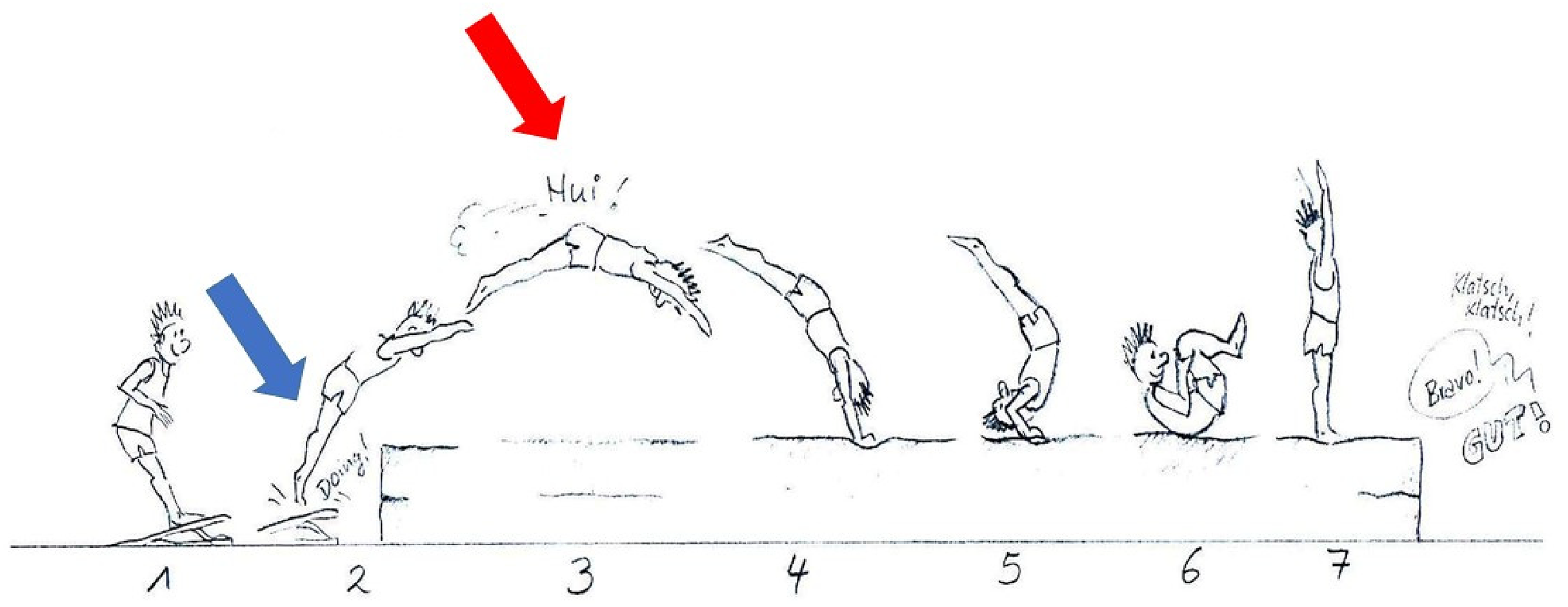
Dive forward roll.
In the following scene, the student Aline wants to show her idea of how to solve the task to her teacher and her group (Table 1). The first picture shows the group's stair-like construction of the gymnastics equipment.
Illustrating example.
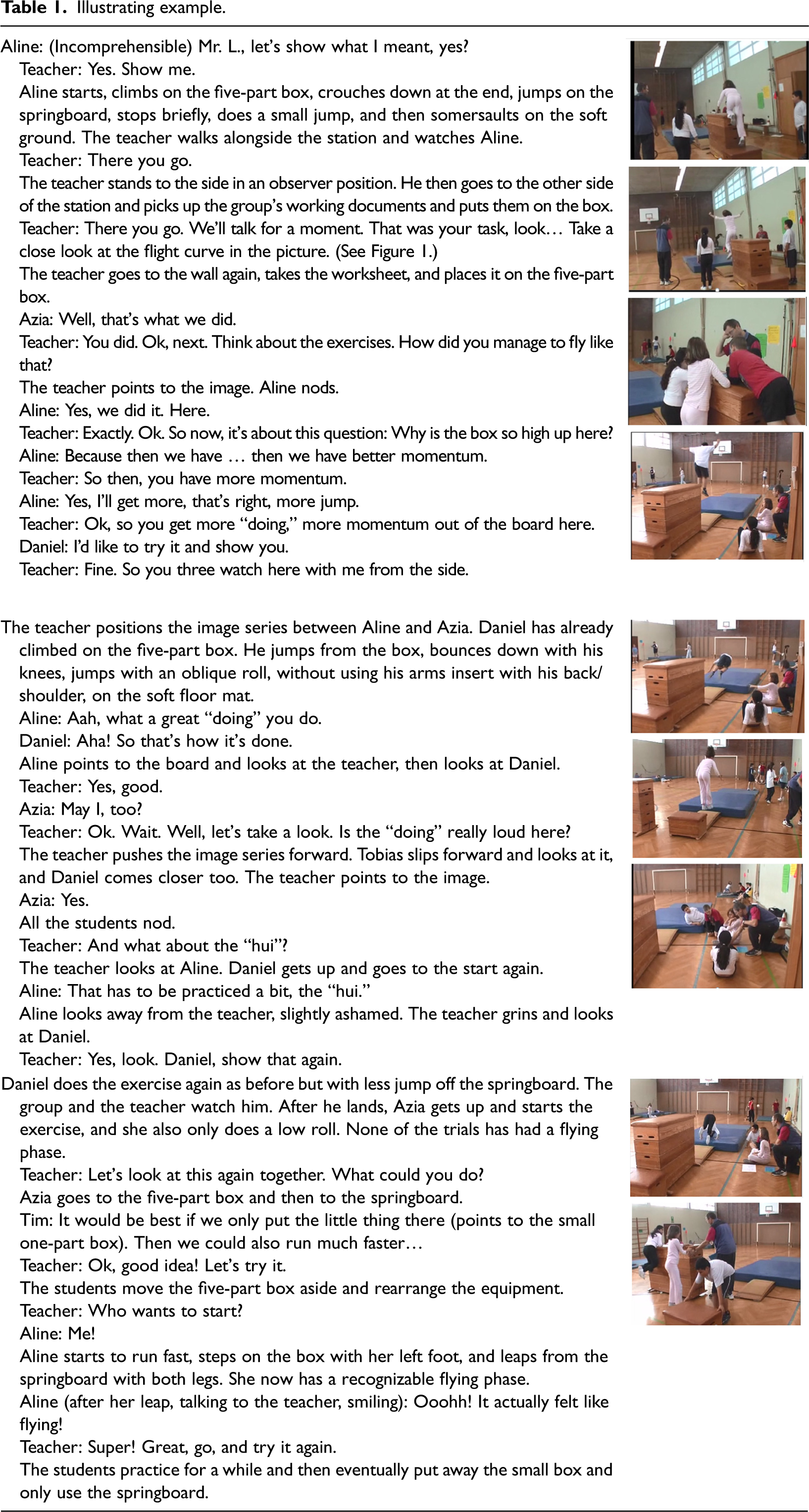
In the example, the content—the handstand and dive forward roll—is a relatively narrow conception that focuses on concrete, predetermined (physical) solutions. However, the teacher follows a problem-oriented approach and provides extensive time and space for students to try out different solutions, creating opportunities for them to reflect on their experiences to identify what and how they are learning. Misconceptions or “wrong turns” are not actively prevented by the teacher; on the contrary, students are welcome to take those “wrong turns” and investigate for themselves their solution to the problem. The students are provided with open-ended tasks that allow space for decision-making, which is a prerequisite for Bildung. In a Bildung classroom, students learn to use that space. Many of the students are highly engaged as they try to determine how to execute jumps off the box and onto a springboard, showing individual responsibility and positive interdependence. The teacher tries to stay out of the way of the students’ progress toward solving the task and only provides helpful “clues” to encourage them to think about the task and what they could do—not what they should do. The self-reliant action of the students is the observable core of the cooperative learning pedagogical practice illustrated here. The students can develop their understanding of the movement task, which is based on momentum and the physics of acceleration force. Finally, they discover for themselves that if their initial idea does not work as well as expected, they can find a more effective way to solve the task.
Reflection (on the action) is an important part of that process. In group processing at the end of the lesson, students are encouraged to openly discuss their questions, with prompts and probes from the teacher (Dyson and Casey, 2012). Often, these sessions are brief but effective in allowing students to actively engage with what they were doing. The teacher acts as a facilitator to set up movement opportunities for students that they find significant in their personal experience, which may initiate Bildung processes.
Bildung and comparable student-centered PE approaches
As stated earlier, we believe that conceptually Bildung is highly compatible with the social-constructivist theoretical framework (Bruner, 2015; Vygotsky, 1978) and model-based practices in PE pedagogy that draw on this framework and are used in the United States and Europe (Casey and Goodyear, 2015). These practices include cooperative learning (Dyson et al., 2020a), sport education (Hastie and Wallhead, 2016), teaching personal and social responsibility (Gordon et al., 2016), meaningful PE (Fletcher et al., 2021), and adventure-based learning (Sutherland and Stuhr, 2014),
In fact, in a number of research projects conducted in Germany, cooperative learning has been used to enable Bildung. It has been empirically shown to have the potential to foster motor learning as effectively as traditional teacher-centered approaches, increase social cohesion within the class, improve students’ social competences, and enable more movement time with higher content-related interaction density between the students (Bähr and Wibowo, 2012, 2018; Gröben and Prohl, 2012; Wibowo and Bähr, 2018). The connection between Bildung and cooperative learning was established by German scholars as there was stated a lack of empirically researched instructional models that have the potential to enable Bildung in the German context. Prohl (2004) calls this the instructional gap. As previously, there has been a tendency to establish wider content structures and more space for students’ decision-making to support the self-activity of the students and finally enable Bildung that comprises both parts, the formal personally-oriented part and the material movement/content-oriented part. Cooperative learning as an instructional model offers characteristics that filled this instructional gap. In particular the German version of cooperative learning in PE, which puts a greater emphasis on space for student's decision-making than their international pendants, seems appropriate to enable Bildung (Bähr and Wibowo, 2012, 2018). However, the commensurability of the underlying theoretical foundations—theories of Bildung and the social-constructivist framework—has not been discussed extensively yet.
One more argument to support the thesis of a fit between philosophies of Bildung and cooperative learning, or rather theories of Bildung and social-constructivist theories, can be found in the discourse about cooperative learning as one way of promoting the social and emotional development of students in PE (Dyson et al., 2020b; Wright and Richards, 2021). The development of students’ social and emotional skills has gained attention in recent years in various countries, with a growing body of theory, research, and practice in the area of social and emotional learning (SEL; Barbarasch and Elias, 2009; Frydenberg et al., 2017). Interest in the topic among educators and policymakers continues to expand (Humphrey, 2013; Jones and Doolittle, 2017). The German concept of Bildung can offer an overarching framework for the development of SEL in the sense that SEL focuses on the formal aspects of Bildung. It should be clarified that Bildung and SEL are not the same, even though both focus on individual and personal development. Bildung is, from our perspective, more holistic and comprises personal aspects (formal Bildung) as well as content/movement aspects (material Bildung), which are inseparably bound together in the processes of learning and Bildung.
The development of student SEL focuses on students attaining and applying the knowledge and skills necessary to understand and maintain their emotions, set positive goals so that they can demonstrate empathy for others, and create positive relationships while making appropriate decisions (Dyson et al., 2020a). This knowledge and these skills are foregrounded in the aspect of formal Bildung.
SEL can be situated in a conceptual framework grounded in social-constructivist learning theory and theories of Bildung, representing a research-informed and practical guide to school-based research that positions and understands Bildung and SEL as pedagogies within the practice of PE (Dyson and Casey, 2012). Vygotsky (1978) has challenged behavioral, individualistic, and fragmented approaches to SEL by offering a unified and profoundly social conceptualization of learning (Rovegno and Dolly, 2006). Vygotsky's theory emphasizes the discoveries of engaged, social, creative, and active learners, as well as the notion that interactions through cooperative engagement are a powerful way to develop knowledge and understanding (Dyson, 2002; Goodyear et al., 2014). Within such activities, children of similar ages are likely to be operating within one another's zones of proximal development, modeling more advanced behaviors as a collaborative group than they could perform as individuals (Slavin, 2015). Here, the classroom is seen as a social community in which learning occurs through peer interactions, student ownership of the curriculum, and educational experiences that are authentic for the students (Azzarito and Ennis, 2003; Dewey, 1916/1966). This also means recognizing education as a social endeavor. Dewey argued similarly that learning is an active and experiential process, which we develop through the teaching of beliefs, emotions, and knowledge and which occurs through experiential activities relevant to our social interactions in schools and communities. PE pedagogy and sport pedagogy have a longstanding tradition of research grounded in social-constructivist theory (Azzarito, 2016; Kirk and MacDonald, 1998).
Education is a complex endeavor that rarely functions in mechanistic ways; a certain input or intervention cannot be expected to produce a certain outcome (Quennerstedt, 2019). Appropriate climates and resources for teachers and students cannot always be assumed to be prerequisites when promoting Bildung or social-emotional development in classrooms. In fact, they can sometimes lead to lower levels of behavior and performance (Humphries et al., 2018). While we acknowledge that important and worthwhile work has already been conducted using Bildung in German universities, sport pedagogy settings, and PE pedagogy settings (e.g. Bähr et al., 2018; Balz and Neumann, 2021; Prohl and Gaum, 2016; Schierz and Thiele, 2018), equivalent work has yet to be done in K-12 settings in non-German-speaking countries. In forwarding a future research agenda, we call for further consideration of theories of Bildung as a potentially useful conceptual framework for investigating learning in PE pedagogy.
Concluding comments
We propose Bildung as a pedagogical student-focused philosophical approach and recommend that future research adresses the often narrow approach to pedagogical practice. We argue that Bildung has a great deal to offer PE teachers worldwide, particularly in addressing Standards 4 and 5 of the SHAPE America National Standards (2013), which recommend a strong and appropriate focus on the affective domain of students’ learning.
A limitation of much school-based research is the relatively short implementation period used to determine the effectiveness of these initiatives in PE (Dyson et al., 2020a). Therefore, we recommend considering extended longitudinal timeframes that allow students time to experience, acquire, and develop movement skills as well as SEL competencies and skills. Rather than putting “the cart before the horse,” there is a need for large-scale studies over longer periods or ethnographic work in schools to augment what is currently presented in PE literature. Future Bildung, health and PE, and SEL studies must be conducted in a variety of school contexts and be planned, delivered, and evaluated by those directly involved and invested in the topics, namely the teachers and students.
We argue that health and PE pedagogy and/or sport pedagogy have the potential to enable Bildung and teach, reinforce, and develop students’ SEL competencies and skills (Ciotto and Gagnon, 2018; Gordon et al., 2016). However, the perceived alignment of health and PE with Bildung and SEL outcomes requires further theoretical unpacking and empirical evidence for legitimization in English-speaking countries.
Echoing Wibowo and Dyson (2021), we know Bildung and SEL programs in health and PE work, but we do not know as much about the what and how of the health and PE classroom. Rather than assuming that we have been doing this all along, we need to explicitly show how we are doing it now. Aligning Bildung with a suitable and universally agreed-upon SEL conceptual framework going forward would undoubtedly enhance our knowledge and understanding of Bildung and SEL in health and PE. In the end, we want to determine what works best for our students and teachers within their unique contextual health and PE environments.
We challenge the field to step up and provide more opportunities for unique pedagogical approaches, such as Bildung, to enhance K-12 health and PE and SEL in our school settings. Research on teaching in health and PE, particularly research that uses school-based student and teacher data, has the potential to illuminate positive learning environments and guide educators and researchers in improving contemporary curricula and pedagogical work in schools.
Footnotes
Declaration of conflicting interests
The author(s) declared no potential conflicts of interest with respect to the research, authorship, and/or publication of this article.
Funding
The author(s) received no financial support for the research, authorship, and/or publication of this article.
