




Abstract
There are many factors and duties that novice teachers do not know about when they enter the profession. Isolation, for instance, affects physical education (PE) teachers because the position often comes with a secluded workplace adjacent to the gym and through the subject's marginalization. These challenges, among others, can send the novice teacher into shock, and there is a risk the teacher becomes disengaged from the profession. This study aimed to provide insights into PE teachers’ experiences of reality shock, isolation, and marginalization over time, as well as how they managed these challenges. Semi-structured interviews were conducted with nine Swedish PE teachers six to 10 years after graduation from PE teacher education (PETE). Qualitative content analysis was used. All participants retrospectively described a reality shock when they were novices, where non-subject-specific teacher assignments were experienced as more challenging compared to teaching PE. Further, isolation had a severe effect. However, the marginalization of PE was not that apparent as when they were novices. Over time, the participants created their own networks to mitigate, for example, isolation. In turn, marginalization seemed to be a remaining challenge to the participants despite an increased societal focus on health. Even though it is impossible for PETE to prepare teachers for every challenge they could face in the profession, PETE should inform preservice teachers of common phenomena such as isolation and marginalization, as well as how to create supporting networks. Further, we argue that perceived autonomy combined with systematic guidance could positively affect novice teachers’ development.
Introduction
Similar to many other European countries, Sweden has a severe problem with teacher shortage (Eurydice, 2021). This shortage, among other factors, is due to the increasing number of pupils in schools, the high retirement rates among teachers, and the lack of students graduating from teacher education (TE) programmes. Further increasing the shortage, high attrition rates (i.e. teachers leaving the profession) exist, especially among new teachers (Flory, 2016; Lindqvist et al., 2014; Swedish National Agency for Education [SNAE], 2019). The problem with teacher attrition in Sweden is not as severe as in other countries, such as the US and the UK, where attrition rates are as high as 40% to 50% (e.g. Flory, 2016). Still, roughly 15% of all Swedish teachers in general quit before retirement (SNAE, 2019) and in addition to potentially being a personal failure for the individual teacher, this negatively affects schools and the pupils that teachers leave behind (Mäkelä and Whipp, 2015).
New teachers are often busy just trying to survive (e.g. Murray-Orr and Mitton-Kukner, 2017; Shoval et al., 2010), and one challenge that has been shown to affect teacher attrition is that the preparation during TE does not match the realities of school (Flory, 2016; Ingersoll and Strong, 2011). There is also a risk that novice teachers who lack expected resources and support do not use the knowledge and skills learned in TE (Blankenship and Coleman, 2009). These experiences and challenges can send the novice teacher into shock, traditionally conceptualized as reality shock (Veenman, 1984). This likely applies to all school subjects, but the physical and psychological isolation further affects physical education (PE) teachers because the position often comes with a secluded workplace adjacent to the gym (Spicer and Robinson, 2021) and through the subject's marginalization (Lux and McCullick, 2011). In agreement with Richards et al. (2018a, 2018b), we see PE teacher education (PETE) as having an important role in preparing preservice teachers for the realities of teaching. We argue that one purpose of PETE is to educate teachers who have the stamina to persevere in the profession. However, to address this issue effectively, PETE needs to be informed empirically (Iannucci and MacPhail, 2019), and we agree with MacPhail and Hartley (2016) when they stressed the importance of examining what challenges and experiences PE teachers endure in the process of becoming more experienced teachers.
Even though isolation and marginalization are barriers for a novice PE teacher to overcome (Ensign and Woods, 2017), these challenges remain as factors for them to manage and reduce throughout their working life (Henninger, 2007; Iannucci and MacPhail, 2019; MacPhail and Hartley, 2016). As such, feelings of isolation and marginalization strongly contribute to PE teachers’ level of satisfaction with work (e.g. Lux and McCullick, 2011; MacDonald, 1995; Whipp and Salin, 2018). Attrition can be productively addressed (Lindqvist et al., 2014); however, there are few studies related to the issues of why teachers stay in the profession, that is, teacher retention (Whipp and Salin, 2018). Against the backdrop of research concerning the significance of reality shock experiences, isolation, and marginalization for PE teachers, there is a need to explore how PE teachers who stay in the profession manage these challenges. Reviewing the literature, Spicer and Robinson (2021) showed that a majority of studies exploring teacher experiences of isolation and marginalization were conducted in the US. Teachers’ experiences are individual and dependent on context (e.g. Flory, 2016; Mäkelä and Whipp, 2015); at the same time diverse nations often address comparable challenges, and much can be learned and gained as such processes unfold (MacPhail and Lawson, 2020; Richards et al., 2018b).
This study will contribute to the existing literature by providing knowledge on a group of Swedish PE teachers’ lived experiences from their teaching reality over time. That is, through examples from PE teachers’ experiences of teaching in a decentralized school system, where SNAE determines and stipulates regulations for schools nationally, and school leaders and teachers have autonomy to decide the activities and teaching at the local school. To the best of our knowledge, with the exceptions of Westerlund and Eliasson’s (2022) and Tolgfors et al.’s (2022) studies on Swedish novice PE teachers’ experiences of the initial induction process, few studies have been conducted on novice PE teachers’ challenges in a Swedish context, and none on their experiences over time. Thus, this study contributes important knowledge for both policy and research (Lindqvist et al., 2014), which may inform the content of PETE nationally and internationally.
Challenges among novice teachers
The transition from TE to the first teaching position in a school is a complex and challenging period in a teacher's career (Engvik, 2014; Fransson and Gustafsson, 2008). There are many factors, procedures, and duties that novice teachers do not know when they first enter the profession (Engvik and Emstad, 2017). The most challenging aspects for novice teachers in general, despite the TE, subject, and school context, are: classroom management; discipline; meeting pupils’ individual needs and abilities; assessment and evaluation; relationships with school staff, pupils, and parents; and administrative tasks (Lindqvist et al., 2014; Veenman, 1984). Further complicating the process, the novice teacher is supposed to act with competency and confidence while fulfilling the same responsibilities as experienced teachers (Lortie, 1975; Shoval et al., 2010).
Depending on the challenges teachers encounter as novices, among other aspects, there is a risk that disengagement from the profession will occur prematurely (Ingersoll and Strong, 2011). According to Mäkelä and Whipp (2015), some will leave the profession altogether (attrition), while others will change the subject they teach (area transfer) or relocate to another school (migration). Related to this, as Ensign and Woods (2017) described, beginning teachers need resourceful networks of support as well as strong TE preparation. For example, administrative support and access to successful induction programmes have been shown to greatly influence the individual teacher's ability to overcome challenges when entering their new profession (Ensign and Woods, 2017; Whipp and Salin, 2018). Furthermore, the literature describes formal and informal approaches to mentoring as two important parts of successful induction programmes (Ayers and Griffin, 2005). Formal mentoring includes structured support by an assigned mentor, while informal mentoring is seen in more unstructured relationships, such as with colleagues, friends, and significant others. When mentoring processes build on reciprocity, support, and trust, transformative learning can be seen among both protégés and mentors (Patton et al., 2005).
Challenges among PE teachers
Throughout their careers, PE teachers learn to be a part of the profession through experiences and challenges associated with the social and environmental contexts. This process is unique to the individual concerning life circumstances, experiences, and work conditions (Schempp and Graber, 1992). Furthermore, PE teachers’ experiences differ from classroom teachers due to different social expectations and the uniqueness of the subject's content (Macdonald, 1995). For example, research on PE has shown that PE subject communities in schools are strong and that novices often feel pressured to adapt to more experienced colleagues to be accepted (e.g. Blankenship and Coleman, 2009; Keay, 2006; Rossi et al., 2015). Keay (2007) further showed how experienced male colleagues affect novice PE teachers more and how that could contribute to reproducing gendered orientations and practices in PE. Moreover, pupils play important roles in PE teachers’ development because they often do not share the teacher's understanding of the subject (Richards, 2015). Furthermore, Flory (2016) highlighted that novice PE teachers often feel unprepared to teach in schools that lack resources and supports, and that have diverse pupil bodies. According to Richards et al. (2013), novice PE teachers also often have a limited understanding of teaching realities beyond teaching content and teaching methods and may have difficulty navigating life in schools’ sociopolitical contexts. Despite clearly being a demanding and challenging phase for novices, studies conducted in various contexts stress the apparent lack of formal professional support in the form of induction programmes (e.g. Shoval et al., 2010; Westerlund and Eliasson, 2022). Instead, the experiences, above all, depend on contextual factors, such as access to informal collegial collaborations, and the feeling of being a valued member of the teacher community (Keay, 2006; Westerlund and Eliasson, 2022). In addition to the reality shock often portrayed among novice PE teachers, significant barriers to positive experiences include feelings of isolation and marginalization (Ensign and Woods, 2017; Stroot and Ko, 2006).
Experiences of isolation and marginalization among PE teachers
Isolation is a recurrent challenge internationally, particularly for novice PE teachers (Spicer and Robinson, 2021). The understanding of PE teacher isolation has become increasingly complex throughout the last four decades. In our study, we see that professional isolation can be both a physical and a psychological state (see Spicer and Robinson, 2021). Scholars such as Lortie (1975) claimed that teachers could be isolated in multiple ways because they are often the only adult in the classroom. However, the gym's location far from the other teachers’ staff rooms may additionally cause physical isolation for PE teachers (Richards et al., 2018a). In addition, the lack of daily informal interactions with other colleagues can increase PE teachers’ psychological isolation by limiting the opportunities for professional dialogue (Mäkelä and Whipp, 2015; Stroot and Ko, 2006). Being the only teacher with expertise in PE or one of few at a school can make professional isolation even more pronounced (Stroot and Ko, 2006). Nevertheless, differences also exist between contexts. For example, Shoval et al. (2010) showed how an Israeli novice PE teacher, despite feeling like an island at school, ignored support from the wider educational circle due to a perceived lack of shared language with other teachers. However, in a Swedish context, Westerlund and Eliasson (2022) indicated that studying and teaching additional school subjects beyond PE could contribute to an openness to the support and professional input from a broader educational context.
Furthermore, novice PE teachers often perceive a lack of support because PE is a marginalized subject (Richards et al., 2022; Stroot and Ko, 2006). In their review of PE teachers’ professional development, Kougioumtzis et al. (2011) highlighted the gap between the high intrinsic value PE teachers often place on their jobs and the low priority of PE in both national and local political agendas. The low status can be seen, for example, in time allocation and economic conditions. Additionally, PE is perceived as a marginalized subject in comparison with other school subjects because PE teachers have observed that colleagues, parents, pupils, and other stakeholders (e.g. school leaders) do not appreciate a PE teacher's work (Richards, 2015). Furthermore, PE teachers express a lack of opportunities to engage in personal and professional development and a desire to use their knowledge and skills better (Armour et al., 2012).
Research has attempted to understand how to reduce feelings of marginality and isolation, even though there are far fewer studies on why teachers stay in the profession compared to those that investigate why teachers leave (Whipp and Salin, 2018). For example, quantitative studies have shown how perceived mattering, defined as feelings that PE and the PE teacher matter to others within a social group, directly decrease feelings of marginalization (Richards et al., 2018b). Mäkelä and Whipp (2015) supported these findings in their study that showed a feeling of teaching autonomy, for example feeling capable, being listened to, or having possibilities for involvement in decision making, was connected to work satisfaction. Further, qualitative data has shown that PE teachers’ confidence in their ability to provide pupils with high-quality teaching helps them in managing organizational challenges (Henninger, 2007). Also, building relationships with colleagues, administrators, and pupils as well as advocating for the PE discipline has been shown to make teachers feel validated (Iannucci and MacPhail, 2019; Lux and McCullick, 2011; Richards et al., 2018a; Whipp and Salin, 2018). Richards et al. (2022) showed how PE teachers with an advanced certification, and thus increased legitimacy at school, did not feel less marginalized. The authors discussed the complex relationship between a perception of a more collegial and collaborative workplace, and at the same time the higher expectations from others to take on more responsibilities. The increased visibility and involvement in school entailed both feeling more valued among colleagues and having a higher workload. Extended responsibilities, in turn, could give rise to role conflicts and difficulties in prioritizing between work tasks (Richards et al., 2022).
Purpose
This study aimed to provide insights into how PE teachers’ experiences of their teaching reality changed over time. More specifically, the aim was to understand how PE teachers managed the challenges of reality shock, isolation, and marginalization during their first years in the profession in a decentralized school system. The specific questions that we answer include the following:
How do novice PE teachers experience and manage reality shock, isolation, and marginalization? How do PE teachers experience and manage these challenges after some years in the profession?
Method
This study is part of a larger longitudinal project that investigated students enrolled at a Swedish PETE programme. With the use of surveys, preservice teachers’ perceptions of the subject and profession at enrolment, graduation, and as teachers in school were explored in the project. For this study, those teachers answering a follow-up questionnaire in the larger project, and who had graduated from PETE at least three years prior, were invited to participate in an interview study focusing on their experience of teaching PE. Nine teachers, four women and five men who had graduated six to 10 years ago, agreed to participate.
The Swedish setting
In the academic year 2020/2021, about 18,500 PE teachers were working at Swedish compulsory and upper-secondary schools (SNAE, 2022). Based on SNAE's (2019) prediction, there will be a severe shortage of teachers in most subjects by 2033. To meet teachers’ general requirements, enrolments in TE programmes would need to increase by 30%. Specifically for PE, given that in recent years approximately 400 students enrol in PETE and only about 250 graduate every year, there will be a shortage of 25% to 30% of PE teachers by 2033 (SNAE, 2019).
Decentralized school system
The Swedish school system is decentralized, which means that schools have a great deal of autonomy to decide their activities. SNAE is the central administrative authority that determines and stipulates the curriculum and evaluates and analyses the practice. Local schools oversee implementing the regulations and local school leaders and teachers decide on how to plan and execute the teaching. Both in compulsory and upper-secondary schools, PE is a mandatory core subject in Sweden. This system provides school leaders autonomy to shape the school's activities according to their local needs, and it provides teachers autonomy and freedom to decide lesson content and the teaching methods used.
Physical education teacher education
The TE programme for PE teachers in secondary and upper-secondary schools in Sweden is a five-year concurrent programme dedicated to the teaching profession from the start. Although the subject areas studied during TE are centrally decided, the exact content is locally determined. During the programme, students study two school subjects (e.g. PE, mathematics, English, etc.), general education courses (about teacher development), undertake sequential practicums in authentic school settings with designated supervisors in the two subjects, and write a final research paper. Similar to about half of the European countries, for instance, Norway and Ireland (Iannucci et al., 2019), PE preservice teachers in Sweden thus become teachers in two subjects. After graduating from PETE, students receive a degree of Master of Education and can apply for teaching positions in the two subjects addressed during the programme.
Induction of novice teachers
Without any additional requirements, students can apply for a teacher license in their two subjects and apply for a permanent position after completing TE. Following the Education Act (SFS, 2010: 800), since 2011, all Swedish novice teachers are entitled to a one-year induction period, during which they should obtain a mentor and further develop and become more confident in their roles as teachers. However, participation in an induction programme is not mandatory for new teachers, and due to the decentralized school system, national programmes do not exist. Local school leaders are responsible for and enact the induction periods and activities involved (SFS, 2010: 800). Despite the regulation in the Education Act, only about one-third of all novice teachers in Sweden participate in an induction programme (Eurydice, 2021).
Data collection
We chose to use interviews as our method of data collection in this study because they are a reliable way of acquiring teachers’ first-hand accounts of their experiences (Kvale et al., 2009). The interviews were semi-structured and the interview guide used was constructed based on previous research on novice teachers’ experiences of transferring to school (e.g. indirect questions regarding reality shock, marginalization, isolation, etc.). We also explored questions about their experience of the teaching reality, current work situation, background and teaching career. In various ways, the interviews addressed the teachers’ (a) experiences and challenges during the first period after PETE (e.g. How did you experience the first years as PE teacher? What conditions existed at the school? What did you find most difficult and easiest about starting working as PE teacher?) and (b) current experiences of working as teachers (e.g. Do you think the subject and the profession have changed since you graduated? What conditions exist at your current school? What type of support have you received over the years and from whom?). The study's first author conducted and recorded telephone interviews with all participants, which lasted between 52 and 82 minutes. The interviews were conducted in Swedish. Before the interviews, participants received written information about the study's purpose, conditions for participation, and the code of ethics. This information was also repeated at the beginning of the interviews, where consent for recording the interviews was obtained.
Analysis
We analysed the interviews through several phases. First, we listened to the recordings to generate an overall impression of the respondents’ answers. Secondly, we transcribed the interviews verbatim, totalling 168 pages. After this, we performed a qualitative content analysis of the transcripts (Hsieh and Shannon, 2005). This process was both deductive and inductive (Bingham and Witkowsky, 2021). First, with a deductive approach, we explicitly searched for expressions of the analytical concepts in the study previously known as challenging among novice and more experienced PE teachers (reality shock, marginalization, and isolation). Aware that reality shock often relates to feelings of marginalization and isolation specific to PE teachers (Richards et al., 2018a), we see these phenomena as complex and intertwined. Thus, with an inductive approach, we secondly searched for variation in teachers’ experiences of these analytical concepts, and how they had managed their teaching realities over time. We performed the content analyses to develop rich descriptions of each teacher's experiences. To create consensus in the results, we discussed their notes on several occasions and resolved all differences via discussion on their nature. To provide a trustworthy picture of the nine teachers’ experiences as PE teachers, appropriate quotes were translated into English and finally selected to exemplify the findings. All quotes and references to individual teachers were also anonymized.
Findings
Table 1 briefly describes all nine certified PE teachers. Thereafter, the findings are presented under the headings Realities of teaching, Isolation, and Marginalization – firstly, from their retrospective accounts as novice teachers and, secondly, from their perspectives as more experienced teachers.
Description of the participants.
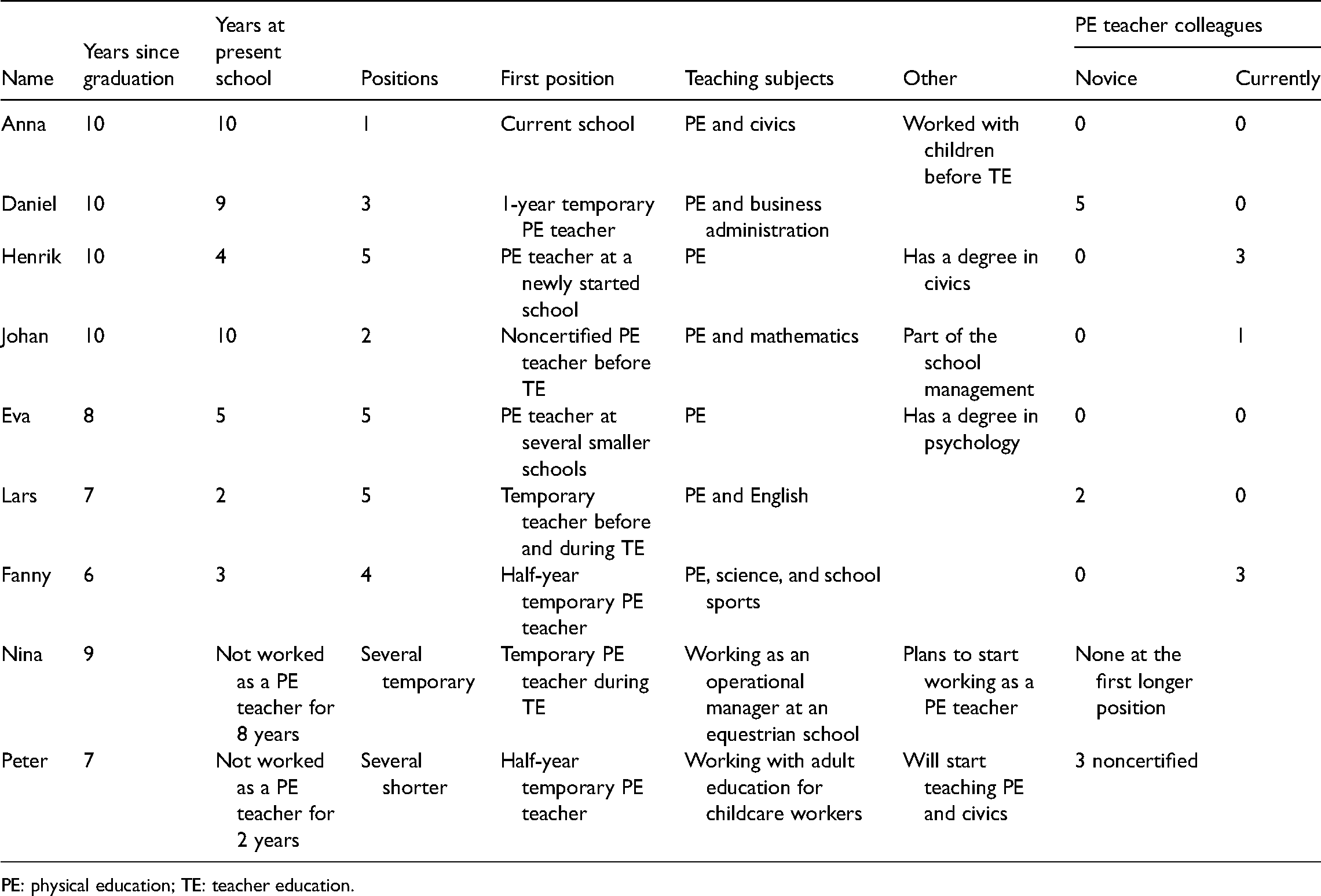
PE: physical education; TE: teacher education.
Experiences and challenges as novices
In general, it can be said that even though they were not all working as PE teachers at the time of the interviews (Nina and Peter had, at the time of the interviews, made what Mäkelä and Whipp (2015) call an area transfer), all appreciated the subject, enjoyed working with pupils, and were satisfied with their initial career choices and education during PETE. The first period after graduation was still experienced as challenging in several ways, and one thing they all had in common was that none had a designated mentor during their induction. The challenges met were experienced and managed in various ways depending on their previous experiences (e.g. from working as substitute teachers or working with children) and the local conditions at their school. In that regard, the findings support previous studies conducted by Ensign and Woods (2017) and Iannucci and MacPhail (2019), for example.
Realities of teaching
All teachers expressed some kind of reality shock (Fransson and Gustafsson, 2008), which was less powerful among those who had already been working as teachers before or during TE (Johan, Nina, and Lars). For those teachers with little experience of classroom management, conflict solving, and diversity among pupils, the reality shock tended to be more powerful. Some situations were also quite challenging in the beginning regarding whether they had teaching experiences or not. For example, several of the teachers experienced non-subject-specific duties, such as mentoring classes, managing pupils with learning disabilities, and planning the upcoming school year, to be more difficult and demanding than conducting PE lessons. This finding is in congruence with previous research, for example, Richards et al. (2013). As Eva explained: To plan, conduct, and evaluate PE lessons – that is why you chose this job […] and to see pupils’ development. But there is a lot that happens when you are out [in the working life] that you have not been prepared for. (Eva)
Even though the participants felt PETE had adequately prepared them for the actual teaching of PE, they experienced time shortages in planning and evaluating their PE lessons (Shoval et al., 2010). Therefore, a common instance of support was found in a Facebook group designated for PE teachers in Sweden. Many of the participants identified concrete tips and tricks for lesson planning learned from the designated group that were crucial in their ability to survive at work as novices. As put by Anna: My subject colleagues are online. In the Facebook group for PE teachers, you can read about or discuss PE subject matter and I am very grateful to have this forum where I can keep in contact with my subject colleagues. It is also interesting to hear about their different everyday life and school contexts. (Anna)
A more powerful reality shock could also be seen for those participants who started to work for a school with poor conditions, which supports the findings of, for example, Flory (2016). While some of the participants did not even have access to a gym, others had swimming pools, orienteering forests, climbing walls, skating rinks, and so on in the school's immediate area. For example, Henrik stated: During my first two years, I had no [gym or other premises] for teaching. I had to use the equipment I was able to carry. I had this kind of bag I could fill that I brought to the place they kept us in for the day. (Henrik)
Taken together, the difficulties experienced are similar to some of those found by Veenman (1984) as recurrent challenges to novices in general. For the novice PE teachers, though, it was necessary to consider the characteristics of the gym as a workplace.
Isolation
When entering the profession, the novices experienced isolation in various forms. In our interpretation, the fact that they were the only PE teacher at school or worked the entire day in a building far away from the rest of the school highly influenced their experiences. As shown by MacPhail and Hartley (2016), for example, access to PE colleagues and support from school leaders and colleagues teaching other subjects clearly affected their overall feelings of physical and psychological isolation. Johan, for example, talked about how the gym he taught PE classes in was located three and a half kilometres from school and how he spent a lot of his time transporting pupils back and forth. Hence, he missed out on important time for planning lessons and interacting with colleagues.
Many of those who, as a novice, were the only PE teachers at the school had to solve all of their challenges and problems themselves (cf. Ingersoll and Strong, 2011), sometimes simply through trial and error. One solution to gain access to discussions of more PE-related issues was to create their own local networks of PE teachers in the area, which we interpret as an action to increase their perceived mattering (cf. Lux and McCullick, 2011; Richards et al., 2018a). Through their individual initiatives, the participants tried to establish relations with subject colleagues who were interested in exchanging pedagogical ideas: We have tried to arrange a collaboration with PE teachers at other schools, but it is always someone who needs to coordinate such meetings. It never works because of our incompatible schedules. (Daniel)
For some participants, the tangible feeling of lacking someone to share your work with daily was apparent. As in the case of Daniel, even though he had opportunities to receive support from school leaders and teachers of other subjects, he explicitly longed for someone who understood the characteristic problems that could arise in PE.
To manage the isolation, some of the teachers also kept in touch with their former peers from PETE. For example, Eva explained, ‘I have discussed the heavier issues that I have encountered with her [former PETE peer]’. In contrast, Peter, who had worked at various schools and often with numerous PE colleagues, had negative experiences of psychological isolation during the induction. At one of the schools, his PE subject colleagues lacked formal PE teacher training, and he experienced no collegial support regarding PE from a teacher's perspective: ‘It was quite a lonely journey, I am sorry to say. There were extremely few persons who could help me. […] [The other PE teachers] lived on old merits, doing what their PE teacher used to do, basically’.
However, isolation could also be experienced in a positive way with regard to the advantages of the entailed autonomy: You can still choose much more in PE, there are a lot of various things you can choose to spend time on. And you can do that based on your conditions in the gym or outdoor surroundings, as well as on your own knowledge. (Anna)
Marginalization
When transferring from TE, the perception of PE as a marginalized subject was not that apparent to all participants. On this topic, Fanny said, ‘I do not think that I reflected that much on how PE was valued as a school subject when I was a novice. I was so busy just keeping my head above water, so to say’.
Nevertheless, some of the participants still mentioned a lack of support from school leaders in shaping institutional structures such as time allocation or financial resources (Kougioumtzis et al., 2011). One example is Eva, who talked about how she had to make her own material for orienteering during her spare time. Furthermore, those participants who had, in the words of Mäkelä and Whipp (2015), migrated, had experiences from various schools as novices, and talked about the obvious differences between school cultures. As such, marginalization depended in these cases on perceived support from colleagues and school leaders rather than merely financial and physical resources. Some participants had experienced expectations from colleagues, pupils, or parents that they perceived as derogatory of their profession. Such norms and values could be seen in, for example, Nina's experience of prevailing local PE traditions at school, where more experienced PE colleagues had deeply ingrained conservative teaching methods that she had struggled to approach (Keay, 2006; MacPhail and Hartley, 2016; Rossi et al., 2015).
Additionally, the participants who had been teaching both PE and another subject in the beginning talked about how the role of a teacher in a theoretical subject had entailed an increased status at school for themselves. As expressed by Lars, ‘It was a different kind of role. I had more to say with respect to being a teacher in English than in PE. That was good because then I could support my colleagues who merely taught practical subjects’. One way to manage the marginalization of PE was thus the simultaneous socialization into a non-marginalized subject (cf. Iannucci and MacPhail, 2019).
Experiences and challenges when more experienced
At the time of the study, all participants had been working for six to 10 years. All the participants but Anna had changed schools at least once, and some had relocated (migrated) several times (see Table 1). Some of the participants had actively applied for positions that better matched their own perspectives on teaching. Others had undergone a seemingly ordinary introduction to working life, where employments began and ended due to various circumstances, such as temporary positions, having moved to another location, parental leave, and so on. Still working in the field of education, Nina and Peter, however, had temporarily left the PE profession and made an area transfer.
Realities of teaching
Most of the teachers talked about a sense of stabilization that had appeared with time and, foremost, with experience. In our interpretation, this development could be explained by how the individuals had managed the challenges met during induction. When teachers become more experienced, their repertoire of strategies broadens, and those situations where they feel out of their depth tend to become less frequent. The participants experienced a continuous heavy workload, often due to practicalities of the subject, such as a tight schedule, limited access to gyms and equipment, and many pupils. However, the now more experienced PE teachers talked about how they had developed their organizational skills, created a structure in their everyday teaching life, and, above all, tried out and refined a comprehensive set of teaching methods.
The increased confidence in the teacher role could be seen in the story of Eva, for example. In congruence with previous research (Westerlund and Eliasson, 2022), Eva had expanded her teaching perspective and she now involved her pupils more in finding various ways to reach the goals she had set out: In the beginning, I did not have the confidence to try many new things in teaching. Now, when my pupils ask me if they can do TikTok videos, I feel, ‘well, it is dancing, right?’ and then include it in the lesson. Well . . . it feels better! (Eva)
In our interpretation, there are no signs of the reality shock that was apparent to the participants as novices. The somewhat conflicting expectations on what assignments and duties the PE teaching profession should include seemed to have diminished or had been internalized over time.
Since the induction period, some of the participants had been involved in a broader range of school development, taking on responsibilities such as part-time school leaders or engaging in continuous professional development – for example, promoting various projects that aim for increased physical activity among children and youth (Fanny) or developing the PE subject in regional professional networks (Eva). As shown by, for example, MacDonald (1995) and Westerlund and Eliasson (2022), involvement in various projects and taking on extended responsibilities can be a way for the PE teacher to gain respect from colleagues and administration.
Isolation
As seen in previous research (e.g. Engvik, 2014; Spicer and Robinson, 2021), relationships with colleagues were crucial to most of the participants in their development from a novice to a more experienced teacher. In opposition to the findings of Shoval et al. (2010), all of the participants in this study talked in a positive manner about collaborative opportunities in the wider educational circle. However, the participants’ stories clearly illustrate the individuals’ various needs. In the words of Eva, ‘I am that kind of person who seeks out support from others’. Participants who expressed themselves like Eva had created networks of various kinds to manage their professional isolation. Those who lacked PE colleagues still missed the opportunity to share their daily working lives with someone who understands the specific problems that can arise in the gym. As Lars explained, ‘I do not feel lonely, not inside. But as a PE teacher, I do’.
Taken together, various forms of physical and psychological isolation were still a part of the more experienced teachers’ working lives but did not appear to be a key challenge to them because they had managed to build important relations and networks (Engvik, 2014). Furthermore, gained experiences made them more confident in the management of their PE teaching. Therefore the need for the earlier mentioned Facebook group was not as apparent.
Marginalization
Over time, marginalization had also taken many different forms, according to the participants. One explicit example given by Daniel and Lars was PE teachers’ difficulty in finding structural opportunities to participate in continuous professional development. Furthermore, the participants shared a widespread frustration over the absence of financial resources. In addition, the lack of professional support from their school leaders permeated several of the participants’ stories, here illustrated by Eva: I have asked for the school leader to come and visit me – to see how the work is for me – but I cannot say that he has been involved in my teaching. (Eva)
The participants also shared experiences from an increased societal focus on health (i.e. physical activity) influencing the view of PE in the Swedish school setting. For instance, school leaders, colleagues, pupils, and parents, gave signs of increased importance of physical activity for a healthy life, resulting in a perception of a reduced marginalization of PE among the participants (Kougioumtzis et al., 2011). However, it had not been altogether easy to combine the values of physical activity with educational goals. The societal development could give PE teachers a stronger voice in their workplace; still, some of the participants of this study highlighted that they continued to observe marginalization due to somewhat cemented expectations towards PE. As Lars stated: There is a lot of talk about [the importance of PE] in media and among teachers. But I think it is still just a conversation about the importance of physical activity. I do not think that PE is merely about that! (Lars)
The higher status at school also seemed to come at a cost for the participants. Either they reconciled with marginalizing views of the benefits of PE or continued fighting for recognition of intrinsic values of the subject. Further, while having found ways to manage several other challenges characterizing the induction of participants, marginalization continued to be a demand for them and a source of attrition. As Johan described: Will I be working as a PE teacher 10 years from now? No, I do not think so, actually. It takes a lot of your energy, both physically and mentally. I have been fighting for 10 years now to get reasonable conditions for teaching. And, in some ways, it has gotten better. Still, in other ways, it seems like we are still walking in circles. (Johan)
While the struggle for legitimacy seems to continue, the passion for the subject and the pupils persists. A united voice from the participants expressed a maintained driving force within the PE profession: watching their pupils develop and learn.
Discussion and conclusion
To address the factors influencing teacher attrition and retention, and to provide knowledge with implications for both policy and research, this study aimed to provide insights into how PE teachers’ experiences of their teaching reality change over time. We set out to investigate how PE teachers managed reality shock, isolation, and marginalization during their first years in the profession, and as such, illustrated the challenges of the induction process in a decentralized school system, which gives school leaders and teachers a great deal of autonomy. We acknowledge that through the study's retrospective perspective, we were unable to account for the teachers’ ‘true experiences’ (Veenman, 1984: 166) from when they were novices and that the teachers’ answers therefore are ‘constructed in a rational logic’ (Lindqvist et al., 2014: 102). However, similar to previous studies on general teachers’ experiences of the transition from TE to school (Engvik, 2014), this study showed that the Swedish PE teachers experienced reality shock, isolation, and marginalization as novices (Ensign and Woods, 2017). How shocking the meeting with teacher reality was depended on the teachers’ previous experiences from working with pupils and the local school conditions (Flory, 2016). The participants’ experiences of PETE left them feeling prepared for teaching PE, and we interpreted their initial challenges to consist primarily of assignments outside the gym. Many of the novices also experienced isolation, mainly due to contextual factors, such as the available PE colleagues and the support from school leaders and colleagues teaching other subjects. These contextual factors clearly affected their overall experiences of physical and psychological isolation, which supports literature highlighting the importance of informal mentoring (Ayers and Griffin, 2005). Furthermore, the marginalization they felt as novices depended on contextual factors, such as norms and values in local PE traditions and the views on PE among pupils, parents, colleagues, and school leaders (Henninger, 2007).
The feelings of reality shock vanished, as participants became more experienced. However, the isolation and marginalization experiences were still present, although in other forms. Isolation was mainly connected to contextual factors, such as colleagues and the gym's location, which the teachers managed through various networks (Engvik, 2014). The marginalization experiences had also changed, at least on the surface, due to an increased focus on health in society. However, the marginalization of PE was still present and perhaps the greatest challenge for retaining these PE teachers. Hence, the results of this study support Lux and McCullick (2011) when highlighting the importance of strategies to effectively navigate marginality as a PE teacher. Our study also supports Westerlund and Eliasson's (2022) findings that indicated that teaching additional subjects, which often occurs in the Swedish context, enables access to a broader educational context and provides the novice PE teacher with the possibility to manage a marginalized position at school (see also Iannucci et al., 2019).
Criticism has been raised against TE for not adequately preparing preservice teachers for the reality of schools and teachers’ future profession (Fransson and Gustafsson, 2008; Richards et al., 2018b), and thus meeting novice teachers’ needs (Flory, 2016). To adequately prepare preservice teachers, PETE needs to be informed empirically (Henninger, 2007; Iannucci and MacPhail, 2019; Richards et al., 2013) of phenomena such as isolation and marginalization. This can also be accomplished by allowing TE students to listen to experiences from authentic surroundings (Engvik, 2014) – that is, PE teachers’ experiences of working in schools. We realize that PETE cannot prepare teachers for every challenge they will meet. Rapid societal changes, for example, increasing diversity among pupils and challenges connected to the digital transformation, entail grand challenges for PETE to educate preservice teachers for an unknown future (MacPhail and Lawson, 2020). Further, some factors must be learned in the school setting (Ingersoll and Strong, 2011). Previous research has shown that teachers’ experiences are highly context dependent (Keay, 2006; Mäkelä and Whipp, 2015), and our study shows that the school context in combination with personal factors construct unique teaching realities (Henninger, 2007).
Previous research has shown that systematic guidance through induction programmes, of which formal mentoring is most common, contributes to successful teacher retention (Eurydice, 2021; Ingersoll and Strong, 2011). In many European countries, induction programmes have a simultaneous controlling function, with a permanent job at stake for the novice teacher (Eurydice, 2021). However, feeling trusted and capable as a novice is also important (cf. Lux and McCullick, 2011). Our study, as well as that of Mäkelä and Whipp (2015), shows how teaching autonomy positively affects work satisfaction. As such, an induction programme in the form of an evaluating body could be counterproductive, since it may lack the important features of reciprocity and trust (Patton et al., 2005). On the other hand, freedom in decision making can also entail a lack of support for the individual. We argue that structural support from a mentor should focus on in-depth professional development without losing the empowerment that autonomy can bring, such as flexibility and self-confidence in teaching methods. The findings show that none of the teachers in this study had a mentor as a novice, despite existing regulations (SFS 2010: 800). Thus, the lack of organizational support in this study could be a gap between policy and enactment. In a decentralized school system, such as the Swedish system, the induction process instead largely relies on the individual's possibilities in finding informal mentoring support from colleagues, former peers, and significant others. Even though informal mentoring is an equally important part of personal and professional development (Ayers and Griffin, 2005), formal mentoring could be a part of transformative learning among both mentors and protégés (Patton et al., 2005). Besides ensuring equivalent induction support and thereby potentially helping to keep highly competent teachers in the profession, a structured mentoring programme could include critical perspectives on teaching and learning, and thus be a part of reformative educational work.
A starting point for innovative practices includes a critical examination of existing structures and learning from international PE and PETE contexts (MacPhail and Lawson, 2020). Our study contributes to the existing literature with information on how PE teachers, who have stayed in the profession or are returning to teaching PE, over time experience challenges of reality shock, isolation, and marginalization, as well as how they manage these challenges. This study furthermore enhances understanding of the complexity of teacher autonomy related to retention. We argue that, as key players for a successful induction (Engvik and Emstad, 2017), school leaders must take responsibility for the systematic guidance of novice teachers. However, in a decentralized school system where schools are autonomous, such as in Sweden, school leaders must prioritize and allocate funds from their budget to do this. Moreover, even though systematic guidance has been shown to have a positive effect on novices’ development (Engvik, 2014), this has proven to be insufficient. Ayers and Griffin (2005) argue that induction support in the shape of mentoring is complex and multi-dimensional. Mentoring can thus be seen as a mosaic, meaning that relationships of both formal and informal character together support a teacher's personal and professional development. Various types of networks inside and outside of school are important sources of support for novices’ development (Ayers and Griffin, 2005; Engvik, 2014). According to this study's findings, these networks may be even more crucial to teachers in countries where no national induction programme exists, such as Sweden. Our study shows how these networks can be created, but more knowledge is needed to inform PETE and school leaders on how to support novice PE teachers.
Footnotes
Acknowledgements
The researchers would like to thank the Editor and anonymous reviewers for their constructive comments.
Declaration of conflicting interests
The authors declared no potential conflicts of interest with respect to the research, authorship, and/or publication of this article.
Funding
The authors received no financial support for the research, authorship, and/or publication of this article.
