



Abstract
Set within the context of a longitudinal project that seeks to engage physical education teachers from the four countries of the UK in cross-border curriculum analysis, dialogue and learning, the current study lays the foundation by mapping and comparing curriculum discourses that currently shape how physical education is conceptualised in England, Northern Ireland, Scotland and Wales. As a team of researchers with affiliations to each of the four nations of the UK, we identified those curriculum documents from each context that were written to directly inform physical education teachers’ curriculum planning and enactment. We firstly identified those discourses evident in each document to understand how physical education is conceptualised within each curriculum, before engaging in a dialogical process that converged around how physical education is constructed similarly or differently within and across curricula. We found some variation in relation to how the concept of health is articulated. With the exception of the curriculum in Wales, we also found that performance discourses related to developing motor competencies for sports continue to dominate as the main purpose of physical education. Finally, there are several points of divergence in relation to how much agency or guidance teachers are afforded within each curriculum. The intention of this research is to initiate dialogue across each of the four nations, creating opportunities for learning so that, collectively, teachers can build capacity to contribute to future curricula and pedagogies in physical education.
Introduction
While the nature and purpose of physical education (PE) has been debated for decades (Kirk, 2010), it has long been associated with the development of sport skills and physical health, a view of PE that has been criticise by some within the profession for being narrow (Gray et al., 2015), neoliberal (Evans, 2014), gendered (Camacho-Miñano et al., 2021) and ableist (Evans and Penney, 2008). Critics of this view highlight the potential that PE has to contribute to a broader and more socially just range of learning experiences that cater for all learners, a claim that has been supported by a wealth of research in this area (e.g. Azzarito, 2019; Lamb et al., 2021; Luguetti and Oliver, 2020). However, this research has had little impact on how PE is commonly conceptualised in curricula or enacted in schools across the globe (Kirk, 2010). A significant contributing factor to PE's apparent resistance to change is the role that governments play in the construction of PE curricula. PE curricula are not value-free. They reflect the wider ideologies of those in power, comprising discourses that convey messages about what is valued and therefore what should be taught (and how) for the good of society (Rossi et al., 2009). Thus, curricula are often developed with minimal or no input from the wider PE profession, including teachers and researchers (Thorburn and Horrell, 2011). Furthermore, those teachers and researchers who are invited, albeit rarely, to contribute to the policy development process are not equal contributors – control ultimately lies with government and their national education agencies (Kirk and Macdonald, 2001; Thorburn and Horrell, 2011).
In challenging this policy development process, Evans (2014) points to the need for a collective professional voice to shape how PE is (re)conceptualised and enacted in schools, with Kirk and Macdonald (2001) suggesting that teacher involvement in policy reform should be a ‘ubiquitous feature of the systematic renewal of curriculum’ (p. 566). Similarly, Penney (2008) suggests that PE teachers need to ‘be proactive in establishing and pursuing their authority to speak contemporary education discourses and furthermore, that doing so is critical for the future of the learning area’ (p. 45).
An important question, therefore, is how can the PE profession come together in pursuing this ‘authority to speak’? There is likely no one answer to this question. However, the present study seeks to take small steps towards addressing this issue by offering a novel approach to curriculum analysis, teacher learning and policy engagement. In doing so, we are drawn towards the work of Evans (2014) who asked the question, ‘what and where are the possibilities for influencing educational debate and decision-making processes affecting policy and pedagogy in PE?’ (p. 548). With this in mind, this research aims to create space for policy dialogue and learning that might open up opportunities to influence curriculum development in the future.
Set within the context of a longitudinal project that seeks to engage teachers from the four countries of the UK in cross-border curriculum analysis, dialogue and learning, the current study lays the foundation by mapping out and comparing curriculum discourses that currently shape how PE is conceptualised in England, Northern Ireland, Scotland and Wales. Articulating and comparing how PE is conceptualised in policy across the four countries of the UK provides a platform for our future work with teachers to help them begin to understand their own context from a different perspective. This may lead to a more critical understanding of policy, provide them with opportunities to engage in dialogue with other PE professionals and begin to develop their collective capacities. This, we believe, could provide them with both ‘the energy and insight to ‘drive’ policy development in particular directions and, in many respects, to thereby reclaim and reshape the HPE policy space’ (Penney, 2008: 45). Importantly, while the current study is positioned in the UK context, we argue that the process of cross-border analysis, and the findings subsequently generated, are relevant to all those with an interest in policy development and the role of teachers in this process.
The place and purpose of PE
Historically, the subject of PE has been positioned on the margins (Hardman and Marshall, 2000), with questions raised about its contribution to the education of young people in schools (Thorburn and Horrell, 2011), particularly in contexts where ‘academic’ subjects and skills are prioritised (Hardman and Marshall, 2000). This position is based on the assumption that PE's value is instrumental; that is, it serves primarily to achieve specific outcomes, for example related to the body or the development of skill (Evans, 2014), rather than being worthwhile in and of itself (Tinning, 2012). However, this view is not necessarily one held by those working within the profession. For decades, the aims and purposes of PE have been debated (Kirk, 2010), with numerous claims made about the educative value of PE (Bailey et al., 2009). Globally, researchers and teachers have explored the potential that PE has for learning and development in the cognitive (e.g. Harvey et al., 2020), affective (e.g. Lamb et al., 2021), social (e.g. Wallhead and Dyson, 2017) and physical domains (e.g. Cale et al., 2016). More recently, this research has focused on social justice issues around, for example, gender (Roberts et al., 2020), race (Azzarito, 2019) and the development of affective (Kirk, 2020) and activist (Luguetti and Oliver, 2020) pedagogies.
That said, the extent to which this research has impacted on policy, and thus the practices of PE teachers, is questionable. Schools do not work in a political vacuum; they are influenced by those in power and by wider educational priorities (Evans, 2014). For example, in England in the 1980s, the national governing bodies of some sports (team games) lobbied the government to ensure that schools did not ‘neglect their traditional responsibilities’ (Kirk, 1992: 3). This ultimately led to tighter control over the work of PE teachers and the prominence of competitive games within the national curriculum, something that persists today in this context (Lindsey et al., 2020). Tinning (2012) uses the concept of memes to show how some ‘ideas’ within PE persist, despite the existence of alternatives. Drawing from the work of Dawkins (1976), Tinning describes memes as ‘the cultural equivalent of a gene’ (p. 117), a set of ideas or practices that can be transmitted within a population. He suggests that PE is made up of a collection of memes, for example, as sport or as health. Those memes that survive are those that best ‘fit’ with wider institutional agendas. Tinning uses this concept to demonstrate that ‘PE as sport’ has sustained because it is both valued and advocated by governments. This also explains why, more recently, around the world PE has become increasingly responsible for pupils’ health and wellbeing (UNESCO, 2017). Government concerns with obesity and the health risks of sedentary behaviours have shaped public discourse, which Tinning (2012) suggests has become ‘pervasive as an orienting perspective for many in our field’ (p. 124). This is also influenced by the current neoliberal context, where performative cultures are endorsed through a focus on outcomes, accountability and surveillance (Evans, 2014; Macdonald, 2011), influencing how we think as well what and how we teach in the name of PE.
The impact of neoliberal discourses on PE curricula
This neoliberal context, and the discourses that circulate within it, have a significant influence on PE curricula across the globe (Macdonald, 2011). Thus, PE curricula are not politically neutral; they embody discourses that reflect and influence beliefs, values and practices of society (Hardley et al., 2020). The work of French philosopher Michel Foucault is useful in understanding how discourses work to exert power and influence social practices. He defines discourses as a set of ‘truths’ that circulate within society, constituted through privileged forms of knowledge and able to exert power, shape subjectivities and influence practice (Foucault, 1973). Discourses, therefore, become the embodiment of power and knowledge and, when presented through curricula, convey messages about what is important and what is to be taught (and how), which in turn, becomes the object of our knowledge (Rossi et al., 2009). This is illustrated in the recent work of Ruin and Stibbe (2021) who analysed curriculum texts in Germany to examine how PE is conceptualised in line with the traditional concept of Bildung. In doing so, the authors highlight tensions between Bildung, with its focus on growth and self-determination, and neoliberal practices associated with meeting targets and contributing to society. Moreover, they contend that PE curricula are less grounded in Bildung, and more governed by scientific knowledge related to achieving a healthy body. The authors conclude by highlighting the challenges faced by teachers in a context of accountability that guides and limits how PE is conceptualised within curricula and how it is taught in schools (Thorburn and Gray, 2021).
In the context of the UK, or more specifically England, Evans and Penney (2008) demonstrated how neoliberalism has influenced conceptions of ability and educability over time. In their narrative analysis of two key policy texts, they uncovered a shift from a PE curriculum predicated on the development of competencies to one underpinned by a performative (neoliberal) culture. The authors highlight how this curriculum shift has altered the corporeal dimensions of learning in PE, as the desire to measure performance objectively and standardise performance dominates the qualitative dimensions central to learning, for example fun or spontaneity.
This policy focus on discourses of performance in England was also evident in a discourse analysis of PE and school sport (PESS) policy and media articles carried out by Jung et al. (2016). Their analysis uncovered several discourses, creating a complex web of meanings for PESS, held together largely by the dominant position of sport, which was the key mechanism through which other discourses operated. These findings are similar to claims made by Lindsey et al. (2020) who highlighted that, although policy in England related to health objectives in PE (school sport and physical activity) have become more prominent, they sit ‘uncomfortably’ alongside the government's commitment to competitive sport.
In a similar vein, McEvilly et al. (2014) carried out a discourse analysis of the PE curriculum in Scotland. At this time, PE in Scotland had moved from the Expressive Arts curriculum to the Health and Wellbeing curriculum (Scottish Government, 2009a) where PE teachers had explicit responsibility for learning and development related to young people's social, emotional, mental and physical wellbeing. However, their analysis uncovered that, despite this new position for PE, public health discourses of physical activity and physical health were dominant, and that the development of motor competency was instrumental in achieving health outcomes. The authors suggest that the presence of such discourses support the government's (physical) health agenda and neoliberal ideals of, for example, self-management, active living and personal responsibility (McEvilly et al., 2014). Importantly, since the publication of the new curriculum in Scotland in 2010, further curriculum guidance has been published, intended to support teachers to meet their wider curriculum responsibilities. However, to date, we do not know how these publications have influenced how PE is conceptualised in this context.
Understanding how PE is conceptualised within curricula is an important step towards developing a critical understanding of policy. It is important to firstly know how PE is conceptualised so that we can then begin to establish whose voices are shaping this process and invite alternative voices (i.e. PE teachers) to join the conversation and contribute to reclaiming the (H)PE policy space (Penney, 2008). Consequently, through the mapping of prevalent discourses in this comparative study, we seek to develop a nuanced understanding of how PE is conceptualised in each context and begin to facilitate curriculum learning across contexts. It is hoped this may go some way to creating a space where PE teachers can begin to contribute collectively to future policy debates and developments in a critical and informed way.
Methods
Documents for analysis
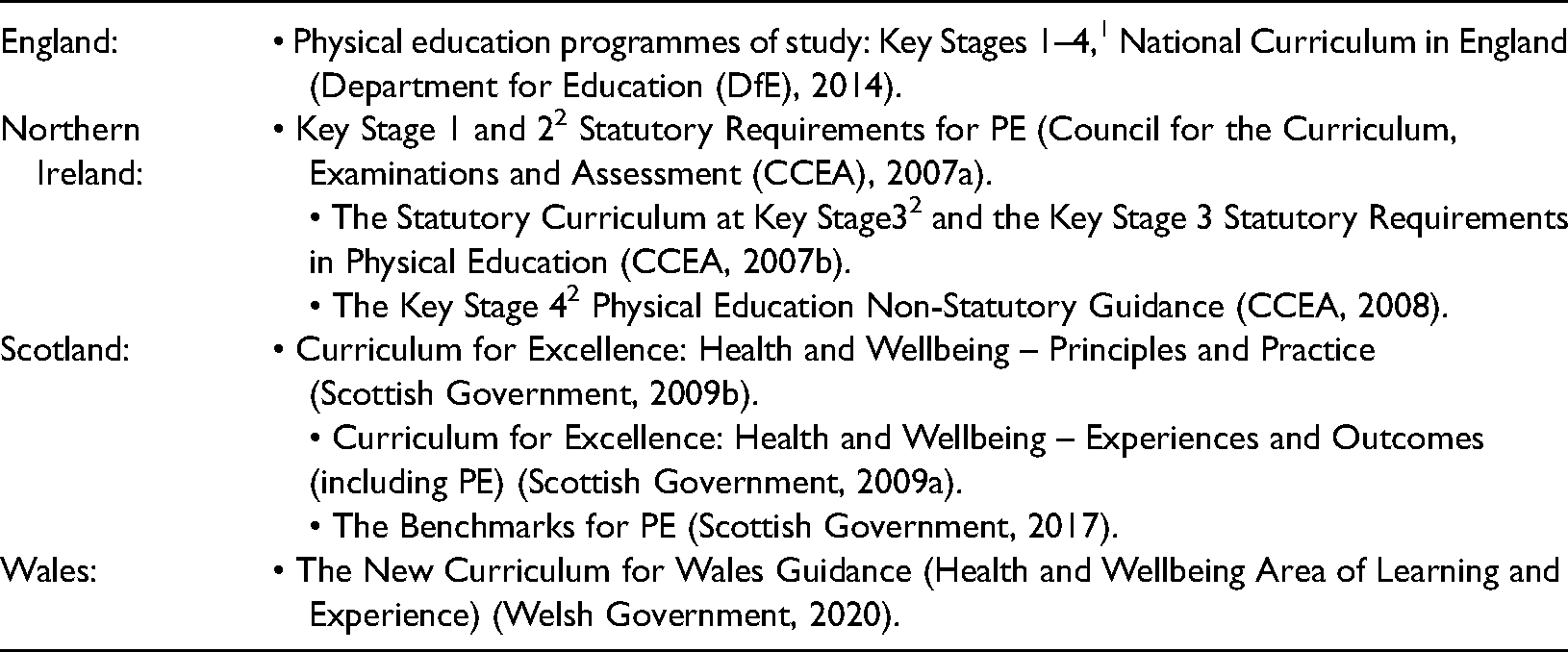
The researchers involved in this study brought curriculum perspectives and insights from each UK context. Together, we analysed those statutory policy documents that were written to directly inform practitioners about the ways in which their PE curricula might be planned, taught and assessed in schools. While we recognise that these documents are supported by a wealth of broader, background policy writings, we focused on those core documents that were perceived to ‘talk’ directly to teachers (see Table 1).
Key documents for analysis.
Data analysis
Although it was not our intention to carry out a discourse analysis of the selected policy texts, we drew from the tools of discourse analysis to identify those discourses that shape how PE is conceptualised in each context (Mullet, 2018). More specifically, we were guided by Mullet’s (2018) critical discourse analysis framework to: ‘locate and prepare the data sources’, ‘select the discourse’ and ‘identify the overarching themes’ (p. 122). Once the discourses were identified, we engaged in a form of thematic analysis, comparing each context to identify areas of convergence and divergence.
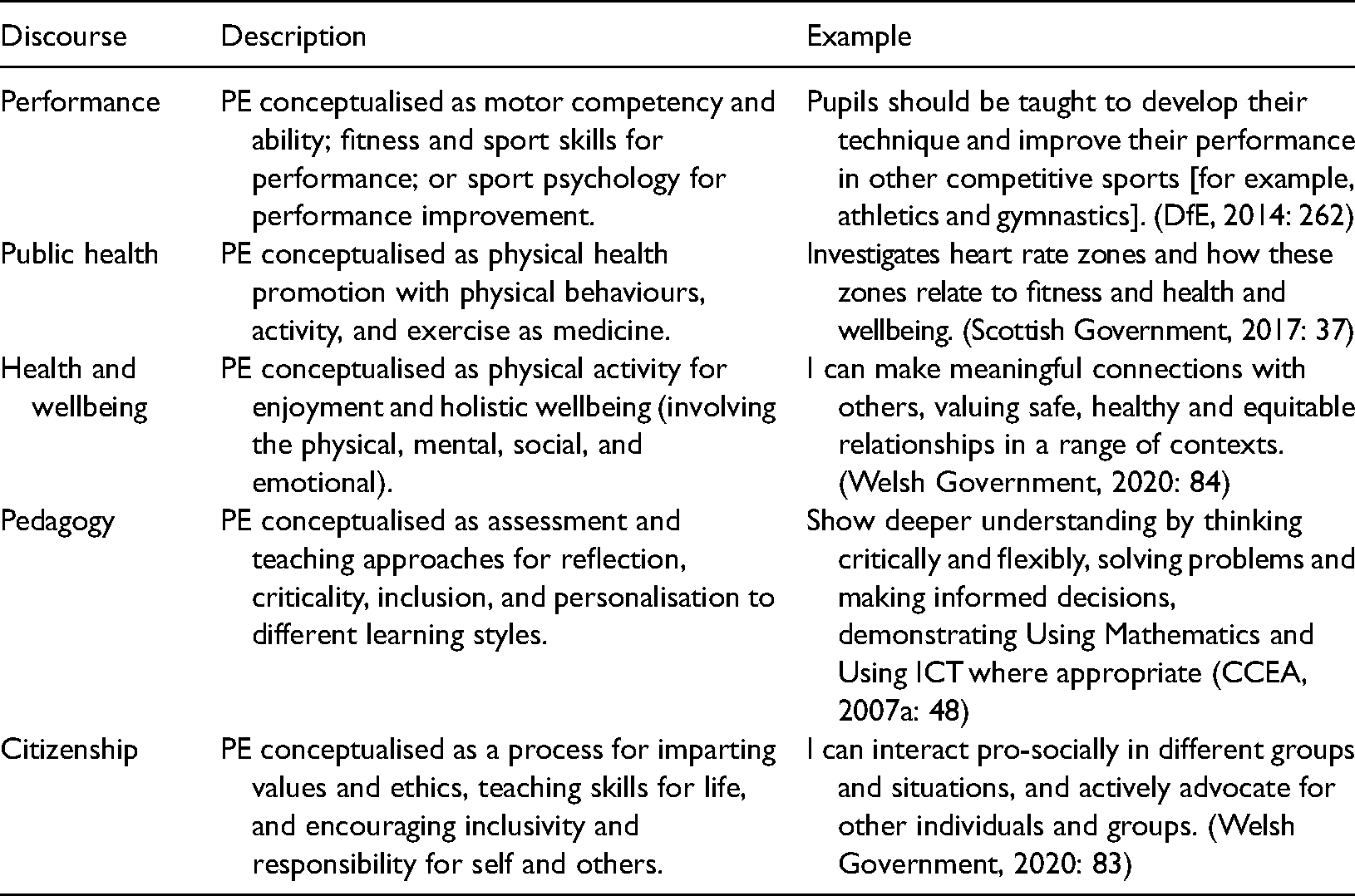
In order to ‘select the discourses’ within each policy text, we drew from the existing literature to identify the core discourses that are known to circulate within the field of PE in the UK (Evans and Penney, 2008; Jung et al., 2016; McEvilly et al., 2014). This led to the initial identification of three common discourses – performance, public health, and health and wellbeing (HWB). We then compiled these into a broad and flexible discourse framework that included a description of each discourse. The development of this framework helped us come to a shared understanding of the various discourses and discursive constructions around the meanings and purposes of PE. This initial framework of discourses was then used to guide a preliminary analysis of the Scottish policy text by all members of the research team. While this analysis was essentially deductive in nature, we remained open to the identification of additional discourses not previously accounted for in the guiding PE literature.
To protect against undue influence, the research team initially carried out their analysis individually, and then came together to present and discuss their ‘overarching themes’ (Mullet, 2018: 122). This dialogical process enhanced our understanding of each discourse and, drawing from our collective knowledge of curriculum discourses in and beyond the domain of PE (e.g. Hardley et al., 2020), enabled us to identify any obvious gaps in the core discourses previously identified. This led to the identification of two further discourses – pedagogy and citizenship – which were subsequently added to our discourse framework (see Table 2), along with examples of each discourse extracted from the policy text.
Discourse framework.
Following this initial process, one member of the research team led the overall analysis and, guided by the framework, carried out a deductive analysis of all the policies across each of the other UK contexts. Analysis occurred by curricular documents being read and re-read, highlighting discourses from the framework and taking notes regarding what these might mean for how PE is conceptualised. Importantly, in each context, the lead analyst co-analysed the policy text with additional member(s) of the research team with links to that country. Again, researchers analysed the documents individually, initially, and then together engaging in an open and dialogical process to come to a shared understanding of how PE is constructed in each context. Following this process, and reflecting a form of thematic analysis, conversations then converged around how PE is constructed similarly or differently within and across curricula. The lead analyst then wrote a summary of the findings from the analyses, which were shared with the wider research group for further discussion of the discourses present and the similarities and differences across contexts.
Main findings
To provide some context against which to present our findings, below we first offer a brief description of each curriculum, followed by the discourses we identified as prevalent within it. Subsequently, we present the outcomes of our thematic analysis, highlighting points of convergence and divergence across contexts, drawing attention to issues that might be worthy of further examination and used as a platform for future dialogue, learning and policy development.
Contexts and discourses
Northern Ireland
PE is one Area of Learning in the curriculum in Northern Ireland in which it is suggested that all pupils should experience a sense of fun, enjoyment and achievement through a variety of progressively challenging and innovative activities. The curriculum indicates that pupils should understand and appreciate the benefits of physical activity and the relationship between physical activity and good health. Furthermore, the curriculum proposes that it is through a broad and balanced PE programme that pupils should develop knowledge, understanding and skills (CCEA, 2007a).
In KS1 and KS2, the most prevalent discourse is around performance, with emphasis on pupils’ physical competencies such as being able to: move with increased control, improve quality of movement, practise and perform movement sequences, or measure their performance. This changes in KS3 where there is a significant discourse around pedagogy, with a strong emphasis on personalisation and cross-curricular planning. Another dominant discourse in the KS3 documents is HWB as a means for teaching students skills for life, with some discursive connections made between HWB and citizenship. This discursive combination appears to emphasise PE and HWB as a process to foster social values and social responsibilities. This is apparent in the curriculum's overarching aim: to promote the spiritual, emotional, moral, cultural, intellectual and physical development of pupils at the school and thereby of society; and prepare pupils for the opportunities, responsibilities and experiences of life by equipping them with the appropriate knowledge, understanding and skills. (CCEA, 2007b: 2)
Many of the requirements in KS4 align with a public health discourse, with an emphasis on accessing, participating in, and sustaining regular activity. However, the most predominant discourse in the non-statutory KS4 guidance is around pedagogy with a focus on planning, auditing, and adopting different teaching approaches to foster PE engagement, personalisation, and relevancy to ‘real-life’. Positioned at various points throughout this document are reflective questions for departments and teachers to consider, encouraging a critical analysis of current practice and developing new ideas for teaching, learning and assessment.
England
The National Curriculum for PE (NCPE) in England is a very brief document that sets out the aims and purpose for the subject for all students aged between 5 and 16 years old. The purpose of PE is described as being to: inspire all pupils to ‘succeed and excel in competitive sport and other physically-demanding activities’; ‘provide opportunities for pupils to become physically confident in a way which supports their health and fitness’; and provide students with the opportunity to ‘compete in sport and other activities [which] build character and help to embed values such as fairness and respect’ (DfE, 2014: 260). Since the inception of the NCPE in England in 1992, there have been numerous revisions, and each has focused on a particular aspect of PE. However, the current curriculum is a relatively ‘minimalist and traditionalist’ document (Herold, 2020: 920) consisting of four key aims, ‘that all pupils: develop competence to excel in a broad range of physical activities, are physically active for sustained periods of time, engage in competitive sports and activities’ and ‘lead healthy, active lives’ (DfE, 2014: 260). The PE curriculum is split into four Programmes of Study (PoS) across KS1 to KS4. In terms of attainment, by the end of each Key Stage pupils are expected to know, apply and understand the matters, skills and processes specified in the relevant PoS.
Within the NCPE, there is a focus on a discourse of performance which emphasises physical competency and participation in competitive sport. There are several references to this discourse throughout the document, for example: Pupils should be taught to develop their technique and improve their performance in other competitive sports [for example, athletics and gymnastics]. (DfE, 2014: 262)
And: Use a range of tactics and strategies to overcome opponents in direct competition through team and individual games [for example, badminton, basketball, cricket, football, hockey, netball, rounders, rugby and tennis]. (DfE, 2014: 262)
As evidenced in the summary above, there is some reference to citizenship and public health discourses in the curriculum aims; however, these discourses are mostly absent elsewhere in the document.
Scotland
In Scotland, PE teachers are guided in their curriculum planning and delivery by several documents. Broadly, by the Principles and Practice document, which sets out the main purpose of learning in Health and Wellbeing, and more specifically by the Experiences and Outcomes, a document that provide teachers with a detailed framework for curriculum planning. Since 2010, PE teachers have been guided by Experiences and Outcomes from two areas of the curriculum, the Health and Wellbeing curriculum, and the Physical Education curriculum. In 2014, further curriculum guidance was published for teachers in the form of Significant Aspects of Learning (SALs), these being physical competencies, cognitive skills, physical fitness and personal qualities (Scottish Government, 2014). Then, in 2017, Benchmarks for PE were published (Scottish Government, 2017). The Benchmarks for PE document specifically focuses on supporting assessment and progression in learning, and explicitly links the Experiences and Outcomes, SALs and Benchmarks in a list with increasing complexity across five developmental levels: early (pre-school to primary one, ages 3–5 years), first (lower primary, ages 6–8 years), second (upperprimary, ages 9–12 years) and third/fourth (lower secondary, ages 13–15 years).
A dominant discourse in the Principles and Practice document is pedagogy, characterised by references to planning for and supporting pupil learning. Another dominant discourse is HWB, centred on physical, social, emotional and mental wellbeing. Through this emphasis on HWB, connections are made to citizenship, highlighting the role of PE and HWB in fostering social values and social responsibilities. This emphasis on HWB with connections to citizenship is also reflected in the Experiences and Outcomes for Health and Wellbeing. However, in the Experiences and Outcomes for PE, this shifts to discourses of performance (developing motor competencies) and public health (daily physical activity). Here there are also references to citizenship (in the context of sport and physical activity), for example, following rules and working with others. Within the Benchmarks document, there is some focus on performance discourse, but more so as pupils progress to secondary school. For example, at the fourth level, pupils should perform: … precise transfers of weight with and without equipment involving static and dynamic balance. (Scottish Government, 2017: 23)
This is in direct contrast to the early and first level Benchmarks, where there is greater emphasis on HWB.
Wales
The Welsh education system is currently undergoing a number of significant transformations. In 2020, a new curriculum was published, intended to guide curriculum planning, pedagogy and assessments in Wales by 2022. One of the main implications of this new curriculum for PE in Wales is that it has been integrated into the broader Health and Wellbeing Area of Learning and Experience (AoLE). Thus, PE no longer has its own curriculum but is one of a number of subject areas that (may) inform the delivery of the new Health and Wellbeing AoLE. In this learning area, there are five Statements of ‘What Matters’ (SWM):
Developing physical health and wellbeing has lifelong benefits. How we process and respond to our experiences affects our mental and emotional wellbeing. Our decision-making impacts on the quality of our lives and the lives of others. How we engage with social influences shapes who we are and affects our health and wellbeing. Healthy relationships are fundamental to our wellbeing.
Here, the focus and purpose of PE is implicitly referenced, particularly in the first statement. These SWM act as the foundations from where teachers in Wales should generate their own curricula, unique to the cultural context of the school and pupils. Teachers are guided by the ‘Principles of Progression’, a framework to support them to flexibly cater for the needs of pupils, and ‘Descriptions of Learning’ which are a series of more specific progression steps for each SWM that increase in complexity as students’ learning develops.
The new Health and Wellbeing AoLE places significance on a discourse of pedagogy, focusing on local leadership, teachers' professional skill and judgement teaching, approaches, innovation and creativity, collaboration and flexibility to adapt the framework to their local needs. The framework explicitly states that it is ‘not simply what we teach, but how we teach and crucially, why we teach it’ (Welsh Government, 2020: 5). In addition, the embedded position of PE exemplifies the holistic focus of the Welsh curriculum, enabling a discourse of HWB to become prevalent. Interestingly, there are discursive connections throughout to citizenship. The connection is evident when the framework describes progression as students not only increasing their competency in physical, emotional, mental, and social skills, but also gaining deeper appreciation of the effects of their decisions on others: as learners become more socially responsible, they progress from primarily considering oneself to considering the impact of their own actions on others at a local, national and global level. (Welsh Government, 2020: 76)
Curriculum comparisons
Our comparative/thematic analysis converged around three main areas: (i) conceptions of health in PE; (ii) performance; and (iii) pedagogy and teacher agency.
Conceptions of health in PE
In all the curricula, PE is understood as playing a role in promoting pupils’ health, although there are some differences both within and across each context in relation to how this is presented. For example, in Wales, health is understood in a holistic sense, encompassing social, emotional, mental and physical wellbeing with discursive connections to citizenship. As indicated earlier, PE in Wales is not explicitly referenced within the policy text, but its purpose is now implicitly recognised within the five SWM which, taken together, reflect this broad conceptualisation of health and citizenship. This novel approach holds potential for PE within Wales to move beyond a narrow focus on physical activity for physical health and become a subject that contributes to a health and wellbeing agenda that is broad and holistic. However, for this to be realised within their own curricular enactments, PE teachers in Wales will have to be supported in recognising the interconnections between all five SWM and in understanding the consequences of interpreting these as singular/discrete discourses.
The relationship between PE and a discourse of HWB in Wales strongly resonates with the Scottish curriculum. One notable point of difference is that in Scotland, PE remains explicitly referenced in the curriculum texts. Within the wider curricular context, as expressed through the Principles and Practice document, health is conceived in broad and holistic terms – social, emotional, mental and physical. This HWB discourse is also evident in the Benchmarks, but more so in the early years and less as pupils progress through school.
Like Scotland, in Northern Ireland, PE is a subject area in its own right (Area of Learning). The PE curriculum broadly alludes to a holistic conceptualisation of health through, for example, fun, enjoyment and achievement. Interestingly, however, discourses of health appear largely absent from the curricular text in the primary years, which instead focuses on developing pupils’ performance. In KS3, pupils should develop social values and social responsibility linked to a discourse of citizenship. As pupils progress through to KS4, a public health discourse emerges, with reference to appreciating the benefits of physical activity and the relationship between physical activity and good health. For example, it is noted that pupils should have opportunities to: plan, undertake, monitor and evaluate safe and effective personal exercise/training programmes that contribute to a healthy and active lifestyle. (CCEA, 2008: 7)
Similarly, the English curriculum makes reference to a public health discourse with two of the four aims focusing on being ‘physically active for sustained periods of time’ (DfE, 2014: 262) and learning to lead a healthy lifestyle. Furthermore, unlike in Northern Ireland and Scotland, this public health discourse is consistent from KS1 to KS4. That said, while these ambitions are evident from KS1 to KS4, they are not reflected in the list of physical competencies that should be acquired. Like the primary context in Northern Ireland, a discourse of performance dominates, perhaps based on the rather simplistic assumption that the development of motor skill (sports) competencies will lead to a healthy lifestyle. These findings also support previous research suggesting that ‘health’ plays a marginal role in PE policy in England (Lindsey et al., 2020) and the health discourse that is evident is largely associated with public health concerns relating to increasing physical activity to improve physical health (Harris and Leggett, 2015).
Performance
In each of the four countries except for Wales, at various stages in the curriculum there is significant reference to a discourse of performance, where learning motor skills and engaging in competitive sports appear to be the primary function of PE. This is especially evident in the English curriculum, where emphasis is placed on physical competency and participation in competitive sport from KS1 through to KS4. The situation in Scotland is similar, although a performance discourse does not begin to dominate until secondary school and is not present in the Principles and Practice document. The performance discourse evident within the secondary school levels primarily relates to performing efficiently, improving performance and sport-related fitness. Even the ‘Personal Qualities’, which in the primary context refer to the development of social and emotional skills that support health and wellbeing, change to social and emotional skills to support performance. For example: Recognises own and other people's emotions that come from performing, and is aware of how they can impact both positively and negatively on performance. (Scottish Government, 2017: 25)
In contrast, in Northern Ireland there is greater prescription and reference to a discourse of performance in the primary years, which shifts to discourses of public health and pedagogy as pupils progress through post-primary school. This prescription around what activities and skills pupils should learn in the early years reflects the common perception that primary school teachers lack content knowledge in PE (Griggs, 2012) and therefore require additional support in this area.
The position in Wales in relation to performance is, however, notably different. While in all the other contexts a discourse of performance dominates, in Wales there is potential for it to play a less significant role. There is brief reference in the ‘descriptions of learning’ for SWM 1 (developing physical health and wellbeing has lifelong benefits) to the development of motor skills and applying them confidently and creatively in different contexts. However, the discourse that seems to take precedence with the Curriculum for Wales is that of pedagogy.
Pedagogy and teacher agency
Our analysis highlighted how ongoing development of curricula within each of the UK contexts has allowed for different pedagogical approaches and principles to be developed. The focus on pedagogy within the context of PE has an extensive history of development (Thorburn, 2017). Over the years, such development has led to many discussions regarding the ways in which pedagogy is conceptualised and practiced (McMillan, 2017). Whilst it is not the intention of this paper to revisit this debate, it is important to highlight how our exploration of the pedagogical discourse within the analysed curricula has uncovered different approaches.
The analysis presented draws attention to how, across the different UK curricula, there were several similarities in the way pedagogical ideas emerged from these documents. Within the curriculum documents for Scotland (Experiences and Outcomes and Benchmarks), England and Northern Ireland (KS1 and KS2), explicit reference to pedagogy was limited. This reflects a tendency to emphasise the role of curricula to provide learning objectives that require teacher professional judgement with regards to the types of pedagogical practices they may use in the enactment of the curricula. Furthermore, it was notable how within both the Northern Ireland (KS3 and KS4) and Scotland (Principles and Practice) curricula, the pedagogy discourse identified, referred to promoting personalisation, cross-curricula planning and supporting pupil learning – alluding to the centrality of the learner within the curriculum and emphasis on transferability of knowledge and skills. In Northern Ireland in KS4, teachers are also encouraged to critically analyse current practice and understand the ways in which they may or may not align with curriculum objectives.
An interesting outcome of the analysis process was the recognition that while both the English NCPE and the new Curriculum for Wales Guidance allude to a pedagogical discourse, this is illustrated in divergent ways. For example, within the English NCPE, there is little guidance for teachers on the types of pedagogical principles or practices they may follow. In many respects, this lack of guidance is reflective of a wider discourse of individualism prevalent within the English education system (Evans, 2014); one that renders PE teachers in this context heavily reliant on obtaining knowledge and understanding of pedagogy from external sources. This focus on individualism lies in direct contrast to the pedagogy discourse evident within the Welsh curriculum, where there is explicit guidance provided for teachers. Here, the discourse analysis highlights an explicit focus on leadership, cooperation and engaging with pedagogical principles and practices, as evidenced in the following: Pedagogy is at the heart of curriculum. In designing their curriculum, schools should consider the pedagogical approaches they will need to employ to support learners in realising the four purposes. Schools should seek to develop a strong vision of learning and teaching which considers the ‘why’ and ‘how’ as well as the ‘what’. This vision will recognise the integral role of the learning environment in supporting effective learning. (Welsh Government, 2020: 50)
The similarities, differences and varied levels of agency and support both across and within curricula in relation to pedagogy is important, given Penney’s (2013) observation that curricula should function to clearly guide teachers on what/how PE should be taught and assessed. Our findings suggest that the level of clarity around the role and purpose of pedagogy within and across each document varies significantly, which may impact on how curriculum is enacted – something that will also be influenced by teachers’ personal curriculum interpretation.
Discussion – policy learning
Using our discourse framework to explore current policy texts for PE in England, Northern Ireland, Scotland and Wales, we identified several discourses that point to the role and purpose of PE in each context. In doing so, we were able to identify areas of divergence and convergence and present them as opportunities for cross-border learning and understanding. All curricula highlight the important role that PE plays in relation to learning about health and, while there are some differences in the way that health is articulated (both within and across contexts), there are also several similarities. For example, there is some reference in each document to a discourse of public health, where PE appears to play an instrumental role in supporting government (neoliberal) health agendas related to increasing physical activity and reducing health risks associated with sedentary behaviours. Interestingly, in England, this discourse is consistent throughout the curriculum. Thus, within the context of PE in England, health is understood in a rather narrow sense, which can have a similarly narrow effect on the way that teachers teach health – in other words, a focus on physical activity for physical health, or fitness for performance (Harris and Leggett, 2015). In Scotland, Wales and Northern Ireland, although there is evidence of a public health discourse at various points within each curriculum, health is also expressed as a holistic concept, providing teachers with the opportunity to move beyond a ‘physical activity for health’ perspective, towards a broader understanding that takes account of the learners’ social, emotional and mental needs. We argue that these variations in how health is conceptualised and articulated present a rich context for future dialogue and learning across borders.
Interestingly, none of the curricula are dominated by health discourses, although it has a significant presence within the Welsh curriculum. Instead, in England, Scotland (the Benchmarks) and Northern Ireland (more so in KS1 and KS2), a discourse of performance dominates, with a focus on developing physical competencies, improving performance and engaging in competitive sport. This reflects previous PE curriculum analyses that have highlighted the prevalence of a performance discourse, aligned with governments’ (and other stakeholders beyond the PE profession) commitment to the development of competitive sport (Lindsey et al., 2020) and the perception that the development of skills for sport will contribute to leading a healthy lifestyle (McEvilly et al., 2014). Given the practical nature of the subject, it is perhaps unsurprising that a discourse of performance dominates, and few would argue against the centrality of bodily movement and learning as priorities in PE. However, some have argued that a broader notion of performance is necessary to align more closely with contemporary society and to support “other learning' that centres on the social, interpersonal, cultural and environmental dimensions’ of PE (O’Connor and Penney, 2021: 20). To achieve this, teachers first need to be aware of the way in which performance in sport dominates their curriculum and the impact that this can have on their teaching and the experiences of their pupils. Again, we see the value in cross-border reading of curricula to facilitate debate that explores why a performance discourse dominates and its misalignment with, for example, contemporary physical cultures, formal and informal physical activity engagement and multiple conceptualisations of ability in PE (Kirk, 2010). Illuminating and challenging this dominance may create space to consider alternative perspectives, where PE teachers can work together to begin to understand how PE might be re-conceptualised and co-construct opportunities for social and cultural renewal around, for example, the concept of performance (Kirk, 2010).
Here we consider the unique position of Wales to begin this process of renewal, given that we do not yet fully know how PE might be conceived as a result of the new Curriculum for Wales. Wales has an opportunity to learn from Scotland, Northern Ireland, and England, and develop a curriculum that embraces all five SWM, ensuring that they are clearly and consistently articulated as pupils progress through their learning. We argue this may support a new (or renewed) PE curriculum, where pupils move and learn in personally, socially and culturally relevant ways and develop a broad and holistic understanding of performance and health. This will be challenging for teachers in Wales and will require professional learning that facilitates a critical understanding of curriculum and creates space for teachers to work together to develop innovative and relevant pedagogies that offer a broad range of learning experiences in and through movement. Indeed, we argue that the similar and contrasting ways in which ideas related to pedagogy are presented in each curriculum document highlight the continued need for all teachers to focus on issues of pedagogy and think critically and creatively about specific pedagogical practices required to enact curricula and meet the needs of individual pupils. To support this process, again, we see much value in cross-border pedagogical understanding and dialogue, where engaging with alternative perspectives supports critical self-reflection with the potential to disrupt current thinking and act as a catalyst for change (O’Connor and Jess, 2019).
Conclusion
In analysing and comparing PE curricula across the four nations of the UK, we have identified several similarities and differences, and suggest that this could serve to initiate cross-border dialogue and develop a collective understanding among teachers, thereby increasing their capacity to contribute to future curricula and pedagogies in PE. In particular, our analysis has highlighted that, although there are some similarities in how health is articulated across contexts, there are also some differences and, perhaps more significantly, differences are evident within contexts. This lack of consistency within contexts may have implications for how health is enacted in schools, and therefore further comparative analysis and dialogue are necessary. This will encourage PE teachers and other key stakeholders to investigate why health is conceptualised in such ways, and begin to consider how health might be re-conceptualised in future policy developments. We have also learned that a discourse of performance continues to dominate and suggest that, if this is to change, there is a need for teachers to critically engage with both curriculum and pedagogy to consider what and who is valued in PE, and how this aligns (or not) with contemporary physical cultures.
Of course, this assumes that teachers have the desire or capacity to engage in curriculum debate and transformation. Kirk and Macdonald (2001) suggest that the possibilities for teachers to be involved in curriculum change at levels beyond the PE department or school are limited by the fact that their expertise is positioned at a local level. Relatedly, teachers are known to engage in change agendas only when they see the direct benefits to their pupils (Gray et al., 2012). Engaging in broader curriculum debates or conceptual debates related to the nature and purpose of PE may be too far removed from the classroom to motivate teachers into action. However, we argue that this level of teacher engagement is essential in shaping future PE practices that are equitable, culturally relevant and inclusive. Additionally, given our current post-COVID-19 and highly digital context, there are now greater (online) opportunities to connect with other teachers, engage in debate and learn across borders.
Finally, it is important to highlight that we can also learn from what is not in each curriculum, notably those references to social and critical issues around, for example, gender equality, conceptions of ability, social class and culture. We hope that the current absence of such issues may become more apparent as PE teachers pursue ‘their authority to speak’ (Penney, 2008: 45) through cross-border dialogue, critical self-reflection and pedagogical innovation. We also suggest this ‘authority’ will be enhanced by a more critical approach to policy analysis. In this paper, we have attempted to map out prevalent discourses that have shaped PE in each context. It is important that future research, too, explores these discourses from a more critical perspective to expose further the underlying ideologies or ‘truths’ (Foucault, 1973) that (re)produce those discourses that persist in PE. This more critical analysis may further support teachers to (re)conceptualise PE in contemporary and critical ways and strengthen their collective and authoritative voice, to thereby ‘reclaim and reshape the HPE policy space’ (Penney, 2008: 45).
Footnotes
Acknowledgements
The authors thank Dr Mike Jess from the University of Edinburgh for his role as a critical friend during the process of writing this paper.
Declaration of conflicting interests
The authors declared no potential conflicts of interest with respect to the research, authorship, and/or publication of this article.
Funding
The authors received no financial support for the research, authorship and/or publication of this article.
