



Abstract
In many countries, assessment for learning (AfL) is recommended in both policy and research as a concept that should be integrated into the teaching of physical education (PE) in schools. AfL is also part of physical education teacher education (PETE) programs in several countries and, consequently, something future PE teachers are expected to practice in their teaching. In a previous study ( Tolgfors et al., 2021), we showed how AfL was transmitted and transformed between a university course and a school placement course within Swedish PETE. In the current study, we have more closely followed three of the preservice teachers who took part in our initial study into their first year of PE teaching. The purpose of this follow-up study is thus to explore how AfL is enacted in the induction phase of PE teaching. The more specific research question is: how is AfL enacted in beginning teachers’ PE practices under the contextual conditions provided at the schools where they are employed? The data were generated through Stimulated Recall interviews and follow-up interviews via the online meeting software Zoom. The analysis was based on Braun et al.’s (2011) contextual dimensions of policy enactment and Bernstein’s (1996) pedagogic device. Our findings illustrate how AfL is generally enacted through (1) progression and (2) “rich tasks.” However, the contextual dimensions of each school provide different conditions that either support or hinder the use of AfL in PE. AfL is accordingly enacted in different ways in the induction phase of PE teaching.
Keywords
Introduction
This article focuses on how principles and different aspects of assessment for learning (AfL) are enacted in early career physical education (PE) teaching. Following Black et al. (2002) we understand AfL as: […] any assessment for which the first priority in its design and practice is to serve the purpose of promoting students’ learning. It thus differs from assessment designed primarily to serve the purposes of accountability, or of ranking, or of certifying competence. An assessment activity can help learning if it provides information that teachers and their students can use as feedback in assessing themselves and one another and in modifying the teaching and learning activities in which they are engaged. Such assessment becomes “formative assessment” when the evidence is actually used to adapt the teaching work to meet learning needs (Black et al., 2002, preface).
According to Wiliam (2011: 12), AfL involves “three main processes (identifying where learners are in their learning, where they are going, how to get there) exercised by three categories of actors (teacher, learner, peer).” Thus, AfL can be regarded as a collaborative pedagogic approach that can be realized through five key strategies. These involve: (1) clarifying and sharing learning intentions with the pupils; (2) engineering effective classroom discussions, tasks, and activities that elicit evidence of learning; (3) providing feedback that moves the learner forward; (4) activating pupils as learning resources for one another; and (5) activating pupils as owners of their own learning (Wiliam, 2011).
In many countries, AfL is recommended in policy (e.g. Department for Education (UK), 2011; The Swedish National Agency for Education, 2020) as well as in research (e.g. AIESEP, 2020; Hay and Penney, 2013) as a concept that should be integrated into the teaching of PE in schools. AfL is also part of physical education teacher education (PETE) programs in several countries and, consequently, a pedagogic approach future PE teachers are expected to practice in their teaching (e.g. Lorente-Catalán and Kirk, 2016; Macken et al., 2020; Tolgfors et al., 2021). Thus, beginning teachers are expected to transform this content area of their teacher education (the “what”) into a functional way to teach and assess in PE practice (the “how”) at the same time as they are encountering schools with different contextual prerequisites. In this sense they are expected to enact AfL as a pedagogy, and in this article, we suggest that AfL can be enacted in different ways depending on the diverse contextual conditions that prevail.
According to Banville (2015), teachers’ beginning journey into teaching—referred to as the induction phase—is a time for survival, discovery, adaptation, and learning. A “reality shock” can sometimes occur when content beginning teachers learnt in their PETE programs is gradually eroded by day-to-day school practice (see also Aldous and Brown, 2010; Smyth, 1995; Starck et al., 2020). In this study, we are interested in how various aspects within the educational context either enable or constrain beginning PE teachers’ enactments such as, in our case, the use of AfL. We accordingly focus on the recontextualisation of AfL as an example of beginning PE teachers’ teaching practices and the transition of one element of teacher education into PE practice. Early career teachers may find that their everyday teaching either strengthens their understandings and applications of AfL or causes them to abandon some aspects of the concept because of “the washing out of practices emphasized in PETE, including their conceptions of the purposes of assessment” (Starck et al., 2020: 2).
In a previous study (Tolgfors et al., 2021), we explored how AfL was transmitted and transformed in the transition between a university course on assessment methods and a school placement course within Swedish PETE. Our findings indicated that the contextual conditions of school placements provided different enablers and constraints for the preservice teachers’ use of AfL. In the current study, we have more closely followed three of the preservice teachers who took part in our initial study into their first year of PE teaching in order to unpack the ways AfL is realized in beginning teachers’ PE practices under the contextual conditions provided. The purpose of this follow-up study is thus to explore how AfL is enacted in the induction phase of PE teaching. The more specific research question is:
- How is AfL enacted in beginning teachers’ PE practices under the contextual conditions provided at the schools where they are employed?
In the following section, we will start by giving an account of previous research on assessment in PE and the potential role of AfL in PE and PETE.
The use of AfL in PE and PETE
For a long time, assessment practice in school PE has been either product-oriented, focusing on health effects, or decontextualized, focusing on isolated sports skills (Penney et al., 2009). Redelius and Hay (2012) have shown that many students find it difficult to grasp what is actually assessed in PE. One reason for this problem has been that PE teachers have tended to take students’ behavior and attitudes into account, rather than their knowledge in relevant areas. Annerstedt and Larsson (2010) and Svennberg et al. (2014) have also identified problems with the lack of transparency in PE assessment practices. When PE teachers rely on their “gut feelings,” their internalized criteria do not always correspond to the stipulated knowledge requirements in national curricular documents. This is one reason why AfL has attracted increasing attention as a pedagogic approach that addresses these issues of assessment validity and credibility (e.g. Hay and Penney, 2013). AfL was initially developed as a reaction to test-driven accountability (Hay, 2006), but is today rather regarded as a link in the chain of instructional alignment between curricular goals, learning outcomes, learning activities, and assessment for and of learning (AIESEP, 2020).
Ní Chróinín and Cosgrave (2013: 1) have shown that the implementation of AfL into the curriculum provided “structure and focus to the planning, teaching and learning processes and impacted positively on both teacher learning and the children's learning.” Moreover, MacPhail and Halbert (2010) have carried out an intervention with a number of PE teachers to develop “rich tasks” that could be used to promote student learning and assess PE performance: The task is deemed to be “rich” when it is authentic for the student and relevant to the learning outcomes in question. It should also contain transparent criteria and standards, encompass more than one learning outcome, involve acquiring, applying and evaluating knowledge, skills and understanding (MacPhail and Halbert, 2010: 25).
A common strand in the research on alternative forms of assessment in PE, such as AfL, is “the importance of students’ participation in the assessment process for enhancing learning” (López-Pastor et al., 2013: 63). The pursuit of responsibilization, subjectification, and collaboration is what makes the assessment process potentially transformative (Tolgfors, 2019). Based on the growing body of research on AfL in PE, it is also likely that more and more PE teachers have integrated AfL into their teaching practices in recent years. However, there is still a lack of critical engagement with AfL among PE teachers (Leirhaug and MacPhail, 2015; Leirhaug et al., 2016), which may entail contrasting versions of AfL in PE practice. For instance, Tolgfors (2018) has shown that amongst PE teachers AfL can be understood on the one hand as “empowerment,” where students’ self-regulatory processes are promoted, and on the other as “grade generation,” where formative ambitions are overpowered by summative motives.
Nonetheless, AfL is widely regarded as a relevant content area in PETE (Lorente-Catalán and Kirk, 2014, 2016). Both Macken et al. (2020) and Tolgfors et al. (2021) have explored AfL in the PETE context. For instance, Macken et al. (2020) have shown that preservice teachers rarely use AfL techniques such as self and peer assessment under the restricted conditions of school placements. AfL is, therefore, likely to be enacted in different ways in beginning PE teachers’ teaching practices, depending on how the five key strategies (Wiliam, 2011) align (or not) with the contextual conditions provided at each teacher's particular school. In the next section, we introduce aspects of professional socialization in the initial phase of PE teaching.
The induction phase of PE teaching
On the one hand, Ní Chróinín and Coulter (2012: 221) note that “teacher education in physical education can have an impact on pre-service teachers’ knowledge and understanding of physical education which, in turn, should impact on teaching and learning in their classrooms.” On the other hand, PE teaching traditions seem to be resistant to change (see e.g. Larsson et al., 2018) and beginning PE teachers susceptible to abandoning the goals promoted in their PETE programs, such as the use of AfL, in favor of goals more in line with the culture of their schools (Smyth, 1995; Starck et al., 2020). According to Smyth (1995), beginning teachers may experience “reality shock” when they move from being students on PETE programs to PE teachers in schools where the educational context may differ significantly from those in their school placements during PETE. One possible consequence of such reality shock is what has been called the “wash-out effect,” when things they learn in their PETE programs are gradually eroded by day-to-day school practice (Smyth, 1995; Starck et al., 2020).
According to Banville (2015), the first three years of a teachers’ career is what she calls the induction phase. Among other things, this phase involves getting to know the educational context, designing learning tasks, creating a classroom learning community, and developing a professional identity. In the same vein, Ensign et al. (2018b: 606) claim that: The performance of beginning physical educators is influenced by the diverse nature of each individual's unique first-year journey, and the art of learning to teach is highly dependent on the availability of adequate resources, support structures, internal motivation, the context of the learning environment, and other complex factors.
Ensign et al. (2018a) have identified enhancers, such as positive interactions with students and colleagues, and barriers, such as role conflict and problems with classroom management. By combining the theoretical perspectives of Bernstein and Bourdieu in their analysis, Aldous and Brown (2010) have further shown that it is crucial that the beginning PE teacher's habitus, based on early biography, teacher training, and experience of PE teaching is supported by the already established framing and performance codes of the school subject of PE. In the induction phase, beginning teachers are likely to be sensitive to whether or not their beliefs are in harmony with the dominant voices advocating continuity or change. Aldous and Brown (2010: 411) describe this experience in terms of “resonance or dissonance felt in relation to the school acoustic.” In the case of resonance, the beginning PE teacher will probably reproduce existing PE pedagogy and discourses in their teaching practice. In the case of dissonance, the beginning PE teacher will either have to endure a mismatch between their newly-learned approaches and those of their school or look for another job elsewhere.
A common denominator for scholars within the field is their interest in factors that have an impact on beginning PE teachers’ teaching. In this article, then, our primary focus will be on the different contextual factors that might have an impact on the use of AfL in the induction phase of PE teaching. In this endeavor, we find a theoretical perspective based on Braun and colleagues’ (2011) contextual dimensions of policy enactment and Bernstein’s (1996) pedagogic device useful.
Theoretical framework
According to Bernstein (1996), the pedagogic device refers to the process within which pedagogic discourses meet at different levels of the education system and are regulated through distributive, recontextualizing, and evaluative rules. Bernstein also suggests that certain pedagogic discourses (i.e. the regulative) tend to dominate others (i.e. the instructional). However, in the teaching practice they merge into one pedagogic discourse. According to our interpretation, when the regulative discourse of AfL, as presented in the research literature in PETE courses, encounters the instructional discourse of AfL in the teaching practice of PE, a process of recontextualization takes place. A complexity that is built into the pedagogic device in this case, and that operates in the transition from PETE to school PE, is that the content area of AfL within PETE is expected to be transformed into a pedagogic approach (rather than content for students to learn) to be realized in the teaching practice. As the five key strategies of AfL, according to Thompson and Wiliam (2007: 2) are “tight but loose,” they can be enacted in different ways.
Drawing on Braun et al. (2011), we focus on how AfL is enacted under the contextual conditions provided in the induction phase of PE teaching. As Braun and colleagues argue: Policy is complexly encoded in sets of texts and various documents and it is also decoded in complex ways. Policy enactment involves creative processes of interpretation and translation, that is, the recontextualisation—through reading, writing and talking—of the abstractions of policy ideas into contextualised practices (Braun et al., 2011: 586).
This quotation connects Bernstein’s (1996) notion of recontextualisation with the view of policy enactment as something highly contextualized (see also Singh et al., 2013). Braun et al. (2011: 586) explain that “putting policies into practice is a creative, sophisticated and complex but also constrained process.” Consequently, different aspects of the educational context may either enable or constrain policy enactments such as, in our case, the use of AfL. According to Braun et al. (2011: 588), the contextual dimensions can be categorized as:
- Situated contexts (such as locale, school histories, intakes, and settings). - Professional contexts (such as values, teacher commitments and experiences, and “policy management” in schools). - Material contexts (e.g. staffing, budget, buildings, technology, and infrastructure). - External contexts (e.g. (…) pressures and expectations from broader policy context (…)).
These dimensions are useful when mapping the contextual prerequisites for beginning PE teachers’ AfL enactments. Thus, by “taking context seriously” (Braun et al., 2011: the title), we intend to explore the recontextualization of AfL in three different PE settings.
Methodology
In Sweden, PE is a compulsory school subject, formally assessed according to knowledge requirements in the criteria referenced national curriculum. Courses on assessment for and of learning are included in Swedish PETE programs (Tolgfors et al., 2021). As the use of AfL is also strongly recommended by The Swedish National Agency for Education (2020), the incentives to use AfL can be understood in terms of an educational policy that teachers are expected to enact in one way or another. However, it is important to note that Swedish teachers have a relatively high degree of autonomy regarding their way of teaching.
Participants and educational contexts
Nine preservice teachers attending a Swedish PETE program that finished in June 2019 took part in our initial study (Tolgfors et al., 2021). Their PETE program included the content area AfL followed by school placement studies, during which the preservice teachers were supposed to use AfL in their teaching. All nine of the preservice teachers were invited to take part in this explorative follow-up study. Three of them (one female and two males) agreed to participate in the extended study, conducted at the schools where they were currently employed as PE teachers. Both the teachers and their students gave their informed written consent to participate in the study.
Teacher 1: Alias Anne (27 years old). Teacher 2: Alias Martin (28 years old). Teacher 3: Alias John (28 years old).
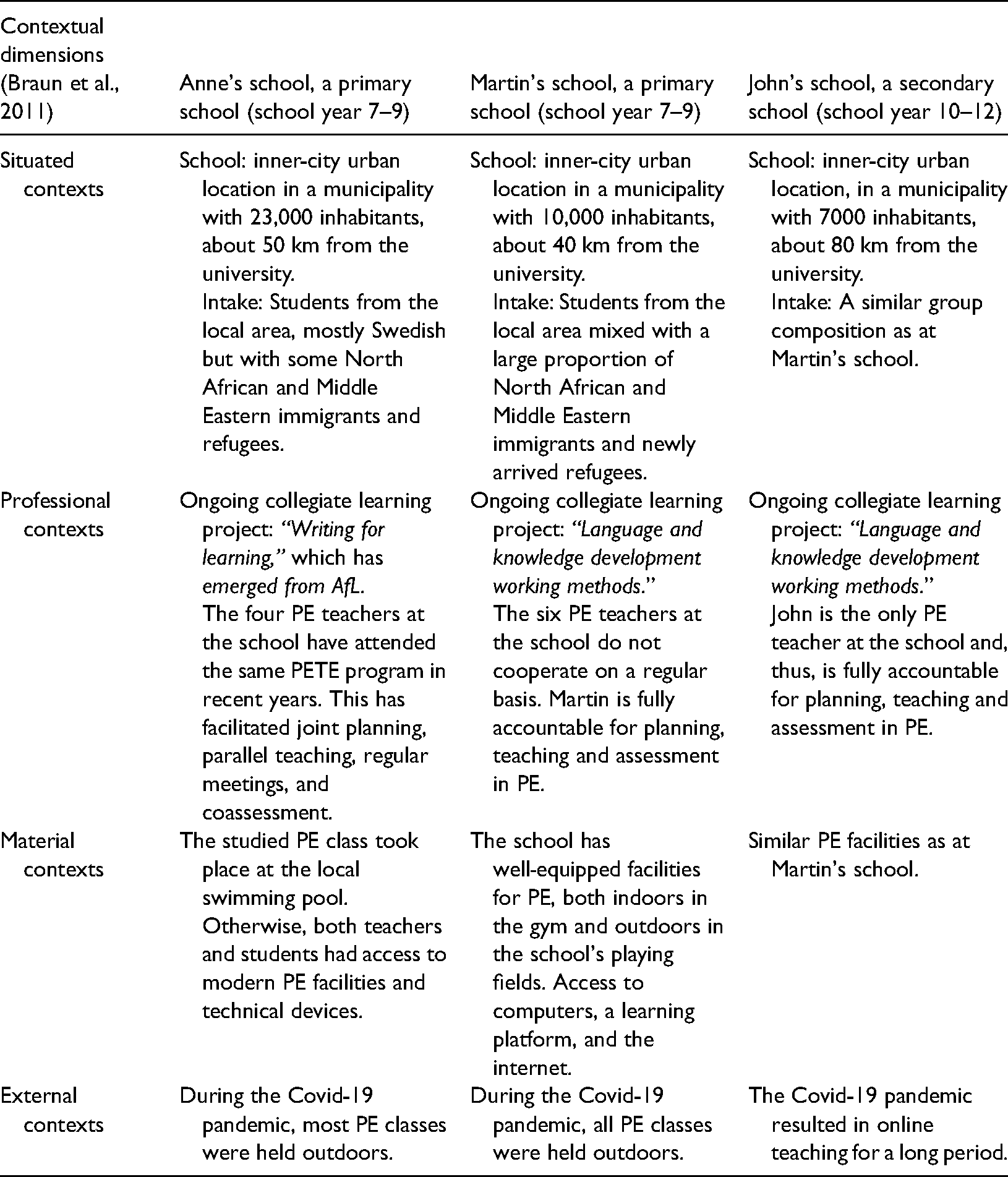
In Table 1 we present the contextual conditions for the beginning teachers’ AfL enactments in PE at the schools where they are employed.
The contextual conditions for AfL enactments in PE at the studied schools.
Data generation
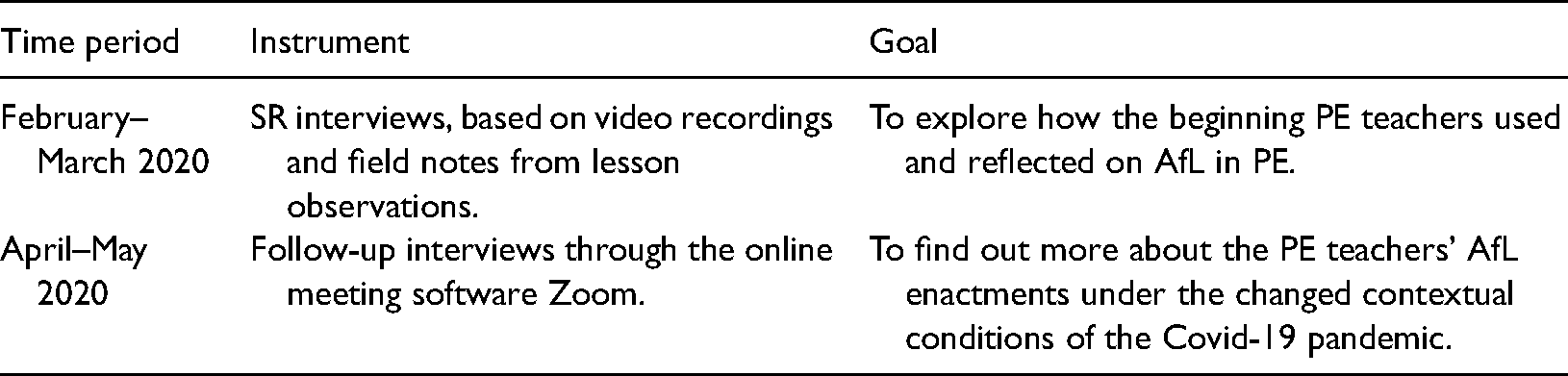
The empirical material was generated through (1) Stimulated Recall (SR) interviews based on video recordings and field notes and (2) follow-up interviews via the online meeting software Zoom. One SR interview and one online interview were conducted with each participant.
SR interviews were carried out at the beginning of the spring term of 2020. The PE teachers were asked to choose which classes they wanted to teach during our investigation. Thus, the participants had the opportunity to plan their teaching with regard to content and methods in ways they found relevant. The PE lessons that were observed and video recorded were between 60 and 90 min long with the SR interviews held directly afterwards. These lasted between 45 and 120 min. A Go Pro camera was used in the gym, whereas at the swimming pool, after a consideration of the ethics of live recording by the visiting researcher and the teacher, it was agreed that field notes only would be taken. The use of SR interviews “situates teachers’ learning within the social context of their practice” and “enables the observer to target deeper understandings of practice” (Endacott, 2016: 32). Thus, this method facilitated the teachers’ reflections on situations documented through video recordings and field notes (Lyle, 2003; Vesterinen et al., 2010). In the interviews, then, the questions focused on the PE teachers’ use of AfL evident in the videos and field notes. For example, the participants were asked to comment on their ways of sharing the learning intentions with the students and their ways of providing feedback that moved the learners forward. They were also prompted to reflect on different aspects of AfL in other situations than those that had been documented.
Because the contextual conditions altered due to the Covid-19 pandemic, we wanted to include these new conditions in the study (cf. Varea et al., 2020). Additional follow-up interviews were thus conducted with the three participants in April and May 2020. An interview guide was designed to find out more about the PE teachers’ AfL enactments under the contextual conditions that had suddenly changed. The questions focused on whether and how the participants had changed their ways of teaching in general and their use of AfL in particular, due to the restrictions. For instance, they were asked about online teaching and other solutions to problems that had arisen during the pandemic. As social distancing prevented us from revisiting the PE settings, individual online interviews were conducted through Zoom and lasted between 45 and 90 min. All SR and follow-up interviews were conducted and recorded by the first author and transcribed verbatim.
The fact that the researcher who generated the data had previously been the participants’ teacher educator entailed both pros and cons. On the one hand, all three PE teachers felt that their ways of teaching were still of interest in our larger longitudinal research project. They mentioned that they appreciated being observed and were eager to develop their teaching based on the questions and comments from the researcher during the visit. On the other hand, the former teacher–student relationship involved the risk that the newly qualified teachers would feel controlled. This potentially asymmetric power relation could have influenced their ways of using AfL in the teaching practice and their reflections in the interviews during data generation. The findings may thus have been affected by these circumstances. However, the fact that the participants were willing to extend their informed consent during the Covid-19 pandemic indicated that they did not object to the study, although we can of course not know if they were affected negatively the moment they were observed. The data generation process is summarized in Table 2.
A summary of the data generation process.
Analysis
Initially, the group of researchers read the transcripts individually, to become familiar with the data. During this process of familiarization (Burr, 2003), we noted sections in the empirical material where the participants specifically talked about matters that we regarded as being of contextual importance for their teaching in general and in relation to their use of AfL in particular. This was our purpose-related reading of the data.
In the next phase of the analysis, we used our theoretical grounding in Braun et al. (2011) and Bernstein (1996) to explore how AfL is enacted under the contextual conditions provided in the induction phase of PE teaching. We agreed on a set of theoretically grounded analytical questions to be used to address our research question. The analysis was conducted in two steps using two distinct analytical questions:
Of the four contextual dimensions suggested by Braun et al. (2011)—situated contexts, professional contexts, material contexts, and external contexts—what are the contextual conditions for using AfL in PE? The results generated through this first analytical step provided a description of the contextual conditions for using AfL in the studied PE practices. These prerequisites are presented in Table 1 and are further used as a starting point for the second analytical question: How is the pedagogic discourse of AfL recontextualized (Bernstein, 1996)—that is, how is AfL interpreted and translated (Braun et al., 2011)—under these contextual conditions?
This second analytical step was facilitated by using the five key AfL strategies (Wiliam, 2011) when identifying how principles and different aspects of AfL were enacted and reflected on under the contextual conditions provided. For instance, we were able to identify how learning goals were shared in the introduction to lessons and how feedback was provided during the learning activities. Our understanding of the “tight but loose” strategies (Thompson and Wiliam, 2007) also made our analysis sensitive to localized interpretations of AfL as a pedagogic approach. This, for example, means that we were observant of other ways of activating students as owners of their own learning and as learning resources for one another than common AfL techniques such as self and peer assessment. Together, the two analytical questions made it possible to address our research question.
Throughout the analytical procedure, we used the advice offered by Goodyear et al. (2019) regarding quality assurance in qualitative research in PE. This entails a deliberative process, in which the goal of the analytical procedure is to form a collective agreement where all coauthors “are given the possibility to make judgements in relation to different alternatives, views, and arguments” (p. 217). In this study, we continuously monitored the design, data collection, and analysis processes for their rigor, contribution, and coherence. As a group, our individual interpretations of the data were collectively compared, challenged, and discussed until we were able to agree on the two main categories. These categories are used as headings in the following section representing how AfL is enacted in the induction phase of PE teaching under the contextual conditions provided.
Findings
According to our analysis, AfL is generally enacted through (1) progression and (2) “rich tasks” in the induction phase of PE teaching.
Enacting AfL through progression
Enacting AfL through progression involves teaching that aims to promote student learning over time by sharing learning intentions and providing oral and written feedback integrated in the learning process.
Anne and the colleagues at her school have interpreted and translated the national curriculum and PE syllabus into a number of knowledge areas that provide opportunities for long-term progression. For instance, the knowledge area of “dance and movement to music” is planned to give the students the opportunity to build on what they have previously learned: In year seven, we start with the basics. We talk about rhythm, pulse and the character of the music and practice some movements to music. We also introduce some simple dances. In year eight, we move on to dance as a training form and some easy step combinations in aerobics. In year nine, the students have developed a repertoire of movements, to some extent. Then we talk about different music genres and dance styles. As a final examination, they are supposed to create their own choreographies in groups (SR interview with Anne).
To enhance progression within the specific knowledge area of dance, AfL has a role to play through feedback that moves the learners forward. Anne and her fellow PE teachers are involved in a collegiate learning project on “writing for learning,” indicating that the use of AfL is facilitated by their school's professional context. Thus, the instructional AfL discourse in the teaching context resembles the regulative AfL discourse, as it is expressed in research literature. Anne explains that: “Even the more experienced teachers have realized that they already work in line with AfL, or writing for learning, as we call it” (SR interview). As a beginning teacher, the support Anne receives from her colleagues means she has the appropriate contextual prerequisites for using AfL. Their common view of how to organize the course content and how to support the students’ progression provides a solid foundation for Anne's way of enacting AfL in PE. This can be illustrated by the way Anne describes how the knowledge area of “swimming and lifesaving in water” is handled: This knowledge area recurs in all school years. But there is supposed to be progression between years seven, eight, and nine. In school year seven, we focus on swimming. That is something they have started working on before [during school year three to six]. Thus, according to the knowledge requirements, we can more or less just check their ability to swim 200 meters, of which 50 meters must be backstroke. In year eight, we introduce lifesaving in water and inform the students about what they are supposed to master in year nine. That means that we share this long-term goal and provide an opportunity for progression between school year eight and nine (SR interview with Anne).
Here the promotion of a long-term progression regarding the students’ swimming abilities is highlighted, where Anne and her colleagues make sure to share the learning intentions with the students. In year eight, the students are already being informed of the goals for year nine. Anne stresses that her intention is that most students will understand where they are in the learning process and what their next step should be to prepare themselves for the examination that takes place in year nine. This line of thinking reflects the basic AfL processes, focusing on where the learners are in their learning, where they need to go and how best to get there. The different swimming lessons, including the lifesaving test, are encompassed by written feedback in line with the ongoing collegiate learning project at the school. Anne explains: “What's so special about written feedback, compared to oral feedback, is that you can keep it and look at it again. That is the positive aspect of writing for learning” (Follow-up interview). In addition, she had used some common AfL techniques in teaching gymnastics, volleyball, and orienteering. For instance, the material context at Anne's school enabled the use of iPads for filming and providing feedback to one another: There is so much to gain from letting students help each other, for example, learning to stand on their hands. It becomes so clear when they film each other in order to provide feedback on different ways of performing movements. (SR interview)
Anne also facilitated peer assessment by giving her students checklists which helped them to grasp what movement qualities to strive for in the different learning activities, assess each other's performances and consider how these could be developed further.
As the only PE teacher at his school, John had to rely on his own interpretation and translation of the national curriculum and PE syllabus when first planning his teaching and assessment practice, including how to use AfL. Documenting every student's abilities and developmental needs soon proved to be very time-consuming, which is why John concluded that he was documenting too much. However, when supervising learning tasks that lasted for several weeks, he still tried to write comments, but in a more concise and time-saving way: Well, I can't comment as much as I did in the beginning. There are too many students, so I don't have time! Now, I try to summarise what they know and what they need to develop: “Think about this next time!” (SR interview)
John explains that he has stopped giving feedback on every aspect of an assessable activity. He simply does not have the time to do more than provide a single, overarching set of comments. But with these he tries to focus his feedback on more generic aspects of the student's performance—broader learning skills—that are likely to be elements of future assignments. Thus, John's AfL enactment also aims at long-term progression.
All three PE teachers further stress the importance of verbally promoting their students’ progression and of the need for continuous dialogue with them. For example, Martin points out: My experience is that AfL only works when there is a dialogue between students and teacher. […] Without dialogue, students are left alone to read and understand the assignment. This is often too difficult for some students, so the dialogue is crucial for AfL to work. (SR interview, Martin's emphasis)
In Martin's way of promoting progression, the instructional AfL discourse is based on the teacher–student relationship. Hence, when Covid-19 restrictions became an element of the contextual conditions of Martin's PE practice, AfL was partly washed out from his teaching. The pandemic had a major impact on Martin's external context in that all PE classes were moved outdoors, which restricted the opportunities he had to have a dialogue with his students. His lessons were transformed into moments of “doing” rather than “learning.” According to Martin: “When you do not have access to a whiteboard or something similar to follow up things, it becomes difficult for students to know what we do and why we do it” (Follow-up interview). Consequently, the only way for Martin to communicate his learning intentions, deliver lesson plans, and provide feedback in order to promote progression was through the school's learning platform. Thus, this technical device ensured that a limited version of AfL survived in the material context, although the all-important verbal dialogue between PE teacher and student had been eroded from the teaching practice.
Enacting AfL through “rich tasks”
Enacting AfL through “rich tasks” involves the use of authentic learning tasks with transparent knowledge requirements that serve the purpose of activating students as owners of their own learning. Collaborative and flexible solutions, sometimes by utilizing technical devices, are aspects of how AfL is enacted under the contextual conditions provided.
In his introduction to a PE lesson that we observed, Martin handed out two documents to his students with written instructions for a “rich task” that was to be solved during the following six weeks. The goal was for the students to put together their own individual training program and simultaneously develop their knowledge of exercise physiology. A rubric with the corresponding knowledge requirements was also attached to the task. Thus, the intended learning outcomes were clarified in writing. One of the motives for this assignment was, according to Martin, to activate the students as owners of their own learning.
When Martin had provided more information about the assignment verbally, he asked the students to scatter in the gym and read the instructions more carefully. Some students formed groups while others sat by themselves. Meanwhile, Martin circulated in the gym to check how the students had interpreted the learning task. As many of the students had an immigrant background, the situated context involved Martin explaining some concepts in the written documents more thoroughly. This way of sharing the learning intentions with the students was in line with the ongoing collegiate learning project on “language and knowledge development working methods” at his school. Thus, the professional context provided specific conditions for Martin's AfL enactment: When I have just given a presentation, I want to tune in to how they have perceived the task. I want my “construct” or way of thinking to be transmitted to the students. And it is only when they start asking questions or come up with their own ideas that there are conditions for AfL to function. (SR interview with Martin)
The excerpt illustrates how Martin gives his students the opportunity to understand the learning intentions and ask questions about the learning task. In addition, lectures and videos on exercise physiology were used to support the students’ learning during the period when they worked on their training programs. The rich task was open-ended, which meant that the students could engage in different forms of training, depending on the goals they had set up. Martin's role was thus to support their individual routes to goal attainment: Martin: I try to challenge the students to challenge themselves. […] You must be dynamic for AfL to work. You have a plan, but it must be possible to change. (Martin's emphasis)
Researcher: Can you give some concrete examples of what you talked about with the students today?
Martin: One of them suggested a certain warm up activity. When I asked if that was not too intense, he persisted. Then I said: “Well, try it out and then we will see. You seem to believe in it, so perhaps you know a way to solve this that I have not thought about”. […] Another boy has very poor patience. And by patience, I mean to wait, try to understand and process a task. Then I believe you need to be very specific in your feedback. To really suggest a good way to start so that he understands what framework he must act within. (SR interview)
This line of reasoning illustrates that Martin is prepared to adapt his feedback to the students’ prerequisites. Nonetheless, he also stresses the importance of students being receptive to feedback: “For AfL to work, there must be a will on their part to develop” (SR interview). During this lesson, it seemed like some students were considering completing the assignment in groups instead of individually, a strategy that Martin supported. Thus, his flexible enactment of the pedagogic approach was open to collaboration, which can be regarded as a way of activating students as learning resources for one another.
When the Covid-19 pandemic suddenly affected the external context, the prerequisites for using AfL in PE dramatically changed for all participants, not least for John. When Swedish secondary schools closed for classroom teaching, students were expected to log in to their computers at home and attend their PE class at a distance. This meant that AfL was recontextualized into a pedagogic approach for supervising distance learning. The material context shifted from school to home environment and depended on the use of technical devices. Under these contextual conditions, new kinds of rich tasks were invented. Inspired by a Facebook post by a Swedish PE researcher, John introduced a learning task on the topic of health: I tried an idea I read about on Facebook, suggesting that students could interview an older relative about health. I gave a lecture on different health perspectives, based on things we learnt during PETE. Then I informed the students about the assignment. They were supposed to contact an older relative and ask them questions about health. Those who could not access an older relative could interview someone else. The second part of the assignment was to reflect on the current situation: “How does this period of distance learning affect you and how do you relate to different aspects of health such as physical activities, routines, habits and social relations in your everyday life?” (Follow-up interview)
Based on his description of “the health interview,” John enacted AfL in a way that related to his students’ life situation, which is a characteristic of authentic assessment. Due to the limited time to assess the students’ written assignments, he was also considering an alternative way for students to present what they have learned: Firstly, because it suits some students better and secondly to reduce workload, we could simply have a conversation. I could let them talk to me and have a discussion in smaller groups. I could easily form groups on the digital learning platform for this purpose. (Follow-up interview)
John's idea of using digital forums for group reflection is an example of how the material contextual dimension can enable the second key strategy of AfL, to engineer effective classroom discussions that elicit evidence of learning. This idea also shows that dialogue does not necessarily disappear from the instructional AfL discourse of PE teaching just because AfL is enacted via an online learning platform.
Discussion
The purpose of this study has been to explore how AfL is enacted in the induction phase of PE teaching. The findings reveal that AfL is enacted through (1) progression and (2) “rich tasks” in the studied PE practices. So, how can we understand this in terms of the situated, professional, material, and external contexts of the schools (Braun et al., 2011)?
Situated contexts
The student group makes a substantial difference for how AfL is enacted in PE. Martin's and John's schools have many students with immigrant backgrounds. Newly arrived refugees are often integrated in Swedish PE classes for the purpose of practical language development. This means that PE teachers must adapt their teaching to culturally heterogeneous classes and potential language barriers in different ways. Under this contextual condition, AfL is recontextualized (Bernstein, 1996) into a pedagogic approach that guides students with different prerequisites for learning on their individual routes to goal attainment. For instance, Martin's “training program” involved “dynamic AfL enactments” (Martin's expression) based on individual objectives and feedback processes, but also collective problem solving and group reflections. Thus, this “rich task” (MacPhail and Halbert, 2010: 25) potentially promoted responsibilization, subjectification, and collaboration, which are three important aspects of transformative assessment (Tolgfors, 2019).
Professional contexts
The professional contexts of Martin's and John's schools emphasize the use of “language and knowledge development working methods,” a program aimed mainly at adapting the schools' teaching to newly arrived students’ needs. The professional context of Anne's school is on the other hand dominated by voices advocating the use of “writing for learning,” a program that has emerged from AfL (Wiliam, 2011). When the use of AfL resonates with what Aldous and Brown (2010) call the school acoustic, beginning teachers are supported in their intention to translate their recent training into practice. Accordingly, Anne is a carrier of an instructional AfL discourse that resembles the regulative AfL discourse as it was introduced at university (Bernstein, 1996; Tolgfors et al., 2021). In addition, the team of PE teachers at Anne's school cooperates systematically in a similar way as those in Ní Chróinín and Cosgrave's (2013) study. Their common PETE background and current collegiate learning project facilitate their cooperation in terms of joint planning, parallel teaching, regular conferences, and coassessment (see Table 1). Our analysis further shows that written feedback is fundamental in their AfL enactments.
Material contexts
All three teachers use a digital learning platform when clarifying learning intentions, communicating learning tasks, and providing feedback to their students (cf. Bodsworth and Goodyear, 2017). According to Anne, this technical device enables written feedback but according to Martin, it also constrains oral communication. There is more to be said about these pros and cons in relation to the following contextual dimension.
External contexts
The Covid-19 pandemic had contrasting consequences for the beginning teachers’ AfL enactments. In John's case, the changed contextual conditions entailed innovative working methods via the learning platform. In times of distance learning, he adopted what can be considered as authentic assessment (Hay and Penney, 2013), for instance through health interviews with older relatives. According to Hay and Penney (2013), considering the usefulness and relevance of a learning activity from a student's point of view is a lifelong and life-wide perspective that is worth striving for in school PE. In Martin's case, however, AfL was washed out (Starck et al., 2020) of his teaching practice when the opportunity for face-to-face dialogue with his students diminished. These differences in approach illustrate, on the one hand, that the external context might be a resource for AfL enactments. On the other hand, without strong incentives to use AfL, such as pressures and expectations from a broader policy context (Braun et al., 2011), AfL may slowly erode from the teaching practice.
The follow-up—AfL is enacted in different ways
In our previous study (Tolgfors et al., 2021), to which this is a follow-up study, we explored the recontextualization of AfL as a particular content area in the transition between a university course and a school placement course within Swedish PETE. We identified some empirically grounded recontextualizing rules (Bernstein, 1996), which entailed three different fabrications (Ball, 2000) of AfL: “(1) AfL as ideal teaching; (2) AfL as correction of shortcomings; and (3) AfL as ‘what works’” (Tolgfors et al., 2021: 10). Compared with the contextual enablers and constraints of school placements, the current follow-up study indicates that the induction phase of PE teaching provides better conditions for building relationships with students over time. This gives beginning teachers the opportunity to adapt their feedback to both individuals and groups and not just restricting them to commenting on students’ shortcomings. In relation to the contextual conditions for using AfL during school placements (Tolgfors et al., 2021), the teachers also used digital devices and learning platforms more in their AfL enactments as beginning PE teachers.
However, considering Bernstein's pedagogic device (1996), the regulative AfL discourse advocating the use of five key strategies to adapt teaching to students’ needs and promote learning (Black et al., 2002; Wiliam, 2011) will inevitably encounter or evolve into different instructional AfL discourses in school PE, depending on the available contextual conditions. It is thus important to note that only one of the three PE teachers in this study (Anne) regarded AfL, or “writing for learning,” as her primary pedagogic approach. Anne also activated students in the assessment process through peer assessment, which rarely happens in the context of school placements (Macken et al., 2020; Tolgfors et al., 2021). Nonetheless, our analysis shows that all three teachers enacted principles and different aspects of AfL in their teaching practices.
In this small explorative follow-up study, we do not make claims about probabilistic-statistical generalizability but rather inferential generalization (Smith, 2018). That means the way we present deep and nuanced descriptions from three cases the readers can transfer the findings to their own contexts. The contextual dimensions (Braun et al., 2011) of each school provide different conditions that support or hinder the use of AfL in PE. AfL is accordingly enacted in different ways in the induction phase of PE teaching.1
Footnotes
Declaration of conflicting interests
The authors declared no potential conflicts of interest with respect to the research, authorship, and/or publication of this article.
Funding
The authors disclosed receipt of the following financial support for the research, authorship, and/or publication of this article: This work was supported by the the Swedish Research Council and the Swedish Research Council for Sports Science.

Note
1. For a more detailed description of our longitudinal design, see Backman et al. (2021).