



Abstract
The transition from student-teaching to full-time teaching is an understudied period in teachers’ careers. This paper uses a cumulative risk (CR) framework to assess personal and professional risks experienced by 135 student-teachers in rural Ghana during pre-service training and later as newly qualified teachers, and examines how risks relate to their professional well-being and learning outcomes of children in their classrooms. Higher CR was associated with lower teacher motivation and personal accomplishment. Furthermore, higher CR predicted lower child numeracy skills and socioemotional development over the school year. Implications for teacher professional development and improving educational quality are discussed.
Keywords
Introduction
The recent landmark Sustainable Development Goals (SDGs) developed by the United Nations proposed an ambitious Education 2030 agenda with a focus on providing high-quality education to children attending school around the world. The SDG 4 on Quality Education agenda acknowledges the existing shortcomings of education systems around the world, including the lack of adequately trained teachers to deliver high quality education. For example, Target 4.C of Goal 4 places great emphasis on increasing the “supply of qualified teachers” by expanding and improving pre-service and in-service teacher training, specifically in developing countries (United Nations General Assembly, 2015).
The recruitment and retention of teachers is rather challenging in developing and developed countries alike (Asim et al., 2019; Boe et al., 2008; Cooper and Alvarado, 2006). According to recent projections by the United Nations Educational, Scientific and Cultural Organization Institute of Statistics, countries around the world must recruit 68.8 million teachers in the next 14 years to achieve the ambitious targets of inclusive and equitable quality education set out in SDG 4 (United Nations Educational, Scientific and Cultural Organization Institute of Statistics, 2016). Alongside recruitment of this large number of teachers, countries must also take steps to better retain new teachers. Newly recruited teachers face a number of challenges that may lead them to change schools or leave the profession altogether within just a few years. These challenges range from personal circumstances including health problems and family and social commitments to professional work conditions such as poor salaries, student discipline problems, and lack of administrative and parental support (Alcázar et al., 2006; Darling-Hammond, 2003; Ingersoll and Smith, 2011; Meister and Melnick, 2003; Schaefer et al., 2012; Schwartz et al., 2019).
For new teachers in low-resource rural contexts of developing countries, these challenges may be multiplied, though little evidence exists for this population. The present study applies a cumulative risk (CR) framework to examine how risks faced by student-teachers, and later when they become newly qualified teachers (NQTs), relate to professional well-being and child outcomes over time. In the rest of this article, an NQT refers to a teacher who has been placed in their first full-time teaching position after completing a three-year certification, including one year of student-teaching. A sample of 135 student-teachers from one college of education in rural Western Ghana is tracked over a period of two school years during their transition to full-time teaching. We examine how CR predicts teachers’ motivation, burnout, job satisfaction and personal accomplishment—elements of professional well-being central to teacher retention and linked to teaching quality—during the student-teaching and newly qualified teaching school years. Further, we examine how teachers’ CR predicts the learning outcomes of children in the classrooms of NQTs over one school year.
Teacher professional well-being
Teacher well-being can be understood as a set of constructs that encompass cognitive, psychological, physical, and social well-being of teachers in schools (Organization for Economic Cooperation and Development, 2018). Teacher motivation includes intrinsic and extrinsic factors that relate to the value and work teachers put into teaching to ensure their students learn (Ryan and Deci, 2000). It is directly related to teacher quality and consequently a critical determinant of student outcomes (Collie and Martin, 2017; Klassen et al., 2012; Martin, 2009). Teacher burnout is defined as a prolonged emotional and interpersonal response to exhaustion, cynicism and inefficacy at work that critically impacts teaching outcomes (Maslach et al., 2001). It is linked with poor teacher quality (Greenberg et al., 2016; National Association of Schoolmasters Union of Women Teachers, 2017) and low student achievement (McLean and Connor, 2015). In more extreme cases of demotivation and burnout, teachers are more likely to leave their jobs or even the profession (Das et al., 2007; Mulkeen, 2010). This means that fewer teachers are available to support student learning and limited public sector resources spent on teacher training are wasted. Similarly, teacher job-satisfaction and personal accomplishment are often explained as dimensions of occupational well-being that are also important factors of teacher retention (Klusmann et al., 2008). These elements of teacher well-being are all critical aspect of teachers’ lives that could promote their success in schools if taken into account.
Teachers support student learning
Student learning includes a set of academic, behavior and social skills (United Nations Educational, Scientific and Cultural Organization, 2013; Weissberg and Cascarino, 2013). There is an emphasis on developing these skills at an early age, in pre-primary and primary education settings, to help children smoothly transition and adapt to school (e.g., Morris et al., 2014; United Nations General Assembly, 2015; Yoshikawa et al., 2013). Teachers are key drivers in supporting children’s acquisition of these skills in school. For example, students’ relationship with their teacher in kindergarten predicted learning outcomes over the next school year (Pianta and Hamre, 2009). Similarly, teaching practices that establish a positive classroom environment through instructional support and behavior management have also been shown to be related to academic and non-academic skills of young children (Brown et al., 2010; Morris et al., 2014).
Demotivated and dissatisfied teachers are less likely to be effective teachers (Collie and Martin, 2017; Jesus and Conboy, 2001; Martin, 2009). Poor teacher well-being may lead to increased absenteeism and lower effort to prepare materials and engage with students, which likely translates into poor socioemotional adjustment and learning outcomes of students (Cooper and Alvarado, 2006; Hamre and Pianta, 2001). In the specific context of Ghana, a recent impact evaluation of a teacher training program for pre-primary school teachers found that when teachers were more effective in classrooms and had reduced burnout, children’s school-readiness skills improved (Wolf et al., 2019). These results suggest that the professional well-being of teachers is directly linked to child outcomes and may be a necessary component of an effective education system.
Context of Ghana
Across countries in sub-Saharan Africa, there is an acute shortage of well-qualified teachers, with the average pupil–teacher ratio at primary level equal to 42:1, rising to more than 60:1 in some countries (United Nations Educational, Scientific and Cultural Organization, 2018). Furthermore, there is evidence of a teacher “motivation crisis,” which some posit is an important source of the poor learning achievement of students in primary and secondary classrooms (Bennell and Akyeampong, 2007; Bennell and Muykanuzi, 2005). Ghana is a lower-middle-income country in West Africa and ranks 140 out of 189 countries on the Human Development Index—a composite index measure of life expectancy, education, and per capita income in a given country (United Nations Development Programme, 2018). According to a recent report by the World Bank, the average years of schooling in Ghana are 11.6 but the number of quality adjusted learning years is 5.7. This implies that children are attending school but learning at a very slow rate (Mikesell, 2018). The report identified low learning levels due to a host of reasons including poor infrastructure, ineffective teacher management, inefficient use of non-salary budget and inadequate accountability. Specifically, ineffective teacher management translated into inefficient teacher deployment, training and support to deliver curricula, and teacher absenteeism and attrition (Mikesell, 2018).
Approximately 9000 teachers are trained and placed in classrooms every year in Ghana (Ghana National Association of Teachers, 2009). However, a nationwide survey revealed that 10,000 teachers also leave the classroom every year for various reasons (such as to pursue higher education, go on secondment, retire, or just leave the teaching profession), and many more intend to leave before retirement (Ghana Business News, 2017). At the same time, teacher motivation is reported to be chronically low (Akuoko et al., 2012; Bennell and Akyeampong, 2007; Moon, 2006, 2007). Specifically, for new teachers, research following previous reforms to the pre-service training system in the 1990s found that positive attitudes toward teaching deteriorated from the beginning to end of the student-teaching year, and more during their initial year of teaching. When asked to speculate about their career in five years time, over 80% indicated that they would most likely have gone on to further studies, and only 3% thought they would still be teaching (Akyeampong and Lewin, 2002).
The Ministry of Education, Ghana Education Service recently launched the Pre-Tertiary Teacher Professional Development and Management Policy to restructure professional development of teachers within appropriate competency frameworks in the pre-tertiary sector (Ministry of Education, Ghana Education Service, 2012). As a result, the government has invested in a multitude of pre-service and in-service teacher preparation programs to recruit and retain teachers in the education system. Teachers are primarily trained in colleges of education (formerly known as teacher training colleges) and two universities. Teachers trained in colleges are prepared to teach in “basic school” (preschool–year 9), while teachers trained in universities take up positions in post-basic institutions (Centre for International Education, 2015). To date, pre-service training has consisted of two years of coursework in a public college of education, followed by one year of fieldwork as a student-teacher, and then placement in a public school as an NQT. However, initiatives such as Transforming Teacher Education and Learning (T-TEL) are improving pre-service teacher preparation through public colleges of education in a recent initiative from 2014–2018 in Ghana (Cambridge Education, n.d.). T-TEL has revamped pre-service teacher preparation by moving towards a five-year training model, in which students completed a four-year bachelor’s degree followed by one year of teaching in a basic school, in order to get a license to practice and achieve a qualified teacher status (Kale-Dery, 2018).
The transition to full-time teaching and professional well-being
There is some evidence of a relationship between student-teachers’ experiences during pre-service training and their professional well-being in early years of their career in developed countries. Rots and colleagues (2010) found that student-teachers’ experiences significantly predicted commitment and intention to enter the teaching profession, controlling for initial motivation and labor market characteristics. Similarly, Vagi et al. (2019) found significant associations between pre-service teacher quality and decisions of student-teachers to enter and stay in the profession within two years of graduation. Specifically, compared to a low-performing teacher, a high-performing student-teacher was seven percentage points more likely to enter the profession, and three percentage points less likely to leave in the first two years of teaching.
A number of studies identify challenges faced by student-teachers during their placement process and first year of teaching that can affect their professional well-being in developed and developing countries. First, teachers are often placed in communities away from their homes, while other times they may have to travel long distances to reach their schools, particularly in countries in sub-Saharan Africa and South Asia. These factors affect their motivation and commitment to teaching (Bennell and Akyeampong, 2007; Thomas et al., 2014). Some studies show that teachers placed in rural settings are generally less motivated than those placed in urban settings. However, if the teacher has origins in the host community, they are more likely to have higher job satisfaction in countries such as Zambia and Ghana (Hedges, 2002; Mulkeen, 2010; Thomas et al., 2014). Second, new teachers generally receive low remuneration and face poor working conditions with overcrowded classrooms, difficult students and few resources to support instruction, which affect their motivation and self-efficacy (Barnes et al., 2018; Mulkeen, 2010; Organization for Economic Cooperation and Development, 2018; Towse et al., 2002). In some instances, teachers in secondary education or in private schools catering to the upper end of the market have higher levels of motivation due to higher salaries, better working conditions, and more effective management in countries in sub-Saharan Africa (Bennell and Akyeampong, 2007). Third, new teachers may experience a potential mismatch between the knowledge/curriculum received during the training, and that they are expected to teach, with limited facilities and peer/mentor support, which could lead to lower job satisfaction (e.g., Wolf, 2018; Akyeampong et al., 2013)
A CR approach
New teachers in low-resource contexts face multiple and inter-related risks. Thus, examining a singular risk factor (e.g., being socially isolated) may overestimate the importance of individual risks in affecting teacher’s well-being. One approach is to consider the number of disadvantages across multiple risks as a CR index (see Evans et al. (2013) for an overview of the approach as applied to child development). The concept of CR originates from the field of developmental psychopathology and was originally applied to understand how experiences of risk factors related to children’s psychopathology (Masten et al., 1995; Rutter, 1979, 1983; Sameroff, 1989) and has since been applied more broadly to children’s development (Evans et al., 2013). The approach posits that not one specific risk is greater than another, but rather it is the accumulation of risks that collectively overwhelms an individual. Multiple studies show that inclusion of additional risks over a single risk explained more variation in developmental outcomes (Evans, 2004; Evans et al., 2013; Lengua, 2002; Pungello et al., 2010). This approach has been expanded to other disciplines and to examine other outcomes including child and adult health outcomes (e.g., Bethell et al., 2017) and child literacy and executive function outcomes (Wolf and Suntheimer, 2019).
Interestingly, there have been some applications of this approach to teachers, demonstrating its utility in predicating variation in professional well-being (Wolf et al., 2015). Teachers in developing countries often face multiple risks that may include household hardships, health problems, and social isolation, along with difficult working conditions at school. This accumulation of risks may have a larger impact on teacher and student outcomes than for example, working conditions alone, as they may overwhelm teachers’ abilities to cope with individual challenges that arise. This may be particularly true for NQTs, who are exposed to multiple personal and professional challenges, specifically in their first year of placement. Therefore, this study considers how indicators of personal and professional challenges experienced by new teachers, operationalized as CR indices, predict professional well-being and children’s learning outcomes in the first years of teachers’ careers.
Present study
This study employs a CR approach to analyze how personal and professional risk factors explain the professional well-being of new teachers—both as student-teachers and as NQTs—in the rural Western Region of Ghana. We address two research questions, following teachers over two years:
Do personal and professional risks during the student-teaching year predict professional well-being of student-teachers (Year 1)?
After the transition to become an NQT, do personal and professional risks predict professional well-being and children’s learning outcomes at the end of the first year of full-time teaching (Year 2)?
The study makes several contributions to the existing literature. The first is theoretical, as this study employs a CR framework which takes into account multiple inter-related personal and professional risks to predict teachers’ professional well-being. The second contribution is empirical. While there is extensive research examining the factors that contribute to poor teacher well-being, there is little empirical evidence showing how the relationship changes as teachers transition from pre-service training to full-time positions. Third, this study has implications for professional well-being of new teachers and learning outcomes of children, pointing to practical levers of change that may ultimately improve teaching practices and children’s learning.
Methods
Participants
This study draws data from a teacher development program in the Western Region of Ghana (Wolf, 2018). It analyzes longitudinal data on 135 female student-teachers, enrolled in one college of education in Western Ghana during their student-teaching year, and then as NQTs placed in pre-primary and primary classrooms in 117 schools across eight regions. These included Ashanti (15 NQTs), Brong Ahafo (5), Central (16), Eastern (4), Greater Accra (7), Northern (1), Upper East (1), and Western (81). The mean age of the student-teachers was 25; the youngest teacher was 21 while the oldest teacher was 31.
The study utilizes direct assessment data of a randomly selected sample of children in each NQTs’ classroom (n = 15 per NQT) in the fall and spring of the first year of full-time teaching. Approximately 52% of the children in the classrooms were male and the remaining were female. The mean age of the children in the spring was 6.2 years.
Procedure
The data were collected in three rounds over a period of two academic school years. The first round of data on teacher well-being was collected at the end of the student-teaching year (June 2016). The second and third rounds of data on teacher well-being and student learning were collected in the following school year when NQTs had been placed in pre-primary and primary classrooms across eight regions of Ghana. The second round was collected in the first term of the start of the year (October/November 2016), while the third round of data was collected at the end of the same school year (May/June 2017). Surveys were administered to teachers by trained assessors at each round. Direct assessments of child outcomes occurred in the second and third rounds of data collection.
There were some missing data as some teachers were not available or refused to participate in the second and third rounds of data collection. Specifically, six teachers did not participate in the second round (one was on maternity leave, one passed away, two refused and two had not been placed in a school yet), and four did not participate in the third round (the same as in the second round except the two who had been placed in a school by then). There were also some missing data for the indicators used to construct personal and professional CR indices, and some covariates that were used in the analysis for the teachers that were present.
Measures
CR index
Personal and professional CR indices were computed separately for student-teachers and the following year when they become NQTs based on previous studies (e.g., Wolf et al., 2015). Table 1 describes how CR indices are defined, and the prevalence of each risk across the three periods. Each risk factor was categorized as a binary indicator for whether the risk was present or absent based on previous empirical literature related to teacher professional well-being (Wolf et al., 2015; Bennell and Akyeampong, 2007). Scores on dichotomous risk factors were then summed within and across categories to create personal and professional CR indices, respectively.
Risk definitions and categorizations of items in cumulative risk (CR) index domains.
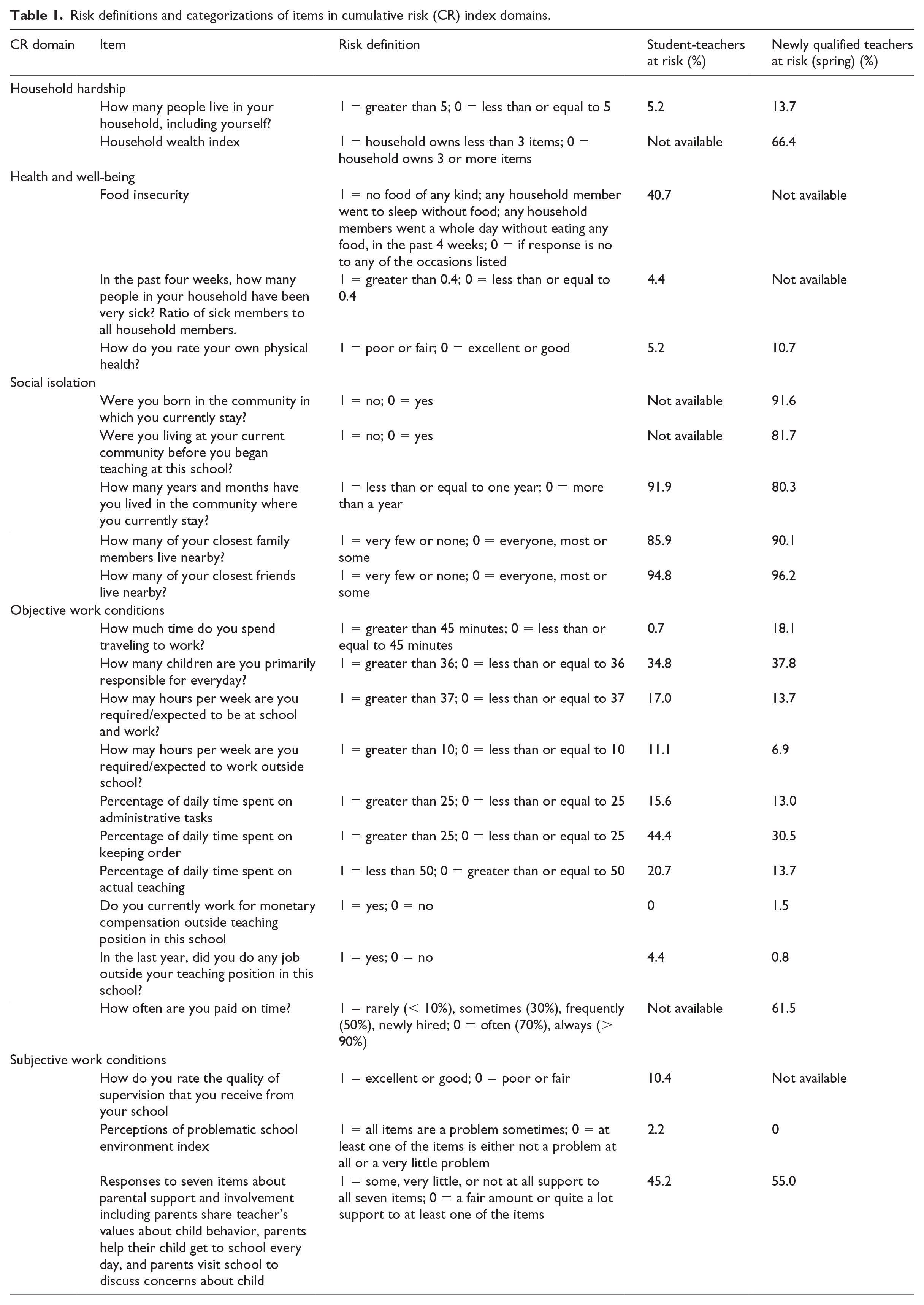
Personal risk factors included risks from three categories: household hardship (number of people living in the household, and household wealth); health and well-being (food insecurity, family health, and personal health); and social isolation (whether born in the community, whether lived in the community prior to placement, number of years living in the community, and proximity to family and friends).
Professional risk factors included risks from two categories: objective; and subjective work conditions. Objective work conditions were measured by length of commute to work, number of students, number of working hours required each week, percentage of time spent on administrative tasks and on actual teaching, whether had another job in the school or outside in the past year and whether paid on time. The subjective work conditions were measured by self-reported quality of supervision by school, perceptions of problematic school environment and parental support towards their children’s education.
The maximum score possible for personal CR for student-teachers was seven and for NQTs was eight. Information on three indicators of personal risk (household wealth, whether born in the community, and whether lived in the community prior to placement) was not collected for the student-teachers but was collected for NQTs. Similarly, information on two indicators (food insecurity and family health) of personal risk was not collected for NQTs but was collected for student-teachers.
The maximum score possible for professional CR for student-teachers and NQTs was 12. Information on whether the teacher was paid on time was not collected for the student-teachers while information on quality of supervision by school was not collected for NQTs. Figure 1 presents the distributions of respective CR indices.
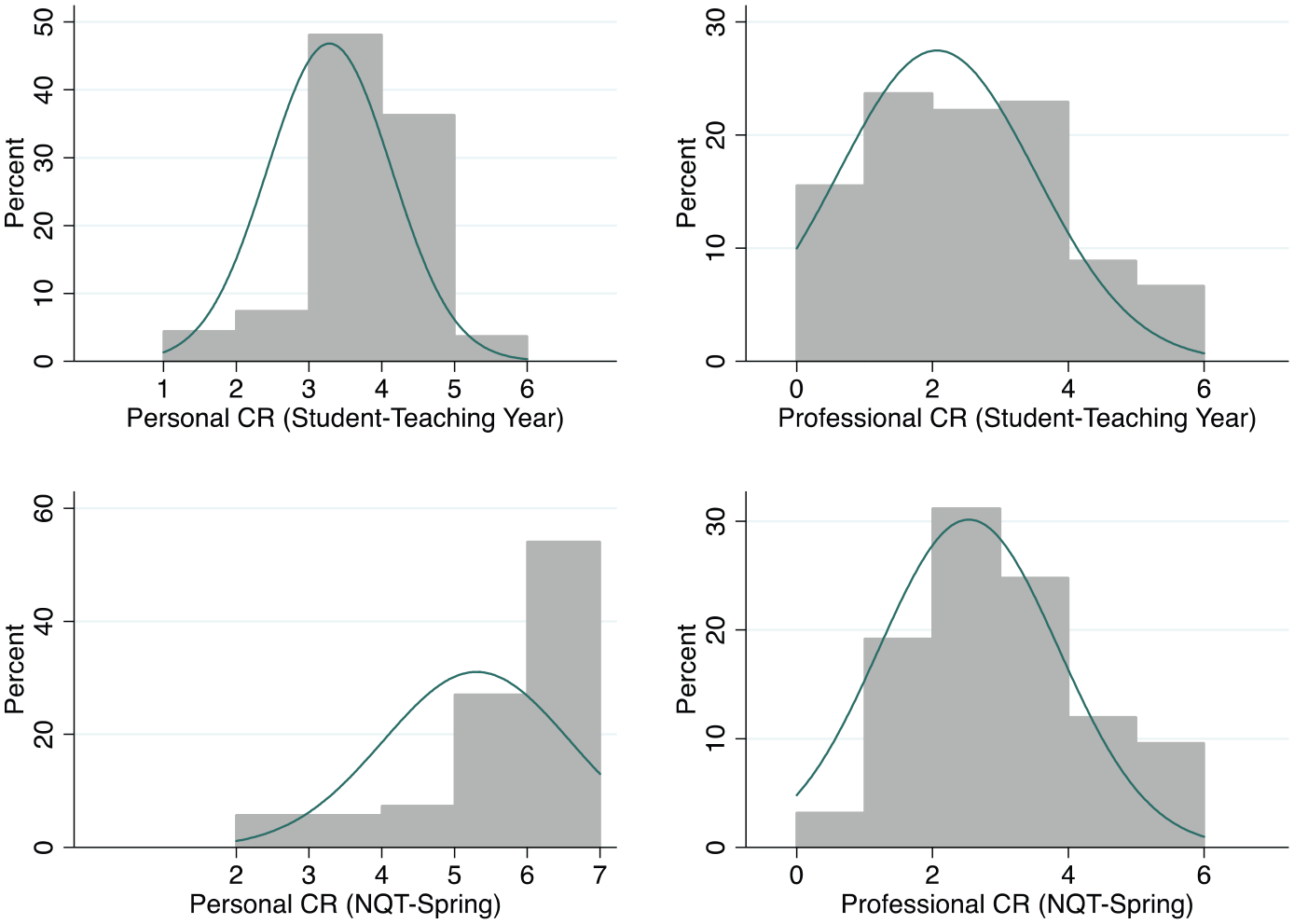
Distributions of respective cumulative risk indices.
Professional well-being
Teachers’ professional well-being was measured by self-reported measures of motivation, burnout, job satisfaction and personal accomplishment.
Motivation was measured using a scale originally developed by Bennell and Akyeampong (2007) as reported in Torrente et al. (2012) and used in Wolf et al. (2015). The scale consists of five items, with scores ranging from 1 to 5 (1 = false, 2 = mostly false, 3 = sometimes true, 4 = mostly true, and 5 = true) for each item. The resulting average score demonstrates moderate internal consistency (α = 0.68 for student-teachers; α = 0.67 for NQTs in spring).
Burnout was measured using 11 items from the Maslach Burnout Inventory, scored on a scale of 1 (never) to 7 (everyday) to indicate the level of fatigue from work (Maslach et al., 1996). The resulting average score demonstrates high internal consistency (α = 0.77 for student-teachers; α = 0.68 for NQTs in spring).
Job satisfaction was measured using another scale developed by Bennell and Akyeampong (2007) and adapted by Torrente et al. (2012) and used in Wolf (2018). The scale consists of six items, with scores ranging from 1 to 4 (1 = true, 2 = somewhat true, 3 = somewhat false, and 4 = false; items were recoded so higher scores reflect higher job satisfaction). The resulting average score demonstrates low to high internal consistency (α = 0.53 for student-teachers; α = 0.70 for NQTs in spring).
Personal accomplishment was measured using another set of eight items from the Maslach Burnout Inventory (Maslach et al., 1996), scored on a scale of 1 (never) to 7 (everyday) to indicate the feeling of accomplishment from work. The resulting average score demonstrates moderate internal consistency (α = 0.69 for student-teachers; α = 0.72 for NQTs in spring).
Child outcomes
Child outcomes were assessed in four domains of school-readiness including literacy, numeracy, socioemotional and executive functioning. Each of these domains were measured using the International Development and Early Learning Assessment tool developed by Save the Children (Pisani et al., 2015).
Early literacy was measured using a scale of 38 items grouped into six subtasks related to print awareness, letter knowledge, phonological awareness, oral comprehension, emergent writing, and expressive vocabulary (α = 0.73).
Early numeracy was measured using a scale of 39 items grouped into eight subtasks related to number knowledge, basic addition and subtraction, one-to-one correspondence, shape identification, sorting abilities based on color and shape, size and length differentiation, and completion of a simple puzzle (α = 0.71).
Social–emotional development was measured using a scale of 14 items grouped into five subtasks related to self-awareness, emotion identification, perspective taking and empathy, friendship, and conflict and problem solving (α = 0.67).
Executive functioning was measured using a scale of ten items grouped into two subtasks related to working memory and impulse control (α = 0.70).
Covariates
A small set of covariates were included in all models. These include the age of the teacher, whether the teacher taught one of two kindergarten (KG) grades, and whether the teacher received training as part of an ongoing randomized intervention of the Fast-Track Transformational Teacher (FTTT) program 1 . Another set of covariates was added for estimates for NQTs once they were placed in 117 schools across eight regions. These include teacher’s prior score for each respective well-being outcome, a set of school controls (whether the head teacher had early childhood education training, a formal system for mentorship and professional development for teachers and whether two NQTs were placed in the same school together (n = 26) to account for potential peer effects), and region fixed effects to control for large geographic and economic disparities across regions. For child outcomes, prior learning (as measured in the fall), grade and gender of the child were included as additional covariates.
Analytic strategy
The association between CR and teachers’ professional well-being was estimated using an ordinary least squares regression model. To address the first research question, which is specifically geared towards student-teachers, the following specification was used:

where Yi is the self-reported well-being score for student-teacher i for motivation, burnout, job satisfaction and personal accomplishment at the end of the student-teaching year respectively. personal CRi and professional CRi are indices for personal and professional CR experienced by them at the end of the student-teaching year respectively. Ti is a set of student-teacher characteristics (age of the teacher, a binary variable for whether the teacher teaches KG grade and whether the teacher received an ongoing randomized intervention of the FTTT program) that may affect the well-being outcome.
The coefficients of interest are α1 and α2, which quantify how observed CR is predictive of teachers’ professional well-being. For motivation, job satisfaction and personal accomplishment, negative coefficients of α1 and α2 suggest that greater personal and professional CRs are associated with lower well-being. For burnout, positive coefficients of α1 and α2 suggest that greater personal and professional CRs are associated with lower well-being.
To address the second research question, we used a similar specification as research question (1) except that we used CR experienced as NQTs as reported in the third wave of data collection to predict teachers’ professional well-being at the end of the first year of full-time teaching. We also controlled for well-being at the start of the first year of full-time teaching, a set of school characteristics (whether the head teacher had early childhood education training, a formal system for mentorship and professional development for teachers, whether two NQTS were placed in the same school) and region fixed effects. We used a similar specification with CR experienced as NQTs at the end of the first year to predict child outcomes at the end of the first year of full-time teaching. We also controlled for the respective child outcome from the fall of the school year and a set of child characteristics (grade and gender).
Robust-clustered standard errors were used to adjust for clustering of NQTs within schools and students within NQTs, respectively. Since there were minimal missing data (described above in the Procedure subsection of the Methods section), we used listwise deletion in the analyses.
Results
Descriptive statistics
Table 2 presents descriptive statistics of CR indices and teachers’ well-being during the student-teaching year, and as NQTs during the first year of full-time teaching. On average, student-teachers reported 3.3 out of seven personal risks (standard deviation (SD) = 0.9) and 2.1 risks out of twelve professional risks (SD = 1.5). NQTs reported 5.3 risks out of eight personal risks (SD = 1.3) and 2.5 risks out of twelve professional risks (SD = 1.3).
Summary statistics of cumulative risk (CR) indices and teachers’ professional well-being outcomes.
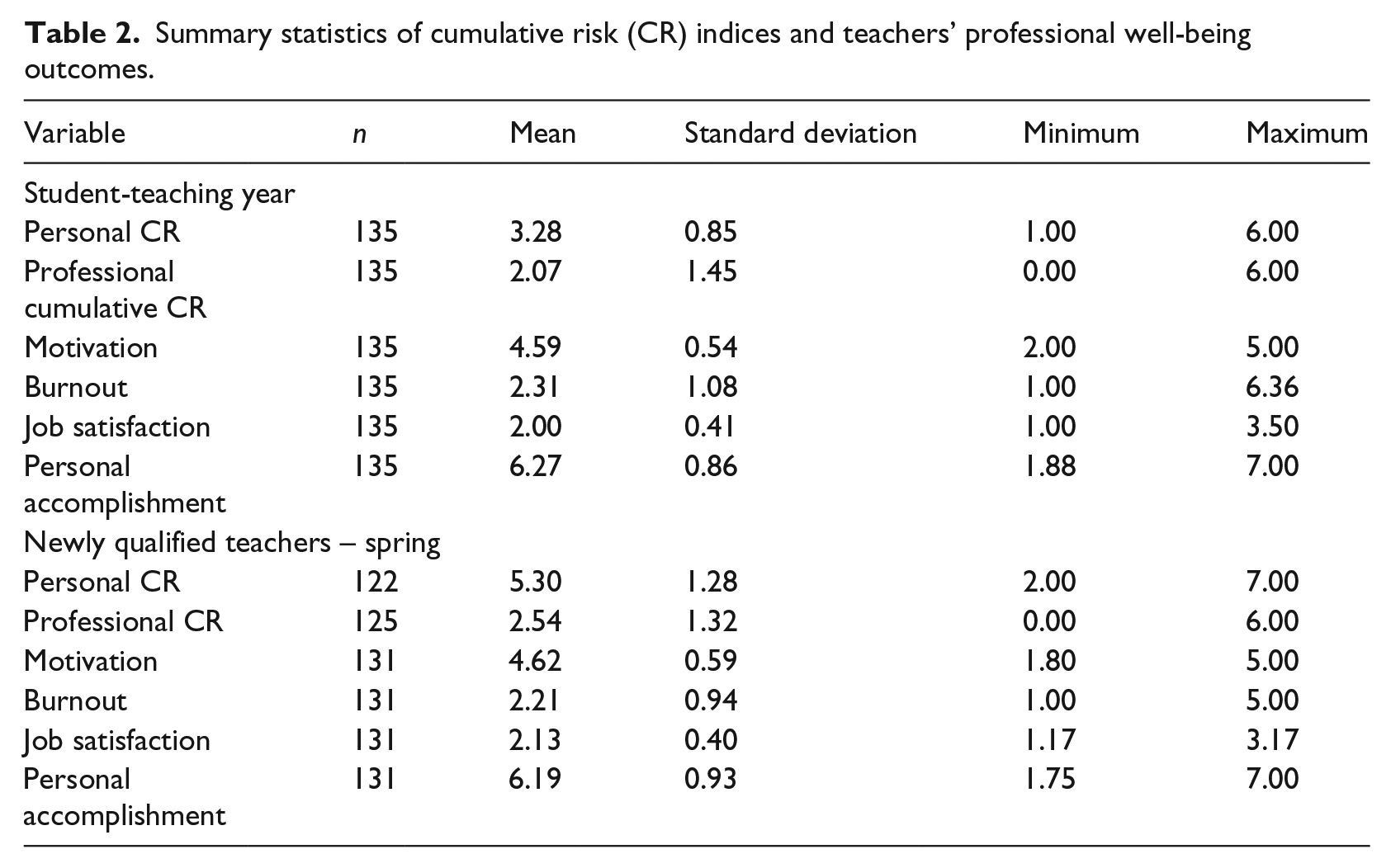
Personal CR reported during the student-teaching year was not significantly correlated with risk reported during the first year of full-time teaching (r = 0.04, p > 0.05). Similarly, professional CR reported during the student-teaching year was not strongly correlated with risk reported during the first year of full-time teaching (r = 0.20, p < 0.05). These correlations confirm that the risks experienced by student-teachers change as they transition into full-time teaching positions.
Multivariate estimates: associations with professional well-being
Table 3 presents regression estimates of the relationship between CR and standardized constructs of teachers’ professional well-being. For student-teachers, there was a marginal but positive relationship between personal CR and burnout (β = 0.17, p < 0.1) while there was a negative relationship of professional CR with motivation (β = −0.16, p < 0.05) and personal accomplishment (β = −0.15, p < 0.05). There was no statistically significant relationship between CR and job satisfaction.
Regression estimates of the relationship between cumulative risk (CR) and teachers’ professional well-being.
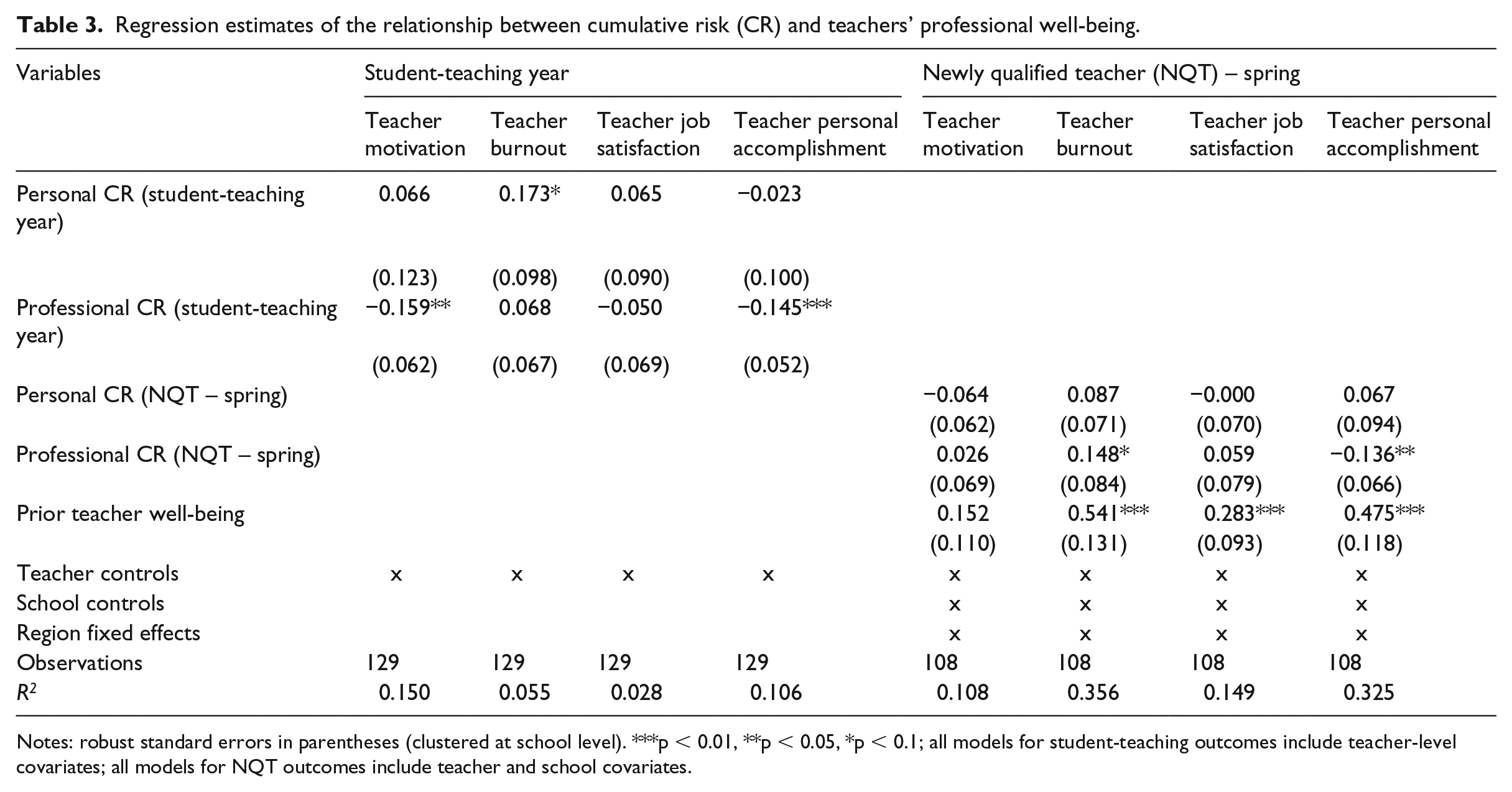
Notes: robust standard errors in parentheses (clustered at school level). ***p < 0.01, **p < 0.05, *p < 0.1; all models for student-teaching outcomes include teacher-level covariates; all models for NQT outcomes include teacher and school covariates.
For NQTs, controlling for well-being at the start of the school year, there was a marginal but positive relation between professional CRs with burnout (β = 0.15, p < 0.1) and a negative relation with personal accomplishment (β = −0.14, p < 0.05) at the end of the first year of full-time teaching.
Multivariate estimates: associations with child outcomes
Table 4 presents regression estimates of the relation between CR and standardized children’s learning outcomes. Controlling for child’s scores at the start of the school year, each additional personal risk was associated with lower child learning in numeracy (β = −0.03, p < 0.05) and marginally associated with lower executive functioning (β = −0.05, p < 0.1). Each additional professional risk was associated with lower socioemotional development (β = −0.06, p < 0.05) at the end of the first year of full-time teaching.
Regression estimates of the relationship between cumulative risk (CR) and students’ learning outcomes.
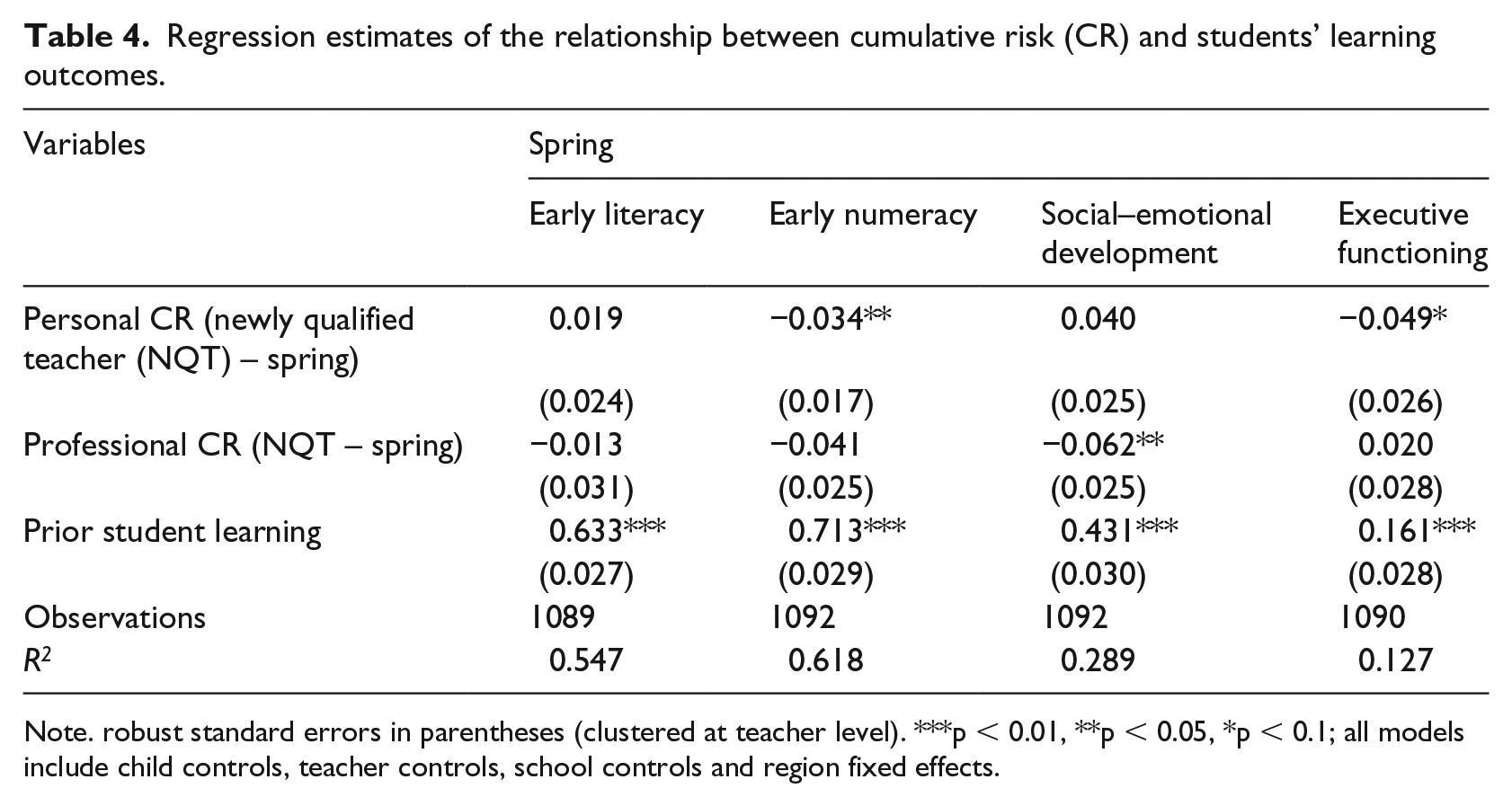
Note. robust standard errors in parentheses (clustered at teacher level). ***p < 0.01, **p < 0.05, *p < 0.1; all models include child controls, teacher controls, school controls and region fixed effects.
Sensitivity analysis
Since there was some variation in the number of indicators available to construct CR indices for the student-teaching and newly-qualified teaching years (refer to Table 1), we repeated the analysis with indices that only included risks that were available in both years. This allowed us to compare results across the two years.
The results did not change substantively. For student-teachers, professional CR was still negatively related with motivation (β = −0.16, p < 0.05) and personal accomplishment (β = −0.16, p < 0.01). Note the magnitude of the estimate for personal accomplishment is slightly higher than before. Similarly, for NQTs, professional CR was still negatively related with personal accomplishment (β = −0.18, p < 0.05). Again, the magnitude of the estimate is higher than before. The only difference was that in both years, professional CR was no longer marginally related with burnout. For child outcomes, personal CR was still negatively associated with learning in numeracy (β = −0.07, p < 0.01); the magnitude of the estimate was higher than before and the relation was more statistically significant. However, it was no longer marginally associated with executive functioning. Professional CR was still negatively associated with socioemotional development (β = −0.05, p < 0.05).
Discussion
With an increasing global focus on teacher quality and effectiveness to deliver the promise of quality education for all children in the post-SDG era, this study brings an important and understudied aspect of professional development of new teachers into discussion. It provides evidence for the need to address personal and professional risks experienced by new teachers, particularly during their transition from pre-service to full-time teaching positions across a country. Personal risks were identified by household hardships, poor physical health, and social isolation. Professional risks were identified by long distances travelled to reach work, large class sizes, extra hours worked inside and outside school, more time spent on administrative tasks than teaching, poor quality of supervision from the principal, and lack of parental support. Our results show that personal and professional risks significantly related to teachers’ professional well-being (measured as teacher motivation, burnout, job satisfaction, and personal accomplishment) and some dimensions of student learning (measured as direct assessments at school). The findings could be particularly meaningful for policy-makers and practitioners as they plan and implement professional development programs for new teachers.
Professional well-being: student-teaching year
During the student-teaching year, personal risks predicted higher burnout, while professional risks predicted lower motivation and personal accomplishment, by approximately 0.15–0.17 SD for each additional risk experienced. The results are consistent with an earlier study examining the relation between CR and well-being of elementary teachers in eastern provinces of the Democratic Republic of Congo (Wolf et al., 2015). The study found that higher levels of personal risk in health and well-being were associated with higher burnout, while higher levels of professional risk in subjective work conditions were associated with lower motivation and higher burnout. Moreover, the study also found no significant association between CR and job satisfaction. Some studies show that job satisfaction is perhaps a product of the wider organizational context of school culture in which teaching and student learning takes place (Banerjee et al., 2017; Kraft and Papay, 2014)—elements of which may not necessarily be captured by the professional CR index used in this study.
Similarly, studies in developed countries have also shown significant associations between student-teachers’ experiences and their motivation and competence in teaching. Korthagen and Evelein (2016) found that fulfillment of psychological needs (such as autonomy, competence, and relatedness) of student-teachers was positively associated with their interpersonal teaching behavior in The Netherlands. Similarly, Tang et al. (2016) identified that student-teachers’ self-perception of competence to work in schools was significantly related to their professional learning and teaching motivation in Hong Kong. Other studies have found that personalities, attachment, and emotions of student-teachers with which they began a pre-service program were associated with the quality of teaching practices during their student-teaching year in the United States (Ripski et al., 2011; Wiens and Ruday, 2014).
These findings emphasize the need for well-structured training programs in cohorts that allow student-teachers to manage household responsibilities and engage in constructive and meaningful interactions with peers and students (DeAngelis et al., 2013; International Institute for Educational Planning, United Nations Educational, Scientific and Cultural Organization, 2018). Similarly, integrated field experiences throughout the student-teaching year can help teachers become familiar and confident in the local language and culture of the schools where they will potentially be placed along with their cohort peers (Sokal et al., 2013). Such programs could help address different personal and professional risks that are related to low professional well-being among student-teachers. Further, studies also show how student-teachers’ experiences are associated with their intentions to stay in the teaching profession within the first two years of teaching (Rots et al., 2010; Vagi et al., 2019). Therefore, such programs could also help retain new teachers in the education system.
Professional well-being: newly-qualified teaching year
During the newly qualified teaching year, professional risks predicted higher burnout and lower personal accomplishment by approximately 0.14–0.15 SD for each additional risk experienced. Personal risks did not predict well-being. This is not surprising since studies show that teachers are likely to experience most personal risks at the start of the school year, particularly when they are deployed away from their homes or in remote/rural communities where they feel socially isolated (Bennell and Akyeampong, 2007; Thomas et al., 2014). By the end of the year, teachers tend to better adjust to their conditions. Note that we controlled for well-being at the start of the year and therefore captured the relation between personal risks and teacher well-being at the end of the year accounting for the initial level of well-being.
On the other hand, professional risks have been found to take a higher toll during the first year of teaching, and our findings suggest a similar pattern. Studies show that new teachers are more likely to leave teaching due to working conditions that offer little support in curriculum development and instruction (Mulkeen, 2010; Organization for Economic Cooperation and Development, 2018). Specifically, Ingersoll and Smith (2003) found that new teachers were likely to be dissatisfied due to poor salaries and school working conditions that include student discipline problems, lack of support from school administration, low student motivation, and lack of space for teachers to participate in school related decisions. Similarly, Meister and Melnick (2003) identified managing behavior and diverse needs of the students, time constraints and workload, and conflict with students’ parents and other adults as major concerns during teachers’ transition from pre-service to in-service training.
Strategic placement could help reduce personal risks of household hardships and social isolation at the start of the school year, especially for teachers placed in rural communities. An earlier study by Hedges (2002) suggests that deployment systems in Ghana should place NQTs, particularly young women, in rural communities near family, or place two NQTs together in the same school, to help teachers settle in difficult locations. Further, work environments that offer constructive mentorship and strong support systems positively relate to teacher well-being and student learning (Barnes et al., 2018; Ingersoll and Strong, 2011; Mulkeen, 2010; United Nations Educational, Scientific and Cultural Organization, 2018). Such interventions could help address both the personal and professional risks that are related to lower personal accomplishment and higher burnout in the first year of teaching.
CR and child outcomes
Among the children in the classrooms of NQTs, there was a significant association between teachers’ personal risks and lower child numeracy skills, and a marginally significant association with lower executive functioning. Further, there was a significant relation between professional risks and reduced social–emotional skill development. While these effects were small, ranging from 0.03–0.06 SD, they were meaningful given that we controlled for each respective child outcome at the start of the year. The findings suggest that children’s learning is affected by the stress in teachers’ personal and professional lives. While we do not study the mechanisms of these associations, previous studies show that low teacher motivation is a precursor of poor classroom climate and teacher–student interactions, which can have serious impacts on student learning outcomes (Collie and Martin, 2017; Martin, 2009). Similarly, high burnout and low personal accomplishment are associated with high teacher attrition in other contexts (Maslach et al., 2001), which can have additional adverse consequences for student achievement (Cooper and Alvarado, 2006). The results suggest that addressing teachers’ personal and professional stressors is a central part of improving educational quality and student learning.
Limitations and conclusions
This study has numerous strengths, including a longitudinal sample of teachers during their transition from pre-service to full-time teaching in an understudied context, as well as assessments of their students during the first year of teaching, which provides an opportunity to study a critical stage of early teaching career. Yet the findings must be interpreted in light of the study’s limitations. First, the study relies on self-reported measures of teacher well-being, which may not be accurate representations of true well-being (Sudman et al., 1997). Second, the sample size is small with some missing data, potentially limiting the power to detect statistically significant associations. Third, the sample is drawn from one college in a rural part of western Ghana, which limits the generalizability of the findings both within and outside of Ghana. Nonetheless, the findings suggest that this area is worthy of further investigations for teachers across the country and in other countries.
These results have implications for teacher well-being and educational quality improvement efforts, and more widely for teacher retention and student learning outcomes. We found that the CRs persist across the transition of student-teaching into full-time teaching positions, which was associated with lower teacher well-being across time. Studies have shown that teachers with low motivation and high burnout are likely to leave their jobs and teaching professions (Das et al., 2007; Mulkeen, 2010). Specifically, in Ghana, earlier research has shown that the positive attitudes of new teachers towards teaching deteriorated in the initial years and a majority of the teachers speculated about leaving teaching within five years (Akyeampong and Lewin, 2002). This aligns with more recent research from Malawi that shows targeted deployment of new teachers with incentives is closely linked to teacher retention (Asim et al., 2019). Research also shows that poor teacher well-being and retention have important implications for their students’ learning outcomes. Demotivated and dissatisfied teachers are more likely to be absent and less likely to prepare lessons or engage with students, which relates to poor socioemotional development and learning outcomes across children (Collie and Martin, 2017; McLean and Connor, 2015; Tsouloupas et al., 2010).
These are important implications that merit attention for improved teacher incentives and support systems, especially in the initial years of teaching. In a comparative study on teacher motivation and incentives in low-income developing countries in sub-Saharan Africa and Asia, Bennell (2004) identified occupational status, job satisfaction, pay and benefits, recruitment and deployment, attrition and absenteeism as the main areas of concern. Further, Bennell and Akyeampong (2007) recommended improved incentives for rural teachers, improved conditions of service, attractive career structures, increased teacher accountability and regular professional development interventions to improve teacher motivation in these countries. Asim et al. (2019) also recommended targeted data-driven financial incentives for teachers deployed in most rural or remote schools. Similar dimensions have been identified in a recent review of 30 studies related to preschool teacher well-being in developed countries—compensation, education levels, satisfaction and stress, emotional competence, teachers’ sense of community, health and pressures associated with emotional change (Hall-Kenyon et al., 2014).
In the light of these studies, a number of steps could be taken to address the different dimensions of risk and consequently improve teachers’ well-being. First, wage incentive programs could be particularly beneficial to alleviate household hardships and improve teachers’ health and living conditions. Second, well-structured training programs, especially in cohorts, could provide a close sense of community and reduce social isolation, especially for student-teachers. Integrated field experiences could help student-teachers become more familiar with the school systems and nearby communities where they may be potentially deployed. Third, effective deployment systems that place NQTs in cohorts or in places they are familiar with, could help them transition to full-time teaching more easily. Finally, positive work environments with strong support systems and mentorship could improve the working conditions of NQTs, and consequently help them to be more effective in classrooms and improve their students’ learning. Such interventions could help alleviate personal and professional challenges experienced by new teachers and have important implications for improving education systems in Ghana and other countries.
Footnotes
Funding
The author(s) disclosed receipt of the following financial support for the research, authorship, and/or publication of this article: This work was supported by the Department for International Development [PO 40099059] and The Marple Charitable Trust [PO MCT0001].