




Abstract
Cooperative learning can be considered as an umbrella term for a number of classroom practices. In this paper we consider the educative nature of cooperative learning in physical education, and we have challenged ourselves to examine how cooperative learning can enhance the education of young people. We do this by revisiting cooperative learning’s Deweyan foundations and hold that such a move would be a constructive way forward for cooperative learning in physical education. We argue that there is a risk, in not going back to its educational roots, that cooperative learning might just become another way to teach, for example, games or sports, and that it currently puts too much emphasis on destination rather than journey. We suggest that using Dewey’s idea of education and experience would add: a situational element, a directional element, a temporal element, a communal element and an educative element. In this way, the use of cooperative learning in physical education can move away from exclusively developing students’ skills, towards an open-ended process of becoming where a diversity of students transform and are being transformed by one another.
Introduction
Fifteen years ago, Barrett (2005) wrote about a beginning literature on cooperative learning in physical education. Since then there has been an upsurge in empirical research on various aspects of the use of cooperative learning as a pedagogical model in physical education practice (Casey and Goodyear, 2015). Such is the prevalence of cooperative learning in the teaching, learning, curriculum and context, i.e. the pedagogy of primary/elementary school (Dyson, 2001), secondary/middle/high school (Casey, 2013) and university (Cohen and Zach, 2013) physical education, that the model’s place in our subject is unmistakable and secure.
Kirk (2013, 2017) has positioned the work of Jewett and Bain (1985) as seminal in the conceptualisation of what we now know as Models-Based Practice. In their original thesis on curriculum models, Jewett and Bain (1985) presented a notion of curriculum planning that started with public need and ended in local curricula. They argued that public policy should be used to create ‘a coherent group of general propositions’ (Jewett and Bain, 1985: 13), i.e. theories concerned with ‘the goals of society, the role of the individual within the broader society, and the kind of future world desired’ (Jewett and Bain, 1985: 14). They then posited that these theories should be operationalised through conceptual frameworks, i.e. ‘structures which attempt to systematically describe the curriculum’ (Jewett and Bain, 1985: 14) that, in turn, are actualised through a model which, in this case, is cooperative learning. That said, and as we will argue in this paper, there has been a narrowing consensus in physical education around what cooperative learning is, does and must contain for it to be understood as cooperative learning. There has also been a narrowing consensus regarding the theoretical basis for the use of cooperative learning as part of Models-Based Practice (Casey and Kirk, in press).
What is lacking from Jewett and Bain’s original thesis is a sense of to-ing and fro-ing between theory, conceptual frameworks, models and curricula. Consequently, and as we will argue is the case for cooperative learning in physical education, this lack of reconsideration (Casey, 2016) has solidified the model to such a degree that there seems to be only one way of ‘doing it’. Such a fixed definition of cooperative learning potentially limits an ambition to make good on the kind of future world we desire (see for example Jewett and Bain, 1985).
Drawing on the recent work of Casey et al. (2018), we will argue that not only should there be no single notion of cooperative learning, but that a theoretical re-understanding of cooperative learning using educational theory would offer a broader and increasingly malleable understanding of the model. In an effort to challenge the narrowing and solidification of a single notion of cooperative learning in physical education, we are revisiting the Deweyan foundations of cooperative learning (see Schmuck, 1985; Sharan, 2010, 2015) and hold that such a move could be a constructive way forward. We use the work of Dewey, predominantly his ideas of experience and education, to frame our thoughts and centre our arguments on the need for children’s and young people’s experience in schools to be ‘one of education of, by, and for experience’ (Dewey, 1938: 29). Our purpose is accordingly to discuss what Dewey’s ideas of education as growth of experience can add to current conceptualisations and uses of cooperative learning as a pedagogical model in physical education.
What is cooperative learning?
Cooperative learning can be considered as an umbrella term for a number of classroom practices. Slavin (1985: 6) argued that ‘cooperative learning methods are structured, systematic instructional strategies’, while Johnson and Johnson (1999: 72) held that they are ‘the instructional use of small groups so that students work together to maximise their own and each other’s learning’. Despite the classification of a number of instructional approaches that fit under the term ‘cooperative learning’ (Schmuck, 1985; Slavin, 1985), this family of approaches has been predominantly influenced by social psychological research and theory. Slavin (1985: 7) posited that the ‘engine’ that powers cooperative learning is always the same, i.e. heterogeneous groups working together to reach common goals. That said, he concluded that the methods of actual cooperative learning differ in almost every other way. This diversity occurs, according to Slavin (1985), because all cooperative learning methods are adapted in different ways when they (a) are used to meet the intended practical requirements of the classroom and (b) are manipulated to solve the problems introduced by cooperative learning itself (i.e. maintaining the individual’s accountability while working towards a group’s goal). Given the mixed heritage of cooperative learning, and the interchangeable use of terms like ‘method’, ‘instructional’ and ‘learning’, it is important to consider the model’s epistemological cornerstones, in our case in physical education.
History of cooperative learning in physical education
From the outset, the use of cooperative learning in physical education has been heavily influenced by the Johnson brothers (Johnson and Johnson, 1975). Orlick (1978) drew on Johnson and Johnson’s work to argue for a shift towards the use of cooperative games in physical education. While his focus was on cooperative games, he was the first in physical education to draw on Johnson and Johnson’s work alongside Deutsch’s (1949) social interdependence theory. He used Johnson and Johnson’s ideas to argue that cooperative children were better able to identify the needs of others than competitively orientated children.
Roger Johnson’s work was one of the first to mention cooperative learning in physical education. Johnson et al. (1984b) argued that cooperative goal structures promoted putting skill in golf and positive attitudes towards the instructor and one another. Five years later the focus on positive goal structures continued through the work of Grineski (1989), who reported that cooperative goal structures improved affective outcomes by enhancing students’ pro-social behaviours. Grineski (1991, 1996) repeated this argument when using the works of Johnson and Johnson to emphasise the need for group goals.
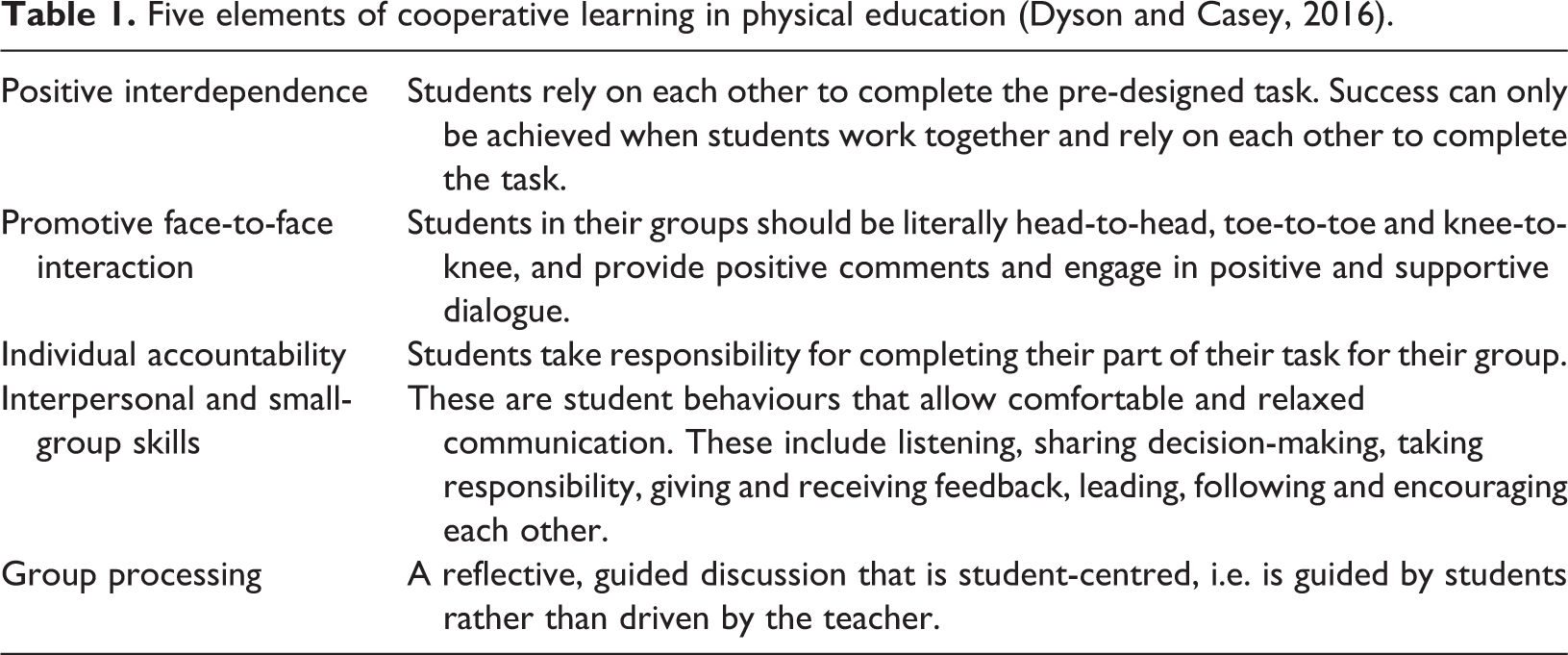
Although Dunn and Wilson (1991) drew on Kagan (1989) to position the use of cooperative learning in physical education, the emphasis on Johnson and Johnson’s work continued throughout the 1990s. Yoder (1993), for example, emphasised three of the four elements (positive interdependence, individual accountability and face-to-face contact) proposed by Johnson et al. (1984a) in their earlier interpretations of the model. The five elements (see Table 1) again appeared in a Cooperative Learning in Physical Education symposium presented at the 1997 American Alliance for Health, Physical Education, Recreation and Dance
Five elements of cooperative learning in physical education (Dyson and Casey, 2016).
Dyson’s work in the 2000s further positioned the five elements as central to teachers’ practices (see Dyson, 2001, 2002; Dyson and Grineski, 2001; Dyson and Strachan, 2000). Yet in beginning to move the understanding of cooperative learning forwards, Dyson (2001, 2002) added Cohen’s perspective to his earlier discussions around different schools of thought. Despite this, the five elements remained central to Dyson’s arguments pertaining to the design of cooperative learning environments.
The decision to select Johnson and Johnson as the dominant theorists to underpin Dyson’s argument has had far-reaching implications on the research, theory and practice of cooperative learning in physical education. Although Barrett, initially in his PhD dissertation in 2000 and then through the 2000s, drew more on Slavin, his decision not to continue to publish in the field curtailed the influence he had on research and practice. Notwithstanding this, Barrett (2005) presented Performer and Coach Earn Rewards (PACER) as an adapted version of Slavin’s Student Teams Achievement Division. Similar to Slavin (1991), Barrett (2005) argued that team rewards, individual accountability and interdependent group contingency (i.e. positive interdependence) were central factors in learning. Ward and Lee (2005), citing Barrett (2005), also argued that while Johnson and Johnson’s elements were reported to influence learning, Slavin and others’ meta-analyses demonstrated that positive interdependence and individual accountability were the only universally agreed-upon elements of cooperative learning. Ward and Lee (2005) argued that identifying the essential characteristics of cooperative learning for physical education was important, while simultaneously acknowledging that this undertaking would be an ongoing challenge. Although Barrett (see Cervantes et al., 2007) further advocated for the structure of PACER, his advocacy of Slavin’s work was short lived.
Similar to Barrett, Goudas and Magotsoui’s (2009) examination of verbal exchanges used more than Johnson and Johnson’s perspective. They applied a different approach, i.e. conceptual, curricular, structural or complex, in different lessons within a unit of activity. Although it is documented that students need time to learn the organisational structure of cooperative learning (see for example Dyson and Casey, 2016), Goudas and Magotsoui (2009) acknowledged the diverse ways cooperative learning could be used. However, such diversity is less apparent in other cooperative learning in physical education literature, with most studies emphasising Johnson and Johnson’s five elements (see for example Lafont et al., 2007) and the use of learning teams (Casey and Goodyear, 2015).
The collaboration between Dyson and Casey (see for example Dyson and Casey, 2012, 2016) has done much to cement the five elements as the cornerstones of theory, research and practice. Dyson and Casey (2016: 4) positioned the five elements as ‘critical elements which [they] believe act as explicit guidelines in the successful implementation of cooperative learning in physical education’. In fact, Dyson and Casey’s collaborative work is widely cited as an empirical justification for how cooperative learning should be practised in contemporary physical education literature (see for example Fernandez-Rio et al., 2017; Sutherland et al., 2014).
An observation pertaining to the way cooperative learning is practised is that Johnson and Johnson’s five elements are used alongside Kagan’s structures and Slavin’s methods (see for example Dowler, 2014; Dyson and Casey, 2016; Fernandez-Rio et al., 2017; Wallhead and Dyson, 2015). While Kagan (1992) advocated the use of PIES (
Darnis and Lafont (2015) are, to our knowledge, one of the few voices to advocate for an alternative to Johnson and Johnson. Similar to Barrett (2005) and Cervantes et al. (2007), Darnis and Lafont (2015) drew on Slavin’s curricular approach to explore how cooperative learning could maximise student learning. In exploring dyadic interactions, these authors (Darnis and Lafont, 2015) argued that the empirical evidence illustrated Slavin’s perspective of cooperative learning as an example of reconciliation between motivation and development. Furthermore, they stressed the importance of group goals influencing interactions and, in turn, motor performance.
It is clear that Johnson and Johnson – through their five elements – are the key theorists underpinning cooperative learning in physical education. The approaches advocated by Slavin and Kagan, and to a lesser extent Cohen, are evident within empirical literature, albeit through the diverse ways in which cooperative learning is being conceptualised and practised.
The unacknowledged contribution of Dewey
The ideas of cooperative learning in education in general were borne out of both the epistemology of pragmatic philosophy (John Dewey) and the positivist epistemology of developmental psychology (Kurt Lewin) (see for example Mitchell et al., 2008; Schmuck, 1985; Sharan, 2010, 2015). The combination of pragmatism and positivism led Schmuck (1985: 3) to suggest that early work in cooperative learning ‘represented a combination of science, therapy, social reconstruction, intervention, and morality’. The ‘cross-pollination’ of behaviourist and constructivist epistemologies goes some way to explaining the multiplicity of cooperative learning approaches in general. It also explains the interchangeable ways in which concepts such as learning, learners and development, as well as the categorisation of children (rather than contexts, events or situations) as being ‘cooperative’ or ‘competitive’, are used in the literature.
Digging deeper into the genesis of cooperative learning, Schmuck (1985) argued that cooperative learning owes much of its early intellectual development to the work of John Dewey and Kurt Lewin, Ronald Lippitt and Morton Deutsch. While both Dewey and Lewin shared the common interest and ‘pioneering spirit…to improve social interaction and cooperation in schools’ (Schmuck, 1985: 2), their respective approaches to such improvement differed considerably. Dewey, for his part, argued for a philosophy of education that saw the intimate and necessary connection between experience and education. In other words, he argued that to live and act cooperatively humans had to experience cooperation in a continuous and mutually constituting process (Schmuck, 1985). Cooperation is accordingly something we ‘do’ and ‘live through’ in the context of our everyday lives. In contrast, Lewin and colleagues adopted a more practical, scientific approach to cooperation that hinged on group dynamics and the fundamental processes of cohesiveness and locomotion. 1
Sharan (2015: 87) argued that cooperative learning in general represents ‘a diversified body of methods and instructional procedures with increasingly diverse applications’ and strong theoretical foundations. Yet, cooperative learning in physical education has predominantly followed and built on one theoretical perspective and, therefore, one set of methods and procedures, i.e. Deutsch’s work on social interdependence. These methods and procedures, informed as they are by social interdependence theory, have been the dominant focus of research and practice on cooperative learning in physical education (Casey and Goodyear, 2015; Goodyear, 2013). Physical education has further positioned Johnson and Johnson’s five critical elements (see Table 1) as a pentagonal scaffold that should be used to support students’ learning (Casey et al., 2015) and has in many respects ignored how, for example, group goals or rewards (Slavin, 1991), group accountability (Cohen, 1994) and the use of multiple cooperative learning structures (Kagan, 1992) could be used. In fact, Johnson and Johnson’s (1975, 1991a, 1991b) five elements of positive interdependence, individual accountability, interpersonal and small-group skills, promotive face-to-face interaction, and group processing (see Table 1) have been proposed as the central criteria to validate and authenticate teachers’ uses of cooperative learning (Casey et al., 2015). Significantly, while the ideas of Slavin, Kagan and Cohen are used to some extent in the literature on cooperative learning in physical education, what is completely missing is educational thinking and theorising. Research on cooperative learning in physical education has thus, as we see it, only explored the tip of the iceberg. Our ambition is to remedy this lack of educational theory by returning to and reintroducing the work of John Dewey and his work on education as growth of experience, which we think can add to current, and dominant, conceptualisations and uses of cooperative learning as a pedagogical model in physical education.
Dewey: education, experience and cooperative learning
Despite the growing body of work on cooperative learning in physical education, Dewey’s work around education (which, as shown above, formed part of the foundation of cooperative learning theory and practice) is conspicuous by its total absence in the physical education literature. Revisiting the 27 papers used by Casey and Goodyear (2015) in their review of literature, for example, shows that Dewey’s name does not appear in a single paper. This clearly suggests a narrowing consensus in the field regarding what cooperative learning as a pedagogical model in physical education is, does and must contain. Our ambition in this paper is to discuss what a revisiting of some of Dewey’s ideas can add to current conceptualisations and uses of cooperative learning in physical education. We will focus on his ideas on education as growth of experience, which we think can add an educational foundation and theorisation to the familiar five elements of cooperative learning in physical education, building mainly on social interdependence theory (see for example Dyson and Casey, 2016).
Dewey’s extensive oeuvre on a wide range of issues related to education, such as learning, reflection, habits, inquiry, aesthetics and how education is closely connected to democratic societies, has been used in numerous ways in education (see for example Biesta and Burbules, 2003; Garrison et al., 2012). Throughout his writing, Dewey argued for a transactional approach to experience and noted that ‘[a]n experience is always what it is because of a transaction taking place between an individual and what, at the time, constitutes his [sic] environment’ (Dewey, 1938: 43). It is accordingly a perspective embracing experience in the environment rather that of or about the environment. According to Dewey, ‘all genuine education comes about through experience’ (1938: 8) since it is through the active reconstruction of experiences that new meanings, new actions and new habits develop. Education in this perspective is accordingly ‘that reconstruction or reorganization of experience which adds to the meaning of experience’ (Dewey, 1916: 76), in terms of a process or possibility for growth.
Education as growth of experience is, according to Dewey, an ongoing, continual process and not something ever completed (Dewey, 1916, 1938), and is thus to be conceived as an active constructive process where we (trans)act in the world, through our experiences. Knowing something, like cooperation, thus becomes a way of doing where both the person experiencing and what is experienced have a potential for change (Dewey and Bentley, 1949).
This also involves connecting the past (previous experiences) with the future (the direction of the experiences) (Dewey, 1938). Dewey stipulated two aspects that allowed us to consider the educative value of experience: interaction and the continuity of experience. Accordingly, in order for an experience to be educative it should enable further experiencing in the context of our lives through, for example, expanding boundaries, increased complexity or promoting the ability for, and engagement in, ongoing learning. For Dewey, experience was vital because without it learning would not be available in the ‘actual conditions of life’ (Dewey, 1938: 48). Indeed, he reasoned that ‘perhaps the greatest of all pedagogical fallacies is the notion that a person learns only the particular thing he [sic] is studying at the time’ (Dewey, 1938: 48). Dewey consequently did not argue for docility, receptivity and obedience from learners, but education of, for and by experience. In relation to cooperation, Dewey (1938: 43) argued that: There is, I think, no point in the philosophy of progressive education which is sounder than its emphasis upon the importance of the participation of the learner in the formation of the purposes which direct his activities in the learning process, just as there is no defect in traditional education greater than its failure to secure the active cooperation of the pupil in construction of the purposes involved in his [sic] studying.
This does not mean that we should rely on spontaneity or leave children to their own devices, surrounded by bats, balls and gymnastic apparatuses with teachers refusing to speak lest they breach the personal autonomy of their students (Dewey, 1938). Instead it means that we, for example through cooperative learning, seek to organise the conditions of experience. The way to achieve this is, first, for the teacher to be intelligently aware of the capacities, needs and past experiences of those under instruction, and, secondly, to allow the suggestion made to develop into a plan and project by means of the further suggestions contributed and organised into a whole by the members of the group. The plan, in other words, is a cooperative enterprise, not a dictation. The teacher’s suggestion is not a mould for a cast-iron result but is a starting point to be developed into a plan through contributions from the experience of all engaged in the learning process. The development occurs through reciprocal give-and-take, the teacher taking but not being afraid also to give. The essential point is that the purpose grows and takes shape through the process of social intelligence (Dewey, 1938).
The purpose of cooperative learning in education, in a Deweyan sense, is accordingly that it should be educative in terms of ‘enriched growth of further experience’ (Dewey, 1938: 73). However, this is not about total freedom for students to do anything. If it were, why bring learners together as a class at all? Dewey’s (1938) argument was not that experience, in and of itself, is a good teacher but that education has been reduced to either meaningless opportunities to create experience or teachable activities that then come to define education. Dewey (among many others since) argued that we do not learn only the ‘one thing’ we are studying at the time, nor are there a certain number of facts and truths that define an educated person. Education instead is valuable when it is ‘available under the actual conditions of life’ (Dewey, 1938: 48).
Educational and experiential cooperative learning in physical education
When we consider Johnson and Johnson’s five elements (Table 1) through Dewey’s educational theory, we can see them as ‘a starting point to be developed into a plan through contributions from the experience of all engaged in the learning process’ (Dewey, 1938: 72). As we see it there is a risk in using Johnson and Johnson’s five elements exclusively. Such exclusivity brings with it the potential risk that cooperative learning just becomes another way to teach, for example, games or sports rather than being an open-ended transactional process of becoming where students transform and are being transformed by one another.
If teachers strive for situations in which each child is individually accountable and positively interdependent then they are creating a learning environment in which those under instruction are making a contribution to the nature and direction of the lesson. The reciprocal give-and-take inherent in promotive (face-to-face) interaction, interpersonal and small-group skills and group processing go a long way to creating a learning environment in which ‘it is not the will or desire of any one person which establishes order but the moving spirit of the whole group. The control is social, but individuals are parts of a community, not outside of it’ (Dewey, 1938: 54). Furthermore, the focus on accountability and particular skills risks pointing to cooperative goals outside of the experiences of the participants (e.g. winning a game or creating flow in a game) instead of learning different ways to participate in relation to the collective purpose (what Dewey calls our ends-in-view) in each event shared by all participants.
Consequently, we argue that adding educational theory as we suggest, in terms of Dewey’s ideas of education and experience (see Figure 1), to Johnson and Johnson’s five elements adds a broader educative element to the pedagogy of cooperative learning in physical education. Such an educative element would redirect focus towards the capacity of further and richer experiences, expanding the possibilities for further actions and experiences where cooperation is lived, and thus being something that should be discovered in an embodied process of inquiry. This, we envision, might be the first step in adopting Dewey’s ideas.
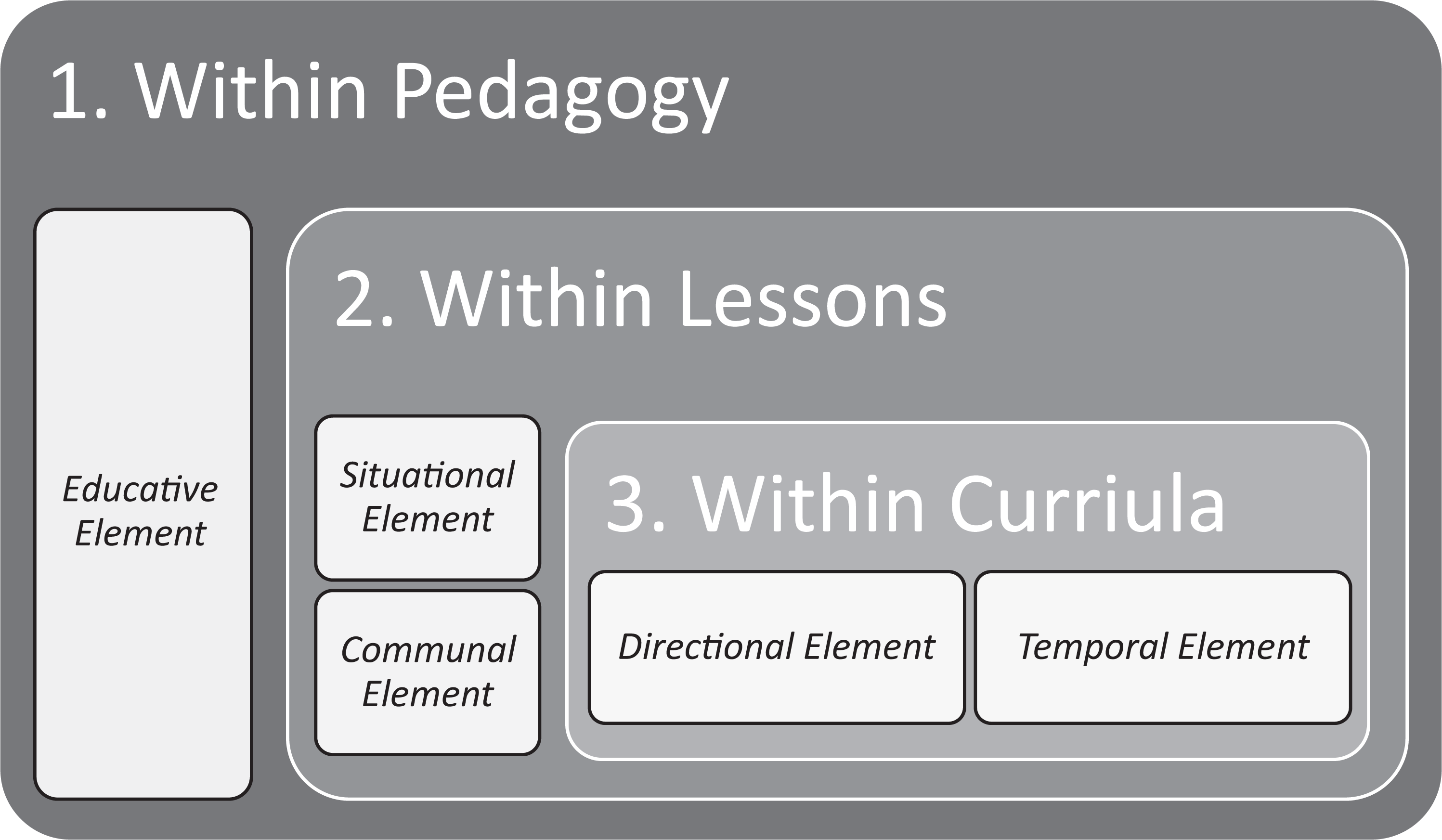
Illustration of educational theory encountering cooperative learning in PE.
From there, we would encourage practitioners to make a situational element and a communal element within their lessons possible. A situational element acknowledges that it is events in education that, in a transactional perspective, should be considered as cooperative. This involves a shift from making children cooperate to regarding children as participants in cooperative events. A communal element helps teachers to recognise that students have different ends-in-view when participating in cooperative learning activities. These ends-in-view should be discussed and reflected upon in order for cooperation to be made into something in common.
Finally, a practitioner would refine the directional element and the temporal element of their curricula (i.e. their long-term approach to education). A directional element involves a shift from teaching cooperation as something specific – a thing to be learned – to experiencing and living through the consequences of cooperative actions as participants in a transactional process. A temporal element involves a process of becoming, where all students’ diverse previous experiences are taken into account, and where cooperative learners make new and revised meanings in experience in relation to an open-ended future regarding what it means to cooperate.
Such an argument, of course, runs the risk of muddying the waters of cooperative learning; waters in which we want students to sink or swim together. That is not our intention. Instead, we want to expand cooperative learning used as a pedagogical model using educational theory (since the E in PE indicates it should be about education) and help to engender situations in schools where students transform and are being transformed by each other. As such, we feel it is important to move beyond proposition and provide some examples of what an encounter between Deweyan educational theory and cooperative learning as a model might offer. In doing this we recognise that ‘education is a complex endeavour and that education rarely functions in mechanistic ways, where a certain input or intervention will produce a certain outcome’ (Quennerstedt, 2019: 613). As such, including the suggested five elements in education does not make something cooperative. Dewey (1916) argued that education should not be conceived of as preparation for an idealised future set up as a pre-given standard for children to achieve, but as a continual transforming of experience that adds to even further growth of experience. But how do we apply this to cooperative learning in physical education? In the following subsection we do this by imagining a gymnasium and beginning to articulate possible actions of the teacher and her pupils in this space.
Elements of cooperative learning using educational theory
The educative element puts Dewey’s idea of education as growth in the foreground, and the understanding of further and richer experience to come. One of Dewey’s (1938) criticisms of traditional education was not the absence of situations in which experience could be found, but its failure to utilise these situations to help students see what alternative understandings the situation might provide. In this sense cooperation should not be something specific to be taught but something to be discovered, whilst also challenging taken for granted assumptions about what it means to cooperate and why. For Dewey, a situation is accordingly educative only if by the education we remain open to richer and more enhanced experiences (i.e. growth of experience). Such an element makes fixed pre-lesson learning objectives highly flexible at best, and instantly obsolete at worse. If our teacher is interested in cooperation as the purpose of her teaching, then she needs to focus on open-ended educative experiences over fixed bodies of knowledge. In this way, the activity (i.e. what is on offer) plays second fiddle to the educative purpose (why) as well as the pedagogical process (how), even if they are, of course, always connected. Consequently, our teacher would prioritise the act of cooperation (e.g. working together) over, for example, her students’ success or failure in the activity in terms of scoring, winning or creating a good, enjoyable game.
When entering our imaginary gymnasium, our teacher keeps her focus on cooperation. Everything else, outside of the safety and welfare of the young people in her care, is in the background. She may have chosen to use Ultimate Frisbee as the medium through which her class can discover what it means to cooperate in different situations, but the skill, the game and the score are all secondary to cooperation. She encourages the students to not only work cooperatively but to recognise cooperation, and the barriers to cooperation, in themselves and others. At times the game is forgotten, as teachable moments present themselves and take the class down unanticipated avenues and into new opportunities to cooperate.
The situational element in cooperative learning asks teachers to look at lessons and consider how they can offer educational events through which a diversity of children might be involved in cooperation. The key aim here would be to move away from a focus on getting children to cooperate in fixed activities (e.g. sport) to a focus on creating events where diverse ways of cooperating are possible. It is accordingly about doing cooperation. To do this, teachers need to consider what goals they set for their lesson or unit, and what content they choose.
In considering our example gymnasium, our teacher might begin by defining what aspects of cooperation she wants to address before choosing the activity or game etc. She would probably define the purpose of the lesson or unit as being cooperative, e.g. that every pupil should be equally involved in the task at hand and, accordingly, that involvement together with others should be put ahead of the activity or winning or losing a game. She might, of course, set expectations around the rules the students should follow with regard to cooperation and the types of attitude, interactions and language she will accept. She might even consider that only cooperation wins games, if competition is part of the game, and judge results or progress accordingly.
The communal element holds that every cooperative transaction occurs between people in the same situation, i.e. we always (trans)act. However, it is unlikely that each student has the same ends-in-view in all situations. For cooperative learning to work, therefore, there needs to be discussions about these different ends-in-view in order to make them into something in common. Mirroring Dewey’s notion of joint action, by deliberating and sharing the purpose of the event and students’ various ends-in-view, an agreement of what cooperation means in this situation can potentially be reached. If we now apply this communal element in our gymnasium then our teacher needs to consider the importance of discussions with and between the students about goals, means, methods, activities and how to proceed in their ongoing cooperative learning experiences. As this will change lesson by lesson it is reasonable that this new element is supported by Johnson and Johnson’s (1975) notion of group processing.
The directional element operates at the curricula level and promotes a sense of journey (i.e. becoming cooperative) and not just a fixed destination (i.e. to cooperate in this lesson). It acknowledges Dewey’s aspiration that education should be about going somewhere – always in a process of becoming – and that, in these processes, we live through the consequences of our actions as participants. In this case, in processes of cooperation. Cooperation is accordingly not something fixed. Instead it is something that has to be done and redone over and over. In doing and redoing cooperation and living through the consequences of our actions we learn how to cooperate. Cooperation is accordingly not something that can be learnt by simply working in groups in a single physical education lesson. It is instead by engaging in a series of cooperative events that students are learning to be cooperative. In our example, the teacher would ensure that her students were continuously engaging with different group mates, in different situations, under different pressures and with different objectives. In many ways this may well mean that different groups travel in different directions, all the while moving together, i.e. by cooperating.
The temporal element follows Dewey’s ambition to dissolve the idea that time comes in segments that arrive sequentially. Instead, it acknowledges that every transaction involves a past, present and future (Öhman and Östman, 2007). In experiencing cooperation, we consequently take up previous experiences of cooperation, we use those experiences to do something in the here and now (i.e. the situational element), and we act in relation to something ahead, thus making new and revised meanings from experience. In many school subjects we arrive at a fairly fixed point, i.e. the predefined answer which in physical education might be a set play. But in cooperative learning we would argue that that ‘somewhere’ should be less fixed and more open-ended. Teachers need to think more about what children potentially can become. To do this, though, our teacher needs be cognisant of the diversity of students’ previous experiences and use these diverse experiences to serve as the basis for what they are going to do in the gym in terms of cooperating. Temporality, therefore, is not just about lessons or even units, but a continuous process of becoming cooperative learners. In our example the teacher avoids creating a longitudinal programme for the school in which learning and subject matter are predefined years in advance. Instead, each class has its own direction mapped out on a needs basis and, as such, no two classes or year groups follow the same path through the curriculum but, instead, find their own route over time and through experience, in a process of becoming.
It is important to note that we are not suggesting that cooperative learning used in physical education should now have 10 key elements. What we are suggesting instead is that there are myriad transactions occurring all the time in physical education practice and we need to acknowledge these and find ways of utilising them. If our purpose as teachers is that children need to learn to play basketball, then cooperative learning is probably not the right pedagogical approach to take. If, instead, our purpose is working together in a team or group, being inclusive and supporting one another (and we are prepared to make these goals subservient to the rules of any game) then cooperative learning is probably a better choice.
Conclusion
Our purpose in this paper was to discuss what Dewey’s ideas of education as growth of experience might add to current conceptualisations and uses of cooperative learning as a pedagogical model in physical education. In concluding, we are left to wonder if physical education has been guilty, when using cooperative learning, of putting too much emphasis on destination rather than journey, and on specific activities and fixed outcomes rather than on process and the open-endedness of education. In other words, we wonder if the units of work taught using cooperative learning focus too much on developing students’ skills rather than focusing on the value of students’ individual and collective interactions or transactions in different educational situations in physical education. In short, do we have too fixed an objective closely related to the cooperative aims of sports (i.e. winning or creating a good game)? If this is the case then we would have to reluctantly conclude that while cooperative learning, in its current guise, is about education, it is still one way of ‘doing it’.
One such starting point for discussion is, as we have suggested, to reintroduce educational theory and the work of Dewey, so prominent in the early works on cooperative learning but so absent today. In closing, we return to John Dewey (1938: 41) and remind ourselves that ‘experience is truly experience only when objective conditions are subordinated to what goes on within the individuals having the experience’.
Consequently, with Dewey’s help, we have been able to see what cooperative learning could be when it encounters educational theory. It is important to understand that cooperative learning is not a pedagogical approach that should prioritise instructor or content. Instead, anyone using cooperative learning should set out with the intention to link the experiences of learners and teachers through the ends-in-view prioritised for the lesson or unit of work. Or, perhaps, that is what cooperative learning aspired to do at its genesis. Either way, if we want what is learnt in physical education to be useful in real-life situations – be that in next week’s game, next year’s adventure education trip or in life in general – then we need to approach lessons differently. In aspiring for cooperation we cannot be fixed in our approach to what, exactly, is being (or has to be) learnt. There cannot be only (or perhaps any) right answers. Like Sutherland’s (2012) notion of the Sunday Afternoon Drive debriefing model, cooperative learning becomes more about the drive (i.e. the learning journey) and less about the specific destination (i.e. the exact learning aspiration (Oliver and Kirk, 2017)).
If we strive for meaningful experiences for the learners in our care, creating different possibilities as well as diverse ways of being and becoming, then we need to put learners first. If we do this, i.e. putting the learning first, then cooperative learning is potentially educative and thus a way to work with the E in PE. In reality this means accounting for more spontaneity in teaching, allowing each lesson to follow its own path and each curriculum to be built around the collectively agreed needs and ends-in-view of each class. In many respects this changes the purpose of physical education from one that prioritises the teaching of sport where students learn particular sporting skills, to one that prioritises education where students learn to become better citizens.
Footnotes
Declaration of conflicting interests
The author(s) declared no potential conflicts of interest with respect to the research, authorship, and/or publication of this article.
Funding
The author(s) received no financial support for the research, authorship, and/or publication of this article.
