




Abstract
Globally, nation states have concerns about health, and this has led to a proliferation of initiatives and policies, which either have a direct or indirect influence on education in schools. This article focuses specifically on how China, with the largest public education system in the world, has sought to transform the health of the nation through national curriculum reform informed by policies from other nations, which has significant implications for physical education (PE). Guided by Charmaz’s (2014) grounded theory, 22 PE teachers from 13 secondary schools in the north of mainland China were interviewed to provide a unique insight into how changes in curriculum were taken up and responded to. Analysis of data from this study indicated that the demands of implementing the new curriculum have their origins in complexities that go beyond individual teachers’ perceptions of health and change. Teachers expressed concerns about the reforms and there were several further contextual factors limiting the realisation of curriculum reform guided by the maxim of ‘Health First’. Teachers were uncertain of how to enact changes and reorientate their practices so that they were in line with the expectations of developing health through PE. The development of an examination in PE also strongly influenced the teachers’ perceptions of what to prioritise.
Introduction
From 1999, the Communist Party of China Central Committee and the State Council of the Chinese Central Government (hereafter referred to as ‘CPC and State Council’) made an explicit statement that the entire school education system would be based on the ‘guiding ideology of health first’ (CPC and State Council, 1999: np). Therefore, to address the growing concerns about student health, all ages and stages of education in China would need to reflect this aspiration. It is a well-documented trend that education reform now draws on discourses of health (e.g. Cale and Harris 2013; Cale et al., 2014; Fitzpatrick and Burrows, 2017; Kilgour et al., 2015; Kirk, 2019; Svendsen, 2012). In the pursuit of enhancing overall student health, China has engaged in policy borrowing, and national physical education (PE) curriculum reform signals a desire to change longstanding epistemic principles and practices (Hayhoe and Bastid, 1987; Ji, 2019; Qi, 2006; Ryan, 2011a, 2011b; Seah, 2011; Tan and Chua, 2014). The context of international research has been predominantly located within what would be broadly characterised as ‘western’ education systems, and comparatively less is known about the efforts of eastern countries to address issues of student health through educational reform (Haddad, 2008; Song and Chen, 2012). To our knowledge, although there are articles that provide initial insights into the 2001 PE curriculum reforms (e.g. Hickey and Jin, 2010; Jin, 2013), to date none have considered the launch of a subsequent phase of curriculum reform in 2011, which requires further analysis. Our research, conducted in China, affords the opportunity to consider a series of issues related to both phases – 2001 and 2011 – of reform, including the relationship between health and PE, the impact of policy borrowing and teachers’ experiences of PE teacher education (PETE) and continuing professional development (CPD).
In many countries, policies are designed from the top down, which involves complex decision-making at government level, but teachers are expected to implement policy straightforwardly (Apple, 2011; Kelly, 2009; Sabatier, 1986). The prescription of educational objectives, curriculum content, teaching materials and assessment approaches are intended to achieve predetermined outcomes (Horrell, 2016). In the process of China’s top-down curriculum design, there are a number of ideas travelling from the ‘west’, such as school decentralisation, school autonomy, student-centred teaching and health-related PE (Tan, 2015). Despite the appearance of a linearity to policy and curriculum, ‘exotic’ ideas are never merely ‘implemented’; they are always interpreted, translated and recreated (Bowe et al., 1993; Herold, 2020). Therefore, this article provides a unique insight, the first of its kind in the English language, into how changes in the 2011 curriculum were taken up and responded to by PE teachers. This study involved interviewing 22 PE teachers from 13 secondary schools in one city in China, and Charmaz’s (2014) grounded theory was employed to analyse the interview data. Horrell (2016) suggested that understanding PE teachers’ responses to curriculum change requires a focus on educational policies and the school contexts in which teachers work, as these pattern and shape interpretations and actions in each school. Following this approach, this article provides a detailed account of the development of curriculum reforms in China which have shaped the policy context for PE and health.
National curriculum reform and ‘three-level’ curriculum management
Since 2000, China has undertaken extensive national curriculum reform of compulsory education for an estimated 150 million primary and secondary students (Law, 2014; National Bureau of Statistics, 2019). Reflecting changes in society, in 1999, China began to promote Quality Education for all-round development, which aimed to promote well-rounded quality education including moral values, physical and psychological health, and intellectual development (CPC and State Council, 1999). The significant document that officially launched the new education reform was the Outline of the Curriculum Reform for Compulsory Education (Trial) (hereafter referred to as ‘the 2001 document’). The 2001 document claimed that the current education system was ‘unable to fully adapt to the developmental needs of the times’ and thus underpinned the rationale of the reforms with the intention that China could ‘meet the demands of quality-oriented education’ (Ministry of Education (MoE), 2001a: np). Therefore, the MoE introduced a school-based curriculum management system, known as ‘three-level’ curriculum management, to articulate with the newly adopted global policies promoting school decentralisation, school autonomy and student-centred teaching (MoE, 2001a; Tan and Chua, 2014). While we recognise that the term policy borrowing can be used pejoratively, we are also aware that it is ‘not per se a bad thing’ and can quite appropriately refer to policymakers seeking to learn from other nations (Burdett and O’Donnell, 2016: 113). The new curriculum management system changed the previously highly centralised approach to a more distributed one shared across three levels – the central, the local and the school – with the aim to empower the decision-making of local government and teachers to increase the impact on students’ learning (Xu and Wong, 2011). The MoE is responsible for formulating curriculum management policy, overall curriculum standards and establishing the subjects included in the curriculum. They also determine the collective number of teaching hours for the curriculum and the specific number of hours for each subject. 1 The local/provincial education departments are responsible for planning the implementation of the national curriculum within each province (or within the autonomous region or municipality directly under the central government). Schools are required to develop or choose a suitable curriculum by considering their existing ethos, traditions and socio-economic context as a way to serve the interests and needs of their students (MoE, 2001a). The ‘three-level’ curriculum management approach gives teachers active encouragement to interpret policies and affords flexibility in their pedagogical approaches (Xu and Wong, 2011).
‘Health First’ and the PE and health curriculum reform in China
In 1950, Mao Zedong, the then leader of the People’s Republic of China and chairman of the communist party, decreed that school education should be ‘Health First, Academic Study Second’ (Liang and Huang, 2001: 12). However, health in that period equated to ensuring the physical fitness of students for purposes of national defence. Health has gained increasing significance within Chinese society as evidenced by various government policies, strategies and responses which have highlighted schools to be instrumental in addressing students’ health. Since the 1990s, data from the National Student Physical Health Survey has indicated a declining trend in the physical fitness of students. This survey has also reported concerns about students’ sedentary lifestyles, rising rates of obesity and poor eyesight (MoE, 2015). These data sets and other policy imperatives have led to the CPC and State Council restating that ‘Health First’ should inform all elements of the education system (CPC and State Council, 1999). China’s reform of the national PE curriculum was regarded as an important way to respond to the ‘Health First’ guideline and a pragmatic solution for addressing the trend of declining students’ health.
National PE curriculum reform followed two sequential stages. The first stage, which took place between 2001 and 2011, began with the MoE issuing Compulsory Education and High School Education Physical Education Curriculum Standards (Grade 1–6) & Physical Education and Health Curriculum Standards (Grade 7–12) (Pilot Draft) (MoE, 2001b). This included, for the first time, the concept of ‘Health Education’ and explicitly increased the integration between the previously discrete disciplines of education and health (MoE, 2001b). Prior to the release of this document, the priorities of PE were closely aligned with those of the former Soviet Union. PE in school focused on developing students’ physical fitness with a dual aim of improving national defence and the quality of the labour force (Jin, 2013). The pilot curriculum (MoE, 2001b) was one document, but with two separate phases – primary (grades 1–6) and secondary and high school (grades 7–12). The name in primary school remained Physical Education, and the name in secondary school changed to Physical Education and Health (PE&H). As He (2012: 82) indicated, there was no explicit rationale for adopting ‘one curriculum, two names’ for PE but it highlights that in the period of curriculum reform, there were ongoing debates about terminology and the positioning of health in PE. The foci of these debates centred on the definition of health education and the relationship between PE and health (He, 2012).
The second stage of China’s curriculum reform (2011–present) refined the curriculum and led to its gradual implementation nationally (Huang, 2004; Ji, 2019). The touchstone for all policy in PE was Opinions on Strengthening Youth Physical Education and Enhancing Physical Fitness of Young People (hereafter referred to as ‘Number 7 document’) (CPC and State Council, 2007). Based on the pilot, the 2011 curriculum reflected policymakers’ intentions to issue curriculum guidance clarifying the name, objectives and content of the curriculum for primary and secondary schools. The course names for the primary and secondary stages were unified and became Compulsory Education Physical Education and Health Curriculum (CEPE&H) (MoE, 2011a). In terms of objectives, some teachers argued that emphasising health-related education was diluting the importance of sports techniques and physical fitness (Ji, 2019). It is notable that the MoE (2011b) guidance document stressed that health education needed to be closely integrated with practical exercise, and that improving sports techniques and physical fitness had always been the mission of Chinese PE (MoE, 2011b). There is a clear expectation and responsibility of PE teachers to help students develop a healthy lifestyle by teaching sports knowledge, techniques and promoting students’ physical skills. The core principles and objectives of the CEPE&H curriculum reflected the MoE’s view that health is multi-dimensional. The CEPE&H curriculum combined health literacy lessons and outdoor practical health-related exercise, acknowledging that indoor classroom teaching may be required if the weather conditions are not conducive to outdoor practical activities (MoE, 2011b). Table 1 has been created to summarise the core principles and the objectives of the 2011 CEPE&H curriculum (MoE, 2011a).
Core principles and the objectives of the (CEPE&H) curriculum.
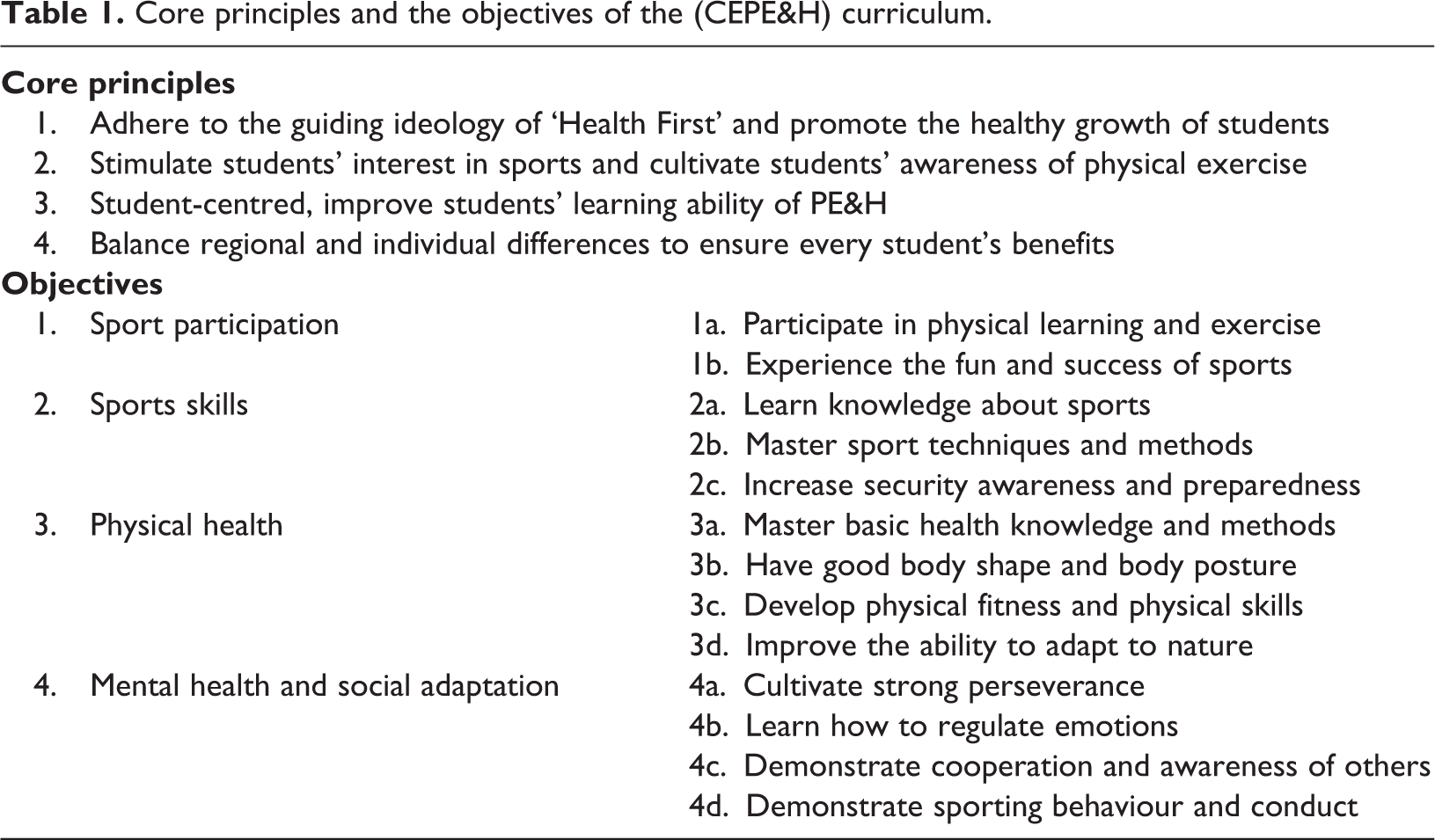
As a result of ‘three-level’ curriculum management, different regions can add in additional objectives and adopt student-centred teaching methods to suit their local contexts but not diverge from the core principles or four objectives. Therefore, all schools and teachers should provide learning opportunities which address the core principles and the four objectives (MoE, 2011b). An important development during this period of curriculum reform which requires close attention was the introduction of the PE Physical Examination (PEPE), and the next section details its importance as a strategy to improve the status of PE and realise the goals of the (CEPE&H) curriculum.
PEPE for high school entrance
In the context of Chinese education, the newly arrived ‘exotic’ ideas about health education interact with longstanding examination-oriented educational traditions. As part of a strategy to promote the status of PE, and improve the health of young people, the CPC and State Council (2007) set out an expectation for all provinces to use the results of the PEPE as part of the entrance requirements for high schools. Table 2 was created to show the physical tests in the PEPE and the corresponding standardised performance required to attain maximum scores (Nuanyan Local Education Authority, 2019).
Items in the PEPE and the corresponding standardised performance scores in Nuanyan city.
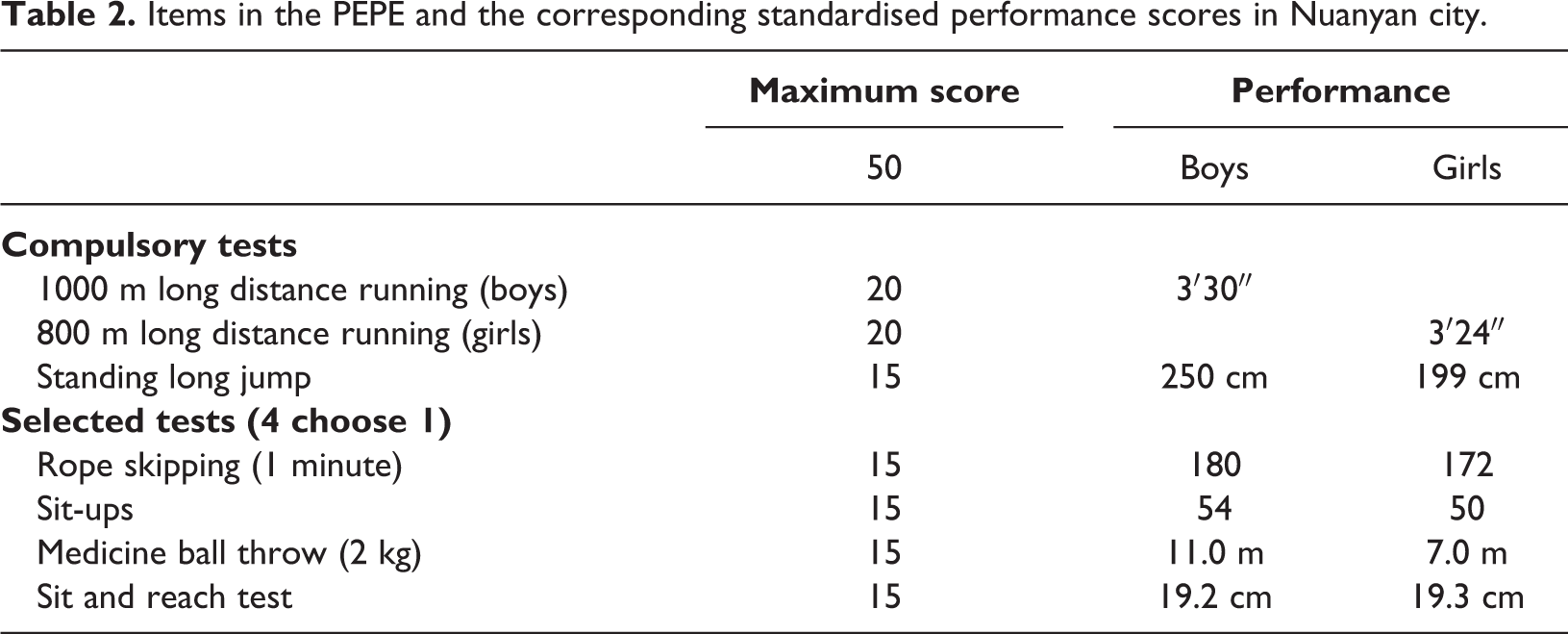
The PEPE comprises three items, reflecting the value of an individual’s endurance and explosive power, with scope for choice in one additional item. Typically, the PEPE accounts for about 7% of the total score for high school entrance; however, in some provinces, its contribution is higher and in some – for example, Yunnan province – equally weighted with other subjects (Yunnan Local Education Authority, 2019). Wang Dengfeng, director of the Ministry of Physical Education, Health and Art, claimed that ‘Under our current education system, in which students get enrolled through exams and are assessed by all kinds of scores, involving PE more in exams is the effective way to have students exercise more’ (State Council of the Chinese Central Government, 2016).
Over a period of 30 years, as highlighted in the preceding sections of this article, there have been extensive changes to the Chinese education system, but little is known about the impact of these reforms on PE teachers. Therefore, for the first time since the 2011 reforms of the (CEPE&H) curriculum, this study, drawing on the perspectives of teachers, provides an exploration of the complexities of translating and enacting ‘Health First’ in the context of PE.
Methodology
The research design for the study was informed and guided by Charmaz’s (2014) grounded theory and is located within a constructivist perspective, regarding knowledge as socially constructed, subjective and contested. The aim is to provide a unique insight into how changes in curriculum were taken up and responded to by PE teachers. Thus, our discussion presents theoretical ideas grounded in our analysis of PE teachers’ experiences of the reform process.
Procedures and participants
Ethical approval for the study was granted by the Beijing Sport University. In the initial recruitment phase, after discussions with the first author, six PE teachers from six secondary schools volunteered and agreed to take part in the study. Via snowball sampling, a further 16 PE teachers from seven different schools agreed to participate, and all were given pseudonyms to respect their requests for anonymity. The final sample of participants included 22 PE teachers (eight female, 14 male) from 13 of the 137 secondary schools in Nuanyan city (a pseudonym) in the north of mainland China. Table 3 presents information about the teachers’ length of service and the school context in which they worked. The selection criteria for participants included those with more than 10 years of teaching experience and the sample spanned a range of school contexts 2 – state-funded, public–private partnership and private. These criteria guided the processes used during participant selection so that the study included teachers who could provide insights about curriculum reform in PE.
Participant information and school context.
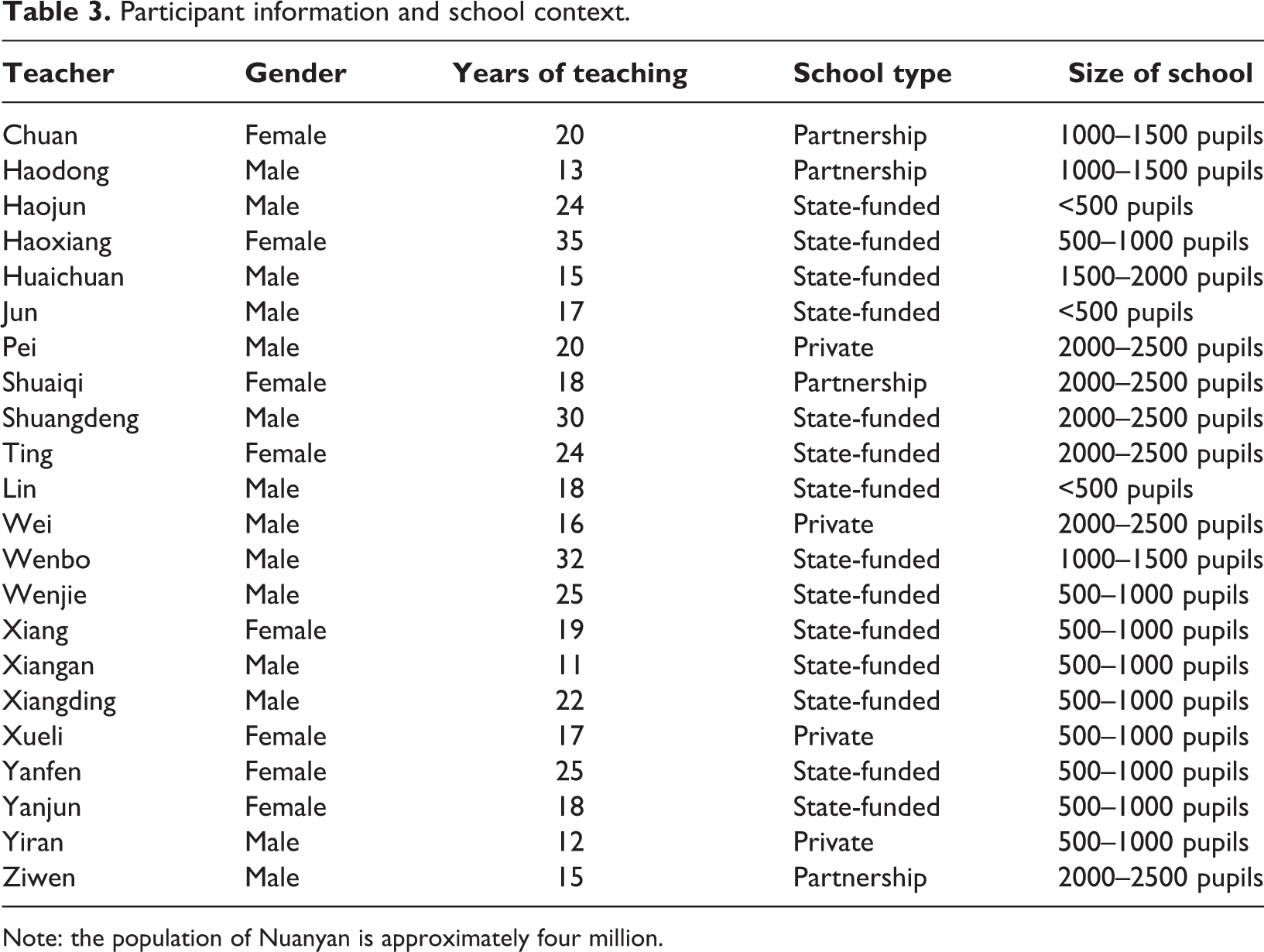
Note: the population of Nuanyan is approximately four million.
The first author conducted semi-structured face-to-face interviews at each participant’s school (60 to 80 minutes each) using a schedule, designed around themes of health and PE. As the researchers developed questions conducive to the aims of the study, previous research studies (Hickey and Jin, 2010; Jin, 2013; Ward, 2009) helped to inform the design and format of the interview schedule. The following interview questions were designed to facilitate discussions about PE and health: How do you understand the health-related elements in the new (CEPE&H) curriculum?; How have you responded to the (CEPE&H) curriculum reform?; What is your experience of teaching health-related PE in the new curriculum?
Analysis
All interview data were transcribed and entered into NVivo 12 Pro for the initial processes of open coding. Conducting grounded theory coding involved initial, focused and selective phases (Charmaz, 2014). The initial coding phase involved: microanalysis of the transcribed data to break down the text into independent events and labelling them. The labelling of independent events was done word-by-word, sentence-by-sentence and finally paragraph-by-paragraph (‘aaXXX + event’). An example code generated by this labelling process is ‘aa133 some type of exercises are forbidden by PE teachers due to accidents that have occurred in class’. The second step of focused coding involved repeated data comparison and the elimination of repetitive or inconsistent codes. In this process, some codes were grouped together into a concept, represented by ‘aXXX + concept’. An example of such a concept is ‘a002 CPD activities’. Via these processes, some codes were grouped to reflect concepts and then finally in the selective phase, theoretical coding took place, working from focused codes to theorise data themes, which were labelled as ‘AXX + major Theme’ (for example, ‘A01 cultural factors’).
For grounded theory, the meaning of language itself is very important for analysis. St John (1987) found that the main concern of non-English writers is the precise expression of their thoughts in the second language. As the first author had conducted the interviews, transcription and coding processes in Chinese, it was necessary to translate these into English for further coding and analysis. Alert to the potential for misrepresentation and erroneous interpretations of meaning, all authors engaged in extensive discussions related to the stages outlined above. The aim was to determine not only the words and terms in each interview transcript but also to clarify whether the original meanings were faithfully coded, categorised and interpreted. These processes sought to avoid semantic ambiguities due to different language backgrounds and the second and third authors of this article contributed to detailed checking of the context and semantics of data used in the study. The many ways in which the PE teachers responded to the introduction of the (CEPE&H) curriculum were revealed via these processes of analysis.
Discussion of findings
The discussion analyses the themes from the interview data; the initial focus is an analysis of the broader social-cultural context, the interactions and conflicts between borrowed policies and local conditions of practice. Thereafter, the focus shifts to analyse how teachers perceived their PETE and CPD they received. A final section analyses the dilemmas PE teachers faced following the introduction of the PEPE.
Interactions between borrowed policies and local contexts of practice
China, like other countries, has borrowed ‘best practices’ from other ‘reference societies’, and educational policy from ‘the west’ has shaped curriculum reforms. However, policy borrowing is by no means a straightforward, predictable and uncontested process. On the contrary, reform initiatives are (re)interpreted, challenged and modified in such a way that the final form they take in a locality may be very different from that in the original setting (Burdett and O’Donnell, 2016; Herold, 2020). A key question in education policy borrowing is the relevance and applicability of foreign policies and practices, in particular, those from ‘the west’ for the Chinese context. Therefore, in the process of policy borrowing, cultural and educational differences can lead to dramatic conflicts between the local traditions and the newly arrived ‘exotic’ educational ideas and practices. The next section will address issues of culture, revealing how teachers responded to the newly framed relationship between health and PE and their negotiation of these ideas in practice.
Cultural factors patterning teachers’ responses to the PE curriculum reform
Cultural factors played a significant role in enabling and constraining curriculum reform. The two extracts below provide an insight into how teachers’ responses to the CEPE&H curriculum were shaped by cultural expectations:
The previous syllabus is better [He refers to the 1992 version of the curriculum]. The old syllabus is really detailed; it tells you how to teach, what to teach, what you should do in the class, and what you should notice in the class, and why you do it. The previous syllabus is very thick. Even if you do not have a PE background, you can teach as long as you have that syllabus. It is like a bible. The curriculum right now is very thin, what do you think you can learn from it? (Haoxiang) Can it be a PE curriculum without sanji? (Yanfen) [Sanji translated means ‘three foundations’, and in the context of the previous syllabus, referred to basic knowledge, basic theory and basic skills]
As Haoxiang and Yanfen suggested, the curriculum in China has been strongly defined and each subject had a syllabus to follow. These specified when to teach, what to teach and how to teach. Tan (2015) presented the view that for a subject, ‘knowledge points’ are essential for learning and these are further divided into foundational points (jichudian), core points (hexindian) and difficult points (nandina). Consequently, knowledge is considered to be relatively fixed, essentialised and objective, and teaching defined as the transmission of knowledge points. In a similar way to Haoxiang and Yanfen’s statements, all teachers in the study considered sports techniques to be ‘knowledge points’, and as a PE teacher, their role was to teach students through careful instruction on how to master sports techniques (He, 2012). Before these changes, teachers’ value resided in their ability to be repositories of worthwhile knowledge, which they would use to teach sports techniques. Teachers’ perceptions of competence were grounded in their ability to use the knowledge they had acquired during PETE and CPD to teach sports techniques. The new (CEPE&H) curriculum shifted from providing knowledge points to only providing broad principles and objectives that students need to achieve. To support students’ learning, teachers were expected to be creative, they needed to develop a curriculum and adopt teaching approaches which aligned with these new aspirations. For these teachers, the reform has increased the expectations of their role, led to a loss of connection with familiar practices and resulted in additional work to enact these changes. Therefore, the findings of this study provide an insight into why the (CEPE&H) curriculum has not been welcomed by PE teachers (Huang et al., 2018).
In the transition from teacher-centred to student-centred pedagogies, most PE teachers suggested that student-centred pedagogy challenged their authority in the class, which was detrimental to the class organisation. Pei and Xiang mentioned:
Class size is too large,
3
only strict classroom discipline and teacher-centred pedagogy can ensure the safety of students in class. PE teachers need authority; if the teacher loses the centre position, I do not know how to organise the class. (Pei) Sometimes I have to act like a ‘tiger’ to keep the order of the class. A free and unstructured class can easily lead to security problems in class. (Xiang)
PE teachers had many pragmatic considerations to contend with, such as large class sizes and students’ safety. These comments highlighted the conflict between student-centred pedagogy and the reality of teaching large class sizes. The teachers viewed student-centred pedagogy not as something to be embraced as a means to enhance opportunities to provide experiences of health education, but rather as a threat to the safety of students. However, their concerns about student-centred pedagogy also reflected a conceptual, deep-rooted and longstanding tradition in China emphasising respect for authority and, as such, the teachers were reluctant to relinquish control of learning in lessons (Kipnis, 2011; Yin and Buck, 2015). As an imprint of the Confucian culture, a teacher is a respected person with high social status, preserving a cultural relationship between teachers and students that is unequal in nature (Zhao, 2019). In the PE class, discipline and obedience are considered as key to class organisation, so if teachers lose authoritative control of decision-making in lessons, this will result in significant risks to their professional reputation. Furthermore, forms of student-centred pedagogy are predicated upon more democratic approaches to teaching, which clash with deeply entrenched cultural scripts in China. For example, the honour, dignity and self-worth people feel in social situations, known as ‘Mianzi’ (translated as ‘saving face’), can be compromised when interactions during lessons could publicly expose teachers’ misconceptions and misunderstandings. In these respects, the values underlying education and teachers’ authority in China are almost the opposite to those of the west. Chan and Rao (2009) made the valuable point that while ‘the west’ remains an important resource for influencing educational reform, local values in China are not abandoned when adopting new western values.
The (CEPE&H) curriculum does not consider contextual factors which may influence teachers’ pedagogy; instead teachers are expected to create the conditions to enable autonomy, cooperation and inquiry in lessons. Xiang indicated why these expectations present her and other teachers in the study with a challenge: ‘PE teachers need authority, if the teacher loses the centre position, I do not know how to organise the class’. She was articulating a commonly held perception that there is a dichotomous choice between either a teacher-centred or student-centred curriculum. Tan (2016: 200) argued, ‘in China, there are two main challenges with the adoption of these student-centred pedagogies: formalism and absolutism’. In this study, Tan’s (2016) analysis is helpful, because ‘formalism’ reflected teachers’ concerns to address ‘health’ as a form of physical activity but not the substance of health education through dialogic learning. Therefore, concerns related to formalism led to ‘ritualistic’ attempts to create unrealistic situations to teach students health knowledge in classrooms. ‘Absolutism’ was detected in teachers’ accounts of their practice; they felt compelled to adopt the new approaches advocated in the curriculum. However, as teachers, they also wanted to retain ‘control’ over the learning that was taking place in lessons. As a result, teachers’ translation of the curriculum policy into practice was challenging and shaped by their perspectives and other contextual factors (Doyle, 1992).
PE teachers’ experiences of curriculum reform
At the school level, the intended pedagogical changes associated with ‘Health First’ have not materialised, and schools have been criticised for failing to help the state realise these aims (Yin et al., 2014). At the classroom level, PE teachers are criticised by the government and some scholars for failing to implement the curriculum (Huang et al., 2018). However, all the PE teachers reported that they did not receive sufficient support to implement the (CEPE&H) curriculum. The next section will discuss teachers’ experiences in PETE and their perceptions of CPD they could access during the period of reform.
PE teachers were not well prepared for curriculum reform
I went to college about 30 years ago; at that time, we did not learn health education. I spent most of my time on practising techniques. [The emphasis was on] my ability to perform sports techniques, [this] means great teaching demonstration, to some extent, it means you have good teaching ability. Before the curriculum reform, I had only heard the term ‘health’, but how to carry out health education in PE, I was not quite clear. (Wenbo)
As Wenbo indicated, the knowledge and skills he and other teachers had developed through PETE were out of step with the demands made by the new curriculum reforms. PETE in China is based on sports science knowledge with an emphasis on sports physiology, sports psychology and sports rehabilitation. In PETE programmes, practical sessions focus on the development of sport techniques so that teachers are able to provide demonstrations when teaching lessons (Li et al., 2019). Therefore, just as Wenbo and other teachers in this study indicated, their strengths lay in teaching sports techniques, and they were unsure about how to address elements of the curriculum requiring holistic health promotion through physical activities. As Harris (2009) summarises, PE teachers’ interpretations of health-related PE are generally narrow and focused mainly on ‘exercise effects’, with minimal attention to ‘health benefits’, therefore reducing the likelihood of teaching health-enhancing PE through activities. The (CEPE&H) curriculum expects teachers to incorporate health education, student-centred theory, situational pedagogy and formative evaluation into classroom teaching, but does not consider whether they have sufficient capacity to meet these requirements nor are there additional resources to support their professional development.
Lack of external support for PE teachers
All the PE teachers stated that they did not receive adequate or effective support from their school and local education authority. According to Shuangdeng:
I felt very lost at the beginning of the curriculum reform. The (CEPE&H) curriculum requires us to be a creative research-type PE teacher, but no one gives us any help. No one tells us how to do it. I also participated in some training courses at that time, but I do not agree with some of them. (Shuangdeng)
Shuangdeng expressed feelings of helplessness, and he was unsure of what to do or how to enact the changes. One interpretation would be that it was his responsibility to embrace the opportunities to be creative and innovative. However, another interpretation grounded in our analysis of data indicated that the quality of the CPD provided added to Shuangdeng and other teachers’ confusion about the reform. The following statements from Ziwen and Ting add further insights into teachers’ experiences of CPD:
Most CPD focused on how to improve student performance in [PEPE] and how to teach sports techniques. Not many courses are relevant to the new CEPE&H. There are some lectures related to health and the new ideas of curriculum reform, but they are not practical. (Ziwen) Actually, the CPD session is also ‘three-level’ management. School representatives attend district training, and district representatives attend state training. At the same time, every school should hold regular teaching seminars and workshops. The problem is that regional and national professional training is very general and not practical and school’s seminars are mainly to discuss administrative affairs. So, teachers in the front line can learn nothing. (Ting)
These statements provide strong evidence that there was a desire across the sample of teachers to seek support and to learn from others via the established means of providing CPD for teachers. They also serve as examples of the confusing and contrasting messages that the teachers had to contend with as they sought to understand what the new (CEPE&H) curriculum would require of them. These findings highlight how new policies signify possibilities for change, but without accompanying opportunities for sustained teacher development, they are unlikely to materialise (Eisner, 2005). In this case, these teachers not only faced problems with limited CPD, but they also encountered a lack of fidelity between the training content provided and the aims of the (CEPE&H) curriculum.
Teachers’ confusion after the curriculum reform
As indicated, the focus of PETE and the nature of CPD teachers could engage in resulted in teachers’ confusion about health as conceptualised in the new (CEPE&H) curriculum:
To be honest, I do not really understand the concept of health in PE. (Wei) The concept of health-related PE is too vague and too big. In the past, PE classes only emphasised physical fitness, so I just need to let children run and play in the class. But now, the curriculum emphasises health. A PE teacher needs to respect the preferences of students. This is a big conflict. You know, children only do what they want to do. They do not like discipline, and they do not like organised classes. We have so many students. I do not know how to respect students’ sports preferences. (Yanjun)
These statements capture the confusion all teachers in the study experienced when considering how to address health in PE. These findings have similarities with the broader points made by Fullan (2007) about the uncertain nature of the change process and that policymakers often present confusing messages for teachers. In this section, the teachers’ accounts provided a detailed and complex insight into the interplay between different issues; PE teachers articulated concerns about how they might balance what they felt were competing aspirations, such as adopting student-centred pedagogy and respecting students’ sport preferences, with the reality of working with large classes. In addition, they were concerned that they did not have adequate training and knowledge to teach health education, but they did have confidence that they could provide opportunities for students to be successful.
Teachers negotiating policies and stakeholder priorities
In response to the question, ‘What is your experience of teaching health-related PE in the new curriculum?’, the majority of PE teachers believed that the curriculum reforms had moderate but not radical changes. Wenjie and Huaichuan’s responses provide a telling insight into their experience of the (CEPE&H) curriculum:
I feel that there is not much difference. In essence, the content of the lesson has not changed much, especially in the secondary school. (Wenjie) I can only say that there are some differences. Before the reform, there were more PE tests, which were required for each semester. After the reform, PEPE has been added, and there are no semester PE tests anymore. (Huaichuan)
Wenjie and Huaichuan were not the only PE teachers to express that the impact of the reform on the teaching realities was superficial and the explicit focus on the health content of lessons had been difficult to enact in practice. Teachers in the study were aware that they may not be addressing the expectations of the ‘Health First’ maxim of the curriculum reform; however, the introduction of the PEPE and the regimes of accountability which were associated with that shaped teachers’ decision-making. The next section will outline the complexities and possibilities of implementing the (CEPE&H) curriculum within an examination-oriented educational context in China.
Embracing PEPE
I know the idea of the new curriculum is good, but the baton of teaching is a high school entrance examination [and the PEPE] rather than the (CEPE&H) curriculum. (Xueli)
In this direct quotation, Xueli uses the Chinese word for baton, and we have provided a literal translation. Xueli was expressing her view that in the same way that an orchestra is directed by a conductor interpreting the notes on a musical score, teachers’ practice is directed by the requirements of the examination system. The comment from Xueli reflected the widespread view from teachers that they would prioritise the PEPE over the (CEPE&H) curriculum. As mentioned above, PE has become part of the high school entrance examination, and this has had an impact on the teachers’ perceptions of the importance of the PEPE. However, as already indicated, this development, designed in part to enhance the status of the subject, is in direct contrast to the holistic view of health informing current curriculum reforms in China. Despite these inherent problems, all the PE teachers believed that they had no choice but to adopt a strategy which maximised students’ potential to achieve success in the PEPE. As Xiangding and Yanfen explained:
Schools, students and parents are actually very realistic. Students only study the subjects and contents of the examination. If PE does not have an examination, many students will choose to take time off in the PE class; they will stay in the classroom to self-study. PE is also dominated by other examination subjects. It is a waste of time to study anything that is not on the examination. (Xiangding) The PEPE is the only way to improve students’ health under the current educational system. (Yanfen)
There was a depth to the PE teachers’ considerations and practice that went beyond only implementing the (CEPE&H) curriculum. Xiangding and Yanfen’s comments provide an insight into their awareness of other stakeholders’ views and their ability to recognise that the expectations of others, such as parents, school leaders and other classroom teachers would impact on curriculum decision-making. The comment from Xiangding, ‘Schools, students and parents are actually very realistic’, means many teachers, students and parents are accustomed to the assessment system associated with high school entrance examinations, with precise scores considered to be the objective way to represent achievement (Huang, 2004). As a result of the prevailing examination-driven culture, although the curriculum reform has introduced learner-centred pedagogies and encouraged formative assessment, the reality is that success in the high-stakes examination is still considered to be the most desirable outcome of educational experiences. Consequently, PE teachers are expected to implement reform, but at the same time, they are also expected to ‘teach to the examination’. In this case, PE teachers’ focus on the preparation for the physical examination is a pragmatic and understandable response.
Securing students’ futures via PEPE
Implementing both the [PEPE] and the (CEPE&H) curriculum are sometimes difficult to achieve. My son is [in] the 2nd year…and he will be facing a high school entrance examination next year. He is obsessed with playing basketball. As a PE teacher, I think playing basketball is good. But as a mother, I know how important [the] examination is for his future, I have to ban him from playing basketball, and let him concentrate on his examination subjects. PE teachers, to some extent, [are] also the same. We all know how important [it is] to have a healthy lifestyle, but for students, the [PEPE], at present, is the only thing [that] can have an impact on their immediate future. (Yanfen)
Yanfen’s statement captured how she and other teachers in this study were alert to how concerns for students’ health would be balanced against the predominant culture, which required success in examinations. PE teachers are not only accountable to the MoE for the implementation of the (CEPE&H) curriculum, but also to other ‘partners’, such as a headteachers, parents and students. Our analysis revealed that for these ‘partners’ the expectations for the (CEPE&H) curriculum focused on the immediate future. PEPE is the essential pathway to the next education stage; therefore, despite laudable efforts to help students learn holistically and embrace healthy lifestyles through PE, these aspirations were not likely to succeed because the education system rewards performance in the PEPE.
Conclusion
Motivated by the realities and demands of globalisation, China’s government and policymakers have sought to engage in widespread curriculum reform. The trend of declining students’ health has compelled China to adopt ‘Health First’ as a guiding principle for the curriculum, therefore prominently positioning the (CEPE&H) curriculum in the process of these reforms (CPC and State Council, 1999). However, data from the national students’ health surveys indicate curriculum reform has not achieved the reductions in ill-health the Chinese government had sought. Borrowing educational policy ideas from elsewhere is known to be problematic, and when there is a proliferation of aims, such as a drive to embrace decentralisation, increase school autonomy, adopt student-centred teaching and develop critical, innovative thinking for real-life applications, it is hardly surprising that teachers feel overwhelmed. Established via a rigorous approach to grounded theory coding, interview data from the teachers revealed that the demands of implementing the new curriculum had their origins in complexities that went beyond individual teachers’ perceptions of health and change. Teachers’ responses reflected, despite well-intentioned government policy, that there were several contextual factors which resulted in the limited achievement of ‘Health First’. These findings highlight the complex interaction between borrowed policies, existing cultures, an education system steeped in regimes of high-stakes assessments and the realities of teaching in schools. The adoption of a PEPE, directly linked to entrance into the next phase of education, rather than bolstering aims of ‘Health First’, became the primary concern for teachers as they orientated their practice to ensure that students were well prepared for the examination.
It is important to clarify that although it would be possible to provide an interpretation which portrayed these PE teachers as resistant or not capable of change, our analysis of data gathered sought to keep in view that changes in policy without adequate resources to support professional development and structural changes in education have positioned teachers at the centre of a complex process over which they have limited control. Presented with a significant educational reform, these teachers were not fully prepared via their PETE nor ongoing professional development to effect the necessary structural changes to incorporate reformed policies in the subject and achieve a transformation to embrace a holistic approach to health education through PE. In this study, it was via well-established teaching repertoires that the PE teachers sought to address ‘health’ and support children as they prepared for the high-stakes PEPE and the passage into high school. The experience of China, then, demonstrates that it is important for policymakers, academics and practitioners to consider the central role of culture in the local reception, adaptation and appropriation of ‘foreign’ knowledge and education. Future research should consider both the prospects and pitfalls of ‘Health First’ as the guiding principle for education in China by capturing a detailed understanding of PE teachers’ interpretations of the (CEPE&H) curriculum.
Footnotes
Acknowledgements
We wish to express our sincere thanks to the two anonymous reviewers and to the editorial team for their valuable suggestions to improve the clarity and quality of the article. We also wish to thank the participants who agreed to take part in this study.
Declaration of conflicting interests
The authors have no conflicts of interest to declare.
Funding
The authors disclosed receipt of the following financial support for the research, authorship, and/or publication of this article: This work was supported by the Chinese Scholarship Council (Finance Code 201906520022).
