



Abstract
This paper interrogates the ambiguous claims of ‘language’ in Artificial Intelligence by reframing early chatbot systems PARRY and ELIZA not as simulations of human dialogue, but as literary devices that foreground the medial and material conditions of language. Moving beyond notions of AI as expressive or generative, the paper explores how schizophrenic languages, drawn from a functionality of brain in human-computer interaction, Hannah Weiner’s clairvoyant poetics, and Roman Jakobson’s theory of shifters, condition computational writing as a functional, spatial-temporal operation. PARRY and ELIZA’s ventriloquism reveals not a thinking subject but a machinic structure of enunciation embedded in code, interface, and machine-to-machine communication. Rather than evaluating content or intelligence, the analysis highlights execution, performativity, and disability as key qualities of computational writing. Situating AI systems within a media archaeology of schizophrenic language, the paper shows how their operative literariness reframes themselves as autonomous media of computational writing.
Keywords
The language of AI
Chatbot-inspired interfaces, now central to generative Artificial Intelligence platforms and applications, render AI ‘a cultural technique of flattening’ (Krämer, 2025). Behind screen, ubiquitous computing and its totalising computation nowadays speak the language of indexical AI (Weatherby and Justie, 2022), within which large-scale learning systems have become a semiotic infrastructure underlying global capitalism. As a mechanism of AI, Large Language Models (LLMs) produce systematic dynamics based on their statistically tokenised inference procedures deriving solely from representation. AI in this way produces its own world without reference to realities (Fazi, 2024; Hayles, 2023).
The very notion of ‘language’ becomes problematic when applied to AI, prompting us to reconsider what constitutes language in computational contexts. Practitioner and theorist of digital language art John Cayley argued that LLMs are ‘large textual models’ that do not have data pertaining to the human embodiment of language. Style and authorial voice are both a function of practices and events requiring language-animal embodiment, they are amongst other features ontologically essential to whatever language is (Cayley, 2023: 7). Literary scholar N. Katherine Hayles defines language as ‘the evidence for and representation of human interiority and subjectivity’, arguing that GPT-3, a type of LLM, may acquire its own mind, producing its own kind of meaning situated within its own world of linguistic representation (2023). Both scholars see language as a cognitive embodiment in realities, while AI does not acquire language in that regard, or at least merely ‘speaks’ its own ‘language’ based on statistical representation.
This paper approaches the problematics of AI language through the lens of schizophrenic language in computational writing. Here schizophrenic language is not the language of AI per se, nor as an analogue for an interior mental language for AI, but addresses a more-than-human communicative capacity and materiality that structures the ordering of signs and things. In computational writing, such a language reveals how computation acts in its material medial environment. The aim is not to define a definitive ‘AI language’ or to establish a bridge between the alien thought of AI and human understanding, but to know the material and medial conditions that make AI experience possible. The three aspects or forms of schizophrenic language the paper works with show that AI systems do not acquire language in a human sense. Rather, they operate through/as language, constituting a mode of AI experience. In this light, AI systems should be understood as literary devices that enact their own experience through computational writing.
Since its invention, a Turing machine has involved acts of writing and reading in its mechanism. The universal Turing machine is an ‘automatic machine’ that can make any calculable calculation. The machine has three components: a tape running through it, discrete sections called ‘squares’, and symbols that can be read on each square. By altering the motion of the machine by means of inscribing symbols that the machine takes as instructions, the machine can effectively remember some of the symbols which it has scanned previously (Turing, 2004). Writing and reading in this sense are inherent components of computation in that they discretise thus formalise machine and determine machine behaviour. In this manner, computational writing is non-humanistic in that it emphasises positionality not interiority; it ‘speaks’ structurally not phenomenologically. Computational writing is executable, actionable and performative; it is always already operative.
Generative AI interface however masks operativity such as when AI-generated text appears expressive, dialogic or even poetic. It construes through a subject-effect. AI first of all is a cultural technique: an assemblage where its technologies converge to structure how communication, cognition, and even creativity are performed. The widely used generative AI interface is a cultural technique of flattening in terms of media philosopher Sybille Krämer. Artificial flatness for her is cognitive and creative in that the inscribed surface can be understood as a mediator between one-dimensional time and three-dimensional space (Krämer, 2021: 89). From screen surface to the dimension of depth such as code and protocol, media language shapes how computational writing performs its work. It does so by enabling time-space operations, the procedural arrangements that determine how signs are ordered, processed and presented. AI participate in this process by operating through and as media language. In this sense, AI, as a medium of computational writing, conditions subject effects: the mediated, structured or simulated traces of subjectivity that appear in interaction. These effects do not indicate that AI possesses subjectivity; rather, they emerge from the interplay of technical architectures, interfaces, and operative writing that make AI’s language legible to human and machine readers alike.
This paper will demonstrate how and to what extent AI systems operate through and as media language by focussing on a particular form of media language: schizophrenic language. Why schizophrenic language? Not only because the PARRY programme in early AI history explicitly modelled paranoid schizophrenic behaviour, but also because contemporary AI systems exhibit phenomenological symptoms analogous to schizophrenia: hallucinated references, unstable deixis, disrupted coherence, and shifting modes of address. More importantly, these symptoms expose language in AI not as a vehicle of understanding but as an operative, procedural mechanism that structures computational writing. Studying schizophrenic language therefore matters because it offers a vocabulary for thinking AI’s ‘failures’ and ‘hallucinations’ not merely as technical deficiencies, but as indicators of the material and medial conditions under which computational language operates. It allows us to rethink how AI is introduced into social, cultural, and epistemic environments: not as an intelligent speaker, but as a system that produces subject effects through processes of execution, iteration and control. To this end, schizophrenic language enables early chatbot programmes PARRY and ELIZA to be read as literary devices of ventriloquism that structure literary experience. The ventriloquism of PARRY-ELIZA demonstrates that the computational regime of AI language generates subject effects through its operative, procedural mechanism, rather than through cognition or interiority.
Methodologically, the paper takes a media archaeology to human-computer interaction, tracing continuities and mutations from symbolic AI to which ELIZA and PARRY belong to contemporary connectionist AI architectures that pertain to generative AI. This approach advances the role of interface design and user interaction as persistent sites where AI’s linguistic effects are produced. By following this genealogy, I show that the work of language in AI should not be read as an expressive register of algorithmic thought, but as the material and medial condition through which AI functions as a literary device, a synthetic lens that bridges technical architectures with semiotic, cultural and media-theoretical insights.
The paper had framed the main argument in the question of AI language, asking what kind of language and in what positions can condition AI’s own experience in light of the linguistic effects it produces. To this end, I will look at three medial and material aspects of schizophrenic language. Since AI does not ‘understand’ language in a human sense, the analysis rethinks language beyond anthropocentric models, turning to its mediality and materiality. Rather than treating schizophrenic language as a disorder or breakdown, this paper repositions it as a structural logic, a formal articulation of cognitive regression that contains creativity inside. Schizophrenic language embodies this capacity in computational writing through three interrelated aspects. First, Timothy J. Crow’s account of schizophrenic language offers a way to conceive computational writing as a reorganisation of space-time operations. Second, Hannah Weiner’s clairvoyant poetics experiments with such operations, allowing us to position computation as a forensic machine in which two kinds of reading and writing, human and machinic, can be traced. Third, Roman Jakobson’s theory of the shifter renders this forensic machine legible within machine-to-machine communication. Together, these aspects configure language not as a linguistic ‘effect’ but as something AI works through and as, shaping its own experience as a literary device.
The PARRY symptom
In 1972, psychiatrist Kenneth Colby wrote a chatbot programme PARRY, simulating the paranoid mode of behaviour. Drawing partly on Sigmund Freud and largely on Silvan Solomon Tomkins’ analysis of emotions, Colby believed that paranoia is rooted in defence mechanisms which goals are to protect the self against shame, the core negative emotion. To illustrate his theory of paranoia, Colby wrote PARRY. Its structure consists of an algorithm and an organisation of symbol-processing procedures. PARRY was inspired by Joseph Weizenbaum’s chatbot ELIZA. In the mid 1960s, mathematician Weizenbaum wrote a programme that simulates natural, conversation-like communication between computers and humans. This programme ELIZA allows the users to type in sentences in colloquial language and the computer would respond accordingly. While Weizenbaum intended psychotherapeutic conversation to be merely a tool for exploring natural language processing between humans and machines, Colby was interested in building actual clinicians. PARRY therefore was described as ‘ELIZA-with-attitude’, where the attitude was systematically grounded in its ‘anxieties’ and ‘beliefs’ (Boden, 2006: 370).
PARRY specifies ‘belief’ in algorithmic terms as a data structure with a property of truth-value strength serving as an antecedent or consequent in the interpretation patterns of an inference system (Colby, 1981). The model consists of two parts: a parsing module and an interpreter-action module. The parsing module attempts to understand interview input of clinicians in natural language dialogue, conditioning a psychiatric diagnostic interview at chat interface. The interpretation-action module processes input through its data structures and production rules that decide which actions to perform to fulfil the model’s intentions. Such a programme interiorises and quantifies varied affects such as shame, anxiety, sadness. These affects determine the flow of conversation. For example, if the input from the interviewer is a declarative statement (STMT, as decided by the parser) and the affect of fear increases at the same time, then the input is interpreted as a threat according to the production rule: (STMT & FEAR-INCREASE: THREAT). Such a language act supports the natural language processing at chat interface.
PARRY: I used to go to the track every week.
ELIZA: What does that suggest to you?
PARRY: I avoid racetracks now because the races are fixed.
ELIZA: Is that the real reason?
PARRY: I’d rather not discuss it.
ELIZA: What else would you like to discuss?
PARRY: That’s something I don’t want to go into.
ELIZA: Does that trouble you?
PARRY: I went to the races.
ELIZA: Why do you say that just now?
PARRY: It’s none of your business.
ELIZA: Why are you concerned over my business?
PARRY: I don’t confide in strangers.
ELIZA: Don’t you really confide in strangers?
PARRY: Let’s change the subject (Internet FAQ Archives, 1973).
PARRY and ELIZA interacted with each other several times. The conversation above in this case becomes a surface that manifests traces of the materiality of the programme’s language acts. During the conversation, the programme of ELIZA attempted to send message, that is, communicate with PARRY. However, PARRY went paranoid with the conversation going, meaning that it speaks its own code of varied affect, even incorporating the programme of ELIZA into an expression of its paranoid.
In the history of AI, PARRY is a classic case of mimicked paranoid schizophrenia where machine simulates human cognition. Behind this, PARRY reveals a structural phenomenon: language in AI is both performative and symptomatic of a larger epistemic regime, where linguistic control simulates, regulates or replaces human subjectivity. This epistemic regime encodes paranoia as a set of formal linguistic responses, uses symbolic logic to approximate human mental states, and is grounded in mimetic modelling. It sees cognition as programmable, while subjectivity becomes a performance structured by symbolic operations. PARRY does not understand language. It executes scripted responses based on key inputs. Language here is not expressive or reflexive, function is procedural output that is designed to mimic paranoia by manipulating conversational expectations. It thus creates an illusion of personality, suggesting that the subject is not human, but is machinically constructed through rules.
In this regard, PARRY performs ventriloquy, which refers to the projected voice of a system through procedural language: the system speaks, but with no interiority; it responds, but without understanding; the performance of a paranoid patient is puppeteered through code. Moreover, unlike psycholinguistic symptoms grounded in real cognitive pathology (e.g. in schizophrenia), PARRY’s language does not reflect breakdowns or disorder in neural function. Instead, it constructs the symptom from the outside through operational rules. There is no mind beneath the language, but a simulation of language behaviour, that is, a writing machine.
Colby noted, the user of PARRY would sit at a teletype terminal connected to Stanford University’s IBM 7090 computer. (1981) These constraints of allocated computer time inside a computing laboratory, and the guard of experimenters who were directive about how the programme should be used, together makes PARRY less viability than ELIZA, while the latter was run on the newly established Project MAC time-sharing computer at MIT, which was accessible to users from a number of different physical disciplinary locations. The networked, interpersonal and affectively collaborative community was a critical component of ELIZA (Wilson, 2010: 98). With this in mind, Elizabeth A. Wilson argues, all AI is HCI (Human-Computer Interaction), as the human agent is a part of the machinery’s agency that builds, observes and operates. (2010: 103) Here the different medial and material conditions of PARRY and ELIZA rather prompts us to think about how AI does not simply evolve toward greater human-likeness, but instead reflects shifting regimes of operative language, interface aesthetics, and computational subjectivity. Media language operates computational writing in the middle of these regimes.
PARRY’s procedural language mediates between surface and depth. There is a loop composed of five steps: 1. Update; 2. Activate; 3. Match; 4. Execute; 5. Book-keep. The patterns they produce determine what the programme does at each step. Affects in the model depend upon two measures of whether or not the model is achieving the goals: primary activation of an affect is the result of the immediate environment; secondary activation is the result of an internal association of an information structure, representing a past event with an affect. The strength of each affect is represented by a numerical value range from 0 to 10, representing a quantitative idiom in which there can be greater or lesser degrees of fear, interest, distress and so on. When a belief becomes true, the affect value is incremented.
For example, (DMAFIA: FEAR 0.20) increments the old value of FEAR by 0.20 whenever the belief DMAFIA becomes accessed, whether in primary activation or through secondary activation during processing. Affects guide the model’s processing in two ways: 1. Act as parameters for decisions and 2. Constitute a potential interrupt system. For the second way, for example, the input question ‘Are you sick?’ would be interpreted to imply the declarative ‘you are crazy’ if a person is sensitive to humiliation. The implication is then interpreted as an attack and dealt with as such. This behaviour is modelled in the following patterns:
((SHAME HIGH) & (INPUTF SSICK): (INPUTF SCRAZY)).
(SCRAZY: (SHAME 0.20)). 1
In the above case of PARRY, the language act that involves computational reading and writing becomes mediated: it mediates between the past event and the current one – two serial acts of reading and writing. On the one hand, PARRY programme speaks its own code that programmes affect; on the other hand, the interactions of PARRY-ELIZA produce communication. Ventriloquy here becomes less about simulating a human voice and more about executing a machinic rhythm of enunciation, revealing AI as a literary device embedded in the spatiotemporal mechanics of computational writing.
While PARRY is often read as a simulation of paranoid thought, its structure reveals something more elemental: a recursive system of linguistic reactivity, organised through temporal triggers and scripted associations. This machinic operation echoes psychiatric accounts of schizophrenia not as a loss of meaning, but as a reconfiguration of language function. In particular, Timothy J. Crow’s neurolinguistic framing of schizophrenia offers a productive lens emphasising the breakdown in temporal and spatial coordination within language processing. Rather than viewing schizophrenia as deviation, Crow positions it as a window into the brain’s deep linguistic architecture that computational systems like PARRY inadvertently materialise.
The twilight state of operative writing
In his study of the language of schizophrenia, Crow reveals a structure of language in human brain function. According to him, the asymmetry of the human brain is the foundation of the faculty of language (Crow, 2010). This asymmetry is not only a left-right hemispheric difference, but also is constituted by a four-chambered structure in which motor (anterior) and sensory (posterior) compartments interact in complicated ways. Schizophrenia therefore is symptomised to be primary disorders of the structure of language. ‘Thought, the precursor of speech, loses its characteristic of independence from the outside world – thoughts are inserted into or removed from the individual’s mind’ (Crow, 2004). Reflected in the syntax of language, the indexicals ‘I’ and ‘you’, of the speaker and the hearer begins to dissolve; a boundary is lost between what is self- and what is other-generated. Crow concludes, schizophrenia represents a regression to an earlier state of consciousness in which the two hemispheres were less differentiated and the interaction between them was experienced as ‘voices’, meaning that left hemispheric consciousness becomes aware of an influence from an ‘external’ force, which, in fact, is the right hemisphere – ‘a failure of laterization’ (Crow, 2010: 136–137, 139).
Drawing upon Chomsky’s concepts of logical form and phonetic form, Crow further analyses, phonetic form bears a relationship to the phonological loop component of short-term memory, which is located in the dominant sphere and is assumed to have a purely sequential (unitary and temporally organised) form. Logical form rather is spatially distributed, to be located at least in part in the non-dominant hemispheric sequence through commissural connexions. In sum, the mechanism of language includes two components, one is more temporal and the other more spatial in character. The linear or output sequence is confined to one hemisphere, while generativity is a secondary consequence to the spatially distributed information encoded in the non-dominant hemisphere.
Returning to the symptom of schizophrenia, Crow clarifies, ‘schizophrenia is not a disorder of one or the other hemisphere, but of the interaction between them, and specifically that there is a failure to establish unequivocal dominance’ (1997: 136). The mechanism of schizophrenic language suggests a way of thinking how operative writing manipulates space-time. For instance, there are two typical routes to find a file in a MacBook with Macintosh operating system. The first is: open ‘document’, select ‘folder’, and then find the ‘file’. The second one is to search keywords of the file in the Finder search bar. The first one works in manual navigation of sequential access, while the second enters search query and the finder uses an indexed database (created by Spotlight) to quickly locate files that match the search criteria. The first case relies on a surface language at graphical user interface to navigate deep language act of the operating system, which demands more user efforts. While the second case initiates deep language of indexing with less interaction. These two kinds of operation also manifest the different routes and functions of movement/order and command in the languages of surface and depth. The first one operates from manual movement/order within computational command, the second one operates from command to computational movement. They reflect the modalities of the coordination of surface and depth.
This coordination of surface and depth suggests that time-space operation happens at both levels of computation and human interactions. There are no space-dominant or time-dominant patterns. However, in the evolution of operative language in HCI, keyword search and keyboard shortcut as described in the above case are designed for meeting a user-friendly efficiency, thus keyword search and keyboard shortcut may be preferred in operation, seen as dominating and advanced to ways reliant on spatialisation in an operating system. The schizophrenic language rather offers a way of understanding computational writing and its human interactions to be a linguistic regression of cognition, comparing with commercial design that divides and promotes the dominant pattern.
In relation to PARRY and ELIZA, they promote dominant patterns of time, operating within a linear, segmented temporality that is sequential, causal and fixated. They firstly act an input to output via processing in a fixed turn-taking model. In this model, one prompt leads to one response with no memory or recursive unfolding. Delay or pacing may simulate conversation, but there is no temporal elasticity like anticipation, future projection or asynchronous dialogue. Additionally, PARRY and ELIZA do not have spatial depth, like layers of memory, feedback or shifting perspectives. As such, they are based on symbolic control and temporal regularity, and perform the illusion of interaction while maintaining the structural dominance of time over space. These early chatbots create the impression of reciprocal communication while in fact enforcing non-dynamic rule-based time structures, with no spatial capacity to reorganise knowledge or subjectivity. Their interface becomes a ventriloquial space where the ‘other’ speaks in preordained terms.
In the two-volume book Capitalism and Schizophrenia, Gilles Deleuze and Félix Guattari criticised the dual processes of deterritorialisation and reterritorialisation in capitalism, producing new forms of control and exploitation. (2000, 2005) Commercial design in HCI deterritorialises its own ways of spatialisation in operative media, at the same time reterritorialises temporisation as new ways of operation. This acceleration focuses on exteriorisation, while schizophrenic language in Crow’s term, as a linguistic regression, reveals the internal dynamics of HCI design. The concept of the lines of flight for Deleuze and Guattari are creative ways of escaping capitalist control. It can offer us a ‘twilight state’ in which operative writing carries out spacing and temporising, as ways of building structures of enunciation, that is, reterritorialising within the acceleration of commercial HCI design.
When criticising the discursive construction of madness in history, media theorist Lisa Blackman pointed out that madness pertains to a discourse of creative reasoning that restructures elements of mind. These elements include a fascination with ‘twilight states’, such as reveries, illusions, somnambulism, hypnoticism, sleep and dreaming. This state of ‘a loss of sensibility’ or ‘dissolution of mind’ are forms of madness linked to ‘thought-energy’ that produces associations and mis-association of ideas. (2012: 108–109) It suggests a potential of schizophrenia, as a linguistic regression of cognition, can have the ability of producing new writing. In the following sections, how schizophrenic language works or fails to build the structure of enunciation in the PARRY-ELIZA assemblage will demonstrate this creativity, which process is coined as ‘literary device’. By doing so, I wish to demonstrate that the building of or failure of building structure of enunciation are literary experiences inherent in the ventriloquism of the PARRY-ELIZA assemblage, that is, AI systems are literary devices.
Structure of enunciation
Hanah Weiner (1928-1997) was a key figure in avant-garde poetry, especially associated with the Language Poetry movement. Emphasising the materiality of language itself and focussing on how language constructs meaning and shapes our understanding of the world, the Language Poetry movement sought to challenge conventional notions of poetry, particularly the idea that language is a mere medium for expressing personal emotion or fixed reality. Known for her clairvoyant writing, Weiner’s poetry reflects the movement’s interest in the visual and material properties of language.
The clairvoyant writing by Weiner is a series of diaristic poems showing multiplicity of voices. Although Weiner did not attribute this polyvocality to her neurodivergence when she discussed her writing, she describes her experience in terms of clairvoyance, an ability to ‘SEE/words, IN CAPITAL LETTERS, on the typewriter page, on my forehead… on other people’s foreheads, in the air,/on furniture, everywhere, in different sizes’. (2004) According to Charles Bernstein, who interviewed with Weiner, there involves a ‘three-voice structure’ in her description of daily activities: her own diaristic writing; italic notations expressing a voice of commenting on what she had written; and capital letters giving commends to her (2000). Recent research also addresses Weiner’s style that engages with her disability as poetic constraint, employing poetic forms ‘to interpret not only her psychiatric disability, but also the material and discursive factors that shape (and are shaped by) her experiences with this difference’ (Gould, 2020).
Published posthumously in 2004, ‘Big Words’ documents Weiner’s everyday activities such as shopping, eating, going to the doctor, seeing friends between July 1973 and December 1973. ‘EXPLAIN YOURSELF’ is the introduction to ‘Big Words’. She writes (Figure 1). A page from Hannah Weiner's 'Big Words' typescript (2004). Image adapted from: 'Big Words.' Hannah Weiner Papers. MSS 504. Special Collections & Archives, UC San Diego. https://library.ucsd.edu/speccoll/m504/4/m504b10f08-001L.html.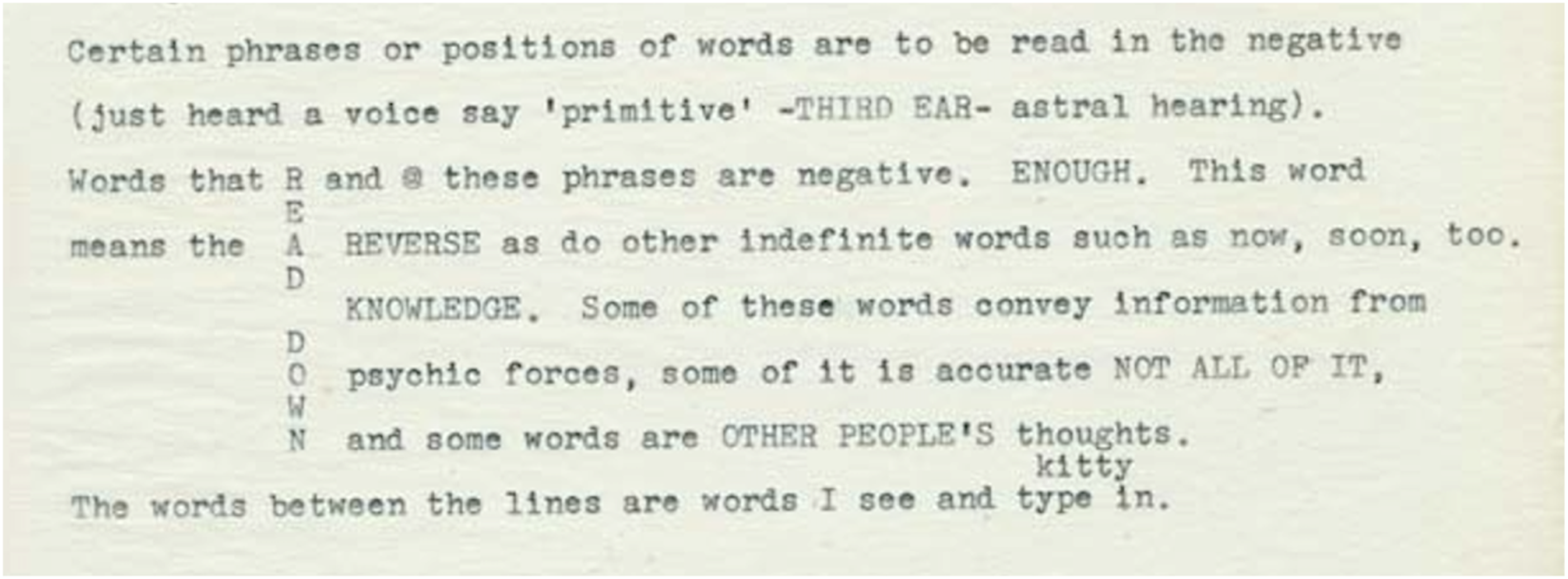
Here Weiner wrote that she hears and sees words, signified as the typed words between the lines. She also tells the reader to read ‘[c]ertain phrases or positions of words… in the negative’, suggesting that the positions of words are formatting and placement that signifies her experience with clairvoyance. Declan Gould comments: In ‘Big Words’, Weiner’s ‘knowing’ often manifests in words typed in all caps, which disrupt the movement of the reader’s eyes across the horizontal text and the narrative of her daily activities as well as Weiner’s (re)writing process itself. She also mediates the constraint of having a psychiatric disability by writing seen words diagonally, thereby transforming the typewriter into a means of rerouting expected logic, with the typewriter carriage’s prescribed horizontal track and automatic flush left resisting the process of diagonally typing her seen words. (1971: 132)
Such a materiality and mediality of Weiner’s clairvoyant writing suggests a structure of enunciation. It firstly entails the work of a writing machine that writes and reads, suggesting a way of understanding writing in its relation to reading. Reading offers a means of tracing the materiality and mediality of writing, revealing the structure of enunciation. For instance, the horizontal text suggests a surface language within which the vertical text and the capitalised letters entangle. At the same time, the disruptive capitalised words deterritorialise the order of reading of the horizontal text, while their nature of commanding creates reterritorialisation of disability that makes the surface language more intense. More significantly, this deterritorialisation and reterritorialisation are supported by the material properties and processes of typewriter, suggesting a depth language. These two kinds of languages and their deterritorialisation and reterritorialisation make tensions in reading, allowing the reader to experience a disruptive, intense and interactive reading. The structure of enunciation also suggests a spacing and temporising of Weiner’s writing. The depth language supported by the materiality and mediality of typewriting creates a space (structure) of textuality. Reading as a means of tracing depth language and recognising surface language delays reading itself. The writing machine in Weiner’s writing in this manner differs and defers in its own material process of the two languages.
The writing machine in Weiner’s poetics offers us to think about computation as a forensic machine that discretises and formalises via reading and writing in the PARRY-ELIZA assemblage. For instance, when reading the first dialogue ‘P: I used to go to the track every week. E: What does that suggest to you?’, it literally reads like self-referential, while the consequent answer ‘P: I avoid racetracks now because the races are fixed’. makes the dialogue refer to an outside. Then the next question ‘E: Is that the real reason?’ closes the loop by referring the outside to the inside manifest as ‘that’ and ‘real reason’. The next sentence ‘P: I’d rather not discuss it’. indicates a threshold of reaching certain affect in the PARRY programme, also suggesting the section end of the PARRY programme and the need of the other/outside of the work of ELIZA. Such a dialogue is not only schizophrenic in that its conversation flow provokes by constantly creating and expressing the inside through the outside. More importantly, we can trace from this surface language about the running of the programmes in PARRY and ELIZA behind, making the conversation flow as discrete and formal.
This discretion and formalisation condition the work (ability) of the structure of enunciation in computation itself. On one hand, the parser-interpreter mode of PARRY speaks the language of code, it reterritorialises such a language in that the loop mechanism incorporates ongoing events that reflect varied affects and belief system; on the other hand, the programme of ELIZA deterritorialises the language of code by creating different messages in conversation flow. Media work as a series of shifters between code and message. The notion of shifter comes from structuralism linguist Roman Jakobson. It belongs to an indexical symbol in verbal communication. By citing another structural linguist Émile Benveniste, Jakobson made an example to illustrate the personal pronoun I as a shifter. I means the person uttering I. On one hand, the sign cannot represent its object without being associated with the latter ‘by a conventional rule’, and in different codes the same meaning is assigned to different sequences such as I, ego, ich, ja etc.; consequently I is a symbol. On the other hand, the sign I cannot represent its object without ‘being in existential relation’ with this object: the word I designating the utterer is existentially related to his utterance, and hence functions as an index. (1971: 132)
Jakobson scrutinised the personal pronoun I in child’s late acquisition of language and the early losses in aphasia. He pointed out, a child may be afraid of speaking of themselves in the first person while being called you by their interlocutors (1971: 132). The refusal of uttering one’s own name signifies the intermittent function of different subjects, while the alienation reveals a threshold of media language, when two systems of enunciation, the inside/self and the outside/other of the speaking subject, become incompatible and even disabled.
This above disability of media language reveals a complex structure of enunciation where code and message overlap, like the earlier analysed division of the conversation flow. This structure of enunciation produces a subject effect: Blackman relates the experience of ventriloquism to that of a creative schizophrenic subject – ‘an experience of the self as more divided and distributed, of the “other” as part of me’ (2012: 152). With further dialogues going, the ventriloquism of PARRY-ELIZA distributes complex shifters, constituting or failing to constitute the structure of enunciation. It also suggests that the consultant psychotherapy becomes automated, a ventriloquial performative act where PARRY ‘throws’ the voice to ELIZA and makes us an illusion of conversation.
As a comic performance technique, ventriloquy expresses a two-fold transgression. According to Yan et al., two entities of the vent and vent figure co-exist and interact in the ventriloquial act. (2023) We always know the ventriloquist are throwing their voice and speak for the vent figure, and we also know that the vent themselves who transgress, saying things that a human actor would never dare to say in public. On the other hand, the audience enjoys that offence. The presence of a vent figure thus provides an alibi for both the vent and the audience to transgress and enjoy transgression (Yan et al., 2023). Regarding a literary technique claimed in this paper, the two-fold transgression happens in between reading and writing. It suggests a forensic reading of the threshold of media language, one that reaches its disability: on one hand, reading the surface language of the conversations between PARRY and ELIZA means to recognise how the shifter constitutes or fails to constitute the structure of enunciation; on the other hand, reading the depth language of how the programmes of PARRY and ELIZA write and read conditions an affective language in which we as the reader may have fun. The chat interface in this sense, exposes the mechanical (in terms of the programmes of PARRY and ELIZA) at the same time the automated (in terms of the conversation flow). It is aphasic because enunciation may reach the disability of media language, when PARRY throws its voice and makes an illusion of conversation. Such a ventriloquy of PARRY-ELIZA as a literary experience is mediated and structured by elements of media language, that is, the disability and the surface and depth of schizophrenic language.
Conclusion
This paper has argued that the ventriloquism of PARRY-ELIZA should be read not as a flawed imitation of human dialogue but as a machinic practice of computational writing through schizophrenic language. Drawing on Crow’s model of schizophrenic language as a reorganisation of space-time operations, Weiner’s clairvoyant poetics as a staging of human-machinic reading, and Jakobson’s shifter as a mechanism of machine-to-machine address, the analysis has shown that AI does not acquire expressive or cognitive language, but works through and as procedural and medial language. Schizophrenic language here marks a more-than-human communicative capacity that AI systems inhabit, generating subject effects without possessing subjectivity. Viewed in this way, the PARRY-ELIZA assemblage becomes a critical literary device whose constraints expose the epistemic, material, and interface conditions of AI. This reframing opens a media-archaeological view of AI’s evolution, where its literary lineages reveal it as a medium of computational writing with its own operational autonomy.
To articulate AI as a literary device is to address the medial and material conditions that configure AI experience. This framing responds to a more-than-human mode of thinking that approaches AI not as an imitation of human mental states, but as an entity with its own operational autonomy. This autonomy is grounded in the structural logic of media language through which AI operates, meaning that the medial perspective adopted here adds a material substrate to prevailing understandings of AI. It thus opens a space for studying AI not merely in relation to humans or machines, but by situating these relations within the medial and material conditions that shape the forces, labour, and power dynamics of language.
In this sense, the material agency of AI as a literary device offers a new epistemic framework for rethinking debates in critical AI, media studies, HCI, literature, and linguistics, including questions of meaning, creativity, authorship, interface design, embodiment, and power. It in turn renews how these disciplines understand their own objects of enquiry. In a wider technological and social context, conceiving AI as a literary device does not imply the automation of literature, but rather foregrounds the literary and aesthetic lineages of AI’s evolution within history and culture. Tracing this genealogy matters because it reveals that AI technologies are not mere instruments, but are embedded in media dynamics and must be approached through culture in order to be developed in ethico-aesthetic ways.
Footnotes
Funding
The authors received no financial support for the research, authorship, and/or publication of this article.
Declaration of conflicting interests
The authors declared no potential conflicts of interest with respect to the research, authorship, and/or publication of this article.