




Abstract
This article conducts a genealogical analysis of Brilliant Digital Entertainment’s multipath movies as a minor history of videogames. Brilliant Digital Entertainment was a company that, from its formation in 1996 until the dot-com bust of 2001, released what they dubbed ‘multipath movies’. These were 3D animated interactive movies based on popular IP like Superman, Xena: Warrior Princess and more that allowed players to make decisions at key moments. These multipath movies emerged at a time of increasing synergy between Hollywood cinema and videogames in the 1990s. Through an analysis of Brilliant Digital Entertainment’s brief venture, this article examines the wider cultural, technological and economic forces that shaped the company’s trajectory. This article argues that Brilliant Digital Entertainment, through its adoption and integration of rhetoric and operating models from the dot-com bubble at the time, treated the media convergence exemplified by interactive movies as a ‘new economic space’ defined by its ‘novel’ combination of media forms, imagined audience and association with the internet.
Introduction
The 1990s was a decade of change for the videogame industry and its relationship to Hollywood. Still moving through a process of aggressive formalisation post-crash and alongside both the growing strength of publisher ‘power brokers’ like Nintendo, Sony and Sega, as well as increasing computational power and graphical fidelity (Keogh, 2019: 22), this period saw a push into new horizons of videogame experiences. Fuelled by developments in 3D graphics and the increased capacity of CD-ROMs, one of the most prominent trends to emerge from this history is an increasing convergence with cinema. This occurred both through film companies like LucasArts and Dreamworks moving into game production, but also the increasing technological overlap between the two industries through the same systems being used to create three-dimensional worlds and iconic films like Jurassic Park (1993) and Toy Story (1995) (Mack, 2016: 1). Whether out of envy for the legitimacy often bestowed upon cinema and neglected in games, or due to purely financial incentives, the 1990s saw these two mediums begin a transformative correspondence that arguably continues to the present day.
This article focuses on one key transformation from this period, the interactive movie. Interactive movie is a term that emerged in the mid-1990s and early 2000s and describes media that combines the experiences of watching a film and playing a game (Allison, 2020: 280). 1 Interactive in this context refers to the ability of the viewer/player to make decisions that affects the events occurring on-screen (Ryan, 2001). During this period of convergence, interactive movies were considered ‘the holy grail for much of the industry’ (Gallagher 2018: 174). A key example of the form, The 7 th Guest (1993), sold over two million copies and was heralded by Bill Gates as ‘the new standard in interactive entertainment’ (Wolf, 2007: 129). The game was followed by Under a Killing Moon (Access Software, 1994), arriving on four disks as one of the biggest budgeted games of the era at $3 million USD (Arar, 1996). Phantasmagoria (1995), created by famed adventure game designer Roberta Williams, released a year later with a budget of $4 million and went on to become Sierra Entertainment’s first game to reach one million copies sold (Philips, 1995: 65).
It is amidst this success and acclaim for interactive movies that Brilliant Digital Entertainment (BDE) was formed. As such, BDE offers a productive case study of cinematic/gamic convergence in the 1990s and how we conceive of interactive movies more broadly. Created in 1996 through the combination of two businesses – Brilliant Interactive Ideas, an Australian entertainment software development company and Sega Australia New Developments, a research and development operation for software tools – BDE began patenting a variety of technologies around 3D graphics streaming that the company also used to produce their trademarked term of ‘multipath movies’. Per their own official description (Brilliant Digital Entertainment, 2000), multipath movies were ‘animated movies made with real-time 3D objects and characters rendered “on the fly” … this means you’re not just watching a flat animation that’s made to look like 3D animation – you’re actually watching real action in a 3D world’. Within these animated movies were BDE’s ‘multipaths’, moments when the player could choose what to do in a branching story structure taking the player to different plot points. According to BDE’s marketing, ‘multipath movies combine the excitement of a game with the plot development of a movie – together for the first time’.
Multipath movies fit neatly alongside the interactive movies of the time, albeit with a focus on CGI-rendered animation over the full-motion video of games like The 7 th Guest. Beginning with the multipath movie Cyberswine (1997), BDE expanded into a range of recognisable different properties like Xena: Warrior Princess, Popeye, Ace Ventura and Superman. By 2000, BDE had released almost 20 different multipath movies via CD-ROM. In 1998, they also began streaming their movies over the internet through ‘webisodes’ that users could purchase via online ‘channels’, as well as embedding their multipath movies in websites like entertaindom.com.
However, in 2001 BDE’s multipath movie output folded. Conducting a genealogical analysis of BDE as a ‘minor history’ of videogames, this article explores why multipath movies, as a clear example of the fantasy of combining cinema and videogames that was so prominent at the time, failed, both culturally and financially. While the mediality of interactive movies has already been robustly explored (Girina, 2013; Grusin, 2006; King and Krzywinska, 2002; Larsen, 2017; Ndalianis, 1999), limited analysis of their extrinsic history exists. The failure of BDE’s multipath movies offers a unique counter-example to prevailing convergence narratives from the 1990s. In my analysis, I adopt a range of useful concepts from media archaeological approaches, even if I do not fully align myself with the term (see Elsaesser 2016; Huhtamo and Parikka, 2011). I specifically conceive of BDE as a ‘minor history’ of videogames by drawing on Nicoll’s (2019) ‘Minor Platforms in Videogame History’. In it, he develops the notion of the ‘historically minor’ as a heuristic device, rather than stable category, as a way of focussing on histories that include objects, subjects and spaces that are ‘ancillary to conventional narratives of videogame history’ (13). Nicoll (2019: 14) argues that minor platforms ‘inhabit moments of rupture, or periods of discontinuity and transitional instability in videogame history’. Considering BDE’s multipath movies in this way poses several compelling questions. What does its presence in that meaningful period of videogame and cinematic convergence tell us? What does it say about how we conceive of interactive movies and their relationship to technocultural context?
I also draw on genealogical analysis that allows for a laying of the past and present side-by-side, producing transhistorical analysis that reveals similarities, differences and connections between the two (Foucault, 1980: 146; Koopman, 2013). This analytical approach allows me to ‘re-conceptualise the present… by going back to suppressed ruptures of the past’ (Nicoll, 2019: 22), situating Brilliant Digital’s trajectory as a lens through which to view the interactive movie form from the 1990s to now (see also Golding, 2014: 23; Trépanier-Jobin, 2021). The challenges of conducting historical analysis via the ever-changing internet (Gitelman, 2006: 132) have also inevitably shaped my approach. This article is based on research I conducted for the ‘Play it Again II’ research project (Cruz, 2021) and from the conclusion of that work in 2021 to commencing writing in 2024, numerous websites and sources are now no longer available. What I conduct here then is a spelunking (Nooney, 2013) of the sources that do exist – an approach that remains inevitably incomplete but nonetheless illustrative.
Through this analysis, I highlight how Brilliant Digital Entertainment’s multipath movies were fundamentally shaped and defined by the cultural and industrial forces that shaped its technology. This focus on the extrinsic factors of media history, namely their social, cultural, political and economic contexts, is far from a new approach – indeed, going as far back as Williams (1974) discussion of television – but it remains particularly pertinent and neglected when it comes to the analysis of interactive movies. To inquire about BDE’s failure is to ask what cultural forces shaped their trajectory; not only did they emerge amidst the boom of videogame/cinema synergies already referenced, but they also existed as a product of the burgeoning, and eventually contracting, development of the web exemplified by the dot-com bubble of the late 1990s. Overall, I argue that BDE perceived their multipath movies the same way the dot-com bubble perceived the internet – as a ‘new economic space’ ripe to be capitalised on. Within this framing, I outline how multipath movies were promoted through both the perceived novelty of their combined mediality and association with the internet. I also highlight how the company sought to shape the desires of an imagined audience specifically designed to respond to multipath movie’s affordances. Thinking of multipath movies as a new economic space allows us to consider interactive movies the same way and draw comparisons to how the form has been conceived of since.
In this article, I therefore conduct a genealogical spelunking of Brilliant Digital Entertainment’s multipath movies by considering them a minor history and notable moment of rupture within the 1990s period of interactive movie’s popularity. In my first section, I outline BDE’s origin and national context, as well as discuss the significance of how their first multipath movie, Cyberswine, was promoted to create a bespoke imagined audience through technocultural desire and Chess’ (2017) concept of designed identity. From there, I orient BDE’s trajectory within the larger technological and cultural context of the dot-com bubble, the speculative bubble in the 90s to early 2000s that conceived of the internet as a new economic space to capitalise on. Through BDE’s interest in digital distribution, foregrounding of the novelty of their multipath movies and software ambitions I suggest that the company readily adopted the logics of the era in their conceptualisation of interactive movies. I then discuss their perceived positionality as a tech startup and explore the impact of the bubble bursting. Finally, I conclude by drawing comparisons between BDE and the promotion of Netflix’s interactive movie Bandersnatch (2018) to connect the company to wider discourses surrounding interactive movies that have occurred since. This allows us to think of BDE as being genealogically significant in how it can reveal similarities and links between contemporary discourse and neglected historical trajectories.
Cyberswine and imagined audiences
I open my analysis of BDE’s historical trajectory through focussing on its formation and how their first multipath movie, Cyberswine, was promoted. Drawing from Chess’ (2017) ‘designed identity’ and Kozinets' (2019) definition of technoculture, I suggest that BDE, through their discourse, sought to create a bespoke imagined audience that reflects their constructed expectations and desires. I also scrutinise BDE’s rhetoric and adoption of a range of different media forms in their description of multipath movies, further situating the media form as a ‘new’ synergy of familiar and established technologies.
Despite being formed from two Australian companies, Brilliant Digital Entertainment’s national identity is a complex one. The company was officially incorporated in July of 1996 in the US state of Delaware as a combination of Australian company Brilliant Interactive Ideas and Sega Australia New Developments, a division of Sega OziSoft, which was the Australian subsidiary of Sega of Japan (SEC, 2001). BDE’s executive offices were then established in California (SEC, 2001), with Brilliant Interactive Ideas instead becoming their Australian-based production arm rather than headquarters. Sega OziSoft, formerly OziSoft, was formed in 1982 by Mark Dyne and Kevin Bermeister and would go on to be Australia’s largest videogame distributor in 1990 before being acquired by Sega in 1992. Dyne and Bermeister retained managerial control of the company after its acquisition, and Bermeister would go on to be CEO and founder of Brilliant Digital Entertainment 4 years later. Sega OziSoft, after a lengthy line of acquisitions and name changes, would eventually end up part of Bandai Namco Entertainment. The history and output of Brilliant Digital’s Australian studio has been productively explored elsewhere by Stuckey and Harkin (2025), whereas this article will focus on the North American executive arm of the company.
Even though both of its incorporated companies originated in Australia, BDE immediately sought to orient its business practices around the US tech market. The company’s Australian roots, however, are exemplified through their first venture into interactive movies, CD-ROM game Cyberswine in 1997. Based on a short-lived Australian comic book series of the same name, the game was originally being developed by Sega OziSoft for 2 years prior to their merging with Brilliant Interactive Ideas and was initially intended for the Sega Saturn console before it flopped outside of Japan. The only BDE multipath movie that CEO Kevin Bermeister acted as director on, Cyberswine follows the titular cybernetic pig in a race against time to save CyberCity from a deadly virus. Cyberswine plays like a CGI movie with added moments during which the player can choose the course of action for Cyberswine to take by either clicking the left or right mouse buttons. If no choice is made, Cyberswine makes the choice for you via an ‘internal mood database’ based on previous decisions. After release there were plans to add ‘episodic updates’ to Cyberswine broken up into half-hour segments for $2.50 each. This never materialised, but it does allude to the fact the company was considering serialised operating models from their inception.
To explore the way Cyberswine was thought of as the first of BDE’s multipath movies, I turn to the close analysis of a preview in Australian magazine PC Powerplay (see Figure 1). As Nicoll (2019: 30) describes, magazine articles are useful in not only uncovering historical details but also ‘how people perceived, used, and imagined these technologies in their historical contexts’ and this article helps articulate what he (35) calls a minor structure of feeling; the affective and discursive contexts that help inform historically situated media objects. This article is particularly notable given it is the first promotion and coverage of any of BDE’s multipath movies, allowing it to be read as a meaningful first orientation for how the company sought to situate their output medially and culturally. Cyberswine preview (Lockart 1996). At the time of publication, the developer was still listed as Ozisoft.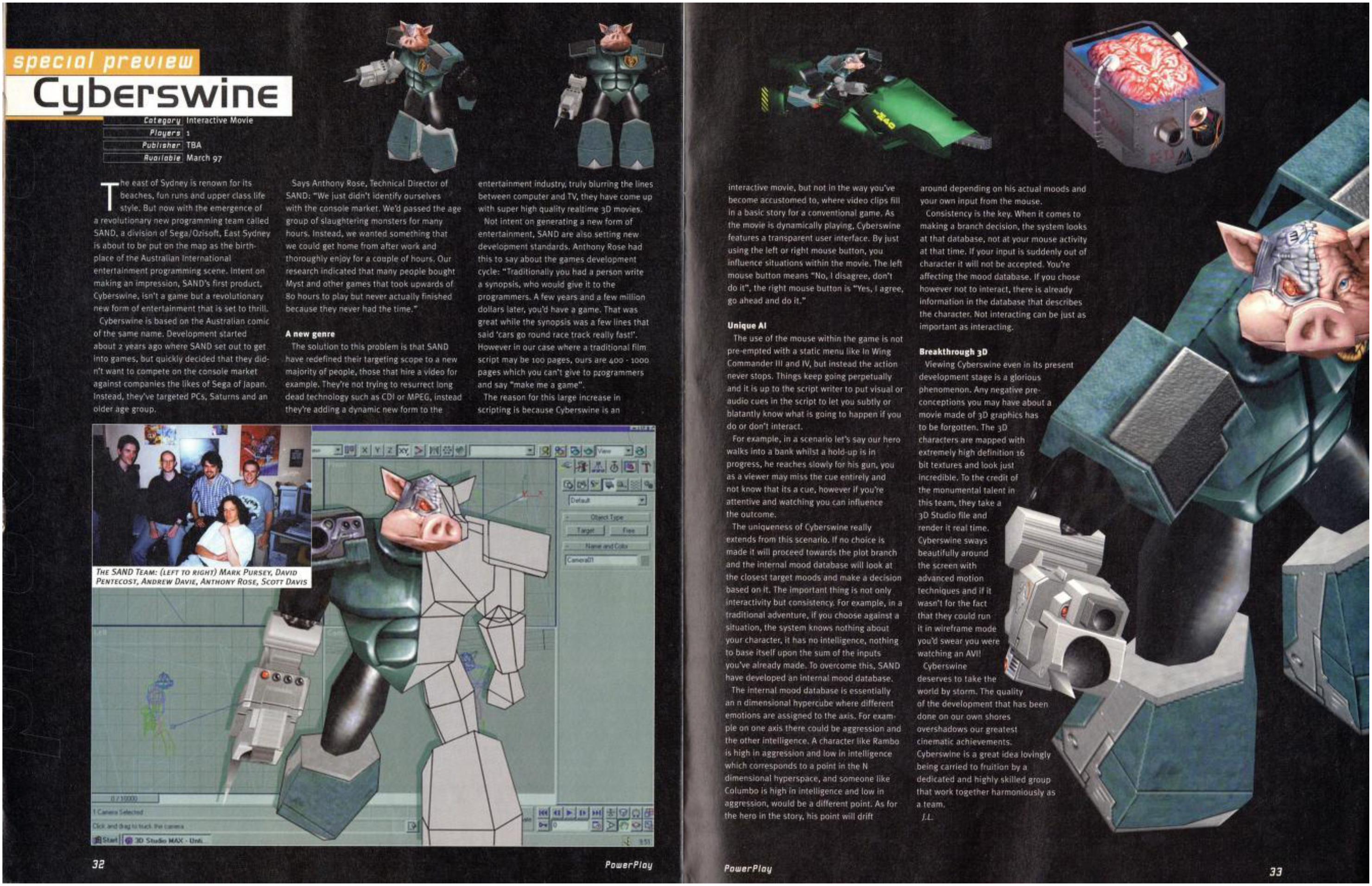
The preview was published in late 1996, several months after the forming of Brilliant Digital Entertainment, though they are not mentioned in the article and instead the developer is still listed as Sega OziSoft. Owing to the publication’s nationality, it draws particular focus to the multipath movie as a distinctly Australian release, with the article even hyperbolically concluding ‘the quality of the development that has been done on our shores overshadows our greatest cinematic achievements’. Of note in the article is how the developers describe their target audience, and how they conceive of Cyberswine as straddling the line between cinema and games. Technical director Anthony Ross remarks,
‘We just didn’t identify ourselves with the console market. We’d passed the age group of slaughtering monsters for many hours. Instead, we wanted something that we could get home from after work and thoroughly enjoy for a couple of hours. Our research indicates that many people bought Myst and other games that took upwards of 80 hours to play but never actually finished because they never had the time.' (Lockart, 1996: 32)
This position contrasts Cyberswine with mainstream videogame consumption behaviours at the time. The derision of consoles games as centred around the childish endeavour of ‘slaughtering monsters’ and acknowledging the time constraints of adults to indulge in such frivolous game pursuits, suggests the article imagines an untapped market of time poor consumers whose screen interest go beyond ‘puerile’ videogames offerings. This cinematically inclined audience is also evoked in Lockart’s (1996: 32) suggestion that the game’s ‘targeting scope’ is ‘those [people] that hire a video for example’.
Particular attention is also given to how Cyberswine represents a ‘dynamic new form’ that goes beyond previous conceptions of both videogames and cinema (Lockart, 1996: 32). This appeal to novelty is far from new for media – as Gitelman (2006: 1) and Nicoll (2019: 113) highlight, all media was once new, and the promotion of media technology is often centred around its newness. Likewise, it is not a new claim for interactive movies. After The 7 th Guest’s success, Bill Gates proclaimed the interactive movie ‘the new standard in interactive entertainment’ and many similar games were noted for the novelty of their delivery via the CD-ROM (Wolf, 2007: 129). The 7 th Guest was one of the first games to be exclusively published on a pair of CD-ROMS due to the game being too large to ship on a floppy disk (Allison, 2020: 281), and its follow-up Under a Killing Moon arriving on four disks as one of the biggest budgeted games of the era (Arar, 1996).
Despite the various antecedents to interactive movies that existed prior to their inception, BDE also claims a level of innovation, both in their description of ‘multipath movies [combining games and movies] … for the first time’ (Brilliant Digital Entertainment, 2000) and through their promotion of Cyberswine. Technical director Ross highlights that the game’s script is 400-1000 pages long; a dramatic expansion upon the traditional film script of typically only a ‘measly’ 100 pages. He also describes the interactive movie as ‘blurring the lines between computer and TV’ due to its use of 3D graphics, with the Lockart (1996: 33) claiming that ‘if it wasn’t for the fact that they could run it in wireframe mode, you’d swear you were watching an AVI!’. 2 These comments work to situate Cyberswine’s mediality as more robust and developed than a movie, more cinematic than a videogame; it does what both mediums can do, but better. This supposedly makes Cyberswine not only a combination of medial influences, but also a new and improved form – a ‘revolutionary new form of entertainment’ (Lockart, 1996: 32) specifically.
This hyperbolic claim to newness is typical of any new form of media or technology, but it nonetheless remains illustrative of how Cyberswine, as the first of BDE’s multipath movies, was positioned. This article is indicative of what Nicoll (2019: 35) calls minor structures of feeling – ‘paying attention to what people… say or have said about [minor platforms]’ reveals much about the discursive and affective context of Cyberswine as a historically situated media object. I argue that this article situates Cyberswine in relation to an imagined audience with a specific designed identity centred around the affordances of multipath movies. I do not use ‘imagined’ suggesting it did not exist – while multipath movies inevitably failed, they did attract a degree of success as I will later highlight – but rather in the same vein that Nicoll (2019: 106) conceives of imagined platforms. Multipath movies arguably were ‘a speculative technology… [and] captures the impossible dreams, unfulfilled expectations, and collective anxieties of its cultural period’. BDE is not only ‘innovating’ new interactive movie content, but also new audiences to consume them. They are ‘imagining’ an audience around their creation – a new class of affluent (employed and busy) and artistically discerning (preferring high cinema over lowly games) identities.
BDE is also arguably not only imagining an audience, but also seeking to shape their identities through technological means. Two useful concepts here is that of technoculture (Kozinets, 2019) and designed identity (Chess, 2017: 5). Kozinets (2019: 621) defines technoculture alongside consumer culture as ‘the various identities, practices, values, rituals, hierarchies… and structures of meaning that are influenced, created by, or expressed through technological consumption’. The concept echoes Chess’ (2017: 5) ‘designed identity’, the perception of players constructed, designed and managed by the videogame industry. Chess uses it to interrogate gender, but here it is productive to put the concept in conversation with technoculture to consider how consumer’s identities and desires are shaped through these discursive practices. Unlike Chess' ‘player one’ and ‘player two’, the audience alluded to by BDE is not visible in games culture – it is imagined, idealised, and speaks to a form of consumer designed in such a way as to have their identities shaped by the technology itself.
What BDE conjures instead is a bespoke audience that reflects the expectations and desires of the company. This imagined designed identity is perfectly positioned to respond to the affordances of multipath movies – they prefer shorter sessions, are interested in more mature content, are comfortable with more passive and cinematic experiences while still seeking something more interactive than a rented VCR. This imagines a potentially very different videogame history, something that affectively orients us toward ‘alternative textures of experience’ that BDE sought to will into being (Nicoll, 2019: 35).
This imagined designed identity stands in stark contrast with the dominant feelings and criticisms launched towards interactive movies in both academia and beyond, with critics tending to deride the form as both poor cinematic experiences and lacking meaningful interactivity. Allison (2020: 277) connects this academic discourse to the narratology vs ludology ‘debate' of early game studies, where theorists were reticent to include anything within their discipline that was perceived as de-emphasising interaction and game-like elements in favour of cinematic elements. Interactive movies were also criticised for being poor cinematic experiences, with Perron (2003) mocking them as ‘look[ing] much like B-grade films’ and having to continually interrupt the pace of the action ‘to make more of the gamer’s decisions’. This positions interactive movies as neither game enough for some, nor film enough for others. In contrast, BDE claims this in-betweenness as a strength – as both the source of multipath movie’s novelty and as central to how it might tap into an imagined new market of players and viewers.
While Cyberswine established BDE’s multipath movie template, and subsequent multipath movies would be continued to be developed in Australia by Brilliant Interactive Ideas, Cyberswine is the only game to be promoted as a distinctly ‘Australian’ title, and coverage of the company going forward would become increasingly oriented around their executive offices in California. Later that year Cyberswine was followed by Gravity Angels Part 1: Alien Discovery (1997), the first of a four-part series of multipath movies based around a group of employees on an interplanetary mining corporation sent to the Jupiter moon of Ganymede for disciplinary action only to discover alien life. Gravity Angels (1997-1998) was the only multipath movies to be based on an original idea rather than existing IP, and was later followed in 1998 by titles Ace Venture: Pet Detective – The Case of the Serial Shaver (1998) and Popeye: The Rescue (1998). It was also around this period that BDE’s operating model began to shift, moving away from the CD-ROM circulation of Cyberswine and others towards digital distribution afforded by the growing interest in the internet.
Digital distribution and the dot-com bubble
In this section, I directly situate both BDE’s interest in digital distribution methods and patented software within the burgeoning dot-com bubble that was occurring at the time of the company’s formation. The dot-com bubble was a speculative bubble that occurred from the mid-1990s to the early 2000s oriented around the new economic possibilities of the internet. This period of rapid transformation and investment made it a time of volatile industry change, and one ripe for genealogical analysis. In Foucault’s original conceptualisation, genealogy is interested in the ‘fluid becoming’ of historical events, in ‘processes of transition’ (Koopman, 2013: 36, 40). The impacts of the 1990s ‘internet gold rush’ tends to only be intermittently discussed in conventional videogame historical narratives (see Kline et al., 2003: 157-9), but it is instrumental to the trajectory of BDE. Recognising its significance contributes an additional signifier to the ‘larger multi-threaded singularity’ (Koopman, 2013: 50) that constitutes historical events, and informs how we make sense of the trajectory of both multipath and interactive movies.
BDE’s interest in digital distribution took off during the episodic release of Gravity Angels in 1998. The company released the ‘B3D Projector’, software that could either be downloaded or act as a browser plug-in capable of streaming multipath movies via the internet when purchased through their website. The B3D Projector offered an interface through which users could control multipath movies by choosing what direction to take the story at certain inputs.
3
This launch led to a full-scale pivot towards multipath movie ‘webisodes’. From early 1999, multipath movie previews and webisodes became available via BDE’s website, and they also began distributing a selection of webisodes via retail outlets (Responsesource, 1999a). Bermeister, in a press release (Responsesource, 1999a), claimed that the launch of this content was: ‘The culmination of over 3 years of investment, development and innovation. Full screen experiences running at variable frame rates, with a minimum download time, is something that the internet has not been able to offer before. With its innovative Digital Projector technology and content, Brilliant is now uniquely positioned to benefit from the growth of the internet by bringing a workable distribution model to state of the art 3-D animation.' (Responsesource, 1999a).
Here we again see multipath movies framed alongside technological innovations and novelty – a new online experience that would be impossible without these recent technological developments, in this case being both BDE’s ‘investment, development and innovation’ and the internet. Regarding the latter, it is of particular significance that Bermeister frames BDE as being ‘uniquely positioned’ to benefit from the internet’s growth. Not only does this directly situate BDE within the historical context of the United States tech sector at the time, very firmly orienting the company around its Californian offices rather than its production company in Australia, the internet is highlighted as a new commercial opportunity, and growing space that BDE intended to grow alongside.
Such perspectives on the internet were far from unique, as historical accounts of the dot-com speculative bubble, the investment context BDE existed within, outlines. Speculative bubbles are characterised as events where the price of an asset or commodity increases rapidly ‘solely because investors expect it to happen’ only for it to later collapse, and are an economic phenomenon that dates back as early as the 1600s ‘tulipmania’ (Baddeley and McCombie, 2001: 219; 227). Writing just after the bubble’s collapse, Kenney (2003: 33) characterises the bubble as emerging from the pre and early commercialisation phases of the internet. At the risk of simplifying the various factors that contributed to its emergence, several key contexts led to its creation, including the US having a massive computer install base relative to other nations, the neoliberal deregulation of the telecommunications industry to ‘accelerate competition and innovation’ and the transition from the university-centred computational use of the early internet to commercial interests (Kenney, 2003: 35-7). This created an environment where the internet was perceived as having (at the time) its own developing imagined audience and led to a commercial tidal wave that Kenney (2003: 33, 35, 39) likens to both the Oklahoma land rush of 1889 and an ‘internet gold rush’ – essentially framing the internet as a ‘new economic space’ to conquer.
These colonialist metaphors underscore the way venture capital perceived the newly created digital space of the internet as an ‘untamed’ economic space ripe for exploitation. Aligned with the logics of capitalism as both perpetually growth oriented and technologically dynamic (Harvey, 1989: 180), this the dot-com bubble framed the internet as the latest technological horizon to expand into. Venture capitalists injected what Crain (2014: 2) characterises as ‘risk capital’, extremely speculative large short-term investments deployed seeking high returns, into the developing space in hopes of being the first to monopolise this new market and subsequently generate massive returns on investment.
This newfound interest came to the fore in 1994 when startups interested in the internet, especially in Silicon Valley, began to multiply. The returns on investment were initially astronomical, hitting 91.2% by 1999 (Kenney, 2003: 43). From 1995 to 1999, venture capital in internet-related firms increased by a magnitude of 2500 times, starting at $12 million and ending at $31 billion (Kenney, 2003: 43). This injection of risk capital led to an environment where software tool firms, web-hosting services and more exploded, and a willingness by venture capital to fund speculative experimentation in turn created increasingly more speculative experimentation. A vast variety of internet services emerged during this time, many explicitly competing with one another to ride the wave created by capital’s discovery of a new frontier to conquer.
BDE’s internet expansion began in earnest in 1998 and was heavily informed by the burgeoning ‘gold rush’ of the dot-com bubble. Their commercial push occurred both online and through retail, with customers able to buy a CD-ROM containing a ‘complete’ multipath movie episode as well as previews for other episodes unlockable and viewable via an internet transaction. These CD-ROMs were also bundled with programs like Packard Bell NEC, CompuServe, magazines and more (Responsesource, 1999a). The internet-delivered ‘webisodes’ that the CD-ROM would advertise were serialised versions of multipath movie episodes which could be downloaded and played via the CD-ROM. For consumers without a CD-ROM, there was the option of a downloadable version of the B3D Projector. Webisodes could be purchased by subscribing to ‘webisode channels’ priced at $8.95 USD for 12 webisodes delivered weekly (Responsesource, 1999a). Both the CD-ROMs and the webisodes were intended to be promoted through an internet-based advertising campaign, with a reliance on banner ads and sponsorships through companies like Disney and Microsoft, with the latter hosting coverage on msn.com’s high-traffic ‘Internet Gaming Zone’. In March 1999, BDE also expanded this distribution model when they struck a deal with SlingShot Entertainment, a special purpose DVD publisher and distributor, to exclusively distribute all their multipath movies in DVD format (SlingShot, 1999).
The design of the digital projector is also worth addressing given its meaningful convergence of media language (see Figure 2). To use the projector is to combine the ‘the best qualities of film’ with the ‘interactivity’ of a computer while buying tickets from the ‘box office’ to watch webisodes. This builds on the imagined audience and the remediation and supposed ‘newness’ of multipath movie’s media form. Multipath movies are designed for screen literate audiences, familiar with the language of cinema but intrigued by the prospects offered by the internet. There is a similar focus on the online significance of the projector too; the box office is ‘ONLINE’ in bold capitalisation and their website is displayed prominently at the bottom. B3D projector (Imgur, 2019).
It is possible to consider the act of ‘play’ that the digital projector is articulating as a historical rupture, what Nicoll (2019: 21) calls instances when ways of making, playing and defining videogames are ‘suddenly thrown into question’. It conceives of a mode of player and viewer that blurs the boundaries between distinct medial experiences – rather than turning on a ‘console’ to ‘play’ a ‘game’ that was typical in the late 1990s, the consumer could ‘download’ a ‘projector’ to ‘watch/play’ ‘movies’. Much like the discursive and affective dimensions that BDE articulated relative to Cyberswine, the digital projector's language encourages a distinct rupture in the way it should be thought about as a media object.
This minor rupture, however, is clearly defined by the increasing dominance of internet-based economic shifts occurring elsewhere in the technology industry. Not only was BDE’s interest in digital distribution increasing, so too was their investment in patented software. As previously highlighted, the dot-com bubble was a time where software tools and their development were being bolstered by the massive inflow of risk capital into the sector. Amidst this, BDE began developing its multipath movies on ‘B3D Max’ and ‘B3D Studio’ software tools created and patented by the company, 4 as well as pushing them as products in their own right. Not only did B3D studio have its own website (B3D, 2000), but BDE explicitly foregrounded the technology in their description of multipath movies (Brilliant Digital Entertainment, 2000).
As Figure 3 suggests, the B3D Studio and Max were as much products as multipath movies, with a third of the page being dedicated to answering ‘how are multipath movies made?’. The two are deeply interrelated, with the movies acting as supposed showcases for the software they were developed with. This is also seen in a 1999 press release (Responsesource, 1999a) within which multipath movies are described as utilising ‘proprietary, technologically advanced software tools’. Per BDE’s 2001 SEC Report (2001: 4), the company also intended for B3D Studio to be used in a range of different contexts besides multipath movies, ranging from internet advertisements, virtual storefronts, education programming, sports instruction, virtual reality and even what they describe as ‘personal online persona[s]’. According to that same report, the software was also used in the development of a range of hiphop animated music videos for various popular artists at the time, including Ja Rule, Sum41, Ludacris, DMX and more (SEC, 2001: 9). ‘What are multipath movies’? (Brilliant Digital Entertainment, 2000).
Internet startups and the bubble bursting
In this section, I discuss BDE’s initial success with their Digital Projector, and how the company was explicitly promoted in the trades as an internet startup, complete with all the embedded logics and rhetorics that come with it. Of note is BDE’s brief foray into deals with film studios such as Warner Bros, and a growing interest in online advertising, which has previously been considered one of the most meaningful long-term consequences of the dot-com bubble (Crain, 2014). This very directly orients BDE within the economic circumstances of the time, as does the impact of the bubble’s eventual collapse that saw BDE’s interest in multipath movies disappear rapidly, in favour of pivoting to other potential revenue sources.
Prior to that, however, BDE’s foray into internet distribution initially appeared to pay off. Within 2 months of release, BDE announced that the Digital Projector had been downloaded over 100,000 times (Responsesource, 1999b). By 1999, BDE had even more licenced content getting the multipath movie treatment through titles like Xena: Warrior Princess – Girls Just Wanna Have Fun (1999) and Death in Chains (1999), both based on an episode from the television show of the same name, and a series of Choose Your Own Nightmare (1999) multipath movies adapted from the titular children’s book series. Many of these, and other releases including Popeye, Gravity Angels and Ace Ventura received dual CD-ROM and online distribution (Figure 4). Multipath movie advertisement, (Next Generation, 1998).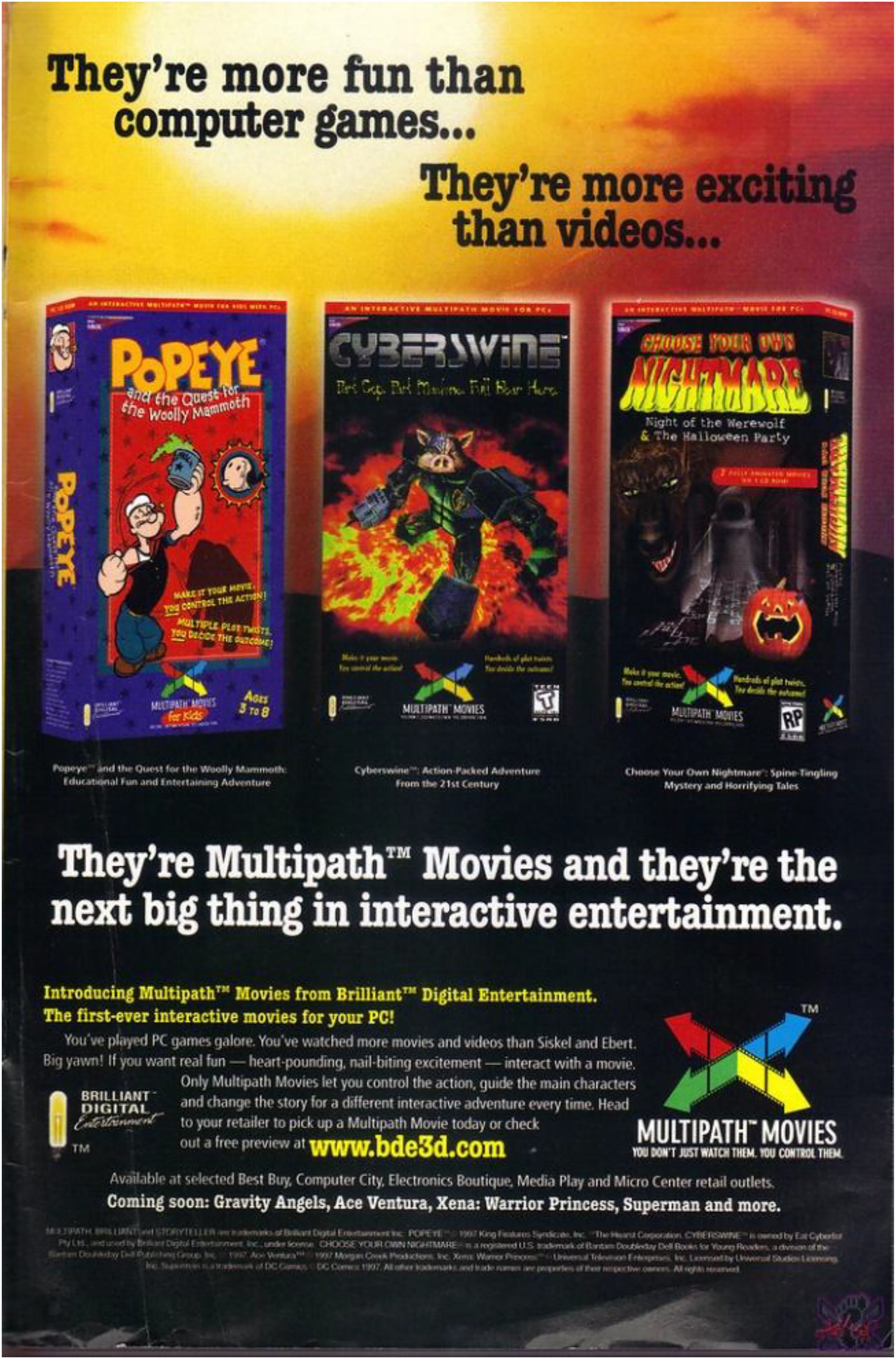
While the Digital Projector grew, buoyed by the seemingly perpetual growth of internet users during this period, CD-ROM sales remained underwhelming. In mid-1998, the company announced it was abandoning its retail ambitions. In an LA Times profile from 2000 (Gettleman, 2000), Bermeister rationalised this move by suggesting stores ‘weren’t sure where to shelve something that was part game, part movie’, subtly situating the multipath movies as such a radically new form that retailers did not know what to do with them, rather than it being a fault of the market or consumers. The CD-ROMs were also retroactively justified as temporary measures until they had the technology to deliver multipath movies across the internet (Gettleman, 2000).
Alongside this smoothing of their retail struggles, the LA Times profile also sought to characterise BDE as ‘a Woodland Hills Internet startup that some observers say is in an excellent position to cash in on the reinvigorated push for online entertainment’ (Gettleman, 2000). 5 Describing BDE as a startup at this stage is apt. The term became popularised during and after the dot-com bubble, and tends to be associated with a range of characteristics like a scalable business model, the attempt to make ‘new’ products or services that can be tailored to different contexts, and a high risk of failure (Koskinen, 2023: 814). Many of these characteristics are observable in BDE’s operating model and promotion – not only did they regularly position multipath movies as a ‘new’ product, but the foregrounding of B3D Studio and Max sought to tailor the underlying technology to different contexts. They were also a company whose ventures ultimately failed; at the time of the profile BDE was far from profitable, posting a $10 million loss in its last four quarters compared to a revenue less than a tenth of the size at $857,000 (Gettleman, 2000).
Describing BDE as a tech startup therefore explicitly situates the company within the larger industrial and economic shifts occurring within the dot-com bubble. The LA Times profile positions the company as being in an ‘excellent position’ to capitalise on this new and untapped market – an analyst at internet research firm ‘Jupiter Communications Inc.’ is quoted as saying ‘a technology company that has emerged specifically to create Web-based entertainment is a very viable concept at this point in time’. Far from the shaggy game development team from Bondi Sydney first depicted in PC Powerplay, BDE here adopts the logics of tech startups and of venture capital itself – perceiving multipath movies alongside the internet as a ‘new economic space’ (Kenney, 2003: 33) the company was seemingly in a prime position to capitalise on.
A key benefit of BDE’s pivot to online distribution was its ability to embed its B3D Projector in other websites. In 1999, they struck a deal with Warner Bros. to stream the upcoming Multipath Adventures of Superman exclusively through their new website entertaindom.com, a WB venture initially created to be an ambitious ‘entertainment portal’ website designed to keep fans coming back for ongoing digital content (Figure 5). BDE took a small percentage of advertising revenue from entertaindom.com, and struck up deals with other sites including Freeserve, Fox Kids, DVD Express and more (BBC, 2001; SEC, 2001). Warner Bros. initially ordered 15 episodes of The Multipath Adventures of Superman (1999-2001) at approximately five to 8 minutes each. The series was successful enough for Warner Bros. to extend their initial order to 30 episodes, and to agree to distribute, via entertaindom.com, BDE’s Xena: Warrior Princess and eight webisodes of their next series The Multipath Adventures of KISS Immortals (2000) that used the original songs and voices of the band KISS developed in tandem with the band’s 2000 ‘KISS-Immortals’ concert tour (Graser, 2000; Writers Write, 2000). In total, 57 episodes of The Multipath Adventures of Superman would air.
6
Entertaindom.com ads.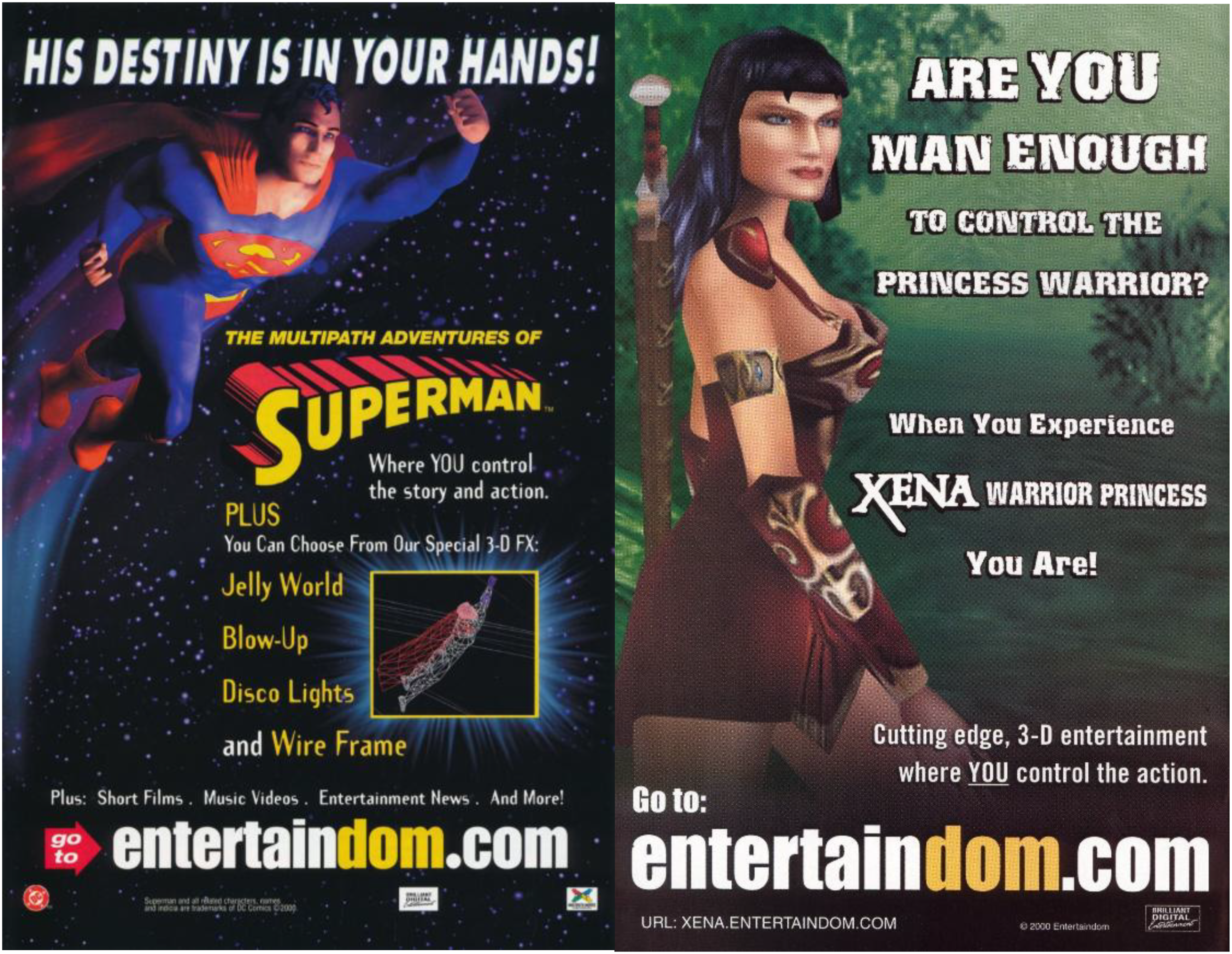
During this period, BDE was not only riding the wave of booming interest in internet startups and websites but was also becoming part of the growing trend of online advertising. Crain (2014: 1), through his analysis of the dot-com bubble, argues that this period can be ‘conceived of as highly generative of modern structures of online advertising’. Online advertisement spending at the start of the bubble was only a fraction of total US ad spending, but by 2001 it had surpassed outdoor media and trade publications. By 2010, it was the second largest ad category in the country. While Crain (2014: 5) centres his analysis on firms seeking to appease venture capitalists through marketing, his insight is productive in how it builds on Kenney’s (2003) conception of the web as a ‘new economic space’. Not only was BDE invested in delivering content online, but this content fundamentally interwove with advertisements through their deals with websites like entertaindom.com to take a small percentage of their advertising revenue in exchange for their content. 7 Perhaps even more telling is Bermeister's quote in Forbes:
‘The entertainment form we are creating is a new method for delivering interactive content. Our business is based on ad impressions and e-commerce integration with partners like Entertaindom. The possibilities for product placement are limitless. In the future, depending on which demographics the advertiser is targeting, because our content is all digital you could see Superman drinking from a Coke can or flying by a Ford Explorer.' (Forbes, 2000).
This is a particularly revealing comment. It reinforces Bermeister and the company’s perception of multipath movies as akin to the developing internet: as a new economic space not only for services but also for advertisement placements. This mode of thinking conceives of multipath movies not as a cinematic art form or expression of audience agency, but as a canvas for marketing spending – a booming prospect given the enormous venture capital of the era. It also mirrors the long history of product placement in film and television (Eagle and Dahl, 2018) as well as videogames (Glass, 2007) and highlights the ‘benefits’ of digitality in how its modularity will supposedly eventually allow for even more targeted advertising.
Considering perspectives on advertising alongside the various other details I have outlined, the company’s position within the dominant economic trends elicited by the dot-com bubble becomes evident. BDE embodied many of the logics of both venture capital and internet startups during this period – ‘get big fast’ through an increasingly rapid output of multipath movie content, profit being secondary to growth, a focus on advertising, and an integration of burgeoning websites, digital distribution and proprietary software into their operating model. In adapting these logics, I argue that BDE approached interactive movies the same way venture capitalists perceived the internet – a new horizon to profit from.
The company’s exuberant rhetoric around their multipath movies – that they represented a new media form combining and improving on both cinema and games – echoes the hyperbole of a tech startup attempting to sell their product as innovative and primed for revenue growth. While BDE’s origins remain in games development and distribution, the company was shaped and defined by its cultural and industrial context, a context that saw ‘profitability, a long-standing rule-of-thumb for companies… as outmoded’ (Crain, 2014: 5). Within this economic ideological context, a business spending 10 times more than it earns maintains the logic of eventual business success (Gettleman, 2000). Only within this context can you have a company losing $10 million while the CEO confidently claims ‘we think we have the potential to become another Disney… Like Disney, we will expand beyond animation to a range of products and services, offering everything from entertainment to sports, even education’ (Forbes, 2000).
In March 2000, the bubble burst. The reality of a sector with a valuation of $1.5 trillion yet only $40 billion in sales hit hard (Kenney, 2003: 42), and a range of e-commerce firms like Pets.com, Eve.com and Boom.com folded. Many tech startups and telecommunication firms soon followed. In the first quarter of 2000, four out of five dot-com companies were running at a loss, and Brilliant Digital Entertainment was amongst them. Because of the collapse, entertaindom.com, the Warner Bros./AOL site hosting BDE’s The Multipath Adventures of Superman, became a cost-cutting casualty in early 2002 (Hansen, 2002).
A year earlier, in mid-2001, the same fate befell BDE’s multipath movies. In BDE’s own words from their SEC (2001) report, ‘in 2001 we substantially reduced our internal production and syndication of 3D animation, which we used primarily to distribute our Digital Projector, in order to reduce our costs and our cash burn rate’. This was done in tandem with discontinuing Brilliant Interactive Ideas, their Australian-based production arm. Despite initial success in digital distribution and entertaindom.com, their operating model never materialised the speculated profits they were ‘uniquely positioned’ to acquire.
BDE’s multipath movies briefly lived on. A deal struck with SlingShot Entertainment (SlingShot, 1999) led to the DVD release of The Multipath Adventures of Superman: The Menace of Metallo (2000) that included the first five episodes of the series, alongside releases of other multipath series like Xena: Warrior Princess, Ace Ventura and Choose Your Own Nightmare. A year later, however, DVD production ceased due to limited success, leaving numerous titles previewed but unreleased such as two more compilations of Ace Ventura and Superman episodes and an adaptation of Xena episode ‘Prometheus’. Many webisodes, including 52 of the 57 online only episodes of The Multipath Adventures of Superman disappeared entirely when entertaindom.com was discontinued in 2002 by Warner/AOL.
While 2001 saw the end of multipath movies, BDE quickly pivoted to alternate revenue sources. Their 2001 SEC Report (SEC, 2001) states, ‘the reduction in our content production and syndication activities has allowed us to focus our efforts and allocate our resources to the further development and exploitation of our advertising serving and authoring tools businesses’. B3D Studios, the program originally used to make multipath movies, began to be used for internet advertisements, virtual storefronts and the aforementioned music videos for Ja Rule, Ludacris and others. Their SEC (2001) report also mentions a brief venture into using the Digital Projector to stream ‘Auctionchannel Inc.’, a service that enabled participants to watch auction events in real-time on television and over the internet. The auction channel was sold off in April 2001. BDE found further longevity through their subsidiary Altnet and their peer-to-peer networks, before being involved in several legal battles over music copyright in subsequent years (Borland, 2003).
BDE’s venture into interactive movies and web distribution from 1996 to 2001 is a minor history in the scope of videogame and cinematic convergences, but it remains an illustrative one. The moments of difference and discontinuity that the company embodies as a ‘minor’ history (Nicoll, 2019: 13) reveals an alternate way of thinking about consumer designed identities and a part of videogame history where the economic and industrial logics of both the dot-com bubble and startup culture were deeply integrated into design and discourse.
I also argue BDE reveals an illustrative historical perspective on interactive movies as a media form. It is a perspective shaped by technology and the novelty in both experience and economic opportunities it provides; a perspective that saw the combination of forms interactive movies represented as a ‘new economic space’ much like the internet. The company entered the industry when interactive movies were considered the ‘holy grail’ (Gallagher, 2018: 174) and ‘new standard in interactive entertainment’ (Wolf, 2007: 129). In being aligned with the logics of the dot-com bubble, we can draw a connection between the perceived opportunities seen in the early internet with the interactive movie and the imagined audience BDE sought to will into being.
Bandersnatch and interactive movies since
BDE not only reveals ruptures and alternatives as a minor videogame history, but it also helps us recontextualise and reconsider discussions of interactive movies since. Returning to my use of genealogy, I do not intend to situate multipath movies as a key technological touchstone within a larger historical trajectory, but instead argue that it embodies a range of discourses and logics that have been uncritically articulated since. To illustrate this point, I turn to the discussions surrounding Netflix’s interactive movie Bandersnatch. While it released in 2018, it remains a productive case study for genealogically ‘lay[ing] the past and present side-by-side’ (Golding, 2014: 23) to reveal links and continuities between how multipath movies and Netflix’s interactive output have been similarly discussed.
Heralded as Netflix’s ‘first’ interactive movie (Rubin, 2018; Strause, 2019a) despite previous projects like Minecraft: Story Mode (2016) and Puss in Boots: Trapped in an Epic Tale (2017), Bandersnatch, much like Cyberswine’s early preview, was presented in the press as a meaningful novelty that blurs different media forms together. Reynolds (2018) claims that creator Charlie Brooker and his team had to ‘reinvent how television is made’ through an initially 170-page hand-coded script that required Netflix to build its own software for it to work. Despite the decades of interactive movies that existed to this point then, the film is still presented as a technological innovation – not only in the bespoke software Netflix had to create, but also the innovations it seemingly required to stream at all (Reynolds, 2018; Roettgers, 2018).
There is also a focus on how Bandersnatch complicates and innovates its form as a film. Strause (2018) notes that ‘there is no official run length to Bandersnatch’, instead noting that there are so many multiple ends and story paths that Netflix’s director of product innovation, Carla Engelbrecht, claims there are ‘millions of permutations of how you can play this story… [so many that] it’s actually hard for us to calculate how many choices there actually are’. Brooker and executive producer Annabel Jones also express hope that viewers simply appreciate Bandersnatch as ‘a novel and cinematic TV experience’ (Strause, 2018). Bandersnatch actor Will Poulter, when asked about whether it should be thought of as a film or a game, argues that it can’t be ‘defined or boxed’ into any category, and that is ‘one of the charms of it’ (Strause, 2019b).
Much like Cyberswine, there are also allusions to conceiving of an imaged audience for Bandersnatch, though in this case it is buoyed by the copious amounts of data from viewers Netflix collects. Engelbrecht noted how ‘94 percent of viewers were actively making those choices’, a level of engagement she considered ‘absolutely a success’ (Strause, 2019a). Brooker also notes that Netflix themselves were very happy due to viewers staying with it ‘longer than we anticipated’. Bandersnatch’s imagined audience is therefore one that is highly engaged and invested in playing through the interactive film’s many story paths, and thus subsequently spends more time on Netflix itself. This is apt for Netflix given co-CEO Reed Hasting’s proclamation that the streaming service’s main competitor is sleep (Hern, 2017).
Bandersnatch is indicative of larger comparisons that can also be drawn between BDE and Netflix’s treatment of interactive movies. Like Cyberswine, Bandersnatch was followed by a flurry of other interactive programs that drew on the name recognition of various brands like The Boss Baby, Carmen Sandiago, Jurassic World, Spirit, Captain Underpants and Man vs Wild. Much of these were targeted at younger demographics, but others also built on Netflix’s own catalogue of originals, like the interactive film sequel to the series Unbreakable Kimmy Schmidt (2015-2019) subtitled Kimmy vs the Reverend (2020) that, much like Bandersnatch, was critically lauded and nominated for two Primetime Emmy Awards.
Also like BDE, this push into interactive movies was eventually deemed not worth the investment. Netflix’s head of gaming, Mike Verdu, was quoted in early 2024 saying ‘we’re not building these specific experiences anymore… the technology was very limiting and the potential for what we could do in that realm was kind of capped’ (Totilo, 2024). Instead, Netflix began pivoting away from interactive movies towards ‘interactive narrative games’ based on their shows like Love is Blind and Too Hot to Handle. This pivot is likely for several reasons, including the greater time investment such games could facilitate compared to interactive movies, and the alternate ways of monetisation they provide (Toonkel, 2024). In November of 2024, Netflix officially announced that 20 of their 24 interactive titles would be removed from the platform in December, with only key titles in Bandersnatch and The Unbreakable Kimmy Schmidt remaining (Peters, 2024).
While this comparison is inevitably cursory, it nonetheless highlights that the logics BDE exemplified have been applied to interactive movies elsewhere – as a ‘novel’ combination of media forms that elicits a specific type of imagined audience designed to position interactive movies relative to their potential economic prospects. The rhetorics around the promotion of Bandersnatch and the logics behind Netflix’s interactive movie push in many ways repackages the same discourses from BDE 20 years later. To paraphrase Kline et al. (2003: 31), while interactive movies were once genuinely ‘new’ media, ‘their possibilities are being realised and limited by a media market whose fundamental imperative remains the same as that which shaped the “old” media: profit’. Brilliant Digital Entertainment reminds us of the intertwined industrial and economic underpinnings of the games industry that have been under-scrutinised when it comes to both interactive movies and other ‘new’ technologies.
Conclusion
Through a genealogical analysis of the minor history of Brilliant Digital Entertainment and their development of multipath movies from 1996 to 2001, this article examined the extrinsic influences important to understanding interactive movies as a media form shaped by economic, industrial and cultural forces. In outlining how BDE adopted the logics, operating models and perspectives on technology from the dot-com bubble, I have argued that they perceived their multipath movies as, much like the burgeoning internet, a ‘new economic space’ ripe for capitalist growth and opportunity. Central to this is how BDE positioned multipath movies as a ‘novel’ new form both in its mediality and technological innovation, and how the company conceived of an imagined audience with an identity specifically designed to respond to the affordances of interactive movies. As a minor history of interactive movies, BDE is therefore a productive and meaningful case study relative to both the period of cinematic/gamic convergence in the 1990s and how we conceive of interactive movies more broadly.
Footnotes
Acknowledgements
This research is the product of research assistance work I was very lucky to conduct for Professor Angela Ndalianis for ‘Play it Again II’. As always, I feel extremely thankful for having had Angela for my PhD supervisor and all the mentorship she provided during my candidature. Many other academic colleagues and friends also contributed to this article, both directly and indirectly. Benjamin Nicoll was instrumental early on in guiding my research and direction and the final article would not be where it is without him. Many thanks, also, to Jacqueline Moran, Xavier Ho, Andrea Andiloro, Mahli-Ann Butt, Ryan Stanton and Gaiwan Lucius Lax for the feedback they provided during the DiGRAA work in progress workshops. A special thanks to Hugh Davis for providing extremely helpful and detailed feedback and revisions, too.

Funding
The authors disclosed receipt of the following financial support for the research, authorship, and/or publication of this article: This work was funded by the Australian Government through the Australian Research Council.
Declaration of conflicting interests
The authors declared no potential conflicts of interest with respect to the research, authorship, and/or publication of this article.