




Abstract
The paper aims to explore the intersection of full-motion video (FMV) games and surveillance cinema, focussing on how FMV games rework and reference the conventions of surveillance films. FMV games, introduced in the 1990s as a blend of movies and interactive gameplay, offer a unique take on the surveillance motifs, aesthetics, and narratives commonly found in cinema. By incorporating interactive elements, these games extend the surveillance logic seen in films, offering players an active role in the surveillance process. The paper begins by examining how non-FMV games have integrated surveillance mechanics since the early days of gaming. Following this, a brief overview of surveillance-themed FMV games is presented, highlighting how they build on the surveillance tropes of cinema while introducing interactive elements. The focus then shifts to Voyeur (Philips Interactive, 1993), a seminal FMV game that exemplifies the convergence between surveillance cinema and gaming. The paper delves into how Voyeur draws from films like Rear Window (dir. Alfred Hitchcock, 1954), but with a crucial difference: the player’s agency. Unlike traditional surveillance films where the audience passively observes, FMV games like Voyeur allow players to actively engage in surveillance, altering the power dynamics between the observer and the observed.
Keywords
Introduction
In the field of Film Studies, the theme of surveillance has attracted considerable scholarly attention over the past years (Kammerer, 2012; Stewart, 2015; Zimmer, 2011; Zimmer, 2015). This trend not only aligns with the rise of Surveillance Studies (Ball et al., 2012; Lyon, 2007; Monahan and Murakami Wood, 2018), but also with the enduring popularity of surveillance-themed media products in popular culture. However, motifs of surveillance as well as state regulation through visual recording technologies, associated power asymmetries as well as the experience of gaining or losing control through watching or being watched, can already be found in early or even earliest film history and theory, permeating the entirety of film history to the present day (Zimmer, 2015). The theme of surveillance ranges from the iconic footage of workers in Workers Leaving the Lumière Factory (Louis Lumière, 1895), to the dystopian police state in Metropolis (Lang, 1927), the voyeurism and surveillance logic in Rear Window (Hitchcock, 1954) and Peeping Tom (Powell, 1960), the visual evidence gathering in Blow Up (Antonioni, 1966), as well as espionage films like The Lives of Others (Henckel von Donnersmarck, 2006), extending to numerous digital control and surveillance dystopias depicted in contemporary films and series such as The Circle (Ponsoldt, 2017) or Black Mirror (Bathurst et al., 2011). According to Catherine Zimmer (2015: 1), the narrative focus on corresponding surveillance technologies has particularly become a common motif in a variety of cinematic domains since the 1990s. Not infrequently, contemporary films and series depict drones, smart devices, and security cameras as narrative elements that appear ubiquitous, while classical cinema relies on analogue media technologies such as binoculars, telescopes, private investigation, surveillance bugs, or analogue cameras to name a few. Due to the cultural, structural, historical, and technological intersections of the conglomerates cinema and surveillance, Catherine Zimmer argues that the development of ‘visual technologies associated with cinema’, their corresponding ‘cinematic form[s]’, and the formation of surveillance practices even mutually shaped each other (Zimmer, 2015: 1; also see Zimmer, 2011: 428). While surveillance cinema in all its forms is shaped in diverse ways on the narrative and thematic level by literary sources (Kammerer, 2012) – think of canonical surveillance novels like 1984 (Orwell, 2021/1948) – cinematic surveillance logic also feeds into digital games. As numerous authors have pointed out, digital games have been closely related to film since their introduction in the 1970s and have often been researched using the tools of film studies (Kallay, 2013; King and Krzywinska, 2002; King and Krzywinska, 2006; Papazian and Sommers, 2013). In addition to the continuous production of film and videogame adaptations and the usage of film production technologies (film cameras and motion capturing), various intermedial relationships can be identified: the translation of cinematic aesthetics, such as the simulation and representation of a camera perspective or montage forms, the processing of cinematic subjects, styles, narratives, and genre conventions. Among these, the use of cinematic recording technologies, as in the case of FMV games (full-motion videogames) – usually associated with the label ‘interactive films’ (cf. Perron, 2013) – became a short-lived trend in the early 1990s. Since the idea of incorporating FMV sequences into digital games was to ‘take “video game” literally by combining full-motion video of live-action and cinematic techniques with a gaming experience’ (Perron, 2013: 237), it can be argued that ‘[n]o other multimedia product came closer to crossing the threshold that separates the worlds of film and video games’ (ibid.). In this respect, this intermedia constellation offers an interesting take on both early intermedia relationships between cinema and digital games as well as the incorporation and reworking of surveillance logic in such hybridizations.
In this paper, I will demonstrate how FMV games both reference and rework cinematic conventions, motifs, aesthetics and narratives from surveillance cinema, while simultaneously integrating ludic and interactive elements into the surveillance logic. To begin, I will define the concept of surveillance as it is applied in this paper and apply it to exemplary (non-FMV) games (early 1980s to early 1990s). I will then provide a historical overview of the relationship between FMV games and the discourse surrounding surveillance cinema. By examining key games, I will illustrate how these games not only reinterpret cinematic tropes and genre conventions on both narrative and aesthetic levels but also incorporate surveillance logic into their game mechanics. Subsequently, I will analyze Voyeur (Philipps Interactive, 1993), a quintessential example of the convergence between surveillance cinema and digital gaming. Through this analysis, I will argue that there is a crucial distinction between FMV games and traditional surveillance films – specifically in terms of the player’s role versus the movie audience’s role: player agency. This agency enables players to assume the role of active surveillants, fundamentally altering the relationship between the surveillance agent and the surveilled subject/object, which is critical to the power asymmetries inherent in surveillance.
Surveillance in digital games: Concept and historical contextualization (1980s to early 1990s)
On the most general level, surveillance describes a process or activity of watching/attending to a (typically human) subject in a manner that is non-accidental and goes beyond mere coincidence or curiosity (cf. Lyon 2007, 13–14). The word ‘surveillance’ etymologically derives from the two French word parts ‘sur’ (from above) and ‘veillance’ (to watch), which already hints at some of its key characteristics. Surveillance is a fundamental ‘social-ordering process’ (Ball et al., 2012: 1) – or even ‘the dominant organizing practice of late modernity’ (ibid.). Surveillance involves the gathering of information from a specific vantage point for a certain purpose. In any event, in surveillance constellations two central subjects/objects are present: ‘We can identify the surveillance agent (whether as watcher/observer/seeker/inspector/auditor/tester), while the person [or object] about whom information is sought or reported is the surveillance subject [or object]’ (Marx, 2012: xxv, addition by author).
This relationship between surveilling agent and surveilled subject is oftentimes seen in a critical light and especially in cinema it is usually related to ethically charged or contemporary political issues. Surveillance, however, is ‘neither good nor bad, but context and compartment made it so’ (Marx, 2012: xxi), as the purpose of the surveillant agent can be ‘controlling and disciplining the subject into certain behavior or a set of norms’ (Galič et al., 2017: 10), but may also be ‘protecting and caring for that subject’ (ibid.). In this respect, surveillance is about more than just watching. It depends also on some capacity to control, regulate, or modulate behaviour for a specific purpose. Just as the word ‘sur’ implies a superior vantage point (‘from above’) the relationship between surveilling agent and surveilled subject implies a power relationship (Monahan and Murakami Wood, 2018: ix). The common process of surveillance thus ‘comprises the collection, usually (but not always) followed by analysis and application of information within a given domain of social, environmental, economic or political governance’ (Ball et al., 2012: 1). The ultimate purpose of surveillance is a ‘form of oversight that judges and intervenes to shape behavior’ (Monahan and Murakami Wood, 2018: xx). One of the central aspects related to surveillance – especially as far as the power dynamics and ethical considerations are concerned – is the question of whether the gathering and analysis of information/data is practiced with mutual consent (Monahan and Murakami Wood, 2018: ix).
Based on this concept of surveillance, it can be argued that surveillance technologies and practices already have ‘many game-like functions’ (Koskela and Mäkinen, 2016: 1528). Analogously, Martin Hennig and Marcel Schellong (2020) have argued that the functions of digital game dispositives, due to their technological conditions, can fundamentally be understood as modes of surveillance: Video games typically require an active engagement with aspects of surveillance. Surveillance is either something that players must evade to achieve the game’s objectives, or it is precisely what they must successfully implement themselves. Furthermore, video games – as games – define the player's scope of action within a structured system of rules, akin to the ‘ludus’ game type. At the same time, video games also function as mechanical ‘referees’, monitoring players' adherence to the established rules. (p. 8, translation by the author)
Based on this premise, games continuously ‘test’ and ‘discipline’ the players’ actions within this system of rules, and as a consequence of failure or resistance to the game’s prompts, the game system may impose sanctions on players – culminating, in the worst case, in the players being ‘punished with a symbolic death’ (Pias, 2011: 179), which is usually a loss of lives, points or the ‘game over’ screen.
This form of monitoring is not confined solely to the procedural level of code or hardware functions. The graphical user interfaces (GUIs) of many games also capture and display a variety of data, such as health points, the locations of enemies, the player’s character, or objects, and the number of points accumulated, thus providing the player with a certain kind of power (e.g. controlling and manipulating game stats, watching enemies or human opponents, developing strategies etc.). The world map, in this context, can be understood as a classic surveillance technology, functioning much like a radar that scans the game environment and can alert the player in critical situations. While this logic can be applied to any game in terms of a technological or interface condition, surveillance logics have been incorporated in digital games on the gameplay and narrative level since their early beginnings (Albrechtslund and Dubbled, 2005: 218). By the end of the 1970s and the beginning of the 1980s, videogames were increasingly influenced by the audiovisual elements of surveillance cinema and the adaptation of cinematic discourse. Recurring themes within surveillance cinema include, among others, dystopian societies dominated by technology where surveillance is imposed by the state (e.g. Blade Runner, Scott, 1982), the omnipresent panoptic observation, control, manipulation, and harm of citizens (e.g. The Running Man, Glaser, 1984), the paranoia associated with being constantly watched (e.g. Blue Thunder, Badham, 1983), as well as the rebellion against a surveillance state (e.g. Brazil, Gilliam, 1985) and espionage conducted by either a single private detective or a larger group or organization (e.g. The Conversation, Ford Coppola, 1974). Typically, these films address issues such as oppression, invasion of privacy, mistrust, and the enforcement of social rules and laws through violence – whether by governments or corporations. Furthermore, these themes and motifs are often interwoven into complex ethical narratives. An example for videogames that reworked the traditions of cinematic surveillance and dystopian cinema (see Lefait, 2013) is the real-time tactics game Syndicate (Bullfrog, 1993), which takes place in a cyberpunk-inspired future where advanced technology and cybernetics are prevalent, and corporations exert control over every aspect of life. The player’s objective is to dominate the corporate world by using a combination of strategic tactics and brutal force. In the espionage-themed point-and-click adventure Operation Stealth (Delphine Software International, 1990) the players control a secret agent who is tasked with thwarting a global conspiracy involving a stolen nuclear submarine and, similarly, in the adventure game Manhunter (Sierra On-Line, 1988), players assume the role of a detective in a dystopian future where Earth has been invaded by extraterrestrials and surveillance-driven control and manipulation are omnipresent. Therefore, reference and adaptation of cinematic surveillance discourses also helped create a certain atmosphere for the stories being narrated within the game (cf. Albrechtslund and Dubbled, 2005: 218). The same is true for stories about private detectives or police work taking place in a contemporary setting, in which the tailing of a suspect or snooping around in a private apartment can play a role, such as in Police Quest: In Pursuit of the Death Angel (Sierra On-Line, 1987). Finally, videogame adaptations of classic surveillance- or espionage-themed Hollywood films, such as James Bond 007: The Spy Who Loved Me (The Kremlin, 1990), often engaged with surveillance logics within their diegetic worlds, even if they did not always remain faithful to the source material. These adaptations incorporated themes of constant monitoring and covert operations, aligning with the overarching narrative of surveillance present in the original films. In many cases, this connection to surveillance was not directly represented through the game’s mechanics or story but was instead suggested through paratexts, such as the game’s manual, packaging or the source films. Even if games themselves did not fully replicate the intricacies of their cinematic counterparts, they managed to evoke the essence of surveillance through both their narrative elements and external marketing materials.
Despite the variety of surveillance topoi represented on the diegetic level, due to their interactive nature and the ‘configurative practice’ (Eskelinen, 2001) involved in gaming, digital games added a further dimension to the conversation around surveillance media. By distributing videogame-specific agencies to the player, that allow for certain mode of ludic involvement (Eichner, 2014: 128ff) and the manipulation of the game elements, games can mediate surveillance relationships that differ from those of cinema and other media (see Green, 2017: 36-40).
1
Although (non-interactive) cinema can represent both surveillance agents and subjects/objects on the diegetic level in a variety of forms and relations, viewers themselves cannot assume the role of a surveillant within the cinematic apparatus. I intentionally use the term ‘surveillant’ here as a specific mode of actor/participant in the process of consuming/using media, as this, according to the definition of surveillance, goes beyond watching and interpreting the perceived images and sounds and incorporates a level of intentional and meaningful ‘manipulation or the configuration of temporal, spatial, causal and functional relations and properties in different registers’ (Eskelinen, 2001). Film audiences may function as voyeurs (Mulvey, 1975), watching a cinematic subject or object with ‘a certain purpose’ (Galič et al., 2017: 10) by collecting ‘data’ presented within the diegetic world and the aesthetic register of the film and using this information to cognitively make sense of the narrative. This can go as far as asking viewers to actively solve certain narrative or aesthetic puzzles, decipher temporal-spatial sequences, or to arrange them in chronological order (at least in their own minds). This mode of cognitively and productively participating in the movie-watching experience is most evident in so-called mind-game films (Elsaesser, 2021) but can to some extend be attributed to any kind of film. Therefore, watching a film does not mean that film spectators do nothing in the act of watching and that a problematic active-passive distinction cannot simply be drawn here to define the differences between videogames and films. Together with differences between narrative and play/non-interactive fiction and games, this distinction has often been criticized in academic discourse on media agency (e.g. Shaul 2008: 45; Eichner, 2014), as Lev Manovich (2001) demonstrates by comparing reading a book and playing a game: […] narratives and games are similar in that the user must uncover their underlying logic while proceeding through them – their algorithm. Just like the game player, the reader of a novel gradually reconstructs the algorithm (here I use the term metaphorically) that the writer used to create the settings, the characters, and the events. (Manovich, 2001: 225, cited in Shaul, 2008: 45)
Similarly, film audiences construct meaning from the semiotic constellation presented within the film. However, they remain fixed in the static position of an observer, in which they are unable of ‘controlling and disciplining the subject [e.g. the main character] into certain behavior or a set of norms, but also – possibly at the same time – protecting and caring for that subject’ (Galič et al., 2017: 10, addition by the author). As the narrative events in (non-interactive) films are prestructured, spectators are unable to alter, intervene in, or influence the course of these events or exert control over any of the film’s characters (besides interpreting narrative situations and relations). I will elaborate this in the analysis of Voyeur in the section below.
Beyond that, videogames often integrate metaphors of surveillance within gameplay, positioning players either as the surveillant agent or as the subject under surveillance. Platform games for instance, incorporate playful elements of surveillance by using obstacles or enemies that monitor specific areas of the level and trigger an action as soon as the avatar enters the corresponding space. In the classic platformer Super Mario World (Nintendo, 1990), for instance, the so-called ‘Boos’ are ghosts that Mario can only see and attack when he turns his back to them – when he is not looking at them or is even unaware of them watching him (Figure 1). Although their eyes are closed, the Boos in Super Mario World continuously monitor Mario’s every move. They serve as a metaphor for a security camera, symbolizing an ever-present surveillance system that tracks his actions despite their seemingly passive appearance.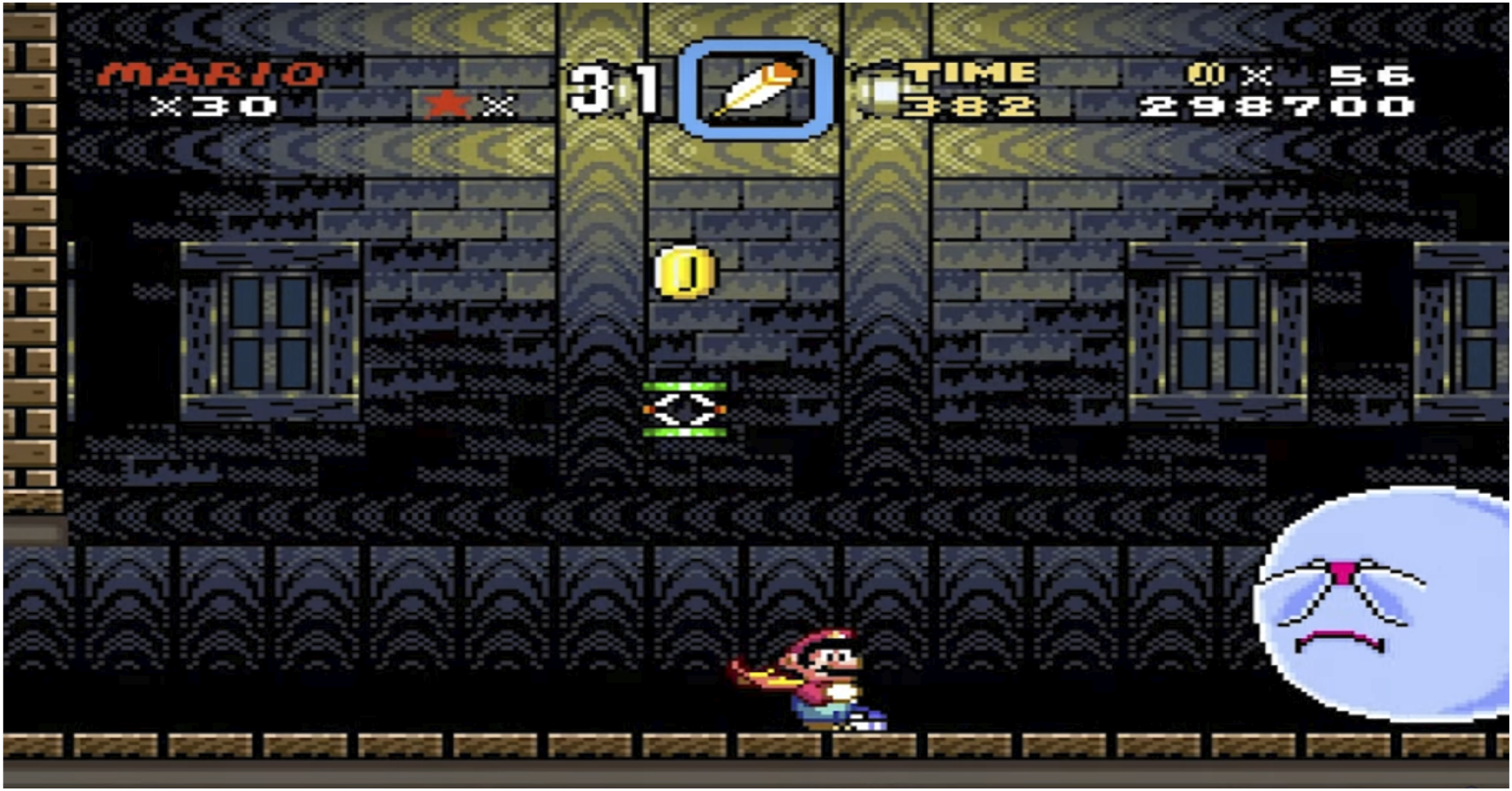
However, as soon as Mario turns around and looks at the ghost, it remains motionless. This logic is similar to that of a security camera, which operates unnoticed by the subject being monitored. Frequently, such gameplay elements were even implemented by placing a static pixelated automatic machine gun or even a security camera into the level, that marked a certain ‘danger zone’ (usually coloured in red), which triggered a certain action – such as firing a sequence of shots or alarming enemies – once the forbidden zone was entered by the player’s avatar. Another iteration of this logic is the patrolling of guards who monitor a certain area that requires the player to sneak past them unnoticed, as in games such as Metal Gear (Konami, 1987) (Figure 2). Solid Snake (lower left) hiding from the surveillance camera (red, middle left) and the approaching army patrols (lower right) in Metal Gear for the Nintendo Entertainment System.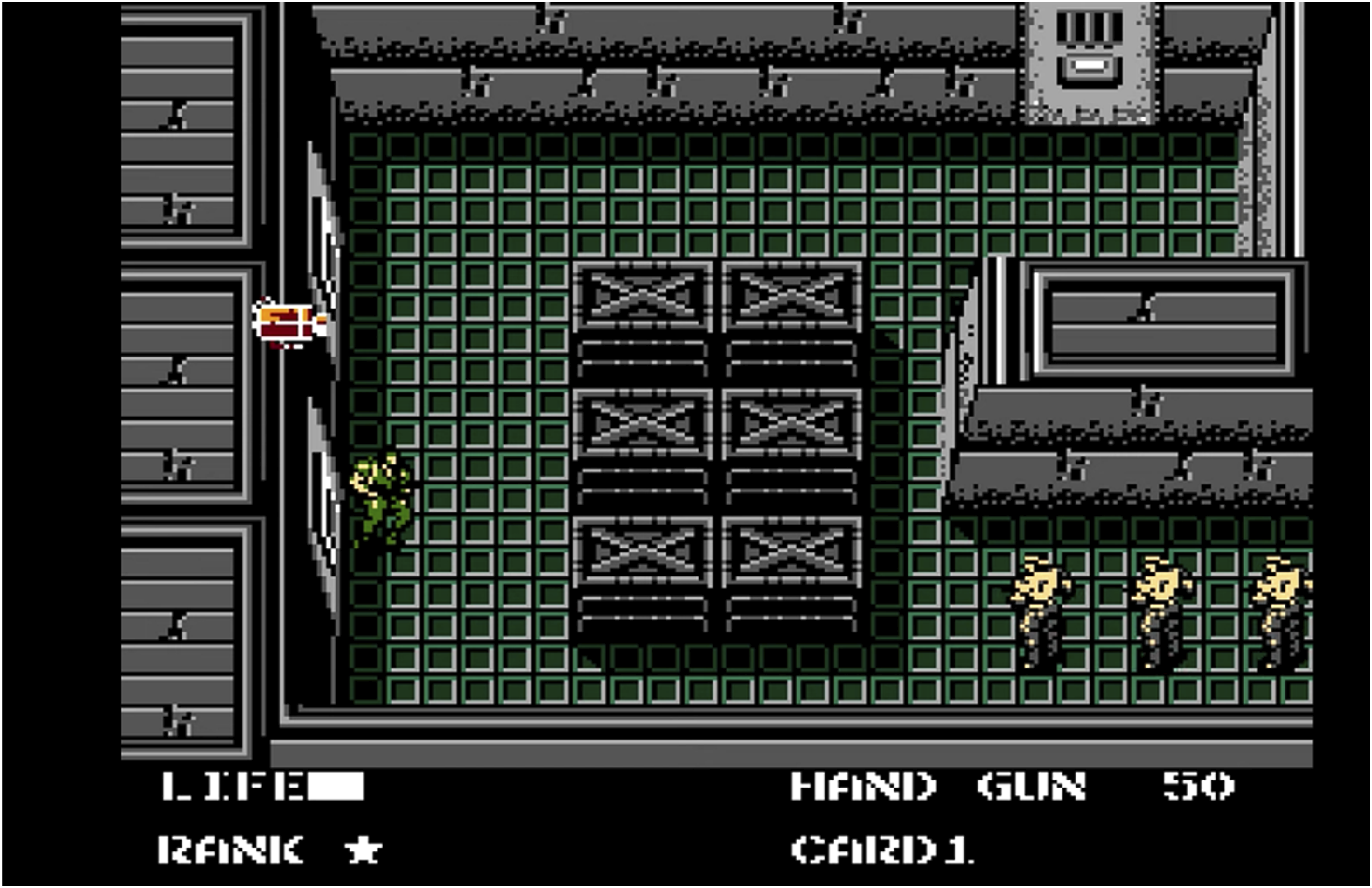
Furthermore, the panopticon (as conceptualized by Jeremy Bentham), a conventional concept in surveillance cinema, is impressively demonstrated in the game Sentinel (Firebird Software, 1986). The game is represented from a first-person perspective and it involves a power struggle over controlling the so-called ‘Synthoids’ within a three-dimensional panopticon, dominated by the gaze of the ‘Sentinel’, overwatching the game’s diegetic environment (cf. Albrechtslund and Dubbled, 2005: 218). Although such games and game mechanics made frequently use of surveillance logic and metaphors, their technological restrictions prevented them from implementing live-action footage, not least security camera footage in the form of a first-person perspective, which is a staple in surveillance cinema. However, the introduction of CD-ROM technology and FMV games changed this situation and led to a series of games, that revolve around recording, analyzing and using security cameras and footage (among other surveillance practices), as will be shown in the next section of this paper.
Full-motion video and surveillance logics in digital games: A short introduction
In the early 1990s American Laser Games tried to revive the formerly failed Laserdisc technology for the home market with FMV game titles such as Mad Dog McCree (American Laser Games, 1990), Who Shot Johnny Rock? (American Laser Games, 1991) or Space Pirates (American Laser Games, 1992). Nonetheless, the Laserdisc could not compete with the newly introduced CD-ROM technology in terms of price, availability, and widespread adoption (cf. Wolf, 2021: 558). Aside from the surveillance logics that condition the technical infrastructures of the videogame dispositive discussed above, the FMV game Who Shot Johnny Rock? did already implement surveillance logics on the narrative level. The game reworked elements of classical gangster movies and film noir, which can be understood as an early FMV example that establishes a connection to surveillance discourse through its intermedial relationships with cinematic genre conventions. In the game, the player assumes the role of a private detective who gathers information, observes suspects, and analyses their behaviour to solve the murder of Johnny Rock. These activities align with narratives of generic detective stories, where the goal is to acquire knowledge about others, often without their awareness or consent, as has been represented numerous times in surveillance cinema (cf. Stewart, 2015). In this sense, the player acts as a kind of ‘watcher’, revealing the truth through the observation and analysis of clues and individuals. On the gameplay level, however, the game was limited to mechanics of the light gun shooter, thus reworking surveillance discourse rather on the narrative than on the level of gameplay.
The early to mid-1990s saw the introduction, popularization and proliferation of CD-ROM drives for the home computer and console market and the development of compressing methods such as MPG. Additionally, the CD-ROM technology became cheaper, widely available and accessible (Garrand, 1997: 66). Besides the standardization of CD-ROM drives for PCs, in late 1980s to early 1990s a plethora of CD-ROM-based consoles, such as the Sega CD (1991), Panasonic 3DO (1993) and Philips CD-I (1991) were released. This led to a ‘multimedia boom’ (Williams, 2017: 165) that brought many arcade laserdisc games to the home console market, resulting in a rejuvenation of FMV games, which again played a short-lived role in the videogame history and journalistic discourse (ibid. 166-167). In contrast to the cartoon-style Laserdisc games of the 1980s, these new console and home computer games frequently could incorporate live-action sequences with a total of up to 60-70s minutes playtime. Beside the light gun shooter genre, most successfully represented by the Star Wars FMV games Rebel Assault (LucasArts, 1993) and Rebel Assault II (LucasArts, 1995), most of the FMV games of the 1990s could be classified as belonging to the adventure or puzzle genre, as for example the detective adventure Under a Killing Moon (Access Software, 1994). Oftentimes involving private detectives, a spy narrative or sporadically placed security cameras that helped solving puzzles, like for example the detective adventure Tex Murphy: Overseer (Access Software, 1998), many FMV games of the 1990s had an affinity towards surveillance logics or at least touched on the surveillance theme briefly.
Beginning in 1992, a series of FMV games centred their gameplay exclusively on the use of security footage and recording technologies. These games employed the perspective of security cameras as a central plot and gameplay mechanism, thereby justifying the incorporation of numerous fixed-perspective cut-scenes (Solberg, 2022: 146). In Night Trap (Digital Pictures, 1992), the player takes on the role of a special agent monitoring the house of the Martin family. The story follows a group of teenage girls who visit the house for a sleepover, unaware that the family has planted security cameras in every room and is connected to a group of vampires (the ‘Augers’) who plan to capture them. The player monitors the house through eight different cameras, switching between rooms to observe the action in real-time (Figure 3). Security camera footage of the Martin’s house’s bathroom: The Augers are attempting to capture one of the teens in Night Trap (3DO version).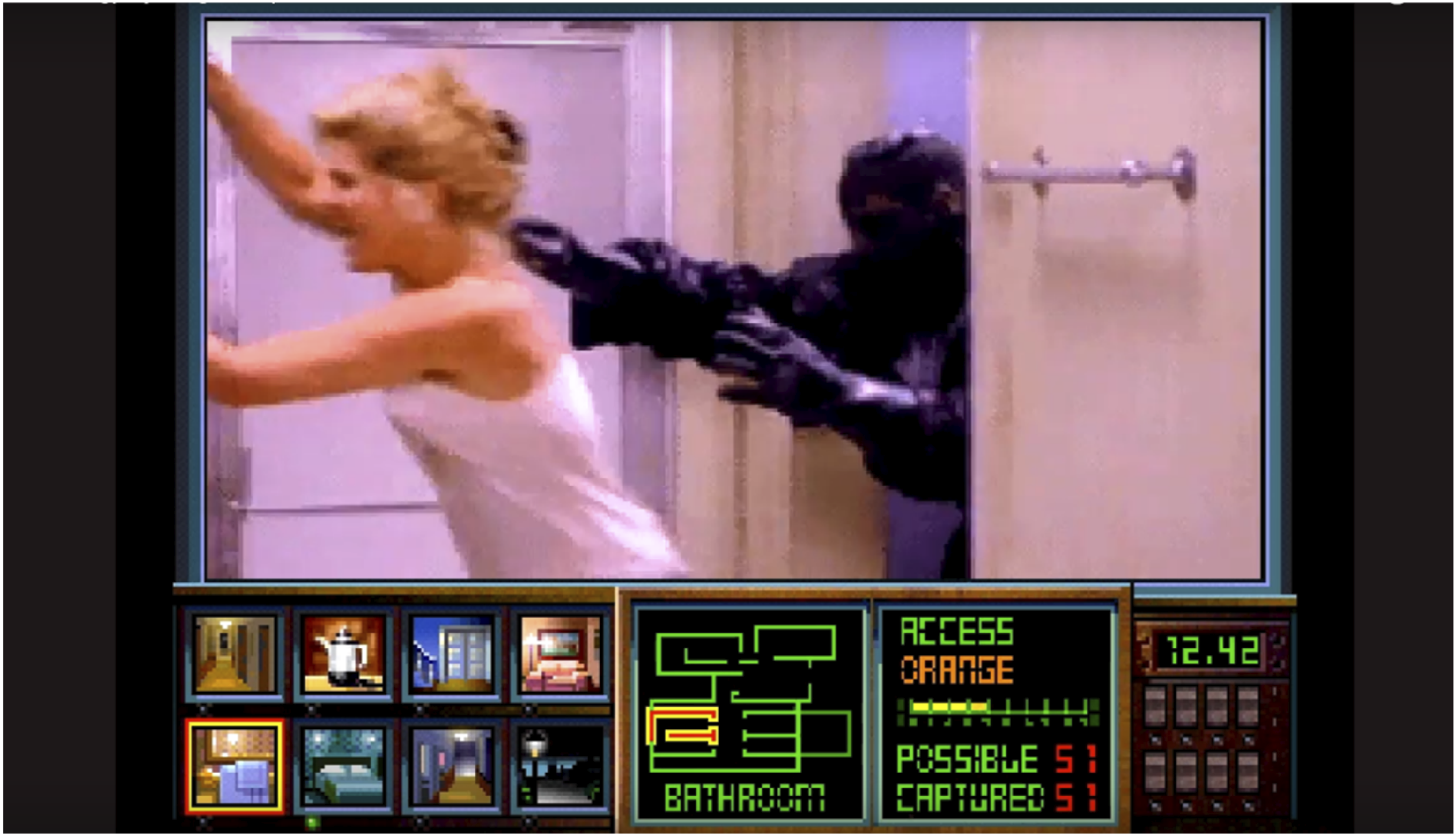
The goal of the game is to protect the girls by triggering traps at the right moment when the Augers appear, preventing them from abducting the girls. Because of the game’s adult content paired with the alleged objective of murdering the girls, the game sparked ethical, political, and legal controversies and congressional investigations on the violence and realism of videogames (cf. Church, 2022: 73–77). Along with the infamous Mortal Kombat (Midway, 1992), the discussion around Night Trap led ‘to the development of a ratings system, at first SEGA’s own Videogame Rating Council (VRC) in 1993 and then the videogame industry’s Entertainment Software Rating Board (ESRB) the following year’ (Perron, 2021: 515). Naturally, these political endeavours, including the banning of games in some countries, rather heightened the interest in FMV games in the consumers and the financial success of FMV games. Another FMV game that centred around the usage of security cameras, the gathering and processing of data as well as the manipulation of such for reaching the game’s objective was Double Switch (Digital Pictures, 1993a). The game was a less controversial clone of Night Trap that, however, added a map that signals the player if the inhabitants of the house and/or intruders are present in a room. The game would also alarm the player, when an intruder entered any room, thus adding further surveillance elements to the game’s mechanics. The narrative of Ground Zero Texas (Digital Pictures, 1993b) was set in the fictional town called El Cadron, Texas, where a series of mysterious abductions have raised alarm. The player assumes the role of a CIA agent to investigate the events and uncover the truth behind these disappearances. It is soon revealed that extraterrestrial beings, disguised as humans, have infiltrated the town. The player’s mission is to safeguard the town and its inhabitants by detecting and hinder the aliens from carrying out their sinister agenda. For the most part, the gameplay of Ground Zero Texas is a hybrid of light gun shooters reminiscent of Mad Dog McCree and switching surveillance cameras as in Night Trap and Double Switch. The player monitors the town through a network of video cameras strategically placed across four distinct areas. Additionally, the player can make use of a variety of other highly advanced military surveillance technologies such as tactical camera guns that are interconnected with a database. Throughout the game, they must diligently observe these surveillance feeds to identify disguised extraterrestrials and kill them before they can inflict harm. The game thus references the connection between surveillance, military and secret services that, by use of futuristic espionage technologies and ‘dataveillance’ practices, try to exert control over ‘foreign’ (or alien) menaces – a theme that had become more popular in Hollywood surveillance cinema (cf. Stewart, 2012) and still is in contemporary cinema and TV. The adventure game X-Files: The Game (Hyperbole Studios, 1998), based on the highly popular TV series of the same name (Conter et al., 1993-2002), places the player in the role of the FBI agent Craig Wilmore and equips them with a variety of surveillance and espionage technologies from the intelligence service. Using surveillance tools such as binoculars, night vision devices, evidence collection tools, as well as the American intelligence agency’s computer database (full of emails, images, texts and further information), the player must solve a series of puzzles and investigate the mysterious disappearance of the agents Fox Mulder and Dana Scully. In addition to the surveillance mechanics that emerge from collecting and analyzing clues in a point-and-click manner, the game also references surveillance cinema on the level of narrative and paratexts – not least through its transmedia reference to the plot of the TV series. Based on the player’s decisions, the game offers different paths for Craig Wilmore. One of them leads the young FBI agent into a paranoid attitude towards the case, a narrative trope, that is ‘commonly associated with a surveillance society’ (Kammerer, 2012: 100), especially in cinematic renditions of such.
A notable FMV game that reworks surveillance discourse is Spycraft: The Great Game (Activision, 1996), a first-person FMV adventure game developed by Activision. It puts players in the role of a CIA operative in a tense, Cold War-style narrative that involves espionage, counter-intelligence, and international intrigue. The player is tasked with investigating the assassination of a Russian presidential candidate. In order to do so they have access to a variety of high-tech surveillance technologies and techniques such as analyzing high-resolution satellite photos (Figure 4) and sound recordings, using international espionage databases (including face recognition and comparison tools), intercepting and decrypting messages (like the then-novel email technology) and applying futuristic military equipment such as night-vision data glasses to observe and eliminate suspects. In this scenario of Spycraft: The Great Game the player is tasked with enhancing a satellite photo to find out the license plate number of a suspicious car.
Comparable to other FMV games, on the gameplay level, Spycraft combines simple puzzle elements (e.g. find a suspicious person or decipher a license plate in a satellite image) with light-gun style shooter sequences. Besides the strong focus on surveillance on the narrative as well the gameplay level, the game is noteworthy as Activision not only recruited James Adams, a noted author of espionage thrillers, for writing a convincing spy-themed story for the game. The developers were also advised by William Colby, former director of the CIA and Oleg Kalugin, a former high-ranked general in the KGB to provide them with detailed insider knowledge of espionage techniques and the psychological dynamics within the intelligence field. These two consultants helped the developers design scenarios and tools that felt realistic and practically applicable to the players (cf. Broderick, 1996). This blend of real-world practices, technological elements, a suspenseful plot and cinematic full-motion video (FMV) sequences led the popular PC magazine Computer Player to rate Spycraft ‘an outstanding spy simulation’ (Broderick, 1996: 78) and a notable example of the convergence between film, video games, and surveillance discourse.
The decline of FMV can be attributed in part to the same factors that hindered its success in the 1980s. While FMV games undeniably ‘provided the highest degree of realistic imagery of the time as they were filmed like movies and often utilized a first-person perspective’, (Williams, 2017: 166) only ‘few of these games represented innovations in design’ (ibid.). Yet, even though industry experts, videogame magazines, and developers of that time significantly overestimated the potential impact and long-term relevance of FMV within the videogame market (e.g. Edge Magazine, 1994: 49), FMV games played a crucial role in facilitating a convergence between the production and distribution practices of the film industry and the gaming industry (Garrand, 1997: 66). One example for this is the game Voyeur, discussed in the next section of this paper.
Voyeur: Surveillance in full-motion video
Security cameras were often depicted as enemies or obstacles in videogames, as previously mentioned. However, the direct experience of viewing through a security camera and the subsequent use, analysis, and manipulation of the corresponding surveillance footage were relatively uncommon in videogames from the 1980s and early 1990s, at least before the introduction of CD-ROM and FMV technology. Typically, cameras used for surveillance in videogames were relegated to mere props or minor plot elements. This stands in contrast to surveillance cinema, where they often played a central role as devices of control (Wise, 2016: 1-14). Furthermore, while players in games such as Metal Gear were surrounded by security cameras, these were primarily static elements that players could only interact with by destroying them or sneaking past them, rather than engaging with them for surveillance purposes. This limitation in videogames can be largely attributed to the technological constraints and aesthetic limitations prevalent at the time. Although digital games could produce visually striking and aesthetically pleasing pixel graphics, they were predominantly confined to a two-dimensional perspective (e.g. platformers or point-and-click adventures), an isometric perspective (e.g. Syndicate), or a top-down view (e.g. Metal Gear). Such representations often featured a cartoonish, stylized, or abstract quality that fell short of the realistic portrayal achievable in cinema (cf. Figures 1 and 2). Although static surveillance images taken by security cameras appeared in a few games and served a surveillance-related purpose, such as in Hacker (Activision, 1985), the audiovisual representation of a fully movable, controllable, and simultaneously photorealistic 3D perspective was generally not technically feasible. In contrast to movies, realistic surveillance footage could not be implemented as a central aesthetic and gameplay element. This situation changed with the introduction of FMV games to the home console market, as games such as Night Trap, Ground Zero Texas or Double Switch prove. 2
One of the earliest full-motion video (FMV) games designed for the home console market was the espionage- and surveillance-themed Voyeur, developed for the extensively promoted and highly anticipated multimedia CD-I console by Philips. This system was notably advanced for its time, offering the capability to play both audio and video CDs. While arcade players had already been introduced to full-length FMV cartoon games such as Dragon’s Lair (Cinematronics, 1983) and light gun shooters featuring live-action footage, including Mad Dog McCree and Who Shot Johnny Rock? Philips sought to extend this experience to the home environment with the introduction of the CD-I in 1993 (Southwell, 1994: 11). The console’s inaugural title, Voyeur, was poised to deliver these advanced gaming experiences to a broader audience and was soon heralded as a ‘landmark achievement in the entertainment industry’ (Documentary Magazine, 1995: np). In contrast to the usually poorly received acting performances in former FMV games, Voyeur promised to elevate the genre to a new standard, by being ‘the first interactive movie with genuine star power’ (Kunkel, 1994: 58) and ‘one of the first projects to combine Hollywood talent with Silicon Valley computer wizardry successfully’ (Documentary Magazine, 1995: np). With a budget of $750,000 (Edge Magazine, 1993: 27), Voyeur marked a significant collaboration between Hollywood and the videogame industry. The project featured the internationally renowned TV actors Robert Culp and Grace Zabriskie in the leading roles. Culp was well-known for his work in the espionage TV series I Spy (Penn et al., 1965-1968) and Grace Zabriskie had previously starred in David Lynch’s Twin Peaks (Lynch/Frost Productions, USA, 1990–1991), lending the game a level of star power rarely seen in the medium at the time and also providing references to surveillance narratives. Additionally, all the supporting actors had been involved in films or TV shows before (Edge Magazine, 1993: 27). Philips partnered with the American film studio Propaganda Films, a studio that had established a strong reputation in Hollywood (Russel, 2012: 159). This partnership, coupled with the relatively high production value and notable talent involved, highlighted a genuine convergence between the film and videogame industries (ibid.). The production involved 65 minutes of filmed footage, captured over the course of 9 days. The actors performed within a confined space, positioned in front of a blue screen, and were filmed using analog cameras. This footage was subsequently digitized, allowing for the integration of digitally rendered backgrounds (cf. Kunkel, 1994: 59; Southwell, 1994: p. 11; Russel, 2012: 159). David Riordan articulated in an interview with Edge Magazine (1993: 27) that Philips aimed to target both movie audiences and gamers with Voyeur, presumably to maximize both profits and success. This goal was ultimately reached: ‘One of the best-selling and most original games on CD-i, Voyeur was innovative in its use of full-motion video, professional actors and original soundtrack’ (Colley, 1996: 16). Although Voyeur was met with mixed reactions within game journalism, it nevertheless garnered significant acclaim, winning seven Interactive Academy Awards for excellence in design, acting, and writing (Russel, 2012: 159).
The narrative of the game unfolds over the course of a weekend in a modest apartment complex and centres around an unnamed private detective who surveils the various rooms of the building across the street using a telescope camera mounted on a tripod. The player assumes the role of a private detective – the eponymous ‘voyeur’ – who clandestinely observes and records the private life of Reed Hawke (played by Robert Culp), a corrupt, lecherous, and alcohol-loving businessman who is also a potential U.S. presidential candidate. It is the player’s goal to stop him. The primary gameplay involves peering through the camera, scanning, and zooming in on the windows of the opposite house, which is represented by a realistic still image that functions as a ‘map’ (Williams, 2017: 10) with various interactive hot spots. The player is tasked with clicking on different windows to investigate objects that are distributed throughout the rooms – primarily evidence against Hawke – or to record conversations between Hawke, his family members, and other residents of the house. These conversations and actions, which can either be overheard (when the shutters are closed) or watched, are depicted through audio tracks or live-action FMV cut-scenes and are reminiscent of the conventional surveillance camera footage popularized through media (Figure 5). It is noteworthy that the symbols used for the interface icons are closely tied to the iconography of espionage and surveillance, as they symbolize sensory enhancement through media technology. The ‘eye’ icon enables the player to observe objects – most notably objects that could otherwise not be seen/observed/read from a distance, the ‘ear’ icon facilitates eavesdropping on characters, and the magnifying glass icon is used to examine and investigate items of interest (‘collecting data’) (Figure 5). The core objective of the game is for the player to view as many of these cut scenes as possible, investigate a multitude of potential objects, watch news reports that may include clues, and ultimately, when enough evidence has been gathered, thwart Hawke’s nefarious plans. Investigation of a suspicious room in Voyeur. The frame, the auto zoom symbol, the rudimentary time symbols (upper right) and the iconographic ‘rec’ (record) symbol signify that this is a mediated image of a surveillance camera.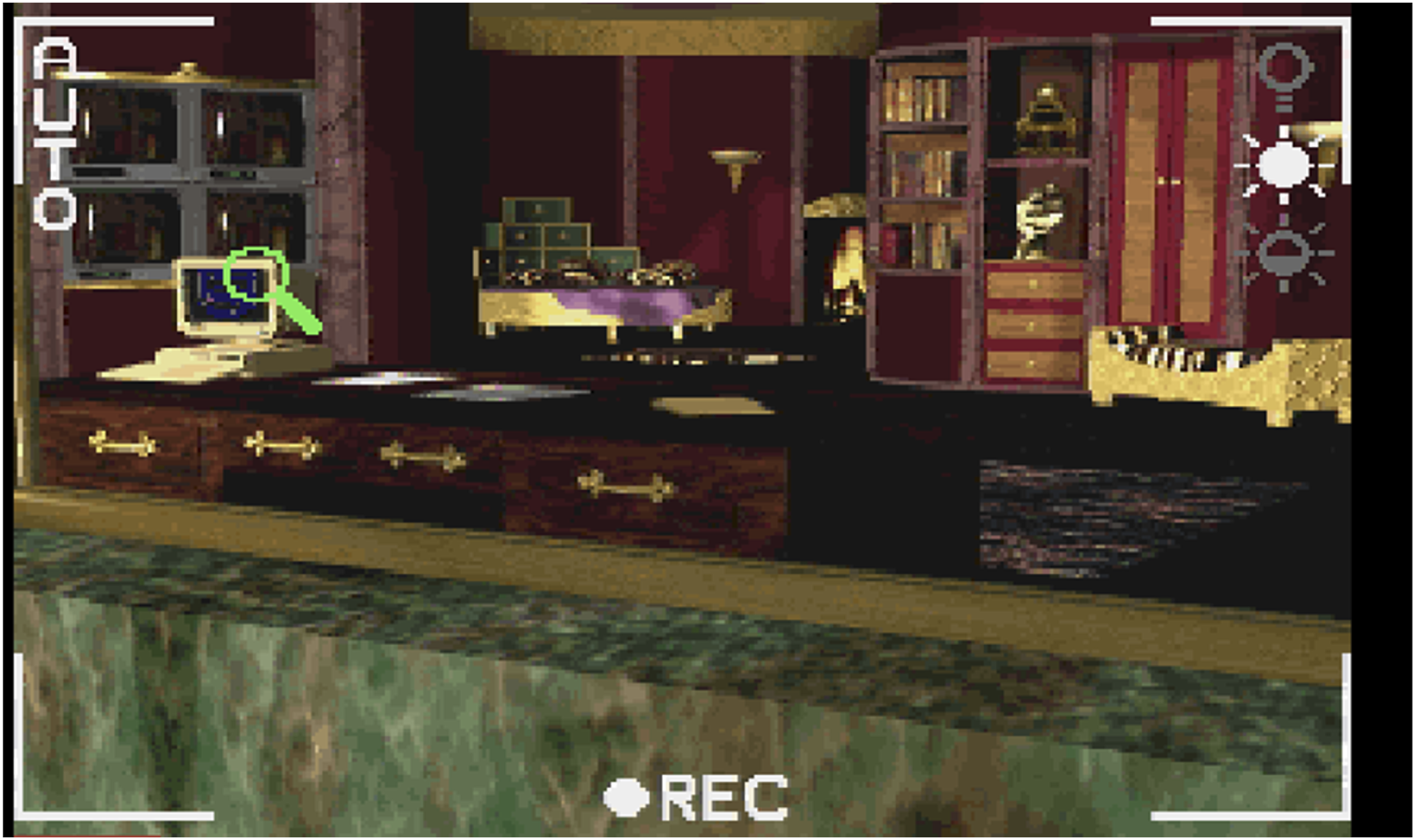
However, this task is complicated by the fact that some events behind the windows occur simultaneously, requiring the player to observe the correct window at the appropriate time. Furthermore, the game’s narrative time spans 2 days, with events changing and evolving as time progresses.
As the story develops, the player witnesses a myriad of intrigues, betrayals, abuse, a planned murder, and other criminal activities, as well as numerous erotic encounters: ‘It’s a story full of lust, greed, corruption, and deceit – your average soap opera really’ (Southwell, 1994: 10). Nevertheless, the ‘adult scenes’, which were one of the game’s major selling points (Ardai, 1995) (Figure 6), are in most cases distractions from the crucial evidence needed to secure Hawke’s arrest. The player encounters one of the many ‘adult’ cut-scenes in the game Voyeur. These scenes serve not only as a primary selling point but also disclose intimate and scandalous details about the apartment residents.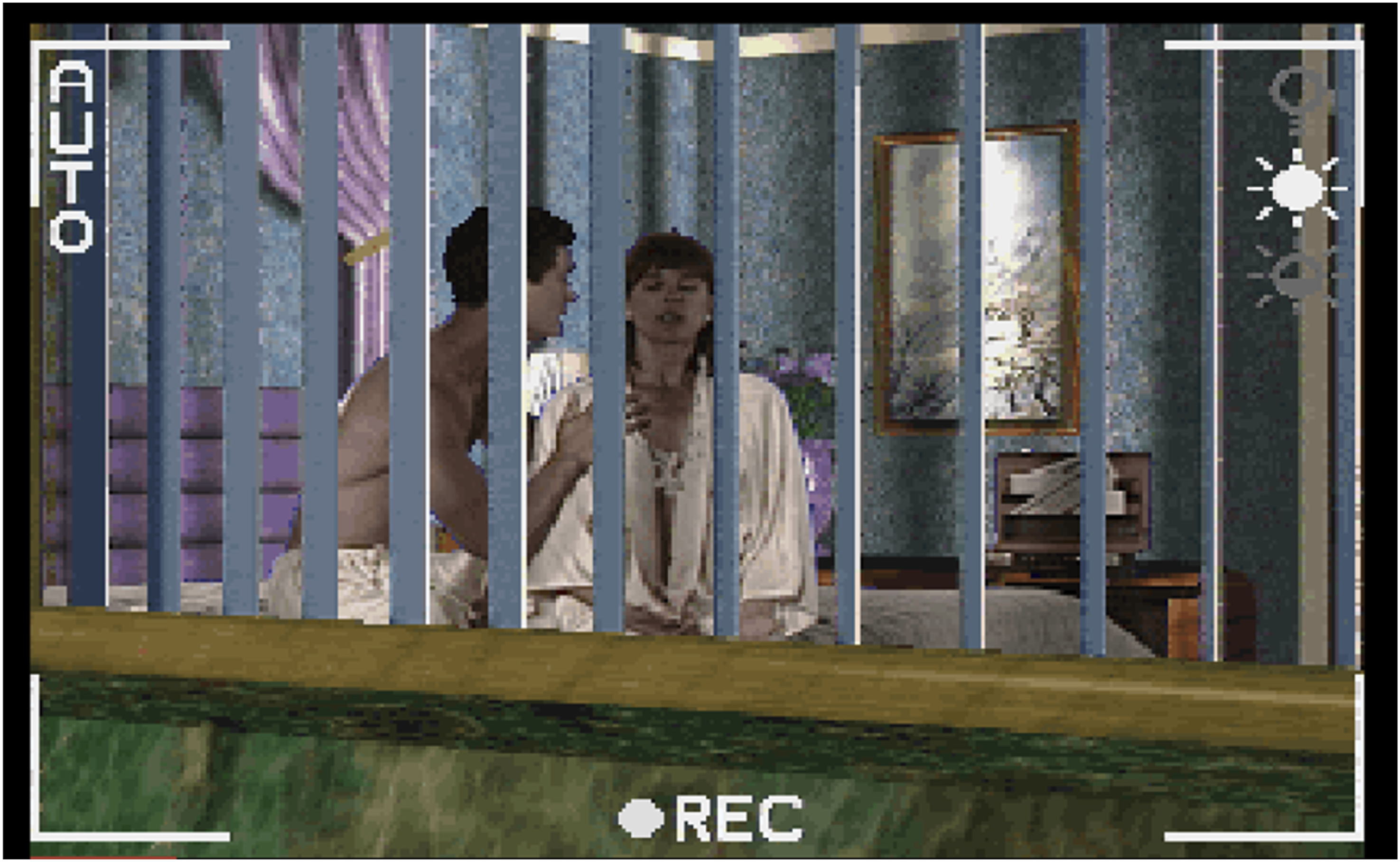
David Riordan, designer and creative director of Voyeur, states that the game is ‘story and character driven rather than arcade driven’ (Yacco, 1993: 71). Although it has time-critical undertone, Voyeur combines the position and agency of the observer/spectator typical for the cinema viewing experience, with the player agency of a ‘decision-critical’ game (Pias, 2011: 184), typical for adventure and puzzle games, thus, interchanging between the spectating – or interpretative-participative – mode of watching a film and the mode of decision-making and manipulation/configuration of game elements (Eskelinen, 2001), specific to games, as described above. Thus, Bernard Perron (2008: 131) argues that Voyeur is a ‘true hybrid’ between the two media. Again, to clarify, this does not imply a ‘naïve’ (Kinder, 2002: 128, cited in Shaul, 2008: 45) active-passive distinction (active player, passive spectator), but should rather be considered as alternating modes or two different ‘engagement styles’ (Vosmeer and Shouten, 2014 : 142) that are part of a ‘continuum’ (ibid.) of this specific hybrid media constellation.
In addition to the micro-decisions of which window to observe, which object to investigate, and which narrative thread to pursue, the game also challenges the player to make significant choices about how to engage with the case and ultimately how to bring the story to a conclusion. Overall, Voyeur features four different scenarios, each involving a different family member attempting to expose Hawke as the criminal he is or to reveal his murderous plans. It is up to the player to influence the course of the story according to their preferences by assuming various roles, such as sending the recorded evidence to one of the family members to warn them of their potential danger or leaving it to them to stop Hawke themselves. The most challenging aspect for the player is to provide incriminating evidence to the police to facilitate Hawke’s arrest, as insufficient evidence may result in the player being arrested by the police entering their apartment and sued for voyeurism. In this regard, the player faces the essential ethical choice of whether to protect their own physical and mental well-being or to prevent clear criminal acts through active involvement, thereby safeguarding (potentially innocent) family members from harm or, in the worst case, death.
With this plot premise, critical film and videogame journalism were quick to spot the intertextual references made to classics of surveillance film and cinema in general. For example, the PC Games magazine received the game’s music as ‘Basic Instinct-style musical score’ (Simmons, 1995: 71) and the Video Games Shopper (1993: 70) makes the same film reference with an elaborate pun, stating that ‘Philips have tapped into everyone’s basic instinct to be nosy’ (40), referring to the erotic thriller Basic Instinct (Verhoeven, 1992), that also features the private-eye theme and the then scandalous ‘adult’ scene with Sharon Stone. Other references were made to classics of surveillance cinema such as the voyeuristic thriller Peeping Tom (Ardai, 1995: 91), the neo-noir film Body Double (De Palma, 1984) as well as the crime film Chinatown (Roman Polański, 1974; Video Game Shopper, 1993: 40). The most frequent references and analogies, however, are drawn to another well-known example of surveillance cinema: Alfred Hitchcock’s Rear Window: One author in the Computercraft magazine, for example, argues that Voyeur ‘bears more similarities to Hitchcock’s Rear Window movie than to most games’ (Yacco, 1993: 70) and goes on to compare the unnamed voyeur in the game with James Stewart’s character in Hitchcock’s film (ibid. 71). Alluding to the adult content depicted in Voyeur, Sight and Sound (1994: 30) calls it a ‘soft-core version of Hitchcock’s Rear Window’ and the CD-I Magazine (1993: 60) describes it as a game that ‘combines the suspense of Alfred Hitchcock’s Rear Window with an American soap Opera’.
Indeed, the narrative of Rear Window unfolds from a similar premise as that of Voyeur: The film follows L.B. ‘Jeff’ Jefferies (James Stewart), a professional photographer confined to a wheelchair in his apartment due to a broken leg. With little to do, Jeff begins observing his neighbours through the rear window of his apartment, using a telephoto lens. As he watches the various lives unfold in the surrounding apartments, he becomes suspicious that one of his neighbours, Lars Thorwald (Raymond Burr), has murdered his wife. With the help of his girlfriend Lisa (Grace Kelly) and his nurse Stella (Thelma Ritter), Jeff investigates the situation from his apartment, leading to a tense and dangerous confrontation. The film explores themes of voyeurism, the ethics of surveillance, and the consequences of invading others’ privacy. Most of the scenes and shots depicted in the film are restricted to the confined space of Jeff’s small apartment or the section of the opposite facade that the limited view through his telescope lens can reveal.
The similarity between the game Voyeur and Hitchcock’s film, however, is no coincidence. David Riordan, who was heavily involved in the production of the game, stated that Rear Window was one of his favourite Hitchcock films and the ‘restricted view of the voyeur was ideal for the technical specification of the platform at the time and the choice of where to look perfect for the interactive gaming element’ (Southwell 1994: 11). Apart from being a mere technical limitation, the ‘restricted view’ in both Rear Window and Voyeur can be interpreted as a deliberate artistic choice that shapes the characters’ and audience’s positions within the cinematic or ludic experience of surveillance (Figures 7 and 8). In Rear Window Jefferies’ perspective is confined by his physical immobility and the restrictive view from his apartment. His observation of the events across the courtyard is restricted to a limited frame, which shapes both his and the audience’s understanding of the events in progress. Similar to Jefferies’ position in Rear Window, the player’s gaze in Voyeur is restricted to a narrow segment of the scenery unfolding in the opposite apartment complex.
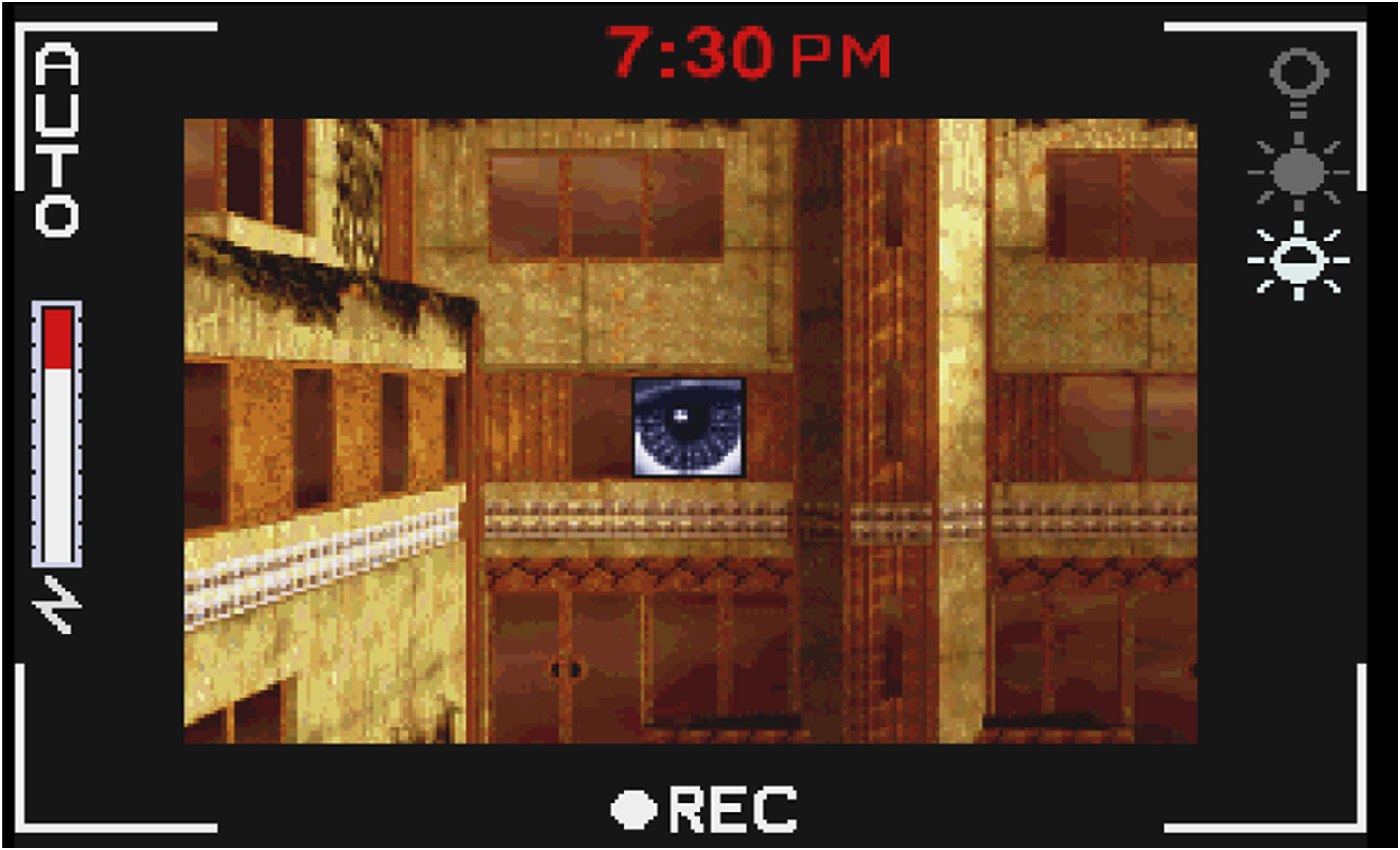
This choice also facilitates the presentation of the narrative in a fragmented and suspenseful manner. Like the private detective in Voyeur, Jeff, when peering through his camera lens, receives brief narrative segments or clues. When these fragments are interpreted correctly and logically pieced together, they form a chain of evidence that ultimately constructs a murder narrative. As various scholars have noted, in Rear Window, this is a metareflexive gesture where Jefferies’ fixed viewpoint serves as an analogy to the stationary but interpretive film audience (Levin, 2002: 581), reminiscent of the position of the spectator in Louis Baudry’s theory of the cinema dispositif (Baudry, 1986). Stam and Pearson (2009: 203) have further argued that Jefferies’ voyeuristic position can be understood through the lens of Jeremy Bentham’s panopticon: ‘He is the warden, as it were, in a private panopticon. Seated in his central tower, he observes the wards (small captive shadows in the cells of the periphery) in an imaginary prison’. Initially, this position creates a power asymmetry between the watcher and the watched, as the inhabitants of the courtyard, particularly Thorwald, are unaware that they are being surveilled. Jeff controls what he sees, and, by extension, who is allowed to see him. Much like the movie-going experience, this grants him a position of safety, where he can observe the unfolding spectacle from a distance, immune to any threats posed by those within his field of view (cf. Baudry, 1986: 308ff). However, as the narrative unfolds, Jefferies abandons his safe position by sending his girlfriend, Lisa, into Thorwald’s apartment. In a sense, Jeff uses Lisa as his avatar, as an ‘instrument or mechanism that defines for the participant a fictional body and mediates fictional agency’ (Klevjer, 2022: 93) in order to conduct his agenda of spying on Thorwald in place of him. When Thorwald catches her snooping, he attempts to harm her. The expression on Jefferies’ face (Figure 9) shifts noticeably, and, being unable to intervene, his voyeuristic pleasure transforms into genuine concern for Lisa’s safety, turning the exciting game with curiosity into an all to realistic life-threatening situation for Jeff and his girlfriend. Jefferies’ expression vividly reflects his fear and panic. By abandoning his previously secure role as the unnoticed observer – through the risky decision of sending his girlfriend into Thorwald’s home – he has exposed himself and her to significant danger.
This marks a turning point where Thorwald becomes acutely and threateningly aware that he himself is under constant surveillance, signalled by his direct gaze into the camera/telescope lens of Jeff – a plot twist that is mirrored in Voyeur, when Hawke becomes aware of being under constant surveillance by the player (Figures 10 and 11). Reed Hawke becomes acutely aware of being under constant surveillance and turns his gaze directly into the camera. This moment signifies that the player’s presence has been detected, and as a result, their own safety is now at risk. The iconic shot of Thorwald gazing directly into the camera signifies a pivotal moment: Jefferies is now certain that the murderer is aware of his presence. This direct confrontation through the camera lens intensifies Jefferies’ sense of vulnerability and peril, confirming that his covert observation has been detected and that he is no longer hidden from Thorwald’s scrutiny.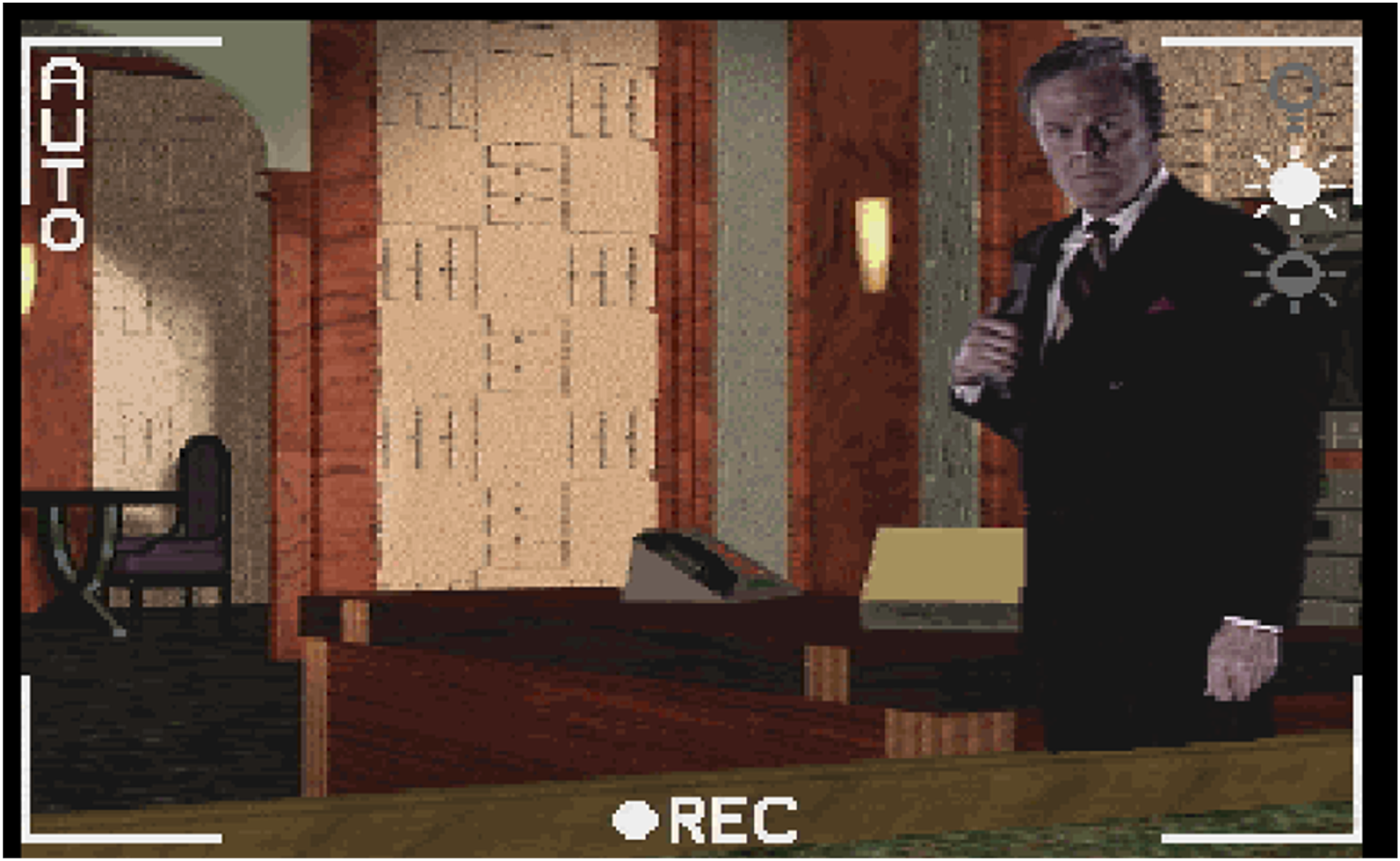

Ultimately, the power dynamics are reversed when Thorwald enters Jefferies’ apartment and threatens to kill him, flipping the power asymmetry in favour of Thorwald. Likewise, the player’s apartment in Voyeur is intruded by the police or Hawke’s henchmen. Kammerer (2012) argues, for both Jefferies and the audience, the ‘former pleasure of looking becomes inextricably intertwined with (or replaced by) guilty feelings of voyeurism and an atmosphere of paranoia’ (102). From a second order perspective, this sentiment also applies to the movie audience: In Rear Window, Jefferies’ fear and escalating paranoia stem from his ‘enforced stasis’ (Stewart, 2015: 120; cf. Baudry, 1986: 308ff), a condition that mirrors the experience of the audience, who must sit and watch helplessly as Jefferies is thrown out the window.
The difference between the player position in Voyeur and the film audience can be observed exactly at this second order level. In Voyeur, the players are not ‘forced’ to watch their character reveal themselves to their subjects of observation. Their scope of agency provides them with the option to either stay hidden or intervene and leave their safe space. In case the players decide to neither reveal their evidence to the police nor to any of Reed Hawke’s family members, they basically can watch the spectacle unfold from their safe distance. Although this leads to one of the more ‘negative’ endings of the game, it prevents the player character from the possible threat of prison or worse from being killed by one of Hawke’s hitmen. In any case, the player is in control of their avatar’s safety, granting them a player-game relationship that is that of an active surveillant, in the sense of the definition of the term surveillance described above: The viewer exerts a certain degree of control over the manipulation and use of the collected data, and can thus control the fate of the involved actors (including themselves): As David Lyon has put it, surveillance is a relationship. It is a connection between watcher and watched. This relationship is one of power: the power to see, to know, to be seen, to be known, to be in control. Establishing surveillance says something about a relationship and can transform it. (Wise, 2016: 24)
For an analysis of the surveillance logics inherent in Voyeur, it is crucial to recognize that unlike in Rear Window, the player is actively involved in creating, structuring, and transforming the narrative and practicing surveillance activities by gathering data, choosing which scenes to watch, rewatching scenes, or even opting to do nothing at all with the material. They are in control of the fictional existence of the characters in the diegetic world. This interactive engagement means that, unlike the interpretative agency of watching or cognitively processing a film, the player can become a character in the story, with the possibility of risking victimization ‘much as the James Stewart character did in Hitchcock’s film’ (Yacco, 1993: 71). Thus, whether the player chooses a narrative where the private detective remains an unseen voyeur deriving pleasure from the dramatic spectacle across the apartment, becomes a controlling and intervening surveillant agent, or even ends up as a victim, is determined by their decisions. The act of selecting which cut scenes to watch, which types of evidence to investigate, and what data to store and analyze in their virtual VCR within their apartment and ultimately which information to provide for other characters is also a deliberate choice (Garrand, 1997: 70). Depending on the player’s actions and decisions, the film-game hybrid they ultimately create during their gameplay can last several hours or only a few minutes, with each resulting in a different narrative outcome. In contrast to the fixed character constellations in a traditional movie, the player in Voyeur has the agency to decide whether to remain a minor character or become the main protagonist, the central node around which the surveillance story unfolds (ibid.).
In academic discourse, the agency of users in interactive films – a label that has often been attributed to Voyeur (e.g. Hales, 2015: 43) – has been described as being less akin to the type of agency a player might possess within the framework of a classical platform game or the creative role akin to that of a screenwriter, as suggested by Marta Martín-Núñez and Victor Navarro-Remesal (cf. 2021: 13). As Tyson Kubota (2016: 61) argues, the agency of users in interactive films is more akin to the range of possibilities available to film editors: ‘[it] is almost an interactive equivalent of the Kuleshov effect, where the meaning arises not from the contrast between images joined in time, but from the cumulative trajectory of the player’s decisions’. Although this statement can be partly agreed upon, the role of the decision-maker in interactive film remains quite limited, as ultimately a finite number of narrative outcomes are predetermined by designers and scriptwriters, with users merely navigating within this predefined narrative space. However, Voyeur is not exclusively that form of film-game hybrid in which users are presented with a binary decision path between cut-scenes, requiring them to determine or predict the outcome of the next scene and, based on this, select one of two possible paths. More precisely, one part of the gameplay of Voyeur requires players to rewatch, select and order certain cut-scenes, which is usually not possible in traditional interactive films and draw their conclusions based on their arrangement of the film material. Another, much larger component of the gameplay involves investigating ‘crime scenes’ in the ‘decision-critical’ (Pias, 2011: 184) fashion of a point-and-click adventure style and deciphering or combining clues and, last but not least, trigger events. At the same time, players must also closely observe the triggered film sequences in order to gather hints that may later assist in arranging the evidence video. On one hand, Voyeur resembles digital games through the process of ‘choosing from a finite set of onscreen options’, (Kubota, 2016: 21) and by randomly assigning the murder victim at the start of each game, it incorporates an ‘element of randomness or arbitrary chance between the player’s decisions and the resulting narrative effect’ (ibid.). Yet, within the framework of surveillance logic, the most striking feature of Voyeur is that the player controls the reception situation and ultimately has the choice of remaining a spectator/voyeur (with their respective agencies) or becoming the overseer of the gaming situation, which is, by definition, not possible in non-interactive films, as they lack the option to manipulate and rearrange the semantically significant material represented on the screen and thus within the space of agency of the medium.
Conclusion
Due to various quality issues – both in terms of filmmaking and gameplay – as well as the resulting economic consequences, the FMV game genre was largely dismissed as a failed fad by the mid-1990s. However, the last decade has seen a resurgence of FMV games, likely driven by factors related to advancements in media infrastructure, shifts in production economics, and a growing sense of nostalgia within videogame culture. This resurgence is evidenced not only by the re-release of several ‘classics’ of the genre, such as Night Trap and Double Switch for PCs, smart devices, and current console generations, but also by the notable success of numerous FMV games from the British studio Wales Interactive. Among the titles released during this new wave of FMV games is Bloodshore (Wales Interactive, 2021), a game that meta-reflectively engages with the film-technological surveillance of a life-and-death scenario, structuring its entire narrative around the ethical implications of ubiquitous surveillance and the spectacularisation of such. Bloodshore is not an isolated case; a wide array of recent FMV games similarly integrate surveillance logic into their narratives and gameplay mechanics. Titles such as Her Story (Sam Barlow, 2015), Recontact Istanbul: Eyes of Sky (Recontact Games, 2016), Telling Lies (Sam Barlow, 2019), and The Complex (Wales Interactive, 2021), among others, invite critical examination of how these games relate to contemporary surveillance cinema, modern gameplay mechanics, and their 1990s predecessors in terms of their use of surveillance logic. 3 Aside from the aftermath that surveillance-themed FMV games have on the current development of interactive films, they can and must also be considered within the broader context of the overall development of videogames, which reference surveillance logics on a narrative, aesthetic, and gameplay level. In addition to the games from the 80s and 90s mentioned in this article, the emergence of the stealth genre is particularly notable here, as these games often incorporate espionage or surveillance narratives and base their gameplay mechanics on these themes. The most relevant game in this context is likely the utterly successful Metal Gear Solid (Konami, 1998). The game combines elements of stealth, action, and puzzle-solving, with a focus on avoiding detection and surpass or counter surveillance strategies rather than direct combat. Furthermore, the trend of embedding surveillance logic as a central thematic element can be observed not only in contemporary films but also in a growing number of videogames. This trend reflects broader societal concerns about privacy, state control, and the consequences of ubiquitous surveillance technologies (see Hennig and Schellong, 2020; Krampe, 2022). Notable examples include Infamous: Second Son (Sucker Punch Productions, 2014), Watch Dogs (Ubisoft, 2014), Orwell (Osmotic Studios, 2016) or the recent remake of the dystopian surveillance classic System Shock (Night Dive, 2023) each of which incorporates surveillance as a key gameplay mechanic or narrative driver.
When analyzing the surveillance-themed FMV games discussed in this paper, it is crucial to recognize that earlier titles like Voyeur, Night Trap, and Double Switch often centre on themes of care, security, or protection, which are fundamental dynamics within surveillance logics and their narrative representations. Surveillance could be about protecting the other, making sure that they come to no harm. Or surveillance could be about control of the other, protecting oneself from the other or attempting to dominate the other. Often, it’s complicated and feature films become sites for working out these dynamics. (Wise, 2016, S. 24)
While many surveillance-themed films portray surveillance as a threat to privacy, freedom, and other personal rights, and depict the struggle to protect these rights, games like Voyeur explore the implications of occupying the surveillant’s position and exercising control over ethically charged surveillance technologies. Similarly, Night Trap and Double Switch depict the intrusion into individuals’ privacy through the unauthorized collection of visual data, yet within the game, this data is used ostensibly for security purposes. The level of participation these games offer leaves the player with the decision of how to conduct their surveillance practices. As discussed above, Voyeur allows the player to either intervene for the sake of care and security or side with Hawke by doing nothing but watching the misery unfold. In the latter case, one could argue that the player’s character becomes a threat, an accomplice to Hawke, rather than a protector. Not only do they watch as the lives of Hawke’s family are endangered, but they also enable (or even support) a criminal in becoming the president of the United States. An argument can be made that spectators of non-interactive movies can or must also become accomplices to some extent, as they are always in the position of witnessing the crimes unfolding on screen. However, in Voyeur, they are confronted with the ethical choice of whether to do so. Future research could benefit from investigating how the new wave of FMV games navigates the tensions between care, protection, and security, and the power asymmetries inherent in such surveillance constellations. In any case, the player’s role as a surveillant agent, their interactions with power asymmetries in specific gaming contexts, and the potential for the habituation and normalization of surveillance logics not only highlight an intriguing and urgent research gap (see Whitson and Bart, 2014) but also suggest new avenues for exploring gaming pleasures.
Footnotes

Funding
The author(s) received no financial support for the research, authorship, and/or publication of this article.
Declaration of Conflicting Interests
The author(s) declared no potential conflicts of interest with respect to the research, authorship, and/or publication of this article.