




Abstract
Recent research on digital placemaking shows that digital media, especially those that have a direct or indirect spatial reference, can alter belonging and attachment to space and place and can thus create a spatial identity. Emerging digital practices evolve the practice of placemaking and refer to space as a nexus of experiences, online and physical components. This is created by people perceiving urban space differently through digital media and appropriating it according to media affordances and their needs and preferences. At the same time, digital placemaking is not necessarily community-driven, nor does it always lead to an increased quality of life for all people equally, but rather encompasses changing power relations and can even reinforce existing inequalities. Using the example of the ‘Andräviertel’ neighbourhood in Salzburg, Austria, we explore which practices of digital placemaking can be identified, and how and by whom these practices are used purposefully and consciously to shape the neighbourhood and its identity. Employing a multi-method approach that includes semi-structured interviews, a hashtag analysis and the examination of digital platforms, three levels of practices were identified (reflecting upon one’s own practices, representations of the practices, judgements about the practices of others). The results show that there is a conscious and deliberate demarcation of the Andräviertel from other neighbourhoods in the city. Furthermore, we found resistance to excessive digital practices with a clear preference for face-to-face networks.
Introduction
Both social geographers (Cresswell, 1996; Massey, 1994, 1999; Werlen, 1993) and social theorists (Lefebvre, 1993) have extensively described how spaces and places are (re-)constructed along the lines of social/societal power structures. This is particularly evident in densely populated urban areas, where diverse needs and interests meet in a confined space. The question of who determines the development and shaping of urban environments is closely linked to the question of who has the power to claim urban space as their own, and to use and shape it according to their interests. While placemaking used to be an activity of people in power (i.e. for many centuries mainly white men), recent decades have seen a shift to a broader and more diverse group of actors. In particular, the emergence of digital media and the practices associated with them are seen as having a high potential for participation and empowerment. Recent research under the heading of ‘digital placemaking’ points to the central role that digital media and mediated communication processes play in the development of neighbourhoods and entire cities by generating meaning, creating identity and changing the spheres of action (Frith and Richter, 2021; Halegoua, 2020; Halegoua and Polson, 2021; Norum and Polson, 2021; Polson, 2015, 2016; Özkul, 2021). Digital placemaking is not seen as dichotomy between ‘digital’ and ‘non-digital’ but as emerging practices that further evolve placemaking (Latorre and Harding, 2017). It therefore points to the complexity of space as a nexus of perception, and appropriation, of experience and online as well as physical components. 1 New identities and senses of belonging can be created and negotiated through online and offline social networks, which enable people to perceive and appropriate spaces and places according to their individual preferences and needs. However, it has also been shown that these negotiation processes are based on permanent tensions, with dominant, assertive perspectives, narratives and privileges on the one hand (e.g. Frith and Richter, 2021) leading to marginalisation, invisibility, and, for example, gentrification processes (Hartmann and Jansson, 2022; Walters and Smith, 2022) on the other.
Practices of digital placemaking can be described and interpreted with reference to this tension. The question of how certain power relations enable certain perceptions and appropriations of space is closely linked to the question of who has the power to attribute a certain meaning to spaces and places (Gryl and Jekel, 2012: 22). In urban settings, this becomes clear, for example, by the indicative capacity of spatial depictions in collaborative spatial planning procedures (Pickles, 2006), or when representations of neighbourhoods on Facebook, for example are deliberately designed to hide ‘voices of the marginalized and precarious, who form a part of the neighbourhood to be “sanitized” by place marketers to make it fit more readily with the desired image neighbourhoods are represented in a way, that is marketable’ (Walters and Smith, 2022: 3).
Our focus is therefore both on the practices of digital placemaking and on the role played by the attribution of meaning to particular spaces and places. But, as Cresswell (1996: 29) argues, place’s meaning is a battleground where power and multiple interpretations intersect, influenced by specific knowledge, varying movements, and diverse identities. Powerful individuals, along with those who challenge established norms, redefine places, often in conflicting ways (Cresswell, 1996). ‘Meaning’ does not refer simply to how city districts (e.g.) are represented: it is also increasingly determined by the position of the user (their social position and identity, and their location on the earth which can be expressed as GPS-coordinates).
For this study we chose a neighbourhood in Salzburg, Austria. We examine how certain perceptions and characteristics of this urban neighbourhood have developed over time (and continue to do so) and who uses which practices of digital placemaking for what purpose. How is the neighbourhood (re-)constructed? The entanglement of spatial (re-)production processes with digital placemaking practices is explored through an online ethnographic study of the quarter. Within this context, it is essential to recognise Salzburg as a city predominantly characterised by tourism. The tourism industry has grown steadily in Salzburg and the city has the highest tourism intensity (number of overnight stays divided by the number of the resident population) compared to the other Austrian provincial capitals (Griesl-Höllmüller, 2023: 10). The strong tourist industry lobby is in a state of permanent tension with the needs and interests of local communities. On one hand, tourism is a significant economic sector and provides job opportunities. On the other hand, there are strong indicators of overtourism in Salzburg and harmful consequences of an increased touristification that can even be accelerated through platformised short-term rentals (such as AirBnB), by drawing in various forms of capital and short-term users while displacing long-term residents and a general increase in rents (Smigiel, 2023). Regarding digital placemaking, tourists engage in various digital placemaking practices, which impact the city as a whole and particularly affect local residents, especially in the old town. In contrast, residents largely abstain from these practices to differentiate themselves from tourists, even though our findings indicate they might share an understanding of the significance of such practices.
Using the ‘Andräviertel’ quarter of the city as a specific case, the aim of our article is to further develop the concept of digital placemaking. Our guiding research questions are: 1. How does digital placemaking happen in the Andräviertel? 2. Who are the key actors involved? 3. How does digital placemaking intertwine with other forms of placemaking, and how do power relations affect these practices?
In the next section, we discuss theoretical approaches to digital placemaking, drawing in particular on Lefebvre’s spatial theory and on other theories that see spatial practices as political. Digital placemaking is understood as an approach that critically reveals the intertwined tensions, privileges, and precariousness inherent in the production, reproduction and appropriation of spaces/places via technology. The potential of the approach lies in critically analysing the interweaving of technology and the production of space in the context of socio-spatial relations (spatiality) with a praxeological focus.
Digital placemaking as a socio-spatial process
The term ‘placemaking’ dates back to the 1960s (Basaraba, 2023) and refers to the planning, restructuring and design of urban living places; a process that is strongly community-driven to create ‘high-quality’ liveable places to which inhabitants feel emotionally connected. Placemaking is also defined as ‘[t]he process of creating places that people care about and where they want to spend time’ (Michigan Municipal League, 2017), ‘in order to maximize shared value’ (Project for Public Spaces, 2007). According to Paleromo and Ponzini (Palermo and Ponzini, 2015), placemaking aims to provide a critical perspective on traditional urban planning processes, which are primarily determined by policy makers and experts (from the traditional disciplines of spatial planning, urban design and architecture, etc.). The perspective of local communities should be strengthened to regenerate public urban places that have meaning for their inhabitants and thus strengthen the cohesion of local communities. The authors criticise that in globalised, modern societies, urban coexistence is more characterised by consumerism and market interests (ibid. 16) and leads to uniformity. ‘The metropolis no longer risks being the privileged place of variety, difference, and interaction, but rather risks becoming a conforming space’ (Palermo and Ponzini, 2015: 16–17) (pp. 16-17). Placemaking seeks to be innovative and generate a civitas in which community-based living arrangements are possible, despite diversified normative frameworks. However, the authors also acknowledge that placemaking cannot be a remedy for social conflicts that arise, for example, from different values. Inevitably, ethical questions arise at the nexus between individual autonomy and collective solidarity (Palermo and Ponzini, 2015: 35).
Placemaking as the community-led, equal, conscious, intentional governance of place-development processes is often missing. Most often, the perspective adopted by urban planners does not refer to inequalities and disadvantages, nor to the role of digital technologies in placemaking practices. In other words, the common perspective on urban planning is only one specific perspective, one that was created on the drawing board that lacks ‘the analysis of the material consequences of these processes on social behaviours’ (Palermo and Ponzini, 2015: 6). For us, it therefore seems essential to step back and ask about the fundamental interplay between the built environment, the socio-spatial relations (spatiality), and continuities/discontinuities of ‘the digital’ to set a framework for understanding digital placemaking practices.
Materiality and agency
To better understand the notion of space, it is helpful to recall Lefebvre’s triad (Lefebvre, 1993). He distinguishes between perceived space, conceived space and lived space. Perceived space can be described as the concrete, the physically material, as a route between A and B, as a measurable configuration. ‘Material space is, for us humans, quite simply the world of tactile and sensual interaction with matter, it is the space of experience’ (Harvey, 2005: 279). In contrast to this is ‘conceived space’, or conceptualised space, the space as represented in plans, maps and other media, conceived by urban planners and existing in models. The third perspective, ‘lived space’, also referred to as ‘spaces of representation’ is ‘part and parcel of the way we live in the world’. Lived space is shaped by our social relationships and by imaginations, fears, emotions, psychologies, fantasies, and dreams (Harvey, 2005: 279).
There are different interpretations of Lefebvre’s spatial model. Tim Rogers (2002) sees the third element as a synthesis of the first two perspectives, which stand in a dialectical relationship to each other. This interpretation is especially interesting for the analysis of ‘digital placemaking’ because it focuses on the process: space must be seen as a social process or construct that is mutually constituted through social and collective practices. Another benefit of this dialectical perspective lies in overcoming the digital, non-digital dichotomy, as we will see in more detail in the next section.
‘Theoretical model for socio-spatial placemaking practices’ (own illustration, based on Harvey 2005; Lefebvre 1993).
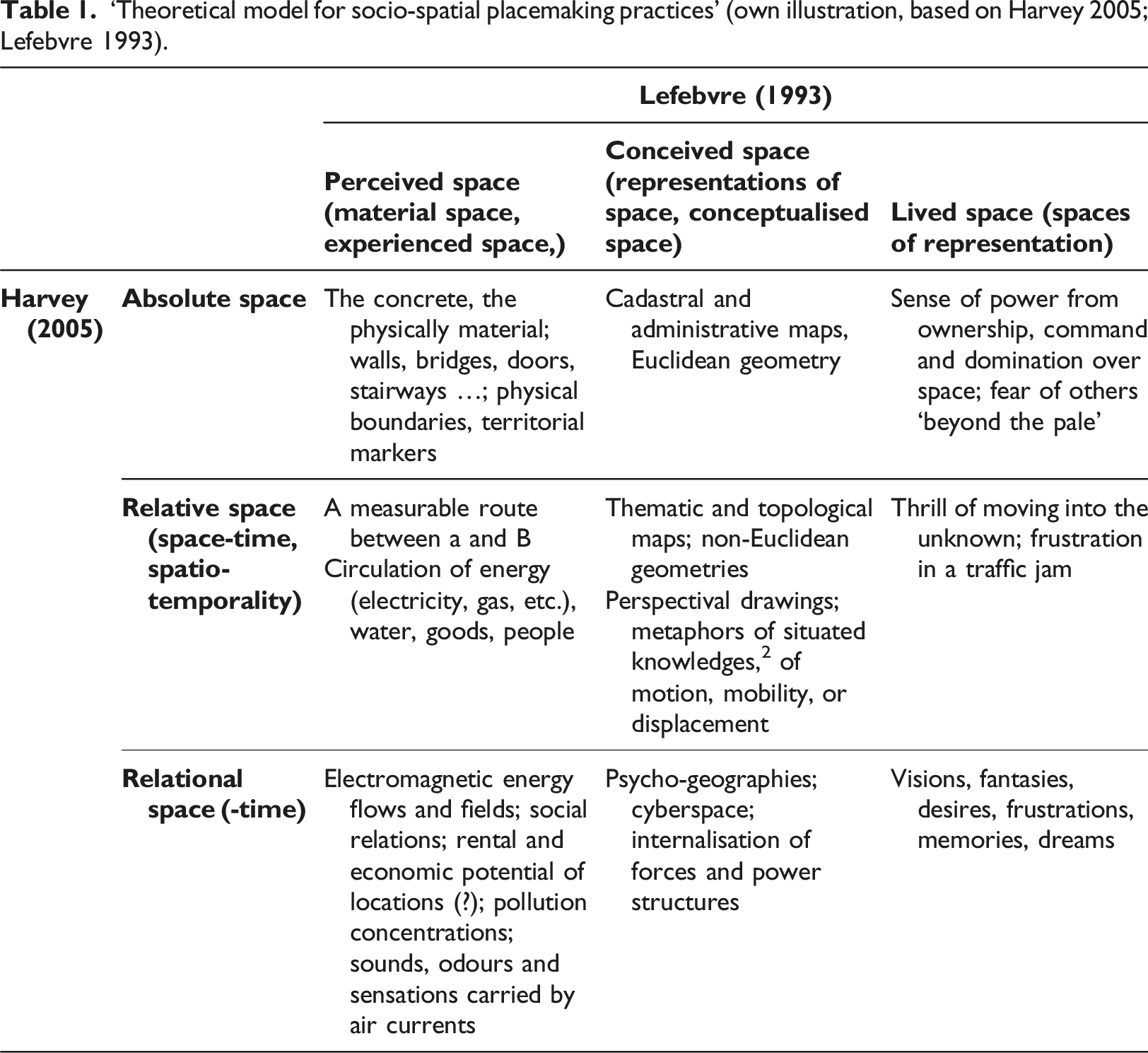
In terms of a city quarter the built environment and the physical-material environment (the entire topography, including rivers, mountains, etc.) are therefore not simply the starting point in which the life of a quarter takes place. These environments become charged with meaning through collective consciousness of them and so are the result of socio-spatial processes in form of collective practices. And as de Waal (2014) very aptly describes for the role of technology in the production of space in so-called ‘smart’ cities: ‘when these collective practices change, the shape and meaning of the physical environment changes with them’ (ibid. 21). In other words, space is not a ‘neutral’ container in which social life takes place, but part of societal processes and of what some authors, referring to de Certeau, call ‘spatial practices’ (Dodd, 2020b).
Spatial practices impact public space. The term ‘spatial practices’ refers to individual or collective modes of action and engagement with space, such as resistance, protest or activism, to fathom one’s own agency, and to use and create space according to one’s own interests. As Dodd (2020a: 8) describes it ‘space is always political’, in a sense that goes beyond politics as governance; processes such as conflict and resolution are the result of collective effort. Recognising spatial practices as the mutual interplay of both the social and the political makes this constructivist approach particularly relevant to architecture and urban planning. In addition, the dialectical relationship between ‘perceived space’ (the physically material) and ‘conceived space’ (imagined and represented) dissolves in the perspective of ‘lived space’.
Material structures exist in the form of asphalt, brick, steel and so on, but the structures are more than ‘mere’ materiality because of their interplay with specific historical and social contexts. This strongly connects to the discussion of a ‘material turn’ (e.g. Jansson, 2007: 186), as a shift focussing on the conditions and practices, such as the constellations and movements of people and objects ‘which put communication in (or out of) place’ (ibid.).
Accordingly, placemaking is always the process of the materialisation of power structures through ongoing struggles of negotiation processes. This leads us to a radically action-oriented or praxeological approach in which different actors ‘make use’ of space for ‘their own’ interests by means of media and communication practices.
One of the best-known examples of how power structures are reflected in architecture, and accordingly influence human agency, is Bentham’s prison, the ‘panopticon’ (Bentham, 1791). Another example, according to Langdon Winner (Winner, 1980), are New York’s Southern State Parkway bridges built by Robert Moses. The deliberately limited headroom of the bridges to Long Island is designed to make it impossible for public transport buses to use them. This would make it unfeasible for a less advantaged social class, for example, to get to Long Island. Such forms of active ‘infrastructural violence’ (Rodgers and O’Neill, 2012) are particularly evident in urban contexts, where infrastructures of all kinds create (or prevent) connections between people themselves and between their environments, or access to resources.
Digitality and spatiality
Having presented placemaking as a process that produces or reproduces political, social and material structures at the same time, we now focus on the role of ‘the digital’ in ‘digital placemaking’. Following on from discussions about continuities and discontinuities in the relationship between space and spatiality (as socio-spatial relations) and ‘the digital’ (Ash et al., 2019; Bauder, 2021) or, in other words, the question of whether new theories of space are needed in an ‘era of digitalisation’, we assume that ‘space’ and ‘digitality’ are mutually dependent and inextricably intertwined in a complex entity. According to Lefebvre’s dialectical model, the materialities of digital devices can be in ‘perceived space’, digital representations in ‘conceived space’ and the complex interplay with social actions and networks in ‘lived space’. Techno-material artefacts (whether digital or non-digital) are inextricably linked to placemaking as a process of social negotiation and meaning-making. In cities as junctions in which the digital urban infrastructure is intertwined with media and communication infrastructure (Krajina and Stevenson, 2019; McQuire, 2008), digital placemaking practices can be highly multifaceted. In other words, digital placemaking ‘is already a part of placemaking (mediated by every present network)’ (Greenfield, 2017; cited after Miller, 2017: 92), it is ‘21st century placemaking’ in the sense that ‘digital practices are emerging that further evolve the placemaking practice’ (Latorre and Harding, 2017: 171).
The term ‘placemaking’ was originally used in geography/urban studies, and has only recently (in 2015) emerged as ‘digital placemaking’ in media studies (Basaraba, 2023). In their discussion of ‘digital placemaking’, Norum and Polson refer to it as ‘cultivating a sense of place for oneself and others [or] interweaving of meaning-making in relation to place, occurring through social relations, communication, embodiment, and personal and shared experience enacted via a digitally mediated platform’ (Norum and Polson, 2021: 3). Digital placemaking refers to a set of overlapping ‘online’ and ‘offline’ practices that produce a unique sense of place and belonging. Polson, for example, examines digital placemaking practices with reference to professional networks of privileged expatriates (Polson, 2015, 2016). Farman (2015) as well as Frith and Richter (2021) focus on the extent to which places are shaped by their history or by dominant narratives, as seen in commemorative plaques for example, and thus also by consciously suppressed histories and stories. The use of locative media 3 could help to establish certain counternarratives (Frith and Richter, 2021: 1). Being able to present counternarratives confers the immediate power to be heard, but how the communication process is mediated is also important. For example, it makes a considerable difference whether a narrative is documented in the form of a robust technology that will last over time, or is merely transmitted face-to-face, as oral communication: Different media have different affordances.
So far, digital placemaking has been conceptualised as something that is intentionally and actively practised by individual human actors, embedding the individual within specific places. Other approaches concentrate on the role of non-human actors. Özkul (2021) addresses the role of machine-learning algorithms in practices of digital placemaking, sorting and classifying people as well as places as well as controlling mobilities. With the aim of creating predictable futures, automated decision-making processes control our whereabouts and thus govern our mobility. According to Özkul, marginalised groups (like refugees e.g.) are affected by the algorithmic control of their physical mobility, putting them in place-based identity categories. These categories in turn have an influence on people’s general possibilities for social and geographical mobility.
In describing the place of digital technology, or more precisely of digital (geo)media, in the spatial-material and social reproduction of urban spaces, the roles of human as well as of non-human actors are equally important. Practices of digital placemaking are inextricably linked to the relationships between materiality, sociality and agency. In urban studies approaches, the term ‘urban assemblages’ (Farias and Bender, 2010) describes life in urban settings that results from ‘heterogeneous networks, spaces and practices’. Accordingly, cities can be seen as assemblages of numerous elements, such as artefacts, technical systems, architecture, spaces/places, events, social gatherings, historical, imaginary and virtual aspects, as well as visual and other representations, and so on (ibid.). In media-pervaded environments, place becomes something that is ‘created through communication norms and interactions’ (Polson, 2015: 630), especially digital practices, and is ‘continually enacted, negotiated and renegotiated across multiple levels of media engagement’ (Wilken and Humphreys, 2021: 2–3).
We suggest that digital placemaking should always take both of two aspects into account: (1) the role of media representations of urban spaces and their influence on the urban experience; (2) the socio-spatial location of the users of digital (location-based) media. This combination in turn influences not only the media content but also the scope of action or range of mobility via algorithmic decision-making. In short: when we refer to practices of digital placemaking as a socio-spatial process, media are to be seen as ‘environments’ that can ‘steer’ us in certain literal or figurative directions.
The literature explored in the previous sections highlights the significant role of placemaking as socio-spatial processes, shaping community engagement within urban environments and the socio-political implications intertwined with these processes. Given the increasing integration of digital technologies in urban spaces, it is crucial to investigate how digital placemaking practices manifest and how the above-mentioned theories apply to specific, localised contexts. Thus, studying the ‘Andräviertel’ quarter allows us to examine these power dynamics in detail, thereby advancing the concept of digital placemaking.
Methodological approach
Using the ‘Andräviertel’ quarter of the city as a specific case, the aim of our article is to further develop the concept of digital placemaking. Our guiding research questions are: 1. How does digital placemaking happen in the Andräviertel? 2. Who are the key actors involved? 3. How does digital placemaking intertwine with other forms of placemaking, and how do power relations affect these practices?
We employed a multi-method approach including semi-structured interviews including miniature ethnographies and a hashtag analysis. Our point of entry to the field was the non-profit association ‘Forum Andräviertel’. The association consists of people living and working in the Andräviertel, including local business owners, local institutions and artists. Their proclaimed goal is to make the Andräviertel a great place to live. We conducted semi-structured interviews with members of the non-profit association. Beyond this entry point, our aim was to create a varied sample and in this respect our recruitment process was very open to cover different criteria (such as socio-economic status, migration background, gender, age, etc.). This included notices in homes, networks of personal contacts and snowball sampling. Eventually, we were confronted with the problem that only those people who had a higher socio-economic status and/or were involved in (digital) placemaking activities professionally or through the work of the non-profit organisation wanted to participate in the study. In total, we conducted 9 semi-structured interviews of which one was conducted with two people at the same time. 7 out of 10 of the interviewees were involved with the work of the non-profit organisation ‘Verein Forum Andräviertel’. They also worked and/or lived in the quarter, running their own business in the area, or holding executive positions within creative industries, an arts centre or the tourist industry. The other interviewees had no connection to the non-profit association. However, they worked in the district or were involved with the Andräviertel through their work (as an estate agent, for a welfare institution, or in a bar).
Following Bachmann and Wittel (2006) in their proposition of what they refer to as miniature ethnographies, the interviews were enriched by taking the environment, the situation as a whole and the interviewees themselves into account. Therefore, we included their positionality within the quarter as part of our data, and generated field notes to enrich our data. In order to gain access to the field as researchers, we were able to draw on our personal experience with and contacts in Salzburg. Knowledge that was particularly relevant for the collection of field notes. At the same time, because we do not live directly in the neighbourhood, we also have sufficient distance for a critical and reflective perspective. In addition, we followed a selection of social media accounts related to the Andräviertel for the duration of the data gathering process until we reached theoretical saturation (November 2020 to April 2021). To grasp the digital representation and practices of digital placemaking, we conducted a hashtag analysis on Instagram (Highfield and Leaver, 2016). For an overview of the major issues being discussed on social media, we chose three Andräviertel-related hashtags (#andräviertel/#andraeviertel, #forumandräviertel and #andräviertelvordielinse), because ‘[v]isual social media content can highlight affect, political views, reactions, key information, and scenes of importance’ (Highfield and Leaver, 2016). The interview material was analysed in depth using MAXQDA software (the interviews were conducted in German; selected quotations for this paper were translated into English). The research project was presented at a research seminar at the University of Salzburg, where the material and our approach to the analysis were discussed and reflected upon by a group of fellow researchers.
Placemaking in the ‘Andräviertel’ in Salzburg
Following the theoretical framework outlined above, we focus on the mutual processual aspects of placemaking. Even seemingly fixed structures, such as buildings or topological features of a terrain, are subject to the ongoing negotiation processes of various interest groups. Buildings are demolished, rivers are regulated, hillsides are removed, entire city districts are completely redesigned. This serves simultaneously both as a starting point and as the result of the currently prevailing power relations. Any analysis of the Andräviertel must, therefore, look at the quarter’s history and characteristics. The left bank of the river Salzach, the area of today’s old town of Salzburg, was already inhabited in the Mesolithic period, not least because of its sheltered location between mountains and the river. The history of Salzburg since the Middle Ages has been closely linked to the Christian rulers whose wealth and power was largely based on the mining and trading of salt, 4 whereby the Salzach formed the most important transport route (Holzapfel and Balcı, 2024). Particularly remarkable is the complete remodelling of Salzburg’s Old Town as a renaissance/early baroque city by Prince Archbishop Wolf Dietrich von Raitenau, who reigned from 1587 to 1612. Von Raitenau commissioned several new constructions, converted others, and erected magnificent ecclesiastical buildings (Seunig, 1981). This complete stylistic and spatial restructuring of the old town has had a major influence on the way people live in the city to this day. In particular, the designation of Salzburg’s Old Town as a UNESCO World Heritage Site in 1996 has led to the Baroque townscape not only being preserved but also being promoted to tourists.
The right side of the Salzach, on the other hand, was largely uninhabited. One of the oldest maps of Salzburg from 1570 shows that the area of today’s Andräviertel lay outside the city walls. The only buildings were a few craftsmen’s workshops, such as dyers, which were usually located outside the walls and a small church of St Andrew. (Schaup, 2000) This small church was built in 1415, initially closed due to dilapidation and then demolished in 1861 despite objections from the citizens. The confined situation in Salzburg made it necessary to build a granary and market square outside the city walls on the right banks of the river Salzach. The granary, known as ‘Schrannengebäude’ was built between 1788 and 1790 but later demolished by fire and war (Salzburg WIKI, 2022). To this day, a weekly farmers’ market (‘Schranne’) is held in the open space.
However, settlement areas were only established later, during the so-called ‘Gründerzeit’ (1870 and 1917), a period of economic growth during industrialisation, and of the expansion of the railway network, characterised by economic liberalism, migration from rural areas to the cities, and the increasing financial precarity of working people. Salzburg was connected to the railway network in 1860, thus becoming easily accessible from both Vienna and Munich. As a result, plans for the expansion of the town became louder, as can be seen from a town expansion plan from 1861. In contrast to Gründerzeit expansions in other cities, the plan in Salzburg however was not to build industrial facilities and workers’ housing, but rather to create a ‘seasonal city’. In other words, a neighbourhood for wealthy Viennese or Munich bourgeois who had emigrated from Salzburg and who would come back here for a summer retreat to the countryside to enjoy the fresh and clean air. Starting in 1867, the city walls of Salzburg were demolished, the material was used to regulate the Salzach and then work began on the expansion of the planned ‘seasonal city’, which was proudly called ‘Neustadt’. (Holzapfel and Balcı, 2024). Later in 1898 the church of St Andrew was rebuilt next to that market square as an enlarged parish church on its current site and during this the name changed to ‘St Andrä’ (a variation of St Andrew). It is reasonable to assume that the term ‘Andräviertel’ developed as a colloquial term for the area around this church. The first written reference, albeit without a precise definition, comes from a local newspaper in 1912 (Salzburger Volksblatt, 1912), in which the author complains about people shaking dusters and bedside rugs out of the window, especially in the Andräviertel. To this day the term ‘Andräviertel’ is neither used consistently nor does it stand for a precise territorial representation, for example, due to historically changing neighbourhoods and their boundaries or influences of demarcations of the UNESCO protection zones. For example, a different demarcation is used for the statistical census districts than for the official designation of the city districts by the city administration. These two in turn differ from the colloquial usage of ‘Andräviertel’ a term for an organically coherent settlement to which a certain meaning has been attached. This ‘meaning’ has more to do with a certain lifestyle than a precise geographical location and is debated to this day (Salzburg WIKI, 2023). Today, the central location, the good public transport connections, the beautiful, spacious old flats in 4-6 storeyed high-ceilinged buildings make Salzburg’s Andräviertel attractive and ensure high rents. More recently, Gründerzeit districts have become associated with processes of gentrification (Hamnett, 1997; Kronauer, 2018) and for Salzburg in general it has been shown how short-term rentals would accelerate touristification with negative effects on the residents (Smigiel, 2023). Representatives of the Andräviertel however position themselves against ‘the rest of Salzburg’, which is ‘inundated by mass tourism’. They see it as insider tip, and promote their own views about the neighbourhood, thus actively trying to shape and use it for their own interests. The quarter is characterised by the steadily growing presence of creative industries (small advertising, graphic designer and marketing companies) and craftspeople. The area also offers alternative ‘special interest’ shops, bars, cafés and restaurants, is enlivened by local identity-creating events organised by the ‘Verein Forum Andräviertel’ and is known for a high degree of multiculturalism. It is also a site of tension between the influential tourist industry lobby and the needs of the local population.
Practices of (digital) placemaking
The analysis of the data gathered revealed insights into how digital placemaking in and concerning the Andräviertel takes shape. Specific practices of digital placemaking can be analysed on three levels (cf. Lefebvre 1993): • Reflecting upon one’s own practices related to the Andräviertel, • Representations of the practices of people who aim to actively shape the neighbourhood • Judgements about the practices of placemaking of other groups, particularly tourists.
Our 9-field matrix based on Lefebvre (1993) and Harvey (2005) (see Table 1) serves as a framework. Central to our analysis is the question of how different human and non-human practices reconstruct and make use of different conceptualisations of space, or the reciprocal relationship between the concept of space and the sphere of action. As Harvey (2005) and Rogers (2002, interpreting Lefebvre’s model) have already noted, it is above all the dialectical relationship between these categories that is important, not the precise separation into distinct fields of the matrix.
Reflecting upon one’s own practices related to the Andräviertel (perceived space)
Lefebvre’s concept of ‘perceived space’ refers to direct or indirect interaction with the physical-material world. For the people we interviewed, the contemporary Andräviertel is defined by being distinct from the old town on the other side of the river Salzach, as expressed by interviewee M: We have our own slogan [...] for the quarter. At the moment it is ‘the vibrant side of the city’. Because we always had the feeling that the real Salzburg life takes place here. The old town is very … it's almost like a piece of art. Art in a positive way. But also, a little bit negative. Because it's a little bit artificial … It stays the same for the tourists, the way they like it […]. There is a lack of intimacy on the other side [of the river]. Here [in the Andräviertel] people have to be creative […] to catch people's interest on Instagram. (Interviewee M., pos. 24)
The baroque old town of Salzburg is contrasted as a negative blueprint – an open-air museum that corresponds to a certain stereotype but is no longer alive. In this respect, the Andräviertel is defined by the fact that it is distinct from the old town and draws part of its identity from this demarcation. Although the boundaries of the neighbourhood are drawn precisely on a map on the association’s website, the interviewees did not clearly affirm these boundaries in conversations. The Andräviertel, in their understanding, corresponds more to an attitude to life that is distinct from the ‘conservative other side of the Salzach’ rather than to a clear demarcation on a map. The quarter is often enthusiastically described as ‘diverse’, an ‘urban village’, and ‘the creative’, ‘the authentic’, ‘the other’. However, we also encountered less enthusiastic voices. One of the interviewees, a real estate agent, argues that the Andräviertel is overestimated as a place to live: It's a beautiful place. The problem is that there are many beautiful places in Salzburg, and sometimes it seems that … the Andrä quarter is like a label. It says ‘Andräviertel’ and […] people say, if it has the label Andräviertel, it's great and the price for real estate is high. I think these prices and assumptions should be questioned. (Interviewee B., pos. 68)
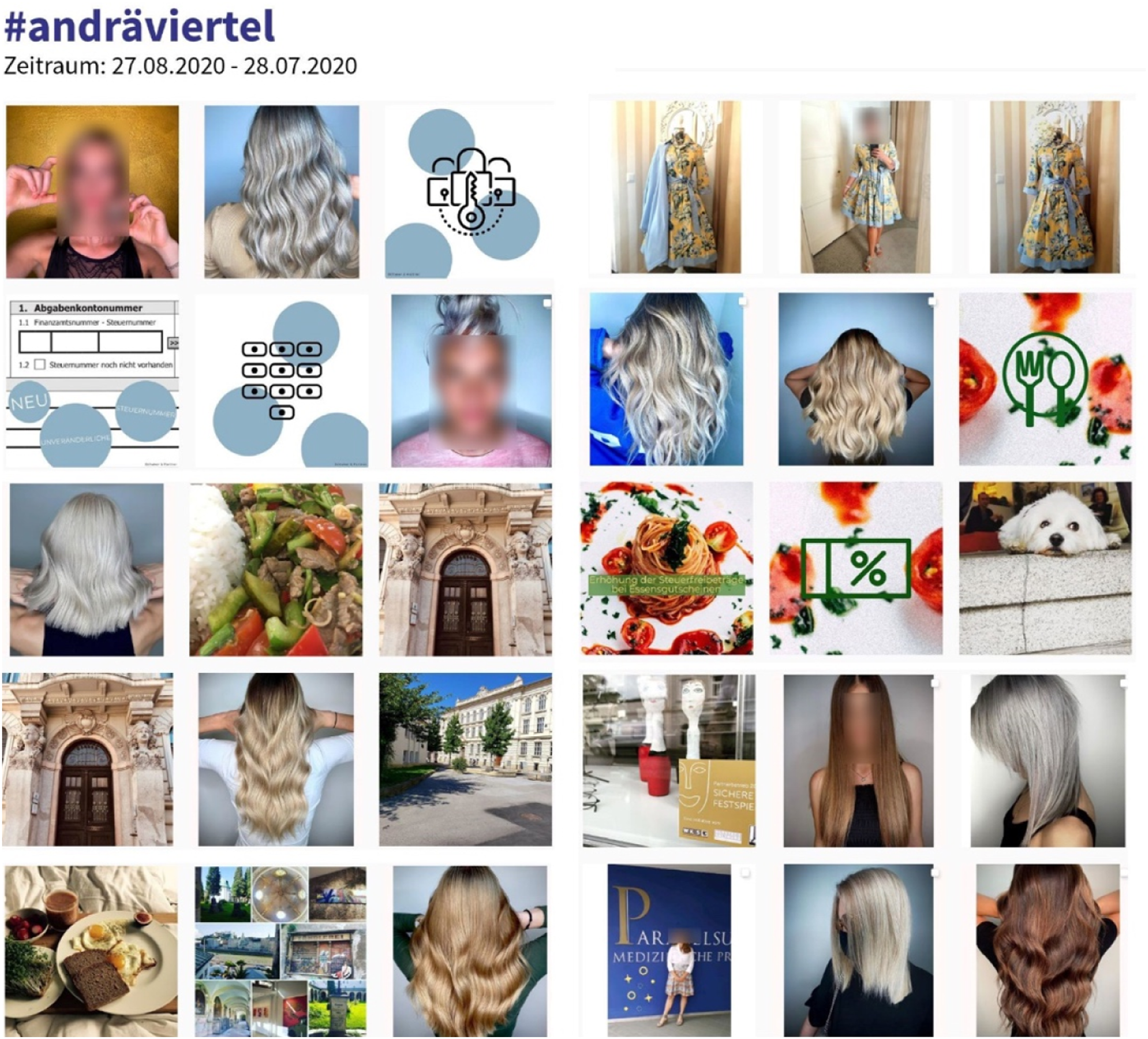
While we encountered a strong sense of place and placemaking activities in verbal conversations, the hashtag analysis on Instagram revealed an absence of the quarter. The Andräviertel is rarely referred to in private or professional media use. Although the Forum deliberately tries to establish a digital strategy with a photo competition, it advertises its event mostly via analogue print media (brochures, posters). Frequently, the interviewees could not see any benefit in marketing the neighbourhood via social media. On the contrary, digital non-presence is even deliberately communicated as a strategy to keep unwanted tourists ‘outside’ and to distinguish oneself from the photo-hunting masses: Personally, I am ambivalent about treating the Andräviertel as an insider tip. As soon as you publish insider tips widely enough, they are no longer that, and automatically lose their appeal. […] [O]f course, if you travel by yourself, you are happy about so-called insider tips and where life is still relatively untouched by tourism. (Interviewee G., pos. 58)
In line with this statement, being online was characterised as a compulsion to be avoided by interviewees. Offline conversation and activities were valued a lot higher (Schwarzenegger and Lohmeier, 2021). The ability to disconnect and operate offline is described as a privilege, as freedom from the pressure of being ‘always on’. Another interviewee who owns and runs a pub in the Andräviertel confirms this perspective: We have, for example […] intentionally no Wi-Fi here in the bar. And our people [the customers] aren't the ones who come, drink three beers and just play with their phones for three hours. But we actually live in an analogue world quite consciously. […] When you observe them, you see our customers talking to each other, communicating and discussing. We also organize so many events, readings, forums, discussions, parties. So, I don’t need to be online. (Interviewee T., pos. 40)
Furthermore, the digital representation of the neighbourhood is described as superficial. When it comes to marketing and sales, online activities are at best seen as complementary to what is happening offline: ‘There has to be a real hot product in the first instance. I need to have a nice bar, sell a good beer and offer a good atmosphere. Otherwise, the best social media presence is useless’ (interviewee P., pos. 86). If you want to be considered an ‘insider’ in the Andräviertel, you have to find access to the local analogue networks. In the ‘digital world’, the Andräviertel is almost non-existent: ‘It's very much by word of mouth, I'd say, that this neighbourhood has earned its reputation. […] I don't think the Andräviertel is perceived digitally in the same way, because it's just there. It's well-known in Salzburg and […] and not a great deal happens online. I wouldn't really pay attention to the Andräviertel online, because I know it's part of the city and in order to experience something […], I have to physically be in the Andräviertel and not online’. (Interviewee B., pos. 70)
Another reason why the positioning of the neighbourhood via social media is seen very negatively is the fear of further gentrification. As an interviewee who is engaged with the work of the Forum Andräviertel outlines: It is also our goal as Forum Andräviertel to enhance the value of the neighbourhood. That is, that we spread the word that the Andräviertel is so great. The danger is of course […] that the Andräviertel has become […] one of the most expensive neighbourhoods. Of course this pushes people out. (Interviewee P., pos. 32)
At the same time, the interviewees emphasise that Salzburg seems to be protected from gentrification processes due to its village structure and limited possibilities for expansion, but they also expect Salzburg to continue to become more and more expensive because it attracts international investors: Salzburg has a vibrant property market. Some rich Arab, Indian, American, Swiss or whoever comes and buys a place, simply to have it. Because it's Salzburg. That's cool. […] It's a sensational area compared to the rest of the world. (Interviewee P., pos. 90)
Thus, our results show that digital placemaking is critically reflected and employed only sparingly by interviewees. There is a strong normative approach that values ‘offline’ practices more than ‘online’ activities. In turn, these are thought to attract more problems than benefits for the Andräviertel.
Practices of people who aim to actively shape the neighbourhood (conceived space)
We also analysed digital placemaking practices by exploring the representations of the neighbourhood (Lefebvre’s ‘conceived space’). Towards this end, we conducted a hashtag analysis and an analysis of the website for the non-profit association ‘Forum Andräviertel’ as well as the representation of the neighbourhood on the popular booking platform Airbnb. The Andräviertel according to the ‘Forum Andräviertel association’ (extracted from: https://www.forum-andraeviertel.at/). ‘Collage of Instagram posts’.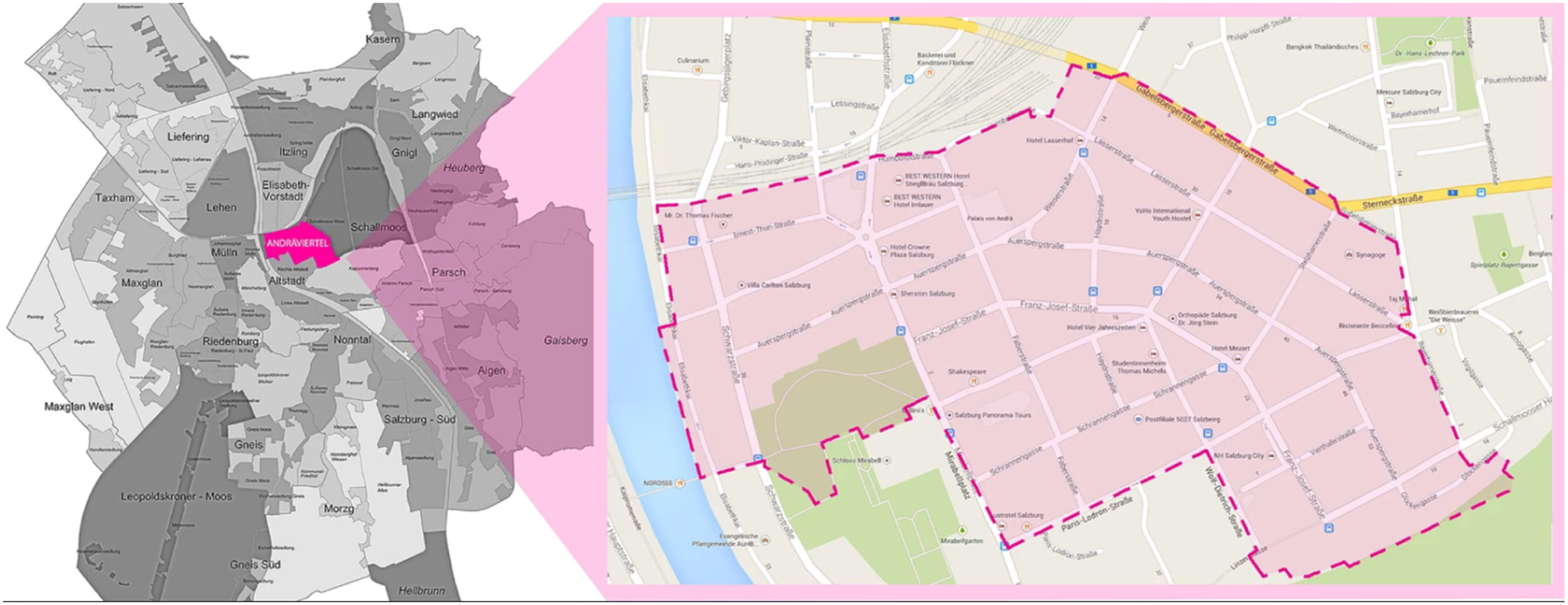
The ‘Forum Andräviertel’ included a map (Figure 1) on its webpage, which clarifies the boundaries of the neighbourhood. The boundaries drawn there do not correspond to any of the statistical census districts or to any other official designations of the neighbourhoods. Hence the non-profit purposefully created a defined space for the quarter.
In contrast to this clear visual statement, we encountered very few incidences of digital placemaking practices on Instagram (Figure 2). Between 28 July 2020 and 27 August 2020, we collected 30 posts using the hashtag #andräviertel (of which no posts simultaneously used #andraeviertel), 40 posts using the hashtag #andraeviertelvordielinse, all of which were posted exclusively by the account @linse_andraeviertel. The account is operated by the Forum Andräviertel association and is used exclusively for the annual photo competition. All posts on this account were also hash tagged #andraeviertel. 3 posts used the hashtag #forumandraeviertel and 6 posts the hashtag #forumandräviertel. 27 of the 30 #andräviertel posts were (geo)tagged, not with GPS-coordinates but with the location of a specific company (23), with ‘Salzburg’ (2), or ‘Andräviertel’ (2).
The analysis shows that the term ‘Andräviertel’ is hardly used as a specific marker in digital media. This result is confirmed by our investigation of the booking platform Airbnb as well. For Airbnb, the search can be narrowed down by using various Salzburg-related words, but the term ‘Andräviertel’ (or ‘Andraeviertel’) does not lead to any hits, while using ‘Neustadt’ narrows down the area to one that corresponds by large to the map of the association Forum Andräviertel. Since the district is hardly represented digitally under the term ‘Andräviertel’, the actual meaning and the geographical space connected to it is only available to locals with the necessary insights and connections. In this sense, the marginalisation of certain groups of people predicted by Özkul (2021) does not take place through algorithmic control, but through information restriction. Tourists, for example, who happen to be in the neighbourhood experience a completely different version of the district, as the ‘authentic’ meaning as described by the locals remains inaccessible to them. There are still media environments available to outsiders, but they lead in a completely different literal and figurative direction.
Judgements about the placemaking practices of other groups, particularly tourists (lived space)
Since the beginning of the 20th century, tourism has developed into one of the most important economic sectors. In Salzburg, it is directly linked to the picturesque old town, which includes, among other highlights, the birthplace of Wolfgang Amadeus Mozart, the baroque cathedral and the Hohensalzburg Fortress. Another tourist attraction is the Salzburg Festival. However, tourism is concentrated in Salzburg’s old town. The Andräviertel, on the other hand, has been largely spared from mass tourism, which is also reflected in the statements of interviewees who characterise the quarter as alternative, authentic and open-minded. The ‘lived space’ or space of representation in the Andräviertel – the space of emotions, fears and visions – is, then, characterised by the sharp demarcation from the old town of Salzburg: In the Andräviertel, we are an alternative for tourists who already know the touristy things and are not looking for that. They might be looking for an insider tip, for something that is more regional, more local. They are looking for an experience as if you were ‘local’ and sitting with other ‘locals’ in a bar – not with fellow tourists. (Interviewees L. and T., pos. 36).
What is striking here is the view of ‘normal’ tourists as a large, homogeneous mass, arriving by bus, being led through the city by guides in large groups, only checking out the most important POIs, and wanting above all Instagram-ready photo opportunities: [T]he Europe-in-14-days people have no time for the Andräviertel. […] It is not spectacular enough. […] It is not a ‘photo-quarter’. It's not that kind of district where you say: ‘awesome, let's take a picture!’. […] Tourists are looking for photos. (Interviewee P., pos. 72)
Another respondent goes a step further and describes how Instagram provides great opportunities for marketing a place, but also how practices related to digital placemaking can also have negative effects: For advertising it has a lot of opportunities, but it also destroys advertising. I think it does. It's a bit of an exaggeration, but for me Instagram is firstly destroying the internet and [corrupting] people's behaviour online. To be honest, it even ruins the world to a certain extent. Because when you look at it, there really are spots in the world that are being damaged just because thousands of Instagram pilgrims travel there to take pictures. Like the lake Koenigssee in Berchtesgaden. They had to declare the forest a ‘no-trespass zone’. (Interviewee P., pos. 62)
Digital placemaking practices of others are harshly judged by locals in the Andräviertel. Moreover, these digital practices – in particular taking pictures – is questioned overall. Perhaps particular to this region, the majority of tourists are looked down upon as a consuming, unreflecting mass of people whose digital placemaking practices is detrimental to the environment and the experienced quality of a place.
The absence of digital placemaking
‘Socio-Spatial Placemaking Practices in the “Andräviertel”’ (own illustration, based on Harvey 2005; Lefebvre 1993).
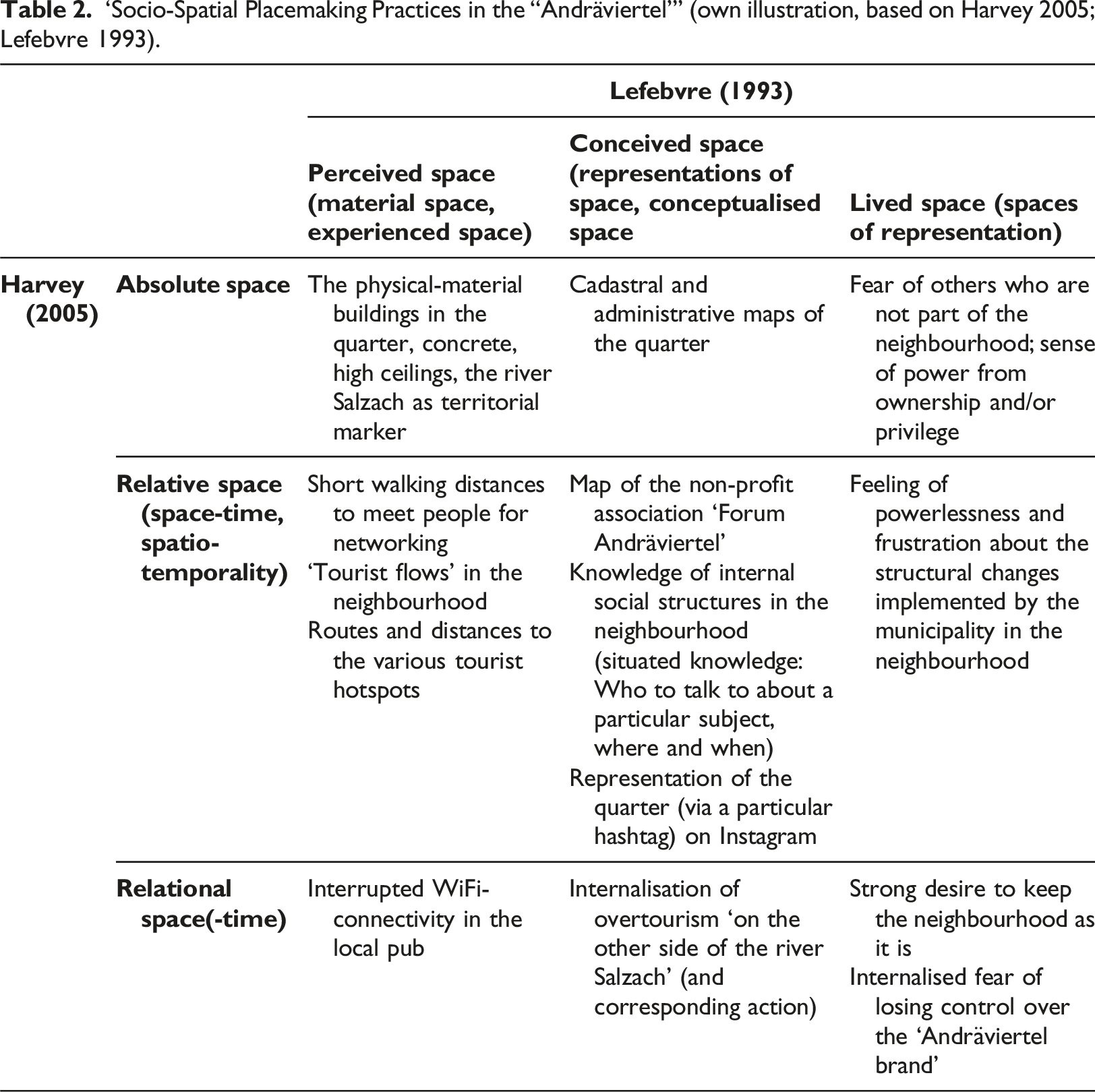
However, our data shows very clearly that digital placemaking is not considered to be needed within the Andräviertel. Rather, it is seen as a nuisance or a potential danger. Posting pictures online is regarded as something done by tourists and viewed highly critically. Although they re-create a ‘hip’ and ‘trendy’ image, locals practise placemaking by being in the quarter and talking face to face with each other. A ‘sense of place for oneself and others’ (Norum and Polson, 2021) is created, but not via a digitally mediated platform. Contrary to our assumption, digital interactions are deliberately avoided and the attribution of meaning to the Andräviertel is hardly ever disseminated via digital media. Placemaking functions in a privileged offline bubble in order to control which information is shared over social media, to address certain tourists only, or to meet the strong need for differentiation (from mass tourism ‘on the other side of the Salzach’). Internal networking works via locality and analogue media: it seems to be important to stay in charge, which is expressed in a certain resistance to change.
It is not surprising, then, that the term ‘Andräviertel’ has grown organically and is understood and used primarily by locals. ‘Andräviertel’ is an attitude to life; an assemblage of local identities. Neither the Instagram analysis nor the search on Airbnb yielded any results that would suggest that the district also exists in the digital world under this term. Thus, a digital non-existence goes hand-in-hand with a conscious strategy to maintain networks in an analogue way, to function within an ‘analogue bubble’. The Forum’s members form a close-knit community, can reach each other on foot at any time, and use the physical infrastructure (e.g. a pub) for internal networking. In such a limited physical space, where face-to-face meetings are easy, there is no absolute need for interdependency between digital and analogue phenomena. The use and marketing of the ‘Andräviertel’ brand via digital media is rather perceived as a troublesome necessity, to be carried out by a younger generation; but it is a necessity which above all carries the great danger of losing control with regards to mass tourism.
In the Andräviertel, digital placemaking rarely intertwines with other forms of placemaking. The few occasions where an overlap can be assumed are the events organised by the Forum such as street festivals, the annual photo competition, or flea markets. Otherwise, restructuring processes (carried out on behalf of the city administration) tend to lead to an even stronger withdrawal from any digital presence. The interviewees report major concerns that too many former residential buildings are being converted into Airbnb flats, entire street blocks are being opened up for tourist use, and large franchises are increasingly setting up shop. Our participants express a feeling of powerlessness in relation to the political decision-makers, and even suspect financial incentives offered by larger chains to initiate such processes. On the other hand, the people we interviewed are in a good position when it comes to affordable office space and are quite powerful in controlling the digital representation of the neighbourhood. Most of them are well-educated and eloquent, often work as entrepreneurs, benefit from the ‘otherness’ of the Andräviertel, and deliberately use their privilege and power to construct ‘their’ Andräviertel according to their needs. For them, the quarter is a construct that stands for of diversity, authenticity and hip urbanity.
Conclusion
In this study, we investigated digital placemaking practices within the ‘Andräviertel’ in Salzburg, Austria. Our aim was to identify these practices and understand how they were purposefully and consciously employed by various stakeholders to shape the neighbourhood’s identity. Utilising a multi-method approach – including semi-structured interviews, hashtag analysis, and an examination of digital platforms – we identified three levels of practices: self-reflection on individual practices, representations of these practices, and evaluations of others’ practices. The findings revealed a deliberate and conscious effort to distinguish Andräviertel from other neighbourhoods of Salzburg. Additionally, there was notable resistance to extensive digital practices, with a clear preference for face-to-face interactions.
Our results also show the prevalence of a dominant narrative ‘created by the powerful’ (Frith and Richter, 2021), which goes back to Wolf Dietrich’s redesign of the city and was reinforced by the designation of Salzburg’s Old Town as a UNESCO World Heritage Site. With his redesign, Wolf-Dietrich unintentionally laid the foundation for mass tourism. The baroque old town serves as a negative concept against which some actors in today’s Andräviertel position themselves against and derive a strong counter-positioning. This encompasses an identity that circles around being ‘an alternative’, ‘vibrant’, ‘authentic’, and ‘open-minded’ which interviewees referred to numerous times during the interviews. The baroque old town – which in some ways can be seen as a historical stereotype, as a site that must be preserved at all costs – is seen by our interview partners as the epitome of conservatism and stagnation. Interestingly, in their rejection of the World Heritage designation, they express an equally strong aversion to change within the Andräviertel.
With regards to digital placemaking, the old town is the place where tourists come to take pictures – because of the way this part of town has been preserved. On the other side of the river Salzach, locals look down upon this practice because they in turn also aim to conserve the Andräviertel as it is today. Our interviewees made black-and-white distinctions about being on- or offline, with the underlying assumption that posting, surfing and scrolling were somehow taking away from the space they were in. While digital placemaking was understood as a significant tool in placemaking – it was also looked down upon. Future research could investigate these ambivalences and question the interplay of digital placemaking in relations to people’s attitudes about ‘being online’ more broadly.
Another issue to solve in future studies is the recruitment of participants. As described above, we encountered a great hesitancy to partake in this project as people believed they had nothing noteworthy to share. Despite our best efforts and a repeated reassurance that no special knowledge was required, we found it almost impossible to engage people who were not in some form in an exposed position already. Perhaps the uncertainties that came with the global pandemic and lockdowns in Austria at the time are part of an explanation for this reluctance. Nevertheless, we aim to develop methodologies that further inclusion and thereby a greater variety in our sample.
Footnotes
Acknowledgements
The authors would like to thank the Department of Communication at the University of Salzburg for funding. We also thank Michaela Jahn and colleagues at the Department of Communication at the University of Salzburg and the anonymous reviewers for their valuable insights and support.
Declaration of conflicting interests
The author(s) declared no potential conflicts of interest with respect to the research, authorship, and/or publication of this article.
Funding
The author(s) disclosed receipt of the following financial support for the research, authorship, and/or publication of this article: This work was supported by the Department of Communication, University of Salzburg.
