




Abstract
The emergence of social media and digital channels have expanded communication practices and also created new, virtual spaces where sports fans can interact and communicate directly with each other and with clubs. This article examines the potential for social media brand communities to develop a sense of both community and place amongst sports fans. It explores their influence in placemaking initiatives through the bonding and bridging social capital of a football club’s supporters. A netnographic study of a football club’s supporter networks (five channels) and their interactions with social media brand communities was performed. Data gathered from online sources was underpinned by interviews with 25 members of the community. Findings were analysed via NVivo using bridging and bonding social capital as a theoretical lens. The paper makes two primary contributions to knowledge. It enhances our understanding of the impact of SMBCs and their use in a sporting context—an area that has become increasingly significant during the COVID-19 pandemic enforced lockdowns that have kept fans out of venues. It also contributes to our understanding of the influence of placemaking strategies upon the social capital of supporter communities.
For sports fans, the feeling of belonging to a wider community is a key element in the appeal of fandom, and a sense of identification between the team and other fans is often developed (Parry et al., 2014). Fans communicate this sense of belonging through their words and actions, often in highly ritualised ways. For highly identified fans, the home venue and its surroundings becomes a focal point for their devotions and can generate location pride and geographic memories (Bale, 1996). Clubs often invest heavily in their stadium (and related) spaces in order to engage fans (Richards & Parry, 2020). However, the socio-spatial element of fandom has been largely overlooked and Richards and Parry (2020) call for more research into this element of the geography of sport. Moreover, Hill et al. (2016) argue that larger modern stadiums have become sanitised environments and call for new digital-sociological studies of the interlinkages between online and urban realities through supporter communities.
Recently, the emergence of social media and digital channels have expanded communication practices and also created new, virtual spaces where people interact and communicate directly with each other and with brands. This trend accelerated during 2020 when the COVID-19 pandemic created enforced lockdowns around the world that shifted communication and engagement to online platforms which, in a sport setting, allows clubs to reach new audiences, engage with existing audiences in new ways and even to encourage greater levels of physical activity (Davis, 2020; Hayes, 2020; Mastromartino et al., 2020). A myriad of applications of digital technology are employed, for instance social media brand communities (SMBC) or applications such as tourist information mobile applications (Garcia et al., 2017), destination-specific social media community pages (Kim et al., 2017) and location information portals (Uşaklı et al., 2017), all of which have enhanced communication between businesses and consumers. It is SMBCs that we focus on here. Although research on SMBCs within destination marketing does exist (e.g., Custódio et al., 2018; Sevin, 2013), the longer-term influence of this form of digital placemaking initiative on communities remains underexplored, particularly in a sport setting. Therefore, this “digital geography of sport” is not well understood. Thus, we turn to digital placemaking, described as the use of digital technology and software associated with users’ interaction with a place (Keegan, 2021). This aids our understanding of how sports fans’ online communication and interactions can develop a sense of both community—the feeling of belonging as part of a group, and meeting through the group (Legg et al., 2018)—and place.
This paper applies social capital theory to advance our understanding of placemakers’ attempts to use modern technology to emulate longstanding practices in order to critically assess the effectiveness of the affordances of digital technology. Social capital is a theoretical paradigm which allows theorisation of socio-economic groups (Field, 2016). Social capital theory was initially popularised by Bourdieu (1980) and is concerned with the connections between people and the value and meaning of those connections. As its focus is on the value of connections between members within networks (Tzanakis, 2013), it is an appropriate theoretical lens for understanding the influence of SMBCs across a range of socio-economic groups within a localised region. This paper argues that SMBCs have a significant influence on two specific aspects of social capital of individuals: bonding and bridging (Field, 2016). More specifically, we examine the use of SMBCs as an extension of community members’ notions of place association and attachment. As placemakers and managers are increasingly turning to digital media, there is a need to theoretically investigate how people communicate about place in online spaces and whether SMBCs can successfully develop a sense of place and community.
The study centred its attention on a community of supporters of Salford City Football Club (SCFC). In 2014, the club was taken over by “the Class of '92” -- famous ex-Manchester United players. The owners were reported to have ambitions to create the “world’s first digital, ‘always on’ football club, giving fans unrivalled access to behind-the-scenes activities and up-to-the-minute information about Salford City’s on-going development” (Mirror Football, 2014). This created an interesting opportunity for research on a football club with huge ambitions to reach the top level of English football. They were successfully promoted to the English Football League for the first time in their history in 2019. In terms of place of study, Salford is situated in the North of England, in the metropolitan area of Greater Manchester, where low pay and unemployment have led to a variety of social issues (Manchester Evening News, 2017). It also has a rich history of sporting communities and a number of famous sports clubs in the area. This provided an opportunity to investigate social capital amongst participants of a local sports club. Two contributions to knowledge are provided in this paper that will be significant for sports clubs looking for ways to understand and be of greater value to their fans as well as for researchers who are interested in digital placemaking and socio-spatial elements of fandom. Firstly, it enhances our understanding of the impact of SMBCs and their use in a sporting context—an area that has become increasingly significant during COVID-19-enforced lockdowns that have kept fans out of venues. Secondly, the study contributes to our understanding of the influence of placemaking strategies upon the social capital of supporter communities.
The paper starts with a review of literature related to social media brand communities in sport, digital placemaking and social capital within communities. We then present an overview of our netnographic methodology and the themes that emerged from our thematic analysis. Following details of our theoretical contributions we also provide future opportunities for research.
Literature Review
Social Media Brand Communities in Sport
It has been argued that virtual spaces can afford similar benefits to sports fans as physical spaces by facilitating communication between fans from around the world (Mastromartino et al., 2020). As such, online brand communities are increasingly ubiquitous channels of communication in modern times and in some ways reflect place-based understandings of community. Muniz and O’Guinn (2001) describe brand communities as admirers of a phenomenon with shared social relations but who are not bound by geography. McAlexander et al. (2002) build on this definition and affirm that they can exist online with communication mediated by electronic devices. The admirers of the brand engage in a variety of practices that add value to the brand and provide fans with a sense of status or capital (Schau et al., 2009). In the context of sport, which is often described as “unique” based on factors such as the high degree of loyalty and engagement of consumers (Baker et al., 2016), the brand can be a particular sport, team or athlete (Mastromartino et al., 2019). Increasingly, social media channels are being used to create brand communities by both sports teams and their fans (Armstrong et al., 2016; Edensor & Millington, 2008; McCarthy et al., 2014). SMBCs are advantageous compared to traditional brand communities in that they are: created by grassroots fans, have higher member volume, lower cost and, use real identities (Habibi et al., 2014). While it has been claimed that SMBCs can be organisationally driven (Alonso-Dos-Santos et al., 2016, 2018), we draw on the work of Chang et al. (2020) and Popp et al. (2016) who identify social media brand communities as virtual organisations on social media platforms that are populated by customers with shared interests in a brand. We do not distinguish these based on size or on whether they are open to all or are closed groups which require registration. Chang et al. (2020) developed a theoretical model that was designed to understand the success factors affecting a SMBC. They found that in order to increase brand community quality and user satisfaction, technology resources and visual appeal were important factors. Popp et al. (2016) studied fans and “anti-brand communities” which were developed in defiance of the official Facebook pages of their football club, and demonstrated how SMBCs in football can represent positive and negative perceptions of the brand, reflecting wider relationships with the club itself and the partisan nature of fandom.
The tribal nature of SMBCs is highlighted by Kozinets (2020), who advises managers seeking success with these “tribes” to provide a wealth of valuable information for its members and to engage with the language and the customs of the community. Social media channels have further enabled these tribal clusters of affiliation, breaking down global barriers. Furthermore, Kozinets (2010) highlights how the Internet empowers people to gather together in groups based on a wide range of social affiliations and cultural interests. Sports clubs have historically created these cultural, global and social connections, which appeal to the tribal nature of fans through the interactive nature of social media and co-creation (Armstrong et al., 2016; Healy & McDonagh, 2013). Cova and Cova (2002) suggest that tribal marketing is of great relevance and surpasses research on individual behaviour; hence, a requirement for investigating the wider implications of SMBCs is merited and this is still relevant today (Kozinets, 2020). On a more cautionary note, Coles and West (2016) point towards online trolling on such SMBCs and suggest that they offer a platform for ‘fruitless argumentation’ and other nefarious communications activities. Whilst SMBC pages will present positive exchanges, equally, digital placemaking initiatives will also provide unsavoury moments and can be the sites of abuse towards players (Cleland et al., 2019; Oshiro et al., 2020). Finally, it is noteworthy how football clubs advocate for their associations with community roots, which underlines the need to understand more about the nature of the communities themselves and the significance of digital placemaking, which we will now discuss.
Digital Placemaking
In utilising digital placemaking and extending our understanding of how sport geography is understood and communicated, we acknowledge Agnew’s (1987) sense of place as a complex concept often involving engagements with multiple locations. These locations include the space around buildings, streets, squares, parks and open spaces that support or facilitate public life and social interaction. This paper considers the how digital spaces reflect their physical counterparts and their utility in facilitating community interaction through placemaking activities.
Placemaking is a much-understood concept whereby the enhancement of places is performed by some form of action, transforming it into more liveable place (Keegan, 2021). Paulsen (2010) claims that placemaking seeks to create meaningful and useful spaces. Ordinarily, residents and official planning stakeholders influence the dimensions of places (such as a Facebook group for friends of a local park); however, more recently we see online communities rapidly becoming vocal platforms for discussions around development of spaces (Breek et al., 2018). Hence, there is potential to consider the formation of community through digital means.
Crucially, digital placemaking is often mistaken for the smart city concept, which can act as a limitation to understanding how digital technology can serve a purpose beyond unidirectional informational purposes (Fredericks et al., 2018). Also, a myriad of empirical work looks at the net effects of social media in the tourism sphere (See Keegan, 2021), but primarily from a user perspective, overlooking the longer term effects on residents and business owners (e.g., Munar & Jacobsen, 2014). Recent place branding studies establish how digital channels are facilitating the development of emotional attachments, both in the physical and virtual sense (Uşaklı et al., 2017). Lastly, it is important to highlight the findings of one study of digital placemaking initiatives in the sporting domain. Custódio et al. (2018) considered the impact of sporting events on online communities, outlining the primary benefits as economic development and destination promotion. Their findings also indicate how sport-related placemaking initiatives were useful in addressing social problems, self-esteem, and cultural self-development. Hence, there is a strong case for investigating the influence of digital placemaking initiatives, such as SMBCs, on the connections between people and the value and meaning of those connections using an established theoretical framework, such as social capital.
Social Capital Within Communities
Bourdieu (1986) described social capital within communities as the individual ties and connections that make up a durable network. He viewed social capital as key to understanding the connections between people and their social mobility. Critics highlight the focus of this view on how the wealthy elite in society perpetuate their status and overlook ordinary people in the same communities (Field, 2016). Negative associations of social capital, often referred to as the “dark side,” are also evident and can prevent social mobility (Adler & Kwon, 2002; Field, 2016). Relating to the darker side of social capital, Putnam (2001) warned of the danger of “cyberbalkanisation” as a detrimental effect amidst social capital in online communities, as they have less scope for diversity and cross fertilisation of ideas. An echo chamber effect can result within online communities when the same content circulates within channels and excludes alternative or opposing views (Coles & West, 2016). Hence, social capital can be considered a useful tool in examining SMBCs and the affordances that digital channels provide.
Several sub-types of social capital exist, however for purposes of this study, we focus on the most prevalent forms, bonding and bridging, for uncovering knowledge relating to digital placemaking. Woolcock (2001, p. 10) described bonding social capital as the “relations between family members, close friends, and neighbours.” Helliwell and Putnam, (2004, p. 1436) also note the strong connection of bonding social capital which is “embodied in bonds among family, friends and neighbours, in the workplace, at church, in civic associations, perhaps even in Internet based ‘virtual communities.’” Bridging social capital refers to ties that are weaker than bonding, consisting of “distant ties such as loose friendships and workmates” (Woolcock, 2001, p. 10). Bridging social capital creates links between different groups including those “that cut across various lines of social cleavage” (Helliwell & Putnam, 2004, p. 1437). These external ties to members relate to bridging capital where actors interact in a “collectivity” (Adler & Kwon, 2002, p. 19), which aptly reflects the dynamic of an online community.
The relationship between sport and social capital has also been the subject of scholarly interest in recent years (Widdop et al., 2016). The focus of this research has largely been on the ability for sport-based development programmes to build positive social capital in disadvantaged communities (Skinner et al., 2008). Bridging and bonding social capital in particular has been employed in a sport context to examine whether participation in sport results in the accumulation of social capital for young immigrant women (Walseth, 2008). However, there is little, if any, research into social capital in a digital sport context.
There have been several calls to overcome the paucity of empirical research on social capital in the digital landscape generally (Huysman & Wulf, 2004; Lee & Lee, 2010). Heinze et al. (2020), for example, call for increased understanding of online social capital, focussing on trust between digital brands and users. In an early study in this area, Lin (1999) notes that access to information via the Internet is empowering for people, offering new forms of social relations, that “involve the creation and use of social capital” (p. 49). It is argued that social capital can be enabled through social interactions on the Internet (Kozinets, 2020), as well as positive reinforcement in social trust and civic engagement through use of Facebook (Valenzuela et al., 2009). Recent work has utilised social capital as an effective tool for theorisation from electronic word of mouth data (information written online by consumers), indicating the influence of SMBCs on members’ social capital (Gvili & Levi, 2018). Heinze et al. (2013, p. 14) also noted the value of the intangible social capital that can belong to both an individual and a group online, indicating, “participants can be enticed by the social capital that members accrue.” Therefore, this study seeks to develop an understanding of the contribution of digital technology to creating a sense of community and place within a sport context that will be of benefit to academics and practitioners.
Methodology
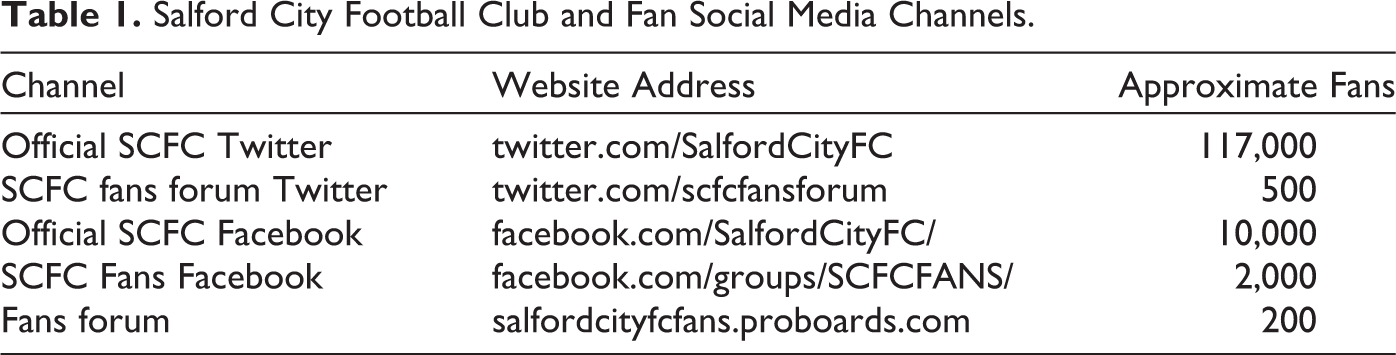
Data was gathered through online participant observation and interviews as part of a netnography conducted between 2015 and 2018. Netnography is a branch of ethnography developed specifically as a set of procedures and ethical standards to study the online interactions of people through participant observation and other methods (Kozinets, 2020). It uses Internet communications as a primary source of data and was, thus, suited to the study of SMBCs. We followed the guidelines of Kozinets (2010) when choosing the channels as relevant to the community under study, active, interactive, substantial, heterogeneous, and data-rich at the time of study. A participant observation diary was used in order to capture key moments between participants on SMBCs (Twitter, Facebook, YouTube, VK and forums) (Kozinets, 2020). Table 1 presents an overview of the channels used in the collection of online participant data. Our observation diary was used to identify those posts that were most relevant and active for further analysis.
Salford City Football Club and Fan Social Media Channels.
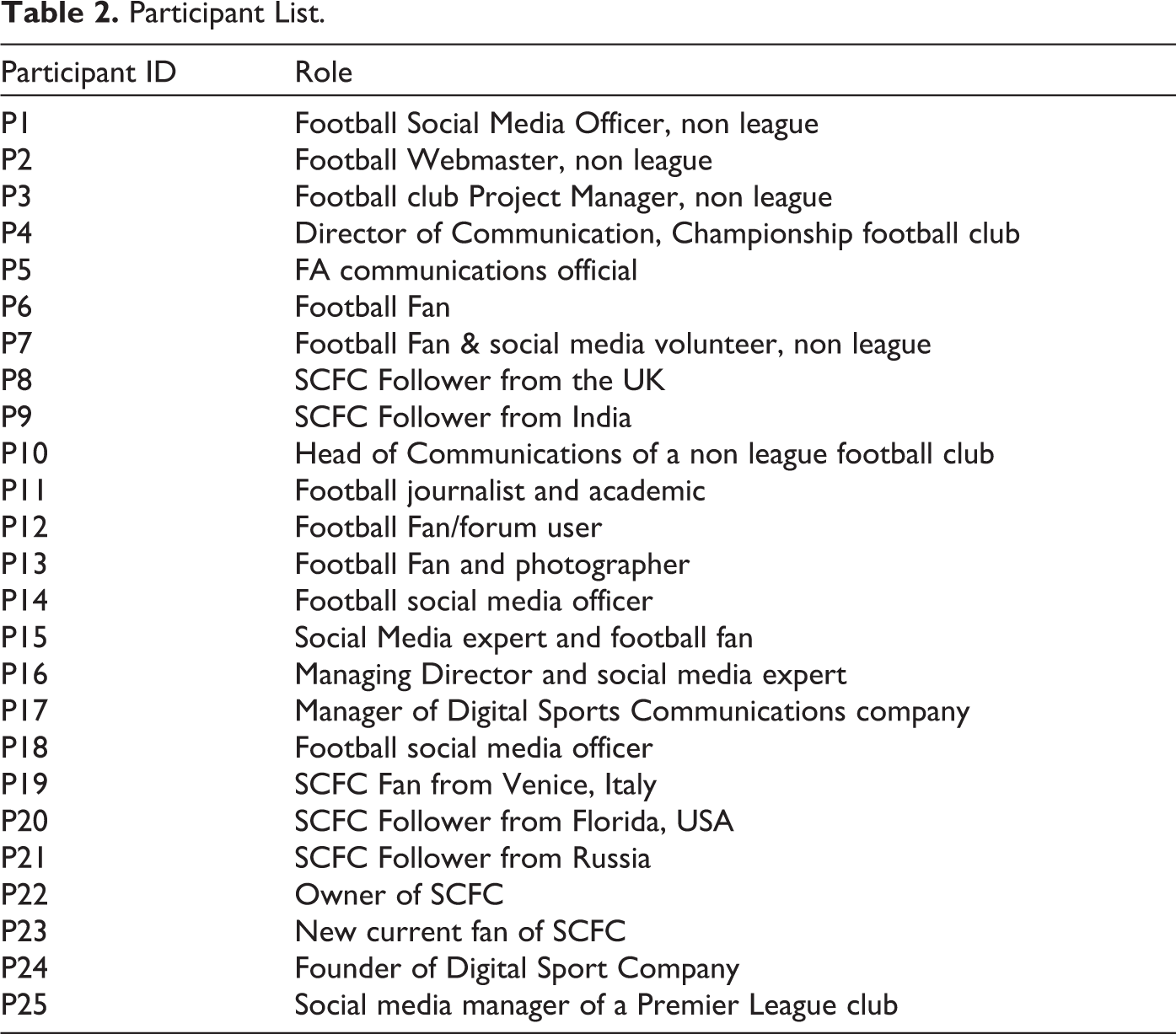
In addition to collecting data from multiple platforms we added interview data to verify findings and triangulate in order to create rich data using a netnographic framework and standards (Kozinets, 2020). Semi-structured interviews with 25 football industry professionals and sports fans were also conducted in order to provide more detailed information and to qualify the online observations and enhance understanding. Participants from the football industry were identified based on a combination of our engagement with SCFC via social media and industry connections. For the latter group, as the network consisted of thousands of social media followers, a snowball sampling strategy (Palinkas et al., 2015) was employed to tap into the relevant networks, beginning with individuals identified via our participant observation. Interviews were set up through the research team contacting interviewees via email or social media in line with the ethical approval from the University of Salford. All were assigned a participant ID number in order to protect their anonymity. Table 2 outlines the roles of the participant, which is relevant information regarding their connection to the data provided.
Participant List.
All interviews in this study were transcribed, and the participant observation diary was added to NVivo. The data was labeled and ordered into categories and sub-categories to create meanings using a thematic approach following the work of Braun and Clarke (2012). This approach is often used in interpretive studies and in netnography research (Kozinets, 2020). In conjunction with the literature and discussion with the research team, a smaller number of themes was created, using a theoretical framing of bonding and bridging social capital, overlaid with associations to digital placemaking initiatives, or other place related topics. Two researchers independently analysed the dataset to create the themes and enhance intercoder reliability and any discrepancies or variations were discussed. Decisions were made regarding theme conflicts and a prioritisation was applied to identify the most relevant constructs in terms of the theoretical frame.
Findings
A Sense of Community and Place
In terms of the specific digital placemaking initiatives, SCFC had an official Facebook page and a Twitter account, which many supporters interacted with (see Table 1). A separate unofficial SMBC, created by supporters, was particularly effective at facilitating an online community centred around SCFC. Throughout these activities, on channels created by the club or supporters, there was clear evidence of digital placemaking, and interviews with participants offered key insights into the impact of these activities upon their experience with the club. The quote below indicates the extent to which digital placemaking initiatives built around the club have helped to elicit a sense of pride, even within an area of relative urban deprivation. Notably, SCFC has seen some recent success in the promotion of a local community group which is campaigning to protect an area of natural beauty from urban development: There’s huge history here, there was a hanging place, it’s the highest part of Salford, part of Salford Racecourse was on it so there’s strong community links round here. I think it’s a no-brainer for the club to get involved in stuff like that. Like helping with the Friends of the Kersal Moor. They use social media and so forth to get involved in those things because the club can do so much in terms helping those local community groups. (P18)
Bridging Social Capital
Analysis produced accounts of relationships between disparate groups of supporters, which we determined as satisfying bridging social capital and enablement of these relationships between fans, or groups of fans was clearly evident as a by-product of the SMBC. Participants commented on the level of connectedness with other fans who they would never have interacted with, without the ongoing placemaking initiatives of the supporters’ SMBC. For example, P13 describes how friendships had grown with a fellow fan they recognised on the various SMBCs. In a succinct example of bridging social capital, a sense of connection through the online brand community, which offers a distinctly positive outcome is shown through this quote: You could come in to work and be asked if you saw such and such a post. Football fans are all about camaraderie, so having that link with people is a good feeling. A few of the lads have met up with people at games that they have met through the Facebook page. (P13) I don’t think it’s so important knowing other fans to be a great supporter. In my experience I feel a strong connection to the club because it is connected with a place I like to live in. (P19) You have the hardcore fan base who have supported [SCFC] for years. They run the forums and engage with the fans on another level because they know so much more about the club than most. (P14) Some of the existing fans and volunteers feel a bit marginalised because we’re going to get here one day and someone’s going to say, “We don’t want you anymore” because we’ve got loads of money. (P18) There are some Italians fans of English football who feel connected to Salford City just because they know that has been acquired by Ryan Giggs and the Neville brothers. (P12) The players seem closer than they are through the Twitter feed. Constant media updates from the club always let me stay up to date with the Club. Salford FC is owned by our Legends, as you know. I came to know about Salford FC through Manchester United. (P9) We have the growing pains at the club, with existing fans, getting used to the fact we’re big and global and feeling like, they’re thinking the new fans are only here since we’ve been winning stuff and therefore they feel a bit of tension there. (P23)
Bonding Social Capital
Where closer ties between groups were observed, these were identified within the data as bonding social capital, and offered a useful platform for understanding the influences of SMBCs. Participants expressed pride at becoming a supporter due to family connections, as evidenced through this quote: “I became a fan through family and nothing would ever change that” (P16). Further to direct family connections, participants felt a strong sense of ‘family’ with other fans through engagement with the SMBC pages. Supporting the club was equivalent to being part of the “collectivity,” which enhanced bonding social capital. Interestingly, for groups such as these, family behaviours were also observed. Specifically, peer rebuke through moderation of online content was reported in a number of conversations, and resembled inter-familial relationships: Non-league football has always had more of a family feel it, so a fan criticising a player’s performance would be like criticizing a member of your family in public. You might do it behind closed doors or in the bar, but we don’t want to see it online. (P11) You have to respect it [SMBC] if you want to be part of the family, you have to behave like you’re part of it, that’s the way I feel about it. We are part of the family all of us. You wouldn’t speak badly about a member of your family outside the house. (P1) With the big clubs it felt like social media was a platform for them to make money. Salford’s was a lot more personal. People would always get replies from whoever ran the page. It made you feel part of the family. (P23)
Place attachment was a key feature in participant discussions, where fans felt a strong association with Salford as a result of engaging with the SMBCs. However, conversations also indicated negative consequences and a fragility within the bonds established through digital placemaking as a result of this engagement. Given the diverse membership of the SMBC, significant chasms were evident with members ending up in argumentative positions in a highly visible manner. Such scenarios are detrimental to the intentions of the digital placemaking strategies, and the general goals of the SMBCs. Figure 1 displays an example of such an incident whereby a fan from outside of Salford posts to the SCFC SMBC page to advertise they are setting up a new Facebook appreciation page. Fans are quick to display their identity and to use memes demonstrating that they are from Salford and not “Mancunia”—referring to the city of Manchester. An interesting debate then unfolds regarding whether a new group is required. The Southern fan then makes a faux pas saying that SCFC fans are from Mancunia and is quickly corrected with a stream of comments and graphics outlining that Salford is distinctly different from Manchester. The incident draws to a conclusion between the fan who started the posting and the SCFC fans.
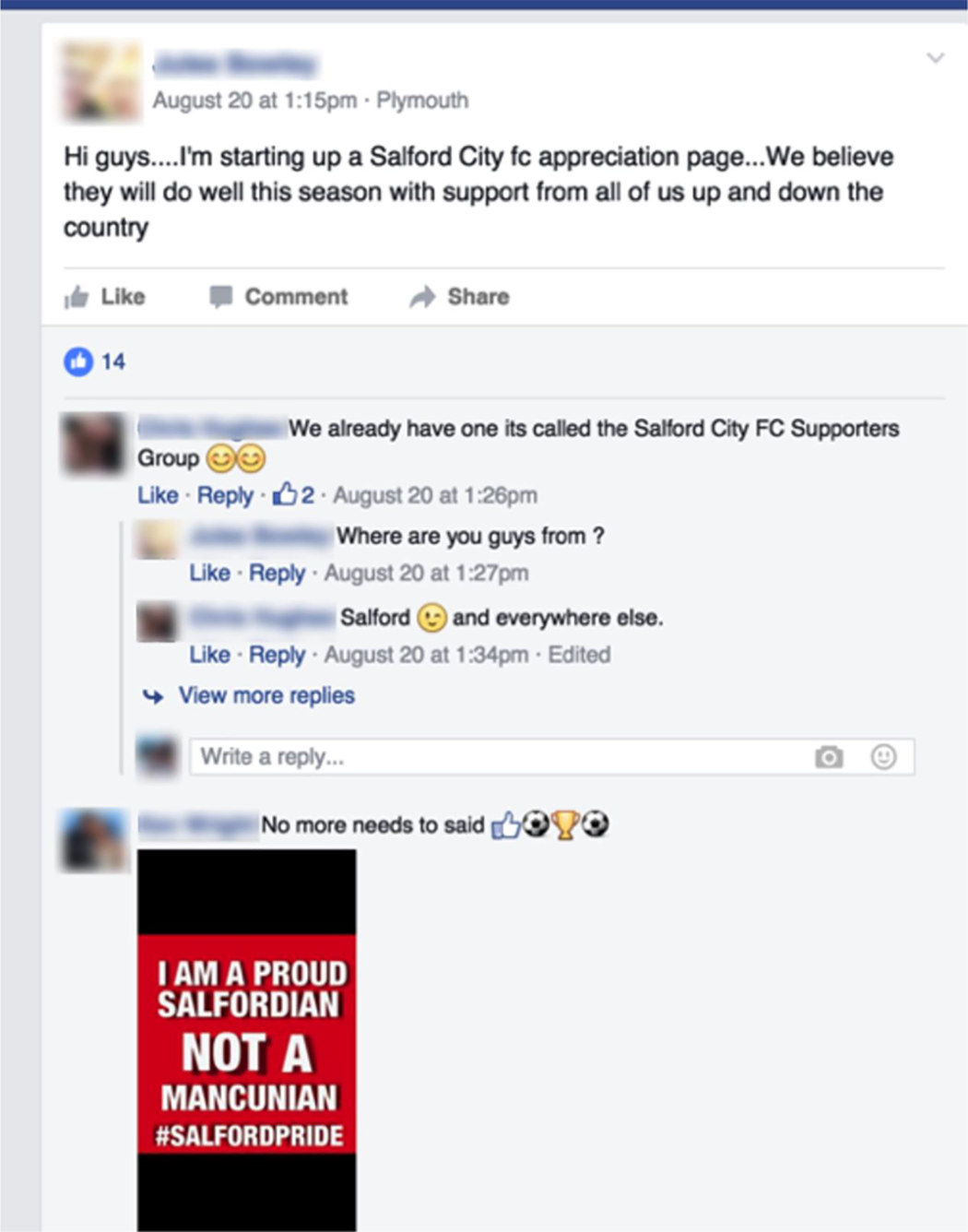
Mancunia critical incident.
This incident demonstrates how bonding social capital can also create conflict, which contradicts the intention of developing a sense of community. In the attempts to create a welcoming and supportive SMBC, it is also reasonable to assume that conflict between members will occur, however we see a degree of solidarity emerging within the strong bonds between members, which acts as a deterrent to new members. Furthermore, in-fighting between closely associated groups of fans is also a key factor in this exchange, with some disagreeing on the extent to which Salford is disassociated from the identity of Manchester. Arguably, strong bonds are evident between the core fans who are quick to defend their identity as Salford fans, rejecting the words Manchester or Mancunia and this further cements the role of the club to the place attachment of its individuals. Hence, bonding social capital exposes the relationship between place associations and the digital placemaking initiatives through SMBCs.
Theoretical Contributions
Two key contributions to knowledge are provided by this study. The first refers to the limited stream of research on digital placemaking, and SMBCs in sport, and how they contribute towards developing a sense of community and place an important factor given that clubs are increasingly investing time and resources to attract the most active fans on social media (Salmi et al., 2019). With digital media technologies creating new relationships between corporations, sporting bodies, and communities (Thorpe, 2017), we provide an overview of digital placemaking initiatives and their longstanding effects on community members and offer a fresh perspective to the geography of sport in the modern era. Arguably, the community members and fans that created the digital framework around SCFC did not have a long-term strategy for community engagement, and hence the outcomes of their efforts exceeded expectations. Results indicate that individuals have managed to bond with fellow fans, establish relationships with disparate groups associated with SCFC and have managed to link with groups of online supporters, which span the globe. Arguably, this vignette compliments the previous works in the areas of sports clubs’ use of digital platforms (Custódio et al., 2018; e.g., Edensor & Millington, 2008; McCarthy et al., 2014).
The first major placemaking affordance noted was the ability of SCFC to develop a “sense of place” (Agnew, 1987; Bale, 1996) on digital platforms that support and facilitate community interaction. Second, the modern view of technology enhanced platforms for placemaking (Breek et al., 2018; Fredericks et al., 2018; Keegan, 2021) is also addressed by civic interaction on SMBCs. By offering supporters the opportunity to interact and engage with each other by discussing aspects of the club and the locale around the ground, members unwittingly are involved in placemaking activities. Hence, the SMBCs observed in this study have become pivotal to creating “useful and meaningful” digital spaces, concerned with physical places, offering a modern-day perspective that harks back to Paulsen (2010).
The second contribution is to our understanding of the influence of SMBCs in terms of social capital. This study highlights how fans of SCFC have responded to digital placemaking endeavours, and how they have affected social capital. With respect to bonding social capital, a unique persepective of the notion of family bonds was observed. Adams (2011) emphasised the strong influence that people’s family and close friends had on social media. Such close networks are seen to be highly influential and may be made up of close friends or family members. The word family presented itself many times in the data, relating to the ways fans communicated their sense of belonging, and was used interchangeably with the community of fans of SCFC, sometimes referred to as the “hardcore” fanbase. This association between relatives and fans was prevalent in the community, emulating the work of Edensor and Millington (2008). However, bonding social capital was observed through fans’ use of discussion forums. Some of these fans were biologically related as brothers, sisters or parents. The word family was also used to refer to other fans who were close friends, season ticket holders and players who referred to each other as family in a metaphorical sense where bonding social capital typically exists (Woolcock, 2001). We argue that these findings have strong connections to Edensor and Millington’s (2008) views on place identity and football clubs, suggesting that the locally embedded nature of the club and how this is communicated is pivotal to successful placemaking strategies. Through digital platforms, SCFC and their fans have been unknowingly complicit in a digital placemaking strategy that has achieved an impressive feat in terms of growing the community.
However, the data also revealed examples of conflict which arose from SMBCs and sheds light on the darker side of digital placemaking (Keegan, 2021). In offering an open platform for communication, numerous cases of hostile exchanges were observed, which further stressed the strong bonds between the fanbase. Such instances, are reminiscent of Putnam’s (2001) notion of “cyberbalkanisation.” Other negative effects were observed, in particular the fragility of bonds in the digital arena. Trolling, exclusion and argumentative behaviours were present, which were, in effect, enabled by the SMBC platforms. These situations present a serious predicament for the concept of digital placemaking, where moderation and management of the network of fans would need to be considered, however this would also have detrimental effects to the idea of a supporters’ community created by fans, for all fans.
The findings also advance our understanding of the creation of bridging social capital through SMBCs used for digital placemaking initiatives. At the time of study, SCFC were attracting new kinds of fans through social media from around the world and therefore bridging social capital became prevalent. As bridging social capital “cuts across various lines of social cleavage” (Helliwell & Putnam, 2004, p. 1437), it was clear that the SMBCs afforded new linkages between different fan groups and bridging networks to include a wider array of members. Bridging social capital, therefore, was built up through the physical place (attending matches) but especially through digital placemaking. Further, these extended networks were observed to be presenting moderated behaviours, suggesting similarities to Adler and Kwon (2002)’s “collectivity” brought about by bridging capital. Valenzuela et al. (2009) also described bonding social capital in terms of the strength of ties whereby networks influence bridging social capital because they connect people from different life situations. Hence, through the lens of bridging social capital, digital placemaking, when successful, can develop a sense of community between a wide range of fans from vastly different backgrounds to strengthen ties between them without requiring physical presence. However, it should be noted that accounts of cynicism towards the expansion of the supporters' network was also prevalent in the findings, and would pose a significant conundrum whereby hardcore fans may be alienated by the influx of new members, and the resulting tensions that ensue. While findings related to bridging social capital allows us to witness development of supporter networks on a macro level, this study has also revealed negative ramifications of such expansion.
Conclusion
This research has helped our understanding of communication in a digital world by shedding light on the influence of social media on digital placemaking through bonding and bridging social capital as a theoretical lens. A limited stream of studies have examined the influence and impact of digital technologies in placemaking and so our findings make a significant contribution to the ongoing conversation regarding digital placemaking by offering an overview of the outcomes of SMBCs in a developing community. We found that communications between the club and supporters and intra-group communication between fans in these digital spaces developed both a sense of community and place. The familial communication that was evident between participants was an indicator of their sense of belonging. Nevertheless, these ties were, at times, strained and revealed tensions between the locally embedded nature of football clubs and the desire to expand and become global brands, suggesting that bridging social capital may have its limits. This situation creates an interesting paradox for clubs as SMBCs have the potential to diversify fanbases, and foster inclusion, but in doing so they may create friction with ‘local’ fans that can have the opposite effect.
Given the global impact of the COVID-19 pandemic on the ability of fans to attend matches, the potential for SMBCs to create a sense of place suggests that sports organisation should focus their communication efforts in this area. SMBCs have certainly enhanced supporters' experience with SCFC, however, nefarious behaviour cannot be ignored, suggesting detrimental effects of digital placemaking should be considered by future studies. It remains to be seen whether the recent shift to an increasingly mediated consumption of sport and the likley change to the stadium experience (Majumdar & Naha, 2020) will result in greater acceptance of an increasingly global fan base by localised, hardcore fans. This last point offers an enticing and growing area for future studies.
Footnotes
Declaration of Conflicting Interests
The author(s) declared no potential conflicts of interest with respect to the research, authorship, and/or publication of this article.
Funding
The author(s) received no financial support for the research, authorship, and/or publication of this article.
