




Abstract
In the film and television industry, many social movements as #MeToo, #BuryYourGay or #BlackLivesMatter have highlighted the necessity of better representations of marginalised communities on and off screen. As diversity and inclusion have become major issues in contemporary societies, video-on-demand (VOD) platforms have publicly committed to diversify representation in the films and series they produce and distribute. This article investigates how streaming platforms with different commercial or public interests and in different national contexts understand and promote diversity and inclusion through the analysis of paratext. Focussing on the visual analysis of thumbnails, we compare the French and Norwegian national public platforms (France TV and NRK TV) with the most popular commercial national platforms in each country (Canal + Series in France and Viaplay in Norway). The visibility and invisibility of gender, race, sexuality and (dis)ability on TV series’ thumbnails reveal certain national and platforms’ social, cultural and political values. By using mixed quantitative and qualitative methods including interviews conducted with industry professionals, we aim to highlight the impact of streaming platforms’ promotional practices on the (in)visibility of diversity.
Keywords
Introduction
Diversity and inclusion have become major issues in institutional and cultural discourses, especially as social movements such as #MeToo, #BuryYourGay or #BlackLivesMatter have highlighted the necessity for all to re-think through gender, sexuality and race. The audiovisual industry in particular has been pressured to eliminate gendered or racial discrimination from their industrial practices, but also to find ways of offering diverse and inclusive representations. This article intends to critically examine how French and Norwegian streaming platforms, namely MyCanal (Canal + Series), France.tv, NRK and Viaplay, contribute to this diversification of models through their promotion of content. We argue that the visibility or invisibility given to diversity depends on corporate strategies that both rely on and shape ideas of national audiences.
Programming strategies of global streaming platforms such Netflix have been studied by many authors. However, national platforms face different challenges and – especially singe-territory SVOD – ‘tend to respond to specific national dynamics’ (Lotz, 2022: 101). Cultural contexts could shape their practices toward producing, distributing or promoting diverse contents. By looking at national streaming platforms (both public and commercial), we aim to uncover how different industrial models lead to different ways of understanding diversity and audiences’ relations to minorities. To expose streaming platforms’ processes in promoting diversity, we look at paratexts – thumbnails in particular – in context with the national policies or practices of France and Norway intended to support diversity, equity and inclusion on screen.
This article aims to contribute to previous research on the (in)visibility of diversity and politics of representation, together with considerations of industrial strategies when it comes to national internet-based distribution of TV series. Emerging from the European collaborative project DIGISCREENS, this article contextualises cultural representation – among which identity and diversity – within industrial practices, and as Olivia Khoo calls for, within ‘the structures and people that make up a media organization, and the media’s platform specific affordances’ (2023: 284). While most studies on streaming focus on American global platforms and especially on Netflix when it comes to looking at diversity (Gaw, 2022; Jenner, 2018; Khoo, 2023), we propose to focus on national platforms in France and Norway, governed by different public or commercial constraints and objectives. Articles on Netflix and the effect of their algorithms on their libraries, promotion and personalisation techniques abound (Amatriain, 2013; Bradbury-Rance, 2023; Eklund, 2022; Khoo, 2023; Lobato, 2019), but little has been written on promotional efforts on other platforms that may still be in a transitional phase from linear TV such as national public broadcasters and commercial platforms originating from cable TV. To answer our questions on the impact of streaming platforms’ practices and histories on the (in)visibility of diversity, we use mixed quantitative and qualitative methods to produce a comparative analysis of two national public platforms (France TV and NRK TV) and commercial platforms (Canal+ and Viaplay).
Methodology
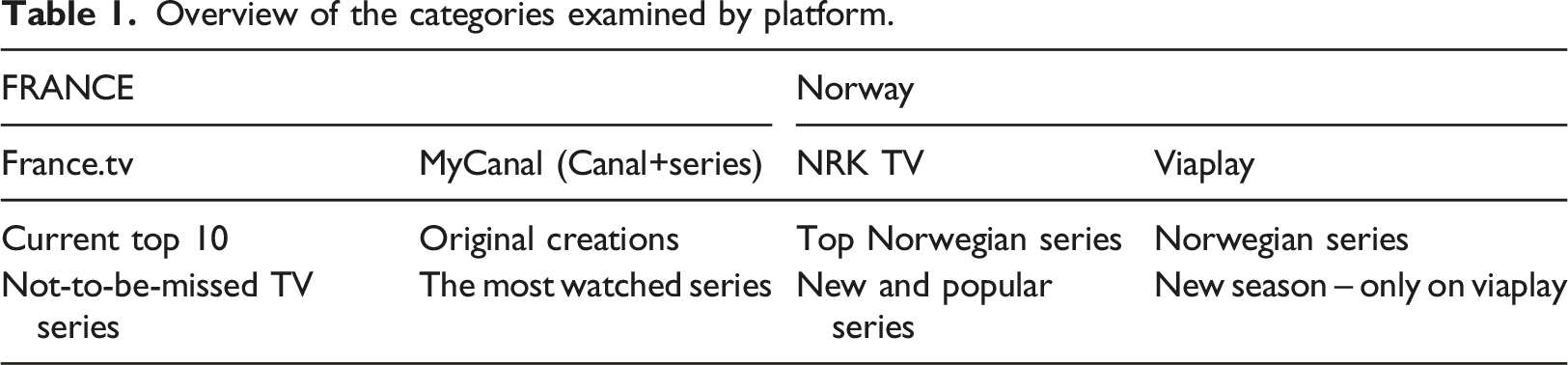
In order to visually appraise how each platform promote or hides minority characters on their thumbnails, we first took five screenshots of each platform’s homepage, over the course of six months (from September 2023 to February 2024) 1 . As the machine learning engineers at Netflix point out, ‘the primary function of the homepage is to help each member easily find something to watch that they will enjoy’ (Alvino and Basilico, 2015): we assume that this statement applies to all streaming platforms. While the Netflix homepage is constructed and generated using algorithms that vary from one user to another, the homepages of the four platforms selected for our study are not shaped by prediction or recommendation algorithms, except for the ‘Recommended for you’ or ‘your favourite’ categories which are present on most platforms. These homepages therefore correspond to programming choices, understood as ‘an art of meeting between the public and a range of programs’ (Souchon, 1990: 95); they embody the wishes and choices of distributors to organise their catalogue and give visibility to certain programs over others.
Overview of the categories examined by platform.
Detail of the number of thumbnails, titles and characters examined by platform.
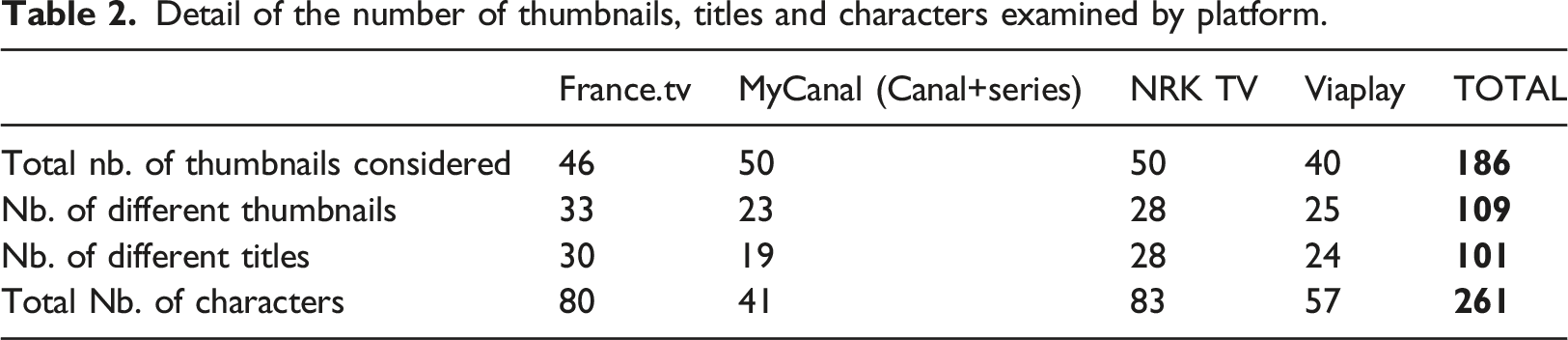
As our aim is not to examine the evolution of the promotion of diversity, we are not proposing a diachronic study, but have adopted a method similar to that used by ARCOM (Regulatory Authority for Audiovisual and Digital Communication in France), to establish its ‘Barometer of the representation of French society’ (as described on their website): twice a year and for a period of one week, the TV programs broadcast will be analysed using the Barometer to assess each channel’s performance against the commitments made the previous year. The aim is to produce and analyse ‘a snapshot of the representation and promotion of diversity on screens at a given moment’ (ARCOM, 2023: 8, translation ours) and of the image that streaming catalogues project of society. By focussing on five months of promotion of content, we however aim for a more comprehensive vision of the promotion of diversity.
For each thumbnail gathered, we first counted the number of characters presenting as: woman or man, appearing as mature (over 45, and further divided this category between men and women), presenting through a non-binary gender identity and/or being in a queer relationship, belonging to an ethnic minority in France and Norway2, or showing signs of a mental or physical disability. To avoid miscalculations, we considered the synopses (or the personalia of the actors) to identify any signs of belonging to a minority that may not otherwise have been visible from the thumbnails. In a second instance, we weighted these results by giving one point to characters standing in the foreground, and half a point to these featuring in the background of the thumbnails. And we finally weighted these results by the number of times a thumbnail was repeated and thus more visible on the platform.
Based on the results obtained, we sought to understand the persistent differences between the two countries and between each platform through looking at identity categories or situations (gender, age, ethnicity, queerness, disability) qualitatively. For this, we analyse ‘images that are deemed noteworthy, important, or interesting’ (Schroeder and Borgerson, 1998: 164), through a feminist visual analysis method that builds upon methods of semiotic, psychoanalytic and textual film analysis (see Buikema et al., 2011; Ceuterick, 2020; Schroeder and Borgerson, 1998). This method relies on the idea that visual images produce and reproduce identity categories, such as gender, race, or queerness, and that ‘the more prominent certain images become, the more power they have’ (Schroeder and Borgerson, 1998: 164). Questioning representations of diversity means, among other things, asking how minorities are – or are not – represented. Minorities are defined by what Éric Macé calls their ‘specific visibility’ within a specific cultural context: they differ from the hegemonic representations which are perceived as the ‘norm’ (Macé, 2013: 182, translation ours). By analysing the representation of the characters on the thumbnails, we aim to reveal how identity categories are made visible and the social, cultural and political values they carry.
Thumbnails: Making diversity (in)visible
On streaming platforms, thumbnails are the most important part of the paratext of a film or TV series. 82% of Netflix’s viewers indeed affirm selecting content to watch based on thumbnails (Khoo, 2023). Because they form an unavoidable access point to the content ‘the power of paratexts like thumbnails to structure and shape understandings is in some ways enhanced on streaming platforms’ (Eklund, 2022: 739-740). In his work on Netflix’s thumbnails, Oliver Eklund argues that thumbnails give an ‘identity’ to a show and are ‘excellent visual indicators of [a platform]’s branding strategy’ (2022: 748; 754). While the four national (public and commercial) platforms analysed in this article do not make use of thumbnail personalisation algorithms as Netflix does, the design of their interfaces is very similar to that of Netflix both at an aesthetic and organisational level. They similarly use thumbnails and categories to attract and orient audiences through their catalogues and make very conscious choices in how they promote their content and attract their target audiences. Public broadcasters such as NRK and France TV indeed also compete for audiences’ attention and their economies and longevity also depend on audiences’ engagement. As Reuben Sletten in charge of the design of thumbnails (‘key arts’) at NRK affirms: ‘The audience spends a short time per key art before deciding whether this is something for them, or whether they scroll further. It is therefore important that the key stands out and is immediate’ (interview, 19/02/2024). The demands that streaming places on thumbnails – to attract and retain viewers rapidly – thus lead to the design of thumbnails that are visually attractive and play with audiences’ expectations, even though this sometimes happen at the expense of truthfulness towards the content promoted, as discussed further below.
Paratext also shapes the interpretative framework of a text, through tapping into viewers’ prior ‘knowledge of generic conventions’ and through a myriad of marketing strategies and critical discourse that exists around a film text (Klecker, 2015: 406). When confronted with thumbnails, audiences are thus already conditioned by their previous audiovisual and cultural knowledge, whereby human faces expressing emotions or colours already indicates the genre of a film or TV series. As Jonathan Gray puts it, thumbnails and synopses, among other paratextual aspects, are ‘texts that prepare us for other texts’ (2017: 25) and give us a lens of interpretation.
As with any other design choice, making diversity visible or invisible in the paratext imbue meaning onto a text, and also reveals what we may call a ‘platform’s identity’ and their understanding of (national) audiences. Because ‘the visible produces the invisible, in the sense that for something to be optically discernible to us within any given temporal frame, something else has to recede from observability’ (Grønstad and Vågnes, 2019: 2), choosing to invisibilise queer relationship or ethnic representations in the paratext gives therefore more visibility to heteronormative and white characters or relationship. When studying the visibility of ethnic minorities, Stuart Hall identifies the dimensions of ‘access’ to visibility and ‘contestation of the marginality’ (1994: 224). While the first aspect refers to the visible presence of minorities in media and their ‘access’ to representation, the second dimension expresses ‘a concern not simply with the absence or marginality of the black experience but with its simplification and its stereotypical characters’ (1994: 223). Indeed, increasing the number of visible minorities does not mean ending negative (or positive) stereotypical representations. On the contrary, as Éric Macé argues, the increase of non-white people in French fiction has been associated with and made possible by the creation of ‘counter-stereotypes’, which could be interpreted as the occultation of issues and political meaning related to ethnic minorities (Macé, 2013: 183). As Hall explains, simply reversing stereotypes does not allow to conduct a proper ‘politics of representation’ that would articulate the full complexity and diversity of social experiences and work ‘with and through differences’; ‘build […] forms of solidarity and identification which make common struggle and resistance possible without suppressing the real heterogeneity of interests and identities’ (1994: 225).
Building politics of representation on screen or through paratext can be applied to the representation of all minorities. Sarah Banet-Weiser critiques the ‘economy of visibility’ of contemporary digital culture, characterising it as the depoliticisation of visibility as ‘economies of visibility fundamentally shift politics of visibility so that visibility becomes the end rather than a means to an end’ (2018: 23). Similarly, Clara Bradbury-Rance warns against the visibility of lesbian couples on screen as fixing what is made visible, without leaving space for politics and an examination of these representations (2019: 3). In the case of streaming platforms’ politics of diversity as we will see in the next section, the introduction of minority voices (in terms of gender, ethnicity or else) at the level of creative teams does not necessarily mean ensuring that minority identities are, firstly, made visible on screen and, secondly, that the content produced adopt a feminist or anti-racist standpoint. Visibility needs to be coupled with politics so that it ‘can be productive of something, such as social change, that exceeds the visibility’ (Banet-Weiser, 2018: 22).
Norway and France’s national platforms, in between public, commercial, linear and streaming practices
When looking at how streaming platforms operate different diversity and identity politics, we first need to consider their organisational history and funding model. In television history, the shift from broadcasting to multi-channel amounted to a multiplication of the content on offer with each cable network targeting ‘specific viewer tastes and preferences’ (Lotz, 2014: 28). While this shift happened through the 1980s until the 2000s, streaming is an evolution of this cable logic as the evolution from linear TV to streaming continued to diversify the texts produced and distributed to cater for a variety of niche audiences (Lotz, 2018: 492). From financial models that evolve with audience numbers present at a given point in time in front of their television (a number that commercial TV services could then sell to advertisers), streaming platforms are concerned with attracting and retaining viewers or subscribers through curating attractive libraries (Ibid.).
Rather than catering for a mass audience at times of high television consumption, streaming enables the targeting of multiple audiences through distributing varied content types, each of them tapping into their specific tastes. However, the capacity of a given streaming service to have a broad library that will attract and retain viewers or subscribers depends on their overall budget. While Netflix’s important production and distribution budget enables it to cater for many different audiences simultaneously (and orienting them through the use of algorithms), smaller platforms must operate a more conscious curational choice in the genre of content they offer. The economy of a platform is key to their strategical development and promotion of libraries, as became evident with HBO closing down its Nordic platform, and being replaced by the global platform HBO Max in 2021 (Kynningsrud Størbu and Lindblad, 2020). Similarly, Viaplay’s downsizing (in June 2023) resulted in a re-orientation of their curatorial and promotional strategies to prioritise sports, title acquisitions and reality TV while closing down their drama production sections in Norway and Sweden, selling market shares (including 12% to Canal + Group) and selling the rights to originally produced TV series and shows (Viaplay Group, 2023: 6).
By choosing four different platforms operating different industry models (NRK TV, France TV, Viaplay and Canal +), we question how national public and commercial practices may have an impact on promotional strategies. In spite of belonging to a group that gathers both digital TV platforms and linear TV channels (such as TV3 in Norway launched in 1988), Viaplay is the only platform in this study that started directly as digital TV in 2007. The other three streaming platforms NRK TV, France.tv and MyCanal all emerged from linear TV as replay-TVs for their broadcast offer between 2009-2013. Through the choice of these four platforms with their different histories, we aim to investigate how their industrial positions and relation to linear TV condition innovation or standardisation in types of content, and in turn modify their strategies regarding the visibility or invisibility of minority characters. If diversity indeed figures among the European recommendations for cultural offers on TV and streaming platforms, national policies and industry models will condition the ways streaming services understand and implement diversity, equality and inclusion in their own work policies or content on screen (Cabrera Blázquez et al., 2021). While the European Audiovisual Observatory states that diversity can be understood as a reflection of the plurality of a society based on multiple variables (such as gender, ethnicity, language, age, disability and sexual orientation), the authors also admit that ‘diversity largely depends on the composition of a country’s society; the latter is the reference for the former and there is no universal standard for diversity’ (Ibid.: 2-3). Similarly, public TV broadcasters and thus their streaming offers have to respond to a public service mission (educate and inform as well as entertain) whereas commercial TV services (such as Canal+ and Viaplay) are not bound to the same educational or informative duties.
All Norwegian public institutions, and thus NRK, must follow the Norwegian Ministry of Culture’s recommendations to provide ‘a wide range of cultural expressions […] and a breadth of forms of expression as part of global cultural diversity’, as written in their last public statement titled ‘The Power of Culture’ (2019: 16). Gender equality on screen has been part of the public debate since 2006 with the Norwegian Film Institute taking gender equality as an explicit focus and consistently reporting on the number of women and men in creative teams and on screen in their annual reports (Kleppe et al., 2024: 11). Public statements regarding other types of diversity and inclusion remain however vague and the monitoring of minorities on screen only started recently and is principally gathered in two reports published by the Norwegian Film Institute looking at ‘Diversity on Cinema Screens from 2013–2020’ (NFI, 2021), and at Norwegian films and series (Kleppe et al., 2024). As a public cultural institution, NRK must thus abide by a set of 52 bylaws, specifying first and foremost that ‘the purpose of NRK is to meet democratic, social and cultural needs in society’ (NRK, 2022; art. 12). However, the 2024 report on diversity in Norwegian films and TV series notes the sheer absence of queer characters or ethnic minorities on Norwegian television (Kleppe et al., 2024; see also Uppal, 2019). In spite of NRK’s explicit engagement towards diversity: ‘A large portion of [NRK’s] offering should be anchored in and reflect the cultural diversity present in the population’ (NRK, 2022; art. 16), the report also concludes that among series produced by or distributed on NRK or other national platforms (Discovery+, Netflix, TV2 Play and Viaplay), content on NRK did not display more equality, inclusion or diversity (Kleppe et al., 2024: 37). Our analysis of thumbnails in the following sections of this article aims to shed light on some of the reasons for this disparity between official commitments and the visibility of diversity featuring in the Norwegian and French population.
Similarly, French laws compel the representation of ‘the diversity of French society’ in audiovisual programmes. The Audiovisual and Digital Regulation Authority (Arcom) (ex-Conseil Supérieur de l’Audiovisuel, CSA) is legally in charge of overseeing the promotion and monitoring of this diversity policy among broadcasters. In the French context, legal guidelines regarding diversity on screen are closely linked to the country’s socio-political context. Major changes took place following the 2005 riots in the French banlieues (or disadvantaged urban areas) which highlighted ‘the logic of social and racial segregation in many low-income neighbourhoods’ (Macé, 2013: 185). Following these events, the ‘Law for Equal Opportunities’ mandated the CSA to increase representations of diversity in French audiovisual media. The Images of Diversity Commission was thus set up in 2007 by the CNC (Centre National du Cinéma et de l’image animée) and Acsé (National Agency for social cohesion and equal opportunities) to support the creation and distribution of cinematographic, audiovisual or multimedia works that contribute ‘to a more faithful representation of the French reality in all its components’ (CNC, 2024). Since 2009 and every year, linear TV broadcasters (including France TV and Canal +) also have to commit to increase diversity on screen while still abiding by their original editorial line (CSA, 2011). These commitments therefore remain quite moderate and prioritise editorial choices over the representation of minorities. The Arcom’s annual ‘Diversity Barometer’ report evaluating the services’ compliance with representing ‘the diversity of French society’ concerns chiefly the broadcasters’ offer on linear TV, but the platforms themselves have the possibility to point to their streaming catalogues to indicate contents that fulfil their commitments towards diversity.
Rather than thoroughly applying a politics of representation that would increase and diversify the roles given to minorities, the platforms’ preoccupations with diversity on screen mostly translate as fulfilling, in effect, unofficial quotas. Program Director and Strategy Consultant at NRK Øyvind Lund indeed describes how NRK uses a matrix to make sure that they have a diversity of content that fulfils the need of all their viewers (Lund, interview, 16/06/2023). To compose this matrix, viewers are divided in demographic groups and their interests are gathered through continual surveys and focus groups (Tveito, interview, 19/04/2023; see also Sundet, 2021). By following a similar strategy to global streaming platforms and giving priority to the content on their streaming platforms over their linear services, NRK manages to cater for a variety of specific audiences and to remain competitive in the streaming era 3 . This strategy to ensure a diversity of content based on demography does not however ensure a diverse politics of representation, with minority identities present in a variety of roles on screen. Strategic Head of Accessibility and Diversity at NRK Siri Antonsen indeed explains that the catalogue as a whole should cater for the Norwegian population, and especially emphasises the geographical and linguistic diversity of Norway, rather than all shows being concerned with diversity: ‘not every show needs to feature diversity’ and when it does ‘it needs to remain natural or realistic’ (interview, 28/04/2023). This conception of diversity may therefore explain the heavy predominance of thumbnails featuring whiteness, youth and heterosexual relationship. Antonsen indeed admits that ‘NRK is not mirroring the Norwegian population enough in the areas of multiculturalism, gender and sexuality, (dis-)ability, and linguistic diversity’ (interview, 28/04/2023).
Similarly, France TV explains its commitment to diversity by focussing on five areas: promotion of ‘social diversity and the fight against all forms of discrimination’, inclusion of disabled people, equal treatment for all the company’s employees, gender equality and fight against homophobia (France Télévisions, 2024). Nevertheless, the two interviews conducted with Heads of the Group (who wished to remain anonymous) tend to show that on-screen diversity is perceived as correlated with the notion of ‘proximity’, whereby everyone in France should be able to find content that makes them feel represented (interviews, 07/03/2024). While gender equality is understood as a kind of ‘normality’, the interviewees placed emphasis on France.tv’s catalogue as serving the diversity of French regions and the overseas territories. Ethnic diversity in turn tends to be limited to the inclusion of actors perceived as non-white in castings. Interviews confirm what Éric Macé pointed out in 2013: the representation of queerness and ethnicity on screen continue to bring political and social issues that are ‘divisive’ and ‘complicated’ (2013: 185) in French society today, and that are therefore difficult to introduce to audiences (interview, 02/02/2024).
In addition to focussing on the streaming platforms of the Norwegian and French public television broadcasters NRK TV and France TV, we investigate how national commercial streaming platforms relate to the promotion of diversity. While Viaplay originated in Sweden, it is often considered as a national platform in Norway and one of its most popular commercial platforms (Jortveit, 2020). If latest reports attest to TV 2 play taking the lead in terms of audiences in the second half of 2023 (Futsæter, 2023), possibly due to Viaplay’s downsizing, the platform has a long history of original series creation and still brands itself as ‘the Nordic region’s leading entertainment provider’ (Viaplay Group, 2024). While Viaplay does not have a public remit as NRK does, the group commits to diversity in their public statements but their concern for diversity mostly concerns gender equality and discrimination in the work environment, which appears detailed in their Annual and Sustainability Report 2023 (Viaplay Group, 2023). Their commitment to improve ‘gender balance, inclusion and diversity’ on screen appears in more succinct terms on their website through a will of distributing ‘content [that] reflects the societies we operate in, with engaging stories that are relevant for as many people as possible’ (Viaplay Group, 2024). Reflecting the longer Norwegian preoccupation with gender equality than with other minority identities, the group affirms wanting to achieve this objective through reaching ‘a 50/50 gender balance in the creative value chain in all Viaplay’s Nordic scripted and non-scripted productions by end of 2026’ (Viaplay Group, 2024).
In 2013, the Canal + Group launched MyCanal, originally intended as a replay platform. As Virginie Spies (2014) pointed out, the group was quickly faced with the challenge of finding new subscribers. Just like NRK, Canal + quickly developed a strategy focused on streaming, through ‘a creative offering and the ambition to propose original programmes’ (Spies, 2014). The group more recently also invested massively in partnerships with Netflix and in form of capital to acquire shares in foreign platforms (12% in Viaplay in Scandinavia, 26.1% in Viu in Asia) (Croll, 2023). As well as diversifying their catalogue, they invest significantly in original creation to build an exclusive and attractive service, as explained by the chair and CEO Maxime Saada (Croll, 2023). Compared to the other three platforms, MyCanal has the particularity to be multi-territory (available in around 50 countries): local content is produced for both a national and international distribution. When it comes to diversity, Canal + similarly focuses mostly on sexism and discrimination in the working environment, described in several public commitments listed on their website highlighting actions ‘to raise awareness and promote inclusion internally and in the content’ (Canal+, 2024). The group defines diversity as ‘the differences related to age, health, disability, sexual orientation or gender identity, and ethnic, cultural, social and geographical origins’ (Canal+, 2024), which they tackle through initiatives such as partnerships with scriptwriting schools to promote a diversity of creative voices or the launch of professional audiovisual training programs in Africa. However, such measures do not necessarily guarantee a reflection or actions encouraging the diversity of representations on-screen.
Both national cultural agendas and commercial platforms chiefly focus on increasing equality and diversity through creating diverse work environments or creative teams. This arises from the (somewhat naïve) expectation that members of a certain community will give visibility to this community, and even practice a non-stereotypical politics of representation. While increasing the diversity of voices may indeed increase diversity on screen, this strategy does not ensure stereotype-free representations since models of representation – with their stereotypes – originate within the same societies that formed these communities. Similarly, thinking of diversity as a catalogue diversification may lead to platforms’ catalogue featuring shows or characters that one could qualify as ‘fulfilling a diversity mission’. These may increase certain minorities’ (or ‘access’ to) visibility but they do not necessarily give them a proper voice or develop a politics of representation anchored in exposing social and cultural issues linked to systemic inequalities and the discrimination of minorities. In the next two sections, we thus propose a quantitative and qualitative analysis of thumbnails through a political feminist lens to examine the visibility of minorities in the paratext of TV series (of gender, ethnicity, age, sexuality and disability).
Excessive visibility or politics of representation?
The initial quantitative approach we took to the thumbnails of our study brings about two main points of discussion grounded within the theoretical framework around visibility and politics of representation. This first part will show how a certain equality in numbers of characters between men and women does not necessarily mean a politics of representation that is free from gendered or stereotypical images. The second part will then show how the invisibility of diversity may be linked to industrial strategies and different ways of considering streaming, as opposed to linear TV.
Somewhat reflecting the priority to gender equality given by the Norwegian Ministry of Culture and the Norwegian Film Institute, the content promoted on NRK and Viaplay shows a greater attention to gender parity than any other kind of diversity. When looking at the number of thumbnails featuring men or women, we can observe a certain equality in gender visibility on the Norwegian platforms and the French public platform (see Figure 1) in contrast with the 23 thumbnails on Canal+, among which only 10 feature women vs. 17 feature men. We then divided the number of characters belonging to an identity category by the total number of characters appearing on the thumbnails, weighted by number of times in our corpus each thumbnail appears and by whether characters appear in the foreground or the background (see Figure 2). In the case of gender, this method thus gives us an indication of the absolute visibility of men and women on the homepages and their position in primary or secondary roles in the TV series categorised. While NRK had a higher number of different thumbnails with women, the platform gives less visibility to women than men in the two categories analysed on their homepages, similarly to Viaplay; men tend to appear more often in primary roles and in content that are more heavily promoted on the platforms. Whereas Canal + Series produces the greatest gender imbalance among the four platforms and gives the least visibility to women, who are almost half as represented as men, France.tv is the only platform to give more access to visibility to women than men. Thumbnails featuring a character within a certain identity category, in percent, rated by the number of different thumbnails for each platform or category. Percentage of characters for each identity category weighted by its visibility on the thumbnail (foreground or background) and its repeated presence throughout the months, rated by the total number of characters.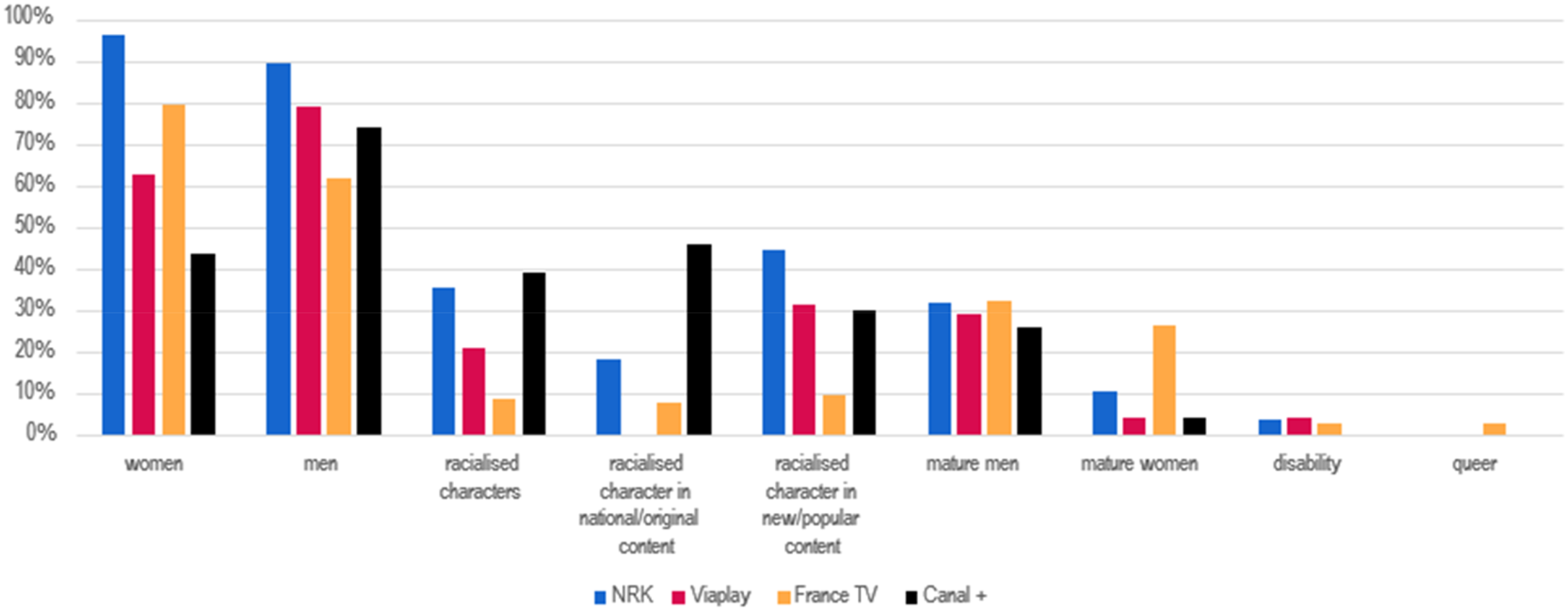
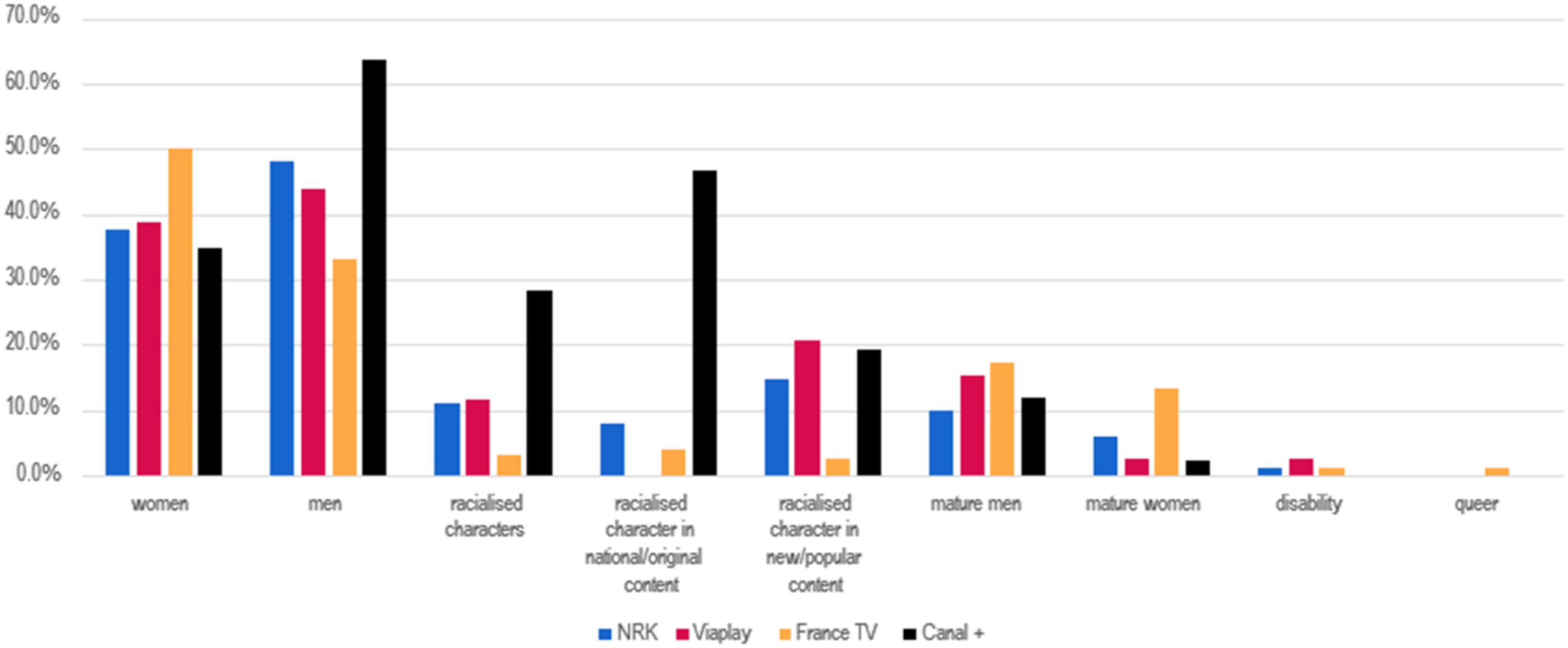
Compared to all other identity categories, the numbers of women and men on thumbnails show industrial strategies somewhat preoccupied with gender equality. While promotional strategies raise questions of stereotypical or misleading representation as we will see, the public platforms demonstrate a certain political engagement with gender issues in the content they produce. If certain gender stereotypes persist (e.g. women are defined as mothers in synopses and appear more often with a smile on thumbnails than men), France.tv is working to achieve greater gender equality especially through police or legal drama which often feature women or gender-mixed duo as protagonists whose personal development is central to the narratives. It aslo demonsrates a will to raise awareness about sexual violence and gender stereotypes. The synopsis of the police drama Sambre, for example, outlines the educational and informative purpose of the fictional programme, which deals with ‘the slow awakening of an entire society to the issue of sexual violence’ (translation ours). Using fiction to raise societal issues – by thematically linking dramas with news items or documentaries – is common to both public platforms’ strategies (interview, 07/03/2024). This amounts to what Eva Novrup Redvall terms the ‘double storytelling’ of public television drama whereby public service broadcasters should ‘[tell] stories that are not only entertaining but which also contain larger ethical and societal connotations’ (Redvall, 2013: 230). In contrast to France.tv, Makta, Lykkeland, and Exit are examples of shows co-produced by NRK that make a social commentary on discriminations and violence done to women without taking these as the main thematic of the shows, and thus not coming across through their paratext.
When comparing the thumbnails on NRK and Canal+ with those for the same series on JustWatch or IMDb (which audiences will often consult before choosing a TV series to watch), the Norwegian and French platforms seem to make active choices to give more visibility to women. The thumbnail chosen on NRK for Babylon Berlin, for example, show the woman and the man characters in an equal position, with both their faces cut in the middle, and a similar serious and self-confident expression on their faces (see Figure 3). On the four thumbnails for the various seasons on Just Watch however, the woman character always appears in the shadow of the man in the background of the poster (or literally as a shadow!). Whereas the synopsis on NRK shows an interest for blurring the gender of the protagonist of the series, as NRK refers to ‘Ein etterforskar’ (an investigator, ungendered), the synopsis on Just Watch makes clear that ‘Colognian commissioner Gereon Rath’ would be the main (and only) protagonist of the series, which seeing the series would be up for discussion. Although Canal + has chosen the same ‘equalitarian’ thumbnail as NRK for the series, the synopsis mentions two male characters, ‘Gereon Rath and his partner Bruno Wolter’, without mentioning the female character shown on the poster. As explained earlier, the paratext of a filmic text highly conditions our reading of films or TV series. These different choices will thus give a different lens of interpretation of the series and its characters, which in the case of JustWatch already installs the woman protagonist in the role of an assistant in the diegesis instead of as a full participant. Thumbnails for Babylon Berlin on NRK, and for the 4 seasons of the series on JustWatch, from the 4th to the 1st (Left to right).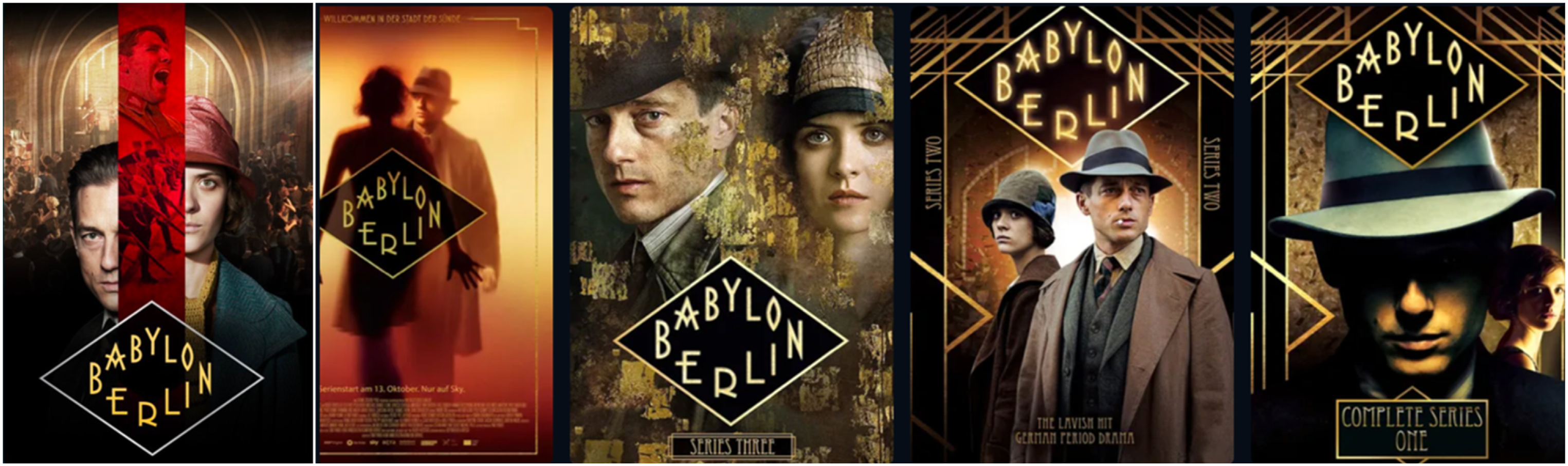
When looking at thumbnails on Canal+ for the original creation Narvalo, it seems at first that the streaming platform also favours gender equality, choosing the actresses Sarah Giraudeau and Déborah Lukumuena to promote the series, while on JustWatch male characters appear as protagonists (see Figure 4). However, this choice may first and foremost be motivated by the credit that these actresses bring with their images as both have won prestigious French awards César and Molière. It may also act as a necessary compensation for the prominent imbalance between women (4) and men (9) on thumbnails for their original creations. On these four thumbnails, Canal + seems to aim to tick the diversity box rather than thoroughly diversifying representations by portraying women with different ‘identity characteristics’ being black, mature, and in a position of social power (see 66-5, Figure 5). The synopses of the four series confirm the hypothesis that Canal+ Series’s strategical promotion of shows may obey the laws of quota-filling or gender-washing as only two present the women as main characters (Désordres and 66-5) and the other two (Le Bureau des Légendes and Narvalo) describe unnamed characters as protagonists instead of the women featuring on the thumbnails. Thumbnail for Narvalo (Canal+, 2020-2023) and Le Bureau des légendes (Canal+, 2015-2020) on JustWatch (left) and on Canal+ (right). Gendered representations on the thumbnails Vi Lover et helvete (NRK), 66-5 (Canal+), L’Art du crime (France TV), Magnum P.I. (Viaplay).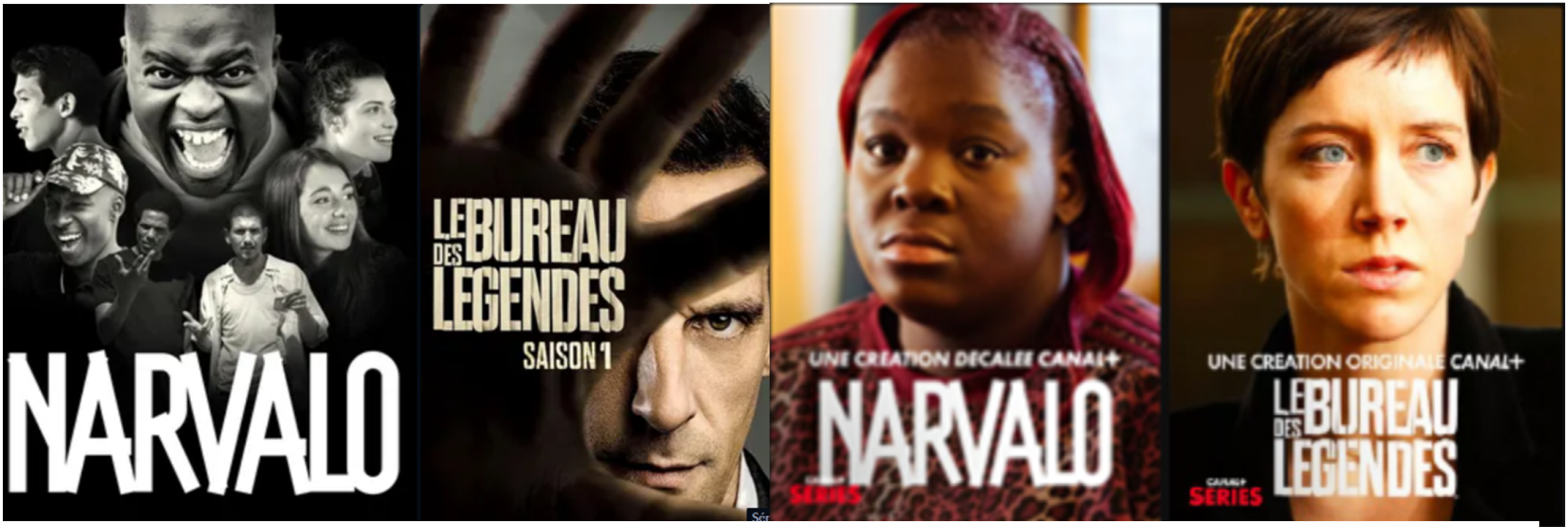
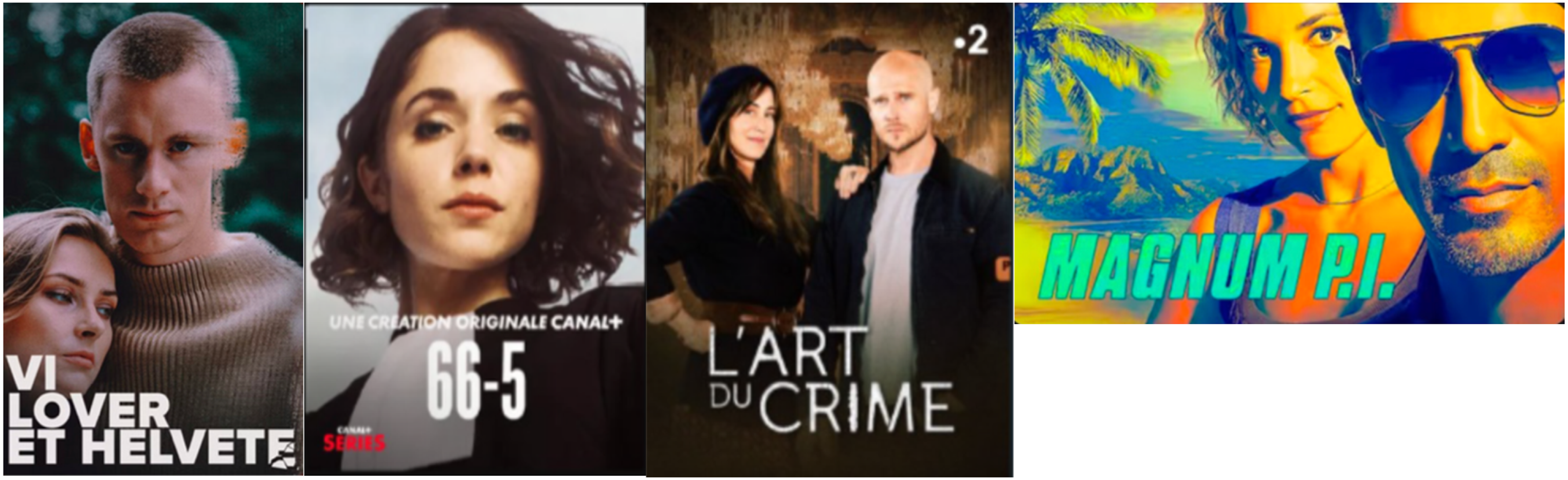
When looking qualitatively at the thumbnails, we still observe the continued presence of gender stereotypes. These become especially apparent when applying Schroeder and Borgerson’s method of visual analysis based on Barbara Stern’s approach of sex-reversal to ‘expos[e] the binariness of gender, its importance as a core category for organizing experience, and its underlying power structure’ (Stern, 1993: 561). For example, the thumbnail for Vi Lover et helvete co-produced by NRK places the male character in a central position looking defiantly straight at the camera while the female character appears in his arms, as if under his protection, and looking downward (see Figure 5). This representation on the thumbnail is very much anchored in binary representations associating masculinity with strength and self-confidence and femininity with weakness and requiring protection. This thumbnail is also rather misleading as the female character in the series itself appears as equally defiant, strong and independent as the male character. Similarly, when considering the thumbnail for Canal + original series’ 66-5, the low camera angle places the woman character in a position of power but the visual analysis reveals a sexualised femme fatale figure through her hair floating in the wind, youth and blasé attitude. As Schroeder and Borgerson emphasise, ‘even when wearing a symbol of authority such as a doctor’s [or a lawyer’s] coat, the woman pictured may still display nonverbal signs of submission’ (1998: 172), or of sexualisation. Applying Stern’s sex-reversal method to the thumbnails for police dramas L’Art du crime (France.tv) and Magnum P.I. (Viaplay) also reveals the gendered portrayal of both the male and female characters. The serious self-confident facial expressions (or smirk) of the male characters place them in the position of experts and as ‘pillars’ for the female characters, whose smiles and body positions leaning on or in the background of their male counterpart portray them as dependent, non-threatening and non-experts in the police narratives.
When looking intersectionally at gender and age in Norwegian films and series, researchers found that 80% of women characters and 63% of men were under 44 (Kleppe et al., 2024: 20). And the gap in numbers between women and men become worse when looking at paratext (see Figures 1 & 2): 9 and 7 out of 28 and 24 titles on NRK and Viaplay featured mature male characters, respectively, whereas one thumbnail had a mature female actor on Viaplay (Pørni), and 3 on NRK, 2 as primary characters (Henriette Steenstrup in Viaplay’s Pørni again and in the Danish series Huset) and one in a secondary role (Pia Halvorsen in the Norwegian series Valkyrien). On Canal + only 1 title (Désordres) features a mature woman on its thumbnails versus 6 for men. The commercial platform follows a similar logic as explained previously with other women characters on thumbnails; as Désordres’ thumbnail in fact features both the image and name of famous actress and humourist Florence Foresti, relying thus on her fame in France to guarantee the series an audience and limit the perceived ‘risks’ of focussing the plot on a mature woman’s life. While Image Design Manager Reuben Sletten at NRK admits that ‘If a drama series has very famous actors in the cast, it would be foolish not to include them in the key art’ (interview, 19/02/2024), Canal + takes this statement a step further by only including famous women on their thumbnails or women that fulfil a diversity or quota criteria. In this category, only the thumbnails on France.tv stand out through their promotion of mature women in leading roles (in almost equivalent quantity as men). The paratexts of the series portray women through unusual professional paths or personality and through distinctive visual traits: very bright colours and a dynamic stance (Marianne), or with an atypical and authentic appearance (a chapka, no make-up and handy clothes) (Capitaine Marleau). While this shows a willingness to innovate with the representation of female characters in French fiction, these character traits (such as being described as ‘outspoken’ in synopses) might not have been emphasised in the same way for male characters and run the risk of building counter-stereotypes. These original creations’ promotion on the platform can also be explained by their success on linear broadcasting, which may be linked to the high average age of the group’s target audience and the identification and/or attachment opportunities offered by these innovative characters.
Hiding diversity from paratext: from broadcast TV to streaming platforms
Making diversity invisible consists in continuing to ‘other’ diversity, keeping minority identities and situations on the margins, and consequently re-affirming the legitimacy (or even supremacy) of the white straight man character as ‘neutral’. As the most recent report on diversity in Norwegian films and TV series commissioned by the Norwegian Film Institute argues, one reason for the lack of diversity on screen is the producers’ will ‘to reduce risks’ (in terms of success and profit) by making films and TV series based on ‘already known concepts’, which thereby ‘can limit the space for original and innovative works’ (Kleppe et al., 2024: 8). Similarly, queer scholars have observed a phenomenon in film distribution of making queerness invisible in the paratext so as to not risk labelling a film or a TV series as ‘exclusively’ queer (Wuest 2018: 24-25; Bradbury-Rance 2023). Looking at the promotion of certain content featuring some instances of diversity on NRK, one can observe a similar phenomenon of ‘de-gaying’, as Wuest calls it (2018: 24). Wuest explains that queerness in the promotion of films featuring queer characters is often kept invisible in their paratext, both in the choice of producers and distributors for a premiere venue (avoiding thus LGBTQ + festivals) and on posters and thumbnails so as to not ‘ghettoise’ the content into a queer thematic, and ‘prime us to understand [the] text in a particular way’ (2018:25).
Invisibilising characters in a queer relationship or with a disability on thumbnails contributes to giving even more visibility to certain ‘normative’ identities or situations and reinforcing others as not-in-the-norm. When looking for queer characters on the 107 thumbnails analysed on our four platforms, none of them show a character in a queer relationship or with a non-normative gender identity (except one on France.tv discussed further below, L’Âge de la colère, see Figure 7), which would lead us to conclude that only one of the 101 series in our study feature queer characters in a primary role. Both on thumbnails and in the content itself, minority characters have been notoriously absent on Norwegian TV and cinema screen, with only 4% of the 580 characters analysed in film and TV series from 2012, 2017 and 2022 identifying as homo- or bisexual, 4% with another ethnic background than Norwegian (vs. 20% of the overall population), 3.3% with a disability, and only 1 character of Sami origins (Kleppe et al., 2024: 36-37).
This interpretation of diversity being absent from content would however occult examples where diversity (through queer relationship, ethnic minority issues or disability) figure as the primary theme of a series but is made invisible in the paratext. For example, the thumbnail of the third season of SKAM (2017-2019) – not present among our titles – focuses on a teenage gay couple but only features one of the protagonists (Tarjei Sandvik Moe) on the thumbnail and thus does not reveal any kind of queer content in the season (see Figure 6). While NRK could argue wanting to avoid spoilers for the development of this character, the image of the actor is also used on another thumbnail (for the TV serie Skitten Snø, 2019), this time invisibilising characters belonging to ethnic minorities in primary roles. The TV series belongs to the genre of rape revenge films, in which a white man (Moe) rapes a second-generation Indian immigrant woman (Hibba Najeeb). Surprisingly, while the series focuses on the young woman’s life and her revenge together with her two friends also from immigrant families, the thumbnail only features the male actor playing a rapist in the series. This design decision may have arisen from Moe’s notoriety due to the success of SKAM the year prior but it can certainly also be read through the lens of de-ethnicisation of paratext and wanting to avoid the ghettoisation of content. By tapping into already known concept (or stars), NRK follows common distribution strategies to ‘reduce risks’ and thereby also reinforces the heterosexual young white man as the default character. This choice of paratext may, as Eklund describes regarding Netflix, function as ‘a site of meaning that visually represents […] corporate strategies’ (2022: 738). The thumbnail is a good example of how their design is meant to attract audiences rather than representing a series with accuracy, and it reveals NRK’s consideration of the Norwegian audience as being more appealed by the image of a white well-known Norwegian male actor than by young women with a visible immigrant background, in spite of being the real protagonists of the series. Through using the image of a young white man on the thumbnails, NRK reinforces whiteness, youth, masculinity and heterosexuality as the default character – yet patriarchal, and thus not neutral – with whom everyone is used to identify (as Laura Mulvey detailed in her brilliant article on the male gaze, 1975). In Viaplay’s Pørni, the father’s homosexual relationship appears very much in a secondary place and is thereby also absent from the thumbnail. Queer characters and ethnic minorities are generally left on the margins of representation on Norwegian platforms, not being given access nor a space for politics in audiovisual content. Tarjei Sandvik Moe on thumbnails on NRK.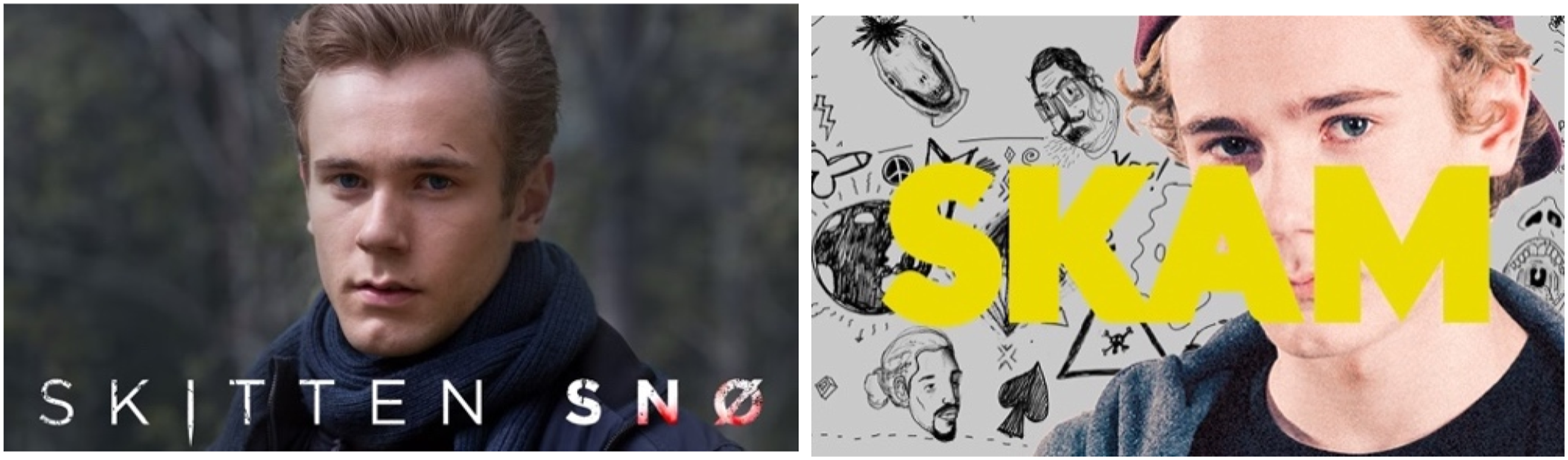
In the case of France.tv, only one paratext evokes a queer relationship (L'âge de la colère), but this portrayal remains ambiguous. There is no mention in the synopsis of a queer relationship, and although the two boys on the thumbnail are embracing, the presence of the young girl on the thumbnails with her head resting on one of the boys could lead to this embrace being interpreted as loving and friendly but not necessarily queer. The thumbnail mobilises what John Fiske calls a ’semiotic excess’ (1987:193), meaning a surplus of meaning that allows for possible alternative readings. This element allows France.tv ‘not to alienate a potentially important part of their audience’ (De Wasseige, 2013), while offering innovative representations of diversity that appeal to a niche audience looking for queer content. This TV series is however not an original production but a Spanish production in the ‘not-to-be-missed’ category on France.tv, and also labelled ‘France TV/Slash’. Slash is a sub-platform of France.tv appearing as a category on the main digital platform, launched in 2018 together with the series SKAM France and providing content for the 18–30-year-olds. In contrast to the rest of the content on the France.tv platform, the offer (and promotion) of fiction, documentaries and magazines is thought and produced for streaming above all and not for linear TV. The difference in the logics of production and the conception of audiences between the main and the sub-platform in fact translates as a focus on issues relating to gender, sexual and ethnic diversity, with thumbnails that explicitly display queer gender identities or orientations (Figure 7). From left to right, thumbnails for Slash TV’s content, L’âge de la colère (2022), Drag Race 2 (2023) and Split (2023).
In its commitments for diversity in 2022, Canal + announced that its content will maintain the level of representation of people perceived as non-white and will pay particular attention to intersectionality (Arcom 2023: 110-114). Apart from ethnic diversity, the diversity and intersectionality of identities (gender, ability or sexual orientation) are however not apparent from the promotion of TV series on the Canal + Series’ homepage (as our numbers also show), suggesting that the titles concerned are not actually promoted by the platform. The 2023 Arcom’s report indeed highlights three titles (Yellowjackets, Conversations with friends and Mood) as featuring characters in LGBTQ+ relationship, but the paratexts (both thumbnails and synopses) for these series do not make these relationships visible (see Figure 8). This invisibilisation of queerness would make us think that it is an element that is secondary in the diegesis. In the case of Conversations with Friends, whose plot deals with bi-, homo- and heterosexuality, the dynamics of invisibility in fact go beyond simple concealment as the thumbnail turns the heterosexual relationship into the main focus of the show by showing a (white) man and woman looking into each other’s eyes and smiling. From left to right, Canal + Series’s thumbails for Yellowjackets (2021–), Conversations with friends (2022) and Mood (2022).
These elements tend to confirm that even if several TV series feature queer identities or relationships, these are not integrated into the logic of the commercial platform’s content promotion. Such a strategy makes it possible to fulfil institutional obligations in terms of diversity, as shown in the ARCOM report, while maintaining a conservative editorial line especially on certain topics, as suggested by repeated incidents on TV channels belonging to Canal+, as well as Group Chairman Vincent Bolloré's public stances on issues such as abortion and his religious faith (Bekmezian, 2024).
A similar pattern of (in)visibilisation to that of queer identities can be observed with ethnic minorities on the three other platforms (France.tv, NRK and Viaplay). Despite the French ‘Law for Equal Opportunities’ following the 2005 riots concerned with social and racial segregations in the French banlieues, the French platforms however do not practice a critical politics of ethnic diversification in the promotion of their content. Indeed, even though Canal+ Series stands out for its visible promotion of ethnic minorities (28.3% vs. 11% of all characters on thumbnails for NRK TV and Viaplay, and 3% for France.tv), stereotypes remain well present. Of the six titles featuring one or more racialised characters, four are about banlieues – focussing on the question of social origins, as is often the case on French television (Arcom, 2023) – or criminality, even if all these characters do not necessarily have a role with negative connotations (such as that of the police unit leader in the series B.R.I). Through its choice to produce and distribute series that take up themes related to ethnic minorities, Canal+ is positioning itself as a competitor to other global platforms. On the contrary, industry professionals at France Télévisions such as the Associate Head of Fiction, justify the ‘difficulty in making ethnic minorities visible’ because of the presumed interests of their linear audience, who are neither ready nor interested in innovative representations of diversity that break with what they are used to (interview, 02/02/2024). This perception of audiences by industry professionals of the platform may thus explain that only 3 thumbnails (out of the 33 analysed) on France.tv feature ethnic minority characters. France TV’s Associate Head of Fiction explains that an effort has been made over the past 5 years to gradually ‘accustom’ the linear audience – which also forms the main audience of the digital platform – to representations featuring diverse identities, mainly by casting actors perceived as non-white (interview, 02/02/2024). However, ethnic and sexual minorities rarely appear on the platform’s promotion of content – except on France TV/Slash – because of not being assigned to main characters, and when they do, are not treated through a critical politics of representation.
Similarly, the Norwegian platforms do not show a thorough engagement towards giving (a politicised) visibility to ethnic minorities in the curation or promotion of their content. For the series Vi lover et helvete co-produced by NRK, neither the thumbnail nor the synopsis makes the woman protagonist’s Sami origins apparent, even though Sami traditions and heritage are an essential part of the diegesis (see Figure 5). Out of 8 titles in the category ‘Norwegian series’ on Viaplay, none of them feature a character with an ethnic minority background. And out of 11 on NRK, only 2 titles featured characters belonging to an ethnic minority, one as primary character (Norsk-ish) and one with a secondary character appearing in the background (Rådebank). Norsk-ish is a notable example of a show fulfilling a ‘diversity mission’, refreshingly treating of second-generation immigrants’ issues in Norway, while the whiteness of the characters in NRK productions overly mark the rest of the catalogue. When we consider the ‘New popular series’ and therefore foreign acquisitions on NRK and Viaplay, the number of characters from an ethnic minority increase however, with 8 titles out of 18 for NRK, and 5 out of 16 for Viaplay, indicating thus the platforms’ strategies to increase the representation of ethnic minorities in their catalogues through foreign content.
As with the general invisibility of queerness and ethnic minorities from paratext, only three titles feature disability (Cammo on NRK, Nede on Viaplay and on France.tv (as En roue libre) and Astrid et Raphaëlle on France.tv) out of the 101 TV series’ paratexts analysed (see Figure 9). For each title, disability or mental illness however remains invisible from the thumbnails and only becomes clear through the synopses of the three series, and thus in a second instance in viewers’ browsing through content. While this is understandable for Astrid et Raphaëlle as one of the two characters suffers from Asperger’s syndrome which has no visible signs, Cammo and Nede feature protagonists with visible characteristics of their disabilities or mental illness, but yet none of the three thumbnails show these signs with clarity. On NRK, one of the main characters of Cammo with down syndrome appears in the background of the thumbnail and is hardly visible. And neither on Viaplay or France.tv is the woman protagonist’s physical disability in Nede or En roue libre visible on the thumbnails, but only becomes clear when coming across the bigger poster for the series on Viaplay’s platform, and thus not in a first instance (or ever) for the viewers. Similarly, on France.tv, the wheelchair is not clearly visible on the thumbnail, hidden by the series title, and the viewer only becomes aware of the central place given to disability in the series when reading its synopsis. The same fear for ghettoisation expressed in the distribution industry regarding queer representation seems to remain valid for the invisibilisation of characters with a disability, a mental illness or an ethnic minority background. From left to right: The thumbnail for Cammo (2024) on NRK, the official poster for Nede (2022), and its thumbnails on Viaplay (up) and France.tv (down).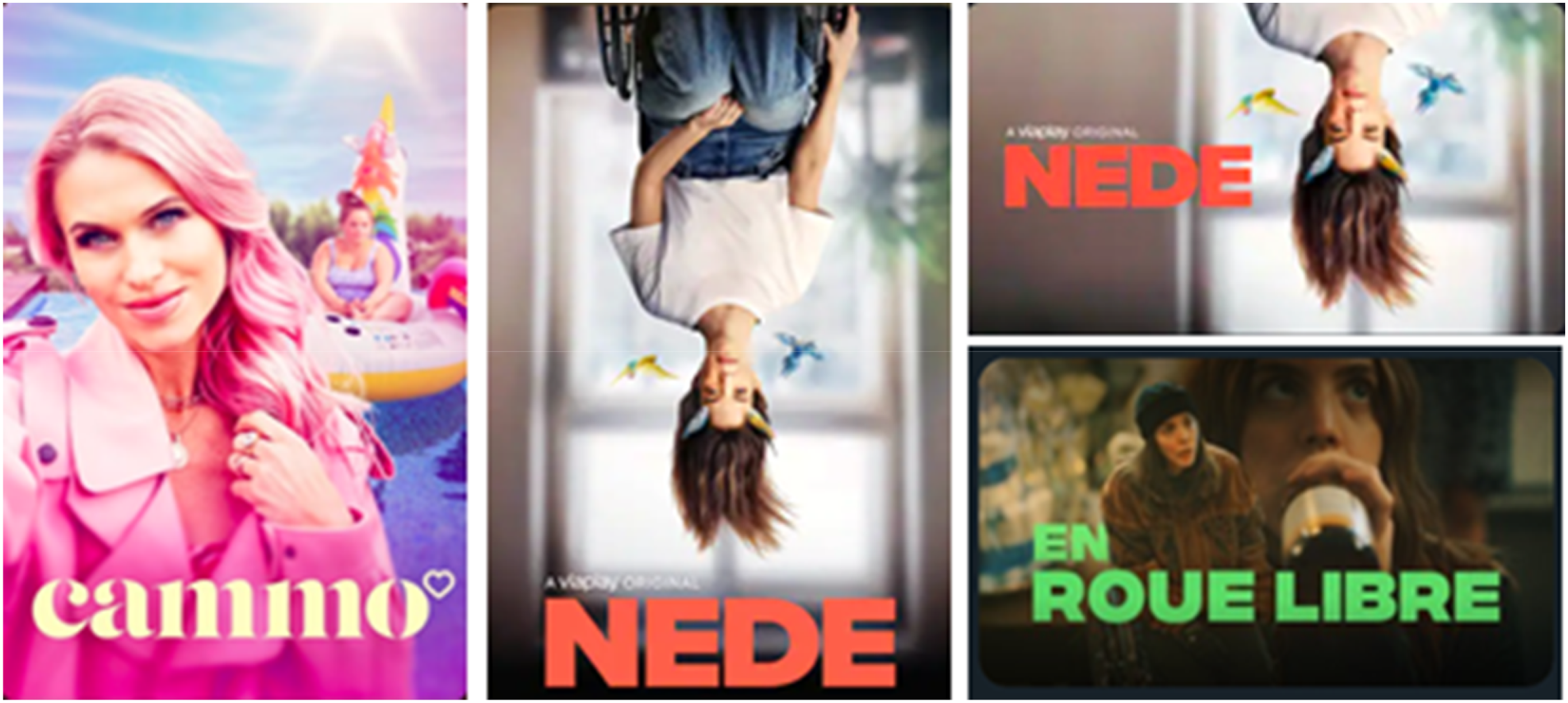
Extracting the thumbnails of some of Netflix’s queer content for a comparative exercise (see Figure 10), the promotion of gay content is much more explicit than what we can find on any of the platforms we analyse. This is true for the offer on all four platforms with the exception of content available on the sub-platform of France TV/Slash, a category that in fact answers to a logic closer to native streaming platforms than the rest of the offer on France.tv. Making diversity visible or invisible seems to amount to a platforms’ will to cater for a multitude of niche audiences with wide ranging preferences and tastes, or to produce content that will cater for the masses in a logic that still somewhat follows linear TV. These industrial strategies can also be explained through different monetary capacity in producing content for very varied ‘niche’ audiences. As Amanda Lotz describes, portals like Netflix ‘achieve scale, like a mass service, but without a mass focus […] they conglomerate niches, a strategy made possible because they are not bound to linear distribution’ (2018: 492). Queer thumbnails on Netflix.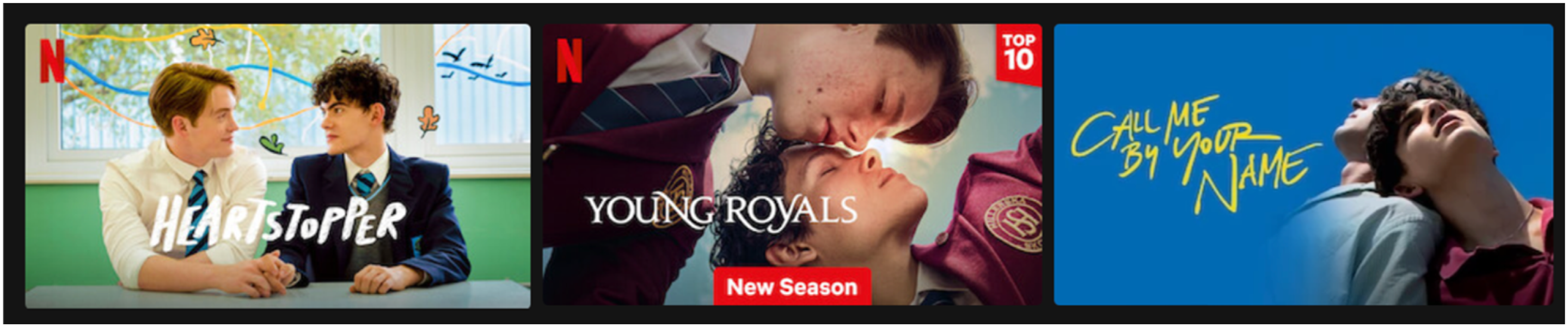
In their continuous transition from linear TV to streaming platform, France TV developed their sub-platform Slash to provide younger audiences with diverse representations similar to those found on global platforms such as Netflix (Arcom, 2023). The curation of the rest of their catalogue however remains rooted in the channel’s linear broadcasting with ‘a limited non-replay offer’ on France.tv (Associate Head of Fiction at France TV, interview 02/02/2024), as most of the TV series promoted by the platform were initially designed for linear broadcasting and its corresponding audience (averaging an age over 60). While Netflix purposefully markets LGBTQ + content to appeal to certain communities of viewers (or ‘taste communities’ as Netflix calls them), the invisibilisation of characters belonging to an ethnic minority, with a disability or in queer relationship in national platforms’ paratext manifests a logic of anchoring their main target audience in whiteness and heterosexuality and only occasionally catering for other audiences through a handful of ‘diversity content’.
Conclusion
The conception of streaming platforms as replay or separate offer and of target audiences has a crucial impact on how different platforms, with their respective histories and industrial strategies, represent and promote diverse identities in their digital catalogue. The national platforms of this study are somehow caught between remaining competitive in the global era of streaming and catering for national audiences, with most of their histories rooted in linear television. While France.tv decided to create the sub-platform Slash as an alternate offer to their main platform to respond to the demands of streaming, NRK made the choice of prioritising the audiences of their digital platform when making strategic decisions regarding production and distribution of content. This transition from considering their main target audience as audiences of linear TV vs. younger audiences of streaming potentially in demand of more diverse content is however slow. Content promotion indeed only tends to show gender parity without much consideration for other gender expressions or other kinds of diversity. Obeying to different curational logic than the public platforms, the commercial platforms of our study demonstrate a major will to curate content for niche audiences. While Canal+ Series prioritise ethnic minorities in the promotion of their series and largely ignores other minority identities including gender diversity, Viaplay concentrates on gender parity in their TV series. These particular focuses somewhat replicate France’s and Norway’s long-standing national priorities in terms of diversification of cultural offer and audiovisual representations as explained at the outset of this article.
The difference in paratextual strategies between Netflix and national platforms may also be explained through the use (or not) of recommender algorithms. NRK, Viaplay, Canal+ Series and France.tv all show a common interface to their viewers (except for one specific category with personalised suggestions), and thus design paratexts for a wide and ‘main’ audience, at the risk of essentialising or homogenising this one. The fear of losing audiences through showing diverse identities on thumbnails, and risking labelling a show with a diversity tag leads industry professionals to whitewash, able-ise or ‘de-gay’ the paratext of their content. This in turn reinforces whiteness, heterosexuality and (young or mature) able-bodied men as the normative characters expected (and arguably wanted) by national audiences, and creates an infinite circle of invisibilisation of diversity and getthoisation of content, whereby certain platforms will produce a few specific shows that fulfil a ‘diversity mission’ and market them as such (through, e.g. Norsk-ish or Cammo on NRK, Pørni or Nede on Viaplay, or the LGBTQ + offer on France.tv/Slash).
We could hypothesise that national platforms’ general approach to making diversity invisible might attract a wider audience (precisely because of the continued ‘default’ position of the white heterosexual man in representation, see also Neff et al., 2024) than if trying to be more original in their choices of thumbnails. But this strategy of ‘sneaking diversity’ in content that may appear normative through the paratext is a double-edged sword. Making diversity invisible in paratext runs the risk of encouraging audiences to keep consuming homogeneous content. As Khoo underlines, this could risk either pleasantly surprising audiences or disappointing them and thus reduce their engagement, and it furthermore ‘does not encourage viewers to make a choice to watch something outside of their comfort zone’ (2023: 288-289). The platforms’ avoidance of minority representation is therefore intrinsic to both how minorities have often been relegated to the margins of texts (being generally absent or secondary characters) and made invisible, and to how national platforms still consider their audiences within a logic of massification of content belonging to the strategies of linear TV.
Footnotes
Declaration of Conflicting Interests
The author(s) declared no potential conflicts of interest with respect to the research, authorship, and/or publication of this article.
Funding
The author(s) disclosed receipt of the following financial support for the research, authorship, and/or publication of this article: This work was supported by the Norges Forskningsråd, CHANSE ERA-NET Co-fund programme.
