



Abstract
The paper explores how visual affective practice is used to spread and bolster a nationalist, extremist and racist ethos on the public Facebook page of the anti-immigrant group, Soldiers of Odin. Affective practice refers to a particular sensibility of political discourse, shaped by social formations and digital technologies—the contexts in which political groups or communities gather, discuss and act. The study shows how visual affective practice and sharing and responding to images fortify moral claims, sense exclusionary solidarity and promote white nationalist masculinity which legitimizes racist practices of “soldiering.” By examining both the representations and their reactions (emoticons), the study demonstrates how ideas and values are collectively strengthened through affective sharing and are supported by platform infrastructures. Most importantly, it demonstrates that instead of considering the affect of protecting the nation as a natural result of “authentic” gut feeling, we should understand the ways it is purposefully and collectively produced and circulated.
Keywords
In recent years, the rise of political populism and anti-immigrant movements and the so-called European refugee crisis in 2015 have resulted in increased political and social tensions. Expressions of hate and racism have become increasingly visible in public political debates in Europe and beyond. In the European context, the New Year’s events in Cologne, Germany, in 2015 have been viewed as a turning point which recontextualized the refugee crisis “in terms of body politics, and the emergence of a “sexual nationalism” where Europe’s young and innocent (body) women were assaulted by the evil other” (Triandafyllidou 2018, 209). Such “politics of fear” have been furthered by the circulation of images of threat, accompanied by a voiced need to protect (white women) against racialized perpetrators (Keskinen 2011; Wodak 2015).
Addressing this trope of threat in the fall of 2015, the Soldiers of Odin, an anti-immigrant street-patrol group, emerged in Finland with the purported intent of protecting citizens from the alleged threats posed by asylum seekers, and they gained the legal status of an officially registered association. Two months after their founding in December 2015, the Soldiers of Odin launched a Facebook group and rapidly gained nearly 50,000 supporters. While the group was founded in Kemi, Finland, it gained international attention and support, mainly through its social media presence. In the following years, subgroups emerged in at least thirteen European countries, including Sweden, Norway, Belgium, the Netherlands, Germany, and the United Kingdom as well as in the United States, Canada, and Australia. The Soldiers of Odin have also enjoyed political support, especially from The Finns Party, a Finnish national-populist party. Many anti-immigrant nationalist groups have shared memberships and alliances, and their separate social media groups form a network of Nordic extremist, nationalist, anti-immigrant movements with neo-fascist undercurrents (Castle and Parsons 2017; Ekman 2018).
This study focuses on one particular extremist far-right group. However, it addresses a larger issue concerning digital affective practices of anti-immigrant far-right groups and the support gained through these practices. Even though different groups address their supporters in distinct ways, they use images to catalyze emotions and affects, such as anger, resentment and bluster, to spread and enhance their ideology (Hokka and Nelimarkka 2019).
For anti-immigrant groups, social media has provided an important platform by which to bypass mainstream media and voice their concerns, agitate supporters and use these technological, algorithmic structures to disturb and confuse the dynamics of public discussion (Back 2015; Daniels 2018; Govil and Baishya 2018; Pöyhtäri et al. 2018). While extreme nationalism and anti-immigrant movements have deep historical roots, the digital media environment has increased the public presence and networking of these movements across the globe (Castle and Parsons 2017; Pal 2015; Pohjonen and Udupa 2017).
To understand how these groups operate and address their followers, we need to explore the emotional and affective structures which drive their social media presence. This aim is connected to larger questions of how emotions drive participation in political debates, enhance or hinder social bonds and shape moral judgments in a mediatized society.
We are also aware of the fact that researching racist and extremist contents can inadvertently add to the publicity and fame of far-right extremist movements, and to some extent, this is unavoidable (also see Askanius in this issue). The point of our research is to critically examine the sensibilities and arguments being used to fortify extremist and racist views and also to show how these views and sentiments may be advanced through social media, where such contents should be banned in principle. Therefore, this study points not only to the relevance of visual affective practice as a political force but also to the failure of the current social media ecosystem in their attempts to curb extremism and racist content. To follow ethical principles of research, we have also informed Facebook of the racist and harmful contents on the site, used in our study.
In the following, we introduce a theoretical framework on emotions and affects and then present our approach to visual affective practice. We next contextualize our case study with previous work on anti-immigrant and alt-right groups before turning to a more detailed account of our data and methods.
Affective Practice
Drawing on work by Margareth Wetherell, we use the concept of affective practice to examine the ways in which emotions and affects shape social relations and drive political action (2012, p. 103). Wetherell is interested in the emotional patterns of social interactions and the ways in which affective practices materialize social life and set up relations between individuals and collectives. This work connects emotions and affects within a larger social meaning-making process and stresses the impact of social worlds on the ways in which we react and feel. Instead of drawing stark contrast between emotions and affect, we understand them to be intertwined; immediate affective reactions are part of a larger emotional pool which includes a range of emotions from sadness to joy 1 . Emotions and affects are both influenced by cultural norms, practices and social structures (Boler and Davis 2018; Nikunen 2019a; Paasonen 2015; Wetherell 2012).
The emphasis in this research is on the collective and culturally constructed dimension of emotions and affect, informed by social meanings and formed in social encounters (Ahmed 2004; Hochschild 1983/2012; Williams 1961). 2 Social research, for example, has shown that particular affective styles are connected to social class, whose boundaries are marked with emotions of fear, disgust or shame (Skeggs 2005; Wetherell 2012, 110). Research on affective practice, then, may sketch out these boundaries and the affective canon of a particular social group or community (Nikunen 2015). The collective dimensions of affective meaning-making are demonstrated, for example, in the different sensibilities produced during public debates on social media platforms: fearful, angry, ironic, hateful or compassionate responses in certain discussion threads. Zizi Papacharissi’s (2015) work on affective publics explores how emotions travel in digital space with particular intensity and how social media invites “affective attunement.” Social media platforms and their affordances shape public debates in different ways, encouraging certain forms of interaction and even setting norms with respect to participation (e.g. Freelon 2015). Yet different groups tend to establish their own particular practices and affective styles over time. Anna Wagner’s (2018) study distinguishes different norms for expressing sorrow on social media mourning sites. In a similar way, Döveling, Harju and Sommer (2018) sketch out digital affect cultures in their research on digital memorials. They point out the connection between discursive and emotional interaction in the formation of affect cultures on social media. Tucker and Goodings (2017) use the term “affective atmospheres” to draw attention to the ways in which affectivity is collectively created and experienced. In other words, the digital atmosphere refers to the ways in which bodies come together to form a collective feeling in a given setting, using bodies, images and texts which carry an affective load.
This previous research has pointed out in different ways how affectivity on social media is connected to the discursive meaning-making process, technological affordances, and relations between users and communities. Different groups have different systems of rules and rule reminders, which may include particular ways of acting on social media and expressing feelings about social and political issues. We learn emotions from others and from various social processes. Therefore, emotions and affects are also open to be amplified, shaped and manipulated, producing contradictory and conflictual ideas and practices.
Social Media Practices of Ethnic Nationalist and Anti-Immigrant Groups
The rise and success of ethnic nationalism and anti-immigrant movements on the Internet has been connected to their skilful use of digital technologies and adoption of the sensibility which is characteristic of the digital world, the humorous, memic culture of tech-savvy millennials. In this way, anti-immigrant and ethnic nationalist groups are seen to profit from the (initially) harmless practices of trolling and memes—the circulation of the fun, the fake, and lulz (Hawley 2017; Milner 2013; Nagle 2017; Prisk 2017; Titley 2019; Topinka 2018; see Askanius as well on this issue). Paul Gilroy (2019) points out the coexistence of different sensibilities of ironist trolls and the “gun-toting belligerent” within the extreme right movement. In other words, not all white nationalist groups identify strongly with the ironic and transgressive, but some, instead, seek their meaning from more traditional, “hard-core” masculinity—for example that of the Soldiers of Odin. The Soldiers of Odin group has effectively connected to similar-minded domestic and international groups through social media networks as well as through offline events (Siapera and Veikou 2016). In February 2019, the group’s public Facebook site had more than 47,000 followers. Through Facebook, the group has been able to communicate ideas and ideology, build communities and networks, establish alliances and create their own particular sensibilities. While most of the activity of the Soldiers of Odin is based in Finland, with 31 local organizations, the group has support and “official” divisions abroad, at least in Estonia and in Malta (Sallamaa 2018). Through Facebook, the group has been able to spread and find new international alliances.
The underlying infrastructure of platforms, their affordances, policies, algorithms, and corporate decisions seem to have been beneficial in general for extreme groups. Besides own channel of communication and algorithmically recommended networks of peers, the vague rules, and policies based on peer regulation enable the public circulation of controversial and racist material with relevant ease. As argued by Tarleton Gillespie (2010), platforms not only facilitate public communication but also intervene, organize and coordinate knowledge through their affordances and logics. As Matamoros-Fernandez (2017) argues, the Internet is “both an opportunity to perform racial identity and a forum to reproduce power relations and hierarchies or amplify racism” (see also Daniels 2018; Nakamura 2002; Kendall 1998). 3 The platformed media environment, with a particular design and technologies, has in different ways enhanced the formation and activities of the extreme right-wing groups, including their visual affective practice.
In this article, we explore the formation of visual affective practice and analyze the ways affects are purposefully and collectively produced and circulated among a far-right Facebook group, Soldiers of Odin Finland.
Method and Material
How can affective practice be studied through images? Using semiology, discourse analysis and aesthetic sensibility, we can analyze images as representations of particular emotional states or claims. Especially on social media, images are often used to reduce complex political issues to simplistic visual frames. Images arouse discourses of shared emotions and responses, illuminating the collective dimension of affective meaning-making. In this way, images do not merely function as representations, but they also form a network of affects in time and place (Nikunen 2015, 22, 2019, Carah 2014, 138; Gibbs 2011; Proitz 2018, 551; Zelizer 2010, 1). Therefore, we also need to understand how images evoke their affective feel. Images carry immediacy and are currently given priority over textual content in many content feed algorithms. Gillian Rose (2014) argues that images are “more-than-representational” and “methods are also needed that can engage with the dynamics embedded in the software (p. 8) platforms that structure these sites” (Rose 2014) (p. 11). In other words, we need to explore how images become embedded and shaped in circuits of social practice.
By exploring the images shared on the Soldiers of Odin Facebook site as well as the reactions which these images evoke within the group, we identify practice and patterns, the repeated use of particular images, repertoires and style, and their responses. When the same social group continuously posts and shares symbols, colors and images which carry particular moral statements and status, we can sketch the group’s affective practice, the affective claims and the responses they evoke. It is important to understand that affective practice is not considered here as something “authentic,” emerging from outside of digital media, but as something which is intrinsically connected and shaped by the affordances and technologies of social media.
Following Rose (2014), we analyze the underlying claims, moralities, and connections of the visual, not only on the representational level but also through responses and comments as part of the digital interface and its organization and structure. In other words, images shared on social media are both representational and more than representational. This dual approach follows our understanding of affect as integrated with, rather than external to, meaning-making processes, as a part of and shaped by social practice.
Our data consists of 309 images. After removing duplicates, we were left with 286 images, originating from the Soldiers of Odin Facebook group. The group was public and had more than 47,000 followers. Data was collected through the Facebook Graph API, an application programming interface, providing us access to all the posts in the groups. The analyzed images were posted between December 2015 (when the Soldiers of Odin Facebook group was founded) and February 2017. All the posts, comments, metadata, and images were downloaded for further analysis. The investigated images included memes, photographs, cartoons, and all other visual material.
First, we categorized the 286 images into different thematic groups: Members of the Soldiers of Odin (SoO) (n = 56), Muslims/migrants (n = 45), Vikings (n = 29), the SoO logo (n = 30), nationalism (n = 20), celebrations (n = 9), loldiers (n = 7), 4 and miscellaneous memes and texts (n = 91). To be able to focus on the group’s moral values and affective meaning-making process, we chose the three largest coherent themes for further analysis: (1) Muslims/migrants, (2) Vikings, and (3) Self-portraits of Soldiers of Odin members. Drawing on visual semiotic and iconographic analysis (Jewitt and Oyama 2004; Kress and van Leeuwen 1996), we analyzed the image size, framing, colors, milieu, graphic style, and texts connected to the images. We also analyzed people presented in the images: their appearance, expressions, poses, and clothing. The sentiment an image conveys differs drastically if it is a close-up of an angry face or a landscape shot of rural scenery. We also analyzed the textual coding of the image as to whether it produced contradiction (as in an ironic image) or an affirmation of the message in the image. In addition to the representational level of the images (what), we also explored their mode (how), that is, the ways in which images were constructed and circulated, how they were sourced and what cultural repertoires they used to identify how they moved and spoke to their audiences. For example, were they generic images without references, and what kind of cultural references (historical, memic) did they use?
To understand their affectivity on an interactive platform, we also examined the different types of emotional and affective responses by the members of the group (Like, Love, Haha, Wow, Sad, Angry). These different responses can give us an understanding of the affective dimensions that particular images evoke and how they may be connected with the representational modes of address. This analysis also enables us to include the non-representational qualities in the social media context. In what follows, we explore each theme and mode in more detail, starting with the propagandist threat of the enemy. After introducing the three different themes and modes, we introduce the analysis of their reactions.
The Propagandist: The Threat of the Enemy
The images in this first theme are mainly close-ups of bearded men, presumably Muslims, dressed in traditional Arabic dishdasha, or women dressed in hijabs, shouting with their hands in the air or participating in some kind of a protest. In one of the images, people are burning and destroying a car, and in another, throwing rocks. These images convey a sense of chaos and disorder. The sentiment of threat is emphasized with action directed towards the camera/viewer as if being attacked by the people in the image (We decided not to re-circulate the images in this category).
This theme also includes memes ironically feed the idea of a “bogus asylum seeker” (Ahmed 2004). For example, one meme consists of two images and text. The first image is of a young dark-haired man in a hoodie, in his twenties, juxtaposed with an image of a naked, crying malnourished brown-skinned baby. The text below the image says, “Food is bad, beds are poor. Look at these conditions. We are not going to go to eat, interprets Mohammed.” The meme seems to suggest that the baby represents a genuine refugee, whereas the young man is a bogus refugee, complaining about the conditions in the reception centre. Without any references it is impossible to know the actual sources, origins or connections between the texts and images.
The mode is propagandist; it constitutes selective, exaggerated, manipulative, coordinated efforts to influence perceptions of particular groups of people, Muslims and migrants (Cole 1996). The affective force of the images is in the anticipation and premediation of danger (Grusin 2010). Taken from international contexts, the images present generic representations of Muslims, migrants, asylum seekers and refugees, without any specific contextual information or identified names, dates or places. In this way, the figure of the dangerous Muslim/migrant becomes separated from its referent and detached from any particular context. It follows that any Muslim/migrant is potentially violent. Clearly, these images draw on old prejudices, narratives, and associations of the ways in which “our” social order is being disturbed by racial “others” (Chouliaraki and Stolic 2017, 1169; van Dijk 1991). Such generic framing also draws on a digital bricolage culture of memes, with practices of mixing and reframing which produce associative and purposeful misconnection which work to emphasize stereotypical ideas—general rather than detailed and contextual (Milner 2016; Rentschler and Thrift 2015; Schifman 2013, 20–3). The parodic and ironic memes invite laughter which ridicules as naïve the people who support the existing refugee policies and human rights (Mäkinen 2016; Nikunen 2015). With memic comparisons and visual combinations, the images seek to “disclose the ugly truth” about Muslims and migrants as allegedly violent, primitive frauds. After repetitious circulation, this imagery of threat does not require evidence; it becomes an affective fact affirmed in a group with welcomed postings of similar images.
Investigation of the origins of the images through reverse image search provided little information about where and how they were produced. However, the exploration confirmed that there is a network of groups who share the same images from the US to Europe, for example individual blogs with far-right sympathies, supporters of the Tea Party movement and UKIP.
The traffic of similar images shared through transnational social media networks also speaks of the way “platform racism” (Matamoros-Fernandez 2017) works. Platform racism refers to the ways in which different social media designs, business models, and policies may amplify racism. In this case, the group was able to circulate racist and sexist contents amongst like-minded groups without any interference. This is clearly a result of vague social media policies which rely on voluntary peer reporting and on arbitrary, outsourced implementation of policies (Siapera and Veikou 2016). When a whole group shares similar values, their reporting of images which portray Muslims in racist terms is unlikely, as in this case study. And the traffic in itself is beneficial to the business of technology companies (Van Dijck 2013), regardless of whether it is based on the sharing of racist images. In the digital world, generic images of the Muslim threat circulate with ease, and at the same time, to use Sara Ahmed’s terms, they collect an affective value which serves communicative capitalism (Dean 2009). For the Soldiers of Odin, posting and sharing these images reinforces and visualizes the group’s emotional and ideological grounds, a sense of threat and the legitimation of the Soldiers of Odin’s role as protectors.
The Mythic: White Fantasy of Vikings
The images in the second theme consist of pictures of Vikings and their god, Odin. The images are mostly black-and-white drawings, along with some more modern, photo-based representations of Vikings (see Figure 1). The Vikings are represented as bearded and unrealistically muscular, dressed in medieval armor and carrying swords. They are depicted either in action, fighting with swords or, more often, staring calmly, presumably at the enemy. In a similar way to the propagandist images, they convey expressions of anger with raised fists and swords targeted towards the enemy. The angle of these images is often from below, emphasizing the power of the Viking figures. The text in Figure 1 as well as many similar images appeal to a sense of national duty and the pride of a soldier.
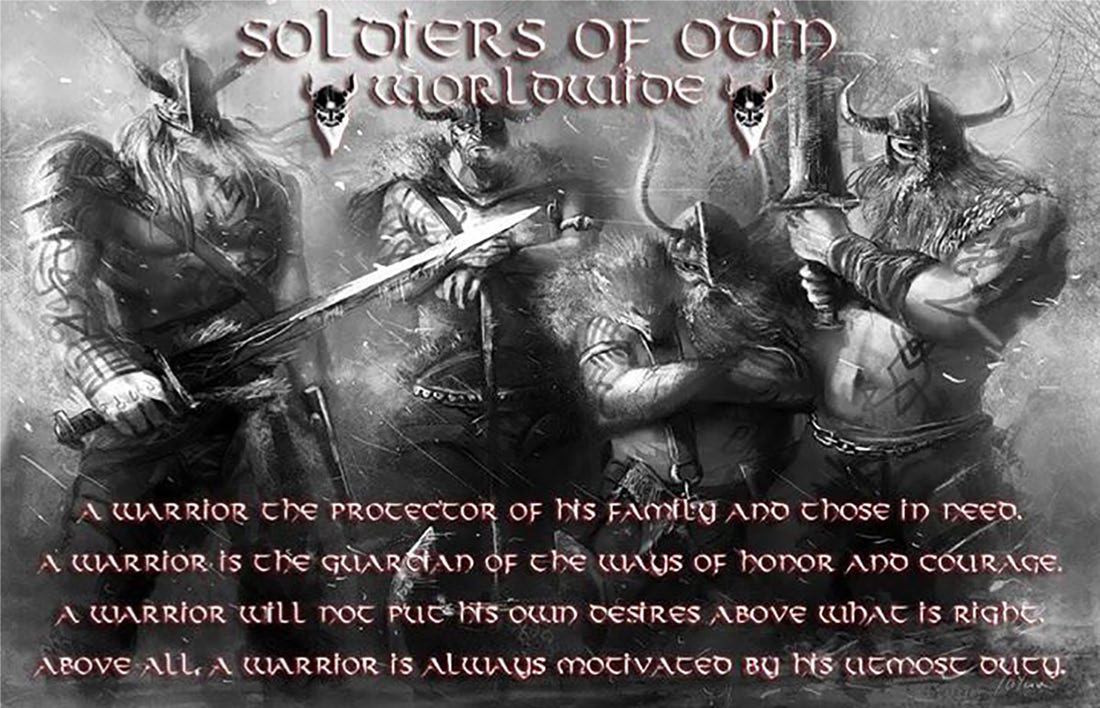
Images of Vikings are mostly black and white drawings.
Masculinity characterized by superior strength and fit, “racially pure,” aesthetically appealing and sexually potent whiteness has been regarded as an essential feature of Vikings, especially in modern-day Anglo-American culture, possibly inspired by popular-cultural products such as the Game of Thrones series or Marvel’s Thor comics (Andreassen 2019; Máthé 2018). The analyzed images offer an idealized version of Northern Europeans as the superhuman white race to which the Soldiers of Odin claim the privilege and pride of belonging.
Odin is an essential character in Scandinavian myths, where belief in him survived until the nineteenth century. The cult of Odin was born as a youth movement in Weimar Germany, emphasizing the union between the Germanic people and the Viking gods and the spiritual purity of Aryan blood. Since the 1980s, the pagan cult of Odinism has rapidly gained popularity in North American and European neo-Nazi and right-wing groups. This “religion of warriors” holds a Darwinist belief in the survival of the fittest, which promotes admiration for war and battle rather than the Christian belief in love for all humanity. With roots in Northern Europe, it matches these groups’ racial thinking better than Christianity does (Pollard 2016; Whitsel 2001; Kaplan and Weinberg 1998).
Odin became the symbol of the Soldiers of Odin, as its founder, Ranta, personally admired the Vikings. To him, the Vikings represented ultimate masculinity; they were real men who “would gulp down beer together after a victory” in battle (Lehto 2016). The group also considered the ancient Finnish god Ukko for their emblem but preferred the Viking god Odin, even though historically Finns were not Vikings but neighbors with whom they fought and traded (Nikkilä 2015).
The mode of the images is mythical; drawings of ancient, ruthless Viking warriors operate on the level of fantasy and produce the myth of the group’s origins. Myth traditionally explains the world and serves the desire to “know the unknown” (Gould 2010), but myth is also remade, retold, interpreted, and translated to serve particular desires and political interests. As Roland Barthes (1973) famously argues, mythology is about forgetfulness. On the Soldiers of Odin Facebook page, the circulation of Viking images enables the forgetting historical facts while expanding and reinterpreting the historical context of the Vikings. The continuous circulation of the Viking imagery invents and naturalizes a new connection between the Vikings and the Soldiers of Odin. The story of the Vikings is adapted to the Finnish context and reinforced with images which carry a particular “mythic essence”: dark, dramatic drawings of objects and texts with a historical feel. Most drawings include slogans about Vikings, “the warriors who protect their families.” These slogans are voiced as if they are guidance for Soldiers of Odin, who continue the work of their fabricated ancestors, the Vikings. The racial whiteness of Vikings further establishes this biogenetic connection, stressing the longing for racial purity.
The Phatic: Posing United
The third theme is the most popular and serves the particular phatic function of fortifying a sense of unity and togetherness. As argued, much research on national populism on social media has focused on the sharing of memes and the practices of trolling on anonymous image boards and under pseudonyms (Vainikka 2017). In contrast to these practices, Soldiers of Odin members show themselves publicly by posing in images, visualizing their presence and power as a unified group (see Figure 2).
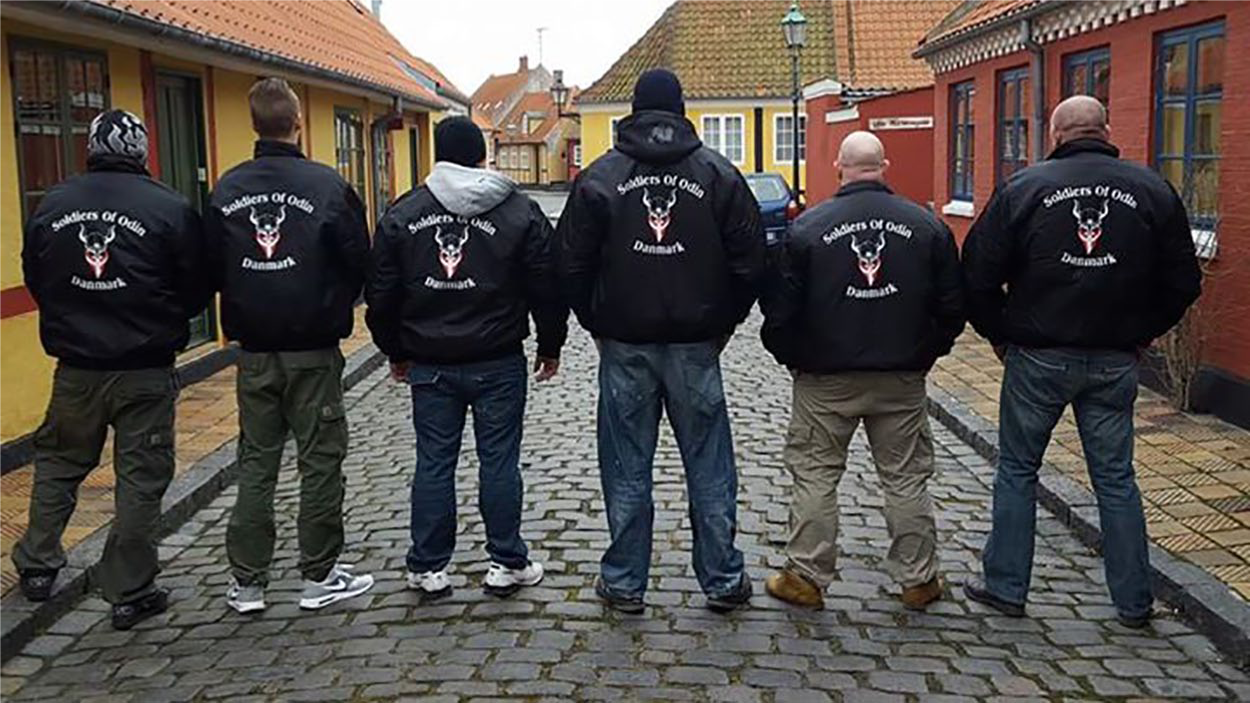
Soldiers of Odin members pose usually with their backs towards the camera.
The most typical images of the group have the same distinct patterns and characteristics: white men wearing similar black jackets stand side by side with their backs to the camera, so the Soldiers of Odin logo on the back of their jackets is the centre of attention (see Figure 2). The image size varies from medium to landscape, with milieus from urban streets to countrysides by the lake. Instead of individuality, the images convey a sense of joint masculine power and discipline. They seem to communicate masculine ideals of service and sacrifice for the fatherland and male camaraderie in war. (Mosse 1996, 130‒42, 168‒72). Various studies related to present-day extreme nationalist movements in Europe have shown that the image of man-as-soldier is even today essential to the national-populist ideology (Ekman 2018; Miller-Idriss 2017). The figure of the soldier gives material form to the “white border guard of masculinity,” who longs for the “golden days” of the “white nation” with clear gender divisions (Keskinen 2013). For instance, Ranta, the founder of the Soldiers of Odin, explained in an interview (Lehto 2016) that he and his supporters were fascinated by the idea of wearing similar outfits, like soldiers, to give themselves mystic appeal.
The men in the images appear strong. Their heavily built bodies and shaved heads refer to body-building cultures, skinheads and motorcycle gangs. They visualize masculine power through their bodies, postures, styles and symbols. As argued by Virchow (2007), clothes, including single garments such as jackets, boots, belts, and uniform parts, express to the group and the public their belonging to a particular movement. Posing together, Soldiers of Odin members mimic the traditional militarized masculinity of “toughness, violence, aggression, courage, control, and domination” (Eichler 2014, 82). Soldiers of Odin images illustrate the contradiction between the self-proclaimed role of the (masculine) civilian protector and the representation of the warrior’s raw physical masculinity. Soldiers of Odin, in particular, builds their ideology around the logic of masculinist protection.
Posing in different places and settings stresses the group’s sense of presence: We are everywhere. This presence is highlighted in a series of images of “soldiers” across the global North: Canada, Sweden, Denmark and Estonia. Men pose together in a park, a shopping centre and the suburbs, by the sea, at a party and as they march and “patrol” the streets. Together, the images provide a sense of surveillance, yet in a particularly mundane way. While some images convey a dramatic sense of power and unity, many are (inadvertently) ordinary, aesthetically plain and flat images. Their intended power is compromised by the sense of a meagre, amateurish group in banal, everyday settings.
Repetitious posing, posting and sharing of these images on social media speaks to the performative function of collectively imagining and constructing a sense of us-ness. It is not necessarily the sense of soldiering and discipline which produces the affective essence of these images. Instead, their affective force lies in their appearance, one after another, solidifying the group. The mode is phatic; rather than emphasizing the content, they function to strengthen and maintain social relations (Rose 2014, 12). As much as they inform the public about the presence of protective soldiers, they visualize the bond and brotherhood among the group members. Unsurprisingly, the most popular images are of marches and demonstrations which visualize the presence of protective power. As argued by Virchow (2007) in a study on neo-Nazis, marches are sites of emotionality which also convey a “soldierly masculinity.” These images of performing masculine power and unity have increased the most since the Soldiers of Odin Facebook site was established.
Affective Reactions Between Themes
To understand how these different themes were responded to amongst the members of the site, we explored the Facebook reactions, the emoticons, of each image theme. Emoticons are graphic facial reactions which convey a set of different emotions (see Table 1 for examples of emoticons on Facebook). Emoticons should not be interpreted as direct and authentic expressions of users’ feelings but rather as technologically produced options for expressing and performing sentiment. Previous research has pointed out that there are age- and gender-related differences in the use of emoticons; thus, their use can be connected to social practices and norms as well as to affect. Furthermore, emoticons may not have clear and explicit meanings; people interpret them differently (Miller et al. 2016). Positive emoticons are used more than negative ones, women tend to use more emoticons than men and overall, emoticons are used to strengthen the message and display humor and sarcasm (Lo 2008; Oleszkiewicz et al. 2017; Tossell et al. 2012). Thus, emoticons serve various functions in computer-mediated interaction, such as carrying affective meanings, explicating social norms or giving interpretation cues. In a way, they are forced reactions from a ready-made selection of a pool of emotions with a potentially wide range of meanings.
Distribution of Affective Reactions Across Image Themes.
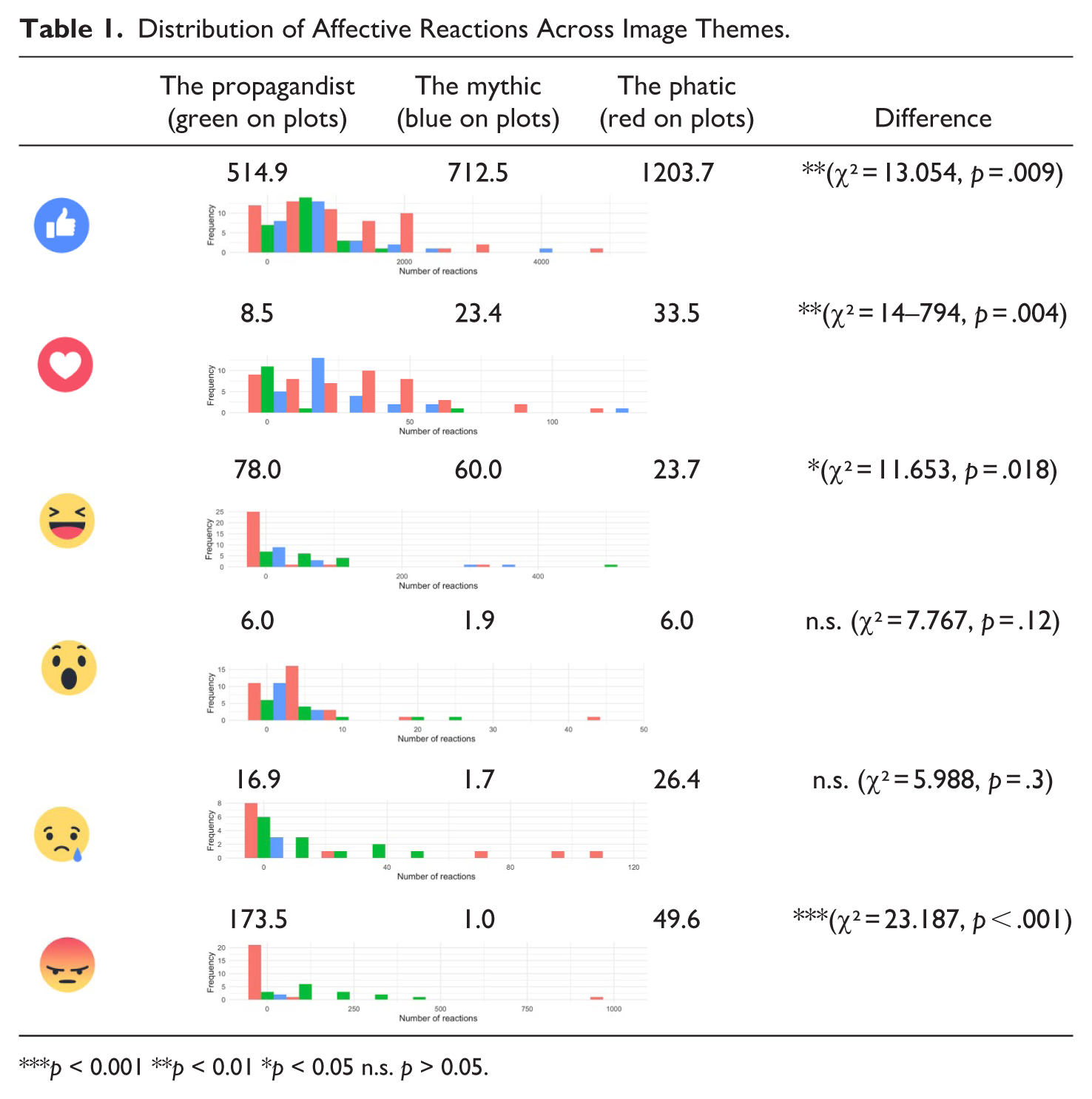
p < 0.001 **p < 0.01 *p < 0.05 n.s. p > 0.05.
Keeping this in mind, we analyzed emoticons to understand how different themes stirred particular affective registers instead of understanding these emoticons as direct displays of authentic affect. These are publicly produced and performed reactions. As they are shared with other members on a public social media site, they become part of the collective affective practice within this particular context. Indeed, our analysis showed that each of the three themes assembled its own type of responses. Reactions seemed to confirm what our analysis suggested in terms of the way in which these different themes addressed their audience.
As shown in Table 1, different image themes gathered different reactions from the members, suggesting that they raised different affects amongst the audience members. Our analysis shows that differences were statistically significant for four out of the six emoticons available on Facebook, using a non-parametric Kruskal-Wallis test. We adjusted p-values using Bernoulli correction to account for multiple tests.
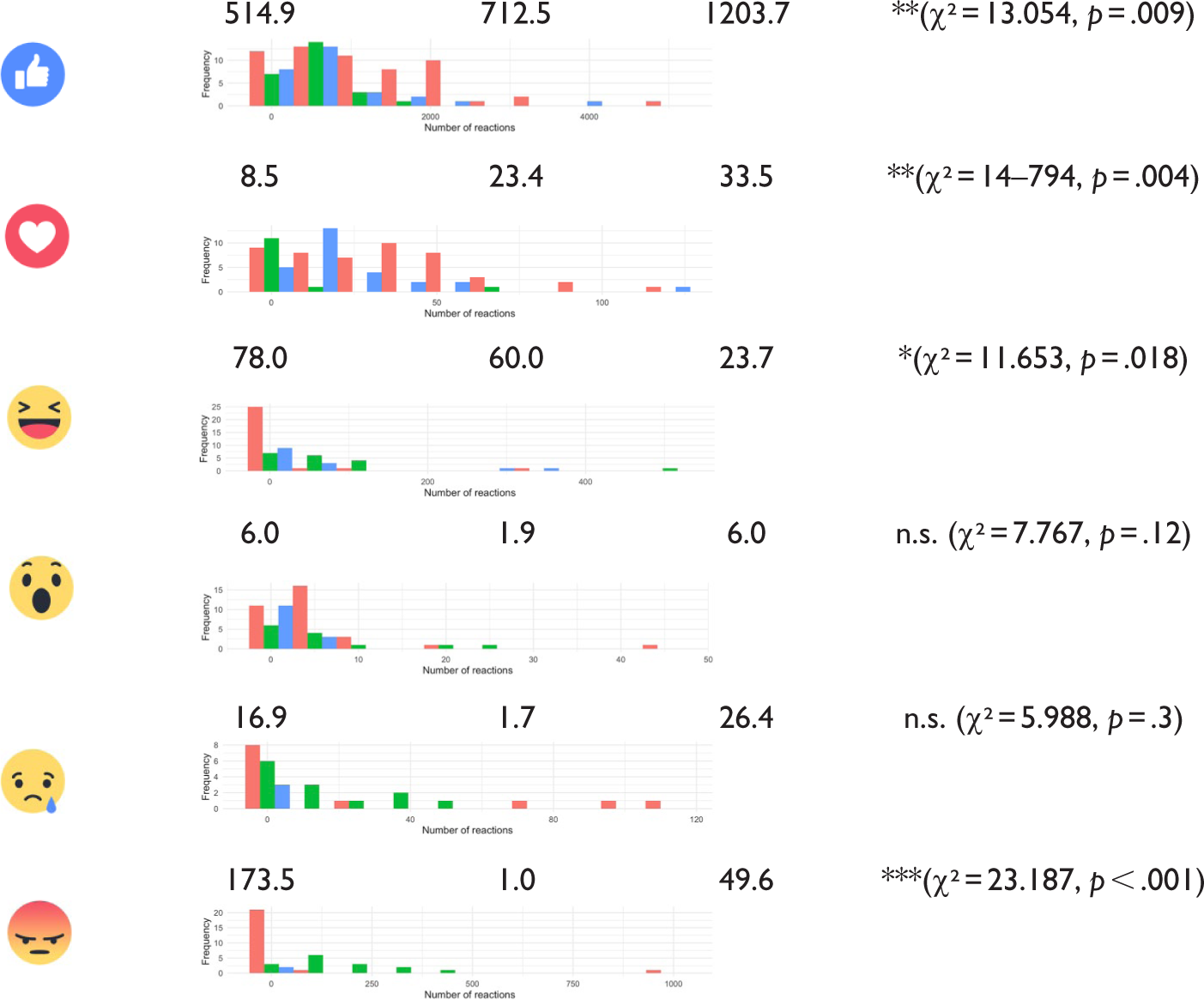
As shown in Figure 3, propagandist images were reacted to more with an Angry emotion and Haha reaction, while phatic images were more Liked and Loved. This seemed to strengthen the modes identified in representational analysis. The first theme involved stereotypical images of the enemy and a series of ironic memes which were used to amplify the sense of “bogus” asylum seekers (Ahmed 2004). Therefore, the reactions of anger and laughter appeared to respond to these representations, and as public responses, these reactions also fortified their affective feel. Of course, it was quite possible that reactions of anger were directed at the racist nature of these images, yet the overall reactions seemed to point to the interpretation that anger was directed at the enemy, the Muslims and migrants represented in these images. Unsurprisingly, the phatic images where the members posed together were responded to mostly with Likes and hearts, thus demonstrating their function as solidifying the sense of community, of being together. Interestingly, the mythic pictures were reacted to with Hahas, Likes, and Loves, but more importantly, they were least reacted to with Angry emoticons. While the propagandist and phatic images seemed to raise clear affective responses, the mythic images were responded to with more subdued acceptance and embrace. Perhaps these reactions illustrated their mythic, fantasy nature, situated in the obscure past, rather than commenting on the current political situation. As noted before, it is important to understand that these reactions arise from a limited selection of emoticons and should not be interpreted as an exhaustive reflection of the emotions and affects of the group. However, the clear differences in the reactions amongst the three themes illustrate how visual affective practice works. Each image theme seems to attract distinct reactions, whereas the group as a whole shares understanding of how to respond.
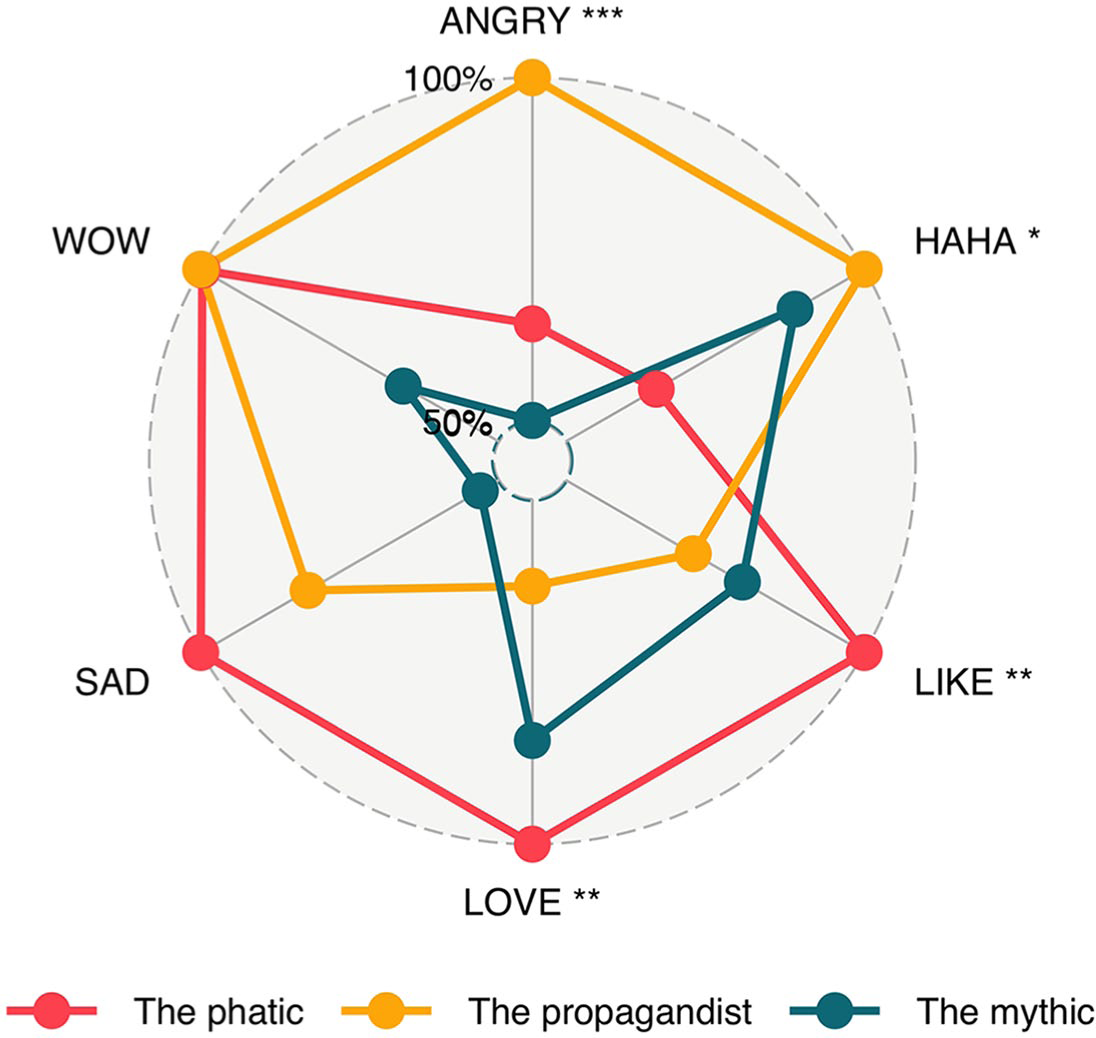
Summary visualization of affective reactions across image themes. Based on data shown on Table 1.
Conclusion
In this paper, we have explored the collective dimensions of visual affective practice on the Soldiers of Odin Facebook group. Previous research on extreme right-wing groups examined how they organized through social media, and it pointed out the groups’ discursive strategies, networks and spread of political ideology (Author 2015; Ben-David and Matamoros-Fernandéz 2016; Ekman 2018; Froio and Ganesh 2019; Kasekamp et al. 2019; Laaksonen and Porttikivi 2017). This study has looked more closely at the visual affective practice in a particular social context, that of how political ideologies are driven affectively through different visual collective practices. The visual affective practice was identified on three levels: on the level of representations, on the mode of shared images and on the level of reactions. Clearly, the images and their responses together amplified particular affective registers; the group incorporated different sensibilities of propagandist, mythic, and phatic communication for political purposes. The propagandist mode purposefully and selectively uses extremely crude, stereotypical images of violent, angry Muslims/migrants to convey propagandist messages, which are responded to with expressions of anger and laughter. The fantasy of Viking warriors operates on a mythic level to create a story of the larger-than-life Soldiers of Odin, drawing on a reinvented history and pagan cult. Finally, the phatic communication of group postings brings members together, visualizing the bond of “brotherhood,” strengthened with reactions of Like and Love.
The public sharing of images and their reactions operate as a collective affective practice reflecting and shaping moral values, including ideas of how to engage with others and how to direct a sense of solidarity (Nikunen 2019b, 24). It is not irrelevant, what kinds of affective practices these groups further. First of all, affective practice can be powerful in addressing identity and a sense of authenticity. In our case, the images shared on the Soldiers of Odin Facebook page enhance an exclusionary solidarity based on racial unity and directed against dangerous others, conducted through the logics of a protective yet crude masculinity. Furthermore, the reactions suggest that the images are connected to shared norms of interpretation. This further demonstrates the importance of affective practice in political identity-building and legitimizing controversial, harmful ideas, and activities, such as racism, as a collective truth in a new media environment.
Second, affective practice is connected to and furthered by the social media infrastructures, affordances and platform policies. As a platform with vague policies and rules based on peer regulation, Facebook enables the distribution and circulation of racist images. The repetitious practice of sharing is elemental to Facebook design, and it can be seen to amplify a digital atmosphere of peer-legitimized racism. With these elements, Facebook offers a space for affective community-building, “the feel of a community,” and it even provides algorithmically enhanced access to global networks of like-minded groups from which the local groups borrow and remake images as well as interactive tools to express support and emotional affinity. Recent pressures to close down hate speech and harmful content signal attempts to tackle platform racism; however, the solutions so far have added to the obscure and coincidental nature of social media policies rather than having made clear cases of racist content which needs to be publicly addressed (Matamoros-Fernandez 2017).
Our analysis suggests affective practice is essential for establishing collective identities for groups like this. Researching affective practice can show how a platformed digital media environment is used in different ways to solidify nationalist, extremist and racist groups. Therefore, research should also ask what the responsibility of social media platforms is in maintaining or even enforcing these groups. Most importantly, this study shows the relevance of understanding emotions and affect as part of meaning-making processes shaped by the contexts they are expressed in. By tracing how this group used images of threat and reinvented narratives of white warriors, we demonstrate that the affect of protecting the nation as a closed community with “natural” borders is not a natural result of “authentic” gut feeling. Instead, it is purposefully fabricated and collectively produced through particular affective practices to make it feel right. In this way, the study draws attention to the need for critical exploration of the ways in which emotions and affect are connected and shaped by social forces, with serious political implications, and it invites scholars to further engage with visual affective practice.
Footnotes
Declaration of Conflicting Interests
The author(s) declared no potential conflicts of interest with respect to the research, authorship, and/or publication of this article.
Funding
The author(s) disclosed receipt of the following financial support for the research, authorship, and/or publication of this article: This research has received funding from Academy of Finland grant no 295948.
