




Abstract
This essay argues for the utility of a platform-studies approach alongside textual analysis when studying the politics of sexual representation in contemporary television programming. Using a corpus of four LGBTQ+-themed programs that represent queer and trans sexualities and HIV/AIDS, the paper argues that funding mechanisms play a constitutive role in determining the kinds of sexual diversity that can circulate via streaming technologies. Comparing and contrasting content created for SVODs, BVODs, and video-sharing platforms, the essay considers the impact that the economic diversity of television’s multiplatform ecology has on the sexual diversity of content that circulates there. Purposefully combining an analysis of online TV with social media entertainment, the essay casts ‘streaming television’ as a wide, varied category whose relationship to questions of representational diversity is more complex than existing scholarship on these issues sometimes suggests. Situating its analysis in the literatures of platform studies, media industry studies, and television’s politics of LGBTQ + representation, the essay shifts the purview of ‘diversity’ away from representations of identity and toward diversities of funding mechanisms and diversities of sexual acts and practices. The essay argues for the necessity of textual analysis to properly articulate the relationship between platforms and the politics of sexual representation in the content that they circulate.
In this essay, I offer a new way of thinking about ‘diversity’ as a conceptual frame in the context of LGBTQ + television distributed via streaming technologies. My goal is to demonstrate how textual analysis can help underline important tensions and contradictions when analyzing the politics of representation in LGBTQ+-themed television as it occurs in the medium’s platform economy. I depart from three overarching concerns: 1) the extent to which television’s multiplatform ecology complicates familiar axioms used to approach analysis of LGBTQ + issues in the medium, 2) how ‘diversity’ is a discourse mobilized in specific ways, for particular ends by the media industries and tech sector which do not always or even usually overlap with the priorities of scholars who investigate the politics of LGBTQ + representation as they occur on television, and 3) how a nuanced, rigorous understanding of LGBTQ + television distributed via streaming technologies requires that scholars hold askance deceptively easy, simplistic assessments of the representational politics found in the medium’s content. Only by thinking across different modalities of streaming television do the relationships between the medium’s ensembles of technology, capital, and (sexual, consumerist) desire come into focus. Throughout, I explain how theoretically-informed textual analysis enables crucial insights into how the bodies, identities, desires, and cultures of LGBTQ + people are represented in television’s multiplatform environment.
My archive for explicating these issues is, admittedly, tricky. It seems to me that the boundaries between television programs created and/or licensed for distribution by media companies (e.g., Netflix, The Walt Disney Company) and content that is economically and infrastructurally accessible to third-party users in multisided markets (e.g., YouTube, Patreon, Twitch) continue to be important in some respects, especially in understanding how the marketplace for television content functions in the contemporary moment (Lotz 2022: 50; Poell et al, 2021: 6). Nevertheless, considering content from these disparate modalities of television in tandem reveals a great deal about the politics of sexual representation as they occur on television as it circulates across different platforms. Comparing incongruent forms of television requires attention to fine distinctions. Reifying the differences between content created by professionals for Netflix and content uploaded by amateur users to YouTube risks misleading conclusions. Furthermore, articulating those differences should never over-describe the impact of insider versus outsider circuits of cultural production on the politics of content created therein. Simply put, the politics of sexuality as they occur on television are more complicated than that. Relatedly, giving short-shrift to the persistence of conventional beliefs about bodies, desires, and identities in the politics at work in representations of LGBTQ + sexuality created by even the most outsider, artisan circuits of cultural production can underestimate the power of established cultural norms. Television’s creation outside of established industry settings can be just as politically problematic as television created inside of them – and vice versa.
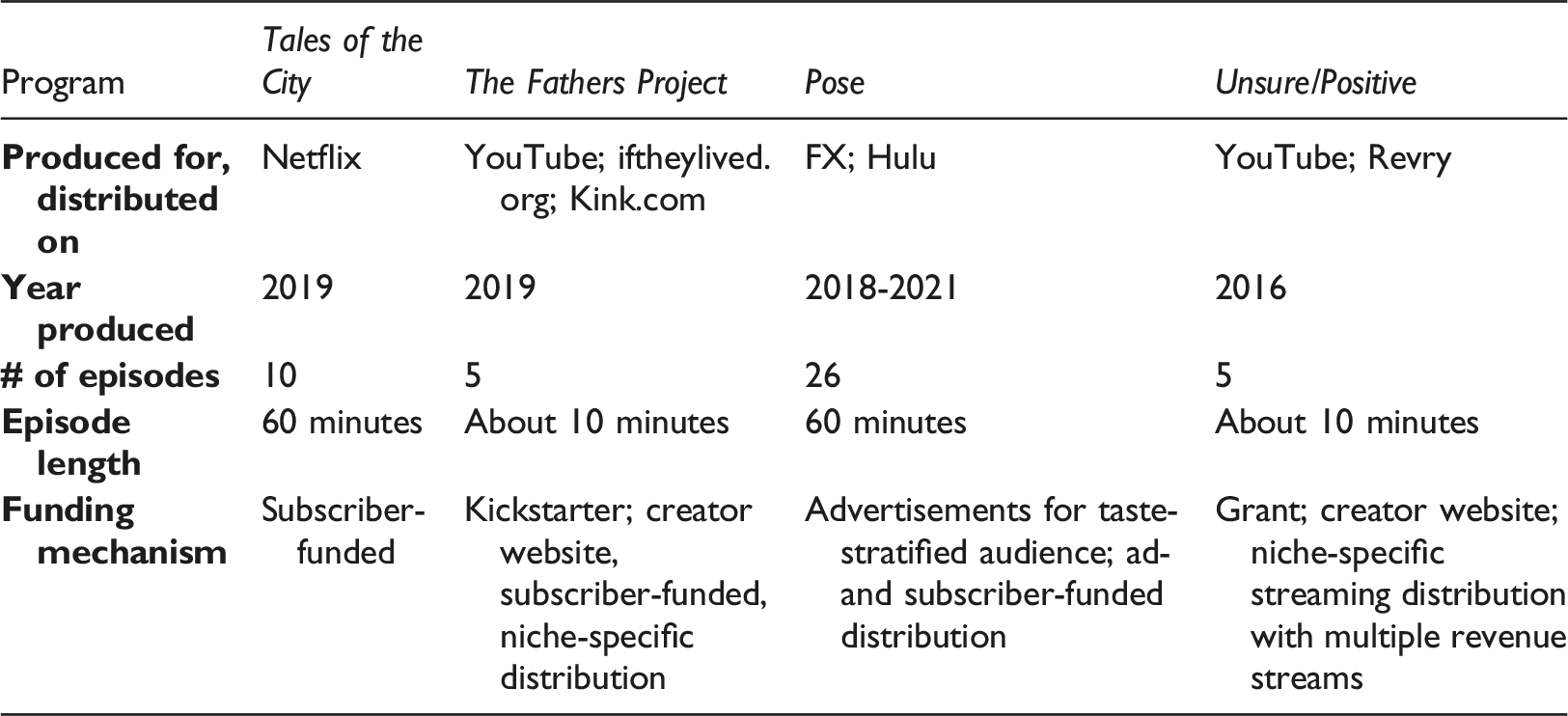
My gambit here is that by questioning the extent to which funding shapes representational politics there is new ground to break for understanding questions of ‘diversity’. For the purposes of clarity, I have divided what follows into three sections. In the next section, I situate my analysis in the literature on platforms in order to articulate why this genealogy yields key insights about the politics of LGBTQ + representation in the context of streaming technologies. In the section that follows, I examine the prevailing issues in literature on LGBTQ + television, paying close attention to how scholars parse the relationships between queer politics, media commerce, and technological infrastructure. In the section after that, I compare tendencies, or how the logic of capital as it operates in television produced for all different kinds of platforms results in particular representational paradigms, with possibilities, or how the representation of queer sexual practices on different modalities of television can feature both familiar limitations and surprising contradictions.
Television: Always, already a platform
Careful analysis of LGBTQ + television’s representational politics in the medium’s multiplatform environment requires bringing together disparate objects as well as disparate areas of inquiry. In television scholarship, the use of ‘online TV’ as a paradigm for understanding entertainment media companies like Netflix, Amazon, and Hulu is often separated from ‘social media entertainment’ like YouTube, Twitch, and Patreon as a heuristic for investigating user-generated content (Lobato 2019; Lotz 2022; Monaghan 2023; Poell et al., 2021). Where ‘online TV’ can be defined as ‘services that facilitate the viewing of editorially selected audiovisual content through internet-connected devices and infrastructure’ (Johnson 2019, 48), ‘social media entertainment’ can be understood as an industry in which ‘previously amateur content creators us[e] new entertainment and communicative formats, including vlogging, gameplay, and do-it-yourself (DIY), to develop potentially sustainable businesses based on significant followings that can extend across multiple platforms’ (Craig and Cunningham 2019, 5). Nevertheless, audience experiences of television in the context of distribution via streaming technologies are such that these categories of content are often consumed in tandem, often via the same delivery technologies, like apps on a smartphone. If there continues to be critical purchase in considering the industry structures and technological infrastructures of ‘online TV’ and ‘social media entertainment’ separately, the extent to which users experience them alongside one another points to the utility of putting these different production and distribution milieux in dialogue with one another in cautious, calculated ways. Because I am interested here in thinking about how television portrays LGBTQ + issues and desires in the context of streaming distribution, I focus on representations of intimacy between HIV + queer people because these representations traffic in culturally-specific vernaculars and behaviors even as they circulate across so many different platforms. My archive includes television produced for and distributed via broadcast television/broadcast video on demand (BVOD), streaming video on demand (SVOD), as well as content created and circulated via video-sharing platforms. Comparing and contrasting such different iterations of thematically similar content allows for consideration of their simultaneous parallels and variations.
In this milieu, it is tempting to toss conventional definitions of television, set aside familiar processes associated with producing programming, and discount any representations of LGBTQ + sexuality produced via ‘old’ means in what is decidedly a ‘new’ world. But television’s multiplatform ecology involves a mix of conventional and emergent practices for the funding and circulation of content (Johnson 2019, 33). These practices shape but do not necessarily determine in any straightforward way the politics of the content produced and distributed there. Yet, traversing these disparate contexts even as one remains attuned to the divergences between them creates some conceptual difficulty. Any attention to television’s representational politics must appreciate that ‘streaming’ is a relatively misleading metaphor. In its suggestion of seamless content delivery, the term masks uneven relations of capital and incongruent conditions of regulation. A web series like Unsure/Positive features frank discussion of sexual practices between HIV + queer men precisely because its queer creator, Christian Daniel Kiley subsidized it outside of conventional television contexts. Yet, the program’s reach is dwarfed by a program like Pose, whose queer creator, Ryan Murphy, used his industry clout to create a program for cable television that also features frank discussion of sexual practices between HIV + queer people. My goal here is not to flatten the considerable differences between these texts and the contexts in which they are produced and circulated. Rather, I want to elaborate on the distinct yet still overlapping cultural work they perform as a result of the platforms for which they were created and distributed.
Given the many ideological labors performed by television – the circulation of capital, the depiction of sociocultural issues, etc. – platform studies provides useful frameworks for considering how those labors occur across its many different forms. Tarleton Gillespie (2010) asks scholars to note the discursive work undertaken via the term ‘platform’ by considering the simultaneity of its computational, architectural, figurative, and political meanings. More recent scholarship on ‘platforms’ is careful to define them as specific entities that operate as ‘data infrastructures that facilitate, aggregate, monetize, and govern interactions between end-users and content and service providers’ (Poell et al., 2021: 5). It seems to me that the computational element of Gillespie’s conceptualization receives more attention than the architectural, figurative, and political elements – and I think that these are precisely the elements that yield the greatest insights where matters of queer sexual politics are concerned. They point to, respectively, the structures through which user actions can take place, the cultural impetuses for those actions beyond the platform, and the ideological implications of those actions out in the world (Andersson Schwarz 2017, 377). When viewed from that vantage point, each form of television examined here marks a different platform. The ubiquity of platforms is gestured to via the term ‘platformization’, a term Anne Helmond defines as ‘the penetration of digital platforms’ economic, infrastructural, and governmental extensions into the cultural industries, as well as the organization of cultural practices of labor, creativity, and democracy around these platforms’ (Helmond 2015: 1). If the entities through which television is circulated and consumed are as widespread as this definition indicates, the ways they harness the micro-level actions and behaviors of users in the interest of accumulating power and capital at the macro-level through their representation of LGBTQ + desires, lives, and communities are issues of considerable import when interrogating political questions related to ‘diversity'.
While the sites of analysis discussed here do not all fit neatly into what scholars understand as ‘platforms’, the milieux in which they circulate are characterized by those sensibilities, nonetheless. For that reason, the conceptualization of ‘platform studies’ as laid out by Jean Burgess (2021) provides a useful conceptual lens for thinking about how the rationalities of platforms, ‘their ways of operating and their systems of value’, are constitutive elements of contemporary television’s representational paradigm (22). Burgess (2021) underscores how ‘these data are exploited and shared, not only internally by single platforms…but also across a far more extensive ecosystem of social media companies, advertisers, and third-party intermediaries’ (22–23). In that sense, datafication is the very process by which television audiences encounter television produced for Netflix alongside content created for YouTube. To that end, a platform-studies approach to analyzing LGBTQ + television takes up ‘the technologies, interfaces, and affordances, ownership structures, business models, media- and self-representations, and governance of these entities, positioning these elements in a coevolutionary relationship with… diverse cultures of use’ (Burgess, 2021: 26). What I see in this formulation is an emphasis on the relationship between, on one hand, the complicated mélange of freedom and control as it occurs on individual platforms and, on the other hand, the mix of sovereignty and domination that results when a handful of powerful corporate actors soften the implications of their infrastructural control via rhetorics of inclusion and ‘diversity’. It should never go without saying: such rhetorics have a less-than-straightforward relationship to politics of sexuality where LGBTQ + people and issues are concerned.
This relationship I am noting between the micro- and macro-levels of television’s platform economy makes attention to a meso, or middle, level rather illuminating. For instance, Amanda Lotz (2019) argues that changes to television financing reveal more about streaming platforms’ business models than does their distribution of content via the internet. She maps a historical trajectory that charts how changes to television’s political economy – the repeal of FinSyn rules that limited financing practices and the conglomeration of the industry sector in the 1990s – resulted in various strategic imperatives for different kinds of television businesses. Perhaps most obviously, a company like Netflix eschews the methods and models most commonly associated with television because it generates revenue by managing a library of content for paying subscribers as opposed to delivering audiences to advertisers. Even so, Lotz argues that subscription financing, not internet distribution, has been more disruptive to conventional models of producing and distributing television. I follow her lead in suggesting that how a program is financed reveals more about television’s ideological content than does its distribution on the internet (2019: 933). Where Lotz analyzes meso-level financing practices to suggest that television was changing long before its distribution on the internet, I want to borrow this impulse to think at a meso-level in service of ideological critique of LGBTQ + content. If, as I have suggested, television is always a platform and, relatedly, different modalities of television are essentially different sorts of platforms, comparing and contrasting the content created for these platforms yields a great deal of insight as to how the politics of sexuality occur there. A meso-level thinks about the relationship between platforms: it puts them in dialogue with one another to consider how they enable the circulation of different kinds of content (Andersson Schwarz 2017: 378–379). In the context of LGBTQ + representation, these differences are both obvious and less so, illustrating how textual analysis still yields valuable insights into how sexuality is configured in television’s multiplatform economy.
Commerce and its discontents
When foregrounding the architectural, figurative, and political elements of platforms, it becomes clear that television scholars have long used a platform-studies approach to studying LGBTQ + content. For instance, in his work on LGBTQ + representation on U.S. prime-time television during the 1990s, Ron Becker (2006) has asserted that the erosion of the broadcast audience in the face of competition from cable resulted in the rise of an advertiser-friendly demographic he calls ‘the slumpies’: socially-liberal, urban-minded professionals who were thought to have high disposable incomes (81). In trying to reach out to this demographic during this period, Becker charges: ‘Gay material wasn’t only useful for network executives… but also for many viewers for whom watching prime-time TV with a gay twist spoke to specific political values and offered some a convenient way to establish a “hip” identity’ (2006: 106). Becker maintains that while LGBTQ + viewers may have found pleasure in these representations, they were not considered a viable audience demographic during this time. As a result, they did not figure into the programming decisions that took place in this particular circuit of cultural production. The result was a representational template that animated LGBTQ + lives, desires, and cultures for the explicit purpose of courting straight viewers.
This disconnect between LGBTQ + representations and LGBTQ + target audiences has been a frequent lament in scholarship on and popular press related to television for decades. But the shifting political economy and changing technological make-up of television in the context of the platform economy has considerably altered that critique and the dynamic on which it centers. As Amanda Lotz (2007/2014) points out, the U.S. television industry has historically relied on the thirty-second advertisement for the generation of revenue. But that commercial model morphed with the expansion of programming offerings, the multiplicity of experiences available to viewers given time-shifting and the abundance of the television universe, diversity of delivery technologies and industry institutions that characterize that universe, and changes to audience measurement that typify what she refers to as ‘the post network era’. (2007/2014: 169). In this context, appeals to demographically specific viewerships became more specialized than in previous eras, so television executives openly courted LGBTQ + audiences via images of LGBTQ + desires, lives, and cultures (Aslinger, 2009; Griffin, 2017b; Himberg, 2018; Ng, 2023; Sender, 2007). In both media scholarship and the popular press, this transformation is often framed, however dubiously, as a matter of political progress (Aslinger 2009; Griffin 2017b; Ng 2023). Programs featuring LGBTQ + representations imagined for more demographically specific viewerships on cable television have often been framed as ‘better’ or more politically progressive than LGBTQ + representations imagined for less demographically specific viewerships on broadcast television. (Griffin 2017a). At the same time, smartphones, user-generated content, and video aggregation sites like YouTube have democratized and globalized the production and circulation of moving images devoted to same-sex desires and LGBTQ + identities and cultures (Craig and Cunningham, 2019; Glatt and Banet-Weiser, 2021; Griffin, 2023).
Given these developments, the object known as ‘television’ and the category ‘LGBTQ + representation’ have become wide and varied. The former markers of differentiation – professional versus amateur, broadcasting versus cable, television versus the internet – do not hold as much sway as they used to. After all, one can watch big-budget broadcast television programming alongside cheaply-produced cellphone videos on the same technology, sometimes via the same platform. Even so, the differences between these circuits of cultural production and the discrepancies that underpin the logics of the content produced there remain meaningful. Although delivery technologies and modes of consumption might collapse the differences between objects like user-generated content on YouTube and television programming created via corporatized circuits of cultural production, audiences are attuned to differences between them. Scholars must remain attuned to the differences between them too – and not merely for epistemological reasons. The differences between them have political implications, although these implications need to be examined with great caution and care. The changes wrought by the platform economy in the last 10 years or so have further transformed the television marketplace, its representation of LGBTQ + lives and cultures, as well as its courtship of LGBTQ + audiences.
Many television scholars have rethought their theories in light of these transformations. For instance, Ron Becker (2023) argues that the splintering of television’s audience and the transformation of LGBTQ + audiences into an actual target demographic requires that queer critics of television shift their modes of critique. In looking at the cable television reality contest RuPaul’s Drag Race (Logo, 2009–2017; VH1, 2017–2022; MTV, 2023-) alongside the oeuvre of openly gay television showrunner Ryan Murphy, the Marvel Universe’s television programming, as well as offerings on the platform Disney+, Becker sees contemporary representations of sexuality difference as a move away from the industry practices of prior historical moments. Whereas LGBTQ+-themed content was previously used to court demographics of all kinds, Becker sees contemporary television taking up queer vernaculars and LGBTQ+-specific cultural narratives in new ways (2023, 20-24). Where Becker thinks across various programming contexts – cable, streaming, etc. – in the interest of making an ideological argument about how different kinds of television programs take up ideas about same-sex desires and LGBTQ + identities and cultures, Amanda Lotz (2022) warns against collapsing the differences between the various business models used by different platforms. Where the terminology ‘streaming’ implies a uniformity of practices among the range of portals that deliver original television programming to audiences – Netflix, Hulu, Amazon, Disney+, Paramount+, Apple+, and so on – Lotz stresses that there are important material differences in their geographic reach, the specificity of their libraries, the nature of content ownership, and the characteristics of their corporate ownership (2022: 8). These differences in their economic bases necessarily have an impact on the ideological nature of the original content they produce.
Alongside these more conventionally commercialized methods of creating and circulating television featuring LGBTQ + representations are modes of media creation and circulation that fit more closely in the heuristic of social media entertainment (SME). As Aymar Christian (2018) has argued about television imagined at smaller scales of production and distribution, legacy television has traditionally excluded queer creators of color and not valued representations of LGBTQ + people of color. He sees the marketplace for web series created by queer people of color via non-traditional methods of distribution (e.g., YouTube, social media, producer websites) as enabling more diverse forms of LGBTQ + representation. (Christian 2018: 104–05). Crucially, scholars are enthusiastic about the possibility of content created outside of corporatized media contexts to then scale within those contexts and thus prove to be transformative (Christian 2019, 2020; Craig and Cunningham 2019; Glatt and Banet-Weiser 2021). To this end, Christian argues for a different understanding of ‘production value’, one that intentionally embraces issues of politics and culture in assessing questions of worth. Using smaller-scale productions as the point of departure, he articulates a category he calls ‘cultural production value’, a category of value coding that determines relative worth by interrogating 1) the level of embeddedness of key creatives in the communities represented in content, 2) whether or not narrative time ‘engag[es] meaningfully specific cultural and social practices or subjectivities’, 3) whether or not the spaces featured in the content ‘have a clear or sustained relationship’ with the people working on the content and the communities that content represents, 4) whether or not the narrative and characters ‘sincerely represent’ the communities featured in the content, and 5) how the content ‘challenge[s] or reveal[s] how power shapes social and cultural value’ (2019: 7). There is an emphasis here on empowering the right kinds of individuals to make television content about LGBTQ + people and communities perhaps over and above the ideological nature of that content. What fantasies of freedom, belonging, and desire does it mobilize? What relationship to power do those fantasies have?
This strain of thought highlights the agency of individuals to create particular kinds of content but I want to stress that even the most well-meaning creatives can create limiting, problematic ideas about LGBTQ + lives, desires, and cultures, for any number of reasons. All representations of LGBTQ + people operate as catechresis, that is the cultural work of representation: they invoke more than they can contain (Villarejo 2003: 28). In its effort to think about how less rationalized, revenue-driven circuits of cultural production might enable more diverse, equitable, and inclusive representations of LGBTQ + people, work on SME as a discursive space for LGBTQ + representation is a welcome attempt to expand the archive of television studies through its attention to smaller-scale, less-corporatized production contexts. As an ideologically-motivated critique, it makes room for thinking outside of the proverbial box in terms of how television content is made and circulated. It also articulates conceptual frames for rethinking the motivations and logics that shape production and distribution in ways that complicate the dynamics of power that too often marginalize production staff and content related to LGBTQ + communities, especially LGBTQ + communities of color.
At the same time, I think that this argument requires more nuance if it is to articulate the vexed relationships between labor, capital, and power in full. Scholars examining LGBTQ + content emphasize the capacity for SME that operates outside of corporate media contexts to empower LGBTQ + creatives to create stories about the communities from which they emerge. Where Glatt and Banet-Weiser (2021: 44) construct two conceptual frames for understanding how creators can have different relations to the political ambivalence of LGBTQ+-themed SME content (transactional versus transformative), Christian (2019: 3) points to the creators of popular, low-budget web series that have then gone on to land lucrative deals with more insider, dorporatized television outlets as evidence of the possibility that this labor can scale in ways valued by more conventional circuits of cultural production, including a streaming portal like Netflix. As Sarah Sinwell (2023) has illustrated in her work on queer showrunners of color like Janet Mock, Lena Waithe, and Tanya Saracho, that can happen, in even the most corporatized circuits of cultural production. Even so, emphasizing the agency of individuals in the face of industry practices and structures seems to underestimate the operation of power in those contexts. The reputation for some well-established queer industry professionals to exploit workers less powerful than they are provides a case in point (Jarvey 2023; Martin 2018).
There are profound political implications when critical gestures in studying LGBTQ + television see individuals having the ability to rise above the power dynamics at work in television's platform economy. That does not need to result in limiting, limited bifurcations between individual autonomy, commerce, and technology. While the differences between platforms remain meaningful, the political consequences of those differences on the content that circulates there are not always linear or straightforward. For instance, in comparing and contrasting the freedom enjoyed by creatives between advertiser-supported television and subscriber-supported television, Amanda Lotz (2017) argues: ‘Nothing precludes an advertiser-supported service from being as creatively hands off as one supported by subscription…, or from the subscriber-funded services to also micromanage’. Following Lotz, the economic base of television has no necessary relationship to the agency of people looking to write and produce stories about LGBTQ + desires, lives, and communities. On some level, differences between advertiser-supported and subscriber-supported television may create more financial precarity for LGBTQ + creators of color in ways that prevent them from creating stories about the communities from which they come. For instance, the eradication of reruns and the elimination of multiple distribution windows has decreased the amount of residual income that writers, producers, and directors can expect to earn from the content they create (Lotz, 2017: 55). That is precisely the income that might allow LGBTQ + creators to create content outside established circuits of production and distribution. Furthermore, the well-documented tendency of social media platforms like YouTube to demonetize LGBTQ+-themed content via practices like age restrictions result in forms of discrimination that create considerable precarity for creators most invested in using moving image media in transformational ways (Craig and Cunningham 2019: 211). A meso-level approach that considers the relationship between different platforms helps account for a leftist trans creator like Natalie Wynn, who minimizes the financial impact of YouTube’s prejudicial mechanisms of control on her ‘ContraPoints’ video content by extending her brand community to the subscription platform Patreon (Glatt and Banet-Weiser 2021: 50–51).
The vexed relationships between labor, capital, and technology are always in play when analyzing LGBTQ + television in the platform economy but these relationships benefit from prudent analysis. Enthusiasm for content created outside conventional industry contexts features a robust sense of ‘outsider’ feelings, which seek to sidestep the problematic, often exclusionary tendencies of better established, better funded, more ‘insider’ circuits of cultural production. To be sure, this is a worthy, even admirable aspiration, especially visions of transforming industry practices. There is a long intellectual genealogy of research that unpacks the shortcomings of LGBTQ + media and activism that valorizes centrist viewpoints at the expense of a more radical, potentially transformative politics (Doyle 2016). Furthermore, there is a considerable amount of work in queer media studies that aims to complicate easy delineations between business/politics and insider/outsider in the media industries, especially in the realm of labor, where LGBTQ + media professionals understand their work on politicized terms, though sometimes only tacitly so (Henderson, 2013; Ng, 2023; Sender, 2005, 2012).
Jobs in well-established industry contexts can provide media professionals with stable lives in the form of income security, health benefits, etc. Working outside the auspices of such institutions to create LGBTQ + television content can result in forms of precarity that make lives less livable. The ability to do the kind of un- and poorly remunerated work that often characterizes media labor outside of conventional industry contexts is, on some level, itself a form of privilege. Furthermore, by purposefully eschewing the power of global companies like Netflix, one risks foreclosing on the potential to transform them. And finally, global companies like Netflix have reach – the established practices and infrastructures of legacy media circulate more content to more people more easily. Purposefully working outside industry contexts risks foreclosing on the potential for politically-invested LGBTQ + content creators to take advantage of the resources that conventional television production make possible. As Catherine Johnson (2020) stresses, one of the key differentiators among platforms in television’s multiplatform environment is discoverability; just because content exists does not mean that all viewers can find it (177). In that sense, when content is created for and distributed via a platform like Netflix, it is discoverable to far more viewers than a clip that is buried on YouTube.
When creators operate outside of corporatized media contexts, the content they create is not necessarily any more politically progressive than content created inside corporatized media contexts. The cultural beliefs and image repertoires that inform representations of LGBTQ + people can be depressingly consistent across even the most varied production and distribution contexts. There is, to be sure, political potential in less-corporatized production and distribution contexts. Even so, it is useful to problematize easy, linear connections between the politics of production contexts and the politics of the content created therein. One way of doing that is comparing contrasting formally and narratively similar content produced via multiple funding models production scales, and distribution paradigms – or to consider content in the context of ‘online TV’ and ‘social media entertainment’ – to think about the political potentialities and ideological limitations of the content itself. Textual similarities created by disparate funding mechanisms are precisely the areas where scholars invested in queer politics and media culture need to pay the closest attention. On one hand, that is where limiting and limited ideas persist and become commonsensical in problematic ways. On the other hand, it raises the question of what, exactly, transformative images of LGBTQ + desires, lives, and cultures actually look like.
Tendencies and possibilities
Across basic and pay cable, original content created for streaming platforms, crowdfunded web series with big budgets and crowdfunded web series with low budgets, there has been a surfeit of representations of gay men and transgender women with HIV/AIDS in the last several years. On some level, I expected to see profound disparities in how these various texts represent sexual intimacy between people living with HIV/AIDS given the differences in funding mechanisms and the streaming platforms used to distribute them. That hypothesis proved true in some respects but misleading and even false in others. Despite their varied financing models, production scales, and distribution strategies, the texts examined here were somewhat but not entirely consistent in how they represented HIV + queer people engaging in sexual intimacy. With notable exceptions that I discuss in detail ahead, the texts I examine here tend to differentiate between ‘healthy’ and ‘unhealthy’ sexual encounters by foregrounding the romantic couple as the ideal form of sexuality. Crucially, though, neither the streaming platform on which they were distributed nor their financing model through which they were produced were reliable predictors as to the politics of their sexual representations.
I recenter textual analysis here because it seems to me that when emphasizing the differences between production and distribution contexts, the ideological parallels between texts created across them can fall too far out of focus. Attention to ‘diversity’ of identity in LGBTQ + television risks falling too far down the industry and technological rabbit holes when those issues are not reliable predictors of the politics of content. One example: the program Pose (FX, 2018–2021), a drama devoted to the lives of Black and Latin queer communities in New York City during the height of the AIDS Crisis in the 1980s and 1990s. Blanca, a transgender woman of color is diagnosed with HIV in the series premiere and over the course of the series several other main character learn they are HIV + too, including Pray Tell and Ricky, black gay men. Frank discussions about protected and unprotected sex are a fixture of several of the program’s 26 episodes, though two such scenes distill the ‘healthy’/’unhealthy’ dynamic quite well. In one, Blanca recounts through flashback having engaged in unprotected sex in an alley when she was younger, specifically with a man she had just met. She suggests that she did so because of poor self-esteem and uses the story to warn other characters about the dangers of engaging in risky sex with strangers.
Yet, not all depictions of sexual intimacy between characters on Pose are cast in such a negative light. In another episode, the characters Pray Tell and Ricky consummate their relationship after growing closer upon learning they have both contracted HIV. There is no discussion of protection in the sex scene itself and the dialogue between the characters includes pointed discussion of ‘flipping’, or the partners taking turns penetrating one another. The scene features a mix of shots depicting the two characters embracing, kissing, and engaging in various sexual acts. At one point the scene cuts from a medium shot of Ricky penetrating Pray Tell to a closeup in which Ricky tells Pray Tell ‘I think I want you to have me too’, at which point the characters switch positions. The soundtrack features the 1989 R&B love ballad ‘Whip Appeal’ by Babyface, further marking the encounter as a pivotal moment for both characters and, thus, for the audience as well. The characters’ relationship then becomes one of the program’s main storylines through to its conclusion, when Pray Tell makes an enormous sacrifice for Ricky’s health and wellbeing. Even so, over the course of the same episode, the relationship is pointedly cast as being non-monogamous. Furthermore, across the rest of the series, the sexual intimacy shared by the two HIV + gay black male characters is never represented as being distasteful or dangerous – in fact, it is cast as the opposite.
As a program created for a basic cable channel and thus imagined for heterogeneous audiences, Pose’s valorization of romance and criticism of sex between strangers is, perhaps, not surprising. At the same time, its foregrounding of non-monogamy and an affirming sexual bond between two HIV + characters of color belies its status as a text created in a highly conventional production and distribution context. In other words, the ideological nature of Pose’s representation of sexual intimacies between HIV + queer people is both consistent with and inconsistent with its status as a text produced in a corporatized context for distribution on a major platform. In contrast, Unsure/Positive (2016) is a five-episode web series funded by donations and circulated via alternative means that is devoted to a similar set of issues as those animated in Pose and, like its more popular, famous counterpart imagined by an openly gay, content creator, Christian Daniel Kiley. Despite its status as a text that originated in and circulates outside of well-established industry contexts, it features the very same binary between ‘healthy’ and ‘unhealthy’ sex Pose depicts – and without any of the other text’s ideological contradictions. Episodes of Unsure/Positive detail the white main character, Kieran McCullay (played by Kiley) as he struggles with an addiction to methamphetamine. Diagnosed with HIV in the program’s first episode, the series revolves around Kieran coming to terms with a changed life. To do so, he seeks help from a therapist, and weighs how and when to tell his straight female best friend about his HIV status. In the series’ fourth episode, after a fight with his friend, Kieran has a relapse. The episode depicts him looking for drugs and a sexual encounter on a mobile media application; he gets invited to participate in group sex with three men he does not know as they smoke meth. The sex scene is shot in the dark and the character is depicted as remorseful; he regrets both the sexual encounter with strangers and the fact that it involved drugs. In the fifth and final episode of that first season, Kieran’s counselor ends their therapeutic relationship after learning about the encounter and his amphetamine use. While Kieran assumes that the counselor, Alan, disapproves of his choices, he actually ends the therapeutic relationship so that the two can pursue a romantic relationship. The episode ends with Alan telling Kieran that he is also gay and also HIV+ – and also happens to be attracted to him. The series ends on a high note, with upbeat music and Kieran informing viewers via voiceover that he is looking forward to his future.
Although Pose and Unsure/Positive are created via different funding paradigms and circulated via different platforms, they contain ideological parallels in that both paint sex between strangers as dangerous and destructive in order to show HIV + characters achieving self-actualization by way of conventional romance. Given the large role of the creator in Unsure/Positive – he writes, directs, and stars in it – as well as the series’ unconventional financing, I anticipated it would have a much different take on the sexual politics of HIV, but that was not the case. At the same time, Pose contains interesting, progressive moments of contradiction that complicate easy assignations about the relationship between mode of program financing and the politics of the content. Marking this differentiation should not be interpreted as a critique of Unsure/Positive’s creator. After all, creator Ryan Murphy had the benefit of conventional industry financing to make Pose a multi-season, dense storyworld that enabled such interesting contradictions in its content. But as a mark of textual differentiation, it complicates kneejerk political assumptions about the role of commerce in representing queer lives and sexual practices. This evidence is only anecdotal and does not in and of itself disprove the notion that television content created and circulated outside of corporate contexts is not necessarily more politically progressive than television content created and circulated inside of those contexts. Rather, it points to how particular cultural beliefs about LGBTQ + people and sexuality can persist in television content despite differences in their modes of production and how resources can make alternatives to those tendencies possible. So the preponderance of attention paid to the romantic couple in content devoted to LGBTQ + people, sexuality, intimacy, and HIV/AIDS is evidence of any number of things, including the durability of ‘safe sex’ ideologies that prevailed in the wake of the AIDS Crisis of the 1980s and 1990s, the emphasis on respectability and domesticity in the context of neoliberal LGBTQ + politics, as well as the strength of Judeo-Christian dogma related to monogamy. In that sense, thinking beyond these staid ideologies and reconceptualizing conventional representational paradigms requires more than simply rethinking funding mechanisms and delivery via streaming technologies.
Given how trenchant cultural beliefs about sexual propriety can be in the depiction of LGBTQ + lives and cultures on television, content that engages risqué elements of same-sex desires and the cultures they help create offers a particularly interesting contrast here. In my sample, episodes that problematize group sex in relation to HIV/AIDS recurred more than once. The ten-episode series Tales of the City (Netflix, 2019) revisits a television miniseries that aired in the 1990s that was based on a newspaper serial and then a series of novels written by author Armisted Maupin. Centering on the lives of straight and queer residents of a San Francisco apartment building, the version of Tales of the City created for Netflix brings the story to the present, both updating viewers on the lives of the characters from the original novels and introducing them to a group of younger characters. One of the main characters, a gay white man named Michael Tolliver, is living with HIV and the Netflix series depicts the character navigating a romance with a younger gay man of color who happens to be HIV-. In one episode, the couple goes to the wedding celebration of another gay male couple. The reception area features a ‘sex tent’, a space cordoned off by a canvas tent that is explicitly set aside for the purpose of a gay male orgy following the ceremony. The couple fights and breaks up while at the wedding, and Michael ends up soothing his hurt feelings by making a connection with another guest. The two men engage in intercourse – though Michael requests that they do so in the privacy of a bedroom as opposed to the semi-public setting of the tent. While the scene depicting the two men engaging in penetration is relatively graphic, I see the character’s request that they escape the publicness of group sex as the program acquiescing to cultural norms related to modesty and decorum. Moreover, Michael eventually reconciles with his partner and the tryst is but a detour in a larger narrative related to conventional romance. As a program created for and distributed on a SVOD (Netflix), the politics of its sexual representation are still relatively conventional. In looking at the series as a whole, and in contrast with Pose, there are no real moments of contradiction that complicate its take on sexuality, intimacy, and monogamy. After all, the activities that unfold in the sex tent are quite pointedly cast as ‘other’ in the program’s narrative.
Television created beyond conventional industry paradigms can result in innovative, progressive takes on the politics of LGBTQ + sexuality. Differences between such programs are best articulated at the level of the text and the potentialities and limitations of the funding model than they are in an emphasis on the affordances of the platform. In contrast with Tales of the City, The Fathers Project (2019) is a five-episode web series directed on a small, crowdfunded budget that embraces group sex in the context of HIV/AIDS. Created by Leo Herrera, a queer Mexican male activist and filmmaker whose work features candid, explicit commentary on and depictions of queer sexual practices, the series is built around a fantasy narrative. The Fathers Project is set in the fictive ‘Queer Colonies’, a location featuring an alternate history in which the AIDS Crisis of the 1980s and 1990s never happened. Across the five episodes, the program imagines a series of utopic settings populated by queer people in a world of their own making (Hargraves 2023). Here, leather-clad BDSM practitioners parade down main streets. In voiceover, a narrator informs viewers that the 1980s were ‘a golden era’ for queer people and the U.S. writ large, featuring advancements in medicine, technology, and the arts. Gay male icon, author, and AIDS activist Vito Russo is president. In this alternate future, an organization known as the Gay Men’s Health Force uses amyl nitrate, an inhalant popular among gay men for use during sex, to cure sexually transmitted diseases. Gay Mardi Gras Krewes provide care for the queer elderly. The bodies depicted in The Fathers Project are largely male but diverse in terms of race, ethnicity, and age. Filmed on location in sex-positive spaces frequented by gay men in New York, San Francisco, and Provincetown, sexual acts feature prominently in the series but conventional romance does not. In The Fathers Project, sex is communal, public, and features a variety of kinks.
As a crowdfunded web series that circulated on YouTube and was shared via social media, The Fathers Project features few of the limitations that can contour representations of queer sexuality in more conventional television. Crucially, though, neither did Unsure/Positive – and the politics of that web series are much like the politics of television created in industry contexts. Moreover, in a contradiction that complicates easy assignations about the politics of content shared on user-generated platforms, one of the episodes of the program was deemed so risqué that it could only be distributed via a subscription platform for adult media content, kink.com. Here, the utility of a platform-studies approach animated via textual analysis comes into sharp focus. By animating an alternative world for a fictive queer colony, The Father’s Project moves beyond staid representational paradigms for imagining sexuality and intimacy in the context of HIV/AIDS. In doing so, it foregrounds ways of being and wanting not seen in many other LGBTQ + representations on television. Its halting travel across the internet suggests that textual analysis continues to be a revelatory, useful methodology when examining television in the platform economy, a context where metaphors of linearity and continuousness cover over differences rooted in capital that result in ideological inconsistency and ambiguity.
Conclusion: Textual analysis for multiplatform television
The proliferation of television content circulating across ever more delivery platforms raises new opportunities for scholars even as it complicates the methodologies and conceptual frameworks they employ. The limitations of textual analysis are a frequent refrain in scholarship on LGBTQ + media, maybe especially television. Here, scholars worry about how the interpretations of researchers can conflict with those made by audiences or too heavily bracket the industry processes that bring content to the marketplace (Douglas 2008; Griffin 2017a; Henderson 2013; Martin 2020; Sender 2012). Yet, insofar as textual analysis provides television scholars with a way of articulating the ideological labors performed by representations of LGBTQ + sexuality, it yields valuable insights about how the politics of sexuality originate in and are distributed via the medium’s platform economy. I combine the heuristics of ‘online TV’ and ‘social media entertainment’ because I see in these two contexts important parallels that require examination: both are areas where ideas about LGBTQ + sexuality are produced and distributed and both are areas thoroughly contoured by the logics of capital. Given the particularities of the platform economy, isolating different kinds of television risks missing the extent to which examining them together results in compelling analysis of – and surprising findings related to – LGBTQ + sexualities. At the same time, collapsing the differences between different kinds of television risks obscuring important distinctions between their cultures of production and the circumstances of their distribution. As I demonstrate here, close readings that remain attuned to how the platform economy results in both tendencies and possibilities in the texts created and circulated there gestures to the ideological limitations of media commerce as well as the potential to create transformational representations of LGBTQ + lives, desires, and cultures. Where ‘diversity’ is a discourse operating in industry contexts that casts LGBTQ + people as an identity demographic that is necessarily embodied and visible, it seems that scholarship that employs ‘diversity’ as a way of diversifying its archive – in this case, via attention to funding mechanisms and their relationship to sexual acts and behaviors – enables attention to different political questions and allows for analysis of LGBTQ + television in new, useful ways.
