



Abstract
The last decade has seen a rapid growth of service-based offerings – also known as Game-as-a-Service or GaaS – in the video game industry, among which are some of the most popular franchises, such as Fortnite or League of Legends. Yet, even though these games are designed to be played and supported for an indefinite period of time, many studios have recently chosen to curtail services after introducing them, making for unclear outlooks on the future of this business model. Hence, based on secondary sources – including company documents, industry press and dedicated player forums – this multiple case study sets out to investigate the reasons behind studios’ decision to discontinue parts of five popular GaaS. Three main motives for withdrawing services emerge from the cases. Namely, rather than supporting services, studios decide to (1) attend to the company, to (2) attend to players and (3) to attend to the core product itself. The results contribute to the nascent GaaS literature, in particular with respect to business models and product-life cycle considerations. Implications for studios are offered in closing.
Introduction
Over the last decade, many video game studios have embraced a new service-driven business model that has come to be known as ‘games as a service’ (GaaS). Unlike traditional ‘product-like’ games, developing these offerings implies continuous support as well as the periodic release of new content, be it new characters, weapons or quests, rather than the introduction of standalone titles or sequels (Dubois and Weststar, 2022; Hussain et al. 2023). Among the most popular service games, Fortnite (2017), League of Legends (2009) and World of Warcraft (2004) still boast large followings and steady revenues, despite having been released many years ago. For studios, such prospects of longevity, player retention and increased spending have fueled enthusiasm for GaaS, in particular given how crowded and competitive the industry has become (Vaudour and Heinze, 2020). Hailed as a sound business model, tested and proven in other sectors, GaaS appeared poised to become the new norm for game development and publishing (An, 2023).
Yet, a slew of high-profile game shutdowns in recent months appears to suggest disillusion and waning interest, raising questions on the service model’s sustainability and future within the industry. In the first few weeks of 2023 alone, over half a dozen games, including the popular Knockout City (2021) and Rumbleverse (2022), were dropped by studios (White, 2023). Citing the excessive time commitment required and the high barriers to entry for new players, as well as the overabundance of games, the hefty costs and the rampant questionable monetization practices, many industry observers are now left pondering about GaaS’ future as a business model (Scoville, 2023). However, beyond the latest headlines, warning signs seemed plentiful. For one, the GaaS literature had started highlighting some of the model’s inherent challenges, be it with respect to tensions with the developers’ skillsets and identity (Dubois and Weststar, 2022), its inadequacy with studios’ work processes (Weststar and Dubois, 2023) or with the players’ competing preferences (Lethonen et al., 2022a). Likewise, many of the early service games released before the recent surge in GaaS had since been shut down or curtailed. Still, why studios choose to divest from service games is unclear, much like these recent trends’ implications for the industry. Are these closures mere growing pains, or has video games’ ‘service turn’ come to a premature halt?
Hence, this study seeks to examine the motives behind the partial or complete withdrawal of GaaS and to better understand why some studios come to pull back on their strategy with offerings initially marketed as services. Through a multiple case analysis of five games – Final Fantasy XI (2006), Age of Empires III (2005), Guild Wars (2005), Destiny (2014) and Anthem (2019) – that rolled back service offerings, the results show that studios move away from GaaS in order to attend to their strained workers, their unfulfilled players, and the oft-broken games themselves. In doing so, this study answers calls for research on business models in the game industry (e.g., Davidovici-Nora, 2013; Lantano et al., 2022), in particular on the sustainability and downsides of GaaS (e.g., Hussain et al., 2023; Landoni et al., 2020; Vaudour and Heinze, 2020).
The rest of the article is structured as follows: we begin by reviewing the literature on the live service model in the video game industry, in which we also draw from related research on servitization. We then introduce our methodology, present our findings on the motives for service withdrawal using a narrative approach, and discuss them in light of the literature. Last, we identify implications for theory and practice, as well as some limitations and directions for future research.
Literature review
Today’s video game industry is said to be ‘progressively service centric’ (Hussain et al., 2022: 398), as exemplified by the surge in popularity of the Game-as-a-Service model (Vaudour and Heinze, 2020). That said, while its discursive renderings are quite recent, this transition to service-based models has been steadily advancing for well over a decade. The production of games as services had already crystalized with the MMORPGs of the late 1990s, such as Ultima Online (1997) and EverQuest (1999). Their intensification of late emerges alongside increases in the technological power and sophistication of informational systems; the normalization of platformized renderings of game ownership and creation (see Joseph, 2017, 2018; Nieborg and Poell, 2018); and broader shifts in the production of software towards models built on ongoing, iterative development or ‘permanent beta’ (Chun, 2016). These forces converge to produce a situation where the notion of a ‘finished’ software product is increasingly being subsumed by its integration in networks that both undergird its functionality and keep it in a state of perpetual evolution. Software once marketed as a product is now often offered on the basis of subscriptions (Cusumano, 2008). As Schreier (2017) points out, titles can ‘become a service’ even after releasing under a traditional product model, ‘thanks to patches [and] downloadable’ new content.
While video games are software, they also operate within the cultural space of mass media, where the stability of the product form has similarly been succeeded by synergistic approaches to production and marketing that capture value from consumer engagement (Caldwell, 2008). Consumers are often rendered as co-creators and incorporated into production flows through direct investment in the product and feedback (Banks, 2014; Dubois and Weststar, 2022). At the same time, mass media has undergone deep transformation through the use of platforms in modes of consumption, which have paved the way to mass uptake in service-based distribution models (Parry et al., 2012; Vendrell-Herrero et al., 2017). These factors make up a culture where game development and branding are subjects of energetic engagement. In brief, as game development becomes more visible, consumers become used to channeling their passion of a given title towards speculations and demands about its further development (Nieborg and Poell, 2018; Watson, 2010).
Culturally, video games overlap with software and popular media. Games as a service attempts to capitalize on the organizational flexibility and customer retentivity of the former and the passionate energies of the latter. It also aims to muster the competitive advantages associated with downstream engagement. Games are increasingly conceptualized as ‘platforms’ for selling ‘post-release’ content (Joseph, 2021) and now often come bundled as part of wider service offerings. For instance, Sony’s PlayStation Plus and Nintendo’s Switch Online offer subscription-based access to proprietary multiplayer servers, while also entitling subscribers to free games. More recently, PlayStation Now, Xbox Game Pass, and Google Stadia, all began giving access to games entirely via streaming. This model cuts out download time but also radically refigures the consumer-product relation to something akin to rent (Bernevega and Gekker, 2022; Joseph, 2021: 10; Nieborg, 2015), as Netflix and Spotify have done with video and music.
Games as a service addresses a number of challenges endemic to game development. For one, studios rely on regular releases in ‘tentpole’ franchises to buoy their revenues and leverage players’ loyalty by delivering a steady stream of new offerings. Producing blockbuster titles is very expensive, and these games must ‘make huge sums to offset the huge risks and the ever-bloating costs and resources to build the next seminal title’ (Clark, 2014: 3). Hence, the GaaS model extends the lifespan of the title while diversifying its monetization streams by capitalizing on its most engaged players through add-ons, all the while extending its viability for primary purchases by new players. Add-on content also expands the range of possible forms of engagement, allowing players with different tastes to pick and choose the options that appeal to them, rather than imposing a single, ‘one-size-fits-all’ product (Singer and D’Angelo, 2020). This multiplicity of playstyles can also be nurtured through the diversification of game modes, rather than privileging a single, ‘official’ one. Finally, the integration of options for networked play allows for these games to be played socially, without alienating those players more attracted to solo style play.
From this perspective, the proliferation of services not only aims to retain the player base, but extend the game’s longevity and profitability in an oversaturated and hype-driven marketplace (Dubois and Weststar, 2022). In that sense, the rationale behind the video game industry’s move towards a service logic is consistent with the broader ‘servitization’ literature, which implies bundling services with products as well as enhancing downstream support to create a distinctive positioning, enhance customization, reduce overhead, and develop long-term relationships with customers (e.g., Baines et al., 2009; Vandermerwe and Rada, 1988). Servitization, in short, implies the same gradual, yet clear subordination of the product itself to the delivery of a service; production here becomes a means of providing bespoke solutions (Wise and Baumgartner, 1999).
That said, video games and service models remain the subject of intense discussion, often centering around the marketing of a given title ‘as a service’. This phrase itself takes on a variety of meanings, referring to the title’s integration with microtransactional economies, the persistence of its support, social and multiplayer offerings, and the quality and scope of post-release content (Stefanidis, 2020). The ambiguity of the product-service relation is rendered in the term GaaS. Certainly, the product model remains very much influential, and many titles billed ‘as’ services nevertheless come with a hefty cost for primary purchases. Yet, the service discourse is often employed to justify charging for subscriptions, and to defend measures that challenge players’ ownership of the game (Joseph, 2018). To a point, services derealize notions of the game as a product that can be owned while emphasizing its status as the intellectual property of its creators. In short, a chief outcome of the service discourse here has been an expansion and diversification of the studios’ monetization, accompanied by the progressive alienation of players who effectively become ‘locked-in’ to a given game over time by design (Landoni et al., 2020: 6).
However, even as service models are enthusiastically taken up, we are witnessing firms already scaling down GaaS offerings or walking away from them entirely. Specifically, service withdrawal in this context implies curtailing support or content updates or introducing standalone installments in a franchise. Last year saw the disappearance of many service games, including some that were well-received and seemed profitable (An, 2023; White, 2023). Games such as CrossFire X (2022) and Babylon Fall (2022), for instance, were pulled after just a few months online While very few studios disclose the rationale behind their decision, the literature suggests potential explanations. Indeed, although GaaS may promise larger profit margins than project-based game releases, it also bears its own set of challenges with respect to the allocation of resources and relationships with players (Weststar and Dubois, 2023). Denying players of the expected level of support can lead to resentment (Lehtonen et al., 2022a), much like too aggressive of a business orientation and ill-informed monetization practices stand to leave them feeling taken advantage of (Lehtonen et al., 2022b). Last, the broader service literature also indicates that potential benefits do not always materialize, as resource-intensive services tend to become too costly or complex to manage over time (Gebauer et al., 2005; Neely, 2008). Zhang and Barnerji (2017) show, for instance, that higher than anticipated costs can also stem from suboptimal resource utilization, improper tools or lack of integrated development processes. Such challenges are especially salient in large organizations who tend to be slower at implementing new business models (Oliva and Kallenberg, 2003). Service offerings may also become unmanageable without basic employee knowledge, internal collaboration, a strong service culture, as well as fully repurposed operations (Barnett et al., 2013; Galera-Zarco et al., 2014).
Nevertheless, we still fail to see which of these day-to-day challenges, if any, are to blame for service withdrawal. It also does not help that the literature tends to discuss these challenges in isolation, unable to account for the potential cumulative impact of players’ dissatisfaction and internal issues. In fact, scholars have called for ‘more systemic analysis of the endogenous and exogenous factors’ at play in GaaS (Landoni et al., 2020: 9), as well as for research on video games’ evolving business models (Davidovici-Nora, 2013; Lantano et al., 2022). As a result, questions regarding GaaS’ sustainability remain (Vaudour and Heinze, 2020), some predicting an uphill battle for studios (Singer and D’Angelo, 2020). A decade or so after having taken the industry by storm and been heralded as a ‘revolution’ for the sector altogether (Vaudour and Heinze, 2020: 38), we posit that recent sputtering of GaaS offerings warrant further investigation. How can a business model go from ‘booming’ (Totilo, 2021) to faltering so quickly? And what does it mean for the future of GaaS? In what is arguably a pivotal moment for the industry, this study seeks to shed light on some studios’ motives to abandon, be it partially or completely, live service (GaaS) games.
Methodology
We chose to conduct a multiple case study (Yin, 2015) of games that have reduced or terminated service offerings going all the way back to 2008. As per Wright and Zammuto (2013), our research draws from secondary data and proceeds in three different stages: case selection, data collection, and data analysis. Findings are presented using a narrative approach (Langley, 1999).
Case selection
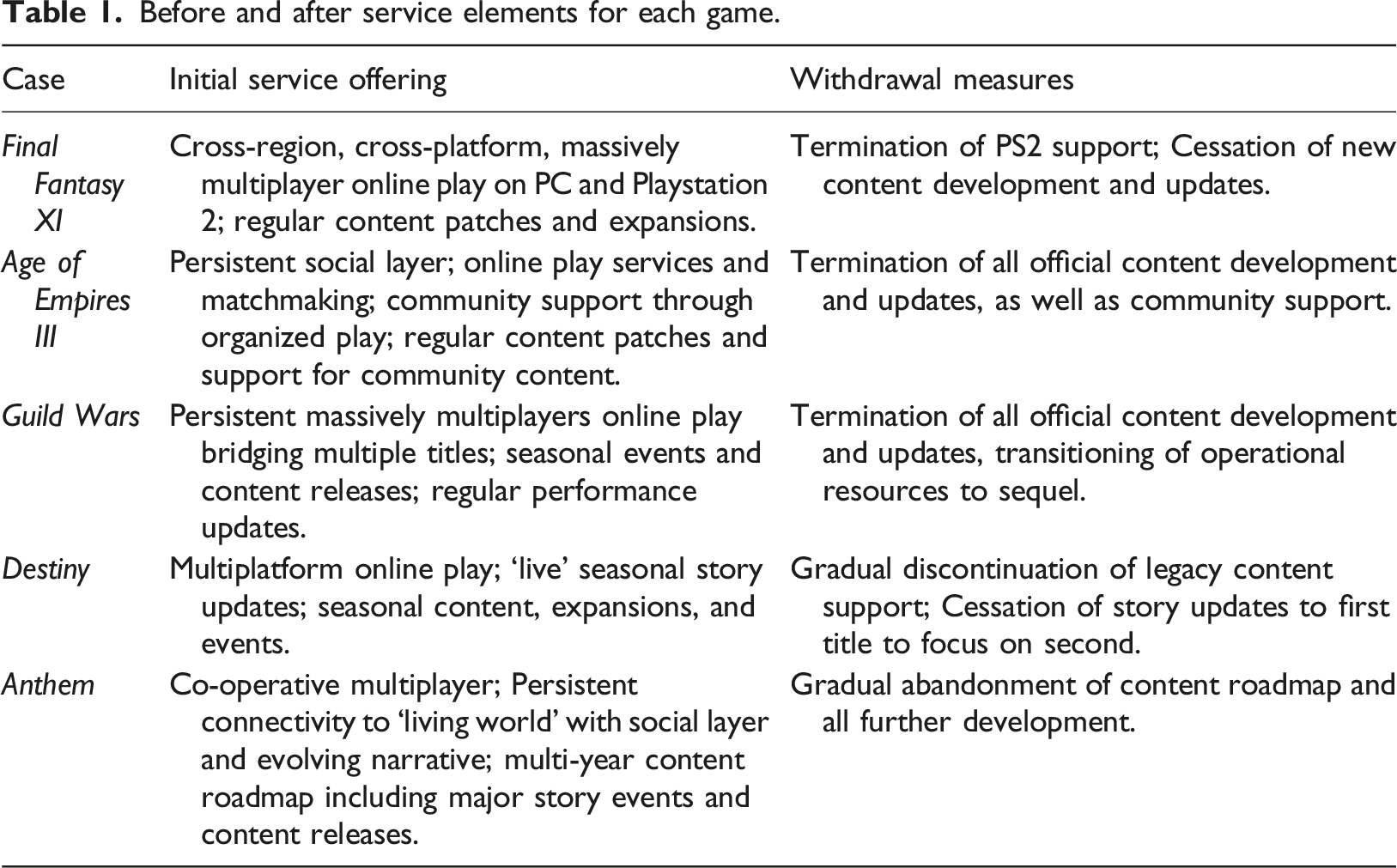
First, five video games – Final Fantasy XI, Age of Empires III, Guild Wars, Destiny and Anthem – were purposefully sampled according to a replication logic, and for their potential to reveal insights on the motives behind such strategy (Eisenhardt, 1989; Eisenhardt and Graebner 2007). Specifically, we chose to focus on games, our unit of analysis, that had reduced or stopped content updates, curtailed features, or introduced standalone sequels. We also limited our sample to high-profile releases that attracted large player bases. These titles garnered extensive public and critical attention, generating a richer dataset and easier to gather enough material set than lesser-known titles allowed. Our cases represent only a portion of full range of genres and gameplay experiences encompassed by GaaS; however, given the current paucity of data on GaaS withdrawal and our focus on motives underlying such transitions in business model, we did not consider the design of the title itself to be a meaningful factor for analysis. This is confirmed by the expansive range of GaaS titles available, which spans virtually all genres and platforms.
In the cases of Final Fantasy XI, Guild Wars, and Destiny, the titles eventually saw the release of sequels (Final Fantasy XIV 1 , Guild Wars 2, and Destiny 2, respectively) coinciding with service withdrawals in the original titles. In these instances, we examine the relationships between original and sequel insofar as it elucidates the withdrawal (and, often, reallocation) of service resources and strategies.
Before and after service elements for each game.
Data collection
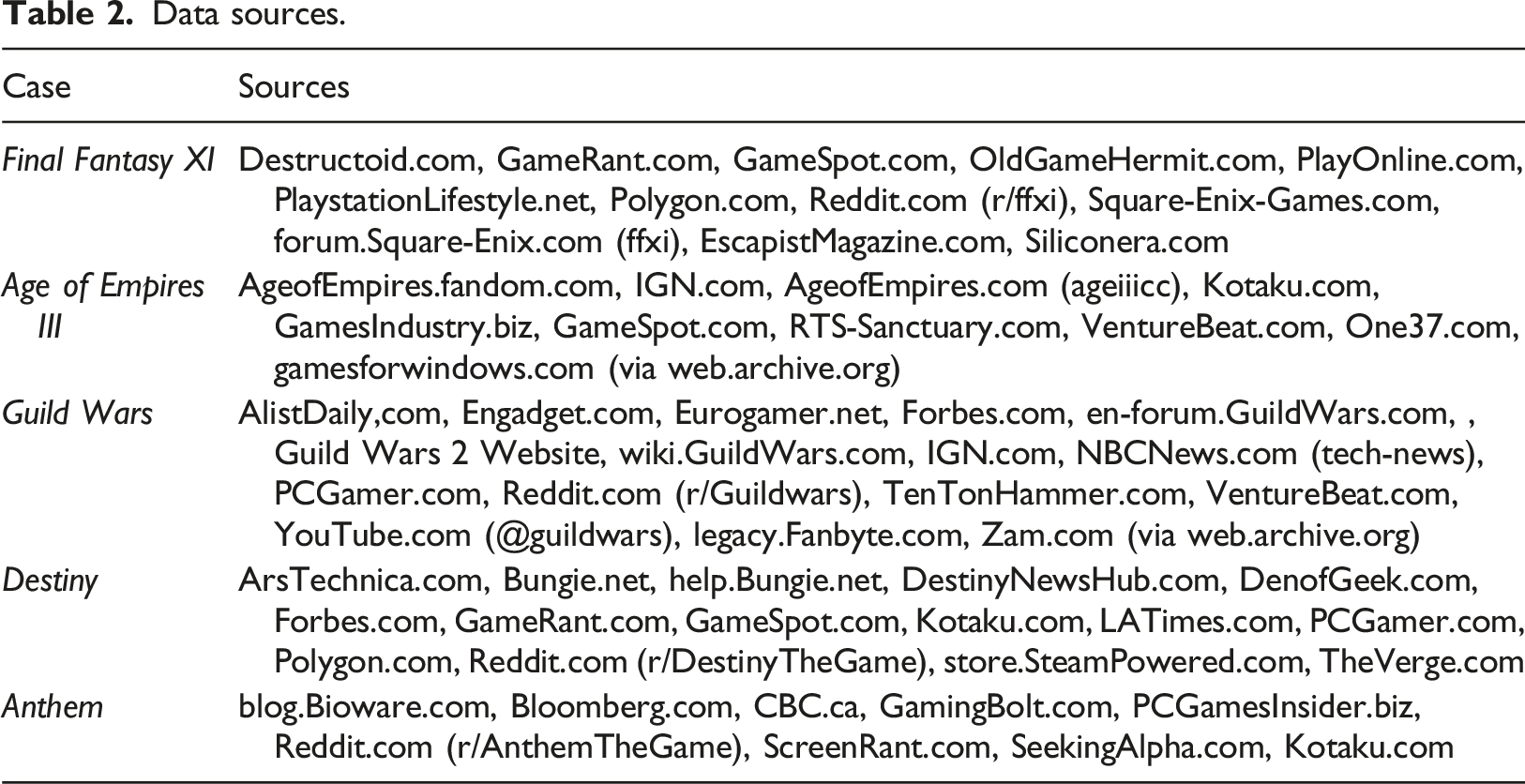
Second, the five cases were built in a consistent way and followed an explicit design from the onset (Yin, 2015). Specifically, the ‘within case’ design meant pulling a range of reputable and publicly available secondary data about the games to shed light on (1) what the initial service model looked like, (2) how the companies rolled back or terminated services altogether, (3) what justifications were provided for this strategic shift and (4) what the reactions from the players were.
Data sources.
Data analysis
Third, our content analysis began by several rounds of close reading of the material by the investigators to fully apprehend the content (Thomas, 2006). Independent in-vivo coding then looked for phrases or words that spoke of the studios’ motives to ramp down services. Proceeding from an inductive approach (Eisenhardt and Graebner, 2007), the first level codes included mentions such as aging software, team fatigue, poor feedback, competing projects, broken code, key departure, etc. From this list of twenty-three codes, we subsequently conducted a comparison to highlight similar explanations, group similar motives together, and identify broad patterns. In rare instances, minor disagreements between the investigators were discussed and agreed on, eventually leading to three main motives for service withdrawal. Our emerging themes were then presented to a panel of industry experts acting as ‘informants’ to ensure that we properly interpreted the studios’ actions (Yin, 2015). We also went back and applied those motives to each individual case to assess the fit, as well as examined them through the literature (Eisenhardt, 1989). This iterative process contributed to refining our emerging typology and theoretical contributions.
Results
The studio’s motives to withdraw services can be summed up into three broad themes: Attending to the company; Attending to the product; and Attending to the players. We discuss each of those themes in turn, making extensive use of end notes to account for the supporting data (Appendix B), and as per Wright and Zammuto’s (2013) approach to working with archival data.
Attending to the company
Games as a service requires a heavy investment in labor power, capital, and network infrastructure, which together can severely tax a firm’s capacities [1]. Indeed, maintaining a thriving service experience means continually producing new content, implementing fixes, and supporting players, requiring ongoing commitment of developers post-launch [2]. These concurrent demands pose significant logistical challenges where, as with Guild Wars and Anthem, priorities to expand the service and improve it can wind up tying up scarce resources [3]. In the case of the former, the decision to begin directing the company’s resources to other projects came quite early, especially by the standards of MMORPGs [4]. Without subscriptions, revenues were driven by primary purchases of games and expansions, with microtransactions introduced later on [5]. This means that the game needed a constant influx of new players, as well as a continuous stream of new offerings for purchase [6]. Maintaining an adequate level of service while continually pushing for new launches presented a massive strain on the company’s operations and finite resources [7]. Inside stories speak to this daily tension: ‘Mike O’Brien, who coded the bulk of Guild Wars 1, can’t afford to spend time doing much beyond running his company now’ [8]. As for the latter, the game’s development was marred by repeated disruptions, strategic reorientations, staff departures, and personal tragedy [9]. New content could never salvage what was widely criticized as a weak experience. One review, for instance, spoke of a game that ‘feels incomplete, while other portions are borrowed from games that did it better’ [10]. BioWare later announced that it was abandoning its planned roadmap to focus on the core experience, with new content released at less frequent intervals, before acknowledging that fixing Anthem was ultimately impossible given the lack of spare resources and its slate of other projects underway [11]. The case of Destiny further speaks to the need of looking after the people that make GaaS possible. As Bungie’s Creative Director explains: ‘the scope of what we delivered, the pace at which we delivered it, and the overall throughput takes a toll on the team. Working on the game was starting to wear people down’ [12].
Game development also relies on the expertise of a perennially scarce talent pool [13]. Even within studios, projects compete intensely with one another, at times resulting in cancellations to re-allocate workers [14]. Such tensions are only exacerbated by the now longer life-cycle of service games, which imply setting up proper human resources planning to avoid discontinuities in the long run [15]. For instance, 5 years after Final Fantasy XIV’s release and 2 years into A Realm Reborn, Rhapsodies of Vana’diel marks a clear intent to sunset XI [16]. The move is seen as a way to free up resources that could be committed to the newer and more popular XIV [17]. Likewise, in 2008, Microsoft decided to shut Ensemble Studios down, transferring support for AoE III to a new company [18]. The reasons for this move were not publicly disclosed, but a post from notes that Microsoft was seeking to re-allocate resources internally; [19] it is likely that devoting considerable resources to services was seen as wasteful given that the game’s online features were not monetized. Commenting on the strain on operations, the head of the studio suggested that rolling back was the ‘right thing for the business’ [20]. While the new company kept the servers online, they would not release any new content or patches [21].
Attending to the product
Withdrawal may also become inevitable when a service ceases to be profitable because of the cost of supporting it or becomes more difficult to maintain. Indeed, service offerings built on a failing or aging product, in this case a complex piece of software that relies on equally complex hardware (i.e., consoles, servers, etc.), may not be delivering the same value to customers and even become cumbersome internally. When this happens, scaling down can help draw out an underperforming game’s playable lifespan rather than terminating it altogether. With Anthem, staying on the planned content roadmap while fixing the game’s core issues would not only have overtaxed developers, but juggling those different priorities would likely have further increased the costs of a service that was already underperforming [22]. In the case of Final Fantasy XI, it had become by 2015, plainly, an old product. Namely, it had also become quite difficult to maintain and impossible to modernize; its code was over a decade old and optimized for the PS2 console [23]. Indeed, the developers used Sony’s proprietary and discontinued PS2 ‘development kits’ – the combination of hardware and software needed to create content – requiring them to seek out second-hand machines as their own kits began to fail [24]. The decision to discontinue support lessened the FFXI team’s reliance on said dev kits but did not eliminate it altogether [25]. Announcements indicate the issues GaaS’ long life poses; one interview referred to staff studying how to use long-discontinued techniques to reopen the possibility of developing new content [26].
Similarly, Destiny 2 functioned as a base game supplemented by a series of seasonal content and expansions, each providing indefinite access to new areas, missions, and rewards [27]. Over time the growing body of legacy content became cumbersome, and gameplay became harder to balance as old players amassed stockpiles of powerful gear [28]. The game’s file size ballooned to over 100 gigabytes; [29]. Destiny took on a reputation as ossified and inscrutable [30]. As a service, it was bloated, with each release deepening the logistical challenges of keeping the game online and satisfying players [31]. A studio update summed up the issue: ‘Destiny 2 is too large to efficiently update and maintain. The size and complexity of the game are also contributing to more bugs and less innovation’ [32]. Ramping down services in Guild Wars was also motivated by the fact it was not aging well, and key aspects of its design had begun to conflict with the developers’ ability to innovate [33]. Indeed, the decision to make a sequel was born out of discussions over an (canceled) expansion when desired features were deemed unworkable using the game’s code [34]. Continuing to build on Guild Wars 1 would have meant continually adding content using uncooperative code, while also making the necessary updates to keep existing content current. As explained by the game’s director, the studio: ‘wanted to be ambitious and do things in the game that we couldn't do with the existing engine, or with the existing infrastructure of the game’ [35]. Guild Wars 2’s monetization notably relies on successive cycles of limited-time releases as part of an ongoing storyline, making for a constantly changing ‘base’ experience with a growing back catalogue of ‘old’ content, as well as expansions released on a more relaxed timeline [36]. This mitigates the upkeep issue in the original game; the new model puts an expiry date on support for content while keeping core experience fresh and feeding into a growing catalogue of add-ons [37].
Attending to the players
Services may bring in less revenue due to attrition as consumer preferences change over time, or as competing products and services take up market share [38]. One FFXI player, a game that faced steadily declining engagement, reminiscing about busier days on the servers explains: ‘those were the days. I wouldn't be surprised if people decided enough was enough’ [39] When this happens, gradual reductions in service may cut costs enough while continuing to bring in some revenue from ongoing purchases, and more importantly, extend the cultural life of the game and keep up a relationship between fans and developers. As seen with Age of Empires, these relationships can translate into goodwill and excitement for future releases [40]. Withdrawing services here can entail curtailing offerings to remove those no longer desired by players, and in the process help to ease the transition from one service to another without alienating one’s existing player base. It bears noting that Final Fantasy XI’s final expansion, Rhapsodies of Vana’diel, released 5 years after its successor Final Fantasy XIV, and nearly 2 years after its much more successful reboot as A Realm Reborn [41]. This capstone acted as both a final offering and a signal that the game’s development life was over [42]. Yet, the studio’s continued support of FFXI acts as a sign of their good will and commitment to their fans, even as they seek to expand their numbers in FFXIV [43]. Square-Enix has since released a sequel in the form of Final Fantasy XIV (2006), another Final Fantasy-branded MMORPG so poorly received it was completely re-built and relaunched later as Final Fantasy XIV: A Realm Reborn [44]. This last title and its expansions have proven an enormous success, buoying the company’s profitability in the intervening years [45].
Nevertheless, Final Fantasy XI remains in service 20 years after its release [46]. Its service has been heavily diluted; support for the Xbox 360 and Playstation 2 versions have been discontinued, and its last expansion, Rhapsodies of Vana’diel (2015), was billed as a capstone to the game’s story [47]. Since 2015, FFXI has experienced ongoing support and hosts a small but committed player base [48]. Updates bring in a steady, slow trickle of bug fixes, gameplay tweaks, minor quests, and limited-time events [49]. These do not constitute meaningful additions to the game per se, so much as regular refreshments of existing offerings to give loyal players something to do [50]. That FFXI is able not only to stay online but actually expand its player base is especially surprising given that playing costs only $3 less than Final Fantasy XIV, without any synergy in access to the latter game [51]. This shows how a highly dated and heavily diluted service-based game can still draw an audience, and still be worthwhile from a brand equity standpoint alone [52].
Bungie undertook a similar strategy in the transition from Destiny to Destiny 2, working the transition into their long-term content roadmap and providing a degree of continuity between the games, in terms of player identity, storyline, and gameplay [53]. The studio had initially planned to release numbered, pay-to-play titles every 2 years following the initial release, interspersed with expansions and limited-time events [54]. In practice, however, transitioning from Destiny to Destiny 2 risked alienating loyal players [55]. To affect a clean break from the first title, character progression – the product of hundreds, if not thousands of hours’ grinding – could not be carried over to Destiny 2 [56]. Although the original Destiny’s servers would remain online [57], players wishing to continue following the story, enjoying new content, and keeping up with the community, would need to buy the sequel [58]. Contrast this strategy with the transition from Guild Wars to Guild Wars 2, where the former was virtually abandoned to shift into development on the latter, leading to a community frustrated over the changes introduced by the sequel [59].
Discussion
Our results contribute to the emerging GaaS literature by highlighting that the decision to withdraw services can be triggered by a range of internal and external motives, be they related to human, structural, technological, or reputational issues. This study also shed light on important GaaS-related challenges that stand to become too big to ignore or too complex to manage, thereby contributing much needed insights on the disadvantages and constraints of this rapidly growing business model in the industry (Landoni et al. 2020). Interestingly, we note that pure bottom line considerations are rarely mentioned and that all studios are still in business today, consistent with Böhm et al. (2017)’s finding that a firm’s decision to transition in or out of services can occur from both positive and negative financial positions. Instead, the studios’ decisions appear largely motived by the need to (re)focus scarce resources on core products, people and players.
These motives are, to a point, consistent with the broader service literature. The stress it puts on operations (e.g., Zhang and Barnerji, 2017), the toll it takes on people (Kowalkoski et al., 2017), or the challenges that come from engaging more closely with end users (e.g., Barnett et al. 2013) have all been put forth as potential service pitfalls. What these cases reveal, however, is the interplay and cumulative effect of motives that are by no means mutually exclusive: unhappy employees, disgruntled players and subpar performance often go hand-in-hand. As such, the results provide a more nuanced understanding of the model’s limitations and show how approaching GaaS from either a technological or pricing standpoint alone is bound to create blind spots. For instance, while Landoni et al. (2020) posit that putting in place the infrastructure should come only after having established reputation with players, we would argue that a flawed infrastructure is likely to undermine the game’s image from the start and lead to failure. Likewise, their assertion that a focus on innovation should come ‘in the maturity phase’ (2020: 8) is likely to curb the players’ initial enthusiasm – be it because of underwhelming content roadmaps or mundane gameplay – and thus commitment to the game. More generally, the results show how this seemingly appealing possibility of ‘releasing unfinished games’ (Vaudour and Heinze, 2020: 38) might actually be quite ill-advised for it stands to leave the company playing catch up and the players wanting for more.
Importantly, the findings also show that withdrawal is a necessary response when developers express concerns of becoming prisoners of service-based offerings (Calvin, 2019), or begin to experience excessive physical and creative fatigue. Further, dropping services is often needed to generate ‘slack’ (Nohria and Gulati, 1996) and respond to market or technological shifts (Chen and Huang, 2010). Maintaining such capacity is particularly key in creative sectors that demand constant novelty (Lampel and Germain, 2016). Withdrawal can also carry beneficial outcomes in player-studio relationships when carried out with an eye towards player participation and smooth transitions. In fact, allowing for closure is particularly important with games marketed as ‘never-ending’ (Lehtonen et al., 2022a). In Age of Empires III, for instance, players were able to take on some of the capacities of the development team following its shuttering, leading to positive attitudes towards the franchise. We note however that the industry trend has been towards limiting or carefully controlling the ways in which players are able to modify game code and assets, or otherwise exercise agency over a game’s content (Joseph, 2018). Likewise, just as adding services can enhance relationships (e.g., Baines et al., 2009; Gebauer et al., 2005), it appears that withdrawal can also extend them after a game begins to obsolesce. For instance, Destiny 2 signaled Bungie’s intention to better serve its community by improving on the game they already had, making it more accessible in the process. This implied a trimming down of the experience, and a narrower focus on quality content to keep it feeling fresh. Or, in effect, addition by subtraction.
To sum up, this study serves a reminder that game development is a rapidly-evolving art, and as its core competencies revolve in cycles of a few short years, the knowledge behind older games becomes rarified – a problem aggravated by the industry’s transience and notoriously high burn-out rates (Weststar and Legault, 2017). As such, the results highlight serious structural challenges to the longevity of GaaS and the perils of holes in institutional memory. Maintenance costs increase over time; hardware infrastructure breaks down, and evolving development standards render both skillsets and tools obsolete. These issues are quite salient with GaaS, such that they can go from cutting edge to woefully dated in just a few years. While technology maturity has been discussed in the service literature, it generally alluded to the diminish need for customer support over time (Kowalkoski et al., 2017), as opposed to being an employee and infrastructure challenge as witnessed in our cases. Thus, while GaaS seeks to extend titles’ lifespans, the technological disruptions and the legacy of past decisions threaten their longevity. And when games unravel, it can make sense to roll back service offerings, instead of piling on glitchy code.
Implications, limitations and conclusion
This study sought to explore service withdrawal in an industry where services have become mainstream offerings in recent years. Arguably, in some cases, studios may have jumped the gun, perhaps not fully knowing what this business model entailed and how to fully monetize their offerings or before having developed metrics to inform their strategy. This study further highlights GaaS’ disruptive nature and emphasizes the importance of planning for a game’s whole lifespan rather than simply slapping on services. It also demands intensive, ongoing resource commitment.
While our findings reveal inherent issues with GaaS and should act as a cautionary tale for studios, they also support the idea that withdrawal can at times be restorative (Gomes et al. 2021). There may be benefits from a planned ending and to letting players know what you are working towards to build loyalty and support. In fact, we posit that live service games should be designed in a way that allows for regular maintenance across their life-cycle. Knowing that components are bound to age, proactive withdrawal may be less damaging than a sudden interruption. While GaaS provides endless narrative possibilities, this study shows that studios must account for ever-evolving employees, technologies, and players, and as such identify ‘windows’ to cut back. While it is not possible to predict when engagement will decline or code will begin to falter, factoring these restorative withdrawal loops from the start likely stands to extend the games’ lifespan.
Our findings are not without limitations. The fact that the cases rest on secondary data, albeit plentiful and less prone to recall bias, implies that said data was not initially produced with our research questions in mind, and that we had no way of following up with those who originally produced it (Johnston, 2017). Despite extensive research, it also means that certain elements, including financials, are likely to have been kept away from the public eye for strategic reasons. Likewise, our case selection limits the applicability of our findings beyond the video game industry. Hence, future research should further explore service withdrawal in other sectors, such as manufacturing, and to test the motives found here against first-hand accounts of decision makers. Is also possible that certain genres are more or less susceptible to experiencing these issues, and that exploring a wider range of games not covered here might reveal genre-specific motives. Last, additional research should attempt to uncover other potential motives. While not mentioned in our cases, we know for instance that studios are becoming increasingly mindful of their carbon footprint and of the environmental impact of running live service games (Liu, 2022).
Footnotes
Declaration of conflicting interests
The author(s) declared no potential conflicts of interest with respect to the research, authorship, and/or publication of this article.
Funding
The author(s) received no financial support for the research, authorship, and/or publication of this article.

Games Synopsis
Published by BioWare in 2019,
Results section sources
1. For example, Macgregor (2019) noted, ‘Live service games have trained players to expect a constant stream of new content, and only constant work can deliver it’: in https://www.pcgamer.com/the-pressure-to-constantly-update-games-is-pushing-the-industry-to-a-breaking-point/. 2. In his ‘crash course in live service games’ Arifianto (2020) discussed the ‘long-term commitment’ and ‘continuous evolution’ required to maintain live service games and appease player communities: https://www.gamesindustry.biz/crash-course-on-live-service-game. 3. An executive producer revealed that the resources required to produce Guild Wars had increased from ‘five guys’ working out of his apartment to a ‘huge studio’ comprising 270 team members: https://www.eurogamer.net/guild-wars-2-the-inside-stories (Purchiese, 2012) while a BioWare blog post from Dailey (2020) explained that having a ‘small team’ made making necessary improvements a ‘longer process’: https://blog.bioware.com/2020/05/15/may-anthem-update/. 4. Beegle (2009) in a gaming news site explained, ‘ArenaNet announced its Guild Wars 2 extremely early in the sequel’s development, since it felt obliged to let its customers know why new content for the original game would be slowing down’: https://web.archive.org/web/20090923201346/, https://www.zam.com/story.html?story=19763. 5. The lead producer stated, in Olivetti (2009), that subscriptions are ‘a huge barrier to entry’, (…) ‘Guild Wars 2’s model, which has no subscription but does charge a one-time fee for the client, each campaign, and optional microtransactions, is far more accessible to gamers’: https://www.engadget.com/2012-08-10-arenanet-dev-says-guild-wars-2s-business-model-will-result-in-a.html. 6. As Kain (2015) explained, ‘To maintain a revenue stream, ArenaNet included an in-game shop that included items like buffs, costumes, etc. that you could buy with real money. Over time, the developer tinkered with the revenue model, released new content, and will soon launch the major, paid expansion Heart of Thorns’: https://www.forbes.com/sites/erikkain/2015/08/30/guild-wars-2-is-now-free-to-play-for-everyone/. 7. As one YouTuber (WoodenPotatoes, 2020) whose channel focuses on Guild Wars 1 points out, the strain was already showing in quality issues and player drop-off with the Factions and Nightfall expansions: https://www.youtube.com/watch?v=a9wt500raFg. 8. Quoted in Purchese (2020) https://www.eurogamer.net/guild-wars-2-the-inside-stories. 9. For example, a rocky VIP demo weekend: https://blog.bioware.com/2019/01/26/anthem-vip-demo-update/ (Robertson, 2019) changes resulting from the pandemic: https://blog.bioware.com/2021/02/24/anthem-update/ (Dailey, 2021), the loss of 7 core staff members: https://www.pcgamesinsider.biz/job-news/72055/ (Calvin, 2021), and the death of the game’s lead designer https://blog.bioware.com/ 2017/07/31/remembering-corey-gaspur/ (n.d. 2017). 10. Quoted in Gach (2021) https://kotaku.com/anthem-the-kotaku-review-1832885378. 11. A series of BioWare blog posts: https://blog.bioware.com/2019/09/17/what-is-next-for-anthem/ (Robertson, 2019); https://blog.bioware.com/2020/10/28/anthem-update-javelin-gameplay-builds/ (Dailey, 2020); https://blog.bioware.com/2021/02/24/anthem-update/ (Dailey, 2021) show how it led to the ‘difficult decision’ to stop development. 12 Bungie’s Creative Director in an interview https://arstechnica.com/gaming/2019/08/bungie-says-current-destiny-2-development-is-unsustainable/ (Orlan, 2019). 13. One industry expert noted in Cheung (2022) ‘There simply isn't enough talent to keep up with the demands of a fast-growing [games] industry, or the competition from other creative sectors’: https://www.gamesindustry.biz/how-game-developers-can-better-respond-to-the-talent-crisis. 14. Schreir (2017a) uses the term ‘dragoon’ to illustrate how projects within companies constantly poach workers from one another in an attempt to ramp up production and meet their deadlines. 15. Arifianto (2020) explained, ‘Having a live service in a game is a big commitment that involves investing in a team dedicated to the lifecycle of the game – that team might actually be sizable, and maybe even your entire development staff’: https://www.gamesindustry.biz/crash-course-on-live-service-game. 16. One reviewer (Old Game Hermit, 2015) encapsulated this notion saying, ‘In the eyes of most players, Rhapsodies serves as a sunset for a game that has been loved for over a decade’: https://www.oldgamehermit.com/2015/12/final-fantasy-xi-rhapsodies-of-vanadiel/. 17. Tanaka (2021) explained, ‘Rather than pouring manpower and budget into reconstructing a world that players had already thoroughly experienced, we felt that those resources would be better spent creating a new game with its own world and adventures’: https://we-are-vanadiel.finalfantasyxi.com/post/?id=120&lang=en. 18. Shelley (2008) announced the closure in a blog post: https://web.archive.org/web/20081118194620/, https://www.ensemblestudios.com/blogs/bshelley/archive/2008/09/22/ensemble-studios-closing.aspx, while transfer of the game's support occurred shortly after: https://remember-ensemblestudios.com/2009/02/robot-to-support-age-community-come-march/. 19. Shelley (2008) cited Microsoft's desire to ‘divert the headcount tied up in ES and the costs that are expected to be required to run ES for the next few years into other projects’: https://web.archive.org/web/20081118194620/, https://www.ensemblestudios.com/blogs/bshelley/archive/2008/09/22/ensemble-studios-closing.aspx. 20. Quoted in Elliott (2008) www.gamesindustry.biz/phil-spencer-ensemble-closure-is-right-thing-for-our-business. 21. As a result, fans created and shared their own patches on gaming forums: https://www.rts-sanctuary.com/Age-Of-Empires-3/showtopic=136145 (n.d.). 22. Clark (2019) notes, ‘Publishers can’t expect there is an unlimited pool of players with unlimited time to spend on an unlimited number of service games...creating an ongoing game will turn into more of a gamble than the sure-fire win that publishers and developers seem to be currently treating it as’: https://www.one37pm.com/gaming/gaas-games-as-a-service-bubble-breaking-point-analysis. 23. EA met to decide ‘whether it’s willing to commit that kind of budget to revive a maligned game’: https://www.bloomberg.com/news/articles/2021-02-08/electronic-arts-to-decide-fate-of-anthem-game-this-week, but ultimately chose not to (Schreier, 2021). 24. Quoted in https://www.reddit.com/r/ffxi/comments/2x2ejh/most_active_final_fantasy_xi_server_2015/ (n.d.). 25. Tanaka (2021) explained ‘we assumed the game was fated to end with the PS2’s lifespan’, but the PS 3 ‘had drastically better graphical capabilities, and we felt that...the graphics data in particular would have to be remade from scratch’: https://we-are-vanadiel.finalfantasyxi.com/post/?id=120&lang=en. 26. Tanaka (2021) added ‘We’ve done everything we can to procure development equipment for PlayStation 2, and...managed to secure nearly all of the equipment from around the world. This equipment is limited to a couple dozen machines, and we have been carefully using these development machines to continue performing version updates’: https://we-are-vanadiel.finalfantasyxi.com/post/?id=120&lang=en. 27. A producer noted that the effect of relying on PS2 development tools was ‘difficult to overstate’, but after ending PS2 service, most updates could now be performed without them: https://www.reddit.com/r/ffxi/comments/fylmjt/pax_east_2020_interview_with_yoji_fujito_akihiko/ (n.d.). 28. A producer, in Sato (2018), discussed these plans here: https://www.siliconera.com/final-fantasy-xi-developers-possibilities-ps4-port-offline-version/. 29. A development update by Barrett (2018) outlined expansions, seasons, and other plans for the game, including an infographic explaining base content and paid add-ons: https://www.bungie.net/en/Explore/Detail/News/46567. 30. For example, a Reddit user new to the game mentioned that the PvP game mode felt unbalanced and that there shouldn't be weapons that can single handedly terminate opponents in one shot: https://www.reddit.com/r/DestinyTheGame/comments/w9shtx/why_is_the_pvp_so_unbalanced/ (n.d.). 31. The storage requirement for the game on Steam currently sits at 105 GB: https://store.steampowered.com/app/1085660/Destiny_2/ (n.d.). 32. A press release from the developers acknowledged these issues, admitting that ‘maintaining that much content in perpetuity slows down our ability to update the game with fresh experiences, reduces our ability to innovate, and delays our reaction to community feedback’ https://www.bungie.net/7/en/News/article/49189 (DeeJ, 2020). 33. A_dmg04 (2020) noted that ‘the tremendous size of Destiny’ was making content builds impractically time-consuming: https://www.bungie.net/en/Explore/Detail/News/49596, while players remarked that the game’s size made updates ‘not really possible if you want to play literally any other game as well’: https://destinynewshub.com/destiny-news/destiny-2s-file-size-shrinking-is-a-godsend/ (Moorcroft-Sharp, 2020). 34. Quoted in Deej (2020) https://www.bungie.net/en/News/Article/49189. 35. In the lead up to the sequel, the executive producer explained, ‘We've really re-built a lot from the ground-up with technology...Guild Wars 2 is a radical revamp of the 3D engine...It's fully 3D, whereas Guild Wars 1 was kind of “2 ½-D”’: https://web.archive.org/web/20090923201346/, https://www.zam.com/story.html?story=19763 (Beegle, 2009). 36. ArenaNet developers explained this change in trajectory, with a game designer summarizing ‘We kept changing the scope of what we were doing, until it became Guild Wars 2’: PC Gamer Issue 161 (May 2007), Guild Wars Reborn, p. 24. 37. Quoted in Beegle (2009) https://web.archive.org/web/20090923201346/, https://www.zam.com/story.html?story=19763. 38. Explaining the shift in the game’s business model, the executive producer noted ‘we also learned that it wasn’t in the game’s best interest to release new expansions as rapidly as we had originally intended’: https://venturebeat.com/games/guild-wars-2-interview-monetization/ (Haley, 2012). 39. An industry publication summarized, ‘Instead of killing itself trying to recreate Guild Wars twice a year, the teams can create Guild Wars 2 practically on the fly by regularly introducing new content in the form of “events” that affect (or generate) story arcs’: PC Gamer Issue 161 (May 2007), Guild Wars Reborn, p. 38. 40. For example, ‘the overwhelming success’ of a sales promo for Age of Empires III: Complete Edition resulted in a shortage of game keys: https://web.archive.org/web/20101123203714/, https://forums.gamesforwindows.com/t/15700.aspx (n.d.) 41. Breakdown by Dolen (2020) here: https://gamerant.com/final-fantasy-7-remake-timeline-games/. 42. According to Old Game Hermit (2015), ‘For veteran players who have already conquered most of the game’s content, Rhapsodies of Vana’diel will serve as both a trip down memory lane, and a final capstone to all of the epic storylines that FFXI has presented over the years’: https://www.oldgamehermit.com/2015/12/final-fantasy-xi-rhapsodies-of-vanadiel/. 43. A producer reflected on the decision to continue support of FFXI saying, ‘I believe that there is no need to shove too many different gameplay experiences into a single game...because FFXIV is still in operation, FFXI can be an MMORPG that allows for the players to enjoy the slower-paced battle that is very much like the traditional turn-based RPG on consoles’: in Bennett (2020)www.destructoid.com/qa-with-final-fantasy-xi-director-yoji-fujito-and-producer-akihiko-matsui/. 44. Kollar (2014) discusses the release of the underperforming sequel and its subsequent turnaround here: https://www.polygon.com/2014/3/20/5527948/final-fantasy-14-killed-square-enix-stubbornness-realm-reborn-new-approach. 45. A producer/director revealed FFXIV had become the most successful game in the franchise to date in Smith (2021) www.playstationlifestyle.net/2021/10/13/final-fantasy-xiv-most-profitable/. 46. Square Enix celebrated the game’s 20th anniversary in May 2022: in Heany (2022) www.square-enix-games.com/en_EU/news/final-fantasy-xi-20th-anniversary. 47. In a update by Matsui (2015) Rhapsodies of Vana’diel is announced alongside news that service for the PS2 and Xbox 360 would end the following year: https://www.playonline.com/ff11us/vanaproj/teaser/index.html. 48. Tanaka (2021) stated he is ‘impressed by the longevity of FFXI’ while another noted that ‘FFXI will continue doing its best to cater to those who prefer a relaxed MMORPG environment’: https://we-are-vanadiel.finalfantasyxi.com/post/?id=120&lang=en. 49. Bennett (2020) reported, ‘Despite the closure of its PS2 and Xbox 360 servers back in 2016, its developers still nourish a healthy PC community with consistent updates and events, outlasting so many other MMORPG games that came and waned from relevance’: https://www.destructoid.com/qa-with-final-fantasy-xi-director-yoji-fujito-and-producer-akihiko-matsui/. 50. FFXI Website highlights said refreshments: https://www.playonline.com/ff11us/index.shtml (n.d.) 51. Subscription fees for FFXI: https://www.playonline.com/ff11us/envi/charge.html and FFXIV: https://na.finalfantasyxiv.com/product/ are $11.95 and $14.99, respectively (n.d.). 52. This brand equity can be seen, for example, in Reddit where one user explains ‘I may no longer be a daily player, or a weekly player, but you better believe I still pay for a sub to this game. I jump on randomly to get my fix. No game has ever been able to fill my MMO void like this game has’: www.reddit.com/r/ffxi/comments/avy1fg/i_will_forever_love_this_game/ (n.d.). 53. In a 2018 development update, the Destiny Dev Team discussed their final live event for Destiny 1, while promising to preserve character personalizations in Destiny 2: https://www.bungie.net/en/News/Article/45708/7_The-Road-Ahead. Following the release of a 2019 expansion, Tassi (2019) further explained the continuity between games: https://www.forbes.com/sites/paultassi/2019/06/13/destiny-2-shadowkeep-reveals-the-slow-way-it-will-absorb-destiny-1/. 54. A Bungie-Activision contract included a release plan comprised of four major releases scheduled for 2013, 2015, 2017, and 2019, as well as other content such as DLCs: in Pham (2019) https://documents.latimes.com/bungie-activision-contract/. 55. Activision's COO confirmed in Chalk (2018) the challenges of this transition: ‘We have not yet seen the full core re-engage in Destiny, which has kind of led to the underperformance against our expectations to date. Some players we think are still in wait-and-see mode’: https://www.pcgamer.com/activision-says-destiny-2-is-not-performing-as-well-as-wed-like/. 56. Statt (2017) noted ‘for players that have sunk hundreds and sometimes even thousands of hours into building out a huge collection of gear, it will be a bittersweet moment to walk away from it all and start over’: https://www.theverge.com/2017/3/3/14803712/destiny-2-bungie-update-characters-weapons-armor-leave-behind. 57. Bungie’s Legacy Support Guide for Destiny 1 states that ‘Destiny 1 will no longer receive planned game updates or content’ but offers information on the services still available: https://help.bungie.net/hc/en-us/articles/360049024352 (n.d.). 58. For instance, Machkovech (2017) urges players to purchase the sequel by claiming ‘the Destiny series has returned with a better story, superior zones to shoot bad guys in, and a more pronounced sense of purpose’: https://arstechnica.com/gaming/2017/09/upon-further-review-destiny-2-is-the-best-co-op-sci-fi-shooter-but-for-how-long/. 59. As one of the game’s co-creators explained in Bye (2007), ‘Any time you’re releasing the sequel to an MMOG, it’s a scary time...having communities change en masse from one game to the next is always a tough proposition’: https://www.tentonhammer.com/articles/guild-wars-co-creator-jeff-strain-interviewed-at-leipzig-gc-07. Indeed, some players felt the new game was ‘painfully boring and slow’: www.reddit.com/r/Guildwars2/comments/147ek6/this_game_feels_painfully_boring_and_slow_what_am/ (n.d.).