




Abstract
In May 2020, the music streaming service Spotify acquired exclusive rights to The Joe Rogan Experience, one of the world’s most popular podcasts. While the music streamer had started its foray into the podcasting world with acquisitions in 2019 of podcasting networks and production companies, the investment on Rogan was widely seen as a strong commitment. Rogan’s podcast is known to be humorous, crass, and often controversial. As the show dealt with highly contentious issues surrounding the COVID-19 pandemic, criticism emerged, both from medical professionals, from artists and from within Spotify. The most widely published pushback came from artist Neil Young in January 2022, as he posed an ultimatum: ‘They can have Rogan or Young. Not both’. The Joe Rogan v. Spotify case can be seen as indicative of how the platformization of podcasting creates tensions and conflicts: Worlds collide as the logics of music publishing and news publishing crash with Rogan’s free reign podcasting world. As a result, Spotify, as a podcasting platform and publisher, finds itself in unfamiliar terrain. This paper connects the details of the case with theories of platformization, looking specifically at the role of Spotify as a comparatively new distributor of podcasts and a driving force to connect various audio formats. Drawing on media industry studies and scholarship on media policy and regulation, the paper ends with a discussion on how to understand the complexity of Spotify’s role as a publisher and a platform and Rogan’s role as a platform creator.
Introduction
In May 2020 the music streaming service Spotify acquired exclusive rights to The Joe Rogan Experience (JRE), one of the world’s most popular podcasts with 10–11 million listeners per show. Reports have suggested a deal in the region of 100–200 million US dollar for the rights to the podcast (Rosman et al., 2022). The massive investment on Rogan was widely seen as a strong commitment to podcasting on Spotify’s part, following up on the ‘audio-first’ strategy announced in February 2019 (Ek, 2019).
Spotify made a substantial bet on Rogan. Not only did the Swedish streamer spend as much as $100–200 mill. on a single show, it also acquired a distinctly non-mainstream piece of intellectual property. First launched in 2009 on YouTube, Rogan’s podcast is known to be humorous, crass, and often controversial. As JRE dealt with highly contentious issues surrounding the COVID-19 pandemic, criticism emerged. In particular, Rogan’s invitation to vaccine sceptics Dr Robert Malone and Dr Peter A. McCullough sparked controversy. The most widely publicized critique was the reaction by artist Neil Young, who posted a letter to Spotify, essentially posing an ultimatum over the spread of misinformation on the podcast: ‘They can have Rogan or Young. Not both’ (Savage, 2022). As Spotify took no immediate action, Young withdrew his music from Spotify, and other artists followed. Meanwhile, Joe Rogan stayed on the platform, although not without a heated debate.
In this article, I argue that the Joe Rogan v. Spotify case can be seen as indicative of how the platformization of podcasting (Sullivan, 2019) creates tensions and conflicts. On the surface, it is a story about a digital media company which acquires content by purchasing and licensing. More fundamentally, we can see the case as a story of worlds colliding as the institutionalized logics (Miège, 1987) of music publishing and music streaming, news publishing and health information crash with Rogan’s free reign podcasting world. Spotify, as a podcasting platform and publisher, now finds itself in unfamiliar terrain, as noted by its CEO: ‘We’re defining an entirely new space of tech and media’ (Carman, 2022b). Arguably, this ‘new space’ is also exemplary of a new phase in podcasting history, as the rise of platforms bring podcasts into new distribution circuits, characterized by a reordering of power relations, battles over exclusivity and the setting up of ‘walled gardens’ (Sullivan, 2019).
This article thus connects the details of the case with theories of platformization (Poell et al., 2021; Sullivan, 2019), looking specifically at the role of Spotify as a comparatively new distributor of podcasts and a driving force to connect various audio formats such as music, podcasts and audiobooks (Gallego, 2022; Hracs and Webster, 2021; Kiberg and Spilker, 2023; Maasø and Spilker, 2022; Prey et al., 2022). While the main focus of attention is on Spotify as the platform provider, the paper also contributes a rare academic analysis of the role of Joe Rogan and his podcast in the digital media sphere. Drawing on media industry studies (Colbjørnsen, 2021; Holt and Perren, 2009) and scholarship on policy and regulation (Cunningham and Craig, 2019; Flew et al., 2019), the paper ends with a discussion on how to understand the complexity of Spotify’s role as publisher and platform and Rogan’s role as a platform creator.
Case methodology and materials
While the object of study, the dispute between Joe Rogan and Spotify, had already been identified as a case of interest, mostly in popular discourse, but cursorily also in the academic domain (Lawrence, 2022), the delineation of the case (the ‘casing’) in this article is informed by the theory of platformization (Poell et al., 2021), a comprehensive vocabulary with which to speak of the encounter and convergence between podcasting and other media industries.
The case was selected purposefully for its distinctive and unique qualities but may still highlight tendencies in the platformization of media in general and, more specifically, trends of audio convergence in podcasting and music.
To shed light on the case from different perspectives, in line with single case methodology (Yin, 2009), I draw on a range of secondary source materials, most significantly forms of communication issued by Spotify and Rogan, respectively. The documents represent texts that vary in terms of how public they are, or in other words, what function they were meant to achieve (Karppinen and Moe, 2012). The documents can be seen as forms of strategic communication, crafted by the respective actors within the real-life context of the case, to convey a particular message or to give a certain impression. Partly, this makes Rogan v. Spotify a case of crisis communication or public relations (PR). Still, the texts that are analyzed reveal more than just corporate strategy, and the framework of the article puts the communicative actions in a broad context of digital media development, specifically platformization. The case can also be seen in light of what Annany and Gillespie call public shocks, ‘moments that interrupt the functioning and governance of these ostensibly private platforms, by suddenly highlighting a platform’s infrastructural qualities and call it to account for its public implications’ (Annany and Gillespie, 2017: 2).
Using Caldwell’s (2009) terminology, we can distinguish between levels of ‘embeddedness’, that is, whether the media industry trade texts serve intra-group relations (within the trade), inter-group relations (both internal and public) or extra-group relations (publicly available). Some of the most central documents to the analysis illustrate the differences: For the Spotify perspective, I draw on transcripts of a Spotify town hall meeting (internal and as such a fully embedded text), Spotify’s ‘Platform rules’ (a semi-embedded text), and the press release issued to communicate said rules (a publicly disclosed text). The Rogan point of view is mostly covered by transcripts of two Instagram videos posted by Rogan, both of whom should be considered publicly disclosed texts.
For additional information and background, I have also consulted the substantial press coverage (of the case and the actors involved), financial information on Spotify (including press releases and quarterly/annual reports), Spotify’s governance records, Joe Rogan’s homepage and social media accounts, unofficial fan pages and media content in the form of the JRE podcast.
Theory and background
This theory section outlines the main literature and references for podcasting, streaming and platformization of the media industries. In order to present the case within its proper context, the article also sketches out the development of Spotify and Joe Rogan, respectively.
The attention around Rogan v. Spotify exemplifies the increased attention towards podcasting as a cultural form. While podcasting as a phenomenon (and as a concept) dates back to the early 2000s, the practice remained for many years on the outskirts of the media industries.
In its original configuration, one of the central characteristics of the podcasting form was its openness, premised on a decentralized technical architecture, in which content is stored across multiple servers across the Internet and linked together via RSS (Rich Site Summary, or Real Simple Syndication) (Berry, 2006; Markman, 2012; Sullivan, 2019). RSS allows listeners to locate, subscribe, and listen to new content without the necessity of visiting a specific storage platform or website (Markman and Sawyer, 2014). Traditionally, podcast listeners would find content through various online directories and platforms, most notably Apple’s iTunes. As podcasting requires little in terms of advanced equipment and costly distribution set-ups, it enables non-professionals to create and disseminate audio content to a wide audience, preparing the ground for what has been termed ‘grassroots radio’ (Berry, 2006).
While openness and amateurism characterize the early years of podcasting, Bonini (2015) argues that a ‘second age of podcasting’ began around 2012, distinguished by the transformation of podcasting into a commercial productive practice and a medium for mass consumption. Broadly speaking, Sullivan (2019) picks up where Bonini ends, tracing the developments in podcasting since 2015. A key concept in Sullivan’s argument is platformization, understood as ‘the penetration of economic, governmental, and infrastructural extensions of digital platforms into the web and app ecosystems, fundamentally affecting the operations of the cultural industries’ (Nieborg and Poell, 2018: 2). While platformization has been part of podcasting since Apple launched a pod-friendly version of iTunes in 2005, the entry of a player such as Spotify marks a new development – and arguably a new phase in podcasting history. Spotify, and similar streaming platforms, create what Sullivan (2019) refers to as ‘platform enclosures’, that is, their exclusive content is only available to Spotify subscribers. As such, they follow the ‘winner take all’ – functions of platforms. Meanwhile, the open RSS standard is gradually becoming obsolete (Rime et al., 2022; Sullivan, 2019).
A key aspect of platformization in the cultural industries is that platforms enforce terms that set boundaries for what creators can do and who they can reach, creating a ‘platform dependency’ which is characterized by asymmetrical power relations (Duffy et al., 2019; Nieborg and Poell, 2018; Poell et al., 2021). Still, as Cunningham & Craig have noted, creator governance is shaped both ‘top down’, through platform and state power, and ‘bottom up’, through creator power and assistive advocacy (2019: 3).
For Spotify, the acquisition of the exclusive rights to the Joe Rogan Experience was a part of its ‘audio-first strategy’. Upon announcing the acquisition of podcasting studios Gimlet and Parcast in February 2019, CEO Daniel Ek also revealed a shift of strategy and the goal to become ‘the world’s number one audio platform’. Podcasting was identified as the starting point for the new approach, with Ek stating that ‘while podcasting is still a relatively small business today, I see incredible growth potential for the space and for Spotify in particular’ (Ek, 2019). Likely to be a significant part of the rationale for including podcasts is the ability to include advertising, even under Spotify’s Premium subscription (Spotify, 2023).
The deal to acquire rights to the Joe Rogan Experience was announced May 19 2020 in a press release which gave few details about the contract apart from it being ‘a multi-year exclusive licensing deal’ (Spotify, 2020). It was also made clear that, as JRE moved to Spotify’s platform, highlights would remain available on YouTube, while video recordings became part of the Spotify podcasting offer.
Rogan started out doing the JRE show with comedian Brian Redban as co-host and producer until 2012 when Jamie Vernon was hired to co-produce and later took over production. After some experiments on the Justin.tv platform, 1 JRE launched on YouTube in December 2009. From 2013, video episodes were uploaded to YouTube, racking up millions of views per episode. 2 As of today, JRE has exceeded 2000 recorded shows, most between one and 3 hours long. In 2019 alone, Rogan recorded 221 JRE episodes. 3
While Joe Rogan was already a major star in podcasting with his YouTube channel, the deal with Spotify arguably brought him closer to the expectations and demands of mainstream culture. In relation to the Spotify deal, Rogan made sure in a video announcement to allay any fears that he would be censored or sanitized: It will be the exact same show. I am not going to be an employee of Spotify. We’re going to be working with the same crew, doing the exact same show. The only difference will be, it will now be available on the largest audio platform in the world. Nothing else will change (Spotify, 2020).
Typically, in each show Rogan entertains a guest and chats quite informally with the guest over various topics. Former guests include fellow comedians and MMA fighters, but also 2020 presidential candidates Andrew Yang, Tulsi Gabbard and Bernie Sanders, as well as episodes with Elon Musk (the most watched JRE show with 67 million views) and Edward Snowden (third on the most watched list, with 37 million). Probably the most controversial episodes prior to the COVID era feature right wing figures like Alex Jones, Milo Yiannopoulos and Gavin McInnes. As the show moved to Spotify in 2020, multiple episodes with controversial guests/topics were reported missing from the streaming service (Hibberd, 2020).
As a podcast host, Rogan is reminiscent of irreverent 1980s US radio stars such as Howard Stern and Rush Limbaugh (Laughlin, 2023). 4 To quote radio scholar Susan Douglas, these were ‘fusing some working class politics and sensibilities with the language and attitude of the locker room’ (Douglas, 2002). While the form and format of the politics, sensibilities and locker room discourse may have changed since the mid-80s, the overall description is a good fit with Rogan’s show. Not least, the common appeal to (young) men is evident. 5 Men are also very dominant on the guest list, comprising 89%. 6 Still, Rogan is not shy to include academics and engage in lengthy political and (quasi-) philosophical discussions, so it would be simplistic to dismiss him as a ‘shock jock’, the phrase that was stuck to Stern (cf. also Rae, 2023 for an analysis of Rogan’s style).
Rising to stardom from Justin.tv and YouTube to Spotify also makes Rogan’s career a distinctly Internet trajectory, separate from the circuits of legacy or mainstream media. The differences between podcasting and legacy media industries such as broadcast radio, music publishing and news publishing can be associated with, or attributed to, the ‘media logics’ that characterize different media industries (Lotz, 2017; Miège, 1987, 1989). For emergent phenomena such as podcasts, the logics perspective enables us to see what new and old traits and practices are invoked in the shiny, novel thing.
Placed somewhere outside – or at the intersection of – various industries, podcasting borrows traits from broadcast logics (e.g., distribution and scheduling practices (Bottomley, 2015)), music publishing (e.g., the audio format, file compression technologies) and news publishing (e.g., addressing current events, program formats). Bonini (2022) calls it a hybrid between new and old media. Perhaps most crucially, podcasting has long remained a media trend with both professional and independent/non-professional actors (Berry, 2006; Markman and Sawyer, 2014). Among the independents, one of the primary motivations has been precisely to stand out from the mainstream media with an alternative (Markman and Sawyer, 2014). The tone and style of podcasting interviews has been characterized as ‘less-mediated and unpretentious’ (Symons, 2017: 113), less structured, more spontaneous, intimate and confessional, open and honest (Collins, 2018), altogether markedly different from network television interviews. JRE can be seen as exemplary of what Collins (2018) sees as characteristics of the ‘Comedian Hosted Interview Podcasts’ sub-genre, such as ‘a flattening of the celebrity layperson hierarchy’ (Collins, 2018: 228). Unlike traditional broadcast and print publishing media, but similar to other forms of digital media that spun out of the development of the Internet, podcasting has been largely unregulated and untouched by media and cultural policy (Markman, 2012).
While podcasting in recent years has seen a professionalization and commercialization (Bonini, 2015), the industry (if one may call it that) has retained much of its outsider status. The un-conventional approach is very much a part of individual shows, including JRE. In fact, the unregulated and non-institutionalized aspect of podcasting was also part of the rationale for Spotify when they became involved. Kiberg & Spilker quote a Spotify executive on the difference between music and podcasting: [Unlike] the music industry, where record companies own the copyrights … there is no representation in the podcast industry: there are no managers, there are no record companies. With podcasts, we can therefore work directly with the creators. … It’s like the wild west – anything is possible (Kiberg and Spilker, 2023, p. 159).
For Spotify the venture into podcasting was a way of broadening its business and its content offering. Acquiring podcasting content with exclusive rights allows Spotify to exercise more control in the marketplace than is the case for the music content (Kiberg and Spilker, 2023). The podcasting deals also meant that Spotify was extending its business further into content production and getting involved in editorial decisions, rather than just acting as an intermediary. As a publisher of ever more editorial content, Spotify can also be said to assume a gatekeeping function, the company finding itself in a position where it needs to make decisions on what will be presented (and not) on the platform, similar on a surface level to the decision-making processes detailed in gatekeeping studies in journalism (White, 1950), television (Gans, 2004) or book publishing (Thompson, 2021). A question remains whether gatekeeping at Spotify at this point in time has been routinized to the extent that we can see ‘uniformity in selection decisions’ (Shoemaker and Vos, 2009: 51). Arguably, the most significant gatekeeping taking place at Spotify comes in the form of a combination of automated and ‘manual’ filtering and recommendation processes that foregrounds certain types of content over others (Maasø and Spilker, 2022). According to Bonini and Gandini (2019), a crucial aspect of the power of platform gatekeepers is the fact that editorial power is ‘“augmented” and enhanced by algorithms and big data’ (2019: 9).
Competition in the global music streaming market had increased significantly since Spotify launched in 2008, especially with the introduction of Apple Music in 2015. Most music streaming services now have similar or largely overlapping content catalogues, each with 80–100 mill. tracks, including all the big names in music (Colbjørnsen, 2021). Prices are roughly the same (Colbjørnsen et al., 2021). Podcasting and other forms of audio (audiobooks, live broadcasts) and audio-visual content (music videos, documentaries) thus becomes a way for the streaming services to stand out from the competition, to differentiate its value proposition to the customers.
Unlike music content, where exclusive deals for streaming have mostly been abandoned by the record companies, a podcasting deal can be made exclusive. This move towards exclusive content in audio streaming (Spilker and Colbjørnsen, 2020) arguably brings Spotify and its competitors closer to the dynamics of the video streaming business, where Netflix, HBO, Amazon, Apple, Disney and others are typically negotiating exclusive deals (Colbjørnsen, 2021; Fagerjord and Kueng, 2019; Lotz, 2017). 7
Analysis
The analysis is chronological, going through the steps of the case as they played out in real time. The first part provides a context and a timeline for the events that preceded the responses by Spotify and Rogan, while the second part looks at how the key actors reacted and communicated in public. The final part of the analysis contains a description of the reorganizations and forms of internal regulation that were introduced.
Part 1: The conflict arises
As touched upon in the introduction, what sparked the conflict between Joe Rogan and Spotify was in fact a dispute with Rogan on the sidelines and where Spotify and other afflicted parties were involved.
8
On January 10 2022, a group of 270 scientists and medical professionals (doctors, nurses, scientists, and educators) posted a signed letter to Spotify over misinformation spread through JRE. The backdrop was the Covid-19 pandemic, a topic widely associated with misinformation and conspiracy theories (Fuchs, 2021; Tuters and Willaert, 2022). The letter opened as such: On Dec. 31, 2021, the Joe Rogan Experience (JRE), a Spotify-exclusive podcast, uploaded a highly controversial episode featuring guest Dr. Robert Malone (#1757). The episode has been criticized for promoting baseless conspiracy theories and the JRE has a concerning history of broadcasting misinformation, particularly regarding the COVID-19 pandemic. By allowing the propagation of false and societally harmful assertions, Spotify is enabling its hosted media to damage public trust in scientific research and sow doubt in the credibility of data-driven guidance offered by medical professionals (“An Open Letter to Spotify,” 2022).
The letter continued by listing numerous instances of misinformation and false claims in several JRE episodes, what the signatories refer to as ‘Mass-misinformation events’. Despite the heavy criticism, the letter did not call for Spotify to cancel JRE, but rather that the company establish ‘a clear and public policy to moderate misinformation on its platform’ (emph. in original). Despite public attention (e.g., Yang, 2022), there was no immediate response from Spotify to address the concerns from the open letter.
Then, on January 24th (or 25th, reports vary), artist Neil Young posted a letter addressed to his record label, Reprise Records, requesting immediate removal of his music from Spotify if Rogan stayed up: ‘They can have Rogan or Young. Not both’ (Savage, 2022). The letter was also published on the Neil Young Archives website before being removed. The contents were, however, widely reported in the media. Young wrote: I want you to let Spotify know immediately TODAY that I want all my music off their platform. (…) I am doing this because Spotify is spreading fake information about vaccines – potentially causing death to those who believe the disinformation being spread by them. Please act on this immediately today and keep me informed of the time schedule (Savage, 2022).
Young also reiterated the claims from the open letter by the scientists and medical professionals, that Spotify ‘presently has no misinformation policy’ (Savage, 2022).
After removing the original letter from his website, Young posted a new letter to neilyoungarchives.com on January 26. 9 In the second open letter, the Canadian rocker repeats his criticism of Spotify, describing it ‘a very damaging force’ and calling for fellow artists to stay away (Young, 2022).
Following the publication of Young’s second letter, an unnamed Spotify spokesperson made a statement to The Hollywood Reporter on January 26: We want all the world’s music and audio content to be available to Spotify users. With that comes great responsibility in balancing both safety for listeners and freedom for creators. We have detailed content policies in place and we’ve removed over 20,000 podcast episodes related to COVID since the start of the pandemic. We regret Neil’s decision to remove his music from Spotify, but hope to welcome him back soon (Chan, 2022).
Several musicians followed Young’s example in the days that followed, with Joni Mitchell (Roth, 2022) and Nils Lofgren (Kreps, 2022) among the most high-profile musicians to withdraw their music from the Swedish streaming platform.
The initiative from Neil Young also prompted other artist actions, several related to Joe Rogan’s use of derogatory and racist terms (‘the N-word’) in his shows. Among those who protested Spotify over Rogan’s language were R&B artist India.arie. January 30, she took to Instagram to explain why she had chosen to pull her music from the service: I have decided to pull my music and podcast from Spotify. Neil Young opened a door that I MUST walk through. I believe in freedom of speech. However, I find Joe Rogan problematic for reasons OTHER than his Covid interviews. FOR ME, IT’S ALSO HIS language around race. What I am talking about is RESPECT – who gets it and who doesn’t. Paying musicians a fraction of a penny? And HIM $100M? This shows the type of company they are and the company that they keep. I’m tired (Abraham, 2022).
As India.arie’s statement shows, the pushback on Spotify at this point connects not only to Covid information and racial slurs, but also to the dissatisfaction with royalty payments, a long-standing issue artists have had with the service (Hesmondhalgh, 2021; Marshall, 2015).
While it is safe to assume, given the massive media attention following Neil Young’s announcement, that there was communication between Spotify and Joe Rogan, little is known for certain about the nature of this contact. According to Daniel Ek, Rogan himself took action to remove certain episodes containing bad language (Williams-Grut, 2022).
Part 2: Explanations and apologies from Spotify and Joe Rogan
Following the media storm over the COVID misinformation and the racist language, Spotify management saw the need to communicate their side of the story and to address concerns both inside the company and to the public. Joe Rogan also made public announcements on his Instagram page about the issues. This part of the analysis takes a closer look at these forms of communication.
According to The Verge, Spotify’s head of communications, Dustee Jenkins, first addressed the issue 30 January in an internal message via the company’s Slack channel. The reports indicate that Spotify found that the controversial JRE episodes ‘didn’t meet the threshold for removal’. Jenkins added: We apply our policies consistently and objectively (…) They are not influenced by the media cycle, calls from any one individual or from external partners. It doesn’t mean I personally agree with this content. But I trust our policies and the rationale behind them (Carman, 2022a).
Despite the emphasis on impartial treatment, the decision not to cancel the contract with Rogan and refrain from removing JRE episodes, was widely portrayed as ‘siding with’ Rogan (Helmore, 2022; Paul, 2022).
To the public, Spotify also sent out press release January 30 about their ‘Platform rules and approach to COVID-19’. Here CEO Daniel Ek addresses the wider issue of COVID information and misinformation, but without mention of the Rogan dispute: You’ve had a lot of questions over the last few days about our platform policies and the lines we have drawn between what is acceptable and what is not. We have had rules in place for many years but admittedly, we haven’t been transparent around the policies that guide our content more broadly. This, in turn, led to questions around their application to serious issues including COVID-19. Based on the feedback over the last several weeks, it’s become clear to me that we have an obligation to do more to provide balance and access to widely accepted information from the medical and scientific communities guiding us through this unprecedented time (Ek, 2022).
Ek makes the point that the Platform rules have supposedly been in place ‘for many years’ and are just being made available to the public. The publishing of the platform rules (Spotify, n.d.-b) is clearly a response to the open letters received earlier in January, that all called for the implementation of rules and guidelines. The press release is also a slight admission of blame, as Ek says the company needs to ‘do more’.
Joe Rogan also saw the need to address these issues, using his Instagram account to explain his position on January 31 (Rogan, 2022a). The message was also spread through other media sites (and transcribed). The video response shows Rogan outside, in a hoodie, addressing the camera up close (it looks as if he is just taking a break from a jog in the park). A key point in Rogan’s explanation is to outline the non-professional and un-scripted nature of his podcast: I’m just a person who sits down and talks to people and has conversations with them. Do I get things wrong? Absolutely. I get things wrong, but I try to correct them. Whenever I get something wrong, I try to correct it because I’m interested in telling the truth. I’m interested in finding out what the truth is. And I’m interested in having interesting conversations with people that have differing opinions (…) I’ve never tried to do anything with this podcast other than just talk to people and have interesting conversations. I didn’t plan it, I can’t believe it’s as successful as it is. It was never really an idea that I had. The podcast started off is just fucking around with my friends and having fun and talking (“What did Joe Rogan say in his apology? Read it in Full”, 2022).
While Spotify had tried to calm the waters with the press release and the Platform rules, this evidently was not enough. Amid staff turmoil, Daniel Ek called an all-hands meeting February 2. This meeting took place behind closed doors, but was reported and transcribed by outside reporters (Carman, 2022b). Ek made a point of differentiating between the responsibilities of a publisher and a platform while simultaneously admitting to acting as both: So while we don’t fit neatly into one category, for instance, given our studios – Gimlet, Parcast, and The Ringer – where we are the publisher, I think our relationship with Rogan is clearly that of a platform (…) (Carman, 2022b).
Ek also commented on the Young-Rogan controversy in an earnings announcement the same day as the town hall, stating ‘Obviously, it’s been a few notable days here at Spotify’ (Aswad and Spangler, 2022). Ek was forced to pick up the topic again in the Q&A session: I know this issue has been top of mind this week, but I think it’s important to take a step back. We’re trying to balance creator expression with the safety of our users. Of course this is a very complicated issue, as I noted in my opening. But I’m really proud of the steps we took following the concerns raised by the medical and scientific communities. And it’s worth noting that both the content advisories on our platform, [combined with] content from physician and health experts which I talked about in my posts as well, push policies for creators that are already [beginning] to roll out. So I think the important part here is that we don’t change our policies based on one creator, nor do we change it based on any media cycle or call from anyone else. Our policies have been carefully written with the input from numbers of internal and external experts in this space. And I do believe they’re right for our platform. And while Joe [Rogan] has a massive audience, and is actually the No. 1 podcast in more than 90 markets, he also has to abide by those policies. So I think when you think about that and you think about the ad business, I have a tremendous amount of confidence (Aswad and Spangler, 2022).
Meanwhile, as we saw in the previous section, the dispute was no longer only about COVID-19 misinformation, but also about racist language. In the wake of the misinformation debacle, more material in Rogan’s deep podcasting history was brought to light. Rogan made a statement on this issue to his Instagram followers on February 5 (this time, he is dressed in a black sweater and there is a bookshelf in the background): Hello, friends. I'm making this video to talk about the most regretful and shameful thing that I've ever had to talk about publicly. There's a video that's out that's a compilation of me saying the N word. It's a video that's made of clips taken out of context of me of 12 years of conversations on my podcast and it's all smooshed together, and it looks fucking horrible, even to me. (…) My hope is that look, I can't go back in time and change what I've said. I wish I could. Obviously, that's not possible, but I do hope that this can be a teachable moment for anybody that doesn't realize how offensive that word can be coming out of a white person's mouth, in context or out of context. My sincere and humble apologies. I wish there was more that I could say but all of this is just me talking from the bottom of my heart. It makes me sick watching that video, but hopefully at least some of you will accept this and understand where I'm coming from. My apologies and much love, my sincere deepest apologies and much love (Rogan, 2022b).
The increased attention to this aspect of Rogan’s podcast also pressed Spotify into making a statement, at least internally. Daniel Ek wrote in a company email February 6: While I strongly condemn what Joe has said and I agree with his decision to remove past episodes from our platform, I realize some will want more. And I want to make one point very clear – I do not believe that silencing Joe is the answer. We should have clear lines around content and take action when they are crossed, but canceling voices is a slippery slope (Williams-Grut, 2022).
It should be noted that, despite Ek’s reluctance to ‘silencing Joe’, certain episodes of Rogan’s show were later noted to have been removed from Spotify, either from violations of the code on COVID information, or because of the use of derogatory or racist language (Timsit, 2022). The website jremissing.com counts shows that have been deleted since Rogan’s switch to Spotify. At the time of writing 28 August 2023, the site notes that 113 episodes are missing from Spotify, while one has been shortened. There is no record of the decision-making behind the deletions. The shows with Robert Malone (JRE #1757) and Peter A. McCullough (JRE #1747) are both still up on the platform.
Part 3: Short-term consequences
The former part of the analysis is testament to the rhetorical work that both sides undertook to repair damages. But Spotify also made some quite tangible changes to its platform and its organization in response to the conflict and the criticism.
One evident change was that the company added a content advisory to any podcast episode that includes a discussion about COVID-19. This measure was to be taken ‘In situations when more context may be needed on a given topic’.
Figure 1 below gives an example of how this applies to one of the JRE episodes. Screenshot of Spotify’s COVID-19 content advisory.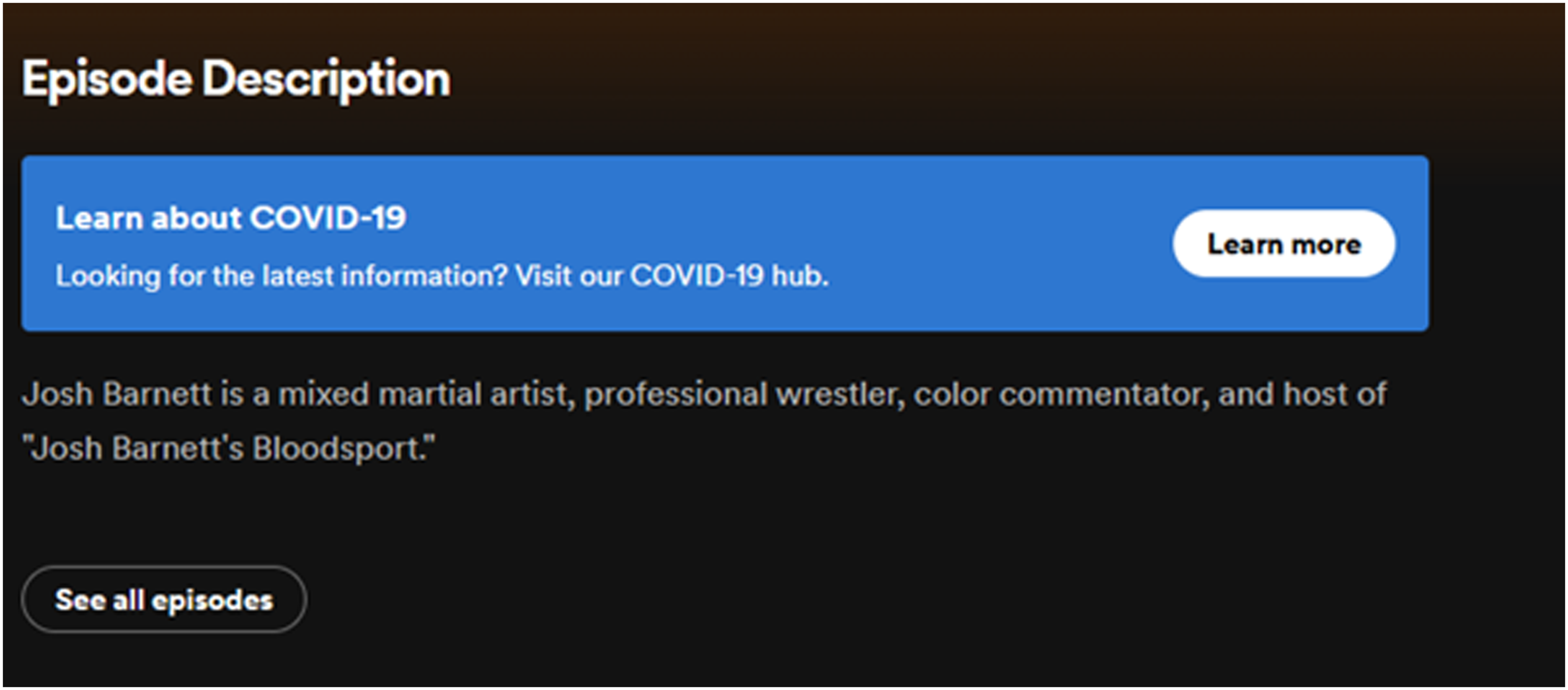
Clicking the link ‘Learn more’ would lead to a COVID-19 Guide (see Figure 2 below), containing news and updates in the form of audio content. The Guide also contains a link which leads to vaccine information from WHO.
10
Screenshot of Spotify’s COVID-19 guide.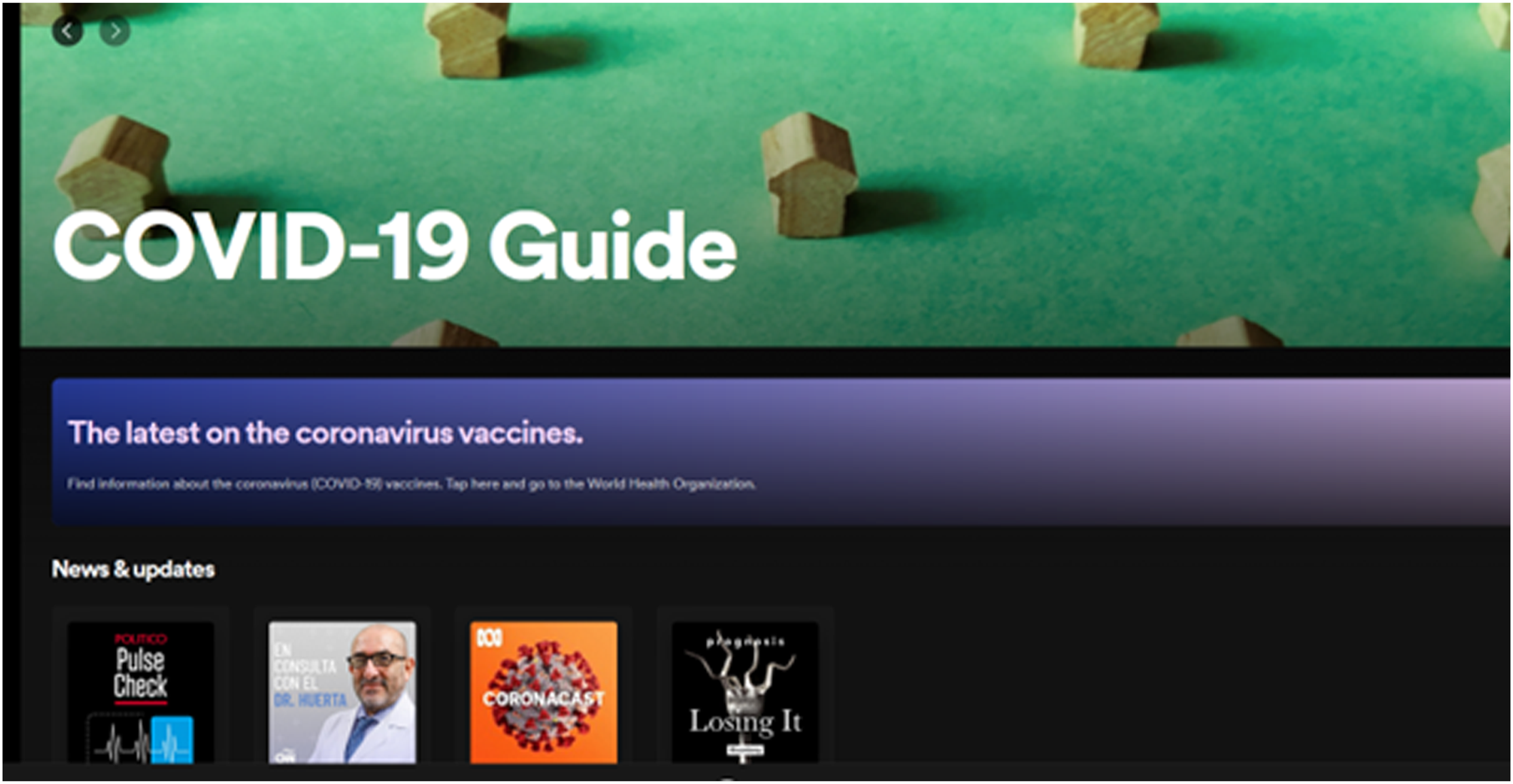
Spotify also, as mentioned above, published its Platform rules (Spotify, n.d.-b), originally (as per Daniel Ek and Dustee Jenkins) a set of internal guidelines that had existed for a while before being made public. The rules clarify the responsibilities of various contributor types to the Spotify platform: Whether you are a musician, podcaster, or other contributor, it is important to be aware of what is not allowed on our platform. The examples in the below sections are for illustrative purposes and are not exhaustive. (…) Spotify is home to communities where people can create, express themselves, listen, share, learn, and be inspired. Don’t promote violence, incite hatred, harass or engage in any other behavior that may place people at risk of serious physical harm or death.
Among the examples of ‘what to avoid’ were ‘Content that targets an individual or identifiable group for harassment or related abuse’ and ‘Content that incites violence or hatred towards a person or group of people based on race, religion, gender identity or expression, sex, ethnicity, nationality, sexual orientation, veteran status, age, disability or other characteristics associated with systemic discrimination or marginalization’. Spotify also warned against ‘Content that promotes dangerous false or dangerous deceptive medical information that may cause offline harm or poses a direct threat to public health’.
In terms of what violations may result in for content creators, Spotify can remove ‘violative content’ from the platform and may also suspend or terminate creator accounts for ‘Repeated or egregious violations’. However, as a company which controls its platform with an array of algorithmic functions for discovery and recommendation, Spotify can also, as per the same Platform rules, restrict the discoverability of content which ‘comes close to the line but does not meet the threshold of removal under our Platform Rules’. In such instances, the company may for instance keep the content up, but make it ‘ineligible for on-platform promotion, reduced within recommendations, ranked lower in search results, and/or excluded from some Spotify product features’. 11 Spotify also has a Brand safety policy which allows for restricting content monetization, meaning that ‘content is subject to review against our Brand Safety policy prior to monetization’ (Spotify, n.d.-a).
As a follow-up to the establishment of the Platform rules and content regulatory measures, Spotify also set up a Safety advisory council in June 2022 (Naomi, 2022a), similar to Facebook’s Oversight Board, established in 2020. According to the accompanying press release, the mission of the council is ‘to help Spotify evolve its policies and products in a safe way while making sure we respect creator expression’. The council members (the founding members include 18 names) will advise Spotify, but ‘will not make enforcement decisions about specific content or creators’. Among the members of the Advisory council are the founders of Kinzen, which Spotify later acquired in October 2022. Kinzen is a tech company which uses machine learning and human expertise ‘to analyze potential harmful content and hate speech in multiple languages and countries’ (Naomi, 2022b).
One of the other measures that were put in place following the conflict over JRE, was the establishment of a $100 Million Creator Investment Fund, also called the Creator Equity Fund, ‘for the licensing, development, and marketing of music (artists and songwriters) and audio content from historically marginalized groups’ (Aswad, 2023). The fund received criticism for not having a ‘well-structured, clear system for vetting and approving projects or allocating money’ (Aswad, 2023) and thus not spending more than 10% of the fund during the first year. By coincidence or not, the size of the fund mirrors the amount first reported to be paid by Spotify for the exclusive rights to JRE.
Discussion and conclusion
One of the striking features of how the Spotify v. Rogan case played out, is the sense that neither party was entirely prepared for what would come. Despite a $200 mill deal and what we can only assume are extensive due diligence checks, the impression left is that Spotify failed to see what they had acquired. The company leadership seemed to improvise its public relations in the wake of the open letters from the medical community and from Neil Young. As the company was branching out into podcasting and other non-music domains, Spotify also entered new terrain in terms of the responsibilities and expectations they may face. The pushback after acquiring exclusive rights to JRE is a prime example and arguably Spotify’s first major public trial as something more than a music intermediary. Arguably, the case revealed an ad hoc approach to decision-making and a lacking awareness of the responsibilities that come with assuming a gatekeeper function.
The different meanings assigned to the terms ‘platform’ and ‘publisher’ helps shed light on what took place. Traditionally, (self-described) platform companies have been able to circumvent regulation and public demands on responsibility (Flew et al., 2019; Napoli and Caplan, 2017). In their function as music streamer, Spotify has been able to maintain a role as a passive intermediary between content creators and users. As evidenced by Daniel Ek’s statement on the different roles the company has with regards to podcasting (as a publisher with Gimlet and The Ringer and a platform with JRE), the picture is not so clear any longer. Clearly, Spotify were left with a genuine dilemma, trying to figure out how to moderate Rogan without silencing him (and, most likely, breaching the contract). Both the anonymous spokesperson quoted in the Hollywood Reporter and Daniel Ek used the term ‘balance’ and ‘balancing’ to describe their approach. Besides the removal of episodes, the most tangible efforts to compensate for any negative effects or associations from Rogan’s show are the notices and links to Covid information that now sticks to any show containing discussions of the pandemic or the vaccination programmes. In hindsight, it seems clear that Spotify could and should have been more prepared. Then again, debates that contain a balancing act with freedom of expression on the one arm of the scale tend to be heated and hard to resolve in any conclusive manner (Peters, 2005).
Moreover, there seems to be less acceptance, both among the public and policy makers, that self-describing as a ‘platform’ removes any responsibility for what takes place on that platform (Flew et al., 2019). The tension between Rogan and Spotify is echoed in similar disputes involving news producers and platform intermediaries (Flew et al., 2019; Nielsen and Ganter, 2022). One aspect of the troubled relationship between platform providers such as Facebook and news media companies, is how to regulate content: How should global platforms with vast operations decide where to draw the line? Do they have the necessary competencies and experiences to make decisions that are essentially editorial?
While music streaming platforms have largely escaped the kind of scrutiny and criticism that social media platforms have been subject to, this is changing. As The Economist reported on the Rogan case: ‘The content-moderation wars have come to audio’ (The Economist, 2022). Daniel Ek’s attempt to draw a line between different parts of Spotify’s content production, arguing that they are sometimes a publisher and in other cases a platform, may make sense inside the boardroom, but fails to take into account a public which demands more from digital media moguls. The multiple measures taken by Spotify during and in the aftermath of the debate can be seen as signs that the company is taking the critique to heart. Then again, soft measures and vague promises fall into a pattern of ‘unsatisfying and insufficient exceptions’ (Annany and Gillespie, 2017: 3) that platforms resort to under criticism.
It is worth noting that Spotify’s Platform rules are phrased mainly as requirements for outside contributors, stipulating where Spotify will draw the line, but remaining vague about the company’s own responsibilities. The company’s so-called Band Manifesto (a declaration of company culture) states unequivocally that ‘We move fast and take big risks’ and that ‘complicated processes and guidelines can kill innovation’ (Spotify, n.d.-c). Meanwhile, the chain of events from open letters by medical professionals and aging rock stars, to R&B artists protesting racist language to internal staff turmoil and a massive media attention – all packed into a short period of time – indicates that Spotify as a company will find it harder to embrace the same kind of ethos that Facebook came under criticism for (‘Move fast and break things’).
The dispute between Joe Rogan and Spotify evidently strained the relationship between the two parties. Rogan has revealed on his own show that it was ‘touch and go’ whether Spotify was going to cancel his deal (Bennett, 2023). He has also claimed that he intends to leave the deal if he ‘has to walk on eggshells’ (Sparks, 2022). For Rogan, the case represents a first encounter with the logics of mainstream media. His unpreparedness is more striking than Spotify’s, but comes as less of a surprise, as it serves as part of the podcast star’s casual and unrestricted credo. As he noted: ‘I didn’t plan it, I can’t believe it’s as successful as it is’. Still, a part of the commercialization and platformization of podcasting is that it is no longer a separate and unregulated sphere. The defense of ‘I’ve never tried to do anything with this podcast other than just talk to people and have interesting conversations’ is in fact no longer feasible, not least because Rogan is now associated with a company with ‘Platform rules’, content advisory notices, and a Safety advisory council. This is a far call from the wild west of podcasting past.
The exclusivity of the deal with Spotify in fact ties Rogan even more closely to the company than it would for a regular third-party contributor, such as a music artist. It would still be simplistic to suggest that Rogan is a victim of creator platform-dependency. Streaming platforms’ relationships to content providers is complicated, with creators often seen as the most vulnerable part (Colbjørnsen, 2021). Streaming platforms need lots of content, but also something that stands out. As such they do place value in (good) content, but that value is barely reflected in the pricing of the streaming bundles (Colbjørnsen et al., 2021). Because of the exclusive licensing deal, Rogan is an exception to the general rule, a point made clear by India.arie in her comments to the case. More than anything, Rogan is a massive star who could quite likely break with Spotify and return to YouTube, still with a huge following. This is not an option open to all. Arguably, he is both less ‘platform dependent’ than most other platform creators and his content is less ‘contingent’ upon changes in platform governance than is the case for most social media creators (Nieborg and Poell, 2018). Rogan’s position is more aligned with the suite of big content creators who exert ‘significant influence on platform fortunes’ (Cunningham and Craig, 2019: 7). Still, Rogan’s story can point to the vulnerability of smaller creators in a platformized media world, bringing into light the kinds of struggles over control and creativity that are often hidden from the public eye.
Multiple worlds collided in the Rogan v. Spotify case: Rogan’s free reign podcasting world met the realities of corporate media. Podcasting, typically associated with lax regulation, entered a new phase and a new domain of tighter regulation and corporate governance. Spotify also clashed with a new set of expectations, as the company went beyond its role as music intermediary and moved into media production. In their new role, they are likely to face many of the same struggles that social media companies have battled over the past decade and become entangled with editorial and freedom of expression debates that are not solved by setting up ground rules and diversity funds.
Footnotes
Declaration of conflicting interests
The author(s) declared no potential conflicts of interest with respect to the research, authorship, and/or publication of this article.
Funding
The author(s) received no financial support for the research, authorship, and/or publication of this article.
