




Abstract
With the accelerated growth of the sim racing industry over the last few years, research on the phenomenon has started to emerge. Nonetheless, the history of sim racing remains unmapped. This study aims to fill the gap by investigating the development in sim racing in Europe and in Asia-Pacific between 1997 and 2021. Twenty four semi-structured interviews were carried out with experts representing sim racing associations, event organizers, and teams from Europe and Asia-Pacific. Data were analyzed using an inductive-deductive codebook approach. The results show the evolution of sim racing throughout five sociohistorical stages, which demonstrate how sim racing emerged as a hybrid of esports and motorsports and has kept evolving since ‘in-between’ their respective actors until today. The findings suggest that the slow evolution of sim racing has been particularly dependent on networked sociocultural actors, while positively affected by uncontrollable events like the COVID-19 pandemic. As a key implication, we find that the history of sim racing differs from that of esports by its multifaceted dependence on the motorsports ecosystem.
Introduction
Playing videogames competitively, both in amateur online leagues and professional tournaments, has become a central part of today’s gaming and sports cultures globally. The various types of such competitive scenes, nowadays collectively referred to as esports, have both diversified and converged over the past three decades along with technological developments (Jin, 2021). As esports history has been written mostly through genres such as real-time strategy, shooter, and multiplayer battle arena (Lu, 2022a; Scholz, 2019; Schwartz, 2017), sociohistorical interest in esports outside the mainstream – such as those of fighting, card, and racing games – has only recently started to gain momentum (see Besombes et al., 2018). Understanding the social and technological development of these non-mainstream genres has significant potential to explain, for instance, why certain types of computer-mediated play ended up dominating the esports market while others did not.
The goal of this study was to empirically map out the history of one central but largely forgotten’ esports genre, sim racing (see Linderoth 2013). We concur with Paiva (2015) who defines sim racing as ‘racing simulation which focuses on the recreation of motor racing in a virtual environment in order to correspond as closely as possible to the experiences an individual feels when driving a racing car’ (p. 146). In other words, a defining element for sim racing is that it simulates existing competitive motorsports, thus aligning closely with traditional racing series like the F1. By this definition, titles such as Mario Kart are not typically considered sim racing because they do not simulate any existing motorsports form; however, there is no consensus on the definition and different views have been suggested. For example, Robeers has more widely defined sim racing as ‘organized video racing competitions that take place online and across different platforms including personal computers and gaming consoles’ (2020, 2). Olsen (2015), in turn, includes all forms of racing games into the sim racing category. In the context of these views, our understanding of sim racing is specifically tied to the technical and simulative aspects of racing (Figure 1). Assetto Corsa sim racing setup. Chassis: SimLab P1-X. Steering wheel: Ascher F64 V1. Basis: VRS DirectDrive. Pedals: Heusinkveld Ultimate. Screen: AOC C32G1 (x3).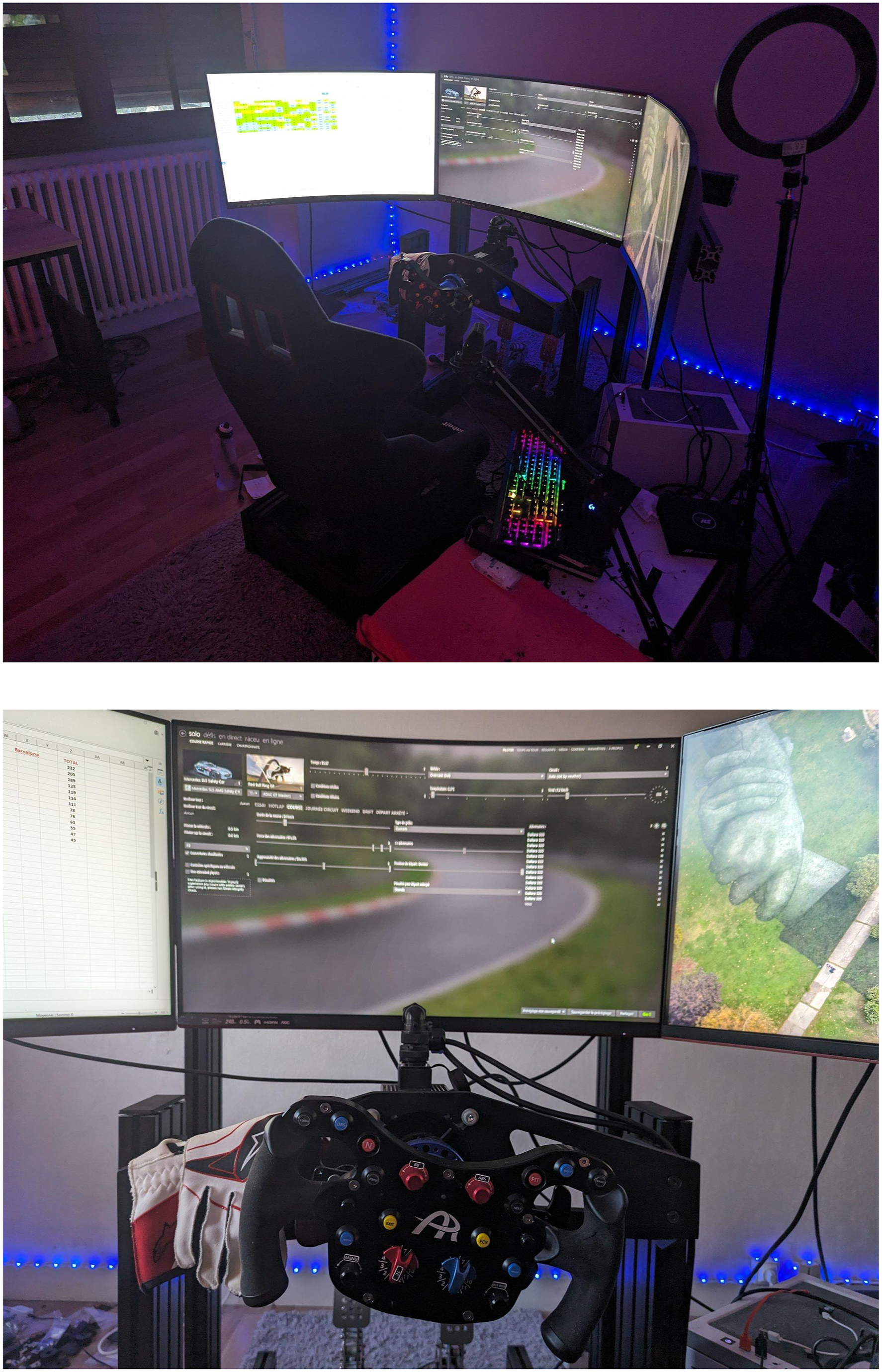
Grand Prix Legends world championship in 1998 represents perhaps the first major sim racing event. In the early 2000s, arcade style sim racing titles started to be included in other esports tournaments. This was the case, for instance, for the ESL Pro Series 2002, the Major League Gaming (MLG) 2004, the World Cyber Games (WCG) between 2004 and 2008, the Electronic Sports World Cup (ESWC) 2005 and the Championship Gaming Series (CGS) 2008 (Lu, 2022a; Olsen, 2015). Aside from popular arcade games like Gran Turismo (Polyphony Digital) and Formula 1 (EA Sports and Codemasters) series, sim racing development also benefited from new highly realistic titles such as iRacing (https://iRacing.com Motorsport Simulations, 2008).
Despite the relatively small player numbers across racing titles, the International Olympic Committee has recently expressed interest toward Gran Turismo Sport (GT Sport, Polyphony Digital, 2017) for the Olympic Virtual Series in 2021 (Abanazir, 2022; Chanavat, 2023) and on Gran Turismo 7 (Polyphony Digital, 2022) for the Olympic Esports Series in 2023 (CIO, 2023). During the COVID-19 pandemic, sim racing also supplanted most traditional motorsport competitions, which at least temporarily increased its global sociocultural status (Goldman and Hedlund, 2020; Kovács and Szabó, 2022; Tudor, 2020; Witkowski et al., 2021). In this respect, initiatives such as the ‘Not the Australian Grand Prix’ emerged for F1, the ‘IndyCar iRacing Challenge’ for IndyCar and the ‘24 Hours of Le Mans Virtual’ for endurance racing.
In order to better understand the sociohistorical frames through which sim racing is now emerging as a serious competitor to previously dominant esports forms, our study utilizes a large number of leading stakeholder interviews. Our expert interviewees come from Asia-Pacific (APAC) and Europe, and through their retrospective narratives, we aim to model the main historical stages related to the development in sim racing in Europe and in Asia-Pacific, starting from 1997 (year before the first major event) and 2021 (year before the interviews). The research responds to a need for better recognizing sim racing practices as part of esports history (Xu, 2023; Zhu, 2020) and the motorsport industry (Burg and Planing, 2020; Malinen, 2019). After the analysis was done, we found the theoretical framework of Actor-network theory (ANT) useful for reflecting on the historical developments of sim racing: ANT acknowledges also non-living and abstract actors as effective, connected variables alongside living subjects and groups (Latour 2005). Because the analysis and our deductive categories were not influenced by ANT, these theoretical details will not be further addressed before the discussion. Next, we review the overall developing stages of esports to contextualize the upcoming historical findings on sim racing in the wider esports frame.
History of modern esports from 1997 to 2021.
Esports history has become a major object of study in the past decade (Besombes, 2023; Borowy and Jin, 2013; Bousquet and Ertz, 2021; Hiltscher, 2013; Jin, 2020; Lu, 2022; Olsen, 2015; Scholz, 2019; Schwartz, 2017; Seo, 2013; Snavely, 2014; Suominen et al., 2018; Taylor, 2012). In this literature, Scholz (2019) and Besombes (2023) provide clear chronological steps regarding the progress of modern esports since 1997. For the purposes of the present empirical study, we apply Besombes' (2023) five stages of esports evolution, which is helpful for organizing our qualitative data later. We present the stages briefly below.
1997-2007: Esports as a niche phenomenon
Esports remained an epiphenomenon until the Red Annihilation on Quake in 1997 – a tournament that gathered nearly 2000 players and provided the winner a Ferrari 328 GTS. After this event, FPS games like Counter-Strike, Quake II and Quake III Arena became popular in occidental countries (Mora and Héas, 2003). This led to the creation of new tournaments and leagues by entrepreneurs such as the Cyber Professional League (CPL) in 1997, the Electronic Sports League (ESL) in 2000, the Major League Gaming (MLG) in 2002 as well as the QuakeCon from 2001 to 2005. Meanwhile, esports cultures were also spreading in China thanks to internet cafés (wangbas) populated by Counter Strike 1.5 and Warcraft 3, eventually leading to the thriving of Dota (BBKinG著, 2015; Dongsheng et al., 2011). In South Korea, a similar wave manifested by the popularization of RTS games such as StarCraft and Warcraft across PC Bangs (e.g., Stewart and Choi 2003) and new international tournaments like the WCG in 2001. Esports then converted into a worldwide legitimate business for teams notably when SK Gaming became in 2003 the first non-Korean to sign a player contract (Scholz, 2019). South Korean broadcasting at national television was seen by North American esports actors as the benchmark to reach new audiences and income sources despite the launch of social media like YouTube and Dailymotion in 2005 (Li, 2017; Scholz, 2019). Hence, multiple competitions like the CPL and the World Series of Video Games (WSVG) were broadcasted on channels like MTV and CBS network.
2008-2009: The first recession of esports
In 2008, the esports industry was hit by the global economic recession. Besides the disappearance of major tournaments like the CGS and the CPL in 2008 and the ESWC in 2009 (Besombes, 2023), historic sponsors such as AMD, Intel, Nvidia and Samsung also stopped their esports involvement. Resulting from this crisis was the incapacity of core esports stakeholders to practice their business models (Besombes, 2016). In 2009, professional teams like Meet Your Makers filed for bankruptcy while many others withdrew from the esports scene (Scholz, 2019). In this context, the remaining esports actors started to reinvent their business models (Li, 2017). Esports governance was also reinforced with the birth of the International e-Sport Federation in 2008 (Thiborg 2009).
2010-2014: Spectacularization of esports
At a time when the most practiced titles such as Quake III Arena (id Software, 1999), Counter-Strike: Source (Valve, 2004) and StarCraft (except in South Korea) were losing their leading positioning in the esports industry (Besombes, 2023), IeSF was trying to resurrect international competitions by launching the IeSF Challenge (2009). Scholz (2019) states that this market recovered from the economic crisis thanks to three phenomena: the launch of League of Legends (Riot Games, 2009) and StarCraft II (Blizzard Entertainment, 2010) as well as the creation of Twitch in 2011. In fact, the emergence of these practices was followed by the organization of new major tournaments such as the Global StarCraft II league in 2010 and the League of Legends (LOL) World Championship in 2011. Live streaming platforms were now able to provide esports stakeholders a vision of their audience, which allowed them to adjust business models. Resulting from this was an increase in both the number of tournaments and prize money allocations.
2015‐2019: Popularization of esports
From 2015 to 2019, the arrival of new non-endemic sponsors into the esports industry contributed to the professionalization of its main stakeholders as the number of competitions and cash prizes allocations were skyrocketing (Jenny et al., 2018). Partnerships between key esports actors and international established companies became more common with associations like MasterCard with LCS in 2018. This period also coincided with the multiplication of sport organizations’ involvement in esports (Lefebvre et al., 2020; Scholz et al., 2021), the stabilization of its main esports scenes and the birth of new competitions like the ELEAGUE (CS:GO, 2016). These observations were further reinforced by five phenomena. First, the entry of battle royale games like Fortnite (Epic Games, 2017) and PlayerUnknown’s Battlegrounds (PUBG, Krafton, 2017) on the esports market led to new major competitions in 2019 like the PUBG Global Championship and the Fornite World Cup. Secondly, mobile games were emerging as new competitors to computer and console games with popular titles like Hearthstone (Blizzard Entertainment, 2014), Arena of Valor (Tencent Games and Garena, 2016) and Mobile Legends: Bang Bang (Mooton Games, 2016). Thirdly, live streaming platforms became more popular and were hence increasingly used by esports stakeholders to promote their activities and to increase their revenues. For instance, Electronic Arts (EA) relied on streamers to advertise Apex Legends (EA, 2019) to compete with Fortnite and PUBG (Boyle, 2019). Fourth, esports major competitions were now increasingly organized inside sporting and cultural big facilities and smaller dedicated ones built for esports (Jenny et al., 2018). Finally, new esports governing bodies emerged to regulate this industry (Chikish et al., 2019) both at the global stage like the Esports Integrity Commission (ESIC, 2016) and the World Esports Association (WESA, 2016) and at the national level such as the United States eSports Federation (2018), which joined an ecosystem of nearly one hundred national esports federations (Besombes, 2019; Witkowski, 2023).
2020-2021: Second recession of esports and new growth and recognition phase
According to Besombes (2023), 2020 can be seen as a second recession for the esports market because the prize money allocations from competitions decreased 77% between 2019 and 2020 due to the COVID-19 pandemic. In this respect, travel restrictions, lockdown episodes and sanitary protocols render offline esports events more difficult to organize. However, esports quickly recovered from this second recession (Xu 2023: p. 1). Unlike most traditional sports like football which could not continue operating in normal conditions during the pandemic (Parnell et al., 2020), esports became ‘a digital alternative to multiple major sporting events which had been postponed or cancelled’ (Xu 2023: p. 4). For instance, IndyCar and Formula 1 used sim racing through virtual grand prix as a replacement of motorsports during COVID-19 to keep their fans active (Tudor, 2020; Witkowski and al., 2021). As a result, esports practices received more recognition from major sporting institutions like the International Olympic Committee (Abanazir, 2022), Asian Games (Olympics, 2021), and the 2021 SEA Games (Lu, 2022b). In such circumstances, esports practices are now representing an interesting set of tools for soft power to achieve diplomatic outcomes (Wong and Meng-Lewis, 2022b). Nonetheless, esports professional players are still unequally recognized as real athletes globally and suffer from a lack of dual career support (Hong, 2022).
Preview of sim racing history
After action-based racing games like Pole Position (Namco, 1982), simulated racing game franchises like Indianapolis 500: The Simulation (Papyrus Design Group, 1989) and Formula One Grand Prix (MicroProse, 1991) brought racing realism to a new level on home computers. Meanwhile, arcade cabinet games like Winning Run (Namco, 1988) and Hard Drivin’ (Atari, 1989) provided more holistic experiences outside homes. It was not until the late 1990 s, however, when the technical developments enabled sim racing to succeed on console platforms (Karhulahti and Grabarczyk 2021), namely, with the ‘simcade’ Gran Turismo (Japan Studio/Polyphony Digital, 1997) on Sony PlayStation as one of the first successful games. Since the mid 2000 s, the range of racing games has spread over platforms, optioning on difficulty, communities, and levels of simulation. From the subscription-based PC game iRacing (https://iRacing.com Motorsport Simulations, 2008) to the Forza Motorsport (Turn 10 Studios, 2005) series on XBox and unofficial simulation mods, the current sim racing scene is diverse. As in other esports, the developments in live streaming, online fanbases, and professional broadcasting have become central. In what follows, our goal is to further understand how these elements construct sim racing history.
Methods
To retrospectively map out the history of sim racing in the Asia-Pacific and Europe, our goal was to carry out 10–15 interviews in both geographical regions with experts who have been involved in the field locally. We chose the Asia-Pacific/Europe as our target because it allows generating much-needed cross-cultural data in countries where motorsports have historically held major sociocultural positions – while also keeping the study focused, which would not have been possible had we pursued a global sample. The first author’s ethics committee was consulted about ethics review. Because the study applied a standard interview protocol and did not deal with sensitive or other data with increased risk of harm, the work did not require a local ethics committee review. The participants were informed about the study beforehand and they all consented to be interviewed. Most participants were willing to share both their identities and full transcripts for reuse, however, as multiple participants also wished to remain anonymous, we decided not to reveal any identities nor process any transcripts for reuse. All participants joined the study voluntarily and had the opportunity to withdraw their participation any time until they had reviewed the results and the manuscript was submitted to peer review.
Data and participants
Breakdown of interviewees.
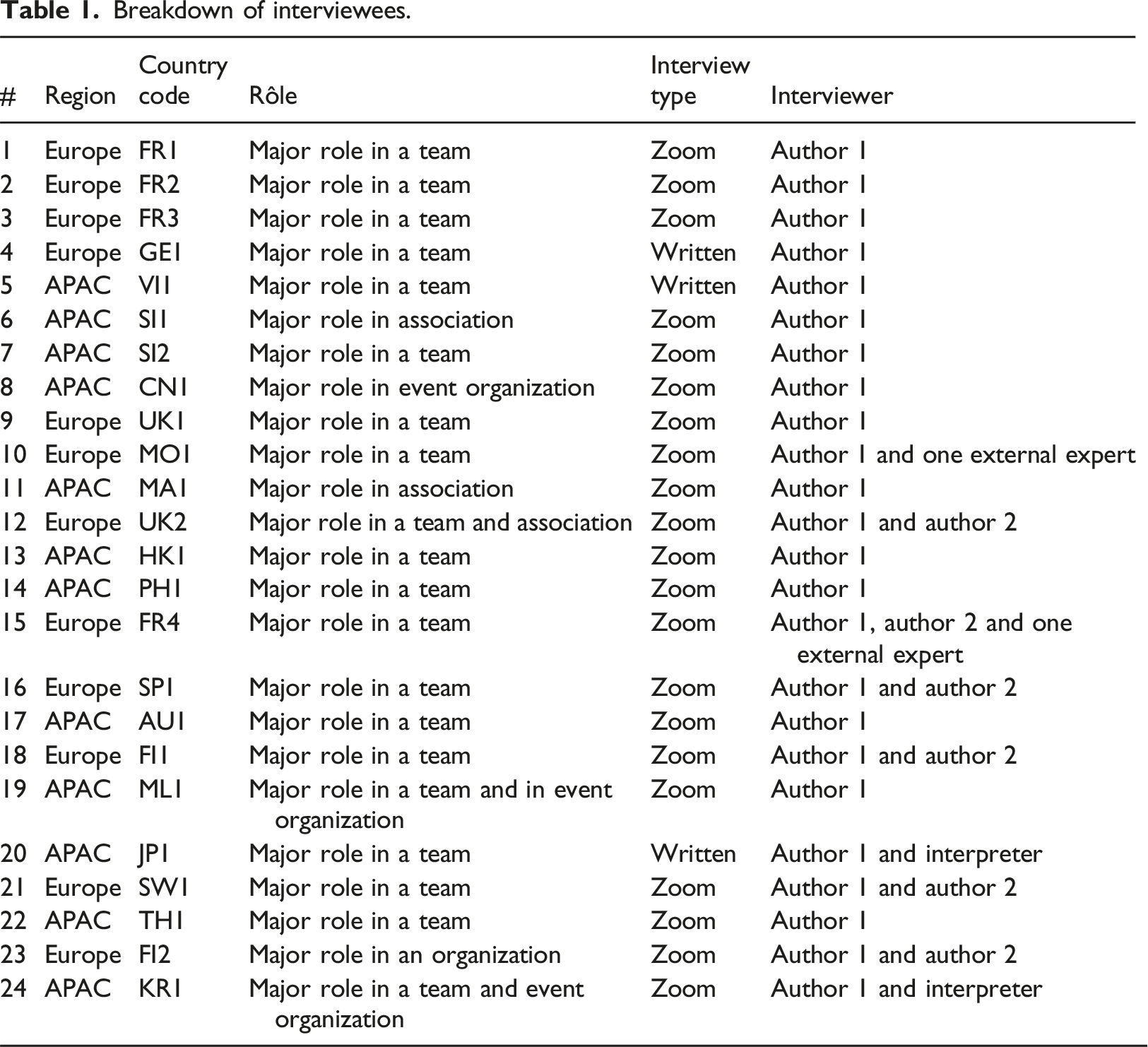
To reach participants, we approached 51 regionally relevant sim racing organizations via email, LinkedIn, or Twitter and invited their long-term representatives for an interview. Only one participant from each organization was included. To identify such organizations, we used snowballing by asking experts for relevant organizations and also retrieved the data from Esports Earnings website to find the most relevant tournaments in sim racing history based on prize money (Appendix 1). These tournament organizers were contacted. In the end, 24 experts consented for an interview.
Out of the 24 experts, 12 came from the Asia-Pacific region and 12 from Europe. All interviews were carried out by using remote Zoom software, except for three participants who did not wish to arrange an interview time. These three participants were provided the option to answer a structured set of interview questions in writing. The remaining 21 participants were interviewed by using a semi-structured interview frame (Appendix 2). The interviews lasted between 42 and 141 min with an average of 89 min. They took place between July 2021 and February 2022. The youngest participant was 21 years old and the oldest 45 (M = 32, SD = 6,8). The participants had personally been involved in sim racing from 1 to 24 years (M = 12, SD = 6,6).
The first and second author conducted all interviews and in two interviews an external expert was present. Both interviewers are academic experts in sim racing with long-standing personal interest in motorsports, which facilitated interviewing. Both interviewers are native Europeans (France and Finland) and identify as male (as did all interviewees), which notably positions both the data and their analyses. The sim racing scene is very male-dominated, and studies explicitly investigating gender are needed to shed further light on this topic. Although the first author has lived and worked in Asia for 9 months and the last author has carried out research in Korea, two external experts of Asian esports research were consulted for feedback after the analyses in order to seek a cultured insider opinion about the findings. The feedback was taken into consideration. Additionally, as a member check, all interviewees were offered to comment on the results after analyses. Ten participants responded and generally agreed that the results corresponded with their views; small edits based on all the above consultations were made in the final writing phase.
Analysis
The data were analyzed in two phases: inductive and deductive. The Asia-Pacific and European data were managed separately to enable regional comparisons. The first author analyzed 14 (9 + 5) transcripts and the second author analyzed 10 transcripts (7 + 3). In the inductive phase, the first two authors openly coded all the data into potentially relevant historical codes, which they clustered into categories by similarity. In total, the first author identified 91 codes and the second author 540 codes, which reflects a difference in coding style (see Appendices 3, 4 and 5). By the tradition of Saldaña (2016), a codebook was created for deductive analysis in the second phase (Appendix 6). The generated codes and categories were deductively inserted to the previously introduced historical stages established by Besombes (2023), which was collectively discussed to establish consensus of stage descriptions. This allowed generating a parallel chronology of historical stages for sim racing. For each stage, both authors established the dominant categories in their data, after which all authors met twice to negotiate an agreement upon each stage and their descriptive title, respectively, for both regions (Figure 2). Development stages with esports adapted from Besombes’ (2023) chronology.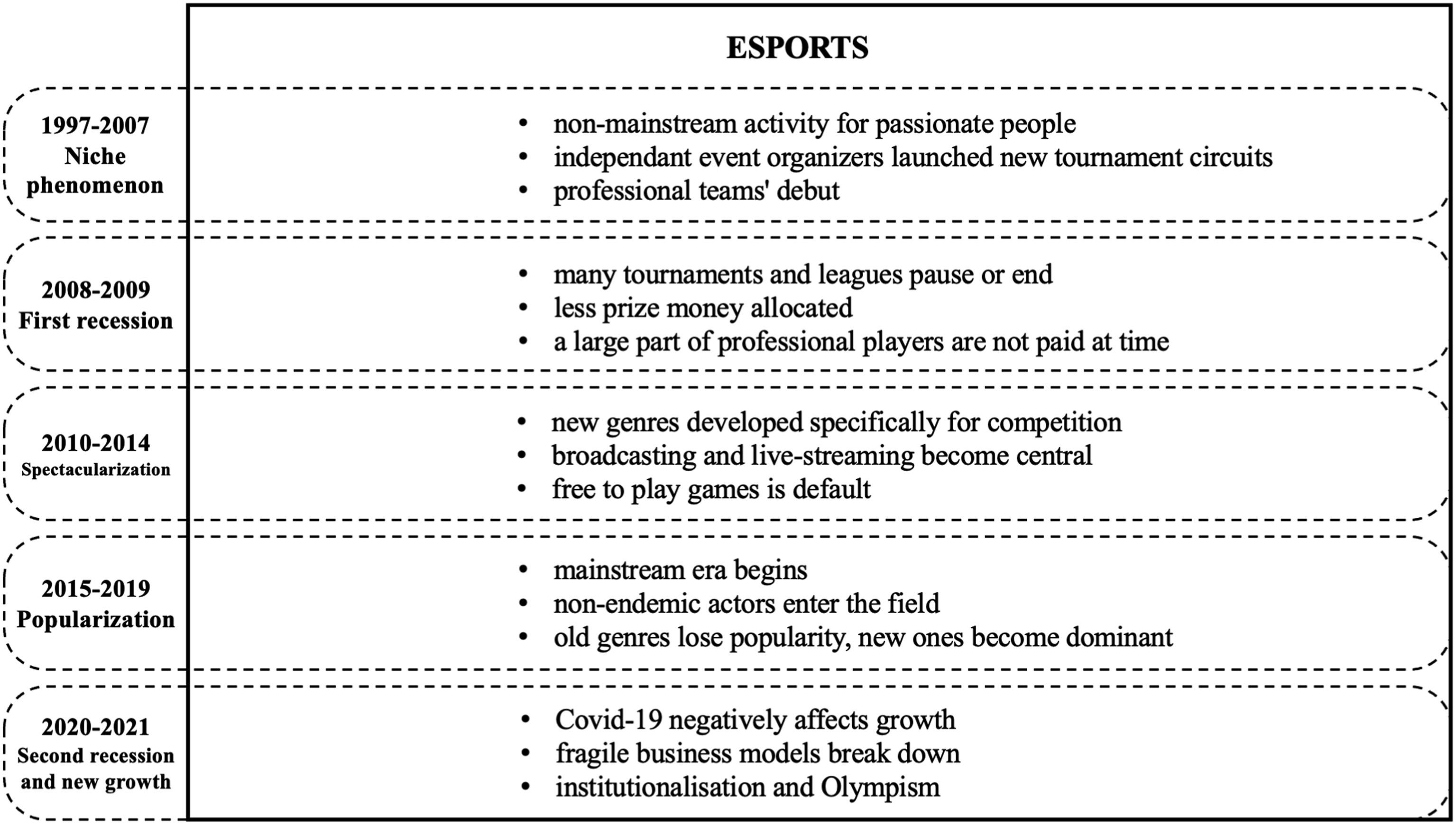
Below, we disclose the results separately for each region stage-by-stage. In order to transparently present the volume of sources forming the basis for each stage, we also report how many interviewees discussed the respective stage in their transcript. We prioritize brief direct quotes with stage-specific context summaries over close description by longer quotes; after all, the goal of this study was to construct an historical narrative of sim racing.
Results
Stage 1: 1997–2008
Europe (n = 8)
Spinoff from motorsport with numerous niche games
In the second half of the 1990 s, playing racing games on arcade terminals like Sega Rally Championship (1994, Sega) constituted ‘the beginning of sim racing’ (MO1) in Europe. Although competition was hardly institutionalized, such titles enabled players to locally race with each other. Aside from arcade games, sim racing practices mainly started to grow in the early 2000 s due to the launch of console games that followed Gran Turismo’s (1997, Polyphony Digital) commercial success (see https://duniagames.co.id/discover/article/15-game-playstation-1-terlaris-sepanjang-masa/en
Asia-Pacific: (n = 9)
Birth of racing game communities
Similar to Europe, the early days of sim racing practices in the Asia-Pacific also coincide with the development of racing in the arcade and consoles. From the 1990 s to early 2000 s, titles like Formula One based games and the Gran Turismo franchise ‘were quite huge in this part of the region’ (SI2). Benefiting from the popularization of the internet, gaming communities emerged in the APAC area around 2000 for simulations like Grand Prix Legends (1998, Papyrus Design Group) and Life for Speed. Nevertheless, those communities were small ‘as the first sim racing league [Life for Speed] in Hong Kong only gathered about 20 people’ (HK1). In the following years, sim racing practices in the APAC region remained niche and major physical competitions were rarer than in Europe. Some pioneer offline tournaments took place such as that of Need for Speed: Underground 2 during the WCG 2005 in Singapore and ‘the Gran Turismo 4 Nihon-Ichi Ketteisen at the Suzuka circuit in 2006 which stands for the first sim racing event in Japan’ (JP1). The end of this era is marked by the simultaneous creation of multiple online leagues within the APAC region. One interviewee mentioned that ‘there was an Australian league ran through a forum on GTR 2 (SimBin, 2006), which simulated the GTOne season in Europe back then’ (AU1). Another respondent highlighted that he ‘started sim racing from 2006 on Race 07 (SimBin, 2007) and kept racing as several teams from Macau and Hong Kong created the servers and competed each other’ (MA1).
Stage 2: 2008–2009
Europe (n = 5)
Recession, stagnation, and lack of organization
The development of sim racing in Europe was still mainly limited to arcade games in 2008. Competitions were very scarce and restricted to offline conditions as was the case on Need for Speed: ProStreet (2007, Electronic Arts) and Project Gotham Racing 4 (2007, Bizarre Creations) for the WCG 2008 in Germany. In this context, early signs of professionalization appeared especially by CGS on Forza Motorsport 2 (2007, Turn 10 Studios) in America. This event gathered players from all over the world that were ‘paid 2000 dollars (per month), fed, housed and laundered’ (FR2) to compete for a prize money of 207 000 dollars. However, ‘this championship fell apart with the subprime crisis’ (FR2). Aside from the termination of major events like the CGS, sim racing expansion was also hindered by a general lack of organization as we found no single European event delivering prize money in 2009. In those complex circumstances, 2008 was nonetheless identified by some interviewees as the ‘early stages of sim racing’ (FR3) due to the birth of Nissan PlayStation GT Academy. The program took place from 2008 to 2016 and provided the possibility for sim racers to transition from virtual to real motorsport, thus contributing to democratize sim racing practices which ‘were very niche before it’ (UK1).
Asia-Pacific (n = 4)
Community stagnation
The global recession also hit the Asia-Pacific region. After the early termination of the CGS in 2008, major sim racing physical events were worldwide exclusively limited to the participation of arcade games, as in the WCG 2008 (Germany) and 2009 (China). At this time, both computer and console sim racing offered players the chance to compete online but tournaments with prize money remained scarce and restricted to offline conditions. This was notably due to a lack of organization within the sim racing communities and a lack of interest from sim racing game publishers towards esports ‘at a time where esports was not sufficiently developed’ (UK1) and was affected by an economic crisis. Online amateur competitions were still growing globally, as some titles like Forza Motorsport 2 ‘were so ahead of their time as it was possible to find a tournament bracket to race online and eventually end up in a final lobby against the best (players)’ (UK1). Yet, this time also coincides with the birth of new local sim racing communities like those around rFactor in Hong Kong in 2008.
Stage 3: 2010–2014
Europe (n = 7)
Semi-professionalization and organized competition
Between 2010 and 2014, offline sim racing tournaments offering significant prizes became scarce in Europe despite France holding a Need for Speed: Shift (Electronic Arts, 2009) competition during ESWC 2010 and ‘a LAN on Forza Motorsport 3 during Paris Games Week 2010’ (FR1). Conversely, online communities were rising both on console and computer platforms. Regarding those of consoles, ‘Formula 1, Forza Motorsport and Gran Turismo communities were particularly important’ (FR4) as reflected by the organization of the ‘2010 French Forza Motorsport 3 Championship which gathered over 5000 players over six months’ (FR2). However, the main sim racing teams evolving on those titles were still far away ‘from reaching a professional level’ (SP1) as most competitions were providing little to no financial rewards. This period was marked by the development of the first globalized sim racing competitions such as the Formula Sim racing World Championship (FSR) on rFactor (i.e., an annual league existing since 2010) and the World Championship Grand Prix Series (WCGPS) on iRacing (2008) – an annual league existing in 2010 and between 2012 and 2018. For instance, the FSR ‘which was a dream for any sim racer to win […] also attracted real-life drivers like the former McLaren F1 driver Stoffel Vandoorne’ (FR2). Those prestigious championships like the FSR and the WCGPS ‘which created legends [e.g., Bono Huis and Greger Huttu]’ (FR2) were still unable to deliver bigger prize pools than major arcade tournaments in the 2000 s. In this context, making a stable living from sim racing constituted an exception only limited to a few elite sim racers.
Asia-Pacific (n = 10)
Reignited interest with competitions and skepticism
At a time where competitions became more global and online centric with best competitors from the biggest leagues coming mostly from European (e.g., on rFactor) and American (e.g., on iRacing) continents, interest in sim racing was reignited and led to breakthroughs in the APAC region. Regional leagues started to appear, such as Sim Racers Asia in 2011. The 2010–2014 period also coincides with the early stages of sim racing new national leagues beginning with Gran Turismo Singapore in 2010. One interviewee from Australia was for instance reporting the formation of ‘iRacing events like the Porsche Super Cup in 2012–2013’ (AU1) while another discussed the creation of ‘local leagues organized by Sim racing Philippinas since 2010 in the Philippines firstly on rFactor, GTR 1 (Simbin, 2005), GTR2 and later on Gran Turismo 5 and 6’ (PH1). Another interviewee highlighted the development of ‘local online small leagues on Assetto Corsa (2014, Kunos Simulazioni) in South Korea which notably grew thanks to the participation of real-life drivers and to the popularization of sim racing in some PC Bangs’ (SK1). However, offline sim racing competitions were still voiced to be scarce. The best sim racers from those countries had to travel far away to participate in global competitions as ‘one Vietnam Racing Zone member did for the WCG 2010 on Forza Motorsport 3’ (VI1). Nonetheless, the further development of the GT Academy program led to the organization of new offline events such as the Gran Turismo Asia Championship in Yokohama in 2012. Furthermore, the expansion of the GT Academy to Asia in 2014 and 2015 also contributed to extending the popularity of sim racing in many countries such as Australia, India, Indonesia, Japan, Malaysia, Philippines, and Thailand.
Stage 4: 2015–2019
Europe: (n = 11)
Institutionalization and transition to high stakeholder involvement
The launch of Project Cars (2015, Slightly Mad Studios) was a ‘key point in sim racing growth both in France and internationally, as most of the concepts that we are seeing nowadays are the results of Project Cars’ (FR4). ‘Very popular at its beginning’ (GE1), many small online tournaments were hosted on this platform but esports events dwindled after the transition to Project Cars 2 (2017, Slightly Mad Studios). A second key transformation relates to the establishment of new competitions supported by motorsport stakeholders like the Federation Internationale de l’Automobile (FIA) such as the World Rally Championship (WRC) esports program on WRC 5 (2015, Bigben Interactive) in 2016, the F1 Esports Series in 2017 and the GT Sport World Tour. These latter two competitions were built on opposite pillars, as the F1 Esports Series ‘was quite exclusive while GT Sport World Tours were more inclusive and accessible’ (MO1). In fact, the F1 Esports Series fostered sim racers’ professionalization as players could aspire to win prize money and earn ‘full time wages’ (UK2) provided by F1 teams – while GT Sport World Tours were conceived as ‘very dynamic shows’ (FR1) which do not financially reward participants. This period coincides with a wider democratization of highly realistic sim racing games like iRacing, rFactor 2 (2013, Image Space Incorporated), RaceRoom Racing Experience (2013, Sector3 Studios) and Assetto Corsa. Notably, the latter ‘has gone so far that there was no longer any need to go to a specialized room and pay a lot to play on a realistic simulator because Assetto Corsa democratized this trick by allowing everyone to experience realistic sensations’ (MO1). These titles were increasingly contributing to bridge virtual and traditional racing. The Visa Vegas eRace in 2017 symbolizes this observation as ‘sim racers were competing alongside real drivers […] for a one million US dollars cash prize’ (FR2). Apart from GT Academy program which terminated in 2016, competitions allowing to transition from virtual to real driving were more common as new initiatives emerged such as the World Fastest Gamer (2017), which aimed to hire the new simulation driver for McLaren F1 team or competitions in Finland on ‘rally games to detect future talented rally drivers’ (FI2). In 2016–2017, Fernando Alonso (double Formula 1 world champion) also launched his own sim racing team with G2 Esports and the International Sim Racing Federation (ISRF) was established.
Asia-Pacific (n = 12)
Investments and transition to stakeholder involvement
Between 2015 and 2019, if Forza Motorsport 6 and 7 were considered ‘active stakeholders’ (HK1), ‘Gran Turismo was the biggest thing’ (PH1). According to one interviewee, ‘many people started switching around 2017 and 2018 to Assetto Corsa, iRacing and Assetto Corsa Competizione (2018, Kunos Simulazioni) as they were more realistic’ (TH1). Despite growing achievements of APAC players in global competitions like Joshua Rogers’ win of the Porsche Esports Supercup (PESC) 2019 edition on iRacing, international events were still dominated by European and American competitors and APAC ones providing prize money were still rare and often dependent on traditional motorsport actors. Among them, Toyota was recognized as ‘the biggest one for countries like Malaysia, the Philippines and Indonesia as they put money into it (esports competitions)’ (ML1). Aside from Toyota, other manufacturers were setting up their sim racing positioning ‘like BMW and Lamborghini who were also doing their league on ACC and iRacing’ (SI2). In this context, the institutionalization of sim racing in APAC countries was as nascent as in Europe with the emergence of a few national governing bodies such as the Macau-China Sim racing Association launched in 2016 which was ‘certified by the (local) government’ (MA1). The Sim Racing Association Singapore, established in 2019, in turn ‘gathered a community of 200 sim racers’ (SI1). Nonetheless, ‘esports was not sufficiently regulated yet and local motorsports National Sporting Authorities [labeled by the FIA as ASN] did not really know what to do with it’ (ML1). Hence, new initiatives aiming to support the development of sim racing and to promote the transition from virtual to real racing were mainly coming from a minority of motorsport athletes such as the eRacing GP launched by the former Malaysian F1 driver Alex Yoong. However, motorsport drivers creating sim racing teams and competitions remain uncommon in the APAC region as ‘sim racing was even looked down by real drivers before COVID-19 and criticized for being a hobby […] that does not match real driving’ (SK1).
Stage 5: 2020–2021
Europe: (n = 10)
Centralization and sportification
Sim racing esports practices continued to grow in Europe especially by the stabilization of competitive series that had been launched between 2015 and 2019 (e.g., F1 Esports Series, PESC and GT Sport World Tours). Moreover, the continued expansion of amateur online leagues such as the ‘Scandinavian racing leagues’ (SW1), the Premier Sim Gaming Leagues (PSGL, created in 2009), and the International Gran Turismo League (IGTL, created in 2018) helped to grow the field. In this context, the main sim racing competitions became increasingly centralized ‘behind real (motorsport) entities’ (FR4) like the Formula 1 for the F1 esports series or the Automobile Club de l’Ouest (ACO) for the Le Mans Virtual Series. In fact, such competitions ‘should be distinguished from previous sim racing major ones like the FSR which was organized by enthusiasts […] and became a world famous championship with very high added value thanks to the entry list’ (FR2). A clear gap between professional and amateur sim racing emerged and was considered a threat for the sustainability of the sim racing industry as ‘sim racers are the active players […] who hold the keys to the future directions of this sport’ (UK2). The growth of sim racing also benefited from the COVID-19 outbreak, which caused the interruption of motorsport championships while sim racing competitions continued to grow. In such circumstances, sim racing practices became even more popular among motorsport stars and many motorsport stakeholders realized how much ‘sim racing was an opportunity for them to continue to exist and even to gain fans’ (MO1). As a result, many motorsport drivers took part in the 2020 Le Mans Virtual Series ‘which would probably not happen if there was no COVID-19’ (UK1). In a similar fashion, the Not For GP series for which motorsport drivers, content creators, and celebrities competed on the F1 game was ‘a big turning point for the business (of sim racing company) as Formula 1 was quite impressed by the idea because they only appear a few weeks after’ (UK1). From there, this is not a surprise to observe the emergence of new sim racing teams launched by motorsport drivers like Romain Grosjean’ R8G project in 2020.
Asia-Pacific (n = 12)
Focused attention on developing ecosystem(s)
The well-known F1 Esports Series China Championship launched in Shanghai in January 2020. Following this, the interviewees highlighted that ‘lots of Asian tournaments were created during the pandemic’ (CN1) as ‘COVID-19 accelerated everything’ (SI2) in a period where ‘all the (physical motorsport) competitions got cancelled’ (ML1). In a similar fashion to Formula 1 in Europe or Nascar in the USA, this situation led some motorsport competitions to transition into a digital model. For instance, the V8 Supercars in Australia launched an online championship on iRacing to remain active but also ‘to try to attract younger demographics interested in esports and develop new commercial opportunities’ (AU1). In those complex conditions, key APAC sim racing event organizers like Toyota, SRO Motorsport Group, HM Engineering and Axle Motorsport pursued involvement in the ecosystem. Meanwhile, in South Korea ‘sim racing infant stages’ (SK1) progressed via ACC and iRacing communities and companies like Automanix and Hyundai, which launched the AMX Esports Championship (2021, iRacing) and the Hyundai N e-Festival (2022, iRacing VR). As APAC sim racers were no longer limited to their national leagues, joining ‘Asian major leagues [became] a way to become more professional’ (HK1). Similar ambition pushed some teams to compete in global competitions based in Europe like the Le Mans Virtual Series but ‘it remains very hard for APAC drivers to get access to top teams because all the top teams are in Europe’ (ML1). Thus, many APAC sim racers ‘are not in the position to make [sim racing] their main career for economic reasons’ (PH1). That said, the development of APAC sim racing audiences has come to constitute a unique opportunity for companies to open sim racing businesses, as did one interviewee by ‘creating a company which is providing [sim racing services] and events’ (VI1).
Discussion
The goal of this study was to empirically map out the history of sim racing. To do this, we conducted 24 stakeholder interviews with European and APAC’ participants to better understand the sociohistorical frames through which sim racing is now emerging as a serious competitor to previously dominant esports forms. Below, we specifically reflect on the historical developments through actor-network theory (ANT), which we found useful due to its explanatory power in perceiving the rich network of sim racing actors (Latour 2005). ANT facilitates the understanding of actors and agencies, which can be both social and material (Latour 2005, 71). Even though within a sociological context the use of ANT is to understand how actors (are made to) produce outcomes among a network of others, the results are not linear and straightforward: actors have their own power to influence (58–60, 71–73).
Among the few historical studies on sim racing, Olsen (2015) demonstrates how competitive arcade racing games have often been integrated within major esports tournaments since 1990 (see also Lu 2022a). From an ANT perspective, this can be interpreted as a single network edge between a tournament organizing actor and sim racing developers. In turn, Kovács and Szabó (2022) argue that the releases of titles like Gran Turismo (1997) and rFactor (2005) paved the way for the democratization of high realistic sim racing practices such as iRacing and Assetto Corsa Competizione. In ANT, the networking of such developers and titles into the following sim racing scene serves as a potential basis for development. The present study continues from these preliminary insights by constructing an empirically grounded international sim racing history, with a few selected actors and their connections highlighted.
A number of historical implications can be drawn from our findings (Figure 3). First, corroborating Olsen (2015) above, sim racing was indeed widely networked with major esports events like CGS, MLG, ESL and ESWC in early days of esports history. Sim racing was also hit by the global financial crisis of 2008, yet the effects were relatively small due to undeveloped professionalization (i.e., a lack of affected actors). From 2010 to 2014, progress was slow and could not match the rapid growth of team esports like MOBAs. Between 2015 and 2019, sim racing history dovetails the general popularization of esports by advancing institutionalization, new large-scale competitions and motorsports stakeholder involvement, in a similar fashion to football organizations joining other esports (Lefebvre et al., 2020; Scholz et al., 2021). This can be interpreted as a general increase in the sim racing network size. The 2020–2021 period marks a unique historical step by sim racing linking with the Olympic movement (Chanavat, 2023), while progress in major esports countries like South Korea still taking early steps (Scholz, 2019). Comparison of sim racing development stages in Europe and APAC with esports in general adapted from Besombes’ (2023) chronology.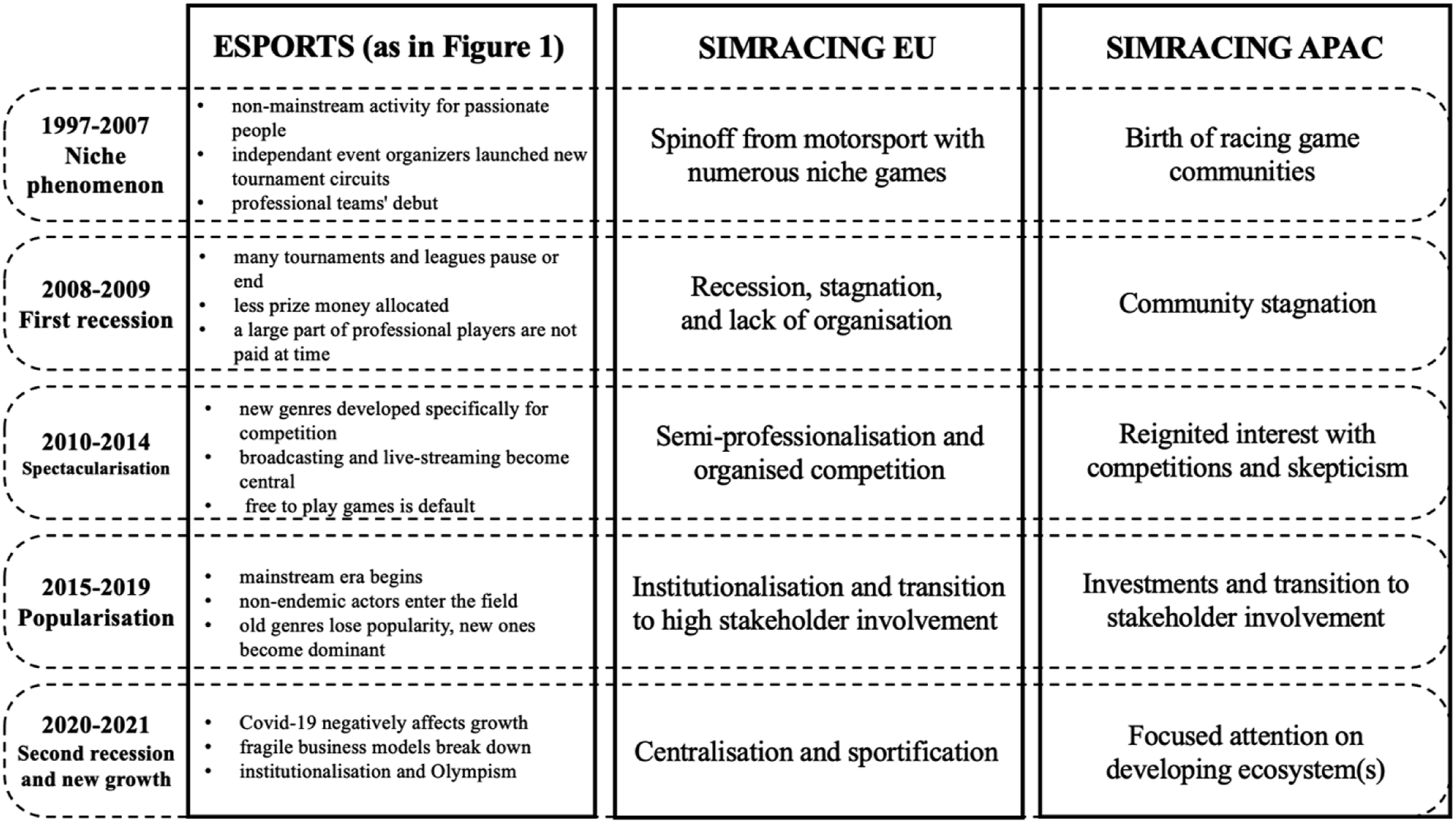
From an ANT point of view, Wong and Meng-Lewis (2022a) give an accurate description: ‘the esports ecosystem is characterized by the confluence of multiple interrelated leisure industries of sports, media, and entertainment’ (p. 1). Sim racing, due to its direct competition and link with traditional racing, additionally involves the mediatization pressures of traditional sports organizations to stay in closer contact with their audiences (Frandsen, 2016). Overall, our results suggest that, in comparison with esports history, sim racing has a dynamic life of its own that does not always match with the main characteristics and pace of general esports history. For instance, while sim racing benefited exceptionally from the COVID-19 period of 2020–2021, it did not go through a spectacularization process in 2010–2014: professionalization in sim racing was delayed and very unusual at this stage due to lacking visibility.
Altogether, we underline that the historical development of sim racing has been interconnectedly influenced by both seamless and surreptitious non-human actants (technology and its usage, material and natural resources) as well as by ‘living’ human socio-cultural and economical interests and agents (drivers and gamers, sponsors and investors, associations etc.). These include sudden major leaps (sim racing titles, tournament investments etc.) affecting the whole ecosystem. For instance, as some digital racing tournaments were held already in the 1980s (Saarikoski et al., 2017), rapid progress in computer technology made the environment fertile enough for major tournaments in the 1990 s (see Karhulahti and Grabarczyk 2021). Besides technical developments and larger sociocultural trends, sudden ‘shocks’ have also affected larger sim racing ecosystems, such as the 2008 financial crisis.
The interest towards sim racing in different countries and continents have both overlapped and differed from each other largely due to the amounts of resources and the socio-cultural status of gaming and motorsports. ANT allows us to comprehend better the amount and logic of different actors/actans connected to sim racing. For example, regarding non-human network actors, many APAC stakeholders were often dependent on European and North American tournaments and sim racing culture due to a lack of competitions, sustainable ecosystems, and level of challenge despite time zone difference and connection issues. In a similar sense on an individual level, team managers and successful star players pursue to develop the ecosystem and motivate other players and teams nationally and globally. Our historical findings suggest that although esports have been hailed as particularly dependent on technology, sim racing – as a less known genre of esports – seems to have evolved and keeps evolving even more tightly connected and dependent on different cultural actors, social groups, and uncontrollable phenomena like the COVID-19 pandemic. Unlike most other esports, sim racing has always been perceived through what it simulates (racing; motorsports) and this link is necessary to understand not only the identity of sim racing but also the sociohistorical development of esports in general.
In the end, this exploratory research also remains limited. For instance, many geographical developments, such as those of North and South America, were not mapped. In addition, our interviewees did not represent important groups, such as publishers and women. This leaves our findings incomplete and calls for follow-up research. Finally, our data concerning the first stages of sim racing history were relatively scarce due to few participants having being involved in sim racing at the time. A complete understanding of the genesis of sim racing would require alternative methodologies.
Conclusion
In this study, our goal was to investigate the sociohistorical development of sim racing in Europe and in Asia-Pacific with the help of 24 semi-structured expert interviews. Overall, our results demonstrate how sim racing evolves in networked interaction of actants from both esports and the motorsport industry. In fact, the recent development of sim racing with the notable involvement of traditional motorsports actors into this industry participate to legitimize sim racing as both motorsport and esport practices that henceforth should be taken into account in esports history. In this context, we see sim racing as a sociohistorical hybrid that strives to fit into both the esports and motorsport ecosystems, yet also seeks its own cross-cultural identity. Future qualitative research should consult sim racing experiences from unmapped geographical regions, stakeholders, and women. Looking at the data from other theoretical angles, such as stakeholder theory, might also enrich the sociohistorical understanding of sim racing globally.
Supplemental Material
Supplemental Material - Sociohistorical development of sim racing in european and asia-pacific esports: A cross-cultural qualitative study
Supplemental Material for Sociohistorical development of sim racing in european and asia-pacific esports: A cross-cultural qualitative study by Florian Lefebvre, Ville Malinen, and Veli-Matti Karhulahti in Convergence
Supplemental Material
Supplemental Material - Sociohistorical development of sim racing in european and asia-pacific esports: A cross-cultural qualitative study
Supplemental Material for Sociohistorical development of sim racing in european and asia-pacific esports: A cross-cultural qualitative study by Florian Lefebvre, Ville Malinen, and Veli-Matti Karhulahti in Convergence
Supplemental Material
Supplemental Material - Sociohistorical development of sim racing in european and asia-pacific esports: A cross-cultural qualitative study
Supplemental Material for Sociohistorical development of sim racing in european and asia-pacific esports: A cross-cultural qualitative study by Florian Lefebvre, Ville Malinen, and Veli-Matti Karhulahti in Convergence
Supplemental Material
Supplemental Material - Sociohistorical development of sim racing in european and asia-pacific esports: A cross-cultural qualitative study
Supplemental Material for Sociohistorical development of sim racing in european and asia-pacific esports: A cross-cultural qualitative study by Florian Lefebvre, Ville Malinen, and Veli-Matti Karhulahti in Convergence
Supplemental Material
Supplemental Material - Sociohistorical development of sim racing in european and asia-pacific esports: A cross-cultural qualitative study
Supplemental Material for Sociohistorical development of sim racing in european and asia-pacific esports: A cross-cultural qualitative study by Florian Lefebvre, Ville Malinen, and Veli-Matti Karhulahti in Convergence
Supplemental Material
Supplemental Material - Sociohistorical development of sim racing in european and asia-pacific esports: A cross-cultural qualitative study
Supplemental Material for Sociohistorical development of sim racing in european and asia-pacific esports: A cross-cultural qualitative study by Florian Lefebvre, Ville Malinen, and Veli-Matti Karhulahti in Convergence
Footnotes
Acknowledgement
This work benefitted from the generous help of several people. Warm thanks go to Dino ge Zhang, TJ Han, Niklas Nyberg, Reynald Brion, and Youenn Rocaboy. We also thank for the helpful feedback given to us in the Asian Studies Days (2021), Northern Star Symposium (2023), and the seminar at Université Paris-Saclay.
Declaration of conflicting interests
The author(s) declared no potential conflicts of interest with respect to the research, authorship, and/or publication of this article.
Funding
The author(s) disclosed receipt of the following financial support for the research, authorship, and/or publication of this article: This work was supported by the Kulttuurin ja Yhteiskunnan Tutkimuksen Toimikunta; 353267. Liikesivistysrahasto 210176.

Supplemental Material
Supplemental material for this article is available online.
References
Supplementary Material
Please find the following supplemental material available below.
For Open Access articles published under a Creative Commons License, all supplemental material carries the same license as the article it is associated with.
For non-Open Access articles published, all supplemental material carries a non-exclusive license, and permission requests for re-use of supplemental material or any part of supplemental material shall be sent directly to the copyright owner as specified in the copyright notice associated with the article.
