




Abstract
This article examines the ways in which Finnish cultural workers experienced and responded to their colleagues’ and peers’ distress on social media platforms during the prolonged COVID-19 pandemic. The theory of media witnessing as mundane world-witnessing is employed to analyse cultural workers’ modalities of experience as audience-like followers on social media. The data comprise 26 focused interviews conducted via Zoom and over phone in 2021 with cultural workers representing the fields of theatre, television and film industry, literature, music and circus. We argue that various modes of affective and politicised witnessing offered cultural workers the mechanisms to articulate and reflect on their own and others’ experiences of inequality and vulnerability as well as develop a sense of responsibility. In the context of the pandemic, mundane world-witnessing involved engagement and identification with distress, peer support and activism, as witnessed and evaluated by cultural workers on social media. Furthermore, this article theorises a new mode of witnessing prevalent on social media platforms – speculative witnessing – which carries a reflective and hesitant approach to social media ‘bubbles’, obscure algorithmic agency and imagination of absent audiences. In other words, speculative witnessing captures a dimension of metacommunicative scepticism in media witnessing that reflects a specific condition of knowing in the context of social media platforms.
Keywords
Introduction
For more than 2 years, the cultural and creative industries (CCI) sector worldwide was paralysed by the COVID-19 crisis, which led to the closing of cultural institutions and venues, cancellations and postponements of productions, loss of income and rising unemployment. Lockdowns and restrictions prevented artists from creating art and people from participating in events and performances. The pandemic exposed the economic and social vulnerabilities of the cultural sector, which is characterised by a high degree of self-employment and freelance work, further highlighting inequalities within the field (Comunian and England, 2020; Warran et al., 2022). This article examines how cultural workers, during the prolonged COVID-19 pandemic, related to social media platforms as ‘witnessable worlds of existence’ (Frosh, 2019: 130). We invoke the concept of media witnessing (Ellis, 2000; Frosh, 2006; 2019; Kyriakidou, 2015; Griffin, 2022) to examine cultural workers’ sense-making of the world in crisis and their audience-like engagement with their peers’ distress on social media.
Previous research has already mapped and analysed early cultural policy responses to the CCI crisis (e.g. Betzler et al., 2021; Hylland et al., 2022; De Peuter et al., 2023). Many studies have surveyed the well-being of cultural workers, their experiences of uncertainty, vulnerability and anxiety as well as the variety of coping mechanisms they adopted (Elstad et al., 2022; Warran et al., 2022). Meanwhile, arguing against the notion of the creative industries being a world of entrepreneurialism and individualism, De Peuter et al. (2023) highlighted a range of collective responses that are identifiable across the field, such as redefining cultural production as work, enacting practices of care and mutual aid and proposing policy changes. Furthermore, Flore et al. (2023) found that art practitioners processed the pandemic through social imagining by articulating both lost futures and new potentialities (see also Crosby and McKenzie, 2022; Shaughnessy et al., 2022).
Approaching the impact of COVID-19 on the cultural sector from a different angle, this article examines how witnessing peers’ distress on social media during the pandemic prompted Finnish cultural workers to reassess the state of their society and the conditions of their profession. When Finnish creative arts industries organised a mass protest in front of the Parliament in Helsinki in June 2021, 15 months of varying governmental and regional restrictions on large gatherings had already been enacted, effecting the closure of cinemas, theatres, concert halls, music clubs, festivals and fairs, thus putting the entire cultural sector on hold. Restrictions that capped group sizes and imposed rules of physical distancing continued to affect everyone in the creative industries, particularly the large number of freelance workers. As a protest, the artists, musicians, actors, film and theatre directors, authors and scriptwriters as well as other employees within the creative arts and events industry wore black clothes and black face masks and stared silently at Parliament for 2 h. Photos of this protest against both the restrictions and the silence surrounding the plight of the cultural sector circulated widely, and hashtags indicating frustration (#mittaontaysi, #wevehadenough) and defending the #righttoculture (#oikeuskulttuuriin) trended on social media. Furthermore, the Facebook group Mitta on täysi (We’ve had enough) gathered activists and mobilised the field for declarations, petitions and demonstrations. On social media, new hashtags emerged to indicate political anger (#200000Ääntä/#200000votes), to demand respect (#OikeaTyö #OikeaElinkeino/#realwork #reallivelihood), to protest against restrictions (#OvetAuki #ViimeinenSulku/#openthedoors #lastlockdown) and to appeal for basic rights and equality (#OikeusTyöhön/#righttowork). However, while many politicians vowed their support and publicly expressed their sympathy towards the arts and culture sector by engaging in social media mobilisation, new restrictions were enforced in the fall of 2021 as the pandemic waves altered.
Instead of concentrating on the early shock of the pandemic in the spring of 2020, this study focuses on the experience of the prolonged crisis and on the ways in which cultural workers made sense of their changing professional lives and communities in the autumn of 2021. At that moment, our participants experienced themselves as being in the middle of a highly exceptional period in their lives. They had no previous baseline for the ongoing state of emergency, and they assumed the position of witnessing a historic change with excessive, unjust consequences for their profession. Due to restrictions, social encounters and professional networking occurred predominantly remotely, through social media interactions, instant messages and phone calls. Online groups and social media updates emerged as important sources of peer support, community building and practical advice (Soronen and Koivunen, 2022). Social media platforms provided easy-access information about the changing restrictions and regulations, but they also made visible colleagues’ hardships, fears of unemployment and a shared distress over the future of the arts and creative industries sector. In our interpretation, the Finnish cultural workers felt that they had witnessed a crisis within a crisis: an emergency within the Finnish cultural sector amidst the global pandemic. From that position, they approached social media updates and posts of their peers as testimonies of an exceptional time.
Analysing interviews with cultural workers from different fields (theatre, literature, film, television, music and circus), this study argues that, first, particular modes of media witnessing offered Finnish cultural workers the key mechanisms to process first-hand and peer-group suffering and distress within their professional fields, thus contributing to the field of audience-oriented approach towards media witnessing. Second, this study suggests that in the context of social media, user engagement with peers’ difficult situations produced a mode of speculative witnessing in which the characteristics of a platformed environment interrelated with an intensified awareness of not only its potential but also of its contingent effects on one’s comprehension of the crisis. Seeing others’ suffering and anxiety about the survival of the cultural sector compelled cultural workers to reflect upon the exceptional circumstances they were living through by relying largely on information received and shared on social media. However, observing others’ rage, frustration and anxiety on social media not only invoked affective engagement and political activism but also called forth reflection and scepticism about social media platforms as sources of knowledge. In the following section, we introduce the concept of speculative witnessing to complement existing theories of media witnessing and highlight a specific platform-driven audience practice.
World-witnessing as moral and ethical action
Media witnessing increases during moments of crisis, when stories of suffering circulate continuously in people’s media devices at a quickening pace (Frosh and Pinchevski, 2014; Kyriakidou, 2015). Furthermore, critical times create an intensified need to make ‘educated guesses’ about the overall picture of a situation. During conflict and other situations of unrest, witness testimonies gain centrality as they offer details or perspectives on uncertain or disputed matters (Mortensen, 2015: 1396). In an era of heightened global risks, everyday acts of media witnessing engender a shared world, enabling people to ‘perceive their own commonality through representations of shared existential threats’ (Frosh and Pinchevski, 2009: 10).
Following Frosh and Ellis, we discuss media witnessing in an expanded sense of the concept of mundane world-witnessing. This conceptualisation entails viewing acts of witnessing through the media as an essential part of media consumption. Media witnessing is a routinised and institutionalised form of engagement with ‘the otherness of others, the alienness of aliens, and to the generality of our connectedness to them’ (Frosh, 2006: 280), which enables audiences to imagine and position themselves momentarily within the framework of others whom they recognise as equally human (Frosh, 2006: 281). According to Ellis (2009), mundane witnessing makes television audiences witnesses of their own times, indicating a process in which they feel a degree of the emotions felt by others and develop an awareness that they are involved in the struggle to understand the concerns shared by others. Ellis (2009: 86) describes this as a commonplace modality of experience involving complex seeing, hearing, narration and working through the content, in which audiences struggle to comprehend. However, in the context of broadcast media they can trust that the content they see is the same as other viewers receive on their devices.
We understand witnessing here as mediated and moral acts that entail awareness, reflection and responsibility in relation to the content one encounters through media (Ellis, 2009: 86; Nikunen, 2019). As Ellis argued in the context of television, media witnessing is a modality of experience that prompts complicity: ‘individuals in the witnessing audience become accomplices in the events they see’. (Ellis, 2000: 11). Therefore, media witnessing may be considered more than just viewing or reading media content, as it foregrounds a reflexive identification between the audiences and sufferers of an event as well as a desire to join a broader community of judgement and action (Chouliaraki, 2006: 46). From their position as spectators, audiences have the ability to observe and reflect by means of judgement (Ashuri and Pinchevski, 2009: 140), which entails regarding what one sees from moral and political perspectives as well feeling and imagining events and, by extension, the world through media content (Frosh, 2006: 274).
Media witnessing requires users to have an intensified awareness of themselves as historical actors in their own time as well as to bear a sense of responsibility to know about and estimate the actions of others as a precondition of knowledge about themselves (see Ellis, 2009: 86; Nikunen, 2019: 117). Their engagement with the witnessed world and sense of obligation towards the events or people depicted in others’ testimonies is a crucial part of the witnessing process (Frosh, 2006: 274). Through others’ testimonies about injustice or distress, people frame their individual actions in a socio-historical context and identify their own sentiments towards the events described. Furthermore, they evaluate the nature of those testimonies in relation to the knowledge they already possess.
When media content is interpreted as a witnessing text, it awakens a sense of shared vulnerability and connectedness. During the process of media witnessing, audiences are compelled to balance the double edges of vulnerability – their connection to the subjugation and injuries depicted and their ability to mobilise political and affective agency (Koivunen et al., 2018). This responsiveness towards and engagement with the other evokes the senses of both powerlessness and involvement (Ellis, 2000; Kyriakidou, 2015). This results in an agency moving between restraint and potentiality, which defines the circumstances of knowing and feeling in the context of media witnessing.
According to Frosh and Pinchevski (2014), although media audiences are not equally exposed to risks and injustices, they are equally vulnerable when exposed. This common potential for vulnerability is a key moral issue in media witnessing. In other words, responsiveness to the other and recognising one’s involvement in the depicted distress and insecurity are largely based on the dynamics of vulnerability. To summarise, as an undertone of media witnessing, vulnerability may be perceived as the capacity to be wounded and suffer under conditions of inequality (Koivunen et al., 2018: 4) as an act of obligation towards the other.
Witnessing on social media platforms
Digital media platforms constitute witnessable and fast-changing worlds of existence; they routinely offer actual worlds, or at least worlds generically interpreted by viewers as being actual (Frosh, 2019: 130), for judgement. For example, Twitter, Instagram and Facebook are not just channels for sharing testimonies, but witnessable worlds foregrounding processes and characteristics of the media themselves and our implication and interpellation within them (Frosh, 2019: 121–122). Griffin (2022) describes social media witnessing as a diffuse mode of witnessing that puts users in relation to new bodies, lives and desires that they might not encounter otherwise (see also Frosh, 2019). Digital platforms have been experiencing an abundance of witnessing practices and implicating users as ‘witnesses-in-potential’ (Frosh, 2019: 133; Schankweiler et al., 2019: 1). In interactions with social media networks, the roles of testimony producers and audiences blur, and, as a result, occupying the position of an audience in social media testimonies can instantly change into the position of a commentator or a new testimony producer. The position of a viewer and a reader constructed by testimonies on social media as well as users’ frequent perception of everyday experiences as potentially reportable and sharable, affect cultural communities and redefine the political relevance of an audience position (see Martini, 2018: 46).
The emotional and moral power of social media testimonies derives not only from the content and topics they convey (injustice and suffering) but also from their ability to expose underlying techno-cultural conditions, including the potentialities and vulnerabilities, of networked lives (Frosh, 2019: 122). The techno-cultural aspects of platforms are particularly essential in processes in which people routinely evaluate the world and the lives of others through social media feeds. Followers of social media actualise media witnessing when they simultaneously experience distancing and involvement with posts, thus forming a necessary relationship between what is viewed (Ellis, 2000: 11) and what feels meaningful. Furthermore, according to Griffin (2022), merely following social media feeds may not only facilitate compassionate connection with others but may also be considered a small-scale form of witnessing that functions as a tacitly politicised encounter with otherness. In this context, media witnessing consists of a network of relationality that is marked by testimonies’ ability to affect, move or mobilise (Schankweiler et al., 2019: 6-7) in a way that makes the viewer a co-witness.
To develop our theoretical understanding of mundane world-witnessing in the age of social media, we invoke Maria Kyriakidou’s (2015) typology of media witnessing, suggesting a complementation to it. Kyriakidou discusses witnessing as a distinct modality of audience experience and engagement. Following Frosh and Pinchevski (2009: 1), Kyriakidou (2015: 217) asks ‘how viewers perceive themselves as witnesses “through” the media, how they relate to the witnesses “in” the media, and what kind of assumptions they make about witnessing “by” the media’. Kyriakidou (2015: 219) introduces the analytical categories of affective, ecstatic, politicised and detached witnessing to account for the complexity of witnessing experience. In what follows, we engage with her categorisation, describe our analytical and methodological processes in detail below and end up suggesting a new conceptualisation: the mode of speculative witnessing peculiar to the context of social media platforms.
Remote collection of interview data
The data analysed in this study comprised 26 focused interviews conducted via Zoom and over the phone from August to November 2021, with the participants being Finnish cultural workers from different sectors (theatre, literature, film and television, music and circus), including freelance workers, employees with permanent contracts and entrepreneurs. In the aftermath of the cultural workers’ spectacular demonstration against unfair restrictions in Helsinki in June 2021, public discussion about the treatment of the cultural sector became louder in Finland. In deciding on a suitable time for data collection, we chose to gather the data when this issue figured prominently in cultural workers’ social media posts as well as in traditional media. Furthermore, we assumed that to obtain meaningful aspects from contemporary accounts of the acute crisis, the data collection should be organised when the events and changing circumstances of the crisis were still ‘fresh’ in the participants’ minds (see also Aho and Paavilainen, 2017). Moreover, some participants stated that conducting the interviews while the crisis was still ongoing was a good idea, as communicating one’s feelings and the nuances of experiences after many months would have been tricky to capture. Participants were recruited via email or direct messages on social media platforms, following a snowball method but attempting to address representatives from different fields of creative industries.
The interview frame focused on two kinds of experiences during the crisis: 1) social media interactions and public discussions dealing with cultural work and 2) the consequences of pandemic-related restriction measures on engagement in work and doing one’s job. In this article, we prioritised the meanings and roles that the participants adjudged to social media interactions and public discussions in Finnish media in 2021. The interviews were recorded and transcribed verbatim, and all quotes in the data were translated from Finnish into English.
A flexible approach was adopted for the interview agenda, following the participants’ manners of talking about factors that they found meaningful in terms of life during the pandemic. The ability to work with and orient pliably to the data being gathered during the interview resulted in a more sensitive examination of the participants’ responses and their manner of responding (Engward et al., 2022). As a rule, all interviews were initiated in a similar way by asking about the effect of the COVID-19 pandemic on the participants’ work. Depending on the first answers and the topics mentioned in them, the interview agenda was constructed selectively, with the basic interview themes dealt with in varying order in each interview.
Many participants recounted their experiences and views in a detailed and vivid way, reflecting on and evaluating the different phases and incidents of the crisis from the individual, collective and societal perspectives. Some participants recounted their changing emotional reactions during the crisis using emotional and affective language. Responding to such kinds of communication in remote interviews felt easier in some ways and more difficult in others. The distance enabled the researchers to exhibit professional interest while avoiding the use of strong affectively or emotionally loaded language. While conducting the interviews over Zoom and phone, expressing empathy towards the participants was largely dependent on nods and changes in the tone of voice. However, it is uncertain whether the participants noticed these elements of the interaction.
A few differences between the phone and Zoom interviews could be identified in terms of interactions through voice or video. For example, in Zoom interviews, intense eye contact may create the expectation of responding swiftly to the researchers’ questions (Engward et al., 2022). Therefore, it was important to listen attentively and pause for a moment if it seemed that the participants needed some time to gather their thoughts. Simultaneously, one goal was to avoid creating the impression of a very tight interview schedule and maintaining a structure that enabled the participants to highlight the issues that they personally felt to be the most significant. Due to the lack of non-verbal communication, conversations during the telephone interviews had to be articulated more explicitly (Holt, 2010: 116). Furthermore, the telephone interviews required more self-observation, careful listening and responses from the researchers to indicate an authentic interest in the participants’ words without receiving or giving any visual clues (see Ikonen, 2017).
The participants differed not only in terms of their employment positions in the cultural sector but also in their perceptions of the intensity of using different social media platforms. Except for one, all participants were active followers of social media feeds (on Instagram, Facebook or Twitter) and many actively shared content produced by others. Almost one-third of the participants had adopted positions as active social media debaters who engaged in discussions with colleagues and peers and contacted policymakers regarding issues concerning the cultural sector. Interestingly, the way they described their actions on social media exhibited characteristics similar to connective witnessing (Mortensen, 2015). In this context, they tended to adopt a participatory and conversational role on social media with regard to the social issues they wanted to advance. Furthermore, the participants who reported that they did not comment actively on social media also expressed having meaningful experiences as followers of their colleagues’ updates.
Our theoretical and methodological approach
The analytical process for this study was based on a theoretically oriented close reading of the data, focussing on participants’ ways of perceiving the world and the cultural sector in crisis through social media feeds. From this position, the participants evaluated others’ pandemic experiences and the state of society through the posts they had viewed and the (imagined) absence of specific people or groups in their feeds. In the participants’ accounts of their experiences on social media, it was not so much witnessing texts (images, videos, stories) that was highlighted, but rather their ways of reading, interpreting and evaluating the realities of the pandemic testimonies as well as the feelings and sensations they evoked. When analysing their accounts of social media use during the crisis, witnessing theory enabled us to approach these accounts as intensive encounters in which the cultural workers became co-witnesses when responding to and recomposing their peers’ and colleagues’ experiences. We also related witnessing to attempts to make experiences more communicable (Ellis, 2009: 81) at times when people perceived reality as lost or, in some sense, missing.
Characteristics of affective, politicised and speculative witnessing based on the interview data.
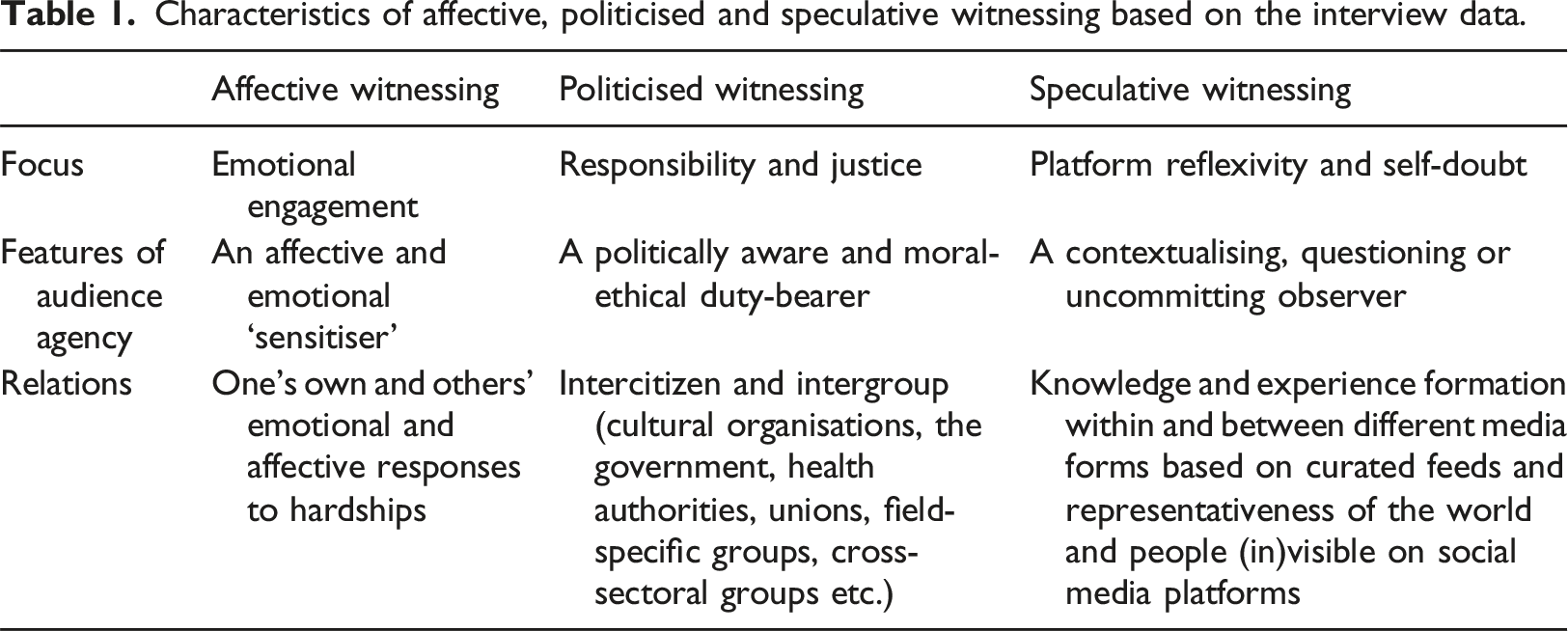
In the second round of analysis, we recognised a new mode of media witnessing that we conceptualised as speculative witnessing. Uncertainty about the representativeness and selectiveness of social media content as well as the need to evaluate, contextualise and perspectivise resulted in the creation of a mode of witnessing that is based on continuous speculation and assessment of the content, other users’ actions and the media environment. Finally, in the third round of analysis, the different modes of witnessing (affective, politicised and speculative) were examined as relational audience practices of mundane world-witnessing and the primary relations involved were identified.
Affective witnessing
Affective witnessing is characterised by emotional involvement and empathetic identification with witnessed suffering. When a modality of affective witnessing actualises, media audiences are driven to deal with the affective impact of media stories and images on themselves. Affective witnessing involves imagining, sensitising and engaging with others’ anguish and distress, thus producing accounts of one’s emotional and affective responses to the content received through media (Kyriakidou, 2015). Some of the participants in this study described the strong affective impact of following their peers’ social media updates on lost jobs, performances or plays never performed or the loneliness of pandemic life. Moreover, many conveyed how they were involved in sensitising and empathising with others’ distressed responses to the intensified precarity of their work.
Witnessing peers’ disquieting situations for long periods led to an accumulation of emotional load. For a few participants, this affected their mood at work and, in some cases, also impaired their ability to work. This prompted them to mobilise their emotional strategies and find ‘conscious solutions’ to manage their affective reactions: So, somehow, that particular despair of others coming from here [social media] began to have an effect. It began to have an effect in the sense that when I saw others in distress, they were in worse distress than I was. I still somehow struggled forward, but then the depressing effect was so big that the whole of spring went completely. In the end, I was so unbelievably exhausted that I could not believe it. I was spent, my work slowed down and I spent time recovering – it took June and July. I just tried to get my strength back. (Participant 10)
This participant described what may be termed emotional contagion – catching despair as a result of witnessing the distress of one’s colleagues. While the participant was somehow able to manage the circumstances initially, the awareness of a distinction and separation from colleagues ended up being emotionally exhausting after a while, with the participant requiring a two-month recovery to resume working at their usual pace.
For many in the study data, affective witnessing on social media platforms followed the logic of intimate publics (Berlant, 2008), as they often feature friends and colleagues. Social media platforms may be described as ‘porous, affective scenes of identification’ that promise to deliver ‘a certain experience of belonging and provides a complex of consolation, confirmation, discipline, and discussion about how to live as an x’ (Berlant, 2008: viii). Emotional engagement features both recognition and reflection, as many participants described how social media platforms reduced their sense of loneliness, thus giving them opportunities to compare their own concrete situations and mental strengths with their peers: Q: Well, if you think about your own experience, what has been the meaning of these groups, social media groups, for you? What have they meant for you? A: Somehow, precisely, that one is not really alone in one’s one-room flat with one’s misery. And every now and then I noticed that, shit, I am actually quite well off, that wow, I received this scholarship, that now, I am fine these 2 months, that I can do what I would have done in any case, perhaps from another point of view. So, somehow … it gave me perspective, but, at the same time, when I saw, heard or read someone’s truly agonising experience, then I felt I responded to it somehow differently, that I didn’t want to drown in that swamp, that I would try to find a means to maintain mental health, to meditate [laughing]. I created quite conscious solutions. (Participant 18)
In this extract, the participant speaks about the sociality and support that social media groups provided during the pandemic. However, at the same time, she engaged in social recognition when describing her response to a colleague’s agony and understanding herself as the could-have-been-me (see Ong, 2015) in the situation. This generates a social space for uncommitted observation and affective witnessing, where other people’s tribulations have resonance in the participant’s lifeworld, enabling them to imagine how it feels to be in another’s shoes (Frosh, 2006: 281). In such a case, affective witnessing induced the determination not to resign to the gloomy and exceptionally uncertain employment situation.
In some participants’ accounts, the despair and negativity felt and expressed by peers on social media was literalised as something ‘eating a person’ – an annihilating and destructive force signifying a collapse of the distance between oneself and others (cf. Kyriakidou, 2015: 221). Some also felt affective discomfort and a sense of alienation when encountering polemical, accusatory or ‘incriminating’ communication styles in their feed, which sometimes led them to leave cultural workers’ Facebook groups.
Politicised witnessing
Politicised witnessing focuses on questions of justice, responsibility and equality. In the participants’ accounts, framed social media posts that contained descriptions of hardships were observed as political discourse (Kyriakidou, 2015: 224). For example, the participants searched for reasons contributing to the political ‘invisibility’ of cultural workers in politicians’ agendas and the dismissal of the cultural sector in decision-making. Moreover, they observed and made judgements about how politicians and authorities responded to social media posts and statements published by cultural workers.
Many participants expressed a sense of responsibility by reflecting on equal opportunities for all cultural workers in their own industry compared to other fields: Even though I’m so gloomy, I’m constantly aware that I’ve still had pretty good luck in many ways. This is also so absurd. My predicament on this issue, although it has certainly brought losses and other things, is that it is still very small compared to all those whose jobs have failed again and again, and the money has gone. What this has exposed, I think, is how unequal we are in relation to any other industry in that there are a huge number of freelancers in this field whose lives are insecure and who lack all the traditional protections for workers. (Participant 5)
The extract above illustrates how the modality of politicised witnessing effaced the specificity of pandemic suffering (see Kyriakidou, 2015: 224) and extended it to address the structural inequalities existing among the professional fields prevalent in Finland.
Many participants identified injustices and their effects at both the union and individual levels. For example, one participant described witnessing their peers’ distress as radically shaping their view of their own field: […] of course I have seen that in the channels of our union, they are different, and there I have seen, one might say, that the messages we [at the trade union] received were really the darkest during the pandemic. The economic distress of people, the different kinds of mental challenges that this time has caused and the loneliness become visible there, and it is a radical change due to a certain kind of lack of prospects that has hit people. (Participant 7)
For participants active in unions, social media channels meant having to witness dystopic fates and then experiencing frustration about lacking the means to fix problems (cf. Kyriakidou, 2015: 220). Cultural workers’ desperation and bitterness led them to search for causes and assess the realities of cultural politics in Finland. For example, some noticed that politicians responsible for cultural affairs seemed to understand culture as celebrations and gala performances. Seeing peers’ difficulties in making a living and experiencing hardships led to demands for a better understanding of the realities of culture as work.
Politicised witnessing also involved notions of the correct ways to communicate difficult societal situations such as political discourse, especially when originally, no one was to blame for the crisis: When COVID started, we tried to avoid and we were told to avoid all metaphors of war, since it was about a virus, and that we should not proceed with war metaphors. But this has had a war dramaturgy, in the sense that, if I think about how well the government handled the first wave of the pandemic and how safe we all felt, how unbelievably good Sanna Marin was in the beginning. And how suddenly, at last, young women in the government and this good straightforward action. And then, as always with any project, suddenly everything is a mess. In a way, what happened this fall and summer was a kind of watershed that something in a sense had died, and the discussion turned upside down. That suddenly the communication is lost, people with power isolated somewhere. That we need to dig for information all the time to get any answers, which, of course, changes the situation into an immensely painful one. In other words, there is somehow, it has been said that, in a sense, the leadership was lost, but I would say that it was not the leadership but communication that was lost. (Participant 2)
In this quote, as an active follower of social and legacy media, the participant evaluated the government’s successes and failures, highlighting the sudden change in communication on social media during the summer of 2021. According to the participant’s reading, this period was marked by a flood of distrust towards the government among cultural workers, after which politicians in power kept their distance from people in the cultural sector. Many participants pointed to the lack of genuine dialogue between politicians and cultural workers and deficient information sharing about the preparation of regulations and restrictions. Some were stunned by the typically mute or silent reactions of politicians in response to posts and media stories of hardships and losses of cultural workers.
Speculative witnessing
Speculative witnessing carries an awareness of the discursive construction of the process, including an awareness of obscure algorithmic agency. This echoes Ellis’s (2009, 79) way of describing the reflection of the media user: ‘[…] the contemporary media user is also painfully aware that this complex seeing is equally a partial seeing, constructed from fragments of larger testimonies and segments of longer shots and sequences’. In speculative witnessing on social media, questions of context, generalisability and representativeness are foregrounded. Exposure to other users’ hardships mobilises a desire to provide a background for testimonies of losses or to reflect upon their representativity within one’s professional community. At the same time, this is experienced as problematic due to the ‘customised’ and algorithmically curated nature of social media feeds.
In our data, witnessing others’ shortage of funds, loss of jobs and cancelled gigs engaged many participants affectively and emotionally, but a widely shared assumption of the existence of social media ‘bubbles’ made it difficult for them to assess how ‘outsiders’ perceived the posts shared in professional groups: It is very difficult to estimate the impact of social media influence on the treatment of the cultural sector because I certainly know that … since I align myself with the people and the content I follow, I’m in that kind of bubble in which it seems that everybody speaks about these things and our common voice is clearly audible. But I can’t estimate what it looks like outside that bubble – does it sound like somebody is whistling a little in the distance, but you can’t even hear it, or does it look like that there really is a bunch of people to whom you should listen? I can’t estimate this. Living in a bubble is one of the problems of social media. It is really tricky to see what it looks like from the outside for a person in another field or a person coming from a different world. When you are within a bubble, you can’t see. (Participant 24)
In this example of speculative witnessing, the participant imagined the personal social media feed as a scene of voices forming a collegial viewpoint while also speculating that from outside the bubble, this may sound like whistling in hushed tones. Hearing and seeing ‘everybody speaking about these things’ cultivates a sense of proximity with the people who are visible in one’s feed. However, at the same time, the context of social media evokes suspicions about the wider social visibility and audibility of one’s professional field.
Acts of speculative witnessing highlight media audiences’ inclination towards ‘viewing with a degree of scepticism or incredulity’, since they are often aware of their circumscribed views (Ellis, 2009: 76). Consequently, audiences voice their reservations regarding issues they see and hear on social media, which affects both the ‘condition and quality of knowing’ (Frosh, 2006: 272). Furthermore, in acts of speculative witnessing, it is typical to look for connections or discrepancies between witnessing texts and news from legacy media: Of course, there were many good discussions. I didn’t look at who all were there, but what felt a little half-baked and a little sad in my opinion was that although we had that discussion, it’s awfully easy to have that discussion in your own bubble. In other words, there is a huge amount of data, a huge amount of effort, a huge amount of argumentation, discussion and other things like that, but how does that discussion become public to the media and the news media, official sources like these, which are very slow? (Participant 16)
The participant described her attempt to assess the impact of social media discussions in comparison to texts published by legacy media and the posts of leading politicians. Many participants expressed that although social media groups function as empowering tools for professional communities in the cultural sector, they were pessimistic about these groups’ relevance and efficiency in influencing decision-makers.
In some cases, speculative witnessing was related to non-commitment to individual testimonies of distress. The following participant’s comment indicated how he ‘stepped back’ from emotionally loaded social media testimonies of the vexations of pandemic life: My idea is perhaps that social media gathers and that it is a terribly emotional medium. It gathers like-minded people around the emotion that irritates them right now. But likewise, it may suddenly change, so that, all of a sudden, everything is forgotten and everything is completely joyful, when all at once there are, for instance, no restrictions. And then the way that [social media] is kind of emotional, a forum for managing emotions where similar people with the same emotions somehow meet. The question whether it influences something since there is such a crazy amount of influences of all kinds ... opinions like that. So, if ... does it have any real impact? I don’t know. I am not quite [sure], I am not. (Participant 8)
Our interpretation is that the participant was able to ‘see through those posters’ eyes’ (Frosh, 2006: 69), but he aimed at exploring the phenomenon beyond the discussion that is often charged with strong emotions. In that sense, he speculated about the motivations and reasons that induce particular and often ephemeral emotions in their professional field. He also recognised the importance of these affective social media testimonies as a therapeutic channel but doubted their impact on the issues that entailed negative feelings.
The algorithmic environment of social media platforms produces a distance between the witness (a social media user testifying to the distress of the cultural sector), a witnessing text (posts dealing with that distress) and an audience (a follower seeing and evaluating the posts) (Ong, 2015). Uncertainty related to the operation of algorithms and the ways in which they recommend and filter content compel audiences to speculate about the conditions and limitedness of the witnessing texts they see. In this sense, a platformed context for witnessing entails a reflection on the extent to which the picture of a crisis that one has is algorithmically loaded or ‘bubbled’. Moreover, this calls for estimations about the effects of the reception of social media testimonies on one’s emotions and experiences and, subsequently, putting them into words.
While the witnessing literature about audience ethics highlights interactions between witnessing texts and audiences, speculative witnessing foregrounds audiences’ interpretations of witnessing texts from the perspectives of the specific infrastructural characteristics of each platform and those of the issues of scale (Griffin, 2022: 101) and proportions. During speculative witnessing, audiences often experience feelings of inadequacy and contingency towards the content they see, which may result in a longing for better contextualisation of the crisis situation. Due to this, although audiences may fully realise the crisis atmosphere, they may have difficulties estimating the extent and proportions of their observations.
Concluding thoughts
During changing restrictions on assembly and requirements for safe distances, different media apps and platforms had an impact on ‘how we believe we perceive everyday reality’ (Ellis, 2000: 15). At the same time, our awareness of the opacity of algorithmic media environments cast doubts on the generalisability of our personal experiences and interpretations. In the context of the pandemic, social media platforms emerged as sources of information and sites for community building and activism. However, ambivalence about platformed communication and social media permeated the data gathered in this study. All modes of witnessing appeared ambivalent, involving a sense of both powerlessness and involvement (Ellis, 2000; Kyriakidou, 2015; Sumiala, 2019). When the participants engaged themselves in witnessing texts, they were found to be continuously negotiating their relationships as co-witnesses with others’ mediated experiences in an environment that they deemed simultaneously contingent and emotionally engaging. They also reflected upon their own agency online from many perspectives, often highlighting their ambivalent feelings and a sense of being somehow implicated in the long-lasting emotional and financial distress of some peers: [...] I am not very politically active on social media. That is, I do try to be a little, but I am not. I feel that … my relationship with social media is very contradictory. And I do feel guilty about how I don’t do enough with it, and, on the other hand, I don’t want to be there at all. So, a kind of hate-love relationship, but not even love. Somehow, I feel that I am in a violent relationship and one I cannot escape [laughs]. (Participant 5)
While mundane witnessing through television, according to Ellis (2009: 83), calls on empathy and a complex process of understanding, it does not require any actions or decisions. In contrast, in our social media data, witnessing requires action, as the users must decide whether they like, comment or share a post or ignore it. For that reason, not only affective and politicised modes of witnessing but also speculative approaches to other users’ accounts of distress require a decision on how to respond or not respond. For example, when interpreting a post as a testimony of our time, users typically consider whether to increase its visibility through likes and shares or to indicate that they commiserate with the person who shared some concerns. Although speculative witnessing foregrounds uncertainty and hesitance, it entails an immediate decision to react.
This paper aimed to explore the ways in which professional cultural workers from different fields made sense of their professional lives and communities on social media during the prolonged pandemic. In this context, the data analysis confirms the key findings of previous research on the coping mechanisms adopted during the early phases of the pandemic: Cultural workers responded to the extended state of emergency in their professional lives by forming and engaging in supportive offline and online communities, by mobilising for the defence as work the activities performed by the cultural and creative industries and by demanding and proposing policy measures and changes (e.g. De Peuter et al., 2023). Furthermore, the data gathered in this study clearly articulate an evolution and change in this response over time. While the Finnish CCI sector willingly complied with general restrictions and policies of social distancing during the first wave of the pandemic, the prolongation of the pandemic and the imposition of new restrictions in 2021 heightened a sense of injustice and increased vulnerability. Subsequently, while a sense of returning to normal was mobilised elsewhere in society, the cultural and arts sectors remained on hold.
Most importantly, the study data highlight the specific context of social media platforms as sites for witnessing an extended crisis. With reference to Kyriakidou’s (2015) typology of media witnessing, we conceptualised three modes of reception and engagement: affective, politicised and speculative. On various social media sites, Facebook and message groups, cultural workers first became audiences to the distress of their peers, engaging emotionally and morally with the repeated accounts of job loss, postponed and cancelled performances and the loneliness of pandemic life. Second, participants interpreted the accounts of hardships as political discourse, thereby assessing, demanding and articulating political responsibility. Furthermore, media witnessing on social media evoked in them a desire to protect cultural work as a profession and art as a vital social domain. Third, this study introduced the notion of speculative witnessing to highlight a specific mode of knowing associated with the context of social media – an overlapping but distinct sense of scepticism and incredulity that the participants expressed when describing their process of sense-making on digital platforms. Instead of attributing the scepticism to particular services, they articulated a general sense of doubt towards the entire context of platformed media. Regardless of this doubt, speculative witnessing on social media requires action and, in many cases, considerations of responsibility because one must decide one’s visible reactions or non-reactions to others’ posts.
To some extent, speculative witnessing on social media resembles Chouliaraki’s (2006: 43) conceptualisation of the spectatorship of television news as reflexive identification, in which suffering is placed in a meaningful context of explanation that addresses why suffering is important and what viewer’s reactions are. Speculative witnessing offers a multi-platform approach to media witnessing by combining elements of audience ethics, textual ethics and ecological ethics of platform companies (Ong, 2014: 191) to reach a complexity of meaningful engagements with social media (Griffin, 2022: 101). These interrelating aspects of witnessing raise questions about the limits of visibility and about whose voices are heard and who remains invisible.
The data in this study accentuate the distinctiveness of the platformed context, where prevalent notions of algorithms and social bubbles introduce a dimension of metacommunicative scepticism into media witnessing as a mode of knowledge. Speculative witnessing, hence, indicates a specific ‘condition and quality of knowing’ (Frosh, 2006: 272). The uncertainty and ambivalence connected to the platform environment and social media highlight a sense of self-doubt, which not only complicates but also hinders participants’ ability to relate to others’ distress and to consider their own and others’ responsibilities in relation to the distress. Therefore, along with exposing participants to the distress of others and inviting affective and moral engagement, media witnessing in the age of digital platforms also entails concomitant doubts about the validity and relevance of one’s own experiences.
Footnotes
Declaration of conflicting interests
The author(s) declared no potential conflicts of interest with respect to the research, authorship, and/or publication of this article.
Funding
The author(s) disclosed receipt of the following financial support for the research, authorship, and/or publication of this article: This work was supported by The Strategic Research Council, Academy of Finland; 327392 and 352520.
