



Abstract
The recent advent of virtual photography and artificial intelligence (specifically AI photography and diffusion models), presents a major challenge to both photographers and photography theory. All our common-sense assumptions about the ontology of the image now seem to be falling apart. Are these interlopers really photography? Can we hear the final death knell for the erstwhile medium in this era of ever-increasing media convergence and virtualisation? This practice-led investigation of these new media forms draws on the author’s recent creative work in virtual photographies, and similar interventions by other photographers and new media artists, seeking to augment and expand their practice using these new tools, whilst querying what photography really means today. From in-game photography to virtual exploration using Google Street View, to AI photography using the latest denoising diffusion models (such as Midjourney), there are surprising commonalities to explore between them, linking these new practices of image-making firmly back to traditions of lens-based photography. Rather than seeking a detailed map of this difficult new terrain, or a definitive ontology of emerging virtual photographies, the author reframes the discourse around practice, examining both photography as an evolving set of practices and also notions of media hauntology – specifically the spectral ways in which new media technologies are always haunted by prior practices and modes of communication. The importance of the frame to both traditional photography and new practices of virtual photography, is suggested as a vital and persistent dimension in photographic authorship. With that authorship increasingly contested by new generative methods, easy appropriation and AI image-making, the act of framing may become the best litmus test we have, for whether or not a photograph should be considered ‘real’ or valued.
Keywords
Introduction
‘Everywhere one looks today in the world of contemporary art, the photographic object seems to be an object in crisis, or at least in severe transformation’ (Baker, 2005)
Virtual photography and artificial intelligence are just the latest in a long line of such crises – the most recent developments in the history of photography’s always impending death. From Walter Benjamin agonising over the terminal loss of ‘aura’ (1935), to Derrida’s muse on digital photography and the final disappearance of a physical ‘subjectile’ (2010: 14), prominent philosophers and media theorists have often struggled to grasp the threat of profound technological shifts to the ontology of the photograph. Do these latest dematerialisations really mark the final death knell for the medium? ‘Photography has been haunted by the spectre of such a death, throughout its long life, just as it has always been inhabited by the very thing, digitization, which is supposed to deal its fatal blow’. (Batchen, 1994: 50)
Ontologically, the photograph is always-already a spectral entity (Bazin, 1945; Derrida, 1998: 34), forever alive and dead at the same time. How can such an elusive ghost ever be said to die completely? One of the key reasons for the perpetual theoretical difficulty is that photography and similar media ‘are inherently destructive of ontology, of physical continuity in space and time’ (Phillips, 2017: 131), making them extremely difficult to pin down and simply categorise as objects that exist in a clearly defined form. With these sorts of intractable problems co-existing in an era of seemingly ever-greater media convergence (Jenkins and Deuze, 2008; Balbi, 2017) and byzantine levels of remediation (Bolter and Grusin, 2000), it can be tempting to discard all our old definitions and even the notion of medium altogether. However, such a gesture will not help us understand the key role the traditional photograph continues to play in all these emerging technologies and new forms of communication. In order to determine what this means for both photography as an enduring practice, and its contemporary virtualisation in new forms, I propose that we must adopt two critical positions. The first is that new media are always haunted in some way by prior modes of communication – a hauntology (Gere, 2016), rather than a simple ontology, might therefore be more illuminating. The second is that we can largely side-step such awkward ontological issues, by reframing the discourse back onto practices. Photographs, of whatever form, are the products of a series of human actions, they don’t materialise out of nowhere, even if they sometimes appear to. By assuming a practice-led theory of photography, more workable definitions of the changing medium may emerge, based upon applied use and hands-on experience of these tools. As we shall see, various practices of virtual photography can be strikingly similar to those of older forms, while AI photography (as we must now discriminate between this and other virtualisations of the photograph), may be seen as a genuine ‘clean break’ with any previous photographic understanding of the image. Whilst acknowledging the extremely diverse relationships to reality in this broadening field, it is the recent change in creative practice that stands out as being the most fundamentally different. Through the author’s own experience of projects using different remediations of the photograph (including those made with AI), and via the theories of Jacques Derrida, both framing and spectrality are shown to be vital to the debate over whether or not these new virtual forms can be considered photography. We must also ask what these technological changes might mean for future conventions of the medium, including the potential for what Jay David Bolter and Richard Grusin defined as ‘retrograde remediation’ (2000: 147), or new media’s influence on older forms that persist, but must adapt somehow to a changing climate. AI image generation is compared and contrasted with other forms of virtual photography, in this context, revealing a cardinal shift in the photographer’s creative role in image-making.
New virtual horizons
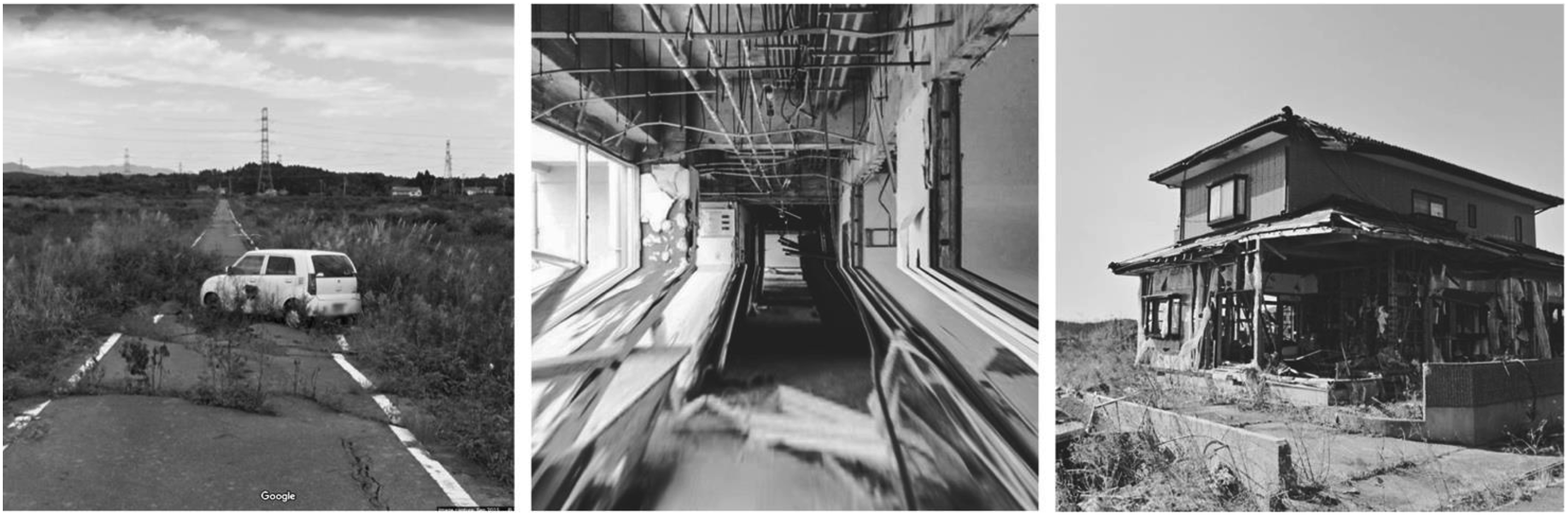
Visitations (2022) by Michael C Coldwell
During the pandemic lockdowns and unprecedented movement restrictions of the past few years, photographers found themselves unable to travel or engage in their usual lens-based practice. Many sought alternative creative outlets while stuck at home, making use of the ubiquitous devices and screens they were glued-to anyway, for rolling coverage of the seemingly apocalyptic events outside. Several journalists picked up on the growing trend for virtual photography during this period, from photographic artists turning to computer games for inspiration (Fowler, 2020), to virtual travellers exploring the world using Google Street View (Haigney, 2021). This popular coverage also highlighted that while much of the content was fairly generic, there was a growing body of work that genuinely utilised these new forms of image-making to develop innovative modes of expression and intertextual art. Alan Butler, for example, is an exhibiting artist who has used in-game photography to recreate the infamous time-lapse sequences from Godfrey Reggio’s Koyaanisqatsi (1982) – as well as a series that seeks to evoke Timothy O’Sullivan’s seminal geographic surveys, using open-world computer game Red Dead Redemption 2. Landscape and travel photography is a recurring theme in this new virtual scene. Place(s) (Greco, 2021) is a photobook of in-game landscapes from Death Stranding on the Playstation 4. Unable to visit Iceland for an expedition due to pandemic travel restrictions, photographer Pascal Greco explored virtual terrain instead, looking for analogues of the empty tundra that was forbidden to him, recreating a visual idea of Iceland through the images and playing with the very notion of photographic veracity and verisimilitude, in the process. These photographers were all beginning to see virtual image production as an extension of their existing photographic practices.
Visitations (2020-2022) and Travelling Without Moving (2020) were two such pandemic projects created by the author of this paper, investigating the image-making possibilities and weird temporal characteristics of Google Street View, both to facilitate such virtual travel opportunities, and also to explore the platform’s potential as a form of photographic time machine. As an artist (working under the alias Michael C Coldwell), I was particularly interested in making images that would be impossible to shoot IRL, 1 visiting locations that would be too dangerous, inaccessible or even unethical to travel-to and photograph physically – while also using the medium to gain insights into how these forbidden places had changed over time. Somewhere between dark tourism, 2 remote viewing and rephotography, 3 this novel approach to representing urban change took in a variety of proscribed locations from around the world, such as Chernobyl and Fukushima Prefecture – the former becoming doubly off-limits to travel and traditional photography, due to the ongoing war in Ukraine. Street View’s ability to skip backwards and forwards through time revealed itself to be an ideal medium for rephotographic documentation – in this instance, revealing how forsaken landscapes were gradually recovering from catastrophe.
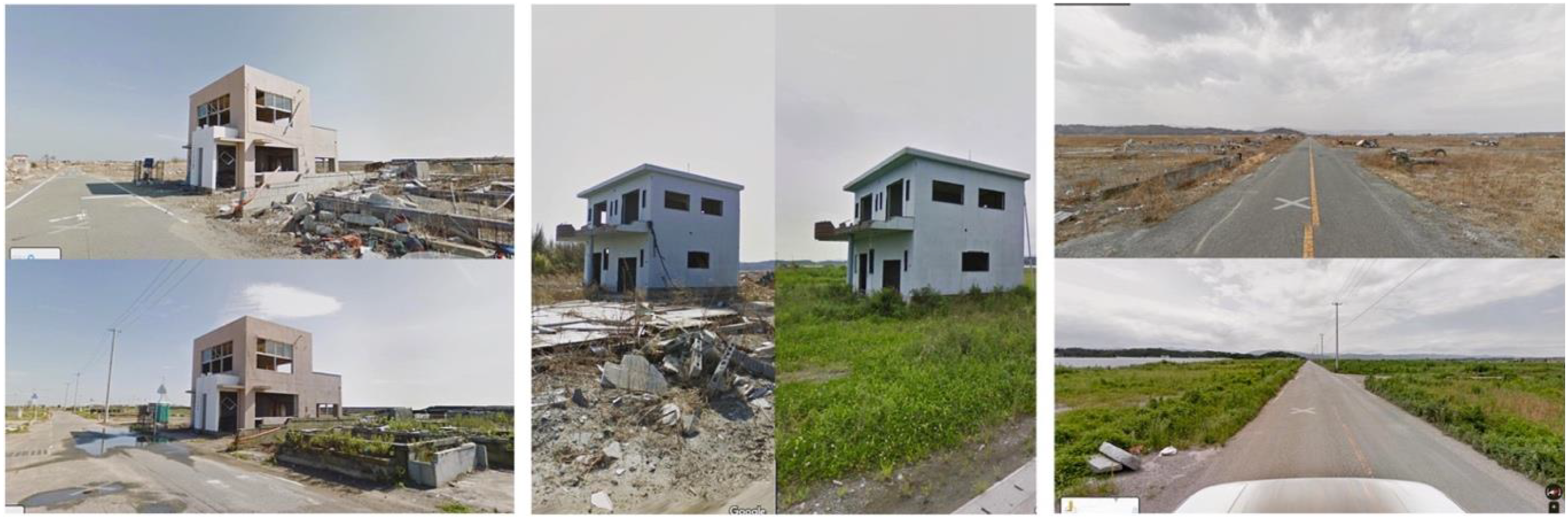
Searching for Fukushima from Visitations (2022) by Michael C Coldwell
Google Street View was not designed with this in mind. It launched in 2007, augmenting Google’s existing mapping facilities and providing users with the immersive experience of being able to virtually explore various streets and cities (Anguelov et al., 2010: 34). This simulated environment is technically photographic, accomplished algorithmically via the automatic stitching of countless 360-degree panoramas, often shot using special cameras mounted to the rooves of moving vehicles. Users can interact with these VR-esque scenes in the final tool, looking in any direction they chose and moving from one spot to the next via a series of static photospheres, simulating the action of walking down the street (albeit in a somewhat stilted fashion). Google has continually expanded the coverage of the service globally, with many millions of miles of road now open to virtual exploration. Often the Google car returns to locations more than once, and it is in these places that a form of virtual time-travel subsequently becomes possible.
Exploring this immersive environment to make new images, the practice of the virtual photographer is not unlike photography IRL. Observation and careful selection through framing constitutes the basic method – marshalling the gaze and guiding a viewer’s attention towards specific details, objects, people or scenes that are discovered, through careful selection and image composition. Extending my remit to examine other practices that fall under the virtual photography umbrella – including what has become known as ‘in-game photography’ – it became apparent that this fundamental process of framing something encountered, was common to all these virtual photographic practices, and also, that it linked the new forms of image-making back to traditions of photography. Selecting from what is found in a wider immersive field is the principal act of photographic meaning-making – and it is this act of selective framing that is largely missing from 360 photography and other immersive media, which seem (while arguably not truly ‘frameless’, as we shall discuss later), to have much less in common with traditional photographic practice, than these new virtual forms do, creatively cannibalising and reframing such immersive media environments. ‘When you take a picture of something, you are highlighting it and saying that this is something worth seeing’. Justin Berry, virtual photographer (Fowler, 2020) ‘For me, it’s an experiment, above all’, says Greco. ‘But of course you take a photographic approach – you have to find the right subject, the best framing, the ideal light and setting’. Pascal Greco, virtual photographer (Longeray, 2021)
Camera Ludica (2019) is a rare example of critical scholarship examining in-game photography, but the key role of selection and framing isn’t fully addressed in this publication. The authors state that its existence mounts something of a challenge to previous definitions of the photographic medium, and that as scholars of media we need to look at ‘in-game photography’s implications on existing theories of photography’ (Möring and Mutiis, 2019: 70). However, the article doesn’t venture too far down this arduous road, refraining from ‘offering an ontological definition of in-game photography’ (71), and instead situating the discourse within the established fields of games research, simulation and remediation – the focus falling on video games imitating cameras and photographic communication, largely as part of their gameplay.
As a photographer engaging first-hand in experimental virtual photographic practices – those involving computer games, Google Street View and AI – I have come to a slightly different conclusion. Virtual photography isn’t just a crude replica of its forebear, it is informed by a common set of photographic skills. While all of the aforementioned virtual environments are very different, they share some crucial similarities, as do the creative practices of reframing them. The level of immersion (and the seeming lack of a pre-existing frame) is very different when we compare a static photosphere on Google Maps, with the fully interactive experience of playing a dynamic computer game or using a VR device. However, the creative intent of the virtual photographer, in all these very different technological areas, and their use of cropping and reframing, remains something of a key constant. In this paper, I will draw on my recent practice research in this field to argue that the relationship between photography and its virtual cousins is not tangential or superficially skeuomorphic, but one of direct descendance and inherited visual language – and that these many varied ‘photographic’ practices are intrinsically linked through the pervasive act of framing or reframing realities, as they are encountered in real-time, by a ‘photographer’. Of all the virtualisations of the photograph, AI is certainly the exception in this regard. The lack of such an immersive context from which to select an image, renders it a very different type of virtual photograph, and a very different practice. There is still direct descendance and inherited language from photography, but not one of synonymous practice. The photograph is effectively simulated by AI, but only as a final image – the selective and subjective experience of the photographer is not part of its recreation.
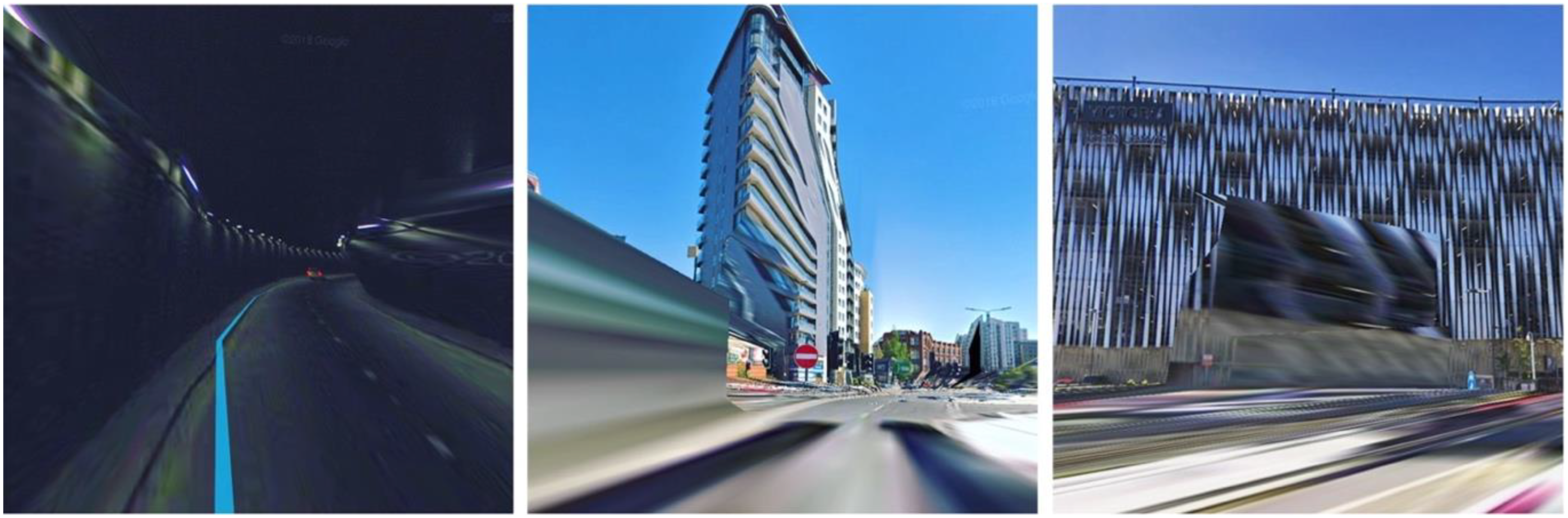
Travelling Without Moving (2020) by Michael C Coldwell
A potted history of virtual photographies
The idea for Visitations and Travelling Without Moving originally arose after discovering Jon Rafman’s Nine Eyes of Google Street View (2008). I was already using the tool for preliminary location research, increasingly looking there for potential shots before visiting a place in-person. Rafman’s work raised the question of whether a trip was necessary at all. This early example of virtual photography as art practice, used the immersive platform to conduct a new kind of street photography. Rafman placed his beguiling screen captures in a new context, as large C-prints on an art gallery wall, literally reframing them within much longer histories of photography and visual art. Many of the images in the collection selected and presented disturbing, absurd and humorous discoveries, made after many hours scouring the virtual streets, but it was the strange accidents, errors and glitches appearing in the work that captured my own imagination. In CM-4009, Polán, Spain, 2010 (The street views Google wasn’t expecting you to see – in pictures, 2012), the frame is broken apart by fragments of photographic trace mis-rendered in strange neon colouration. The anomaly seems to allow us to glimpse multiple views of the same location simultaneously, a ruptured doorway to different pieces of time, momentarily revealing something of the hidden piecemeal construction of this virtual environment, and its patchwork relationship to temporality. Travelling Without Moving was my first attempt at capturing such moments myself – taking screenshots in which Street View’s temporal illusion began to break down. Both framing and timing were crucial to catching these elusive glitches between times – an unlikely setting for a photographer to rediscover the importance of the ‘decisive moment’ (Cartier-Bresson and Tériade, 1952). However, unlike traditional photography, it wasn’t a real present moment that was being captured on-the-fly, but a small fragment of a giant time tapestry, momentarily falling apart. Though it presents itself as a navigable present, Google Street View is in fact a disjointed record of our recent past– specifically, the moment in which it drove past the place it recorded. I re-enacted those moments (Odell, 2009)
Jenny Odell was another early adopter of Google Street View photography, using the platform alongside her own lens-based practice to recreate the strange scenes she found there. As with Rafman, there is a surrealism and humour in her various performative re-enactments (Odell, 2009), but this rephotography project also revealed Street View’s potential as a serious survey research tool – with changes to the urban environment carefully framed and recorded in the work. This aspect was certainly an influence on my own practice. With this photographic tool it became possible to conduct rephotography remotely, attentively studying how places had changed over time, without ever needing to visit them in the flesh.
Years before the coronavirus pandemic elicited a wider interest in this type of virtual travel, Jacqui Kenny was using Google Street View to explore and photograph the world from the safety of home. Her virtual photography project, The Agoraphobic Traveller (Kenny, 2016) was very successful online, and has seen support from Google itself (Kenny, 2017), including a solo exhibition in New York and a film commissioned for World Mental Health Day. Kenny lives with agoraphobia, an anxiety condition that causes individuals to avoid venturing into crowded or remote places, for fear of having a panic attack and being unable to escape or find help. For some, at its worst, this can mean a fear of leaving home. To counter this, Kenny roams the globe via Google Street View, and virtually combs streets and landscapes to snap screenshots for her photography series (Gottschalk, 2017)
Kenny often captures and reframes incredibly isolated locations where the Street View photospheres have never been opened by users before, giving the project a sense of genuine exploration and discovery. The resulting images are then meticulously processed to a given aesthetic style, reminiscent of medium format analogue landscape photography – and at first glance, her images could easily be mistaken for conventional photographic practice. On YouTube, Kenny talks about her method (The Agoraphobic Traveller | Men in green 360°, 2017), explaining how certain features in the landscape catch her eye, and how she goes about selecting and editing her images for Instagram. The importance of the frame is plain to see in this practical demonstration, cropping from the wider immersive field of view, to reveal something intriguing that might otherwise go unseen. The action and intent of this practice is very much in line with documentary landscape photography as a traditional medium.
Over the last 10 years, the term ‘virtual photography’ has become less associated with this type of virtual sightseeing,
4
and is increasingly used synonymously with in-game photography, particularly in popular online discourse (Bromley, 2021). As we’ve seen, these two creative practices are certainly very different, calling into question the usefulness of this increasingly broad epithet. Another major difference between images that use Google Street View and in-game photography, is arguably the preserved indexicality
5
of the former. While the latter reframes entirely computer-generated worlds, adopting the visual language of photography, the work of Rafman, Odell and Kenny, is still engaging with photographic recordings of the real world in various ways – only the final act of photographic framing becoming fully virtualized. Does this mean that in-game photography should be excluded from the discussion, because it lacks the indexical trace of the real? From a practice perspective, they can certainly be very similar. There is still little scholarship comparing these relatively new forms, and ‘virtual photography’ is rarely used to describe them collectively in an academic context. Instead, we see a host of new granular terms, categories and definitions emerging, and attempts to draw clear ‘distinctions between screenshot, in-game photography, and screen image photography’ (Gerling, 2018: 159). Winfried Gerling, however, does still examine screenshots and in-game photography together, seeing them as part of a continuum that can be traced back to much earlier photographic methods. Screenshots and in-game photography can be seen throughout this context but they are cameraless and can therefore be understood and discussed within a long history of experimental photographic practices. (Gerling, 2018: 149)
Gerling’s argument brings these various new forms of image-making within the scope of photography theory, and bypasses, to some extent, the question of whether they should be considered a type of photograph at all. Certainly, it is easy to forget that the camera has never been the primary precondition of photography as a medium, and that just as ‘a painting can be made without a brush, so a photograph can be made without a camera’ (Barnes, 2018: 7). However, we cannot simply see these new virtual practices as just another form of cameraless photography. For one thing, a camera is still involved in many of them. While the Google Street View artists might be making the final selection and composition on a screen, the world depicted in their work was originally captured automatically by advanced VR camera technology, originally designed by Immersive Media (A Brief History of Google’s Street View Cameras, 2019). The main difference with traditional practices is that the camera is no longer the main selection device, as such 360 technology captures everything within view. Even in-game photography cannot simply be understood as cameraless photography. Unlike computer game shooting, the older cameraless practices described by Barnes and Batchen (2016), all still featured that indexical trace of something real appearing on some photosensitive surface – and to complicate matters yet further, many contemporary video games feature a ‘virtual camera’ (Gerling, 2018: 156), with sophisticated in-game camera modes, faithfully recreating the optics (and many of the manual functions) of the original physical device. The camera here may not be real, but it would be difficult to characterise these specific practices as completely ‘cameraless’.
As a new history of this convoluted and expansive photographic field emerges, it is easy to get lost attempting to categorise these many shifting practices, technologies and contexts. While creating a definitive map of this new terrain is worthwhile work, it is equally necessary to examine what might connect these sundry new media, the commonalities linking them firmly back to traditional lens-based photography as a guiding practice – not to mention that medium’s always-already troubled ontology. John Tagg recognised the plurality of photography in The Burden of Representation (Tagg, 1988), opting instead to refer to ‘photographies’ – a related media family without ‘a singular history’. We might do the same with ‘virtual photographies’ – defined here as a diverse collection of virtual technologies and digital practices, that have evolved in parallel – but whether based upon a real camera or not, still utilise the framing and presentation of what is found by the practitioner, in a recognisably photographic way.
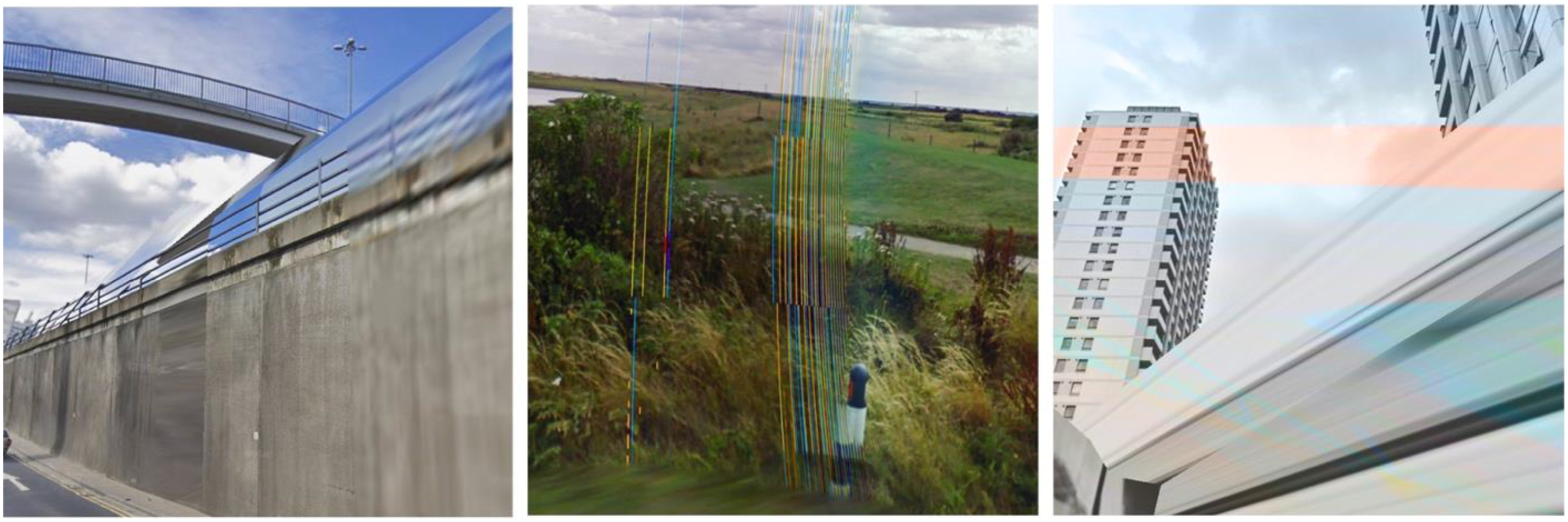
Travelling Without Moving (2020) by Michael C Coldwell
Reframing the frame
‘Framing up a shot is selecting and presenting a portion of the setting/subject for the attention of the audience’ (Ward, 2002: 83) ‘Photography is about finding out what can happen in the frame. When you put four edges around some facts, you change those facts’. – Garry Winogrand (Composition in Landscape Photography, 2019)
While framing hasn’t always played a major role in how the photograph has been ontologised, it is often vital in how photographers think about and discuss their own practice. Photography theorists who are also practitioners are more likely to appreciate the role of framing in the creative act of taking a photograph, and also how framing ultimately changes meaning – how we read what has been represented in the image via features such as inclusion, omission, focus, scale and juxtaposition. Victor Burgin, for example, noticed that framing not only structures the representation, but in so doing, ‘contributes to reproducing ideological discourses’ (Wells, 2022, p. 44). This can also be said of other similar visual media, such as painting – but what makes the role of framing in photography distinct, is how that framed composition is made on-the-fly, using optical technology – a deliberately chosen selection from a wider encountered visual reality, rendered there-and-then, by use of a machine. It can also now be argued that new technologies and new ways of thinking have diluted the frame’s importance to photography. 360 photography, VR and other immersive expansions of the medium, seem to have negated the need for framing altogether. And this can seem an attractive prospect to those who still see photography’s ‘truth claim’ (Mitchell, 1992; Gunning, 2004) as being its most crucial cultural asset – with those subjective and ideological aspects of framing mentioned by Burgin, seen by these scholars as fundamentally problematic and something to avoid. ‘However faithful an image that serves to convey visual information may be, the process of selection will always reveal the maker’s interpretation of what he considers relevant’ (Gombrich, 1982)
In Immersive Reflexivity (2017), Edgar Gómez Cruz asserts that there are real gains to be made for ethnographic fieldwork in using 360 cameras in social research and eschewing the frame altogether. For Gómez Cruz, the ‘postframing turn’ (Gómez Cruz, 2017) marks a shift in which photographic meaning is dislocated from the act of taking photographs, and that we might therefore be liberated from the ‘power-vision imbalance’ inherent within all acts of framing, selection and abstraction. A camera that records everything, disregarding the need for ‘any particular point of view’ (Uricchio, 2012), surely cannot be biased? However, the placement of a given 360 camera in time and space, could still be argued to be an act of selection. Also, these cameras still have a limitation in what they can record (it isn’t everything – when the camera records, the position of the camera, view distance and resolution, all place limits upon the immersive representations they can make), and that rather than removing the act of selection from photography, the ‘frameless’ quality of this type of photograph, merely obscures it. Having said this, Gómez Cruz is certainly correct that immersive VR photographs are fundamentally different and cannot be read as texts in the normal way. It is hard to imagine that anyone might describe a Google Street View photosphere as having meaning. It is up to virtual photographers such as Rafman or Kenny to reframe immersive photographs as texts, and give them some kind of significance. In these examples, it is certainly the virtual photographer sat at their computer screen, rather than the Google car operator (actually outside visiting these locations), who is fulfilling the traditional authorial role of the photographer – even as they are acutely aware of the immersive experience being unreal, and the created intertextual texts being fully ‘hypermediated’ (Bolter and Grusin, 2000: 154). ‘If we are to approach a text, it must have an edge’ (Derrida, 2011)
Jacques Derrida was adamant that the frame was vital for all forms of text. We cannot ‘dream of the pure and simple absence of the frame’ (Derrida, 1987), we can merely try and hide it, or destroy the text’s meaning in attempting to remove what constitutes it in the first place. In many virtual photographic practices we see a return of the frame to media that had previously sought to rescind it, and in so doing, we see the spectre of photographic traditions still haunting this purportedly ‘postframing’ age. In Travelling Without Moving (2020) the frame is used critically, to reveal and interrogate hidden aspects of Google Street View’s immersive illusion – particularly those regarding time. In Rafman’s work, there is a gesture towards returning narrative and surprise to hypermediated representations of place. The photographer’s role here is to show us what is salient and try and make some sense of this new world through visual re-representations. In attempting to show us everything (even if they fail in this regard), automatic and immersive photography has the potential to show us nothing much at all. There is also a ‘citizen media’ (Ritchin, 2013) and grassroots political dimension to some of these acts of intervention and reframing, where ordinary users are now the people able to make new meaning from vast immersive environments, that are primarily created and owned by large multinational corporations. It certainly isn’t as simple as ‘remove the frame, remove the bias’. Framing is the core language of photography and the primary method by which we can clearly communicate visually. To suggest otherwise, would be to uncritically perpetuate the techno-utopian myth of ‘total photography’ (Timby, 2018) – an old Bazinian idea, which still seems to drive the development of these many immersive media technologies – and the work of some media scholars too.
Just as my virtual photographic practices were beginning to mature, and my arguments about the frame were beginning to bear some fruit, artificial intelligence came along to disrupt everything we thought we knew about photography, once again. If we can expand our conception of what photography is in the 21st century, by redefining it towards common practices of (re)framing encountered spaces, what about ‘photographs’ created by AI? However photographic they may appear (and this technology is improving in that regard by the day), we cannot consider this a form of virtual photography in the same way as the others. What is the role played by a ‘photographer’, and by practices of framing and selection, when there is no synonymous immersive environment to select from? In generative AI image-making, the human operator often plays the role of curator, choosing from a range of generated outputs. This changes the role of the human in the creative process of image-making, ‘from content creator to content selector and/or modifier of AI-generated material’ (Atkinson and Barker, 2023). Photographers have long understood that selection itself can be a creative act, but the difference here is in the role framing plays within that selection. Unlike with other virtual photographies we’ve examined, the human being involved is not in control of the frame, and therefore the final composition of the image – certainly not with text-to-image models and other DDPM 6 generators, which all begin with random noise: the ‘seed’ that ultimately determines the final framing. To investigate these differences further I embarked on two new virtual photography projects – Is Anything Real? (Coldwell, 2013c) and Anarchaetypologies (Coldwell, 2013b). Both new series used Midjourney (a proprietary diffusion model that has got much closer than its competitors in producing convincing emulations of photography), using a combination of text and image prompts to see how much I could control the resulting ‘photographs’ and their framings. Unlike Stable Diffusion, Midjourney is closed-source software, so the user has limited technical control of the model and its final outputs. However, prompting with Midjourney can be much more complex than with many of its competitors, and the astonishing photorealism of some its outputs makes it an ideal choice for investigating the current front-line in the simulation of photography. The first of these projects used my own illusory architecture photographs as the initial prompts (you can prompt the model solely with images – often called ‘image-to-image’ generation). This source series was originally made as a challenge to simplified conceptions of photographic indexicality. The latter project made use of seminal work by Bernd and Hilla Becher (2004), in the manner of Idris Khan’s postmodern appropriations. 7
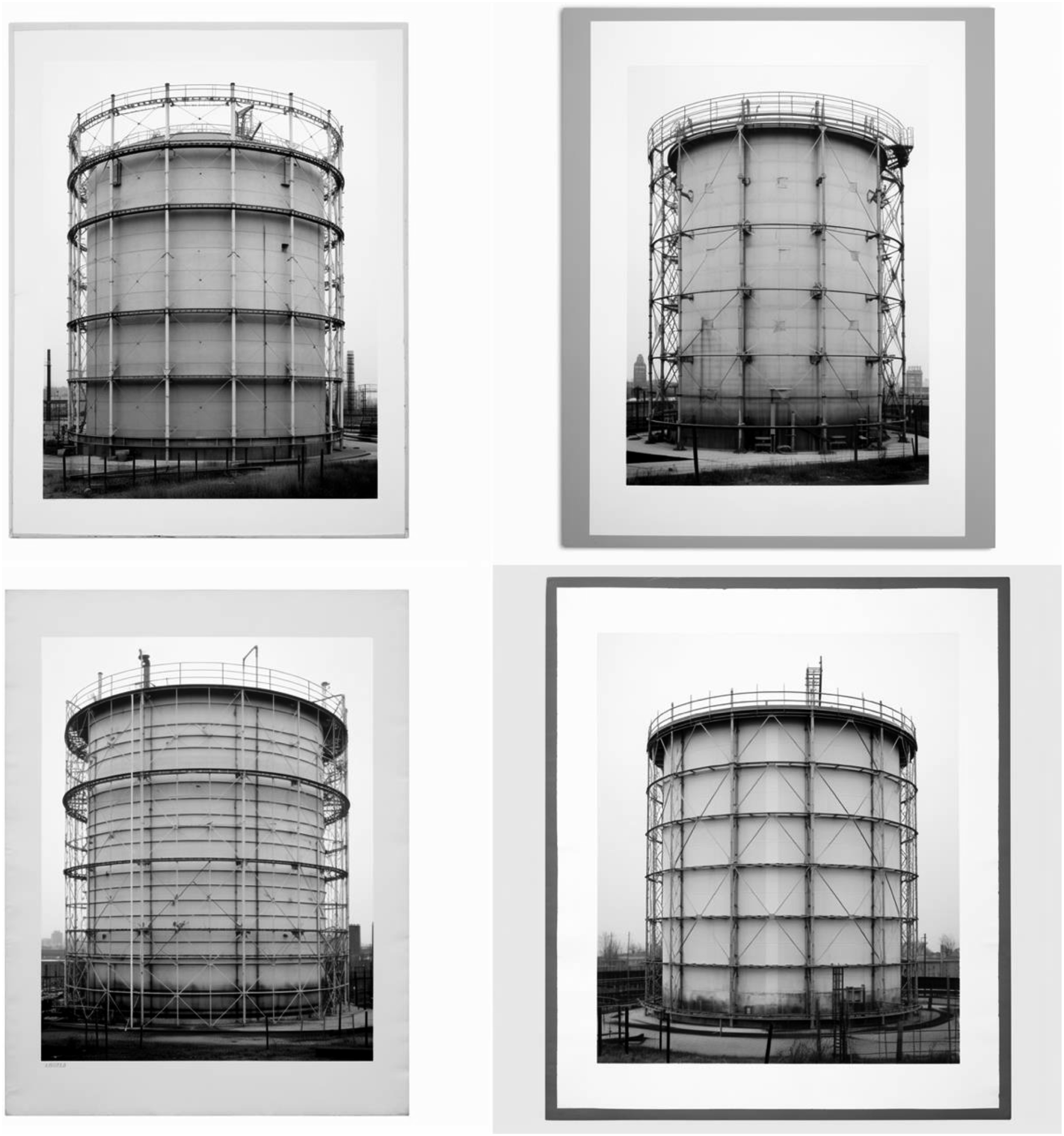
Anarchaetypologies (2023b) by Michael C Coldwell (and AI)
In both projects it was possible to push the results towards the desired compositions, but in no way did this ever approach a photographic experience of framing, where an image is selected dynamically from an experienced environment. With Visitations I still felt like a practicing photographer, engaging in somewhat familiar creative processes. With Anarchaetypologies, the experience was more like that of a cunning thief, clairvoyant or spirit medium, practicing their dark arts – the summoned ghosts of the Bechers framing the compositions of the final work, rather than myself. Even when using my own photographs as image prompts, as I did with Is Anything Real?, the resultant framings were often enigmatic, surprising and chaotic, though this unpredictability could be somewhat reduced by developing more elaborate prompting strategies.
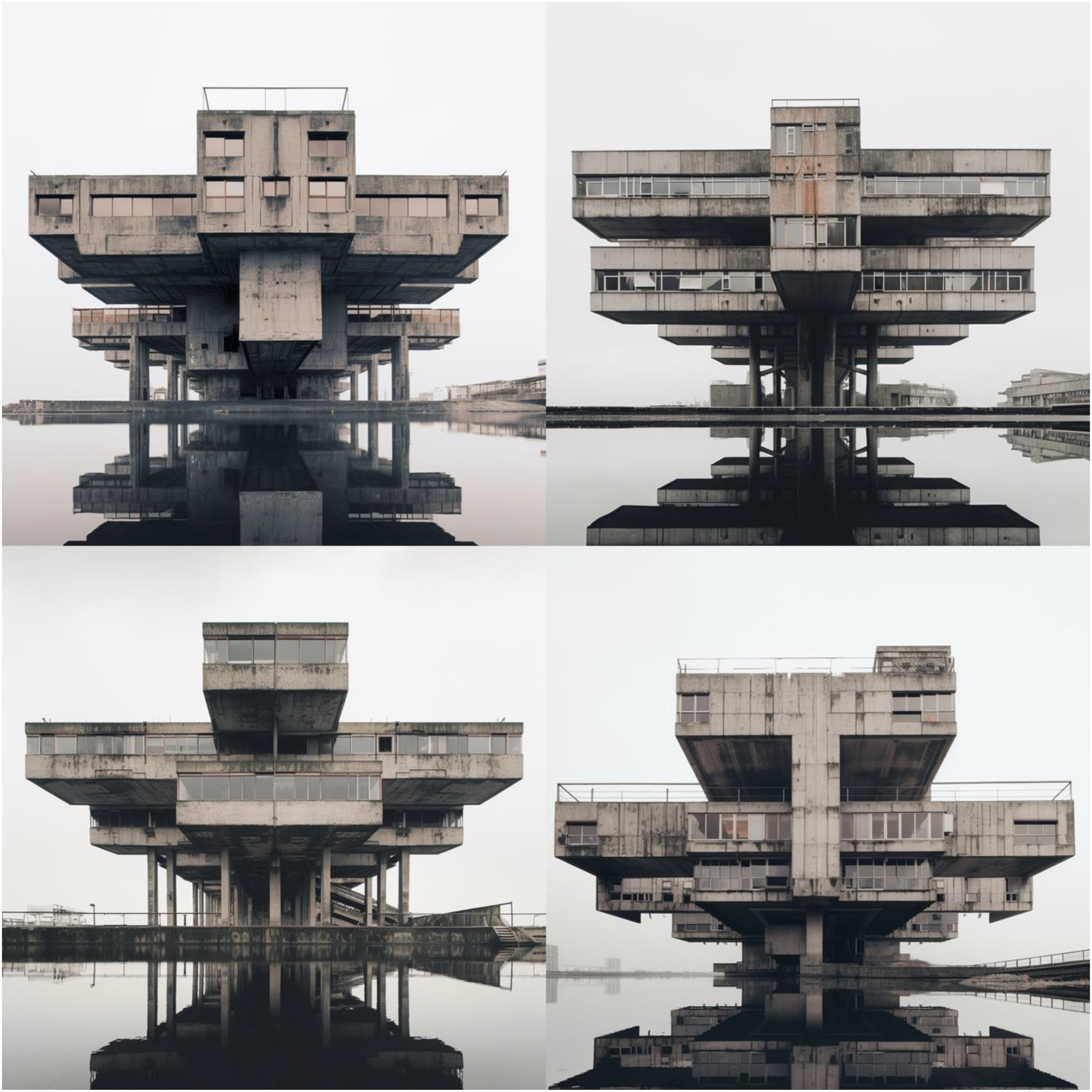
Third Order Simulacra from Is Anything Real? by Michael C Coldwell (and AI)
By virtue of the way Midjourney can create endless variations of a generated image, the results often had a default typological framing, even without the Bechers’ influence on prompting. Here the composition could be controlled more precisely by selecting compositions close to the desired outcome, and requesting the tool deliver subtle variations based upon that. By pursuing certain variations, I could push the outcomes in preferred creative directions. In the example above, Midjourney misinterpreted the optical illusions in my original photography for actual architectural forms. In creating new variations based on these, the model generated a whole fictional typology of impossible brutalist buildings, certainly inspired by my initial seed photographs, but nevertheless heading off in its own unanticipated direction. Strangely, each successive generation of these variations seemed to closely mirror Baudrillard’s precession of simulacra (1983). I decided to let this observation structure the presentation of the final series (Coldwell, 2013c). Perhaps with these new practices photography has finally reached Baudrillard’s fourth order.
AI ‘photography’ (which we should probably see as a sub-set of generative art, rather than a virtual photographic practice that is anything like the others) is obviously not photography in terms of the medium’s conventional ontology – primarily via its lack of a clear indexical relationship to the physical world. Neither is it photography if we try to redefine the medium in terms of those common practices which allow us to consider its virtual descendants as part of the same methodological continuity. With AI, an immersive ‘reality’ is not being selected from and framed by any human ‘photographer’, and so the basic practice involved is wholly different. However, as a new form of image-making we can certainly see that it is profoundly haunted by photography as a medium, with an archive of millions of past photographic images making up its vast training data. This photographic foundation ultimately affects the composition, aesthetics and possible interpretations of the generated images – increasingly rendering them indistinguishable from traditional photographs. While they may not be photographs according to any workable definition that we currently have, their prodigious use of photography looks set to deeply disturb the photographic universe (Flusser, 1984: 65). Evolving at great pace, diffusion models will almost certainly end up redefining the photograph once again. The current prevailing narrative is that AI can only be bad news for photographers and other artists, whose appropriated work is utilised without permission by these models – but there is certainly scope for AI tools to be utilised and controlled by artists too, much in the same way other virtual photographies have been adopted by experimental creatives, who are interested in new ways of looking at the world, making images and interrogating the photographic. AI’s adoption by the creative industries, including by photographers, is bound to prove controversial in many ways. There are already quite a few well-documented cases of this happening – even in photojournalism, where the veracity of the photograph is surely imperative. 8 A new ethics of AI is therefore a vital and growing research area, but one that can only be touched upon briefly here. Midjourney’s ability to create very persuasive illusions of the photograph, creates the potential for falsifying evidence, but also the normalisation of troubling representations, biases and injustices (reinforced by a new illusory ‘truth claim’) – many of which have already been highlighted by researchers working in this new field (King, 2022).
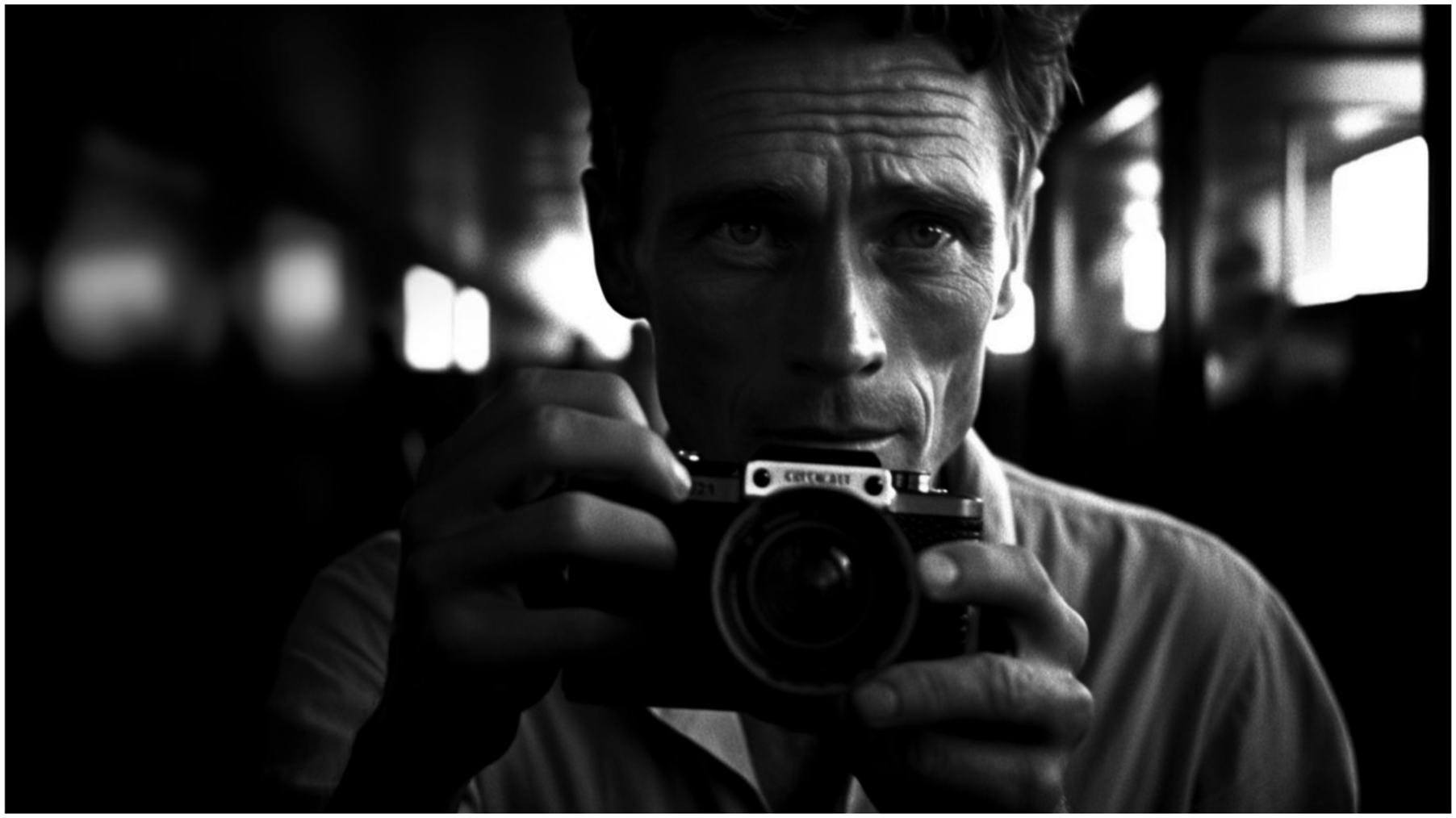
Jettison (forthcoming film, 2024) by Michael C Coldwell (and AI)
The camera is now the ghost
‘Photography as an activity is transferred into virtual worlds’. (Gerling, 2018: 158) ‘The virtual image becomes the modern phantom’ (Gunning, 2007: 111)
While the difficulty in precisely defining photography is nothing new, there is a common thread running through much of the photography theory canon that seems to indicate a simple metaphor for what a photograph truly is: the ghost. Bazin (1945: 14), Sontag (2002: 9), Flusser (2011: 32), Gunning (2007: 98), Mulvey (2006: 56), Barthes (1993: 87) and Derrida (1998: 34), all employ distinctly ghostly language in their leading theories about the medium, with the latter two of these thinkers going much further in their spectral definitions of photography. In Camera Lucida (1993), Roland Barthes defines the photograph as the ‘ectoplasm of “what-had-been”’, a material presence that marks a haunting absence, while Derrida states, in no uncertain terms, that the ‘spectral is the essence of photography’ (Derrida, 1998: 34). Key to these ideas is the notion of the trace, a presence that marks an absence, intangible and virtual, but nevertheless something that persists, that links an apparition in the present to something real from the past. This begs the question as to whether these new virtual photographic forms maintain this essential time-travelling trace, which could potentially resolve, once and for all, the argument over whether they can truly be considered photographs.
In The Hauntology of Rephotography (Schofield, 2018) I attempted to investigate the concept of photographic spectrality through exploratory practice, asking if all photographs really are ghosts, why is this not always apparent – why do only some of them have the power to haunt us? Through the post-photographic reuse of archival images, and the practice of rephotographing them, I discovered this relates to the fact that the photograph has two interacting parts. ‘A material ghost must have a dual nature: the present object, the support or “medium” (which can often be invisible to us), and the spectral trace of the past that it channels – the usual focus of our attentions: the absent referent’. (Schofield, 2018, pg 20)
I noticed that it became possible to reveal a photograph’s inherent ghostliness by exposing or foregrounding the materiality of its substrate – the image’s own material presence as a time-travelling object. As the trace’s illusion of presence is subsequently undermined, we become aware of the absence that it represents. In most contemporary photography this material substratum appears invisible or even missing entirely. With digital images, it is certainly harder to access and manipulate than it is with paper, celluloid or emulsion on glass. Nonetheless, it does become possible to uncover the spectrality of the digital image once you realise that the same material role is played by its underlying raw data. This can then be foregrounded and manipulated in the form of the glitch. Such spectrality is invisible in most virtual photography too, but again, it can sometimes be brought to the fore when its own technical illusion breaks down, as it does in the temporal experiments of Travelling Without Moving (2020) and the glitchy dark tourism of my Visitations (2022) series.
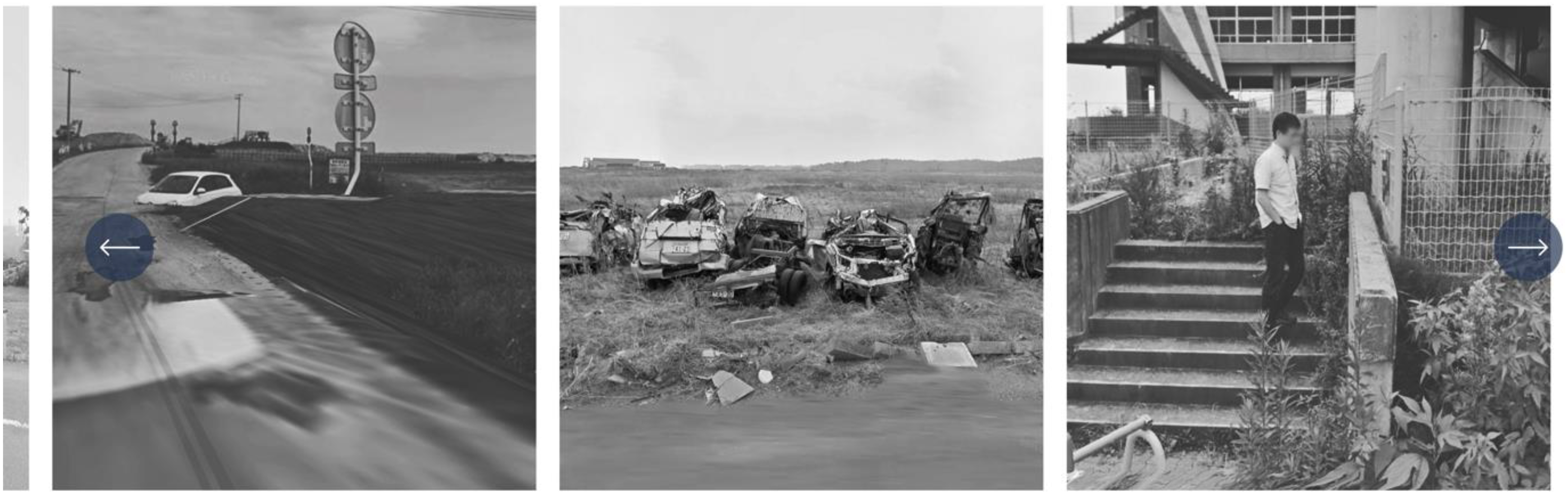
Visitations (2022) by Michael C Coldwell
Both of these virtual photography projects are comprised of real-world photographic data (from Google Street View imagery), so it probably shouldn’t come as much of surprise that their trace can be revealed as spectral in a similar way as it can with other photographs. Could comparable interventions be made to reveal spectrality in other virtual photographies too – including those with weaker or more convoluted links to real pasts – even those associated with AI and diffusion models? A recent cultural phenomenon suggests a possible strategy, a creative disruption of digital environments referred to by several scholars as ‘glitch gothic’. ‘These deliberately engineered interruptions in the fabric of virtuality (or digitality) are material forms of noise that have now become signifiers of spectrality’ (Kozlovic, 2016: 120) ‘Glitch gothic stories recount a temporary interruption in the fabric of virtuality or digitality in order that the spectral can become material’ (Olivier, 2015: 270)
Even without the strong indexical trace that we see in the traditional photograph, various other kinds of digital image can be revealed as similarly spectral by interrupting and unearthing the hidden data that underlies them. Unlike Barthes, Derrida didn’t see such spectrality as unique to photography, that all forms of media have the power to haunt us, and that ‘every culture has its phantoms and the spectrality that is conditioned by its technology’ (Derrida et al., 2010: 39). Once the illusion of presence of media is disrupted, we can experience a haunting and uncanny effect, but the ‘realist mode’ of their artifice generally hides their ‘ghostly and phantomatic aspects’ (Wolfreys, 2015: 614). For any illusion of presence to be successful, it must be predicated on a spectral link to real forms that lie elsewhere. The ghosts here aren’t as direct as they are with the indexical photographic trace, but they share many similarities – and neither of these kinds of trace are ontologically ‘real’ anyway – they are necessarily virtual.
9
‘The trace is not a presence but is rather the simulacrum of a presence that dislocates, displaces, and refers beyond itself’ (Derrida, 1973: 156)
While AI images are conjured from random noise rather than recorded using light, the trace of many photographs informs their making as guiding data. Those that look sufficiently like photographs are illusions of presence too, and this can be undermined in various ways, revealing a common spectrality. Learning models are prone to ‘hallucination’ (del Campo and Leach, 2022; Alkaissi and McFarlane, 2023), and while the developers are working hard to iron-out these strange glitches and make AI a more reliable source of information, hallucinations do still occur, although they are much more noticeable in earlier versions and iterations. There were substantial changes, in this regard, even during the few months I was developing Anarchaetypologies (Coldwell, 2013b). Earlier experiments seemed much more erratic, much less convincingly photographic, but undoubtedly more eerie, sometimes drifting firmly into the realms of the uncanny.
To investigate the phantomatic aspects of AI image generation further, I developed another experimental series which I called All That Is Solid Melts Into AI (Coldwell, 2023a). This work took advantage of the fact that Midjourney now allows you to select earlier versions of the model to complete the requested image generation. You can also stop the process before it is complete, revealing something of the strange way in which the photographic is being hallucinated.
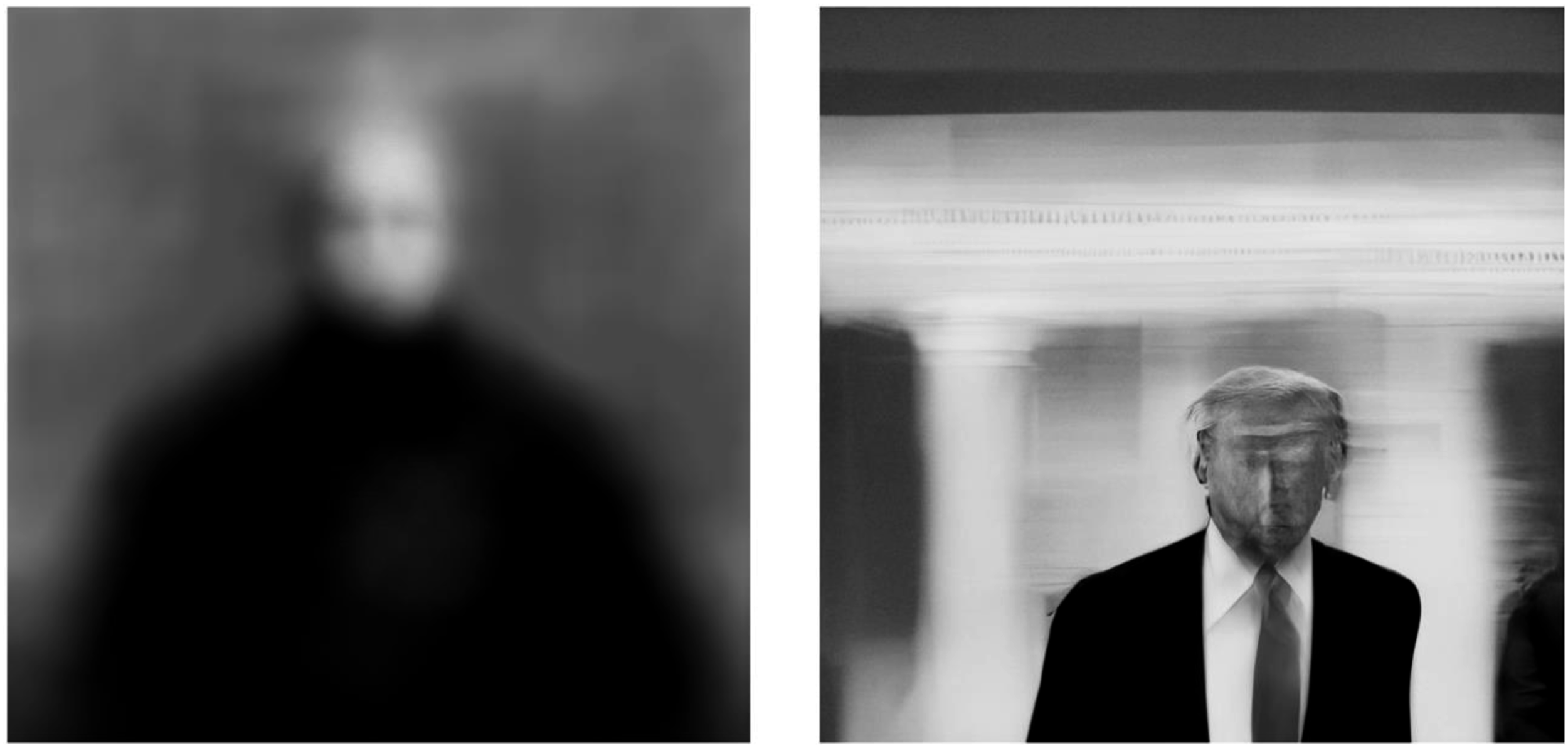
All That Is Solid Melts Into AI by Michael C Coldwell (and AI)
There is definitely something ghostly about this particular AI project. The trace of the real is disconcertingly incomplete, with figures wavering between absent and present, seemingly human and certainly inhuman. The way the trace is summoned from noise has much in common with visual pareidolia, 10 a psychological phenomenon that is also a common scientific explanation for ghost sightings. In a very real way, the model is hallucinating these ghosts – it is seeing things that aren’t there, by matching vague patterns in random noise in the present, against learnt patterns and forms from the past. Text prompts tell the model what to find there, and the models turn out to be just as suggestible as we can be, especially if they are ‘primed’ 11 to divine the things we command them to.
Playing with the glitchy limitations of AI photography not only helps reveal a spectrality that is related to traditional photography, it is also where there is much greater scope for creativity and originality. It is here that AI shows itself to be an inspirational tool for those seeking the novel and the peculiar. In Anarchaetypologies (2023b) the outputs are ordered chronologically, revealing how the models improved over time, with the earlier examples showcasing some bizarre and genuinely individual characteristics. As the project progressed, and the model advanced considerably, AI image generation began to look more and more like the straight copying machine it is routinely accused of being. 12 At a quick glance, the later images in the series could easily be mistaken for original photographs by the Bechers, but that error is unlikely to occur viewing Midjourney’s initial attempts, some of which seem to have a genuinely unique ‘glitch gothic’ aesthetic.
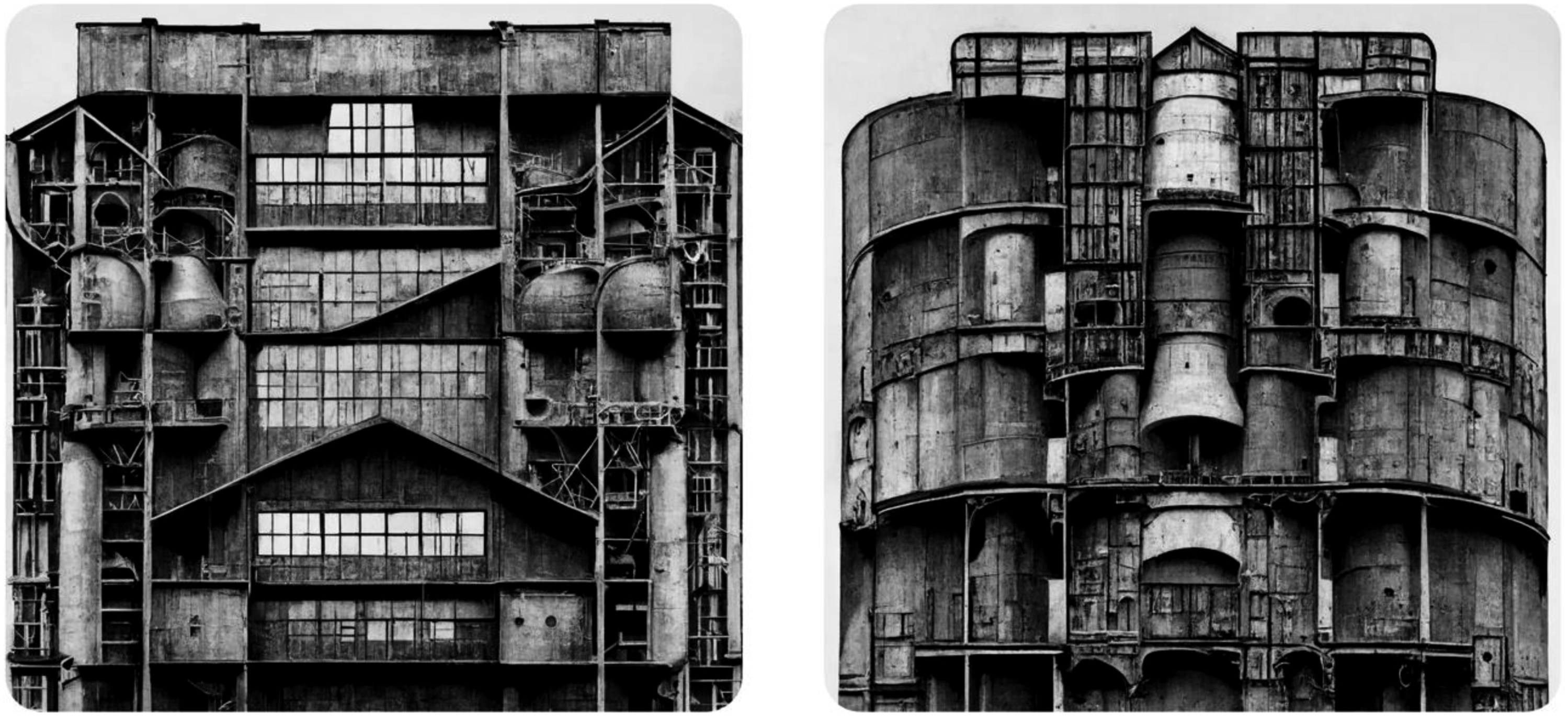
Anarchaetypologies (2023b) by Michael C Coldwell (and AI)
A common and often justified criticism of virtual photography increasingly applies to AI art as well – that rather than creating anything original with these new tools, the ‘screenshotters are [just] reframing someone else’s art’ (Hobbs, 2021). However, this critique is of the way these tools are sometimes used, rather than the tools themselves – it doesn’t apply to those reframing automatic 360 photography (which I don’t think anyone would call ‘art’), as we saw earlier with the Google Street View photographers – and it doesn’t apply to practitioners pushing AI models outside of their comfort zones, applying disruptive approaches, or using earlier models to explore the spectrality of these new artificial imaginations. AI image-making is very different to other virtual photographic practices in that it doesn’t always simulate the photographic that well at all – and perhaps it is most interesting when it fails, rather than when its illusion of photographic presence is successfully perfected. Once revealed, the spectrality of AI photography is also very unusual. The photographic trace of the past can be found there, but it is often buried and garbled, an odd amalgamation of millions of traces summoned from chaotic data. It can still haunt us, but not in quite the same way – there is no real passage of time felt, no palpable link to human mortality – Barthes’ haunting ‘that-has-been’ (1993) no longer applies. The main thing haunting these new AI images is actually the camera itself, rendered a ghost now by its total absence from the new medium, a seemingly unnecessary anachronism, but one that nevertheless exerts a strong spectral influence on everything that is generated. This time-honoured optical device, that has had such a vital role to play in visual culture over the last century – and the creative ways of seeing that it helped engender – continues to structure these strange new simulacra, and the ways in which new practitioners choose to use them, even as the camera is seemingly erased from the picture entirely.
While the overall view of this emerging field is yet to come into sharp focus, there is no doubt that photography as an ‘activity’ has now fully ‘transferred into virtual worlds’, as Gerling predicted (2018: 158). This is beginning to transform how we see and use the medium in contemporary visual culture. Whilst it is still a distinct medium, in many ways, it has also now become fundamentally hypermediated. Activity is a key word here, if we’re to understand photography as a changing practice within this context, and the creative ways these tools are being employed beyond the mere theft or simulation of others’ work. The modes in which the photograph has been remediated and virtualised are manifold, with many different new practices and technologies emerging rapidly in recent years. Understood through the lens of framing as a creative activity, we can see clear similarities in process between traditional photography and many of its virtual offspring (if not all). There is skill and merit in much work that could easily be dismissed as artless screenshotting, without applying a deeper understanding of the power of selection and composition in traditional photography, and the artistic and experimental frameworks in which some of these new practitioners are operating. Framing can help us understand many of these practices, but it is insufficient as a basis, to completely redefine the photographic as something now lying beyond the camera, or to fully understand the relationship between photography and the virtual practices that currently draw heavily upon it. For one, AI in the form of the diffusion model, has broken this link between virtual photographer and traditional practice. This later form of virtualization eschews the dynamic act of framing that we see in other virtual photographies, instead synthesising the frame using machine learning and the archive. This completely changes the processes and creative practices involved in making photographic images. As we’ve seen, the frame can still be controlled in this new kind of creative work (to a degree), but not in a comparable way. It is no longer the primary tool of selection, and its relationship to the real (or something we might encounter similarly in the virtual world) is fragmented and chaotic. There is still a vital link to photography though, which we should certainly not discount. We see a new kind of spectrality at play in diffusion, in which a multiplicity of photographic traces from the past can be drawn-upon simultaneously, to synthesise entirely new forms – some of which can look strikingly real, and much more like traditional photographs than many of the in-game screen captures, or lo-fi images scraped from Street View, that we looked at earlier. AI photography may not really be a form of photography at all, or a photographic practice or skill as we currently understand them, but perhaps it is a kind of emergent super-photography, fully intertwined with the photographic, in systems that will make them seem completely inseparable, with time. Photographers are already turning to these AI tools to augment their practice, routinely. Such facilities are now built into industry-standard photo-editing software, such as Adobe Photoshop’s ‘generative fill’, and easy-to-use AI tools have proliferated, so that anyone can now make images in this way, including the editing and manipulation of existing photographs using AI models. This is only the beginning of a great sea change in the photographic universe. As new technologies and practices of image-making continue to emerge, photography is only going to become more diffuse and confusing to ontologise – but some things are likely to remain largely the same. The act of framing still has a very important, and often unacknowledged role to play in all visual communication – in the value we place on both photography and photographers as practitioners – a creative, meaning-making role, that has been very consistent since the dawn of the medium, however many times photography has seemingly died and been resurrected in strange new configurations. 360 photography, for example, hasn’t replaced the traditional image for a very good reason – and I expect to see greater creative control of the frame being offered in diffusion models soon, for the same reason – we need the frame, as framing is meaning. Greater creative control of this kind will move AI closer to traditional photographic practice, which in turn will make it even harder to tell fact from fiction, a real trace from a virtual one. ‘Like a ghost, this photographic apparition will continue to surprise us with its presence, long after its original manifestation is supposed to have departed from the scene’ (Batchen, 1994: 50) ‘Photography it appears, is a logic that continually returns to haunt itself’ (Batchen, 2002: 143)
Ultimately, whether or not we ever move beyond the need for cameras and traditional photography skills, the medium’s longstanding frames and practical approaches will continue to haunt and disturb whatever follows – the photograph constantly re-emerging from its virtual ashes.
Footnotes
Declaration of conflicting interests
The author(s) declared no potential conflicts of interest with respect to the research, authorship, and/or publication of this article.
Funding
The author(s) received no financial support for the research, authorship, and/or publication of this article.
