



Abstract
Creative artificial intelligence (AI) has received a lot of attention in recent years. Artworks that are introduced to be generated by AI (rather than a human artist) are, however, often evaluated negatively. Integrating extant research, we suggest that AI is ascribed less mind (i.e. agency and experience) which is responsible for this effect. In two experiments (N = 176 and N = 381) we observed negative indirect effects of artist information (AI vs human artist) on the appreciation of visual artworks. The AI is consistently ascribed less agency and less experience than a human artist. Higher levels of experience and agency ascribed to an artist are, in turn, associated with higher appreciation of a piece of art. In both experiments the total effect of artist information on appreciation was not significant. Artist information did not predict whether the artwork deviated positively from viewers’ expectations developed before the actual artwork was encountered.
Keywords
There has been a recent interest in artificial intelligence (AI)-generated art (Cetinic and She, 2022; Small, 2023). Initially sparked by events such as the sale of an AI-generated artwork for US$432,500 at Christie’s, the fascination for AI-generated art seems to have reached a new peak. Programs like DALL-E 2 and Midjourney enable users to generate artworks from text requiring only little technical knowledge (Roose, 2022). In addition, AI has become able to generate artworks as well as other creative content that can hardly be distinguished from content made by human creators (Elgammal et al., 2017; Gangadharbatla, 2022; Köbis and Mossink, 2021). Despite these developments, several studies suggest that the same pieces of creative content are evaluated more negatively if they are introduced as generated by an AI, as compared with a condition in which they are introduced to be made by a human artist (e.g. Agudo et al., 2022; Messingschlager and Appel, 2022; Wu et al., 2020). Other studies, however, do not find such an effect (e.g. Friedman and Taylor, 2014; Xu et al., 2020). The aim of this work is to identify mechanisms underlying the appreciation of AI-generated art. Our main line of reasoning is based on the mind perception literature. Extending and connecting prior theory, we argue that humans ascribe AI a lack of mind in terms of agency and experience (Gray et al., 2007), leading to lower appreciation of supposedly AI-generated art (vs the same piece that is ascribed to a human artist). We further examine a mechanism that could lead to higher appreciation of AI-generated art, namely, positive deviation from expectations. To test our theoretical model, two preregistered online experiments were conducted. An online supplement, as well as preregistrations and data for both experiments are provided on OSF (https://osf.io/dmvur/?view_only=fccb0563d39e4156823deb3e2576cecb).
The evaluation and experience of work by creative AI
The evaluation and experience of artworks depend on several aspects like features of the artwork, such as genre or style, and interindividual differences of the observers, like domain-specific expertise, genre preferences, or prior experience with art (Leder et al., 2004; Van Paasschen et al., 2015; Wallraven et al., 2009). Another important aspect, influencing the way recipients evaluate art, is context information (Kirk et al., 2009; Lin and Yao, 2018). Once a viewer learns about the artist of a creative piece, their knowledge about and perception of that artist affects their experience and evaluation of art (Fischinger et al., 2020; Steinhardt and McClaran, 2022). In the case of creative AI, several studies suggest that artist information negatively affects the evaluation of art and other creative products (see below).
Our focus here is on the appreciation of creative work as an essential aspect of evaluating and experiencing art, as it covers more aspects than just the assessment of quality or perceived value (Fingerhut and Prinz, 2018; Leder et al., 2004). Our definition of appreciation includes two components: first, art needs to be perceived as meaningful to be appreciated (Hager et al., 2012; Leder et al., 2004; Wu et al., 2020). Viewers who appreciate a piece of art express a feeling of being moved or touched by what they see (Menninghaus et al., 2019; Schindler et al., 2017). Second, appreciation includes that a piece of art is considered to be beautiful, and individuals enjoy the experience of looking at it (e.g. Hager et al., 2012; Jacobsen et al., 2004; Schindler et al., 2017).
Some prior research showed that the information that a piece of art is AI-generated can reduce appreciation and related experiential responses (Wu et al., 2020) such as artistic value (Gangadharbatla, 2022), perceived beauty, novelty, liking and perceived meaning of artworks (Ragot et al., 2020), emotion evoked by audiovisual content (Agudo et al., 2022), and narrative transportation into stories (Messingschlager and Appel, 2022). Other studies find no effect of artist information (AI vs human) on perceived quality, imaginativeness, engagement and spatial presence of artworks and poems (Xu et al., 2020), artistic value or originality of an artwork (Hong and Curran, 2019), and neither on meaningfulness, arousal, positive affective response, likeability, or interest sparked by music (Friedman and Taylor, 2014; Moura and Maw, 2021). In addition, although some studies indicate that AI-generated art might be evaluated as less novel and original (Gangadharbatla, 2022; Ragot et al., 2020), it is a new kind of technology and AI-created art may be perceived as new and interesting, leading to a novelty effect that could have positive downstream effects on appreciation.
In sum, findings on the evaluation of supposedly AI-generated content are somewhat mixed. That said, the majority of studies suggest that the information that a creative piece has been AI-generated (vs the information that the piece was created by a human) leads to a more negative experience, indicating a bias against AI-generated art (e.g. Agudo et al., 2022; Chamberlain et al., 2018; Hong, 2018).
Mind perception of AI as the creator of art
The evaluation of AI-generated art seems to be influenced by a negative assessment of what kind of art AI is able to produce (Chamberlain et al., 2018; Ragot et al., 2020). Some individuals tend to think that creative AI is insufficient as a creator of good artworks, since human input is required to generate art (Cetinic and She, 2022). Hence, AI-generated art is supposedly of lower value, less unique, or less original than art made by humans, and AI or AI-driven robots are less often perceived as an artist (Ch’ng, 2019; Hong, 2018; Mikalonytė and Kneer, 2022). Importantly, the reasons underlying this negative general assessment and the reasons underlying lower appreciation of AI-generated art have not been examined systematically.
As outlined above, recipients’ evaluations of art rely on the assessment of its creator (Boden, 2016; Natale and Henrickson, 2022). We suggest that the negative assessment of AI as the creator of art is rooted in a basic assessment of AI in terms of mind. Gray et al. (2007) identified two dimensions of mind ascribed to an entity: agency and experience. Agency is the capacity to think, which includes having a sense of morality, recognizing emotions, and being able to plan and act accordingly. The second mind dimension is experience, which includes the capacity to feel different emotions, have unique personality traits, and consciousness. Typically, an adult human is perceived to have high levels of agency and experience. The minds of different entities are characterized by varying levels of perceived mind in both dimensions (e.g. children and animals are attributed lower agency than adults but a high level of experience). Compared with an adult, various forms of technology, like AI (Shank et al., 2021), or robots (Gray et al., 2007), are ascribed lower levels of agency and very little experience; and computers (Gray and Wegner, 2012), robots (Appel et al., 2020), smart speakers (Taylor et al., 2020), or virtual agents (Stein and Ohler, 2017) are perceived as eerie if they appear to show abilities that differ from these expectations.
These mind perceptions can be seen as the foundation of the task-dependent perception of AI. Machines are often trusted to fulfill tasks that demand certain agentic capabilities as their work is precise and reliable (Castelo et al., 2019; Sundar, 2020). If compared with humans, however, they are ascribed lower agency (Gray and Wegner, 2012). Especially their apparent lack of experience disqualifies them for jobs that require a subjective perspective (Castelo et al., 2019). Technology is perceived to be suited for “thinking—not feeling—jobs” (Waytz and Norton, 2014: 434). Heuristics, beliefs, and mind perceptions are especially relevant, since there is often no further information or embodiment of AI (like robots or virtual agents) that could foster anthropomorphization and negate the perceived mismatch of capacity and task (Chamberlain et al., 2018). We argue that the negative evaluation of AI-generated art stems from the lack of agency and experience attributed to AI. Viewers need to ascribe both agency and experience to an artist to appreciate a piece of art, since a certain level of mind perception can be considered a prerequisite to perceive actions of an entity as intentional and meaningful (Shank et al., 2019; Waytz et al., 2010). Without a perceived mind, AI would not be able to learn from existing artworks, perform artistic actions, and put intent in the art it creates (Bullot and Reber, 2013).
Although both factors of mind perception are necessary to create meaningful art, they contribute to the process in different ways: agency is needed to develop a clear, coherent concept for an artwork and act accordingly. To create artworks of high quality, artists need to be knowledgeable about art style and techniques to incorporate them in their work (Hager et al., 2012). Viewers seem to doubt that technology intentionally (rather than accidentally) creates art, even if they are told that it decided to do so (Mikalonytė and Kneer, 2022). Compared with this awareness of the creation process, the ability to create meaningful art would require an even higher level of agency by the artist. In addition, the capability to feel and express human emotions, seems to be crucial to produce meaningful art (Hong, 2018). The appreciation of an artwork includes affective evaluations throughout the evaluation process (Leder et al., 2004). An artist with low experience would likely struggle to purposefully express emotions in an artwork that can then be interpreted and experienced by its viewers.
Since AI’s lack of agency and experience does not allow for a human comprehension of the world, some authors have critiqued past attempts to create AI-generated art for the fact that AI is unable to create original artworks or consider symbolic and cultural implication of its pieces (Eden, 2010; Hertzmann, 2020; Natale and Henrickson, 2022). As technology is typically ascribed less agency and less experience than humans (Gray et al., 2007) the differences in mind perception of an AI and a human artist will affect the appreciation of their art.
Our formal hypotheses started with the artist main effect, followed by the underlying mechanisms. In most prior studies on the evaluation of work by creative AI, introducing a creative piece to be AI-generated (vs human-generated) negatively affected appreciation and evaluation (e.g. Gangadharbatla, 2022; Messingschlager and Appel, 2022; Ragot et al., 2020). Focusing on appreciation and visual art, we formulated the following hypothesis:
H1: The information that an artwork has been created by an AI reduces the appreciation of this piece.
Given our theoretical rationale outlined above, we further expected that the effect of artist information on the appreciation of an artwork is mediated by the perceived mind of the artist, more specifically:
H2: An AI artist is ascribed less experience than a human artist. Lower perceived experience is, in turn, associated with less appreciation of the artwork.
H3: An AI artist is ascribed less agency than a human artist. Lower perceived agency is in turn, associated with less appreciation of the artwork.
Experiment 1
In order to test hypotheses H1–H3, an online experiment on the appreciation of artworks was conducted.
Method
Participants
We expected a small-to-medium effect size of artist information on appreciation (f = .22, α = .05, 1 − β = .80). After a G*Power analysis a sample size of 180 participants was preregistered (https://aspredicted.org/blind.php?x=2VK_DYD). We recruited a sample of 226 German participants through research platforms (e.g. survey circle) and social media. Due to the preregistered criteria, 50 participants were excluded from the sample: 19 participants failed the attention check (recognizing information from the previous artist information), 16 had low self-reported diligence (three or less on a five-point scale), and 15 completed the questionnaire in less than 120 seconds. The remaining 176 participants (67.6% female, 32,4% male) were between 19 and 72 years old (M = 29.82, SD = 12.27). Note that the final sample size was a bit (four participants) smaller than preregistered. It was sufficient to detect a small to medium effect of f = .21 rather than f = .22 (given α = .05, 1 − β = .80).
Stimulus material
All participants initially received information about the supposed artist of a visual artwork. This was either a fictional artist or a creative AI. To ensure that all participants in the AI condition had basic information about creative AI, they were given a short description of AI and its application in the arts (see Online Supplement S1 for full introductions). In the human artist condition, participants received some information about the artist (“The following picture was created by Mika J. Baker. Mika J. Baker was born in 1956 and studied at Dartmouth College, USA.”). We deliberately presented few pieces of information about the artist to prevent this information (e.g. the artists’ reputation) to influence the results. Participants were subsequently presented one of four different visual artworks. Four artworks (rather than one) were included in order to increase the generalizability of our results. All artworks were generated by AI from pieces of text with a demo version of X-LXMERT (Cho et al., 2020) and were created for the purpose of this study to make sure participants were not familiar with the artwork. The style of all artworks resembled abstract paintings (see S2 for the stimuli). The artworks, with a size of 400 × 401px, were presented in the middle of the screen. Participants were asked to carefully look at the piece as long as they wanted.
Measures
Mind perception
Mind ascribed to the artist was measured with a German translation of the mental capacities measured by Gray et al. (2007), which were adapted to fit the topic of this study. Participants indicated their mind perception of the artist on a five-point scale (1 = strongly disagree to 5 = strongly agree), answering 11 items referring to experience and seven items concerning the agency ascribed to the artist (see S3 for full list of items). The scale proved to be a reliable measure for experience (Cronbach’s α = .94, M = 2.61, SD = 1.08) and agency (Cronbach’s α = .84, M = 3.00, SD = 0.89).
Appreciation
Participants indicated their appreciation for the artwork with four items on a seven-point scale (1 = strongly disagree to 7 = strongly agree). The scale covers specifically two important aspects of appreciation: being moved and perceived beauty. 1 The items were derived from two different approaches to measuring appreciation and reception of media and art (Fingerhut and Prinz, 2018; Oliver and Bartsch, 2011, see S4 for all items). Reliability for this scale was good (Cronbach’s α = .84, M = 2.54, SD = 1.12).
Procedure
All participants gave their informed consent to begin the questionnaire. They were reminded that their participation was voluntary and anonymous and asked to carefully read all texts and instructions. Participants were randomly assigned to one of eight conditions (one of two artists and one of four artworks). Participants received information about the respective artist (human or AI), followed by a short attention check (choosing the piece of artist information previously presented to them). Next, they were presented with a single AI-generated artwork. Afterwards, all participants were asked to report their appreciation for the artwork they had just seen and indicate their mind perception of the artist described earlier. They self-reported socio-demographics and their diligence during their participation. Finally, all participants were debriefed, informed that all artworks were in fact generated by AI, and given the opportunity to make remarks or report technical problems.
Results and discussion
Analysis overview and descriptive statistics
Our hypotheses included a main or total effect (H1), suggesting a negative impact of AI artist information on appreciation as well as links between ascribed agency and experience to the experimental treatment and the dependent variable appreciation (H2 and H3). The specific artwork shown did not influence the effects of the artist manipulation on appreciation; the interaction term between artist information and pictures was not significant, F(3,168) = 0.27, p = .850. Therefore, the results for all four artworks were pooled. To test our hypotheses, a bootstrapping mediation analysis was conducted with the PROCESS macro for SPSS (Hayes, 2018, Model 4, 5000 bootstraps). We also report partially standardized values for all effects in our mediation models (Hayes, 2018). Artist information was dummy coded (human = 0, AI = 1).
Descriptive statistics and zero-order-correlations are reported in Table 1. The zero-order correlations show positive relationships between both dimensions of mind perception and appreciation, with a stronger correlation of appreciation with agency than with experience. Furthermore, agency and experience were highly correlated with each other. As they are two dimensions of mind perception, this is to be expected to a certain extent. However, as the high correlation between both mediators may impose problems of multicollinearity, we examined mediating effects of experience and agency in two separate mediation models (Hayes, 2018). We provide an alternative analysis in which both mediators are entered together in one model in Supplement S6.
Descriptive statistics and zero-order correlations (Experiment 1).
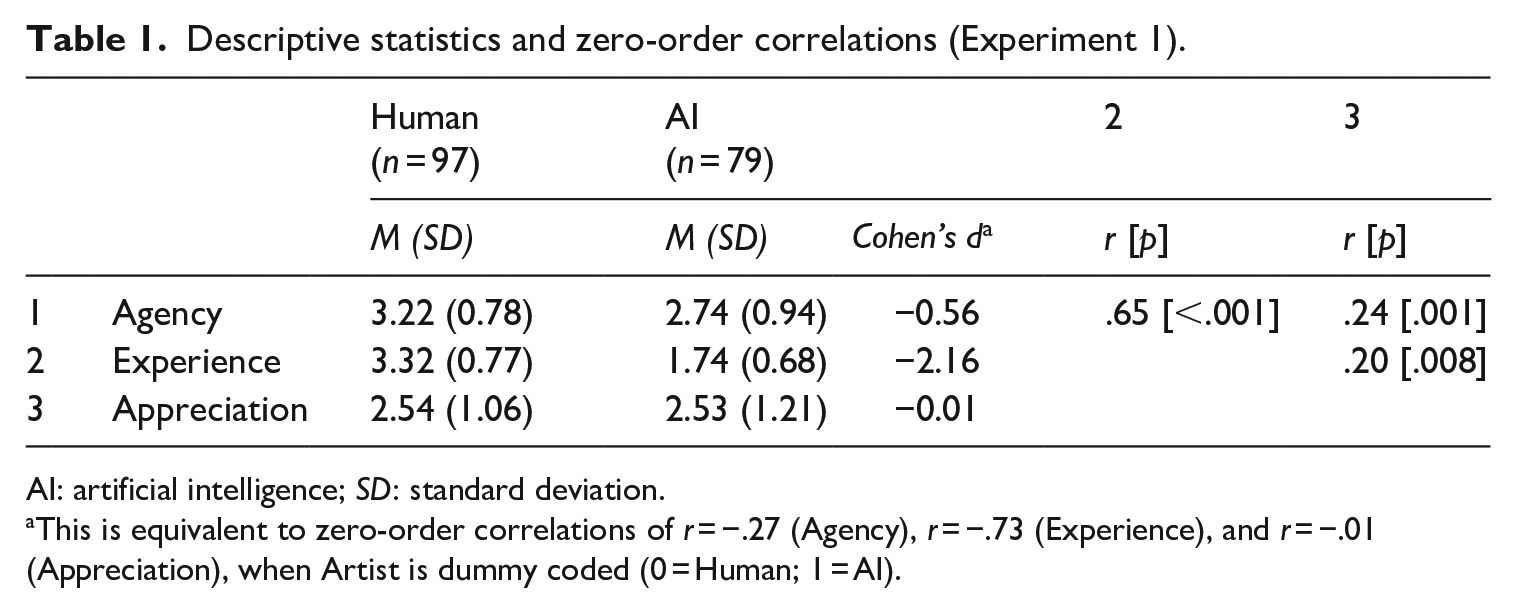
AI: artificial intelligence; SD: standard deviation.
This is equivalent to zero-order correlations of r = −.27 (Agency), r = −.73 (Experience), and r = −.01 (Appreciation), when Artist is dummy coded (0 = Human; 1 = AI).
Total effect and mediation models
The total effect did not point toward a significant influence of information about an AI artist on appreciation of the artwork (b = −0.02, SE = 0.17, p = .929, 95% confidence interval [CI] = [0.35, 0.32], bps = 0.01). A picture that was introduced as created by AI (M = 2.53, SD = 1.21) did not elicit significantly lower appreciation than the same picture that was introduced as created by a human artist (M = 2.54, SD = 1.06), d = −0.01. Thus, we found no support for H1.
The mediation model including agency revealed that, in line with our assumptions, the AI artist was perceived to have significantly less agency (b = −0.48, SE = 0.13, p < .001, 95% CI = [−0.73, −0.22], bps = −0.54), which in turn predicted appreciation (b = 0.32, SE = 0.10, p = .001, 95% CI = [0.13, 0.52], bps = −0.26) in a sense that higher perceived agency increased appreciation (see Figure 1). This is also reflected in a significant indirect effect (b = −0.15, SE = 0.07, 95% CI = [–0.30, –0.04], bps = −0.14). Thus, our results are consistent with H2, suggesting a role of reduced ascribed agency in the appreciation of AI artists. The residual (i.e. direct) effect of artist information on appreciation was not significant (b = 0.14, SE = 0.17, p = .420, 95% CI = [–0.20, 0.48], bps = 0.12).
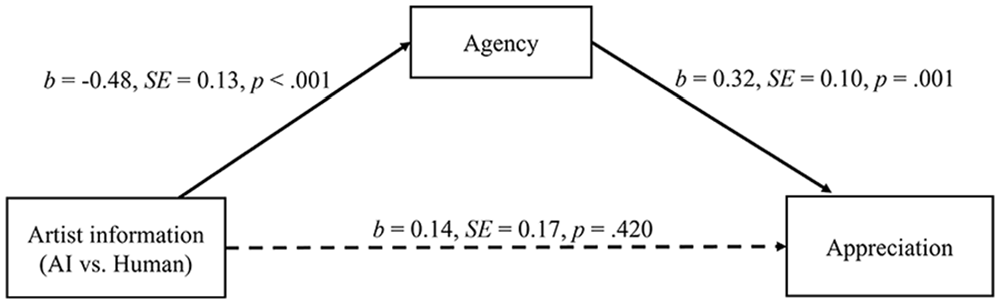
Effects of artist information on appreciation, mediated by perceived agency of the artist (Experiment 1).
In the second model, the AI artist was ascribed less experience (b = −1.58, SE = 0.11, p < .001, 95% CI = [−1.80, –1.36], bps = −1.47) than the human artist described in our manipulation. A higher ascribed experience was associated with a higher appreciation of the artwork (b = 0.44, SE = 0.11, p < .001, 95% CI = [0.22, 0.66], bps = 0.42), which in turn resulted in a significant indirect effect (b = –0.70, SE = 0.18, 95% CI = [–1.06, –0.37], bps = −0.62). Thus, our results are consistent with H3 suggesting a role of reduced ascribed experience in the appreciation of AI artists. Interestingly, the residual effect of artist information on appreciation was positive in our second model (b = 0.68, SE = 0.24, p = .005, 95% CI = [0.20, 1.16], bps = 0.61), indicating that the information that a picture was generated by AI led to more appreciation (controlling for experience ascribed to the artist, see Figure 2).
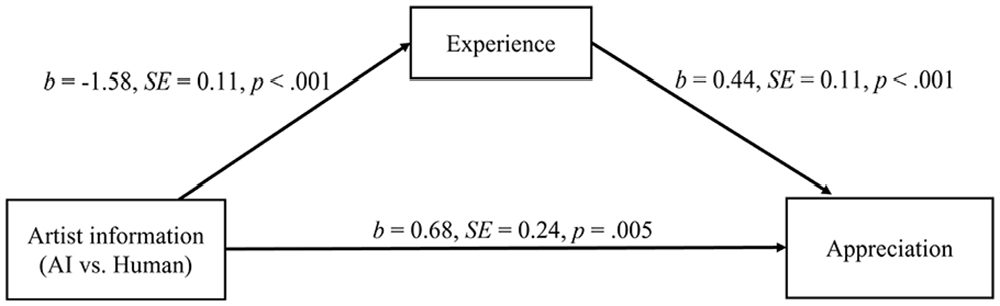
Effects of artist information on appreciation, mediated by perceived experience of the artist (Experiment 1).
Discussion
We did not find support for the negative effect of AI artist information on the appreciation of a visual artwork, as indicated by a nonsignificant total effect. Indeed, the underlying process of negative evaluation of AI-generated art appears to be more complex. In line with theory and research on mind perception, the AI artist was attributed less agency and less experience than a human artist (Gray et al., 2007; Waytz and Norton, 2014). Both dimensions of mind perception were highly correlated. We refrained from combining them in one variable, since they represent two distinct theoretical aspects, have different roles in the creation of art, and are both essential to create a meaningful artwork in their own way (Bullot and Reber, 2013; Waytz et al., 2010). Instead, they were analyzed in individual models to avoid multicollinearity. Zero-order correlations further suggest that ascribed experience and ascribed agency both were positively associated with art appreciation. This was confirmed by the mediation models, showing that higher experience and agency ascribed to the artist were associated with higher appreciation of the artwork. The indirect effect of artist information on appreciation via both dimensions of mind perception suggests that the negative effect of an AI artist on the evaluation of art, which has been reported by previous research (Gangadharbatla, 2022; Messingschlager and Appel, 2022; Ragot et al., 2020), can be attributed to the perceived mental capacities of an artist.
Still, the lack of a negative main effect of AI artist information was a puzzling result. In addition, a positive residual effect of AI artist information on appreciation of art emerged in the model including experience as a mediator. Although residual effects in mediation models should be interpreted with caution, this would indicate that information about an AI artist elicits some mechanism that in turn increases the appreciation of a picture. Given this possibility and the general need for replicating results (e.g. McEwan et al., 2018), a second experiment seemed warranted.
Experiment 2
Experiment 2 was conducted to replicate and extend the results from Experiment 1. Extending our line of thought, we suspected that although the mismatch of mind perception of AI and requirements of creative tasks can decrease appreciation, AI artists might at the same time positively affect the appreciation for art via surpassing expectations. Before even influencing the reception of creative content, information about the creator of a piece can shape expectations of recipients (Fischinger et al., 2020; Tezer et al., 2020; Tiede and Appel, 2020). Due to the design of our experiment, artist information and the implicit perception of an AI’s mental capacities may have caused expectations about the quality of the artwork before they were able to see it (Sundar, 2020). Expectations for AI-generated art could be rather low (Cetinic and She, 2022; Ragot et al., 2020), leading to a more positive experience when the actual piece of art is observed. In other words, the lower expectations from AI artist information are more likely to be exceeded. The positive deviation from expectations could increase appreciation for the piece of art (Hong et al., 2020). Thus, the effect of AI artist information on appreciation mediated via positive deviation from expectations might oppose the mediation effects of ascribed agency and experience.
H4: The effect of artist information on appreciation is mediated by a positive deviation from expectations in a sense that an artwork is more likely to exceed expectations if participants think it has been AI-generated. If an artwork exceeds expectations, appreciation for the piece is increased.
In Experiment 2, positive deviation from expectations was included as an additional process variable to explain the positive direct (i.e. residual) effect of AI artists on appreciation that was observed in Experiment 1. Experiment 2 was preregistered (https://aspredicted.org/p5t6e.pdf). To further increase the generalizability of our results, the study was conducted with a US sample (whereas Experiment 1 was based on a German sample).
Method
Participants
As a main goal of Experiment 2 was to replicate and explain the direct effect of Experiment 1, we performed an a priori power analysis with G*Power for the lower CI of the residual direct effect (d = .32, α = .05, 1 − β = .80) (Kenny and Judd, 2014). To reach the aspired sample size of 310 participants, we recruited 401 participants via Prolific (US residence). Eighteen participants, who completed the questionnaire in 90 seconds or less, and an additional two participants, who failed to recall the artist information correctly, were excluded from the analyses. 2 The final sample of 381 participants were between 19 and 81 years old (M = 40.73; SD = 13.98), 44.4% reported their gender as female, 54.3% as male, 0.8% as other and 0.5% preferred not to answer the question. Concerning their ethnic background, 74.0% reported to be White, 11.5% were Black or African American, 8.9% Hispanic, 7.1% Asian or Asian American, and 2.9% were Native American, Alaskan Native, Native Hawaiian or Other.
Measures
Mind perception
Measures for mind perception of the artist were identical to Experiment 1 and again proved to be reliable for experience (Cronbach’s α = .98, M = 2.99, SD = 1.36) as well as for agency (Cronbach’s α = .94, M = 3.19, SD = 1.12).
Positive deviation from expectations
Participants indicated to what extent the artwork deviated from their prior expectations with the help of two bipolar items (. . .was much worse/better than I expected; was far below/above my expectations) on a 7-point scale from -3 to + 3 (Cronbach’s α = .94, M = 2.90, SD = 1.47).
Appreciation
We used the same measure of appreciation as in Experiment 1 (being moved and perceived beauty items, 3 Cronbach’s α = .92, M = 2.54, SD = 1.37).
Procedure
The artworks used in both experiments were the same as in Experiment 1. The artist information texts presented in Experiment 1 were translated into English and slightly adapted to be used for Experiment 2 (see S1). After giving their informed consent, participants read the artist information, answered the attention check, and were presented one out of four AI-generated artworks. Next, participants reported to what extent the artwork deviated positively from their expectations and indicated their mind perception of the artist. Again, all participants were debriefed, informed about the origin of the visual artworks they saw, and had the opportunity to leave comments.
Results and discussion
Analysis overview and descriptive statistics
Mediation analyses for the effect of artist information (dummy coded, human = 0, AI = 1) on appreciation were performed to follow-up on the mediation models of Experiment 1. In addition, we included the positive deviation from expectations variable as a potential mediator. See Table 2 for descriptive statistics and zero-order-correlations. The specific artwork shown did not influence the effects of the artist manipulation; no significant interaction between artist information and pictures was observed, F(3,373) = 0.80, p = .496. Therefore, results for all four artworks were pooled. Zero-order correlations show that the more positive the artwork deviated from expectations, the higher was the appreciation of the artwork. Again, the correlations of both agency and experience with appreciation were significant. Due to the very high correlation of agency and experience, the mediating effects of both dimensions were again examined in two different models to avoid multicollinearity (see S7 for an alternative model).
Descriptive statistics and zero-order correlations (Experiment 2).
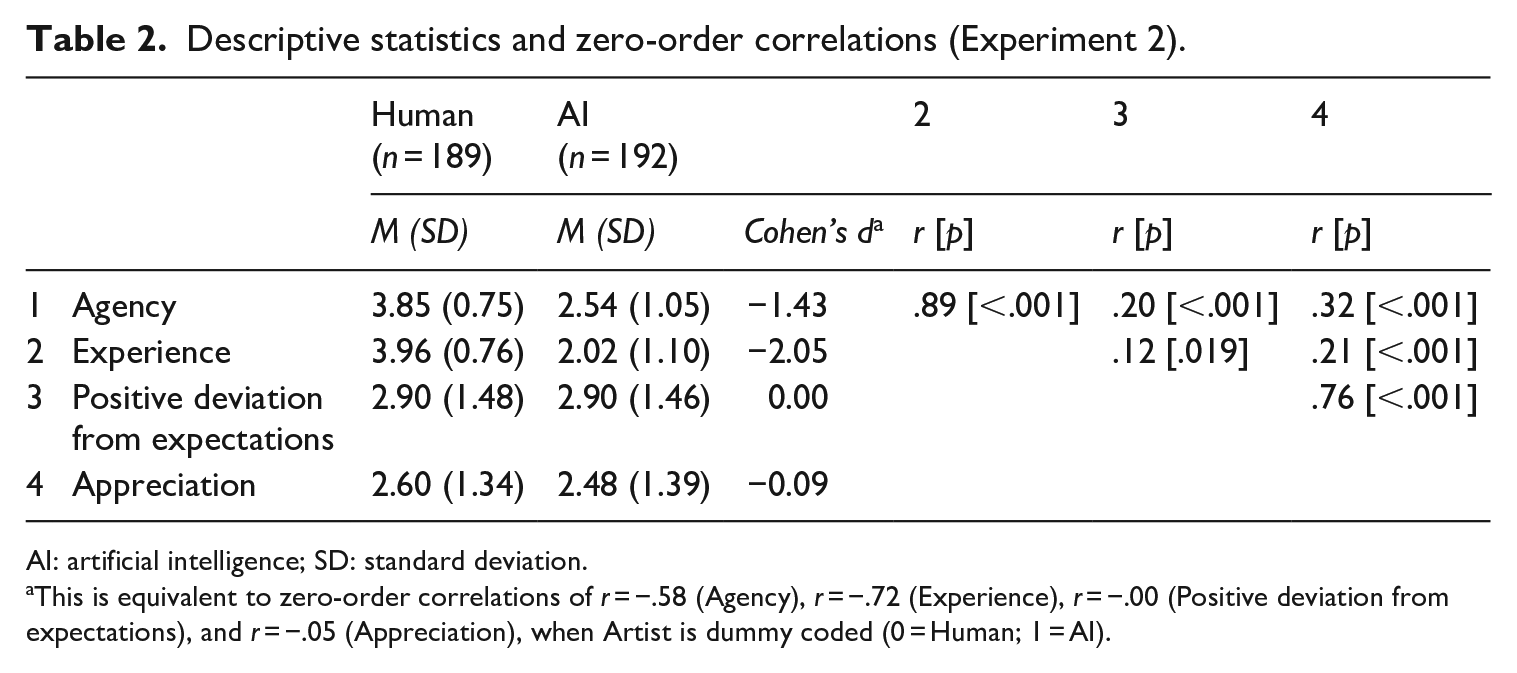
AI: artificial intelligence; SD: standard deviation.
This is equivalent to zero-order correlations of r = −.58 (Agency), r = −.72 (Experience), r = −.00 (Positive deviation from expectations), and r = −.05 (Appreciation), when Artist is dummy coded (0 = Human; 1 = AI).
Total effect and mediation models
Consistent with Experiment 1, the total effect of artist information on appreciation was not significant (b = −0.13, SE = 0.14, p = .371, 95% CI = [−0.40, 0.15], bps = −0.09). Appreciation for an artwork was not decreased by artist information about an AI (M = 2.48, SD = 1.39), compared with the appreciation for an artwork supposedly created by a human artist (M = 2.60, SD = 1.34), d = −0.09. Thus, we again found no support for our H1.
Further replicating the results obtained in the first experiment, the information that AI rather than a human created the artwork reduced perceived agency (b = −1.31, SE = 0.09, p < .001, 95% CI = [–1.49, –1.13], bps = −1.17) and agency positively predicted appreciation for the piece art presented to participants (b = 0.53, SE = 0.07, p < .001, 95% CI = [0.39, 0.68], bps = 0.44). Hence, the indirect effect of artist information on appreciation via agency could be replicated (b = –0.70, SE = .10, 95% CI = [–0.89, –0.51], bps = -0.51), supporting H2. The residual effect of artist information on appreciation was positive (b = 0.57, SE = 0.16, p < .001, 95% CI = [0.26, 0.89], bps = 0.42).
In the mediation model including experience, the AI artist was attributed less experience than the human artist (b = −1.94, SE = 0.10, p < .001, 95% CI = [–2.13, –1.75], bps = −1.43). Consistent with Experiment 1, a higher experience ascribed to the artist was positively associated with appreciation (b = 0.37, SE = 0.07, p < .001, 95% CI = [0.23, 0.51], bps = 0.37). Consequently, in support of H3, an indirect effect from artist information to appreciation, mediated by experience, was observed (b = −0.71, SE = .14, 95% CI = [–1.00, –0.43], bps = −0.52). The residual effect of artist information on appreciation was positive and significant (b = 0.59, SE = 0.19, p = .003, 95% CI = [0.21, 0.97], bps = 0.43).
Mediation models: positive deviation from expectations
In a next step, we included positive deviation from expectations in both mediation models along with agency (see Figure 3) and experience (see Figure 4). The effects associated with agency and experience remained virtually unchanged. Artist information failed to predict positive deviation from expectations (b = 0.00, SE = 0.15, p = .978, 95% CI = [−0.29, 0.30], bps = 0.00). Hence, we did not find support for H4. The incorporation of positive deviation from expectations into the models reduced the direct (residual) effect of artist information on appreciation, which was smaller when agency and positive deviation from expectations were part of the model (b = 0.22, SE = 0.11, p = .046, 95% CI [0.00, 0.43], bps = 0.16) and was no longer significant when experience and positive deviation from expectations were part of the model (b = 0.23, SE = 0.13, p = .082, 95% CI = [−0.03, 0.48], bps = 0.17).
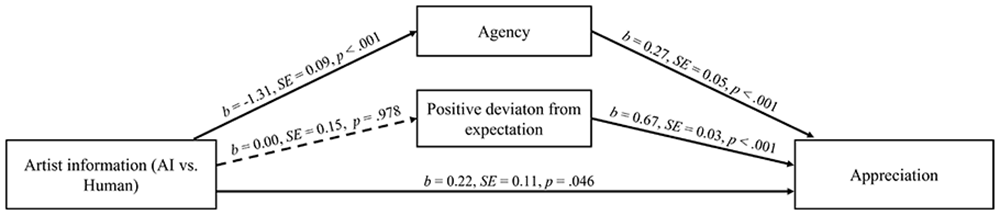
Effects of artist information on appreciation, mediated by perceived agency of the artist and positive deviation from expectations of the picture (Experiment 2).
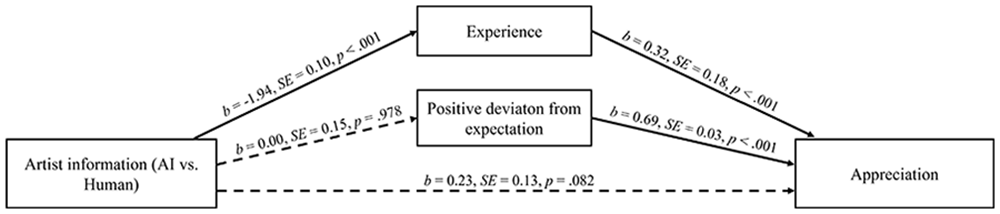
Effects of artist information on appreciation, mediated by perceived agency of the artist and positive deviation from expectations of the picture (Experiment 2).
Discussion
In Experiment 2, we aimed to replicate and extend the results from Experiment 1 with a sample that differed in language and cultural background, and we added a new process variable. Overall, the main findings of Experiment 1 persisted. Importantly, the information that an artwork was created by AI (vs a human) reduced perceived agency and experience. The mediation models as well as the zero-order correlations reveal an association between agency and appreciation and between experience and appreciation, with both correlations being significant and of small to medium effect size. This time, the direct (i.e. residual) effect of artist information on appreciation was positive and significant in both models. The inclusion of positive deviation from expectations failed to explain the positive residual (direct) effect of AI artists on appreciation as our manipulation of artist information did not influence positive deviation from expectations, opposing H4. Accounting for this variable reduced the residual (direct) effect of artist information on appreciation.
General discussion
Context and contribution
Since the first idea of an intelligent machine, AI has come a long way in its purpose to mimic human intelligence and behavior (Natale and Henrickson, 2022). Computer scientists have started to tackle one of the last resorts that some perceive to be exclusively human: creativity. In fact, the latest products of AI have received public attention with some being surprised by the high quality of recent AI-generated pictures, while others highlight its future potential (e.g. Davenport and Mittal, 2022; Small, 2023). Initial research on the reception of AI-generated art yields ambiguous results, pointing toward a bias against art that is AI-generated, compared with art by a human artist.
We identified ascribed mind in terms of agency and experience as mechanisms that can explain differences between the perception of AI-generated and human-created artworks. In two experiments, we consistently showed that AI is ascribed lower agency and experience as creators of art. The perception of the creator’s mind, in turn, affects the evaluation of their art. Both dimensions of mind perception play similar but theoretically distinct roles in this context. While agency is required to learn from existing art and create an artwork with intentionality, experience is needed to portray a human perspective on the world, which is characterized by one’s own emotions and the emotions of others. From the participants’ perspective, however, both mind dimensions were highly overlapping.
Our results suggest that an increased perceived agency and experience of an artist leads to a more positive evaluation of art. These findings support previous results by Hong et al. (2022) stating that embodiment of the AI, sensory abilities, and the capability to recognize emotions, can increase the acceptance of the AI as a musician, which is in turn linked to the positive evaluation of its work. In addition, our work establishes a link between both dimension of mind perception and appreciation of AI-generated art. Importantly, mind perception of AI is not a persistent trait but can be manipulated, if the presented information about an entity is adjusted accordingly (Gray and Wegner, 2012). In that sense, the anthropomorphization of AI could lead to a more human-like perception of an artist, influence the perception of its mental capacities, and foster positive evaluation of AI-generated art. If there is no additional information on the creative AI, it is likely that machine heuristics (Sundar, 2020) would reduce mind perception—as observed in our study—and hence reduce appreciation for the piece of art. In general, our results emphasize the importance of putting the viewers’ perception of the AI artist in the center of research on AI technology and the appreciation of AI-generated art (Coeckelbergh, 2017; Guzman and Lewis, 2020; Natale and Henrickson, 2022).
Despite the significant indirect effects observed, the total effect model revealed that artist information did not significantly predict appreciation. Although the pattern of means was in line with the negative influence of AI artist information on appreciation across both experiments, effects were very small and not significant. This nonsignificant total effect is not in line with the majority of studies on responses to AI-generated creative works, which would suggest that supposedly AI-generated artworks are evaluated more negatively than artworks attributed to a human artist (e.g. Gangadharbatla, 2022; Ragot et al., 2020). It rather supports the notion that AI-generated art might be perceived to be different than human generated art, but not necessarily worse (e.g. Hong and Curran, 2019; Moura and Maw, 2021). This result might encourage artists, who already use creative AI, to embrace differences between this new form of creating art and traditional paintings or digital art, because they are not necessarily perceived more negatively. Our findings suggest that AI artist information sends multiple messages to viewers, which spark different processes. We successfully identified two related processes (attributing less agency and less experience to the artist) that lead to lower appreciation. However, our nonsignificant total effect and the positive residual (direct) effect indicates that AI artist information may send other messages, with a positive influence on appreciation.
The positive direct residual effect observed in both experiments was unexpected. To test a theoretical rationale for this effect, the positive deviation of the artwork from viewers’ prior expectations was included in our model (tested in Experiment 2). Contrary to our prediction, positive deviations from expectations did not differ between both author conditions. Hence, our results do not indicate that the positive direct residual effect of artist information on appreciation is due to participants being particularly positively surprised by the work of AI artists (or by being disappointed by the supposed human artist). Furthermore, positive deviation from expectations highly correlated with appreciation, which was to be expected as both variables include positive valence.
Thus, our search for the nature of the positive residual influence of AI art information on appreciation was unsuccessful. Possibly, there are other mechanisms that lead to a more positive evaluation of AI-generated art. Since creative AI draws from existing works to learn about concepts that are then pictured in its artworks, some might value this new form of creating art as it offers a new and unpredictable perspective on familiar and established concepts. In this sense AI-generated art could be perceived as a new art style that is valued in a different way than artworks by human artists. Thus, it remains an intriguing question as to which processes are elicited that lead to higher rather than lower appreciation of art by creative AI.
Limitations and future research
A first limitation of our work is that our stimulus material does not represent all types of AI-generated visual art, which can be very diverse. Styles of AI-generated art vary between different algorithms (e.g. between Midjourney and DALL-E 2) and constantly change over time as the algorithms are optimized and machine learning is used to improve the results. To increase the comparability of both experiments we used the same stimulus material. Our goal had not been to include and compare different styles or genres. Instead, we focused on artworks that fall in the broader category of abstract art as most renowned fine art since the early 20th century involves some form of abstraction (Fer, 1997) and we considered abstract art to have a high likelihood to be perceived as art, rather than as kitsch (Ortlieb and Carbon, 2019). Future research is encouraged to compare different styles and genres of artworks and their appreciation depending on human versus AI artist information.
We need to acknowledge that the appreciation scores were rather low. This could be explained by a generally rather low appreciation for abstract art among the general population (Leder et al., 2004; Mastandrea et al., 2021). That said, mean values and standard deviations do not suggest that floor effects have influenced our findings.
Furthermore, participants in the human artist condition received only little information about the creator of the artwork, because any additional information (e.g. an artists’ works in famous collections) could influence the results—rather than the AI versus human author information. As a result, the assumption about the human artist made by participants might have varied and in turn influenced the effect on positive deviation from expectations and appreciation. If participants thought of the human artist as inexperienced, they might have attributed less meaning to their work and in turn decreased appreciation.
Moreover, in the time between data collections of our two experiments creative AI had gained public attention due to an improved accessibility and high quality of some AI-generated pictures. As technology in this area evolves at a rapid pace, it is important to keep track of recent trends that could influence viewers’ perception of creative AI or AI in general. This includes their prior knowledge on (creative) AI technology and products, as well as their own experiences with creative algorithms, especially as this technology becomes more accessible to users without advanced programming skills or a keen interest in digital art. This also applies to the agency and experience ascribed to AI. With future technological advancements the level of perceived mind in AI might change on both dimensions (Shank et al., 2019).
As outlined above, the results of our experiment do not allow for conclusions about the mechanism underlying the positive residual effect of artist information on appreciation once agency or experience were included in the mediation analyses. AI artist information seems to convey multiple opposing messages. This work has only identified two underlying mechanisms (agency and experience), which could explain negative effects of AI artist information on appreciation. Identifying other messages conveyed by AI artist information, and examining their effects, will likely help to shed light on the conflicting results of previous research. Thus, future research should evaluate whether it is a mere novelty effect that leads to these positive experiences and evaluations of supposedly AI-generated art or if there is another mechanism responsible for this effect. On a related note, including other facets of the reception of art could allow for a deeper understanding of this process. Our research focuses on central aspects of appreciation of art, namely, being moved and perceived beauty. But creative pieces can evoke various aesthetic emotions within recipients, like surprise, confusion, sadness, or pose an intellectual challenge (Schindler et al., 2017).
Our research pertains to situations in which recipients are aware of the identity of the artwork’s producer. The impact of artist information will likely increase in applied settings since the gap between AI-generated artworks and art made by humans narrows. In some cases, recipients already struggle to correctly identify the source of an artwork (e.g. Gangadharbatla, 2022). Soon, creative products by AI might be of such a high quality that their involvement in the process of creating art may not be obvious. At this point, context information, including explicit information about the artist, becomes even more relevant to viewers to evaluate artworks.
Conclusion
Two experiments consistently show that the AI that generated art is ascribed lower mental capacities in terms of agency and experience than humans. We observed negative indirect effects of artist information on the appreciation of AI-generated art, mediated by these two dimensions of mind perception. The reduced mind ascribed to AI was associated with less appreciation for its art.
However, we observed no total effect of artist information on appreciation of artworks, which suggests that learning that AI generated a piece of art elicits not only negative experiences. Rather, there seem to be multiple messages conveyed by AI artist information, which result in opposing processes. The positive residual effect of the information that a piece is AI-generated on the appreciation of an artwork could not be explained by positive deviation from expectations. Future research on the mechanisms underlying the impact of source information on the experience of AI-generated art is encouraged.
Given our research, we recommend that artist information is available at all times and not deliberately left out or manipulated. As AI systems like DALL-E and Midjourney become popular tools to generate pictures within seconds, our work emphasizes the importance of revealing the source of an artwork, because this information affects the perception of key artist characteristics. Whereas we identified ascribed agency and experience as important elements in this process—favoring humans over AI—there could be other mechanisms favoring AI artists over human artists. These complexities need to be considered in the research and practice of creative AI.
Supplemental Material
sj-pdf-1-nms-10.1177_14614448231200248 – Supplemental material for Mind ascribed to AI and the appreciation of AI-generated art
Supplemental material, sj-pdf-1-nms-10.1177_14614448231200248 for Mind ascribed to AI and the appreciation of AI-generated art by Tanja Veronika Messingschlager and Markus Appel in New Media & Society
Footnotes
Acknowledgements
The authors thank Lena Opel for her support in conducting Experiment 1.
Declaration of conflicting interests
The author(s) declared no potential conflicts of interest with respect to the research, authorship, and/or publication of this article.
Funding
The author(s) received no financial support for the research, authorship, and/or publication of this article.

Supplemental material
Supplemental material for this article is available online.
Notes
Author biographies
References
Supplementary Material
Please find the following supplemental material available below.
For Open Access articles published under a Creative Commons License, all supplemental material carries the same license as the article it is associated with.
For non-Open Access articles published, all supplemental material carries a non-exclusive license, and permission requests for re-use of supplemental material or any part of supplemental material shall be sent directly to the copyright owner as specified in the copyright notice associated with the article.
