




Abstract
Platform media are changing the disability charity landscape. This paper employs a hybrid critical disability studies – platform media studies lens to explore the SickKids VS campaign, aiming to ‘fight’ childhood illness and disability. Employing a social media thematic analysis, we analyzed social media content distributed through the campaign, consisting of images, videos, and captions (n=620). We found three dominant narratives: heroic sick kids, crumbling infrastructure, and informational content. Each trend, we argue, emerges within a changing platform mediascape, whereby charitable audiences must be cultivated and curated over a long-term process, rather than in a single moment, as in telethon fundraising. We ask how disability is framed in each of those narratives, and how disability studies might respond to these formulations in the political economy of platform media. We end by exploring the strategies disability studies can take to combat the marginalizing effects of such charitable campaigns.
Introduction
Judith Butler’s Frames of War (2010) begins with a deceptively simple question: What is a life? Butler is not looking for a mere definition. Rather, she asks what makes a human life grieve-able, how do we make our precarious existence certain, while denying the lives of others? Secondly, what practices frame lives as lives worth living, others as lives worth taking? Finally – for this list – Butler asks how the human body gives, makes, and receives meaning in these frames. As such, ‘What is a life?’ is not a simple inquiry at all, entangling questions of normative ethics with questions about the body, belonging, and desire. We argue that all of Butler’s questions about grievance and belonging can be fruitfully applied to childhood disability, and campaigns aimed to ‘fight’ it.
This paper extends Butler’s framework to the case of childhood disability, and a charitable campaign designed to ‘fight’ it. ‘Fighting’ here means raising money: beginning with television commercials, YouTube videos, and now, an Instagram campaign, the SickKids VS campaign aims to raise money for a large Canadian children’s hospital, across myriad forms of media. Whereas Butler wants to ask questions about the changing nature of mediated warfare, we want to look at the projection of childhood health and disease in new media. Critical work in childhood rehabilitation has exposed the moral nature of development, as much a political outcome as a state of growth for all humans (Gibson, 2016). We argue that these same frameworks are found in the SickKids VS campaign. Our argument proceeds as follows. We briefly introduce the SickKids VS. campaign, before pivoting to theory in two disciplines, platform studies and critical disability studies. In line with the latter, we frame this campaign as one afforded by the political economy of media, under the regime of platform capitalism. Disability Studies tells us that disability, too, is of political economic consequence. Marxist analysis have suggested disability is the result of capital and ideology (Gleeson, 1999; Oliver, 1999). We look instead to affect theory. We use this analytical framework to ask how childhood disability is given value – not far from Butler’s questions about bodies, belonging, and desire. We take this framework to a thematic analysis of the @SickKidsVS Instagram account, from its inception until the time of writing. In this context, we ask: How is chronic illness and disability made meaningful therein? And what are the projections of life in charitable need? Following a discussion of the consequences of this frame, we look for future charitable work, for and against childhood health, illness, and disability.
SickKids VS campaign
The SickKids VS campaign is the fundraising campaign developed by the SickKids Foundation, which is part of Toronto's Hospital for Sick Children, located in Ontario, Canada. Launched on Instagram in January 2019, this ongoing campaign is designed to raise funds for the construction of a new hospital, as well as invest in medical research. The development of this campaign, with its emphasis on high-production visuals and engaging informational videos, falls along the foundation's strategic plan to ‘advance a culture of philanthropy’ and diversify its revenue streams via commercialization as a means to drive the financial sustainability of the hospital (SickKids, 2020). At the time of writing, the SickKids VS Instagram page had 24.5 thousand followers, and was given a verified badge by Instagram.
Campaigns like SickKids VS have long been the objects of inquiry from disability studies, the sociology of health and illness, and the critical rehabilitation sciences. Longmore’s (2005) study of telethons is case in point, as is Haller and Preston’s analysis of ‘inspiration porn’ on social media (Haller and Preston, 2016) and McGuire’s (2016) study of autism advocacy.. In this paper, we align this existing critical analysis of charitable efforts, and the understandings of disability they project, with work in platform media studies. We selected SickKids VS because of its size and ubiquity. The videos are popular on YouTube, with over a million views, and the campaign aims at over a billion dollars (CAD) in fundraising (SickKids vs: Undeniable, 2016). We do so not only to expand the subject matter explored through existing frames, but to outline, first, how the affordances of the social media platform (here, Instagram) inform the kind of charitable content produced, and, secondly, what those doing critical disability work might do, in light of that production.
Theoretical framework
This paper incorporates two major groups of literature into its theoretical framework. First, we look to recent work on platform capital, and place the mediated environment therein. This explores Instagram as a platform, and how it contributes to the production of mediated subjects and objects. Next, we explore critical studies of disability and childhood rehabilitation, allowing us to situate the SickKids VS campaign. We supplement that literature with recent work on affect, technology, and disability futurity to fill out our theoretical framework. Again, the emphasis is on how disability is an affective outcome of bodily assemblages. Together, this section’s two pillars provide a political economy of platform media and disability.
Platforms capital, algorithms, and digital media
Srnicek’s Platform Capitalism (2016) provides a scaffolding through which to interpret the political economy of contemporary media. He outlines platforms as having three major features. They are digital infrastructures with network effects, extractive apparatuses for data. That is, the nature of platforms and platform work extends past solely content provision, to the material means through which that content is afforded, and moderated (Gillespie, 2018; Roberts, 2019). Secondly, platforms maintain network effects – they become more efficacious as their user groups expand. Their aim is to encourage participation, for they are nothing without it. Finally, the purpose of these platforms is the generation, manipulation and sale of data. Whereas industrial manufacturing was characterized by data loss (contained within the production process but ending with commodity manufacture) digital platforms cultivate data first – and incorporate manufacturing to capture that data, second. We seek to match this focus on platform political economy with the political economy of disability, following work done by authors like Oliver (1999) and Russell and Malhotra (2002). We will see that the platform political economy alters the landscape for disabling charitable campaigns like SickKids VS.
Bucher’s If… Then (2018) adds a meaningful component to Srnicek’s erudite materialism. Rather than treat algorithmic media as a black box – a series of proprietary pieces of software, inaccessible to those outside their platform owners – she looks to the way users of those pieces of software make meaning in their midst. Bucher engages both individual media users trying navigate Facebook’s timeline function, and Dutch media content producers trying to navigate the digital news landscape. In both cases, while the algorithms themselves are out of the hands of users, their meaningful incorporation in praxis is accessible to academic scrutiny. This is pertinent to both how individuals shape themselves as mediatized subjects, and the political economy of news production. The power of algorithmic imaginaries, then, extends to both the creating of subjects and objects of inquiry. In this sense, our extension to the production of disabled subjectivities and objects of charity is not a far leap.
Finally, for this review, media platforms like Instagram also have particular affordances that pertain to disability and charity. In a social media context, we use affordances to describe the interactions between users, designers, and social media interfaces, which results in dynamic relationships where users appropriate and adapt technologies to fit their needs (Cirucci, 2017; Van Dijck, 2013, 2017). Tufecki’s Twitter and Tear Gas (2017) looks to the protests following the killing of Michael Brown in Ferguson, Missouri in 2014. Tufecki notes how the protests failed to appear on Facebook feeds the world over. The reason: at the same time, the ‘ALS Ice Bucket Challenge’ had been trending, itself a more ‘likeable’ series of events, and thus more likely to appear on individual news feeds. Our point being that, as Bucher notes, content creators adjust media dissemination strategies according to these technological affordances. Here we suggest the above analysis is useful not only for outlining the contours of contemporary capitalism, but also the non-profit sector. Charities like the SickKids foundation are subject to the affordances of the platform, in turn shaping the structure of donation and charitability, and, as we will argue, disabled subjectivities. This is a far different model than the traditional telethon model. Both are equally mediated, though their affordances shape the production, distribution, and reception of charitable content.
Childhood disability, affect, and futurity
With this literature on platform capital in hand, we pivot to critical work in the rehabilitation sciences and disability studies. All the work explored here falls under the umbrella of affect theory, addressing how bodily capacities emerge in contact with other bodies. The key political question is ‘what can a body do?’ (Deleuze, 1990: 217).
Gibson’s Rehabilitation: A Post Critical Approach (2016) aligning the field of critical studies in youth rehabilitation with post-structural disability studies. Gibson outlines how narratives of innocence, quality of life, and functional independence are deployed in rehabilitative settings. Looking to the body as a socio-material assemblage, an outcome of connective forces, Gibson reconfigures the childhood rehabilitation hospital as a moral space. One can analyze the disabled body as a rhizomatic entanglement, a series of productive desiring forces, some deemed ‘natural’ and some deemed ‘social’, that shape individual bodily capabilities. A ventilator, an attendant care worker, a discourse of independence – each of these components alters the form of what, exactly, disability is and can be (Gibson, 2006). Disability is, in short, connectivity.
Anne McGuire’s War on Autism (2016) extends these questions about the moral nature of disability to autism advocacy. McGuire takes a Foucauldian approach to explore how charitable campaigns frame autism-as-lack. Advocacy by mainstream organizations like Autism Speaks, McGuire argues, represents a discursive apparatus whereby the truth of autism is constituted solely as biomedical lack, and constitutes autistic subjects as deficient. This regime of truth, McGuire argues, takes autism only as non-life. She looks to recent work in the neurodiversity movement to challenge these notions. Aggressively neurotypical explanations of autism, she claims, produce the normal, and find their foil in work that takes the normal itself as a socio-material production (see Yergeau, 2018; Yergeau and Huebner, 2017). In McGuire’s reading, autism advocacy takes autism as a foil. In our reading, the SickKids VS campaign invokes childhood disability as its foil. Childhood is good, and to be cherished. Disability is a threat to that state of innocence, a barrier to human flourishing. By invoking McGuire here, we argue that the narrative of combat has discursive consequences, in what we understand youth, illness and disability to be. To fight disability is to frame disability.
The publication of Kafer’s Feminist, Queer, Crip (2013) heralded a burgeoning literature in disability futurity. Kafer asks us to ‘explore disability in time’. Like Butler’s question about what a life is, this task is deceptively simple. This exploration involves departing from strictly materialist models of disability and incorporating queer critiques of heteronormative temporal regimes appealing to ‘future generations’. The future, for disability and disabled persons, is a political space, with contested narratives of moral worth and value, about the role of medicine and medicalized logics, and represents an interpretive frame through which disabled persons make sense of themselves. It, too, is productive, connective, and discursive – echoing McGuire, Gibson, and Bucher. In advocacy for future research, we believe, it is possible to locate the production of normal subjects, those they contrast, the value of health and wellness projected in that truth regime, and – most importantly – a space for critical disability studies of platform media.
Essential reading here is Berlant’s Cruel Optimism (2011). Cruel optimism, she tells us, is ‘something you desire is actually an obstacle to your flourishing’ (Berlant, 2011: 1) Berlant’s book is foundational in theorizing affect, following bodies as they affect or are affected by one another. Whether physical, conceptual, literary, or charitable. Berlant wants to explore the cultural production of the good life, our affective attachment to our collective futures, and how times of ‘crisis ordinariness’ are lived. Capitalism today isn’t simply a succession of crises challenging the normal – it is a way of dwelling in a lack of flourishing, and open to cultural critique. In ‘Slow Death’ (Cruel Optimism’s third chapter) Berlant uses the example of the ‘obesity epidemic’ as an instance of affect, spectacle, and biopolitics. The obesity epidemic is affective insofar as it is centered on bodily desire, both the desire to govern and repair bodily sovereignty, and the management of want and consumption. It is spectacular insofar as the obese body is projected publicly, through both targeted health campaigns, and scrutiny in public heath discourse. To name obesity an ‘epidemic’ is the stuff of Foucauldian biopolitics, to problematize and govern subjects in the name of public health and economic livelihood. Invoking an ‘epidemic’ reduces bodily life to a matter of pathology and risk; obesity is framed as an obstacle to flourishing. The obesity epidemic is another example of the government of desire, policing the sovereignty of subjects who are just trying to get by. We argue that disability, too, is much more than a series of struggles facing bodies. SickKids VS. treats disability as an obstacle to flourishing, and nothing more.
The final textual thread we wish to incorporate is Jasbir Puar’s The Right to Maim. Drawing on Berlant’s Slow Death, Puar offers an important conceptual distinction between debility and disability. Disability can be an object of academic inquiry, as in Disability Studies, or it can be a contested label for particular bodies and bodily identities. Debility, by contrast, refers to the affective arrangements that wear bodies down, ‘that render some bodies as definitely unworthy of health and targeted for injury’ (Puar, 2017: 68–69). The worlds of war and work, in neoliberal capitalism, predispose bodies to this state. When charitable initiatives aim to ameliorate stigma, and promise a better future, they more often than not ignore the political economy of debilitation through which it courses. Puar opens her book talking about Dan Savage’s It Gets Better campaign, promising a better world for youth hiding their sexual identities. The critique stems from disability studies: it cannot get better for debilitated bodies, because of the political conditions in which they dwell. The politics of neoliberal rehabilitation, at work in disability charitable campaigns or in Savage’s, attend to difference as an accidental property of certain bodies, not to affective arrangements wearing them down. Puar demands our attention must turn to slow death endemic to neoliberalism and colonialism – to debilitation.
We see these same forms of affect, debility, and futurity unfold in disability and rehabilitation. When, for instance, young men with life limiting conditions are told they are ‘wasting precious time’ (Abbott and Carpenter, 2014), we might ask who values their time, what they might actually desire, and ultimately what future is possible given the world of poverty austerity in which many disabled persons dwell (Runswick-Cole and Goodley, 2015). Charities might tell us children can do anything – that medicine knows no bounds. We know this is not true, and very often those barriers are economic rather than scientific. Thus, in cruel optimism we find a map for a promised future, a likely future, a focus on economic circumstance and the means to explore disability in time.
Methods
To pursue this study, we employed an in-depth thematic analysis of the ‘SickKids VS’ Instagram account, from its inception (January 18, 2019) until May 18, 2020 – the month we began data collection for this project. We collected screen captures of all the images and videos available on the account, with a total of 310 images and video stills, as well as their corresponding captions (n=620 units of analysis). Instagram Stories and comments were not part of the data collection strategy, as the former disappear within 24 h and therefore cannot be captured retroactively, and the latter do not represent the campaign’s message which is of interest to this study.
In regard to the ethical collection of these posts, in the standards set by the Canadian Tri-Council Policy Statement for Ethical Research, research ethics review is not required for cyber-material such as publicly available content that is found on the internet and for which there is no expectation of privacy (TCPS 2, 2019). Since the SickKids VS Instagram page is publicly available, we are not required to undergo ethical review, or de-identify any of the posts found in the account. Please note that in order to preserve the confidentiality of SickKids VS Instagram followers, likes and comments have not been shown in the images provided.
Analysis was carried out by conducting a systematic review of the data. The data was coded using NVivo software (version 12.7.0). We used a multimodal analytical strategy, which involved analyzing both the images/videos as well as the captions that accompanied each image/video. A multimodal approach is relevant in this context given that we sought to understand how the image and text presented were simultaneously used to showcase a singular narrative about the role of the SickKids VS foundation in fighting childhood disease and illness (Kress and Leeuwen, 2001). In this manner, we understand the use of textual and visual content as complimentary forms of communication, where the images/videos and text may reinforce each other and fulfill co-constitutive roles, and in doing so produce a particular reading or interpretation (Jovanovic and Van Leeuwen, 2018; Kress and Leeuwen, 2001).
We coded and categorized the data through an iterative coding process that involved two phases of data analysis. The first phase of data analysis involved one of the authors familiarizing themselves with the data, generating initial codes, searching for overarching themes, and reviewing and naming the themes (Braun and Clarke, 2006). With regards to the visual data, the analysis was descriptive in nature, and paid attention to the compositionality of each image/video by noting the way in which certain objects were shown as meaningful. This level of analysis also paid attention to the social production of the image, insofar as it focused on how social and political identities were mobilized to produce knowledge about childhood illness (Rose, 2022). The textual data was analyzed by first, coding in vivo – whereby descriptive words from the texts were identified and used as draft categories (Manning, 2017) – and second, assessing the meanings and patterns of the data. The second phase of data analysis involved reviewing the categories generated so that the themes found were internally consistent and mutually exclusive. This involved reviewing every code within a theme, drafting a conceptual definition of the themes, and finalizing a codebook. The codebook produced from this process was evaluated by the second author, who provided verification that the analysis was methodologically and theoretically coherent (Morse et al., 2002; Nowell et al., 2017).
From this codebook we selected the following three themes for discussion: Crumbling Infrastructure, Informational Content, and Heroic SickKids. The objective of this paper was to evaluate how media-driven charity campaigns have changed in the context of social media; thus, we chose these themes due to their distinct engagement with the affordances of Instagram as well as their reproduction of platform-mediated cultural scripts about the invidualization of social responsibility (Banet-Weiser, 2012; Nieborg et al., 2020; Poell et al., 2021) and the neoliberal logics of social medial branding (Duffy and Hund, 2019; Marwick, 2017; Raun, 2018).
Results
The following sections present observations of the visual and textual content of the SickKids VS Instagram account. The first section explains how SickKids constructs a narrative that positions them as heroes and knowledge-developers in the fight against childhood illness. The following analysis describes how SickKids uses their hero narrative to compel donations for their new hospital by maintaining their status as a cutting-edge medical hospital while at the same time describing the inadequacy of their current infrastructure. Finally, our examination of the account’s use of informational content identifies the ways in which SickKids uses their platform as a means to offer value to their followers, by which they further entrench themselves as specialists in children’s health.
Crumbling infrastructure
In this theme, posts speak of how the current infrastructure that the SickKids Hospital uses is not good enough to meet their needs (see Figure 1). This takes disability studies’ long-standing focus on material barriers (Gleeson, 1997; Oliver, 1990), albeit restricted only to barriers to providing health care. In particular, the textual content of these posts juxtaposes the cutting-edge medical work that takes place at SickKids hospital with the aging and limited space the current building offers. For example, ‘[SickKids] is a global leader in pediatric health care that is continuing to defy the odds, but the success of the hospital has overshadowed the fact that they are in desperate need of a new building. With some of the infrastructure built in 1949, the medicine has outpaced the space, and is in danger of holding back the future success of the hospital’
These posts focus on the space within the building as a detriment to providing the type of medical care they pride themselves in. In this manner, the posts speak of lack of space as a major impediment to providing adequate care. For example, ‘Former SickKids kid Connie Cameron is now a Registered Nurse and Quality Analyst @sickkidstoronto. She understands the limitations of our current space better than most. “There are challenges making a room feel like home for patients and fostering an environment where care providers can do bedside procedures in a safe and effective way.” Tap the link in our bio to read why every kid needs a safe and private space. #ThisIsSickKidsNursing #NursingWeek’.
Visually, these posts showcase cramped spaces full of medical equipment, with several people carrying out medical procedures. Thus, these posts highlight space as an important requirement for providing adequate medical care. In this sense, the posts showcase how the current space at SickKids Hospital limits the ability of the medical staff to work, and they make the case that space is a conduit for better medical care. ‘Crumbling infrastructure’.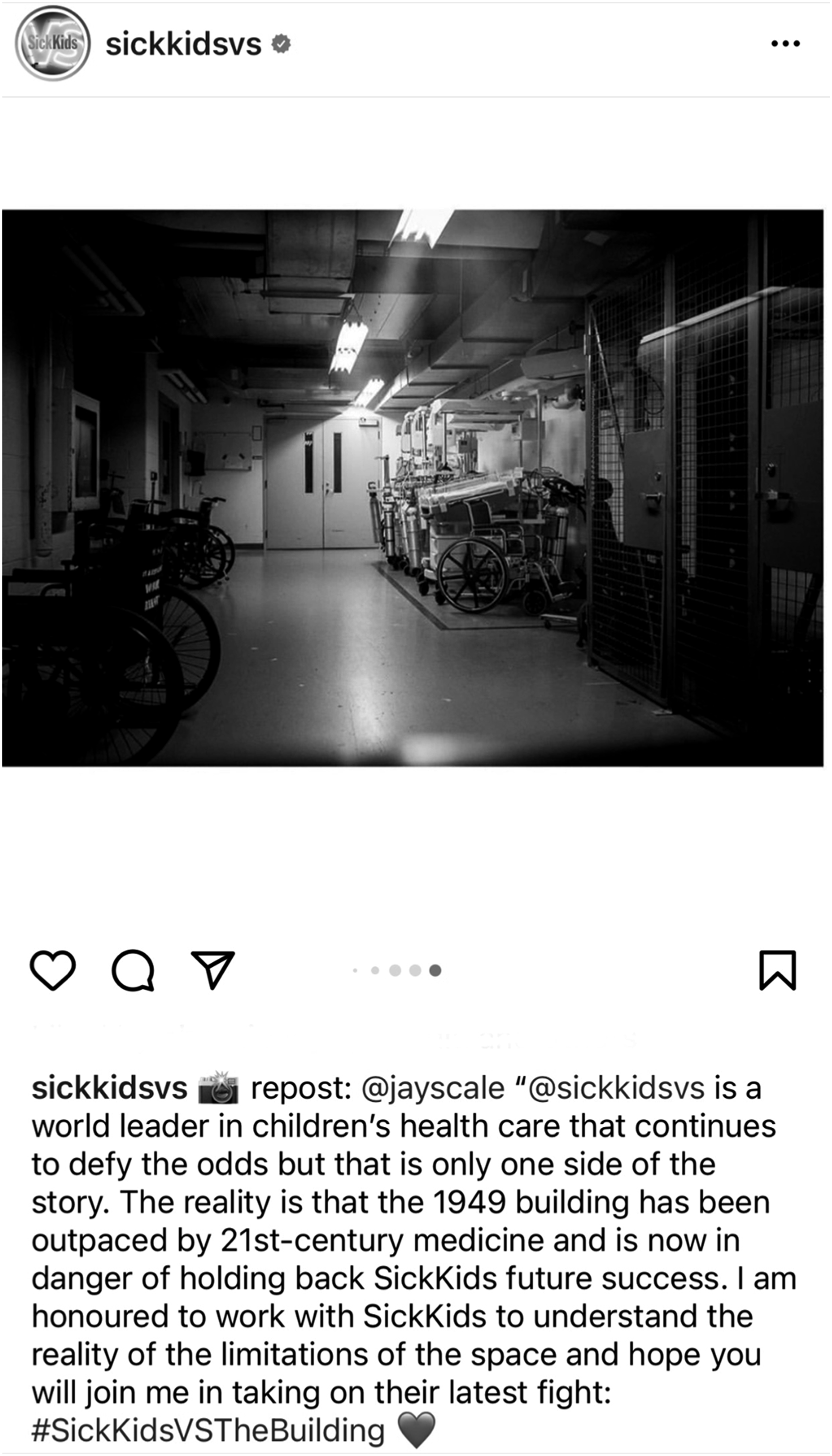
This relationship is further established in SickKids’ posts through a specific campaign they called ‘SickKids AirBnB’. In this short video campaign, Celebrities and athletes stay at a SickKids suite overnight while being filmed. The individuals are all placed in a crowded room, with beds, chairs and I.V. poles occupying most of the space. In the middle of the night, they get woken up by emergency medical staff that rushes to a bedside. In the commotion, carts carrying medical supplies smash against the beds and the IV poles, jerking everyone in the room awake. There are no curtains between beds, so all of the individuals participating are able to observe the medical staff rushing in. The videos then show individual interviews where the T.V. personalities and athletes reflect on their experience, and how their experience directly affirms the need for better infrastructure.
From these posts, we see how SickKids positions the need for a new building by appealing to two narratives. First, they position themselves as global leaders in health that are being limited by their current building. In this manner, they speak of the overarching medical work they do as cutting-edge, advanced and highly technical but restricted by their infrastructure. Second, they focus the narrative on the specific space that patients and staff members inhabit at SickKids. This space is small, old, and inadequate to meet the needs of care providers and patients alike. Thus, we can see this construction of the SickKids Hospital space as a limitation to the development of medical knowledge at large, as well as a limitation to providing adequate levels of safety, care, and privacy to patients. While medical infrastructure is surely needed to do research and provide adequate care, the focus on SickKids works to frame the hospital’s work as individual and unique. This neoliberal framing decouples the hospital from large scale issues of healthcare public spending and places the responsibility for adequate infrastructure onto the shoulders of donors.
Informational content
Much of the content featured on the account was designed to inform and elicit a continual following of media users (see Figure 2). The posts provided information to followers in the forms of medical advice (such as nutritional advice, managing mental health in children, and maintaining a healthy lifestyle), services that the hospital offers to patients and followers, historical information about the SickKids hospital and its mandate, and information about the work that SickKids staff does. ‘Informational content’.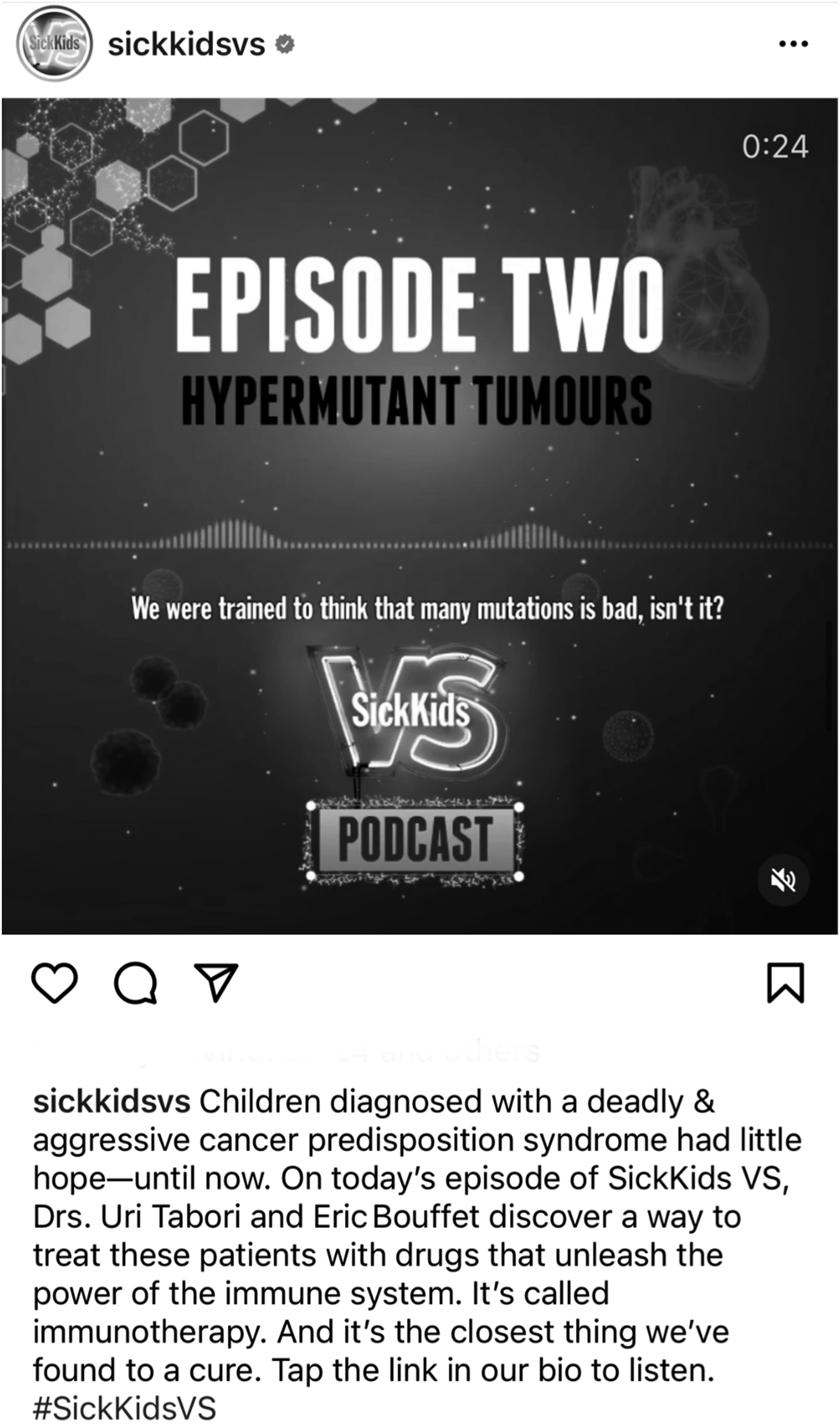
Informational content is geared towards parents, but often addresses issues that children might be facing, like sleeping difficulties, how to get children to eat vegetables, dealing with mental health issues in children and youth, and managing digital media consumption. The advice is provided by medical staff from the SickKids hospital, and is often presented in a video or a voiceover. For example, ‘How much screen time is too much screen time? @WHO recommends no more than one hour each day. WATCH as @SickKidsToronto Clinical Neuropsychologist Dr. Tricia Williams shares tech tips for parents. Follow @myyoungster for more parenting tips’.
In addition, this theme also includes posts that advertise the new SickKids VS podcast. In their words, the podcast aims to take the listener ‘to the frontlines in the fight for children health’. The podcast covers noteworthy stories of doctors using innovative medical strategies to care for their patients. For example, ‘Children diagnosed with a deadly and aggressive cancer predisposition syndrome had little hope – until now. On today’s episode of SickKids VS, Drs Uri Tabori and Eric Bouffet discover a way to treat these patients with drugs that unleash the power of the immune system. It’s called immunotherapy. And it’s the closest we’ve found to a cure. Tap the link in bio to listen. #SickKids VS’.
Visually, this theme depicted videos of health care professionals as well as infographic images. This theme demonstrates the variety of content that the SickKids VS Instagram account offers to their followers. This content transcends the boundaries of fundraising and marketing, which is the main purpose of the page, and it establishes itself as a legitimate source for information about children’s health, medical advances, and parenting advice.
Heroic SickKids
This theme includes posts that frame the work that SickKids does as heroic and daring, and speak of the staff at the hospital as hardworking and dedicated (see Figure 3). In the captions, the posts speak of SickKids as fighting a battle against childhood illness. This theme features images of children fighting both an invisible enemy and their sickness – the pictures and videos show children in martial arts attired juxtaposed to roaring tigers, children running towards a foggy battlefields and children attached to IV poles, with medical staff tending to them. The captions allude to war, with statements like ‘there are still a lot of battles left to fight, and we can’t afford to lose a single one. The momentum is building, but the fight is not over. Join us – tap the link in bio to donate’. This example speaks of the fundraising campaign to build a new hospital for SickKids, and how the fight against child illness is limited by the infrastructure the organization occupies. ‘Heroic SickKids’.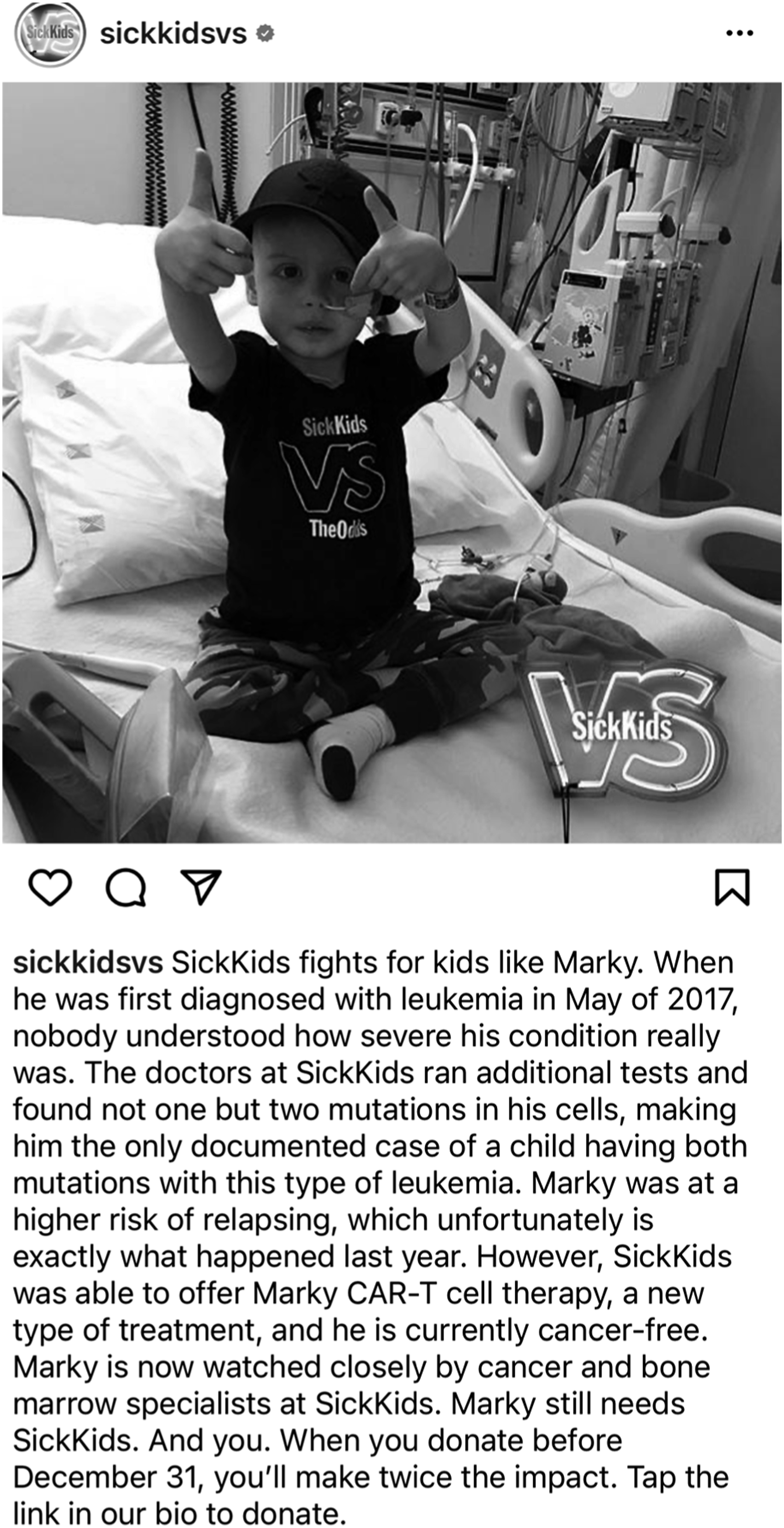
In addition to this overarching narrative about the hospital’s general work, the posts also identify specific patients and situate the organization’s work in relation to the patients. In one post, a picture of a smiling child with face paint is captioned: ‘Alice was diagnosed with Biliary Atresia – an incurable, life-threatening liver disease at only two months old. SickKids saved Alice’s life as a baby, and keeps her healthy to this day’. The caption, detailing a life-threatening disease, paired with a non-threatening image of a happy child works to show a singular outcome in the work that SickKids hospital does.
The manner in which the posts speak of the organization imbue SickKids with personhood, speaking of it as an entity that acts on its own behalf. Although posts mention staff and the services the hospital provides, their inclusion is written as an operational part of the hospital, ‘SickKids fights for kids like Marky. When he was first diagnosed with leukemia in May of 2017, nobody understood how severe his condition really was. The doctors at SickKids ran additional tests and found not one but two mutations in his cells, making him the only documented case of a child having both mutations with his type of leukemia. Marky was at a higher risk of relapsing, which unfortunately is exactly what happened. However, SickKids was able to offer Marky CAR-T cell therapy, a new type of treatment, and he is currently cancer free’.
Through this theme, we see the depiction of illness as an unseen enemy, and SickKids as an entity that fights against it. Medical staff, service providers, and the children dealing with illness are portrayed as operational parts and collateral damage of a war amongst the abstract ‘illness’ and SickKids. Further, the action that SickKids takes in its fight is situated within the infrastructure that it inhabits, as the posts urge followers to donate to the fundraising campaign for the new SickKids hospital as a means to aid in the fight against childhood illness.
Discussion
Crumbling infrastructure
The crumbling infrastructure narrative is built on a fundamental ambiguity, that of the cutting-edge medical work being at the hospital, and the need for a new material environment and implements to continue that work in the future. So, alongside the subjective affections that are aligned with a personified hospital and those subject to childhood disability, there exist objective relations that link personal affects to things. What are the things of illness? Ill bodies to be treated, certainly, but also therapeutic things to be purchased with the dividends of ongoing support. Here we would extend the idea of SickKids as an institution to its material ingredients, needed for the ongoing battle versus childhood illness.
The question of infrastructure brings up the matter of material affordances, whereby medicine is both enabled and constrained through the physical attributes of the hospital and therapeutic accoutrements. With some aspects built ‘as old as 1949’, the hospital building is not the building of the future. Cutting-edge medicine needs a cutting-edge building. Of course, this task is never finished, with the constraining physical environment of the hospital, stuff of the past, at one time being the cutting-edge of medicine. Those being asked to give support to the hospital, in sum, are more than just being asked to be part of the team. They are also asked to equip it with the stuff needed to fight illness. In contrast to charitable campaigns are restricted to ‘raising awareness’ and ‘fighting stigma’ – both of which are relatively immaterial – there is a materialism at work in the SickKids VS campaign. It is not the same materialism so many sociologists have used to critique the deviance and stigma literature (Oliver, 1999; Thomas, 2012; Tyler and Slater, 2018), but remains a materialism nonetheless.
Informational
We noted above that the Instagram infrastructure impacts the shape of the SickKids VS campaign, in the need to maintain a constant following of enthusiastic supporters. As is well known, and other sociologists have documented empirically, the structure of online activism is fickle, with media platforms like Facebook being ‘less useful a mobilizing tool than a marketing tool’. (Lewis et al., 2014: 9) This is understandable: it is far easier (and cheaper) to ‘like’ a post than become personally or financially invested in a cause. However, and despite these challenges, the SickKids VS account sought to become an informational gatekeeper, both to inform and maintain its following.
This strategy of engagement and digital expansion demonstrates how network effects are capitalized on by platform users. Expanding the content offering attracts varied groups of users, therefore increasing the number of engaged individuals willing to make a donation (Snircek, 2016). In this manner, fostering a SickKids community through the deployment of several types of engagement avenues, such as an Instagram account and a regular podcast, is a means through which organizations such as SickKids capitalize on the promises of big data: offer free services in exchange for individual’s data (Duguay et al., 2018; Srnicek, 2016).
While previously charities relied on transactional, commercial forms of fundraising such as the telethon, in this new format and through the appropriate use of digital media’s affordances, charities now take on a social form (Van Dijck, 2013). This social form is housed under the institution, the healing hospital that fights against childhood illness. The institution of SickKids becomes larger than the sum of its parts, and draws affective energy that is geared towards its preservation. Under this model, the institution’s purpose of treating sick children becomes obscured under the largesse of the institutional persona. This further displaces the children and their experiences of sickness and disability from view.
This engagement shows the fundamental bind endemic to childhood illness and disability: things are going to get worse. Infrastructure will crumble and children are going to get sick. Not every fight against childhood illness will be a victory. This is the “crisis ordinariness” that Berlant identifies in Cruel Optimism: constant and often unavoidable failures aside, the show must go on. It is often, as Shildrick (2015: 10) puts it, a case of ‘living on; not getting better’: providing information about childhood illness and disability will ultimately bring us to debility.
To combat the doom and gloom of debility, then, the SickKids campaign seeks to offset potential sad information about the evils of wars not won with the tactics used to maintain childhood health. Dietary tips, means for weathering the COVID pandemic and tales of hope and success are the information presented first and foremost. The material realities of living with illness, immediate or chronic, are less important than securing the good life, one where medicine can shape the world better. To this view, we would pose the following question: a good life for whom? This is Berlant’s point, and that of much of the critical childhood rehabilitation literature (Gibson et al., 2017; Setchell et al., 2019): what happens to those who cannot or will not fit the cheery mold? Puar’s (2017) work provides sobering context: it is through the underlying juxtaposition – of illness and the good life – that debility is mobilized. Here, debility and capacity are mobilized for the purpose of capital accumulation, where the promise of capacity is formulated against the threat of debility. In this neoliberal formulation, debility can be overcome through individual donations.
Heroic SickKids
Like many other charitable campaigns surrounding illness and disability, we found that the Heroic SickKids theme projected childhood illness as an enemy to be combated, and in doing so projects two types of subjective affectivity. First, and as the title ‘sick kids vs.’ suggests, the campaign attempts to cultivate the subjects of medical treatment as the subjects of charity. The message seems to be: children get sick, sadly, and your money will help relieve this sadness. This affective component of the charity model has been well documented in both the disability studies and science and technology studies literature, the muscular dystrophy telethon being a common site of analysis (Callon and Rabeharisoa, 2008; Longmore, 2016). Given the long-standing disability studies critiques of the MDA telethon, and its long-time host Jerry Lewis, we will not belabor this aspect. Suffice it to say that the aesthetics of charity are at work here, and this does not offer the full spectrum of humanity to those subject to the charitable gaze. This point has already been made elsewhere – and made well (Goggin, 2008; Longmore, 2005; Oliver, 1990; Shakespeare, 1994).
The affective tie with the sadness of childhood illness is not the only aspect of the heroic SickKids trend we noted. Given the nature of the Instagram platform, whereby individuals follow accounts in addition to being shown sponsored images, there was an attempt to form affective relationships with SickKids as an institution. While the campaign clearly attempts to tug at the heartstrings of would-be-donors, it also attempts to draw a following. Not only is childhood illness bad, but the SickKids foundation is the institution to fix it. Here we would emphasize that this is more than simply a medicalized way of thinking about illness – it certainly is – but it is also a site of collective imagination. SickKids, the healing hospital, is not only a space of medical practice, one of collective imagination and hope. Parents, children, practitioners, and celebrity volunteers alike play a role in this collective imagination, giving childhood health and illness a moral dimension, in the Durkheimian sense. There is a division of caring labor, with affective ties constituting individuated social positions through social solidarity. Here, as both Kafer and the platform literature would remind us, there is also a dually temporal dimension. First, an ideal one, projecting a hope for the future without childhood illness, and secondly, a material one: keeping a following and gaining the network effects of the social media platform, accrued with a sizable flock of repeat visitors.
Conclusion
While charity fundraising campaigns are not a new phenomenon, the development of these campaigns on social media does bring up important questions about how individuals interact with changing media environments. The narrative use of disability and childhood illness as an abnormal bodily state follows that of other mediatic campaigns, such as telethons and newspaper interest stories (Longmore, 2016; Titchkosky, 2005). While these campaigns sought to bring awareness about disease and disability, their representation of disability and illness as a social problematic to fix sought to elicit affective ties from the audience, and thus compel them to donate. Although these representations have been thoroughly challenged by scholars and people with disabilities (Elman, 2014; Shakespeare, 1994; Siebers, 2010), they endure in the cultural imagination as seen in the SickKids VS campaign. The parallels between this campaign and previous ones are worth noting, however, of interest to this paper are the changing dynamics between charity fundraising and digital media.
The development of an informational and entertainment-geared element to the campaign signals a changing relationship between audiences and charities. Traditional charity events like telethons relied on the public nature of the event to incentivize individuals to donate. In what Longmore (2016) terms ‘conspicuous contribution’, donating to a telethon became a matter of published performance, where donors reaped the social exaltation of giving publicly. Further, these events only required audiences to engage with them through the duration of the event. While these public performances are still a part of contemporary fundraising campaigns, they are not the sole focus. In order to maintain an engaged following through social media, accounts often rely on the development of parasocial relations, where the accounts ‘produce one-sided interpersonal connections and the illusion of intimacy with their audience’ (Abidin, 2015: 9). In the case of SickKids VS, the parasocial relations are established through a conversational approach to providing medical information and health tips to their followers, as seen in their informational videos and podcasts. While traditional fundraisers like telethons offered donors a means of showing their moral superiority through the act of public donation, charity accounts offer a manufactured, perceived interconnectedness that supports the development of affective ties with their following. In this social media setting, donors become ‘followers’, and the affective ties developed through perceived interconnectedness are catalyzed into monthly donations.
While the SickKids VS campaign relies on cultural scripts about disability and illness, the contemporary decentered media environment on which it relies is perhaps not as supportive of these scripts. Changes in the platform mediascape are altering the stakes of disability politics. The classic political economy of disablement linked disability to the political economy of work – whereby individualizing ideological structures justified the economic exclusion of those who could not sustain wage labor (Oliver, 1990). The goal of the disability activist, then, was to show the historical genesis of these ideological frames, and demonstrate how the medicalized, individual tragedy theory of disability was reproduced through charitable efforts ignorant to economic marginalization (Oliver, 1992). Here, the critical disability work was being done against mediatized disability, as it appeared on disability telethons, collection boxes on the counter at the liquor store, in pamphlets and through motivational speakers, and so on.
The perennial target of Disability Studies objection to charity has undeniably been the Muscular Dystrophy Association (MDA) Telethon, long hosted by Jerry Lewis. Though not unique in its aims, design, or depiction of childhood disability, it is the object of the classic literature on mediatized disability charity, and opposition to it (Haller, 2010; Longmore, 2016). The sight of the activist group ‘Jerry’s Orphans’ protesting Lewis and the MDA telethon, found in Richardson’s documentary The Kids Are All Right (2005), is a classic depiction of these politics. But we should not restrict disability studies of media to that single entity, or only to the United States. Drawing on Horkheimer and Adorno, Jones (2017) locates media tropes of disability in the same ableist culture industry, the ideological categories through which we inherit disability. We find the same tropes of in the MDA telethon as we do in routine newspaper reporting about disability, beats to be covered by disabled journalists, and other similar fundraising events (Jones, 2019). Here, Jones (2012) points to Saskatchewan’s Telemiracle Foundation annual event, we might invoke Bell’s annual ‘Let’s Talk’ multimedia event. Importantly, Jones indicates that our roles within that industry are always multidirectional: we constitute its schemas as we attempt to disrupt them, as storytellers, activists, and educators. She suggests resistive disability writing provides some tools to challenge these norms – if only partially, given the force of ableist cultural institutions.
We believe the new political economy of platform charity requires a new set of tools to evaluate the redeployment of ableist tropes. No doubt, disability receives a benevolent frame, and becomes the object of charity, within platform media. ‘Supercrips’, ‘Disability as Overcoming’, and ‘Pity’ remain constant themes in mediatized disability, then and now. But the stakes of platform media activism take place on the same plane. Mediatized activism is taking place on the same platform as charitable efforts, rather than in opposition to that mediatization as a whole (Christensen-Strynø, 2020). Given this shared terrain, dominant cultural tropes must be outmaneuvered rather than merely switched off. Here, the political economy of disability is less about rejecting false, ideological accounts of disability as a whole, but the affective enrollment of a following through content production and consumption. Those doing critical disability work, then, are subject to the same affordances as content producers (charitable or otherwise) on platform media. This is not to say that power imbalances are non-existent on platform media – on the contrary, we would indicate the opposite. But it is to indicate that platform charity and platform disability politics share the same terrain. It is a disability politics from within, rather than from without.
The shared terrain of platform media where activism and charity take place creates challenges in subverting dominant cultural tropes about disability. While traditional charity events could be counteracted by protest or disengagement, the platformed media environment within which most individuals consume media makes it difficult to engage in oppositional politics that successfully neutralize charity narratives. This is due to the decentered nature of such an environment, where charity narratives are dispersed, individualized and networked – the aim is not to ‘cure muscular dystrophy’ writ large, but rather fund individual hospitals or initiatives. It is the networked nature of these initiatives that creates further challenges in counteracting dominant disability tropes, as this networked environment is mobilized through the affective responses that are catalyzed into donations and online engagement (Tufekci, 2017). These responses – such as follows, likes, comments or visits to a profile – produce algorithmic results that work to make certain narratives visible (Bucher, 2018). Therefore, the task of disability activism is not to protest or disengage, but rather appropriate and transform platform media practices.
Fundraising in the age of social media has changed the nature of affective relationships between media and ‘audiences’ (what we now call ‘followers’) and the politics of charity. This entails a change in the way in which people interact with media content, in that people now have more choices available if they are looking to support or donate to a certain cause, reinforcing the need for maintaining ‘engaged’ followers. Charitable agency can be thought of as a process, rather than a single, unified event. While this decentered media ecosystem allows for other frames to emerge and shift discourses about disability and aid, it is important that we pay attention to how certain frames are afforded more legitimacy over others. We can see how certain accounts of disability are legitimized by the platforms, made visible through the Instagram verified badge, and the reach of particular accounts, in the case of sponsored content. While there are more contradicting, variable frames emerging, they do not all have the same visibility. Here we have argued that disability studies provides a unique perspective on mediated agencies – who has, and how do we have, the capability to cultivate a following? The affordances of platform media are crucial when exploring the mediation of ability and disability.
In this paper we have explored how platform media campaigns like SickKids VS frame disability. The findings presented here are limited in scope, as we only evaluate one media campaign produced by a singular charitable organization. Subsequent research into how disability is framed in platform settings is needed, with special attention paid to how different platforms (e.g., Facebook, TikTok, GoFundMe) facilitate different frames. In the context of our findings, we suggest both an extension and re-consideration of disability studies’ critical tools, in light of this new political economy. Campaigns like this one move from a single mega-event, an annual telethon, to an ongoing recruitment of affective energies. No longer is childhood disability apprehended once, annually, through a deficit or pity-based frame. Those frames undoubtedly remain – but are reproduced through an ongoing enrollment of that following. We suggest that our tools be refined, to match this tempo. This is not to discount previous critical work challenging inaccurate and harmful versions of disability, reduced to bio-economic deficit. Attacking this emerging mediatized environment requires reframing the deeply entrenched models of individualism and charity through which we inherit disability categories, and emphasize a future with disability. To do disability studies is to reject frames of disability that deny its temporality, and locate it as part of daily life, and in days to come. This was the case in the telethon model, and it is the case now.
Footnotes
Declaration of conflicting interests
The author(s) declared no potential conflicts of interest with respect to the research, authorship, and/or publication of this article.
Funding
The author(s) received no financial support for the research, authorship, and/or publication of this article.
