



Abstract
TV news programmes use social media intensively to promote and distribute their content. Instagram has become integral in this field, as all major players have their own account and Instagram has become a widely used news source. This article analyzes the news coverage of TV news shows on Instagram as a designed space, asking which genres are used, how they are positioned in regard to the technical and social affordances of the platform, and what implications their form and style have for journalism culture(s). Underpinned by the concepts of platformization, digital mediality, and media affordances, the analysis will focus on the characteristic stylistic forms of Instagram news coverage, comparing the Instagram accounts of six German speaking private and public TV news stations from Switzerland, Germany, and Austria. The corpus includes 100 posts and reels from each account collected in September 2023. The analysis identifies different genre profiles of the accounts and then focuses on the question of how different common genres (like headlines, newsbites, news briefs, and reports) as well as reels are designed multimodally, including different structural parts and their patterned style.
Introduction
Digital media not only changes the way we communicate, but also the way we receive news and how news is (and must be) presented. The main interest of this article is the question of how news content and established genres from (online) newspapers and TV news shows are adapted and reconfigured to the Instagram platform in line with its constraints and possibilities. As Instagram posts must be published as photos or videos and can only contain a very limited amount of text and no links, the platform does not lend itself to news presentation. The question of how news is ‘platformized’, and how the logics of the medium are reflected but also creatively used in news media posts is therefore even more urgent – also given the fact that online news has become the main news source in modern society.
Digitalization and the resulting ‘deep mediatization’ (Hepp, 2020) have led to a fundamental restructuring of journalism, changing the way most people get their news, how newsrooms are organized and how news is produced, and – what will be the center of interest in this study – in which forms and styles news is reported. More and more people get their news online, 1 and social media access to news has surpassed access via news websites or apps since 2021 (Newman et al., 2023: 11). In the countries this study looks at (Austria, Germany, Switzerland), online news has surpassed traditional channels like TV or print as well, but social media are a little less important than news websites and apps in Germany (Newman et al., 2023: 77), while they are more important in Austria and Switzerland (Newman et al., 2023: 61, 103). In all three countries, people name Instagram as the fourth most important social media news source (after YouTube, WhatsApp, and Facebook). Social media platforms that are networked and usually mobile have obviously become crucial in the process of news digitalization.
As news organizations widely use these channels to promote their content as well as their brands, and to increase traffic to their websites, they face different challenges: To remain visible, they have to make use and adjust to how the platform works and how people use it, and sometimes only partly pay attention to it (Boczkowski et al., 2018). This pushes major news organizations to create content specifically for these platforms, that is, native formats. At the same time, their content has to be recognizable as trustworthy news. This is continuing to lead to the emergence of new genres, of journalistic ‘microformats’ (Vázquez-Herrero et al., 2019), combining journalistic media logic and social media logic (van Dijck and Poell, 2013).
This transformative process has been called ‘platformization’ (Poell et al., 2019), 2 although the term ‘platform’ is ambiguous. It is often related to essential features of social media, like the possibilities for users to create and disseminate content created on the platform, which can be shared, liked, commented on etc. by other users. It is important to note that the platform metaphor (like any metaphor) highlights some aspects and downplays others. As Gillespie (2017) writes, platforms are not ‘flat, open spaces where people speak or exchange’; they are not just there, but ‘structured and controlled by design decisions and policies’ (Pfurtscheller, forthcoming) with big tech companies in the background which are not neutral (Pfurtscheller, forthcoming). The mentions of ‘platform’ thus ‘obfuscate [. . .] business models and technological infrastructures’ (Poell et al., 2019: 3).
This is also the case for the platform this study considers, that is, Instagram (a blending from ‘instant’ and ‘telegram’), which was primarily introduced as a social networking service for ‘social photography’ (Zappavigna, 2016) and video sharing, where users can post their everyday photos and videos with accompanying caption, follow each other, and comment on each other’s photos. As already mentioned, Instagram has now become a major site for the dissemination of news by journalistic news organizations. While big English-speaking news organizations like BBC, CNN, or the New York Times had follower counts in the double-digit million range by the end of 2023, 3 this article will discuss Instagram posts from German speaking news organization that have up to 5.1 million followers (tagesschau, January 2024). The engagement of news organizations on Instagram is due to its success; in Germany, the platform has become the most important social network platform in 2020 (followed by Facebook, Snapchat, Twitter, and TikTok), and it is above all successful in the economically important target group of people aged 14–29 (Schützeneder and Graßl, 2022: 13f.). In addition, as the reference to telegrams suggests, temporality is a crucial aspect of Instagram posts, an aspect that goes in line with the ‘timeliness’ (see Bednarek and Caple, 2012: 42) of news.
Despite the importance of Instagram as a social media platform, studies on journalistic news in social media have so far focused mostly on Twitter (X), with a few studies addressing Facebook (for overviews see Hermida, 2016; Larsson, 2018: 2227). Instagram has been much less studied so far. Hase et al. (2022) compare Facebook, Instagram, and Twitter, Hermida and Mellad (2020) develop a conceptual framework for journalistic practices on Twitter and Instagram. Schützeneder and Graßl (2022) discuss news on Instagram from the perspective of journalism studies and journalistic practice, while Seyidov and Artan Özoran (2020) analyze news values in Turkish data, Pfurtscheller (2022a, 2022b, forthcoming) analyzes German data, and Vázquez-Herrero et al. (2019) study Instagram stories from news media.
To discuss the question of how Instagram as digital medium environment shapes the form of news and thereby news practices and news cultures, Section ‘Journalism and social media: Digital mediality and medial affordances’ will address the concept of media affordances, followed by a discussion of data and methods (Section ‘Data and research questions’). The analysis, presented in Section ‘Genres of TV news Instagram accounts’, will discuss some quantitative findings as well as qualitative case studies of the common genres used in the corpus.
Journalism and social media: Digital mediality and medial affordances
From the perspective of media linguistics, we can understand platforms like Instagram as media. In a dynamic, semiotic understanding of media, media can be defined ‘as social procedures of sign processing’ (Luginbühl and Schneider, 2020: 53, see also Schneider, 2008). In this understanding, a medium is more than a technical infrastructure or device, it decides on the signs we (can) choose and shapes the way in which we use them. Media, materiality, and meaning constitution are not separable phenomena, as communication always relies on media, in and through which signs are materialized. Communication is not only transmitted by media; rather, it can only come into being within and by media, which again include certain aspects of materiality, multimodality, institutional aspects, etc. All communication is therefore shaped by media from the beginning (Luginbühl, 2019b). One aspect of platformization is therefore the institutional shaping of communication through design structures (like multimodal possibilities, templates, navigation, and interactive possibilities), algorithms, etc. on the one hand, and the strategic use of these options by the users on the other hand. By looking at multimodal communication practices by journalists on Instagram, the starting point of the analysis is the materiality of communication, but this materiality has to be interpreted in the context of its mediality and journalistic practices, as these aspects are interdependent (see also Hermida and Mellad, 2020: 865).
Information on Instagram is thus ‘shaped both by the contours provided by the platform and by the accretions of users and their activity’ (Gillespie, 2017). This points to a crucial question of media linguistics, how established journalistic practices are adapted to the requirements of the platform and to what extent the possibilities given are exploited, for example, by developing new formats. To capture this relation between mediality, materiality, and communicative practices, we can use the concept of media affordances, which addresses the tension between media constraints and opportunities recognized by the users. The concept of affordances originally comes from the perceptual psychologist Gibson (1977; see also Fox et al., 2015). In his understanding, affordances are the uses of an object attributed to an object in the act of its perception. In this use of the concept, affordances are what Linell calls ‘relational phenomena’ (Linell, 2009: 346; see also Hutchby, 2014: 87). Gibson writes: An affordance is neither an objective property nor a subjective property; or it is both if you like. An affordance cuts across the dichotomy of subjective–objective and helps us to understand its inadequacy. It is equally a fact of the environment and a fact of behavior. It is both physical and psychical, yet neither. An affordance points both ways, to the environment and to the observer. (Gibson, 1979: 129)
Thus, an affordance is a relation between the material nature of the object and the subjective way of dealing with it (Meier, 2021: 42). It is not the materiality of an object alone that invites or offers a certain use, but it emerges in an interplay between materiality and the situational perception and the intention of a user (Meier, 2021: 42).
The concept of affordances is helpful for understanding the mediality of digital communication (see Arminen et al., 2016; Bender et al., 2022; Costa, 2018; Hase et al., 2022; Meier, 2021; Pentzold and Bischof, 2019; Zipoli Caiani, 2014). How discourses in (digital) media are shaped can be related to different aspects of affordances. Technical affordances shape the representation of media discourse and therefore the communicative practices. Digital platforms differ, for example, regarding the modalities that can be used (text, picture, video, sound, layout), their hypertextuality (possibility to access linked information), interactivity (engaging with the content by liking, sharing, commenting), or their algorithmic curation (presentation of personalized content), etc. (see Hase et al., 2022: 3). A crucial technical affordance of Instagram is its high visuality (focus on pictures and audiovisual content that is page-by-page structured, with a slideshow and predetermined spatial direction from left to right), while other aspects, like algorithmic curation, hypertextuality, and interactivity are moderate (see Hase et al., 2022: 4). But as already mentioned, affordances are more than technical features of a medium that enable certain possibilities and constrain others: Affordance also entail a perceptual dimension (Hase et al., 2022: 2). While the technical features of digital media are arranged in favor of certain usage patterns, these patterns must be applied in a concrete communicative situation and they can therefore always be adapted to specific needs within the technical affordances of a medium (Meier, 2021: 46). This is where next to technical also social affordances (Bender et al., 2022: 38) come into play: Against the backdrop of sociocultural and historical contexts different usage patterns emerge that become conventionalized through collective routinization and are reflected in different ways of interacting, different (new) genres or genre variations, etc. (Luginbühl, 2019a; Pentzold and Bischof, 2019). In this understanding, affordances are understood as ‘collective achievements’ that ‘emerge from a conjunction of matter and sociality’ (Pentzold and Bischof, 2019: 2). Therefore, affordances relate technical possibilities/constraints to actions/forms of actions based within these opportunity spaces, but also depend on communicative needs of individuals and communicative groups (Bender et al., 2022: 40f.).
In sum, we can state that digital media – like all media – shape communication from the onset. This shaping is not only related to technical affordances (opportunities and constraints regarding materiality and multimodality), but also to social affordances that are at play in the form of usage patterns that are eventually reflected in new genres or genre variants. The cultural practices of journalism, which will be at the core of the following analysis, are located in this field of tension between technical infrastructures and their use and exploitation by journalists.
Data and research questions
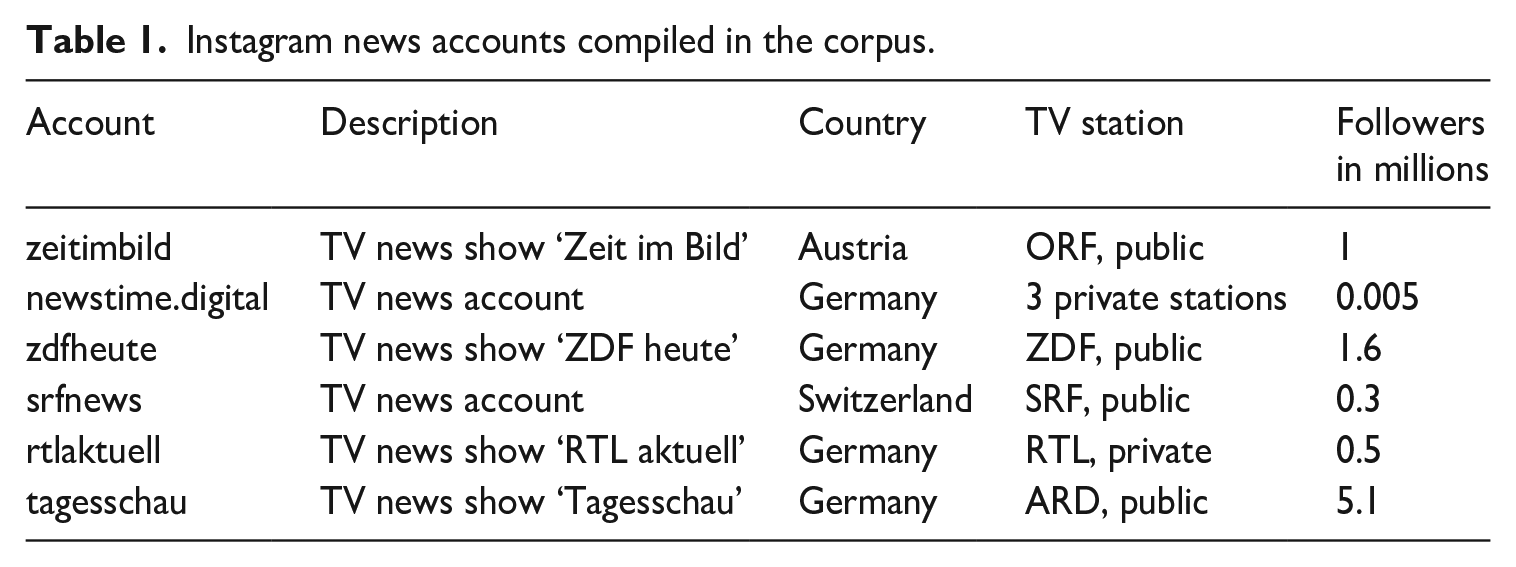
All major German speaking TV news shows, especially shows of public broadcasting companies (Pfurtscheller, 2022a), use Instagram intensively to promote and distribute their content, usually using the full range of possibilities (photo posts, reels, and stories). We 4 collected 100 posts (single photo posts, carousel posts with up to 10 photos, and reels, that is, short videos) from six accounts, starting from September 13, 2023. 5 We collected data until 100 posts per account were reached (the latest posts are from October 9, 2023) from the accounts in Table 1: The accounts are from public and private TV stations in the case of Germany, and from public TV stations in the case of German-speaking Switzerland and Austria. As indicated in Table 1, the accounts ‘srfnews’ and ‘newstime.digital’ are not associated with a single programme, but with one (srfnews) or several TV stations (newstime.digital, associated with the TV stations ProSieben, Sat1, and Kabel Eins).
Instagram news accounts compiled in the corpus.
As journalism changes and is changed, new criteria to discuss quality of (online) journalism are necessary (for a discussion in the context of Instagram see Sehl et al., 2022). One possibility to discuss these issues is to rely on the proposition of Hermida and Mellad (2020), who describe five dimensions for the analysis of social media affordances: design and structure, esthetics, genre conventions, rhetorical strategies, and interaction. These dimensions, as the authors write, ‘extend beyond technical affordances’ (Hermida and Mellad, 2020: 865), including characteristics that can be related to the social affordances of the platform in question. In the following genre analysis, I will address these aspects, although not separately, as they all are part of genre styles: design and structure, esthetics, rhetorical strategies as well as opportunities (or constraints) for interaction are all part of genre conventions as soon as they become patterned. I understand genres here as ‘recurrent, goal-directed, communicative events [. . .] mediated by digital tools [. . .], along with the constellation of activities that surround such events’ (Hafner and Pun, 2020: 4).
The following analysis will focus on news genres in the accounts compiled in the corpus, focusing on the following questions:
- What is the genre profile (i.e., genre repertoire and genre frequency, see Luginbühl, 2019a), in the Instagram posts of TV news accounts?
- How are the main genres designed? How are the structures and templates of Instagram used, which social affordances can be reconstructed? And to what extent do journalists adapt the forms of reporting to the technical affordances of Instagram?
For the analysis of the genre profiles of photo posts and carousels, we analyzed a subcorpus of 35 posts of each account. Loosely based on the classification of Pfurtscheller (2022a), I have reconstructed the recurrent genres in my data as discussed in the next section.
Genres of TV news Instagram accounts
A first look at the corpus shows that the two different kinds of Instagram posts (‘post’, ‘reel’) are used quite differently by the six accounts (see Figure 1).
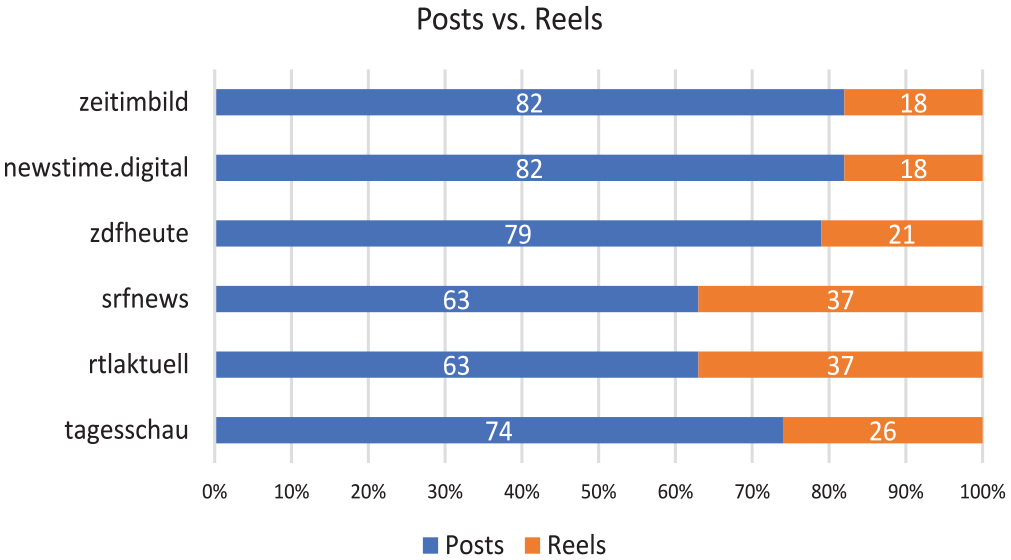
Share of posts versus reels in the corpus (n = 100 per account).
There are three accounts publishing reels at around 20% of the 100 cases, two accounts include more than a third (37% each), and one account is in the middle (26%). While one could expect that accounts of TV news shows predominantly rely on reels, as this format is closest to TV news genres, this is obviously not the case. This may be due to the production costs, since videos demand additional work in editing (Gruber and Radü, 2022: 266). It may also be due to the way posts and reels are presented in the Instagram feed. While it is easier to catch viewers’ attention with an attractive headline consisting of an image and a written headline, any reel must catch viewers’ attention within the first seconds of a video. The use of regular news video is therefore limited, which is arguably due to the ‘media affordances’ of Instagram with its specific way of news consumption (compared to classic TV news, where viewers will probably not switch channels after just 1 or 2 seconds). Keeping this in mind, the following sections examine the news genres that can be reconstructed, starting with the photo posts and carousels, and continuing with the reels.
Genre profiles
In his analysis of Instagram news from 2019, Pfurtscheller distinguishes 18 genres (Pfurtscheller, 2022a: 220). In the corpus analyzed in this study, not all of these genres can be reconstructed (e.g., there are no memes and no behind-the-scenes). This could be because Pfurtscheller looks at 28 different accounts and also analyzes Instagram stories, but it could also be due to an increasing reduction of the genre repertoires and an increasing homogenization, similar to the rather small repertoires of TV news worldwide. In the photo posts and carousels, I reconstructed the following genres, which will be further discussed in the analysis below. I have further differentiated and supplemented Pfurtscheller’s (2022a) classification and was able to reconstruct the following recurrent genres 6 :
- Headline (single picture post with headline)
- Headline+ (single picture post with headline and figure/table/picture in picture)
- Multiple headlines (single post with several headlines)
- Newsbite (single picture post with headline and short lead)
- News Brief (carousel; headline with second frame with pictures or text)
- News Report (carousel; headline followed by several frames with pictures, text, and subtitled videos)
- Package (carousel; long post with pictures, videos including sound bites, often with so-called ‘stand up’, showing a journalist on site speaking into the camera)
- Quote Card (single picture post with quote)
As news cover a very broad range of topics, this classification is based on formal instead of topical features, with the quote card as the only exception. Based on the analysis of 35 posts of each account, Figure 2 shows the genre profiles that can be observed.
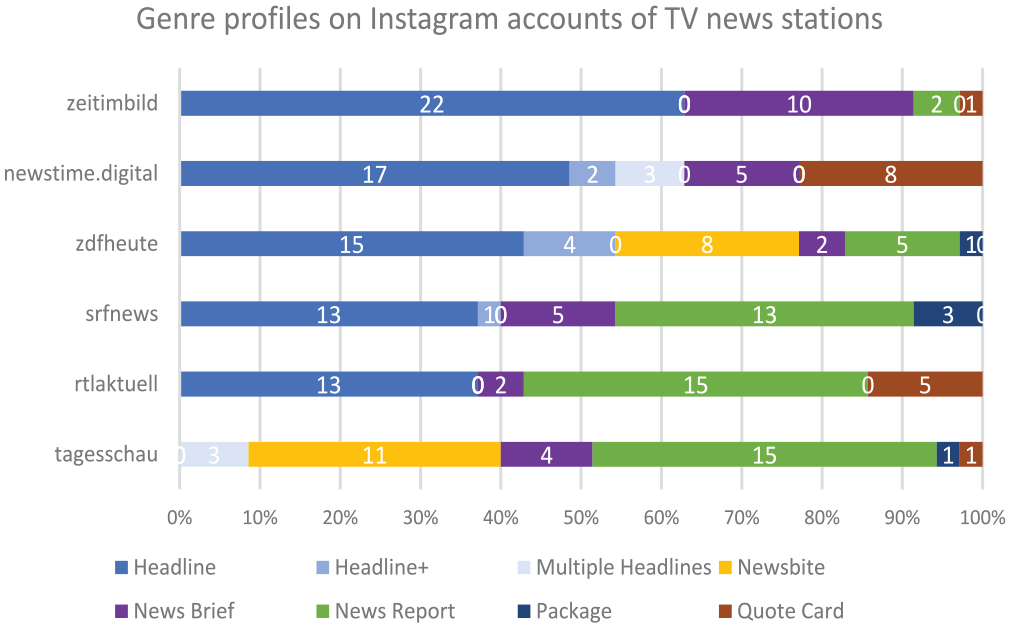
Genre profiles of Instagram posts (without reels) on Instagram accounts of TV news.
Figure 2 demonstrates that there are roughly two types of genre profiles: There are accounts (like zeitimbild, newstime.digital, or zdfheute) that clearly prefer short genres, consisting of one or two frames. These accounts also do not post many reels. On the other hand, there are accounts (like srfnews, rtlaktuell, or tagesschau) that not only post comparatively many reels, but also many longer posts like news reports. These two types do not coincide with ownership of the TV news stations (private or public), nor with the countries of the stations. Packages only play a minor role, as do the stand-alone quote cards (see section ‘News briefs and news reports’). But even in the accounts with more longer genres, the short genres prevail in all accounts, making up between 54% (tagesschau) and 100% (newstime.digital). Thus, the genre profiles all show a clear preference for short, bite-sized news. Although the genres analyzed in this study are not ephemeral, they very clearly are produced for (very) quick consumption, reinforcing the ephemerality of traditional TV news genres. We can see affordances at work here: While the technical affordances are optimized for picture and movies with short verbal texts that can be consumed quickly, the social affordances that emerge on the news organization’s accounts lead to intensified headline news, with short genres at the core. The news stories often consist of only one single frame, or they are split into several frames that include little text next to the picture. This news coverage is primarily aimed at a quick, concise overview that provides a brief orientation. The following analysis will focus on the most common genres, leaving aside the packages as well as single quote cards (see Pfurtscheller, 2020 for this genre).
Headlines and newsbites
In all but one Instagram account of the six TV news accounts, headlines (with three variants) and newsbites make up a big portion of the posts (ranging from 37% to 63%; see Figure 2). The multimodal design of these two genres is similar across all analyzed accounts (see also similar findings by Pfurtscheller, forthcoming): Headlines combine a picture and a superimposed, often complex headline text (see Figure 3), while newsbites include a headline and at least one additional sentence. While I use terms that have been coined for printed or online newspapers, the Instagram counterparts have their own characteristics. In newspapers headlines are usually only part of a text and no independent genre, but the Instagram headline is a genre of its own. Although there is a (short or long) caption, only the picture and the superimposed headline can be seen on the Instagram home or profile screen, while the accompanying caption is truncated in the main feed and can only be read if the text is expanded. This makes the picture and the headline the main parts of this genre. 7 The ‘direct visualization’ (Manovich, 2011) in Figure 3 shows examples of such headlines.
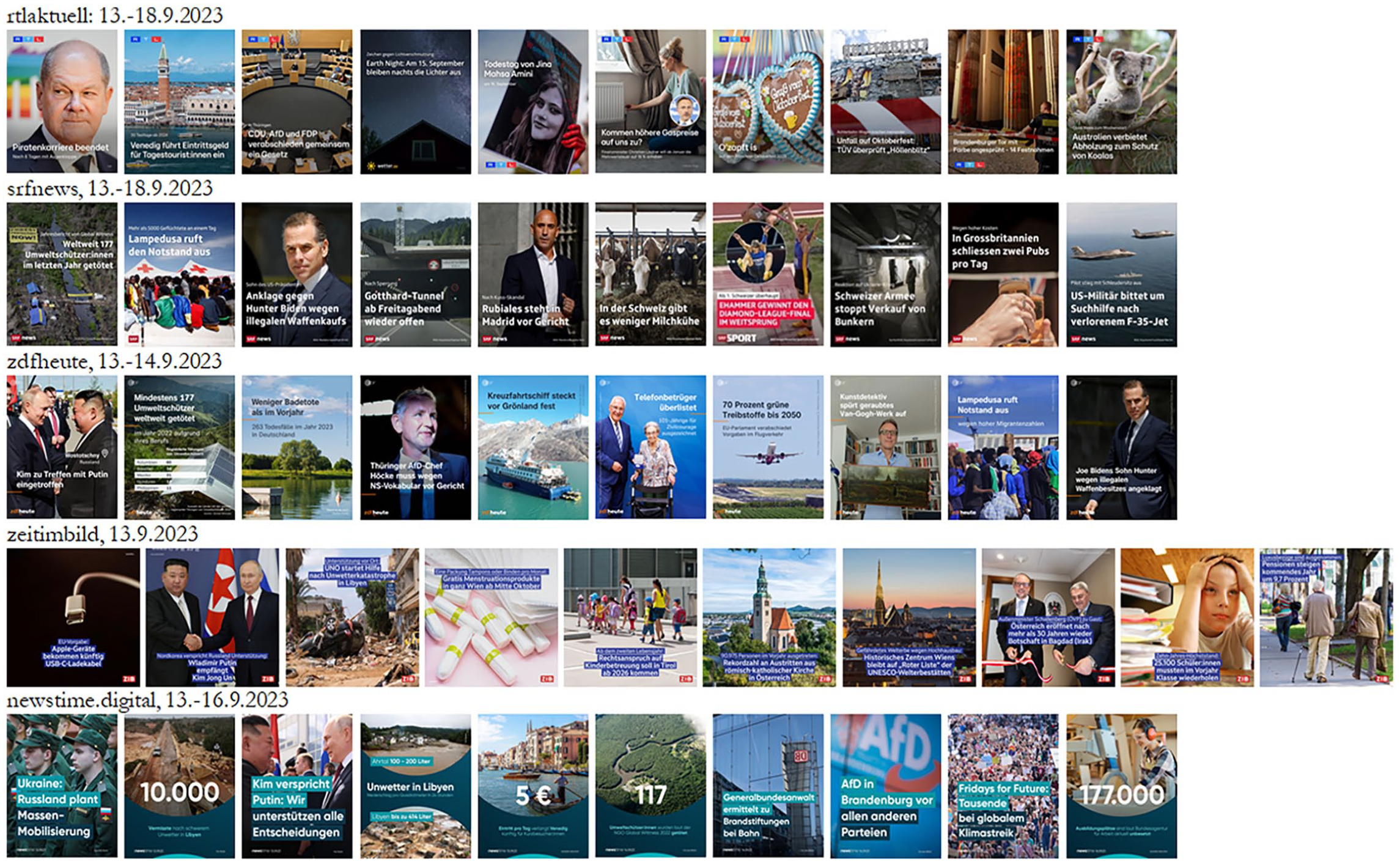
Headlines of TV news stations’ Instagram accounts. rtlaktuell: 13.-18.9.2023; srfnews, 13.-18.9.2023; zdfheute, 13.-14.9.2023; zeitimbild, 13.9.2023; newstime.digital, 13.-16.9.2023.
The direct visualization shows a far-reaching uniformity of the headlines: One photo picture fills the main part of the screen, and a short (sometimes compound) headline is superimposed. Only in some cases (ranging from 0% to 11%) a second photo is inserted (see the seventh example of srfnews; I call this genre ‘Headline+’) or a table is added (see second example of zdfheute). Overall, the headlines show a great deal of uniformity or ‘sameness’ (Pfurtscheller, forthcoming). This is on the one hand due to technical affordances of the platform, which limits the image dimension to a square or rectangular cropped frame of a certain size (Zappavigna, 2016: 275) and which also limits the space for text, thus necessitating the use of short texts. At the same time, we see social affordances at work: Branding is consistently implemented within these constraints by the news stations; all accounts insert their brand logo and use the typography and colors of the corporate identity style. While news media accounts on Instagram used to rely on design resources provided by Instagram like templates, typography, filters at the beginning of their Instagram presence (see Pfurtscheller, 2022a: 223), they now all use their corporate design. This ensures the recognition of the news brand – one of the crucial aims of the news media corporations on Instagram (Hase et al., 2022: 5). Furthermore, there are some headline styles specific to single brands like the combination of a number in large letters followed by the rest of the headline in smaller letters, which only becomes readable after clicking on the thumbnail preview (newstime.digital, Examples 2, 5, 6, and 10). Regarding genre style, it is also important to note what is absent from these posts: There are no emojis, no GIFs, no ornate typography, and no illustrations other than photos, which restricts the playfulness of the posts. This provides a contrast to many other Instagram posts, emphasizing the seriousness of the news provided.
Looking at the canvases of these posts, there is a specific orchestration of photo content and text positioning: The headline is usually positioned at the top or at the bottom of the picture; sometimes it is placed around objects on the picture, always emphasizing a certain part of the picture. Regarding the style of the pictures, we cannot observe typical ‘social photography’, which implies a ‘you could be there with me’ esthetics (Zappavigna, 2016: 272). Instead, news photography is used comparable to newspapers: portrait pictures, pictures of the events reported, buildings, cities, landscapes related to the event, or metonymic pictures (a church for a headline on church resignations, parliament building for legislation, pars pro toto, etc.). In almost all cases, the point of view that can be reconstructed in the photos puts the viewer in the position of an observer. At the same time, the pictures are adapted to the Instagram esthetics: The color saturation is intensified using filters, and the chosen pictures often have a high aesthetic appeal (e.g., a beautiful rainforest landscape is shown with a headline on killed environmental activists, see also Caple, 2013). This is in line with what Manovich calls ‘Instagramism’ as ‘the construction of scenes and images that are atmospheric, visually perfect, emotional without being aggressive, and subtle as opposed to dramatic’ (Manovich, 2017: 81).
Looking at the rhetoric of the headlines, there are many parallels to German newspaper headlines (see Burger and Luginbühl, 2014: 147–154). There are ellipses (‘Joe Bidens Sohn Hunter wegen illegalen Waffenbesitzes angeklagt’/Joe Biden’s son Hunter charged with illegal possession of firearms, zdfheute; ‘AfD in Brandenburg vor allen Parteien’/AfD in Brandenburg ahead of all parties, newstime.digital) and full sentences (‘In der Schweiz gibt es weniger Milchkühe’/Switzerland has fewer dairy cows, srfnews; ‘Generalbundesanwalt ermittelt zu Brandstiftungen bei Bahn’/Federal Public Prosecutor General investigates arson at Deutsche Bahn, newstime.digital). However, in most cases we find compound headlines consisting of a strapline and a lead headline (‘Sohn des US-Präsidenten; Anklage gegen Hunter Biden wegen illegalen Waffenkaufs’/Son of the US President; Hunter Biden charged with illegal arms purchase, srfnews, ‘Ab dem zweiten Lebensjahr; Rechtsanspruch auf Kinderbetreuung soll in Tirol ab 2026 kommen’/From the age of two; legal entitlement to childcare to be introduced in Tyrol from 2026, zeitimbild) or a lead headline and a sub-headline (‘Piratenkarriere beendet; Nach 8 Tagen mit Augenklappe’/Pirate career over; After 8 days with an eye patch, rtlaktuell; ‘Weniger Badetote als im Vorjahr; 263 Todesfälle im Jahr 2023 in Deutschland’/Fewer bathing deaths than in the previous year; 263 deaths in Germany in 2023, zdfheute). Looking at all 90 headlines (including headlines+ and multiple headlines) of the subcorpus analyzed, the style is mostly factual without emotionalization, even in the case of military events (‘Aserbaidschan startet Militäreinsatz in Bergkarabach’/Azerbaijan launches military operation in Nagorno-Karabakh, srfnews). Interestingly, there are only very few headlines that include negative evaluation. If they occur, it is in the context of events where a negative evaluation corresponds to the common sense, that is, an uncontroversial attitude (‘Mehr als 5.000 Tote nach Flutkatastrophe in Libyen’/More than 5,000 dead after flooding catastrophe in Libya, newstime.digital; ‘20.000 Tote alleine in Darna befürchtet: Warnung vor Epidemien in Libyen nach Unwetter-Katastrophe’/20,000 deaths feared in Darna alone: Warning of epidemics in Libya after storm disaster, zeitimbild; emphasis added). There are also some positive news headlines (‘Good News zum Wochenstart; Australien verbietet Abholzung zum Schutz von Koalas’/Good news to start the week; Australia bans deforestation to protect koalas, rtlaktuell; ‘Telefonbetrüger überlistet; 101-Jährige für Zivilcourage ausgezeichnet’/Phone scammer outwitted; 101-year-old honored for civil courage, zdfheute; ‘Für Berge und Wälder: 92-jähriger Deutscher erfindet Turbo-Rollator’/For mountains and forests: 92-year-old German invents turbo rollator, zeitimbild). However, since the timespan for our data collection was limited, the proportion of negative/positive news on Instagram deserves further investigation in larger and more representative datasets.
Summing up: While the rhetoric of the headlines is serious in tone, with not much emotionalization, evaluation, or dramatization, the photos and filters tend to estheticize the events reported and therefore can be understood as an infotainment strategy – and of course an adaptation of Instagram esthetics.
Moving on to the qualitative analysis of the newsbites in the corpus, these are similar to the headlines, and in some cases the transitions are fluid. In essence, like in online newspapers (Knox, 2007; Luginbühl, forthcoming), newsbites on Instagram consist of a topical focus in the headline and more information on the event in the lead text, and they always contain a picture. 8 The written text is superimposed and the leads are usually shorter than online newspaper newsbite leads, consisting of only one sentence. This is why the difference between an Instagram headline and an Instagram newsbite is sometimes hard to tell, as sub-headlines may consist of a full sentence. Nevertheless, if the headline is complemented with a full sentence, and this sentence is visually separated from the headline section, it has been categorized as newsbite. This is the case in Example 1.
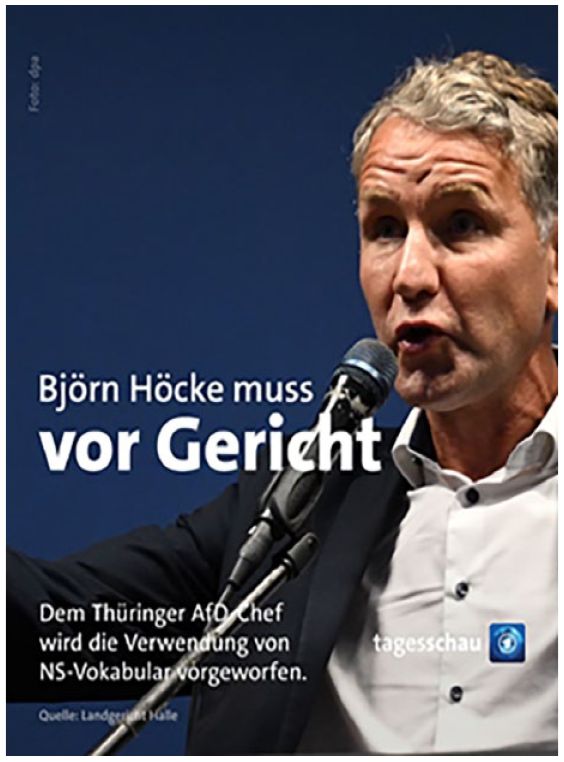
tagesschau post from September 13, 2023 (Björn Höcke must stand trial; The Thuringian AfD leader is accused of using Nazi vocabulary.
While the headline is in the middle of the picture, connecting the face of the person represented with the fact of him being charged, the lead is a full sentence with a period at the end, and it is clearly separated from the headline, written in smaller letters, and positioned at the bottom of the picture. In very small letters – and this is also true for many headlines – the source of the news information is quoted. While often barely readable, this information is important nevertheless, as it stresses the seriousness and the reliability of the news.
As Figure 2 shows, the analyzed accounts differ in their use of headlines and newsbites; there are different ‘house styles’: While most of the accounts do without newsbites, one account (tagesschau) uses newsbites a lot, though without headlines, and only one account (zdfheute) uses both headlines and newsbites. As the analysis shows, the genre styles of Instagram headlines and newsbites are related to technical as well as social affordances of the medium. The genres discussed so far are based on genres of (online) newspapers, but they are adapted to the technical constraints and possibilities of the platform while also following design practices already established on Instagram. With their mostly factual headlines, their esthetic pictures and elaborated text-picture orchestration on the canvas, they aim at highly condensed information, sensual entertainment, and (probably above all) branding.
News briefs and news reports
As we have seen in the previous section, Instagram newsbites are often a very slightly elaborated version of Instagram headlines. The relation between news briefs and news reports is similar, but not identical: briefs consist of two frames, one with a headline and one with text, which in most cases is combined with a picture. The news reports consist of a headline and several following frames, including picture-text frames and text-only frames (disregarding the logo of the news organization). Both genres rely on the technical affordance of carousel posts, that is, they combine several frames that can be viewed by swiping left. While in the case of headlines and newsbites, the shorter genre is much more frequent (except on tagesschau), in the case of news briefs and reports, it is usually the other way around (see Figure 2): the longer news reports are produced much more often than the news briefs (except for zeitimbild and newstime.digital). Example 2 shows a typical news brief.
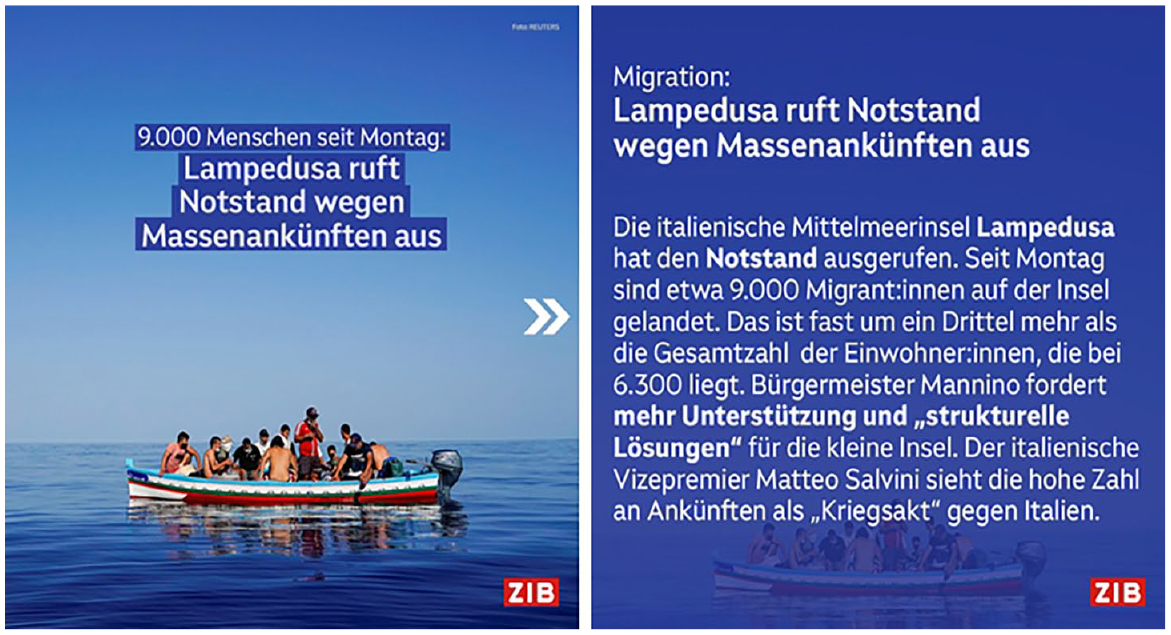
News brief of zeitimbild (September 14, 2023). 9
This example from zeitimbild starts with a headline, once again factual in tone (taking into account that ‘Notstand’/emergency is a legal term here) and features an aesthetically appealing picture, while the event covered stands in stark contrast to the beauty of the picture. The design of the second frame is inasmuch typical, as the text takes the most space, but is still combined with a picture in the background. Text-only frames are very rare in news briefs. The content structure of the text corresponds to the well-known structure of newspaper texts but also to short film items in TV news shows. It follows the inverted pyramid-style (Bell, 1991) with the w-questions (who, what, when, where) answered in the headline and the first two sentences, followed by a contextualization and then by verbal statements of officials. While this design and language style is the most common in the corpus, in some news briefs the second frame consists of a picture with a short caption. In one case (rtlaktuell of September 14, 2023), the second frame even consists of a picture with only the TV station’s logo. In some other cases, the second frame consists of a quote card, showing a person (usually their head) with a superimposed quote of this person.
Moving on to news reports, these show a greater variety in design and style. The subcorpus includes 50 news reports (see Table 2). The median value of the frames of these reports is exactly five frames in four cases, exactly four in one; one account (newstime.digital) does not produce news reports. While 20% include 3 frames, there are two reports with 10 frames. 10
Number of news reports, frames in total, highest and lowest value, median value.
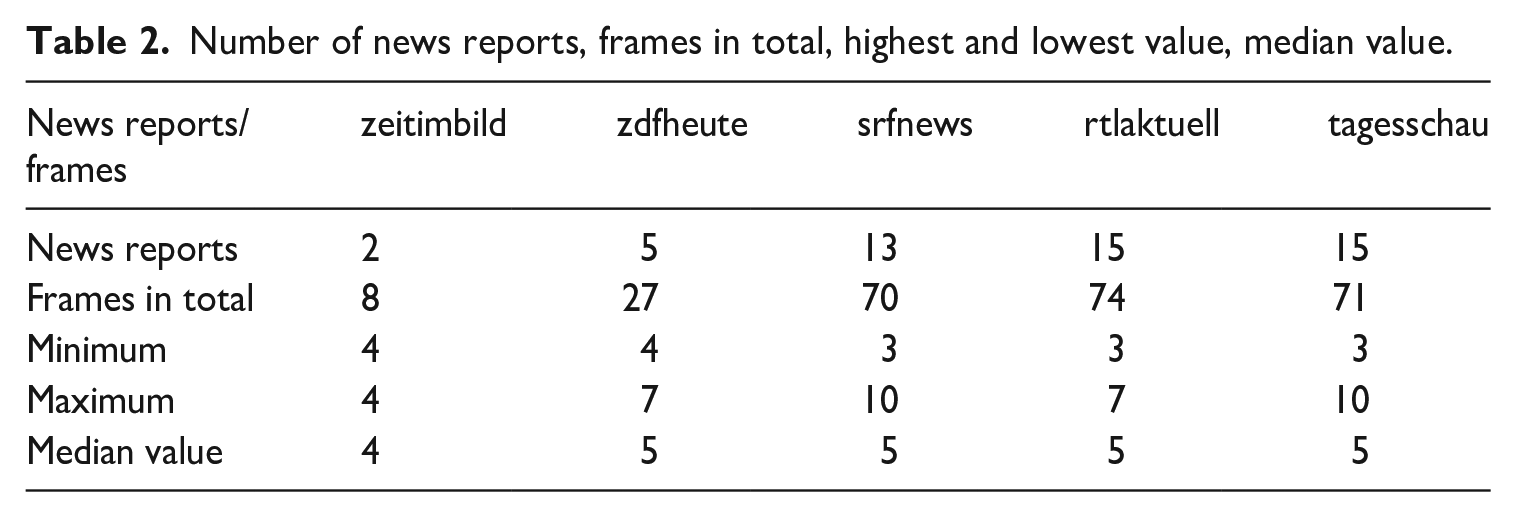
Usually, news reports consist of a headline followed by several other picture-text-frames covering the same topic, often structured by subheadings. One example of this kind is Example 3.
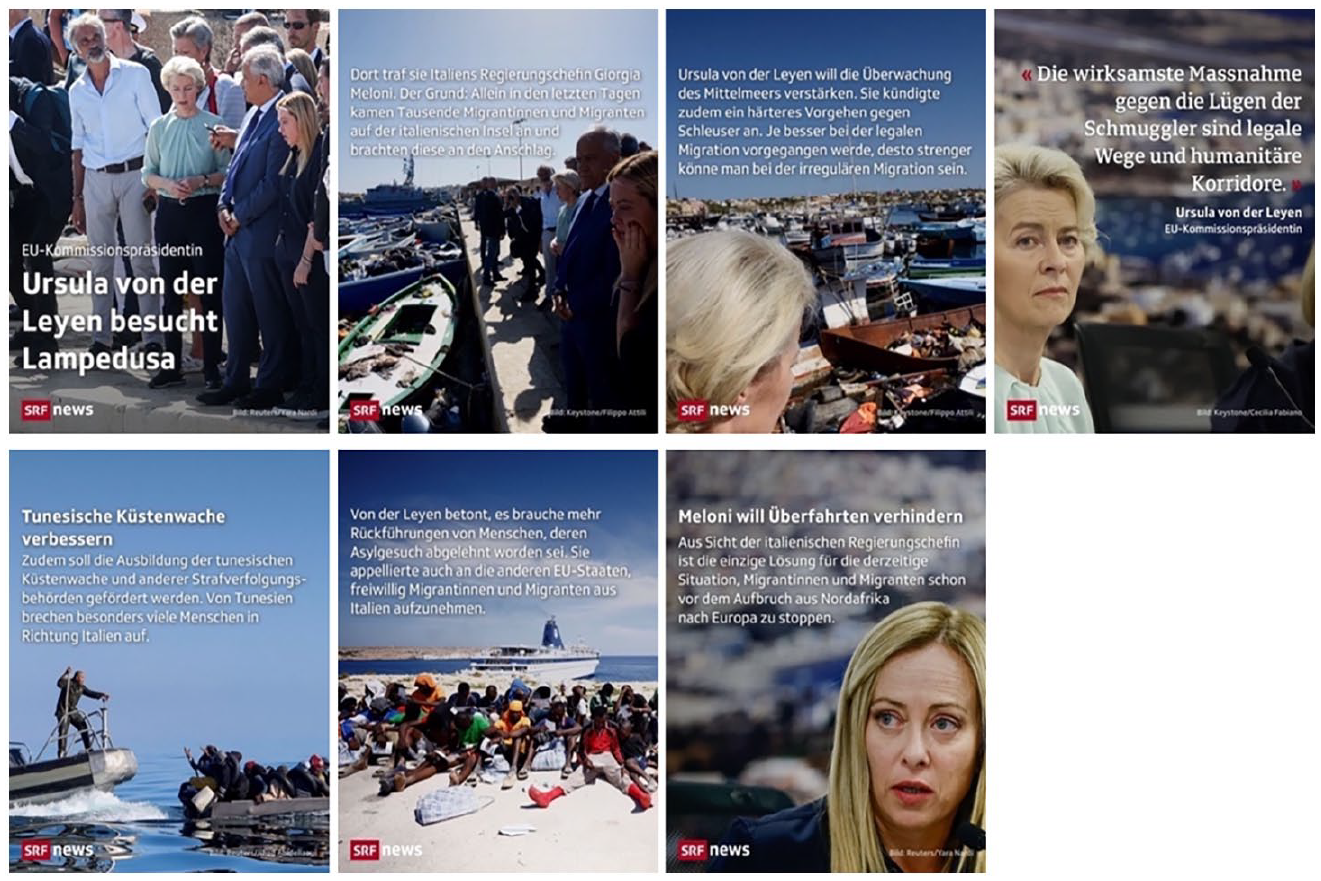
News report of srfnews from September 17, 2023.
Looking at the entire report in Example 3, we can again see the importance of esthetics for the images: The pictures chosen all contain blue colors, creating aesthetic consistency. In some cases, there even seems to be a filter at work making the blue sky darker. 11 This not only increases the color saturation, but also renders the written text more readable. As in most cases, the pictures are not ‘demand’-pictures in the sense of Kress and van Leeuwen (2021: 116) with people looking directly into the camera. In addition, all photos in this report except for the photo that occurs with the headline are cropped in a way that makes it possible to superimpose the text at the top of the pictures. The blue colors and this positioning of the text give the frames of this report a consistent esthetic look.
Like in many news reports in this corpus, the verbal text in Example 3 does not follow the inverted pyramid. After the headline, the ‘why’ is mentioned explicitly (‘Der Grund: . . .’/The reason: . . .), followed by an indirect quote on the next frame and a direct quote from the president of the European Commission in the following quote card frame. The next frame includes a first subhead, the continuation of the quotes (‘Zudem. . .’/In addition. . .) and some background information. After another frame with indirect quotes, the position of the Italian head of government is presented. Overall, the report is highly personalized, showing Ursula von der Leyen on scene and showing what she (could) see there. All news information not directly related to her (why, other background information) is kept very short, only the reaction of Giorgia Meloni is elaborated a little bit more. In contrast to the problems that are at stake, the pictures and the entire report are highly estheticized.
While Example 3 is illustrative of a common design of news reports, there are two variants in the subcorpus, one with less and one with more text (including text cards). In the first variant, news reports consist of a headline or a newsbite, followed by picture frames with only a minimal caption, like in Example 4.
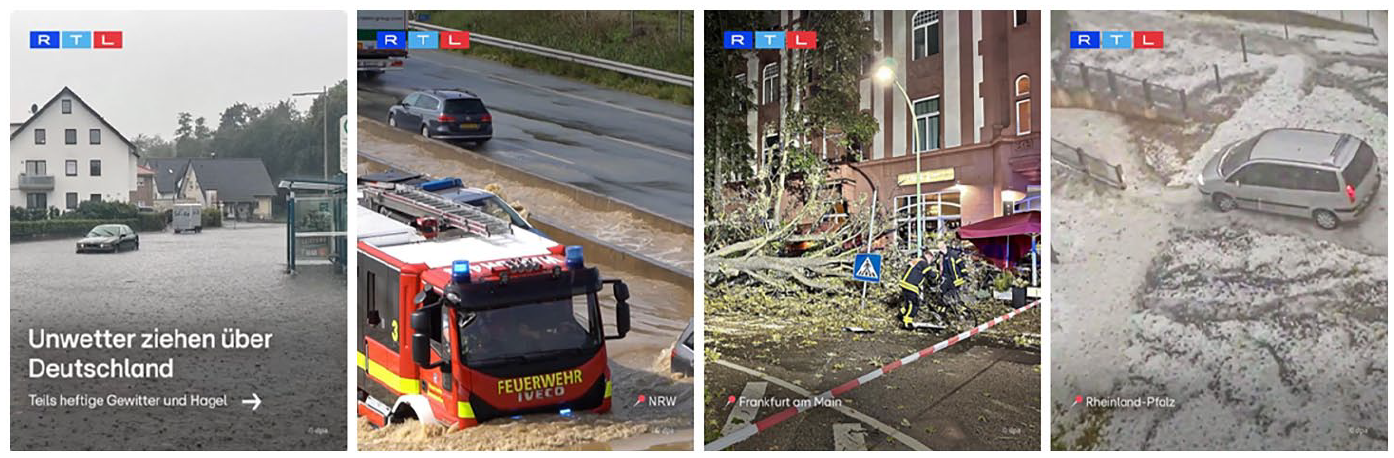
News report of rtlaktuell of September 13, 2023.
This variant of news report is only used by the rtlaktuell and the tagesschau accounts with six instances in the corpus analyzed. Like online news galleries, the pictures are presented in an order ‘in which they are intended to be “read”’ (Caple and Knox 2017: 205, see also Caple and Knox 2012, 2015). But while certain online news gallery genres like ‘unfolding stories’ or ‘bios’ (Caple and Knox, 2017) can be related to a temporal sequence, these posts are reminiscent of what Caple and Knox have called ‘episodic galleries’ (Caple and Knox, 2017: 208) and they combine pictures that show only cohesive strings related to an event, sometimes to a location (Oktoberfest in Munich) or participants (throne jubilee of Carl XVI. Gustaf of Sweden). In other cases, like Example 4, pictures from different places are combined. In all of these cases, no unfolding in time, no narrative structure in a narrow sense of the word (exposition, action, climax, resolution) can be reconstructed. For instance, Example 4 shows pictures of storms from different places in Germany, combining wide shots of flooding and damage in populated areas in random order. While the storm is raging in pictures 1 and 4, reactions and consequences are shown in pictures 2 and 3. The pictures show disaster and damage seemingly everywhere and in a random order. And as they remain uncommented, they mostly aim at an emotional impact and sensationalize the news content. It is important to note that the logo of the TV stations can always be seen, again showing the importance of branding.
In the other variant, pure text frames (disregarding the logo) are used next to text-picture-frames (Example 5). Between a headline frame and a quote card, we can find a pure text frame in this news report. Although it is designed in the corporate design of the Instagram account of the TV news show ‘Tagesschau’, there is no picture used apart from the show’s logo. This is important, as we can see here that the technical affordance of posting a picture is adapted to the needs of the medium for verbal information. Instead of posting a picture showing objects, persons, landscapes, or abstract content, the picture of a verbal text is posted, without fully exploiting the possibilities of multimodality and visuality of the platform.
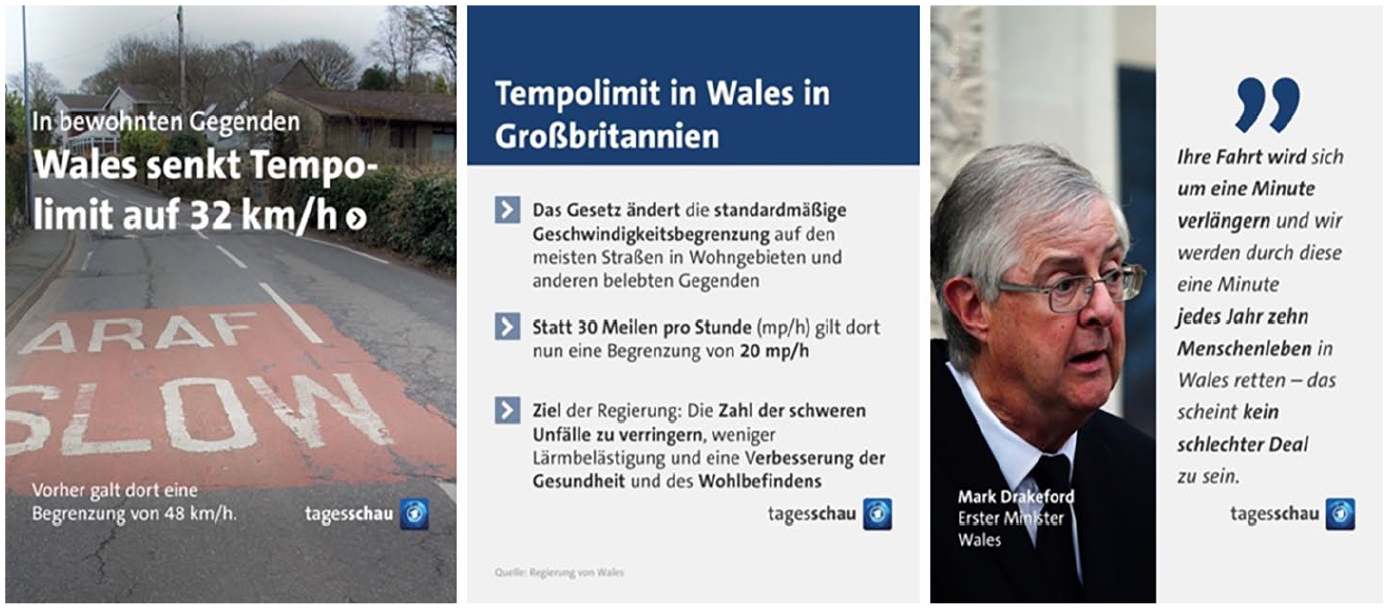
News report of tagesschau of September 17, 2023.
Although text frames are not the most common design, such use of text is not exceptional either. In the 250 frames of the news reports in the subcorpus, there are 38 text frames without picture (15.2%), in two cases there are also quote cards without picture. 12 However, the text frames are not used the same way across accounts: Only rtlaktuell, tagesschau, and zdfheute use them, with rtlaktuell doing so the most. This is interesting, as one might expect more infotainment and therefore more pictures in the account of a private TV station. On the other hand, text frames are of course the easiest to produce. 13
As in the case of headlines and newsbites, news briefs and news reports are adapted to the technical affordances of Instagram, most often combining text and (background) pictures. As social affordances, a tendency emerges to the either very short headlines or the longer news reports (instead of the news brief), which differ from the inverted-pyramid. Additionally, headlines followed by picture-only frames or text-only frames can be observed. The pictures chosen often show aesthetic consistency and in some cases are aesthetically appealing even if the event covered is distressing.
Reels
The final section takes a brief look at reels. Reels consist of multi-clip videos and are promoted by Instagram as ‘fun, entertaining videos’. 14 For this study, a reel subcorpus of 7 reels per account was analyzed (42 reels in total), given that their analysis is time-consuming. As Table 3 shows, the average as well as the median length of these reels vary both between and within accounts.
Average and median reel length in the reel subcorpus (minutes:seconds).
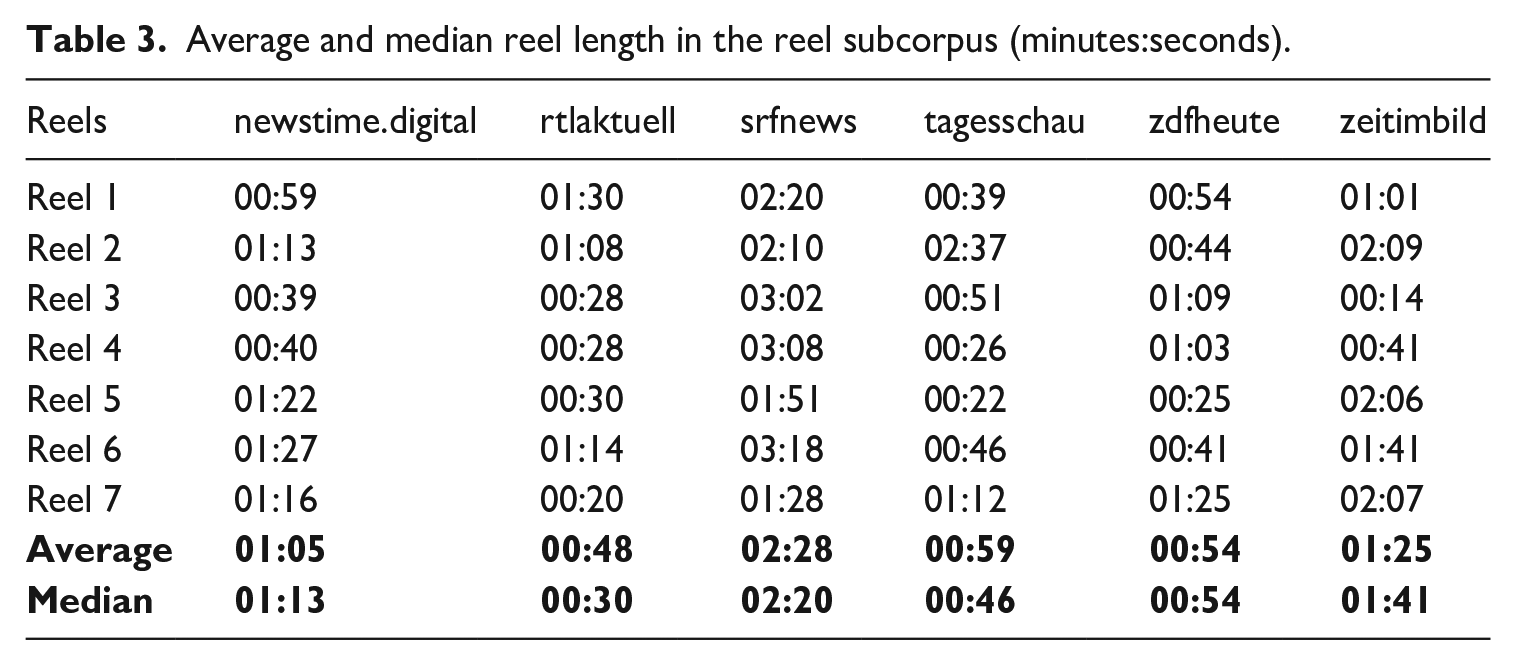
As Table 3 shows, most reels are shorter than 90 seconds, except for the majority of the srfnews and some of the zeitimbild reels. Only these two stations have a median length of more than 90 seconds. This is also reflected in the median number of shots within one video: The median ranges from 2 (rtlaktuell) to 11 (zdfheute), the two accounts with longer reels have 19 (zeitimbild) and even 32 shots (srfnews). A clear difference between private (newstime.digital, rtlaktuell) and public TV accounts exists regarding the median length of a video shot. While the median shot length in all public TV station’s reels is 4 seconds, it is 13 and 14 seconds in the case of the two private stations. This might once again be unexpected, as we would expect a higher shot frequency, resulting in more dynamic and entertaining reels in the case of private stations than in the case of public ones. However, this result must be verified with larger corpora and through qualitative analysis of the content of reels. For instance, some reels include soundbites which are usually much longer than news video and thus interact with overall reel-length.
The reels in the subcorpus analyzed (n = 42) not only differ in length and number of shots, but they also differ in design and news narrative, despite some similarities. Like in the case of the other genres discussed so far, the corporate design (logo, typography) is used in all reels; some even include a jingle of the TV news show at the end of the reel (e.g., zdfheute). In rare cases, logos of other shows are used, usually other news or documentary formats of the same TV station. Similarly, in almost all reels, text is superimposed onto the videos; in some cases, a voice-over can be heard reading this text. In many cases, music is added to the reel and unobtrusive spheric sounds are used. In other cases, the sound of the original situation can be heard (e.g., traffic noise, etc.).
Apart from the reels consisting entirely or to a large extent of soundbites, most other reels consist of a mixture of news videos from the reported event or topic, superimposed texts and soundbites. Only in very rare cases are the soundbites translated in a voice-over, as is usually the case in TV news shows. Other differences and similarities between traditional TV news coverage and Instagram reels will be discussed in the following brief analysis of a typical case of the tagesschau account (Example 6).
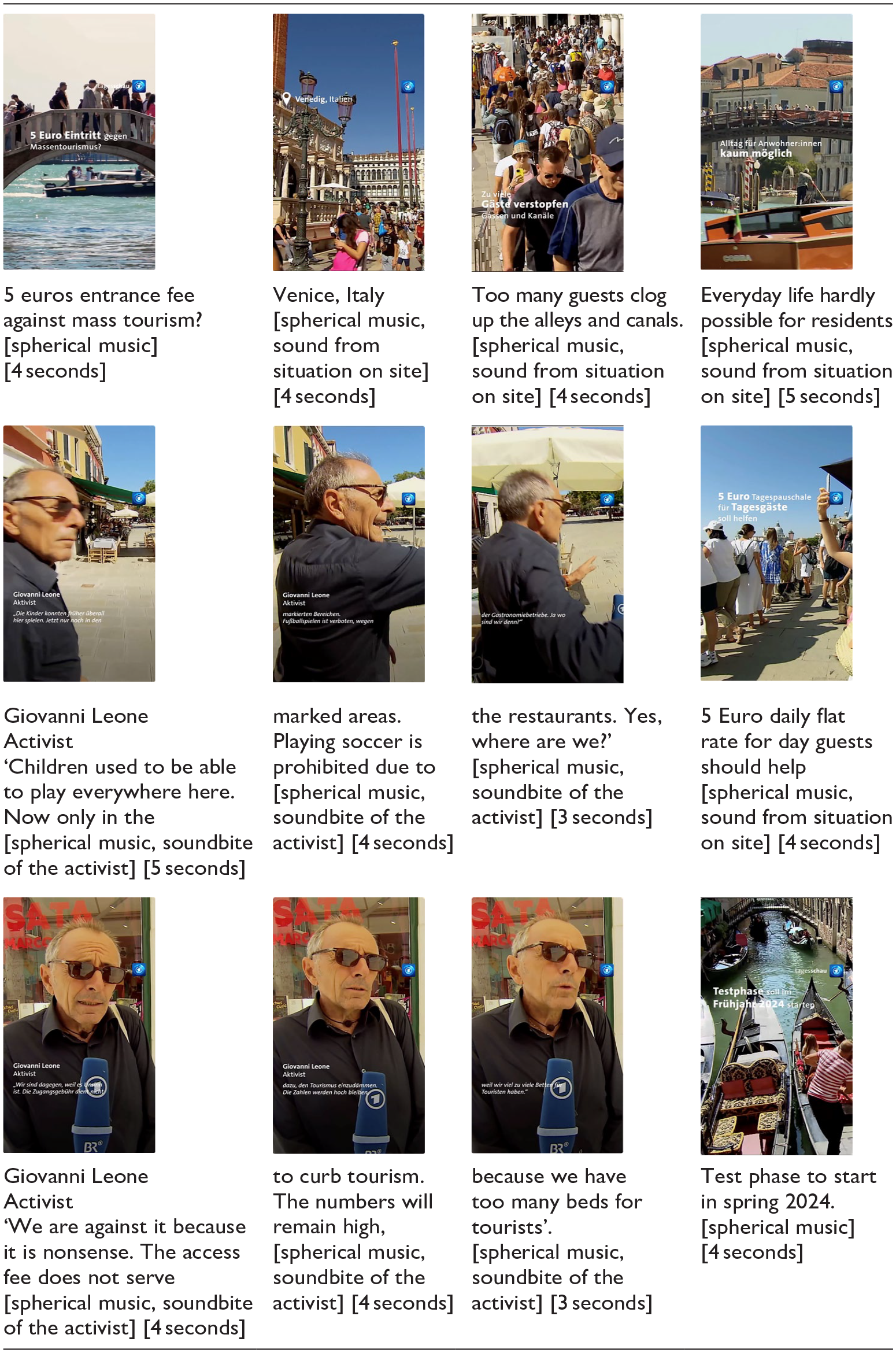
tagesschau reel of September 13, 2023.
Like many reels, the reel in Example 6 combines video, soundbites, background noise, spherical music, and superimposed text, which is dynamized by fading it in and out (this is the case in most reels, also in the other accounts analyzed). In stark contrast to traditional TV news, this reel’s verbal text is only presented as written text (using different fonts for emphasis, but also indicating verbal quoting), but not as voice-over. 15 This practice is a social affordance relating to the common consumption of Instagram without sound. On the other hand, the use of spherical music (which is also in stark contrast to traditional TV news) does not have narrative functions, as it is usually the same musical soundscape for different reels. Its aim is purely entertaining, rendering the reel more pleasing (adapting to the dominant Instagram style) and also connecting the different shots. Similar to current news coverage in TV news shows, the single shots are short (3–4 seconds), only the soundbite shots are longer, but structured by changing captions in the same rhythm (for rhythm as a specific quality of digital news storytelling see Gruber and Radü, 2022: 261).
Further, the content delivered is short, condensed, and elliptic. This can not only be seen in the use of verbal ellipses, but also on a content level: One of the main questions, namely who proposes an entrance fee of 5 euros, remains unanswered. Instead, the reel focuses on the verbal reaction of one activist, next to the what, where, and why. In addition, and again in contrast to most traditional TV news items, the person speaking in the soundbite is not introduced in advance, and only mentioned in the caption. The relevant soundbite also has emotionalizing potential, as it mentions the lost possibilities of children playing soccer outside.
Considering shot types, these appear to be purposefully varied: While the shots of tourist masses in Venice are shot with a static camera, the first shot of the activist is shot with a mobile camera, following this person very closely as he walks through the city, staging closeness to the activist and giving the impression of a rather improvised gathering of information with the microphone swaying into the picture. In the second shot of the activist, the microphone of the journalist can be seen again, bringing us close to the scene and the process of news gathering. This can be – like the stand up shots in some Instagram packages and stories (see Pfurtscheller, 2022b) – interpreted as social parainteraction (Luginbühl and Meer, 2022), as it aims to give the viewers the impression of being on the scene and involved in the situation shown. Overall, the visuality is estheticized, showing stereotypical pictures of Venice on a beautiful day, once more with a high color saturation.
In sum, we can again see a genre design that is simultaneously shaped by both technical and social affordances. The social affordances that emerge relate to established journalistic practices (e.g., use of rather unspecific video shot from distance, combined with soundbites shot in medium close shot). At the same time, other aspects relate to practices adapted to the platform (e.g., use of superimposed text instead of text from off screen, elliptical coverage, seemingly improvised shots) and in the case of the use of captions instead of voice-over, related to anticipated practices of consumption within the platform.
Discussion and summary
Instagram has become a major site for news distribution. This study dealt with genre choice and genre design in Instagram accounts of German speaking TV news stations, focusing on the form of news coverage, its adaption to the platform logic, but also on its exploitation for the news organization’s aims. The results show how news media adapt to the logic of social media, but at the same time rely on and adapt established genres and practices. In all cases, it is not only the technical affordances that are at work, but also social affordances.
Analyzing the genre profiles, different account types could be found, one with a clear preference for short genres and fewer reels, another with short and longer stories and more reels. In all cases, the short, bite-sized news genres prevail. In this way, news is radically condensed, which can be interpreted as an adaptation to the social affordance of the platform, where short texts consumable within seconds prevail. In many cases, this is due to a further segmentation or fragmentation of more complex genres; the single headline, for example, does not exist as independent genre in newspapers. This atomization of news is the preliminary end point of a very long change within news reporting, aiming at a lead-structure for a quick overview (Knox, 2007; Püschel, 2001). This reduction of news content comes with the price of a far-reaching de-contextualization of news events, which can be seen as (further) step of journalism toward more entertaining news, as it does not address a citizen eager to be informed, but a consumer wanting to be quickly updated on the go (Hase et al., 2022: 5). Regarding dimensions of journalistic culture (Hanitzsch, 2007), this accentuation can be related to a growing market orientation of news media.
The analysis of the different genre forms showed the uniformity of short news genres such as headlines or newsbites. This observation can be related to technical affordances of the medium in use (mandatory use of pictures; image dimensions; limited amount of text; etc.), but also to social affordances (brand building; renouncing playfulness by using no emojis, GIFs, or ornate typography; use of aestheticized pictures, but hardly any involvement of the viewers; mostly factual verbal headlines). The journalists thus adapt their established genres to the technical infrastructure of the platform, but at the same time to the viewers’ habits (‘instagramism’; quick news update on the go) and to their own aims (brand building; staging of serious news coverage). This is most consistently implemented in the case of the headlines, combining and orchestrating mostly beautiful images with high color saturation with short and serious headlines in one canvas that can be consumed within seconds.
Longer genres like news briefs and news reports show more variation but rely on quite similar frames (mostly text-picture frames). Some news reports consist of picture carousels starting with a headline and followed by photos with short caption, similar to online galleries. In other reports, text-only frames are used; here, a photo of a short text is published, exploiting the technical constraints (using pictures) for the news organization’s own aims (text focused news). While the image-centric briefs and reports are more entertaining given the aesthetics of the pictures and the often homogeneous picture style within a report, text slides usually entail factual, condensed hard news. While the verbal text, like in the headlines, as well as the point of view in the pictures tends to an orientation of the journalists toward objectivism (Hanitzsch, 2007: 371), the use of aestheticized pictures and (in some cases) significant personalization stands for a focus on infotainment and market orientation. This is also due to the fact that all genres analyzed are mainly based on pictures, in line with the shift toward image-centricity in news coverage (Stöckl, 2020), where pictures ‘take center stage’ (Stöckl, 2020: 19). In addition, many examples show aesthetically appealing pictures, while the event covered is distressing. Bednarek and Caple (2017: 187) speak in a similar context of an ‘evaluative clash’, where texts construct negativity and the pictures are aesthetically appealing. It is up to future research to show if such evaluative clashes are more likely in image centric news stories.
The design of the Instagram posts is thus shaped by technical as well as social affordances of media in use. This is also true for reels: The news text is usually not presented via a voice-over, but superimposed as caption(s), allowing for a consumption with the sound turned off. The use of (spheric) music on the other hand is entertaining and usually does not relate to the news narrative. Another characteristic feature of the reels is their elliptical coverage of news, which can be related to the language use, but also to the omission of crucial wh-questions. The structuring and fragmentation by page seems to influence the coherence at least of the verbal text. In the context of soundbites, the use of seemingly improvised video can be observed, creating an atmosphere of viewer involvement and being on-site as rhetorical strategy.
The corpus analyzed comprised Instagram TV news accounts from different media organizations, public as well as private ones. Overall, the genres published by the private accounts seem to be less elaborately produced: Next to the short forms that make up 100% of the posts on newstime.digital, the news reports on rtlaktuell have the highest share of easy to produce text-only slides, and on both accounts the reels consist to a large extent of decontextualized soundbites.
The genre analysis of this study shows that the news is shaped by technical affordances of the platform as well social affordances in form of already established uses. The trend toward short headline-news is the result of a longtime change of news reporting that is not solely due to Instagram, but also to longer trends in journalism and societies at large. Vázquez-Herrero et al. (2019: 9) conclude, that ‘the ephemeral nature of the stories is solely due to a specific condition of the platform, which once again defines the development of journalism practice’. At the same time, we can see how news organizations creatively exploit the technical and already established social affordances for their aims. The uniformity of many genres shows that processes of conventionalization and collectivization can be observed that are related to the media affordances, but also the social, institutional, and historical context of media use. Therefore, affordances are relational and ‘collectively achieved in interactions between human and technological agents’ (Pentzold and Bischof, 2019: 5). The resulting combination of adapting to social media logic and imposing journalistic media logic can be understood as ‘hybrid normalization’ (Bentivegna and Marchetti, 2017: 1464). As the form of news is always more than just a carrier or a vehicle but is always meaningful and part of the content delivered, these new emerging genres also change journalism, the news covered, the news production, its dissemination and the way it is consumed and discussed (Larsson, 2018: 2225). At the same time, they also shape the way news is presented on Instagram and thereby a growing part of Instagram itself by shaping new genres, their digital mediality, and the way we can use them.
Footnotes
Acknowledgements
I would like to thank the anonymous reviewers and the editors of this special volume for their constructive and helpful comments, which have significantly improved the quality and clarity of my manuscript.
Declaration of conflicting interests
The author declared no potential conflicts of interest with respect to the research, authorship, and/or publication of this article.
Funding
The author received no financial support for the research, authorship, and/or publication of this article.
