




Abstract
This research delves into the digital reproductions of a specific monument in locative media employing Walter Benjamin’s conceptual framework presented in ‘The Work of Art in the Age of its Technological Reproducibility’. The monument in question, namely, the recently reconstructed and rescaled Atatürk, His Mother and Women’s Right Monument in İzmir, Turkey serves as an exemplary case for examining the reproducibility of monuments within both physical and digital environments. Its significance lies not only in the ongoing political and scholarly debate revolving around the decision of local municipality to undertake its reconstruction, but also in its growing popularity in social media as a consequence of this debate. The analyses of digital reproductions of the monument in the paper are twofold: The first gives insights into the effects of digital reproductions on the aura and authenticity of the monument in locative media. The second focuses on how the local municipality and individual users instrumentalize these productions to perform official and mundane rituals and aestheticize not only their own political agendas but also their everyday life.
Keywords
Introduction
Situated on the coastline of Karşıyaka, an upper-income district of İzmir, which is the third biggest and acclaimed ‘the most Western city’ of Turkey, Atatürk, Annesi ve Kadın Hakları Anıtı [Atatürk, His Mother and Women’s Rights Monument] often sets the usual background of public events organized and promoted by the local municipality on its official Instagram account. In most of these images, the monument is reproduced more than once because its shared photographs are accompanied by its graphically redesigned image as the logo of Karşıyaka Municipality (see Figure 1). What makes these digital reproductions even more interesting is that the monument situated on the site today is a reproduction of its precedent per se. The first monument stood at the center of the Constitution Square for more than four decades, until the local municipality decided to demolish and reproduce it despite the majority of adverse public opinions. This highly debated process boosted the popularity of the monument on social media. It increased the number of geotagged images that combine the context of the monument with the content produced by the visitors through hashtags, comments, descriptions, and images of their own, their vehicles, daily practices, and alike. What we see today in the posts geotagged at the monument are the digital reproductions of the physical, which is itself already a reproduction par excellence, reminding us of Walter Benjamin’s seminal work ‘The Work of Art in the Age of its Technological Reproducibility’ (Benjamin, 2010). Therefore, this paper aims to revisit the key concepts delineated in this essay in order to get insight into the new layers of information produced in the hybrid space of digital and physical through shared content geotagged at the digital location of Atatürk, His Mother and Women’s Rights Monument on Instagram. Digital reproductions of the monument and its silhouette. Source: Screenshot of a post on the official Instagram account of the Municipality of Karşıyaka.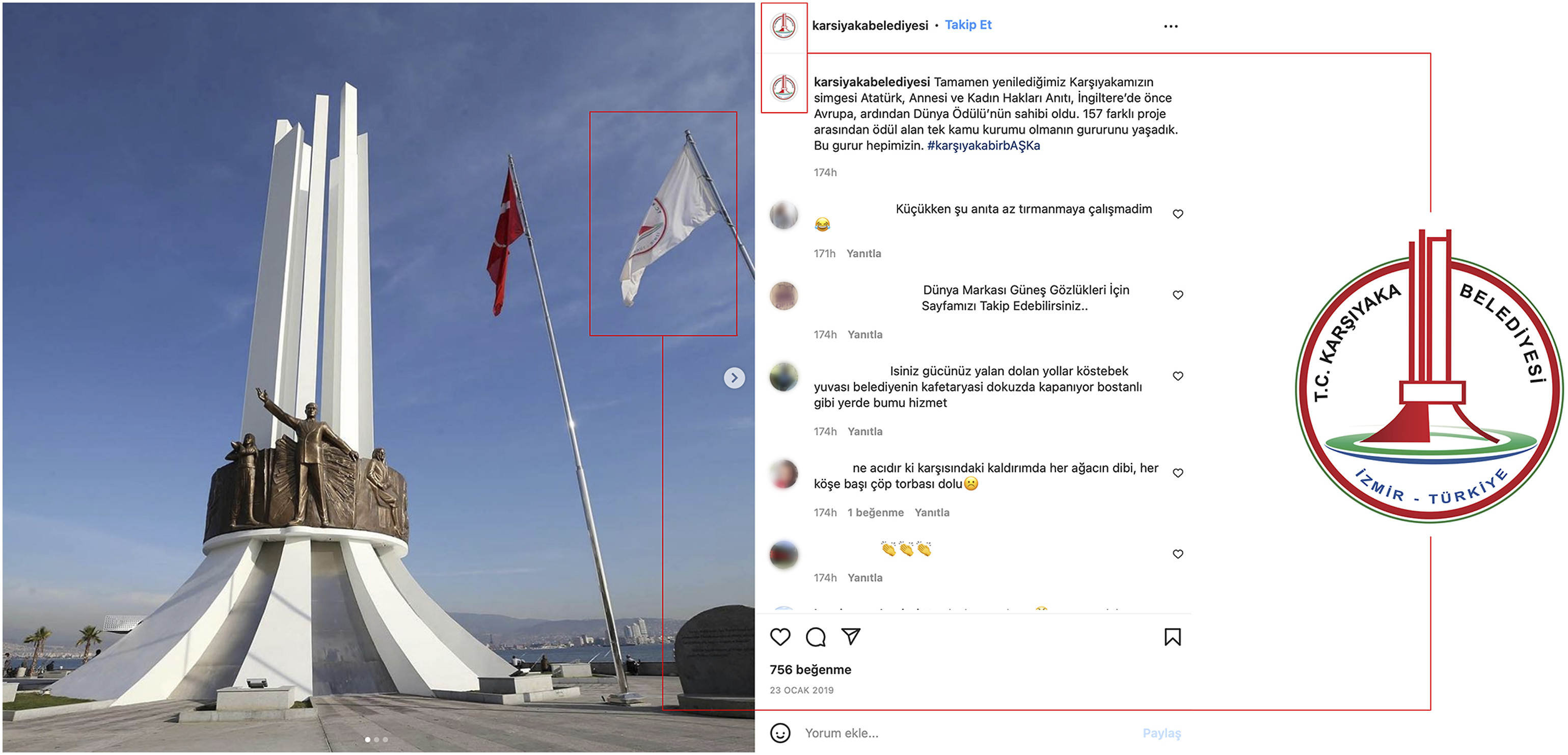
In ‘The Conquest of Ubiquity’ (1964), French poet and philosopher Paul Valéry claims that ‘electronic signal’ has the potential to close the distance between the user and things. Moreover, he argues that ‘just as water, gas, and electricity’ that ‘are brought into our houses from far off to satisfy our needs’, we are likely to ‘be supplied with visual- or auditorily images, which will appear and disappear at a simple movement of the hand’ (Valéry, 1964). Echoing Valéry’s description of ‘simple movement of the hand’, locative media today offers access to layers of information in the forms of images, videos, texts, and alike. Within the interface of locative media, geotagging attaches digital material to information of physical location, although the medium itself is ubiquitous (Humphreys and Liao, 2011: 409; Thielmann, 2010: 1).
What happens presently with the advances in digital technologies highly resembles the effects of the revolutions on reproduction techniques at the beginning of the Twentieth Century. While the dictionary meaning of reproduction ‘is a copy of a work of art, especially a print or photograph of a painting’ (New Oxford American Dictionary, 2021b), Walter Benjamin’s thesis on ‘technological reproducibility’ folded new meanings to the word itself. Scholars from various fields use the term ‘digital reproduction’ to carry Benjamin’s theses to their reception on digitalization (Davis, 1995). The scope of these studies ranges from printing technologies (Grishko et al., 2020), photography (Sassoon, 1998; Whyte, 2009; Romanato, 2017; Josephy, 2020), video (Van Dijck, 2005), film and cinema productions (Mattock 2010), digital mobile media (Agista and Handajani, 2019), material culture, archive and digital history (Bartmanski and Woodward, 2015; Robinson, 2016; Choi, 2018; Goulding and Derbaix, 2019), art and criticism (Hall, 1999; Latham, 2004; Burns, 2010; Frischer, 2011; Emison, 2021), music (Adler, 2012; Green, 2017), literature (Stroud, 2003; Bury, 2019) to theology (Gedicks and Hendrix, 2005), politics (Breckenridge, 2014), and education (Peim, 2007). There is also scholarly research that revolves predominantly around Walter Benjamin’s own theses and concepts such as ‘thought image’ (Tschofen, 2016), ‘storyteller’ (Gratch and Crick, 2015), ‘aura’ (Akin and Kipcak, 2016; Betancourt, 2015; Humphries, 2020), and ‘technological reproduction’ (Sigurdsson, 2001; Bruce, 2000), as well as the ones that focus on the effects of digital technologies on spatial reproductions (Bolter et al., 2006; Brillembourg et al., 2016; Schweibenz, 2018; Kane, 2020).
Despite the presence of this vast research, none of these studies concentrated on the effects of locative media technologies on a digitally reproduced urban element. In order to bridge this gap, this paper focuses on digital content geotagged at Atatürk, His Mother and Women’s Rights Monument on Instagram through the basic concepts instrumentalized by Benjamin in his essay: aura, authenticity, rituals, and aestheticization of politics. With its location tag feature, Instagram filters an excessive amount of content created by diverse groups of users according to the locational information embedded in geotags. Today, the location tag of Atatürk, His Mother and Women’s Rights Monument on Instagram contains more than four thousand eight hundred accessible digital reproductions. With this aspect, it serves as an open digital library of imagery and textual information about the monument to any user. Moreover, without the necessity of being physically there at all times, it allows one to virtually witness how the municipality and individuals use the monument and space around it. Therefore, this study utilizes the monument’s location tag on Instagram to analyze the digital reproductions of Atatürk, His Mother and Women’s Rights Monument.
The monument
In May 1967, an association dedicated to the six principles of Atatürk, the founder of the modern Republic of Turkey, initiated a competition to build a monument to be opened on the 50th anniversary of the Republic. Sculptor Tamer Başoğlu and architect Erkal Güngören’s design proposal won the competition (see Figure 2). After 2 years of construction, the monument was opened with a public ceremony in 26 October 1973. Named after Atatürk’s contributions to women's rights in social, cultural, and political life, the monument consisted of three main parts; seven white vertical plaques that emerge from the landscape as a symbol of the rise of a nation, a bronze belt with women figures and a radially organized landscape around the vertical plaques (Mimarlar Odası İzmir Şubesi Yönetim Kurulu, 2017). Early years of Atatürk, His Mother and Women’s Rights Monument. Source: Salt Research, Güngören Family Archive.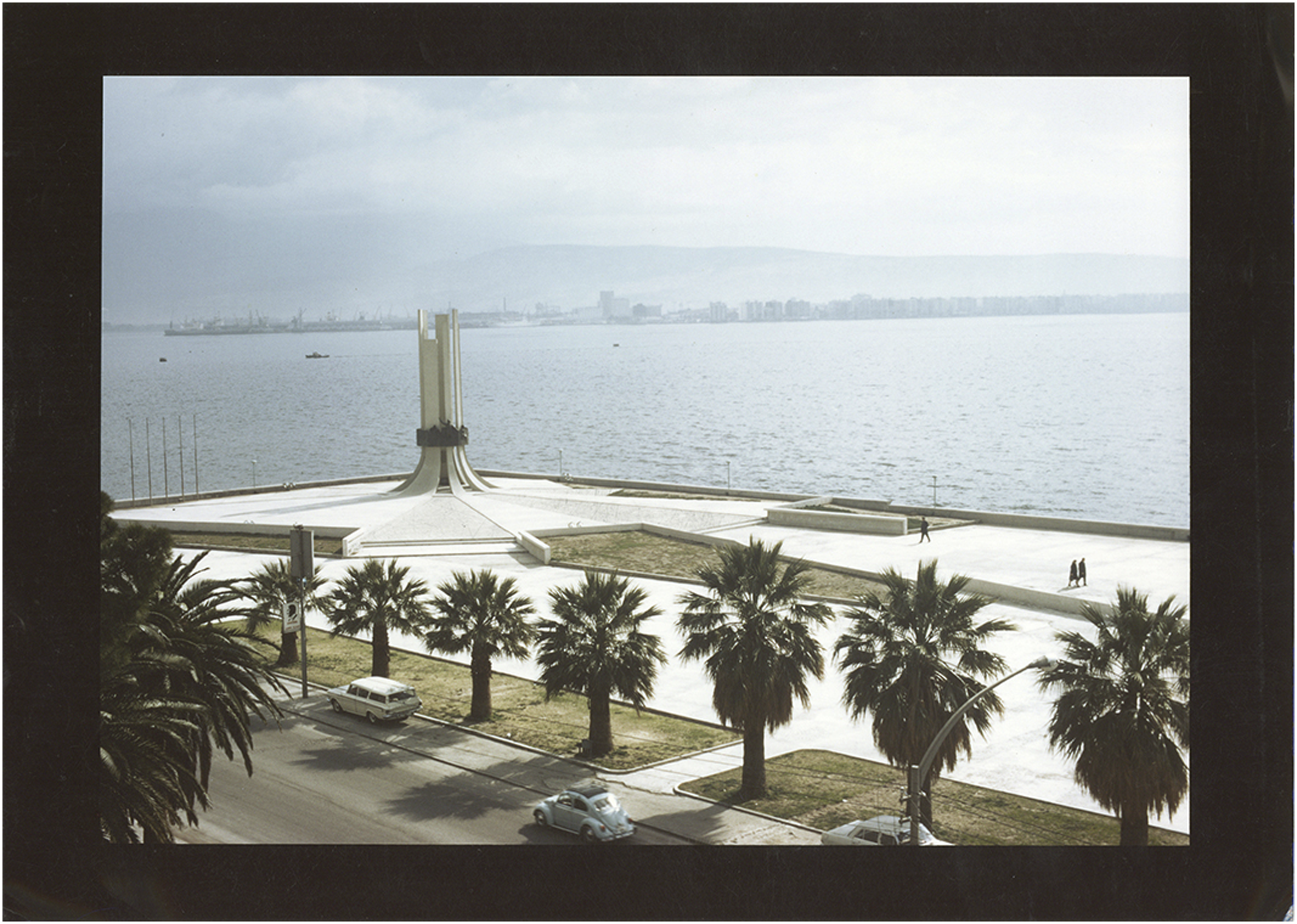
After its opening in 1973, the monument was embraced by the community and started to be the stage for national celebrations on the local scale. Over time, it has turned into a symbol whose silhouette started to appear on display windows of local shopkeepers and became the municipality’s logo (Güngören, 2015). However, due to its location near the seashore, which makes its materiality vulnerable to corrosion, it took heavy damage over time that made its structural integrity debatable (Mimarlar Odası İzmir Şubesi Yönetim Kurulu, 2017). To overcome this vulnerability and structural weakness, local architects and associations proposed conducting a comprehensive restoration process (Pasin, 2017). Despite the contradictory voices and especially objections from the İzmir Branch of the Chamber of Architects in Turkey, underlying the monument's value as a modern architectural heritage, the municipality abruptly demolished it in 2017 and promptly reconstructed a new one in 2018 (Güngören, 2018). The mayor of Karşıyaka, Hüseyin Mutlu Akpınar, who is a representative of the main opposition party in Turkey, which Atatürk himself founded during the early republican era, announced this destruction and reconstruction process as follows: The meaning of the monument that roses in Karşıyaka is deeper today. By renovating, raising, illuminating, enlarging the landscape, and increasing its function, we will draw attention to one of the biggest scars (violence against women, fundamental rights, and freedoms) in Turkey… Our aim is, while raising the monument, to increase and improve women's rights (Demirci, 2015).
Even though the words above appear politically correct in terms of the struggles that women have to face on a daily basis in the country, and also the monument was reproduced according to the same design layout except for the scale and the addition of a museum, the demolishment and reproduction heated up a political and scholarly discussion. Being the tallest commemorative structure arrayed along the coastline of İzmir with its doubled scale, turned the monument into the focus of public attention, especially on social media. As a ‘new interfaces of everyday life’ (Farman, 2013b: 86–87) social media allows its users to create ‘transmedia stories’ that ‘blur the line between story world and physical world’ (Ritchie, 2013: 53) to ‘give meaning to their location history as an active force in their everyday life’ (Frith and Kalin, 2016: 46). As a favorite backdrop for the shared contents, the location tag of the monument has turned into one of these places where transmedia stories are written through digital reproductions of not only essential moments of official ceremonies or national holidays but also individuals’ mundane use as a new interface of everyday life.
Locative media in the age of digital reproducibility
When Paul Valéry forecasted ‘conquest of ubiquity’ with the utilization of the ‘electronic signal’ in 1928, he asserted that ‘at first, no doubt, only the reproduction and transmission of work of art will be affected’ (Valéry, 1964). Almost a century after Valéry’s essay, from most mundane things to high-end artistic productions, society and everyday life practices have become inseparable from mediated experience and the ubiquity of the electronic signal (Kane, 2020: 99). Moreover, ‘contemporary senses of space and time’ have become ‘inextricable from a media-saturated environment’ (Kane, 2020: 100). Our ‘simple movement of the hand’ in Valéry’s vision does not only bring ‘amazing changes’ to works of art but also to our very notion of space (Kane, 2020: 101). Quoting Valéry’s words, Walter Benjamin (1969: 218) in his artwork essay claims that it took ‘more than half a century to manifest in all areas of culture the change in conditions of production’. Unquestionably, the change to what Benjamin refers is the invention of new ways of communication, like photography, that ‘challenged prior modes of perception’, and especially film, which ‘changed reality’ (Zeller, 2012: 75). Even though Benjamin acknowledges the dangers of these drastic changes regarding the aestheticization of war and politics, his approach to technology and technological reproducibility was constructive and optimistic. Since, he considers the new notion of art that emerged by the age of technological reproducibility as a counterforce to the aestheticization of politics and technology (Benjamin, 2010: 36).
Indeed, the practice of reproduction for artworks was not new even when Benjamin wrote his essay. In antique civilizations, statues and busts had been reproduced through hand craftsmanship to send and use at different places. As Benjamin (2010: 12) points out, manual labored ‘replicas were made by pupils in practicing for their craft, by masters in disseminating their works, and, finally, by third parties in the pursuit of profit’. In early to mid-19th Century, museums across the world started to manufacture copies of monuments made of plaster and poured into casts to exhibit them out of their contexts (Lending, 2018). However, the ability to mechanically reproduce works of art accurately in the early 20th Century, ‘had reached a level that made it virtually impossible to distinguish between the original and its copy’ (Groys, 2003; as cited in Zeller, 2012: 71). According to Benjamin, speed and acceleration were two main characteristics that differ mechanical reproduction from the manual reproduction, underlining the difference between reproducibility by hand and by technology in terms of authenticity. To him, ‘the authentic work retains its full authority in the face of a reproduction made by hand, which it generally brands a forgery, this is not the case with technological reproduction’. Because firstly, technological reproducibility can make some information in the original that are normally impossible to perceive or recognize for an individual, perceptible (Benjamin, 2010: 14). Secondly, decontextualization from time and space provides a reproduction with a potential of accessibility to a larger audience. Nevertheless, Benjamin (1969: 220) underlines that these new opportunities do not change the fact that ‘even the most perfect reproduction of a work of art is lacking one element: its presence in time and space’. Moreover, the detachment from time and space certainly ‘withers’ the aura of the artwork (Benjamin, 1969: 221).
Due to this decontextualization, however, ‘occurrences and things that before only be perceived by a limited number of physically present individuals’ become accessible ‘in a different time and space’ and ‘presented to an entirely different audience’ (Sigurdsson, 2001: 55); their ‘unique existence’ is replaced with the ‘mass existence’ through numerous perceptions (Benjamin, 2010: 14). With their ‘mass existence’, reproductions change ‘the relations between audience and image, which in turn, alters the nature of auratic experience’ (Humphries, 2018: 159). In his own words, Benjamin (2010: 29) defines this new mode of perception as ‘simultaneous collective perception’, which is an experience that painting has never provided, but film does. For example, a painting that is unique and partly mobile ‘could now be experienced at the cinema or on a postcard’; moreover, its each reproduction alters ‘the future experience of the original’ (Bruce, 2000: 67). Benjamin elaborates on these new experiences as follows: Our bars and city streets, our offices and furnished rooms, our railroad stations and our factories seemed to close relentlessly around us. Then came film and exploded this prison-world with the dynamite of the split second, so that now we can set off calmly on journeys of adventure among its far-flung debris. With the close-up, space expands; with slow motion, movement is extended (2010: 30).
Referring to these new experiences, Benjamin underlines that just like ‘the mode of existence’, the ‘mode of perception’ of individuals constantly alters during societal transformations. Aligning with this fact, advances in technological reproducibility at the end of the nineteenth century also resulted in drastic changes in the perception of masses (Benjamin, 2010: 15). Contrary to the previous changes, ‘mechanical reproduction emancipates the work of art from its parasitical dependence on ritual’, which had always been the ‘total function of work of art’. In this process, the ‘cult value’ of the artwork has been replaced with ‘exhibition value’ to mesmerize the masses (Benjamin, 1969: 224). The decontextualization in reproduction transcends to a higher level with digital reproducibility, especially with the never-before-experienced extent of the ubiquity of digital media. As a result, while detached from their context, works of art become observable anytime, anywhere (Schweibenz, 2018).
With the proliferation of locative media, not only works of art, but digital reproductions of urban elements become ubiquitously experienceable as well. These digital reproductions ‘offer people new ways to interact with and through urban space’ (Humphreys and Liao, 2011: 407), and they are ‘charged with powerful social and psychological implications’ (Davis, 1995: 382). Because, with its ‘ubiquitous and pervasive’ nature (Galloway and Ward, 2006: 3; Lemos, 2009: 91), locative media ‘fundamentally mediate the everyday practices of urban life, subtly shaping senses of place as particular interpretations of events and locations foregrounded or side-landed’. This not only alters the embodied space but ‘the cultural objects we are producing and interacting with are also being transformed’ (Farman, 2013b: 17).
As the layers of digital information geotagged at one place become accessible ubiquitously to everyone anytime, the perception of place per se changes. According to Lemos (2009), ‘[w]hat we are seeing now are several examples of integrated, mixed process that merge electronic and physical territories, creating new forms and new senses of place’. As Bareither argues, on certain locations, digital image ‘changes the way in which the place is perceived by others, potentially on a global scale’ (2021: 588). Similarly, Farman describes how his perception is affected by locative media as ‘I see the landscape around me differently’ (Farman, 2013a: 12). This new digital reproducibility depends on not only the detachment from the unique spatial condition but also from a temporal one. Graham et al. (2013: 497) describe it as ‘timeless power’, as locative media flattens time, thus dissolves ‘temporal meaning within augmentations’. This augmentation in digital technologies transforms, if not revolutionizes, acts of reproducing space. Yılmaz and Kocabalkanlı (2021: 208) claims that ‘the convergence of physical and digital space through locational data at particular geotags on social media’ provided individuals with more opportunities to reproduce spaces with their own “images and symbols.”’
Instagram ‘amplifies the reproduction process’ with its ability to instantly reproduce an unlimited number of contents, which changed ‘the traffic of photos, videos, and stories distribution’ (Agista and Handajani 2019). While this ‘traffic of photos’ occurs between followers who may know each other, features such as hashtags and location tags add one more layer of network to the visibility of images in the algorithm. Though what has been produced through digital reproduction is fundamentally decontextualized from the physical, such features tie digitally reproduced content within the context. This is similar to what happened to plaster monuments of the 19th Century. Lending (2018) describes plaster monuments at museums as decontextualized, dismembered imitations that often come with rewritten context. In a similar fashion, reproductions of the Warsaw Ghetto Monument were built in New York and Jerusalem with different goals and messages than the original. For those reproductions, James E. Young (1989: 98) states that ‘in its many echoes and reproductions, the Ghetto Monument’s image has become a kind of memorial currency, an all-purpose iconographic tender whose value fluctuates in every new time and place’. In this perspective, the digitally reproduced images of the monument on social media can be considered as a ‘monument currency’ whose value fluctuates with its ever-changing meaning at its converged physical and digital location. What follows is the reading of these fluctuations in digital reproductions geotagged at Atatürk, His Mother and Women’s Rights Monument on Instagram through the concepts of aura, authenticity, rituals, and aestheticization of politics.
Aura and authenticity of digitally reproduced monument
While dictionary meaning of aura is ‘the distinctive atmosphere or quality that seems to surround and be generated by a person, thing, or place’ (New Oxford American Dictionary, 2021a), in ‘Little History of Photography’, Benjamin (1999a) describes it as a halo that encompasses the person who poses for a portrait in early black and white photography. In the ‘Artwork Essay’, Benjamin (2010: 15) re-introduces the concept as ‘a strange tissue of space and time’ which he elaborates as a ‘unique appearance of a distance, however near it may be’. He also depicts it as, ‘if while resting on a summer afternoon, you follow with your eyes a mountain range on the horizon or a branch which casts its shadow over you, you experience the aura of those mountains, of that branch’ (Benjamin, 1969: 222–3). In his other writings, the aura is mentioned as ‘a form of perception that…endows a phenomenon’ (Hansen, 2008: 339) that has the ‘ability to look back at us’ (Benjamin, 2006: 338) as the ‘distance opened up with the look that awakens in an object perceived’ (Benjamin, 1999b: 314).
In the age of digital reproduction, being ‘supple and elastic’, aura ‘has stretched far beyond the boundaries of Benjamin’s prophecy into the rich realm of reproduction itself’ (Davis, 1995: 381). However, ‘the aura’ aforesaid here refers not to the ‘aura of the physical’ but to the ‘aura of information’ existing in the digital realm, in other words, the ‘digital aura’ (Betancourt, 2015: 57). Indeed, each geotagged digital reproduction proliferates and spreads the information regarding the monument across locative media users even far from its physical location as the term ‘reproduction’ does not solely refer to uploading content but also the ability to recall it virtually on a device's screen ubiquitously, through scrolling, clicking, or tapping. Therefore, the information reproduced in locative media breaks through the limit of the monument’s locale in the form of ubiquitous data to be experienced by a larger and diversified audience. Thus, unlike the aura of the physical, aura of information does not decay when a digital object is reproduced; on the contrary, it spreads. As Betancourt claims, in digital media, technological reproducibility becomes ‘the source and vehicle for a work’s aura’ as ‘the more fully a work is disseminated, the greater the aura’ (Betancourt, 2015: 57).
When locational tags are combined with specific popular hashtags, not only the targeted users but also haphazard ones become potential digital visitors. According to Shirvanee, (2006: 2), ‘there is a viscosity of space that forms between strangers with locative media, creating landscapes charged with traces of others that have inhabited the same space’. If the density of the media geotagged at location increases, the viscosity between users causes the interaction of two or more strangers. Consequently, with the increased interaction, locative media becomes a medium that allows ‘simultaneous collective perception’ of the monument’s digital aura, which is loaded with the ability to alter the future experiences of the physical one. Due to this sprawling visibility and ‘simultaneous collective perception’, the flow of the geotag accumulates a high number of digital reproductions that reflects the everyday life practices or transmedia stories of a wide variety of user profiles from local vendors, shopkeepers to daily visitors (see Figure 3). A sample of thumbnails of Instagram posts geotagged as ‘Karşıyaka Anıt’. Source: Screenshots of thumbnails of open access posts under the location tag of ‘Karşıyaka Anıt’ on Instagram.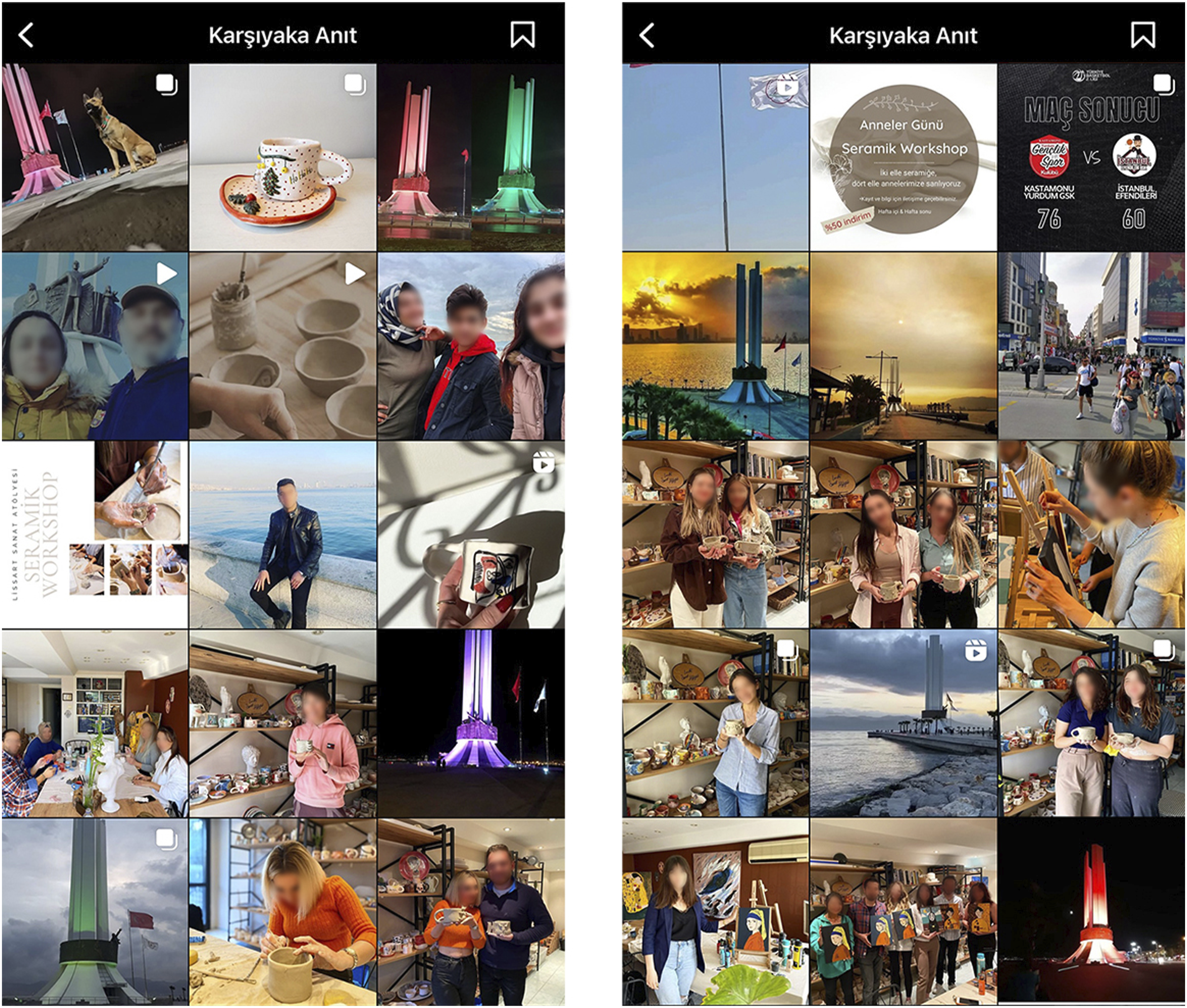
Benjamin (1969: 221) asserts that ‘the presence of the original is the prerequisite to the concept of authenticity’, and the authenticity of a work of art is ‘the essence of all that transmissible from its beginning, ranging from its substantive duration to its testimony to the history which it has experienced’. According to this framework, it is possible to argue that authenticity comes into question when an artwork is reproduced not only manually or mechanically but also digitally. The authenticity of the monument vanished with its demolition and the one stands there is not authentic anymore. Moreover, with the ‘timeless power’ of digital reproductions, this authenticity is tangled even more in the digital realm. Because through the location tag, a user may encounter with the images of the monument taken in different time periods, from its original form in pre-destruction period, to post-reconstruction (see Figure 4). Since the new monument erected right on the same spot, with the same name and almost the same form, due to various optical illusions, misinformative texts, and deceptive hashtags, geotagged digital reproductions blur the distinctness and solitude of both the old and new into a coalesced and hybrid image. Therefore, in hybrid space of physical and digital domains, the authenticity of the monument, which roots in the ‘unique existence’, is replaced with the ‘mass existence’ of its digital reproductions. Digital reproductions of the monument from its pre-destruction, destruction, construction, and post-reconstruction state. Source: Screenshots of open access posts under the location tag of ‘Karşıyaka Anıt’ on Instagram.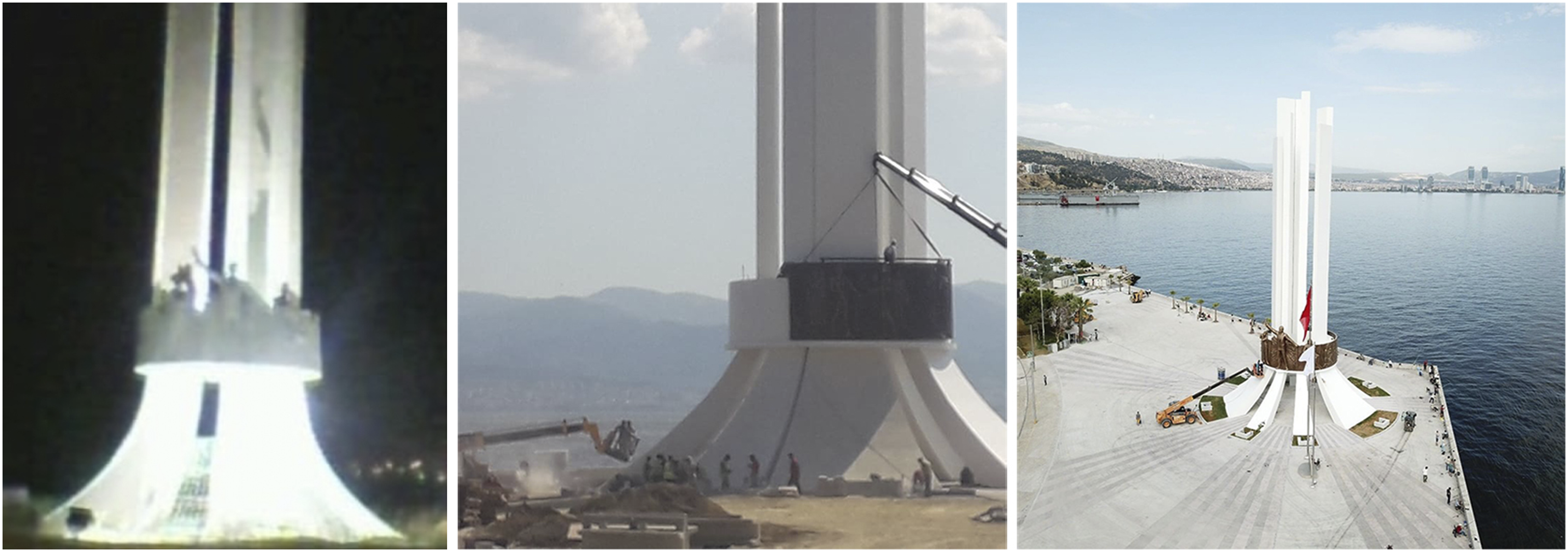
With the user’s ability to ‘upload, download or modify iconic contents’, through digital reproductions, an image can develop ‘an independent story’ (Romanato, 2017: 1, 7). Moreover, such images ‘can highlight only the certain aspects of its original object, distort it through the use of special lenses, or cut up and paste together disconnected parts…through photomontage’ (Sigurdsson, 2001: 56). New meanings occur, as the users ‘adjust the image size and the resolution, to focus in on minute details, to extract portions of an image, to combine one image with another, and surround the image with a new textual or visual content’ (Bruce, 2000: 68). With the convenience of reproducing ‘an infinite number of any digital work’ (Betancourt, 2015: 41) and endless possibilities of manipulations, digital content can be ‘reproduce[d] in this manner forever, millions and millions of times’ (Davis, 1995: 382).
With such control over digital reproductions, the content generation processes of locative media applications grant previously passive users new authorship, evoking what Benjamin observed in the age of mechanical reproduction. Users gain agency through the location tag, which works as a virtual panel open to everybody, democratizing the monument's hybrid environment. While enhancing the users' agency and making the site’s intangible social and cultural values visible, locative media also opens up a vast potential for reproduction based on manipulation, questioning the authenticity of the meaning and function of the monument. Through montages, users create posts that reflect the monument's significance from their point of view, or benefit from its monumentality to send messages through locative media (see Figure 5). A collage of digital reproductions of the monument with montaged texts. Source: Screenshots of the posts under the official Instagram account of the Municipality of Karşıyaka and the location tag of the monument.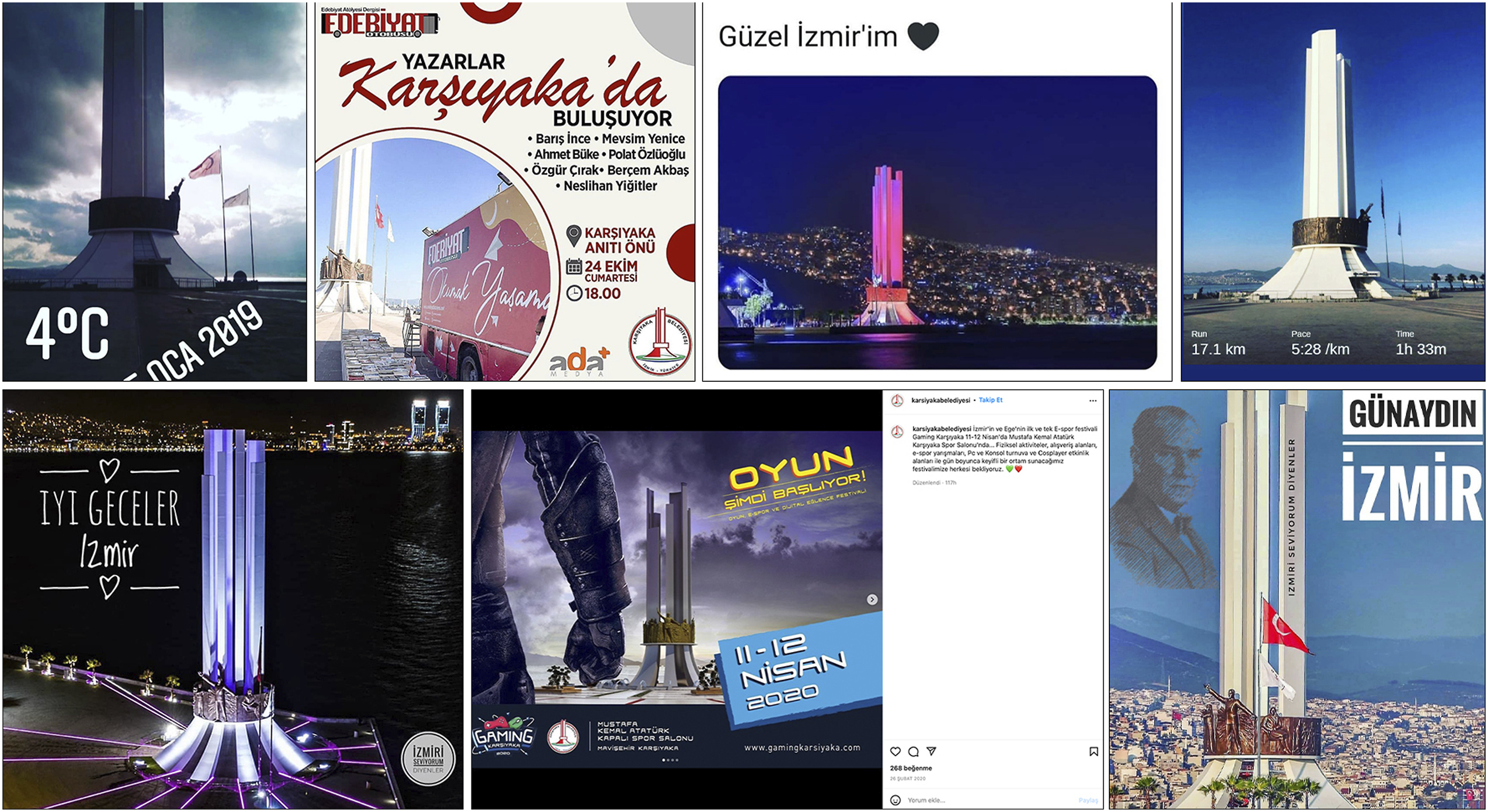
Moreover, the name attributed to its geotag on Instagram, which is ‘Karşıyaka Monument’, excludes its function to commemorate Atatürk’s mother and women’s rights, even Atatürk himself. Instead, the name of the district is montaged into the name of geotag. In addition to this, some of the digital reproductions also montage their contexts to the monument’s image. For instance, fans of Karşıyaka Sports Club utilize it to reflect their clubs’ colors, combining green and red from the environment with the monument in different compositions (see Figure 6). Instagram posts that montage the colors of the local sports club to the monument’s surface. Source: Screenshots of open access posts under the location tag of ‘Karşıyaka Anıt’ on Instagram.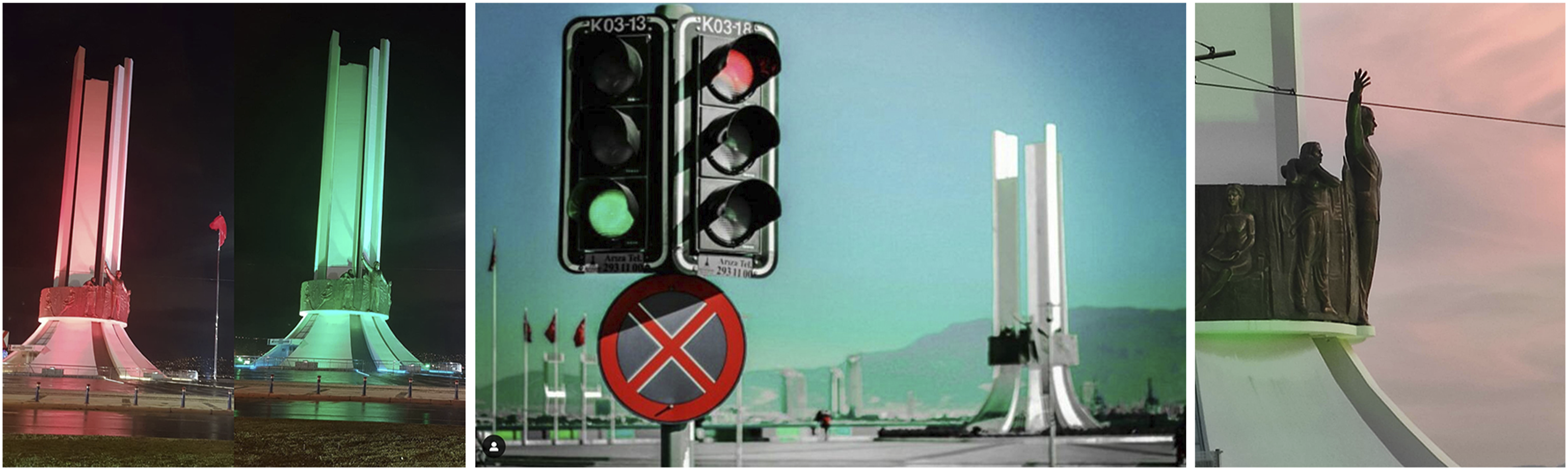
In all these reproductions, the authenticity of the real object, the function, and the very reason behind the construction of the monument at its physical location, totally vanishes. Its ‘cult value’ as a cultural heritage, based on its commemorative function, which Benjamin attributed as a condition in which ‘the cult of remembrance’ finds its ‘the last refuge’ (Benjamin, 2010: 19), turns into ‘exhibition value’. The original objective behind the construction of the monument, which is to memorialize Atatürk, his mother and women rights hardly becomes the topic of the posts on locative media. The authenticity of the original monument has long since vanished with its demolition and has been embedded in digital media's location tag.
Rituals and aestheticization of politics in locative media
The utilization of ‘fascist propaganda films in the 1930s’ and the mass media technologies as part of the political entertainment industry culminate in Benjamin’s thesis of ‘aestheticization of politics’ (Kang, 2010: 11). In his essay, Benjamin describes the aestheticization of politics as ‘uses of art in ceremonies, political speeches, on the staging and communication of political events through mass media channels’ to mesmerize the public (Kurylo, 2020: 631). With the technological reproduction, the ‘quantity has been transmuted into quality’, and the ‘greatly increased mass of participants has procured a change in the mode of participation’ (Benjamin, 1969: 239). Since, as Kang (2010: 11–12) states, ‘mass reproduction relates to the emergence and transformation of the masses themselves’. Jay (1992: 45) describes this as ‘the victory of the spectacle over the public sphere’. Rituals become especially prominent in this process of mesmerizing the public through spectacle.
While the dictionary meaning of the ritual is ‘a series of actions or type of behavior regularly and invariably followed’ (New Oxford American Dictionary, 2021c), in his artwork essay, Benjamin (1969: 224) described it as ‘original use value’. The running event held in the monument’s vicinity on the 10th of November, Atatürk’s annual commemoration of his passing is one of the examples of the ‘use value’ of monuments described by Riegl. Use value of the monuments comprise of ongoing rituals of groups and individuals, ‘as long as the monument's existence is not threatened’ (Riegl, 1996: 79). The event starts at Constitution Square, where the monument is situated, and ends at the grave of Zübeyde Hanım, Atatürk’s mother. Once a year, digital reproductions of this running event shared on locative media by the attendees to perpetuate their respect for Atatürk and Zübeyde Hanım by means of images with the addition of hashtags, descriptions, and comments. On other important days, like the Foundation of the Republic of Turkey, Victory Day, or during local and national protests, individuals in the crowd also take selfies or give poses for others' photographs to share them online (see Figure 7). A collage of digital reproductions of the gatherings around the monument. Source: Screenshots of open access posts under the location tag of ‘Karşıyaka Anıt’ on Instagram.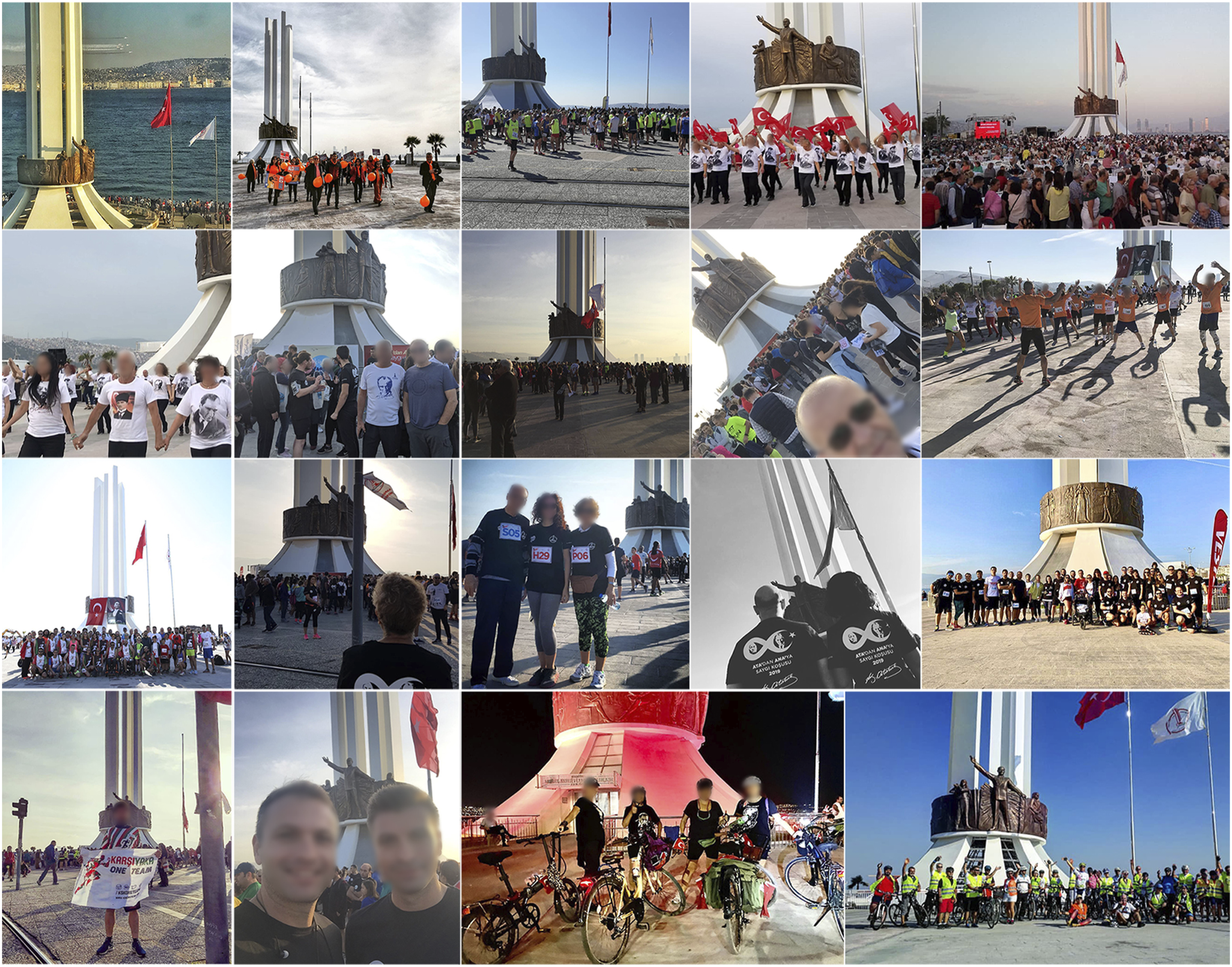
The mayor, who decided to replicate the monument at its current location with a doubled size and an addition with a museum, states in his autobiography that he made his decision during one of the national celebrations, when he realized the monument’s terrible physical condition, announcing to his officers ‘[w]e demolish, and rebuild a new one, even more magnificently’ (Akpınar, 2017: 202). The loss of the original monument’s aura and authenticity in this magnified replica does not refrain the local municipality to utilize its ritualistic function. The official posts of Karşıyaka Municipality that contain the monument on Instagram to reproduce national rituals surely address the masses in line with its political agenda. For instance, via its official Instagram account, the municipality regularly shares posts for important days such as celebrations of National Sovereignty and Children’s Day, World Bicycle Day, and International Dance Day. In these posts, the monument is included as a background object with its ‘magnificence’. Furthermore, its nighttime illumination is utilized as an element of montage to the monument's image as the monument is lit with colored lighting according to the day the images were shared, with blue for getting attention on World Autism Awareness Day, and purple on International Women’s Day.
Indeed, the colored silhouette of the monument has been featured as the logo of Karşıyaka Municipality for a long time. Over the years, the logo incorporated every event, organization, meeting, rally, aid, and field mission conducted by the municipality with the silhouette of the monument. Therefore, each time when the municipality shares a post, the logo, thus the image of the monument, is digitally reproduced regardless of whether the post’ content is related to the monument (see Figure 8). Being repeated several times through social media posts, the image of the monument becomes a ‘monument currency’ and aestheticization of politics turns into virality of politics. Digital Reproductions of the Silhouette of the Monument. Source: Screenshots of the posts of the official Instagram account of the Municipality of Karşıyaka.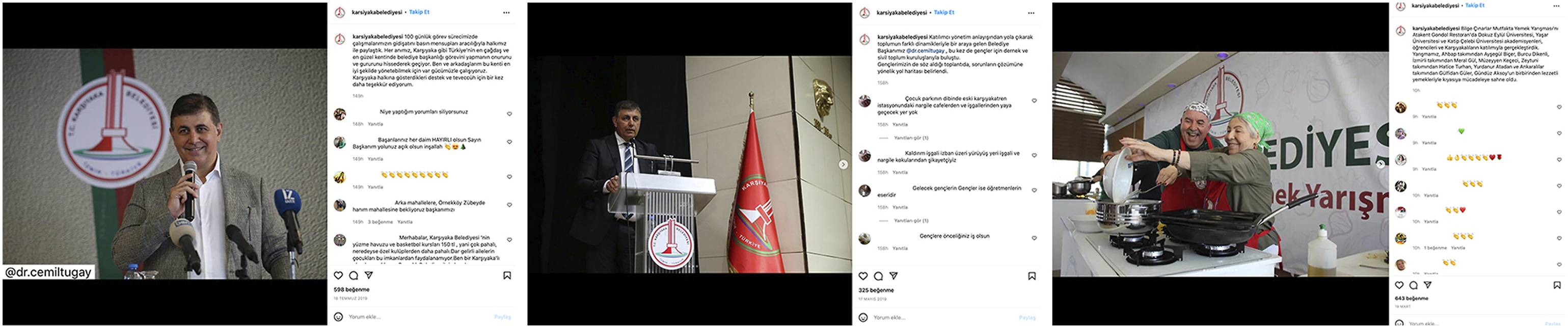
Photomontages done by the municipality’s official Instagram account amplifies this ‘monument currency’ even more. For instance, on the eve of the new year celebrations of 2016, a post shared by the Municipality, blends the image of the monument with the New Year tree by replacing its white vertical plaques with the needle-leaved texture of the tree. In 2017, an image of the monument was added to the inside of a snow globe with a Santa Claus hat positioned at the top, and in the post of 2018, again, parts of the New Year tree were wrapped around the image of the monument (see Figure 9). Such posts neither memorialize nor signify anything about the monument. Instead, the image of the monument is pulled away from its cult value and flowed within the daily life posts. The virality of politics becomes an instrument of this new currency. New Year celebration posts with montaged images of the monument. Source: Screenshots of the posts of the official Instagram account of the Municipality of Karşıyaka.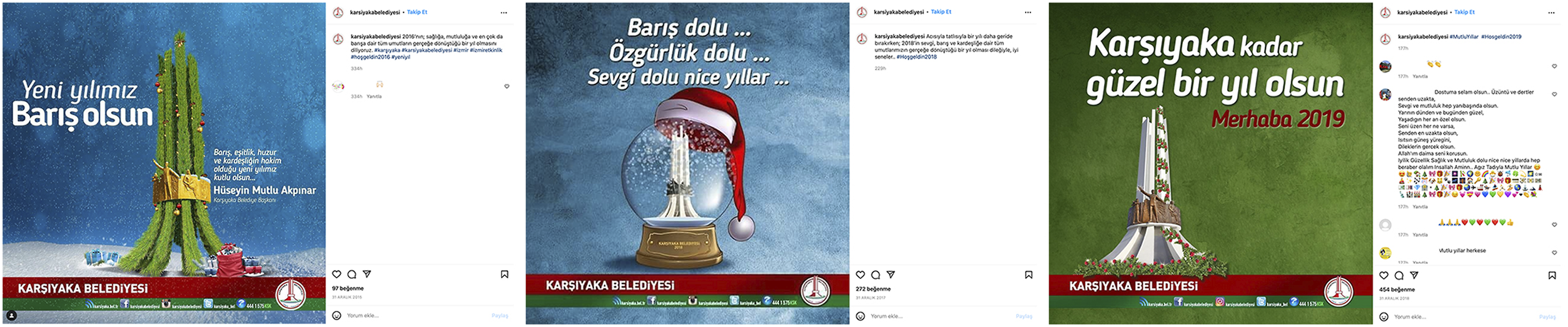
Notwithstanding the political role of these official rituals and self-organized rallies, the digital reproductions also opened up a way to reflect the mundane use of the monument. As Kim (2017: 505) asserts, in the age of digital reproduction, with the enhanced accessibility and interaction of the Internet, ‘people can create new stories’ and ‘set their own rituals through the interactions’ with others. Unlike the digital reproductions of official rituals, these include everyday uses that represent individuals’ interactions with the converged space as part of everyday life practices. They mostly happen when their daily practices, like strolling, running, cycling, fishing, etc., are halted for a moment around the monument and crowned with a photo filled with new stories. These digital reproductions utilize both the physical monument and its location tag to endorse one’s presence in locative media. As Yılmaz and Kocabalkanlı (2021: 200) assert, ‘[m]anaging what to present on social media, where to check in, and what to share about a space are new ways of identity practices’. According to them, individuals carefully tailor the spatial aspects of their Instagram posts according to the social norms of the groups that they prefer to be included (Yılmaz and Kocabalkanlı, 2021: 208). The abundance of tailored content on the location tag shows that the converged space produced around the monument is one of the spaces where individual users perform their ‘new ways of identity practices’ and purposely become part of visitors’ selfies and distant poses (see Figure 10). A collage of selfies and distant poses of the visitors with the monument in the background. Source: Screenshots of open access posts under the location tag of ‘Karşıyaka Anıt’ on Instagram.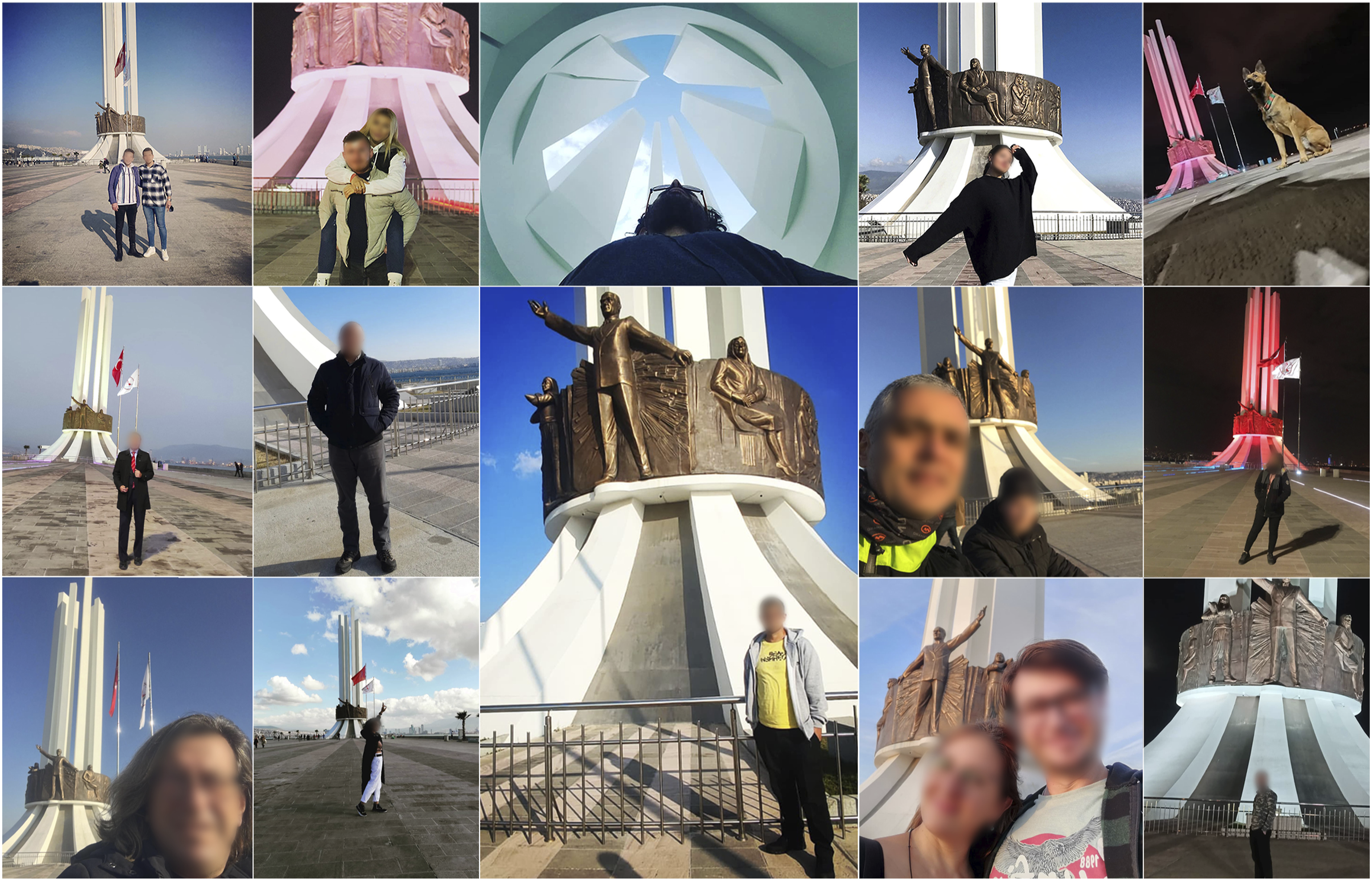
In these digital reproductions, with its exhibition value, the monument completes the background as a landmark in visitors’ selfies and distant positions, and users who pose in front of the monument create new stories, somewhat contradicting its original use value. This photographic composition of digital copies can even be observed in shared posts with a variety of stories and ambitions. Bicycles and motorcycles, for example, are used to montage users’ daily life actions to photographs placed at the geotag. The way these posts are presented and vehicles are placed within the frame show that locative media influences and sets a template for digital reproductions and everyday life practices of visitors around the monument. As a more specific example, it is possible to witness that people’s everyday fishing practices has evolved into a friendly rivalry among fishermen at the monument’s location tag on Instagram (see Figure 11). Pose of the users with the caught fish in front of the monument. Source: Screenshots of open access posts under the location tag of ‘Karşıyaka Anıt’ on Instagram.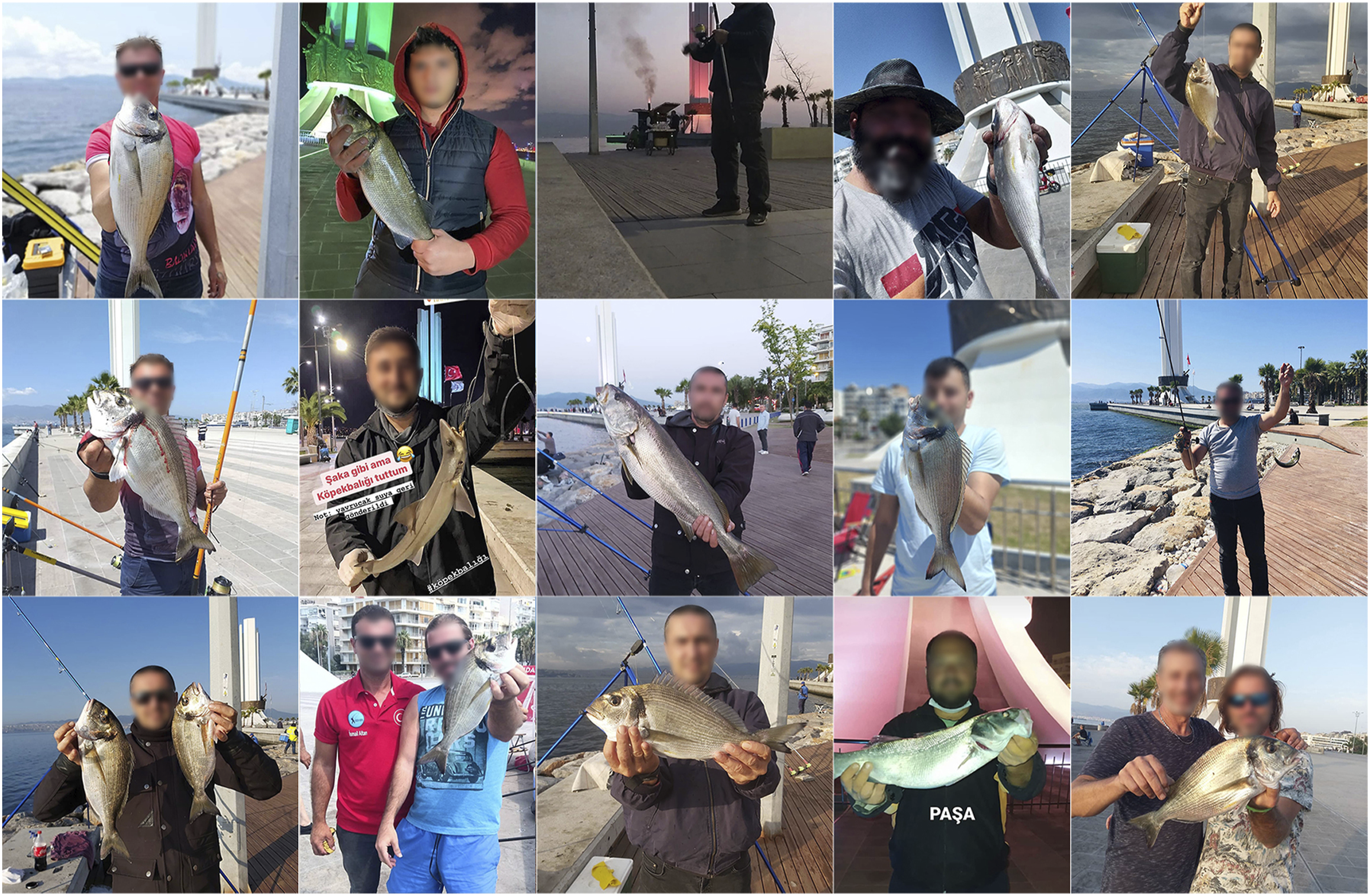
Holding the caught fish as a trophy and sharing the image of this moment on locative media as an achievement seem to become a ritual as much important as the practice itself. In these posts, the image of the monument is again utilized in the background albeit as a podium this time. In this way, with proof of location, fishermen circulate their photographs to compete and even reach out the ones outside of this competition. The majority of these digital reproductions of the monument spread via locative media, resulting in a ‘simultaneous collective perception’ that is fully separated from its ‘original use value’, but laden with many new prosaic uses, even capable of influencing its future physical use.
Conclusion
On Instagram, thousands of reproductions of Atatürk, His Mother and Women’s Rights Monument freely float, detached from the monument’s unique physical existence but highly bonded to its location tag. Selfies, family, and group photos, or ads of the local vendors geotagged at the monument suggests that the location, either being digital or physical, is more significant for these posts rather than the original objective behind the monument’s construction. While doing so, however, with their timeless power, they blur the monument’s authenticity into a ‘mass existence’. The digital reproductions make some of the monument’s spatial aspects visible and accessible to a diverse and larger audience within a digital aura. Searching for the authenticity of the monument in these digital reproductions becomes futile because the users mostly manipulate the image of the monument to reflect their own narratives upon it in locative media. In this process, the digital aura of the monument is embodied through its location tag, which stands as the sole authentic aspect of the digital reproductions.
Conversely, local municipality keeps the commemorative value of the monument alive by organizing annual events and ceremonies on national holidays, posting snapshots of the crowd that gathered to pay respects to struggles and hassles those experienced in achieving various rights in modern republic to reveal theoretically eternally and ubiquitously through Instagram. In these posts, the Municipality digitally reproduces the silhouette of the monument, which is extensively used to set the background to address the masses and especially the local community. With this process, the ‘aestheticization of politics’ transforms into the virality of politics in locative media and digital reproduction becomes an instrument to diffuse any political goal in a medium used by diverse users in daily practice as a monument currency. However, what digital reproducibility differs from technological reproducibility in terms of addressing the masses and the utilization of reproduction for rituals unfolds especially in its use for daily rituals. The broad use of the silhouette of the monument as a background in the images of unofficial fishing contests or motorbike activities geotagged at the location of the monument are the acts of the aestheticization of everyday to address particular groups with the ability to alter the future use of the physical monument.
Footnotes
Declaration of Conflicting Interests
The author(s) declared no potential conflicts of interest with respect to the research, authorship, and/or publication of this article.
Funding
The author(s) received no financial support for the research, authorship, and/or publication of this article.
