




Abstract
While the ‘media city’ has gained academic attention for over a decade, the role of the media in urban gentrification processes has been an overlooked issue. Due to the rapid expansion of geomedia technologies, for example, app-based social media and location-based services on mobile platforms, there is a growing need to address this area from a critical perspective. The article develops and tries out an analytical framework for studying the mutual shaping of geomedia technologies and gentrification processes, using alternative tourism apps as its illustration. The middle-class biased appearance of such mobile apps is hypothesized as an articulation of a broader trend, through which geomedia recognizes and gains affordances that fit the ambitions of certain social groups and their spatial norms, preferences and practices. The framework comprises two steps: (1) a media-technological unpacking exercise inspired by affordance theory and (2) a critical consideration of how geomedia play into the distribution of spatial capital in the city. The first step outlines how representational, logistical and communicational affordances of alternative tourism apps represent the broader shift from mass media to geomedia. The second step discusses the social logics whereby alternative tourism apps are adapted to middle-class spatial interests, and thus to gentrification, and how geomedia technologies in general affect the ability of different groups to access, appropriate and define different places and neighbourhoods in the city.
Introduction
What does it mean to a city and its different neighbourhoods, places and inhabitants that mainstream tourism is challenged by alternative forms of travel, spurred by digitalization, geomedia and the so-called sharing economy? And how are we to understand the middle-class biased appearances of many new geomedia technologies in light of dominant urban transformations? This article is an attempt to construct an analytical framework that can address this mutual interplay between gentrification and geomedia, or, more broadly, between spatial production and the social construction of technology.
The term ‘geomedia’ is here understood as a technological regime that gradually replaces the regime of mass media. According to McQuire (2016), geomedia has four main characteristics: ubiquity (that media are continuously available, also while people are on the move), real-time feedback (that many-to-many flows of information can be circulated immediately between users), location-awareness (that media flows and contents are adapted to the users’ locations and movements) and convergence (that different media technologies, genres and institutions are fused together and traditional distinctions break down). The expansion of geomedia, notably app-based social media and location-based services on mobile platforms, accentuates the need to scrutinize how different communication resources form part of, and respond to, the processes whereby former working-class neighbourhoods get appropriated by the middle classes and shaped by their lifestyles.
As will be discussed in this article, geomedia makes citizens and consumers (some more than others) increasingly involved in the spatial coding (Lefebvre, 1974/1991) and cultural classification (Bourdieu, 1979/1984) of neighbourhoods (e.g. Boy & Uitermark, 2017; Zukin, 2010). Today, it is not only mass media that shape people’s expectations on different places, but a variety of social media (e.g. Facebook, Instagram) and location-based services through which commercial messages and user generated content, ratings, and so forth, circulate (e.g. Frith, 2017; Munar & Jacobsen, 2014; Zukin, Lindeman, & Hurson, 2015). Furthermore, geomedia changes the logistical conditions for spatial appropriation and the overall capitalization of place. This pertains to, for instance, specialized app-based services like Airbnb, Couchsurfing and TripAdvisor, which supply travel guidance and private accommodation, and whose design creates shortcuts for certain travellers into certain types of neighbourhoods (Frith & Kalin, 2016; Molz, 2012). Geomedia even facilitates and articulates the shaping of new kinds of places, for example, coworking spaces, ‘coffices’ and ‘creative hotels’ that offer a cosy home-like atmosphere in urban locations to middle-class fractions whose professional and private lives are dependent on mediated connectivity (e.g. Sihvonen & Cnossen, 2015).
This is to say that communication resources are socially shaped (e.g. Bijker, Hughes, & Pinch, 2012) unevenly distributed and thus sustain the spatial interests of some groups more than others. While this phenomenon per se is not new, the technological regime of geomedia provides means of spatial power that were more or less unthinkable under the regime of mass media. Geomedia technologies carry affordances that largely recognize the interests of the mobile middle classes and support their endeavours to find and appropriate previously unfamiliar places in distinctive, seemingly independent, ways. Urban transformations, in turn, are adapted to media change and gentrified areas accommodate inhabitants and visitors (consumers, workers, tourists) whose lifestyles reinforce the indispensability of geomedia – while other inhabitants may feel estranged or marginalized (Paton, 2016). Yet, while the ‘media city’ has gained academic attention for over a decade, the (re)productive interplay between (geo)media and gentrification processes has so far escaped systematic scientific treatment.
The aim of this article is to outline an analytical framework for advancing the investigation of this complex interplay, and thus to spur further research into the neglected area of media and gentrification. The framework combines two analytical endeavours. The first part entails the deconstruction of particular geomedia technologies, focusing on how their representational, logistical and communicational affordances articulate certain spatial interests and ideologies. The second part applies Centner’s (2008) notion of spatial capital as an intermediary term for grasping the social logics whereby geomedia technologies are adapted to middle-class spatial interests and how geomedia affects the ability of different groups to access, appropriate and define different places and neighbourhoods in the city. This discussion is informed by Bourdieu’s (1979/1984) and Lefebvre’s (1974/1991) theoretical approaches to social space and stresses the extended relevance of studying the role of media in the symbolic struggles over the city and its places.
To illustrate how the analytical framework can be used, the discussion focuses on a particular case of geomedia: alternative tourism apps. Such apps target leisure travellers interested in visiting places beyond the radar of mainstream tourism, including alternative sites/sights and alternative forms of accommodation. While a complete overview is yet to be conducted, tentatively, there are four main functions of such apps (from the tourist’s point of view): (1) getting in touch with locals and other travellers, (2) finding accommodation, transportation, guided tours and other services, (3) receiving and sharing recommendations of places and events to visit and (4) sharing photos and images. The spread of alternative tourism apps can thus be hypothesized as a force behind contemporary gentrification processes, as well as a response to the interests of middle-class travellers and urban gentrifiers (e.g. entrepreneurs of the tourism sharing economy).
The article begins with an overview of research on media and gentrification, pointing to the obvious lack of systematic investigation. This is followed by a general discussion of how alternative tourism apps are involved in the mutual shaping of geomedia and gentrification, based on an overview of the field as well as a more detailed description of one typical app, Spotted by Locals. The remaining sections outline the analytical framework with reference to the case of alternative tourism apps.
Research overview: the neglected interplay between media and gentrification
Gentrification was first identified and defined in the 1960s (Glass, 1964). It refers to how neighbourhoods, especially in urban areas, are socially and economically upgraded and working-class populations gradually replaced by the middle classes (Newman & Wyly, 2006). The standard of living, as well as rents and property values, go up and new forms of services emerge (restaurants, bars, cultural venues, etc.). Gentrification thus refers to both alterations of the housing market and cultural change, meaning that the place-identities of gentrified areas change in terms of lifestyles and aesthetic appearance (Zukin, 2010).
Over the decades, gentrification research has explored the dynamics of social upgrading in a variety of settings around the world. Researchers have identified different driving forces, leaning towards either ‘production oriented’ or ‘consumption oriented’ explanations. While the former camp has pointed to the power of real estate developers and property owners (e.g. Smith, 2002; Wyly & Hammel, 1999), the latter has emphasized the agency of particular social groups, such as the cultural intermediaries (Bourdieu, 1979/1984; Featherstone, 1991) and ‘marginal gentrifiers’ (Caulfield, 1994), including artists and cultural entrepreneurs, who become attracted to certain places because of their authenticity, aesthetic qualities and low prices, and thus initiate the early stage of gentrification (e.g. Caulfield, 1994; Ley, 1996, 2003; Zukin, 2008). While this divide is still present in gentrification research, the overall picture is more nuanced; reckoning that gentrification not only undergoes different stages but is also influenced by different forces in different places (cf. Davidson & Lees, 2010; Lees, 2003; Phillips, 2005). It has also been stressed that gentrification cannot be reduced to a middle-class phenomenon, but should account for the agency of working-class populations (Paton, 2016) and agents who oppose gentrification (Mayer, 2013).
The role of media, however, is both under-researched and underestimated in gentrification research. In her much-cited overview of gentrification research, Lees (2000) does not mention the media. More recently, Doucet (2014) discusses the state of gentrification research without identifying, or calling for, any studies on media. The only classical text that explicitly mentions the significance of media is Clay’s (1979) work on neighbourhood renewal, which holds that mass media play an important role during the intermediary stages when the gentrified area is publicly coded as secure for middle-class professionals and treated as a good place for housing investments. Besides such general findings concerning the legitimation of gentrification processes through mainstream media (see also Zukin, 2009) and a number of analyses of media coverage of ongoing gentrification processes (Jansson, 2005; Gin & Taylor, 2010; Slater, 2006; Zukin et al., 2009), very little has been written on media and gentrification.
Above all, there is a lack of research addressing the broader cultural and material significance of media practices, technologies and infrastructures. While several studies have shown that the early stages of gentrification are marked by cultural creativity and experimentation (e.g. Ley, 2003; Zukin, 2008), they do not discuss to what extent these activities rely on certain media. Similarly, while studies have addressed changes in urban consumption patterns (e.g. Burnett, 2014; Centner, 2008), very few have problematized how such changes are related to changes in media uses, tastes and demands. A few recent exceptions concern the role of Instagram and mobile customer rating apps for the stratification and segmentation of city spaces (Boy & Uitermark, 2017; Zukin et al., 2015), the changing sociolinguistic technologies of gentrification (Trinch & Snajdr, 2017) and the discursive construction of precarious forms of flexible housing (Ferreri & Dawson, 2017).
While gentrification scholars have paid little attention to media, the relationship between cities, or ‘the urban’, and media constitutes a lively area of research, frequented by human geographers as well as media researchers. Above all, there is a clustering of research around the term media city, first theorized by McQuire (2008), pointing to the intertwining of urban life forms and mediated communication. The media city is traced to the early formation of infrastructures for urban communication (Graham & Marvin, 2002), which paved the way for the digital landscapes of contemporary data-driven cities (Kitchin, 2018; Kitchin, Lauriault, & McArdle, 2018). Research into the media city has addressed a number of important aspects, including the status of community media in cosmopolitan cities (Georgiou, 2013); the social impact of geomedia (McQuire, 2016) and public media/screens (Krajina, 2013) on urban life; the corporate discourses and visual cultures of urban developments (Aiello & Thurlow, 2006; Degen, Melhuish, & Rose, 2017); the adaptation of urban sociality to locative media (Sutko & de Souza e Silva, 2011); the role of locative (or spatial) media in the symbolic coding and political struggle around particular urban sites (Elwood & Leszczynski, 2012; Frith, 2017); and the proliferation of flexible work in urban settings due to mobile media (Duffy, 2016; Pratt, 2002). However, issues of gentrification have not been systematically analysed within this field.
Against this background, there is a need, as well as a potential, to bring together insights from a variety of fields within a more coherent framework for analysing the mutual shaping of geomedia technologies and gentrification.
The case of alternative tourism apps
As long as tourism has been considered a mass/mainstream phenomenon in affluent societies, middle-class consumers have been spurred to seek out more specialized, or ‘alternative’, forms of travel in order to uphold distinctions in relation to the ‘golden hordes’ (e.g. Feifer, 1985; Lash & Urry, 1994; Munt, 1994). In today’s complex media landscape, the possibilities to define ever more fine-grained tourism segments are greater than ever. Visiting ‘genuine’ neighbourhoods and places ‘off-the-beaten-track’, including anything from local food markets to abandoned industries, is a way of escaping the ‘tourism bubble’ and maintaining a sense of autonomy among middle-class travellers (e.g. Molz, 2012, 2013; Jansson, 2018a, 2018b). New tourism geomedia contributes to this development. However, when self-reflexive middle-class tourists start exploring, documenting and sharing information about ‘alternative’ places through such media, as shown in studies of urban explorers and ruin tourists (Klausen, 2017; Jansson, 2018b, Jansson & Klausen, 2018), they also augment the process whereby these places are turned into sites of aestheticization, exploitation and – ultimately – gentrification. While research has shown that ‘alternative’, or ‘transformational’ forms of tourism often accompany early stages of urban renewal (e.g. Smith & Zatori, 2015; Tegtmeyer, 2016), the role of tourism media has not yet been investigated.
This article uses alternative tourism apps as an illustration because they (1) articulate the general characteristics of geomedia, (2) target a culturally reflexive group of travellers and (3) represent a broader trend where well-known applications like Airbnb and Couchsurfing are just the tip of an iceberg. There are today numerous websites, blogs, social media groups and mobile applications that provide guidance and (location-based) services (e.g. accommodation) to those who want to enjoy ‘other’ forms of leisure travel, ‘discovering hidden wonders around the world’ (atlasobscura.com), ‘rediscovering your city’ (untappedcities.com) and following a typical device: ‘Don’t be a tourist’ (see messynessychic.com). The ‘alternativeness’ of these media thus stems from their self-proclaimed ambition to deliver something else than mainstream tourism experiences.
A good example of an alternative tourism app is Spotted by Locals, which offers its users (on the welcoming screen) to ‘Experience 70+cities like a local’ (Image 1). Those who buy the full version of the app get access to numerous travel guides and recommendations pertaining to ‘no tourist highlights’ presented ‘by handpicked locals only’ in capitals and other big cities around the world. At the same time, users (locals or not) are also encouraged to participate through sharing their own spots. The guides and recommendations can be accessed through virtual entrances to each city, symbolized by ‘Instagramified’ images (quadratic shape and a filter that accentuates contrasts and colours) (Image 2). These images normalize a particular, aestheticized way of looking at urban places. The fact that guides are also made available offline (which is one of the selling points) suggests an adventurous mode of travelling and implicates that users might go off the beaten track to places where Wi-Fi connection is scarce. In practice, however, this seems to be relatively unlikely given the type of urban places put on display. They are mostly tied to urban lifestyles with an inclination towards cultural consumption and the sharing economy. Typical highlights include restaurants with ‘great vegetarian and vegan options’, sometimes located in transformed buildings like old hospitals and factories; bars characterized by a ‘bohemian atmosphere’, frequented by ‘artists and philosophers’; cultural venues like ‘street art urban galleries’ saturated with ‘creative anarchy’; micro-breweries, pop-up stores and various places of ‘urban farming’ and ‘vertical farming’. There is also an accent on multi-culturalism and a strong focus on ‘pure’ cosmopolitan encounters in local settings, such as ‘real Asian and Vietnamese stuff and food’, as well as a mythologization of certain historical periods. For instance, certain venues in Berlin are presented as ‘survivors of early post-Wall years, reflecting the spirit of that time period’.
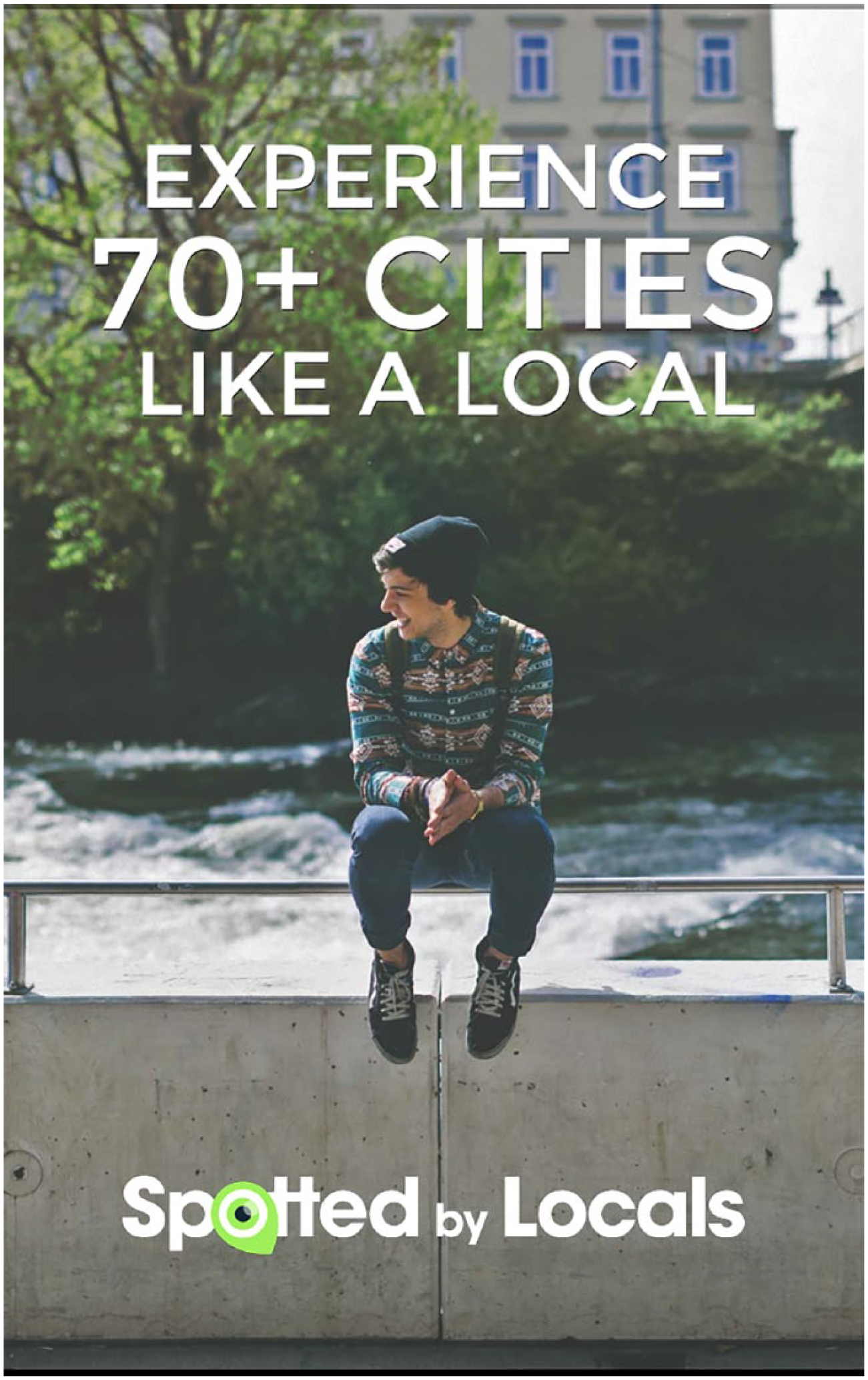
Screenshot of the welcoming screen of Spotted by Locals (February 2019).
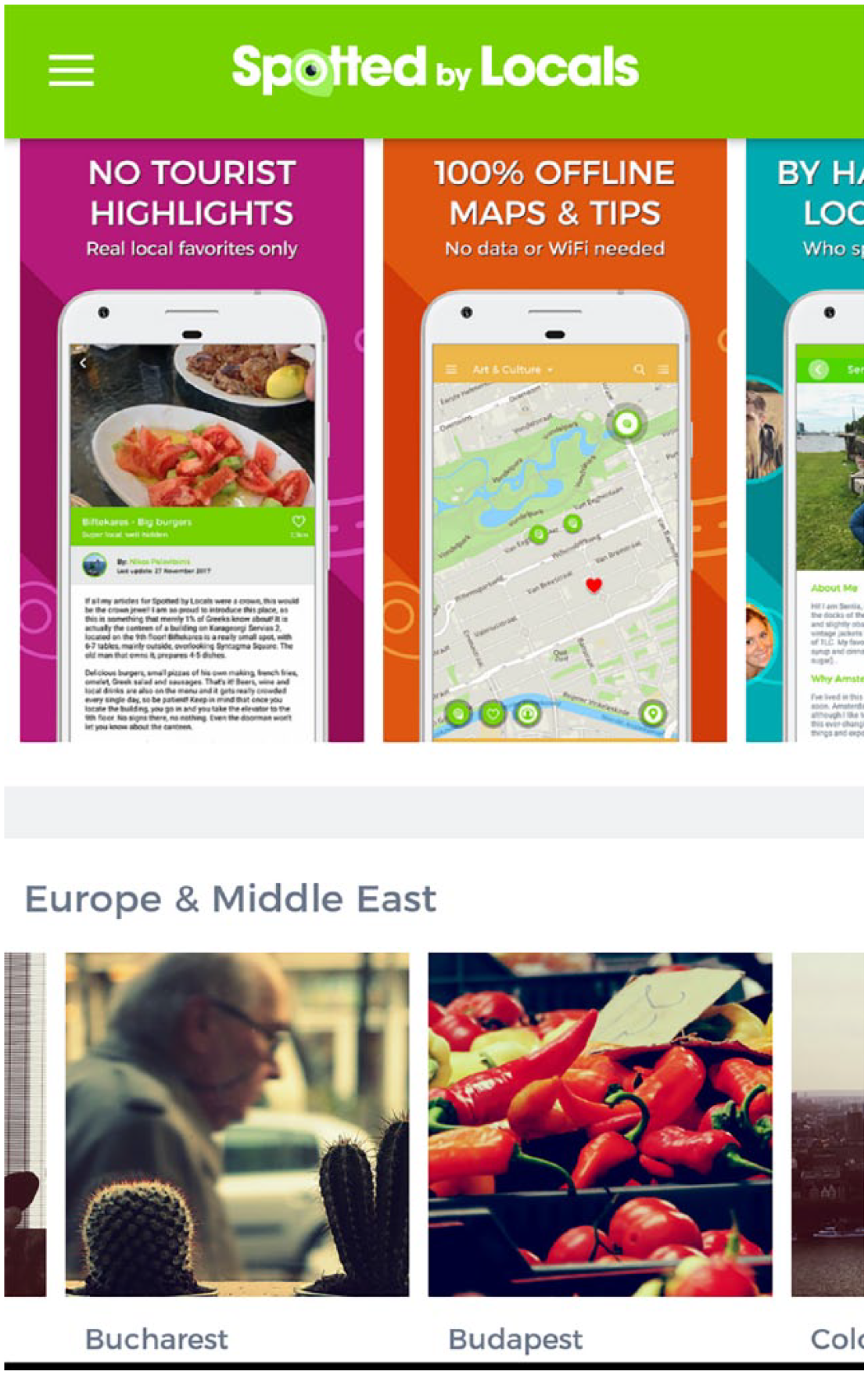
Screenshot of the start screen of Spotted by Locals (February 2019).
Spotted by Locals is just one of numerous mobile apps that speak to a crowd of tourists that refuses to see themselves as tourists, whose journeys are envisioned as independent from the tourism industry and whose destinations should be untouched by any obvious staging efforts (cf. MacCannell, 1976). Other examples include NuFlit, WithLocals and Vayable, as well as apps dedicated to particular cities, for example, GoingLocal Berlin. At the same time, these apps represent a new entrepreneurial sector whose business idea denotes just a slight adjustment of modern tourism ideology and whose very existence points to extended touristification of leisure travel rather than a break from it. Alternative tourisms apps can be described as distinctive media accessories for reflexive middle-class travellers. The apps allow these groups to travel more frictionless and to reach exactly the types of distinctive places, people and experiences they wish to reach – thus, paradoxically, creating a new type of ‘tourism bubble’ (Molz, 2013).
Outlining the analytical framework
The remainder of this article will establish an analytical framework for gaining deeper insights into the social co-construction of geomedia and gentrification. The framework combines two approaches and two intermediary concepts: affordances and spatial capital. In the first step, the above observations are used as a foothold for discussing how the features of new geomedia technologies – which in the case of alternative tourism apps come together in a synergetic way – resonate with certain modes of spatial appropriation. This unpacking exercise follows from the fundamental idea that technologies are socially shaped, that there is no distinct line between technology and ‘the social’ (see, for example, Bijker & Pinch, 2012). It pinpoints key technological transitions as well as their social articulations in terms of ‘affordances’, and discusses how they might spur ‘non-touristic’ forms of spatial appropriation. Following Nagy and Neff’s (2015) approach, affordances are thus seen as situated in-between what is technologically ‘given’ and what different social groups imagine technology might be good for and for whom. The second step concerns the question of whether and how alternative tourism apps, through their (imagined) affordances, sustain and respond to the spatial interests of some social groups rather than others. Following Lefebvre’s (1974/1991) triadic view of social space, it specifies how such apps, as well as geomedia technologies more broadly, reverberate with the quest for spatial capital (Centner, 2008) among the mobile middle classes.
Step 1: unpacking the affordances of geomedia technology
Tourism is one of those institutions in society in which historical transformations related to media change can be most clearly identified. Modern tourism has been enabled and shaped by media in three principal ways, linked to representational, logistical and communicational media affordances, respectively (cf. Peters, 2008). First, spatial representations have always been essential to the creation of tourism experience. Tourists’ imaginations of distant places as well as their modes of gazing at and collecting and sharing memories from these places have been reliant especially on visual media such as photography, but also textual and auditory technologies for spreading and storing information (e.g. Strain, 2003; Urry, 1990).
Second, tourism is defined by the saturation of logistical media, whose function, according to Peters (2008) is to ‘arrange people and property into time and space’ (p. 40). Good examples of media that provide such affordances are clocks, timetables and maps. The distinction between representational and logistical affordances (or types of technology) is not always clear-cut, since obviously most media are representational in one way or another. Still, on a more practical level, the distinction resonates with two fundamental elements of tourism: the desire to appropriate place and the need to navigate.
Third, tourism revolves around more ‘conventional’ communicative needs and desires, such as keeping/getting in touch with others. Communi-cational media affordances refer to the linking together of people and are essential to tourism practices albeit in a less defining way than the other two types. For example, the expansion of the global telegraph system in the late 19th century was important to tourists as well as travel agencies and other actors that needed to convey information rapidly across large distances.
In the early days of tourism, and until not very long ago, the above-mentioned affordances were mostly provided through separate technologies. Whereas, for instance, the guidebook encompassed both representational and logistical features, still, most media attained clear biases (cf. Innis, 1951); emphasizing either representational, logistical or communicational affordances. During the past two decades, however, the shift from mass media to geomedia has made it difficult to uphold such distinctions between ‘media types’. While a map is obviously still a map, a navigational tool, an interactive map utilized through a smartphone provides a more complex set of affordances than the physical map printed on a piece of paper. Besides the fact that the logistical affordances are accentuated – enabling users to identify their location in geographical space and zoom in on particular spots of interest – digital maps are often supplemented with representational and communicational affordances. Maps may allow for closer explorations of space through photographic representations such as satellite images, street views and user-generated content. Likewise, interactive maps are often embedded in touristic applications whose primary purpose may be of a more representational or communicational kind, such as destination guides or accommodation services. Altogether, this points to a converging media landscape in which tourists (and others) have an increasingly complex range of information at their fingertips regardless of where they are – often adapted to who they are as well as where they are – as long as they have access to digital networks (e.g. Elwood & Leszczynski, 2012; McQuire, 2016; Thielmann, 2010; Wilken & Goggin, 2015).
While smartphones and other mobile devices have radically enmeshed previously separated media affordances, the transformative nature of geomedia technologies can be understood in greater detail if the three affordance types are considered separately. The case of alternative tourism apps illustrates how each type is affected by paradigmatic media technological shifts, which in turn open up new theoretical avenues – transmedia, connective media and locative media – for making sense of the interplay between geomedia and gentrification.
Transmedia
The representational affordances of tourism apps are marked by the coming of transmedia as a normalized mode of circulation (Fast & Jansson, 2019, p. 7). Transmedia means that media content circulates across different devices and platforms and may be reworked, remixed and re-contextualized throughout these processes. The term was introduced in the 1990s to describe ‘world building’ in popular culture (Kinder, 1991) and later elaborated in relation to new forms of interactive storytelling (Jenkins, 2006). It has since then been applied in a variety of areas in which media users are actively involved in media circulation (for an overview, see Freeman & Gambarato, 2018). It may not always be the case that stories or images are drastically altered, but the core idea of transmedia also applies to all those platforms that enable users to comment upon content, add additional elements or recirculate material through extended networks. There are today numerous tourism apps, as well as social media groups, exposing places and ways of seeing that were previously largely unseen among tourists. As these alternative representations circulate more widely they are not only semantically worked upon, or recoded, by users, they also become part of establishing new (sub-)communities of likeminded travellers.
Locative media
Logistical affordances are altered through the development of locative media. The term has been given slightly different meanings by different authors, but refers broadly to ‘media of communication that are functionally bound to a location’ (Wilken & Goggin, 2015, p. 4). As Wilken and Goggin argue, locative media today entail much more than location-based services based on the combination of cell-phones and global positioning systems (GPS). Place-specific information, check-in services and geotagging are today standard ingredients of mobile apps – turning located information into the norm (p. 5). The properties of locative media are also detected in McQuire’s (2016) writings on geomedia, which pinpoint two trajectories that pertain to the logistical affordances of media. One is location awareness, which refers to the fact that not only digital maps but also a range of other networked services provide information and respond to the user’s online activities in ways that depend on where the device is located (if its tracking capabilities are activated). While this means that navigation becomes an easier task for tourists and other people on the move, it also has a profound impact on how flows of people and information are ordered in geographical space (basically through increasingly pervasive forms of surveillance). The other trajectory is the growing ubiquity of digital networks and devices, including embedded media and digital sensors in, for example, transit systems, cars and shopping malls, ultimately producing the so-called Internet of things. Electronic tickets can be booked on the move, transactions can be carried out instantaneously, timetables are available at one’s fingertips. The abundance of spatial information and digital access points available to almost any tourist today makes travelling much more predictable and frictionless – also for those wanting to travel off-the-beaten-track.
Connective media
Communicational media af-fordances are today pervasively affected by the logics of connective media (commonly called social media) (Van Dijck, 2013). Connectivity not only refers to the fact that media users are now connected through networks that, unlike the telephone, telegraph or written letter, enable many-to-many communication with instantaneous feedback in different modalities (text, images and sound). It also implies that the online activities of users (for instance, a comment on a posted photo) automatically generate data that through algorithmic processes (datafication) contribute to user profiling and, by extension, individually adapted recommendations and advertising. Users are thus automatically steered towards other users with similar interests, as well as activities and types of content that they ‘should’ like. Many tourism apps today – also those primarily offering alternative forms of accommodation or travel guidance – entail communicational affordances that obey the logics of connectivity. The encapsulating consequences of this has been analysed and discussed in relation to, for instance, accommodation sharing apps like Couchsurfing (Molz, 2012, 2013).
This unpacking exercise demonstrates that the ‘geomediatization’ (Fast et al. 2018) of tourism comprises an increasingly complex range of qualities, which provide tourists with new opportunities for making independent choices, while at the same time binding individuals closer to infrastructures of surveillance and control. The next step elaborates a perspective on how this development resonates with gentrification.
Step 2: Analysing spatial capital and the mutual shaping of geomedia and gentrification
Spatial capital is a relatively unknown concept, introduced by Centner (2008) in an article on how the ‘dot.com economy’ changed the urban landscape of San Francisco. It refers to those resources that empower certain agents to access and appropriate places according to their own preferences, including dwelling, work and leisure, and in various ways define the usage and future identity of these places. Centner found in his study that the ‘dot.com workers’ were better equipped than others, by virtue of their habitus, to influence the meaning and shape of the evolving city space. Their urban practices, including distinctive forms of consumption, produced ‘exclusionary places of privilege’ (p. 193) that sparked gentrification processes they could themselves take advantage of. While gentrification research has mainly dealt with the distribution of residential power – and sometimes used the term ‘spatial capital’ in a similar way (Rérat & Lees, 2010) – deeper understandings of gentrification require analyses that consider the multiplicity of ways in which spatial capital is invested and played out in the city, especially during the early stages of gentrification when neighbourhoods are still relatively mixed, undergoing negotiation through alternative forms of leisure, consumption and tourism.
Centner advances spatial capital as a way of illuminating the different assets that an agent may possess for appropriating space and place. While the notion of capital is borrowed from Bourdieu (1979/1984) and refers to the capacity of a social agent to exercise power within a certain field of activity (such as economy or culture), Centner also takes on board Lefebvre’s (1974/1991) triadic view of spatial production to specify how spatial capital is constituted. Spatial capital, Centner (2008) contends, ‘is a form of symbolic capital in a field where material space is at stake’ (p. 197). But material space is not just a matter of materiality itself. Rather, following the Lefebvrian understanding, the power over space is exercised through spatial representations (Lefebvre’s conceived space) and normalized understandings, including myths, ideologies and morality, of space (lived space), as well as in relation to the concrete stuff and activities that make up places (perceived space). Spatial capital can be played out along each of the three dimensions, largely depending on the kinds of resources the agent possesses (e.g. economic or cultural capital). This may sometimes lead to competition between agents with different varieties of spatial capital, as often seen in relation to urban regeneration projects.
The point to make here is that the affordances of geomedia – articulated through the interwoven trajectories of transmedia, locative media and connective media (as described above) – adds to the spatial capital of middle-class groups, while at the same time recognizing their spatial capital. Following Centner’s (2008) understanding of spatial capital, and linking this to the case of alternative tourism apps, this shift in power balance can be further examined through the lens of Lefebvre’s ‘trialectic’ of social space.
Beginning with conceived space, the above example, Spotted by Locals, is useful to discuss the power exercised through the representation of space and place. The question that should be asked here is, who are invited to appropriate which kinds of places and in what ways – and who are excluded? The anticipated users of the app, and thus the ‘preferred tourists’, are obviously those looking for previously non-exploited sites and distinctive activities that are still not too expensive. Such travellers are likely to be younger and positioned in the cultural rather than the economic parts of social space (following the Bourdieusian construction of social space). It is also a group of travellers drawn to the local, understood as something genuine and close to the everyday life of ‘ordinary people’, rather than to spectacular or exclusive environments (Image 3). At the same time, the local, as represented in Spotted by Locals, seems to be already moving away from vernacular culture and the more or less ‘vulgar’ tastes of the working classes. The promoted taste pattern corresponds in a striking way to the kind of ‘adventurous’ dwellers, especially artists, cultural workers, students and certain academics that persistently and over several decades have shaped the early stages of gentrification processes – that is, before real estate prices have escalated (Caulfield, 1994; Clay, 1979; Ley, 1996). As previous research has shown, part and parcel of early gentrification is an aestheticization of urban places (Ley, 2003) resonating with the value orientations of the cultural fractions of the middle-classes. Paradoxically, however, the emancipatory and egalitarian ideals of these groups translate into ways of consuming the city – vegan and vegetarian food, pop-up stores and ‘creative anarchy’, as stressed by the illustrated app – that gradually turn into a means of exclusion vis-a-vis the more rooted population that can sense their spatial capital being continuously devaluated (Zukin, 2008).
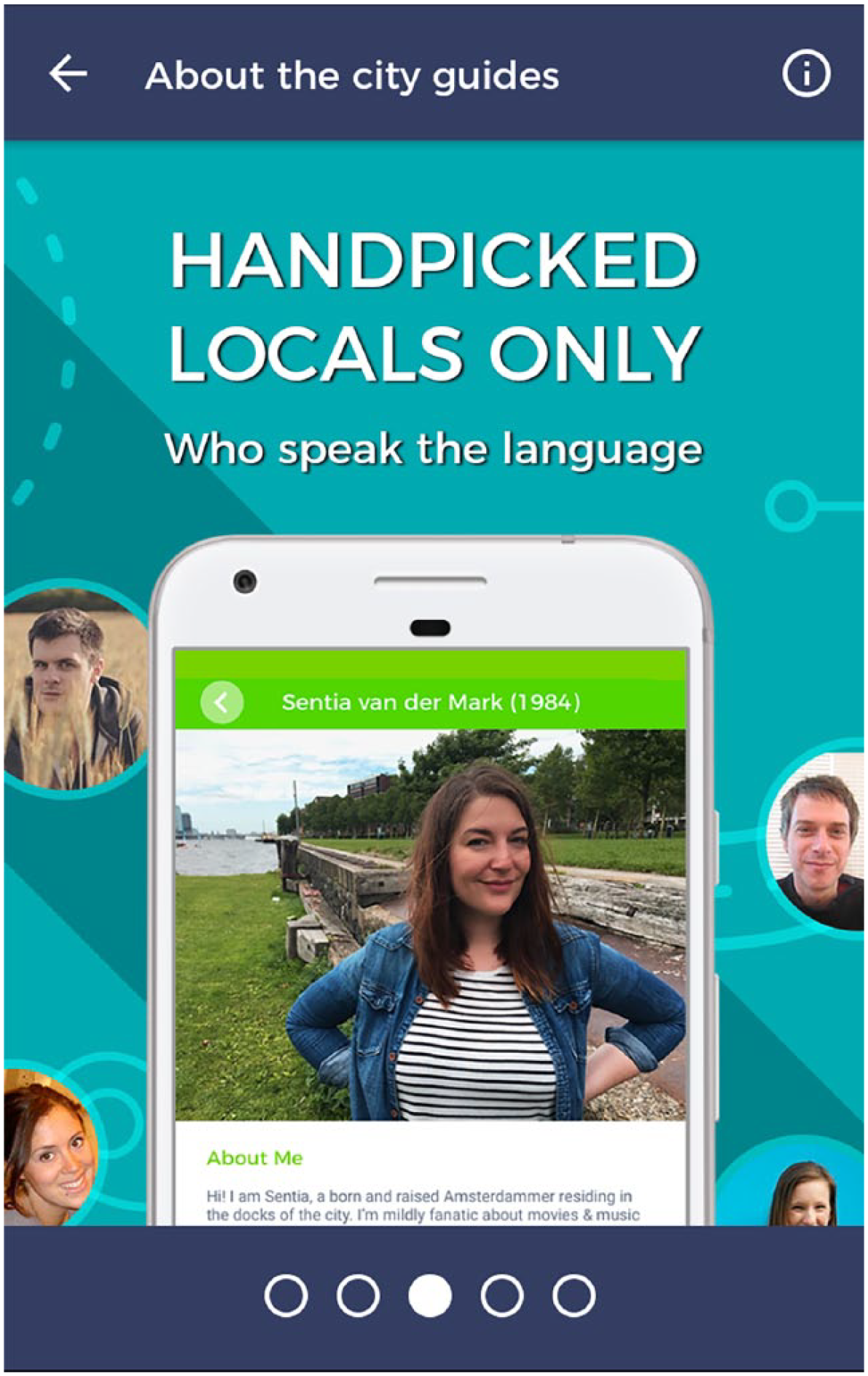
Screenshot from Spotted by Locals (February 2019).
Turning to perceived space, two questions should be asked. How does geomedia affect the mastery of cultural and material geographies among different groups in the city? Which groups in the city have access to particular media technologies and can make use of them in a beneficial way? These questions pertain to logistical rather than representational media affordances. Again, it is obvious that geomediatization leads to a division between advantaged and disadvantaged groups. The acquisition of new locative media turns travellers into spatial experts, connoisseurs, and contributes to their sense of cosmopolitan belonging in foreign places (Hannerz, 1990). While this is not to say that visitors to a city are actually able to grasp the deeper layers of social life, at least, the increased cultural ease with which they can find their way to places of their preference contributes to spatial capital. This provokes the classical question of who has ‘the right to the city’ (Lefebvre, 1968/1993). While alternative tourism apps may underpin growing economic prosperity as well as cosmopolitan encounters, for instance, through personal guiding and accommodation services, they also play into the power balance between ‘locals’ and ‘cosmopolitans’ (Hannerz, 1990). Urban space is gradually adapted to the latter group and their desires, including the provision of digital infrastructures that reinforce mobile lifestyles. While Internet access is an increasingly normalized public service there are still occasional needs among tourists, especially in technologically less advanced regions, to find ‘Wi-Fi-hotspots’, ‘Internet cafés’ and other amenities for making full use of mobile applications. Furthermore, as Polson (2016a) shows in a study of female travellers to Bangalore, India, the functionality of mobile technology is indispensable not only for geographical mastery but also for achieving a sense of safety when moving outside the comfort zones of mainstream tourism.
Lived space, finally, refers to processes less available to direct observation, ultimately the ways in which people think about spaces and manage their actions in relation to them. Which lifestyles are associated with certain places and which urban visions are attached to them? Given the above points regarding the aestheticization and material adaptation of cities, one can assume that alternative tourism media tend to normalize the presence and preferences of certain middle-class fractions in urban life. In other words, the geomediatization of lived space is inseparable from the circulation of representational tropes and the actual design of urban media spaces. While alternative middle-class travellers may look for the ‘authentic’ and the ‘hidden’, they are also, through their habitus, as Centner (2008) notes, part of normalizing certain scripts for urban transformation. We can see this today in the mythologization of the media-driven sharing economy and upgraded versions of the ‘creative city’. Their spatial practices thus play into the recoding, or re-classification (Bourdieu, 1979/1984), of urban places and neighbourhoods that, in turn, become increasingly attractive to various investors. In this connection, it is worth highlighting the communicational affordances and connectivity of new tourism media, which contribute to the bringing together of people with similar interests and complementary spatial demands, including both tourists and local hosts and service providers. Similar mechanisms for ‘spatial sorting’ have been identified in recent analyses of how Instagram and mobile customer rating apps (related to restaurants, accommodation, etc.) contribute to the stratification and segmentation of city spaces based on lifestyle preferences (Boy & Uitermark, 2017; Zukin et al., 2015).
This tentative analysis suggests that alternative tourism apps contribute to the normalization of middle-class ways of appropriating and displaying urban neighbourhoods. Spatial capital is gradually shifting hands, from local inhabitants, notably the working classes, to reflexive middle-class travellers and other gentrifiers – including those who buy apartments for speculative purposes or for setting up Airbnb businesses – aiming to appropriate genuine sites for anchoring and improving their habitus. At the same time, the app-based sharing economy and ultimately this type of technology are coded as ‘middle-class’, and thus not inviting to just anybody.
While this conclusion is certainly at odds with the oftentimes celebratory mythologies of alternative tourism and geomedia, it resonates with established theories and research on gentrification processes. However, much more research is needed to map these relations in closer detail. First, in line with the SCOT (social construction of technology) approach (see, for example, Bijker et al., 2012), it is important to ask critical questions also about the role of other ‘relevant social groups’ than those discussed above (Humphreys, 2005; Pinch & Bijker, 1984). Who are the bystanders of the ‘geomediatization’ of urban space? Are there any particularly disadvantaged groups? Any forms of resistance? Second, whether and how alternative tourism apps are representative to other geomedia technologies must be further evaluated through empirical research, which is also what the suggested framework is meant to support. Finally, the current approach should not be mistaken for an exaggerated view of how digital media transform cities today. Rather, what has been provided here is a first draft of how to conceptualize future investigations that may open up a more complex research terrain, in which media are no longer excluded from the gentrification equation.
Conclusion
This article started out with the observation that the relation between gentrification and media has been largely overlooked in the research literature. Yet, there are obvious reasons to assume that media technologies, practices and representations are deeply involved in such urban transformations, as they are in other forms of socio-spatial production (Jansson, 2013), and, vice versa, that media are adapted and shaped in relation to dominant forms of spatial change. Against this backdrop, the article assessed the mutual shaping of geomedia technologies and gentrification processes, using the case of alternative tourism apps as an illustration. The distinct, middle-class biased appearance of such mobile apps was taken as a symptomatic articulation of how new media gain affordances that fit the ambitions of certain social groups and their spatial preferences. However, rather than to search for any deeper empirical conclusions as to the significance of these apps, the aim was to develop and try out an analytical framework to support future investigations into the proposed interplay.
The analytical framework is summarized in Table 1 and comprises two axes representing analytical actions: (1) a media-technological unpacking exercise inspired by affordance theory and (2) a critical consideration of how media play into the distribution of spatial capital. The intermediary concepts of affordance and spatial capital provide tools for grasping, on one hand, how technologies are socially constructed, and, on the other hand, how (urban) spaces are socially produced. In other words, they are tools for deconstructing a complex interplay, actualizing questions of inclusion and exclusion, which can then be described in closer detail. While this article has focused specifically on gentrification and the role of alternative tourism apps, the overall aim has been to establish a framework that could be applied (and further developed) in relation to different (geo)media and different forms of urban transformation.
Analytical framework for studying the mutual shaping of geomedia and gentrification (main areas of interaction marked in grey).
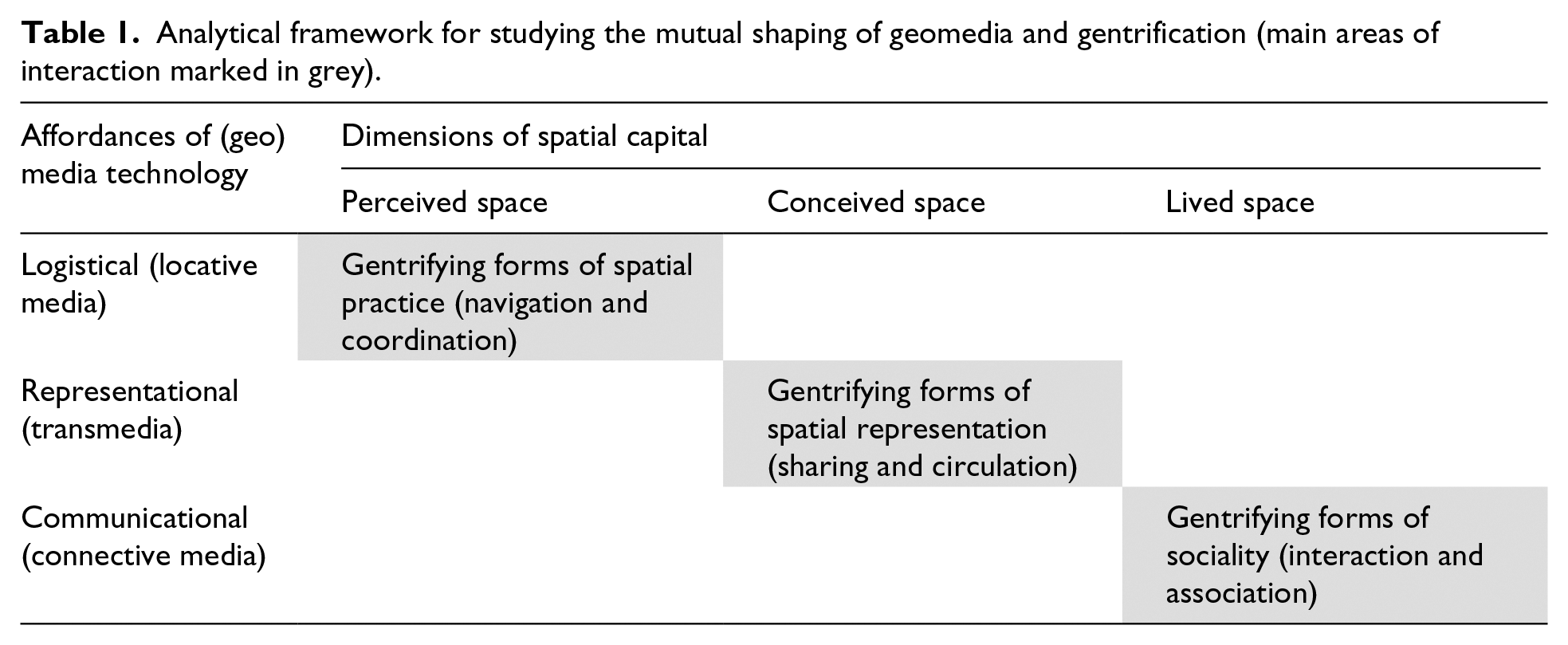
As suggested in Table 1, certain types of affordances can be predicted to have a particularly strong relation to certain dimensions of spatial capital (the grey areas). While the development of locative media, for instance, foremost plays into the capability of travellers, as well as urban dwellers, entrepreneurs and so forth, to navigate in the city (mastering perceived space), the affordances of transmedia rather play into how certain information about the city is spread and circulated (producing conceived space). One should not take this model too far, however, or, assume any kind of one-to-one relationship. The whole point of the model is to theorize an interplay that is notoriously complicated to pin down, because of its dialectical nature, and to provide guidance to the gathering and interpretation of empirical data. None of the categories are stable or exclusive, but intertwined in complex ways, which means that in reality there is much more to these relations than the grey boxes. The only way to grasp how all this works is to initiate more comprehensive research projects on geomedia and gentrification, based on ethnographic methods as well as more discursively and socio-semiotically oriented approaches to space and technology.