



Abstract
Theatre is increasingly exploring the potential of interactivity, especially as the growing experience economy reveals that people actively seek activities that offer new ways to engage with stories. The inclusion of interactive elements akin to game mechanics, which I call ergodic mechanics, shifts these performances into an intermedial sphere between digital games and conventional theatre. I use the term ergodic theatre to classify this specific subgenre of immersive theatre where the traveller works to form their path through the storyworld. Ergodic mechanics are the systems through which the traveller works or interacts. But what impact does the inclusion of ergodic mechanics have on storytelling? This question is critical to producing meaningful ergodic theatre performances and preventing interactive elements from becoming gimmicks, as some theatre reviewers have labelled them (Gardner, 2014). I interrogate the relationship between and impact of ergodic mechanics on the creation of story and meaning by examining narrative moments from The Under Presents, a VR ergodic theatre experience, and What Remains of Edith Finch and Dream, both digital ergodic theatre experiences. Analysing these case studies helps demonstrate the value of weaving ergodic mechanics with the story. When there is harmony between the interactive and story elements, the included ergodic mechanics heighten the traveller’s narrative engagement and emotional connection to the play’s characters or themes. I argue that ludonarrative harmony loops are a powerful tool that can enrich the traveller’s theatrical experience. I present an interdisciplinary approach by applying digital game theory parsed through dramaturgy to address the nuances of telling meaningful and engaging stories in ergodic theatre. Analysing the incorporation and dramaturgical function of interactivity highlights the potential of ergodic mechanics in intermedial ergodic performances. Furthermore, creating ludonarrative harmony is central to ergodic theatre’s continued success and growth as a storytelling medium.
Keywords
Introduction
The mediums we use to tell stories are ever-expanding and evolving, but are some methods superior or just better understood? In 2005, film critic Roger Ebert declared that digital games are ‘inherently inferior to film and literature’. Despite admitting he was only vaguely familiar with the medium, he rationalises his position saying that,‘[v]ideo games by their nature require player choices, which is the opposite of the strategy of serious film and literature, which requires authorial control’ (Ebert, 2005). A weakness in Ebert’s position is that he oversimplifies the ergodic nature of digital games by presenting authorial control and player choice as mutually exclusive. This exclusivity disallows the structural freedom of ergodic mediums. The question is, how do we effectively structure ergodic mediums to create meaningful stories? Discussing meaning and the relationship between story and game mechanics in digital games, Clint Hocking (2009: 256) explains that ‘the ludic contract works in the sense that I actually feel the themes of the game being expressed through mechanics’. For Hocking, game mechanics allow him to connect with the themes cognitively and participate in and experience the story’s themes first-hand. The connection is possible because the game developers align the mechanics with the story using rules and defined parameters. Ergodic theatre, which includes interaction that I name ergodic mechanics, has the same potential to connect travellers to the story. What ergodic theatre creators require, however, is a method to formulate the weaving of mechanics and story to produce meaning. Digital Game Studies offers the terms ludonarrative harmony and ludonarrative dissonance to help articulate why players respond positively or negatively to certain game mechanics contextualised by the story. Looking to formulate ludonarrative harmony in digital games, Despain and Ash (2016) identified what they term ludonarrative harmony loops. I argue that ludonarrative harmony loops are a powerful tool that can enrich the traveller’s theatrical experience. By weaving mechanics and story together in ludonarrative harmony loops, ergodic theatre-makers can utilise the full potential and strengths of the interactive medium to give travellers first-hand experiences of the portrayed themes in ways that non-ergodic mediums cannot. To accomplish this, I define ergodic theatre as it relates to this paper before looking at the purpose of ergodic mechanics in performances. I then explain the ludonarrative relationship and ludonarrative harmony loop model. Finally, I apply the loop model to three case studies: What Remains of Edith Finch (2017) – Edith Finch herein – by Giant Sparrow, The Under Presents (2019) – TUP herein – by Tender Claws in collaboration with Piehole, and Dream (2021a) by The Royal Shakespeare Company in collaboration with Manchester International Festival, Marshmallow Laser Feast, and Philharmonia Orchestra.
Ergodic theatre
Immersive theatre is the predominant label for experimental works exploring interactivity, untraditional performance spaces, alternative audience arrangements, and technology. The genre, however, is difficult to define; it is both too broad and yet not broad enough. Consequently, a highly diverse range of experiences receive the immersive theatre label. Filmer (2016: 296) states that ‘[n]either term [immersive or site-specific] is helpful in specifying the aesthetic and dramaturgical logics employed by artists nor the sorts of spectatorial engagement and participation these might engender’. Immersive theatre is applied so broadly that there are no inevitable, predictable, or orchestrated audience configurations within the varied spectrum of immersive theatre. Consequently, it is difficult to provide specificity when studying the audience’s role and their experiences. Immersive theatre focuses on what a performance desires the audience to be or feel – immersed in the work – which itself is problematic, as immersion can only be designed for but not guaranteed (Biggin, 2017: 1). Alternatively, site-specific and environmental focus on performance location, and interactive and promenade, focus on interaction and movement, respectively, but do not attribute purpose to those actions that reveal the audience’s role. I advocate for a subgenre that groups work according to the audience’s role and the nature of their engagement with the experience.
Building on the work of Espen Aarseth, whose concept of ergodicity – derived from the Greek words érgon and hodos, meaning ‘work’ and ‘path’ – and ergodic literature continue to shape discussions around the intersection of gaming, literature, and theatre, I introduce the term ergodic theatre. Aarseth defines ergodic literature as requiring ‘non-trivial effort […] to traverse the text’ (1997: 1). While the term ergodic or ergodicity is sometimes used in process drama (O’Mara, 2012: 523) and immersive theatre (Swift, 2016), I define ergodic theatre as a subgenre of immersive theatre where the traveller works (érgon) to navigate their path (hodos) through the performance in physical, digital, or multimedial space. The combined notion of work and path informs that travellers must act with the purpose of forming a path. While my case studies all take place in digital space, physical examples include Sleep No More (2011 - ongoing) by Punchdrunk and A Midnight Visit (2021) by Broad Encounters, and multimedial examples include Jack: Part One (2018) by Baobab Studios and Chained: A Victorian Nightmare (2018) by MWM. Regardless of delivery mode, ergodic theatre has three basic elements: the traveller, ergodic mechanics, and storyworld. The traveller’s path, or the narrative they form, through the performance results from the interplay between these three elements. Travellers also have a degree of agency over their narrative as they explore and interact with the environment and other characters.
Interactive mediums, such as ergodic theatre, provide a complex and multifaceted audience experience with numerous forms of engagement and enjoyment. For example, Calleja (2011: 43) proposes six distinct forms of involvement: kinesthetic, spatial, shared, narrative, affective and ludic. Ryan (2009: 54) distinguishes between pleasure from ludic immersion and narrative immersion, the latter of which she separates into four types, spatial, temporal, emotional, and epistemic immersion. Finally, Ramos and Maravala (2016: 159) form a dramaturgy of participation by identifying three types of participation design – participatory rituals, immersive environments, and interactive gameplay – in Hotel Medea. Although beyond the scope of this paper, these theories highlight the different facets that contribute to enjoyment and meaning in ergodic experiences. Like the above scholars, ludonarrative harmony is concerned with creating meaningful and satisfying experiences by focusing on the weaving of mechanics and narrative elements. The analysis I provide serves theatre-makers by providing a method to structure the incorporation of mechanics so that they enhance the story’s meaning and the traveller’s emotional engagement.
Ergodic mechanics
One of the distinguishing features of ergodic theatre is the inclusion of ergodic mechanics. The formal definition I am using that I have adjusted to fit ergodic theatre is ‘[actions] invoked by [travellers], designed for interacting with the [storyworld] as constrained by the [performance rules]’ (Sicart, 2008). Ergodic mechanics encompass all the interactive elements of the performance; they describe the actions a traveller performs to interact with the performance. While present in all ergodic theatre performances, mechanics differ slightly depending on the delivery mode. Teleportation, for example, is possible in a virtual world but impossible in real life. Physical performances, however, can enforce or encourage the suspension of disbelief to mimic certain mechanics. For instance, Sleep No More (2011 – ongoing) gives travellers masks and actors ignore their presence to provide the illusion that travellers are invisible. Here my three case studies all occur on digital platforms to provide a clearer comparison. Edith Finch is accessed on a computer or console, TUP is a virtual reality experience, and Dream is accessed on a computer or personal device. While there are significant differences between flat screens and VR, these differences affect the experience and possibly engagement, but not the success of ludonarrative loops. 1
The purpose of ergodic mechanics is to provide a system through which the traveller works to form their path within the storyworld. Mechanics are intrinsically tied to narrative formation. Mechanics facilitate the potential for travellers to receive meaning from what they do, not just what they see and hear. By making choices, performing actions, and completing tasks, the traveller can feel more tangibly the emotions or sensations that the story and themes express. You do not simply watch a character experience something; you, either physically or digitally, experience it first-hand. Creating this impact, however, requires a link between mechanics and story elements. Interrogating the ludonarrative relationship is vital when determining how theatre-makers can include mechanics to fulfil their purpose in ergodic theatre.
Ludonarrative dissonance
Ludonarrative dissonance is a debated but valuable term that describes the interplay between mechanics and story and the effects of opposition between the two elements. First appearing in a blog post, Clint Hocking coined, though never actively defined, ludonarrative dissonance. Hocking argues that ‘Bioshock seems to suffer from a powerful dissonance between what it is about as a game, and what it is about as a story’ (Hocking, 2009: 256). He states that this dissonance between ludic and narrative structures is detrimental because it ‘all but destroys the player’s ability to feel connected to either’ (Hocking, 2009: 256). Hocking implies that ludonarrative dissonance results from contradictions between the story and themes, and the choices and actions available to players. Furthermore, Hocking argues that this dissonance severs the player’s sense of immersion in and enjoyment of the game. Avoiding ludonarrative dissonance – except intentional usage to serve a production goal – therefore, is crucial when aiming for a positive player, or traveller, experience. Similar to Hocking’s concern with the impact mechanics have on games and the player’s experience, Alexander Galloway’s (2004) Congruence Requirement explores how mechanics can aid realism in games. He states that ‘a realist game must be realist in doing, in action. […] realism in gaming requires a special congruence between the social reality depicted in the game and the social reality known and lived by the gamer’. Galloway acknowledges a need for harmony between the player’s lived reality and the actions they take in-game for the creation of realism. Similarly, Ian Bogost (2008: 125) explains how digital games can incorporate procedural rhetoric, ‘the practice of using processes persuasively’, to make compelling arguments that players engage with via mechanics that are structured using rules. Effective use of game mechanics allows players to experience the argument’s reasoning through play. The congruence requirement and procedural rhetoric demonstrate how game mechanics can function as a meaning-making device rather than a purely ludic element. The above theories demonstrate a complicated relationship between ludic and narrative elements that result in either dissonant or harmonic experience.
Ludonarrative harmony, ludonarrative loops, and dramaturgy
Gaming circles most commonly use ludonarrative harmony to describe the positive relationship between game mechanics and story. Referencing Ben Abraham and Travis Pynenburg, Despain and Ash (2016: 3) define ludonarrative harmony as ‘the synchronised interaction between the mechanics and narrative that creates a unified story’. In other words, ludonarrative harmony occurs when the story and game mechanics communicate a consistent meaning and theme. When there is consistency, the player experiences greater involvement and emotional connection to characters or events. Although Hocking never uses the term, he reveals the benefits of ludonarrative harmony when he discusses the successful aspects of Bioshock’s ludonarrative relationship. Hocking (2009: 256) states, ‘the ludic contract works in the sense that I actually feel the themes of the game being expressed through mechanics’. He did not just engage with the themes intellectually; Hocking experienced and partook in them. Digital games demonstrate that their interactive nature can generate a powerful connection between the player, the characters, and the storyworld. The same potential is true for ergodic theatre. As with other theatrical elements, ergodic mechanics must be dramaturgically consistent when creating a cohesive story. Drawing connections between ludonarrative harmony and dramaturgy helps illuminate why ludonarrative harmony produces meaning and a more O’Grady (2011cohesive and enjoyable experience.
Dramaturgy, particularly game dramaturgy and new media dramaturgy (NMD), highlight the value and relevance of ludonarrative harmony for ergodic theatre. Dramaturgy emphasises the benefits of weaving all performance elements together to form a cohesive and meaningful whole. A pitfall ergodic theatre faces is including mechanics without considering their relationship to and impact on the traveller or story. Alice : 146 original emphasis) comments that current research emphasises the possibility of interactivity in performance rather than the ‘quality or significance of the interactions taking place’. Although O’Grandy’s observations are a decade old, her statement holds currency for contemporary audiences. For instance, RSC heavily promoted Dream’s (2021b) interactive qualities, yet a prominent criticism from reviewers was that the included mechanics were frustrating or lacked substance and purpose (Clapp, 2021; Crompton, 2021; Loxton, 2021; Lamb, 2021). If we are to see ergodic theatre develop and refine as a genre, we must look critically at the purpose and value of ergodic mechanics in performance. Eckersall et al. (2015: 376) explain that NMD prioritises questions around effective communication and how audiences respond to new media works with a focus on technology, intermediality, and interactivity. Moreover, Jantke (2015: 370) states that ‘game dramaturgy is the design of emotional experience that will take place when humans engage in game playing’. Game dramaturgy, therefore, recognises the significance of the player’s emotional response. Like NMD, game dramaturgy is concerned with emotion, communicating meaning, and anticipating players’ reactions. Whereas Jantke’s work in game dramaturgy centres on time and the construction and ordering of game events in relation to meaningful stories, my work with ludonarrative harmony and ludonarrative harmony loops examines emotional responses relating to individual mechanics and narrative points in ergodic theatre.
Despain and Ash present a model for creating ludonarrative harmony with four central elements: mechanic, narrative (which I refer to as narrative point), context, and emotion. These elements form a ludonarrative loop. Each element feeds into the next, as shown by the arrows in Figure 1. Each mechanic or narrative point has its own ludonarrative loop that should also fit within the greater context of the game’s story. Expanding on the ludonarrative elements, Despain and Ash (2016: 11) state that mechanic, describes what the player is doing; narrative point explains why the player is doing the action; context describes where the action is happening, how the action fulfils the narrative, or why the action matters; and emotion, or emotional fulfilment, explains how the action serves the player. Despain and Ash (2016: 11) also state that the ‘elements create a satisfying emotion that encourages the continued use of that mechanic’, which is why emotion circles back to the mechanic in the ludonarrative loop. According to Despain and Ash, a satisfying emotion – not to be confused with a positive emotion – is necessary to close the loop and produce ludonarrative harmony. Although the model was created for game designers, I apply the model to analyse whether specific narrative points or mechanics produce ludonarrative harmony in preexisting ergodic theatre experiences. For this reason, there are times when I adapt the model to express events taking place more accurately. For clarification, I use the letters M (mechanic), NP (narrative point), C (context), or E (emotion) in each box to designate which element I am describing. I use ludonarrative loops to analyse whether the incorporations and design of ergodic mechanics in certain scenes from each case study help generate meaning and promote a satisfying traveller experience. The individual ludonarrative loop. Despain and Ash (2016): 11.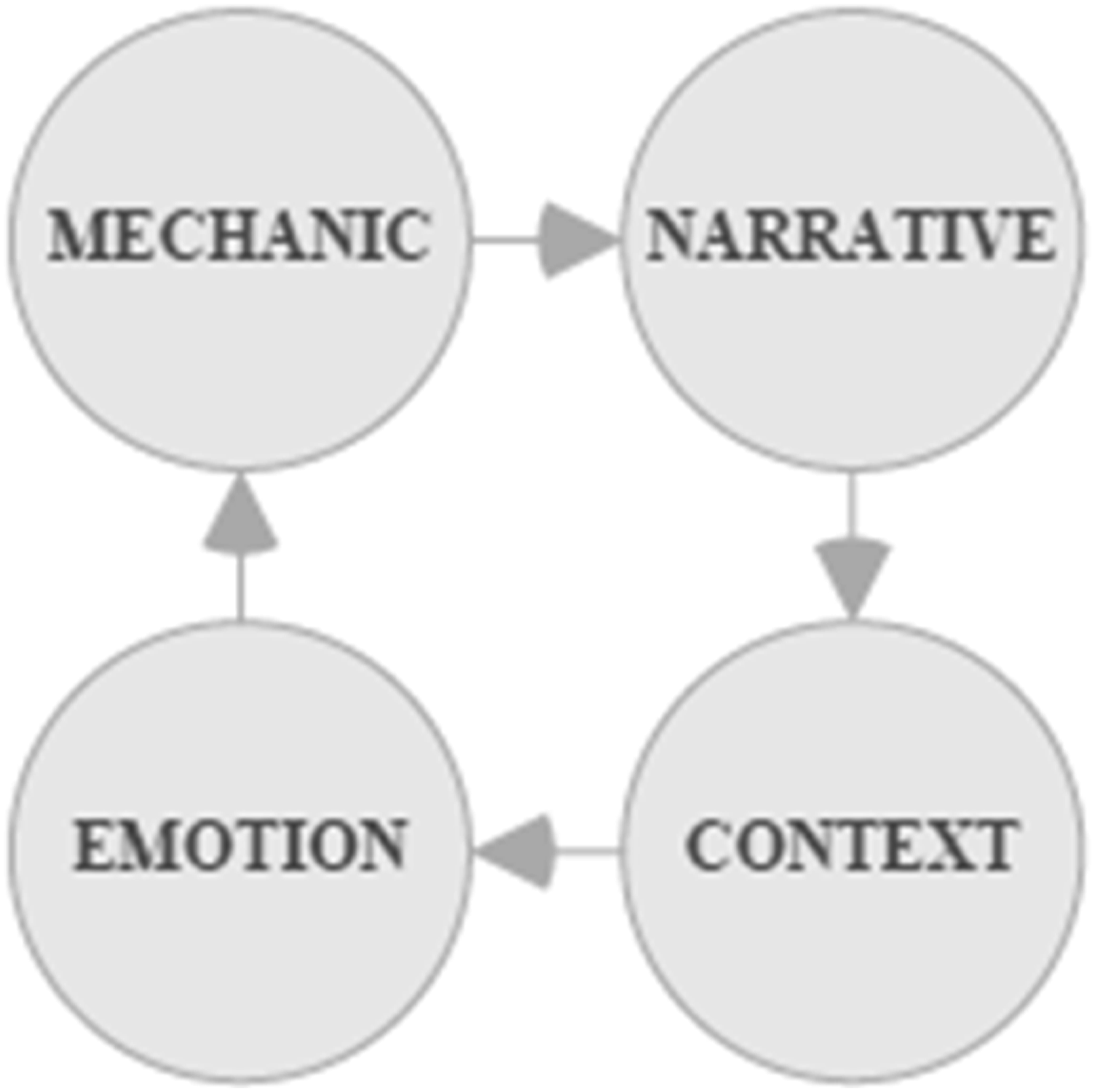
Case studies
What remains of Edith Finch
Released in 2017, Edith Finch is a series of stories within stories. Traditionally, Edith Finch is regarded as a digital game, specifically a walking simulator. I present Edith Finch as an intermedial work that hovers between the gaming and ergodic theatre boundary to show what could be possible in theatre. My chosen scene from Edith Finch serves as an exemplar of ludonarrative harmony to expose successful and unsuccessful loops in TUP and Dream. The majority of the story is from the first-person perspective of 17-year-old Edith, the last remaining Finch. Edith returns to her childhood home after 7 years to discover her family’s history and what led to their deaths. The traveller, as Edith, makes their way through a series of secret passageways that lead to previously sealed rooms of the vast house. They come across shrines with letters, photos, comic books, poems, and-the-like that record the deaths of each family member. Engaging with items transports the traveller to the first-person perspective of the relative in the moments leading up to their death. Digitally inhabiting each relative, the traveller must control the character’s actions that result in their death.
Lewis’s scene (Edith’s eldest brother) beings when the traveller finds a letter written by Lewis’ psychiatrist detailing the events leading up to his suicide. As Edith starts reading the letter with the psychiatrist’s voice narrating the words, the scene changes to the first-person perspective of Lewis working at a fish cannery. His job is to decapitate fish by moving them under a small guillotine on the bottom right of the screen and then moving the fish onto the next conveyer belt on the screen’s top right side. The psychiatrist’s letter explains how Lewis, newly sober, recognised the monotony of his daily life. To cope, he began inventing an imaginary world in his mind. Though it started small, the world grew in scale, detail, and complexity. This fictional world appears on the left of the screen. As the world grows more complicated, it takes up more of the traveller’s field of view and eventually fills the screen with only the fish and Lewis’ bloody and gloved arm still visible. The psychiatrist started worrying about Lewis, but she spoke to his boss, who said he became ‘a model employee’. The psychiatrist explains that one day it struck Lewis, ‘the real Lewis is not the one chopping salmon but the one climbing the steps of a golden palace’. She continues, ‘I think it pained him to remember Lewis, the cannery worker. […] I still thought I could save him. Even after he said he was being crowned king over all the lands of Wonder’. As Lewis goes through a golden door in his imaginary world, the scene shifts to him in the dreary cannery locker room. The traveller, as Lewis, continues walking through a set of doors onto the cannery floor where they can see Lewis, like an out-of-body experience, mindless chopping fish. They walk onto a conveyer belt leading towards a bright window. As the window opens, the scene changes back to the imaginary world. Still on a conveyer belt, now lined by a cheering crowd and accompanied by joyful music, the traveller makes their way towards a set of stairs where a king or queen – depending on who the traveller chose earlier during the story – is standing holding a crown. A guillotine separates Lewis and the royal. The psychiatrist explains, ‘there was only one thing left to do. Bend down his head’. Lewis kneels and places his head in the stock of the guillotine. The music crescendos, and the falling guillotine sounds as the screen cuts to black and confetti falls. The psychiatrist’s letter concludes with her condolences to his mother and family. The broader context of the story, therefore, is that the traveller is stepping into the mind and body of Lewis, who created an imaginary world in his head to cope with the depressing boredom and monotony of his job working at the cannery. The world he created started consuming his mind and identity until he believed the only way to fully embrace his preferred fictional reality was to commit suicide.
Lewis’ scene contains two core mechanics that operate simultaneously. The first mechanic (M1) utilises the right joystick. The traveller uses the joystick to move Lewis’ right hand to grab a fish as it comes onto his workstation on the left side of the screen and then moves his hand to the right side of the screen, where an automatic guillotine chops off the fish’s head. The traveller then moves his hand to the top of the screen, automatically releasing the decapitated fish onto a conveyor belt. The second mechanic (M2) utilises the left joystick. The traveller uses the joystick to traverse an imaginary world inside Lewis’ mind. After chopping several fish, a miniature Lewis avatar in the middle of a black background appears, covering a small portion of the screen. Travellers move the miniature Lewis avatar through the imaginary environment that begins as a two-dimensional black-and-white maze and slowly grows in complexity. The traveller must engage with both mechanics simultaneously. If they stop moving the fish, they will pile up and cover the screen displaying the imaginary world. If the traveller stops moving the avatar, the narration stops, and they will not progress through the story. There are also specific points where a fish blocks the path in the imaginary world. Chopping a fish at the cannery also chops the fish in the imaginary world, and the traveller can proceed. For the two core mechanics to be harmonious, they must form ludonarrative loops that also fit within the greater context of the story.
Figure 2 displays the ludonarrative components relating to Lewis’ scene. Unlike the standard ludonarrative loop, however, I join these components in a single ludonarrative loop (Figure 3). Rather than split the mechanics into separate loops, the single modified loop better depicts the relationship between mechanics, narrative points, context, and emotions. Analysing LNL1, the first mechanic (M1) moves the fish, and the narrative point is stopping the fish from piling up. The context is your (Lewis’) job at the cannery and the emotional response is monotonous and boring. Because it is tedious, Lewis invents and explores an imaginary world (M2). The second mechanic is a consequence of the emotion from the first mechanic. The narrative point for traversing the imaginary world is escaping the reality of working at the cannery. The context is that the world is in Lewis’ imagination, and the emotional response is exciting and fulfilling. Traversing the fictional world is emotionally gratifying and distracts Lewis, and therefore the traveller, from the necessary but less rewarding task of moving the fish (M1). Ludonarrative loop table for Lewi’s scene in What Remains of Edith Finch. Ludonarrative loop for Lewi’s scene in What Remains of Edith Finch.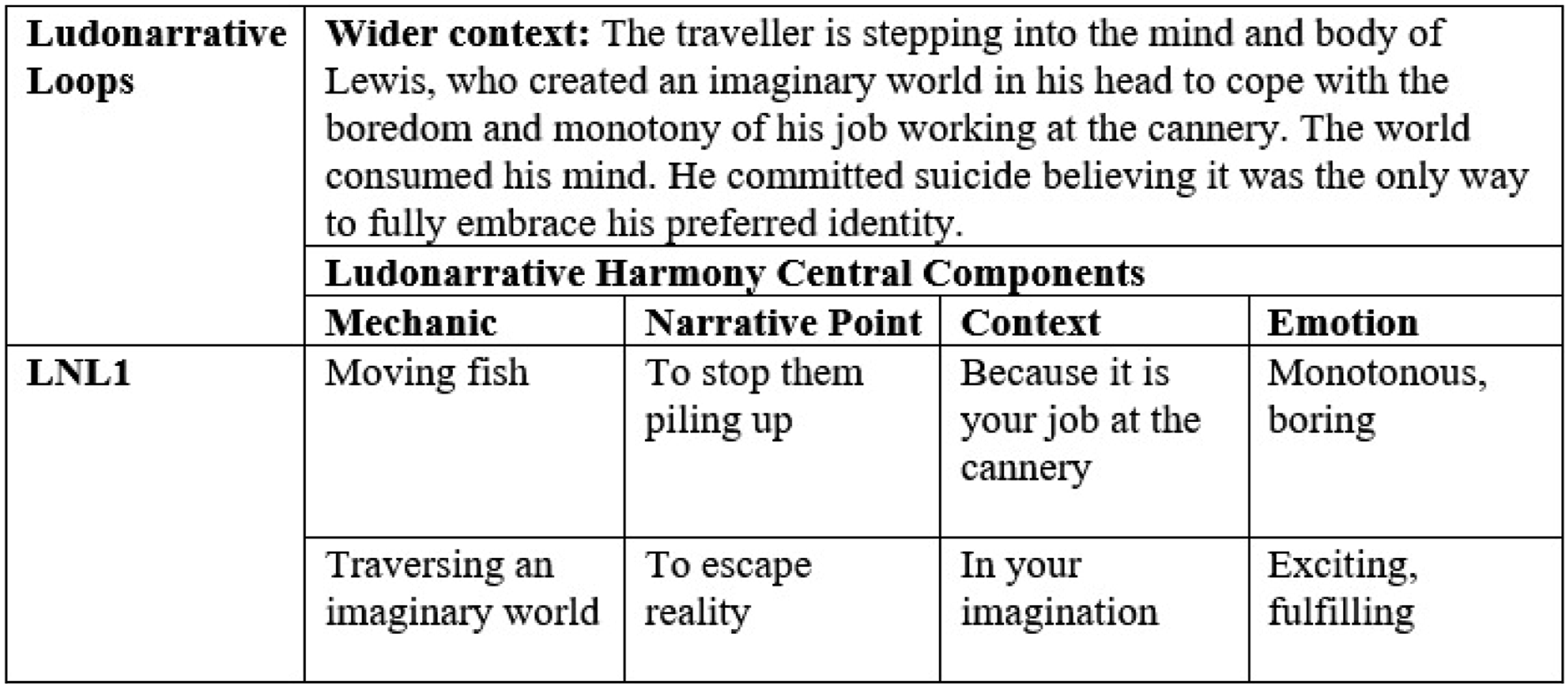
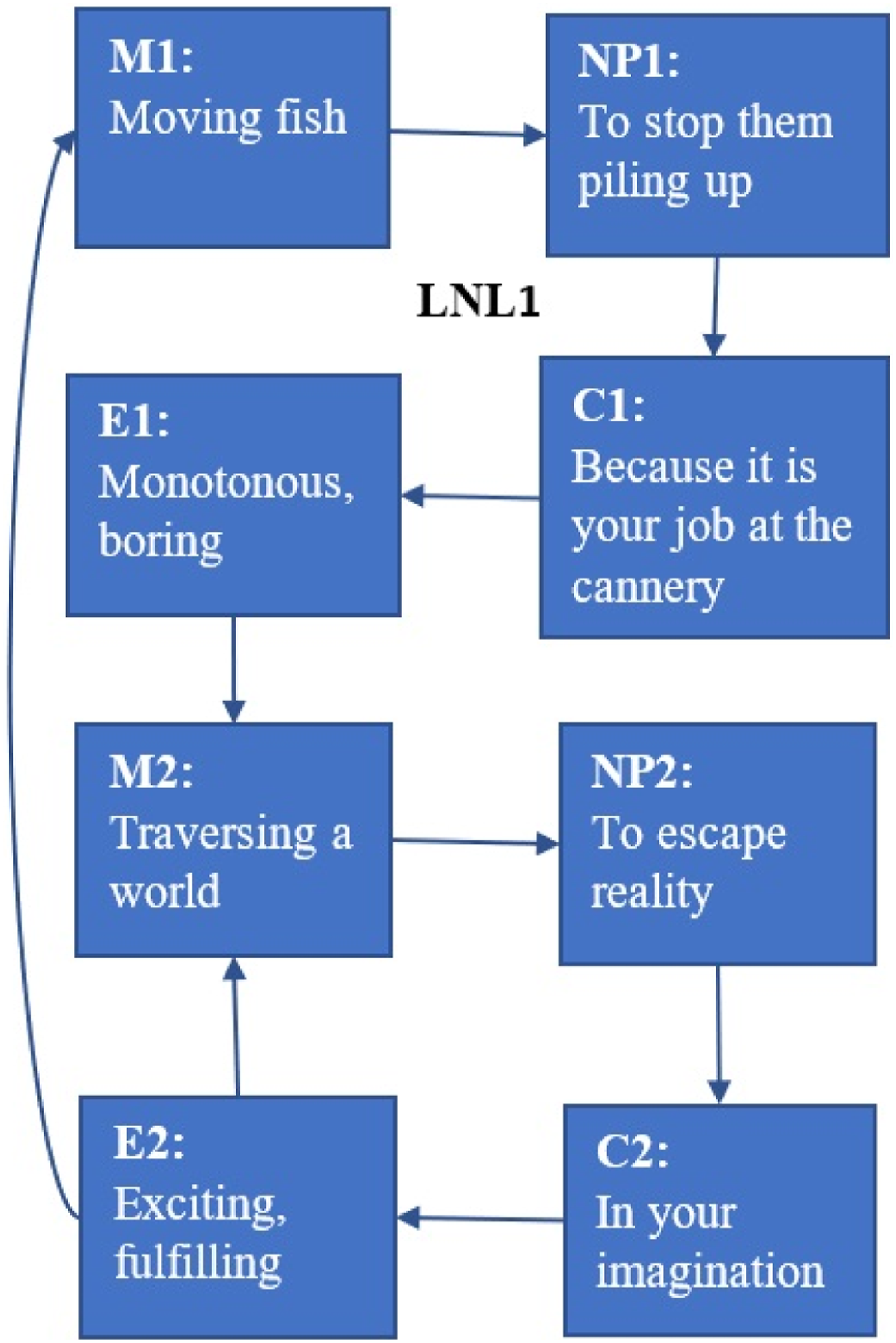
A design detail that helps travellers experience the feeling of becoming lost in the imaginary world is that the two mechanics require differing degrees of focus. Moving the fish is a repetitive motion. The traveller moves the joystick from left to right to up and back to left to repeat the action. The mechanic requires less concentration as the traveller becomes more comfortable with the motion. Navigating through the imaginary world, however, requires increased attention as they make their way through a simple maze structure, which transforms into bustling streets, navigating a boat between rocks, and even choosing between different paths, such as whether they follow the king or queen. The design of the mechanics draws the traveller’s attention away from moving the fish, which is Lewis’ physical reality, and toward the exciting world in Lewis’ imagination. As the traveller progresses through the scene, the imaginary world fills more of their field of view until it eventually covers the entire screen with only Lewis’ arm and the fish visible. This design choice allows the traveller to experience the imaginary world consuming their attention just as it consumed Lewis’ mind.
Another design choice that helps the traveller connect to Lewis and experience his desire to live in his imaginary world is the juxtaposition between environments. There is a noticeable contrast between the monotonous and grim task of chopping off fish heads and the bright and joyful imaginary world. Emphasising the variance between realities through colour and sound helps place travellers in Lewis’ mindset to understand why he prefers and pursues the fictional world. The cannery features muted colours, the drone of background machinery, and the sharp and shrill slicing of the guillotine. The imaginary world showcases bright colours and cheerful and catchy music, including drums, trumpets, clarinets, and cymbals. The use of cymbals is notable because they blend in and drown out the slicing sound of the guillotine. The sound of the guillotine slicing, which is highly prominent at the start of the scene, starts to fade into the clapping of cymbals while the fictional world spreads and blocks the sight of the blade. The scene further reinforces the disparity between fiction and reality when the golden doors of the palace turn into the doors of the cannery locker room. The traveller faces the grim cannery with blood and decapitated fish covering the floors. As the traveller witnesses Lewis chopping fish from the third-person perspective, they can see the sad and miserable reality of his job and physical surroundings. As they move up towards the brightly lit window, they are again met with a sudden switch from depressing to jubilant. The bright colours, cheering crowds, and catchy familiar music welcome the traveller even as they approach death. The contrast between the environments helps them see the situation from Lewis’ perspective and why he so desired his fictional world over his reality of working at the cannery. The final switch is when the music crescendos and stops, the screen turns black and the final slice of the guillotine rings loudly. This last switch snaps the traveller out of the imaginary world and reminds them of the tragic reality of events.
The ergodic mechanics in Lewis’ scene are ludonarratively harmonious. Although LNL1 diverges from the standard ludonarrative loop model and features two sets of elements, the scene uses the contrasting emotional responses from each mechanic to close the loop and reflect the wider context of the scene. Furthermore, placing the traveller in the first-person perspective of Lewis helps them embody Lewis’ mind and body when operating the mechanics. Additionally, the design of M1 and M2 helps shift the traveller’s focus from the simple and repetitive task of moving fish to the more complex and varied task of exploring and admiring the fictional world. This shift in focus, combined with the transition from slicing and machinery sounds to music, and the visual representation of the imaginary world filling the traveller’s field of view and blocking the cannery, represents Lewis’ detachment from reality and absorption in his imaginary world.
The under presents
Released in 2019, TUP is a complex and multilayered storyworld with three separate but related parts: ‘The Under’, ‘Timeboat’, and ‘Tempest’. ‘The Under’ is the world that travellers inhabit and features runs of live actors, mysteries to solve, interaction among travellers, locations to explore, and a magic system to master. ‘Timeboat’ and ‘Tempest’ are ergodic theatre experiences accessed within ‘The Under’. They are ergodic theatre experiences within an ergodic theatre experience. ‘Timeboat’, the focus of the following analysis, is a solo experience aboard a ship. Like ergodic theatre experiences such as Sleep No More, travellers can explore the boat, follow characters, and watch the many simultaneously occurring scenes to form their narrative. Travellers also have the power to control time. If the traveller is in the right location at certain critical story moments, the experience transports them to a new scene where they must complete a puzzle or challenge to save a character from death. The character’s puzzles are all symbolic, with varying degrees of clarity regarding their meaning. Sandy’s scene features one of the clearest storylines, which allows for greater focus on the ludonarrative relationship.
The premise of ‘TimeBoat’ is a doomed research vessel called The Aikman that becomes trapped in ice after a supernatural event. Sandy, her husband Billy, and research dolphin Gerald are aboard The Aikman; Gerald swims alongside the ship. Sandy and Billy are both marine biologists. While Billy researches molluscs, Sandy is developing a technique to communicate with her dolphin named Gerald. Sandy’s attachment and attentiveness to Gerald over the past five years leaves Billy feeling neglected. A supernatural event traps the boat in ice and distorts the flow of time. Believing Billy and Gerald dead and assuming her situation is doomed, Sandy mentions to another passenger named Weil, ‘bet it’s [drowning] peaceful, better than starving probably’. Once Weil leaves, she tentatively goes down to her submerged research lab. Sandy dies and is not present in the remaining scenes if the traveller does not interfere. Following Sandy to her lab, however, transports the traveller to a new scene involving a large glass water tank with airlocks on each side surrounded by five life-sized (relative to the traveller’s digital height in VR) dioramas. The five dioramas depict Sandy and Billy on their house’s porch, setting up a nursery, standing by a small grave, working with Gerald, and transporting Gerald. The traveller must intervene to pull apart the dioramas and place the scrap into the take through the airlock. The bits of debris then form the shape of a dolphin. Once fully assembled, the scrap dolphin jumps and swims outside the tank near the traveller. The scene changes to a final diorama of Sandy and Billy cradling baby Gerald. The broader context of the scene is a surrealist portrayal of Sandy’s mind as she attempts suicide. She is remembering the trauma of losing her child, and it is the traveller’s job to give her hope by reminding her how she converted her pain and grief into her work with Gerald; she has the strength to overcome grief and find joy.
To complete the puzzle and save Sandy, the traveller must throw enough scrap from the dioramas into the tank to form a dolphin. There are two core mechanics. The first is tearing apart the dioramas and getting the pieces into the airlock. Travellers must grab pieces of furniture, floorboards, walls, and whatever items make up the three-dimensional images and throw them toward the water tank airlocks. Once thrown in the general direction of the tank, items shrink and continue floating towards the airlock. The traveller then must press a button to activate the airlock that sucks the items into the tank, where they take the form of a dolphin. The second core mechanic is an automatic loop. At the end of 1 minute and 40 seconds, the scene loops back to the beginning with all the dioramas restored. A copy of the traveller appears and performs their actions from the previous loop. There are a total of four loops. The traveller fails and must restart the Act if they do not get enough scrap into the tank by the end of the last loop. Figure 4 displays how these mechanics fit with the other ludonarrative components. Ludonarrative loop for Sandy’s scene in ‘Timeboat’ from The Under Presents.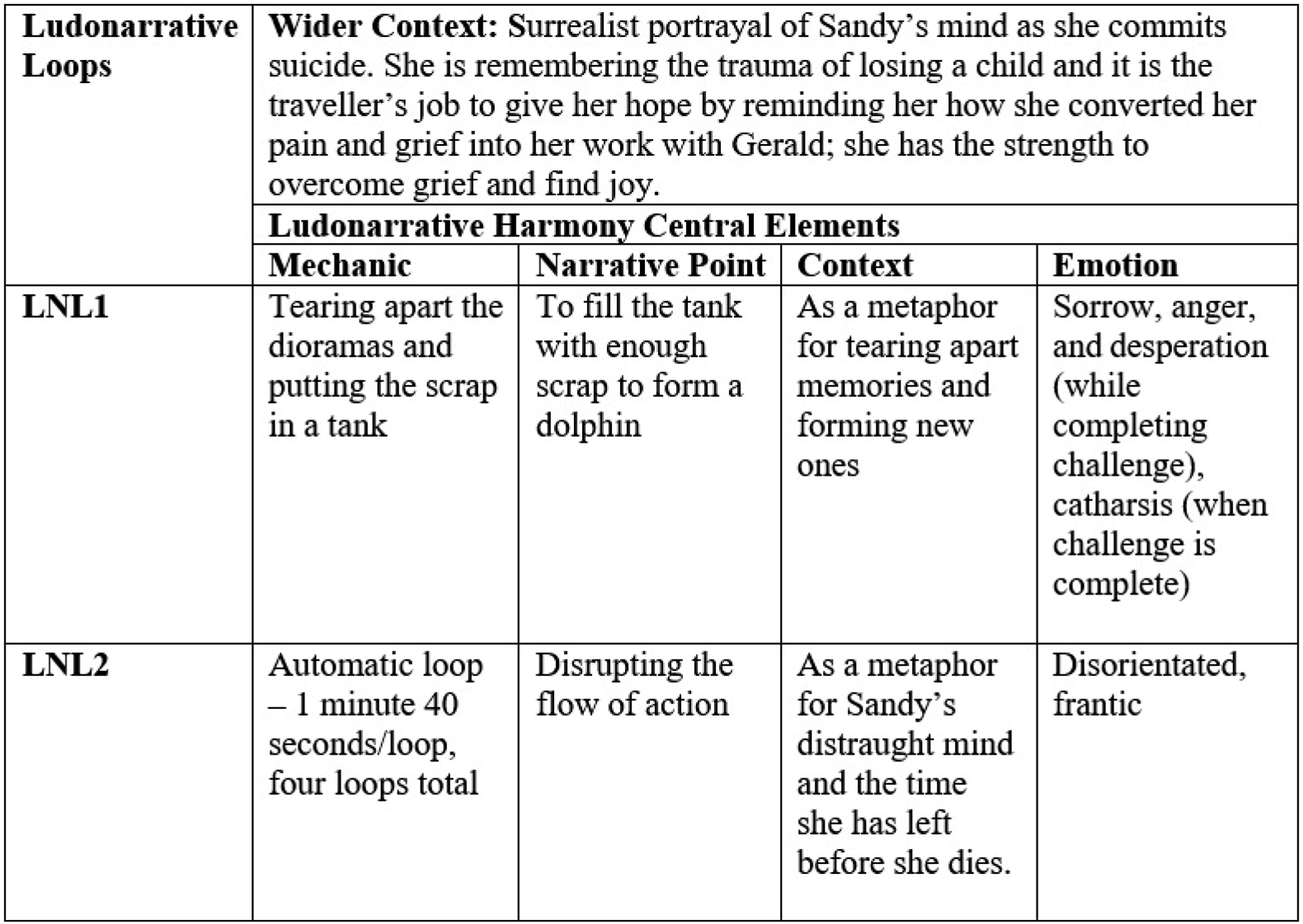
With LNL1, the mechanic is tearing apart the dioramas, and the narrative reason is to fill the tank with enough scrap to form the shape of a dolphin (Figure 4). The context is tearing apart the dioramas as a metaphor for destroying memories and developing new ones. The emotion is sorrow, anger, and desperation while completing the challenge and catharsis when the traveller finishes and can see the dolphin. Looking at the design of the mechanic, as the performance is in VR, the controls are more physical than digital performances that utilise a console controller or computer mouse and keyboard. Travellers must also physically reach with their arms and hold the controller’s grip button to grab items with either hand and then release and throw them towards the water tank. They then need to scrunch – locomotive mechanic where the traveller warps the environment towards them by pressing A or X on the controller to grab, pulling their hand towards their body, and releasing the button – back to the tank, jam any remaining items into the airlock and press the button to send the objects into the tank. The physical action of grabbing items instead of just pressing a button on a controller enhances the visceral feeling of destruction. The physical motion of tearing apart the VR dioramas mimics ripping up photos to erase painful memories.
For LNL2, the mechanic is the automatic loop – 1 minute and forty seconds per loop with four loops total – and the narrative reason is disrupting the flow of action and thought (Figure 4). The context is a metaphor for Sandy’s distraught mind and the time she has left before she dies, and the emotion is disorientated and frantic. A significant aspect of the mechanic design is the task’s small timeframe relative to the workload. The limited timeframe requires travellers to work at a near frantic pace to complete the task and save Sandy. The dioramas and tank are also quite spread out, requiring the traveller to travel reasonable distances digitally. The large scale of the puzzle space further enhances the speed that the traveller needs to work. The total time – six minutes and forty seconds – is also consistent with the time it takes for a person to die from drowning (Armstrong and Erskine, 2018: 13). Therefore, the looping mechanic’s timeframe aligns with the broader context of needing to save Sandy from drowning. Each loop concludes with the screen fading to black, representing fading in and out of consciousness as Sandy drowns. The scenes then reset, and the traveller appears in a new location. This disruption to the traveller’s flow of movement and thought disorients the traveller and feeds into the context of representing Sandy’s racing and disjointed thoughts during her emotional turmoil. The automatic loop and limited timeframe make the traveller feel disoriented and frantic as they try to save Sandy.
The ergodic mechanics in Sandy’s scene in Act Three of ‘Timeboat’ are ludonarratively harmonious. As LNL1 and LNL2 show, the loops are closed, with each element linking to the next (Figure 5). A deeper analysis of the design of the mechanics and how they relate to the narrative point and context highlights how they contribute to an emotional response. The physicality of ripping apart the dioramas in LNL1 helps travellers experience Sandy’s emotional state as she metaphorically tears apart old memories. The looping mechanics and time limit in LNL2 then enhance the feelings of panic and confusion in Sandy’s mind. Finally, after the frantic pace that the traveller had to work, representing Sandy’s racing thoughts, the traveller experiences catharsis, a chance to take a breath just as Sandy takes a breath when she chooses life over drowning. The traveller gets to share in Sandy’s emotional state of renewed hope and clarity as the traveller watches the scrap dolphin swim around and a new diorama of a happier future. The traveller didn’t just witness Sandy’s distress and eventual relief; they experienced these emotions through their engagement with the ergodic mechanics. Ludonarrative loop for Sandy’s scene in ‘Timeboat’ from The Under Presents.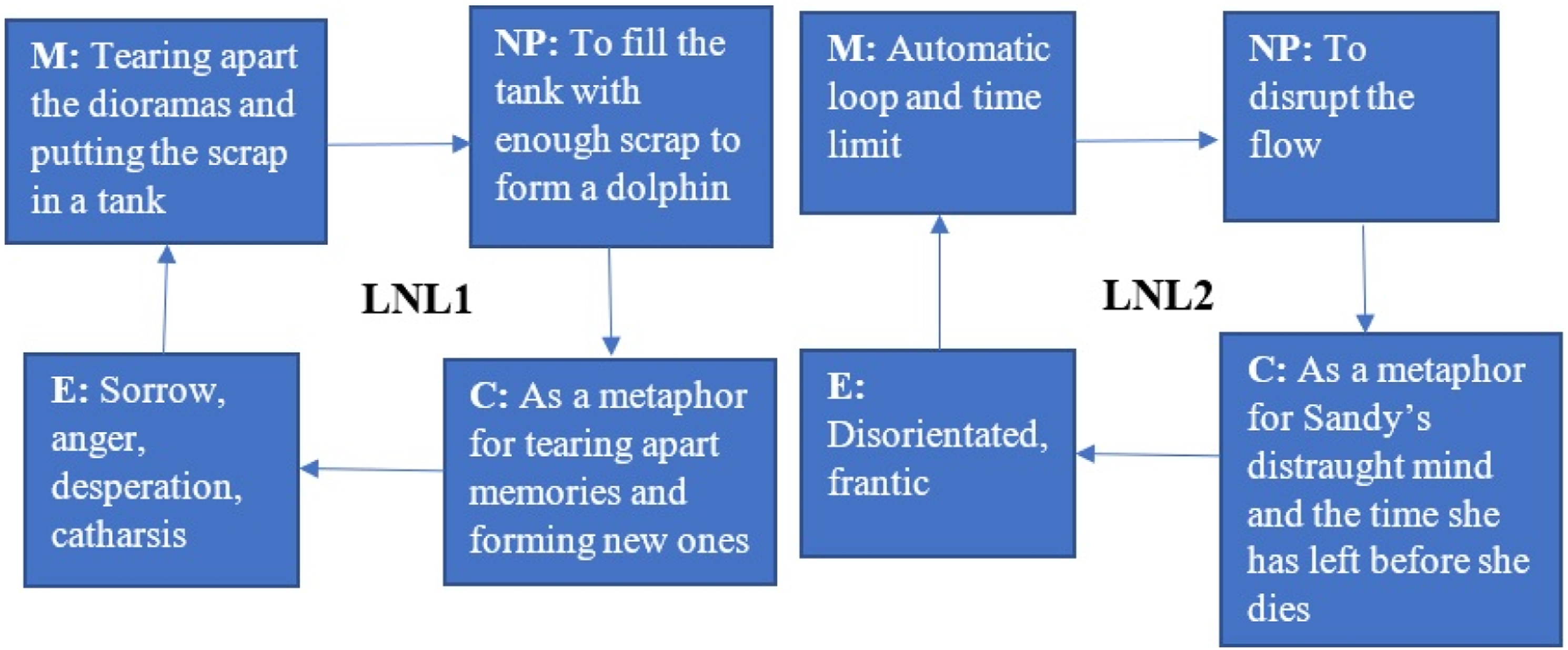
Dream
Performed in 2021, Dream was a research and development (R&D) project as part of the Audience of the Future program that sought to test the potential of including new technologies and modes of delivery (Audience of the Future, 2021). With the R&D label caveat, analysing Dream is valuable as future performances can build on the work’s foundations. RSC offered two ticket options, a free ticket to watch the performance and a paid ticket to interact with the storyworld. Here I analyse the paid experience. I would note, now, that there were noticeable discrepancies between how RSC advertised Dream and what they delivered, especially regarding traveller involvement. RSC advertised that using the ‘latest gaming […] technology’ (Audience of the Future, 2021), ‘[y]ou’re invited to explore the forest from the canopy of the trees to the roots […] and take an extraordinary journey into the eye of a cataclysmic storm […] take part and at key points in the play directly influence the world of the actors’ (Royal Shakespeare Company, 2021b). While these descriptions fit my ergodic theatre definition, the performance did not provide travellers with the agency or mechanics to form a path through the storyworld. For the analysis, however, I maintain the ergodic theatre classification and compare the delivered performance against what RSC advertised. The apparent advertising discrepancies are also significant as they contribute to traveller expectations. For some travellers, narrative immersion is more valuable than ludic immersion. It is reasonable, however, to assume that at least some travellers who invested in a paid ticket valued the promise of ludic immersion that RSC advertised.
Dream is inspired by the world and themes of Shakespeare’s play A Midsummer Night’s Dream (Royal Shakespeare Company, 2021c). Dream’s plot, however, is scant; the play is more about the experience of exploring the forest. RSC promotes that ‘[a]udiences are invited to explore the forest […] meet the sprites […] take an extraordinary journey [… and] regrow the forest’ (Royal Shakespeare Company, 2021d). This description implies a strong focus on exploration and experience. There are three main beats of action within the performance. These are exploring the forest and meeting the fairies, weathering the storm, and regrowing the flowers after the storm’s destruction. As interactive beats contain negligible differences, I focus on the traveller’s first interactive opportunity during beat one. In the performance, Puck begins exploring the forest but exclaims that it is dark and difficult to see. Puck stumbles across some fireflies – not controlled by travellers – and exclaims, ‘About the wood go, swifter than the wind and light it with thy firey glow worm eyes. Now sweet friends [addressing the travellers], I need your help, light my way’. Puck reinforces the task of lighting the area, saying, ‘show me thy golden light you firey glow worms. Cast though lead me through the glimmering night’. Puck then explores and examines various plants, trees, and flowers. The wider context of this part of the story, therefore, is exploring the forest and guiding Puck by lighting the sprite’s way.
Dream’s only mechanic is throwing digital fireflies into the storyworld to increase the light level in the first two interactive moments or throwing a single seed that turns into a plant in the third interactive moment. Whether a firefly or seed, the mechanic design and function are identical. During the interactive moments, the screen splits to display the live video on the left and a simple topographical mini-map of the virtual world on the right. Travellers use the firefly mechanic by clicking and dragging the icon of a firefly to aim at a spot on the mini-map. Releasing the icon sends the firefly into the storyworld displayed in the live video on the left. Travellers only control the firefly while aiming at the mini-map; they lose control when the firefly enters the storyworld. Although there is only one mechanic, there are two narrative points centred around exploring (LNL1) and helping (LNL2). I display these narrative points and corresponding components in Figure 6. Ludonarrative loop table for Dream.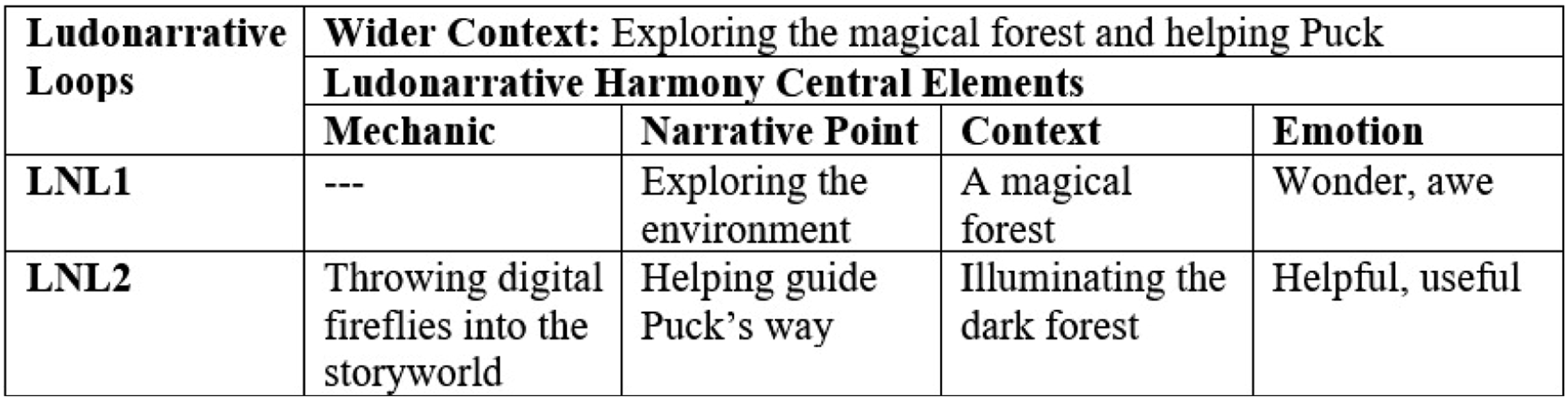
The narrative point in LNL1 is exploring the environment (Figure 6). The experience did not include any other mechanics or controls, such as controlling the field of view, other than the firefly mechanic. This mechanic, however, kept travellers distanced from the environment. They never moved within or interacted directly with the storyworld; their only interaction was with the topographical mini-map. Furthermore, although RSC advertised that travellers could use the mechanic to influence where Puck explored, which we could interpret as the travellers exploring the world, the simplistic aiming design makes this unlikely. RSC explains that ‘as the fireflies land, [T]he [F]orest speaks and describes the flowers and trees the fireflies are illuminating’ (Royal Shakespeare Company, 2021e). This description implies that the travellers could direct Puck by targeting specific areas with fireflies to dictate what The Forest described and where Puck explored. During the performance, however, this did not appear to happen. The aiming mechanism was simplistic and imprecise, making it impossible to aim at specific features. Consequently, the fireflies were distributed evenly, albeit sporadically, across the forest floor. The Forest, a pre-recording voiced by Nick Cave, would say the name of a particular plant that triggered Puck to search for it and examine it for a few seconds before The Forest said the name of another flower. There was no indication, however, such as an increased concentration of fireflies on certain plants, that travellers had any meaningful control over where Puck went. One reviewer was sceptical about the impact of their fireflies, saying ‘Do [we] really influence where to explore next?’ (Loxton, 2021). The firefly mechanic, therefore, did not facilitate travellers to explore the forest. The only way to explore the forest was through non-ergodic means – watching the live film. This means that LNL1 is incomplete and not conducive to ludonarrative harmony. Travellers may still experience wonder and awe at the visuals produced in Dream that they could enjoy through non-ergodic means, though the mechanic did not enhance these feelings. Additionally, the split-screen design of the firefly mechanic limited the traveller’s view of the live video. Instead of the video taking up the whole screen, it now only took up half. When watching the performance, I also found that the moments of interactivity heavily divided my attention. Though aiming was not difficult, it did require some concentration, and I found my eyes darting between the mini-map and the performance. The smaller viewing window and attention needed to aim the fireflies start to push the relationship between the firefly mechanic and the narrative point of exploring into the realm of ludonarrative dissonance. The dissonance is triggered because the mechanic detracts from watching the live video, which is the traveller’s only means of exploring the forest.
For LNL2, the narrative element is guiding Puck by lighting the forest way (Figure 7). On the surface, each element of LNL2 appears to link to the next: throwing digital fireflies to guide Puck’s way through a dark forest makes the traveller feel helpful or useful, so they continue throwing fireflies. The issue, however, lies with the design of the firefly mechanic. Firstly, as I discussed above, the firefly mechanic design made it difficult, if not impossible, to accurately aim and guide Puck. With minimal points of reference to aim at and no way to distinguish which firefly was mine once it entered the storyworld, I ended up mindlessly flinging the fireflies at the mini-map; far from the goal of guiding Puck through the dark. The ineffective aiming mechanism design prevented the mechanic from fulfilling the narrative point of guiding Puck. Secondly, the fireflies emitted limited light. According to the story, the forest was too dark for Puck to navigate safely. Increasing the number of fireflies within the storyworld, however, did not produce a noticeable light difference. One reviewer commented that ‘my attempts were more glow-worm than floodlight, with no discernible effect on the action’ (Clapp, 2021). The story asked travellers to ‘light it with thy firey glow worm eyes […] light my way’. Mechanically, however, the fireflies did not serve this purpose. The fireflies were far too dim to make a noticeable visual difference in the environment. The mechanic, therefore, did not adequately serve the context because it did not illuminate the dark forest. The result is that the firefly mechanic was not conducive to the satisfying emotion of feeling helpful. Ludonarrative loop table for Dream.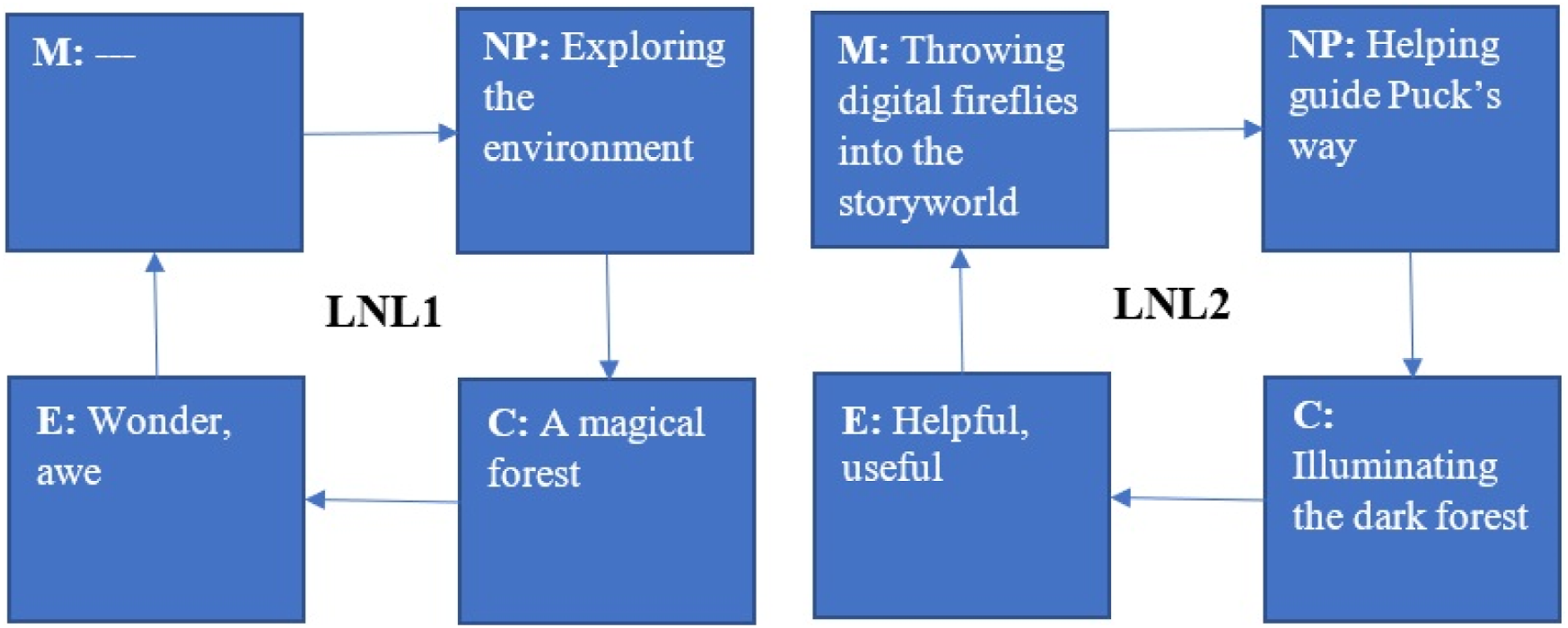
The ergodic mechanics in Dream did not produce ludonarrative harmony. LNL1 highlights that no mechanic enabled travellers to explore the forest or generate a sense of wonderment of RSC’s digital world (Figure 7). Travellers could still experience narrative immersion and visually enjoy the digital world that RSC created. But even then, the firefly mechanic starts to cause dissonance as it reduces the traveller’s ability to concentrate on the visual experience fully. LNL2 then highlights the critical role of design and how it can alter or reduce the mechanic’s success in creating harmony. Simple adjustments, such as a more accurate aiming system and greater contrast between the environment light level and the light radiating from the fireflies, would enhance feelings of helpfulness and fulfil the narrative point of guiding Puck through a dark forest. While the firefly mechanic’s novelty may increase engagement for some travellers, analysing the ludonarrative loops demonstrates how altering the mechanic’s design would produce a more harmonious experience.
Conclusion
Far from Ebert’s critique that relinquishing a degree of authorial control to the player makes digital games an inferior medium, ludonarrative harmony demonstrates that the interplay between game mechanics and story can produce a deeply engaging, meaningful and satisfying experience. Additionally, ludonarrative harmony demonstrates that mechanics are not separate from the game or ergodic theatre’s story but are intimately linked. As with dramaturgy, ludonarrative harmony aims to weave the mechanics, narrative point, context, emotional response, and the wider story context into a meaningful and coherent whole. The chosen scenes from Edith Finch, TUP, and Dream demonstrate how the loops function as a method to identify if any elements are either missing or causing dissonance in ergodic theatre. Furthermore, ludonarrative discussions are valuable for identifying how travellers emotionally respond to the story and how this response is either enhanced or disrupted by their engagement with the available mechanics. The three case studies highlight that the design of the mechanic impacts whether or not the loop generates a desired emotional response. Ergodic theatre is an emerging genre experimenting with the line between theatre and gaming. Ludonarrative harmony as a concept and ludonarrative loops as a method are effective at weaving ergodic mechanics with the other performance elements. As ergodic theatre continues to experiment and explore the potential of ergodic mechanics to enhance the story and themes, ludonarrative harmony provides the framework to enrich the traveller’s theatrical experience and increase the success of future works.
Footnotes
Acknowledgments
I would like to thank Dr Bernadette Cochrane and Dr Maureen Engel for their valuable feedback and advice on this article.
