




Abstract
Virtual reality (VR) technology is an emerging medium of experience in many different public-facing entertainment and cultural contexts, such as immersive theatre, live performance, VR film festivals, gaming arcades, escape rooms, and museum exhibitions. The processes of ushering audience members or users into the virtual experience and out again, to which I refer here as ‘onboarding’ and ‘offboarding’, have been considered within some specific contexts, or on a case-by-case basis, but to date no systematised consideration of VR onboarding and offboarding has been produced. One reason for this is that ambiguities in disciplinary and practical definitions of immersion have obscured the relationship between VR technology and users. Clarification of this relationship results in clear evidence of a need for attention to onboarding and offboarding processes in public-facing contexts. In this paper, I define onboarding and offboarding, and present a framework for considering the onboarding and offboarding experiences of virtual reality audiences that helps stakeholders identify both their responsibilities to audiences and the best way to facilitate the immersive experience. This framework is based upon identifying experience goals, centred on the affordances of virtual reality and principles of immersion and presence, and utilises the Immersive Audience Framework developed by StoryFutures in its interdisciplinary research with immersive audiences since 2019.
Keywords
Introduction
Much scholarship on virtual reality attends more to the state of immersion than the processes of achieving immersion or the implications of the entries to and exits from the immersive experience. For example, although the much-cited review by Slater and Sanchez-Vives (2016: 4) begins by acknowledging that perception is an active and individual process, and distinguishes between the autonomous and cognitive processes that shape perception (6), the remainder of the review of the body of research on VR enumerates various states of immersion, emphasising perception as a response to a stimulus; there is no attention to the process by which individuals experience this stimulus beyond psychological processes occurring within the moment of response. As I will explore in Part II, theories about the experience of immersion itself are bedevilled with inconsistencies of definition, depending on the context of the experience and the disciplinary perspectives of the scholars. While this is understandable in many ways, given the myriad use cases and contexts for VR, the medium of virtual reality itself suggests some core concerns that deserve consideration in relation to user experience, which may be relevant to numerous use contexts. Practitioners and theorists of immersive theatre and live cinema have reflected extensively on the experiences of the audience or participants within the event, considering the means by which immersion is achieved, the types of participation invited, the mediation of technology, and the relationship between virtual and real (e.g. Biggin 2017; Frieze 2016; Giannachi 2004; Kennedy and Atkinson 2018; Machon 2013; White 2013). In particular, scholars who have considered the role of the senses in immersive theatre (Machon 2013; Ramos and Maravala 2016; White 2013) offer valuable reflection on the processes, ethics and politics of guiding audience transitions in and out of immersive theatre experiences, sometimes framed as a ‘contract of participation’ (Machon 2013). To foreground the technology, however, it is notable that there are many different use cases and contexts for virtual reality, even within entertainment or cultural sectors, including live VR performances, VR film festivals, VR cinemas, gaming arcades, escape rooms, and museum exhibitions – to say nothing of the consumption of VR content in home spaces.
However, in these contexts, consideration of the processes of ushering audience members or users into the virtual experience and out again, a process I will refer to here as ‘onboarding’ and ‘offboarding’, is often notably absent. While I will further elaborate on the definition of these terms in Part II, for now I will define onboarding as the process followed to guide users to understand technically and conceptually how to participate in a VR experience, facilitating their ability to successfully attend to and participate in the experience (i.e., one might say, though I will problematise this below, to become ‘immersed’). Likewise, offboarding is the process followed to guide users in their transition out of the virtual experience, returning their attention to the physical world. However, in many VR contexts, these processes are given scant consideration: VR audiences are often treated in the same manner as screen audiences, with similar processes and levels of guidance, left more or less on their own to negotiate their experience. Sometimes this neglect has negative physical, psychological, and social effects – for example, experience of personal physical or social harm (Aymerich-Franch and Fosch-Villaronga 2019); gendered senses of discomfort (Bailenson et al. 2001); breaches of personal data security (Adams et al. 2018); motion sickness, information overload or disorientation (Behr et al. 2005); violation of personal space, unexpected strong emotions and overwhelming exposure to experiences that mirror scenarios to which users have a real-life aversion (Castaneda et al. 2018); harassment, breach of privacy and exposure to negative social environments (Maloney 2021; O’Brolcháin et al. 2016); and misunderstandings of empathy toward others (Martingano et al. 2021; Nakamura 2020; Nash 2018).
Despite some attention to the need to assist audiences in their immersion on a case-by-case basis (e.g., Dunne et al. 2018; Kennedy and Atkinson 2018; Lopes Ramos, Dunne-Howrie, Maravala & Simon 2020; Wilson 2020), to date no systematised consideration of VR onboarding and offboarding has been produced. In this paper, I draw on 3 years of audience insight research, including longitudinal, qualitative research with VR audiences and shorter-term, site-specific audience insight and user testing, to consider the challenges of transition in and out of virtual reality. I bring this research into dialogue with insights from immersive theatre and live action role play about the rationale for considering the onboarding and offboarding of audiences, and show that stakeholders in VR exhibition, whatever the context, should consider both their responsibilities to audiences and the best way to serve the practical or creative goals of the immersive experience. I present a framework for onboarding and offboarding based upon identifying experience goals, centred on the affordances of virtual reality and principles of immersion and presence, adapting the Immersive Audience Framework (Bennett et al. 2021) developed through StoryFutures’ interdisciplinary research with immersive audiences since 2019.
This paper will be structured in three parts. In the first section, I present three case studies that demonstrate the challenges of transition in and out of virtual reality for audience members. The second part explores the notions of onboarding and offboarding in detail, drawing on literature on immersive theatre and live action role play. I argue the need for a comprehensive framework that guides onboarding and offboarding practices, founded upon a definition of immersion that recognises a reflexive relationship between audience members and technology. The third part demonstrates how this framework can be used to explicitly define experience goals, technology affordances, user agency, and user risks. I will then briefly set out principles for putting the framework into action, including understanding and planning the immersive process, training hosts or staff members, and monitoring audience experience. This paper aims to provide both a theoretical basis and a practical guide to onboarding and offboarding which should be of interest to anyone involved as a creator, commissioner, exhibitor, or researcher of virtual reality entertainment or cultural experiences.
Part I: Case studies of transition in and out of virtual reality
The following three case studies provide examples of different contexts for VR, and in each the act of transition in and out of virtual reality is foregrounded as a site of friction between a physical and a virtual world. The first two case studies are drawn from our team’s ethnographic research (see Appendix 1 for a more detailed description of our research methods); the last case study is an autoethnographic account of the author’s experience.
VR gaming in the home
In our ethnographic study of home users of virtual reality, a very popular activity that our participants engaged in was playing Beat Saber (2019) on their VR headsets at home. The game was most enjoyable for them, however, as a social activity, where they would take turns playing and observing each other’s play. Our research took place before Beat Saber’s October 2021 release of multiplayer mode, but several of our participants nonetheless found ways to play together, taking turns on various levels, as the most pleasurable way of experiencing Beat Saber. They accomplished this at times by casting the view from the headset to their mobile phones and then screencasting their mobile phones to the television, but often they simply watched the person in-headset thrash an imaginary saber around, ducking and twisting and shouting. They reported inviting flatmates or family members – from little brothers to grandmothers – to take part: one participant wrote, ‘3 of my flatmates are in the room with me, we are all taking turns trying out the game. We are all finding the game funny and enjoyable as some of us are better than others and we can mess about in the game. When one of us is in the headset we are usually describing what we see to the others’ (George, media diary, 18 January 2020). The context here is the home, not an exhibition venue or public space; but the participant is surrounded within a social context, with family and/or friends watching. The entertainment and appeal of this is that the person in the headset is partially somewhere else; they are there with you in the room, but they are also distinctly in another world that has different rules and norms. In interviews, participants reflected on a process of ‘getting rid of your other senses’ and moving into the other world from which ‘you can’t get out quickly’ (Leo, interview 18 June 2020). Their actions and behaviours are only coherent in that other world, and it is the lack of coherence of their actions in the real world – taking place in the virtual world but visible to those in the physical world – that provides amusement for onlookers. Players are aware that they are simultaneously away and present in both worlds. They are aware that their behaviours do not make sense in the real world, but by engaging in this context they willingly consent to becoming sources of humour. One participant related the experience of watching his brother play Beat Saber: ‘My little brother… would jump all over the place and stuff. And luckily, we’ve got a big space in the lounge so he was fine, but I think he was very consumed, he had no real subconscious understanding of where he actually was in the real world’ (Noah, interview 25 June 2020). This has enormous social potential: another participant reflected, ‘What surprised me is, although one person's using it, how much it can bring people together…’ (Julia, interview 13 January 2020).
Immersive cinema
Undertaking a weekend of research in 2019 with audiences attending the Limina Immersive cinema pilot project in Bristol, my colleague and I spoke with its CEO, Catherine Allen, and some of the hosts working alongside her to deliver accessible VR experiences to first-time audiences, and documented the exhibition process as both participants and observers. The goal of the Limina Immersive cinema was to widen the audience base for VR, introducing people who would not normally see themselves as target VR audiences to the world of VR film. We observed that its audience demographic definitely seemed to skew older and more female than the stereotypical ‘young white male gamer’ headset user. Careful attention was paid to the creation of an environment that is welcoming, non-threatening, comfortable and safe, ensuring that people’s first experience of VR was not off-putting in any way and that they were amenable to immersion. Allen and her team created a spa-like environment, with soft furnishings in the waiting area, low lights, soft blankets, and cushions, even some scented aromatherapy diffusers at times. People spoke in soft tones, and at the time for the screening to begin, audience members were ushered behind protective fabric screens, away from the front windows and the curious eyes of passers-by on Bristol’s harbourside. They were seated on stools that spun, and their bags and belongings taken into protective custody by the hosts, valuables locked away securely while they were out of this world.
Hosts explained to audiences how the headsets work and how to put on the headsets and headphones. They told the audience members they could ask for help at any time by putting a hand up, but that they would otherwise be putting the equipment on themselves unless they requested assistance. The hosts would not touch them, they explained, unless in case of emergency, and then only by a gentle touch on the shoulder, so as not to startle them. Audiences were asked if anyone preferred another method of having their attention drawn than this touch. They were asked to remain seated for their safety, but told they could feel free to turn in their seats to explore the space. Once in headsets, a loading screen allowed them time to orient their vision to the 360-degree virtual space, and once everyone was ready, the films launched and ran simultaneously. Afterwards, the same virtual space prompted people to remain in the space and gradually become aware of their physical surroundings, and to take the headsets off when ready, remaining seated for as long as they needed to. Hosts came around to collect equipment and return belongings, and audiences were encouraged to take a few minutes in the waiting area, if they wished, before going back out onto the busy harbourside. Many people took the opportunity for a glass of water with cucumber slices, and spoke to each other in hushed and happy tones about their experience.
Film festival
It is 2019 and I am at a film festival, excited to see some new VR films. The venue is a long room with a wooden floor. Various stations are erected around the room, some of which involve screens or signage. Computers are clearly the source of the VR films, tethered to various brands of headsets. I wait for an opening to try a film that I have chosen from the programme. The previous participant leaves, and I approach the staff member who is absorbed in rebooting the experience on the computer.
Once it is initialised, I am handed a headset with the simple instruction, ‘Here you go’. It is not a brand I have used before, and at this point I am relatively new to VR, but it is more or less evident how I need to put it on. I am standing in an open space, connected to the computer, but otherwise without any surrounding barriers. ‘This is best experienced sitting down’, I am told. But there is no stool or chair. ‘Just… on the floor’? I ask, and the staff member responds affirmatively. I am wearing a restrictive skirt, and I have some physical limitations that are perhaps not evident to the staff member. Nonetheless, I struggle to a seated position, where I stay for the duration of the film. I am aware that people are moving around the room, walking past me and around me. The film takes place around me in approximately 270°, so I crane my neck and scootch around on the floor, ever conscious of needing to protect my modesty, and aware that I am definitely not comfortable. At one point the cables are twisted around my shoulders and I blindly work out a way to fling them over my head.
At the end of the experience, I have to wait for one of my legs to regain sensation after it has fallen asleep. I start to stand, still in headset, and then think this is not sensible. I take the headset off and lay it on the floor so that I can have my hands available to help me stand up without the aid of any person, chair, or supporting structure. The film was nice, I think, but I was certainly not able to appreciate it fully; I think I was supposed to feel childlike, playing with my toys on the floor during this experience, but I was tethered more to the real world by my social and physical discomfort than I was to the VR experience via the headset.
These three accounts indicate very different ways of negotiating the space between the physical and virtual reality, as well as various goals and social contexts for the experience. They demonstrate one important principle: where one takes responsibility for another user’s experience in a VR headset, it is incumbent to realise that the user is not simply being invited to be a spectator of virtual reality content; they are being asked to actively invest their embodied consciousnesses. This suggests that the scope and quality of this investment need to be considered in terms of processes for guiding these transitions in alignment with the creative, practical or programmatic goals of the content.
Part II: Onboarding and offboarding: Invitations, frames and emergence within immersive experiences
The metaphor of travel inherent in the terms ‘onboarding’ and ‘offboarding’ has been thoroughly subsumed by organisational usages, referring to a planned process for introducing new employees to the workplace and helping them to ‘acquire [] the social knowledge and skills necessary to assume an organizational role’ (Van Maanen and Schein 1979: 210). Both contexts have comparative relevance to a virtual reality experience: by onboarding users, we hope to transport them to another (virtual) place; we aim to help them understand the vehicle by which they will travel, and provide the knowledge and skills they need to do so safely and effectively. These metaphors elicit VR’s key affordance of immersion as both the vehicle of transportation and the context of experiential activity.
Virtual reality as a technology is often defined by its dual promises of presence and immersion in a virtual space. While practitioners and theorists of immersive theatre have considered in depth how this sort of presence and immersion will be achieved in the world of the drama, with or without the aid of technology, not all contexts where VR is used in entertainment spaces have evidenced the same consideration. Indeed, the problem begins with overlaps between definitions of immersion and presence. Calleja (2011: 21–22) observes that while Slater and his various co-authors tend to contrast a technology-focused definition of immersion with a psychology-focused definition of presence, other authors (e.g. Witmer and Singer 1998: 227) use the term immersion for what Slater et al. describe as presence. For example, one technology-focused definition of immersion, ‘how well [the VR headset] can afford people real-world sensorimotor contingencies for perception and action’ (Slater and Sanchez-Vives 2016: 37) can be juxtaposed with presence as a response to this affordance: ‘the propensity of people to respond to virtually generated sensory data as if they were real’ (Slater et al. 2009: 194); by contrast, a psychological definition of immersion as ‘a psychological state characterized by perceiving oneself to be enveloped by, included in and interacting with an environment that provides a continuous stream of stimuli and experiences’ (Witmer and Singer 1998: 227) is an element that then overlaps with presence as ‘the subjective experience of being in one place or environment, even when one is physically situated in another’ (225).
There is not necessarily a problem with a definition that focuses on technology, but the frequent practical usage of the term ‘immersion’ to signify both technological capability and a human response to this technological capability muddies an understanding of the relationship between technology and its users. Overemphasis on technology results in placing the focus for presence and immersion within the moment of the immersive experience itself, isolated from a sequence of events and a timeframe that has a very real impact on the immersive experience. Moreover, an overly technical definition endows the technology and developers of the experience with undue agency, framing a cause-effect perspective of its impact on human senses and cognition. This view situates the people in the headsets as users of the technology, rather than as participants in the experience who retain some level of autonomy in their response to the technology and the medium. It does not recognise variation in levels of experience, physical difference, or indeed the life stories and individual circumstances amongst which the immersive experience figures. It also misrecognises the relationship between the physical environment and the virtual one, a misunderstanding Calleja characterises as a problematic assumption of immersion being a ‘unidirectional plunge into a virtual world… excluding the real world so completely as the participant is submerged into the virtual environment’ (Calleja 2014: 10). To focus on technology alone, Hollett et al. (2020: 57) argue, ignores the impact of differing ‘feeling histories’, which are the ‘embodied ways of sensing, feeling, and moving within digital environments’. They note that certain VR experiences or tasks require specific types of feeling histories, giving the example of learning to row in VR, and note that users without these feeling histories may experience ‘frictions’, or ‘sites of bodily contestation’, when their personal ‘feeling histories’ and the requirements of the VR experience do not align.
This signals a need for a much more flexible, individual notion of immersion that centres on the user rather than the technology, and includes not only the time within the experience in a VR headset, but also the time before and after the experience – recognising that frictions can arise for users at any point during this longer process. Some attention has been paid to this process in terms of the marketing of VR experiences (Freeman et al. 2021; Jarvinen 2020), exploring the way that promotional materials and activities such as ticket purchase can guide audiences in setting expectations, orienting them to their forthcoming experience, and facilitating sharing experiences that feed back into promotion. However, for the purposes of this paper, I focus not on promotion but on the process of supporting audiences attending the main event, and largely on the role of hosts or event staff who facilitate their immersion in the virtual world.
What scholars of immersive theatre and immersive exhibition emphasise is that immersion is not instantaneous, and that it must engage with the agency of individual audience members. For Machon (2013: 83) audiences must ‘become attendant’, a process in which a ‘reciprocal, sensual relationship [is] established between self, space and other bodies in the space’. In fact, the self must relate to two spaces: on one hand, the physical environment in which one’s body is situated; on the other, in a virtual world in which the self is enveloped, which has its own aesthetics and rules (55). Audience members are at once attuned to agents within the virtual world and to their own and others’ bodies in the physical world. Whether or not these bodies are directly related to the activity at hand, the presence of other bodies in the space implies relationship. This relationship may be antagonistic, ambivalent, or complementary to the immersive experience. I argue that outside the immersive theatre context, these relationships between the person in the headset, the spaces they are in, and the others that occupy the space with them are also significant elements of VR experience. 1
Offering insight from games studies, Calleja’s (2011) term incorporation perhaps better serves an understanding of VR encounter that accounts for its contextual and personal situatedness, and allows for the consideration of the specific qualities of the medium of virtual reality. He identifies two common metaphors implied in the usage of the word immersion: immersion as absorption (indicating a state of concentration and interest) and immersion as transportation (indicating a state of reorientation to another reality). The main problem with these metaphors and the common usage of terms immersion and presence, he argues, is that they foreground discontinuity from the real, physical world (2011: 167) rather than the movement between, or attention to, both physical and virtual environments. He offers the alternative metaphor of ‘incorporation’ which offers two, simultaneous senses of inhabiting a virtual environment: the user’s cognitive incorporation of the virtual environment as a part of their immediate surroundings, and the incorporation of the user within a virtual environment (169). This two-directional model accounts for the design of the experience, the affordances of the technology, the agency and perception of the user, and the influence of the physical space in which the virtual experience takes place. While some (e.g. Machon 2013) see in Calleja’s metaphor the possibility of ‘total immersion’ that achieves both absorption and transportation, Calleja notes that idealisation or fetishization of this type of ‘complete’ experience is not necessarily essential to its enjoyability or success when discussing game environments (2011: 29).
The notion of ‘incorporation’ as a reflexive relationship between the user’s experience of virtual and physical worlds is also useful for defining the goal of a VR experience: does it intend for the user to be captivated and focused on the action in the headset, or does it intend for them to feel as if they are fully transported to another space? To what extent does it aim to displace them somatically or psychologically from their physical space? As VR headsets largely block a user’s visual perception of the real world, arguably visual ‘substitution’ is a presumed baseline objective of virtual reality, although increasingly the development of mixed reality affordances that incorporate the real world – already hinted at in mainstream VR with the possibility of pass-through and hand tracking – potentially complicate the idea of a baseline. These developments make it all the more important to understand the individual VR experience being exhibited or distributed and what will help audiences to experience it as intended – whether entering or emerging from the experience.
The invitation to enter the experience
White (2013) focuses on the ‘invitation’ element of immersive theatre, with an entire monograph attending to the act and process of extending and accepting the invitation, theorising what happens in these moments. Theatre audiences are always to some extent participants, he argues, responding to performance with attention, emotion, or applause, for example, but in his focus on active audience participation in the action of the performance, he points out that audience members are simultaneously performing themselves but also performing ‘audiences’ (5). For awareness to shift to their role as ‘audience member’ they must be offered a new ‘frame’ in which to participate, drawing on Goffman’s concept of ‘framing’. Frames are simply ‘organisational premises’ that humans use to understand our position in the world and in events, to make meaning of them, and to understand what behaviours are appropriate in this context. Goffman’s ‘definition of the situation’ points toward an agreement between the people within the frame, and the potential or scope of the event or interaction. VR is also an event or an encounter. Inasmuch as it is frequently experienced in the presence of others, guided by others, participating alongside others, certain ‘definitions of the situation’ arise. That is not to say that these are consciously shaped in all circumstances; nonetheless agreement must be sought in order to achieve the expected experience.
The virtual reality medium thus demands a particular attention to the definition of the situation regarding the negotiation between real and virtual. These must not be construed as opposite ends of the spectrum: in fact the relationship between real and virtual may be contested and changeable. Giannachi sees the relationship between virtual reality and reality as paradoxical: On the one hand, [the virtual] is part of the real; yet, on the other, it has to be constructed as different from the real in order to be perceived as separate from it. Thus, virtual reality consists of a dichotomous paradox, torn between its ontological status which locates it as part of the real and its aesthetic, through which it demonstrates its difference from the real. From the point of view of perception, a viewer experiences this dichotomy as the principal characteristic of virtual reality. A viewer is both immersed within the virtual (in the sense that they are part of it) and interacting with it (and so they are separate from it). (Giannachi 2004: 123)
Massumi points out that the construal of the virtual as unreal or illusory is a contemporary phenomenon, emerging with Deleuze’s reinvention of notions of the virtual in the 1990s. He positions the virtual as ‘a dimension of reality, not its illusionary opponent or artificial overcoming’ (Massumi 2014: 2, italics original). While the virtual is abstract, it is best thought of as an intermedial space that offers ‘a sense of being between material and immaterial realities’ (Wilson 2020: 127). Therefore, it is useful to perceive virtual reality as an invitation to ‘reflect on the reality of the virtual, the potential of virtual reality to create real perceptions’ (128, italics original). VR therefore offers this opportunity but also requires the user to negotiate this paradoxical relationship and the crossing over of these states. The moments within immersion are also complex and not necessarily straightforward. While VR is a ‘technology of mediation whose purpose is to disappear’ (Bolter and Grusin 1996: 315), its mediation concealed in the achievement of complete attention, in fact the negotiation of the user between material and immaterial, or virtual and physical worlds, is ongoing. Moreover, the ‘breaks in presence’ that might be characterised as failures of technological affordance Wilson argues are but moments in which those wearing headsets relocate themselves as embodied beings, ‘to ask questions about embodiment and humanity through the experiences of our individual bodies’ (Popat 2016; in Wilson 2020, 122). Awareness of one’s physical body in the virtual space, or proprioception, may be disorienting but may actually contribute to the desired effect of the virtual experience. A confusing or unsettling state caused by the doubling of perception in VR can actually speak to the goal of the piece; the end goal of virtual reality is not always total immersion or a ‘unified feeling of bodily presence’ (Wilson 2020: 122). Thus, keeping in mind the goal of the experience and the slippage or negotiation between material and immaterial that VR requires of the user, the sorts of immersion sought are best not left to chance, but foregrounded.
Machon (2013: 66) notes the frequent misuse of the word ‘immersive’ as a descriptor of theatre experiences. Equally, in the advertising for an ‘immersive exhibition’ it is frequently unclear what the forms of ‘immersion’ are, what types of technology (if any) will be used, and how the audience will be expected to participate (if at all). The word ‘immersive’, she argues, needs to be used to define rather than describe – intention and framing are essential to understanding the goals of immersion. Much immersive theatre, Wilson (2020, 129) observes, includes a ritualised element that directly comments on the liminal space between virtual and physical worlds as an element of the invitation to become absorbed within it or transported in or out of it. Machon elaborates on the invitation to immersion – to whatever degree it is desired – in the preparation of the audience. In immersive theatre, this is frequently a considered, intentional, detailed process that involves… …preparation techniques to gently immerse you in the world: pre-performance rituals and framings to acclimatise the guest participant within the work; antechambers where you are masked, introduced to characters or guides who will take you through the world; or settings which steep you in the outlandish environment…. Sometimes the contract of participation is made clear beforehand as part of this process, whether written for or told to you… or verbally guided through audio instruction. Alternatively, sensory awareness may be gently suffused into and drawn out of you as you embark on the physical journey to the event…. A number of practitioners blend a balance of the two,… [presenting] clear written guidelines related to the requirements of the event prior to and during one’s individual journey to the work and an immersion of the individual into the piece once the collective journey is begun with the other participants in the event. (Machon 2013: 84)
Several elements of this preparation or invitation are evident here – the genre of the event, the space in which it occurs, the techniques of immersion, the time flows of the experience, and the contract of participation established with the audience members themselves. There is thus implied responsibility for guiding audience members into a VR experience, and facilitating the responsibilities that audience members have to themselves and each other. This process of scene-setting, orienting, soliciting attention, negotiating relationship, setting expectations and inviting consent constitutes ‘onboarding’. These responsibilities can be defined using a framework that I will explore shortly, but also include such considerations as duty of care toward audience members and their health (which, I would clarify, includes psychological or emotional health) and safety. Certainly some immersive theatre experiences are meant to disturb or to provoke, to disorient; however, these kinds of encounters take place within a frame that provides a certain ‘definition of the situation’ and best facilitates the invitation to immersion within that frame. To an extent, it is not often the VR content itself that commands attention, but rather the experience of that content. The object of attention in immersive theatre, Frieze (2016: 23) suggests, is not merely the content but ‘the ways that our attention is managed, the ways in which our engagement is co-opted with and as content’. I argue that this is also true in VR experiences, although this management of attention and engagement is frequently absent in practice, with the assumption that they will be automatically produced by the encounter with VR content.
In the case studies above, the management of attention and the formation of a contract of participation are the basis of the success or enjoyment of the VR experience. Even in VR gaming at home, we found that our study participants frequently extended literal invitations to family members to take part, and carefully considered what experiences they should try first. Julia observed the differing introductory approach she took to different users: ‘It’s safe to say that my mum first needed a strong introduction to VR with First Steps and First Contact, whereas my brothers, having a little bit of knowledge about VR and being big gamers stormed ahead, already thinking about what apps they wanted to use’ (Julia, media diary, 26 October 2019). Another who shared it with her family referred to a period of adjustment and learning that was needed, even using it within the home space: ‘Since the last report, I’ve felt way more relaxed and in control of my surroundings. I believe this to be due to gaining trust in the boundary and also having my family become much more familiar with the space required – generally a small space will suffice as most games are fairly stationary; however, I would say there is an adjustment period’ (Dorothy, media diary, 12 January 2020). Through this process of learning and sharing VR, an unspoken contract is formed between players and their observers – within their home setting, the players are implicitly willing to engage fully and enthusiastically in another world’s rules; willing to suspend self-consciousness and become the object of others’ gaze in the real world; and willing to exchange the role of player at the end of their turn for the role of watcher, to be amused by the incongruence of another being doubly present in the real and the virtual, but visible only in the real. The presence or absence of screencasting is not a defining factor here, as the screen is cast to two dimensions on a screen in the physical environment, which is part of the real world and plays by the rules of the real world. The screen is merely an aid to understand an element of the player’s experience in the virtual. However, in many instances, such as my film festival experience, the audience experience is treated as if the relationships in this space are identical to the home space despite being an entirely different social, physical, and temporal context for consuming VR. By contrast, the Limina Immersive experience carefully set the scene, established a contract of participation with audience members, not only setting expectations but gaining consent for all aspects of the experience, allowing time and space for them to become oriented within the venue and within the virtual experience, and considering what assistance they would need to be able to fully accept the invitation to incorporation.
‘Bleed’ and emergence from the experience
Likewise, coming out of a VR experience requires a management of attention. It can be uncomfortable: a word that recurs in the accounts of our research participants characterising the return from VR is ‘jarring’. Goffman’s frames also explain this experience. Orazi and Van Laer (2022) analyse live action role play and the distress players sometimes feel when an experience ends and they return to everyday life, and demonstrate that the frames suggested within the experience are connected with roles and with the flexible identities that constitute play. The layering of frames increases distance from ‘reality’, a process Goffman has named ‘upkeying’. Both the distance from literal reality and the opportunities that roles offer to detach from everyday life and take on new characteristics or abilities produce tension between the extraordinary and the ordinary. This tension, Orazi and Van Laer argue, remains after the extraordinary frame drops away, with the ‘bleed’ or ‘trace’ of the experience evident in its absence (9). The greater the distance between the experience and reality (the more ‘upkeyed’ the experience is) and the greater the identification of the player with the role, the more distress they are likely to experience in returning from the experience, and the more they are likely to feel their identities ‘bleed’ over into their everyday lives (2022: 13). Likewise, in VR, our research participants experienced this layering of frames; one, for example, reflected that in social VR it was possible to ‘you lose yourself for a moment in the AltSpace VR world and your communication with others’ – assuming a different body and persona through the virtual avatar, absorbed in the virtual interactions and environments by the affordances of the technology and design. Only when there was a failure was this illusion broken with a ‘jolt [such as by] a glitch, or someone's mic playing up, or your POV height being very low/high’ (Jim, media diary, 25 May 2021). The layering of physical and virtual is corporeally constituted as well, with the physical movements in the virtual world and the role played in that space producing ‘bleed’ over into the real world. Exiting VR requires a kind of reconditioning that Orazi and Van Laer (2022: 12) also note in their study.
Machon describes a correlate process of coming out of the immersive theatre experience: ‘You leave the space and are aware that time has condensed or elongated over the duration of the event. The experience bleeds into the real world, you are aware of attending to detail, sensation being heightened as you wend your way home. You are exhilarated, disturbed, perhaps tired’ (2013: 55). For Giannachi, this process of emerging from virtual reality is ‘both strange and estranging’, creating a space of reflection (2004: 130). Wilson also notes that the adjustments are not merely physical, adjusting to the light in the room: ‘the space feels different’ (2020: 123). The sensory shifts have the potential to create in the user an internal state that is different than the state they were in before the VR experience. Virtual reality has the potential to shift time and space and their meaning through its sensory intervention. At the minimum, where VR cannot be constituted only as content and must be constituted as a type of participatory experience, it is imperative to consider that element in the planning and execution of any joint virtual reality experience.
In fact, the intended impact on the audience member may be closely identified with the goal of the experience, and onboarding and offboarding processes need to be gauged to this. Orazi and Van Laer (2022) identify four potential ‘trajectories’ for players upon their return to the real world, exhibiting different levels of discomfort, reinterpretation, reflection, integration, or even aversion. An ‘absent trajectory’ (14) occurs when players have not engaged in depth with the frames of the extraordinary experience and experience no bleed from the event; a ‘compensatory trajectory’ (14–15) occurs when they experience a trace of the event and attempt to compensate or revisit through additional experiences, or by seeing themselves as changed by having had a singular experience; a ‘cathartic trajectory’ (15–16) occurs when players avoid ‘reconsuming’ such experiences and struggle to ‘disembed’ from the extraordinary frame, but continue to discuss and reminisce about the experience; and finally, the ‘delayed trajectory’ (16) characterises those who experience a long period of avoidance of the issues or experiences associated with the extraordinary experience. Attention to the intended trajectory of the experience, and awareness of the level of incorporation that the VR experience requires to produce this trajectory, is essential for ensuring duty of care and maximising opportunities for reflection or perspective-shifting – particularly when these are explicit goals of a VR experience.
VR offboarding thus involves consideration of the degree to which audiences may have been cognitively, affectively, and physically incorporated into the virtual world during this experience. Factors such as the duration of the experience, the degree of interactivity, and the depth of narrative involvement can potentially create experiences in which audience members assume new frames of reference and new roles; offboarding provides an opportunity for them to ‘disembed’ from these and reintegrate to the ordinary. Many VR experiences will hope to provide a compensatory trajectory, leaving a trace upon the audiences that causes them to want to return for more, and will seek to contextualise the bleed from the extraordinary event as the type of memorable, personable experience that Pine and Gilmore’s (1998) ‘experience economy’ model explains. There is not space here to pursue this in more detail, but it is worth noting that this will depend upon the creative or practical goal of the experience; Pine and Gilmore’s model of entertainment, educational, aesthetic and escapist experiences (1998: 102) also suggests other desirable trajectories, although there will be ethical imperatives for more intense experiences with more significant levels of bleed to include clearer and more comprehensive contracts of participation (one thinks of the behaviour- or attitude-changing intentions of serious games, humanitarian VR or other more educational forms of VR, for example).
The emergence from the virtual and reentry to the physical world requires a real negotiation to take place, formally or informally, regardless of the degree of incorporation. How well this negotiation occurs can be to the benefit or the detriment of the experience itself. For example, one home user observed others needing this offboarding time after the experience: ‘I found that many of my friends and family were taken aback by the scope of how immersive it can be. As they played around more with the headset, they would “loosen up” more and begin to put more effort into what they were doing. After, most seemed surprised about how jarring it is to take the headset off and move around again’ (Gordon, media diary, 19 February 2020). In home spaces, there is autonomy over the space and one’s position in it, so the process of disembedding has low risk and may occur without notice. However, another longitudinal study participant described a lingering feeling of presence, ‘still thinking in that sort of world when I came off it’ (Victor, interview 24 March 2020), after playing the game Superhot (2019). He remarked that in line with the game concept, the expectation that time would continue to stop moving if he stopped moving took 10 to 20 minutes to dissipate. The bleed from Superhot required offboarding to provide a compensatory trajectory to his experience; he was eager to play again, but mainly in the evenings when there was time to properly offboard himself and disembed from the experience.
In the Limina Immersive case study, it was evident that throughout audience members’ visits, the ‘definition of the situation’, a new and unknown one for many, was foregrounded. The roles and acceptable behaviours of audiences and hosts were made explicit. Individual autonomy was protected, and the entire process unfolded within the context of an invitation to be relaxed, to escape, to go away, and to return when ready. A contract was established between hosts and audience members about the type of participation that is acceptable within the frame of this ‘immersive cinema’ experience. The experience ended gradually, accommodating the bleed from the virtual experience, allowing participants to make sense of what they had just experienced. The unknowns were minimised, and familiar genres of experience (mindfulness, yoga, and the spa come to mind) were used to frame this unfamiliar experience. Audiences were invited to make their attention and transportation a priority. The best outcome for these audiences was a compensatory trajectory to their emergence, facilitated by gentle offboarding, providing an experience that they will want to return to in future. Indeed, a more intense experience, without careful onboarding and offboarding, might have the opposite intended effect of causing them to avoid immersive experiences.
In contrast, my awkward film festival experience was characterised by an entirely different ‘definition of the situation’ – that individuals would have individual experiences in headsets, that I could interact and experiment with the technology in the same manner and at the same pace I might if I were at home, in private, and that the headsets and the VR films themselves were most important and entirely autonomous. There was no contract of participation, little consideration of the social frame, no agreement reached regarding the presence of the others in the space nor the staff members guiding the experience, nor of my vulnerability, away in the other world but still present in the physical world. The bleed that I was likely intended to experience through the evocation of embodied memories of childhood was forestalled by the physical and social discomfort that prevented my incorporation into the virtual world. My trajectory of emergence from the virtual world was an entirely absent one; rather than being presented an opportunity to reflect on the reality of the virtual, or to participate fully in the frames I was offered, I was entirely grounded in the uncomfortable reality of the physical – surely a less engaging experience than the creators of the experience intended.
Part III: A framework for onboarding and offboarding immersive audiences
For the purpose of extending an invitation to audiences that facilitates the best possible experience and the most suitable trajectory to the return to ‘the ordinary’, the following immersive framework is presented as a guide to decisions about the exhibition or distribution of VR experiences. The answers to the prompts can and should shape host scripts, technology management, space design, and audience journey. The framework is adapted from the StoryFutures Audience Toolkit (Bennett et al. 2021), which was presented to guide the development process of immersive content; here, I unpack its potential for establishing the frame, or the ‘definition of the situation’ for VR experiences, and inviting VR audiences into a contract of participation.
The five key domains of platform, place, time, genre, and users are constants that require consideration in structuring the audience journey through a VR experience. In reality, these dimensions overlap significantly given the types of incorporation VR seeks to achieve, but focusing on them individually elicits important considerations, as I will demonstrate below.
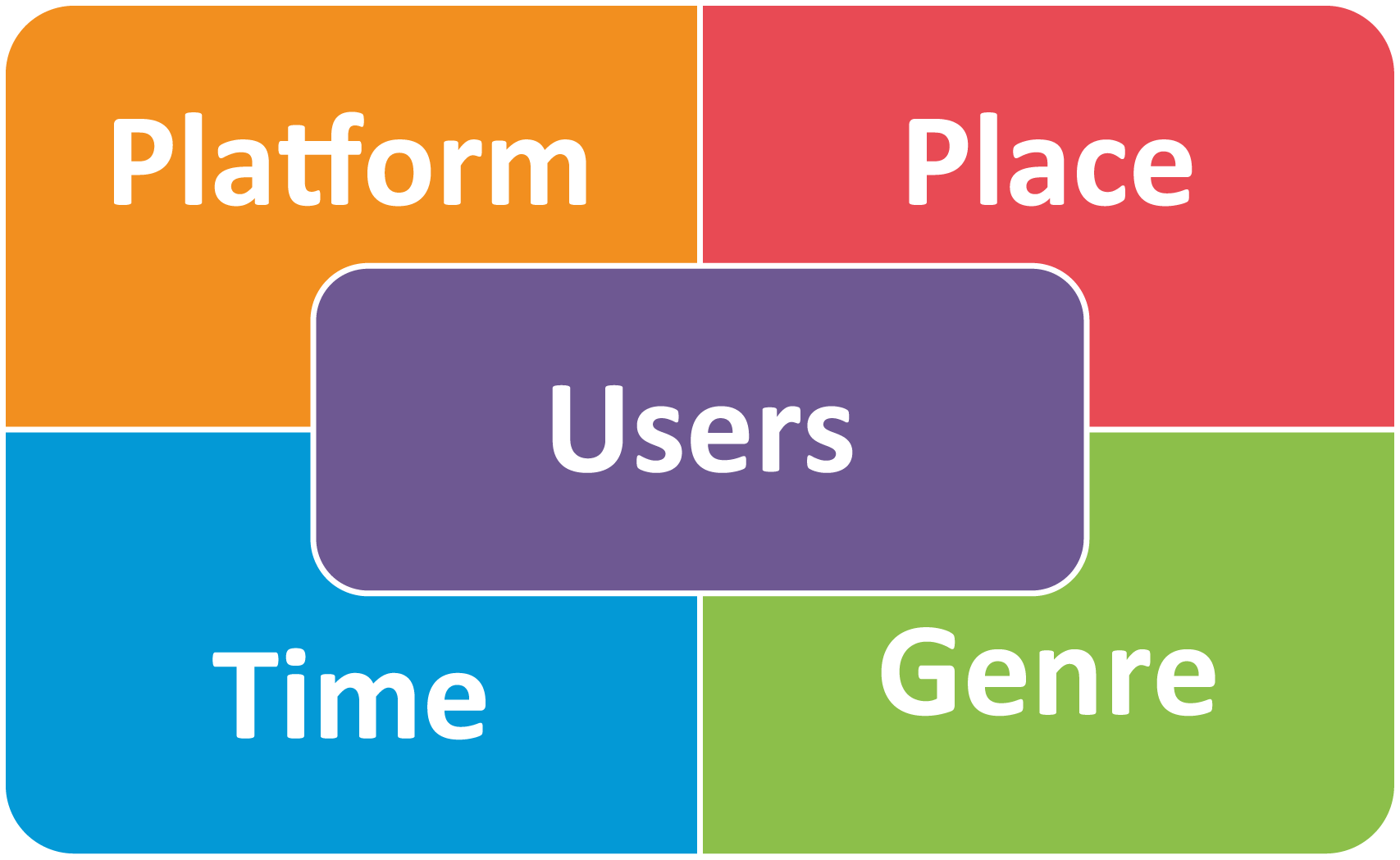
Platform
The platform or medium is of course the virtual reality headset, including any other equipment that may be required (headphones, controllers, haptic devices), and the ways in which it needs to be worn by the participant. The considerations here are mainly regarding the specific technological affordances of VR that are exploited within a specific experience. For example, in shared Beat Saber gameplay at home, the built-in interactivity requires a physical mastery of the body in the virtual space, albeit one that is relatively easily achieved as one need only wield a controller; no joysticks, triggers or buttons are required to produce the slashing motions that must only come at an appropriate angle and speed. The interface provides an accessible but deeply immersive experience in a corporeal sense. By contrast, the Limina Immersive Cinema experience featured VR experiences on the Oculus Go that required no interaction with controllers, but which featured a stimulating 360° virtual environment. The onboarding processes and the virtual holding screen provided opportunities for audience members to master the technology and physically adapt to the platform in as low-friction a way as possible.
Genre
The genre of the experience is an essential consideration that determines what type of incorporation is feasible and what type of participation is solicited. The genre may provide the frame for the type of emotional or cognitive state induced in the person in the headset, or their physical or behavioural response. As a game, players expect the playful potential of Beat Saber; it is this that allows them to turn it into a social occasion where their incorporation into the virtual is moderated by the social surroundings that ground them to varying degrees in the physical, social world. The informal consent among players to give oneself over to incorporation into the virtual is gained by turn-taking, and while bleed from the experience into the real world does occur, it is contextualised as an amusing result of incorporation; the bleed becomes part of the expectations of the experience. The Limina experiences, on the other hand, were either narrative (e.g. non-fiction films Notes on Blindness (2016) and Traveling While Black (2019)), or aesthetic, where a narrative arc occurs in terms of the audience experience (e.g. music experience Ex\Static (2017); dance experience Celestial Motion (2018)). Limina eased people into the narrative by providing the loading screen with prompts to draw attention to the virtual space, and brought the narrative to a defined end by returning to that screen with prompts to return attention to one’s body in the physical space.
Place
The considerations of the place, and the prior social meanings ascribed to places in which immersive activity takes place, as seen above in the varying examples of home, VR cinema and VR film festival, are worthy of much deeper exploration, but there is not sufficient space to explore these here. Questions that uncover the social meanings and the practical functions of the places in which VR is experienced and the virtual places that they facilitate are needed. While our participants sometimes struggled to find ample space to play Beat Saber, particularly with an audience, in the home they were in their own territory and able to define the functions of the space, including leisure and gaming. The Limina experience turned a warehouse-like event space rented from the Watershed cinema and cultural centre into a tranquil, spa-like environment, transitioning people off the busy harbourside pavements as they walked through the doors. Audiences were shielded from the outside spaces by the position of the seating areas away from the windows and the fabric screens that created a private space for VR participation. My own film festival experience occurred in a similar warehouse-like space, but with little meaning or context to attach to such a place, and little in the way of furniture, objects, or environments in the physical world to foreshadow and reinforce my virtual experience, I struggled to find an invitation to incorporation.
Time
The objective duration and time of day in which experience take place may affect experience, as will the subjective sense of time that audience members experience. Like place, the time of day or even year may have prior social meanings that align or misalign with the intended experience – for example, the bustling harbourside on a sunny afternoon into the Limina Immersive cinema could be at odds with the more aesthetic, dreamy short experiences on offer; people may associate evenings more with films, for example. But more significant is the duration of the experience. Orazi and Van Laer’s (2022: 2) focus on live action role play demonstrates that the longer the duration of an experience, the greater the likelihood that participants become immersed in the roles and frames of the experience. As VR technologies improve and physical discomfort and technical limitations are reduced, it may be possible for longer VR experiences to become more mainstream, and many immersive experiences already embed several ‘episodes’ in virtual reality within a larger immersive theatre context. Subjectively, the elongation or condensation of time that Machon (2013, 55) has noted with immersive theatre occurs in VR as well; in our longitudinal study, audiences frequently experienced VR as either lasting longer than it really did (i.e. in an August 2021 survey on a mindfulness experience in our longitudinal study, 14 of 17 respondents reported the sensation that time had slowed down) or lasting for a shorter time than it really was (i.e. 16 out of 29 participants completing an October 2021 survey in our longitudinal study reported regularly losing track of time in the headset, and a participant in the first phase reported spending two and a half hours in the headset when she felt she had been in it only about 30 minutes (Anusha, interview 13 January 2020)). Synchronicity of experiences, starting and ending together, will also need to be planned for differently than individual, self-timed experiences. The lack of a timeframe around my film festival experience meant that there was little ritual or structure signalling the beginning and end; this made it feel less like an occasion or event and more like ‘having a go’ on some technology, especially given its essentially self-guided nature.
Users
What is likely noticeable up until this point is the flexibility with which I have at times interchanged the terms ‘users’, ‘audience members’, and ‘participants’. Indeed, each of these terms has particular connotations, and dependent on genre and type of experience, one categorisation of the person in the headset might be more appropriate than others. Furthermore, while users are at the core of most of the above questions, it is worthwhile considering thoroughly the kinds of diversity amongst audiences of VR experiences, rather than presuming ‘mainstream’ audiences. The fact that VR is still for many a very new medium means that a large proportion of VR audiences may know relatively little about it. In our research, for example, people have sometimes expressed concerns about falling over or becoming sick, about ‘being tricked’ into thinking that they are elsewhere, about becoming addicted to the experience. While these kinds of fears may recede as people become more familiar with the technology, it is worth considering how these kinds of concerns can be taken seriously and not characterised as naïve, and how users can best be supported in their VR encounter. Certainly there was little attention to my experience level and my physical ability to get up and down from the floor in my film festival experience; since VR requires individual use of headsets, staff will need to be attuned to the individual needs of audience members, and onboarding and offboarding needs to be designed to allow for this.
Developing the audience journey and staff roles
Each of these domains can be considered in terms of three dimensions of responsibility borne by the staff running events: • First is the management of equipment and technology, ensuring that headsets and experiences are running as expected and are launched and reset systematically, minimising any technical frictions. This includes introducing the technology to audience members, demonstrating its function, describing and demonstrating how they can perform any interaction required, and helping them to put the kit on and take it off again. • The second dimension is the invitation to immersion. This involves a process of making audience members aware of the frames and the ‘definition of the situation’ of the experience they are about to undertake and doing so in a way that is in line with the frames themselves. This may involve sensory cues that prepare the audience for the experience and help them to begin to become attendant to virtual environments and roles; it could involve written guidelines or introductions to the themes or focuses of the experience. For experiences that are intended to provide a deeply immersive experience, it could involve attention to the design of the spaces through which audience members move as they approach and enter the virtual world, including any roles that staff members may take that mirror the frames within the virtual world. These will also require attention to the potential for bleed from the immersive experience into the ‘real world’ and consider opportunities to support audiences through offboarding and so avoid undesirable trajectories of return during this process. • The third dimension of staff responsibility is duty of care and responsibility to the audience members. This involves ensuring that audience members are sufficiently aware of the themes and content of the experience they are about to undertake so that they are aware of a ‘contract of participation’ – either explicitly or implicitly providing informed consent to the process of becoming incorporated into a virtual space, and not entirely present in a physical space. This involves ensuring they remain physically and psychologically safe, within the frames set for them within the experience, that they are not worried about their own or their belongings’ safety, and that they are aware of the degree of incorporation the experience seeks. Arguably, it also involves audiences becoming aware of potential trajectories of return, particularly if the experience is explicitly intending to facilitate any type of cathartic or delayed trajectory.
Having analysed the event through the immersive framework, an audience journey may thus be devised in which event staff ensure all three dimensions of their roles are executed in a way that best facilitates frictionless experience, an invitation to immersion, a contract of participation, and a suitable trajectory of return. These concerns can then also inform training of event staff, and help to set out any monitoring of audience experience to understand whether the types of participation being encouraged, and the degree of incorporation being realised, is aligned with the goals of the experience.
Conclusion
The immersive framework thus provides a systematic approach to creating a user-centred experience. It is useful for understanding audience experiences of virtual reality and recognising the factors that contribute to incorporation into the virtual. It offers creators and event producers a tool with which to analyse VR experiences and develop exhibition spaces, technology plans, audience journeys and staff training. Moreover, it provides a formalised corrective to the notion that a VR headset can offer everyone the same experience, or to notions that audiences can largely be expected to manage their own immersive experience. Careful onboarding and offboarding processes will effectively introduce audiences to the immersive frame, help to gain their understanding of the ‘definition of the situation’, extend an invitation to a contract of participation, and manage the bleed of the extraordinary virtual experience into the everyday following participants’ emergence from the event, preventing undesirable trajectories of return.
The framework requires an understanding of the degree of incorporation that the experience invites people to realise, and awareness that the technology does not on its own guarantee immersion. Instead, the framework puts the user of the experience at the centre of plans for VR distribution and event delivery, understanding that users have different levels of prior experience and associations with technology; they will come to an event with individual expectations and skill levels and for different purposes; and they may have very individual experiences of the content which can lead to different trajectories of return. The careful planning of onboarding and offboarding procedures, then, combines technical, practical, affective, and ethical considerations. It requires a shift in focus from the technology itself to the users of the technology, and from the moment of immersion to the processes of incorporation.
Whereas this paper has mainly focused on a subset of virtual reality experiences, mainly within cultural and entertainment sectors, it would be worth applying these principles to other use cases and contexts of VR to determine whether these shift the ethics or characteristics of user experience. As well, as new headsets and new types of technological affordances become available, and as immersive technologies gain broader acceptance, it will be valuable to understand the impact that these new affordances might have on stakeholders’ responsibilities to audiences and the facilitation of the immersive experience, offering audience members the potential of the virtual to create real experiences and perceptions.
Footnotes
Acknowledgments
Many thanks to past and present colleagues in StoryFutures, led by Prof. James Bennett. Particular thanks go to Dr Chloe Preece, Prof. Olga Goriunova and Jodie Pearton for invaluable conceptual and practical contributions to the virtual reality audiences longitudinal study. Thanks also to StoryFutures audience insight team members, Prof. Polly Dalton, Dr Andy Woods, Dr Maruša Levstek, and Isabelle Verhulst, for the collaboration and conversations that helped to shape my ideas. I would also like to thank all of our research participants for their time and insights. Finally, I am grateful for the partnership of the MASSIVE Cinema team and Catherine Allen and the team at Limina Immersive that enabled our ethnographic research, and to Samantha Kingston and Bertie Millis of Virtual Umbrella for discussions about the practical and ethical aspects of VR exhibition during our research collaboration.
Declaration of conflicting interests
The author(s) declared no potential conflicts of interest with respect to the research, authorship, and/or publication of this article.
Funding
The author(s) disclosed receipt of the following financial support for the research, authorship, and/or publication of this article: This research was made possible through the generous funding of the AHRC, reference number: AH/5002758/1, and an EM3 LEP Tech Booster grant.

Note
StoryFutures audience insight research methods
The immersive framework presented in this article draws on 3 years of mixed methods research with immersive audiences by the audience insight team, including quantitative and qualitative analysis of a number of small and large research and development projects and larger, longitudinal qualitative research projects, as set out in the StoryFutures Audience Insight Report (Bennett et al. 2021).
To theorise the audience experience, this article mainly draws upon audience insight data collected by the qualitative leads, including a collaborative research project with Limina Immersive Cinema in Bristol conducted in June 2019. In this project, the author and collaborator, Chloe Preece, conducted surveys, focus groups and participant observation with Limina audiences over the course of 3 days of screenings, and extended the surveys to Limina’s audience base over the next 2 months. This provided rich data on the cognitive, emotional and social dimensions of immersive cinema experience.
The article also draws upon a large-scale, multistage longitudinal project to explore the place of immersive technologies in the lives of young people aged 16–30, conducted between 2019 and 2021. A first scoping phase used questionnaires and virtual reality lab focus groups to establish the levels of penetration of various forms of VR and AR technology into the lives of young people and begin to scope areas of research. We subsequently provided groups of students with headsets for home use for a period of one university term. Participants tracked spending and engagement, and concluded with in-depth interviews.
In a second phase, we obtained funding to purchase 60 Oculus Quest 2 headsets, and worked with an industry partner, MASSIVE Cinema, to recruit 60 young adults under age 30 from across the UK to receive these headsets. Our selection process prioritised representation of regional, ethnic, socioeconomic, and gender diversity. Participants took part in a project lasting 6 months, during which time a programme of activities and tasks were set out at regular intervals. The Covid pandemic necessitated that this research be conducted digitally and remotely. Consequently, we used digital ethnographic methods to generate rich qualitative data, including reflexive diaries, open-form questionnaires, focus groups (taking place in virtual reality platforms, on Zoom, and, when it became possible, in person), and in-depth interviews. A self-selected group was invited to attend the London Film Festival’s 2021 immersive programme, LFF Expanded, and to subsequently take part in a focus group.
These methods have afforded us a sustained engagement grounded in participants’ real-life engagement with virtual reality, including both attendance at virtual reality events and at-home headset use. All research was conducted with ethical approval of the Royal Holloway, University of London ethics committee. In all cases, interviews and focus groups have been transcribed, and all materials have been anonymised. All data was compiled in MAXQDA for thematic coding and analysis. Pseudonyms have been used for any participants quoted above.