



Abstract
Ever since the emergence of digital gaming as a popular pastime, the Second World War has been one of its major sources of inspiration. This article contributes to the study of the memory-making potential of historical digital entertainment games, by offering an analysis of The Saboteur, an American game that is set in France during the Second World War and that offers a depiction of an explorable open game world occupied by the Nazi regime. Through an analysis of a game's paratextual positioning, its ludic social discourse, and instances of perceived ludonarrative dissonance from a historical and cultural memory perspective, the article concludes that the game offers a romanticized representation of male violent resistance against the Nazi occupier who is depicted as Manichaeistically evil and a-historically violent. This representation equally reconfirms the dominant cultural memory narratives formulated in France and the United States during and immediately after the war.
Keywords
Ever since the emergence of digital gaming as a popular pastime, the events of the Second World War have been one of its major sources of inspiration. This is illustrated by the game Tanktics (Crawford, 1976), published soon after the appearance of the first personal computers during the late 1970s, which allowed players to simulate tank battles between the German and the Soviet army on the Eastern Front (Crawford, 2003). In recent years, several new digital entertainment games set during the Second World War, such as Hearts of Iron IV (Paradox Development Studio, 2016), Call of Duty: WWII (Sledgehammer Games, 2017), and Hell Let Loose (Black Matter, 2021), have been purchased and played by millions of players, underlining the ongoing popularity of the period in gaming.
As illustrated elsewhere (Van den Heede, 2020), a majority of these games tend to highlight military frontline combat, in particular in Europe during the later stages of the war. As such, digital entertainment games about the Second World War mostly tend to ignore the prior period of occupation, also in particular in Europe by the Nazi regime. This happens despite the fact that, for example, argued by Polish historian Czesław Madajczyk, a majority of the people who lost their lives during the Second World War, did so “not at […] or even near the front, but as a result of the terror and of the conditions created in the occupied territories […]” (Madajczyk, 1980, p. 105). This article adds to the growing body of research addressing how digital games reconfigure historical and memory discourses. It does so by investigating the ludic memory-making potential (Pötzsch & Šisler, 2019) of one of the few digital entertainment games on the market that does offer a ludic representation of a freely explorable occupied territory during the Second World War. This is the open world third-person shooter game The Saboteur (Figure 1), set in occupied France (and the city of Paris in particular). The game was created by the now defunct U.S.-based game developer Pandemic Studios, and published by Electronic Arts back in 2009. Following Pötzsch and Šisler’s (2019) observation that, to fully estimate the interrelation between computer games, historical discourse, and cultural memory, we actively need to consider a game's procedural and performative elements (see Bogost, 2007; Chapman, 2016), I will carry out an analysis of both the representational and simulational aspects of The Saboteur, a game that has not been analyzed in-depth until now. In doing so, I will answer the following question: how does The Saboteur reimagine the Nazi occupation of Western Europe, and of France and Paris in particular, and what does this say about the memory-making potential of this game in relation to the memory of the Second World War?
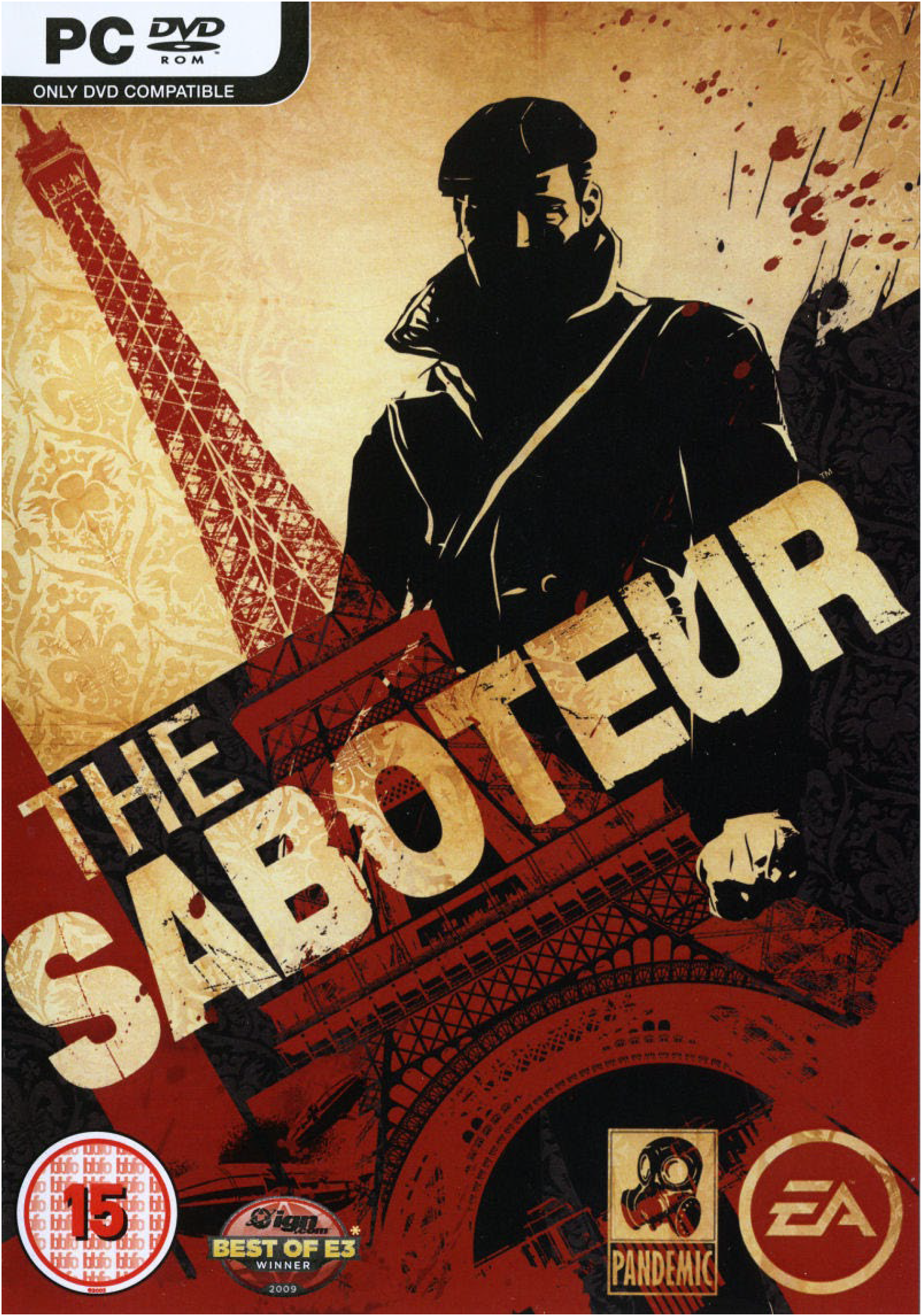
Cover art for The Saboteur (Pandemic Studios, 2009).
To answer this main question, I expand on the analytical framework formulated by Pötzsch and Šisler for the study of digital games as mediated mnemonic expressions. I do so by emphasizing three interrelated elements. First, I focus on the perspective of the creators of a game, by carrying out a thematic analysis (Braun & Clarke, 2006) of the promotional interviews given by the latter to press outlets as marketing paratexts. I do this to assess what I identify as the paratextual positioning of the game from a historical and cultural memory perspective, that is, the extent to which game creators actively claim to want to depict the past or contribute to the remembrance of distinct past events. Second, based on this paratextual assessment, I carry out a systematic analysis of a game's ludic design, through an adaptation of the ludic social discourse analysis model formulated by Latorre (2015). Third, I highlight my perspective as a researcher, by discussing how digital games such as The Saboteur, by adhering to an intertextually established premise of an exciting action game, confronts me with a sense of perceived ludonarrative dissonance from a historical perspective. This concept serves as a modification to the theory on ludonarrative dissonance formulated by Hocking (2007).
In what follows, I first provide an overview of the existing scholarship on digital entertainment games as mnemonic cultural expressions. Next, I discuss how a focus on marketing paratexts, ludic social discourse, and perceived ludonarrative dissonance can enrich these prior analyses. Finally, I apply these conceptual tools to The Saboteur and investigate how this game, as a “popular” historical representation, offers players a ludic representation of France and Paris as occupied territories during the Second World War.
Digital Games and Cultural Memory
Over the past few decades, significant shifts have occurred in how we understand the past. Not only have historians become increasingly aware of the constructed, perspective-bound and narrative nature of historiography following the postmodern critiques on history writing formulated by, for example, White (1973). At the same time, the late 1980s witnessed a boom in the interdisciplinary study of “memory”, that is, the manifold ways in which sociocultural, political, economic, technological, and cognitive factors shape how individuals, groups, and societies remember the past. A significant tradition in this field has centered on the study of “cultural memory” (Assmann, 2011), which departs from the centrality of material and medial representation in the construction of memory: shared memories of the past are not accidentally brought about by social entities, but rather the result of active attempts at cultural mediation, through diverse material, textual, audiovisual and performative means. Following this premise, memory scholars are currently investigating how memories are constructed and negotiated through various cultural expressions and how the formal properties of these expressions reconfigure existing imaginations. In doing so, memory scholars actively try to study what are often characterized as “popular” representations of the past such as historical novels, comics, and films, as these representations are a primary channel through which people engage with history today (De Groot, 2016). The study of these formats allows for a deeper understanding of the manifold historical representations and performances that shape contemporary historical culture (Grever & Adriaansen, 2017).
Following this broader research effort, several scholars have begun to analyze how contemporary cultural memory intersects with digital gaming. Based on the study of games as a format for history (Chapman, 2016), Pötzsch and Šisler (2019) present a game-specific version of Erll's (2008) framework for the study of mediated mnemonic expressions, consisting of three levels of analysis: (1) an intramedial level, centered on the distinct formal properties through which a media format represents and allows for an engagement with the past; (2) an intermedial level, centered on the intertextual influences of a representation and how it “refers to, comments upon, or recontextualizes preceding representations dealing with the same historical period or event;” and (3) a plurimedial level, where the potential meanings of a representation are embraced, negotiated and/or subverted by diverse audiences in varying contexts (Pötzsch & Šisler, 2019; for the quote, see Ibidem, p. 6). Following Chapman's observation that digital games can be characterized as both “historical representations for reading and systems for doing history” (Chapman, 2016, p. 32), Pötzsch and Šisler stress that the intramedial level of analysis of the memory potential of games has to take into account the simulational and performative nature of the medium since this is what sets games apart from other cultural formats (Pötzsch & Šisler, 2019, p. 4).
This premise has been adopted by scholars to analyze various historical digital entertainment games, including games that are set during the Second World War. Sterczewski (2016) incorporates the framework in his discussion of Polish games about the war, illustrating how they present a layered negotiation between dominant conventions of war-themed digital entertainment games on the one hand and national commemorative discourses about the war in Poland on the other. And Hammar (2017) adopts the framework as a starting point to discuss how the game Assassin's Creed: Freedom Cry (Ubisoft Montreal, 2014), centered on the experiences of a black protagonist living in the Caribbean during the period of the Transatlantic slave trade, can subvert existing hegemonic historical narratives through counter-hegemonic ludic memory-making.
These prior studies shed significant light on how digital entertainment games have the potential to co-configure how we remember and understand the past. At the same time, they adopt a rather open-ended approach in assessing the meaning-making potentials of the intra-, inter-, and plurimedial dimensions of games as mnemonic expressions. Therefore, to allow for a more systematic analysis of these layers, I will discuss how an explicit focus on interviews given by game creators to press outlets as marketing paratexts, a ludic social discourse analysis of a game, and a discussion of what I as a researcher identify as instances of perceived ludonarrative dissonance, can complement these previous analyses.
Extending the Study of Ludic Memory-Making
Paratexts and the “Double-Faced Nature” of (Ludic) Popular Historical Representation
During the past decade, especially media scholars have increasingly studied the paratextual “thresholds of interpretation” (Genette, 1997) that accompany a cultural text, such as a film or a television show. Gray (2010) has described how advertisements, previews, interviews with producers, fan fiction novels, and other paratextual expressions that are created in conjunction with a media text, can set up multiple frames and meanings that shape our expectations and experiences of the original text. In line with these observations, also game scholars have studied game paratexts and how they operate in contemporary (game) culture (Consalvo, 2007). Here, Kline et al. (2003) and Payne (2016) have shown how game marketing paratexts, as an expression of an increasingly digitized and interconnected culture, should be seen as bidirectional sites of negotiation, where developers continuously interact with players to gather feedback and address concerns throughout the entire life cycle of a game. At the same time, Payne (2016) emphasizes that “publisher-driven” marketing paratexts such as trailers and interviews with developers, for example, presented during press events, remain important, as these provide the initial frames through which players can think about a game prior to release. This is certainly the case for games that were made in the first decade of the 21st century when digital game distribution and social media engagement were not as prevalent as they are today.
In light of these observations, I argue that a thematic analysis (Braun & Clarke, 2006) of promotional interviews with the creators of a game, as a traditional publisher-driven paratext, can greatly complement the intermedial analysis of the memory-making potential of historically themed digital entertainment games (for a wider discussion of the significance of marketing for the study of historical games, see Wright, 2022). I formulate this argument for two interconnected reasons. On the one hand, these interviews have traditionally been, and remain, a primary site for game creators to render explicit the intertextual influences that have inspired the development process, or at least the ones that the publishers deem relevant from a marketing perspective. When releasing a game, creators try to position it in a broader network of meaning to convey to players what they can expect from the game. As such, creators actively seize the opportunities provided by (gaming-centered) press outlets to establish these connections. On the other hand, online available interviews are a relevant source to study what I identify as a game's paratextual positioning from a historical and cultural memory perspective. This concept refers to the efforts of creators of historically themed games to position their product on a multivariate spectrum of what one can call the “double-faced nature” of popular historical representation. As discussed by Hammar in relation to the games from the Assassin's Creed series, creators of historically themed digital entertainment games aim to establish a degree of historical referentiality, while also emphasizing that various aspects of the game, such as its central narrative, are fictional. This allows game creators to achieve a double goal: “[it] leaves the game to conveniently both be marketed as alluring for its so-called historical authenticity and simultaneously not bound to criticisms of its depictions” (Hammar, 2017, p. 5). Here, I argue that a variation of this tension between fact and fiction manifests itself in every popular historical representation that was produced as an entertainment-oriented and profit-seeking cultural commodity. As such, interviews with game creators function as a site to assess where on the spectrum creators try to position their game product. More precisely, identifying which aspects of the past game creators wish to represent and how they wish to do so, allows researchers to carry out a more targeted analysis of the game from a historical and cultural memory perspective.
In my analysis, I will study the paratextual positioning of The Saboteur as follows: I will carry out a thematic analysis of a corpus of promotional interviews with the creators of the game as identified on gaming websites and in online press outlets aimed at wider audiences (for an overview of the studied corpus of interviews, see Appendix 1). Throughout my analysis, I will identify (1) which fictional and historical sources of inspiration the creators of The Saboteur highlight and (2) whether or not the creators of the game formulate explicit arguments about the past or aim to contribute to the remembrance of past events while talking about their sources of inspiration.
Historically Themed Digital Entertainment Games and Ludic Social Discourse
Following the study of the “procedural rhetoric” of digital games, which emphasizes that games make ideological claims about the world through their algorithmic rules (Bogost, 2007), Latorre (2015) has developed a multi-level framework for the analysis of a game's ludic design (i.e., a game's interactive dynamics) and how it can express ideological and social realities. Latorre makes a distinction between three discursive components that can be identified in a game's ludic design. First, Latorre refers to the design of the character/player: the scope of the actions of the playable character of a game and the player, as defined by the game rules. Second, Latorre highlights the design of the game world: the virtual environment in which the game is set, including the social environment created by other player characters and virtual non-player characters (NPCs). Third, Latorre refers to the design of the overall gameplay activities: the broader units of play that can be identified in a game, such as the different types of quests players can undertake. For each of these layers, Latorre makes a classification of rules and properties, each of which can add meaning to the social realities expressed by the game. In this article, I present an analytical framework based on Latorre's model that emphasizes the following aspects of the ludic design of the character/player, the game world, and the gameplay activities:
Concerning the character/player, I focus on what Latorre identifies as the game mechanics, determined by performance and operation rules. Performance rules determine the possible actions of a playable character. Operation rules establish a link between these actions and how players perform them through physical input devices such as a mouse and keyboard. In addition, I analyze what Latorre identifies as state rules, which establish the varying states playable characters can find themselves in,, for example, expressed through the amount of in-game “health” the character has. Concerning the game world, I emphasize what Latorre identifies as the world's spatiotemporal design. This encompasses the analysis of the scenic design of the game world, the virtual objects of the game world and the rules that apply to them, and the patterns of behavior of the NPCs that populate the game world. In relation to open world games, especially this analysis of NPC behavior is significant, since creators of open world games develop various AI systems and animations that regulate how NPCs behave in the game in order to uphold the illusion of a ‘living’ virtual environment. In doing so, the analysis of NPC behavior can shed light on the historical and memory discourses that game creators want to express. An example thereof is the games from the Assassin's Creed series, where NPC crowds are designed to express past mentalities. In the game Assassin's Creed: Unity (Ubisoft Montreal, 2014), set during the French Revolution, an atmosphere of “revolutionary fervor” is simulated by letting different NPC factions, such as extremist revolutionaries and royalist guards, clash violently with one another, without active player involvement (Blondeau, 2015). Concerning the gameplay activities, I focus on the chains of actions that constitute gameplay units, the winning/losing conditions that characterize them, and the extent to which players can adopt varying ludic strategies to achieve the central goals of the units and the game The Saboteur in its entirety.
I will apply this framework in order to provide a systematic analysis of the intramedial dimension of The Saboteur as a “popular” representation of the Second World War.
Perceived Ludonarrative Dissonance and Cultural Memory
As first described by Hocking (2007) in relation to the FPS game Bioshock (2K Boston & 2K Australia, 2007), the notion of “ludonarrative dissonance” refers to a central meaning-making conflict that can manifest itself when the narrative and procedural layers of a game express divergent, or even contradictory, values and ideologies. In the case of Bioshock, a game that tries to critique the objectivist philosophy of Ayn Rand, this is shown in the contradiction that can be observed between the game's ludic design, which allows players to aggressively pursue their self-interest, and its narrative, which forces players to altruistically help other characters. The game's central narrative premise subverts its central ludic premise.
In this article, I expand on the notion of ludonarrative dissonance, in light of the “double-faced nature” of popular historical representation identified above. I argue that ludonarrative dissonance should not primarily be seen as a property of a game, but rather as a perception of the player. This can be illustrated by my personal experiences while playing Bioshock. As I was not aware of the philosophical inspirations of the game when I first played it, I did not experience the contradictions identified by Hocking. More generally, I argue that the level of ludonarrative dissonance perceived by players is determined by their personal biographies, in a twofold way: on the one hand, by their personal lived experience, in line with Galloway's (2004) observation that games are perceived as “realistic” if a degree of congruence exists between the realities expressed by a game and the social realities lived by the player; and on the other hand by what I identify as a person's inter- and paratextual biography, or the entirety of textual expressions that a person has engaged with when playing a game, as a form of cultural capital (Bourdieu, 1986). This observation presents an important addition to the plurimedial level of analysis identified by Erll (2008) and Pötzsch and Šisler (2019), in that meaning-making potentials of mediated mnemonic expressions are not only embraced, negotiated, and/or subverted. They can equally be ignored or left unnoticed due to a variety of reasons.
For historically themed digital games such as The Saboteur, then, the observation that ludonarrative dissonance is primarily perceptive means that a player's sense of ludonarrative dissonance is strongly dependent on the latter's mnemonic awareness. This places a direct emphasis on my role as interpreter. As creators of historically themed digital entertainment games claim to want to represent the past through paratextual positioning, as discussed above, players such as myself can experience a sense of ludonarrative dissonance in relation to how a game does so, based on personal historical and memory-related points of reference. I will illustrate this in my analysis of The Saboteur, by highlighting personally perceived instances of ludonarrative dissonance when studying the narrative and ludic design of the game from a historical and cultural memory perspective.
Ludic Historical and Memory Discourses in The Saboteur
Paratextual Positioning of The Saboteur as a Ludic Historical Representation
Through my thematic analysis of the selected corpus of interviews given by the creators of The Saboteur, I identified several distinct (intertextual) references to fictional and historical influences that are relevant for the analysis of the game from a historical and cultural memory perspective.
The first set of influences highlighted by the creators of The Saboteur concerns the protagonist and central narrative of the game. In The Saboteur, players take on the role of Sean Devlin, a fictional Irish race driver who, following the death of a close friend at the hands of a Nazi officer, becomes involved in the French resistance. Following this premise, the creators of The Saboteur highlight that the game's protagonist was inspired by a historical British racecar driver named William Grover-Williams, who assisted the French resistance and the British secret service during the war (Cheer, 2009). However, the creators subsequently emphasize that they actively changed the character, in two ways. On the one hand, they gave the protagonist an Irish background. This was done to strip the character of a direct political allegiance during the war, to tell a story of an “ordinary” person, in contrast to narratives centered on soldiers in military shooter games. On the other hand, the creators transformed the character into a cinematic action hero with distinct character traits. This is shown in the quotes below, taken from the interviews: “We went with the Irish character just to separate ourselves from the typical World War II game. […] If we made [Sean Devlin] English […], he would […] be distracted with […] the political motivation of the war that's going on. So by making him Irish, it really makes him a man without a home inside this occupied country.” (John, 2009)
“The Saboteur is not your typical soldier story storming the beaches of Normandy. It's an intense personal revenge story [that] will take you […] right into the heart of the French Resistance and its “ordinary” people who become heroes eventually.” (Cheer, 2009)
“[…] we wanted to make [Sean] the cool action hero that we all wished [we] could be […]. […] we […] referenced a lot of what we felt were some of the greatest action heroes of all time — Indiana Jones, John McClane from Die Hard. [We also] wanted to imbue him with that classic cool […] like Steve McQueen. He's good with women, he smokes, he drinks and so we really wanted him to have all those character traits.” (John, 2009)
Based on these quotes, it first becomes clear that the creators of The Saboteur wanted to make an exciting game centered on a cinematic action hero more so than recreate history. This is reflected in the choice to give the protagonist an Irish background, as this allows for a game narrative that is, at least at the first glance, centered on a more personal (but also more universal) desire for revenge, freedom, and righteousness rather than patriotic allegiance. At the same time, the quotes show how the game serves as a homage to William Grover-Williams as a remarkable historical figure and the “ordinary people” of the French resistance who took up arms against Nazi oppression more generally. As a result, The Saboteur also memorializes these “everyday heroes” as historical actors, which partly places the game on the referential side of the representational spectrum. Second, it becomes clear that Sean Devlin as a fictional character closely adheres to heteronormative conceptions of masculinity, whereby a predisposition toward physical violence, sexual conquest, and substance (ab)use are identified as admirable inclinations. This point to a distinctly gendered representation of wartime resistance.
The second set of influences highlighted by the creators of The Saboteur concerns Paris as the game's setting. Here, the developers state that they wanted to capture “the spirit of Paris”, in several ways. First, Chris Hunt, the game's art director, describes how the developers made a research trip to Paris to recreate the city's outline, landmarks, and visual style to “stay true to the city” (CoinOp TV, 2009). Second, the developers highlight how they adopted an explicit black-and-white esthetic for the game, for a double reason. On the one hand, they adopted the esthetic to render visible the “sexuality” of Paris, with its burlesque nightclubs such as the Moulin Rouge. To recreate this atmosphere, they adopted the esthetic tropes of “film noirs” such as Sin City, which to varying degrees also play into these sexual themes. On the other hand, they adopted the esthetic to reference the obscure atmosphere in which the resistance operated during the war, and to refer to a sense of despair that the population of Paris assumedly felt due to the presence of the Nazi occupier. This is shown in the quotes below: “Paris has this inherent sexuality about it. I mean, Paris is really famous for its red-light district, and the Moulin Rouge… […] So having that in the game really puts Sean in kind of the seedy underbelly of the world, and that's what we really wanted. That's the mood and the picture that we wanted to paint that the resistance lived in, hiding from the Nazis in these strange little places. […] On top of that, there's a lot of film noir influence in our game, from the modern films like Sin City or the classic movies like The Third Man, and those movies have a kind of inherent sexual undertone to them as well.” (John, 2009)
“The art design […] arose from a simple necessity. We wanted to let the player feel the occupation, the oppression, and you can’t really achieve that by just putting down a bunch of Nazis into a vibrant and colorful city like Paris. We literally wanted to let the player feel like the life had been sucked out of the city, so we came up with the idea of sucking the color out, which is how the stylized b&w look came into existence.” (Cheer, 2009)
Based on these quotes, a more ambiguous approach to historical representation concerning the game's setting can be identified. On the one hand, the creators of The Saboteur adopted a black-and-white esthetic to explicitly embed the game's representation into a broader postwar intertextual (cinematic) framework and activate a degree of sexual titillation. On the other hand, however, they also adopted the esthetic as an expression of various assumptions about the experience of living in Paris, and cities occupied by the Nazi regime more generally, during the war. This is directly meant to convey a degree of historical authenticity, which makes it meaningful to carry out a more in-depth analysis of how the ludic design of the game aims to express this authenticity.
The final observation about the influences for The Saboteur relates to the overall historical accuracy of the game's ludic design. About these, Tom French, the game's lead designer, states the following: “I always like to say The Saboteur is ‘historically inspired’ rather than historically accurate. […] While we did our research in learning every bit we could about actual events, those were just starting points for our designs […]. Our goal was to capture that almost pulpy high-spirited adventure fantasy of the war.” (Cheer, 2009)
Here, it becomes clear that the events of the Second World War, also in particular in France, primarily serve as a grab bag for a fictional action game that is centered on excessive violent action, adventurous exploration, and sexuality as male-dominated endeavors. However, given that the creators also actively aim to encode references to and assumptions about the events of the war in the game, in particular concerning the game's protagonist, spatial setting and how the latter is “colored”, it becomes meaningful to further interrogate The Saboteur as a historical representation. I will do so via a ludic social discourse analysis of the game.
Ludic Social Discourse and Perceived Ludonarrative Dissonance in The Saboteur
To carry out the ludic social discourse analysis of The Saboteur, I first analyze the ludic design of the character/player. Here, an overview of the game mechanics already sheds significant light on how The Saboteur represents the phenomenon of resistance during the Second World War in occupied France. As defined by the performance rules, the possible actions of Sean Devlin can be summarized as follows: walking/running on foot, involvement in fist fights, use of firearms and explosives, stealing and driving motorized vehicles, the ability to secretly infiltrate and escape forbidden areas by climbing buildings, putting on disguises and hiding in places, and finally, the ability to call in support from other resistance fighters. Combined with the operation rules, which revolve around a standard input pattern for a third-person shooter game through a game controller or a keyboard and mouse, this result in the need for players to apply visual and motoric skills when engaging in fighting and racing, strategic planning when carrying out infiltrations and spatial orientation while navigating the game world. Apart from this, especially the state rules which describe the moment-to-moment conditions of Sean Devlin's playable character, add a significant discursive dimension to the character's ludic design. The interface of the game doesn’t only show a map but the selected weapon and an increasing number of bloodstains on screen when Sean is hit by gunfire. The interface also includes a “suspicion meter” (Figure 2), which shows whether Sean's actions are attracting the attention of the Nazi guards in Sean's vicinity. This can significantly impact how players behave in-game, as certain actions, such as carrying firearms, can quickly result in enemies sounding the alarm. This is not necessarily meant to urge players to avoid these actions, as they have to perform them to complete the objectives of the game. Rather, it stimulates players to plan their actions in advance and otherwise test their evasion skills. Once an alarm has been raised, players cannot escape the situation by killing enemies in the area, as this will increase the alarm level and therefore the difficulty of the pursuit, in a dynamic similar to the one in Grand Theft Auto games. Players are therefore strongly induced to plan their missions, carry them out and subsequently experience the tension and excitement of fleeing the scene.
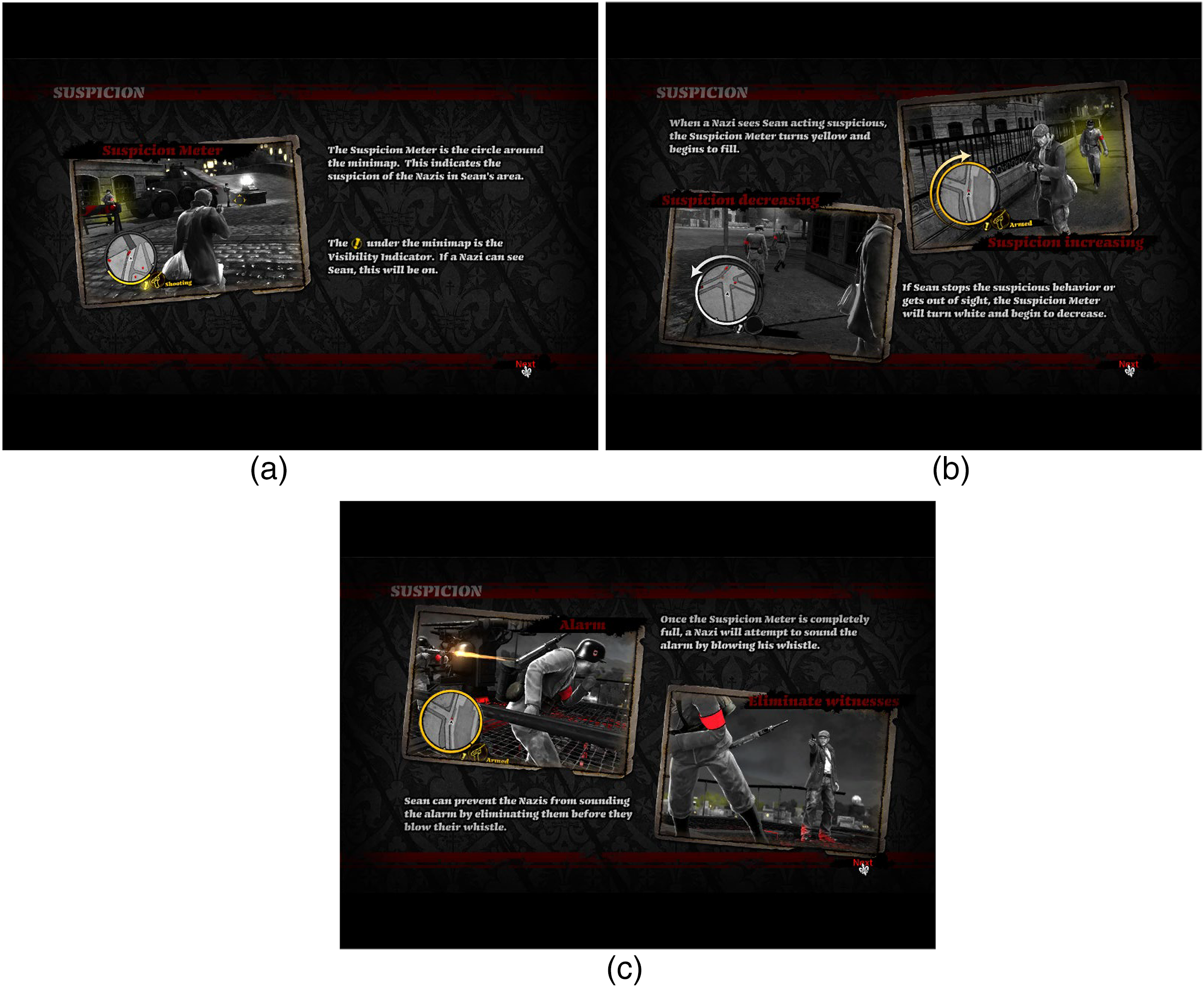
Screenshots of the tutorial for the “suspicion meter” in The Saboteur.
Taken together, the ludic design of the character/player primarily references a romanticized notion of empowered male violent resistance against the Nazi menace, and the feelings of danger, adventure, and excitement that assumedly accompanied it. As such, this design not only aims to capture the cinematic action fantasy that was mentioned in the interviews. It also paints a specific and narrow image of what constitutes “resistance” that is not only found in many other North American and European popular representations of resistance during the Second World War in occupied France/Europe (Corbin, 2019). It is equally reminiscent of the heroic and self-congratulatory cultural narratives that many (Western) European countries adopted in the immediate years after the war (Lagrou, 2003). Finally, by adopting a focus on exciting and adventurous action, the design ignores the many nonviolent manifestations of resistance in the territories occupied by Nazi Germany and its allies, such as providing support to people in hiding and the distribution of clandestine press (Cooke & Shepherd, 2013). It also overemphasizes individual agency and both the importance and impact of armed resistance during the war, as only a small segment of the European population was involved in it, also in France (Moore, 2000, pp. 1–26).
Concerning the ludic design of the game world, that is, the second main dimension of Latorre's framework, players can immediately observe how its spatiotemporal design closely aligns with the intermedial network of meaning discussed above. The black-and-white esthetics becomes instantly visible when exploring the game world. In addition, the focus on heteronormative sexuality, inspired by both “film noirs” and conceptions about Paris as a 20th-century “capital of sin”, is rendered visible at the start of the game, as its opening scene takes place in the “Belles de Nuit”, a burlesque nightclub that serves as one of Sean Devlin's hiding spots.
Apart from these elements, the game world is filled with an abundance of signs that highlights the “Nazi-infested-ness” of France (Kingsepp, 2006). Examples include banners with swastikas, as well as installations such as guard towers, weapon depots, and propaganda speakers. Especially here, an interesting set of rules that apply to these game objects can be identified. When players destroy these virtual installations, they do not only earn “contraband”, that is, the in-game currency with which players can buy weapons and equipment on the black market. These actions also permanently remove the objects from the game world without further consequences. As a result, the game seemingly represents the Nazi occupation of France as a superficial material presence that players can straightforwardly remove through physical violence and spatial conquest.
Next, especially the design of the NPCs in The Saboteur, and the AI scripting that defines their in-game behavior, provides a specific representation of the occupation of France during the Second World War. Here, distinct assumptions about the occupation of France as a historical event become visible.
First, The Saboteur represents the Nazi occupation of France by placing a variety of German soldiers in the game world, who all wear explicit Nazi insignia and only differ from one another based on the weapons they carry, and therefore the challenge they pose to the player. As a result, the game fundamentally ludifies and simplifies the occupation. It not only represents the latter as a playful obstacle that is meant to challenge the player's visual, motoric, and strategic skills. It also represents the occupation as a homogeneously Nazi affair, in which French civilians or government officials were not actively involved. This is reflective of an underlying assumption that can productively be interrogated historically. During the war, the Nazi occupier relied extensively on the collaboration of local political and economic elites, administrative circles, and police forces, as well as denunciatory actions by citizens to inform on political opponents, Jews, and laborers in hiding, to organize daily life in its occupied territories (Mazower, 2008). This also applies to Paris and the part of France occupied by Nazi Germany in 1940 (Joly, 2012). In this context, I identified the first example of perceived ludonarrative dissonance when analyzing The Saboteur historically. In the game narrative, the player is repeatedly given missions to assassinate traitors, in reference to the collaborationist and denunciatory practices that characterized France's sociopolitical life during the occupation. However, this reality is not made visible in the freely explorable game world. Here, players do not have to consider denunciatory efforts on behalf of French civilian NPCs when the latter observe Sean Devlin's suspicious and violent behavior. Instead, the civilian NPCs are passive in their conduct and fearful of German reprisals. The game therefore indirectly characterizes the collaboration of the French civilian population during the war as negligible rather than systemic: it was solely done by individuals as “bad apples”, who can justifiably be killed by the player.
Second, Nazi NPCs behave in particular ways toward French civilian NPCs and in response to violent acts by the player. Concerning the first, the Nazis are represented as indiscriminately violent. Many scenes can be encountered in the game world where Nazi guards are preparing to detain or execute civilians, without a direct cause (Figure 3). Since these actions occur from the onset of the game, it suggests that the violence of the Nazis is consistent and unchanging. This can again be interrogated by contrasting it to the policies of the occupier in France during the war. Following Nazi Germany's military victory over France in June 1940, the first months of the occupation were relatively peaceful, as a reflection of a widely shared opinion that Nazi Germany had won the war. However, this initial phase was followed by an intensifying spiral of resistance, reprisals, and executions from June 1941 onwards, when Nazi Germany invaded the Soviet Union (for the full paragraph, see Mitchell, 2010). The Saboteur, therefore, offers a fundamentally a-historical representation of the wartime occupation of France characterized by a Manichaean dichotomy between “good” and “evil”, whereby the Nazi occupier one-sidedly imposed itself on an innocent French nation without structural local support and through never-abating excessive violence. This places the Nazi regime outside of history and within the realm of the mythological.
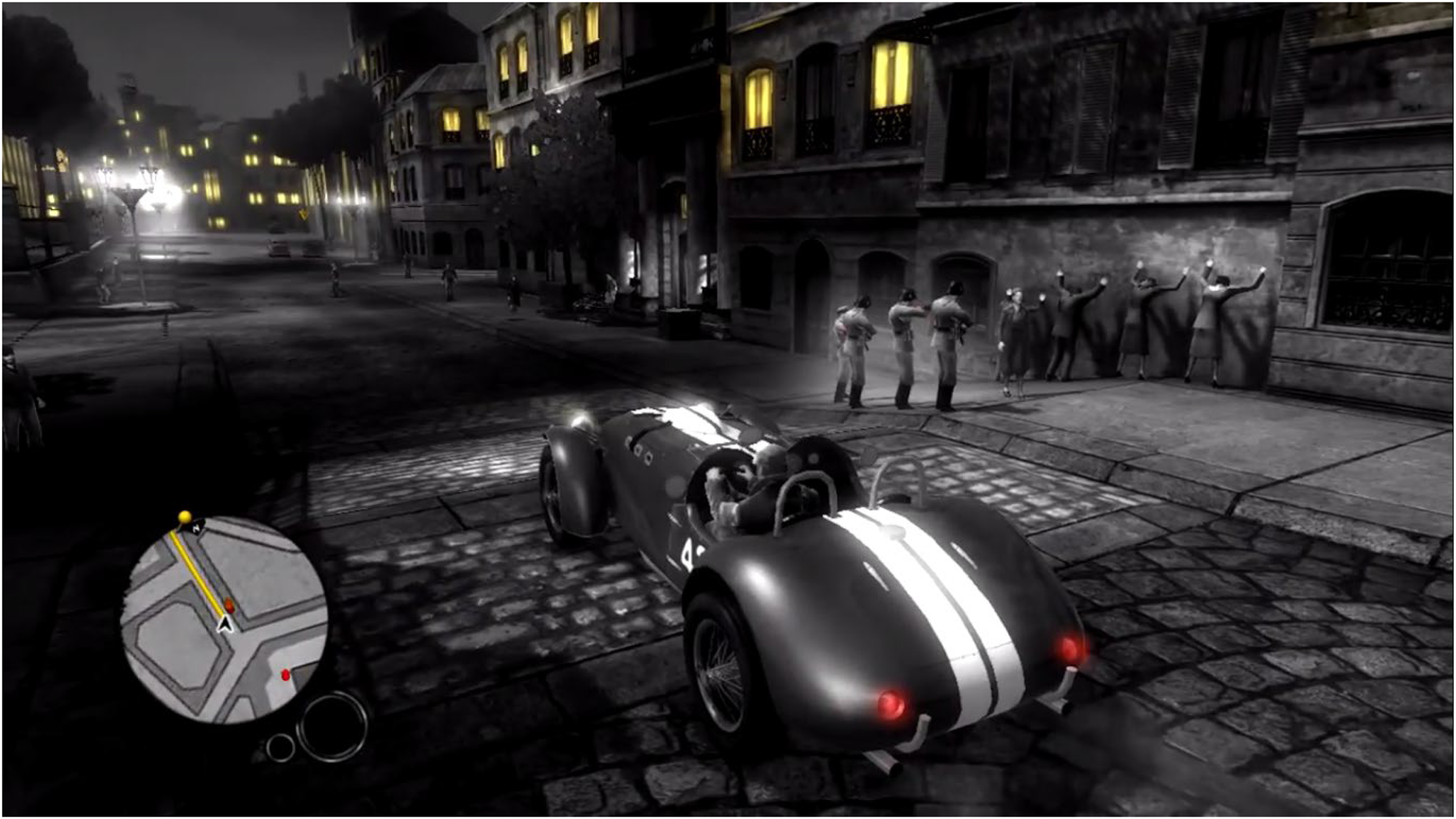
Illustration of an execution about to be carried out by Nazi soldiers in The Saboteur.
Concerning the response of Nazi NPCs to the actions of the player, I identified the second example of perceived ludonarrative dissonance from a historical perspective. In the narrative of the game, the player is regularly confronted with the consequences of Sean Devlin's actions. An example thereof is that several story missions revolve around saving hostages taken by the German occupier in response to prior narrative events. However, this is not the case when players freely engage in violence in the game world. Here, if players kill a guard or destroy equipment and flee, the Nazi guards will only target the playable character and not the French civilian population. This directly contradicts the reprisal policies adopted by the Nazi occupier during the war, especially from the summer of 1941 onwards (Mitchell, 2010). This design choice is equally meant to emphasize The Saboteur's central premise as a “popular” ludic historical representation. The game is meant to be an adventurous depiction of the heroism of violent resistance against the Nazi occupier, in which players are not confronted with the broader impact of their violent resistance on civilians. This is reflective of common design tropes in other popular shooter games (Pötzsch, 2017).
Finally, in relation to the design of The Saboteur's gameplay activities, several play units can be identified, whose chains of actions are made up of a combination of the following activities: stealing vehicles, driving support characters to their destination, shadowing or assassinating dangerous or high profile individuals, sabotaging military installations, rescuing resistance fighters, engaging in open combat with the Nazi occupier, fleeing the scene of an attack after the alarm has been raised, and participating in car races across France. For each of these activities, rather strict winning conditions exist, as players can only advance in the game if they successfully shadow, kill, destroy, steal, or rescue targets and elude the pursuing Nazis. The degree of variability when engaging in these gameplay activities is also limited, as players can only choose between silent infiltration or open combat. This again demonstrates the prioritization of tense action and violence in the game, in accordance with The Saboteur's central intermedial premise as a romanticized fantasy of heroic male violent resistance.
As part of the central narrative of The Saboteur, each of the gameplay activities is carried out by the player on behalf of several side characters, who either belong to one of the cells of French resistance fighters scattered across Paris, or a fictionalized rendition of the British secret service. The French resistance cells are depicted as exclusively driven by patriotism, which means that the game represents the French resistance as a purely nationalist movement. This can be contrasted with the situation during the war, as groups with other ideological backgrounds, in particular communist ones, were also involved in violent resistance against the Nazi occupier, often more actively so (Moore, 2000, pp. 1–26). As Sean Devlin helps each of the side characters to obtain their objectives, he ultimately achieves a personal one: avenging the death of a personal friend, who was killed by a Nazi officer. By doing this, Sean achieves an important additional goal: he succeeds in uniting the scattered cells of resistance in Paris who, with the support of the British secret service, launch an uprising against the Nazi occupier to liberate the city at the end of the game.
Here, I want to highlight an additional goal of the gameplay units in The Saboteur. When players complete key missions in the game, they activate the so-called “Will to Fight” (WTF) dynamic in the region where the mission was completed. This means that, upon completion of the mission, a cutscene starts playing that shows how the black-and-white esthetic of the area highlighted earlier, is lifted and replaced by a bright and colorful one. This serves as a metaphor for the return of hope and a fighting spirit among the local civilians, but also as a condition for the latter to join the armed uprising at the end of the game. The changing atmosphere is translated into behavioral changes among the NPCs in the area. The virtual French civilians will now act in a more assertive manner when Nazi soldiers harass them, and players are able to enter “Fight Back Zones” in case of an alarm. Here, other armed resistance fighters can be called in to support the character/player in fighting back pursuing Nazi soldiers.
Following these observations, I argue that the ludic design of the core gameplay activities of The Saboteur carries in itself a double memory-making potential. On the one hand, the gameplay units can be seen as an expression of a power fantasy. Players are invited to revel in imagining how they would have been involved in heroic resistance against the Nazi regime during the Second World War. On the other hand, especially the “Will to Fight” (WTF) dynamic and the appearance of the “Fight Back Zones” in the “liberated” areas of the game world, can be seen as an acknowledgment of the notion that France was a “nation of resisters” during the war that reluctantly accepted the occupation and only needed an, in this case external, spark to rise up. This characterization is reminiscent of the narrative propagated by Charles de Gaulle and his “Free French” movement, which upheld that “the French [people], defeated but defiant after 1940, were virtually all sympathetic to, if not indeed active participants in, the Resistance” (Mitchell, 2010, p. 12). These interpretations also became a part of the American public discourse through, for example, wartime Hollywood films made by French filmmaker Jean Renoir, official visits by Charles de Gaulle to New York in 1944/1945 meant to win over the U.S. leadership for the cause of the “Free French”, and the postwar translation of novels about the French resistance written by Joseph Kessel and others (Reid, 2012). However, this characterization has been actively refuted since the 1970s by historians such as Paxton (1972), who has described how the wartime French Vichy leadership and a broader French conservative movement was often actively willing to collaborate with the Nazi occupier. It illustrates how the American creators of The Saboteur, in their efforts to create an exciting historically themed entertainment game, ended up reiterating nationalist commemorative discourses about the experience of the French population during the Second World War and related stereotypical American imaginations of (occupied) France, as seen in other “popular” representations.
Conclusion
In this article, I presented an analysis of The Saboteur, a historically themed open world game set in Nazi-occupied France during the Second World War. The goal of this analysis was twofold. First, as the total wars of the 20th century not only resulted in large-scale military confrontations between state armies but also transformed entire societies, this analysis aimed to shed light on how digital entertainment games represent these societal transformations during wartime. The analysis showed that The Saboteur could be characterized as a pulpy action adventure that represents the wartime occupation of France and the French resistance in a strongly romanticized and gendered manner, by emphasizing exciting, heroic, and male-dominated violence against the Nazi occupier as a mythological rather than a historical enemy. Following this assessment, several underlying assumptions about the wartime occupation of France as a historical event could be identified. One example thereof is that the game reduces the occupation of France to a superficial layer of Nazism that can straightforwardly be overcome through spatial conquest from within, and that the occupation affected the morale of the French population but none of France's deeper social structures. As such, the game not only depicts the occupation of France as an a-historically violent but also as a homogeneously Nazi affair, in which French officials and civilians played no part. This reaffirms celebratory cultural narratives that were first formulated in France and other Western European countries shortly after the war and that have actively been refuted by (international) historians since, such as the narrative that France was a “nation of resisters”.
Second, the article provided a significant contribution to the study of the meaning-making potentials of digital entertainment games from a historical and cultural memory perspective. It presented three core analytical tools that complement prior analyses. First, I emphasized the importance of studying the paratextual positioning of a game, in light of an inherent “double-faced nature” of “‘popular” historical representation. By making a thematic analysis of the promotional interviews given by the creators of a game prior to its release, the researcher gains a better understanding of the distinct ways in which the creators aim to represent the past. This serves as a significant context for the analysis of the game. Second, I highlighted the importance of systematically studying a game's ludic social discourse, in line with Latorre's analytical framework. This allows for a deeper insight into a game's discursive potential from a historical and cultural memory perspective, in that it serves as a frame of reference for researchers to systematically assess all ludic components of a game. In relation to open world games such as The Saboteur, it, for example, highlights the discursive potential of the design of NPCs, as this design can express various distinct historical sociocultural and political realities. Finally, I highlighted the importance of the perspective of the researcher. I did so by adopting the concept “perceived ludonarrative dissonance”, which renders visible that experiences of dissonance through play are dependent on a player's lived experience and textual biography.
By emphasizing the significance of the analytical tools discussed above, this article presents a rich framework for further analyses of digital games as a format for historical and mnemonic expression.
Footnotes
Appendix
Appendix 1 Overview consulted online available interviews with the creators of The Saboteur.
Anderson, L. (2009). Comic-Con 09: The Saboteur Interview. GameSpot. Retrieved October 18, 2022, from https://www.youtube.com/watch?v = hKJD7OxnZMA
Cheer, D. (2009). The Saboteur: We speak with Pandemic's Tom French. Gameplanet New Zealand. Retrieved October 18, 2022, from https://www.gameplanet.co.nz/xbox-360/features/i134264/The-Saboteur-We-speak-with-Pandemics-Tom-French/
CoinOp TV. (2009). The Saboteur interview with Tom French. CoinOp TV. Retrieved October 18, 2022, from https://www.youtube.com/watch?v = an9xIKnjpxA
Console Creatures. (2009). The Saboteur - Cory Lewis from Pandemic Studios Interview (HD). Console Creatures. Retrieved October 18, 2022, from https://consolecreatures.wordpress.com/2009/10/16/the-saboteur-cory-lewis-from-pandemic-studios-interview-hd/
Gamereactor. (2009). E309: The Saboteur Interview. Gamereactor. Retrieved October 18, 2022, from https://www.gamereactor.eu/video/5028/E309+The + Saboteur + Interview/
Gamervision. (2009). Tom French The Saboteur Interview. Gamervision. Retrieved October 18, 2022, from https://www.youtube.com/watch?v = dMpZS4g9dAQ
IGN. (2007). IGN Interviews Pandemic About Saboteur. PlayStation Universe. Retrieved October 18, 2022, from https://www.psu.com/forums/threads/ign-intreviews-pandemic-about-saboteur.63786/
John, T. (2009). Sex and ‘The Saboteur’: Dev Talks Nudity in New Game. Time. Retrieved October 18, 2022, from http://techland.time.com/2009/12/08/sex-and-the-saboteur-dev-talks-nudity-in-new-game/
UFragTV. (2009). Thomas French Lead Designer - Pandemic Games PAX09. UFragTV. Retrieved October 18, 2022, from https://www.youtube.com/watch?v = vEG-kcEeYlo
Winegarner, T. (2009). The Saboteur Interview. GameSpot. Retrieved October 18, 2022, from https://www.gamespot.com/videos/the-saboteur-interview/2300-6209426/
Declaration of Conflicting Interests
The author(s) declared no potential conflicts of interest with respect to the research, authorship, and/or publication of this article.
Funding
The author(s) received no financial support for the research, authorship, and/or publication of this article.
