



Abstract
Can virtual reality (VR) lead to more desirable persuasion effects than videos in communicating the science of contentious issues like climate change? And, will these effects differ between messages that offer hope versus fear? We addressed these questions with a 2 (Modality: Desktop VR vs. Unidirectional video) × 2 (framing: Gain vs. Loss) between-subjects experiment (N = 130), and found that VR triggered more fearful responses, which in turn led to more persuasive outcomes. It also increased individuals’ attitudes toward climate change mitigation policy when the experience was loss-framed, but backfired when the experience was gain-framed. Theoretical and practical implications are discussed.
Despite compelling scientific evidence documenting the devastating consequences of climate change, a significant number of people in the United States are still skeptical about climate change, its immediate threat, and the mitigation strategies offered by scientists to battle it (Kennedy & Johnson, 2020). This has created an urgent need for designing effective campaigns to persuasively communicate the scientifically validated reality to the public.
Practitioners and researchers have long been trying to increase public awareness and knowledge about environmental issues. Their messages generally contain information that illustrates the importance of environmental sustainability, the specific actions the public can take to help the environment, and how these actions will ultimately benefit human life (Pelletier & Sharp, 2008). However, researchers have increasingly noticed that these rational and evidence-based appeals might not be very effective in relation to climate change. This is often due to barriers among the audience (e.g., preexisting attitudes toward climate change and political ideology) that hinder their cognitive information processing of these messages (e.g., Lewandowsky & Oberauer, 2016). Past research has demonstrated that when individuals are exposed to rational, scientific information, they often become motivated by their partisan goals. As a result, they tend to engage in reasoning that reinforces their preexisting beliefs, a phenomenon commonly referred to as motivated reasoning (Kruglanski & Webster, 2018). This process is frequently influenced by specific cognitive biases, leading individuals to selectively process information that aligns with their worldview.
As a result, in recent years, communication scientists have shifted the focus away from cognitive approaches and toward other persuasion appeals, among which emotional appeal has gained considerable traction in climate change communication (Nabi et al., 2018). For instance, Smith and Leiserowitz (2014) found that people’s experienced emotions while thinking about climate change (e.g., hope, worry, and interest) explain almost 50% of the variance in their intention to support mitigation policies. They concluded that the effect of emotions surpasses the effect of other factors such as political ideology, party identification and cultural worldviews. Two types of affective responses, fear (Feldman & Hart, 2016) and hope (Ojala, 2012), have received particular attention from researchers studying climate-change communication. These emotional responses can be elicited by varying the style of the messages, particularly in relation to their framing, in the form of either loss or gain (Shen & Dillard, 2007).
The effects of gain and loss-framed messages on persuasion by eliciting various emotional responses could be amplified by the presence of visual stimuli (Seo et al., 2013). Visual representations are especially valuable for climate change communication as they help visualize the slow and incremental environmental changes in users’ minds (Oh et al., 2020). Past research investigating the moderating role of visual stimulus on the effects of loss- and gain-framing has typically used still images (e.g., Seo et al., 2013). The prevalence of more immersive technologies, such as virtual reality (VR), however, can enable us to create richer and more compelling visual representations.
VR has been increasingly adopted by various organizations, including National Geographic, The New York Times, and the United Nations, to communicate environment-related issues. But more research is needed to uncover the persuasion potential of this technology. Although loss over gain message framing is a common strategy to communicate the potentially harmful effects of climate change, not much is known about its persuasive effects in the VR environment. This study aims to fill this gap in knowledge by investigating the persuasive effects of VR in communicating climate change impacts.
Specifically, we investigate the integrated effects of loss versus gain-framed messages and modality (Desktop VR vs. unidirectional video) on emotion elicitation, and whether these emotions are, in turn, associated with attitudinal and behavioral changes toward climate change issues. Our objective is to advance science communication literature by reporting on the causes and effects of negative and positive affective responses to climate-change messaging in immersive virtual environments.
Literature Review
Persuasive Effects of Loss and Gain-Framed Messages on Climate Change Issues
Prospect theory (Kahneman & Tversky, 1979) defines loss and gain framing as ways of presenting the same information in logically equivalent ways. This can be achieved by highlighting either the positive or negative consequences of behavior during the persuasion process without altering the actual content of the messages (O’Keefe & Jensen, 2007). Gain-framed messages stress the advantages of performing the recommended behaviors, while loss-framed messages emphasize the disadvantages of failing to perform the recommended behaviors (Seo et al., 2013). The effects of loss and gain message framing have been mostly tested in relation to health topics (O’Keefe & Jensen, 2007). Researchers are, however, beginning to increasingly apply it in environmental communications, such as how loss and gain-framed messages can change individuals’ willingness to make sacrifices for mitigating climate change (e.g., Bilandzic et al., 2017).
Despite its prevalence and popularity, meta-analyses (O’Keefe & Jensen, 2007, 2008) show no meaningful main effect of loss or gain message framing on persuasiveness. This is rather surprising given that, based on prospect theory, loss-framed messages seem to be in general more effective due to individuals’ greater tendency for loss aversion (Levin et al., 1998). Therefore, researchers have increasingly argued that the inquiry into the effects of message framing can benefit from looking beyond the simplistic direct effects, and focusing on how these effects are mediated by different affective and cognitive responses (Keren, 2011).
While affect and cognition are two distinct mechanisms through which message framing can influence individuals’ attitudes, an increasing number of researchers have argued that they are overlapping and functionally related processes (MacKinnon & Hoey, 2021). Although a consensus on the temporal order of affect and cognition is lacking (e.g., Ajzen & Fishbein, 1975; Lazarus, 1991; Zajonc, 1980), researchers generally agree that affect and cognition jointly determine the course of attitude acquisition, albeit with varying degrees and sequences (Edwards, 1990). Notably, researchers found that affect itself can directly influence the cognitive process or prime how people think (Fiedler, 2000; Isen, 1987).
However, it is essential to recognize that affect and cognition may not always be equally effective in persuasion. Edwards (1990) conducted a series of experiments and found that affect-based attitudes are more susceptible to affective means of persuasion (i.e., presenting affective cues) than cognitive means of persuasion (i.e., presenting logic-based information). Therefore, when aiming to change individuals’ attitudes toward emotionally evocative events such as climate change (Chapman et al., 2017), employing affective means of persuasion, which can be achieved through varying loss and gain framing, may be particularly beneficial.
Message Framing and Emotion
Past research has shown that users’ affective responses can be one variable that mediates the effects of loss and gain-framed messages on persuasion (e.g., Lerner & Keltner, 2001; Marti et al., 2018; Nabi, 2003). A recent meta-analysis summarizing research over the past 30 years (k = 25, N = 5,772) about the effects of loss and gain framing revealed that gain-framed messages are more likely to induce emotions with positive valence (e.g., happiness and hope), while loss frames usually induce emotions with negative valence (e.g., fear, guilt, and anger) (Nabi et al., 2019). Empirical studies about climate change communication have also found that gain-framed environmental messages elicit the feeling of hope (Ojala, 2012), while loss-framed messages tend to elicit the feeling of fear (Meijnders et al., 2001). Therefore, based on the existing evidence and the theoretical rationales, we propose the following hypotheses:
Hypothesis 1: Gain-framed climate change persuasion messages will elicit a higher level of hope than loss-framed messages.
Hypothesis 2: Loss-framed climate change persuasion messages will elicit a higher level of fear than gain-framed messages.
Although persuasive messages elicit emotional responses among individuals, those emotions do not always guarantee persuasion (Dillard & Peck, 2001). This could be attributed to the fact that the relationship between affect and attitude is largely context-dependent (Shen & Dillard, 2007). Climate change is one of the contexts that often elicits emotional responses from message receivers (Nabi et al., 2019), which could further lead to persuasion outcomes (Smith & Leiserowitz, 2014). Specifically, researchers found that among different emotions, fear explains the relatively stronger effects of loss over gain-framed messages on attitudes toward climate change (Bilandzic et al., 2017; Spence & Pidgeon, 2010).
Conversely, a study by Nabi et al. (2018) found that an increasing feeling of hope as a result of gain-framed messages leads to more supportive attitudes toward climate change issues. Hope is defined as the feeling of “wishing and yearning for relief from a negative situation, or for the realization of a positive outcome when the odds do not greatly favor it” (Lazarus, 1991, p. 282). Although hope is an emotion with a positive valence, it originates from negative situations similar to fear (Lazarus, 1991). Unlike fear, however, hope is associated with positive future expectations and usually serves a motivational function to encourage one’s goal pursuit in the future. Therefore, hope might be especially effective in encouraging individuals to engage in sustained actions to achieve the goal (Chadwick, 2015). Existing research in the realm of climate change communication has found that hope could make the audience pay more attention to the messages which, in turn, leads to higher perceived message effectiveness (Lu, 2016).
Overall, past research has demonstrated the potential of attitudinal and behavioral effects of both fear and hope in the context of environmental communication. There is consensus that loss and gain message framing can be equally effective in persuasion (Nabi et al., 2019; O’Keefe & Jensen, 2007, 2008). Although gain- and loss-framed messages might not show a direct effect on persuasion, they could influence attitude toward climate change by eliciting two distinct types of emotions. Furthermore, attitudes are usually sufficient causes of behavioral intention (Kim & Hunter, 1993), which may manifest in the form of behaviors such as policy support and advocacy. Therefore, instead of proposing the total persuasive effect of either loss or gain framing, we propose the following mediation hypotheses:
Hypothesis 3: Compared to loss-framed messages, gain-framed messages will lead to higher levels of hope, which in turn will be associated with individuals’ (a) climate change risk perceptions, (b) attitudes toward the climate change mitigation policy, and (c) pro-environmental behavioral intention.
Hypothesis 4: Compared to gain-framed messages, loss-framed messages will lead to higher levels of fear, which in turn will be associated with individuals’ (a) climate change risk perceptions, (b) attitudes toward the climate change mitigation policy, and (c) pro-environmental behavioral intention.
Although gain-framed and loss-framed messages are usually presented as mere textual information to users, in recent years, researchers have begun to study how visual elements could amplify the persuasiveness of framed messages (Seo et al., 2013). Communicating through visual elements might be particularly relevant for environment-related topics since changes in the environment are usually slow and incremental (Oh et al., 2020). As such, rich visualizations are recommended in order to vividly showcase environmental changes (Altinay & Williams, 2019). However, much of the research investigating the amplifying effects of visual elements in this context is based on still images (Seo et al., 2013). With the emergence of newer technologies such as motion pictures (i.e., videos) and even more engaging and immersive visualizations such as VR, there are far richer ways to visualize environmental changes that are otherwise difficult to be observed and experienced in reality.
How can VR be Leveraged to Enhance Environmental Messaging?
Past research has already shown that VR might be an effective tool to raise awareness and subsequently increase the pro-environmental behavioral intention of users (Ahn et al., 2015), particularly for those with less science education (Sajjadi et al., 2022). However, despite the increasing popularity of VR technology, the pervasiveness of immersive VR devices (Head-mounted Displays—HMDs) in the United States is still relatively low, at only 15% of the households in the population (Kolmar, 2022). A more accessible VR experience to a broader range of users is Desktop VR, as desktop computers and laptops are a ubiquitous technology. Though being technologically less immersive than VR experienced through a Head Mounted Display (HMD), research has shown that Desktop VR can foster an equal amount of engagement among users (Sousa Santos et al., 2009), and even improve users’ spatial learning, compared to HMDs (Srivastava et al., 2019).
With the increasing adoption of VR technology in environmental communication, understanding its persuasive effectiveness has become crucial. Researchers often argue that VR helps create a more immersive experience than videos (Meyer et al., 2019). Immersion, a technological quality of the medium, is defined as an objective measure of the extent to which the system presents a vivid virtual environment while shutting out the physical reality (Schubert et al., 2001). Slater (2009) argues that high immersive quality contains two dispensable components, namely, display and interactive capability. Compared to unidirectional videos, desktop VR allows users to drag, click, and navigate their viewing directions while watching (Feng et al., 2018), hence affording a more interactive visual experience to users. Although unidirectional videos and desktop VR share the same displays, desktop VR affords users more interactivity as users’ actions could lead to meaningful changes in the virtual environment. Such interactivity is usually referred to as modality interactivity, or the extent to which a mediated environment offers users a variety of interaction techniques (Sundar et al., 2015) (e.g., sliders, drags, mouse-overs, zoom, click, and navigation). The use of modality interactivity tools is theorized to lead to better user engagement by enhancing the perceptual bandwidth of users, because these tools offer more potential for perceiving the mediated environment.
Researchers have found that higher perceived interactivity is associated with higher perceived realism (Ahn et al., 2013; Fox et al., 2009), more message-related beliefs and behaviors (Lu, 2016; Sundar et al., 2015), and higher levels of favorable attitude change (Sundar et al., 2003). In the context of environmental communication specifically, researchers also found that 360° videos increased users’ perceived interactivity of the experience compared to unidirectional videos, which in turn increased their pro-environmental behavioral intention (Oh et al., 2020). In light of this, we propose the following hypothesis:
Hypothesis 5: Compared to unidirectional video, desktop VR will lead to higher levels of (a) climate change risk perceptions, (b) attitudes toward the climate change mitigation policy, and (c) pro-environmental behavioral intention due to higher perceived interactivity among individuals.
Furthermore, highly immersive technologies could elicit more emotional responses compared to less immersive systems (Juan & Pérez, 2009; Visch et al., 2010). For instance, researchers found that VR can be helpful in inducing emotional responses among individuals, as it could provide a richer and more interactive experience about emotionally charged scenarios (Felnhofer et al., 2015; Herrera et al., 2018; Sundar et al., 2017). A recent review of 134 studies of VR in the past decade revealed that overall, VR is very effective in eliciting emotional responses among users (Somarathna et al., 2022). The methods to induce affective responses can be quite diverse, including gamification, narratives, embodiment in an avatar, static emotionally charging images, and interactive virtual environment (VE). Among them, engaging individuals in virtual environments is found to be one of the most common ways to induce emotional responses among users by enabling them to interact with virtual entities, explore the virtual environment, and move and look in different directions (Somarathna et al., 2022). Past research also revealed that interactive VE can elicit both positive emotions like joy, happiness, and peace (Felnhofer et al., 2015), or negative emotions like fear and anxiety (Pan et al., 2018). Therefore, compared to unidirectional video that is non-interactive and non-immersive, we expect desktop VR to elicit a higher level of emotional responses among individuals, which is expected to be associated with more positive persuasive outcomes:
Hypothesis 6: Compared to unidirectional video, desktop VR will lead to a higher level of (a) climate change risk perceptions, (b) attitudes toward the climate change mitigation policy, and (c) pro-environmental behavioral intention due to a higher level of hope among individuals.
Hypothesis 7: Compared to unidirectional video, desktop VR will lead to a higher level of (a) climate change risk perceptions, (b) attitudes toward the climate change mitigation policy, and (c) pro-environmental behavioral intention due to a higher level of fear among individuals.
VR and Loss and Gain-Framing
Although VR is generally referred to as the empathy machine and offers a richer experience compared to videos, more research is needed to understand how manipulating the content of virtual environments can lead to more optimal persuasive outcomes (Riva et al., 2007). Message framing is one such content variable.
According to Zillmann’s (1999) exemplification theory, exemplars, or the information units that represent the phenomena, could exert great influence on attitudinal outcomes by eliciting emotional reactions. Thus, visual exemplars might amplify the affective response generated from loss and gain framing. This might be even stronger when positive or negative emotional cues are presented to users. Loss-framed and gain-framed messages might serve as such cues that amplify the emotional responses one experiences in a virtual environment, leading to a double-dose effect.
Although VR might help elicit both positive and negative emotions among individuals, the intensity of the emotional responses might be different. For instance, research has shown that immersive technology might be more effective in eliciting even stronger responses for emotions that are high on the arousal spectrum, such as anger and fear, compared to emotions like hope and peace (Juan & Pérez, 2009). This implies that immersive technology might be more effective when the messages are loss-framed, rather than gain-framed, in inducing a higher level of fear. Even when VR is equally effective in eliciting high levels of hope and fear emotions when the message is gain-framed or loss-framed, exposing users to hopeful information in a much more vivid form might be detrimental to persuasion in the context of environmental communication, because it may make users feel too optimistic and become complacent as a result. For instance, an experiment revealed that hopeful messages about climate change can reduce individuals’ motivation for engaging in pro-environmental efforts as they are less likely to perceive climate change as a serious risk (Hornsey & Fielding, 2016). Given the contradictory research findings regarding whether VR could be more effective in amplifying the effect of loss-framed or gain-framed messages, we propose the following research question:
Research Question 1: Will the message modality (VR vs. unidirectional video) moderate the effect of loss and gain-framed messages on climate change risk perceptions, attitudes toward climate change mitigation policy, and pro-environmental behavioral intention?
Our study is not the first to apply the concept of loss and gain framing in VR to climate change communication. For instance, Ahn et al. (2015) focus on changing the content of the virtual environment, such as the tasks users need to perform in the VE (either cutting a tree or planting a tree). The limitation of this approach, however, is that it is not clear whether the effect of VR is due to the framing of the VE, or the task itself, since the two groups of participants are exposed to different content in the VE. By definition, loss and gain framing refer to a persuasion technique by highlighting the positive or negative consequences of behavior without altering the content itself (O’Keefe & Jensen, 2008). Therefore, to avoid the potential confound of the different content experienced by users, other researchers also tested how adding the same virtual experience to either loss or gain-framed textual information increased the persuasion effects in the context of environmental communication (Nelson et al., 2020). The limitation of this method is that the power of VR was restrained when it could have been used to highlight the negative or positive consequences in a much more visual and sensorially stimulating manner. To fill this gap in the literature, we extend the effect of loss and gain framing from the textual realm to the visual realm, but without altering the content that participants view. This can be achieved by showing the negative changes in the environment due to the lack of climate change mitigation (i.e., healthy coral reefs turning into unhealthy coral reefs) for loss framing, while showing the positive changes in the environment due to more pro-environmental policies (i.e., unhealthy coral reef turning into healthy coral reefs). This enables us to ensure the content across the two conditions remains the same, with the only variation being the temporal order of the scenes.
Method
A 2 (Modality: Desktop VR vs. Unidirectional video) × 2 (framing: Gain vs. Loss) between-subject experiment was conducted.
Participants
Participants were recruited using CloudResearch, which consists of high-quality Amazon Mechanical Turkers (Litman et al., 2017). A screening question was added requiring all participants to have a Windows operating system. A total of 134 participants were recruited. After excluding four participants due to an incomplete response, a total of 130 participants were retained as our final sample.
A meta-analysis of the impact of loss and gain-framed messages revealed that, on average, there was a medium-sized effect on negative emotions (Cohen’s d = 0.22) and positive emotions (Cohen’s d = 0.31) across 22 studies (Nabi et al., 2019). Therefore, we decided to adhere to the guidelines provided by Faul et al. (2007) and performed a power analysis using conventional medium effect-size values (0.25) in G*Power (Cohen, 1977), with an alpha level of 0.05 and a power of 0.8. With four conditions, 1 degree of freedom, and three covariates, the desired sample size is 128 which is smaller than our sample size, indicating sufficient statistical power for data analysis.
The average age of participants in our sample was 44.01 (SD = 15.22, range: 23–78), with almost half of them identifying as female (49.23%, N=64), nearly another half as male (49.23%, N = 64), and 1.5% (N = 2) who did not disclose gender information. The majority of our participants are Caucasians (83.9%, N = 104), followed by African Americans (6.4%, N = 8) and Asians (6.4%, N = 8). In general, our participants are relatively educated, with 57.7% (N = 75) having an associate degree or above, with their political ideology being relatively neutral (M = 4.35, SD = 1.85).
Procedure
The study received institutional review board (IRB) approval from Penn State University. At first, a small pilot study with 68 participants was performed. The pilot study revealed that the randomization among VR and video conditions was violated (60 participants in the video condition and eight participants in the VR condition). The high bounce rate of the VR condition was shown to be due to the onerous requirement of downloading the VR experience to their local devices, leading to many quitting the study when informed about this requirement. To mitigate this threat to randomization, in our main study, we included detailed instructions at the very beginning in the recruitment materials that they need to download an experience to their local device. As a result, the bounce rate of the VR conditions was significantly reduced. Overall, 68 participants were assigned to the video condition, and 62 to the desktop VR condition.
After agreeing to the informed consent, participants were first asked to fill out a pre-questionnaire that measured some of the control variables (climate change issue involvement and environmental self-efficacy). They were then randomly assigned to one of the four experimental conditions and experienced the stimuli for around 3 min. They received a code at the end of the experience, and were instructed to use it to gain access to the post-questionnaire measuring the mediating and dependent variables, as well as their demographic information (including the remaining control variable political ideology).
Stimuli
Modality
The desktop VR experience was created in the Unity3D game engine. Upon the execution of the application, users would find themselves under the ocean, surrounded by coral reefs and aquatic plants. Participants had the freedom to look and move in any direction they desired to explore the virtual environment. To create a more psychologically immersive experience, an underwater effect was added to the user’s view, simulating what one would experience when submerged under the ocean 1 .
We later recorded the unidirectional videos based on the virtual experience we developed for the desktop VR conditions. Please refer to Supplementary Material I for the actual stimuli we used for the study 2 .
Loss and Gain-Framing of the Experience
Loss and gain-framed messages were manipulated both in terms of messages embedded in the experience, and the audio and visual scenery inside the experience. Two versions of this virtual environment were created to facilitate gain or loss message framing. In one version (i.e., healthy), the coral reefs and aquatic plants looked healthy, the ambient lighting of the scene was bright, and a hopeful sound clip was played in the background (Scene 1). In the other version (i.e., unhealthy), the coral reefs and aquatic plants looked unhealthy, the ambient lighting of the scene was darker, and a sad audio clip was played in the background (scene 2).
In the loss-framed condition, participants were first exposed to Scene 1, then they were directed to Scene 2 with messages explaining the negative consequences if we do not engage in climate change mitigation behaviors. In the gain-framed condition, we switched the order of Scene 1 and Scene 2 with messages explaining the positive consequences of engaging in climate change mitigation behaviors (see Figure 1 for a detailed illustration of the flow).
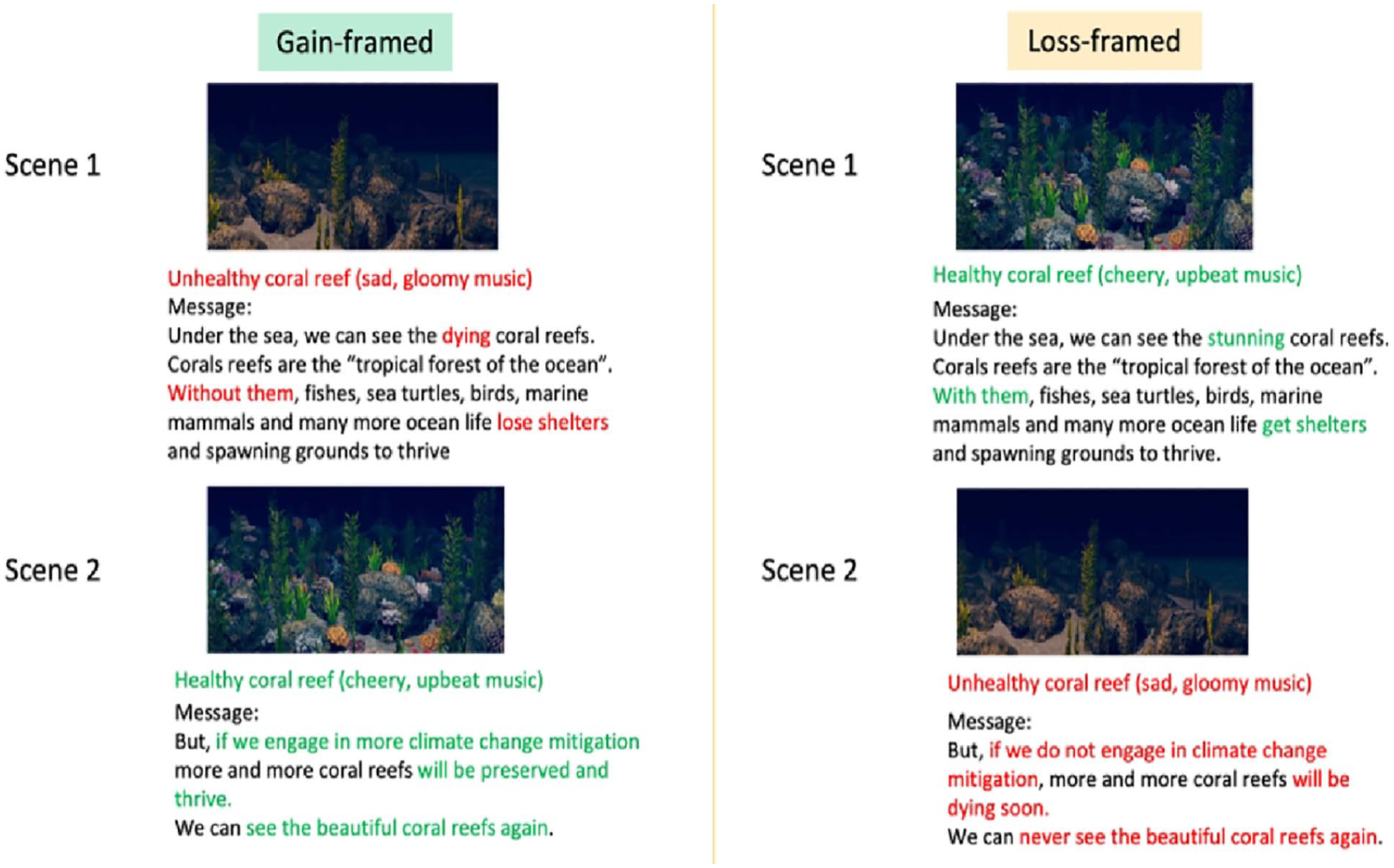
Manipulation of Loss and Gain Framing.
Measurement
All items were measured on scales from 1 to 7. Please refer to Supplementary Material II 3 for the exact items we used to measure the variables.
Control Variables
Climate change issue involvement was measured using the 20-item bipolar scale developed by Zaichkowsky (1985). Sample items include, “To me, information about climate change is unimportant (1)–important (7), irrelevant (1)–relevant (7), worthless (1)–valuable (7), unexciting (1)–exciting (7) (α = .96, M = 5.54, SD = 1.64)
Environmental self-efficacy was measured using the three-item scale developed by Kellstedt et al. (2008). Sample items included “I believe my actions have an influence on global warming and climate change” (α = .87, M = 4.89, SD = 1.58).
Political ideology was measured by asking “In politics, people sometimes talk about liberal and conservative. Where would you place yourself on a scale from 1 to 7 where 1 means very conservative and 7 means very liberal?” (M = 4.35, SD = 1.85).
Manipulation Check Questions
We included two items for the manipulation check of loss and gain framing, participants were asked to rate on two items, “The experience focuses on the positive outcomes if I engage in pro-environmental behaviors” for gain-framing and “The experience focuses on the bad things that could happen if I do not engage in climate change mitigation behaviors” for loss framing.
Mediating Variables
Perceived interactivity was measured based on the three-item scale developed by Oh and Sundar (2015). Example item: “The experience allowed me to perform a lot of actions on its content” (α = .90, M = 3.77, SD = 1.74)
Affective responses. Fear was measured by the scale in Shen and Dillard (2007) wherein participants were asked to rate three items, “when I think about climate change, I feel fearful/afraid/scared” (α = .97, M = 4.00, SD = 1.90). Hope was measured using two other items in Chadwick (2015), which asked if participants feel “hopeful/ optimistic” when thinking about climate change (Spearman–Brown coefficient 4 = .95, M = 4.04, SD = 1.70).
Dependent Variables
Risk perceptions was measured by the 9-item scale developed by Leiserowitz (2006). Sample items include, “I am concerned about climate change” and “The current impacts of climate change around the world are serious” (α = .96, M = 4.94, SD = 1.43). An exploratory factor analysis using principal axis factoring method revealed that this scale is unidimensional.
Attitude toward the climate change policy is measured using the modified scale developed by Nabi et al. (2018). Participants were asked to rate on a semantic differential scale (bad/ good, wrong/right, unfavorable/favorable, negative/positive) for the following item, “I think government policy that aims to reduce climate change is . . .” (α = .99, M = 5.33, SD = 1.78).
Behavioral intention was measured using the seven-item scale developed by Ferguson and Branscombe (2010). Sample items include “I will sign up for more expensive green electricity,” “I will drive considerably less” (α = .90, M = 4.42, SD = 1.55).
Data Analysis
To test H1, H2, and answer RQ1 as well as the effects of our IV on the mediators, we conducted a MANCOVA. To test H3, H4, H5, H6, and H7, we used Model 4 in the Process Macro of SPSS, which involves a bootstrapping procedure using 5,000 resamples and 95% bias-corrected confidence intervals (Hayes et al., 2017).
Results
Manipulation Check of Loss and Gain Framing
We found that there were significant differences between the loss and gain framed conditions on the manipulation check questions regarding the framing, such that participants in the gain-framed conditions on the manipulation check questions regarding the framing, such that participants in the gain-framed conditions (M = 5.88, SD = 1.09) were more likely to perceive the experience to focus on positive outcomes than those in the loss-framed conditions (M = 3.21, SD = 1.96), t(128) = −9.50, p < .001, while participants in the loss-framed conditions (M = 6.23, SD = 1.19) were more likely to perceive the experience to focus on negative outcomes than those in the gain-framed conditions (M = 4.59, SD = 1.59), t(128) = 6.60, p < .001.
Effects of Loss and Gain Framing
H1 and H2 proposed that loss and gain framing will elicit different emotional responses among participants. Results from the MANCOVA revealed that gain-framed experiences elicited a higher level of hope (M = 4.38, SD = 1.62) compared to loss-framed experiences (M = 3.68, SD = 1.72), F(1, 123) = 5.15, p = .03, R2 = .04, supporting H1. We found that loss framing (M = 4.41, SD = 1.82) elicited a stronger feeling of fear compared to gain framing (M = 3.63, SD = 1.90). However, the difference was not statistically different, F(1, 123) = 1.13, p = .29, R2 = .01, thus failing to support H2. This also means no support for H4, which proposed that fear could serve as a mediator between framing and other dependent variables.
H3 proposed that hope will mediate the effects of framing on other dependent variables. However, the mediation analyses revealed that the feeling of hope did not serve as a significant mediator between loss and gain framing and participants’ risk perceptions (B = −.03, SE = .04, 95% CI from −.14 to .03), attitude toward the climate change mitigation policy (B = .02, SE = .06, 95% CI from −.12 to .14), or pro-environmental behavioral intention (B = .07, SE = .05, 95% CI from −.00 to .18). Hence, our H3 was not supported.
Effects of Modality
H5 proposed that participants will perceive the desktop VR to be more interactive than unidirectional videos, leading to higher persuasion. Results from MANCOVA revealed that desktop VR (M = 4.66, SD = 1.20) was indeed perceived to be more interactive than unidirectional videos (M = 2.95, SD = 1.77), F(1, 123) = 49.23, p < .001, R2 = .29. However, mediation analyses revealed that such high perceived interactivity did not further lead to higher risk perceptions (B = −.02, SE = .11, 95% CI from −.24 to .21), more positive attitude toward climate change mitigation policy (B = −.23, SE = .19, 95% CI from −.62 to .12) or higher pro-environmental behavioral intention (B = .00, SE = .13, 95% CI from −.26 to .25) among participants who interacted with the VR experience. Therefore, H5 was not supported.
H6 and H7 proposed that desktop VR will trigger stronger emotional responses among individuals, leading to more persuasion than unidirectional videos. We found that contrary to what we hypothesized in H6, desktop VR elicited a lower level of hope (M = 3.64, SD = 1.62) compared to unidirectional video (M = 4.41, SD = 1.69), though the difference was only approaching significance, F(1, 123) = 3.51, p = .06, R2 = .03. Mediation analyses also revealed that hope did not mediate the relationship between modality and risk perceptions (B = .03, SE = .04, 95% CI from −.03 to .12), attitude toward the climate change mitigation policy (B = −.01, SE = .05, 95% CI from −.13 to .09) or pro-environmental behavioral intention (B = −.06, SE = .04, 95% CI from −.16 to .01), failing to support H6.
For H7, however, we found that compared to unidirectional videos (M = 3.59, SD = 1.95), desktop VR (M = 4.46, SD = 1.73) elicited a higher level of fear among individuals, F(1, 123) = 4.75, p = .03, R2 = .04. The heightened level of fear was associated with higher risk perceptions (B = .08, SE = .06, 95% CI from .00 to .22), and higher pro-environmental behavioral intentions (B = .10, SE = .06, 95% CI from .00 to .25) among participants who interacted with the VR experience, supporting our H7a and H7c. Fear, however, did not mediate the effect of modality on attitude toward the climate change mitigation policy (B = .06, SE = .06, 95% CI from −.02 to .20), failing to support H7b.
Interaction Effects Between Framing and Modality
Given the contradictory findings reported in the literature regarding the effects of loss and gain framing, and the elicitation of negative or positive emotions in VR, we proposed a nondirectional research question. Results from a MANCOVA revealed that modality did not moderate the effects of message framing on fear, F(1, 123) = .38, p = .54, R2 = .00, or hope, F(1, 123) = .00, p = .99, R2 = .00. However, we found that there was a significant interaction effect between modality and framing on individuals’ attitude toward climate change mitigation policy, F(1, 123) = 12.02, p < .001, R2 = .09. Specifically, we found that compared to unidirectional videos, desktop VR increased individuals’ attitude toward climate change mitigation policy when the experience was loss-framed, but it decreased their attitude toward the policy when the experience was gain-framed (see Figure 2).
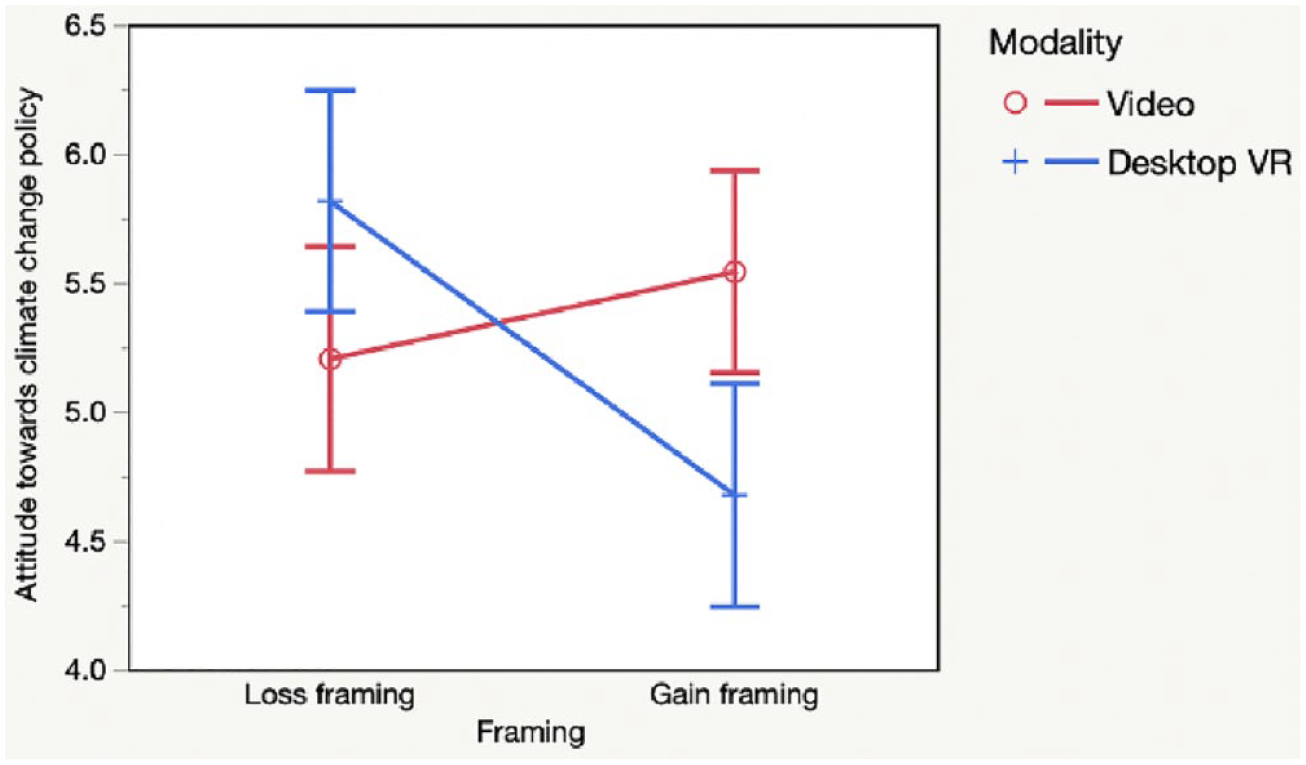
Interaction Effects Between Modality and Framing on Attitude Toward Climate Change Mitigation Policy.
Discussion
Understanding how to design effective VR experiences to communicate climate change risks and consequences has become a pressing issue, particularly since more outlets have started to harness the power of VR as a persuasion tool in science communication. The current study explored how framing the virtual experience helps enhance the persuasiveness of immersive technology on climate change issues, potentially through the elicitation of different emotional responses.
Consistent with previous literature (Nabi et al., 2019; Ojala, 2012), we found that a gain-framed experience elicits a stronger feeling of hope compared to a loss-framed experience. However, this amplified level of hope did not lead to more persuasive outcomes. On the other hand, we failed to find a significant difference between the two message framing techniques on the level of fear participants reported, which contradicts previous literature (Meijnders et al., 2001; Nabi et al., 2019). This particular null effect may be due to the lack of statistical power for detecting a relationship with a small effect size, owing to the small size of our sample 5 . However, although framing was not shown to have an effect on the level of fear, we found that modality made a difference, with desktop VR significantly increasing individuals’ levels of fear. This finding has several theoretical implications. First, we extend the current research and find that modality itself could trigger not only cognitive responses in the context of climate change communication as documented in the past literature (Barnidge et al., 2022; Hsu et al., 2018), but also emotional responses. The power of VR in eliciting more emotional responses is in line with past literature (Pan et al., 2018). These findings suggest that compared to messages, modality might be more effective in eliciting negative arousing emotional responses, such as fear, among users. Yet, it should be noted that VR only elicits stronger negative emotional responses such as fear, but might not be very helpful in inducing more hopeful feelings. The reason behind this finding can be explained by past research which revealed that visual stimuli might be more effective in eliciting stronger responses for emotions that are highly arousing in nature (Juan & Pérez, 2009). Our study extends this finding in a science communication context and reveals that, compared to hope, fear toward climate change is more likely to be elicited in a more interactive environment such as desktop VR. Second, we found that heightened level of fear further led to higher perceived risks of climate change, and higher behavioral intention of engaging in pro-environmental behaviors among participants. Theoretically, this finding corroborates past research regarding the persuasive effects of fear in science communication (Feldman & Hart, 2016).
It should be noted that although we find desktop VR and unidirectional videos to be significantly different from each other in terms of perceived interactivity, that difference did not predict persuasive outcomes. One interpretation could be that compared to cognitive perceptions (like perceived interactivity), emotional responses are far more persuasive in the context of climate change communication, as indicated in the previous literature (Smith & Leiserowitz, 2014). This could be because affect-based cues are more likely to influence affect-based attitudes, which is especially true for emotionally evocative events like climate change (Chapman et al., 2017; Edwards, 1990). This result could also be due to the fact that the afforded interactivity in our study was still quite limited. Specifically, we operationalized interactivity of desktop VR experience in terms of looking and moving around the scene, but it was limited to exploration without allowing users to modify the content. While our users are given the agency to look and move in any direction they desire, they were not afforded any rich action-based forms of interaction to, for example, manipulate the virtual environment and experience its consequences. We designed our manipulation in this way mainly because we were interested in providing a proper test of the framing effect itself in the current study and avoid the potential confound of exposing two groups of participants to potentially different content in the VE (as a result of individualistic exploration and/or manipulation of the environment). However, this design choice could also diminish the persuasiveness of VR as the interactivity afforded may not have been powerful enough, as reflected in the mean score of perceived interactivity in the desktop VR condition (M = 4.66, SD = 1.20 on a 7-point scale). The limited interactivity could also explain why we did not observe an interaction effect between modality and message framing on emotional responses. It is possible that desktop VR might better help elicit a higher level of hope or fear in users, through either feeling a sense of accomplishment or a potential loss when they experience how their own pro-environmental actions or lack of pro-environmental actions can repair or exacerbate aquatic life.
Moreover, our study advances extant literature by demonstrating that the use of desktop VR might not always lead to better persuasive outcomes. Specifically, we find an interaction effect between modality and message framing on attitude toward climate change mitigation policy such that desktop VR increased individuals’ attitude toward climate change mitigation policy, but only when the experience was loss-framed. When the experience was gain-framed, desktop VR led to a lower attitude toward climate change mitigation policy compared to unidirectional video. This effect was not mediated by any emotional responses, suggesting the possibility that when studying thoughts or attitudes related to policy, cognitive information processing matters more than the emotions users feel. This could be due to the fact that policy-related attitudes are typically more cognitively demanding, making them more susceptible to be influenced by cognitively engaging elements such as message arguments (Edwards, 1990). Another possibility is that, instead of directly influencing users’ attitude toward climate change policy, affect primes users regarding their associated cognitive ideas or schemas during information processing. According to the alternative affect priming model (Bower, 1981), affect serves as an integral part of people’s cognitive representations of the world. Consequently, users’ emotions can automatically prime them to follow certain cognitive structures, biases, or heuristics. This effect might be particularly pronounced in the VR setting. Past research suggests that interactive VR could lead to more heuristic information processing among users because the virtual experience itself could exhaust users’ mental resources (Liu et al., 2017). In other words, the relatively higher immersion provided by desktop VR is likely to promote heuristic, rather than systematic, information processing. VR could potentially promote the triggering of the availability heuristic, when users make decisions or judgments based on the information that readily comes into their mind (Schwarz et al., 1991). Past research generally documented that we not only have a natural tendency to avoid potential loss (i.e., loss aversion) (Levin et al., 1998), but are more sensitive to negative information as well (i.e., negativity bias) (Ito et al., 1998). These human biases explain why users were more persuaded by loss-framed information heuristically compared to gain-framed information, especially when the information was rich and easy to access, as in the case of a VR setting. In sum, it appears that negative information is far easier to be accessed and used by users to make heuristic judgments compared to positive information in a VR setting. This effect might be particularly strong because we showed the negative consequences by presenting an abrupt contrast between healthy coral reefs and unhealthy coral reefs caused by the absence of mitigating actions. The same explanation can be applied to why gain-framed experience in VR had a backfiring effect on persuasion. In a gain-framed VR experience, users might only focus on the vivid portrayal of the positive consequences of climate change, hence their perceptions were less influenced by their bias to avoid potential loss. Future studies could further test this possibility by measuring individuals’ cognitive responses toward the stimuli.
Our study offers several practical implications for science communication. We found that interactive and visually rich technologies, such as desktop VR, can be harnessed to effectively communicate scientific issues. In the context of climate change communication, interactive technology could be more powerful in inducing fearful responses toward climate change than plain information, which in turn affects individuals’ risk perceptions and pro-environmental behaviors intentions. It suggests that science communicators can leverage VR technology to better convey fear-evoking consequences of human action or inaction to laypersons. Moreover, beyond message design, our study highlights the importance of creating rich visual representations that illustrate the gradual and incremental environmental changes in users’ minds, which can elicit specific affective responses that lead to persuasive outcomes.
However, we also caution that practitioners should carefully consider when to use VR technology for persuasion. While desktop VR can enhance the persuasiveness of certain messages, such as loss-framed messages, it may have a counterproductive effect when conveying other messages, such as gain-framed messages, compared to a unidirectional video. This finding also implies that practitioners could leverage the power of desktop VR by designing the experience to be loss-framed instead of gain-framed, or at least make sure the experience places higher emphasis on the negative consequences of not engaging in the advocated behaviors.
Limitations And Future Directions
Our study is not free from limitations. First, by only including users who have a Windows operating system, our results might not be able to extrapolate to the general audience. Also, in our recruitment materials, we indicated that the participants needed to download an experience onto their own device. Therefore, it is highly likely that only those participants who did not find this process burdensome or those who were highly motivated to participate in this study (either motivated by the monetary incentives or are interested in climate change related issues) chose to participate, which could have resulted in a response bias in our sampling process. We statistically controlled for participants’ level of involvement in climate change issues, but future studies could invite participants to a controlled environment such as a lab and attempt to replicate the effects found in the current study. Additionally, the borderline power afforded by the small sample size limits our ability to detect subtle relationships, so the null effects from MANCOVA (i.e., H2) should be interpreted with caution. Furthermore, as we discussed earlier, our current study is limited to desktop VR and does not utilize the power of immersive VR (HMDs) and the level of empathy it can evoke through presence, embodiment, and natural interactivity. While desktop VR is admittedly more accessible to everyday users, it does not offer nearly the same level of immersiveness as head-mounted VR. Replications with more immersive VR tools will enable us to study the mediating effects of embodiment, presence, and interactivity on risk perception, attitude toward climate change policy, and behavioral intentions. Furthermore, it is important to note that the study sample in our research consisted predominantly of white participants. As a result, our ability to generalize the findings to other populations is limited, given that past research has shown individuals from different racial groups may have different baseline concerns and skepticism regarding climate change (Ballew et al., 2020). By controlling for climate change issue involvement in our study, we mitigated this effect somewhat, but replications of our findings by using more diverse and representative samples would more definitively verify the external validity of our findings. Finally, we utilized a two-item scale to measure the feeling of hope. While we achieved a good reliability score with this scale, future studies could consider employing alternative scales with more items.
Conclusion
In this study, we investigated the persuasiveness of technology (desktop VR vs. unidirectional videos) as well as message framing (gain vs. loss) on communicating the science of climate change. We found it is not the message framing, but the modality itself (i.e., desktop VR) that triggered more fearful responses, which, in turn, predicted higher perceived risks of climate change, and higher behavioral intention of engaging in pro-environmental behaviors. However, the effect was interactive, such that desktop VR (compared to a unidirectional video) increased individuals’ attitudes toward climate change mitigation policy only when the experience was loss-framed, but reduced their attitudes when the experience was gain-framed. Our study extends the current literature on understanding the causes and effects of negative and positive affective responses in a virtual environment, as well as highlighting the importance of using interactive technologies for communicating climate change and other science-related issues.
Footnotes
Declaration of Conflicting Interests
The author(s) declared no potential conflicts of interest with respect to the research, authorship, and/or publication of this article.
Funding
The author(s) received no financial support for the research, authorship, and/or publication of this article.
Notes
Author Biographies
 ) is James P. Jimirro Professor of Media Effects and co-director of the Media Effects Research Laboratory at the Donald P. Bellisario College of Communications in The Pennsylvania State University. Supported by the National Science Foundation, his research investigates social and psychological effects of technological elements (e.g., interactivity and modality) in a variety of digital media, from websites and social media to robots and virtual reality. He edited the first-ever Handbook of the Psychology of Communication Technology (2015).