




Abstract
The emergence in 2022 of surreal and grotesque image sets created using the free online AI text-to-image generator DALL-E Mini (Craiyon) prompts our analysis of their aesthetic content and connections to preexisting media forms and trends in digital culture. DALL-E Mini uses an unfiltered database of images from the internet to create new images based on a user’s text prompt, often resulting in misshapen bodies and impossible scenarios. Despite its technological limitations, DALL-E Mini’s popularity as a meme-making tool is visible on social media platforms, where crowd-sourced images are shared and experimentation with the tool is encouraged. Through comparison with existing artistic practices and formats (creative automata, surrealism, body horror, celebrity memes), we argue that DALL-E Mini creations can be understood as human-AI co-creations and forms of aesthetic mimicry. Building on the ideas of surrealists such as André Breton, we propose that DALL-E Mini’s images, prompts and the grid interface adhere to surrealism’s historical interests in the unconscious, the uncanny, and the collaborative ‘exquisite corpse’ parlour game. We also consider DALL-E Mini’s relevance to the category of ‘AI Arts’, Patricia De Vries’s call for more research that relates algorithms to the broader artistic and cultural contexts in which they are embedded (2020), and the ‘authoring’ of celebrity bodies as data (Kanai, 2016). Our theorisation of DALL-E Mini is supported by examples drawn from social media and personal experiments with the generator. Overall, we propose that internet users’ experimentation with DALL-E Mini corresponds with a cultural moment in which AI imaging technologies are eliciting excitement and anxiety. The outputs are revealed to be reliant on users’ pop cultural knowledge, with DALL-E Mini allowing for a playful, co-creative algorithmic practice, wherein contemporary anxieties about digital labour, (post)digital culture, biopolitics, and global issues are redirected into surreal visual storyworlds.
Keywords
Introduction: Algorithmic culture and aberrant creations
Images created with the free online AI image generator DALL-E Mini first circulated widely on social media platforms in the summer of 2022. DALL-E Mini screenshots became a viral social media trend and meme, helped popularise AI image generation, and prompted popular articles on the generator’s flaws, nightmarish aesthetics and technological implications. DALL-E Mini applies a user’s prompt sentence to create visual representations (text-to-image synthesis) and generates a 3 x 3 grid of nine images, using an unfiltered database of online image results. Users can prompt imagery of things and events that may not really exist, resulting in misshapen bodies and objects and absurd visualisations. Appropriately, the name ‘DALL-E’ is a portmanteau of artist Salvador Dalí and Pixar’s animated film WALL-E (2008), about a sentient robot who collects garbage on a depopulated Earth: effectively merging the history of surrealism with more contemporary awareness of machine learning and posthumanism.
DALL-E Mini was designed by Boris Dayma on the AI development website Hugging Face and inspired by research at OpenAI, who launched the more powerful DALL-E 1 and 2 in 2021 and 2022, respectively, which achieve more realistic and accurate imagery. 1 DALL-E 2 is not currently widely available to the public for fears of misuse because it can generate much more convincing imagery (Knight, 2022). For the time being, DALL-E Mini is thus the most accessible and popular DALL-E version, despite and perhaps because of its errors and grotesque qualities. As Art Review critic Tom Whyman (2022) comments, although the original AI is stronger than the ‘mini’ version, it would be much less ‘fun to play with’. Discourse on DALL-E Mini in popular and social media has rightly noted some of the algorithmic biases inherent in the software (see Johnson, 2022; Al-Sibai and Christian, 2022), while other user experiments suggest the AI is attempting to redress these biases by adding descriptors such as ‘female’ or ‘black’ to user prompts in order to present a more diverse output of imagery (Sparkes, 2022b). Commentary of this kind is undoubtedly important, drawing public attention to how digital technologies and systems like DALL-E Mini are not neutral entities. This discourse further illustrates research into the topic by scholars such as Safiya Umoja Noble, who demonstrates in Algorithms of Oppression (2018) how the near monopoly status of internet search engine Google has led to a biased set of search algorithms that discriminate against people of colour.
While acknowledging the significance of DALL-E Mini’s algorithmic biases, this paper focuses on the creative use of this flawed technology, which we position in relation to visual and (post)digital culture. Specifically, we theorise and historicise popular uses of DALL-E Mini on social media platforms in relation to three pre-existing artistic trends – creative automata, surrealism, and body horror – and with reference to broader visual aesthetics and conventions including memes, celebrity iconography, and precursors to DALL-E’s grid interface. By identifying recurrent patterns or trends in the content and style of the text prompts and image outputs, we argue that internet users of DALL-E Mini deploy media and visual literacy skills to redirect some of the technology’s perceived flaws into a form of visual storytelling that is collaborative, both with other social media users, and with the AI technology itself.
As Carolyn Kane (2019) argues, ‘In creative spheres, failure is dealt with quite differently than it is in industry. Here, aberrant creations marginalized in the business world are welcomed back into the fold as inspiration for artmaking’ (p.5). Kane connects 21st century digital aesthetics to issues in the history of technology, an approach that can shed light on why social media users have embraced the jarring, distorted images produced by DALL-E Mini. Taking social media platforms as creative spheres, and DALL-E Mini outputs as the corresponding aberrant creations, helps us understand why the flaws inherent in the initial, public version of DALL-E have been welcomed as a means for making digital art (or at least digital artefacts) – ones we deem here to be a worthy subject for critical analysis at the levels of aesthetics, content, and user trends. We also see DALL-E and its outputs as part of a longer history of creative automata and as notable examples of what Patricia De Vries (2020) and others (Galloway, 2006; Striphas, 2015) term as ‘algorithmic culture’. As De Vries notes, despite the abundant scholarship on AI, in general, we lack research that connect algorithms to the broader contexts in which they are embedded, something that is crucial since ‘Reflections on algorithmic culture require materializing what is, mostly, invisible’ and including ‘an analysis of how the algorithm is imagined, represented, and narrativized by artists’ (p.8; p.14).
Here, we argue that DALL-E Mini’s emergence as an AI creative tool corresponds with contemporary discourses on technological automation, posthumanism, biopolitics, and other anxieties in the (post)digital moment. DALL-E Mini’s vernacular use thus potentially reflects what De Vries examines as ‘algorithmic anxiety’, an ontological and epistemic concept whereby anxieties about the future of algorithmic culture shape its perception in the present and is in turn reflected in contemporary artworks that address issues such as facial recognition, automation, and state control (pp. 11–12). Moreover, the 2022 period in which DALL-E Mini emerged is marked by various collective anxieties, such as the threat of nuclear war in Ukraine, the lingering impact of the COVID-19 pandemic, and the continuing effects of global warming, which seem to be reflected in vernacular DALL-E Mini trends. As we argue, DALL-E has allowed for these anxieties to be expressed via algorithmically co-created surreal, distorted, and dystopian prompts and image outputs. At the same time, DALL-E Mini’s aesthetic mimicry of artists’ styles using an algorithm can be tied to other anxieties about AI ethics and digital labour in contemporary society, or what De Vries terms fears over ‘algorithmic replacement’ (p.20), as AI art becomes increasingly visible in mainstream spheres and potentially obfuscates human creators. By acknowledging the human and AI collaboration behind DALL-E Mini’s popularity, our paper explores how the image outputs can be described as co-produced units of meaning. Paying attention to these dynamics, we theorise common patterns in aesthetic style and content in DALL-E outputs, as well as how users who are not necessarily artists, per se, are helping to shape the meaning and culture for this particular format of algorithmic culture, in part by interacting with and sharing outputs as a form of meme.
Like other internet memes, DALL-E Mini outputs can be described as units of cultural distribution which can be imitated in content, form, and stance (Shelley, 1818; Shifman, 2013). DALL-E Mini’s online proliferation as a meme relies on online community participation in producing and expressing humour and playful commentary on contemporary life. The irony at the heart of many DALL-E Mini creations tends to combine objects, people, and events that would not normally be associated. DALL-E Mini image generation, as a meme and online practice, is most visible on dedicated social media profiles such as Weird DALL-E Mini Generations (@weirddalle) on Twitter (with over 1.1 million followers) and its associated Instagram profile @weirddallemini (with over 2.5k followers). These platforms reshare community submissions through the ‘weirddalle’ subreddit (r/weirddalle), started in June 2022 (with 122k members). 2 DALL-E Mini users take advantage of the affordances of smartphones and social media by screenshotting their image outputs and sharing them on Instagram, Twitter, Reddit, and so on, where other users can reshare results and be inspired to participate in making outputs themselves (a fundamental aspect of memes as an online practice). 3 Like most internet memes, DALL-E Mini outputs had a relatively short lifespan, as the novelty of AI image generation has perhaps worn off. The lifespan is also tied to more sophisticated and accurate AI image generators that emerged on social media by the end of 2022 (primarily MidJourney, Lensa, and Stable Diffusion) and somewhat displaced use of the more unpredictable and flawed DALL-E Mini.
Despite the relatively short lifespan, DALL-E Mini’s viral internet moment provides evidence of a notable period when AI-driven imagery is gaining mainstream use, for better or worse. Drawing on examples found on social media and some of our own experiments with the technology, we argue here that DALL-E’s cultural moment can be seen as a meaningful confluence of various creative practices and visual conventions. Indeed, the average social media user is arguably much better versed in media, genre, art and meme conventions than they are in the complexities of algorithmic databases and text-to-image software. And it is this knowledge and literacy that has helped shape common trends in DALL-E’s vernacular use in a time when AI-driven art is a contentious, rapidly evolving issue. After first laying out our theoretical framework for historicising DALL-E’s outputs and positioning it in terms of its aesthetic and cultural ties to creative automata, surrealism, and body horror, we will analyse DALL-E imagery in terms of its aesthetic mimicry, precursors in horror media, and distortion of celebrity bodies. We conclude our analysis with an examination of how the dynamics of DALL-E’s 3 × 3 grid interface also builds on users’ familiarity with earlier aesthetic forms and storytelling formats.
Theorising DALL-E Mini within (post) digital culture
DALL-E Mini’s popularity as a contemporary AI toy partly depends on its mimicry of human creativity through machine learning. It is thus part of a much longer history of cultural fascination with, and anxieties around, the human-like abilities of automata. The image generator potentially demonstrates what digital media theorist Lev Manovich calls fully autonomous creation (2018: 5). While the images DALL-E Mini sources originate from unfiltered data from the internet with human-made origins, the mashup of these images into new images is almost completely beyond the control of the user. DALL-E Mini’s text-to-image synthesis emulates a range of painting, drawing, sketching, and blending styles, suggesting non-human creativity. While distinct from AI (designated typically to computers), automata (non-human animated forms) have existed for centuries as the focus of human invention, amusement, and anxiety. They include the classical myth of Prometheus; Pierre Jacquet-Droz’s automatic mechanical organ-playing, drawing, and writing dolls in the 18th century; Mary Shelley’s monster in Frankenstein; or, the Modern Prometheus (1818); rebelling replicants in Blade Runner (1982); and, in the digital streaming era, the fusion of AI and automaton in the Black Mirror (2011-2023) episode ‘Be Right Back' (2013).
Although DALL-E Mini does not have a body with which to create art and its autonomous abilities are hidden from the user (unlike true automata), it is nonetheless personified. DALL-E Mini is unpredictable but can be ‘trained’ by users to produce more desirable outcomes through informal experimental and analytical strategies that afford some control for the user. ‘Training’ can be achieved using highly specific directions and longer prompt sentences (Knight, 2022). The personification of DALL-E Mini (imbuing it with human or at least animal qualities) is implied by the term ‘trained’ and in the language of its interface, specifically DALL-E Mini’s rebranding as another portmanteau, ‘Craiyon,’ in June 2022. The new name combines AI with a creative tool that is typically held by a human hand. As of November 2022, Craiyon’s interface invites users to ‘draw’ by entering a prompt into a text box with a crayon symbol. A crayon evokes playfulness, childishness, and messiness compared to a pen or pencil, which suggest a more mature, accurate writing and sketching ability. The rebranding was requested by OpenAI to avoid confusion with the original, stronger DALL-E, but it also captures how DALL-E Mini is inherently naïve and unable to ‘colour inside the lines,’ so to speak. This departs from Manovich’s (2019) discussion of how more restricted development of ‘strong’ AI or AGI (artificial general intelligence) would produce ‘semantically plausible media artefacts about human beings and their world,’ which would require ‘approximately the same knowledge of the world as an adult human’ (p.10). Instead, DALL-E Mini’s aesthetic appeal ostensibly lies in its creative immaturity. Like Jacquet-Droz’s dolls, Shelley’s ‘being,’ and Pixar’s WALL-E robot, DALL-E Mini is framed as naïve and childlike. Lacking a body, DALL-E Mini nonetheless emulates through machine learning the phenomena we associate with creativity, such as photography and drawing. Suitably, Jacquet-Droz’s doll used a pen in the age of Enlightenment, reflecting the era’s proliferation of writing and ideas, as well as industrialisation. Now, the crayon-like algorithmic tools employed for DALL-E Mini reflect our ‘messy’ digital visual culture or what Carol Vernallis (2013) calls the ‘media swirl’ of ‘scrambled’ internet mashups and cross-media (p.3).
Yet, attributing full creative autonomy to DALL-E Mini disregards its collaborative elements and mimicry of human creativity. Rightly pointing to the crucial human participation in DALL-E Mini generations, Whyman (2022) observes: ‘In collaboration with a human user, DALL-E Mini can process the internet’s collective mind into that of an artist’. This collaborative element raises ethical concerns about digital labour and the extent to which humans are credited in AI artwork, especially in image generators that are more sophisticated than DALL-E Mini. With the increasing pervasiveness of AI comes anxiety about authenticity, autonomy, and plagiarism. For example, in 2018, Edmond Belamy – the first AI-generated portrait sold at auction – drew criticism for its authorial status and monetary motivations (Christie’s, 2018). More recently, OpenAI’s partnership with Shutterstock to further integrate AI-created stock images into the company led to criticism from existing image contributors who fear their work’s obsolescence (Vincent, 2022). Artists have also voiced their anger in relation to sophisticated image generators like Lensa and Stable Diffusion that can produce artwork by ‘ripping’ from databases of online artwork made by unpaid human artists (Landymore, 2022). While image generators can mimic the style of a famous and long-dead artist, such as Claude Monet or Vincent Van Gogh, image generators also directly impact the livelihoods of living and lesser known artists who do not receive credit or payment for the plagiarising of their art styles. Meanwhile, AI companies profit from this practice and deny wrongdoing (Landymore, 2022). Ironically, the ‘mangled remains’ of artists’ handwritten signatures can remain in image outputs (Landymore, 2022), and thus highlight the human labour embedded in AI creation and, symbolically, its roots in writing automata. The rapid expansion of AI image generators like DALL-E and collective participation in their outputs is therefore fraught with both curiosity and tension. Indeed, OpenAI’s reluctance to launch DALL-E 2 immediately to the public oddly reflects Victor Frankenstein’s fear of his child-invention reproducing and wreaking havoc.
DALL-E Mini’s ties to historical concerns about automata are one of several ways in which it reanimates certain surrealist ideals. Beyond DALL-E Mini’s name invoking that of famed surrealist artist Salvador Dalí, the generator’s blending of machine learning with familiar images from the human world often leads to nightmarish results that reflect a wider historical interest in surrealist art, including its links with the ‘uncanny’ (Freud, 1919). The term surrealist is translated from French roughly as ‘beyond reality’ and is most often associated with André Breton’s first Manifesto of Surrealism (1924), in which he defined it as: Psychic automatism in its pure state, by which one proposes to express—verbally, by means of written word, or in any other manner—the actual functioning of thought. Dictated by thought, in the absence of any control exercised by reason, exempt from any aesthetic or moral concern. (p.26)
The surrealist movement placed emphasis on the unconscious and dream logic and was strongly associated with uncanny outputs, including those from the game ‘exquisite corpse’: each player took turns writing or drawing on a sheet of paper, folding it to hide their contribution, and then passed it to the next participant, until all the players had added something, and the final product was revealed (see Figure 1). The overlaps between DALL-E and surrealist creations are perhaps best described as versions of this game, where visual and often chaotic presentations of the body emerge from dynamic exchanges between multiple participants (each relinquishing control), and including that of the AI generator itself. Man Ray (Emmanuel Radnitzky), André Breton, Yves Tanguy, and Max Morise, Exquisite Corpse, 1928. © Man Ray 2023 Trust / ADAGP Paris / IVARO Dublin.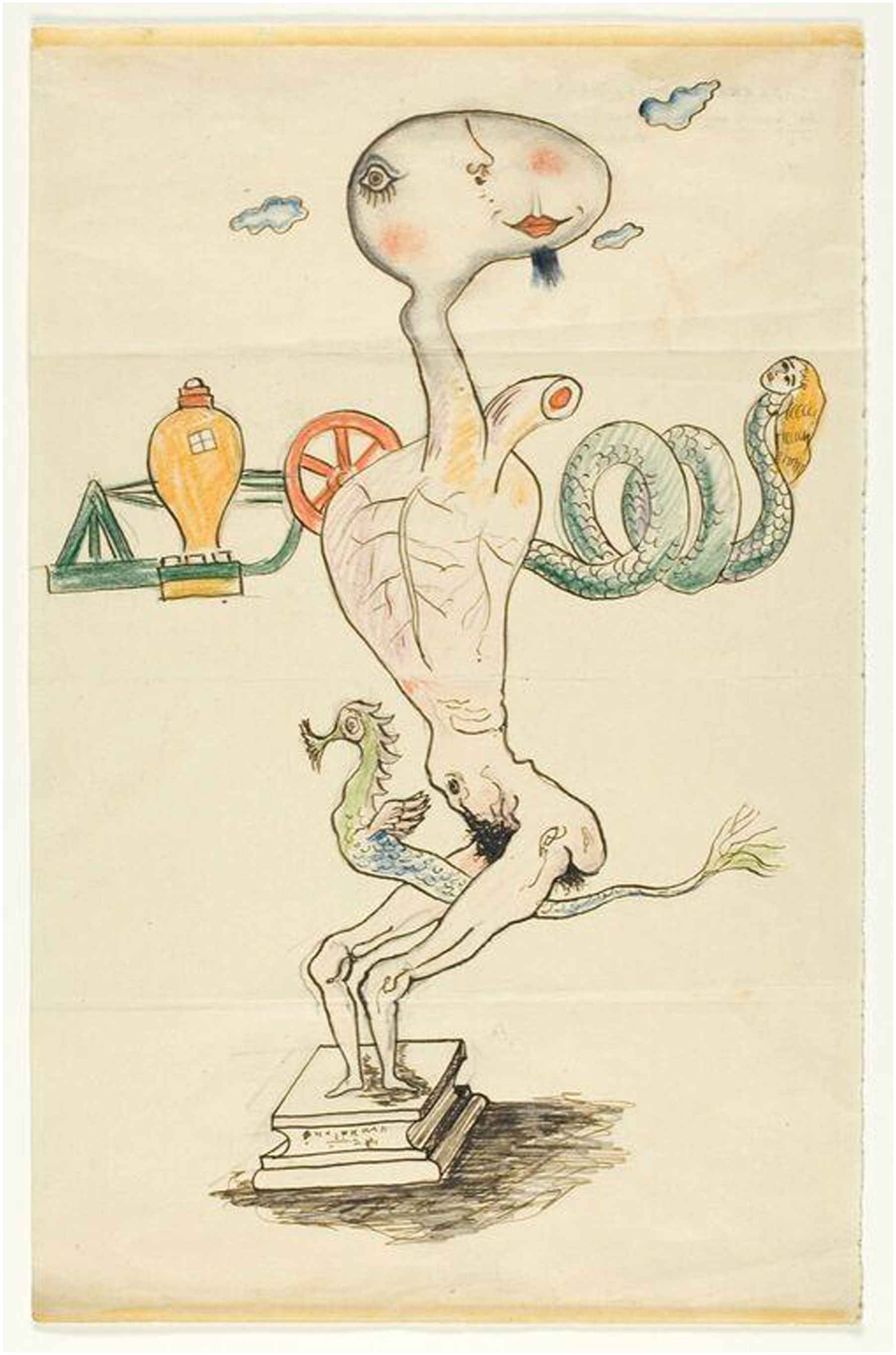
More broadly, surrealists often drew on Freud’s description of the uncanny and made artworks that combined familiar things in unfamiliar ways in order to create feelings of unease. Artworks often depicted imagined alternative realities, with artists using processes like ‘automatic’ or ‘free’ drawing or writing in order to free ideas or images from their unconscious minds (TATE, 2022b). 3 Internet users have similarly developed creative strategies for using DALL-E images to provide playful commentaries on realism, and with their uncanny or disturbing effect similarly resulting from their origins with our known world. In this case, the technology performs an update on free drawing by creating images based on algorithmic image data, while users’ often nonsensical text prompts might be seen as a form of free writing. The outputs from DALL-E Mini can also be considered an expression of the functioning of thought, in that the user’s specific prompts give rise to a set of image outputs that might otherwise be near impossible to express. Paul Miller notes how much of online culture, including digital mashups and remixes, mirrors a lot of what went on with the original exquisite corpse game (2009: xiv). Writing 13 years before DALL-E Mini emerged, he seems to anticipate its workings when describing how variations of the game ‘let the unconscious methods we’ve used to sort information become a filter for the way we engage the external world’, and thus ‘turns the mind inside out’ (2009: xi). In the case of DALL-E Mini, tagged internet images are sorted and synthesised into new images.
DALL-E’s surrealist presentation of bodies that are both familiar and jarring has the potential to disturb and can be usefully conceived in terms of ‘body horror’: a subgenre of horror that showcases grotesque or psychologically disturbing violations of the human body. Variations on body horror can be found across a range of media and artworks, for example, in the reception of the art of Francis Bacon, which is frequently described as ‘grotesque’ (Harpham, 1976; Fingesten, 1984) or ‘distorted’ (see: Fifield, 2009; Safran et al., 2012). In keeping with our argument that users have learned to deploy the DALL-E generator to reflect anxieties related to contemporary threats (such as pandemics and biopolitics), for Ronald Allan Lopez Cruz (2012) body horror in film is a form of biological horror; wherein horror is elicited by presentations of physical metamorphosis, genetic mutations, and hybrid creatures. This form of horror features in David Cronenberg’s films from the 1970s and early 1980s, such as The Fly (1986) where ‘body horror finds strength in the way it goes against what is considered normal anatomy and function in biological species (not limited to human)’ Lopez Cruz, (2012, p.161). This approach extends on that of Noel Carroll (1981), who used the label of ‘fusion monsters’ to describe a kind of horror hybrid creature in which contradicting categories are fused into a single entity (p.19).
Again, DALL-E Mini’s links to body horror can be understood in terms of the broader context into which it was released: it emerged into to a largely postdigital world, where technologies related to robots, cloning, gene engineering, virtual performers, and deepfakes have led to considerable debates and fears around biotechnology, biopolitics, and posthumanism. Indeed, screen scholars have historically positioned body horror in relation to contemporary biological discourse. In The Fly, Seth’s mutation results from a genetic splicing experiment. Fears around genetics have also been used to explain the emergence of what Patrick Gonder (2003) terms ‘body rebellion films’ in the 1950s, which were influenced by developments in genetic transplantation technologies (p.33). In the contemporary moment, the mainstreaming of digital assistants and internet bots, and the rise of synthetic media and virtual influencers, have reinvigorated debates about posthumanism and what it means to be ‘real’ and ‘human’ in the digital and postdigital eras. The body horror of DALL-E Mini can also be seen to reflect such fear around hybrid creatures (part human, part technology) and the ability for one’s likeness to be appropriated or violated via digital tools, as with facial recognition technologies and deepfakes. In the digital era, celebrity bodies frequently become the guinea pigs for early experiments with new technologies and digital tools, as when they become the unwitting subjects of memes and synthetic media (see, for example, Kanai 2015; O’Meara 2018; Prins, 2020; Nielsen and Sabenacio Nititham, 2022). As we examine in the subsequent sections of close analysis, it is thus unsurprising that celebrity images and popular fictional characters are a common focal point in users’ DALL-E Mini prompts and corresponding outputs.
DALL-E Mini’s aesthetic mimicry
Representations created via DALL-E Mini reflect an avant-garde spirit for subverting dominant images in visual media and celebrate aesthetic disgust over aesthetic appeal. The at-once familiar and unfamiliar imagery in DALL-E outputs can take the form of objects, spaces, and bodies. Prompts referring to objects and household commodities represent a plasticity and textured or haptic quality, creating ‘impossible’ designed products that do not feature in everyday encounters. One example included by Whyman (2022), of an ‘extremely muscular teapot’, presents grotesque images of items that are non-existent in reality. The irregular shapes and human skin texture of the teapots are uncanny and surreal, combining a fleshy human body with a ceramic or metal substance. Similarly, ‘a person using an umbrella made out of blobfish in the rain hyperrealistic’ is repulsively fleshy (Figure 2). The nightmarish quality of these hyper-realistic, distorted, hybrid objects and creatures evoke the sculptures of Swiss surrealist Méret Oppenheim. Her works include Object (1936), a cup, saucer, and spoon covered in gazelle fur; My Nurse Maid (1936), with white high heels tied up on a platter like roast meat; and Squirrel (1969), a squirrel’s bushy tail on a beer glass. Each of these similarly combines unrelated objects and textures to elicit tactile disgust or horror. Surreal, fleshy objects (@weirddalle, Twitter, 11 September 2022).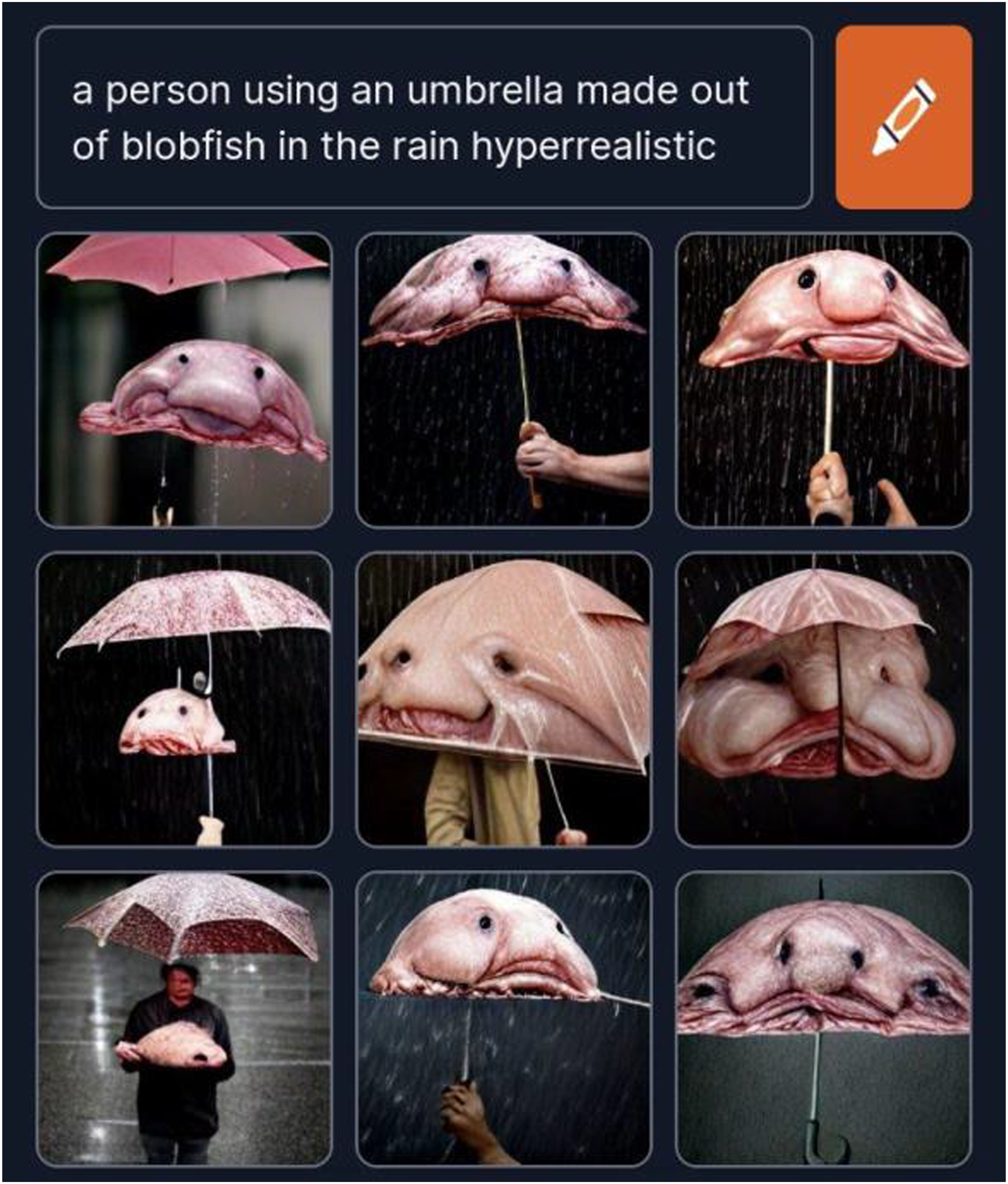
This DALL-E trend also connects to the practice of using ‘found objects’ in sculpture, as well as concepts of artistic transgression and ‘abject art’, reflected in Sarah Lucas’s artworks or Georges Bataille’s writing, in which flesh, waste, body parts, and bodily functions typically cast off from public view are instead foregrounded (TATE, 2022c). DALL-E’s interlinking of text and image more specifically recalls Breton’s poetic novel Soluble Fish (1924), which coincided with the first Manifesto of Surrealism (1924). Breton’s descriptions of ‘blonde hands’ (p.51) and sentences like ‘Tell your mistress that the edge of her bed is a river of flowers’ (p.52) play with irrational relationships between signifiers, while evoking a dream-state with Freudian influences. DALL-E Mini users can instead input prompt sentences such as ‘blonde hands’, adapting Breton’s interests in language and the unconscious for the digital age.
More broadly, DALL-E’s ability to produce images from a collective unconscious, results in the mimicry of various existing styles of aesthetic creativity, including references to popular culture. As noted, DALL-E’s mimicry of art styles can be problematic in the broader digital context in which working artists go uncredited and unpaid in AI image generations that remix their work. Aesthetic mimicry is most obvious when DALL-E Mini users (or users of other AI image generators) consciously apply the styles of well-known artists, many of whom are long-dead and whose work is already reproduced or mimicked in the public domain. For example, DALL-E Mini generations have featured objects and scenes in the recognisable style of painters such as Vincent Van Gogh, Claude Monet, and Keith Haring. DALL-E Mini screenshots have also been shared showing a generic courtroom sketch style, video game animation style, vapourwave, and lo-fi aesthetics (which became popular on the internet in the 2010s), and the Soviet propaganda poster style. DALL-E is not the first AI system to allow users to combine art styles with their chosen content. 4 Referring to AI ‘style transfer’ tests conducted by Artsiom Sanakoyeu et al. (2018), Manovich argues that AI learns how to transfer an artist’s ‘style’ to the user’s chosen images but does not authentically capture the logic of the original artist’s content (2019: 4). However, the logic or authenticity of the original artist’s content is not particularly important for our analysis or for users who experiment with DALL-E Mini: the jarring, often humorous, re-combination of style, and content is generally what makes the AI-generated images interesting as an online participatory practice. Thus, even a very basic evocation of an artist’s style proves desirable, provided the style is juxtaposed with formerly unrelated media, objects, or people.
Beyond visual artists, aesthetic mimicry also extends to auteur-director culture when users’ prompts play with authorial signatures of a film director’s consistent and recognisable style. For example, DALL-E Mini can mimic Wes Anderson’s signature symmetrical compositions and colour palette in ‘Coronavirus the movie directed by Wes Anderson’ and ‘McDonald’s Wes Anderson’ (Figures 3(a) and (b)). These generations are not the first collective online social media practice to imitate and play with film auteurism. The Instagram profile @accidentallywesanderson collects crowd-sourced images of colourful, picturesque locations that strongly resemble those in Anderson’s films. Similarly, fan participation by ‘reimagining’ auteur culture is present in the online practice of alternative poster creation, in which ‘decoding’ may be necessary to fully grasp more niche and insular fan references to auteur films (O’Meara, 2016). With DALL-E, the prompts are generally key to decoding the user’s niche authorial commentary. (a) and (b): Wes Anderson mashups (authors, 2022 and @weirddalle, Twitter, 16 September 2022).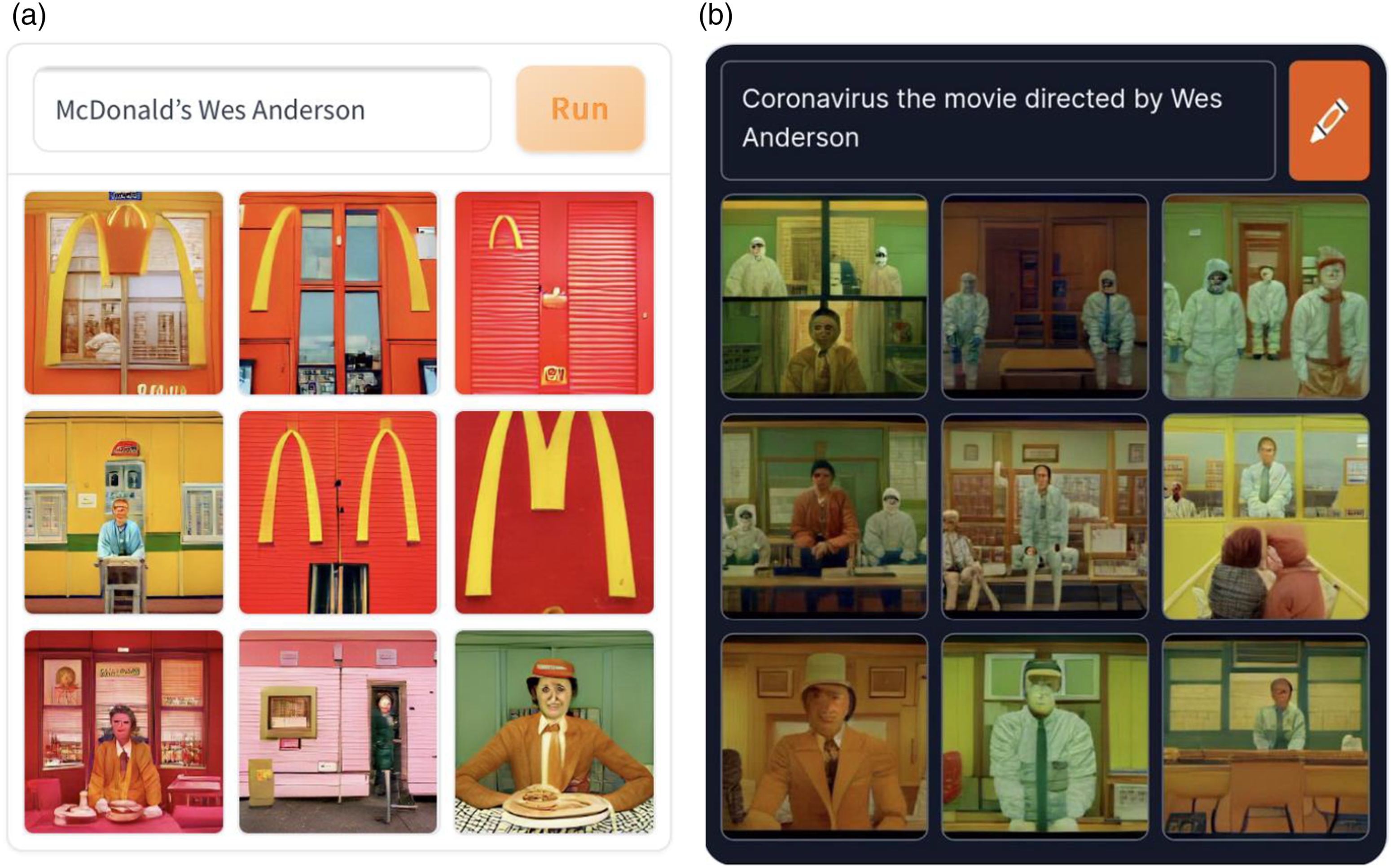
DALL-E Mini outputs can also convey technological anxiety through aesthetic mimicry of a ‘reality’ effect and surveillance technologies. ‘Hyper-realistic’ is a popular term applied to prompts, resulting in more life-like or photorealistic images of things that don’t really exist, thus achieving what humans cannot photograph (without the post-production assistance of high-quality photoshopping or computer-generated imagery). Hyper-realism in DALL-E generations arguably captures the grotesque that cannot be captured through ‘real’ photography, as Peter Fingesten (1984) posits. The hyper-real, again, creates a feeling of uncanniness, because a strange non-existent object or anachronistic event or figure is rendered ‘real’ through the truthful filter of photography. Similarly, prompts that include scanning technologies (MRI scans, QR codes) or camera lenses (CCTV, fish-eye lens, GoPro, and trail cam) create a voyeuristic and disturbing surveillance effect in image outputs. These can assume a suggestion of ‘reality’ through the filter of cameras typically used for observational non-fiction video-making practices, surveillance, documentation, or scanning purposes (see Figure 4). The intrusive, illicit quality of DALL-E images mimicking perceptual technologies can make something benign appear sinister or to have criminal connotations. They represent the omniscient, panopticon-like gaze that increasingly characterises 21st century surveillance societies, in which citizens are captured constantly not only through CCTV but also via the recording capacities of smartphones, Ring bells, Google maps, and drones. The menacing surveillance effect of technology in prompts like ‘thoreau in trail cam footage’ (@alexrmoskowitz, Twitter, 13 June 2022).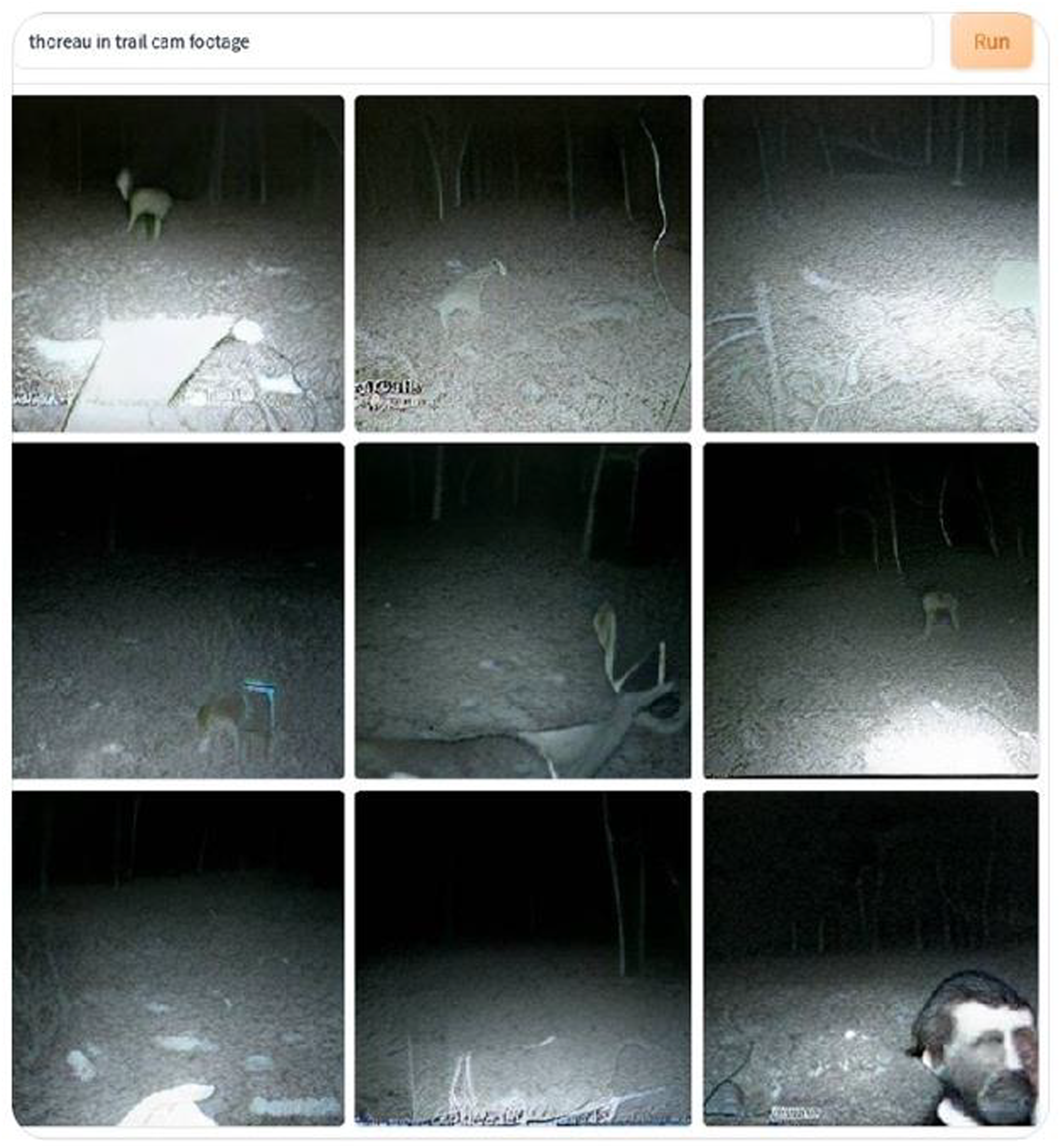
Through experimentation with prompts, it also becomes clearer how DALL-E Mini produces stereotypical imagery to connote time periods, in part by using remediated versions of colour or black-and-white film. For example, although historical events took place in a world of colour, photographic documents of the early 20th century are usually in black-and-white (before the widespread availability of colour photography). Prompting DALL-E Mini with ‘Me in the past’, not only results in black-and-white analogue-style photographs but also represents people wearing early 20th century period clothing – even though the ‘past’ could equally mean the 21st century. ‘Me in the future’ instead generates stereotypical conceptualisations of the future – a cyborg hybrid figure wearing VR-like headset technology and a metropolis of glass and metal skyscrapers with silver and blue tones to evoke technological progress (see Figure 5(a)). This is not surprising since Google Image results for ‘the future’ produce imagery that is similarly oversimplified. Such imagery is perpetuated in science fiction representations of the future, like Steven Spielberg’s Minority Report (2002), where technology and human bodies become fused. Other words can prompt DALL-E Mini to apply colour to otherwise black-and-white imagery. For example, our prompt of ‘Bette Davis in a punk band’ results in mostly black-and-white images of the classical screen actress (as Davis looked in the 1940s–1950s), performing in what appears to be a 1970s punk band, but with some flashes of blue, possibly to evoke the colourfulness of punk fashion and hairstyles (Figure 5(b)). These outputs suggest that temporality is represented stereotypically in AI aesthetics. (a) and (b): Temporality represented partly via colour palettes in AI image synthesis (authors, 2022).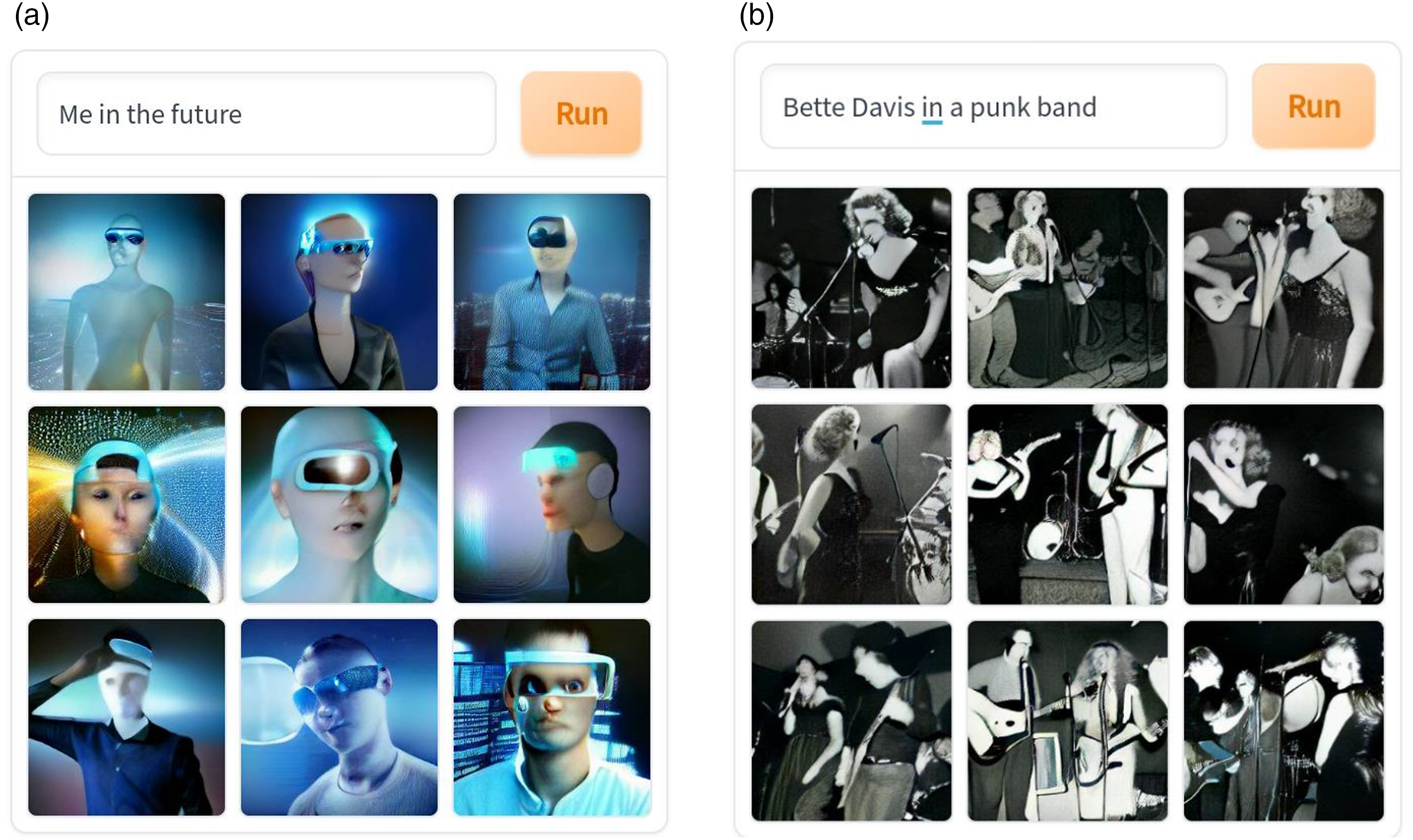
(Celebrity) body horror
The fluidity and strangeness of these DALL-E outputs contributes to an interest in the surreal among its users through the temporal and aesthetic displacement of the familiar and an emphasis on bodily transformation, especially when applied to celebrity bodies. With body horror films, violations of normal anatomy and species boundaries feature as part of a narrative plot and are presented via some combination of a performer’s body, costuming and special effects, and computer-generated imagery. The Fly presents a mutation that leads to the character of Dr Seth Brundle (Jeff Goldblum) transforming into a ‘Brundlefly’, while in The Hills Have Eyes (1977) a family exposed to radiation poisoning become deformed cannibals as a result. With DALL-E Mini, transformed violations to the normal anatomy of a creature can instead be performed almost instantaneously, and at no cost, when the users’ prompts interact with the DALL-E software to create a whole range of hybrids, mutations, and metamorphoses. Indeed, Lopez Cruz explicitly discusses bodily asymmetry in body horror, itself a distinctive aspect of faces and particularly eyes produced in DALL-E imagery, as an undesirable trait to both humans and animals (p.165). Similarly, when discussing the ‘visual shock’ provided by the body horror works of Francis Bacon, neurobiologists Zeki and Ishizu (2013) argue that Bacon succeeded in delivering this shock by subverting the normal neural representation of faces and bodies: ‘viewing stimuli that depart significantly from a normal representation of faces and bodies entails a significant difference in the pattern of brain activation’ (p.1). In the digital era, a similar ‘visual shock’ can apply to post-human representations that distort the familiar human body, such as with DALL-E outputs, deepfake media and, more recently, the viral trend for Lensa self-portraits, termed ‘Magic Avatars’, which generate at once familiar and uncanny portraits of the user based on uploaded images. 5
DALL-E Mini’s creation of impossible human faces and human-like objects can also cross the ‘uncanny valley’, whereby simulacra that closely mimic human movement and facial features convey both too much and not enough familiar ‘humanness’. First identified by roboticist Masahiro Mori (1970), in recent years the concept of the uncanny valley has been applied to computer-generated effects in films or deepfake videos circulating on social media that are considered unsettling. Deepfake videos use AI to graft the hyper-realistic physical (and sometimes vocal) likeness – typically of celebrities or politicians – onto a surrogate body and without the figure’s consent (Bedingfield, 2022; Bode, 2021; Fletcher, 2018), with uncanny results for viewers who question their authenticity. Similarly, the hyper-realistic computer-generated human–cat characters in the musical Cats (2019) were critiqued for being too creepy (Lodge, 2019). While the creators of Cats ostensibly did not aim to cause negative reactions in audiences, creators and social media sharers of DALL-E Mini generations can more intentionally celebrate the irony of their grotesque hybrids.
Similar to deepfakes and Cats’ human-cat hybrids, DALL-E Mini’s mutations from the original bodies – such as the loss of facial symmetry – are particularly notable when the digitally reworked human subject is a familiar character or a celebrity. 6 It is therefore unsurprising that users have taken to DALL-E Mini as a new form of celebrity meme, by entering prompts tied to popular film and television characters, singers, actors, politicians, and other public figures. Fictional characters often referenced in DALL-E Mini creations include Darth Vader from the Star Wars franchise (‘origami of Darth Vader helmet’, ‘MRI image of Darth Vader’) and Walter White (Bryan Cranston) from Breaking Bad (2008-2013), as in the prompt ‘Walter White painted by Van Gogh’. Also popular are well-known animated characters such as Bart Simpson, Mickey Mouse, Mario (‘Courtroom sketch of Mario on trial’), and Donald Duck (‘Donald Duck hosting a TED talk’), perhaps because the relative simplicity of animated features makes them more receptive to AI metamorphosis.
The iconography of celebrities and pop cultural characters is facilitated by their widespread reproduction across media platforms. Audiences not only recognise them immediately from their image, but can generally recognise when their image is presented in an unfamiliar way that becomes something of a violation of their more conventional images. Familiar bodies thus more easily facilitate DALL-E body horror, while extending on existing online fan and cult practices within celebrity and multimedia culture. But the trend for celebrity prompts is also tied to the fact that the DALL-E software recognises them: their name (real or fictional) will call up a large number of images from the underlying database, thus allowing their ‘real’ image to appear – in uncanny, AI-modified composite form – in the DALL-E outputs. Entering a generic name, such as one’s own name, is much less likely to create the kind of database hits that would give way to satisfactory outputs, wherein the visual story is both somewhat coherent and familiar (owing to its overlaps to reality) as well as uncanny and horrific (due to distortions of the familiar reality).
As with deepfakes, memes, and other online forms of digital remix culture, DALL-E Mini thus deconstructs and reconstructs the celebrity image. Akane Kanai, writing on the microblogging site Tumblr, notes how celebrities memes ‘compress celebrity into forms of shared, distributed data which function as visual representative shortcuts’ (p.329). She surmises that the celebrity image ‘is used and reauthored, and circulated’ (p.329). With the DALL-E image sets, we similarly see celebrity iconography being divorced from its original context, with their images quite literally serving as data that can provide visual shortcuts (for meaning) and inserted into a new narrative authored by the internet user. ‘Cher with chicken nugget accessories,’ prefaced by artist Sarah Devereaux (@thedirtbird on Instagram) with ‘I made one of those nightmares #dallemini’, exaggerates the singer’s Camp fashion sense when DALL-E generates chicken nugget bags for her to hold. Cher’s image (as data) is authored by the internet user, in this case an artist who considers the DALL-E output something she ‘made’. This innocuous example points to the nightmarish elements of AI image generation that makes celebrities unwitting subjects to media co-created based on the whims of fans or critics. The dystopian potential of internet users authoring a celebrity’s image came more fully to light when AI-generated images of Pope Francis wearing a comically large Balenciaga coat went viral on social media (Perrigo, 2023). The images and their rapid digital circulation highlighted both the reputational damage (to figures such as the Pope) and the advertising potential (for brands) that might come from such unofficial AI-driven mashups. 7
Users of DALL-E Mini have also exploited people’s sensitivity to real-life horror inflicted on the body. Though DALL-E Mini blocks certain keywords and the ‘Weird DALL-E’ subreddit warns against ‘dark’ posts and gore, there are still examples circulating on social media, including ‘war crimes, school shootings, and the World Trade Center attack’ (Knight, 2022). 8 Cultural anxiety over current bodily threats are also reflected in DALL-E prompts that juxtapose the sinister with the innocuous. ‘Lofi Chernobyl disaster to study and to relax’ shared on Twitter by @weirddalle is one example of a ‘dark’ dichotomy, using the cute aesthetic of anime-style animation associated with lo-fi internet music, with the sinister Chernobyl nuclear power plant in the background. 9 This prompt, and others like it, test the boundaries of good taste in DALL-E’s form of horror media. The abstraction of real-life bodily harm and death might reflect contemporary anxiety over biopolitics and the human threats of nuclear war, especially in Ukraine, where the Chernobyl disaster occurred and has again become a threat in the war-torn country. Or, looking to the United States, director David Cronenberg recently compared the US Supreme Court’s overturning of basic abortion rights (in Roe v. Wade) to his own interest in body horror cinema that explores ‘who owns whose body’ (Donnelly, 2022).
DALL-E Mini’s creators have already commercialised its connections to the horror genre.
10
In November 2022, DALL-E Mini (now Craiyon) strategically promoted the horror film Smile (2022), about a paranormal curse that affects those who witness the unsettling smile of its victims (Figures 6(a) and (b)). The use of CGI in Smile corrupts the human body, much as DALL-E users corrupt bodies algorithmically. With the Smile tie-in, the economic value of DALL-E Mini as a novel promotional tool for the film industry, and the horror genre in particular, was realised. (a) and (b): Trailer for Smile promoted by @weirddalle and Smile tie-in with @craiyonAI (Twitter, September 2022).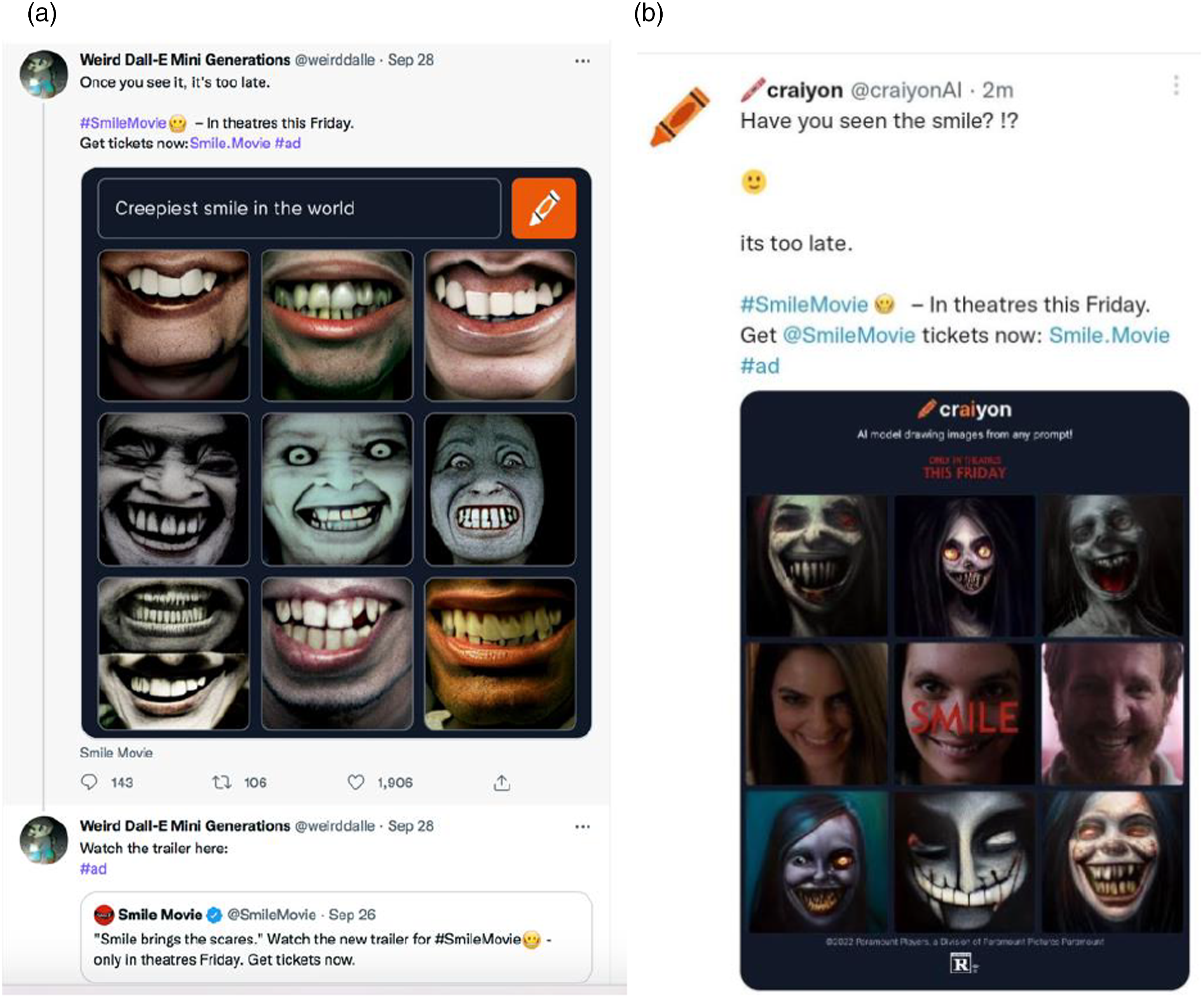
In keeping with these horror elements of DALL-E Mini’s popular and commercial uses, in late 2022 online discourse around AI image synthesis focused on the sinister figure of Loab – a woman who resembles the ‘old hag’ trope in folk and horror stories, largely due to her asymmetric facial features and reddened, saggy skin. Created by training AI with negative prompts, Loab elicited fear over AI’s potential to convey subjectivity and prompted computer scientists to debunk any potential AI supernaturalism (Sparkes, 2022a). Interest in Loab underscored the surreptitious threats of AI image synthesis and helped crystallise the links between algorithmic culture, traditional horror tropes, and digital era anxieties around posthuman entities that are equally present in social media trends for DALL-E. The ‘fear’ of Loab, partly based on a few stereotypically unattractive physical traits, also signals towards the gendered dimensions of AI-generated or altered imagery. The impact of the DALL-E software on the body could be positioned in opposition to the dominant uses of both Lensa’s ‘Magical Avatars’ (which tend to enhance beauty) and augmented reality filters on social media platforms such as Instagram. As Tate Ryan-Mosley (2021) puts it, ‘beauty filters are changing the way young girls see themselves’, with his description of this as a kind of ‘mass experiment’ similarly capturing how DALL-E users are collectively experimenting with another form of digital software with the potential to disrupt realistic representations of the human body. However, the nature of these disruptions – towards less stereotypically attractive bodies – means that users, particularly male users, may generally be more comfortable applying DALL-E’s de-facto ‘filter’ to men. In keeping with this dynamic, there is at least one worrying example of how DALL-E Mini has been used as a pseudo-scientific tool as part of the online harassment of a female filmmaker of colour. 11 As with other digital technologies, there is thus a potentially sexist gender politics of DALL-E Mini, in its popular use if not in the inherent design. In this respect, it aligns with existing studies of deepfake media. Travis L Wagner and Ashley Blewer (2019) highlight how the emergence and distribution of deepfakes continues to enforce gendered disparities in visual media, for instance, through the creation of deepfake pornographic videos that superimpose women’s faces onto other women’s bodies.
Having examined the aesthetics and anxieties captured in DALL-E Mini’s images, our final section of analysis will consider the significance of the generator’s nine image grid interface, which equally builds on users’ familiarity with earlier aesthetic forms and formats.
Aesthetic precursors to DALL-E Mini’s grid interface
The tendency to make meaning and potentially infer a story from disparate images that are framed together has many reference points in visual culture. These precursors range from comics, cel animation frames and storyboards, to ‘exquisite corpse’ drawings, artists’ triptychs and, more recently, Instagram grids. Within the digital landscape, Instagram’s 3 x 3 image interface (3 horizontal columns and 3 vertical columns) may have most directly informed the interface design of DALL-E’s 3 x 3 grid of image outputs. According to Manovich’s (2017) analysis of Instagram images, for many Instagram users ‘sequence aesthetics’ – how the individual posts relate to one another when viewed on the grid interface – ‘takes priority over any individual photos’ (p.129). Similarly, we would argue that the popularity and creative effect of DALL-E at least partly rests on the fact that it presents users with multiple (nine) images to interpret both individually and as a collective.
In keeping with our earlier analysis of the surrealist components of the individual DALL-E images, a variation on the grid interface was also central to the hand-drawn ‘exquisite corpse’ works of the early surrealist movement. In the 1920s–1940s, hundreds of exquisite corpses were created by folding a sheet of paper in four along the horizontal axis, with each section completed by a different participant. As with these hand-drawn composite figures, there is a sense of anticipation when waiting to see the full picture when it comes to the DALL-E grid. With both, the co-creator is an impatient viewer of the final output: they wait to see precisely how the process (their contribution, either in the form of a section of the figure, or a text prompt) will impact the overall picture(s). In both practices, though the sections are clearly demarcated from one another by prominent lines, there is an implicit understanding that they should nonetheless be considered in relation to one other.
DALL-E’s ability to use a grid of images (adapted from text) to gesture towards a coherent storyworld perhaps aligns it best with the long tradition of storyboarding, which is considered a key step between ideation and creation for films and other mediums that require scene planning. As Marcie Begleiter explains ‘storyboards allow the director time and space to translate the dialogue and action of the screenplay into the language of imagery’ (2001, p.3). Begleiter focuses on how filmmakers express themselves regarding visual thought, noting that ‘once you have the image in your mind’s eye, you need the skill to be able to project and render it onto paper’ (p.7). Directors including Sergei Eisenstein, Alfred Hitchcock and Steven Spielberg have all highlighted the significance of storyboarding to their working processes and the finished film. The artists or animators responsible for creating storyboards are often also tasked with creating ‘concept art’ for how a film will look in pre-production stages. Storyboards can be particularly important to science fiction and fantasy films, where the storyworlds to be represented can diverge radically from the real world. In this way, storyboarding and filmic concept art can be seen as indirect precursors to DALL-E’s surrealist storyworlds. Indeed, much as DALL-E outputs reflect collaboration between casual users and the AI technology, the design of sci-fi films in particular can depend on collaboration between artists and technologists or engineers. This was the case with Syd Mead, a self-described ‘visual futurist’ (NPR, 2011), whose work as an industrial designer for car companies gave way to his work as a concept artist for sci-fi films including Blade Runner, Tron (1982) and Aliens (1986). Their final ‘looks’ are considered to be heavily indebted to Mead's vision (Kilkenny, 2019).
In the DALL-E Mini outputs we can see a number of similar creative impulses at play: to translate words into images; to flesh out preliminary ideas; and to render visually the image ‘in your mind’s eye’, as Begleiter (2001, p.7) puts it. Furthermore, although the DALL-E outputs lack key elements of film storyboards; namely, the shot list and the overhead diagram, their standard grid-like design (Figure 7) is notably similar to the DALL-E interface. As with previously mentioned concerns among artists over AI’s appropriation of their work, the potential threat of AI-made storyboards making human-made movie storyboards obsolescent contributes to what De Vries terms societal anxiety over ‘algorithmic replacement’ in labour (p.20), specifically the diminishing of a craft within the film industry. For now, however, flawed applications like DALL-E Mini appear to be non-professional parodic novelties that could not replace storyboarding on a large scale. Sample storyboard template from: https://depositphotos.com/53583019/stock-illustration-storyboard-template-gird-x-9.html (accessed 7 December 2022).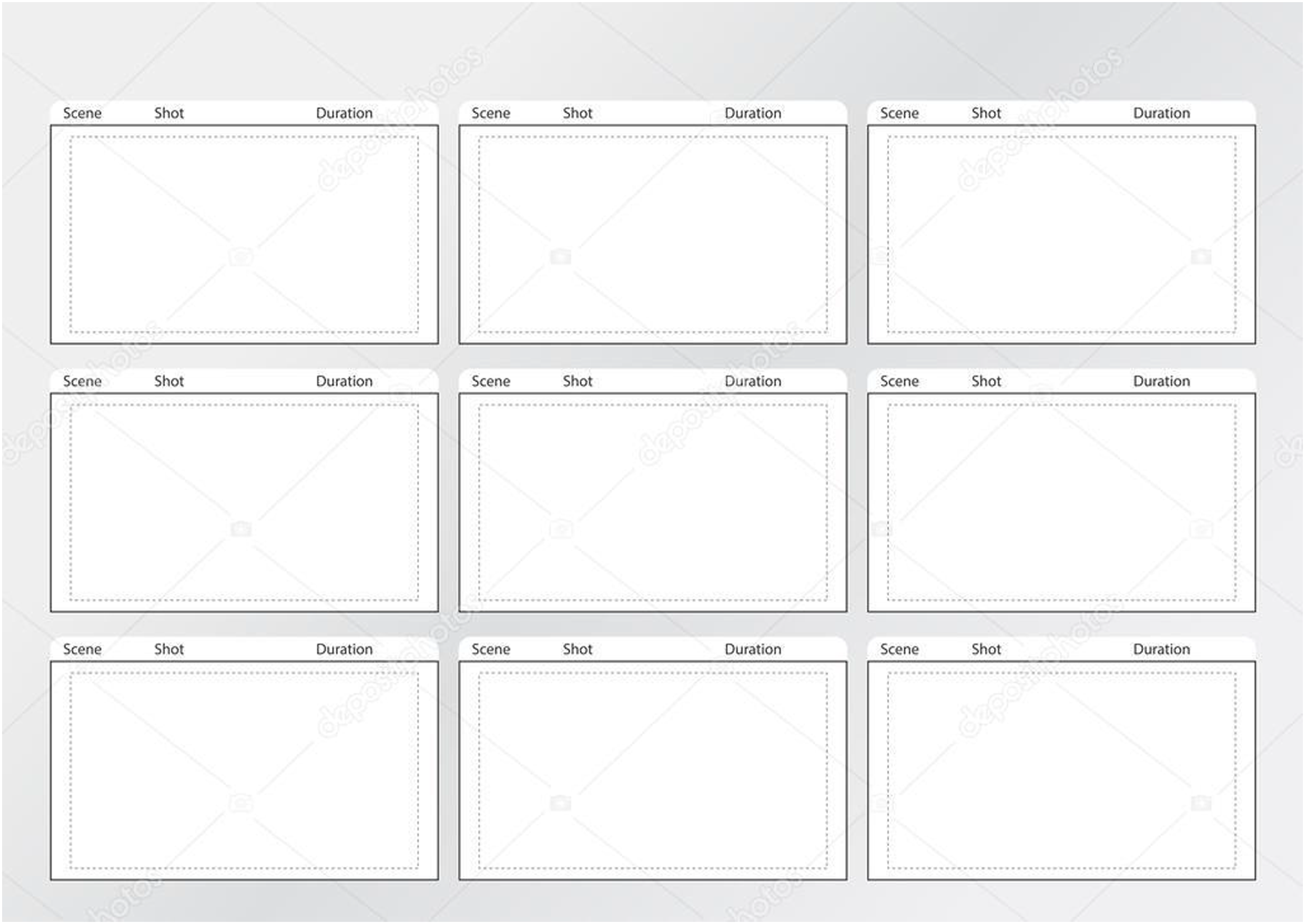
Like comic books or graphic novels, storyboards tend to be visually ‘read’ in a linear fashion from the top left image to the bottom right. The expectation that the disparate images in a given storyboard (or comic, etc) are part of a coherent ‘story’ is likely also applied to the way that users visually interpret DALL-E outputs. Even if they cannot be logically read from top left image to bottom right, the viewer can find impressionistic meaning in the strange and visual worlds. When the prompts include individual people or characters, then the interpretative strategy might involve deducing a story from the changes in their actions, expressions, and body language, as well as from the background ‘set’ presented around them.
A range of DALL-E Mini outputs support this analysis of them as AI-driven variations on the traditional storyboard, including examples that lean into the surrealist, body horror dimensions of DALL-E creations. For example, film scholar Liz Greene gives the title ‘ERASERHEAD 2’ to her DALL-E prompt of ‘Eraserhead pushing a stroller’ (Figure 8). DALL-E Mini being used to visualise an imaginary sequel to Eraserhead (1977) (Twitter, @lizgreenesound).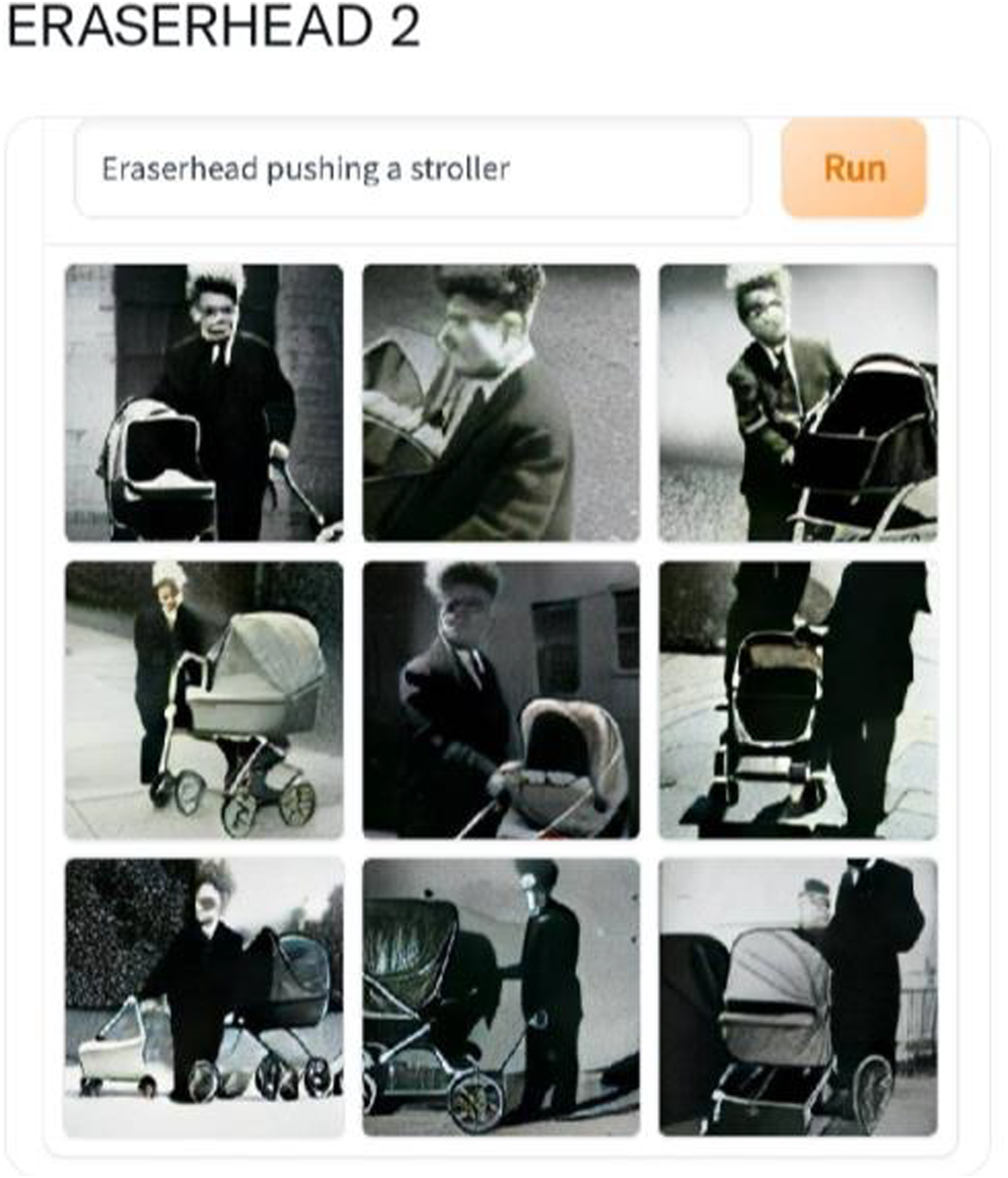
In this playful ‘sequel’ to David Lynch’s surrealist horror film Eraserhead (1977), the description of him ‘pushing a stroller’ leads to the titular character being humorously presented as a father, potentially of more than one child – based on image #7. 12 The images might be interpreted as part of a storyboard for this imagined sequel, or as screenshots excerpts from a sequel that has already been filmed. The distorted presentation of the original film’s character of Henry (Jack Nance) echoes that of the main character of John Merrick (John Hurt) in The Elephant Man (1980) and might thus be interpreted as something of a transmedia creation, combining the physical features of two iconic film characters from Lynch’s already surrealist filmography.
Because storyboarding creates cohesion between images, the perception of the narrative logic of a film, especially a popular one with iconic characters, can be altered through DALL-E’s potential for aesthetic mimicry. For example, the star images of familiar franchise protagonists from The Twilight Saga (2008–2012) are altered in ‘Twilight as a Disney movie’ (Figure 9). Similar to the layout of storyboards, the grids pictured resemble the ‘cels’ used by Disney and other animators. Before digitisation in the 1990s, hand-painted celluloid sheets were photographed as frames in sequence to simulate motion. With the DALL-E take on Twilight, the Gothic young-adult romantic saga about vampires appears more positive and oriented towards younger audiences. The output reflects the consistently bleak colour palette of the Twilight Saga (greens, blues, greys), likely derived from web results of promotional posters, with some vibrant colour to represent Disney animation. DALL-E grids therefore offer a novel way to co-create and examine media franchises and corpuses through their presentation of nine composite images that can be gleaned to gain insights into patterns present within the mass imagery tied to mainstream franchises in online databases. In this way, it is a less sophisticated method resembling Kevin L. Ferguson’s (2017) composite images of Disney films through ‘z-projection’ by summing an entire film or corpus in a single abstract image. Ferguson creates what he calls ‘a computer-based form of automatism, a screwmeneutical, playful, digital surrealist method that extracts what we might metaphorically imagine as a film’s "unconscious" visual field without conscious intervention’ (par.61). As already explored, DALL-E Mini similarly channels surrealism through the abstract displacement of strange and familiar imagery, while creating composites that redirect digital users’ personal interests and pop cultural knowledge in a playful way that can be easily shared as a meme on social media. The Twilight franchise is altered to resemble Disney-style animation (authors, 2022).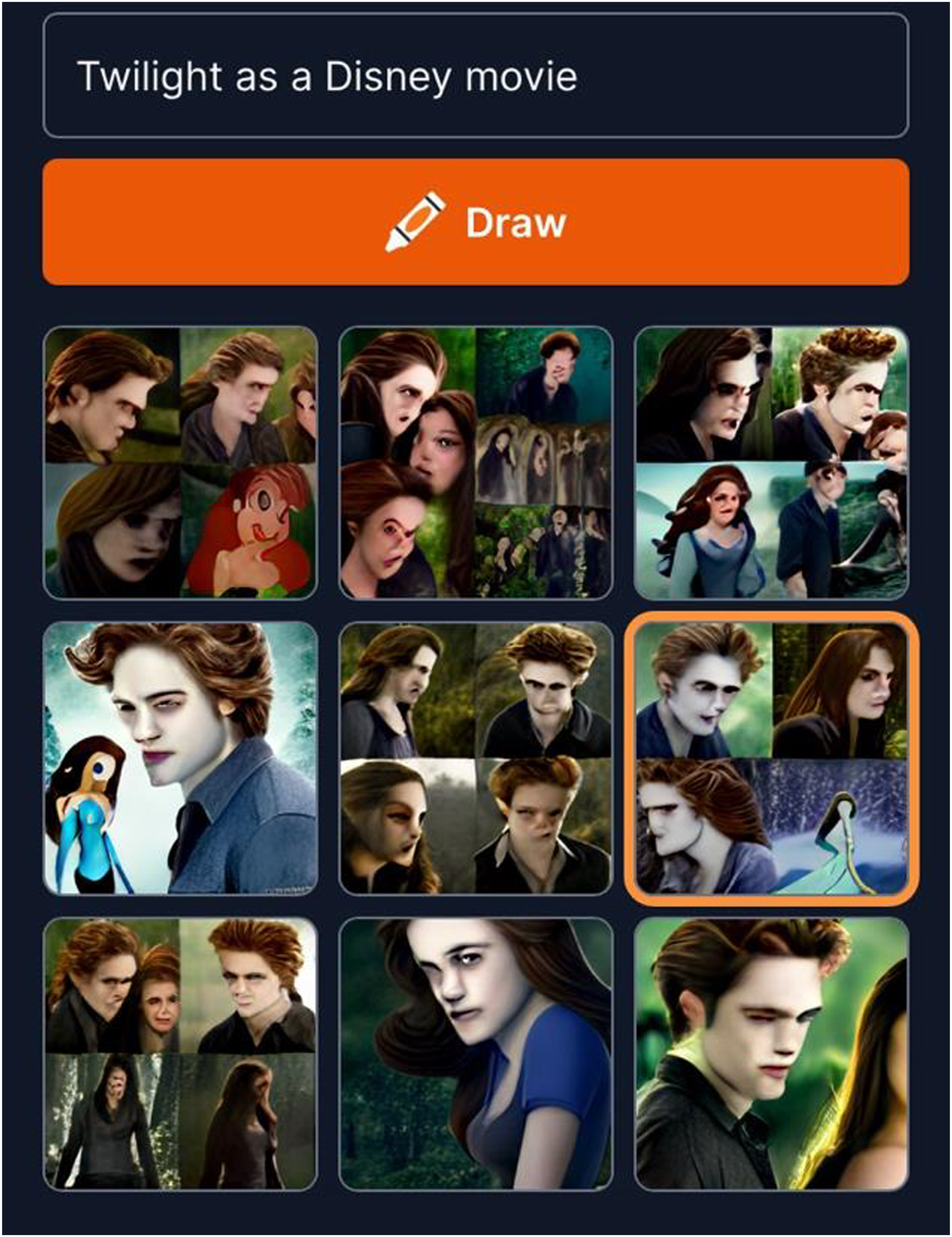
Conclusion: DALL-E Mini as facilitator of collaborative AI art
The wearing novelty of DALL-E Mini as an AI meme or ‘toy’ to be played with in online communities is perhaps inevitable, as ‘our rapacious appetite for “new and improved” gadgets and toys’ causes cycles of obsolescence (Kane, 2019: 4). Indeed, by November 2022 some online creative communities had already begun to experiment and share more sophisticated AI-generated storyworlds made through Midjourney, another text-to-image synthesis model. In keeping with the trend we identified for both futuristic and reimagined auteur culture, some of the most viral Midjourney images to date have results from prompts such as ‘Jodorowsky’s TRON’ and ‘Jodorowsky’s Frasier’, where the cult following of avant-garde filmmaker Alejandro Jodorowsky is merged with, respectively, a sci-fi film and an American sitcom. 13
In 2022, the popularity of DALL-E Mini represents a notable ‘moment’ in contemporary visual culture, when AI art is developing under a more mainstream lens, and where users without enhanced technological skills can co-produce outputs that are media-literate and surreal. As Elza Adamowicz summarises in Surrealist Collage in Text and Image: Dissecting the Exquisite Corpse (1998), two essential modes of surrealist production were: spontaneous verbal flow or spontaneous graphic gestures and ‘the deliberate cutting up and assembling of disparate elements’, with Breton’s definition of the surrealist image ‘based on the encounter of disparate elements’ (p.5). We have shown here how these impulses are reworked via DALL-E, both with the media-literate users’ text prompts for the software – which can seem to take on a stream of (un)conscious structure – and with the resultant combinations of generated images that are similarly surreal after being assembled from disparate elements, based on the text prompts.
DALL-E Mini generations are inherently ephemeral due to algorithmic alterations in the database from which images are sourced, unless they are downloaded immediately or captured via screen shot. The same text prompts can produce different image results over time. DALL-E Mini therefore invites experimentation and multiple attempts to produce varying results. Furthermore, the practices of sharing DALL-E images as a form of meme on social media sites enabled DALL-E’s ephemeral outputs to be captured and consumed by a much larger audience than that of the actual DALL-E generator, which reveals its output only to the person who enters a given prompt. As such, our analysis has confirmed that there are interoperable affordances between DALL-E and the social media platforms on which they are shared, which results in the co-construction of both art and artists through creations with DALL-E: people train a system (DALL-E) which in turn, trains artists and consumers in a new type of artistic practice.
DALL-E’s software, reception, and uses in digital culture contribute meaningfully to debates around AI’s contentious relationship to art and creativity. Manovich (2019), for example, has explored potential definitions for ‘AI arts’, building on existing understandings of artificial intelligence: ‘“AI arts” would refer to humans programming computers to create with a significant degree of autonomy new artefacts or experiences that professional members of the art world recognize as belonging to “contemporary art.”’ (p.1). Manovich quickly dismisses this though, given that there is no standard agreement even of what can be defined as art among the professionals such as art critics and theorists. Computational creativity scholar Margaret Boden (2010) does, however, provide a useful description of a Turing test for AI art: for a program to pass the Turing Test ‘would be for it to produce artwork which was (1) indistinguishable from one produced by a human being and/or (2) was seen as having as much aesthetic value as one produced by a human being’ (p.409). On the one hand, the outputs from DALL-E Mini appear to pass Boden’s test, if only due to their aesthetic similarities to a range of existing artworks: exquisite corpse drawings, body horror media, and so on. On the other hand, because the software relies on prompts from users to generate its outputs then the artworks it produces are arguably not solely produced by AI, but collaborative works co-produced by humans and the AI software.
Our theorisation, close analysis and illustrative examples have revealed just how significant the prompts are to the outputs that are produced. Furthermore, to disregard DALL-E’s outputs as AI art based on this would appear to fall back on the myth of the solitary creator and to disregard the highly collaborative nature of many traditional artworks – including the aforementioned exquisite corpse drawings. Ultimately, the artistic merit or status of DALL-E outputs is of relatively minor concern to us in this paper. However, viewing internet users’ engagement with DALL-E as a form of playful, collaborative creative practice – similar to established digital media formats such as memes or fan art – helps to alleviate potential ‘algorithmic anxiety’ (De Vries, 2020) around AI art and DALL-E Mini’s inherent biases based on the database of tagged images from which it draws. Moreover, DALL-E’s presentation of mutated bodies and dystopian worlds are apt expressions of contemporary concerns around biotechnology and posthumanism, not to mention a range of very real environmental and public health issues (environmental disaster, threats of nuclear war, the COVID-19 pandemic) that threaten to radically disrupt contemporary life as we know it and make us ever more dependent on digital technologies. Within this context, users’ creative application of the DALL-E Mini image generator both emerges from, and contributes to, playful online expressions of pop cultural knowledge and anxiety, including algorithmic anxiety.
Footnotes
Declaration of conflicting interests
The author(s) declared no potential conflicts of interest with respect to the research, authorship, and/or publication of this article.
Funding
The author(s) disclosed receipt of the following financial support for the research, authorship, and/or publication of this article: This work was supported by the Trinity College Dublin (Provost’s Project Award) and Irish Research Council (IRCLA/2022/2959).
