



Abstract
Digital advertising’s cultural surround is algorithmically tuned. The popular narrative about digital advertising is that it is hyper-targeted and customized. In this article, we argue that digital platforms’ targeted advertising is more productively understood as tuned advertising, where algorithmic models optimize the resonance between ads and consumers in a continuous rhythmic flow of images, videos, and text. We develop the concept of tuned advertising by drawing on a study conducted with 204 young people from the Australian state of Victoria, where they sent us over 5,169 screenshots of alcohol, gambling, and unhealthy food ads they saw in their digital feeds. We identify five different “vibes” in the collections of ads they sent us that reflect different subjectivities and practices of consumption. We argue that digital platforms create a mode of advertising organized around tuning the vibe between ads, content, and users.
Introduction
A person chats to a friend on Messenger about their day, dramas with friends, funny stuff they saw online, and plans for the weekend. “I really want to go out for a drink tonight,” they write, followed moments later by, “but I gotta stop drinking so much haha, too much lately.” Moments later an ad appears in their Facebook feed for an event at a local bar, and then moments after that in their Instagram stories feed appears an ad for a pre-mix gin they had previously viewed on a retailer’s website. The ad has a buy button, and the gin can be delivered to their door within an hour. The specific combination of image, text, and button is unique to that person. It is published nowhere other than their Instagram stories feed. This combination responds to their emotions, vulnerabilities, past purchasing habits, and the time of day. The ad is the product of an algorithmic model feeding on the everyday participatory expressions of users: their Messenger chat, images of themselves drinking at a picnic with friends the weekend before that Instagram has converted into “interests” data, and search history of retailers’ websites.
This ordinary, everyday experience of advertising on digital platforms is one moment in a continuous flow of promotional appeals and clickable buttons. What matters most in this story is not the targeting of a specific ad at a particular moment, but that this moment is just one in a continuous everyday sequence or flow engineered and tuned by algorithmic models (Beauvisage et al., 2023; Carmi, 2020; Dean, 2010; Lupinacci, 2021). Flow is an advertiser-centric logic, first observed on television, where the “lines between content and advertisements” are blurred to create an “uninterrupted mediated feeling” (Carmi, 2020). If Raymond Williams (1974) observed that the flow of television profoundly altered our cultural experience, then we are now contending with the cultural upheaval wrought by a new kind of advertiser-funded media that reaches deeply into our intimate and public lives (Bucher, 2020; Carah, 2017; Phan & Wark, 2021). Where we once tuned into the rhythms of broadcast and print media, now we scroll and swipe in the algorithmic flow of digital platforms that immerses us in a tuned sequence of ads designed to optimize our attention, shape our moods, and extract taps on buy buttons (Carah et al., 2023; Hund & McGuigan, 2019).
Advertising developed with mass media through the twentieth century to construct a cultural surround of shared narratives, identities, and feelings. The power of advertising arguably rests not in the persuasiveness of individual ads but in the more general capacity to orient and organize the rhythms of life in consumer societies (Schudson, 1984). Following this history, we argue that digital advertising is not just algorithmically targeted ads, but also productively understood as algorithmically tuned flows. Digital platforms tune and trade the rhythms of users to advertisers (Carmi, 2020; Lupinacci, 2022). If targeted advertising involves delivering an ad to a particular person at a precise moment, tuned advertising draws our attention to the continuous optimization of the relationships between ads, content, and consumers, and the synthetic creation of promotional images and copy by generative algorithmic models (Carah et al., 2023). Advertising is one of the most common forms of information we encounter in our daily scrolling and swiping through digital feeds of content. The cultural surround that digital advertising creates is one where an algorithmic flow tunes endless, mutating, personalized rhythms and “vibes.” We argue that critical accounts of digital cultures need to center this automated sequence of ads and the associated experience of rhythm and flow. Tuned advertising constructs and reflects the “rhythmic” (Carmi, 2020; Lupinacci, 2022) nature of digital platforms as their algorithmic models aim to generate a harmonious “right-timeness” (Bucher, 2020) in the flow of images, video, and ads. As Williams (1974) observed for the programmed flow of television, the algorithmic flow of our digital cultures is built by and for advertisers.
The Vibe of Tuned Advertising
Digital advertising is characterized by a programmed algorithmic flow where the explicit targeting of users by naming demographics and behaviors has morphed into the continuous autotuning of ad placement using unnamed affinities and proxies (Phan & Wark, 2021). The algorithmic models of tuned advertising work with impressions, patterns, and associations, that do not have to interpret language to understand particular cultures or identities. Algorithms vibe in that they associate us with other users, content, products, and experiences we are resonant with (Grietzer, 2017) or proximate to (Phan & Wark, 2021). Tuned advertising reflects digital media’s “infrastructures of feeling” that are engineered for modulation, anticipation, and association (Clough, 2008; Coleman, 2018). As software engineer Yeetgenstein (2021) writes: What the neural network “learns” is emergent rather than deduced. For example, it may notice a pattern that if it’s cloudy, then people are more likely to carry an umbrella. But it would not be able to explain that this is because cloudy implies rain and rain implies umbrella. Instead it effectively identifies a “rainy” vibe through correlations of an initially arbitrary set of parameters.
Deep neural networks discover patterns and associations across sets of data. Patterns do not have to be narrated into language for digital platforms to be able to produce them and extract value from them.
We employ the colloquial expression “vibe” to describe how digital advertising is felt and experienced by users as algorithmically tuned sequences of ads. While “tuning” describes the mass experience of algorithmic flow (Carmi, 2020; Lupinacci, 2022), a “vibe” is the rhythmic sequence tuned for users in a particular moment in time and place, attempting to stimulate and modulate a feeling, decision, or tap. The term “vibe” has emerged in popular and cultural criticism to describe an affective sensibility that the flow of content is attuned to the mood and moment of users. As Robin James (2021) puts it, a vibe is like the “sympathetic resonance” that happens “when the vibrations from a sounding object like a tuning fork or piano string activate similar frequencies in nearby objects that are relatively ‘in tune’ with the original sound source.” In this model, tuned advertising works when ads and users are more “resonant,” “vibing,” and “attuned” with each other. The auto-tuned flow optimizes the relationship between platforms’ interests in keeping users scrolling so that they can be served more ads and advertisers’ interests in interrupting the flow with a tap on the “buy” button in a particular ad.
The term “vibes” is used colloquially to describe the atmosphere and feeling of relationships, people, spaces, events, experiences, objects, and content both online and offline. A “vibe” refers to a combination of symbolic, aesthetic, and contextual elements; literal atmospheric factors such as weather, humidity, and time of day; as well as intuitions and hard-to-articulate “feelings” about the overall mood of something. We use “vibe” to describe the meanings, feelings, and atmospheres produced by algorithmically tuned and customized sequences of ads, not just the symbols and meanings of individual ads by themselves. The vibe emerges from the association of texts with each other, and algorithmic models tune this flow to “vibe with” participants to optimize their scrolling and tapping. Furthermore, the term “vibe” helps to describe how users experience advertising as an associative, algorithmically tuned flow of ads over time, where they can only imagine (Bucher, 2017), guess at, and intuit why their flow “vibes” the way it does.
To develop this conceptualization of tuned advertising, we draw on a study conducted with a group of young Australians from Victoria to investigate “harmful industries” advertising on social media platforms (Robards et al., 2023). From February to May 2021, we recruited 204 young Victorians aged 16 to 25 to screenshot and send us ads for alcohol, gambling, and unhealthy foods they saw in their digital and social media feeds. While we acknowledge the productive and pleasurable dimensions of these industries, their harms suggest that an interrogation of their advertising practices is vital. The focus on alcohol, gambling, and unhealthy foods was set through our partnership with VicHealth, the health promotion foundation that funded the study (Robards et al., 2023). The collections of ads that users donated to us are an extract of the customized sequence tuned for them. We examine these collections as products of the interplay between advertisers, users, and the algorithmic models of digital platforms. We propose that collections of ads donated by users can be analyzed as a “proxy” for how the algorithmic advertising model “vibes with” individuals and tunes a user’s flow affectively and aesthetically. The collections of ads are a “proxy” in the sense that they stand-in “when one is precluded from accessing a model’s backend” (Phan & Wark, forthcoming). This is particularly important in the case of harmful industries advertising where the continuous flow is tuned to our interests, identities, behaviors, and moods, and learns to exploit our vulnerabilities.
Studying the Algorithmic Flow of Advertising
Participants were recruited using ads on Facebook and Instagram. We attracted 398 volunteers and invited 305 to participate in our study in four successive week-long waves to ensure a diverse group of participants. Of the 305 invited to participate, 221 completed an initial survey and onboarding process that included informed consent and training videos that outlined examples of alcohol, gambling, and unhealthy food ads to collect and how to send them to us. The survey covered demographics, phone and social media use, consumption practices, perceptions of unhealthy advertising on social media, and attitudes toward regulation (see Robards et al., 2023). Some of the insights from the survey are shared below to introduce our participants, but other aspects of the survey are outside the scope of this article. At the end of this onboarding process, participants began a week of data collection where they took screenshots of unhealthy ads they saw on social media and sent them to us via SMS. We used a web-based SMS platform that enabled our team to use a single phone number to chat with participants in a real-time format they were familiar with. Team members monitored the chat regularly, answering questions and inviting participants to interpret, explain, and theorize about the ads they were seeing and sending to us. A total of 204 participants fully completed this week of data collection, and were offered a $100 gift card to recognize their time. These 204 participants sent us a total of 5,169 screenshots, an average of 25.6 screenshots each (well above the minimum we set which was 10), with four participants sending us more than 100 screenshots. Some participants who sent us a lower number of screenshots said that this was because they were not seeing much unhealthy advertising. At the conclusion of the week spent sending us screenshots, participants completed a second survey and an optional focus group discussion reflecting on their week of data collection.
We had a diverse sample of young participants across age, gender, sexuality, employment, and education. Ages ranged from 16 to 25, with an average age of 19.52. Forty-seven percent were identified as male, 46% as female, 6% as non-binary, and one participant preferred not to say. Sixty-eight percent identified as straight or heterosexual, 14% as bisexual, 7% as lesbian, gay, or homosexual, 3% as queer, and 3% opting to choose another identity category. Eigty-five percent of our participants were based in the Victorian capital city, Melbourne, with the remainder in regional areas. Seventy-six percent of our participants were born in Australia, and 24% were born overseas. Nine of our participants (4.4%) identified as Aboriginal or Torres Strait Islander.
Eighty-six percent of the ads sent to us by participants came from Instagram (51%, n = 2,354) and Facebook (35%, n = 1,611), both owned by Meta and functioning as a single advertising model. Eighty-four percent of Instagram ads were “sponsored” posts or stories and 87% of the Facebook ads were “sponsored” posts. Most of the remaining 14% of ads came from YouTube, Snapchat, and TikTok and were dominated by a single “display” ad format. Participants submitted relatively few examples of influencer ads, organic posts, and emerging formats like augmented reality filters. The ads submitted came from a small number of major corporate advertisers. The top 10 advertisers (1% of all advertisers) account for 25% of the total ads submitted by participants. These top 10 advertisers were major fast food, alcohol retail, and home delivery brands.
Our participatory approach centers young people as knowledgeable guides to their own social media use and experience of advertising. If harmful industries advertising is now dark and ephemeral, then we need to work with young people to find it, show it to us, and help us make sense of how it appears in their lives. This approach builds on participatory methods we have employed in past research including scrollback interviews and platform walkthroughs (Carah & Dobson, 2016; Light et al., 2018; Robards & Lincoln, 2017). As we received ads and discussed them over SMS with participants, we jointly began to notice patterns in their collections. When we invited participants to reflect on these patterns they would connect them to their own practices, particularly what they had purchased, followed, or clicked that might trigger the ad placement. We began by coding every ad by platform, advertisers, and format. Reflecting on our discussions with participants, we decided to explore the patterns in each participant’s collection to determine if their perceptions that their collections had distinctive patterns were evident when we compared them with each other. This approach follows Williams (1974) in the sense of observing the “actual succession of words and images” that constitute a planned flow (p. 97). Meanings and affects are channeled not just in the symbols used in particular ads, but in the arrangement and relation of ads to each other.
We inductively coded 195 of the collections of ads the 204 participants sent us (nine users’ collections of ads were too low resolution to reliably analyze). We first described signs, symbols, images, and language that appeared in the ads and wrote a short text description for each collection. One researcher undertook the initial coding, and then presented and discussed the coding with the research team in several co-analysis sessions. Through these sessions, we identified repeated patterns that participants’ collections shared in common. We iteratively grouped these repeated patterns into shared “vibes” with accompanying thick descriptions. We use the term vibe because it is a vernacular description of how algorithms curate flows of images that capture the mutating assembly of images that are curated by automated models. Rather than suggest themes “emerged” in our data, we emphasize that we attempt to explore how “vibes” are assembled by an automated advertising model.
Our approach follows from the critical tradition of analyzing the “codes” advertisements use to narrate the “good life” in capitalist consumer cultures (Asquith, 2021; Jhally, 1987; Marchand, 1985). Semiotic critique of advertising has traditionally taken archives of ads as the object of analysis. While digital ads can be approached as the “equivalent of twentieth-century magazine advertisements,” we need to extend this tradition to investigate the “relationships between the algorithmic infrastructure and textual representations” of platform media (Asquith, 2021). The “codes” of advertising in the digital era are constructed not only in an individual text but by circular systems and feedback loops (McStay, 2011) that associate ads with each other. Through this process of analyzing collections of ads, we deliberately move away from analyzing a single text to “focus on the larger flow” to characterize the “experience of the flow sequence itself” (Williams, 1974, p. 96). We use textual analysis not only to understand how ads make meaning for subjects but also how collections of ads can stand in as a proxy for how algorithmic models associate texts with each other.
By starting with the sequences of ads donated by young consumers, rather than an archive of ads, we can organize our texts not only by what codes individual texts contain but also by how those texts are associated with each other by algorithmic models. On the basis of this analysis, we created a composite visualization of the ads that made up collections in each vibe to illustrate the symbolic patterns in the collections of ads particular participants sent us (Figures 1 to 5). In the sections that follow, we describe and analyze five vibes we identified in the collections of participants: (1) a “femme botanicals and golden hour” vibe that was attributed to 14 of 195 participants, (2) a “masc ‘long may we play’” vibe that was attributed to 33 of 195 participants, (3) a “suburban ‘see menu, order now, get one free’” vibe that was attributed to 160 of 195 participants, (4) a “foodie ‘feasting with the eyes’” vibe that was attributed to 28 of 195 participants, and (5) a “going out” vibe that was attributed to 29 of 195 participants. We also noted the gender, sexuality, location, and age of the participants’ collections in that vibe. The vibes are deliberately not exclusive or exhaustive. Eleven participants’ collections were not attributed to any of the vibes that we present here. Ninety participants’ collections were attached to multiple vibes, while 95 were only attached to a single vibe. In our analysis, a vibe represents a moment, mood, or instance in the flow, rather than reflecting a stable, bounded identity category, or aesthetic persona. Because our participatory method involves young people manually choosing to screenshot and send us ads, we do not claim these vibes represent all the ads that young Victorians see. The algorithmic model that places ads in our feeds is not publicly observable, and yet advertising is a fundamental part of our digital culture (Carah et al., 2023). Our aim is to draw attention to the flows of ads that digital platforms make. Our purpose is not primarily to define particular vibes but to offer an account of the capacity of a tuned advertising model to vibe.
The Femme “Summer Botanicals and Golden Hour” Vibe
The collections of 14 participants had groups of ads that formed a distinctive feminine aesthetic, combined with text offers and images that enjoined them to meticulously plan intimate and pleasurable social gatherings with female friends. Twelve of these participants identified as female and nine as heterosexual. All except one of them were from the state capital of Melbourne. This vibe is characterized by scenes of well-coordinated drinks, food, accessories, and fashion. For instance, in an ad from Rebecca for Patron Tequila (see Figure 1), an influencer demonstrates a cocktail recipe. The scene is perfectly manicured with the pale white and lime clothes of the influencer matching the muted green of the Patron tequila bottle she holds, standing at a table with white flowers, green limes, and rock salt. These collections are dominated by ads for premium alcohol products, retailers, and venues. The product is placed in a “glamourous” (Hearn & Banet-Weiser, 2020) curated still-life scene or is incorporated into the atmosphere of social gatherings, bars, and picnics. Recurring visual themes include botanicals like flowers, dried fruits, slices of fruit, and sprigs of herbs, positioned with or in brightly colored cocktails, and the golden light of sunsets. For instance, an ad for Rekorderlig sent by Ariel (see Figure 1), presents the cans of cider in large silver tubs filled with ice, on a full table featuring platters of fruit, dips, and dried flowers. The heterosexy (Carah & Dobson, 2016), young, slim, mainly white feminine bodies in these collections drink premium and artisanal spirits, go to cocktail bars, visit wineries, and attend live performances. The color scheme is rendered in images of pink icy cocktails adorned with wedges of watermelons and strawberries, trays of orange shots and Aperol Spritzes, beige kitchen tables and satin clothing, gold and rose-gold-colored cocktail shakers, wine and liquor packaging, as well as “golden hour” lighting. The ads reference the leisurely vibe of a summer spent drinking at picnics with girlfriends and describe “summer in a bucket, ‘summer in a glass’” and implore Ariel to “keep the summer vibes going while you can and try the tequila Margaritas. . ..”
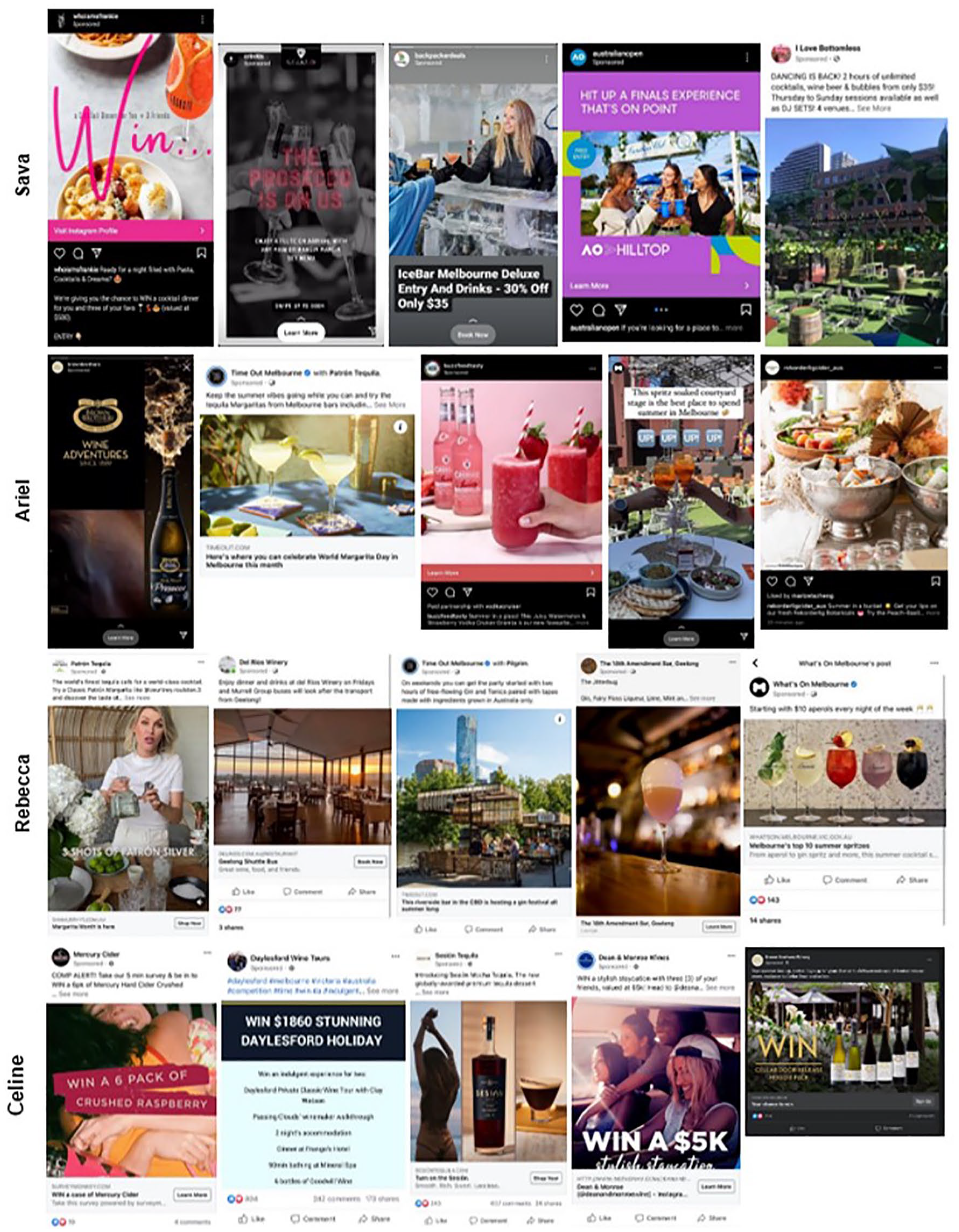
Femme “summer botanicals and golden hour” vibe visualization.
This vibe is also characterized by a connection between pleasure, heterosexy femininity, and planning. There is little that is serendipitous about the pleasure on offer to young women here: creating the suggested vibes requires careful planning in advance. Drinking with friends in an ideal setting—watching the sunset at a beach, vineyard, or a tennis grand slam, having a picnic with color-coordinated drinks and accessories, meeting up for a charcuterie board and Aperol spritz at a rooftop bar—are all the product of expert planning. Exclusive luxury and pleasure are not only for those who can afford it, but who also have the time, feminine acuity, and judgment to plan it. Some participants sent us ads that present this “femme” vibe as more aspirational, with ads that feature sales promotion tactics like prizes and entry into competitions alongside the images of idealized venues and cocktails. This is clear in collections from participants Sava and Celine (see Figure 1). The desire to be “that” girl is presented as something to aspire to. This creates a logic in the flow that, even if the user cannot afford it, they too one day may be able to go to a winery or have an expensive perfect getaway by filling out a survey or buying a particular product. This could be coincidental or could suggest that tuned advertising demarcates relations between gender and class using proxies based on signals such as which consumers are more likely to respond to ads with promotional offers. We cannot say definitively that the ad model can accurately make these distinctions, but we ought to take up such questions when thinking about how tuned advertising reflects and constructs relations of power and subject positions between gender and class, and how pleasurable and privileged forms of consumption are positioned in more naturalized or more aspirational ways of different consumers (Leach, 1993).
The Masc “Long May We Play” Vibe
The collections of 33 participants are characterized by a masc “long may we play” vibe that enjoins them to play the game, maximize enjoyment, and seize opportunities. Of these, 30 identified as male, two as female and one as transgender male, and 30 were heterosexual. No other vibe had a similar concentration of male participants. These collections were dominated by sports betting, fast food, and alcohol ads. The collections contain many repeated ads from Pepsi and KFC, along with sports betting firms Ladbrokes, Sportsbet, Neds, and Pointsbet. Only 11 of these participants said they had gambled, but they all saw sports betting ads.
The frames of the advertisements are dominated by block-colored backgrounds and declarative calls to action in bold capitalized letters in the foreground of the ad. For instance, in the collection of ads sent by participant Malvin, a Sportsbet ad reads “Bet Now” and “Download Now”; Cadbury states “Get in the Game”; and Pepsi declares “Victory Tastes Good.” All this copy text is in bold, all-caps font, that commands immediacy, speed, and action. The extension of pleasure, play, and high-adrenaline, sports-oriented fun is also referenced in copy such as “Long May We Play” (TAB ad), “Make it Count” (Jack Daniels), and “Get in the Game” (Cadbury). Advertisers also promise wins and opportunities, often associated with sports betting. The ads in the masc vibe very rarely feature women. They depict male athletes or “ordinary” Aussie blokes socializing or excitedly enjoying the all-male spectatorship of broadcast sport. Pleasure is represented in invitations to calculative pleasure by taking risks, navigating markets, and hitting buttons. Stimulated by the live broadcast of sport, the highlights and big hits, cold drinks, and crunchy chicken, the masculine consumer exercises mastery riding the waves of excitement and skilfully judging who will score next.
In the collection of ads received by Rene (see Figure 2), an 18-year-old heterosexual male from Melbourne who never gambles, Jimmy Brings asks, “Wanna get discounts when your favorite team wins this season?,” Ladbrokes promises, “Up to $100 in Bonus Bets,” and Neds likewise offers, “Sign in and Score up to $100 in Bonus Bets.” The prevalence of promotional offers and prizes in this vibe, as above, raises questions about whether and how tuned advertising reflects and constructs relations of power and subject positions, and how pleasurable and privileged forms of consumption are positioned in either more naturalized or more aspirational ways for different consumers.

The masc “long may we play” vibe.
Rene also had a relatively small collection of ads that included horse betting ads (see Figure 2). These ads appeared to coincide with a racing carnival in their regional city that pubs in the area were also cross-promoting. So, they may only have been temporarily addressed as part of this vibe given their proximity to, or attendance at, the local racing carnival. This is an important aspect of our conceptualization of algorithmic advertising as “vibe-based”: vibes might be interstitial and temporal, rather than definitive and enduring. They might reflect enduring aspects of identity, but they might also suggest moments where we intersect with scenes, cultures, and practices, in fleeting ways.
The Suburban “See Menu, Order Now, Get One Free” Vibe
One hundred and sixty participants’ collections featured ads that emphasized convenience and eating at home. This suburban fast food vibe was by far the most prevalent across the cohort of participants. These collections of ads featured carousels of food available for home delivery accompanied by buttons like “order now,” “see menu,” and “shop now” that link through to supermarkets’ online stores or home delivery services. The collections are dominated by ads from fast food chains, supermarket confectionery brands, and home delivery services. The alcohol advertising in these collections is not for bars, venues, or premium brands but for brands pitched at home consumption, online retail, and home delivery. The ads in these collections imply consumption of food and alcohol at home and emphasize availability and price, but they do not typically depict a social setting for consumption. Visually they present the product associated with information about promotions, deals, price, and delivery. Fast food ads present highly stylized “food porn” imagery in conjunction with delivery offers, buy buttons, and promotional deals. Flatlays of food demonstrate the quantity of food included in meal deals and the range of options available. The appeal of these ads is not the social or sensory pleasure of consumption, but convenient consumption in the home, with products delivered via the supermarket, the drive-thru, and the home delivery rider. Alcohol and unhealthy food are not connected to fantasies of indulgence or the pleasures of friendship, but to the mid-week humdrum or ordering food and eating while watching TV.
Ads from alcohol delivery services function like a tappable, algorithmic shopping catalog. For instance, while 62% of Instagram ads had a button, 87% of alcohol home delivery ads had a button (Robards et al., 2023). Alison sent us a sequence of ads for alcohol delivery featuring carousels of products that appeared to be tailored to their preferences (see Figure 3). The products presented in the carousels are automatically selected by the “dynamic creative” advertising tool that uses data about each individual user (such as products people like them like, or products they have previously purchased or viewed in an online store). A carousel ad for BoozeBud promised to “Get your drinks delivered right to your door, safe and contact-free . . .” and then featured several alcohol products in a carousel format with “Shop Now” buttons (see Figure 3). These ads only featured images of the product, price offerings, and the promise of quick and seamless delivery. The carousel ads are like the catalogs delivered to mailboxes, but they are customized to our preferences and contain buttons that enable us to immediately order them for home delivery.

The suburban “see menu, order now, get one free” vibe.
Where once convenient consumption of food and alcohol was orchestrated with market devices like supermarket shelves, freezer windows, and drive-thru intercoms, now the tappable button on the smartphone brings this apparatus into the home. The “suburban” vibe extends Williams’ (1974, p. 19) notion of “mobile privatization,” an “at-once mobile and home centred way of living.” If in other vibes alcohol and food are presented as part of evening and weekend practices of socializing with friends, here we see the same products presented as part of domestic consumption. The dominance of this vibe in our corpus highlights how the ordinary experience of the algorithmic flow of harmful industries advertising on social media is more like the shopping catalog than it is like television advertising or branded entertainment.
The Foodie “Feasting With the Eyes” Vibe
Twenty-eight participants sent us collections of ads denoting a “foodie” vibe. Their collections were laden with ads that promoted the social and pleasurable consumption of food. Sixteen (57.14%) identify as female, eight (28.57%) as male, three (10.71%) as non-binary, and one (3.57%) preferred not to say. In these ad flows food is presented in stylized ways—zoomed in on to see the crispness of a crust, the dusting of sugar, or the perfectly round piping of jam filling. The ads frequently use flatlay images, where food is laid out on a table or bench and photographed from above. Flatlay images fill up the frame with accessories like sprinkles, easter eggs, flowers, or pots of sauces. They arrange the food into geometric patterns using carefully curated bowls and plates. Food is depicted “in motion”—being tossed, pulled apart, cracked open, and torn. We see the stringy pull of melted cheese from a toastie or sauce dripping from a taco or clinging to chicken wings as they are tossed in the air, chai being poured from a scoop into a pan steaming and splashing, or an easter egg cracked open to reveal candy inside. These images emphasize the delectable textures of indulgent sweet and fried food. In addition to close-ups of the food, ads in these collections emphasize sociality and atmosphere in ways that ads in the suburban vibe do not.
Food appears set out on tables or at a restaurant, but usually with no people present or with just hands reaching in to dish up. The food is there waiting to be enjoyed, anticipating and inviting the viewer in—to go to the restaurant, sit at the table, and enjoy the atmosphere and food. In an ad for Mukka Fitzroy sent to us by Holly (see Figure 4) a natural wood table is laid out with vivid yellow food, sauces, and drinks. Where in the suburban vibe ad copy emphasized the product and sales appeals, in the foodie vibe the wording speaks to the qualities of the food and the providore. The food is described as “homemade,” “locally sourced,” with “signature” or “premium” ingredients. The venue is “authentic” and “from humble beginnings.” These appeals emphasize the qualities of the food, the people who make it, and its connection to identities, places, values, and ways of life.

The foodie “feasting with the eyes” vibe.
Many ads in this vibe accompanied portrayals of the quality of the food and venue with sales promotions like “unlimited,” “free,” and “bottomless.” Kia sent us a collection of ads that offered free doughnuts, bottomless dinners, and $1 ice-creams (see Figure 4). Unlike the sales promotions in the suburban vibe, which emphasized convenience, these sales promotions were always connected to the quality of the food, the sociality of eating out, and the pleasure of indulgence. Nevertheless, the ads frequently used buttons to invite consumers to “head over,” “order now ‘shop now’” and sales promotions like “last chance,” “must try ‘limited edition’” and special offers and discounts.
The foodie vibe conjures an “instagrammable” aesthetic, characterized by “food porn” ads that draw viewers in with a kind of “feasting of the eyes.” By depicting food in motion or close up viewers see rich colors and textures. Ads both emphasize the qualities of food visually with—dripping, greasy, crunchy, and glistening lusters. Foods are meticulously presented and decorated, plated up, and shown seconds from being eaten.
The “Going Out” Vibe
Twenty-nine participants had distinctive collections of ads in their feeds promoting nightlife or party events. Eighteen (62.07%) identify as female, 8 (27.56%) as male, and 3 (10.34%) as non-binary. The going out vibe had the least straight participants of any of the vibes (48.26%), with the majority of participants describing themselves as lesbian, gay or homosexual, queer, bisexual or other. The going-out vibe is characterized by a proliferation of different nightlife cultures. Participants’ collections reflected hip urban nightlife of bespoke cocktails and small bars, alternative EDM, nostalgic city clubbing, student nightlife, and queer venues and events. These collections were made up of many more unique advertisers compared to the other vibes—with a long tail of music venues, bars, clubs, pubs, and bespoke alcohol brands like craft beers and micro-breweries. Alcohol advertising dominated this vibe, but where other vibes were dominated by major alcohol brands and retailers, ads in the going out vibe focused on smaller brands and venues that spoke to particular identities and pastimes. These different inflections create a specificity within particular collections that seem to reflect the practices of “going out” in particular parts of the city, moving between specific venues that reflect niche pastimes, identities, and tastes.
Here we focus on three of these inflections—urban hipsters, alternative EDM, and city clubbing. One instance of the going out vibe is characterized by “hipster” cultural signs and symbols like do-it-yourself (DIY) collage and poster designs, the use of vintage media technologies and decor like 1970s floral orange and yellow wallpaper, pink and purple neon signs, a photo of gelato taken with a film camera, and a bookshelf of vinyl records behind a person promoting gin. The ads emphasize political values and unconventionality. This is evident in the sequence of ads sent by Jean, a 25-year-old queer female (see Figure 5). There are often nods to “diversity” and “pride” in the captions of ads, such as a champagne ad which states that “Everyone is welcome at our table.” Ads state that it is time to “escape the conventional” and try “boutique” experiences “for the curious and creative.” The pleasure invoked by these ads is being “in the know.” Most are for upmarket or bespoke bars, microbreweries, galleries, and live performances.

The “going out” vibe.
Another instance of the going out vibe is organized around techno, house, and minimal electronic music where ads foreground DJs, genres of music, and setlists. Zach, a 19-year-old gay male, received ads for club nights with big bold text such as “RnB, commercial tech house and minimal” set against a background of neon light, another for an afro-punk act, and one from an artist promoting a day party event (see Figure 5). These ads circulate information about local and underground music scenes taking place at warehouse parties and local gigs. The ads imply a cultural capital of “knowing” the artists and venues that comprise underground music scenes. Where the hip urban ads emphasize the consumption of alcohol as part of going out, these ads emphasize the live performances of artists and don’t depict or mention alcohol.
A final example of an inflection of the going out vibe is participants whose collections of ads were organized around going out clubbing—to dance, hook up, be with friends, and drink. These ads promoted events and parties at large venues and nightclubs, frequently with buttons like “book now” to pre-purchase admission or tickets. Unlike the other inflections of these vibes, the ads in these collections promote pleasure through sexualized images of women, cheap alcohol, and nostalgic “throwbacks” to 1990s and 2000s pop music, fashion, and aesthetics. Sandra, an 18-year-old female bisexual, received ads with captions, and bold lettering over the top of club photography which promoted “free,” “cheap ‘2-4-1,’” and “bottomless” drinks (see Figure 5). Ads promoted excessive and cheap alcohol consumption with phrases like “want to pre-game and save money at the same time?.” Women are almost always the center of the images, most often posing in club photos.
Across these finely tuned vibes participants see collections of ads that feature the clubs, bars, venues, and artists that they are interested in, and the collections are as diverse as the nightlife scenes in the city. While structurally the ads in this vibe are the same—they all promote events, venues, and drink deals—the aesthetics of the vibe change depending on the scene they are part of.
Advertising as Auto-Tuned Vibe Sequences
As our participants sent us ads from their social media feeds, we began to see them not just as individual targeted ads, but as excerpts of a tuned sequence that flowed under their fingers as they scrolled through digital feeds. The vibes we present here are not representative of the totality of ads and vibes that harmful industries advertisers produce, nor are they equal in prevalence, or comparable in structure. Vibes do not displace the symbolic narratives of ads. Each vibe is tuned differently to emphasize different modes of pleasure and consumption. For instance, in the “femme” vibe, at a symbolic level, we’ve suggested that pleasure and femininity are tied to stylistic expertise and careful planning. The ads in these collections continue a longer history of media and advertising addressed to women pedagogically (Ouellette & Hay, 2008). But, as we’ve discussed above, variations appear in individual collections that present this vibe in more “natural” or “aspirational” ways, depending on algorithmic judgments. In the “masc long may we play” vibe, masculine pleasure and consumption are associated with sports, high-adrenaline fun, and playful calculation of odds, risk, and reward. Where feminine subjects put together a cheese board, carefully prepare a scene for consumption, and spend leisurely afternoons drinking over sunsets, masculine subjects sit on the couch with phone in hand, following live events and feeds of information, offering commentary, deriving pleasure from knowing the odds, making the call, and predicting the outcome. The gambling-centered pleasure of the masc vibe reflects Nicoll’s (2013) concept of “finopower” where “values of play, capital, and skill-based gambling converge to produce the valorised subject . . . expressed through affective injunctions to be and to have fun” (p. 403). There’s a rhythm to pleasure and enjoyment, centered not only on the weekend broadcast of sport but the always-on mobility of streamed sport across global leagues stimulated by highlights, soft drinks, alcohol, fast food, and odds.
Vibes, like the affinities and proximities between users that produce them algorithmically, are still most often tethered to particular bodies and subject positions. As Phan and Wark (2021) argue, while Facebook removed crude ethnic categories from their advertising program, racial groups were still reproduced algorithmically, as audience affinities became proxies for race. Our account helps build an understanding of the algorithmic flow of digital advertising as both a technical system and a contemporary cultural sensibility. The emphasis we place on vibe deliberately moves away from thinking about advertising and other algorithmic recommendation systems as offering ever more fine-grained forms of customization. Algorithmic systems are trained toward linking users up with a finite set of options (products, songs, and television shows). Algorithmic ad models harmonize or tune the vibe between us and the available stimulus. Vibes with a long tail of advertisers appear to be more finely tuned toward location, temporality, and cultural proximities. Above we illustrated how the “going out” and “foodie” vibes are characterized by a proliferation of bars, clubs, venues, cafes, and restaurants, whereas the “masc,” “femme,” and “suburban” vibes are characterized by a smaller number of major brands. While the symbolic codes are relatively stable, the more fine-grained tuning is evident in the range of advertisers that can be associated geographically, temporally, and culturally with participants.
Platforms and advertisers have complex and competing sets of interests. While platforms want to suspend users in the flow for as long as possible, to serve them more ads; they also need to offer advertisers moments of activation that interrupt the flow by visiting an advertiser’s website or clicking on the “buy” button. Platforms sell advertising products that are tuned for a range of different goals—from awareness to activation (Meta, 2023). We see these tensions and tactics play out in the vibes. While awareness-oriented ads are aligned with the logic of continuous flow, and a limited range of consumer subjectivities, activation-oriented ads are characterized by much more specific forms of customization such as the products selected for carousels, the choice of buttons, and specific sales promotions. For instance, the “suburban” vibe features ads that are oriented toward activation with carousels of products, sales promotions, and buy buttons. Platforms work to optimize the flow of ads within this range of objectives from awareness to activation.
Paying attention to ad sequences enables us to apprehend, in a partial way, the capacity of digital advertising to tune the relationship between users and a flow of ads with tappable buttons. Advertising is powerful because the flow is more or less right over time, even if some of the individual ads are not—the shoes we already bought, the gin we would never drink, and the sport we would never bet on. Tuned advertising continuously experiments and tests combinations, optimizing connections between us and the available consumer identities, styles, aesthetics, products, and suggested lifestyles. Participants are not a stable target defined by a single “vibe” (made of particular interests, feelings, preferences, aesthetics, and moods) any more than they can be understood as stable, unchanging subjects. While we’ve focused here on exploring how the “codes” of five vibes emerge associatively in sequences of ads, the larger point is that these vibes would morph and proliferate with the open-ended emergence of products, brands, cultural sensibility, and identities, and our own living entanglements with consumer culture. Rather than think of algorithmic models as succeeding or failing at predicting what we want, as if we know what we want, they instead tune the associations between us and what is available and proximate to us in a particular moment. For advertisers and digital platforms, the ideal relationship is one where the flow of content and the users are orientated or attuned to one another—when they are, they “vibe.” Rather than precise targets to be hit, there are endless vibes to be tuned.
We need to approach digital advertisements as a modular and dynamic textual culture, characterized by a tuning of proximities within the symbolic codes of a mass cultural form. If we’ve begun to get accustomed to algorithmic models that tune the placement of ads, we need to think about the rapid emergence of algorithmic models that tune the ads themselves. Digital advertising will soon involve tuning the relationship between ad and consumer, where the text itself is no longer a stable object but a momentarily assembled tappable image, text, and/or video in the ongoing effort to tune and vibe. With generative artificial intelligence (AI) models, the logic of tuning we’ve described in this article extends to the relationships between ads already in the flow and ads that don’t yet exist. Already digital platforms and agencies are deploying generative AI to create and tune ads. For instance, Levi’s announced a partnership with Lalaland.ai to use generative AI to create “diverse” virtual models for their ads (Schneider, 2023). The relationship between the ad and the user becomes an open-ended query. The ad that is produced is not only the product of the effort to narrate, but more fundamentally the product of an algorithmic model trying to vibe with users. “What is the next ad in this sequence?” is the problem that tuned advertising solves. At present the ad is chosen from a database of pre-loaded texts that will increasingly be supplemented by a query that generates an ad “on demand.”
The approach to conceptualizing and studying tuned advertising we have advanced in this article can be further developed. We suggest three further avenues of inquiry. First, in this study, we relied on participants collecting and sending us ads they saw in their feeds from harmful industries advertisers. This is a partial extract of the tuned sequence of ads they see. To develop a fuller account of the algorithmic flow we need tools and methods for collecting all advertisements together with other kinds of content users see (Angus et al., 2024), although we do note the important ethical questions associated with capturing fuller sequences of social media feeds. Second, in this study, we analyzed only the collections of ads with some limited co-analysis and “algorithmic gossip” (Bishop, 2019) via SMS chat. To explore how to tune advertising vibes with users, we need to more deeply engage with research participants to analyze their everyday experience of advertising. Third, in our approach, we analyze collections of ads as the output of an algorithmic model. We also need to conceptualize and develop approaches that enable us to explore how algorithmic models associate ads with each other, what they are responsive to, and what capacity collections of ads have to train the generation of new ad formats and content (Burgess et al., 2021; Phan & Wark, forthcoming).
Conclusion
In the era of tuned advertising, advertisers feed ads and ad components (collections of text, images, and video waiting to be assembled) into an algorithmic model that tunes the vibe and flow of ads as we swipe, scroll, and tap. Critiques of how advertising symbolically addresses us need to start with how ads show up in our feeds as a product of algorithmic association and approximation (Phan & Wark, 2021). We’re sorted into flows of ads based on who our swipes, taps, movements, and choices indicate we are proximate to. Algorithmic tuning takes place at multiple levels. At one level, our feeds are characterized by stable symbolic narratives, our identities play out within mass consumer cultures with limited subjectivities and consumer options. At another level, the specific choice of businesses, products, and promotions are tuned based on algorithmic predictions about how to “activate” us as consumers. We argue that algorithmic models are tuned to particular patterns among users, which we have “narrated” as vibes—“ femme ‘masc,’” “foodie,” and so on—but these vibes are only “stable-ish.” Our labeling of them mirrors the way algorithmic models are programmed to render their operations into explainable labels. For instance, Meta’s “Why Am I Seeing This Ad?” feature offers us a straight-forward symbolic explanation that obfuscates to some degree what is an associative non-symbolic algorithmic process (Burgess et al., forthcoming). These explanations impose a symbolic meaningfulness on what are brute-force correlations and calculations. The meaning and feeling of a vibe emerge in the associations between ads in user sequences that are assembled by an algorithmic model attempting to predict who we are proximate to.
The paradox of digital advertising is that while each of us experiences its algorithmic flow as an intimate and persistent rhythm in our lives, that flow is no longer a public cultural form open to the kinds of mass criticism, appreciation, and analysis that gave us a shared understanding of advertising—and associated forms of accountability—in the mass era. Advertising is a “major institution of everyday life in which subjects are imagined, produced, classified, and narrated by communities of experts and their technoscientific tools with profound effect on the social and material worlds constructed around those subjects” (Goldenfein & McGuigan, 2023). When we analyzed collections of ads as excerpts of the sequence, we were making the decision to focus on, and re-enact, somewhat speculatively, what an algorithm would do, as well as how consumers might understand the sequences of ads in their feeds.
The colloquial resort to “vibes” points us to the limits of explaining how these models work, and instead names the “guessing at,” the inarticulable and contingent experiences of living in “infrastructures of feeling” (Coleman, 2018) that are programmed to tune flows of meaning, action, and affect. The position we find ourselves in where “social media users are trying to comprehend, typically alone with their devices, what is going on in terms of continuously changing algorithmic systems, is undermining public culture” (Ruckenstein & Granroth, 2020). By focusing on the tuned sequence, rather than the targeted ad, we are able to reinstate a notion of advertising as a larger cultural system. Advertising’s new cultural surround is an algorithmically tuned one. Tuned advertising constructs us not as subjects looking for meaningful narratives, but as collections of patterns, moods, and propensities available for modulation (Goldenfein & McGuigan, 2023). What platforms and advertisers aim to do is work out how to tune the relationships between our practices of glancing, swiping, and tapping the symbolic appeals and tappable buttons of advertisers. We need to follow that flow.
Footnotes
Acknowledgements
The authors acknowledge other researchers on the wider project team for their involvement, including Karla Elliott, Claire Tanner, Steven Roberts, and Michael Savic (see Robards et al., 2023 for a detailed account of that study). They acknowledge and thank their research participants for their time and insights. Also thanks to the anonymous reviewers and editors for their thoughtful and constructive feedback on this article.
Authors’ Note
All authors have agreed to the submission and that the article is not currently being considered for publication by any other print or electronic journal.
Declaration of Conflicting Interests
The author(s) declared no potential conflicts of interest with respect to the research, authorship, and/or publication of this article.
Funding
The author(s) disclosed receipt of the following financial support for the research, authorship, and/or publication of this article: This research was funded by and conducted in partnership with VicHealth, an Australian health promotion agency. This research was supported by an Australian Research Council Discovery Project [grant number DP200100519].
