




Abstract
This study investigates the role of two intermediaries, a mainstream media outlet and a popular digital media platform, to shape cultural identity through a case study of the 2019-2020 Australian bushfire crisis (colloquially known as the ‘Black Summer’). Theoretically framed by networked publics, this study explores the vernacular creativity of social media users and mainstream media coverage during the Black Summer bushfire crisis. Findings draw on a thematic analysis of 100 news articles published between September 2019 and January 2020 by the Australian Broadcasting Corporation (ABC) randomly selected from a larger corpus of bushfire coverage (n = 1269) and 120 TikTok videos posted between November 2019 and January 2021 that included prominent hashtags associated with the bushfires. Findings from news coverage highlight the ways in which the ABC framed the role of social media to connect with wider audiences while preserving their values as a public service media outlet. Findings from TikTok videos illustrate the role of ‘templates’ that encourage user participation and vernacular creativity on the platform. Comparing coverage of the bushfires on the ABC and TikTok revealed a shared set of striking visual elements used to shape cultural identity, communicate information, and make sense of a significant public crisis. This article offers directions for future research to explore the relationships and tensions between digital content creators and journalists and their capacity to create and contest cultural identities and imaginaries.
Introduction
On any global social media platform, localities inevitably emerge. The recommendation algorithm on the short video platform TikTok personalises content, beginning with a user’s language preference and country settings, and continuing when users move through the videos on their ‘For You’ Page, watching and scrolling. Subcultures emerge through shared interests and datafied connections like follows, comments, hashtags, and shared sounds and routines. For instance, anthropologist Crystal Abidin (2021) has documented the ‘You’ve Now Entered’ trend, where videos that represent a niche interest are specially created to welcome fellow TikTokers into the specific, obscure space where they are likely to belong. In response, this paper began with its authors wondering about what an ‘Australian TikTok’ looked like, how to find it, and what it might mean. We took a moment of crisis as our case study: the devastating 2019-2020 Black Summer bushfire season (referred to in this article as ‘Black Summer’) 1 . We were interested in how TikTok practices and cultures have emerged in a uniquely Australian context, to demonstrate the importance of local and regional cultures to this global platform.
We were also interested in how Black Summer TikToks would represent and shape an Australian identity in a media landscape in which the Australian Broadcasting Corporation (ABC) is more formally responsible for the work of fostering the nation’s cultural development (Hutchinson, 2017). Australians believe in the importance of the ABC: 78% agree that the ABC performs a valuable role in the Australian community (ABC, 2020). Crisis communication is a vital part of the ABC’s remit, which was demonstrated during the surge in audience reach during Black Summer (Public Media Alliance, 2020): ABC teams often worked around the clock to provide critical information and coverage to local communities […] Not only was the ABC the most trusted information source, but lives were saved as a result of people acting on information the ABC provided (ABC, 2020: 28).
While the ABC provided admirable service in terms of its crisis communication during Black Summer, comparing the way ABC News articles and TikToks about the bushfires led us to discover an important gap in the media landscape: the digital cultural intermediary. As digital media scholar Jonathon Hutchinson (2017) puts it, there is a need for cultural intermediaries to act as a conduit that harnesses social media audiences while aligned with the values of public service media. These intermediaries have a lot to add to the work of shaping Australian cultural identity.
Black Summer TikToks represented a moment that unfolded across a networked public: an engaged, connected media audience who share culture and knowledge (Itō, 2008). Through the lens of networked publics (Itō, 2008; boyd, 2010), taking into consideration Hutchinson’s (2015a, 2015b, 2017, 2020) argument that public service media should engage with social media platforms to collaboratively produce content that speaks to a (hopefully more progressive) Australian cultural identity, we ask the following research question: What is the relationship between user vernacular creativity on TikTok and the ABC’s role as a professional cultural enrichment facilitator in shaping Australian cultural identity, and what might this relationship be missing?
To examine the media landscape that incorporates both vernacular creativity (Burgess, 2006) and the professional practice of the national broadcaster during a time of crisis, it is useful to first describe what an ‘Australian’ TikTok might look like, and how it operates on TikTok.
Background: TikTok arrives in Australia
Social media platform TikTok features short user-generated videos: lip synching to ‘sounds’ or audio tracks, dance challenges, and comedy routines abound. TikTok culture is youth-oriented, with memes and trends often in the orbit of pop culture and politics. The platform was the most downloaded app of 2020, and rose to become part of the top 10 most used social media platforms in the world by January 2021 (Hootsuite, 2021). 2
The origins of TikTok in a corporate sense are well documented. Chinese technology company ByteDance acquired lip synch video app Musical.ly for USD$1 billion in 2017, then, following the success of their short video platform Douyin, merged Musical.ly into TikTok in 2018 (Mackenzie and Nichols, 2020). Douyin still operates within the Chinese market, and has subtle but important differences to internationally-targeted TikTok in an example of what media studies scholars Xu Chen, Bondy Kaye, and Jing Zeng (2021) call ‘parallel platformization’. On this international version of the app, 2.5 million Australians, or 10.5% of the country’s population, were using TikTok in 2020 (Roy Morgan, 2020).
In 2018 and 2019, news media coverage mostly provided broad explainers on TikTok to introduce readers to the platform, often by framing it as a youth-oriented phenomenon that needed to be clarified for adults, such as ‘TikTok: The Chinese lip-syncing app your kids love, but you’ve never heard of’ (Bogle, 2018). An article headlined ‘TikTok bullying timebomb’ (Masters, 2019) presented teens sharing cruel videos through the app as a concerning aspect of TikTok’s presence in Australia. This fluctuation between TikTok’s quirky, youth-oriented appeal, and its potential dangers, gradually gave way to more coverage of specific communities that emerge on TikTok, such as fiction reviews on #BookTok (Touma 2021), financial advice on #FinTok (Kopel, 2021), and, acknowledging its user base expanding past teenagers, 3 breastfeeding mothers flashing their breasts at their babies to see their delighted reaction (Byrnes, 2021). Researchers also recognise the utility of TikTok for crisis communication in the context of protests in Lebanon (Lujain et al., 2020), throughout the COVID-19 pandemic (Stratton, 2021) and in response to the ongoing climate crisis (Hautea et al., 2021).
In addition to these niche topics, a story about TikTok’s place within Australian cultural identity is most often revealed on social media-based, youth-oriented Australian news platforms like The New Daily, PopSugar, and Pedestrian TV. These cultural commentaries often describe the cultural narrative of ‘rags to riches’ of those Australian-based users who have gained considerable following from publishing their ‘bedroom lives’ across the platform. The ‘Little Aussie Battler’ tale (Attfield, 2020; Whitman, 2013) retrofits perfectly on the stories of online content creators who have gained success during their establishing period on TikTok. Here, we note the emergence of an Australian-centric group of users gathering on the platform to disseminate a specific cultural relevance of their lives.
The number of articles about TikTok has been increasing as the platform has gained cultural relevance. In 2018, ABC News published three articles about TikTok; in 2019, 11 articles; in 2020, 60 articles; in 2021, 127 articles, and by mid-2022, 114 articles had been published. One notable ABC article that connected Australian use of TikTok with Australian cultural identity suggested that TikTok (and Facebook) were helping to popularise Australian slang terms that referred to elements of the COVID-19 pandemic: ‘iso’ (isolation), ‘rona’ (Coronavirus), ‘magpie’ (panic-buyers), or ‘sanny’ (hand sanitiser). This created ‘a sense of community among Australians during the pandemic’ (Faa, 2020), which strengthened ties between these Australian-identified individual users and their national community on this platform. The use of slang as a networked public mechanism may also have an impact on how algorithmic visibility operates on TikTok to connect users and strengthen common understandings.
With the emergence of a regional-specific TikTok culture apparent in the Australian context, shared values, understandings, and sense making practices are strengthened. While they engage in algorithmic visibility practices (Abidin, 2021; Bishop, 2019; Bucher, 2018), the platform supports this vernacular creativity (Burgess, 2006) to further strengthen the community building practices. This practice is in contrast to the often hard-news line of the popular news media. We have focused on the media of Black Summer as an Australian climate tragedy to demonstrate the contrast between traditional news media coverage and the vernacular creativity of Australian TikTok users.
Framework: Networked publics and Australian identity
This paper captures Australian TikTok through the lens of ‘networked publics’. Using social psychologist Sonia Livingstone’s (2005) definition of ‘the’ public as a construct that demonstrates inclusiveness and common understanding, anthropologist Mizuko Itō (2008) introduces the term ‘networked’ public to align with the social, cultural and technological activity associated with networked media. This observation remains important for TikTok, given that technology scholar danah boyd (2010: 46) has argued that ‘networked publics are publics that are restructured by networked technologies; they are simultaneously a space and a collection of people’.
For new media scholar Wendy Hui Kyong Chun (2016), networks generated by new media produce publics that converge around a series of crises, or events, that connect individuals. Chun understands networks as ‘imagined’, extending political scientist Benedict Anderson’s concept of the ‘imagined community’ as people connected by the idea of the nation. Anderson’s imagined community is of people who may never meet each other, but ‘in the minds of each lives the image of their communion’ (Anderson ([1983] 1991): 6). Nations exist as sociopolitical constructions that take geography as a starting point for inclusion and exclusion. For example, Australians all hold in their mind an imagined Australia; an idea that becomes meaningful through how this image is enacted. So how is Australia imagined through media?
Australian cultural identity is a fraught, unstable narrative. A national character that underscored independence, masculinity, egalitarianism, and a certain disrespect for authority (White, 1981) worked to situate Australia as a youthful child of Britain. This narrative disavows the history of Australia’s first people: the Aboriginal people who have lived in the country for least 40 thousand years (Peel and Twomey, 2011), despite their dispossession by the British from 1788, during which Aboriginal people became subject to colonial violence and segregation policies (Auguste, 2010). When the picture of Australianness is constructed from bush and war tales of White, heterosexual, masculine courage and strength, these narratives reflect the ideology of powerful groups of people (Elder, 2007). They also deliberately exclude Aboriginal Australians and non-British immigrants, providing a convenient cultural barrier against change and cultural diversity (White, 1981). According to historian Richard White (1981), there are three main forces in the invention of the Australian identity: (1) the framework of nationality; (2) powerful groups of people; and (3) the writers and artists responsible for its definition. We can see from White’s three forces that the first force, the idea of a nation, or what we understand as an imagined community, is shaped by the third force: the media. In the early 1980s, when White was writing about Australian identity, the media was a class of people that included journalists, historians, authors, and critics. In the 2020s, we would include content creators, influencers, and cultural intermediaries as part of the media that shapes and reshapes what it means to be, and to feel, Australian.
To return to Livingstone, publics of all kinds are made up of people who have things in common – whether that common thing is geography, interest, experience, or a social media platform. We have situated this study within the Australian networked public of Black Summer as it appeared on TikTok and ABC News. For sociologists Yanni Brown et al. (2022), Black Summer TikToks featured young people reckoning with the powerful affects of grief, anger, and political disempowerment based on the Australian government’s lack of meaningful action on climate change. By analysing Black Summer TikToks and interviewing young Australians who regularly watch TikToks, Brown et al. argued that juxtaposing the humour and whimsy of the TikTok form with the tragedy of the bushfires was part of the affective design of this social media content. The young Australians in Brown et al.’s study experienced Black Summer TikTok as ‘both a place of escape from and connection to the bushfires’ (Brown et al., 2022: 7), suggesting that remixed elements of Australian cultural identity were important ways to feel connected to this networked public.
This article seeks to investigate the relationship between social media and the ABC in shaping Australian cultural identity to discover what this relationship is missing. To achieve this aim, our methods section details how we gathered and analysed news articles and TikToks as media objects that work within networked publics to shape how Australian cultural identity is imagined.
Method: Understanding the imagined Australia through responses to Black Summer
Thematic analysis
The epistemology of this paper comes from communication scholar Nancy Baym’s (2010) elucidation of the ‘social shaping of technology’, which considers the possibilities technologies offer, and the practices of use that occur when these possibilities are taken up and negotiated. The fundamental work of media studies is to interrogate how meaning is made through mediation, and we accomplish this in this paper through a thematic analysis of news articles and TikToks about Black Summer. Both forms of media reveal the imaginaries that underpin networked publics of Australia and Australianness.
Psychologists Braun and Clarke (2006) paper on thematic analysis gives a useful foundation for this method, calling the process ‘searching […] to find repeated patterns of meaning’ (Braun and Clarke, 2006: 86). Their approach here is developed for use in the discipline of psychology, so it operates from the assumption that the thematic analysis is being performed on interview transcripts – although they briefly mention media items including documentaries and websites are potential parts of a data corpus too. For thematic analysis to be most fruitful as a media studies method, grounded in the social shaping of technology, we remained attuned to the aspects of news and platforms that matter for our research context and research questions. The strength of thematic analysis is its flexibility, and as media scholars, we used the same coding process as Braun and Clarke outline, but applied it to our collection of media objects that included words, images, sounds, and video, along with platform metadata such as likes, hashtags, comments, shares, and views. Platform metadata is not as traditional an object of study as interview transcripts, but on social media, is an important aspect of how audiences interpret texts.
For both data sets – one from ABC News, one from TikTok – we began by collecting a corpus (process detailed below), then following Braun and Clarke’s phases of analysis. This involved familiarising ourselves with our collection by reading, scrolling, and watching; generating initial codes through taking field notes; searching for themes; reviewing the themes; and naming our final themes. At the heart of thematic analysis is the process of coding: developing labels for aspects of content through a process of interpretation (Herzog et al., 2019). We took what Braun and Clarke (2006) refer to as an inductive approach, by beginning with a collection of material that all responded to the Black Summer bushfires, and being guided by what else the data revealed. This methods section, having outlined thematic analysis, will now turn to how we collected our data before the paper moves to presenting the results of our collection, and our analysis of the news articles and TikToks.
Data collection
As most Australians would learn about the bushfires from the news, rather than first-hand experience, we wanted to know how a national broadcaster was presenting this information. If we understand news as a form of public discourse (Van Dijk, 1988), and publicly funded news organisations as resources with a unique responsibility to represent and support national culture (Liu et al., 2019), then the news coverage from the ABC was likely to express particular narratives of Australian cultural identity. We used searchable news archive Factiva to search for ABC News articles containing the keyword ‘bushfire’ from 1 September 2019 to 31 January 2020. These are the dates of the Australian bushfire season as specified in the report on Black Summer from the Monash Climate Change Communication Research Hub (Burgess et al., 2020). We chose Factiva as a research tool, instead of using the search feature on the ABC News Web site, for its ease of use. Factiva allows keyword searches from specific sources and date ranges, and provides a document with the relevant articles. The original search yielded 1,269 results, and we selected every 12th article to collect our random corpus of 100 articles for a snapshot of how the ABC covered the crisis.
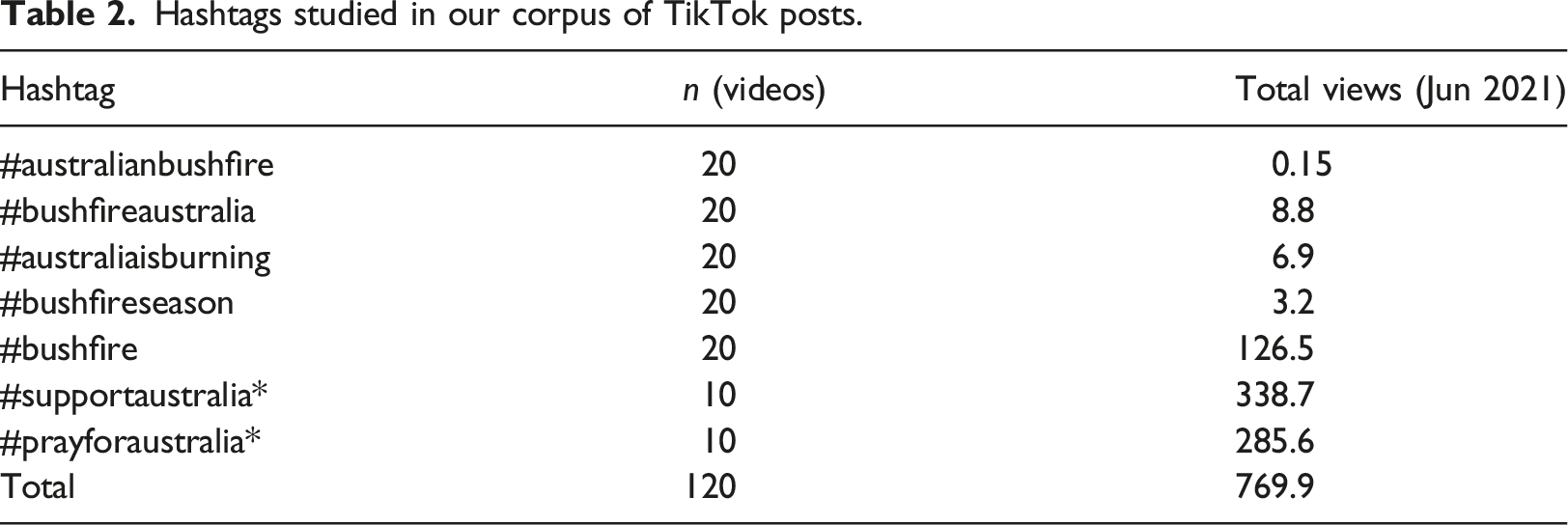
We also wanted to study vernacular reactions to the Australian bushfires on TikTok, aiming to understand how TikTokers were employing different hashtags and templates to communicate about the crisis. Data from TikTok were collected manually using hashtag inputs and the TikTok mobile search function. The TikTok mobile search function separates search results into five categories. ‘Top’ shows the most viewed or used content across all filters; ‘Users’ shows any user profiles associated with the search term; ‘Videos’ shows the top TikTok videos that feature the search term in some form, such as in video text, on screen text, or hashtag; ‘Sounds’ shows any audio clips that are either named or in some way associated with search term; ‘Hashtags’ shows any hashtags that fully or partially feature the search term, but in text form only. At the time of data collection, we determined hashtags to be the primary mode of content organisation on TikTok that would yield the most relevant sample for analysis via in-app searching. We explored different combinations of ‘Australia’ and ‘bushfire’ using the hashtag search function to identify a set of hashtags to collect our full sample.
We considered the limitations of our data collection approaches on TikTok carefully. The inability to sort videos ‘by date’ was not an issue, as we focused on the ‘top viewed’ videos. These were high performing videos that had registered good engagement on the platform because they were posted during the throes of the crisis. As such, our data collection criteria naturally surfaced videos that were posted during the bushfire season.
In a similar vein, the inability to sort videos ‘by location’ did not present any issues, as the top performing videos (determined by engagements native on the platform) were based in Australia. Although in our larger corpus outside of the scope of this study, we did identify videos by creators based outside of Australia – who stitched, dueted, or otherwise remixed and repurposed the original content first posted by Australian TikTokers – whether to lend support or to produce ‘spam’ for aspirational virality, these were not the top performing videos that met our selection criteria.
Our corpus of TikTok videos was published between 12 November 2019 and 25 January 2021. At the time of data collection, this enabled us to capture data for at least two of the annual bushfire seasons over the 2019/2020 summer and 2020/2021 summer. All the videos in our corpus were considered in our analyses, as TikTok discourse about the bushfires was not limited to the actual dates during which the disasters had occurred, but extended over the summer season.
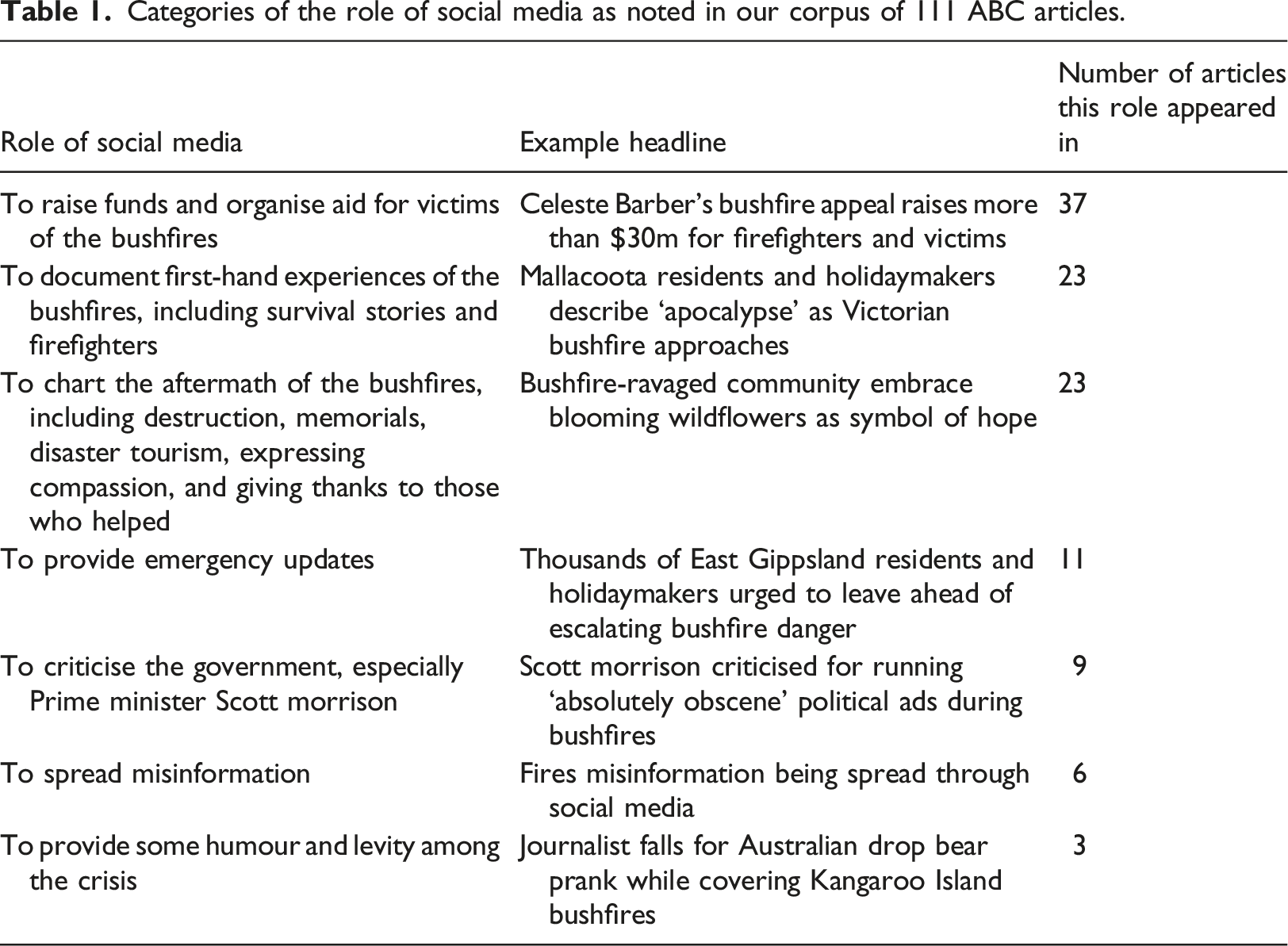
Categories of the role of social media as noted in our corpus of 111 ABC articles.
Results: Constructing Australian cultural identity through responding to the bushfires
News
Reports from September 2019 focused initially on rising temperatures, fire risk, the coming summer as ‘fire season’, bushfire preparation, and warnings. By November, the focus on Queensland had shifted to New South Wales and Victoria, with reports of the growing bushfire crisis, including the location, size, impact of, and response to, the fires. In December, Australian Prime Minister Scott Morrison faced criticism for holidaying with his family in Hawaii while the disaster continued to unfold. As the bushfires continued, more reflective articles emerged in the coverage, including research into bushfire management, assessing the toll of the bushfires, and dealing with the ongoing health impacts of the bushfire smoke.
Hashtags studied in our corpus of TikTok posts.
TikToks
Descriptive statistics of engagement metrics in our sample of TikTok posts.
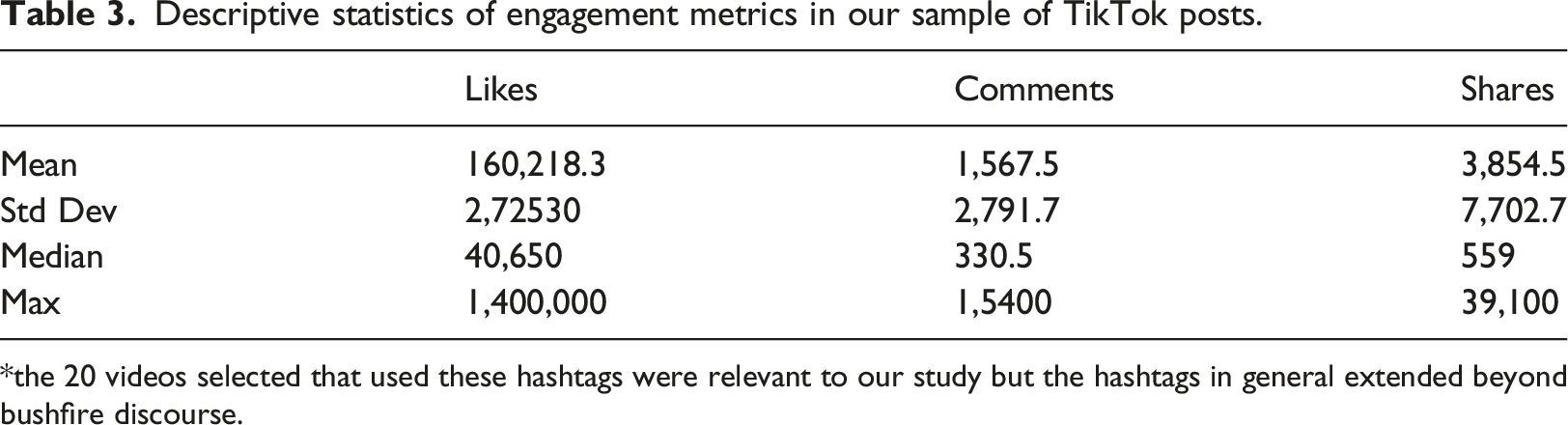
*the 20 videos selected that used these hashtags were relevant to our study but the hashtags in general extended beyond bushfire discourse.
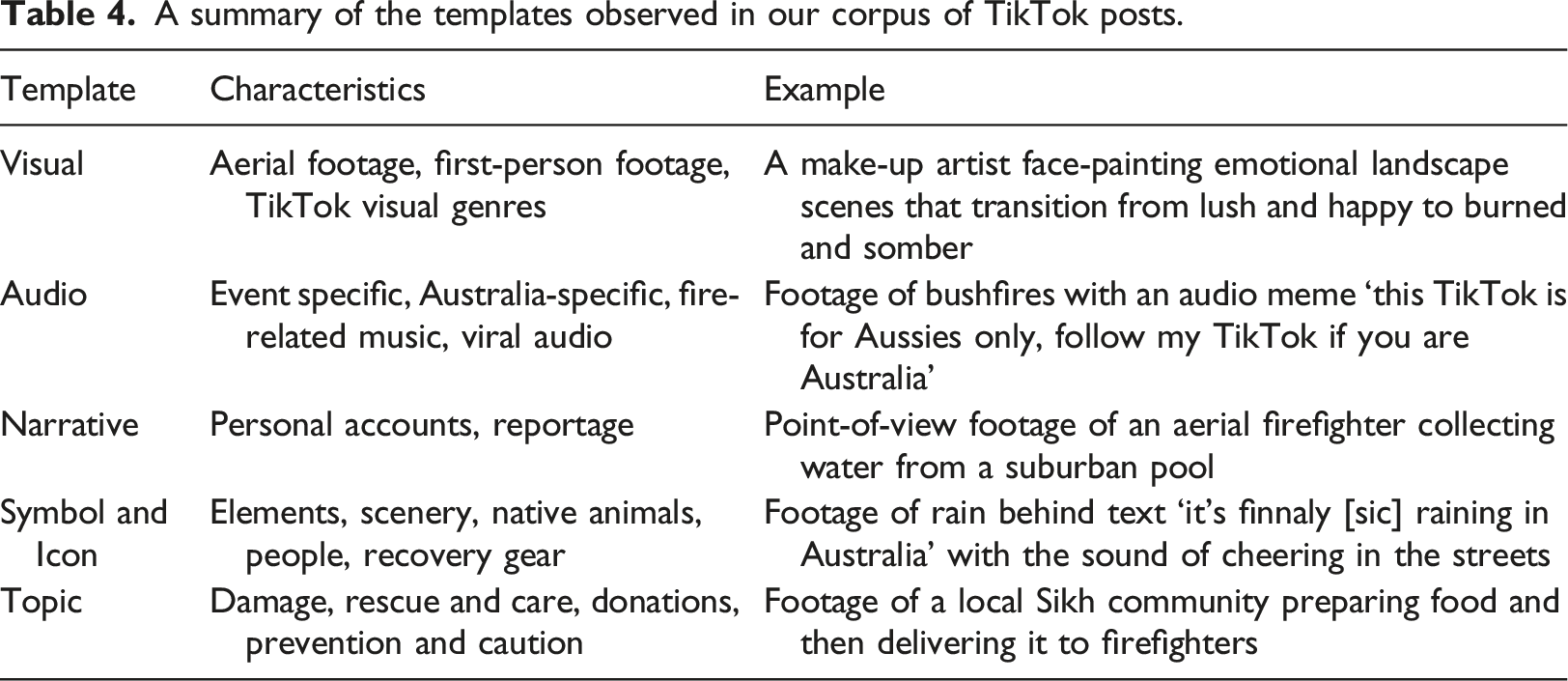
Qualitative thematic coding of our sample involved locating the various types of ‘templates’ used in TikTok videos. Templatability refers to the vernacular norms promoted by elite users and the algorithmic recommender systems that reinforce these norms on visual social media platforms (Leaver et al., 2020). Strategic aesthetic choices become short video templates through repeated interactions between users and platforms and occasionally videos going accidently viral on TikTok (Kaye, 2020). Templates reflect internalised logic of users trying to ‘game the algorithm’ by successfully capturing and holding the limited attention of viewers in a cycle of scrolling through new content that is constantly being refreshed. The TikTok platform also encourages certain forms of templates through features that ‘circumscribe creativity’ by suggesting viewers create new content based on the video they were just watching with a few taps of their finger (Kaye et al., 2021).
A summary of the templates observed in our corpus of TikTok posts.
Case studies: ‘Fire on Fire’, koalas, and Celeste Barber’s fundraiser
Our thematic analysis covered ABC News articles and TikToks about Black Summer. Within the two collections, two case studies emerged that best reflect the discourse of the crisis. These case studies allow us to present enduring themes that spoke to the imagined Australia: the audio template of the song ‘Fire on Fire’ by British artist Sam Smith, and the symbol and icon template of koalas. A third case study allows us to present a missed opportunity for the ABC: comedian Celeste Barber’s fundraising efforts.
Audio template: Fire on Fire
In our first case study, we highlight a vernacular norm from TikTok featuring the creative remix of audio templates (Abidin and Kaye, 2021). A snippet of ‘Fire on Fire’ by Sam Smith was turned into an audio meme on TikTok. This sampled from the early half of the chorus, featuring the lyrics: Fire on fire, would normally kill us/ But this much desire, together, we’re winners/ They say that we’re out of control and some say we’re sinners/ But don’t let them ruin our beautiful rhythms/
In the context of the original song, the singer was poetically capturing the love and passion (ie ‘fire’) that a couple might share despite being rebuked by the world (i.e. ‘sinners’), 4 and how they are able to overcome hardship and difficulties in this season. In the TikTok ‘audio templates’ analysed, users deployed this ‘audio template’ in two main ways.
In the first instance, TikTokers applied the storyline of the song to the context of the bushfires. This included TikTokers who had deployed the narrative of overcoming hardship and rising above in the context of encouraging victims as well as Australian fauna and flora to recover swiftly. For example, one post (@twinsstylee, 2021) featured a pair of male twins partaking in the unboxing trend, but instead of revealing presents, one box features a greenscreen of beautiful scenery and wildlife in Australia outside of the bushfire season, while the second box opens to reveal damage from bushfires. The twins end the video by pushing the second box of ‘damage’ away, ending with a caption that pleads with others to ‘pray for Australia [emoji: Prayer hands, Koala, Broken heart, Four leaf clover]’.
In the second instance, TikTokers took the song literally (eg ‘fire on fire’) to accompany scenes of the bushfire. This included TikToks who used the ‘audio template’ to accompany a carousel of video clips depicting scenes of locals in the thick of the bushfire (@caity.o, 2020), including orange smoky skies, locals gathering to receive instructions from firefighters, packing suitcases, consoling family members, and driving away from bushfire sites.
Symbol and Icon template: Koalas
In our second case study, we highlight the vernacular norm of wildlife rescue movements, utilising cute (and or distressing) imagery to solicit assistance and contributions. Koalas in distress emerged as the iconic symbol of the bushfires. While other native wildlife – such as kangaroos, wombats, and possums – were also featured, koalas and their young were the quintessential icon of the crisis, considering the more visible loss of their natural habitat, and perhaps in part due to the high publicity of koala rescue campaigns in previous years. Two main types of content emerge.
Firstly, koalas were depicted receiving assistance from rescue workers. This included firefighters attempting to retrieve koalas who were trapped in trees, using tools such as night vision cameras and at times accompanied by melancholic audio templates like Amazing Grace (@michaelsehr, 2020), and compilations of koalas being wrapped in blankets and doused in water before being take away to the hospital (@ecciuu, 2020). More optimistic renditions featured rescue workers releasing recuperated koalas back into the wild, watching them return to their natural habitat accompanied by diegetic sounds of nature (@infearnoo, 2020).
Secondly, koalas were depicted soliciting or receiving help from passersby. For instance, posts would feature a person feeding water to a koala in a child’s toy bucket, and dripping water onto the koala’s face (@kategebbing, 2020). The caption reads ‘It’s like our beautiful wildlife know we aren’t there to hurt just to help. At no point did he seem scared of us [emoji: cry face]’. A particularly poignant post features a young man similarly feeding a koala water out of a container (@rhyannonstock, 2020), but accompanied to the audio meme of the song ‘I Am Australian’. The lyrics of this audio meme – ‘I am Australian/We are one, but we are many/And from all the lands on earth we come/’ – depicts the need for unity and care across Australians, both human and wildlife.
A missed opportunity for the ABC: Celeste Barber’s fundraiser
While the previous two case studies present points of interest from within our corpus, our third case study steps outside this gathered material to give an example of the kind of cultural intermediary missing from the ABC coverage of Black Summer. During the bushfire season, comedian Celeste Barber circulated a personal plea for help for her family on Facebook, linked to a fundraiser for The Trustee for New South Wales Rural Fire Service and Brigades Donations Fund. On Instagram, Barber shared photographs taken from the windows inside a house, lounge room chairs on carpet, a vivid yellow glow permeating the bushfire smoke outside, with the text: This is my mother in laws house. It’s terrifying. They are scared. They need your help. International donations can be made via the link in my bio (Barber 2020 n.p.).
With an initial goal of AUD$30,000 to help her mother-in-law’s community, Barber was surprised to raise a total of AUD$51 million, the biggest ever Facebook fundraiser (Dye, 2020) at the time. The fundraising effort evidences Barber’s success in leveraging her emotional connection with her audience into donations. This kind of activity positions Barber as a cultural intermediary: someone who uses social media to act as a conduit between media institutions and citizen audiences (Hutchinson, 2017). While Barber effectively garnered a great deal of financial support through social media, the ABC remained in the background as a news coverage service instead of working to nurture the kind of vernacular creativity and audience engagement seen on TikTok.
Discussion: Who shapes, and should shape, Australian cultural identity?
This section examines the tensions within public service media, specifically the ABC, which is responsible for fostering a nation’s cultural development (Tracey, 1983; Hutchinson, 2017). It also articulates the stakes of the ABC not effectively operating on emerging social media platforms like TikTok.
The ABC has a strong history of engaging audiences across emerging technologies through orchestras (Wilson et al., 2010), news (DeBrett, 2010), co-creation (Hutchinson, 2017) and more recently through innovative measures such as the ABC Newsbot on Facebook Messenger (Ford and Hutchinson, 2019). When the ABC does not have an active role in an emerging digital media landscape that favours TikTok as a cultural identity defining mechanism, what is missing? Why is the ABC uniquely positioned to innovate for the purposes of supporting cultural identities through digital services?
In most countries, there are traditional media regulatory responses that ensure cultural identities are maintained and strengthened. These happen either through nudging techniques such as support for content production or specific location-based talent quotas, or through more direct intervention such as policy and regulation. In many cases, cultural institutions are designated for the role of facilitation and construction of Australian cultural identity, for example through museums or galleries and more specifically through its public media organisations. However, these same cultural institutions often underperform in social media spaces that do not have specific cultural content quotas but instead have social media influencers who attract large audiences (Hutchinson and Sørensen, 2021).
Some news organisations are embracing TikTok as a chance to cultivate new audiences. One study identified 234 news organisations with TikTok accounts who were making use of TikTok’s video editing capacity, trending hashtags, and popular sound templates to communicate the news, indicating enormous potential for incorporating social media logic into their role as information providers (Vázquez-Herrero et al., 2020). In the US, ‘The Washington Post TikTok Guy’ Dave Jorgenson has been writing and producing TikToks that do not just repackage television news snippets, but draw on the vernacular creativity of TikTok to create platform-specific content. Jorgenson often communicates headline points from the news in the form of short skits, with humorous ‘conversations’ between two versions of himself (Meek, 2021). The Washington Post described the account as ‘an investment in storytelling’ (WashPostPR, 2021) as it sought to grow the content creation team when TikTok became its fastest-growing audience. This is cultural intermediation in action: reinforcing the news organisation’s journalistic mission by actively engaging social media audiences.
During Black Summer, there were opportunities for nurturing the vernacular creativity on TikTok. One important aspect to consider during this crisis was the increased international attention Australia received. On TikTok, Australians and non-Australians alike drew on the cultural imaginary of Australia to communicate their feelings about the crisis. Empathy, sadness, and solidarity were evident in TikToks using the ‘Fire on Fire’ sound as a backdrop for images of flames, blackened trees, and native animals (especially koalas) from Italian Jessi Brugali (@jessibrugali, 2020), French baker Arrzzii (@arrzzii, 2020), or Polish twins (@twinsstylee, 2020), and through specific individuals such as American news anchor Owen Confenti (@conflenti, 2019) or Australian internet celebrity Caleb Finn (@caleb.finn, 2020). There was clearly a demand for emotionally resonant posts about Black Summer, as demonstrated by the enthusiastic response to Celeste Barber’s fundraiser. This was a unique opportunity for the ABC to take a leadership role in supporting the cultural identity of the nation, innovate across emerging digital services, and perform the public service remit it is legislated to perform. While the ABC creating a TikTok account would be a significant start for the national broadcaster, this is not enough. It is important to be present, and to invest in communicating with vernacular creativity as a form of online community development. For example, understanding how young people were frustrated with their Prime Minister for being on vacation in Hawaii and the sorts of techniques they were employing to discuss this amongst themselves was missed. Or the use of specific audio templates (Abidin and Kaye, 2021) that became key identifiers for cultural understandings of the moment were not identified, nor reported on. But it is more than just identifying and reporting on such things: it is the active contribution of community building in this space that is missing from the national cultural institution. If the ABC is responsible for the enrichment of culture across digital technologies, they are not fulfilling their legislated role as per the Charter (Australian Government 1983). We argue that there is room to proactively develop cultural intermediary roles in future who are aligned with the values of the ABC while operating within social media.
Conclusion: Towards cultural intermediaries in networked publics
There is not one TikTok. As a global platform that reached one billion users in late 2021 (TikTok 2021), TikTok is home to all kinds of subcultures, niches, and localities. This paper has researched just one of them: the networked public that coalesced around the Black Summer bushfires of 2019–2020. ABC News articles and TikToks both communicated the devastation wrought by Black Summer by drawing from a shared imaginary of Australia. The expanse of bush, populated by koalas and kangaroos, rescued by firefighters who courageously battled fires, speaks to the constructed notion of Australia as a young, wild land in need of taming. TikToks were more likely to use images and sounds to convey strong feelings about the crisis, emotionally processing the destruction of Black Summer, while the news coverage focused on the impact of the fires to specific parts of the nation. TikTok is in tension, but not conflict, with the ABC here as part of a media landscape that has a lot to communicate about Australia’s cultural identity and changing imaginaries.
As Hutchinson (2021) argues, the ABC needs to strengthen its social media offerings by adopting a cultural intermediary approach to effectively operate in these emerging digital services. One positive impact of cultural intermediaries in this space could be actively bringing better representation to our existing imaginaries of Australia. Through social media activities that ordinarily provide an ‘Australian-ready’ image to the world, leveraging those influential attributes in times of crisis is crucial. In that regard, the ABC needs to not only provide digital media services to strengthen the cultural identity of Australia, it needs to be proactively functioning in this space to leverage communication visibility during times of crisis. This is especially important on TikTok, where everyday citizens identify, and contribute to, the news.
Future research on the relationships between TikTok and public service media could detail the connections and tensions between content creators and journalists as key roles in national imaginaries; test ways of finding and connecting with TikTok subcultures; and further investigate the dynamics between vernacular creativity (Burgess, 2006) and formal institutions. As public entities, news organisations like the ABC should consider how they can best engage with emerging platforms and formats, whether communicating news in the platform vernacular, connecting views and visibility on social media platforms to their existing news websites, and by actively seeking and nurturing cultural intermediaries. Content and conversations on social media make valuable contributions to Australian cultural identities and imaginaires – within, and beyond, a crisis.
Footnotes
Declaration of Conflicting Interests
The author(s) declared no potential conflicts of interest with respect to the research, authorship, and/or publication of this article.
Funding
The author(s) received no financial support for the research, authorship, and/or publication of this article.
Notes
Author Biographies
 and @wishcrys.