



Abstract
In recent years, gender scholars have begun to examine the various costs and benefits of hierarchically arranged femininities. These cultural ideals are particularly appealing in the context of growing digitally mediated interactions, as the symbolic and relational boundaries between these femininities are becoming more fluid. Drawing on 32 in-depth interviews with Romanian content creators on TikTok, I highlight the intersectional, symbolic, and discursive character through which different types of femininity define online success and popularity. Women who approximate the hegemonic locations of femininity were found to practice privileged experiencing of TikTok’s affordances. These users already endorse affluence, heteronormativity, and knowledge premiums, which gives them an advantage in becoming popular on TikTok. However, women in disadvantaged intersectional locations tend to practice a resistant assimilation of TikTok’s affordances, as they tend to borrow but also criticize certain strategies from privileged users. Implications for digital communication and intersectionality are discussed.
Keywords
Introduction
In 2023, several Romanian influencers on TikTok, most of them women, came to public attention after repeatedly endorsing gambling ads. Many times, these influencers encouraged ordinary women to bet on such activities, stating that in this way they would contribute to the creation of “communities of strong women who have fun responsibly” (Pătrașcu, 2024). Such promoters are active both on TikTok and in TV commercials, even setting up the Lucky Ladies community, where ordinary social media users are encouraged to play games of chance. The situation has become all the more serious, since some such influencers are mainly followed by children and young people under 18 years of age, and not marking these sponsored ads makes the promotion a subtle one (Meseșan, 2023). Such influencers symbolically distance themselves from traditional femininity, especially from some characteristic aspects such as subordination to male dominance or lack of professional ambitions (Renold and Allan, 2006). In the Romanian context, this discussion is of central importance, given the fact that the sudden post-communist transition of the Eastern European countries led to the formation of hypercapitalist behaviors of immediate enrichment, through a rapid exploitation of resources by social actors who have equipped with the necessary leverage for social mobility (Chelcea, 2023; Chelcea and Druţǎ, 2016).
Although the participants in my study are not sponsored by various private organizational entities, some of them have the social location and affluence necessary to self-sponsor their content in order to reach as many users as possible. However, all of my participants are content creators and consider themselves as such, even if they create content for a variety of reasons and have audiences of wildly different sizes.
I therefore join an emerging body of research centered on the ways in which different femininities coexist, generating heterogeneous motivations and social realities of using social media. Such an approach is important as it highlights how leisure and work coexist in a wide range of social practices and discourses in the public space (Grünberg and Matei, 2020; Matei et al., 2023; Moga and Rughiniș, 2023). This discussion is useful because, through this research, I argue that the variety of purposes for which users create content on TikTok do not simply have motivational aims, but also intersectional ones. Of course, the causal relationship is not as clear-cut as one might think. Not only does the intersectional location of users clearly shape their aspirations on social media, but, as Foster (2022) explains, digital platforms play an active role in perpetuating social inequality, given that effective access to social affordances depends on knowledge capital, but also on forms of social and economic capital.
Therefore, the purpose of my research is to examine what role does the intersectional location of users play when it comes to their activities and experiences of using TikTok. Such a diversity of the intersectional background of users is necessary as it allows a deep understanding of the motivations behind the use of TikTok, both for users who practice content creation and for those who practice content consumption or both of them. Thus, regardless of the reasons for using TikTok, I included Romanian users with different intersectional locations who actively participate on TikTok.
This discussion is important in the context of intersectional feminism. Despite the egalitarian and neoliberal myth that online popularity largely depends on personal effort in producing quality content, it is observed that content creators’ access to online popularity reflects systematic efforts to legitimize – discursive, practical, or symbolic – forms of hegemonic femininity. However, most TikTok users do not have these material advantages, and most forms of digital feminism are frequently contested or countered through misogyny or other aspects of hegemonic domination (Kim, 2021). Thus, this study is important in the predominantly conservative Romanian context, given that idealized forms of hegemonic femininity continue to dominate at the social and cultural level. Furthermore, the study is also important since investigating the costs and benefits associated with different types of femininities is a relatively recent topic for gender scholars (Hamilton et al., 2019; Ispa-Landa and Oliver, 2020), and digital stratification based on appeal and affluence is typically subtle.
Hierarchical femininities in action: agency, premiums, and taxes
The main theorizations of femininities usually start from Connell’s (1987) view on emphasized femininity as a form rather devoid of agency, stating that “There is no femininity that is hegemonic in the sense that the dominant form of masculinity is hegemonic among men” (p. 183). Instead of analyzing femininity in terms of compliance with men, the more recent intersectional approach suggests adopting hegemonic femininity as a more agentic form that should be defined in relation to other types of femininity. Authors such as Pyke and Johnson (2003) anticipate important components of Patricia Collins’ later definition of hegemonic femininities. They argue that axes such as race, class, sexuality, and age contribute to shaping the superior type of femininity, which “emphasizes the superiority of some women over others, thereby privileging white upper-class women” (Pyke and Johnson, 2003: 95).
In her book Black Sexual Politics, Collins (2004) explains that just as hierarchical masculinities are constituted in relation to one another, there is a similar pattern in the case of femininities. Thus, social locations such as class, age, gender, race, and sexual orientation intersect, producing similar typologies of hegemonic, marginalized, or subordinate femininity (Collins, 2004: 187). Both offline and online, certain women frequently feel the benefits of securing hegemonic femininity. This happens because such a location brings the most “intersectional incentives” (Feinstein, 2017: 549) due to their complicit attitudes in perpetuating cultural ideals of femininity.
In the context of hierarchically arranged femininities, Hamilton et al. (2019) discuss the premiums and taxes given by the location of femininities on the matrix of domination. While premiums refer to the benefits women derive based on their intersectional location, taxes refer to the costs associated with this location. In the United States and most European states, such premiums are usually higher education level, affluence, attractiveness, and the possibility of easy access to elite romantic partners (Adler et al., 1992; McClintock, 2014). However, access to these premiums does not always come naturally but has a performative aspect: privileged women must demonstrate a certain level of effort (Bettie, 2003) specific to hegemonic femininities; otherwise, they will not be able to extract all the rewards in terms of race and class. Hegemonic femininities often function as gatekeepers to intragender costs and benefits (Mears, 2011; Myers, 2004). Therefore, women who possess the necessary resources, knowledge, and hegemonic identity aspects manage to control the success/reputation of other women, along with their access to social and productive networks (Ispa-Landa and Oliver, 2020). This discussion is all the more important in the context of neoliberal feminism, through which different femininities are encouraged in the spirit of individualism and market-based progress, as this form of empowerment is based on personal choices rather than systemic solutions (Banet-Weiser et al., 2020; Obreja, 2024; Peng, 2021; Risman, 2004). Thus, multiple content creators, especially those with intersectional advantages, can use TikTok as a catalyst for a self-branded feminism, centered on promoting financial literacy materials, business tips, or other forms of personal success.
Hegemonic femininities via TikTok’s affordances
Previous studies have established that within the human–computer interaction (HCI) framework, user engagement with a platform works multidimensionally, given that these users might encounter psychological or behavioral challenges when using social media features (Busselle and Bilandzic, 2009; Oh et al., 2018). However, there has been limited discussion of the intersectional barriers that users encounter when interacting on social media. For example, it is widely recognized that the everyday (anti-feminist) backlash has become a prevalent phenomenon in digital communities, resulting in the formation of manospheres where misogyny and hatred toward inclusive forms of femininity and masculinity are propagated (Han and Yin, 2023). Consequently, many women prefer to adopt the passive behavior of “just watching” in the online environment without actively interacting with the contents viewed (Orme, 2022). In addition, Noble (2018) highlights the intersectional discrepancy related to access to technological affordances when she describes the limited access of black women to what she calls “the new coding divide, of the twenty-first century” (p. 64). Thus, unequal access to digital resources is a specific feature of neoliberalism, whereby aspects such as creativity or talent are appropriated in a meritocratic spirit, ignoring the structural differences between users.
For example, intersectionally advantaged users manage to invest both material resources and knowledge capital to create more attractive contents, which work on the principle of show rather than tell. These users possess the necessary skills to implement some “attention-grabbing visuals” (Alvermann et al., 2021: 203) instead of adopting long and boring narratives that usually tend to be swiped past. Alvermann et al. (2021) examine the profiles of three TikTok users and identify a phenomenon I describe as privileged negotiation with the algorithm. These users already possess the material and knowledge capital to go viral on TikTok. They skillfully utilize the most appropriate soundtracks and implement performance-designed visual elements to attract likes and comments from viewers in a short time. Surprisingly, the aforementioned authors discussed these findings in terms of gender performances (Butler, 1990) without pointing out the hegemonic profile of these viral women on TikTok. However, some elements indicating the hegemonic position of femininities can be found in their research: “Prudence Smalls, for example, demonstrated a strong interest in modeling” (Alvermann et al., 2021: 203), or “Kxtty also dressed in garb from the European Renaissance, and cosplayed . . . fictional characters from Japanese anime” (p. 204). However, as a “biracial person of color,” Kxtty cannot fully achieve hegemonic femininity. Although Kxtty is socioeconomically advantaged, we learn that they have to pay a higher femininity tax (Hamilton et al., 2019) because of their racial profile: “they were accused of being not Asian enough when they tried to express their Indonesian heritage and not Celtic enough when they engaged with Irish practice” (Alvermann et al., 2021: 204).
At the opposite pole are the majority of TikTok users, who practice what I term a hybrid resistance with the algorithm on social media. These users mainly repost other people’s content and try to avoid creating too intimate videos for fear of becoming too exposed. Such passivity, more or less strategic, is caused by the different toxic technocultures (Massanari, 2017) existing online. Based on my observation, both privileged and precarious forms of negotiation manifest certain fears about their online activity. However, they do so for quite different reasons: while hegemonic femininities on TikTok avoid debating controversial, non-hegemonic topics for fear of losing the privileges given by their intersectional location (fear of being too controversial), marginalized femininities manifest the fear of not being too exposed, that is, of not revealing their intersectional location in front of other users. Previous studies have shown how diverse sexual or racial identities benefit least from social media algorithms (Duffy, 2017; Duffy and Hund, 2015; Foster, 2022), so affordances such as number of followers and speed of propagation of created contents will be affected by users’ intersectional location. Thus, I aim to examine how these users are using TikTok’s affordances to perpetuate or, on the contrary, ameliorate their intersectional location.
Although some users use TikTok for professional purposes and others use it mainly for fun, what they have in common is the desire to create content as a way of communicating with their followers. As will be seen, access to different popularity tools not only outlines certain regimes of (in)visibility on social media (Bucher, 2012), but also reflects to some extent the ways in which content creators access and capitalize on their social locations to convey certain messages.
Sexual diversity on social media
Although sexual and gender diversity was present in most spheres of social life, it encountered concrete resistance within new media technologies, forcing sexual minorities to remain silenced. Thus, the hegemonic and heteronormative aspects that define online attractiveness and appearance largely determine who deserves to be visible on social media (Foster, 2022). Such digital resistance takes place despite clear trends of normalization of homonormativity and same-sex marriage at the European level (Santos, 2013), which highlights the rather opaque contribution that recommendation algorithms have in the process of propagating hate and discrimination on social media.
Affluence, whiteness and attractiveness are hegemonic aspects frequently idealized in the digital space, while women with a disadvantaged social location, such as sexual or racial minorities, are forced to adopt less visible identities in the online or media space (Baumann and de Laat, 2012; Craig, 2002). Noble (2018) discusses in her book how algorithms have a visible role of oppression especially in the case of marginalized communities, given the fact that the contents created by them do not reach wider digital audiences, which prevents the participation of these communities in the decision-making process. Precisely for this reason, it is necessary to investigate how the social location of individuals, whether by gender, race, or sexual orientation, restricts or favors their access to different material or symbolic resources (Hamilton et al., 2019; Jderu, 2023; Zamfirache, 2010).
The Romanian context
In Romania, the participation of ethnic minorities in liberal professions is almost completely absent, which is reflected in the dominant discourse in news media outlets. According to Cernat (2024), the relatively homogeneous social locations among Romanian journalists – white women, relatively young, and quite affluent – contribute to shaping a mainstream discourse from which social issues such as diversity or inclusion are almost completely absent. In addition, the increasingly active representation of LGBTQ+ members in Romania on digital platforms such as TikTok, Instagram, and Twitch has contributed to increasing online militancy for the causes of sexual minorities (Obreja, 2023). However, although apparently well-intentioned, activism that is too focused on a certain axis of oppression perpetuates intersectional domination by neglecting categories that simultaneously possess several oppressed traits (Crenshaw, 1991).
Many Romanian users have transitioned to the online environment, resulting in a current count of over 7.5 million TikTok users, or almost 40% of the country’s total population (Kemp, 2022). In addition, 70% of the Romanian population is on social media (Kemp, 2022). Such high connectivity among the Romanian population stimulates the propagation of ideologically diverse content, which encourages a variety of social and political actors to promote content that incites hatred based on race or sexuality (Rughiniș et al., 2024; Stănoiu, 2024). One such member of the European Parliament described transgender women as “perverted males” (Stănoiu, 2024) indirectly encouraging Romanian users to spread hatred toward users who identify as queer. Such a social dynamic explains, to a good extent, the relative reluctance of Romanian users who represent sexual minorities, to easily expose their identity in the online environment, even in the case of a limited number of followers. Such results confirm previous results whereby users who belong to minority groups are frequently being silenced and opt for a passive attitude of viewing the contents (Obreja, 2023; Orme, 2022).
Methodology
Study recruitment
This research is part of a recent digital project investigating the confluence between social media affordances and users’ broader backgrounds that guide their online experience and identities. This study specifically addresses the following research question:
RQ. What role does the intersectional location of users play when it comes to their activities and experiences of using TikTok?
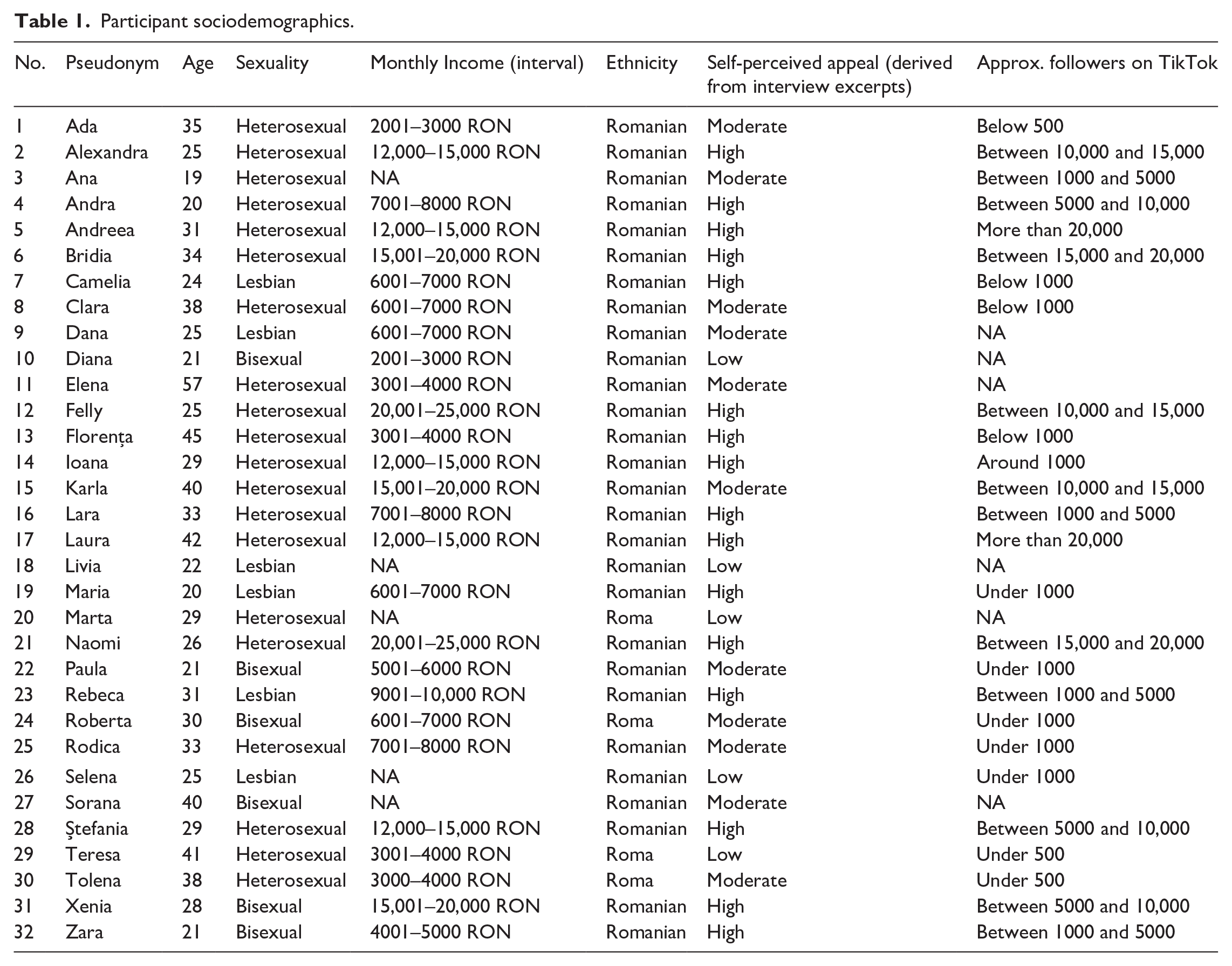
Initially, seven participants were recruited for this study. These participants are enrolled in the sociology department of my alma mater university in Romania. These students immediately expressed their intention to participate in this study due to their interest in both TikTok and digital feminism. Subsequently, these participants referred more acquaintances or family members to participate in the study, resulting in the inclusion of an additional 25 participants through snowball sampling. Deliberate efforts were made to include participants with intersectional locations, which resulted in 4 participants from the Roma minority, 14 participants who identify as part of a sexual minority, and 8 participants with medium education. See Table 1 for the characteristics of the 32 participants, including their approximate monthly incomes. Note that the minimum monthly salary in Romania is approximately 2000 RON (approximately $400), and the average monthly salary is approximately 5000 RON (approximately $1000). All participants included in this study were given pseudonyms, while each was assured of anonymity and data confidentiality. This aspect was particularly relevant given that some participants recruited through snowball sampling came from the families of initially enrolled students. My participants have a very wide range of followers, ranging from 500 to 25,000.
Participant sociodemographics.
Interviews
All the interviews were conducted between September 2023 and March 2024, utilizing both face-to-face and online platforms such as Zoom and Google Meet. The interviews were conducted in Romanian and were subsequently translated and transcribed. On average, each interview lasted for 67 minutes. A range of topics were incorporated into the semi-structured interviews, including (1) the main satisfactions and dissatisfactions in using TikTok; (2) the main features used on TikTok to view or create content; (3) the deep reasons for which users decide to create regularly, or not to create content on TikTok at all; (4) participants’ own or others’ intersectional performances; (5) the main structural barriers or opportunities associated with their identities.
Despite having a TikTok account for a few months, I have never created professional content (such as paid partnerships) or attention-grabbing visuals like some of my participants did. This allowed me to act as an “acceptable incompetent” (Lofland et al., 2006: 29) in some cases, allowing me to ask additional questions about the process of creating and editing online content. This helped me familiarize myself with certain professional affordances that support users in a good intersectional location.
Type of analysis and adjacent coding process
This research follows a definitely abductive trajectory, given that I aim to investigate the most plausible explanations for my observations through a purposive relationship between the data obtained and the pre-existing theoretical framework. This approach is fruitful and flexible because it allows a constant dialogue with existing theories by proposing empirically grounded amendments (Timmermans and Tavory, 2012).
Deterding and Waters’s (2021) recommendations for a rigorous and flexible qualitative analysis of the interviews were carefully followed in this study. The codes obtained from the analysis of the interview transcripts were grouped using Quirkos, initially starting with broad codes that render concrete elements of unequal access to TikTok’s affordances. This implies that codes such as “massive popularity,” “many fans who donate,” or “wealth attracts more wealth” are included. Subsequently, comprehensive analytic coding was performed, aiming to leverage the abductive nature of this research. After reviewing the transcripts, a series of analytic memos were created during and after the interview process to associate users’ experiences with access to different premiums and taxes (Ispa-Landa and Oliver, 2020).
The following sections elaborate on the two core types of negotiations with TikTok’s algorithmic affordances, which are indicative of specific intersectional locations. Subsequently, the relevance of these data in the relatively conservative context specific to Romanian society will be emphasized.
Findings
Overall, hegemonic forms of femininity are encouraged through TikTok, given that most participants are aware of the idealization of these values at the level of Romanian society (Hamilton et al., 2019). However, subordinate forms of femininity (Collins, 2004) recognize the specific privileges of hegemony on TikTok but also criticize the content of more intersectionally advantaged users, especially through how this content is often monetized.
Given the diversity of intersectional locations of the participants in this study – different levels of affluence, sexual orientations, and expertise in using TikTok – two types of relationships with the application in the agency negotiation process were identified. On one hand, users with modest socioeconomic levels, moderate self-perceived appeal, and a non-heterosexual orientation practice a resistance against such privileges. They avoid posting certain content, such as entertainment, due to receiving relatively few likes or reposts, after which they delete them and prefer to adopt more passive attitudes, but at the same time criticize the financial orientation of users who create high-performance content on TikTok. On the other hand, users with a higher intersectional location practice privileged negotiation. These users post more often and have higher-quality videos, thereby reaching a larger audience. They feel an increased impetus to create as much content as possible and avoid posting controversial content. Although feminist attitudes can be identified in both categories, intersectionally disadvantaged users feel constrained technologically to silence such perspectives. In contrast, users who possess a privileged intersectional location feel constrained by the pressure of their hegemonic position, which requires predominantly heteronormative values and opinions.
Navigating privileged negotiations with TikTok: “natural” beauty and great effort
The participants in this study possess knowledge of the trivialization of the image of those who create successful content on social media, especially those young, beautiful, and affluent women. However, these successful participants on TikTok often believe that “hard work” is what brings them this success, seemingly oblivious to their privileged position due to their advantageous intersectional location. In this regard, Lara explains that
It’s really important to wield [air quotes] these filters and tools if you want to be successful as a content creator, but that’s not nearly enough . . . I mean, yes, you have to know when to add the column the trendiest sound at that moment and you still need to know how to add filters to your advantage, but all that doesn’t do much if you don’t also have a natural beauty . . . so I don’t see why not take advantage of following my natural advantage. (Lara)
For other participants, their popularity on TikTok is closely related to their physical appearance and the main ideas exposed during live broadcasts. Although Naomi states that this success is largely due to the “pleasant physical appearance, which you can’t really fake,” she became immediately aware of the role that technological affordances play in this process:
But is it only beauty that counts in this popularity process?
Well, not really! You also need to have good technical conditions, otherwise you cannot make quality content. For example, when I do spontaneous live while I’m outside, I couldn’t do without it [shows me her latest Iphone 15 Pro Max version], and when I’m in front of the computer, I couldn’t do without my headset and mic from Meze . . . I’m not a hypocrite, I’m aware that all these components help me create quality content, but I think fans wouldn’t be interested in joining a channel if the creator looks like hell.
Most participants in this category often do not realize their intersectional advantages, or they were attributed to natural beauty, which aligns with Ispa-Landa and Oliver’s (2020) findings among top-tier sororities with Greek membership. Even though gender performances on TikTok represent a rather informal system of reproducing intersectional inequalities, some participants are aware that their advantages contribute to their popularity on TikTok.
Therefore, some participants experience discomfort regarding this inequality, which is visible on a daily basis through social media. Xenia says that her life changed significantly only after she came to Bucharest and subsequently got the project manager job at an IT company. Up until that point, Xenia admits that she was having a much harder time financially, and her improved socioeconomic status gave her the opportunity to invest both money and time into her TikTok profile. For Xenia, the idea of creating professional content on TikTok “came only when I realized that I could get more visibility . . . it’s a nice feeling to find that all this confidence in your powers starts to grow as you invest in your dreams, and the money I started making allowed me to do this.” However, she is aware that without extensive professional opportunities, “you can’t take advantage of TikTok to the maximum . . . if you want to take advantage of TikTok, it must also take advantage of you.”
Unlike Xenia, Alexandra, an HR manager in Cluj, is aware that technological privileges require users to approach the hegemonic cultural ideal. However, users with a disadvantageous intersectional location have the opportunity to feint the lack of some femininity premiums (Hamilton et al., 2019). Moreover, this happens because the locations that bring the most social and cultural privileges also create the greatest expectations and pressures for social conformity (Mize and Manago, 2018). Alexandra believes that the technological affordances available on TikTok create some leveling of the potential premiums that content creators can extract from this platform:
Unlike Facebook or Instagram, on TikTok you can easily pretend to be someone else than who you really are. Basically, nowadays all girls want to be an influencer [air quotes], and TikTok allows you to do that, even if you live with a cow and chickens in the yard.
Alexandra coherently illustrates how certain marginalized femininities manage to extract certain benefits specific to hegemonic femininities. This is facilitated by the easy access to affordances available on TikTok, which uses powerful algorithms to detect facial features and advanced visual elements for content capture and posting (Kang and Lou, 2022). Thus, beauty premium and “plainness penalty” (Hamilton et al., 2019: 327) are frequently discussed criteria when it comes to professional or personal success (Cook and Mobbs, 2023), and TikTok allows users to reap such hegemonic benefits through filters and other similar affordances. While Alexandra admits that other women manage to mask their true intersectional location through TikTok, she says that, more often than not, it is easy to identify the true social origin of those content creators. To bolster her argument, Alexandra brings up a viral TikTok of a Romanian teenager filming herself trying out certain shades of makeup, at which point she is interrupted by her mother, who yells at her to shower as soon as possible because she “smells like a dead body.” For Alexandra, such examples clearly reflect how “most content creators try to appear to be something other than what they actually are, and that’s because social media constantly asks you to pretend you have a perfect life.” An important part of the participant’s claims is that “natural” advantages combine with the professionalization of their presence on TikTok, which requires constant efforts to discursively and relationally legitimize the femininity premiums they have.
Highest femininity tax: not to be controversial
Participants who practice privileged negotiation share similarities regarding TikTok’s affordances, both at the level of class, race, and education. These privileged intersectional locations are often reflected in the effort of these participants to constantly legitimize the identity of patriarchy and heteronormativity in a relatively conservative society. For example, Alexandra had an intervention on her TikTok channel in which she legitimized the importance of protecting women’s abortion rights. However, the situation quickly escalated when one of the participants asked her if she was a “globalist” or a “leftist.” Thus, Alexandra quickly felt the need for an intervention to reinforce her heteronormative identity:
Comments on TikTok have a contagion effect . . . one negative comment immediately attracts dozens of similar comments, usually from men. That is why I felt the need to publicly confirm to them that I am not a globalist, because they used it in a derogatory way. I told them I consider myself a feminist, I support women’s rights, but that doesn’t mean I also support gay marriage or adoption.
Another truncated but slightly different vision of feminism is also shared by Felly, a young Romanian singer who has online interventions on social issues. Felly says she does not usually consider herself a feminist, but “I have campaigned every time for equality between women and men.” When the community of followers on TikTok began to ask about her feminist origins, she immediately began denying the label:
because I was afraid of losing my followers . . . why lie to you? I remember that the next day I had inserted certain visual elements in a corner of my channel, which read <<If you’re gay, you’re not welcome>>. Now I deeply regret it, but in those moments, I was only thinking about the fact that I have to do everything I can to keep my followers.
Alexandra and Felly exhibit distinct relational differences in their engagement with feminist activism. While Alexandra practices situational feminism (Crossley, 2010), whereby she assumes the label of feminist in overtly sexist or misogynistic situations, Felly practices a hybrid version of implicit feminism (Giffort, 2011), where the feminist label is immediately rejected in order to maintain the privileges gained through TikTok. 1
Overall, participants who practice privileged negotiation with TikTok’s affordances constantly feel a state of tension from having to legitimize or downplay their privileges in front of their audience. All these efforts of hybrid femininity (Ispa-Landa and Oliver, 2020) demonstrate how TikTok is an environment conducive to securing privilege for femininities in an advantageous intersectional location, and this context of subtle domination is realized even in the absence of men.
Navigating hybrid resistance: low perceived appeal, contested knowledge, and poor affordances
Participants who practice hybrid resistance with TikTok’s algorithm reject the idea that their popularity on TikTok reflects their true worth. However, most participants in this category indicated some interest in various popular profiles on TikTok. For instance, Livia, a law student, says she would pay more attention to TikTok “if I were more attractive.” She is quite critical of the nature of monetized content: “Some women think that if you have money you can get what you want. The problem is that in real life things are not quite like that, but on TikTok it is.”
And why do you think this is happening?
Well, because TikTok is a corporation like any other: no matter how much the CEO claims that it is an app for everyone, obviously those with the most money will have priority. That’s how it is in capitalism.
Teresa, a Roma woman working in a Bucharest supermarket, highlighted an intriguing perspective. For her, TikTok is all about entertainment content or popular songs from her childhood. When asked about the women she follows on TikTok, she replied,
Yes, I also have an influencer and I follow her almost daily. I see her going on yachts in Greece or having dinner in Madrid, but to tell you the truth, I don’t think I could do with so many vacations . . . I think if you have too much money you start taking care of it day by day, and that brings you many health problems . . . people generally think it’s a great joy to have many sponsors, maybe financially yes, but I wouldn’t be willing to sell my identity like that for some money.
For women like Teresa, there is an unbridgeable line between the highly popular women on TikTok, who enjoy the luxury of living, and the average user, who simply consumes this content. Teresa’s comments reflect that a disadvantageous intersectional location is more of a relief when it comes to TikTok, given that it avoids the constant burden of filming every moment of one’s life. Tolena, another Roma participant who works as a hairdresser in Iași, believes that her position is noticeably superior, given that she feels an increased agency over her personal life:
I don’t have to constantly show everyone what I do, what I eat, or where I pooped . . . I’m just an ethnic woman who goes about her business, gets her salary in the middle of the month and drinks a beer a week. Fortunately, no one cares what I do.
Both Teresa and Tolena are satisfied with the idea that their intersectional location exempts them from unrealistic expectations. As a result, their activity on TikTok is limited to passive affordances, such as liking or reposting. For example, Teresa states that such passive behavior allows her to be closer to her friends who use TikTok because “we can mock and laugh at some influencers, especially those influencers for whom life is reduced to silicone implants or vacations in Dubai.”
However, TikTok’s recommendation algorithms also operate differently: they often recommend content from users with similar class or gender locations, thus homogenizing their concerns and expectations. Maria works as a junior researcher at a company in Cluj and says her lesbian identity got complicated when she realized her lack of knowledge about taking advantage of the networking opportunities on TikTok:
In a way I’m happy to see other LGBTQ members going through similar stories . . . it makes me feel understood. However, it’s very difficult to do much about it, because the effort to find similar contacts on TikTok is often a time-consuming one.
Participants like Maria feel that their agency on TikTok is diminished due to technological affordances that do not encourage dialogue for activist causes. As will be pointed out, such affordances operate as obstacles for these participants, given that many of them constantly fear becoming too exposed. Although her sexual identity places her at some distance from the hegemonic ideal of femininity in Romanian society, Maria benefits from other advantageous axes that allow her to voice her sexuality on TikTok. Thus, the socioeconomic status allows her to invest relational resources in order to voice her sexual identity on TikTok, which confirms previous findings (Kamran, 2023) of sexual activism on social media among users who have overcome working-class condition.
Highest femininity tax: not to be too exposed
The participants in hybrid resistance situations constantly felt the tension between the desire to network with like-minded individuals on TikTok and the fear of not becoming too exposed in front of strangers when making certain personal videos. However, this fear is not uniformly felt among participants who practice hybrid resistance. Participants decide not to display much about their personal lives due to the influential role of ethnicity.
For Marta, a 29-year-old barista, TikTok is all about “scrolling for fun and reposting memes that amuse me.” Tolena, who was previously discussed, uses TikTok to sometimes post content about her daily life, but this activity is accompanied by constant fear:
Sometimes I film myself when I’m shopping or when I go out with a friend in the city, but I ended up repeatedly refreshing TikTok, to be sure that I don’t end up being watched by too many strangers. You never know when someone will come and insult you on your own profile . . . some people are very mean, especially when they see your ethnicity.
However, other participants criticize the system of privileges that underlies TikTok. They argue that this system has transformed the idea of democratic debate into an environment in which the few affluent ones are listened to. Livia, whom I introduced in the preceding section, expands on this argument:
It wasn’t a problem that I was a lesbian, if I was doing live shows from Monaco or Madagascar, because when you have money you can do and say what you want on TikTok, and the fans applaud you. But if you don’t have a lot of money, it’s just you and your 30 constant followers, who listen to you because they know you. However, it’s hard to fight for sexual minorities when you’re afraid misogynists will invade your profile. (own emphasis)
Tolena and Livia’s arguments coherently reflect how a hybrid resistance with TikTok’s affordances accentuates existing taxes on femininities with disadvantaged intersectional locations. However, concerning the intersectional framework, participants who practice hybrid resistance mainly focus on their own disadvantages. This prevents them from adopting potential collective positions against how platforms like TikTok mainly benefit from affluent users. Hamilton et al. (2019: 333) identified the lack of such collective mobilization, stating that “Even well-intentioned social movement activists can contribute to intersectional domination when they focus too intently on a single form of oppression.” Participants in this category identify affluence as the main axis of oppression; however, their attitudes are rather ambivalent: either they adopt feminist principles of contesting illegitimately acquired benefits, or they appreciate and try to acquire certain premiums (whether marginal) by imitating affluent users (Kamran, 2023).
Paula, a bisexual chemistry student, describes a situation of cognitive dissonance in which she increases her number of followers in order to have more popular live streams, but this situation makes her more insecure about the fact that more and more strangers will view her live interventions on TikTok:
Yes, to have visibility on TikTok you must have at least a few thousand followers. Without these followers, no one cares how right you are or how actively you fight against sexism in Romania . . . so I also started to co-opt followers that I don’t know, but it’s a whole new field for me, and I might end up regretting it, that’s my main fear: I don’t know what the risks of too much popularity are, I wouldn’t know how to relate to the sponsors, I feel like I’ll be laughed at and I won’t get any more money.
Paula presents an eloquent typology of hybrid femininity (Ispa-Landa and Oliver, 2020), in which militancy for certain forms of gender equality is combined with increased interest in the hegemonic aspects of popularity on TikTok, aspects revolving around affordances such as the high number of followers and access to content with high reach. This last point is of additional importance given that the creation of sponsored content is a visible indicator of hegemonic femininity on TikTok among my participants.
Discussion
Affordances such as liking, reposting, commenting, or creating content on TikTok are not simply options chosen instinctively or psychologically; they are often integrated into the intersectional realities of the participants. Thus, the participants with the most advantageous intersectional locations frequently resort to hybrid forms of femininity (Bridges and Pascoe, 2014; Ispa-Landa and Oliver, 2020), combining hegemonic elements with more recent forms of women’s empowerment. However, in the context of digitally mediated realities, such participants prove to be hypercautious when commenting on social issues on TikTok. In order to maintain their hegemonic privileges and popularity online, these participants constantly reinforce heteronormative and patriarchal values.
The results I obtained show that the freedom to upload almost any type of content represents a form of power that is both constraining and enabling (Bucher, 2012; Foucault, 1977). While intersectionally advantaged users manage to bring together a larger number of followers thanks to paid affordances such as post sponsorship, intersectionally disadvantaged users receive neoliberal criticisms such as a lack of creativity or successful content (Noble, 2018).
Previous intersectionality contributions have highlighted various social processes through which the most advantaged femininities maintain their class or race privileges (Ispa-Landa and Oliver, 2020; Myers, 2004). However, the emancipation of a culture that criticizes underserved or illegitimate earnings makes TikTok the medium for efforts to legitimize hegemonic locations. By highlighting creative talent and beauty and simulating militancy for some social issues, such as abortion, the participants who practice privileged negotiation manage to secure power asymmetries in ways that limit the number of critics. While previous studies note the predominantly activist orientation of young people in the digital environment (Alvermann et al., 2021; Brough and Shresthova, 2012) or the potential of such platforms to connect young users in similar situations (Lindsay, 2024), this research highlights rather the dynamic, hybrid forces through which privileged users manage to maintain existing power relations while maintaining the popularity gained on TikTok. The implications for digital and political communication are obvious, given the fact that popular users on TikTok have the reach and monetization advantages that allow them to make other users encounter or experience news (Hendrickx, 2024). Also, new media platforms can create the premises of new types of intersectional interactions, as Larson and Carter (2023) showed in the framework of cultural production involving LGBTQ + members.
Most often, access to sponsored content is recognized as unanimous evidence of hegemony on TikTok, given that such an advantage usually reflects many other premiums that hegemonic femininities have access to. Users who practice hybrid resistance have relatively mixed attitudes toward influencers who frequently resort to product placement on their live content: they frequently criticize their interest in online affluence and fame, but also embrace the neoliberal hardwork paradigm, as in the case of Teresa, who states that access to sponsors usually reflects a constant effort to gain popularity on TikTok.
Limitations and future research directions
Naturally, this study has some limitations. While the main theoretical framework on which I base my findings is that of intersectionality, some could legitimately argue that the variety of purposes and motivations for using TikTok, or for attracting new followers, could rather depend on heterogeneous practical usages. Some content creators may use TikTok in monetizable ways, while others may use TikTok for more entertainment purposes.
Although not all of these users can be considered influencers, their interest in content creation reflects, in fact, a desire for affirmation and emancipation that coincides with an individualism specific to neoliberal feminism. TikTok, unlike other social media platforms, favors the significant spread of content even outside the networks of followers, and this feature encourages a potential popularity for many TikTok users, regardless of the nature of the content posted. Therefore, my argument supports this sociotechnological reality, in which I aim to show that users’ intersectional location contributes to the ways in which they respond to the challenges generated by this popularity on TikTok. However, future studies could examine to what extent intersectional location also operates in other cultural contexts, but also on other social media platforms such as Facebook, where the content of regular users is transmitted mainly among networks of friends.
Footnotes
Acknowledgements
I am grateful for the feedback received on the initial version of this article from scholars such as Maggie O’Neill and Ana Cristina Santos, during the PhD Summer School organized by the European Sociological Association. I am also grateful for the suggestions received from the two anonymous reviewers for improving this article.
Funding
The author received no financial support for the research, authorship, and/or publication of this article.
