



Abstract
Amid the Russian invasion of Ukraine, TikTok has emerged as a pivotal platform, where creators utilize its compressed video formats to mediate the harsh realities of war zones. In this article, we examine 97 videos produced by 12 Ukrainian and Russian TikTok creators in response to the 2022 war in Ukraine. We focus on the playful embodiment of trauma using digital ethnography, analyzing creators’ practices and their interconnected memetic communication on TikTok. We identified the use of play through three dynamic practices where platforms, bodies, and trauma converge: (1) the utilization of POV (point-of-view) aesthetic in shareable templates to convey the realities of war from engaging first-person perspectives; (2) the incorporation of dance as a means of embodied creative expression and amplification of trauma; and (3) the harnessing of platform features to facilitate whimsical dialogues with followers about life under war. We argue that playfulness is entrenched in and enacted through platform vernacular modes, driving creators to forge communal ties during adversities and shape the ongoing representation of trauma and its accelerated visibility in digital spaces. We present the concept of playful trauma as a framework for understanding the structural dissonance that arises when creators utilize their bodies alongside platform-specific humorous, ironic, or subversive dialects to perform and amplify the gravity of trauma. This tension provides a unique space for creators to convert their shared experiences of grief and resilience into participatory coping mechanisms. In doing so, they subject and harness their playful platformed body as both the medium and the message, documenting injustices, bearing witness, and galvanizing crowds into action during times of war.
Introduction
The invasion of Ukraine has resulted in different forms of devastation: physical, personal, and cultural. As an increasing number of Ukrainian cities have been targeted by ongoing Russian attacks, the Ukrainian population has had to deal with hardship on a massive scale, in what can be referred to as a wide-scale cultural trauma (Eyerman, 2011). In times of societal crises, individuals turn to social media to tell their stories of trauma and grief (Leaver & Highfield, 2018). TikTok has evolved into a pivotal platform for capturing and amplifying personal mourning (Eriksson Krutrök, 2021), collective crises (Basch et al., 2022), and cultural traumas (Vickery, 2020), showcasing a significant rise in visual digital evidence of these themes.
In the context of the Russian invasion of Ukraine, the role of TikTok has come to the forefront, with creators employing the platform’s compressed video formats to mediate their war zone realities. In this article, we analyze videos (n = 97) created by 12 Ukrainian and Russian TikTok creators responding to the war in Ukraine from the start of the current war in February 2022. As the platform’s features open up possibilities for whimsicality, humor, and affective performance, we examine how TikTok becomes a space where creators playfully experiment with, subvert and extend norms related to (cultural) trauma, utilizing their bodies as a vehicle for expression.
Drawing upon a nuanced understanding of play, humor, the body, and its relationship to trauma, we explore how TikTok’s vernaculars, afforded by the technological amalgamation of features, trends, and aesthetics, allow trauma to become woven into TikTok’s architecture. By exploring TikTok creators’ bodily performances, we aim to enrich the literature on cultural trauma online and the use of humor and play (Little, 2015; Trezise, 2012), highlighting the role of platforms as spaces where bodies, playfulness, and participation in trauma-related content create experiences that are “simultaneously serious, insightful, and amusing for participants” (Tully & Ekdale, 2014, p. 69).
Utilizing digital ethnography (Pink, 2021), we delve into the diverse creator practices that revolve around the playful expression of trauma on TikTok, connecting platform vernaculars (Gibbs et al., 2015) and embodied ludic attitudes (Zimmerman, 2008), presenting three digitally mediated formats: (1) Playful point of view (POV) of Trauma, (2) Playful Dance of Trauma, and (3) Playful Dialog of Trauma. Those formats collectively constitute what we call playful trauma—a dynamic framework that allows creators to translate their personal and collective grief, struggle, and resilience into platform local dialects for content creation, blending levity and gravity to challenge conventional trauma narratives. Playful trauma sparks a structural dissonance emerging from the counterintuitive performance of adversities as content, artfully juxtaposed with the mundane and converging platforms, bodies, and trauma online.
Introducing playful trauma as a conceptual framework, we explore how it enables the expression of ongoing wartime experiences through digital formats. We illustrate how these creators engage their playful platformed bodies when sharing war-related content, revealing how their physical embodiment and expression serve as a medium for articulating trauma on TikTok, which, in turn, becomes algorithmically desirable to international audiences. We argue that this framework not only facilitates coping with and documenting injustices through templates for content creation, but also empowers both creators and viewers to bear witness to existential insecurities, mobilizing collective action in times of trauma. Our inquiry expands the understanding of trauma’s digital mediation and calls for further exploration into the diverse expressions of playful trauma across different online contexts.
Cultural Trauma on Social Media
Cultural trauma refers to the effects of a “tear in the social fabric,” as described by Ron Eyerman (2011, p. 12), where “the foundations of an established collective identity are shaken by a traumatic occurrence and are in need of renarration and repair.” The traumatic events that may result in cultural trauma are likely sudden events, which have wide-scale societal effects and result in a disorganization of cultural life, have external factors, and are unforeseen (Sztompka, 2000). Creative self-transformation practices are becoming more evident for individuals to reclaim their agency in times of instability and compensate for mental and emotional incapacities emerging amid disruptive events (Sztompka, 2000). In this context, individuals turn to social media to tell their stories of hardship in times of societal crisis, such as wars, terror attacks, or large-scale disasters.
Using social media platforms, individuals can socially join in a spatially and temporally detached, yet very connective, manner. This was also evident long before the launch of TikTok. Platforms can be helpful in collectively coping with trauma of all kinds, for example, on YouTube after the Virginia Tech massacre in 2007 (Lindgren, 2012) where the reality of school shootings was mourned and negotiated in YouTube’s comment discourse, compensating and countering media narratives that lacked the context of high school culture, gun control, and racism. Grassroots coping mechanisms also manifested in the Hurricane Katrina bloggers’ community in 2005, which emerged during climate trauma. Scattered individuals used blogs to repair cultural trauma by producing counter-narratives of media reports surrounding the hurricane (Ostertag & Ortiz, 2013). In several cases, chat rooms and forums have fundamentally transformed how people collectively mourn and cope in response to events like the death of Princess Diana or 9/11, challenging conventional norms of mourning and fostering resilience (Robinson, 2005; Stone & Pennebaker, 2002).
However, cultural trauma goes beyond the mere collection of individuals’ traumatic expressions to atrocities and worldwide crises immediately after their occurrence. Cultural trauma can also manifest in societal negotiations to past events, resulting in a meaningful struggle among users over collective narratives and memories online. Prominent examples range from animated e-cards challenging hegemonic memory in the context of the Soviet victory in Russia (Makhortykh & Sydorova, 2022), “edit wars” between Russian creators over Wikipedia pages depicting the country’s contested history with Ukraine (Dounaevsky, 2013), to Instagram’s comments and visuals as amplifiers of “dark” tourism in Holocaust-related sites (Commane & Potton, 2019).
A notable aspect of cultural trauma that enhances our understanding of how trauma is expressed on platforms in unconventional ways is its characteristics of performativity and ambiguity. The concept of “virtual trauma” by Trezise (2012) illuminates how trauma expressed online undergoes a two-phase transformation: initially, it is articulated via the performative capabilities of technology, and subsequently, reshaped by the enduring influences of these technological mediations. Exploring online spaces like open-world games, Trezise highlights the initial obscurity of trauma, noting it as “precisely not known in the first instance” (Trezise, 2012, p. 394), being simultaneously dis/located, a/temporal, and dis/embodied—a result of the transformation of trauma into a spectacle by digital culture practices.
The unorthodox expressions of trauma on social media can be done in ambiguous ways, frequently relying on humor and playfulness as prevalent means for conveying trauma. This illustrates how the spectacularization of trauma is interwoven with lighthearted practices, turning the digital representation of adversity into the actual site of trauma (Ibrahim, 2018). Historically, this playful performance of trauma was conveyed via cinema and TV, utilizing “critical laughter” and satire to address sensitive topics such as the Holocaust (Zandberg, 2006). Online, the 2017 Stockholm terrorist attack was playfully articulated by Twitter users, employing references to seemingly mundane items such as pizza, beer, and kittens to both depict and counter the horrors of the attack, fostering social resilience through humor (Eriksson, 2018). Similarly, on TikTok, we posit that humor serves as a pivotal mechanism for processing traumas in grassroots ways, immersively engaging creators in bodily performances. Thus, to fully comprehend the manifestation of playful trauma on TikTok, we first need to examine further the culture of humor and playfulness inherent to social media platforms.
Humor, Play, and Trauma on TikTok
Humor has played a climactic role in navigating through times of hardship. During World War II, Obrdlik (1942) explored “gallows humor,” a form of humor employed by individuals in occupied and oppressed regions. This type of humor served dual purposes, providing hope and wishful thinking while enabling resistance through counter-propaganda by sharing anecdotes and jokes about their oppressors. Thus, humor conveys purpose-driven messages through sarcasm, irony, and full of invectives, each carrying significant social functions within conflicts (Obrdlik, 1942).
On the internet, humor is intricately linked with trauma and resistance as a “cushioning glue” during tumultuous periods, fostering peer support, feedback, and reinforcing social ties (Marone, 2015). Social media platforms provide diverse methods for producing and sharing humorous content, shaping how we address topics of gravity (Weitz, 2017). For social movements, humor enables individuals to collectively confront and challenge dominant power structures via whimsical expressions and behaviors (Korkut et al., 2021). Hartley (2010, p. 241) conceptualized it as “silly citizenship” where “both professional and amateur creativity expended in the cause of political agency,” claiming humor is a significant aspect of online political engagement. Thus, humor merging with online politics is shaped by satire, blending education and entertainment to bolster political activism and citizenship (Doona, 2022).
A notable method for tackling societal upheaval, including war, trauma, and oppression, involves the unique language of internet humor in the shape of memes. These digital entities “loaded on various vehicles: images, texts, artifacts or rituals” (Shifman, 2014, p. 366), enable a type of user-generated play characterized by replication through imitation, rapid dissemination, and inventive alterations. Playing with memes can act as a form of political expression (Mortensen & Neumayer, 2021), as creators weave trauma, adversity, and criticism into novel online formats, offering a shared space for playful coping amid significant events like the COVID-19 pandemic (Flecha Ortiz et al., 2021), refugee crises (Pilipets & Winter, 2017), and creative commemorative methods (Trillò & Shifman, 2021).
Thus, play emerges as a central mechanism for the manifestation of humor online, serving as a purposeful way for creators to express their ideological identities (Hartley, 2010). On TikTok, which has been described as an “experimental audiovisual playground” (Klug, 2020, p. 6), the concept of play thrives within the platform’s memetic ecosystem, manifested in multimodal memes undergoing what Abidin and Kaye (2021) term the “aural turn.” This evolution extends beyond the traditional image and text formats, transforming memes into multi-layered contextual vessels of internet humor, relying heavily on audio elements such as song snippets, remixes, and diverse forms of recurring sounds to be repeatedly used throughout the platform.
TikTok’s play culture is epitomized by the platform’s imitation-based performances of “challenges.” Here, creators initiate competitive play tasks that stimulate interactive participation with trending videos (e.g., dance or lip-sync), incorporating a mix of mimetic elements, such as audio, text, and movement, to enrich user interaction (Zulli & Zulli, 2020). Given their potential to travel outside of users’ social boundaries into the public discourse, challenges are highly politicized on TikTok and used to “externalise personal political opinion via an audiovisual act” (Medina Serrano et al., 2020, p. 264). Owing to their frivolous and sticky nature, challenges embody a centrifugal force for viral participation (Burgess, 2008), with versatility that transcends genres and infiltrates key public domains such as education, politics, and media, subtly disrupting the rhythm of serious discourse.
TikTok’s vibrant palette of playful and humorous memetic formats, such as challenges, mobilizes users to engage in sociopolitical activities. Examples of this dynamic include Jewish creators leveraging humor and cynicism to combat hate speech (Divon & Ebbrecht-Hartmann, 2022a), and Indians online participation in elections (Vijay & Gekker, 2021). Nonetheless, humor on TikTok is intricately tied to context (Matamoros-Fernández et al., 2022), necessitating users’ platform literacies and often leading to ambiguous forms of play, as exemplified by instances such as “Digital Blackvoice” where audio was manipulated for racial mockery (Connor, 2020), or the employment of “Fox Eye” filters that caricatured Asian features (Zhao & Abidin, 2023).
Within the multilayered landscape of playfulness on TikTok, we delve into how the platform necessitates the creator’s body to act as a performative conduit for various expressions. Drawing parallels with trauma studies, we assert that—akin to Landsberg’s (2004) observation of technology’s role in trauma remediation—the platform embodies a form of “prosthetics,” equipping users with the means to collaboratively cope, mourn, and exhibit resilience on TikTok. Thus, much like individuals employ diverse forms of expression to navigate trauma in offline settings, TikTok creators utilize their physicality to adapt platform vernacular such as memetic templates, trends, and aesthetics, amplifying the visibility of their traumas and evoking emotional resonance. In this process, their mediated bodies “become both the medium of the meme and its message” (Shifman, 2012, p. 200). To fully grasp the dynamics of body and playful trauma performance on TikTok, we need to explore the interaction between platforms and bodies, with bodies serving for creation and amplification and platforms acting as facilitators and regulators of online interaction.
The Playful Platformed Body
As technology has rapidly advanced in recent decades, scholars have turned their attention to the complex relationship between infrastructures and the body. Jordan (1999, p. 180) posited that individuals, through their engagement with the internet, assume “virtual selves” facilitated by “keyboards, screens, wires, and computers.” As our bodies have become indispensable for our online interactions with the rise of digital tools and spaces, they have transformed into a “vehicle of investigation” (Shilling, 2016, p. 2), serving as instruments to explore power dynamics, social structures, and economic relationships.
Extending the quest into the online sphere, E. Gómez and Piera (2010) examined the concept of “playful embodiment” in blogs, where users employ theatrical elements and performance techniques to engage with their own bodies through practices such as digital photo editing, posing, and intertextual references. We conceive of embodiment as the strategic expression of the body within online performance, where creators integrate physical sensations and gestures to articulate layers of their identity or experiences. Pointing explicitly to this bodily connection to social media platforms, Warfield et al. (2020, pp. 5–6) have conceptualized the idea of the “socially mediated body” as the complex interplay of material forces influenced by technologies, platform designs, affordances, algorithms, and privacy settings, as the body represented and self-mediated by “curated, calculated, crafted, and computed entities.”
By synthesizing the scholarly perspectives on mediated bodies, online spaces, and playful embodiment, our goal is to illuminate an overlooked inquiry into the dominance of the platform in creators’ performances of trauma on TikTok. Platforms exert significant influence over users through their programmable architectures, organizing human interactions in profound ways (Bucher, 2012; Gillespie, 2010). Van Dijck et al. (2018) have emphasized the pivotal sociotechnical role of platforms, which extend beyond technical structures to shape users’ communication styles and social landscapes, precipitating an epistemological shift in our comprehension and interpretation of our realities.
We argue that on TikTok, the body is being platformed as it is designed by, for, and under platform-defined constraints, giving rise to the playful platformed body. TikTok has cultivated a prominent culture of body performance, where certain bodies are thrust into accelerated visibility while others are marginalized. For example, TikTok was found to curate users’ body appearances by excluding attributes such as “abnormal body shape,” purportedly to protect individuals vulnerable to online abuse (Biddle et al., 2020), while also privileging “white” bodies and minimizing the exposure of others (Boffone, 2021). Therefore, via platform policies implicitly prioritizing certain appearances, TikTok exerts substantial power and assumes the responsibility for shaping the trajectory of users’ bodies on the platform (Rauchberg, 2022).
Within this body-centric attention economy, creators have professionalized their performative strategies to gain visibility by leveraging TikTok’s playful dance culture (Kennedy, 2020). Participating in dance routines, a type of social media challenge, requires creators to demonstrate a high level of synchronization with the given task and proficiency in utilizing the provided templates. Creators know that dance challenges tend to gain algorithmic exposure (Divon, 2022; Klug, 2020), prompting them to effectively use their bodies as conduits for achieving visibility. The dance culture is the cornerstone that transformed TikTok into a playful platform from the outset, and its allure gradually extended to various stakeholders, including brands that capitalize on this vernacular for product placement (Perreau, 2021), consequently fueling the commodification of bodies on the platform.
Recognizing the pivotal role and use of the body in various playful and creative pursuits on TikTok, coupled with creators’ internalization and subjectification to visibility regimes, we contend that the platformed body on TikTok becomes politically contested. Given the historical precedent of the body being utilized as a medium for expressing resistance (Sutton, 2007), on TikTok, creators leverage playful cultures such as lip-syncing, dancing, and makeup tutorials as amplifiers for their sociopolitical vocalization (Zhao & Abidin, 2023). Cervi and Divon (2023) referred to this as “playful activism,” wherein creators engage in ludic participation to convey a message of resistance in times of war, employing meme-based challenges to shape a collective political narrative.
Yet, despite employing the same whimsical and performative platform vernacular, playful activism emphasizes sociopolitical advocacy and resistance, while playful trauma centers on coping with and reclaiming agency over traumatic experiences. Thus, it illuminates the underexplored realm of research regarding how platforms, particularly TikTok, mold, shape, and remediate bodies and trauma. In a notable study, Vickery (2020) explores TikTok’s memetic functions as “social modes of production” amid school shootings in the United States. Her observation reveals how young individuals employ memes to navigate the real-life threat of such incidents, reclaiming familiar spaces within their school environment, such as hallways and classrooms, in playful ways, using “their bodies and the technosocial affordances of social media to playfully experiment with and subvert cultural discourses and norms” (Vickery, 2020, p. 2).
Therefore, as we delve deeper into the intersection where bodies and platforms serve as a medium for navigating cultural trauma on TikTok, we assert that the platform’s unique vernaculars foster what we introduced as playful trauma. We define playful trauma as the counterintuitive embodied performance of cultural or personal adversities through digital dialects on platforms, where trauma is artfully juxtaposed with the mundane. It is a dynamic practice where platforms, bodies, and trauma converge, offering creators infrastructural pathways to translate their personal and collective grief, struggle, and resilience into playful platform vernaculars, utilizing these spaces as coping mechanisms. Thus, playful trauma can ignite a structural dissonance when painful events are expressed through a fusion of users’ and platforms’ whimsical and ludicrous languages, afforded by and woven into memetic challenges, music, dance, aesthetics, and features. In this article, we ask how and in what ways playful trauma becomes expressed through creators’ embodied performances on TikTok and interwoven via the platform’s features, aesthetics, and trends during the 2022 invasion of Ukraine.
Method
Approach, Collection, and Analysis
Our data collection commenced with the onset of the war in 2022, leveraging TikTok’s “for you” page—the platform’s recommendation page curating trending videos based on user preferences—as our guide for selection. As we embarked on a daily engagement with war-related content on our “for you,” we actively searched for such videos in the first few weeks following the invasion of Ukraine on 24 February 2022, using keywords such as “Ukraine,” “Invasion,” “War,” and more. In doing so, we conditioned the algorithm to prioritize war-related content in our “for you” feed, reflecting the experiences of users as this interface powerfully nudges them toward recommended videos rather than actively searching for content (Kaye, 2023).
We employed the “for you” as our “ethnographic site,” building on Sarah Pink’s work (2021), contextualizing this space as an immersive setting where creators’ interactions and platform infrastructures interlace, allowing us to see human sociality emerging with new meanings. We argue that the sociotechnical attribute of this recommendation mechanism is crucial for digital ethnographers aiming to explore and reveal the “social, material and infrastructural environments and practices associated with them” (Pink, 2021, p. 3). To broaden our algorithmic recommendations and ensure comprehensive exposure and collection, we utilized two separate accounts across different continents (Europe and the Middle East), steering us toward consistent queries of war-related content that was both relevant and engaging for international crowds.
Our ethnographic path for gathering data adhered both to Pink (2021) and to Sumiala and Tikka’s (2020) work on digital ethnography, motivating researchers to document the course of digital phenomena across various sites and contexts as a basis for data collection. Their guidance suggests that in delving into digital environments and societal dynamics, researchers must remain attuned to the fluidity and mobility of digital cultural expressions and communities as they traverse online spaces. Embracing this mind-set, we engaged with TikTok creators in real-time, compiling a detailed overview of how the platform is utilized to produce war-related content while examining how digital behaviors move, evolve, and converge among various creators, not as isolated occurrences but within a larger ecosystem of video content.
With an abundance of Ukrainian-related videos flooding in, we leveraged the in-app bookmark system and our platform literacy to save videos featuring creators showcasing life in Ukraine during the war, resulting in the selection of 12 profiles and curating a data repository containing 97 videos. Although many of the videos were produced in Russian and Ukrainian, our analysis included exclusively those in English, assuming they were tailored to disseminate information to an international audience. This repository was collected using a purposive sampling technique (Sandelowski, 1995), which sets out to “deliberately look for information-rich cases” (p. 81), exhibiting a unique utilization of the platform’s features, aesthetics, templates, and trends. In our selected profiles, 11 creators were Ukrainian and one was Russian, responding to the war from inside Russia. By monitoring these creators both temporally and spatially as they navigated through their shared experiences, we were able to observe their continual posting of war-related content, capture their personal and collective trauma narratives, and engage actively with their output.
We initiated a qualitative structuring of the sampled videos, focusing on their playful attributes (such as dance, POV, or lip-syncing), technical aspects, and their interconnectedness with other content and creators. We ended up with 97 videos in the repository that were reviewed by both researchers and coded based on the levels of data that “describe material objects in ways that make possible analytic coding” (Hammersley & Atkinson, 2019, p. 152). In accordance with Pink and colleagues (2016, pp. 8–14), we have attempted to understand the multiplicity and “non-digital-centric-ness” of the data, while staying open, reflexive, and unorthodox in our analysis. In this manner, we expanded our analysis beyond the platform’s technological functions to fully encompass the contexts within which this content was created.
The data descriptions included information at two distinctive levels, following the analytical framework of Cervi and Divon (2023) for the analysis of multimedia videos. First, the platformative elements, including the uses of sound, image, text, filter effects, duration, and loop, as well as the interconnected use of memetic templates. Second, we included information about the performative elements, including hand gestures, body postures, facial expressions, and so on. This approach enriched our understanding of creators’ engagement with physicality and bodily expression, deepening our grasp of the sociotechnical dynamics of platforms (Van Dijck et al., 2018), where content creation is shaped not just by technical features but also by social conditions articulated through the “socially mediated body” (Warfield et al., 2020, pp. 5–6).
The two levels of coding were used as the basis for our multimodal video analysis of war-related content focused on the visual, auditory, and textual aspects, through which we were able to find patterns, identify key communicative practices and modes for playful content creation in regards to the war in Ukraine. The data descriptions allowed us to move in between the worlds of data and theory (Kozinets, 2020), leading us to our analytical concept of playful trauma, and the role of the playful platformed body in expressing trauma, which will be presented in the upcoming sections.
Ethical Consideration
While the TikTok videos were publicly accessible to both app users and non-users, it is essential to highlight the nuanced level of sensitivity associated with the content within these videos. Despite the rising popularity of some TikTok creators during our research, not all accounts fit the definition of public figure accounts, as outlined by Williams et al. (2017). We assessed TikTok creators’ fame by their follower count, directly quoting those with over 50,000 followers as indicators of popularity and recognizability while anonymizing those with fewer followers in the analysis.
The dynamic interplay of factors, such as the ongoing war in Ukraine affecting our TikTok creators, capturing immediate and visceral responses in these videos, and the occasional portrayal of somber scenarios, emphasizes the necessity for ethical reflection. Therefore, we turned to the Ethics Working Committee of the Association of Internet Researchers (AoIR). These widely recognized ethical guidelines have established the standard for this research genre and undergo periodic refinements. At the core of their framework lies the concept of “ethical pluralism and cross-cultural awareness,” emphasizing ethics as rooted in critical inquiry and responsiveness to questions rather than adhering solely to a deductive, predetermined set of rules (Franzke et al., 2020, p. 2).
Findings
Trauma displays a spectrum of diversity, posing challenges in accurately encoding it as such, especially as it materializes in digital formats across online environments (Eyerman, 2011). In our analysis, we unearthed the collective performance of trauma among creators, characterized by embodied affective gestures (Sztompka, 2000), evident in their varied physical and emotional reactions to the war. This portrayal of cultural trauma intertwines with their daily experiences, intermingling with familiar aspects of TikTok’s culture, such as memes, songs, dances, and templates. The ludicrous essence inherent in these expressions spurred us to delve deeper into how trauma is not merely acted out but also creatively contested via playful interactions (cf. Trezise, 2012).
Thus, our findings illuminate three prominent practices in which playful trauma becomes evident through creators’ platformed body performances, intricately woven into TikTok’s features, aesthetics, and trends. We categorize these into three digitally mediated practices: (1) Playful POV of Trauma, (2) Playful Dance of Trauma, and (3) Playful Dialog of Trauma, collectively constituting the mechanisms for the embodiment and manifestation of playful trauma.
Playful POV of Trauma
The first practice through which we could identify a playful encounter between a local TikTok dialect and expressions of trauma involves creators employing the POV aesthetic. TikTok’s distinctive and popular POV aesthetic (55.8 billion posts as of April 2024) features creators adopting storyteller roles and engaging viewers by addressing the camera while discussing everyday scenarios. With their cinematic roots, POV shots became prominent in vlogs, offering a playful format for experimenting and mediating the self by “documenting its thoughts and inner dialogue” (Raun, 2012, p. 1). On TikTok, the POV format diverges from its origins by capturing scenes not through the creator’s eyes but by presenting the creator’s whole body as the carrier of experiences. This not only influences the technical aspects of video creation but also enriches relationality, enabling creators to convey their lived realities more holistically. The growing utilization of POV on platforms has been proposed to cultivate “healthy narcissism” (Raun, 2012) among marginalized creators, such as trans vloggers advocating for community issues on YouTube, impacting users’ ability to envision, connect with, and empathize with the emotions of others.
On 24 February 2022, one of our creators, @alina__volik, used a famous TikTok sound from the song Little Dark Age by the group MGMT, with the lyrics, “Forgiving who you are for what you stand to gain, just know that if you hide, it doesn’t go away.” This sound has commonly been employed on TikTok as a challenge template for “coming out” narratives, where individuals who had previously concealed their authentic selves as LGBTQ+ (lesbian, gay, bisexual, transgender, queer or questioning, intersex, asexual, and more) now openly embrace their identity. In this video, the creator incorporates photos and screenshots of her daily life during the invasion, writing “POV: you live in Ukraine” (see Figure 1). Throughout the video, the creator’s expressions convey frustration, as if responding to an impending threat, while guiding the viewers through her preparations for war: she gathers her belongings, showcases her organization methods, secures the windows, and readies herself to head to the shelter. Meanwhile, messages from friends already taking refuge in bunkers intermittently appear on the screen. In the overlaid text, she writes: POV: You live in Ukraine UA Emergency backpack beside your bad (bed) with documents, money, aid kit Your windows are sealed, so splinters won’t be scattered You sleep dressed because the alarm can sound suddenly Your friends send videos from the shelters
In this video and similar ones, adopting the widely popular “come to pack with me” template for trauma-related POV videos provides a gateway to understanding current events in Ukraine. Creators transition from merely depicting war atrocities to sharing their personal experiences, customizing their paths to safety through an entertaining, localized dialect of content creation. The absence of visceral trauma gives way to the incorporation of performative and musical elements, including integrating a popular audio meme aimed at both triggering automated algorithmic exposure and resonating their feelings of fear and uncertainty among the audience. Thus, corresponding to what Schellewald (2021) identified as a communicative form on TikTok, the POVs move beyond the “random and short-lived entertainment” to a “complex, cultural artefact” (p. 1438), and as we highlight, put the individual’s embodied experience in the forefront in playful and relatable ways. POVs serve as a conduit for both physical and emotional bridges to traumas that one may never personally endure, offering a softer approach to engaging with the current adversities of war.
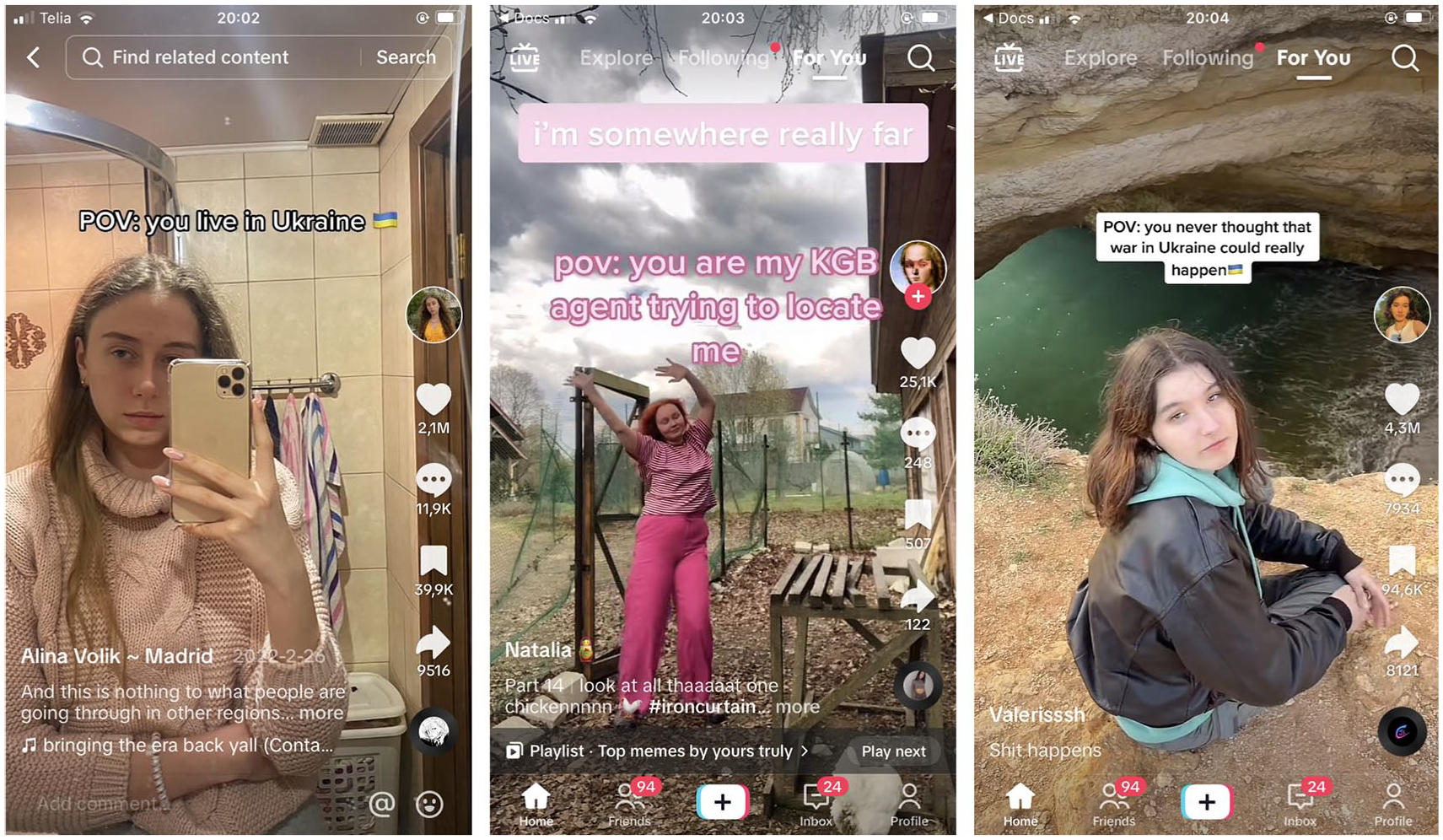
TikTok videos incorporating POV templates.
In another example, the Russian creator @ironcurtainlyf posted a video of herself dancing in the middle of a chicken coup, stating this to be the POV of a “kgb officer trying to locate me” (see Figure 1). Supposedly, this creator had at the time been able to flee Russia, due to her active content creation of political dissent on TikTok. Before this, she consistently shared anti-regime content and expressed her fears and anger since the war began in 2022. Her username, @ironcurtainlyf, alludes to her residing behind the “iron curtain,” cynically subtexting a reference to the Cold War-era boundary that separates Europe from the Soviet Union and its affiliated states. In her video, she aptly utilized TikTok’s popular culture of roleplaying, where creators employ their POV as a playful means of swapping roles, allowing her to effectively embody both her identity as an activist and the oppressive system personified by the Russian state. In the accompanying Russian music, she translated the song lyrics to convey, “I’m somewhere really far, in a dump / you can try and find me but you can’t,” alluding to the fact that she had to go undercover, risking being targeted by Russian surveillance on social media during times of war.
This POV roleplay example and numerous others unveil a multidimensional trajectory in creators’ selves as they employ embodied storytelling, self-exploration, and creative methods to articulate the narrative of both victims and perpetrators. In this form of embodied storytelling, creators forefront themselves through memetic performance, with the body, as Shilling (2016, p. 28) suggests, acting as a “multidimensional medium,” actively shaping their narrative of enduring cultural trauma. As such, creators employ their bodies as storytelling instruments within the framework of POV memetic templates to establish an accessible and relatable pathway for viewers to connect with the depicted trauma. Beyond the mere connection, performativity and embodiment presented through the POV converge at the core of memeification, where creators’ bodies become “both the medium of the meme and its message” (Shifman, 2012, p. 200).
In a video shared by the Ukrainian creator @valerisssh, she takes viewers on a reflective short journey back to the peaceful days before the war, creating a poignant contrast with the stark realities of war while showcasing the serene landscapes of picturesque Ukraine, all set to a slowed-down version of Kanye’s song “Bound 2.” Paired with a widely recognized POV template, based on the premise “you never thought . . . ,” she writes, “POV: you never thought war in Ukraine could really happen,” immersing the viewers in the captivating landscape, captured via images and joyful dancing, encapsulating a collective sense of disbelief (see Figure 1). However, the vibe shifts dramatically as her video abruptly transports viewers to the heart of post-airstrike devastation, where buildings lie in ruins. Against this backdrop, her body recoils and then steps forward, locking eyes with the viewer, conveying the swift transformation of reality, offering a perspective on the unimaginable upheaval within a fleeting moment while using her body to point to the ruins and immerse herself in this landscape.
In @valerisssh’s example and others, creators employ the POV as a memetic bodily practice, serving as an essential channel for peer-to-peer communication. Unlike traditional POVs that show a direct perspective from the creator’s eyes, TikTok’s POV offers viewers a perspective centered on the performing creator, seeing them as a whole. This approach creates a dialogic environment where the creator becomes the focal point of the viewer’s POV, fostering a deeper empathic understanding of trauma by allowing viewers to connect with the creator’s embodied experience and revealing “things you never thought . . . ” Crystallizing the inherent tension in playful trauma, creators unveil the unimaginable by juxtaposing the gravity of life and death scenes in Ukraine with a POV template typically employed and registered by creators in playful scenarios.
Finally, we support our argument for enhanced empathy through the use of POV templates, which have been identified on TikTok as playing key roles in fostering community and echoing users’ affiliations (Trillò, 2024), becoming vehicles for affective communication on trauma. In a Reuters interview published on 7 March 2022 (Dang & Culliford, 2022), @valerisssh conveyed that because of her videos, “40 million people have seen what it’s like to live in Ukraine and what we feel,” noting receiving hundreds of reaction videos (also known as “duets”) and an overwhelming amount of supportive comments in response to her content. This kind of engagement enabled a global audience to connect with her ongoing traumatic experiences, facilitated by the popular POV memetic templates that allowed the exposure of wartime conditions through a clever use of platform vernacular. Beyond mere global visibility, the use of POV templates, guided by creators’ playful bodily expressions, has the potential to become a multimodal witnessing text (Frosh, 2006), positioning viewers as witnesses to war crimes, fostering empathy, and empowering them to respond to these realities with their own agency.
Playful Dance of Trauma
The second practice through which we could identify a playful encounter between a local TikTok dialect and expressions of trauma involves the use of TikTok’s audio-meme dance challenges. Challenges on TikTok are in sync with the platform’s imitation ethos and are a favored means of expression for creators, adhering to its status as an “experimental audiovisual playground” (Klug, 2020, p. 6). Nevertheless, the sound is the linchpin of their virality, acknowledged as an “audio meme” being the fundamental template that shapes TikTok videos (Vizcaíno-Verdú & Abidin, 2022), carrying and crafting their narratives, particularly in times of war (Bösch & Divon, 2024). Here, we argue, the elements of dance and embodied creative expressions drive playfulness as a means for creators to experiment with and subvert orthodox cultural norms and discourses, including those related to trauma communication during the war.
Within our dataset, dance and sound served as common co-creative storytelling elements in creators’ videos. In a monumental video by @valerisssh that significantly shaped online communication about the Ukraine war, she depicted a poignant scene in her family’s bomb shelter (see Figure 2). She takes viewers on a guided tour interweaving moments of dancing and finger-snapping to the cheerful and celebratory traditional Sicilian tarantella, “Che La Luna”—a track frequently employed by TikTok creators to accentuate everyday experiences across different cultures and settings, such as “things that make sense in Jewish houses.” While this trend commonly highlights surreal or nonsensical scenarios, @valerisssh adapts it to depict the harsh realities of residing in a war-torn region. In her video, she navigates the various stages of her family’s adaptation to life in their bomb shelter, striving to preserve a semblance of pre-war normalcy amid the chaos of conflict.

TikTok videos incorporating dancing.
In this video, @valerisssh vividly portrays the lived experiences of adversity during wartime, intertwining sound and a sense of playfulness through her dancing and ironic observations (such as writing “ shower for cleaning ass ” when filming their shower facilities). The incorporation of @valerisssh’s family members snapping their fingers and dancing within this meme frames the role of the body in expressing playful trauma, opening painful experiences for play, subversiveness, and performative affect on TikTok (cf. Cervi & Divon, 2023). These playful embodiments (E. Gómez & Piera, 2010) of ongoing cultural trauma subject it to the spectacularization by viewers (Debord, 1967; Trezise, 2012), thereby accelerating exposure and resulting in the virality of wartime commentaries from affected populations on TikTok.
By adeptly directing both algorithmic and human attention toward the harsh realities of Ukrainian wartime and leveraging their platform’s literacies to embark upon TikTok’s visibility streams, creators such as @valerisssh, among others in our research, underwent a transformative shift. As outlined by Divon and Eriksson Krutrök (2023), they transitioned from ordinary users to war influencers, defining them as: users who inhabit a distinctive space on social media, located at the intersection of citizen journalism (Allan & Thorsen, 2009), voluntary witnessing (Klausen, 2015), microcelebrity activism (Tufekci, 2013), and online content creation (Brake, 2014). While war influencers produce content to “get attention and build social capital” (A. R. Gómez, 2019, p. 15), they do so with the intention of reporting, commentating on and amplifying audience knowledge and attention regarding the traumatic scenery of a war zone. (Divon & Eriksson Krutrök, 2023, p. 120)
As expressed previously by Vijay and Gekker (2021, p. 714), play, as performed on TikTok, “becomes a productive heuristic in unveiling how power insidiously enters banal social media practices and the implications they can have on the broader political setting.” In this manner, incorporating the body into dance challenges, a widely embraced playful practice, serves as a pivotal strategy for expanding audiences for political messages, as the platform’s algorithmic focus is organically drawn to this vernacular style (Kennedy, 2020). For instance, the creators we studied gained popularity with videos that combined dance and war trauma narratives, averaging 257,150 likes per dance video, significantly higher than the 2,974 likes average for non-dance videos. They creatively repurposed viral sound elements, incorporating them into their content as background music, lip-sync performances, or dance soundtracks to capitalize on the platform’s playful climate.
This creative approach encouraged creators to craft fresh contexts through platform techniques and fostered unique storytelling environments that evoked sentiments of belonging and solidarity (Vizcaíno-Verdú & Abidin, 2022), utilizing their own bodies as the expressive element of play. In one of the videos posted by creator @dzvnks, she filmed herself lip-syncing and dancing to the song Wild Thoughts by Dj Khaled ft. Rihanna & Bryson Tiller. In this video, she is shown engaging in a dance with a fellow Ukrainian friend, accompanied by a text that conveys the resilient spirit of Ukrainians amid adversity, “when you are both ukrainian and it’s hard to pull you” (see Figure 2). Alluding to the role of sarcasm and irony as a means of wartime playful resilience (cf. Obrdlik, 1942), this narrative portrays their steadfast pride amid the backdrop of war, brought to life through the lens of dancing to a TikTok trend. This way, dancing redefines video creation during the war, enabling creators to express their Ukrainian unity sentiments while blending with the platform’s vernacular of participatory immersion in popular culture trends (Boffone, 2021).
In a video by creator @alina__volik, she shares a throwback of herself dancing happily in a Ukrainian Christmas market before the start of the war. In short video clips, added together, she is shown dancing and running in the snow, laughing toward the camera, and hanging out with friends, under the caption: “Hope to see Kyiv this way again” (see Figure 2). The happy environment is juxtaposed by a memetic sound recorded at a concert of fans singing along to the song “Another Love” by Tom Odell. TikTok creators have often used this sound to show solidarity or sadness (e.g., after the passing of a loved one). Based on our dataset, during the war outbreak, this memetic audio emerged as a soundscape for expressing solidarity with Ukraine, capturing the experiences of Ukrainian soldiers, citizens seeking refuge abroad, and a global community rallying in support. This way, dance, supported by audio memes, communicates and symbolizes the profound sadness and hope experienced by many Ukrainians through a before-and-after narrative of wartime trauma, making cultural trauma more relatable, digestible, and attention-worthy.
Playful Dialog of Trauma
The third practice through which we could identify a playful encounter between a local TikTok dialect and expressions of trauma involved interactive communication paths between the creators and other users. On TikTok, user interaction is enhanced through various features, including comments section, duets, and stitches. Medina Serrano et al. (2020) underscored the capability of TikTok’s technical features to facilitate engagement within “communication trees” through the platform’s functions such as duet. This feature places creator video responses on the right side of the screen adjacent to the original content, allowing creators to react to others’ videos while maintaining the original posts’ integrity. Consequently, creators can respond, critique, endorse, or comment on the original content and facilitate a multidimensional dialogic framework that was found to possess peer-to-peer educational value (Ebbrecht-Hartmann & Divon, 2022).
In addition to the duets identified in our dataset, we also observed a widespread use of features such as “reply with video.” This feature allows creators to respond to a comment left on one of their previous videos, and create a new video in response, utilizing the selected comment as a departure point. For example, this feature emerged as a vital communal gateway for the transgender individuals on TikTok to illuminate, educate, and cultivate a safe space for sharing their experiences and challenges by addressing random users’ questions about trans life (Olivares García, 2022). Similarly, within the context of the Ukrainian war, we argue that the sociotechnical conditions of users’ interaction about their traumas are not only shaping, but shaped by platform structures and available affordances.
In utilizing the “reply with video” function, the playfulness found in creators’ responses emerged as a key dimension in their interactions. For instance, the creator @xenasolo often leveraged this feature to publicly address specific comments. She would read them out loud, laugh, and use hand and facial gestures to humorously mock commenters who criticized her or her political stance (see Figure 3). This feature was utilized to highlight comments from Russian users expressing pro-Putin sentiments, often presented in a tone that was both derogatory and lighthearted. In one instance, @xenasolo responded to a comment criticizing Ukraine’s NATO aspirations with laughter, reading it aloud in a Russian accent: “Your ridiculous desire to join NATO is what is stirring this. It’s pretty simple, stop discriminating against Russian-speaking Ukrainians, don’t join NATO.” Through this approach, embodiment and performativity serve as a subversive tactic, employed to playfully embody political dissent and counter opposing narratives amid the war.

Videos adopting the response to comments feature.
Following Obrdlik (1942), videos that mocked and derided the oppressor, specifically Russia, served a distinct sociological purpose by bolstering group cohesion and lifting spirits, as evidenced by many supportive comments in playful ways (“lol, you forgot to add madness to your tone”; “we hate Russia!”). By embodying provocations from Russian-speaking users in her comments section, @xenasolo adopts amateur yet creative techniques to mock and elevate her response, displaying silly citizenship (Hartley, 2010) behaviors within her humorous stance on the situation. The humor in these exchanges acts as a “cushioning glue” (Marone, 2015), building bonds of peer support and enhancing social cohesion in tumultuous times.
Another of the creators in our sample, 1 much like @xenasolo, harnessed the “reply with video” feature to create explanatory videos aimed at shedding light on the ongoing war in Ukraine. This was sparked by a comment trivializing the creator’s lifestyle in her host country, where she had begun to produce videos addressing challenges such as dating and apartment hunting in the city center while “the men in Ukraine are dying in the war” (see Figure 3). Seizing the chance to shed light on the realities of life in Ukraine, the creator employs a patronizing eye-roll and a skeptical attitude to expose the diverse roles in the current war. She spotlights various roles outside of direct combat, with a focus on the active involvement of women. Through her efforts, she aims to normalize the life of a refugee by revealing that her ostensibly ordinary content coexists with her ongoing concerns about the war.
@xenasolo’s portrayal evoked supportive comments from viewers, indicating a shared understanding and appreciation for her efforts to illuminate the realities of life in Ukraine. In addition, more gender curiosity was sparked, leading to follow-up questions and a deeper engagement with the content in the comments section. For instance, discussions emerged regarding the prohibition of men leaving Ukraine due to their obligations for service, and how women handle such challenges. Therefore, serving as another dimension of the platform’s structural amplification of voice, we argue that this feature provides diverse “forms and routes to participation” (Gee, 2005, p. 228) in TikTok’s space, establishing a triangular relationship wherein creators and viewers are encouraged to actively engage as commentators who become creators of a new agency.
Discussion: The Virality of Trauma
TikTok has evolved into a platform where creators communicate and perform their intimate and personal experiences (Kennedy, 2020), also during times of adversity. The platform’s robust audiovisual memetic grammar goes beyond the traditional coping norms, allowing creators to delve into subversive and performative explorations of trauma (Divon & Eriksson Krutrök, 2023; Vickery, 2020). In this context, our article shows how TikTok has transformed into an “experimental audiovisual playground” (Klug, 2020, p. 6) where creators navigate the complexities of trauma and societal upheaval, playing a crucial role in the communication, amplification, and dissemination of the sounds and images of warfare in playful ways.
Through our analysis of TikTok creators who experienced the invasion of Ukraine in 2022, we offer playful trauma as a framework to untangle the complex junction where platforms, bodies, and personal and collective adversities converge. We claim that the performance of playful trauma on TikTok is intricately woven into a structural dissonance stemming from the juxtaposition of the platform’s ludicrous approach to content creation with the expression of traumatic moments in creators’ everyday lives. This dissonance occurs when creators blend adversity with creative expressions that may appear counterintuitive yet align with the platform’s vernacular and the grassroots routes for gaining accelerated visibility. Thus, we argue that the creators’ literacies in performing trauma with the platform’s distinct linguistic style propels playful trauma into virality.
To delve deeper into how playful trauma manifests in creators’ embodied performances on TikTok, we introduced the concept of the playful platformed body. The platformed body is shaped by platform visibility regimes (Bucher, 2012), which influence how creators align with aesthetics, features, and trends that are considered platform-specific norms and expectations of content creation. On TikTok, the body-centric attention economy (Kennedy, 2020) makes creators inscribe their content with physical appearances, as their bodies are used as both the “conduit and the expression itself: a medium and a message” (Calkins, 2014, p. 2). Our analysis illuminates how the platformed body is inherently playful on TikTok, as the platform allows creators to directly build upon, riff off of, and iterate on each other’s physical performances, spawning evolving layers of in-jokes and references that serve as the unique lingua franca of TikTok’s digital communities.
In depicting trauma, the embodied playfulness of the platformed body reframes traumatic experiences in humorous or absurdist ways that are both unsettling and cathartic. This ironic embodied expression is carried through dance moves, smiles, laughter, facial expressions, eye rolls, and hand gestures, all of which contribute to a whimsical and light-hearted portrayal of cultural trauma on the platform. Creators’ bodies become a canvas for playfully imitating gestures, movements, and expressions in an inherently subversive way—re-contextualizing them via new embodied performances. This playful embodiment (E. Gómez & Piera, 2010) adds a visually striking, visceral dimension to war-related content, making playful trauma more tangible and accessible as it is constantly in mutation and meditation due to users’ harness of popular memetic templates for content creation. As they adhere to platform sociotechnical conditions (Van Dijck et al., 2018), users’ bodies expose cultural wounds through incongruous juxtapositions of playfulness with the everydayness of war realities, allowing for an epistemological turn in how we comprehend trauma on platforms.
Our analysis highlights three practices through which playful trauma emerged: First is the POV aesthetic, allowing creators to use their first-person perspective to blend their traumatic experiences with the common humorous, ironic, or subversive vernacular of this format. This practice enables viewers to witness, react to, circulate, and learn about war-related trauma from the creator’s everyday perspectives, cultivating a physical and emotional connection with the adversities (Divon & Ebbrecht-Hartmann, 2022b). Second, TikTok’s audio meme dance challenges, where creators employ dance as a creative outlet for storytelling to express and cope with trauma, subverting cultural norms surrounding conventional coping mechanisms with hardships. As the creators’ dancing bodies amid adverse settings emerge as a spectacle (Debord, 1967) on international “for you” pages, their playful bodily performances captivate both human and algorithmic attention by vividly enacting, embodying and magnifying trauma. This dynamic expression transforms their bodies into pivotal amplifiers of war zone communication on the platform. Third, TikTok’s “reply with video” feature playfully engages in a dialogue about trauma, employing body language, text, and discursive elements to address their experiences. These videos employ physical reactions to offensive comments or deliver humorous and ironic readings of such comments to captivate viewers and stimulate reflection and follow-up questions.
Against those findings, we argue that cultural trauma cannot only be seen as an outspoken societal and cultural condition, but also an embodied practice becoming entrenched in and enacted through the vernacular modes of expression circulating among online spaces and within digital collectives. While humor, parody, and satire online have been researched extensively (Buckingham, 2003; Highfield, 2016), our proposed concept of playful trauma offers a valuable framework for comprehending how online communities employ embodiment and playfulness as coping mechanisms within platforms that prioritize performance. With this framework, we follow Pinchevski’s (2019) claim that media has always constituted the material conditions for trauma to appear as “something that cannot be fully approached and yet somehow must be” (p. 3). So while this practice may appear frivolous to some, it is in fact a serious means of expression for many creators online, including those from LGBTQ+ and other marginalized communities, to document acts of injustice, bear witness to societal adversities, and mobilize audiences to address a wide range of political challenges and contexts.
While TikTok offers creators a platform to process and express their trauma through performative acts such as POV videos, dance routines, and feature-based dialogues, playful trauma risks, however, trivializing or aestheticizing the gravity of war zones. Also, the necessity of embodying trauma for visibility may lead to the exclusion of deeper emotional and psychological aspects that are not readily performable. This could shift the focus toward the more visible, dramatic aspects of trauma, overshadowing the subtler, intricate experiences. Consequently, it may lead to a superficial understanding of the trauma conveyed. We acknowledge that not fully unpacking this issue is a limitation of our study, but we are mindful of this potential criticism. Also, given the limited sample of TikTok creators included in this study, as well as the specific focus on war-related content within a single platform, rather than data collected from a variety of platforms (such as Instagram, Facebook, or others) where trauma may be expressed differently, we advocate for further research that includes a more diverse range of creators based on their backgrounds, political perspectives, as well as those with minor follower counts.
Footnotes
Declaration of Conflicting Interests
The author(s) declared no potential conflicts of interest with respect to the research, authorship, and/or publication of this article.
Funding
The author(s) disclosed receipt of the following financial support for the research, authorship, and/or publication of this article: Swedish Research Council (grant no. 2022-05414).
