




Abstract
This article explores how and why some online protests manage to gain digital resource abundance, that is, mobilising large numbers of people and attracting wide interest and support in a short space of time. The study focuses on the case of the Swedish Petrol Uprising 2.0 which after a few months managed to mobilise 630,000 members on Facebook. The article expands established theories on online mobilisation by stressing the structural elements of social media platforms and the shaping of online mobilisations through three types of factors: resources, discourses and social positions. By combining contemporary social media research with classic stage theory, we discern the significance of each factor in the three-stage mobilisation process, leading towards digital resource abundance. The article shows that digital resource abundance serves both as a blessing and a burden for online organisers. Paradoxically, social media platforms serve as a fertile ground for bringing ‘the many’ together yet also force successful groups to stay in a stage of constant mobilising.
Keywords
Introduction
Digital technologies and social media platforms have opened up opportunities for actors to mobilise members and followers, yet whereas most online movements struggle to mobilise people at all, we find that a small set of organisers quickly grow and manage to bring together hundreds of thousands or even millions of supporters. Although online mobilisation now constitutes a mature research field, few studies have explored how and why certain mobilisations manage to get through the noise on social media platforms and bring together large numbers. We find studies that stress how social media algorithms affects collective action (see e.g. Etter and Brindusa Albu, 2021), the role of social media teams in mobilising people and managing online movements (see e.g. Poell et al., 2016; Gerbaudo, 2017) and gaining professional news media coverage to get public attention (see e.g. Chadwick and Dennis, 2017), yet rarely addressing several different factors that contributes to successful online mobilisation.
The purpose of this article is to analyse how and why some online protests manage to mobilise such large numbers and gain what we refer to as ‘digital resource abundance’ (see also Johansson and Scaramuzzino, 2022). The term refers to the rare cases when online protests, almost as if by accident, manage to attract wide public attention and bring together large numbers of followers in a short space of time. Digital resource abundance can be very large quantity of followers, likes or re-posts which online protests can use and transform into advocacy tools to gain recognition, influence and to achieve social and/or political change. Although recent research has explored how online mobilisation takes place, few studies have investigated digital resource abundance as such (see however, Johansson and Scaramuzzino, 2022). Scholars (e.g. Shultziner and Goldberg, 2018) have used the concept of mass mobilisation, but we argue that digital resource abundance adds a different dimension, as it points to the ambiguous position of gaining large numbers of followers in a short space of time, potentially forming a blessing and a burden for online movements and organisers.
The article explores a structural analytical approach to online mobilisation, and we argue that social media platforms set conditions for online mobilisation through three structuring factors: resources, discourses and social positions. The article combines contemporary social media research with classic stage theory from social movement theory (e.g. McAdam et al., 2001; Tarrow, 1998) to discern the significance of each of these factors, and the interplay between them across stages of online mobilisation. By approaching mobilisation as a process with distinctive stages, we can empirically identify and conceptually clarify the factors at play at different stages, and their changing significance for online organisers to gain digital resource abundance (see Shultziner and Goldberg, 2018 for a recent revival of the stage approach).
The article analyses a strategic case of online mobilisation, the Petrol Uprising 2.0 (Bensinupproret 2.0) in Sweden, which started as a Facebook group protesting against increased petrol prices and taxes. In a few weeks, the group had amassed 630,000 members on Facebook. At the time, it had become by far the fastest-growing online mobilisation ever, its membership exceeding that of national political parties and most trade unions in Sweden. It hence shows resemblance with other well-known large protests, for example, ‘the yellow vests’ (cf. see Clifton and De la Broise, 2020; Guerra et al., 2020; Shultziner and Kornblit, 2020), and ‘the Occupy Movement’ (Shultziner and Kornblit, 2020). Studies of such movements have shown the significance of mobilising frames for mobilising large protests; our focus, however, lies in analysing the significance of social media as a technological structure for understanding large online mass mobilisations.
A structural approach to online mobilisation
The following section develops a framework encouraging scholars to think structurally on social media and online mobilisation. We draw on previous research on online mobilisation and distinguish three ways by which social media platforms set conditions for actors and their actions with regard to available resources, discourses and social positions. While previous research has tended to either focus on just one of these or failed to make a clear analytical distinction between them, our framework suggests studying them in combination.
Social media as technological structures
Mediatisation theory (e.g. Couldry and Hepp 2017) stresses the deep embeddedness of media into societal structure and social media as inseparable of social life. In their simplest forms, social media are software, developed by software engineers and in more complex forms products run by global companies with far-reaching influence on citizens and governments in most countries. Social media are technological structures which, to a certain extent, set the terms for how actors mobilise and act on and outside media platforms. Dolata (2017:15) argues that social media have a structural and behavioural impact as ‘the action-structuring and regulating features of technology are not simply there coincidentally but are instead deliberately designed and implemented by their manufacturers, who thereby have regulatory power’. Social media platforms are, however, not fixed and have changed significantly over time, for example, when it comes to algorithms used and privacy settings (Walker et al., 2019).
Exploring social media from a structural approach does not imply taking a ‘techno-deterministic’ view of social media platforms, as it involves an interplay between users and technological structures (cf. Barassi, 2015). This means that the former can affect the latter, as a kind of feedback effect between actors and structures, illustrated in users demanding that the companies that own Facebook and Twitter take more responsibility regarding ‘fake news’ or privacy settings (cf. Walker et al., 2019). Some even consider social media platforms as having a degree of agency, as such, and have sometimes been referred to as ‘actors’ (Milan, 2015:3) to counteract the myth of technological alleged neutrality. This could be reflected in current debates on social media platforms’ exercise of censorship and surveillance (Leistert, 2015; cf. also Kazansky and Milan, 2021). Nonetheless, online activists are often unaware of how current social media algorithms operate, meaning that they are ‘left in the dark’ (Etter and Brindusa Albu, 2021:70; cf. also Bucher, 2017 for other groups) regarding how technological structures shape actions and how they can best be used.
Shaping resources
Social media platforms constitute one of the most prominent sources of resource mobilisation for activists, NGOs and social movement organisations. Group members, followers, likes and re-tweets have all become key assets for online mobilisers as they seek to bring people together for their cause and to influence politicians and societal development (Johansson and Scaramuzzino, 2019). Classic accounts of resource mobilisation have seen resources as being scarce and difficult to mobilise (McCarthy and Zald, 2001; McAdam et al., 2001). Yet social media have great potential for bringing large numbers together, as they lower the transaction costs for mobilising and organising in terms of time, effort, attention and money (Shirky, 2008). Social media therefore bring more opportunities for actors to mobilise large numbers (Baxmann et al., 2016; Bennett and Segerberg, 2013; Karpf, 2012; Tufekci, 2017), as group members and followers can be aggregated on a greater scale (Tremayne, 2014).
The ‘low-threshold argument’ however has limitations. Social media platforms certainly offer extensive opportunities for actors to mobilise at large scale, yet it goes without saying that not ‘all’ manage to mobilise large numbers. Members and followers are just not out there, but need to be allocated, produced or aggregated, and there is fierce competition over members and followers. In some situations, the costs for mobilising online might be low, while in other situations the costs are high (Treré and Mattoni, 2016; Vaccari et al., 2015). Although the low threshold argument is valid still, we need additional tools to capture digital resource abundance.
Shaping discourses
Social media directly and indirectly shape what issues are being put forward as algorithms, at least partially, determine what information will be visible to users (Boulianne et al., 2020; Diana, 2016; Kitchens et al., 2020; Pariser, 2012). Online mobilisations have to respond to social media platforms as media systems that create opportunities and/or constraints regarding particular topics, agendas and discourses (cf. Karpf, 2017). If politicians are rightfully seen as the rule-makers of political institutions, programmers and software engineers have a say about what is at the top of the social media agenda (Smit et al., 2018).
Social media such as Facebook, Twitter and Instagram can therefore be described as ‘techno-discursive spaces’, as they constitute key platforms for the current formation of agendas, ideas and frames that movements aim to pursue. Discourse formation on social media however runs fast as ‘there is a need for constant updates and new materials’ (Kaun, 2017:471). Acceleration points to the opportunity for social media to offer ‘direct delivery’, which can be used by online organisers to reach wide audiences with their message. Characterised by social media’s urge for constant ‘newness’, online discourses are hence in the making driven by constant quest for attention among mobilisers (Chadwick and Dennis, 2017; Guo and Saxton, 2020; Webster, 2014; Johansson and Scaramuzzino, 2019, 2022). Poell (2020) proposes the notion of ‘multiple temporalities’ as platforms steer activists towards rapid content formation and protest communication, making them act in a desynchronised way with politics and political decision-making (Kaun, 2017).
Mobilisation around a ‘single issue’ (Vraga et al., 2015:203), become ‘anti-ideological’ (Johansson and Scaramuzzino, 2022), or act as ‘issue generalists’ (Karpf, 2012:5) are strategies to reach the widest audience and potentially gain digital resource abundance. Online discourse formation moreover tend to promote (and demand) individualised and personalised expressions of ideas and frames (Bennett and Segerberg, 2013; Dey, 2020; Jenzen et al., 2021). Through the creation of a hashtag, a large protest can start (Gjerald and Eslen-Ziya, 2022). An individual message/hashtag can bridge the divide between individual action and dominant discourses as ‘… a hashtag’s narrative logic – its ability to produce and connect individual stories – fuels its political growth’ (Clark, 2016:789). In these processes, social media platforms such as Twitter, can go ‘from being polarising to unifying’, and emotions play an important role in the development of the movement (Gjerald and Eslen-Ziya, 2022:17).
Digital resource abundance relates to online mobilisers getting through the noise. Although ‘everyone’ has the opportunity to ‘speak’, ‘surprisingly few can be heard’ (Karpf, 2012:2). The concepts of ‘echo chambers’ and ‘filter bubbles’ are illustrations thereof. While large numbers might be a blessing and increase the ability to be heard, they could equally hamper the ability to form powerful messages and rapid action due to the wide range of internal voices.
Shaping social positions
Social media as technological structures also shape social positions and the social organisation of actors and agency (cf. Dijck and Poell, 2013) as social media saturate social domains, in and outside platforms (Hepp, 2020). Inside platforms, online mobilisers have to adjust to a set of predesigned platform scripts, roles and positions that create a social order that is hard to change. These social positions are inherited in the technological architecture and provide a degree of stability. Although social media platforms might be considered as ‘opaque’ and ‘imperceptible’, they nonetheless entail an element of a platform script, with ‘rules for social interactions’ (Milan, 2015:3) and promotion of particular forms of social agency (over others). While the notion of media acceleration indicated competition over audience attention through ‘digital immediacy’ (Kaun, 2017), the notion of social acceleration indicates that online social life is lived at a high speed and shaped by what Rosa (2013) refers to as the ‘compression of the present’ and ‘compression of social action’.
Studies of online mobilisation indicate two major forms of social organisation. On the one hand social media platforms tend to foster horizontal, leaderless and peer-production networks (Bennett and Segerberg, 2013; Boler et al., 2014). Network-based forms of organising, however, come with challenges, and many online mobilisations tend to falter because they fail to build lasting structures, and procedures for decision-making (Tufekci, 2017; Ozduzen and McGarry, 2020). Both ‘non-digitally native’ and ‘digitally native’ advocacy organisations often consider it challenging to develop long-lasting structures for advocacy work (Schmitz et al., 2020).
On the other hand, current studies question the understanding of online mobilisation as leaderless and rather find hierachisation of roles due to mass mobilisations. Notions like social media teams acting as ‘digital vanguards’ (Gerbaudo, 2017), core users functioning as ‘connective leaders’ (Poell et al., 2016), online organisers acting as ‘digital choreographers’ (Ozgul, 2019) and ‘power accounts’ (Gerbaudo, 2017) driving online mobilisation, illustrate the link between large numbers of followers and some actors being more central than others. While this points to two modes of online social organising, the latter is potentially the result of, or even contributing to digital resource abundance, yet each shaped by the rapid pace of social interaction and social organising on social media platforms.
Towards an analytical framework
Social media platforms set a series of structural conditions for online organisers which operate through shaping resources, discourses and social positions. We suggest that social media platforms shape the situation which agents find themselves in and that ‘some courses of action would be impeded and discouraged, while others would be facilitated and encouraged’ (Archer, 2010:277). Social media platforms hence embed enabling and constraining factors which ‘obstructs or aids the achievement of some specific agential enterprise as subjectively defined’ (Archer, 2010: 278). Online mobilisers in this respect hold a degree of agency, here distinguished between habitual (following rules) or reflexive (acting upon given rules) agency (Archer, 2010) to fulfil their interest under given circumstances. Actors have however varying capacities based on previous knowledge and/or experience on online mobilisation and social media algorithms.
This approach invites to a process perspective to online mobilisation. Social movement studies have long spoken in terms of ‘waves’, ‘stages’ and ‘cycles’ to conceptualise the changing phases of mobilisation (e.g. Tarrow, 1998). Although the idea of phases was abandoned, we follow Shultziner and Goldberg (2018), who argue each phase has its unique factors and mechanisms. As shown, social media platforms enforce a compressed temporality to stages of online mobilisation, as they encourage ‘immediacy’ instead of ‘endurance’ through media and social acceleration (Kaun and Stiernstedt, 2014; Kaun, 2017; Poell, 2020). This immediacy can be both beneficial and a challenge for online protesters: they can share information to a vast number of people in a heartbeat, but the rapid speed allows limited time for reflection (Barassi, 2015), keeping up with speed tends to be time-consuming (cf. Karpf, 2017) and requires online mobilisers to work on multiple temporalities (Poell, 2020) that social media requires.
Methods
This paper examines the development of an online mobilisation using a single case study to address our research questions (Easton, 2010). We selected the Petrol Uprising 2.0 in Sweden as a ‘strategic case’ as it managed to gain high numbers of members in short time. We became aware of the group at an early stage and began to observe its activity on at Facebook, from 10 April 2019 and observed its development during the first year. The Petrol Uprising 2.0 used Facebook as their main platform. Due to the amplified group numbers, we expect it to serve as an effective illustration of the structural properties of social media platforms.
Instead of comparing multiple cases, we chose to study within-case differences in order to identify phases and factors that might have relevance for other similar cases. Following case study method, we have used different data sources to provide a comprehensive analysis of the case. This includes two interviews with a key organiser of the group (August 2019 and October 2019), addressing how the uprising started, its development, and key activities with regard to the coordination of ‘netroots’ and ‘grassroots’. These lasted for approximately one hour and were transcribed verbatim. Interview quotes have been translated and anonymised. We have moreover conducted observations of the Facebook group and its development. We observed the number of group members, administrators, moderators, posts and likes, as well as the communication and interactions taking place on the Facebook page. All quotes have been translated from Swedish into English, and this procedure also helps to avoid direct personal identification. Although we provide date for all quoted posts, they are still hard to identify due to the vast number of posts. In addition, we made observations at a street protest organised by the group (Stockholm, 20 September 2019), where we took pictures of placards bearing the group’s slogans and also took the opportunity to put questions to some of the participants. We have moreover used the database Media Archive 1 (Mediearkivet) to conduct a study of the media coverage (Vliegenthart, 2014) of the Petrol Uprising 2.0. The search was conducted using different versions of the term ‘Bensinupproret’ (Petrol uprising) and spanned the period from 2000 to 2020 in order to capture media exposure over time. We analysed headlines and preambles of news reports to grasp what the news was about, particularly for the year 2019. By combining material produced by the group (e.g. Facebook posts) and on the group (e.g. media coverage) allows a thick case description to advance knowledge on process and factors.
Following our analytical framework, we undertook an initial sorting of the material and identified three phases of the online mobilisation: (1) a period of initiation, (2) the rise to abundance, and (3) after the peak – managing abundance, which largely coincides with other theorising on this matter (e.g. Shultziner and Goldberg, 2018). Our identification of phases correlates with the number of group members, but is also informed by interview material. Each phase has been subject to further thematic analysis (cf. Nowell et al., 2017) linked to our analytical framework of the three factors of shaping online mobilisation.
Results
A period of initiation
The period before the Petrol Uprising 2.0 started had been turbulent. Several changes in public opinion and political events seem to have provided a favourable context for the Petrol Uprising 2.0. Sweden held a general election in September 2018 (Oleskog Tryggvason, 2018), which was followed by protracted difficulties forming a government due to changes in the parliament. The Sweden Democrats, a right-wing political party with a nationalist, conservative and anti-migration agenda, advanced and challenged established parties. It was successful in gaining votes, especially from those living in rural areas, and particularly adept at using social media to engage supporters (cf. Kalsnes, 2019). The 2018 election was largely shaped by two key questions: migration and climate change/sustainability. In August 2018, just a month before the election, Sweden had served as the setting for the Fridays for Future movement after 15-year-old Greta Thunberg started her school strikes against a lack of government action on climate change (Emilsson et al., 2020). In spring 2019 (26 May), Sweden also held elections to the European Parliament, which brought an additional dimension to public debates. Most likely, general debates on climate change also fostered interest and support for issues linked to tax on fuel and gas.
Within this context, the Petrol Uprising 2.0 entered the scene on 10 April 2019, when one person decided to set up a Facebook page to protest against high petrol prices and the government’s decision (now led by the Social Democratic and Green parties in coalition) to, once again, raise the tax on petrol. Its start hence shared resemblance with the start of the yellow vests in France, as an online reaction against fuel tax (e.g. Shultziner and Kornblit, 2020). Similarly, a single individual took the first step, rather than an established network or organisation, yet the initiative certainly built upon broader grievances and public resentment against perceived injustices. In other words, it was easy for the founder to set up a Facebook page and to use the available technological structures to initiate the uprising. There had already been protests against the tax, price and regulation of fuel in Sweden in the form of the Petrol Uprising (Bensinupproret), which had also gained wide support. Hence, there were already ‘digital traces’ that the Petrol Uprising 2.0 benefitted from (Ozduzen and McGarry, 2020). These digital traces can be considered as a structural and technological enabler for the Petrol Uprising 2.0 in another sense as well. Social media companies often use ‘group recommendation algorithms’ to give personalised recommendations to the users in order to help the users to discover new groups. These recommendations are based on the users’ previous behaviour records and preferences (cf. Junjie et al., 2021), why this type of algorithms potentially could allow for a faster promotion of the Petrol Uprising 2.0. There were already people to suggest the group to.
However, the overall purpose of the Petrol Uprising 2.0 was not decided but rather negotiated on the Facebook page. We find elements of a classic populist frame of being against the establishment, and our interviewee explained that the group’s members were disappointed with both Swedish politics and Swedish politicians: This is really what our group is trying to build on: mutual respect for the individual, and it is this respect that we feel does not exist at all among those who are in government today. The first and most important thing is, as stated in the constitution, that the “power belongs to the people”. If they (the politicians) are elected by people, then they should represent the people and not their own interests. This is what made me engage in this (uprising) from the very beginning: the dissatisfaction with how the last election played out and how a small minority party (the Social Democrats) suddenly took a shameful grip on the entire country (interviewee).
While the Petrol Uprising 2.0 was created to protest against extortionate fuel prices and taxes, it also connected with broader concerns about who actually represented the people. Similar to, for instance, the French yellow vests, the Petrol Uprising 2.0 also had a populist dimension in its rhetoric from the start, emphasising that its members were the ‘ordinary people’ against the ‘elite’ (Guerra et al., 2020).
Rise to digital resource abundance
From its humble beginnings, the group quickly entered a stage of rapid and massive growth in followers and members. Initially unknown to the wider public and unrecognised in the media, it soon became an actor in public and political debates. Like most Facebook groups, it developed slowly at the start, with a gradual rise in group members. However, after a couple of weeks, it had managed to attract 3000 members, and after this point, the numbers skyrocketed. By the start of May, the Petrol Uprising 2.0 had reached almost 100,000 group members on Facebook. Our interviewee explained: ‘We managed to reach up to 120,000. Then it exploded and (group members) just poured in’. The group grew from approximately 100,000 members on 5 May to 350,000 four days later. Gaining more members appeared to be a key objective for the organisers. In a video posted on Facebook on 11 May, one of the organisers said: ‘I wish everyone an enjoyable weekend and just keep on adding people, you know, the more we are, the stronger we are’ (Facebook, 11 May 2019). Two days later, one of the organisers stated excitedly that: In a couple of days, this group has got 400,000 members. I think this is the beginning of a major change in society. Our political elite will get it real though. There is one before and one after (the Petrol Uprising 2.0), and this (the increase in fuel prices) has added that last drop that overflowed the beaker. We are not the government’s dairy cows, nor are we idiots (Facebook, 13 May 2019).
Two days later, the Petrol Uprising 2.0 wrote in a post: ‘Half a million. Together we are strong’ (Facebook, 15 May 2019), and four days after that: ‘600,000’ (Facebook, 19 May 2019). All in all, the group had grown from one to more than 600,000 members in just less than one month. According to our calculations, the numbers peaked just after this point, with an estimated 664,955 members (Facebook, 10 June 2019). Because of its size, the Facebook group quickly turned to what Gerbaudo (2017:189) refers to as a ‘power account’.
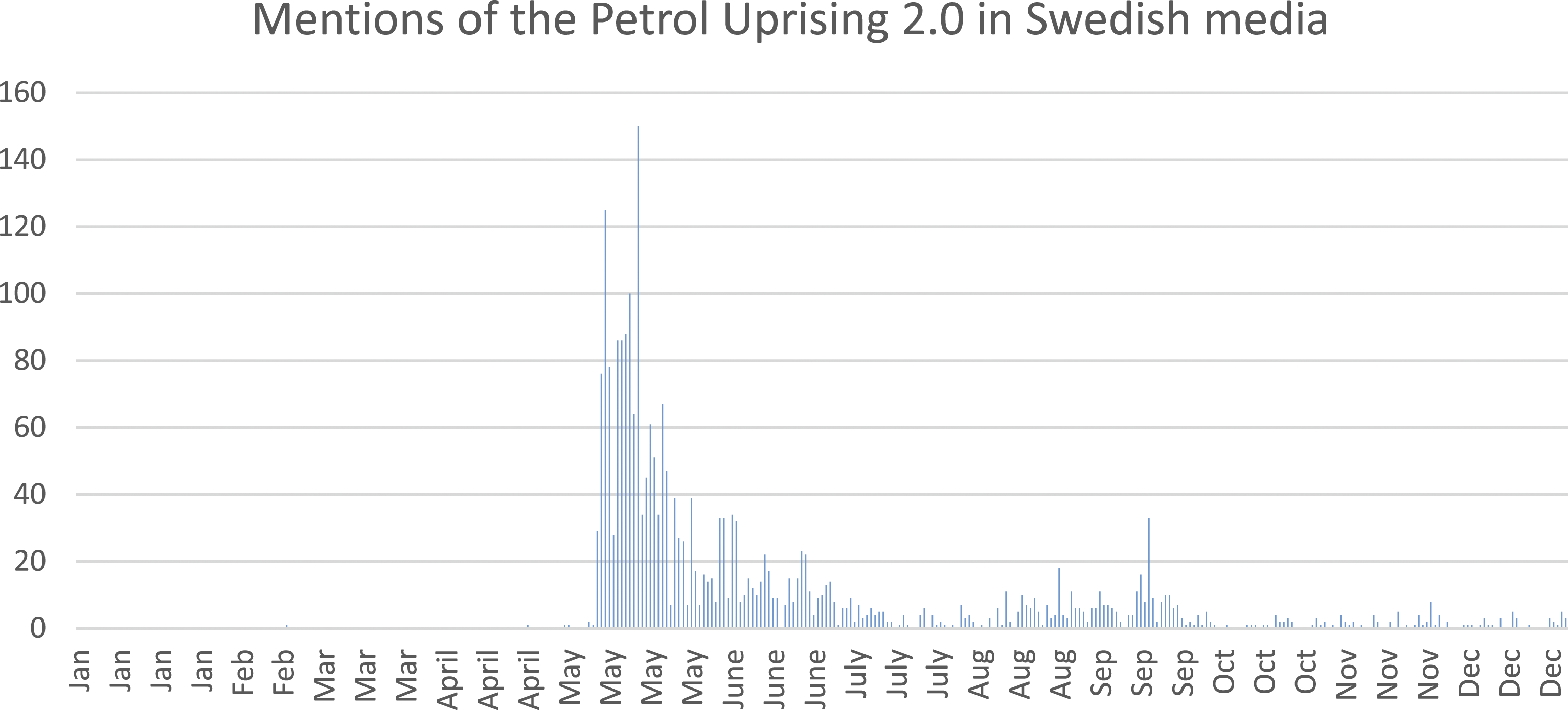
Studies of the 38° online movement in the UK, for instance, showed a strong connection between politicians, media and a rapid rise of online followers (e.g. Chadwick and Dennis, 2017). This also seems to be relevant for our case, as the group gained considerable recognition from key politicians. Some started to run campaigns in line with the main message of the group. For example, the Christian Democrats, the Conservative Party and the Sweden Democrats all advertised for the Petrol Uprising 2.0 on their Facebook pages. The leader of the Sweden Democrats also posted a video on Facebook on 9 May in which he stood in front of a gas station and explained that he supported the movement. On 23 May, representatives of the group were invited to the Swedish parliament, only a few weeks after it had started. The group also received extensive media coverage in all major newspapers and was mentioned 2476 times during 2019. Media reporting peaked mid-May 2019, only weeks after the Petrol Uprising 2.0 had been formed on social media, with 150 articles on average (print and online) being published about the group on a daily basis (see Figure 1). Its representatives were also invited onto morning television shows.
The massive growth of members, posts and media exposure required considerable resource management on the part of the organisers. The group’s founder decided to opt out as leader and head administrator and handed over the position to another administrator who had substantial experience of running Facebook pages. Similar to several recent studies, this online mobilisation was not leaderless (Poell et al., 2016; Gerbaudo, 2017; Ozgul, 2019).
While the group’s chief aim was to bring down fuel prices, its leaders carefully sought to balance left-wing and right-wing sympathisers in its membership base in order to attract as many supporters as possible. This was stated on its Facebook page: ‘We are here for one reason, and it is to bring down the prices. It is important to stick together and bring down the prices regardless of where you live’ (Facebook, 10 May 2019). The group also sought to bridge the rural/urban divide among members, as well as trying to discourage discussion of anti-migration issues. A recurrent strategy was to contain its more radical elements, as actions (and views) that veered towards the extreme were considered ‘unsmart’ as they could risk the group’s credibility and the public’s support.
However, it proved difficult for the organisers to balance internal fractions and create an ‘anti-ideological space’ (see also Johansson and Scaramuzzino, 2022). The group’s members were active, almost too active to handle. For example, on a discussion thread about what the fuel price should be, based on our observations, about 8500 group members answered the question in less than 14 h. The group, it seemed, was ‘growing far too fast for (its) own good’ (interviewee).
Because of the ‘digital immediacy’ (Kaun, 2017:478) the Facebook page became chaotic, characterised by an overload of information, double postings and unclear procedures for interaction and membership. Many group members started to complain that it was difficult to find relevant information on the page. The moderators had to close the post function at times because of the influx of new posts. As a case in point, in the midst of the rapid increase in members, one of the administrators stated in a post: ‘We are doing all we can to keep up’ (Facebook, 8 May 2019). In only a few hours, the post received 140,000 likes. All in all, the rise in group numbers, and all the activity that came with it, put pressure on the organisers.
… when it exploded, then it was [dealing with the Facebook page] from 7 in the morning to 12 or 1 at night, sleep for a few hours and then up again and continue. At the most stressful time, with posts and comments, in 30 days we had 4.1 million posts and comments (interviewee).
In the interviewee’s understanding, one explanation for the rapid rise in numbers would be that Facebook had made a series of changes in its algorithms that allowed for such explosive growth (cf. also Walker et al., 2019 on algorithms). The interviewee recalled that Mark Zuckerberg, the co-founder and chairman of Facebook, declared in a public speech at the time that the Petrol Uprising 2.0 had become the fastest-growing Facebook group ever: ‘We were recognised as the fastest-growing Facebook group ever, on a worldwide basis, not only in Sweden but throughout the world’ (interviewee).
Our interviewee certainly felt proud to be recognised by the co-founder of Facebook, but also contested the theory, held by Zuckerberg, that the group’s growth was the result of changes in the platform’s technological structure, rather than the group’s own strategic actions. The interviewee contended that if the growth had indeed been merely a result of changes in Facebook’s algorithms, ‘then we would have (seen) many (other) groups that had grown to our size’. In this discussion, the interplay between users and technological structures became visible (Barassi, 2015). However, this recognition spurred even more interest in the group. Independently of whether it was the algorithms or the strategic actions of the uprising that spurred the increase, or a combination, it is clear that from being merely a protest against fuel prices, it had become a phenomenon of digital resource abundance.
After the peak – managing digital resource abundance
The high numbers of group members put pressure on the organisers to adapt, develop rules and procedures, and manage the temporal dimension of online mobilisation. The development of the Petrol Uprising 2.0 then followed two interrelated trajectories: trying to slow down the pace through building more lasting structures for the group and working on a day-to-day basis to keep the ‘masses’ interested.
The period of rapid growth left limited time for reflection, as administrators and moderators mainly tried to keep their heads above water: ‘… [in] the first weeks, when it completely exploded, then there was only time to react and not to act. It was only reaction, after reaction, after reaction that you could learn from’ (interviewee). Such practice of ‘adhocracy’, also noted by Tufekci (2017), is common in online mobilisations, yet certainly intensified in cases of rapid growth and large numbers. After just a few days in operation, the Facebook group had 27 administrators and moderators (Facebook, 13 May 2019). They acted as ‘digital vanguards’ (Gerbaudo, 2017), together with the group chief who was the ‘charismatic leader’. One year later, it still had about 25 people who volunteered for these positions (Facebook, 1 April 2020).
Most of the time was spent on managing posts. In a video posted on Facebook on 11 May 2019, one of the organisers said: We have to remove comments, we have to remove posts. Many people do not like when we remove their opinions. We have to do that, to be politically correct and because we have come this far, we do not want everything to go straight to hell, so to speak (Facebook, 11 May 2019).
Due to the group’s size and public recognition, the practice of moderating became even more relevant, and its scale demanded more procedures and formal practices. ‘[We] have a rule, for example, that we in the steering committee are the ones who accept posts. All posts that come in must be approved, just so we can balance the temperature of the discussion’ (interviewee). The administrators also had to watch out for social media trolls. These forms of social agency and related activities were much in line with the opportunities for being active on social media platforms like Facebook, as the roles, routines and ways of interaction are limited.
Driven – or perhaps tempted – by the high numbers, organisers tried to transform the Petrol Uprising 2.0 into a formal association, as a spin-off from the Facebook group. This could be interpreted as an attempt to slow down the pace of online mobilisation, as well as securing online members to become offline (paying) members. The move also sought to counter criticism of the group as being merely an online phenomenon and accusations of using fake accounts. We have done this partly for financial reasons, so that we can carry this to a higher level, and for us to be a little more, let us say, real. The Swedish finance minister said at an early stage that we were just lots of fake accounts on Facebook (interviewee).
However, it soon turned out that the low thresholds that allowed for digital resource abundance in terms of large numbers of Facebook group members were no guarantee of similar interest and support outside of social media platforms. Unlike many other key large protest movements across Europe, the Petrol Uprising 2.0 did not manage to turn into a proper movement in terms of arranging massive street protests, as its main event only attracted some hundreds of participants (Observation notes from street protest in Stockholm). One month after starting the formal association (21 June 2019), the group had about 5000 paying members. Responding to the gap between the online and offline numbers, our interviewee expressed that: Most people think, 5,000 is not even a hundredth of how many you are on Facebook. That is their first thought. But if you think of an association that starts and in less than a month has attracted 5,000 people, then I think it is very strong (interviewee).
However, the wide gap between online and offline members and supporters remains, and after one year, the association still has between 5000 and 6000 paying members (website, 19 January 2020), and it has not managed to engage in classic street protests.
In addition, the situation of digital resource abundance forced administrators and moderators into a condition of constant reinvigoration. Poell (2020:615, 618) argues that social media are characterised by a ‘multiplicity of temporalities’. Online mobilisers therefore have to develop ‘alternative temporalities’ in relation both to medias ‘24-hour news circle’ and to the temporalities of digital platform that they use. In this case, the algorithmic rules of Facebook expected the organisers to be constantly active, and their large membership base required substantial amounts of posts to keep them interested. In previous research, this has also been described as the ‘Phoenix syndrome’, as digital resources tend to push organisers to ‘constantly “feed the bird”’ (Johansson and Scaramuzzino, 2022:2593). The interviewee described it in a similar way as having to ‘feed the beast’, referring to the massive number of group members eager to be engaged and to debate. Although the large size of the group certainly was an advantage in terms of access to key decision makers and media publicity, it created a set of constraints and conditions: ‘We have to find new avenues at all times to maintain interest and that is not always the easiest (…) Yes, we find new ways. That is the only option’ (interviewee). Platforms such as Facebook are not only characterised by digital immediacy, but also on a demand for constant newness (see also Kaun, 2017). In fact, when media coverage fades, online protests tend to be even more dependent on the attention, and in this process the protests become more likely to fail and falter (Chadwick and Dennis, 2017).
The organisers’ activities were reduced to day-to-day mobilising efforts to keep the group members interested by publishing both the right ‘quantity’ (volume) and ‘quality’ (relevant) of posts (Gerbaudo, 2017:193). Unless the organisers managed to publish a constant flow of relevant posts and successfully moderate the discussions within the group, the statistics immediately dropped: We have between 300,000 and 400,000 people who are on the Facebook page on a daily basis and read our posts. It has been constant. We have had a few drops to maybe 250,000. It has depended on, how can I put it? Let us call it low values on our posts, (where) they have not been informative enough and people have only made negative comments. But when we have published informative posts and managed to create good discussion forums, people have been back immediately (interviewee).
This suggests that the development of the uprising was almost circular, as it entered into the ‘Facebook loop’ of constantly having to renew itself. However, despite management challenges, lost interest from politicians and limited media recognition, the Petrol Uprising 2.0 did not lose many group members on Facebook. Membership has rather remained stable (albeit with some small losses): ‘We have lost about 7% of our total group members and I think this is an acceptable figure’ (interviewee). Almost one year after the group was formed, it still had almost 600,000 members, according to the Facebook page (1 April 2020). Mentions of the Petrol Uprising 2.0 in Swedish media.
2
Conclusion
This article finds the interconnected shaping of resources, discourses and social positions in the process leading to digital abundance. They however have a differentiated impact across the three phases and change from enabling to structurally constraining factors (see Figure 2), followed by the change from reflexive to habitual practices. Factors across stages.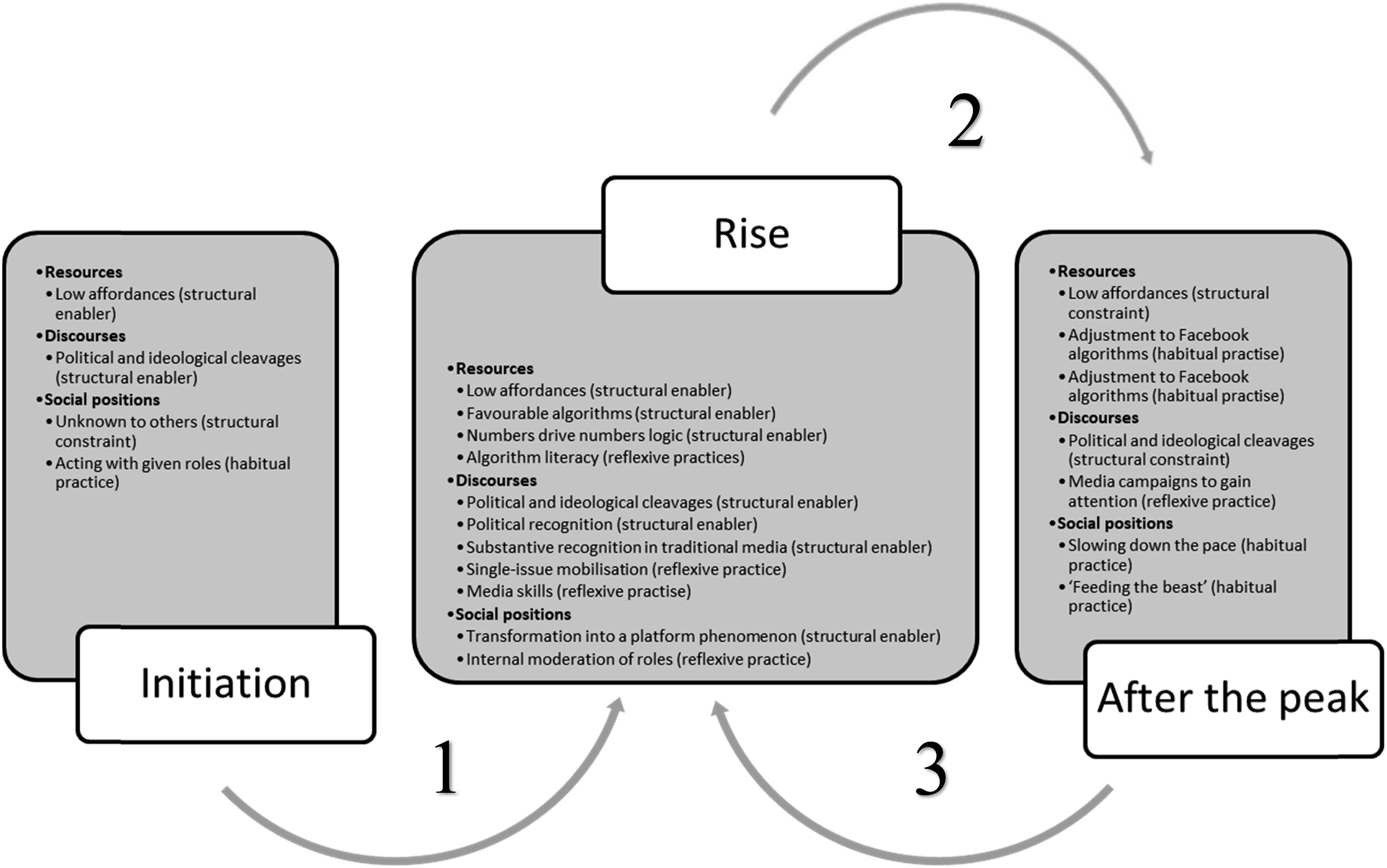
Resource related factors and above all low affordances constitute a basic rule for online mobilisers and has relevance across all stages, yet the step from a phase of ‘initiation’ to the phase of ‘rise to abundance’ to greater degree relate to discourse and social position related factors. Similar to arguments within mediatisation theory (e.g. Couldry and Hepp, 2017), we find that the Petrol Uprising 2.0 benefitted from close connection to political debates and media coverage. Like other major movements (e.g. like the Yellow vests, Guerra et al., 2020), the Uprising 2.0 mobilised upon a populist frame of being for the ‘ordinary people’ against the ‘elite’ and benefitted from a favourable political climate linked to ideological cleavages, strong rifts among the public, and an upcoming European election. Supportive statements from key politicians had significance as they opened up a wider pool of potential group members and brought extensive media recognition. While resource related factors like low affordances hence had significance during the phase of initiation, other resource related factors like the members-adding-members function had even greater importance for the phase ‘rise to abundance’. A particular social media logic of ‘numbers driving numbers’, moreover transformed the Petrol Uprising 2.0 from an ordinary Facebook group into a widely debated social media phenomenon, attracting even more members.
These structurally enabling factors corresponded to a series of reflexive practices by online organisers. The group was far from leaderless and leadership became more distinct as the group grew and became a power account in broad public debates (Poell et al., 2016; see also Gerbaudo, 2017). The group, and its administrators, had substantial knowledge and experience of online mobilisation and were not ‘left in the dark’ (cf. Etter and Brindusa; Albu, 2012; Bucher, 2017). Members held media skills (Gamson and Wolfsfeld, 1993) and benefited from what could be called ‘algorithm literacy’ as an ability to understand, interpret and use social media platforms’ algorithms and act at the required pace. The combination of favourable structural factors and strategic practices allowed the group to get through the noise and grow.
The particularities of digital resource abundance come, however, to the fore during ‘after the peak’. Although the favourable political context remained unchanged, we find that the large numbers pushed the group to stay in a phase of constant mobilising. Instead of using numbers for particular purposes, the main efforts concerned constantly ‘feed[ing] the beast’ to keep the large numbers (see also Johansson and Scaramuzzino, 2022). While the group hence benefitted from social media platforms high speed and ability to reach wide audiences in short time, media acceleration turned into a burden as those already mobilised required immediate attention (Kaun, 2017; Rosa, 2013). Social media platforms hence aid the mobilisation of large numbers yet obstruct their usage due to algorithms’ focus on nurturing members and followers.
To sum up, the structural approach developed in this article adds new knowledge to studies of online mobilisation. Social media platforms offer a series of structural opportunities for actors to mobilise upon, yet require actor skills and capacities to turn them into real opportunities (Tufekci, 2017). While previous research has had a tendency to focus on actors’ strategies or single platform factors (e.g. low affordances), we show the complex interplay of contextual and platform-related factors paving the way for successful online mobilisation. While a favourable political climate certainly allows a group to grow, exponential growth rather draws on the particularities of online mobilisation and the tipping points at play as actors grow big on social media.
Finally, this article shows the paradox of digital resource abundance as both a blessing and a burden. Social media platforms serve as a fertile ground for bringing ‘the many’ together, yet digital resource abundance equally forms a condition that forces successful groups to stay in a stage of constant mobilising as a form of cyclical return from the stage of ‘after the peak’ to the ‘rise to abundance’ (see Figure 2). This challenges previous theorising of mobilisation as (mostly) a linear process and shows that online digital resource abundance rests on a fine line between being caught up in a process of constant mobilising (bringing together) and facing difficulties to act as an online mobilisation (acting together). More studies are however needed to explore whether other cases of digital resource abundance almost by default run the risk of turn into mobilisation failures, as they are caught in a vicious circle of gaining and maintaining large number of followers.
Footnotes
Author note
Both authors have agreed to the submission and that the article is not currently being considered for publication by any other print or electronic journal.
Funding
The author(s) disclosed receipt of the following financial support for the research, authorship, and/or publication of this article: Riksbankens Jubileumsfond; M17-0188:1.
