




Abstract
This qualitative study examines how the spring 2020 COVID-19 restriction measures impacted adults’ gaming in Finland. The study draws on a thematic analysis of qualitative data (N = 201) collected in April 2020, which is explored through the lens of Apperley’s (2010) theory of gaming rhythms. The results illuminate the ways in which gaming was situated in everyday life both during and before the COVID-19 restrictions, and how the pandemic and its associated restrictions disrupted, reinforced, and reconfigured the everyday rhythms of gaming. The situation impacted individuals and families differently, being beneficial to some and detrimental to others, contingent on other aspects of respondents’ lives. The results underline how an individual’s gaming does not happen in isolation, but takes place in the confines of everyday life, shaped by factors outside the individual’s control. Developing Apperley’s theory, the results show that gaming can be a very resilient activity, given the right circumstances.
Keywords
Introduction
In March 2020, the Finnish government announced a set of restrictions and safety measures in response to the COVID-19 pandemic. Amongst other things, these included travel bans both internationally and domestically, the closing of schools and workplaces as well as restaurants and other leisure venues, and physical distancing guidelines. These measures drastically transformed everyday life: schools and other educational institutions switched to remote teaching, and if possible, working from home was either required or suggested. While Finland was under a state of emergency from 16 March to 15 June 2020, the strictest measures were in place during the first 2 months, after which they were gradually relaxed. At the time of writing, Finland has not had a ‘lockdown’ as such, and in this study, the word is only used in respondent quotes. While travel from Southern Finland to other parts of the country was restricted for a time, there have been no curfews during the pandemic.
Everyday life consists of both work and leisure (Lefebvre, 1984), and the new situation changed both (Häkkilä et al., 2020; Kinnunen et al., 2020; Salin et al., 2020). Parents had to ensure that their children participated in remote learning while they often also switched to remote work. Importantly for this study, both digital and non-digital gaming increased considerably in Finland during the spring of 2020 because of the COVID-19 containment measures, especially amongst active players (Kinnunen et al., 2020). Despite financial challenges caused by furloughs and layoffs, limited capacity in welfare systems, and stress caused by reduced social contacts and anxiety over the pandemic, in the Eurobarometer survey, 50% of respondents in Finland reported the experience was ‘fairly easy to cope with’, with 23% reporting the experience was ‘very easy to cope with, and even an improvement in [your] daily life’ (European Union, 2020). Finland ranked third lowest in Europe in stress levels during the spring of 2020 (Travaglino et al., 2020), with high levels of trust in both the World Health Organization (WHO) and the Finnish government.
As pandemic containment measures started globally in the spring of 2020, the gaming industry partnered with the WHO to promote gaming as a method of dealing with social isolation and anxiety (Snider, 2020). Digital gaming platforms such as Steam and GOG launched COVID–19-related campaigns, offering free and discounted games. The release of games such as Animal Crossing: New Horizons (Nintendo, 2020) coincided with the start of the pandemic, and video game playing and spending increased considerably (Steamworks Development, 2021), a phenomenon also seen in Finland (Kinnunen et al., 2020). As gaming increased, researchers highlighted potential well-being benefits (Marston and Kowert, 2020) and expressed concerns about problematic gaming behaviour (King et al., 2020), both of which have subsequently actualized to an extent (see Barr and Copeland-Stewart, 2021; Zhu et al., 2021).
This qualitative study provides a descriptive historical snapshot of gaming during the early stages of the COVID-19 pandemic and explores how the changes to everyday life caused by the pandemic and the associated restrictions impacted adults’ (N = 201) gaming behaviour in Finland in the spring of 2020. The results are interpreted through Tom Apperley’s (2010) theory of gaming rhythms, grounded in Lefebvre’s (2004) rhythmanalysis. Apperley’s work is expanded upon based on the results, specifically focusing on the vulnerability of gaming to outside disturbances.
When describing the exceptional situation, the respondents also revealed much about the mundane. The interplay between everyday life and gaming was rendered visible by the stark contrast provided by the COVID-19 restrictions, as everyday life and the domestic ecology needed to be reconfigured. The period of acute global crisis central to the study allowed for an exploration of a disrupted everyday, and through rich qualitative data of people’s lived experience in an exceptional situation, the study develops our understanding of gaming as a situated activity inseparable from the rest of an individual’s life and impacted by both local and global factors. By examining the different facets of gaming routines and experiences in an exceptional situation, the study illustrates how gaming can provide stability to everyday rhythms during moments of crisis – but also that this is highly contingent on other factors in a person’s life.
Background
A complex phenomenon that billions of people participate in, gaming cannot be reduced to a simple dichotomy of beneficial versus harmful. Digital games have been a source of both legitimate concern and moral panics since the late 1970s, with issues such as problematic gaming (e.g. Thorhauge et al., 2018), harassment (e.g. Gray, 2012) and aggression (e.g. Prescott et al., 2018) drawing scrutiny in academia and public discourse. In contrast, attention has also been given to the beneficial impacts of gaming (Granic et al., 2014). In addition to the role of gaming in supporting mental well-being (e.g. Snodgrass et al., 2018), strengthening social bonds (e.g. Evans et al., 2018) and enabling participation (Kowert et al., 2014), research on gaming has also revealed cognitive benefits (Moisala et al., 2017) and positive learning effects (De Freitas, 2018). Game players and their families are aware of the complex tensions between risks and benefits, and negotiate them in everyday life (e.g. Meriläinen, 2021).
Because of the centrality of the player and their diverse life experiences, it is necessary for research on gaming to address the conditions and structures surrounding and connecting to game play, in other words, the situatedness of gaming and players’ everyday. Gaming is not isolated from the rest of a player’s life. Instead, it is always situated, and takes place between, dependent on, and shaped by for example societal structures, social relations, local and global cultures, life experiences, and available materials (Apperley, 2010; Taylor, 2006). Gaming opportunities and outcomes are thus not universal. Lack of mental or physical resources, hostile gaming cultures, negative societal perceptions of gaming and many other factors can present barriers to gaming and shape game play experiences. While some may consider gaming an activity unaffected by identity or social structures, as observed by Siutila and Havaste (2019), different players and player groups in different life situations have vastly different opportunities and barriers to enjoying games. For example, Enevold and Hagström’s studies on gaming mothers (2008, 2009), Gray’s research on black lesbian game players (2018), and Siutila and Havaste’s work on women in competitive gaming Siutila and Havaste (2019) have in the past shed light on important questions of discrimination, access and identity in gaming cultures.
Gaming rhythms and rhythmanalysis
In this study, I explore the disruptions, both beneficial and harmful, to the everyday and its rhythms caused by the spring 2020 COVID-19 restrictions. The study builds on Tom Apperley’s (2010) discussion of gaming rhythms, adapted from Lefebvre’s rhythmanalysis (2004) with a more practical, grounded focus compared to Lefebvre’s original philosophical and more abstract work. While rhythms in the context of game play are discussed further by Keogh (2018) and Anable (2018), Apperley’s theory was chosen for its focus on the mundane, everyday dimensions of gaming. In Gaming Rhythms (2010), Apperley presents a multi-faceted look into digital game ecologies and provides several useful concepts and viewpoints for exploring them. In this study, I have elected to focus especially on his discussion of the changing arrangements of temporal and spatial practices related to gaming, as these are key to understanding the impact of the COVID-19 restrictions on game play.
According to Lefebvre (2004), each moment in life is composed of a bundling together, or polyrhythm, of different cycles or rhythms – the natural, cyclical rhythms of day and night, bodily functions and so on, and the more linear cycles of human activity and societal practice. He introduces three key terms for analysing life’s rhythms: polyrhythmia is the basic state of two or more rhythms co-existing, eurhythmia is when rhythms unite in ‘health’ and ‘normal everydayness’, and arrhythmia is when rhythms clash to produce ‘suffering, a pathological state (of which arrhythmia is generally, at the same time, symptom, cause and effect)’ (Lefebvre, 2004, 16). An example of eurhythmia, drawn from this study’s data, is a player anchoring their daily routines to gaming for a feeling of normalcy and comfort. Arrhythmia, again drawing from data at hand, is demonstrated by a player being too exhausted after a day of remote work to enjoy gaming. Despite Lefebvre’s definition, Apperley notes (2010, 39) that it is not simply a case of eurhythmia being ‘good’ and arrhythmia being ‘bad’. Arrhythmia is a disturbance, an unstable state that may eventually become a pathological one (Lefebvre, 2004, 20), yet arrhythmia can also spark new innovations and practices to overcome it (Apperley 2010, 39).
In Apperley’s (2010) rhythmanalytic approach to game play, the gaming body is central to examining individuals’ experiences. The gaming body does not refer simply to the physical body of the player, the literal gaming body. Instead, it is a network, composed of elements such as space, time and matter, required to produce play with the literal body of the player as its central node. The gaming body is subject to biological, social and societal rhythms which shape and constrain the gaming experience. The player needs to eat and sleep, engage with family members and friends, work, study, relax and so on, and these rhythms are then matched to the rhythm of games. A disruption to either of these rhythms, the rhythm of the everyday or the rhythm of games, can disjoint game play.
The strength of using rhythms and the everyday as conceptual tools for understanding game play is in their demand of drawing connections between digital game play and other objects, locations, people and activities (Apperley, 2010). Apperley’s theory views games and their play as situated in the material and mundane everyday, impacted, shaped and constrained by its context. The more linear rhythms of games weave together with the more cyclical natural, social and societal rhythms of the player. Paired with the concepts of situated gaming and the gaming body, rhythmanalysis keeps the game player, as both a physical being and a societal actor, central to the analysis of game experiences.
Methods
This study explores the question
Q. How did the disruptions to everyday life caused by COVID-19 and the pandemic restrictions of spring 2020 impact adults’ gaming in Finland?
The question is answered through a thematic analysis (Braun and Clarke, 2006) of the responses (N = 201) to open-ended survey questions, collected during 2 weeks in April 2020, when the situation was still novel. A qualitative online questionnaire (Braun et al., 2020) was constructed to allow respondents to discuss their experiences of gaming both during and before the restriction measures in detail without restricting them to a predesigned selection of answers.
The questionnaire consisted of four main questions and four background questions (age, gender, education, number and age of regularly co-habiting children). The main questions were all open-ended, and asked the respondent to report 1) How COVID-19 measures had affected their own digital gaming 2) How COVID-19 measures had affected gaming in their family 3) What their outlook on gaming was, and whether the exceptional situation had had an impact on it 4) How COVID-19 measures had affected their and their family’s non-digital gaming
To help answer these questions, example subquestions were suggested (e.g. ‘Do you play less or more than usual?’). It was explicitly stated to the respondents that these questions were only examples, and it was not necessary to formulate the response based on them.
The questionnaire was distributed on social media platforms (Facebook, Twitter) and shared to relevant professional, hobby, and family and parenting groups, leading to a self-selected sample of 201 individual respondents. 47% (N = 94) of respondents were women, 45% (N = 90) were men, 6% (N = 12) were non-binary, and 3% (N = 5) elected not to disclose the information. The average age (N = 200, 1 missing) of the respondents was 35.6 (Mdn=35), with an age range of 19–64. 59% (N = 119) did not have children co-habiting with them, whereas the rest of the respondents either had children living with them constantly (37%, N = 74) or regularly, such as on alternate weeks (4%, N = 8). 71% (N = 142) held at least a bachelor level degree. A little over half (52%, N = 104) described themselves as gamers or gaming hobbyists in their open responses.
The text data were analysed using the Atlas.ti qualitative data analysis software, following Braun and Clarke’s (2006) thematic analysis guidelines. My approach was exploratory, as the coding was not based on existing theory. I familiarised myself with the data, reading through it several times. I then coded aspects that I considered relevant and interesting: responses and comments that revealed something new about the phenomenon, connected to existing research, or seemed meaningful for the respondents. I repeatedly went over the data, adding codes and combining or separating existing ones. This process resulted in 93 codes describing the respondents’ experiences (e.g. ‘Less time available for gaming’, ‘Gaming to escape’).
I grouped the codes into subthemes, out of which I then built six themes based on common features and aspects outlined in existing literature (Figure 1). Different dimensions of life cannot be fully disentangled, so while distinct, the themes have some overlap. The themes constructed were Gaming to cope, Social life continues online, Situated game play, Spending time and money, Changing family practices and Permission to play games. Thematic map of main themes and subthemes.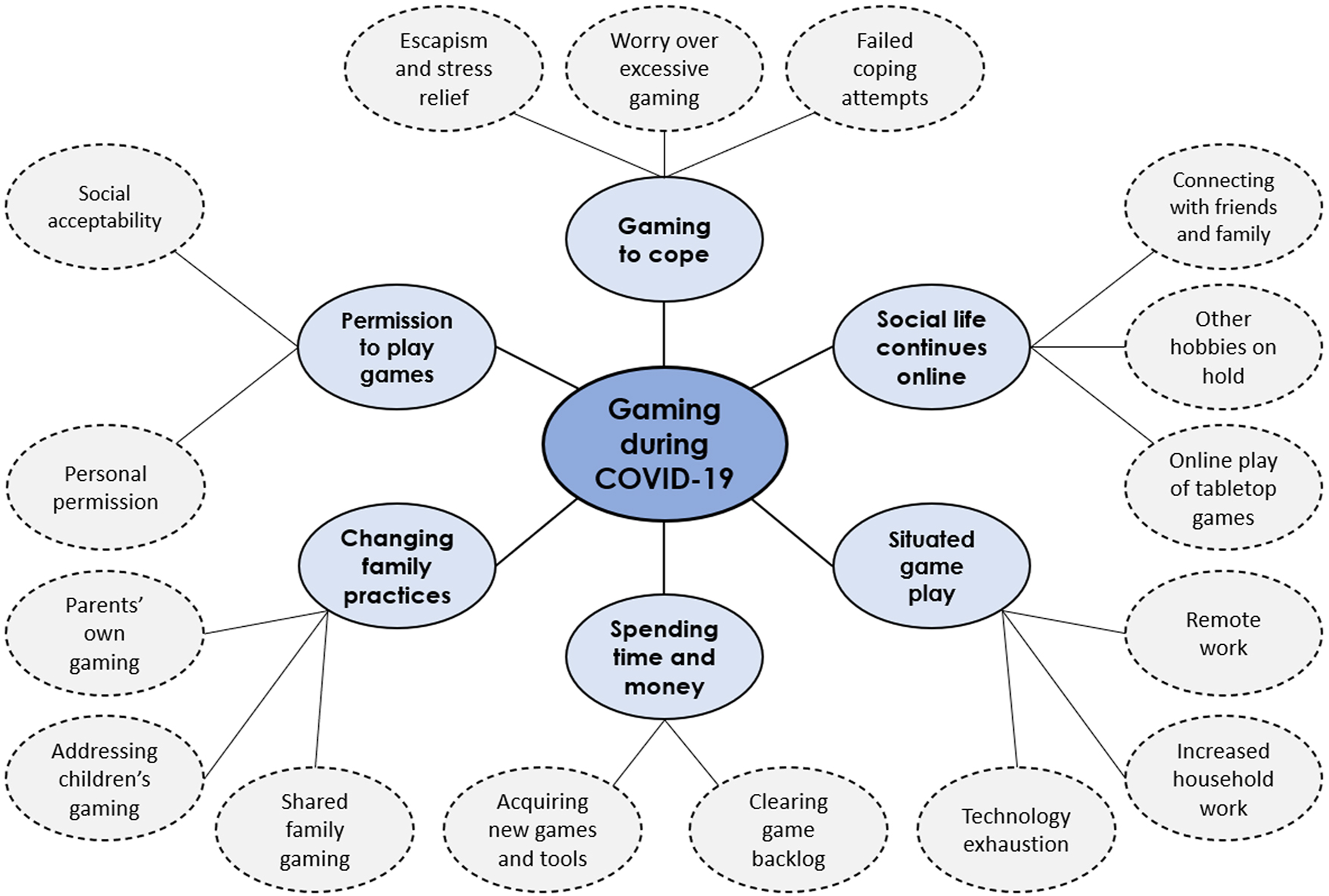
Results
The six themes mentioned above each discuss a distinct aspect of gaming during the early period of COVID-19, from psychological coping to consumer behaviour. Quotes have been translated from Finnish by the author and are presented as close to their original format and tone as possible, although minor changes such as capitalizations of game titles have been made. Respondent gender and age have been reported after each quote to provide the reader with additional context.
Gaming to cope: ‘Without gaming I would be on the brink of madness’
Gaming can support coping the managing of stressful life situations (see Folkman and Moskovitz 2004), yet can also increase stress in highly stressed individuals if game play takes on problematic aspects (Snodgrass et al., 2014, 2018). The pandemic itself and the containment measures caused considerable disruptions in the everyday, resulting in psychological stress (Kowal et al., 2020; Travaglino et al., 2020) visible in the data. In the spring of 2020, the pandemic still had several unknown quantities and the media was rife with speculation, as well as news of mounting death tolls and related imagery. In this context, the need for distractions to support one’s well-being is apparent.
Having time to oneself has been identified as an important part of coping with the COVID-19 situation (Salin et al., 2020), and gaming provided this to many respondents, leisure serving as a temporary break with everyday life as suggested by Lefebvre (1984, 54). For the respondents of this study, it was common to use gaming to cope with the COVID-19 situation and to balance the disruption of the pandemic, and for most respondents, gaming had increased. Gaming provided a welcome break from the constant barrage of distressing news and helped while away time. Gaming routines helped harmonize disjointed rhythms, game play becoming a rhythmic anchoring point for out of sync everyday life, orchestrating a sense of normalcy in an exceptional situation. Several respondents explicitly mentioned games being “calming”, suggesting that the relief offered by gaming did not stem only from establishing routine, but also from game play itself soothing the literal gaming body and providing a way to maintain a sense of normalcy and well-being. This was in line with the findings of Barr and Copeland-Stewart (2021) and supports the arguments of Marston and Kowert (2020) of gaming potentially being a positive coping tool during the pandemic. Around the time they were starting to enforce the containment measures, I surprised myself by digging up Hay Day from my phone, a game I had years ago played to level 40 and then forgotten about. Now I play multiple times per day, sometimes alone, sometimes with the kids. The game’s harmless, repetitive tasks and positive atmosphere feel calming. It also helps interrupt the continuous browsing and reading of worrying news. (Woman, 37) I did not expect to be saying this, but without gaming I would be on the brink of madness because of this comprehensively shit situation. (Man, 27)
The 20 March 2020 release of Animal Crossing: New Horizons, a ‘life simulator’ with a relaxed atmosphere, coincided with the containment measures, and was mentioned several times. Mentions of the game tie in with the Spending time and money theme discussed later, describing an overlap between psychological coping and consumer behaviour (see Arndt et al., 2004). A part of the game’s appeal may be that it is played with a handheld console, the Nintendo Switch, making it convenient to play in what (Apperley, 2010, 22) describes as ‘transitionary spaces and fragments of time which are characterised by boredom’. I bought Animal Crossing: New Horizons precisely to have something to do when life got limited, and first and foremost to have something calming to occupy my thoughts. A couple of my friends play Animal Crossing as well, and we meet inside the game. Because of this I also had to purchase the Nintendo Switch that I had long considered. (Woman, 38)
Mentions of gaming to cope were mostly positive, suggesting a “rich get richer” (Snodgrass et al., 2014, 2018) effect, in which people with moderate amounts of stress are able to use games as a positive coping tool. Some respondents, however, expressed worry over gaming and reflected on potentially problematic behaviour, providing a counterpoint to earlier examples. These respondents saw gaming as potentially disrupting the already disturbed everyday even further, the gaming rhythm overtaking everyday rhythms, causing arrhythmia, instead of synchronizing with them. I have wondered whether I game too much. When things are bleak and I feel miserable, it is easy for gaming to get a little too tempting. If you play an MMO [Massively Multiplayer Online, a game type] with friends in a similar situation, the situation can collectively escalate. On the other hand, so far gaming has not had a negative impact on my life. (Man, 38) Just as the lockdown started, I deleted a game that I had played for a couple of years, usually an hour a day, at worst more than that. This wasn’t problematic gaming (a free game and I was in control), but it was still consuming more time in everyday life than I wanted. I didn’t like being so addicted to the game. [...] I’ve occasionally thought whether I should install it again, but I have come to the conclusion that I definitely shouldn’t. Now that everyday life is so weird overall, I’d surely play even more than before. I don’t want to go back to that. It would be nice if I hadn’t removed the game already, but it’s better that I did. (Woman, 41)
Playing games to cope was not always successful. Exhaustion made gaming difficult, resulting in arrhythmia and underscoring the limits to game play imposed by the physical body. Gaming can require considerable effort and concentration from the player, making it susceptible to disturbances (Apperley, 2010), as the quote below shows. I sometimes find it hard to relax because of corona, so a few evenings on which I have planned to really concentrate on gaming have ended with me starting a game, playing for 15 minutes, closing it when I get it in my head that maybe another game would fit the situation better, open it and play 15 minutes and so on. In this state of anxiety gaming just becomes a mishmash, and it doesn’t really help me relax. After an hour of trying I drop gaming for that evening. (Man, 32)
Social life continues online: ‘We hang out together in video games’
The spring 2020 measures severely limited physical contacts, a very concrete example of societally imposed restrictions on everyday life and consequently, gaming. The regular cycles of the everyday were profoundly disturbed; most organized hobbies and events were shut down, and when possible, work and leisure moved online. This made the social aspects of gaming more important, as the role of gaming in maintaining social relationships grew.
Social contacts and experiences of relatedness are common reported motivators and benefits of playing both digital (e.g. Kowert et al., 2014; Przybylski et al., 2010) and non-digital games (Coe, 2017). Social digital gaming was something that could be engaged in without leaving the house, allowing respondents to compensate for restrictions on physically meeting other people. Although the online space was framed as separate from the physical, ‘real’, world, it nevertheless appeared as an everyday, mundane one, in line with previous work by, for example, Pargman and Jakobsson (2008). With so many other hobbies forced to be on hold, it’s great that there’s a hobby [online gaming] that I can still dig into for long stretches at a time to forget real-life chaos, and that allows me to be social with friends at a time when it’s not really appropriate to meet them. (Man, 27) My partner lives in another city, and with neither one of us currently visiting the other, we hang out together in video games using microphones. (Man, 30)
Online play of tabletop games, in which physical presence and material components are key elements (Rogerson et al., 2016), presented a challenge. Some respondents moved the play of role-playing games and boardgames online, while others paused the hobby entirely. Experiences of remote tabletop gaming varied considerably. Many welcomed the easier scheduling that made it easier to align game rhythms with everyday ones and enjoyed the new experience. For others remote games were a poor substitute for face-to-face gaming. I live alone, so boardgaming has stopped completely. On the other hand online tabletop role-playing gaming (mainly Dungeons & Dragons 5th ed.) has increased considerably. Before, we usually played once a week, now there can be up to three sessions per week. We play with several different groups and switch game masters as well. The horror game Ten Candles also works wonderfully over a remote connection! (Man, 27) There has been less role-playing gaming. My child hasn’t been able to play D&D at all. Larps [live action role-playing games] for both the child and me have obviously all been cancelled. I’ve tried doing some tabletop role-playing gaming over a remote connection, but it’s not the same. (Man, 43)
Situated game play: ‘There just doesn’t seem to be time for gaming’
The pandemic drastically changed the rhythms of everyday life. Parents were forced to oversee their children’s remote schooling, while adjusting to the new situation and often also trying to handle their own remote work. Classes moved to online platforms and student activities were cancelled. Furloughs and working from home meant major changes in available time, and as staying at home was encouraged, physical and mental space became an issue, as also observed in a previous study of Finnish families (Salin et al., 2020). This theme echoes Apperley’s (2010) observation that the unpredictable demands of the everyday can disrupt the process of play if sufficient contingencies are not in place. The theme consists of intersecting subthemes, such as family life and remote work, describing how the availability of time and space impacted adults’ gaming – typically negatively.
For many employed respondents, the pandemic situation led to the increase of remote work. While the lack of commuting left more time for gaming, for some respondents, mobile gaming usually done while commuting stopped, an example of a gaming activity disappearing alongside its game ecological niche, and a new one taking its place. I clearly have approximately 2 hours of extra time per day now that there is no more commute. I spend that on gaming most days so my weekly gaming time has gone up approximately +10h. You can’t do anything on weekends and that makes for about +12h too. (Non-binary, 41) My mobile gaming has changed. With no more commute, I don’t play the games I normally spend my commute time on. I work remotely, and I have tried to spend the time I normally spend on commuting on walking. This means simulation games have changed into the re-discovery of Pokémon GO. (Woman, 46)
In line with previous studies on life during COVID-19 restrictions (Marchetti et al., 2020; Power, 2020; Salin et al., 2020), the situation seemed to impact more on families with children although experiences varied and, surprisingly, no obvious gender differences could be discerned in the data (cf. Marchetti et al., 2020). Whereas for many respondents without children, the restrictions meant more time available for gaming, for families with children, it was common for parents’ gaming times to decrease. The restrictions prompted a rapid reconfiguration of domestic space and time, as distance work required respondents to physically re-organise their homes to make space for work and necessitated extra gaming time for small children to allow parents to work uninterrupted. While reconfiguration of gaming in the domestic setting is not unusual, it typically happens over longer periods of time (e.g. Enevold 2012).
The following two quotes illustrate two very different situations, one of arrhythmia and the other of eurhythmia. In the first, the pandemic disrupts the respondent’s gaming through their partner’s work, his additional workload altering the everyday rhythms of the family, clashing with existing gaming rhythms. In the second quote, one of the respondents matches their game rhythm with the new domestic rhythms created by the restrictions by choosing to play a game that can be paused when needed. Here, a state of eurhythmia is formed, the rhythm of the game compatible with the respondent’s domestic situation which allows them to play while also meeting their responsibilities and the demands of other family members. Interestingly, this game play style is more typical of women’s leisure, often characterized by its operation in smaller snippets of time (see Chess, 2018). There just doesn’t seem to be time for gaming, having a 4-month-old baby. Maybe if my husband was also at home, but as a nurse he will be working until he falls ill. [...] I would like to play more, but there is not enough time. (Woman, 32) Because activities (such as my children’s hobbies and my own other hobbies) have dropped off, I’ve had time to play in the evenings. [...] I’ve mostly played old familiar games such as Civilization, which is always easy to pause if something else at home needs my attention. [...] Gaming before corona was about 2h per week, now I have time to game approximately 4h per day. (Man, 30)
A notable facet in the data was that of technological exhaustion. As remote workers spent their days sitting at the computer, the appeal of gaming dwindled. Instead of a welcome, escapist rupture in the everyday, the demands of gaming in terms of physical and mental engagement with technology became a strain and disrupted eurhythmia. Below, respondents describe ‘staring’ at screens and ‘wrestling’ with connections, their choices of words suggesting literal gaming bodies exhausted both mentally and physically. When I’ve done an 8 hour remote day at the computer I haven’t really been in the mood to game. Normally it’s nice to relax with games in your own personal world to offset the face-to-face encounters of a workday, but now when I’ve stared at the screen for 8 hours for work I really haven’t been interested in staring at the screen any more after work. (Woman, 46) Our workplace Dungeons & Dragons campaign moved to Discord and Roll20, but we’ve still had weekly sessions. So even the boardgame turned into screen-staring and wrestling with remote connections. (Man, 32)
Spending time and money: ‘For the first time in a long while it felt appropriate to put money into games’
The acquisition of games is an integral part of gaming (Johnson and Luo, 2019; Rogerson et al., 2017). The restriction measures elicited new purchases also from people who reported not usually buying games. The global game ecology interacted with the local, as sales across platforms such as Steam resulted in new purchases at home. Respondents also reported buying new gaming hardware for both themselves and their children and seemed happy with their new purchases. It is possible that for some, shopping behaviour served as a form of coping, a phenomenon discussed in previous literature (e.g. Arndt et al., 2004). I bought a game at the PlayStation Store for the first time, I had not even registered there previously, and I’m strongly considering buying expensive additional content. I also bought a few pc games on Steam. All of these have been really inexpensive, but I normally buy maybe one game per year. (Non-binary, 38) The father of the family started playing on the Playstation again, because “he never finished Dark Souls II” (a couple of years ago?). He also bought 10 PS [PlayStation] games on tori.fi [a Finnish online auction site] when the lockdown started. (Woman, 46)
Increased consumption was not limited to digital games. New boardgames and role-playing games were also bought, as well as digital tools such as Roll20 (The Orr Group, 2012) and Tabletop Simulator (Berserk Games, 2015) that enable remote play of non-digital games or simulate them. We’ve played more boardgames together, now there’s time. I bought an add-on to Carcassonne and we’ve also taken add-ons and unplayed games out of our game storage and into use. (Man, 31)
Lack of time, rather than lack of interest, can be a reason for quitting game play (Bergstrom, 2019). In an overlap of consumer behaviour with the previously discussed availability of time, respondents returned to previous time-consuming favourites and unplayed games. The changes in the rhythm of the everyday allowed respondents to weave in more gaming, new gaming rhythms also echoed in spending behaviour. For the first time in a long while it felt appropriate to put money into games (e.g. World of Warcraft subscription) because it was certain that there’s enough time to get enough value for your money. (Woman, 26)
Changing family practices: ‘Normally we don’t really play together as a family’
Family relations influence and regulate gaming, especially that of young people (Meriläinen, 2021). In addition to parents mediating children’s game play (e.g. Martins et al., 2017), there is playing games together with romantic partners (e.g. Evans et al., 2018), and parents negotiating their own gaming with family life (Enevold and Hagström, 2008, 2009; Rogerson and Gibbs, 2018). Especially in families with young children, gaming lay at the intersection of work, time and family life.
Many parents actively play games (e.g. Enevold and Hagström, 2008, 2009), yet as described in previous themes, during the restrictions there was less time and energy for gaming. Parents’ gaming appeared much more vulnerable to disruption than that of singles or couples without children, likely due to added complexity of the polyrhythms brought on by children. Some respondents were unable or unwilling to alter the rhythms of the rapidly changed everyday despite its clashing with their own gaming, so they sought eurhythmia by altering their game rhythms instead. I’m gaming a little less, because the isolation of our family indoors has cut down on personal time. Gaming has focused more on family games that can be played together with small children. It’s much more difficult to find time for so-called adults’ games. (Man, 38) I’m gaming less, because there’s remote work spread out through the day and there’s less time for gaming. We also have to come up more often with things to do for our smaller children [aged 1 and 5] as daycare has stopped. (Man, 36)
Children were often allowed to play more than usual during the restrictions, echoing previous research in Finland (Salin et al., 2020). In many families, children’s game play and other media use was seen as necessary to allow parents to work remotely, with the impact of global events filtering down to children’s game play rhythms. While some parents welcomed this and encouraged gaming, some considered it problematic or worried over long-term effects, the new game rhythms becoming too dominant in relation to their children’s everyday life. The responses seem to illustrate a previously identified (Meriläinen, 2021) core tension in gaming-related parenting between understanding and supporting gaming and protection from harmful impacts. Both children play more, no-one even considers keeping the teen from gaming and we try to lure the four-year-old to games more often, so we could work in peace. We also play together, since so many other fun things cannot be done at all. (Undisclosed, 38) My approach to digital gaming is quite conflicted. I understand that it’s a part of contemporary (children’s) culture and also understand its appeal, but I’m sure I’d be more satisfied and somehow calmer if there was another way of entertaining your child when you’re working. Of course there’s also telly viewing, independent drawing and Lego building at our home, but gaming is the number one thing. Gaming is really important for the boy [age 6] and he talks about it and his goal of collecting all Lego Jurassic Park dinosaurs really often. Also progressing in Ekapeli [a Finnish language learning game for children] has been a great source of joy. What I’ve already been thinking about is that once this corona lockdown some day (hopefully) ends, are we as a whole family so numb to gaming, that the boy stays caught up in it even to excess. (Woman, 44)
In some families, playing both digital and non-digital games together with children and partners increased. The altering of some everyday rhythms, those of hobbies or work for example, allowed family members to match their individual gaming rhythms more easily with each other. This, combined with new spending practices and wanting to share activities, brought family members together in play and changed the games played. There are now more opportunities for shared gaming moments, because we’re both home all the time and there are no activities. Additionally playing together [with partner] is a change from doing things alone, and you possibly end up playing games you wouldn’t normally pick up. (Woman, 31) Everyone has been gaming more, normally we don’t really play together as a family. That kind of gaming has now increased the most. (Woman, 37)
Permission to play games: ‘At least it’s more socially acceptable right now’
A minor, yet distinct, theme addressed the social acceptability of gaming. Despite adults’ gaming being common in Finland (Kinnunen et al., 2020), time spent gaming was normally a source of guilt or embarrassment for some respondents, producing a constant state of arrhythmia as respondents were forced to negotiate their game play with personal and social demands. Gaming was positioned in opposition to activities such as household chores, an example of the ‘rhetorics of frivolity’ described by Sutton-Smith (1997, 201–202), in which play is seen as fundamentally separate from work; work is useful and necessary, play is not.
The altered everyday brought by the restrictions helped some respondents synchronize this arrhythmic clash between gaming and the everyday into a state of eurhythmia, especially mentally. It provided an alibi (see Deterding, 2018) for gaming, thus alleviating feelings of guilt and inferiority. The theme illustrates how the global and local intertwine, as broader discourses and societal norms about adulthood actualize in individual players. I have a positive outlook [on gaming], because of the lockdown I allow myself more time for gaming and don’t have as guilty a conscience over it as before, because I know that there’s still enough time left over for other things (like work and household chores). (Woman, 26) I probably have some internalised feelings of social inferiority for playing WoW [World of Warcraft]. On the other hand it’s a way for me to maintain a necessary routine in a life situation in which there isn’t really much else that I can do. The situation maybe just highlights that this is my everyday life outside corona as well. I don’t know if this is a good or a bad thing, but at least it’s more socially acceptable right now. (Woman, 31)
Discussion
The COVID-19 pandemic and the measures to contain it in the spring of 2020 impacted adults’ gaming in Finland. The restrictions effected change in motives and attitudes, game preferences, the functions that gaming served, time and space available for gaming, and ways of playing. The start of the pandemic was a massive shock, momentarily throwing off established rhythms of both the everyday and gaming. For some, carefully constructed everyday practices of gaming were disrupted by the new situation, bringing about arrhythmia. For others, the new conditions aligned previously incompatible rhythms which re-established gaming as a crucial part of everyday domestic life. The pandemic accelerated change, typically gradual changes in gaming and everyday rhythms changing in a matter of days or weeks.
Changes were not always dramatic; gaming often continued as usual or for example with very minor changes in gaming times. The results echo existing literature that shows how gaming is inextricably situated in players’ lives (e.g. Apperley, 2010; Enevold and Hagström, 2009; Pargman and Jakobsson, 2008): as everyday life changed, so did gaming.
Escape into eurhythmia
For many of the respondents, gaming helped synchronize disrupted rhythms and restore a state of eurhythmia. Escaping quotidian life and engaging in social interaction are both common motives for gaming (De Grove et al., 2016), and with added stress and physical distancing requirements, these aspects became even more important. Friends and partners kept in contact online, gaming routines provided a sense of normalcy, and time spent with games helped combat internalized requirements of constant productivity and the barrage of unsettling news.
In a situation in which the everyday was severely disrupted, rhythms of both individual games and gaming as an activity helped fill in ‘missing beats’, alleviating distress and boredom. Games offered escape not just through immersion in fantastical worlds but also through the opposite, by providing everyday routines. Many of the responses serve as prime examples of positive escapism as described in previous research (e.g. Calleja, 2010; Kardefelt-Winther, 2014; cf. Hagström and Kaldo, 2014).
The social aspects of gaming were another notable part of game play. Games were used as a communication channel by both adults and children, yet this was only a part of the whole. Shifts in global game ecologies shaped game play in local ones; while not everyone was home all the time, the restrictions mandated that many more than usual were. A global altering of millions of everyday and domestic rhythms lead to the orchestration of new rhythmic configurations: more activity on gaming servers and more friends and strangers available for gaming.
Rhythm changes were not limited to digital gaming. According to the responses, the switch to remote play had increased tabletop role-playing gaming considerably, likely due to easier logistics. The game rhythms of tabletop games can be challenging. For example, typical role-playing game sessions take several hours, and require most players to physically travel to wherever the game is played. With other hobbies on hold and remote play eliminating the need for travel, many players found themselves with much more time for gaming, reflecting the previous findings of Kinnunen et al. (2020).
The results add qualitative detail to the mainly quantitative results obtained by Kinnunen et al. (2020) as well as those of Barr and Copeland-Stewart (2021). They also confirm some of the benefits of gaming during COVID-19 suggested by Marston and Kowert (2020) in the early days of the pandemic. For many people, gaming appears to support well-being in difficult life situations, although context is extremely relevant, as discussed next.
Gaming as situated
For all their potential and the even transcendent aspects sometimes attributed to gaming, potentially to legitimise games and gaming as subjects of study (see Gekker, 2021), the results also illustrate how gaming is a profoundly situated, mundane activity. The rhythms of the everyday shape, constrain and compete with game rhythms. The differing rhythms of, for example, work and family shape adults’ gaming to a great extent – whether in a state of arrhythmia or eurhythmia. Games are played while commuting, used to distract children when parents need to work, bought and never played, or add to the physical and cognitive load of extended IT use.
The exceptional physical, social and mental disruption caused by the pandemic rendered the situatedness of gaming uncommonly visible. While individual motives for gaming shape gaming behaviour (e.g. Przybylski et al., 2010), gaming is not solely regulated by individual choice. Because of the individual gaming body existing in the world, gaming is also an emotional (e.g. Madden, 2009) and physical (e.g. Apperley, 2010) act that predominantly takes place in the external, physical world. The fantastic of digital environments is contained in mundane computers, smartphones, and gaming consoles (Gourlay, 2021), all of which are physical objects. Even with digital games, the player still has a physical body, needs to be somewhere, and play games with something.
Like in many other areas of life (see European Union, 2020), the impact of the restrictions on gaming was not evenly distributed, as the situation both offered new affordances and created new barriers depending on contextual aspects. Family composition and work are two examples of different contexts resulting in different outcomes. As shown in previous research (Marchetti et al., 2020; Salin et al., 2020), the restrictions meant exhaustion and the loss of free time for many parents. In the context of this study, this led to them giving up gaming, their time taken up by extra household chores, childcare, and remote schooling – challenges that respondents without children did not have to deal with. In working life, some respondents could switch to remote work while others did not have this option. As remote work is not possible for many people in lower-paid jobs, for example, in the retail, service and healthcare industries, there was likely an implicit class distinction at play. Gaming is shaped also by societal structures, in this example actualizing as different opportunities for gaming depending on employment.
Counter to previous studies (cf. Marchetti et al., 2020), gender did not appear to be a defining factor in negotiating altered everyday life, at least in the context of gaming. This study does, however, present an overview of the data, and a new analysis focusing on gender and family composition might reveal new dimensions to the subject. A qualitative study of Finnish families with children (Salin et al., 2020), predominantly consisting of mothers’ responses and focusing on the same period as this study, indicated that parents made explicit agreements on sharing family responsibilities and decided to downgrade normal standards such screentime rules and housework duties to facilitate an easier life during the restrictions. This may have resulted in a more equal sharing of home duties than usual.
Broader implications of the results
While the results primarily describe gaming in Finland during the early stage of the COVID-19 pandemic, I have identified three broader implications regarding research into gaming in terms of both theory and methodology. The first one relates to viewing gaming as situated, the second concerns rhythmanalysis and the everydayness of gaming, and the third advocates for nuanced qualitative explorations of the plurality of gaming.
Firstly, the results underscore the vital importance of viewing gaming as situated. Both local and global changes impacted game play, sometimes with complex and unexpected causal chains: a virus outbreak in China led to a Finnish nurse working overtime months later, leaving his wife with extra childcare duties and no time for gaming, a disrupted rhythm distant in time and space creating disruption and arrhythmia. In another home, the same event led to entirely different outcomes, bringing a family together to enjoy new gaming experiences. Whether looking at gaming during a pandemic, problematic gaming, game-based learning, social relationships, toxic online behaviour or any number of gaming-related phenomena, isolating and detaching gaming from the rest of an individual’s life and the societal structures and global and local rhythms that shape it, is counterproductive. Everyday life is profoundly related to all activities (Lefebvre, 1991, 97), and examining and unfolding these intertwinings helps us understand the complex interactions between gaming and other areas of life, whether on an individual or a global level.
The results illustrate the impact of the COVID-19 measures on gaming through its disruption of everyday life. Pandemic measures did not have to directly affect gaming to nevertheless render it more difficult or easier. This is an important observation on the fluctuation of issues central and peripheral to game play. Things on the surface unrelated to gaming, such as remote work or children’s lack of hobbies, became important regulators of gaming overnight. While many respondents technically had the possibility of playing games, having the required skills, hardware, software, and motivation, they found themselves unable or unwilling to enjoy games. Even if respondents wanted to, escape into games was not always possible or successful. It was much easier to relax with games with no small children to attend to, remote schooling to organize or physical exhaustion from remote work. The finding echoes Apperley’s (2010) observation of gaming as a frail activity disrupted by changes in the everyday, discussed in detail next.
The second implication of this study concerns Apperley's (2010, 38) notion of gaming as a frail activity that is easily disrupted by the demands of the everyday unless the gaming body has the necessary contingencies in place to rapidly meet them. This partially holds true in the data: in line with Apperley’s theory, some respondents’ gaming was certainly disrupted to a great extent, while others managed to avoid this disruption by altering their gaming. However, for many respondents gaming simply appears to have continued as before without necessitating any change or readjustment, even as their everyday life around gaming changed drastically. Although it is possible that these respondents did work, either consciously or unconsciously, to enable their gaming to continue, this has not been identified or reported in the data. The finding suggests that given the right circumstances, gaming can be a robust and resilient activity capable of withstanding considerable disruptions to, and demands from, even a dramatically changing everyday. This said, the COVID-19 pandemic restrictions, with their emphasis on staying at home and the severe limiting of most leisure activities, provided a very conducive situation for gaming.
In some cases, gaming became central to everydayness, an anchor to a previous, ‘normal’, pre-pandemic life. In these instances, rather than being a rupture in the everyday (cf. Lefebvre, 1984, 54) and going beyond something that can never escape the confines of the everyday (cf. Apperley, 2010, 39), gaming is a core part of the everyday. It is enjoyable precisely because it is mundane, familiar, and provides routine, not despite these things. The 10 year difference between the publication of Apperley’s theory in 2010 and the start of the COVID-19 pandemic in 2020 is a very long period in the context of digital gaming, and it is probable that a major part of this change is due to the process of gaming becoming a more domesticated, everyday activity, continuing the trajectory noted for example by Pargman and Jakobsson in 2008 and Enevold in 2012.
Rhythmanalysis, especially as adapted and developed by Apperley (2010), appears to be a valuable tool for exploring the intersections between gaming and the everyday. The concepts of polyrhythmia, arrhythmia and eurhythmia mapped well onto the broad range of gaming-related experiences described by the respondents of this study and allowed the unbundling and examining of the myriad rhythms of both gaming and the everyday that make up individual game play experiences. Whereas Apperley’s 2010 work draws from research conducted in gaming cafés in 2005–2006, this study shows that the lens of gaming rhythms lends itself to examining gaming in contemporary home settings as well.
As cultures around games and game play have expanded and become visible (e.g. Gekker, 2021; Stenros and Kultima, 2018), the need for acknowledging the plurality of game play has increased. While being parts of the polyrhythmic whole of the digital game ecology (see Apperley 2010, 21), the gaming experiences of people, even those living in the same society, differ considerably from one another. This again draws attention to the importance of situating gaming. Although the gaming experiences discussed by the respondents and the background information they have reported make for a rich data set, they only offer glimpses of the context of their game play, and a wealth of information inevitably remains hidden. The class and gender differences mentioned previously would make for interesting research vectors into domestic gaming during the pandemic.
While it is impossible to address every factor impacting game play, scholars should actively avoid exceptionalist approaches to gaming, and be wary of considering game players as a homogenous group. This also has methodological implications: the strength of qualitative approaches is in their capability to produce detailed, nuanced, and unexpected data. Allowing participants to discuss their experiences in their own words helps challenge researchers’ preconceived notions of the phenomena studied.
Strengths and limitations
The rich data and the qualitative approach to it are some of this study’s key strengths. The responses brought out novel aspects of the respondents’ gaming habits and preferences, painting a detailed picture of adults’ digital and non-digital gaming in Finland, not only in the context of COVID-19, but more broadly as well. The format allowed respondents to respond in their own words rather than constraining their expression to pre-selected options (cf. Kinnunen et al., 2020), illustrating the capacity of qualitative online surveys to provide in-depth data for qualitative research (Braun et al., 2020).
The sample in this study was self-selected, and is not representative, instead highlighting a range of experiences from a group of respondents differing, for example, in age, gender, health, relationship status, employment, and family composition. This said, the data only reflects the experiences of Finnish-speakers (cf. Finell et al., 2021), and it is possible that the questionnaire format discouraged participation from potential respondents not comfortable with or capable of expressing themselves in written Finnish. Some of the respondents expressed stress to the point of having difficulties concentrating, and some potential respondents may have found the questionnaire format too taxing to respond to in the spring 2020 conditions, possibly leaving out the perspectives of individuals struggling to cope with the situation.
Approximately a quarter of the respondents explicitly mentioned working remotely, suggesting that they were likely quite privileged in terms of socioeconomic status. In a US study (Wanberg et al., 2020), higher income was associated with lower depressive symptoms and higher life satisfaction during the pandemic, yet higher education was positively associated with depressive symptoms and negatively associated with life satisfaction. This leaves the potential impact of respondents’ socioeconomic status uncertain.
In line with the situatedness discussed in this study, the national context needs to be acknowledged. Finland is a wealthy Nordic welfare state with a robust system of public healthcare and social services, and high trust in the government. A strong digital communications infrastructure allowed for extensive remote work, and Finland had Europe’s highest percentage of distance workers during the early stages of the pandemic (Eurofound, 2020), when this study’s data were collected. These factors have likely helped mitigate the impact of the pandemic on everyday life, limiting the generalizability of the results to other locales.
Conclusions
The COVID-19 pandemic measures caused major disruptions to both everyday life rhythms and game rhythms, bringing about new rhythmic configurations and states of both arrhythmia and eurhythmia. The measures wrought changes on both global and local levels, impacting gaming bodies and affording new gaming opportunities for some while raising barriers for others.
In some instances, gaming was shown to be surprisingly resilient to disruption, although this was very dependent on individual situations. The results suggest that gaming can be a core part of everyday life, for example by providing enjoyable routine. Gaming helped with coping, provided means and opportunities for communication, and helped families connect, yet also caused stress, sparked worries about gaming habits, and added to technological exhaustion, these conflicting outcomes dependent on individual contexts.
This study highlights the paramount importance of considering the multiple factors of everyday life and individual differences that shape, restrict, and provide affordances for gaming. The results support the validity of the gaming rhythm theory in exploring intersections of gaming and everyday life and encourage further applications of the theory. The exploration of everyday and gaming rhythms appears to be a fruitful approach to games and media scholars interested in the situatedness of gaming and the beneficial and harmful impacts of game play.
A global pandemic is an extreme example of disruption of everyday and gaming rhythms. Most disruptions occur due to much more common reasons: health issues, new family members, or changes in employment, study, or relationship status. Isolation is not usually due to state-enforced restrictions, but loneliness, lack of social contacts, health issues or simply living in a sparsely populated area or moving to a new city or country. Many aspects of the exceptional situation described in this study, such as constant stress or the challenges of family life, are mundane and familiar to countless game players around the world. Similarly, many of the challenges revealed were not produced by the pandemic restrictions but revealed and exacerbated by them.
As of spring 2022, the pandemic is ongoing, and a variety of safety protocols are still in effect in Finland. This study presents a snapshot of the situation in the spring of 2020, an exceptional period in the context of the COVID-19 pandemic. Whether the changes effected by the restrictions were long-term, is an important topic for further study.
Footnotes
Acknowledgements
The author would like to thank the Academy of Finland, the Jenny and Antti Wihuri Foundation, and the Strategic Research Council for funding this research. The author would also like to thank Tom Apperley, Joleen Blom, Emilia Lounela and Lars de Wildt for their valuable feedback during the writing process.
