




Abstract
Consumer virtual reality (VR) headsets (e.g. Oculus Go) have brought VR non-fiction (VRNF) within reach of at-home audiences. However, despite increase in VR hardware sales and enthusiasm for the platform among niche audiences at festivals, mainstream audience interest in VRNF is not yet proven. This is despite a growing body of critically acclaimed VRNF, some of which is freely available. In seeking to understand a lack of engagement with VRNF by mainstream audiences, we need to be aware of challenges relating to the discovery of content and bear in mind the cost, inaccessibility and known limitations of consumer VR technology. However, we also need to set these issues within the context of the wider relationships between technology, society and the media, which have influenced the uptake of new media technologies in the past. To address this work, this article provides accounts by members of the public of their responses to VRNF as experienced within their households. We present an empirical study – one of the first of its kind – exploring these questions through qualitative research facilitating diverse households to experience VRNF at home, over several months. We find considerable enthusiasm for VR as a platform for non-fiction, but we also find this enthusiasm tempered by ethical concerns relating to both the platform and the content, and a pervasive tension between the platform and the home setting. Reflecting on our findings, we suggest that VRNF currently fails to meet any ‘supervening social necessity’ (Winston, 1996, Technologies of Seeing: Photography, Cinematography and Television. British: BFI.) that would pave the way for widespread domestic uptake, and we reflect on future directions for VR in the home.
Keywords
Introduction
Interrogating the ‘immersive turn’
The 2010s saw a surge of interest in immersive media, including virtual reality (VR), augmented reality (AR) and other forms of mixed and extended reality (MR/XR). Widely considered to be the third wave of engagement with VR, it was the first to include an ‘immersive turn’ within non-fiction (Rose, 2018b). Since the development of the concept of ‘immersive journalism’ (De la Peña et al., 2010), followed by the first generation of Oculus hardware in the early part of the decade, producers across journalism and documentary have embraced the immersive and interactive affordances of VR technologies for non-fiction (Rose, 2018a; Uricchio et al., 2016).
At the beginning of the 2020s, VR non-fiction (VRNF) has become an established presence at festivals such as the Venice Biennale, Sundance and IDFA 1 and platforms such as the Oculus Store, Steam and YouTube now include hundreds of VRNF works in their libraries of content. 2 The technology industry remains a formative influence, and producers eager to experiment with emerging media technology have been supported by investment from governments and arts bodies keen to understand what this generation of media means for creative industry and audiences. From head tracking to eye tracking; from high definition to foveal rendering; from hand controllers to brain–computer interfaces, a plethora of interactive technologies are now poised to integrate with immersive media. Whereas the first generation of VRNF was dominated by ‘hype and hope’ (Rose, 2018a), with producers harnessing 360° video for its potential to offer a feeling of unmediated experience, more recently works such as Felix and Paul’s Travelling While Black (2019) and East City Films’ Common Ground (2019) demonstrate a more reflexive grammar. Rather than harness VR as ‘empathy machine’ 3 , these works show how VRNF might take forward currents within documentary that foster historical understanding, self-questioning and criticality about social relations.
The engagement with VR for non-fiction continues apace, and it is now urgent that we begin to understand the reception of VRNF in sociocultural context. The last half-decade has seen the development of a significant body of scholarly work emerging on the implications of the turn toward VR within non-fiction. This critical discourse offers vital context, which we will discuss, but there is a dearth of empirical research into what audiences make of VRNF experiences. To address this gap, this article presents an empirical study of VR reception, using an interdisciplinary methodology that draws on documentary studies, cultural studies and human–computer interaction. Our aim is to listen carefully to feedback from a mainstream audience, to discover what insights they offer about VRNF, and what new directions these might suggest for research and practice in the field. We ask, how does a mainstream audience respond to VRNF, experienced in the context of the home? What values do people find in encountering non-fiction content in VR? What questions do they raise about VR as a platform for real-world themes?
VR non-fiction
Let us begin by clarifying the term virtual reality non-fiction. In previous work, we catalogued and analysed over 500 works of VR documentary and journalism released between 2012 and 2018 (Bevan et al., 2019). This corpus provides the basis for our working definition of VRNF. However, definitions of immersive media remain fluid, as relatively simplistic conceptualisations such as Milgram and Kishino’s (1994) reality–virtuality continuum give way to more elaborate models of ‘sensory alignment’ (e.g. Marshall et al., 2019). Acknowledging that this is a shifting landscape, VR nevertheless remains a discrete point of focus for many researchers, practitioners and distributors of media content. A plethora of definitions of ‘VR’ (e.g. Lanier, 2017) necessitate some clarification of the term, so here we differentiate VR from other immersive media in two ways. Firstly, in terms of hardware: VR refers to head-mounted displays (HMDs) that cover and replace the entire visual field (e.g. Oculus Go, HTC Vive, Playstation VR, etc.). Secondly, VR is also a format of digital content produced for this hardware; it includes works of fiction and non-fiction, in both linear and non-linear traditions.
While an uptake of VR for games, for instance, was in a sense predictable, as interactivity and immersion have been central premises within the development of the games industry, the rapid embrace of VR for non-fiction was less expected. Early investment in VRNF came from major media players including New York Times and Guardian – both notably in partnership with Google – and Facebook, whose significant investment in Oculus VR For Good had a catalytic influence on creative industry engagement with VRNF. The claim by VRNF producer Chris Milk in 2015 that VR was the ‘ultimate empathy machine’ 4 has been influential, producing a widespread association between immersion and empathy. This association continues, despite Milk’s claim having been widely dissected and critiqued (Bloom, 2017; Nakamura, 2020) and humanitarian organisations continue to partner with immersive media companies to harness the affective power of VRNF (Irom, 2018; Kennedy and Atkinson, 2018).
VR is predicted to become an even more lucrative media platform 5 and the drive to invent and implement entertainment applications for the platform continues. In the United Kingdom, VRNF has benefitted from the government’s Industrial Strategy, which involves considerable investment in immersive media innovation. Non-fiction projects have, for example, been funded through the Arts Council and Digital Catapult’s Creative XR programme, 6 which supports producers in exploring and realising the new creative language that immersion requires. However, elsewhere in the industry, funding is being rerouted. In the United Kingdom, Bristol-based Limina Immersive’s VR Theatre, which programmed non-fiction alongside fictional content, closed less than a year after it opened. 7 In 2019, the BBC wound up its pilot VR studio after producing lauded projects including Damming the Nile and Make Noise, 8 despite making the case in their final report that VR ‘helps people to engage more deeply with world events’ (2019: 31).
One of the defining characteristics of VR is the sense of presence it affords. As an abbreviation of the term telepresence, Witmer and Singer defined presence as, ‘the subjective experience of being in one place or environment, even when one is physically situated in another’ (1998: 225). Slater et al. (2009) usefully specify two factors that are required to create a sense of presence – the illusions of ‘place’ and ‘plausibility’ – that denote the physical and cognitive aspects, respectively. However, like other forms of non-fiction media, VRNF ranges from the lifelike to the highly impressionistic, and while we know that the illusions of plausibility and place in VR can be powerful, a key consideration for VRNF is how they combine with non-fiction content – media that carries ‘the “ethical charge” of the real’ (Hight and Harindranath, 2014). The role of presence in non-fiction VR is widely considered to be significant, but it remains critically under-examined (McRoberts, 2018). To better understand it, and to mitigate potential ethical risks, such as those arising from increasingly plausible representations of people and places in VR, we need a deeper understanding of audiences’ subjective experiences of presence in VRNF.
Another defining characteristic of VR is interactivity. Steuer defines interactivity as, ‘the degree to which users of a medium can influence the form or content of the mediated environment’ (1992: 80). At the cutting edge of VR technology, various interaction modalities, including eye tracking and brain–computer interfaces, can be integrated with VR (Lécuyer et al., 2008; Pfeiffer et al., 2008). There is a considerable gap between the user agency offered by state-of-the-art interactive VR and the kinds of VR that are widely accessible to the general public (Chatterton and Newmarch, 2017). Owing to the higher cost and infrastructure requirements, the most advanced interactive VR tends to be accessible only at festivals and at location-based experiences (LBEs) that take place out-of-the-home. We are interested in VR usage at home. For digital media scholar Janet Murray, the design goal for interactive environments is not to maximise interactivity but ‘to create a satisfying experience of agency for the interactor’ (Murray, 2011: 13). We must therefore avoid the trap of assuming that more interactivity means bigger and/or more engaged audiences. What works at a festival or LBE might not work at home, for example, and a key aim of this research is to question this assumption.
It is important to clarify what kinds of interactivity are currently available to domestic users of VR. To this end, we will adopt an industry term – linear VR – to denote VR experiences where interaction is limited to head-movement, as is the case with most 360° video. We can then distinguish these experiences from interactive VR, which involve other forms of interaction like pointing-and-clicking; typically determined by peripheral hardware, for example, hand controllers. At the moment, most VRNF is linear and it is most readily accessible via consumer VR platforms (e.g. Oculus). A relatively limited amount of interactive VRNF is also available on these platforms, but interactivity is limited (by the interface) to head tracking and hand controller-based pointing-and-clicking. Since our primary interest is in domestic usage, we frame this research around the most widely available consumer VR devices (e.g. Oculus Go), while acknowledging that this is a rapidly changing landscape and that consumer VR platforms are in various stages of continuing development.
VRNF audiences
A major issue facing producers and funders of VRNF is that the identity of its ‘media audience’ (McQuail, 1997) remains nebulous. Who are the audiences for VRNF? We know that there is interest in VRNF at documentary and feature film festivals, where VR programmes continue to emerge, and where the work is seen by cinephiles, producers, emerging media professionals and a wider audience of documentary fans. Elsewhere, by virtue of the fact that VRNF has so far been distributed through the same platforms as games and ‘thrill experiences’ – haunted houses and rollercoasters, for example – early adopters of VR technology have been among the first to encounter and experience VRNF. However, VR remains a niche medium for non-fiction, compared to more accessible platforms such as non-fiction podcasts, documentaries on television and online news. An obvious reason for this is that VR headsets remain expensive; even a cheap cardboard headset requires an expensive smartphone. However, there is still a fundamental lack of understanding as to whether a mainstream audience would want to engage with this headset-based medium, even at an accessible price point.
A growing body of research explores the socio-historical context of VR, its convergence with other media and the evolution of its narrative language (Elmezeny, 2018; Elsaesser, 2014; Gröppel-Wegener and Kidd, 2019). This includes critical perspectives on VRNF, such as the privileging of feeling over thought (Uricchio et al., 2016) and the influence of Silicon Valley over the sector (Harley, 2019; Rose, 2018b), some of which have overarching implications for audiences of immersive media. De la Peña et al.’s seminal innovation of what she called ‘immersive journalism’ (2010) has generated a body of critical enquiry into the opportunities and challenges of VR for journalism (Aitamurto, 2019; Jones, 2017; Shin and Bioccha, 2018; Sirkkunen et al., 2016). Other scholars have questioned how the affective power of VR positions audiences in relation to non-fiction content, raising issues around ‘improper distance’ (Nash, 2018) and ‘mortality salience’ (Archer and Finger, 2018; Chittaro et al., 2017). Others have explored the way immersive environments can be manipulated to create uncanny experiences that intentionally disorient audiences (Staubli, 2017). These raise significant ethical questions about the impact of the intensity of VR, particularly when making a claim upon historical reality (Kent, 2015; Kool, 2016; Rose, 2018a).
Elsewhere, the question of how VRs affective potential might be leveraged for social good has been explored through participatory media work engaging under-represented communities in the development of VRNF projects (Wallis and Ross, 2020). Yet here, and in other emerging genres of VRNF, an understanding of VR audiences is still embryonic.
The potential of immersive experiences in the cultural sector has been more widely examined (Checa, 2017; Parker and Saker, 2020), bolstered by growing evidence of VR’s potential as a platform for education and learning (Jensen and Konradsen, 2018). However, while VRNF at cultural venues such as museums and galleries is widely seen as a good fit, here too the audience – and the nature of audiences’ experiences – remains underexplored.
While such studies have offered welcome critical perspectives on VRNF, there has been a dearth of reception studies in this area. There have been empirical studies of V
R user experience within psychology, typically using experimental, lab-based methodologies. In several cases, VRNF has been the media content used as a stimulus in these studies. A 2018 study examining responses to We Wait (2016) was designed to elicit insights into the factors influencing presence in VR (Steed et al., 2018). Clouds over Sidra (2015) has been the focus of repeated study (Irom, 2018; Kool, 2016); the most recent found no evidence to support Milk’s claims that immersion increases empathy (Farmer et al., 2019). In a recent user-study (Nielsen and Sheets, 2019), focus group participants experienced VRNF in a lab, and subsequent analysis revealed six kinds of user ‘gratifications’ relating to experience (immersion and transportation), affect (emotion and empathy) and agency (information and control). This evidence, which explores the kinds of value VRNF might have for audiences, may offer encouragement to producers of VRNF. However, such a study offers little insight into whether audiences will choose VRNF over other types of everyday non-fiction media. This is particularly important since – across these contexts – we find enthusiasm for VRNF tempered by issues relating to the user experience of VR technology, including the weight of headsets and motion sickness. A 2017 Ipsos Mori study 9 for the BBC involving field-based research with 16 participants found people struggling with fundamentals around the usability of the headset and revealed the challenges people faced with discovering and understanding the nature of the content available to them. The researchers concluded that – as well as improvements in usability – better content curation was needed to enable people to fully engage with VRNF.
In the space between lab-based research focusing on single users and critical scholarship that situates immersive media in historical and cultural context, there is an opportunity for focused empirical research that examines the social and cultural contexts of VRNF reception. This research needs to pay careful attention, not just to what people say about particular VR works, but to how they respond to the platform in an everyday context. It needs to explore the ways in which VR might intersect with the existing media ecosystem of peoples’ lives. It needs to examine how this media platform supports or creates tension with the sociality of home life. It is vital, also, in light of feminist critiques of VR as White and male-dominated 10 (Harley, 2019), that empirical research into VR audiences reflects diverse perspectives and proactively includes under-represented voices. This calls for research that confronts what happens when VRNF is experienced in the home, where traditional media reach their widest and most diverse audiences, and where other media – and other distractions – compete for attention.
In this article, we take up this challenge and contribute to the nascent body of empirical research on VRNF by conducting an extended empirical study that explores the social and cultural contexts of VRNF usage at home. We draw upon and extend prior work by bringing together diverse perspectives and insights, informed by an interdisciplinary research context.
Virtual realities: Immersive documentary encounters
Virtual Realities: Immersive Documentary Encounters 11 is a 2½ year research project, funded by the Engineering and Physical Sciences Research Council (UK), uniting cross-disciplinary expertise from documentary studies, psychology and computer science and facilitated by cross-sector knowledge exchange with partners including BBC, The Guardian and MIT Open DocLab. The project has critically examined the production and reception of immersive non-fiction, with the primary research question asking, ‘How do the affordances of virtual reality for immersion and interactivity take forward documentary’s mission for storytelling about our shared world?’ The project began by mapping and analysing VRNF in the English language released between 2012 and 2018, which was reflected in an online ‘mediography’ 12 (Bevan and Green, 2018; Bevan et al., 2019). It has also involved commissioning three VRNF prototypes: Waiting Room: VR by Victoria Mapplebeck, Love & Seawater by Lisa Harewood and Ewan Kass-Cavanagh and Transplant by VRTOV, which form the basis of a series of case studies (forthcoming). The work presented in this article is one aspect of the audience-focused research we have undertaken. Others are lab-based studies examining psychological factors relating to empathy and prosocial behaviour (Farmer et al., 2019) and the impact of seating position on the perception of embodiment (forthcoming).
In this article, we begin by describing our methodology, including details of our study design, curatorial approach, recruitment strategy, fieldwork process and data analysis methods. Then, we present our findings, which show that initial enthusiasm for VRNF across our participating households waned and usage dropped off as participants raised questions about the content, expressed ethical concerns about the platform and, in some cases, questioned the suitability of VR as a domestic media platform.
Research methodology
Here, we describe the design and implementation of our qualitative empirical study of VR usage in households in Bristol, UK (population ∼450,000 13 ). Reflecting the wider aims of the Virtual Realities project, the aim of the study was to understand how VRNF might connect with ‘mainstream’ audiences at-home. Our objective was to explore individuals’ attitudes to VRNF and identify social and cultural factors that inform VR usage in a variety of domestic settings.
Study design
We framed the study around households – social units with intrinsic diversity, including (multigenerational) families and other forms of cohabitation such as houseshares. We facilitated households to access VRNF – at home – via an Oculus Go pre-loaded with 46 pieces of curated VRNF content. We adopted a qualitative approach and engaged households in dialogue about their experiences throughout the study.
Drawing on our own initial experiences, those of colleagues and friends, and noting the phenomenon of YouTube videos of people encountering VR for the first time, we were aware of how powerful first impressions of VR can be. We opted therefore for a longitudinal approach to gain insight into what participants made of the platform beyond these initial encounters, to allow participants to get used to having access to VR at home, and to explore whether they formed habits relating to this new platform. We defined a minimum study duration of 10 weeks: 8 weeks of structured usage (which included a 2-week ‘pause’ over the Christmas period). Prior to initiating the study, we obtained ethical approval from UWE Research Ethics Committee (ACE.18.06.065) and Chair’s Action from the Universities of Bristol and Bath.
Recruitment strategy
To maximise diversity, we cast our net widely in recruiting for the study. We set up a website for the project and advertised the opportunity to participate via social media. We wanted to be inclusive of under-represented voices in the study and, in particular, we specifically sought to involve people with refugee experience in the study since we had previously identified ‘human migration’ as a major genre in the ‘immersive turn’ (Bevan et al., 2019). To facilitate these objectives, we worked with two local charities: Knowle West Media Centre 14 (KWMC), an arts centre and charity, based in a lower middle income part of Bristol, that works ‘collaboratively with people from different backgrounds’, and Refugee Women of Bristol 15 (RWoB), a ‘multi-ethnic, multi-faith organisation which specifically targets the needs of refugee women in Bristol’. In partnership with KWMC and RWoB, we cohosted six informal VR experience days at multiple venues in Bristol, where people could drop in and try VR, often for the first time. We did not collect research data at these events, but they played a major role in our recruitment. We followed VR industry guidelines in only including participants who were aged 13+.
To register for the study, potential participants signed-up manually (at the experience days) or via an online form, providing headline information about their household. To incentivise participation, we offered individual participants a £15 shopping voucher at the beginning of the study and each household a £100 shopping voucher on completion of the study. We aimed to recruit a maximum of 15 households/50 participants, but we received applications on behalf of 28 households. From these, we selected a diverse sample of 14 households to take part. We visited these households to introduce and talk through the study. Since this visit was about building trust, we did not collect research data at these visits. Two households dropped out due to scheduling conflicts, so 12 households – a total of 34 people – participated in the study. Figure 1 shows the distribution of the 34 participants across the 12 households.
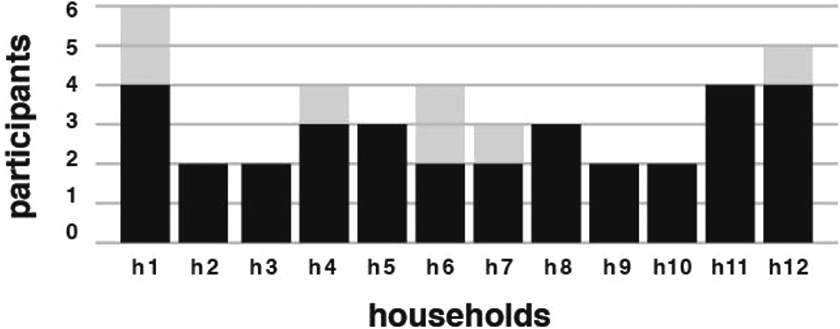
Households had between two and four participating members. In five households, there were members of the household who did not participate in the study, either because they were under 13 years of age (H6, H7 and H11) or because they chose not to take part in the study (H1 and H4).
Content curation
We curated a collection of English language VRNF, framed around eight themes (Table 1) derived from the most popular genres revealed by our mediography (Bevan et al., 2019). For each theme, we selected five to six pieces. The overall collection included a variety of formats, including linear and interactive pieces, a combination of 360° video, CGI and hybrid works, and a range of durations (∼1 min to ∼30 min), release dates (2012–2018) and production locations. The collection included several award-winning pieces and, given that there would be participants as young as 13, all were suitable for a pre-watershed audience. In week 7, we directed participants to journalism apps that offered topical content. Most works were available through the Oculus Store and were made accessible to participants on the Oculus Go. Two were available as apps, which participants could access via their smartphones, using the Google Cardboard headset, which we provided.
Curated content.
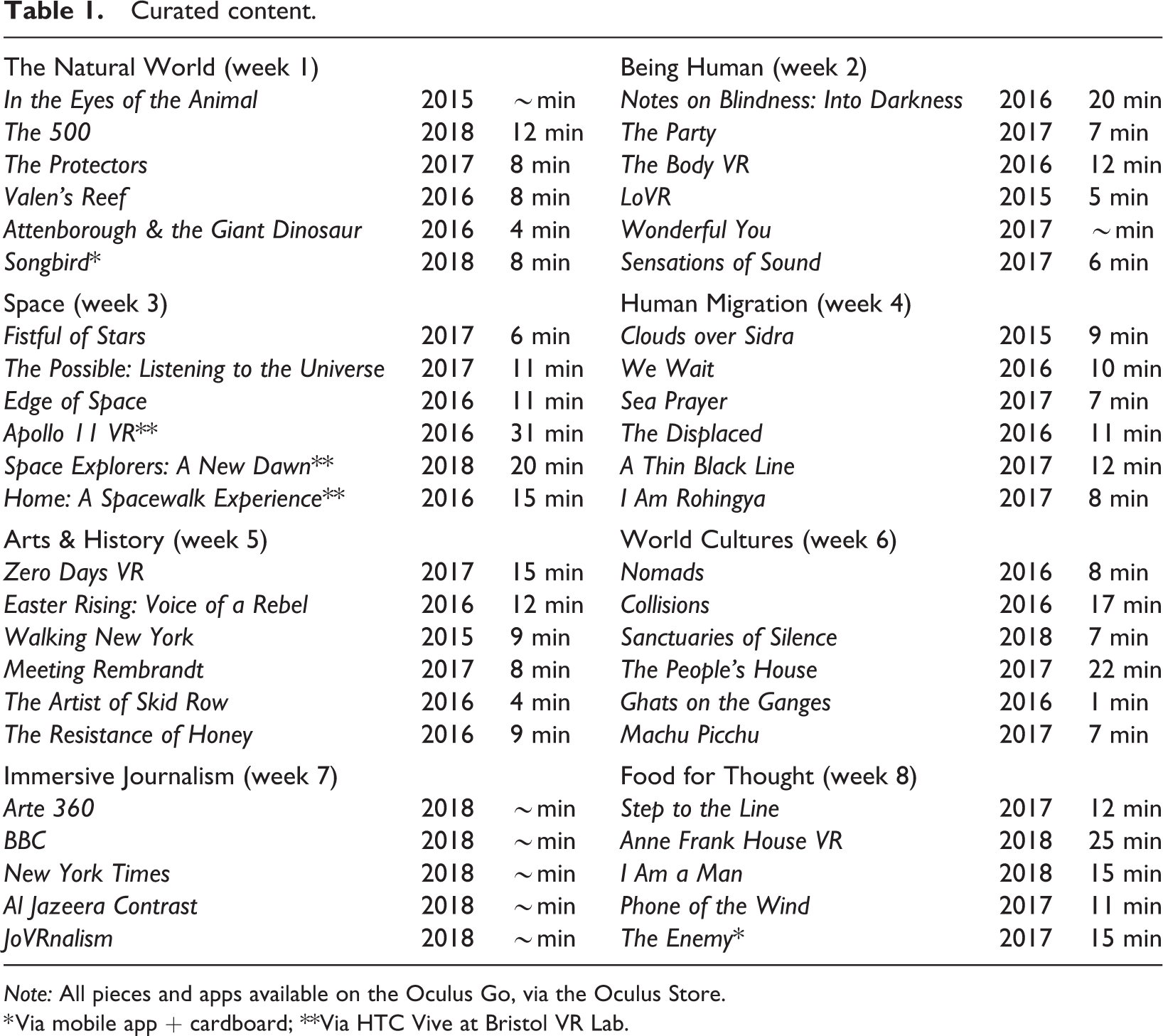
Note: All pieces and apps available on the Oculus Go, via the Oculus Store.
* Via mobile app + cardboard; **Via HTC Vive at Bristol VR Lab.
Research process
Unboxing
We began the study with an ‘unboxing’ session, at home with each household (Figure 2), attended by two researchers; one leading the session and another taking notes. We began with a 15-min semi-structured group interview about existing patterns of individual and shared media usage both at-home and out-of-the-home. Participants were then invited to ‘unbox’ the study materials (Figure 3). This included a box containing a Stereoscope (1900s) and a Viewmaster (1970s), to suggest the historical precedents of contemporary VR, gently undermining the claim for novelty that has been key to the promotion of the platform. The box also included an Oculus Go (one per household) and a pair of noise-cancelling headphones. We talked participants through each of the items as they unwrapped them. Where necessary, we demonstrated and offered advice, but our primary objective was to observe participants as they discussed the items among themselves. This segued into a semi-structured group interview about expectations of the study. The session lasted ∼2 h and was audio-recorded throughout.
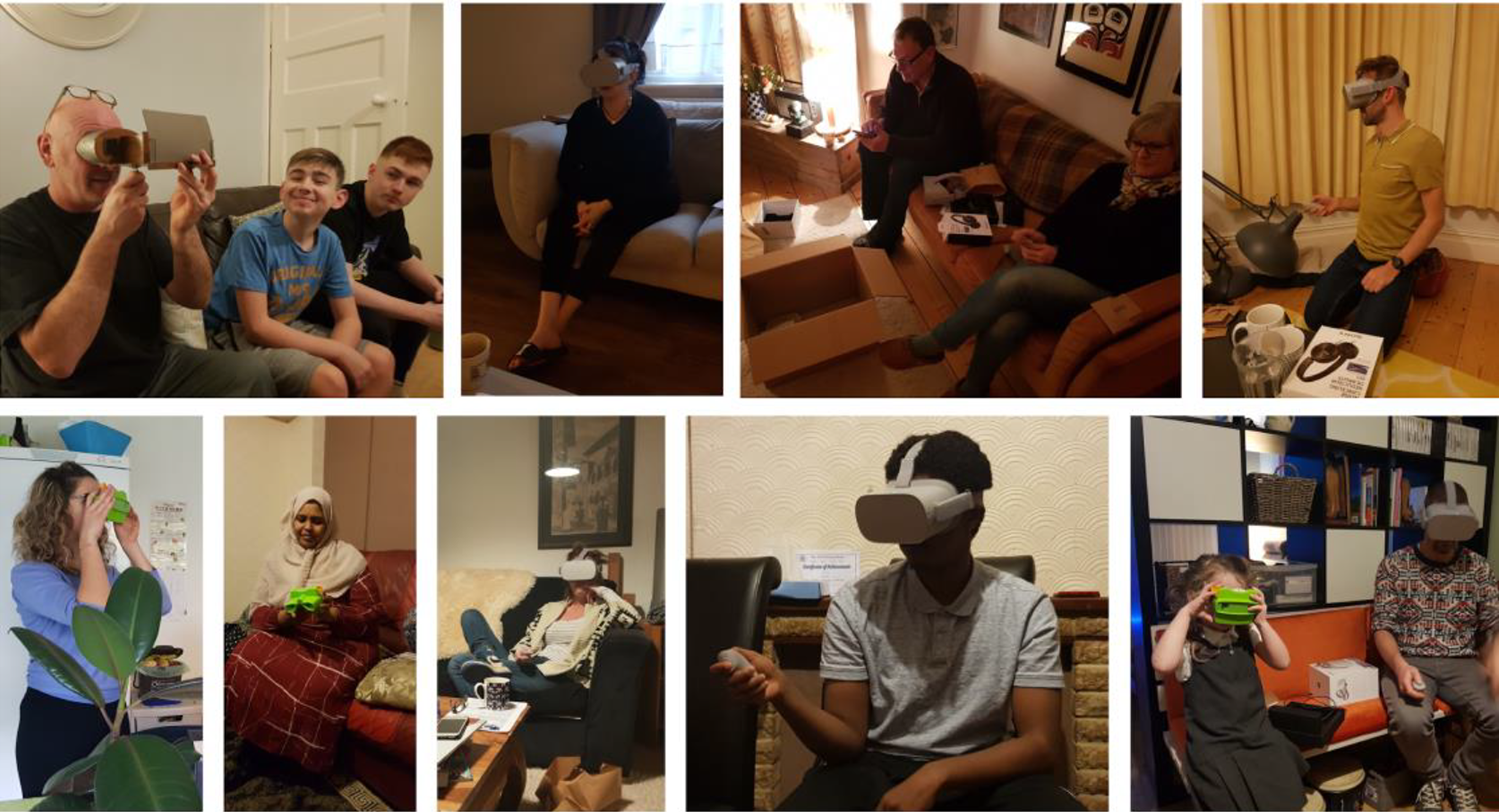
Some of our study participants, photographed during the initial ‘unboxing’ session. Top row (left to right): Dan, Dexter and Darren (H4); Eva (H5); James and Julie (H10); Barry (H2). Bottom row (left to right): Amelie (H1); Khalija (H11); Isabel (H9); Kadin (H11); Fred (with daughter) (H6). The names used are pseudonyms.
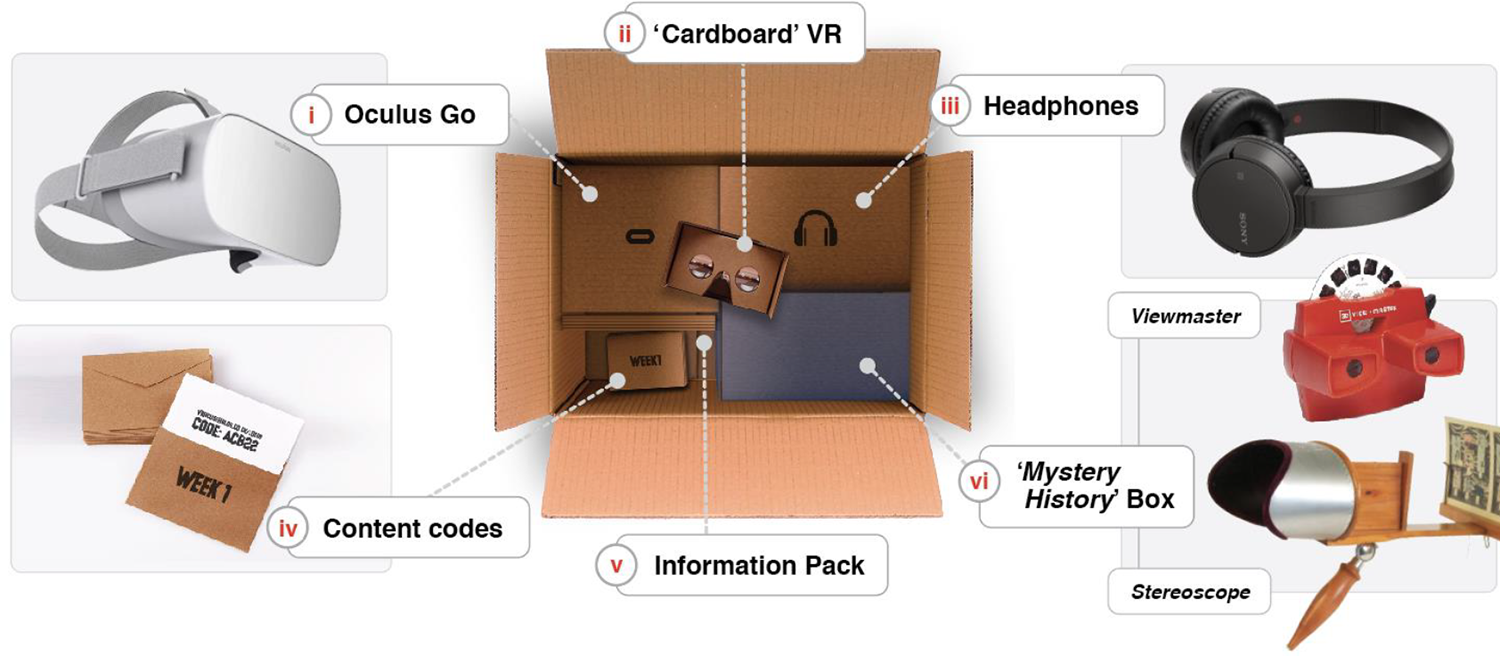
Study materials. (i) 1 × Oculus Go VR headset; (ii) 1 × ‘Cardboard’ VR headset for each participant (used with participants’ own smartphone); (iii) 1 × Sony BMDR-ZX110NA active noise-cancelling headphones; (iv) 8 × codes to access weekly content via the website; (v) 1 × Information Pack with manuals, replacement batteries, usage guides and project information; and (vi) 1 × ‘Mystery History’ box containing a Viewmaster (1970s) and Holmes Stereoscope (1900s).
During the study
To provide impetus and to help maintain momentum throughout the study, we provided each household with a set of eight envelopes, with details about the weekly theme and the individual pieces we curated around each theme. The weekly framing was designed to overcome the ‘paradox of choice’, an issue flagged in the BBC/Ipsos Mori study from 2017, and to aid discoverability of VRNF content. However, we made it clear to all participants that our recommendations were optional and they could discover content as they saw fit. Since the devices were also connected to the Internet, participants could watch whatever they wanted, whenever they wanted. We kept in touch with participants throughout the study via WhatsApp. We set up a group for each household and sent announcements for each theme and asked open-ended questions once per week. It was also used by participants to report issues and ask questions, and participants who did not use WhatsApp could also see and respond to the questions via a web form on the website.
Final interview
After a minimum of 10 weeks, we returned to each household and conducted a 90-min semi-structured group interview. The questions were organised into six sections, based on our research aims: patterns of usage, content, social aspects, perspectives on documentary, ethics and usability. The first section (patterns of usage) asked open-ended questions about their overall experiences during the study. The second section (content) included questions about likes/dislikes, preferred themes, surprises and frustrations. The third section (social aspects) was about the ways that the VR platform was talked about, shared and negotiated between household members and with visitors. In the fourth section (perspectives on documentary), we asked specific questions such as, do you think that real world subject matter works well in VR? and how is VR different to other kinds of documentary? In the fifth section (ethics), we asked open-ended questions, such as, do you think anyone could be negatively affected by VRNF?, as well as specific questions about the affective power of VR and whether any content was upsetting. Finally, in the sixth section (usability), we asked general questions about the usability and accessibility of the devices and people’s experiences of using the technology.
Data analysis
Based on transcriptions of our interactions with participants, two researchers conducted an inductive thematic analysis and generated a coding scheme of approximately 120 codes from the data. Through an iterative process of code clustering and analysis, we derived several broad themes. In this article, we focus on three that respond to the research question addressed in this article: Enthusiasm for VRNF, Reservations about non-fiction content in virtual reality and Reservations about VR at home. Within those themes, our interpretive frame draws on a cultural studies ethos – rooted in recognition of audience members as active agents who make ‘preferred’, ‘negotiated’ and ‘oppositional’ readings of media experiences (Hall et al., 1980). These theme headings then serve as the basis for the presentation of our findings below. Meanwhile, a complementary set of themes form the basis of another paper (in preparation) that reflects on the same data set from a more technical perspective. This extends the scope of this article and incorporates deeper reflections on the traditions of domestic technology uptake and usage, contextualised by historical work in the disciplines of computer science and human–computer interaction. Whereas our focus here is specifically on non-fiction, the other paper offers insights to designers and developers of VR systems in a broader sense.
Findings
Our interviews with participants offer a range of insights into their experiences of engaging with VRNF. We begin by discussing the ways in which participants’ engage positively with VRNF and discuss how those responses relate to the concept of immersion. We then turn our attention to some of the critical issues that participants raise, before finally addressing the specificities of the home context. The names used are pseudonyms and households are reflected by the allocations H1–H12.
Enthusiasm for VRNF
It’s quite a bizarre sensation, but enjoyable. Thoroughly enjoyed it. (Dan, H4)
Overall, we found that participants from all households, across all demographics, saw positive potential in VR as a platform for non-fiction. Participants all cited specific pieces of VRNF that they liked, and most said that they enjoyed one or more of the weekly themes. Science-related genres such as The Natural World and Space were notable favourites, but all styles, durations and formats drew some praise. Across this feedback, we were interested in examining the ways that participants made connections between the affordances of VR and their engagement with non-fiction content.
Participants regularly used the term immersive to describe what VRNF felt like. In one sense that is unsurprising, as immersion is in everyday use as a term to reflect the feeling of becoming ‘completely involved with something’ (Cambridge English Dictionary). In a cultural context, immersion is commonly used to suggest the feeling of being absorbed – in reading a book, in particular, and this feeling of deep engagement may be part of what participants are speaking about. In these VRNF experiences though, they also use immersion to convey the experience – unique to VR – of feeling oneself to be within a simulated media environment, rather than looking at media on a flat screen. It would feel like you’re very much part of it – and in it. (Cassie, H3) It didn’t matter where I went, I felt like I was in it, you know? On Valens Reef I’d find myself holding my breath. Because it felt underwater […] you do this [holds nose]. (Dan, H4) In the story of water in Pakistan*, where the community were gathering outside of their house and they were kind of coming up with different ideas of how to clean the water. You feel – in that moment – you are sitting next to them. (Khadija, H11) [*The Source]
And then it kind of takes you back to when I was young […] you are – not physically – but – oh – you’re emotionally there! (Khadija, H11) It’s better in VR because you can look up at the buildings, you can see the sky, you can turn around, whereas you wouldn’t get that from watching TV. And then there’s people that don’t travel or can’t travel – I think, you know that’s perfect for them. (Dan, H4) In real life – you can’t just go, like – you know – stare straight up, because you’ll look really weird to other people. But in VR…you can get away with things. (Darren, H4)
Walking New York begins with ground-level camerawork showing some artists constructing a large-scale artwork on the streets of the city. The whole piece can’t be seen at this stage, but the camera eventually lifts upwards to reveal a bird’s-eye-view of the complete artwork. As the camera rises, the viewer’s inclination to look down is rewarded as the whole picture is revealed; the vertical axis providing a spatial metaphor in which the viewer has some agency but with the intended action clearly signposted by the narrative. For participants, this was inspiring. That was the first one I thought, ‘oh I can really see why this would be amazing to documentary film’. Not that the other ones weren’t powerful in their own way but that was the first one that was like ‘oh wow’. It’s great. (Caroline, H3) And was it because of the bird’s eye view? I think so yeah – and also the fact that it was the way they did it was really clever they kept the final image secret until you saw it from above. (Cassie, H3) I don’t think you would have had the same impact on TV – it was like it felt like you were floating up above it and going…It makes my back shiver through just thinking about it! (Caroline, H3) I like the Space one because it was just…Space…everywhere! […] I’m always a bit blown away [by space] in general anyway, but [in VR] it was more like I was in the middle of it and looking all around me and that was kind of quite a ‘wow’ experience. (Eva, H5) I feel like I’m upside down! Oh good lord. I’m the man inside of it. So are you floating around in that? That’s crazy…That’s a space station! (Dan, H4) The space station one […] That was cool. It gave me such a sense of scale. But I didn’t like the rotation…It was worse than car sickness and worse than a roller coaster. (Alan, H1) I liked it as an interactive storytelling medium, like when there was a story and you could sort of – you know – you can explore the story in a different way because you’re a participant and you can sort of choose which angle you can see. (Alan, H1) I really liked being in the Grand Canyon [a background image on the menu screen], so I was quite happy to stay on the homepage. I don’t really want to do anything but just look around and I found that amazing…It’s completely wonderful! (Helen, H6) I found it relaxing because I didn’t have to think about anything else […] I can just think about this one thing, and even if it’s one thing that might be worrying, it doesn’t matter – because life is worrying. So, if there’s only one thing to deal with, that’s still easier. (Grace, H7) We’re so used to multiple distractions coming in, […] it was like going back to when we just had BBC1 and BBC2 and you watched the snooker in black and white. That’s the only thing that you can think about, look at, or do. So I loved that and I found it super-relaxing. (Isabel, H9) My mum asked one of us to search for like, ‘VR beaches’, so yeah we searched like ‘beaches VR’ or something and then we just clicked randomly on one that was about 10 minutes long and they just go like ‘this’…[relaxed ‘deckchair’ pose]. (Laila, H12) I thought it was gonna be like a kind of epic tour of the pyramids and it was sort of a bit like a video game and it was quite laborious – kind of clicking and moving and clicking and moving rather than it being a kind of cinematic experience. I wasn’t so keen on those. I kind of liked just being transported. (Caroline, H3) I think you get a lot more from VR. Being able to understand the person’s story, say, like the blind guy* […] getting a sense of it but from the VR video – the animation and the sounds and visuals. It just gives you more of a sense of what he’s feeling. You wouldn’t get that watching a documentary on a flat screen. (Francesca, H6) [*Notes on Blindness: Into Darkness] VR helps you understand real world problems. You see it from their perspective. You can understand them. And you can see the danger element. Because that one with the elephants. They tell you it’s dangerous and there could be poachers in the area, and they go through the bush and you go ‘there’d better not be any poachers in the area!’. You’re wary, whereas you wouldn’t be if you were watching a documentary on television. It wouldn’t have such an impact on you if there was somebody there. (Dexter, H4) 360° immersion in the rubble somewhere in Syria hits home a lot harder than it does watching on a 48” TV, because it’s all there around you. (Fred, H6)
Agency, affect and experience were all commented on as positives by participants, each discussed as providing a new dimension to non-fiction experience. I think VR enhances the documentary experience, which I was surprised about actually. I kind of thought on some level it might be too much, but actually I really, really enjoyed watching something that was really powerful, and being in it, and then taking [the headset] off and going “phew, I really got to experience that”. I found it really, really excellent from that perspective. (Caroline, H3)
Reservations about non-fiction content in VR
Alongside the positives that participants reported in relation to engaging with non-fiction content in VR, there was also negative feedback. Some of this related to personal preferences regarding subject matter, but distinct themes also emerged relating to user experience and to the form and ethics of non-fiction content on this novel media platform.
First, we need to acknowledge that most participants experienced the VR platform as not just novel but disconcerting. There are frequent and widespread uses of words including weird (70 mentions (m) across 10 households (h)), strange (14m/4h) and bizarre (5m/3h), as well as related terms like trippy (4m/3h) and freaky (4m/3h). The tendency for newly emerging media technologies to be received as troubling and even uncanny has been a subject of discussion among media historians. Tom Gunning notes how experiences of wonder and especially of the uncanny, ‘cluster around technologies like the telephone, or of representation like the photograph’ (in Thorburn and Jenkins, 2004: 39), and links these responses to feelings relating to liveliness and mortality, to life and death. Such responses tend to wane over time, he suggests, or with later adaptations. Film, for example, was perceived by some as ghostly, and music was added, to ‘breathe into the pictures some of the life that photography had taken away’ (Adorno and Eisler, 1947). For Gunning, ‘astonishment and familiarity’ are interlinked in the introduction of new technologies, although the path from one to another may not be predictable; ‘the move from astonishment to habitual second nature may be less stable than we think’ (Gunning in Thorburn and Jenkins, 2004: 39). The frequency with which study participants use words that describe types of emotional discomfort suggests that VR may meet some resistance in that journey.
For example, more than one participant noted a tension arising from the illusion of being present within the media scene, while being invisible, and without any agency in relation to unfolding events. (it’s) like being a ghost watching it but being able to do anything, and not anyone being able to see you or anything. (Monty, H8) Everything’s going on around you and you’re not involved with it, so you feel like you’re more pushed away. (Horace, H8) It’s too quick. You put it on, and there’s no backstory, and you don’t have their memories and their value judgments…and their perceptions – you don’t have any of that. You have your own value judgments that you’re making about what you’re seeing, supposedly through their eyes, but not really. (Amelie, H1)
Drawing upon the notion of ‘improper distance’ (Chouliaraki, 2011), Nash considers the ethics of the immersive documentary encounter and suggests that the illusion of virtual proximity with the subjects of VRNF carries a particular risk of improper distance (Nash, 2018: 1). For Nash, the position of the witness to documentary events is one in which the viewer needs to maintain a reflexive awareness of their own position and, likely, their privilege in relation to the situation of the documentary subject. She argues that within VRNF the illusion of being alongside the subject of VR documentary can lead to a situation in which the viewer’s awareness of that privileged position can be overwhelmed by the affective power of the scene.
While often recounted by study participants as a positive relating to the VR experience, the ubiquitous use of terms that suggest that participants felt as if present within the media scene – ‘in it’, ‘with them’, for example – appears to support Nash’s argument, as the illusion of presence erases the sense of (appropriate) distance from the documentary subject. Participants’ accounts are not however without critical reflection on this aspect of VR experience. One participant’s critique of the illusion of proximity suggests how, as well as eliding the distance between viewer and subject, this mode also cloaks the directorial point-of-view, It’s not the same because you feel immersed in it – you feel like you’ve been there – you feel like you’ve been somewhere, and you feel like you know about it; but actually, you just know one person – one filmmaker’s – perspective. (Cassie, H3) I have had to flee…I have had to run for my life. I don’t know if that would trigger a memory. (Khadija, H11) I’d be careful about showing it to people on drugs, or if they’ve got mental illness, because I think it could be very confusing. (Helen, H8) You were in a pig slaughterhouse, which was really intense and a lot of my friends went vegetarian after that. And it’s really, really gruesome! It really hits you, and to some extent it’s effective, but it’s not the nicest thing. And the other one that they did; you’re supposed to be in Syria, which was also really intense. It was powerful. Things are blowing up, and there are children screaming. It’s really intense. You can’t have it on for more than a minute or so. (Komal, H11) I suppose, actually, I trusted the content in the VR more…because I was in it. So I think it could be really persuasive, which is interesting. (Grace, H7) If someone’s using it in a way that’s, like, really honest then that has the potential to do loads of good. But if someone was using it for propaganda, for example, that could be really, really bad – spreading the wrong message – because it is so realistic you could end up thinking, ‘well that’s how it is cos I saw it with my own eyes’. (Cassie, H3) I suppose – in that it had the potential for a person to empathize more deeply with a subject – that’s like the currency of propaganda. (Alan, H1)
Reservations about VR at home
So far, we’ve considered reactions to the VRNF texts – the content of the VR works, and the immersive context in which that was experienced. However, by introducing VRNF into households, the study was also designed to provide a framework through which we could probe reactions to the platform of VR in the context of the home. While participants identified positives in the VRNF experiences that they tried, and suggested that immersion offered distinct potential for non-fiction, the limited extent of participants’ engagement told a different story about their interest in adopting this new medium for home use.
Seven of the 12 households stopped engaging after 1 or 2 weeks. For three others, it was a more gradual tapering. Two households dipped in-and-out with decreasing regularity. Two households persevered through each of the 8 weeks but conceded that doing so was out of a sense of duty to the research project. At the end of the study, only two households said they would consider purchasing a headset to continue using it.
While there was enthusiasm for the novel features of the medium, this wasn’t sufficient to sustain engagement, I guess at the beginning it was like, it was something new and everyone was like trying it out in the first couple of days but I think surprisingly quickly, we became quite used to it. Then we started using it like much less. (Kadin, H11) Yeah. I don’t want to say the novelty, but – yeah – I didn’t feel the need to keep going back to it, […] other than, yeah, finding some really immersive, really cool music videos and stuff. (Eric, H5) [Usage] did tail off over Christmas, and we found it quite hard to pull back, but that wasn’t any usability issue. (Fred, H6) In the first couple of weeks it was like kind of cool because it was sort of new, but then I was like a like a few of the documentaries but then, I thought like it’s just bit of a process you know I mean to go in there put it on and then watch the documentaries – like I have to be in the right mood, and I wasn’t often in the right mood. (Horace, H8) …when you put the headset on you’re at the mercy of people around you in the ‘reality’. And you’re quite vulnerable. (Isabel, H9) I mean I feel like we could get burgled. I could be sat there and there’s someone, like, carrying all my furniture out, like the TV just casually taking it all out and I’d be oblivious. (Barry, H2) I felt so strange I felt strange having the headset on when I was at home on my own because it made me feel vulnerable. (Cassie, H3) So one of the reasons I liked using it in bed was because I was alone and it was safe. And I would be – I didn’t feel secure sat here when they were other people in the house using it. Because, you know, my job is to look after small people. So that’s my job. So if I’m in here it means that I need to be there for them. (Grace, H7) Yeah it’s been […] really cool but I just found it incredibly antisocial – kind of incredibly antisocial. (Caroline, H3) Do you think it’s social at all? No – completely asocial. (Grace, H7) I guess if I was watching a documentary on TV with people I’d probably talk about it afterwards…That seems like something that would require a lot of orchestration to actually make that happen [in VR], compared with watching TV. (Alan, H1)
So when a respondent within our study says, about VR, that ‘it doesn’t bring people together’, they are speaking from a context in which they have experience of home media as a phenomenon that can perform positive social functions. In keeping the media out of sight to all but the person in the headset, VR closes off these multiple social uses that are taken-for-granted aspects of living with TV and can be expected to operate to a degree in relation to other screens that are open to be seen by multiple household members. In this context, VR is experienced as actively antisocial. …you can’t look up from it. Like, you know even if you were watching the football or playing a video game or something that would feel more connected and more like you could be in the room compared to that [VR], cos you’re inside it […] You can’t just look over from it cos it’s like stuck to your face…You’re snubbing the real world! (Barbara, H2)
It is social desire, Winston argues, that drives the transformation of the technological prototype into an invention that becomes embedded in everyday life. He calls this complex of social needs and favourable circumstances, ‘supervening social necessity’. In highlighting the poor fit between the VR platform and the sociality of home, our study suggests not only that domestic VR lacks a supervening social necessity but that it actively frustrates social desires.
There is furthermore some evidence within participants’ responses of a resistance to VR because it is seen as symptomatic of a wider trend towards social division that concerns them, I find it a bit troubling when you think about how people are becoming so kind of socially divided from each other to bring in another tool that separates you socially from other people and puts you into a world where you feel like you’re kind of…completely isolated from all our human contact. (Cassie, H3) And you’re detached from reality. (Caroline, H3) …it would be so different if you could watch it together – that would be such a different thing, wouldn’t it? It would have immediately felt like something that was really great to do…(Cassie, H3) …a Skype version of VR – that would be amazing…it becomes sociable. Okay [right now] you’re like removing yourself…from what’s around you, but if it is to talk to someone that is not around. Yeah, that is quite cool. (Amelie, H1)
Conclusions
In our household study of VRNF usage, participants articulated a variety of ways in which documentary and journalistic content benefitted from the affordances of VR. Participants felt that that their understanding of non-fiction themes was enhanced by the feeling of virtual proximity to people and places that they couldn’t experience directly, as well as by the spatial qualities of virtual environments. This led them to speculate about the potential of VRNF in schools, libraries and museums, in a way that resonates with emerging research about the potential of VR to provide an immersive dimension within out-of-home learning and discovery contexts. However, participants also expressed a number of pertinent reservations about VRNF and demonstrated a disinclination to engage with the VR platform that we believe raises questions about the viability of VR in its current form as a mainstream media platform in the domestic context.
Participants also offered a variety of insights in relation to VR user experience and grammar that producers might learn from. For example, some were uncomfortable with works in which there was ambiguity about their point-of-view or role and conversely showed an appreciation for works that offered them meaningful agency and interactivity. We were initially taken aback by participants’ enthusiasm for the simple home screen, but understood from their reflections that this expressed a pleasure in immersion in high-resolution images, and in an environment in which they had the freedom, agency and time to explore as they chose. While not specific to VRNF, discussion of the home screen also suggested how seclusion within the headset – that was a concern in other respects – might have positive potential for relaxation as a counter to the distractedness of contemporary life.
One of the most significant findings for non-fiction relates to participants’ concerns about the affective and persuasive power of VR. In this context, the ‘feeling of being there’ within immersive media amplified the impact of distressing or intense content. It was felt to endow content with a compelling veracity, as if it had been seen first hand. This led participants to raise concerns about the impact of VR on vulnerable users, and its potential for manipulation or propaganda. Here, we see an urgent need for the development of digital literacy that addresses the context of immersive media, for protocols to alert users to intense and/or potentially ‘triggering’ content and potentially for new governance structures around VRNF.
While they offered these valuable insights, participants also expressed reservations about VR as a home media platform and demonstrated those reservations through a lack of engagement. The headset was the problem. Because of it, most felt VR to be unsociable when others were at home, and some felt vulnerable if they used it when they were home alone. As participants prioritised the sociality of the home, their VR use tapered quickly. More research will be needed to ascertain if and how immersive media might have potential for non-fiction in a domestic setting. Perhaps AR or MR platforms might deliver some of what participants valued in VR without the sense of dislocation from other people and the physical environment.
TV was a key cultural touchstone for almost all of our participants and, as a basis for comparison, it was seen as a more sociable medium. In its present form, consumer VR was seen to frustrate the social functions of TV in a domestic setting while not having a clear social role of its own. However, participants’ appetite for sociality led them to speculate on the potential of VR for social connection. Some wished that they could jointly experience the VR content that was made available within the study. Others mused on VR’s potential for co-presence with distant others. With Covid-19 now enforcing social distancing, and people turning to VR as a platform for connection rather than isolation, their insights take on particular relevance and poignancy and suggest that sociality needs to be a central concern within VRNF research and production.
Footnotes
Acknowledgements
Thanks to Helen Brown, Jo Gildersleve, Maxine Glancy, Stuart Gray, and Julia Scott-Stevenson for their input to the research reflected in this article and to the staff and communities of the Knowle West Media Centre, Filton Community Centre, the Bristol VR Lab, We the Curious and Refugee Women of Bristol for their support in recruiting our households.
Funding
The author(s) disclosed receipt of the following financial support for the research, authorship, and/or publication of this article: This research was funded by the UK EPSRC (Engineering & Physical Sciences Research Council) as part of the research project Virtual Realities: Immersive Documentary Encounters (ref: EP/P025595/1). For more information on the project and its partners, please visit  .
.