




Abstract
This study responds to recent calls to investigate how media users perceive virtual reality technology in journalism. Within a uses and gratifications framework, focus group participants were asked to experience recent immersive journalistic productions and discuss their reactions. Six distinct gratifications were identified, which cluster into gratifications related to experience, affect, and action. Despite clear reservations about the technology, users see great potential for journalistic use. If employed responsibly, users think virtual reality can add considerable value to mainstream journalistic productions, potentially boosting engagement and trust. Researchers and practitioners can benefit from this initial study of users’ impressions of and reactions to immersive journalism.
The hype over the use of virtual reality technology in journalism has been growing steadily over the last few years (Doyle et al., 2016). This has led to heavy investments in its development (Döpfner, 2016; Phelan, 2017) and major media houses have been experimenting with its storytelling possibilities. Current productions have been given the umbrella term ‘immersive journalism’, and some researchers predict such developments have the potential to profoundly shape the future of journalism (Aronson-Rath et al., 2015; Doyle et al., 2016; Mufson, 2014). Despite this optimistic discourse, however, questions and issues about its utility, benefits, and pitfalls – especially from the perspective of users (Watson, 2017) – remain insufficiently addressed in the academic literature.
This study, therefore, takes an initial exploratory step toward understanding what media users think of immersive journalism as a means of news consumption. Using focus group methodology, we explored the ways in which media users understand and respond to immersive journalism, also compared to traditional journalism. Our research identifies six gratifications that users derive from immersive journalism, related to how users experience the technology, affectively respond to it, and the degree to which it enhances feelings of agency. Our results have implications for both researchers and media companies who are interested in the audience perspective on this much-hyped trend.
The crisis in journalism and the emergence of VR
Media practitioners and scholars alike recognize the dynamically changing – and in many cases, struggling – news business. Alongside declining subscription (Pew Research Center, 2016) and ad revenues (Anderson et al., 2014), and challenges in maintaining and increasing profits (Grueskin et al., 2011), media trust in so-called ‘fake news’ era is alarmingly low (Marchi, 2012; Newman et al., 2016), as is general interest in the news, particularly among younger audiences (Cauwenberge et al., 2013; Marchi, 2012). But ‘the only way to get the journalism we need in the current environment is to take advantage of new possibilities’ as Anderson et al. (2014) argue (p. 42). In particular, virtual reality (VR) has become a hot topic in journalism research (Doyle et al., 2016; Watson, 2017) and practice, as a wide range of media outlets has started experimenting with VR (Doyle et al., 2016). In 2015, The New York Times sent out over a million Google Cardboards – foldable, low-cost VR viewers that mount onto a smartphone – to subscribers for the launch of a new VR initiative (Owen, 2015), and other outlets have also launched VR apps (CNN Press Room, 2017). A growing list of VR-productions has developed since late 2015 (Doyle et al., 2016), on topics as different as the aftermath of an earthquake in Nepal (RYOT, 2015), a visit to North Korea (Woodruff, 2015), and the discovery of Mars’ Gale Crater (Emamdjomeh, 2015). Noticeably, all the best examples are productions by established players in the media field, with big budgets and specialized technical and journalistic teams, but still, VR journalism, it seems, is on the rise. Despite this industry interest, there remains much ambiguity in terms, in scholarly understanding, and, in particular, in our understanding of how audiences perceive VR as a potential anodyne to some of journalism’s problems.
VR, immersive journalism, and the research so far
First of all, despite being labeled as such, calling most of these productions ‘VR’ is an exaggeration (Smith, 2015). While the technology and inspiration derive from over 40 years of VR use in research labs, gaming, and science fiction, existing journalistic productions differ, technically, from a true VR experience. True VR has four key elements: a virtual world, immersion, sensory feedback, and interactivity (Sherman and Craig, 2003). A virtual world is a constructed place where content is conveyed; immersion – mental or physical – is understood as the individual’s sense of presence; and sensory feedback and interactivity relate to the technology’s ability to respond to users’ actions (Sherman and Craig, 2003).
Most current journalistic productions labeled as VR are 360° videos (Cornia et al., 2016), and despite providing users with some control over the story – by allowing the user to choose what to focus on – such productions lack true ‘interactivity’ – the viewer cannot interact with characters or scenes in the story and receive tailored responses. A small but growing number of productions using computer-generated virtual worlds designed to represent reality do exist (De la Peña et al., 2010; Guardian, 2016), enabling more or less interaction by letting the audience impact the unfolding events, but these are currently either generally inaccessible or limited to eye control – not general control – of movement. Hence, the term immersive journalism (IJ) is more appropriate for these products, though other scholars continue to use VR. This article will henceforth use the term IJ, using VR only to describe the technology.
When it comes to audience research concerning IJ, early explorations – including experiments examining the effects of IJ on audience perception (De la Peña et al., 2010) – generally provide an optimistic take on IJ’s potential as playing an important role in ‘the future of news’ (Aronson-Rath et al., 2015; Doyle et al., 2016; Watson, 2017). Of particular interest is the possibility to mentally bring audiences to distant, inaccessible places, and for audiences to experience these with ‘their own eyes’ (Doyle et al., 2016). Emerging entertainment technologies have for years centered on this goal of giving users a truly ‘natural’, immediate’, ‘direct’, and ‘real’ experience (Lombard and Ditton, 1997; Schubert et al., 2001), and the related notions of presence and transportation are well-known to media researchers. For example, research on narrative transportation shows that being highly transported has a positive effect for readers in terms of believing information (Green and Brock, 2000). For journalism, this suggests that perhaps IJ, through its capacity for transportation, can rebuild trust among audiences in ways traditional journalism cannot; this is especially interesting now, as the spread of (un)intended misinformation or ‘fake news’ appears to be on a rise (Marchi, 2012; Newman et al., 2016). But questions remain unanswered about whether news consumers are actually ready to be (and interested in being) mentally transported for the sake of consuming the news.
Like presence, audience interactivity and the role of the narrator are other keywords in IJ research, and a fundamental shift in production and viewing of IJ in the story framing has been acknowledged (Jones, 2017). That is, although narrators (including journalists) give context to a story, fully interactive experiences – combined with effective storytelling and appropriate choice of subject matter – appear to help content have a stronger impact on a receptive audience (Karlin et al., 2018). An experiment carried out using VR content explored responsiveness and embodiment as contributors to feeling present and interested in IJ and found that responsiveness was the major factor positively contributing to presence (Steed et al., 2018).
A final relevant element in extant IJ research is empathy. In a 2015 TED talk, filmmaker Chris Milk described VR as ‘the ultimate empathy machine’, and it caught a lot of interest in VR technology’s potential for news (Steed et al., 2018). The Tow Report Virtual Reality Journalism pointed out that ‘a core question is whether VR can provide similar feelings of empathy and compassion to real-life experiences’ (Aronson-Rath et al., 2015). Experimental IJ research has found VR technology to have a positive impact compared to traditional journalism on not just feelings of empathy (Laws, 2017) but also source credibility and story-sharing intention (Sundar et al., 2017); likewise, research shows empathy to be linked to immersion and embodiment (Shin and Biocca, 2018). Empathy, then, seems to play a similarly essential, though possibly controversial, role in understanding how VR technology might be used for the news.
Thus, we know IJ has a positive effect on presence, that presence leads to higher source credibility, and that interactivity and empathy are central to these positive experiences. We know, also, that the technology is being used by newsrooms as a new way to connect with (new) audiences (Watson, 2017). But for IJ to actually live up to its hyped role in ‘the future of news’, more investigation into how media users perceive the technology’s potential for news consumption – and understand the relevance of presence, interactivity, and empathy to IJ news consumption in particular – is needed. Can they actually see themselves using it – and if so, why?
Studying audiences
Understanding media audiences is essential to understanding media effects (Rubin, 2009). Audiences are commonly studied from a Uses and Gratifications theory (U&G) perspective. U&G originated from studying how media and its content satisfies the social and psychological needs of audiences (Cantril, 1942), and gained popularity in the second half of the last century with a change of research perspective from ‘what do media do to people?’ to ‘what do people do with media?’ (Katz, 1959). The cornerstone of U&G theory in relation to mass communication was laid in the 1970s (Ruggiero, 2000) with the understanding of audiences as selective and motivated by rational self-awareness of their own needs, as well as the expectation that those needs would be satisfied by particular types of media and content (Katz et al., 1974; Palmgreen, 1984). 1 In their seminal work, McQuail et al. (1972) identified four broad gratifications for using traditional media: diversion (media serve as a distraction and way to pass time), personal relationships (media provide ‘ammunition’ for social conversations), personal identity (media help people understand themselves and how they fit into society), and surveillance (media provide information to understand and control the environment). Across all these studies, surveillance is the only gratification that has remained constant. The original outline of U&G, however, still dominates research on media gratifications to this day, where the notion of an active, rather than passive, audience has reached new heights with the Internet and moved from an assumption to a reality (Sundar and Limperos, 2013).
Scholars have criticized U&G for lacking comprehensive theoretical grounding and clarity of central concepts, and for not acknowledging how technology itself can impact the selection of media for obtaining gratifications (Ruggiero, 2000). Still, U&G is considered a highly effective approach to the study of uses and effects of 21st-century electronic media (Basilisco and Cha, 2015; LaRose and Eastin, 2004; Rubin, 2009), including mobile phones (Leung and Wei, 2000), online newspapers (Yoo, 2011), social media (Basilisco and Cha, 2015; Quinn, 2016), and augmented reality smart glasses (Rauschnabel, 2018). However, gratifications associated with IJ remain unexplored. The original gratifications identified from traditional media may not be applicable to IJ since the activities are fundamentally different. Thus, the theory used here is as an exploratory first step in understanding what key reasons audiences identify for using IJ, and what gratifications they obtain from it. Furthermore, focus group methodology puts users’ experiences front-and-center, thus adding unique perspectives to the growing body of research on IJ.
With all of this in mind, we posed three audience-centered research questions to structure the data collection and analysis:
Methods
Given the novelty of the technology and relative scarcity of IJ audience research to date, an inductive, qualitative focus group approach was felt to be most appropriate (Boeije, 2010). Research with an exploratory nature, setting out to take a first step toward understanding a new area of inquiry, is considered to benefit more from qualitative than from qualitative data (David and Sutton, 2011). This approach allows researchers to interpret new phenomena in terms of the meaning people bring to them (Denzin and Lincoln, 1994). Our focus groups allowed us to introduce participants to the technology yet keep the tone rather informal and include ‘everyday talk’ which is useful in the process of producing and reproducing meaning in daily life (Kitzinger, 1994; Lunt and Livingstone, 1996). Focus group participants can be each other’s audience in constructing meanings and understandings (Lunt and Livingstone, 1996); the combination of researcher control and participant-driven discussion affords a broad range of information on the topic (David and Sutton, 2011).
Recruitment of participants
Recruitment was done through convenience sampling, which is the most common method for selecting focus group participants as it saves time and money but still considers the characteristics of the participants in relation to the research (Stewart and Shemdasani, 2015). A web page and flyer with relevant information about the focus group were shared through the lead researcher’s online, offline, and mobile networks. It was stressed that anyone with a personal knowledge of the lead researcher could not participate, that participants were expected to bring a smartphone and headphones, and that the discussion would be in English (to ensure participants were fluent enough to have a natural, interactive discussion). We advertised that participants would receive a pair of Google Cardboard VR viewers in exchange for participating. These were donated for the research by Google News Lab.
Twenty-two people showed interest. They were asked to fill out a short questionnaire about themselves. Based on the results, participants were divided into two groups: one for those in communication-related occupations (students or practitioners of journalism, communication, or marketing) and one for those in non-communication-related occupations (students or practitioners of anything else). A few interested participants were excluded in order to evenly distribute the two groups, and so a total of 13 people eventually participated; 8 were male, most were master’s students (9 of 13 – all in other fields than the researchers’), they had nine different nationalities (five were Dutch) and they were between 22 and 60 years of age (the second oldest was 32).
The focus groups were conducted on 18 and 19 April 2017. Participants were welcomed by the lead researcher, who also served as the focus group moderator. Everything was recorded on video for analysis purposes. A colleague of the lead researcher provided technical assistance with recording devices and assisted in answering questions from participants about how to use the Google Cardboards.
Conducting the focus groups
After signing consent forms and checking their Internet connections, participants were given a Google Cardboard and instructed in its use. Participants were then asked to introduce themselves through a small ice-breaking activity; then the discussion started out with simple questions about why and how they used journalism in their daily lives.
Next, VR as a topic was introduced, using association cards, where participants wrote down what came to mind when thinking about VR, which led to a short discussion. This was followed by two rounds of structured discussion about two examples of IJ: first, a 360° video production by The New York Times about the war in Iraq called ‘Fight for Falluja’ (The New York Times, 2016), and second, an IJ smartphone application by the Guardian about solitary confinement in the United States called ‘6x9’ (Guardian, 2016). After each example, participants shared their reactions, and the discussion was gently structured around the three research questions. For RQ2, which asked about the comparison with traditional journalism, participants were shown a clip from the TV documentary Frontline on solitary confinement in the United States by PBS (Jones and Edge, 2014), which was based on the same research as the Guardian’s app. To broaden the discussion, the moderator continuously reminded the participants to focus on the general experience – not the topic or messages of this specific content.
A final discussion challenged participants to consider whether and how they might use IJ in the future. Closing statements and farewells followed. Both sessions lasted for 1½ hours. The full focus group guide can be found in an online appendix.
Data analysis
To analyze the data, thematic analysis was used. This is a method for finding themes that emerge as important to the description of the phenomenon (Daly et al., 1997), through ‘careful reading and re-reading of the data’ (Rice and Ezzy, 1999: 258). The analysis is data-driven, and the coding is a recursive process (Braun and Clarke, 2006).
After a structured familiarization process by the lead researcher, a code list of major topics related to the RQs was generated. Data relevant to each code were collected while the coding set was inductively expanded through coding and recoding of data. This process matched the ‘scissor-and-sort’ technique (Stewart and Shemdasani, 2015). When an existing code wasn’t sufficient to accommodate an existing theme or topic, a new one was created. The final list consisted of 24 relevant codes (see online appendix 2). These codes were analyzed and structured around the RQs (see online appendix 3). NVivo, a qualitative textual analysis software, was used for coding.
Results
In the following, the data for each RQ are presented using examples, descriptions, and quotes from the focus groups. Participants are referred to by a letter (A for members of the ‘non-com group’, B for the ‘com group’) and a number to differentiate participants from each other.
RQ1: Gratifications from IJ
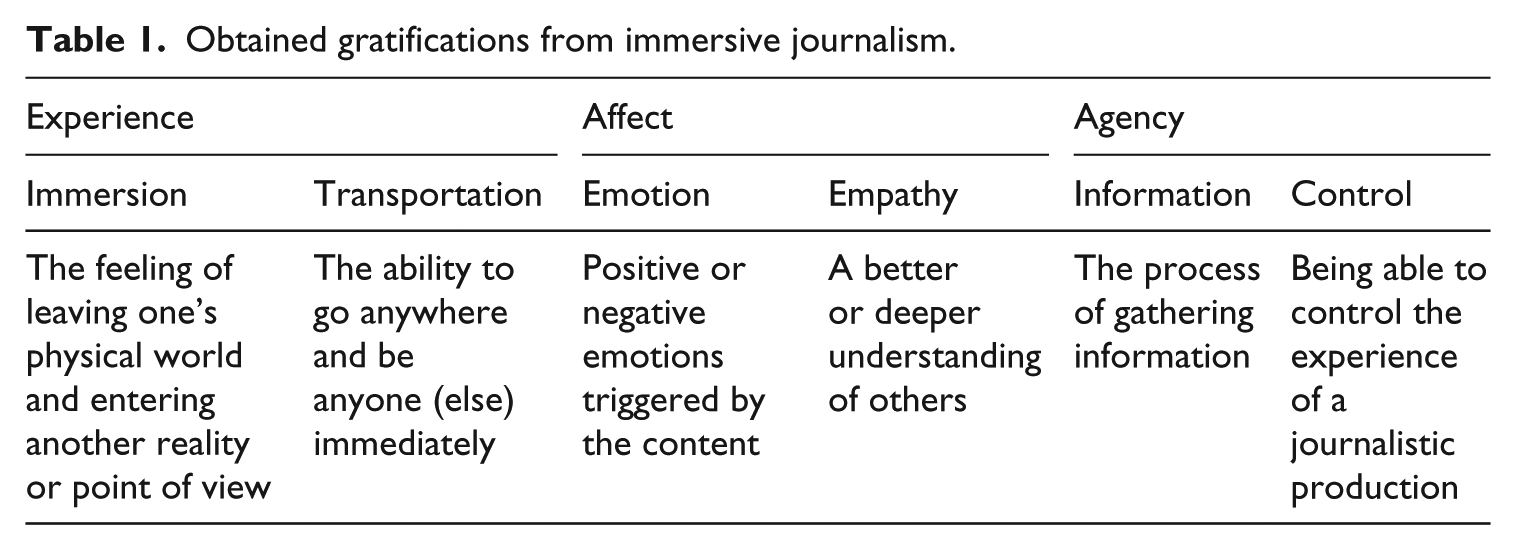
Participants were asked to discuss why and how they would potentially use IJ to satisfy specific needs (RQ1). Their identified gratifications grouped into six broad categories (see Table 1), some of which speak to traditional U&G research, others of which fit better with research on immersive media, as described below. These six gratifications cluster, conceptually, into three pairs: experience, affect, and agency.
Obtained gratifications from immersive journalism.
Experience gratifications: Immersion and transportation
The first category of gratifications relates to how users experience IJ. It includes immersion, the experience of leaving one’s physical world and instead entering another reality or point of view, which was a dominant gratification identified by the com group. Many participants expressed feeling highly immersed in the IJ examples, through phrases like ‘when I was in the cell’ (B2).
The non-com group expressed less immersion, but some did feel the impact of a change in point of view: ‘I have never seen prison as a threat to me, but suddenly it became one’ (A3). Overall, they distanced themselves more from potential immersiveness: ‘In the end, we are comfortably still sitting here and having chocolate’ (A1).
The feeling of ‘being there’ (or not) is closely related to immersion but separated by giving users a notion of being taken to another place – perhaps one they cannot physically experience. This gratification of transportation is thus a second gratification related to experience. While members of the non-com group called it ‘an extension of perception’ (A4), this was mostly addressed by the com group who pondered seeing a war battlefield, watching a surgery, or witnessing breaking news stories somewhere as they unfold: ‘instead of going to Twitter, I would go “there” instead to check it out’ (B6). Transportation is a well-established factor in the role of persuasive impact of public narratives (Green and Brock, 2000).
Research on IJ has found these two gratifications to be of particular relevance for journalism (Aronson-Rath et al., 2015). The findings indicate that IJ provides an immersive experience that could lead to more transportation than traditional journalism and that IJ could provide a more compelling way for audiences to achieve this gratification and gain insight and empathy for the conditions of others (empathy will be discussed further below).
However, the group division revealed interesting differences between the participants. Most noteworthy, many non-coms distanced themselves from what was real by discussing bias and fear of manipulation, whereas almost the entire com group got highly immersed verbally and physically. Research has found knowledge of and prior experience with the medium to impact the perception of it (Lombard and Ditton, 1997), and this could be an indication of such for how IJ is experienced, at least vis-à-vis the experience gratifications.
Affective gratifications: Emotion and empathy
The second category of gratifications relates less to physical or mental immersion, and more to affective responses. The first is emotion. This included positive and negative emotional reactions to IJ content; gratifications do not have to be experienced as positive (Orlik, 2015). In the current case, negative emotions experienced (such as feeling claustrophobic) are still regarded as a gratification because they contribute to the overall understanding of the story.
The com group expressed how they ‘got pretty scared sometimes’ (B6), how it was ‘extremely uncomfortable’ (B5), and that it was ‘disorientating’ (B3), but also how emotions enriched the experience despite the unpleasantness. B2 and B5 both suggested that ‘If you want an emotional response from the viewer, then VR is the way to go’ (B2).
The non-com group found it ‘cool, but also a bit stressful’ (A1), to be a ‘very active way of consuming’ (A2), and A3 found it ‘exciting’ and ‘tense’ even though she at first found it very uncomfortable due to claustrophobia. Although responses such as ‘disorienting’ and feeling sick could be categorized as unintended consequences rather than as actual gratifications, almost all participants expressed some individual emotional reactions as gratifications from their IJ experiences.
In addition, participants often linked their experience to the notion of empathy for others: ‘When you can get the feeling of how it is to be there [in solitary confinement], you kind of understand why they get crazy’ (B1). Empathy is, therefore, the fourth gratification identified. Both groups touched upon the opportunity IJ presents to put people in others’ shoes, which B4 called ‘unique’ because not enough people ‘look outside their own life’. However, the non-com group had a larger focus on empathy and the ‘emotional investment’ (A1) in the ‘characters’ as an important gratification, one that could lead users to care about topics or stories they may otherwise have gotten desensitized to. ‘Every time there is a war, some people are saying “this can never happen again” and it always happens again’ and ‘maybe they really need to realize what is going on and VR could contribute to that’ (A5).
This resonates with De la Peña et al. (2010), who found that IJ leads to emotions accompanying news and greater audience involvement with the stories, which can create empathy. Emotion and emotional release are key elements in the literature on U&G, considered to belong within ‘diversion’ as one of the four broad motives for using media (McQuail et al., 1972).
Emotion and empathy are not new media gratifications, but the immediacy and intensity with which IJ elicits them might make these particularly relevant gratifications for this sort of journalism. Such gratifications can give audiences a more profound and richer understanding of stories by appealing to their personal feelings in ways that contribute to a strong understanding of others. For journalists, this is potentially appealing as part of their role conception may be as mobilizers to take action on pressing issues (Beam et al., 2009). As such, there is clear potential in VR for journalists to achieve that goal.
Agency gratifications: Information and control
The third category of gratifications relates to the way users can learn from and control the content of IJ. Both groups said IJ would be useful to gather and help simplify information on complex matters: ‘I thought about history education [. . .] about the 16th century, which I think would help especially young people understand better how things were’ (A7). Both groups felt that information needs might be specially served by IJ for areas that users were already interested in; A4 noted that it would be great for occasionally experiencing a ‘special piece’ one already had an interest in and wanted to know more about. Most participants also considered IJ useful for getting a new perspective on generally well-known topics. Notably, however, a consensus emerged in the non-com group that IJ was too intense to use for everyday information gathering.
A second gratification emerged here: control. Both groups highlighted how they could control the experience and therefore also the information they were interested in when using IJ: ‘I wanted to listen to the whole thing [about letters on the bed in the prison cell], so I stayed there and kept looking’ (B4). Unlike a traditional news story, in IJ, users can not only explore and find their own answers to questions but also choose to stay in the story for a long time and to get purposefully lost while exploring. The ability to look around was found by the com group to make it a very personal experience.
This idea of control was particularly relevant to the IJ app experience; participants – especially in the non-com group – distinguished between the app experience and the 360° video by describing the latter as more limiting, which A4 called ‘like you are a GoPro [camera] being carried around’. Also, the participants’ body language was indicative: during the 360° video, only one person stood up, whereas three stood up and even walked around the room during 6x9. While doing so, B6 stumbled over an item shown in the video and almost walked into the camera recorder, B1 moved her hand to reach out for a virtual item and B2 walked so far away from the table that he almost hit a wall on the opposite of the 85 m2 big room. This, of course, not only exemplifies the immersion mentioned previously but also illustrates the level of agency related to control and information in the experience.
Information-seeking has, as noted, been a constant across most U&G studies (Sundar and Limperos, 2013), and for media studies in general. In the age of information, media users will seek information (Ruggiero, 2000). IJ presents a new way of getting information, however, that gives more agency and control to the user/audience. Thus, information and control are important gratifications that increase users’ agency, adding value to traditional news stories – especially for complex topics, where the immediacy and control of the experience can simplify the content and provide a more personal information experience.
RQ2: IJ versus traditional journalism
The discussion of RQ2 was facilitated by participants trying out the IJ app on solitary confinement after having watched a clip from a TV documentary on the same topic (and based on the same journalistic research; Jones and Edge, 2014). Participants in both groups agreed the two formats had different, complementary qualities: IJ adds value to traditional journalism. They emphasized how the TV piece was more pleasant for being introduced to facts while the IJ app gave a deeper and more memorable understanding of being in solitary confinement: ‘Watching it on TV communicated to my brain, where the [app] was communicating more to my heart’ (B5).
Participants discussed how traditional TV can feel ‘overdramatized’ whereas IJ can be ‘more authentic’: ‘You’re genuinely like this prisoner, you listen to their story and there is no element of over-acting’ (B2). The notion of empathy was included in the authenticity discussion and linked to the experience with comments such as ‘[In the documentary] it’s very easy to distance yourself from them [prisoners] and to not really care about their cause, but when you feel like it is you sitting there, you suddenly feel much closer to them’ (A1). Thus, authenticity emerged as a way that IJ can differ from traditional journalism.
This perceived authenticity also prompted discussion of potential manipulation and over-editing in both traditional journalism and IJ, where the two groups had diverging perspectives. The com group was positive about the prospects of IJ content because the entire scene – not just one angle of it – is presented firsthand. The non-com group was more skeptical, and members emphasized how it is still ‘something editors did’ (A6) and that ‘[I don’t think] we should discard our objection to bias because – you can still make anything biased – even VR’ (A7).
A3 and A7 argued that IJ also has moral complications because it can give news about real people a ‘video-game feel’. Addressing the best way to make IJ content seem real and not manipulated or like a video-game, Migielicz and Zacharia (2016) produced a practical guide for VR journalism that touches upon issues also raised by scholars such as positioning of the journalist or the narrative direction in storytelling (Aronson-Rath et al., 2015; De la Peña et al., 2010). Scholars have found it problematic that IJ simply appears very real (Kool, 2016: 9). Thus, we see that IJ treads a fine line between providing a sense of greater authenticity for some users, whereas others see it as video-game-esque and no less subject to manipulation than traditional news stories.
Both groups highlighted the new and personal perspective as the most crucial difference between the two kinds of journalism. Individuals in both groups (A4 and B5) drew parallels to TV’s impact on the Vietnam War when the American people got their first real pictures of war; such images are credited with turning public opinion against the war (Mandelbaum, 1982). This led to specific points of caution in the discussion of IJ’s impact: A3 found it problematic and said ‘We don’t need more technology to enhance our moral judgment [. . .] I can still say that it’s horrible what happened in Iraq, but I don’t need to experience it to know it’, and B5 encouraged media who want to use IJ to study its effect carefully before using it over traditional journalism: ‘This [IJ] can have the same impact [as the Vietnam War had] that people can get much more engaged than they were before, and you have to know what you are playing with’. Interestingly, scholars have also discussed IJ related to the effect of technology during the Vietnam War. Kool (2016: 9) notes how we should think carefully about how it can ‘change the transmission, the reception, and the understanding of news around the world’.
In sum, when comparing traditional journalism and IJ, the most important aspects are the personal experience and emotional impact of IJ. According to the focus groups, IJ is not set to replace traditional news, but instead, it provides complementary features, not without their own ethical issues.
RQ3: VR as a medium for journalism
Participants were all asked before and after the main portion of the focus group whether they thought they would use IJ on a regular basis for their news in the future. There was a difference between the two groups. In the com group, one of six answered ‘yes’ before the examples/discussion, versus five of six after they had tried it. They all believed IJ had the potential to be the ‘next big thing’ and hoped to see more options for customized user experiences. Their biggest hesitation was the social constraint of feeling self-conscious and looking silly using VR viewers. A similar finding was reported by the BBC, whose research suggested current limitations to the way audiences experience VR ranging from ‘clunky user experiences of the headsets to confusion around varying user experience’ (Watson, 2017: 37).
The social constraint was echoed by the non-com group, though they believed it would evolve along with the development of more convenient technology: ‘If everyone is walking around with special glasses that can switch the real world on and off and have different channels, then I would also use it on the streets or in the metro’ (A3). For personal news use in the future, however, only two of seven said ‘yes’ while the rest said either ‘maybe’ or ‘no’, both before and after trying it. Only one member changed her mind and went from ‘maybe’ to ‘no’, thus the non-com members were more pessimistic about IJ’s mainstream implementation. This could be due to different approaches to the concept of ‘news’ and how to use it. Furthermore, the com group had a much clearer idea of what VR was before the group session started, and that knowledge alone combined with their interest in participating could be an indicator of how prior interest in VR and its development impact the experience positively. In any case, practitioners and theorists alike should be cautious before assuming that all users are ready to adopt the technology. Participants in both groups agreed that IJ would never be the only way of consuming news, but that it would and should supplement other productions.
Discussion
Attaining ‘value’ is one of the most essential drivers of success in people’s acceptance and use of (new) media and technology (Rauschnabel, 2018). This study takes a small, though important first step toward understanding what media users think of VR technology – and specifically IJ – as a means of future news consumption.
Our findings suggest that although some users have reservations about the technology and their likelihood to embrace it, they see great potential in the use of IJ. To them, IJ will never be the only way of consuming news, but if done right, it can add value to many journalistic productions. Specifically, six interconnected gratifications from using IJ were identified: immersion, transportation, emotion, empathy, information, and control. These gratifications are individually echoed in research on immersive media (Aronson-Rath et al., 2015; De la Peña et al., 2010) or U&G research on traditional and new media (Katz et al., 1974; Ruggiero, 2000; Sundar and Limperos, 2013), but as a set of gratifications specifically linked to IJ, it is unique. VR technology in journalism indeed offers ‘unheard-of-possibilities for journalism’ as news becomes ‘an experience’ (Kasem et al., 2015: 16). As the focus group discussions on authenticity suggest, VR can potentially serve an important purpose for building trust with audiences by letting them experience the news ‘with their own eyes’ (Newman et al., 2016).
Despite that optimism, the results here show that users may find IJ less suitable for presenting facts and statistics, to be too stressful and attention-demanding for everyday use, to raise moral issues, and to be relatively inconvenient in its current form. The constraints regarding wearable technologies should not be overlooked, but when it comes to fashion adoption, social influence matters (Grant and Stephen, 2005); as A3 pointed out in the focus group, this would naturally change with more people using it.
Our results confirm that media houses – at least those with sufficient budget and expertise – could benefit from exploring the use of VR technology further. IJ can give audiences a deeper and richer understanding of stories, appeal to emotions and enhance empathy (Laws, 2017), and create a strong notion of being present elsewhere. New media and technology come with new user gratifications (Ruggiero, 2000; Sundar and Limperos, 2013) and by satisfying experience, affect, and agency gratifications, IJ may be a powerful tool to cover and understand otherwise inaccessible places. This is especially relevant for journalists, in their role as social mobilizers on pressing issues (Beam et al., 2009). It can provide a personal experience of journalism not matched by traditional news and might provide a competitive edge for media houses competing in the information age.
That said, the results are necessarily tentative, primarily due to our method. Focus group data cannot be considered generalizable, as dominant individuals taking control of the discussion, member contributions being limited to what they are willing to share in a group, and particular attitudes toward the topic brought up early on can affect the conversation going forward (Carey, 1995; David and Sutton, 2011). Likewise, in terms of our sample, the two groups mainly comprised students in their 20s based in a large European city. This sample of higher-educated university students is not representative of other demographic segments, and it is safe to assume that users less familiar with smartphones, social media, and new technologies may have a different attitude to IJ. However, younger audiences are considered particularly interesting for IJ because their news habits are still developing (Marchi, 2012); furthermore, they are ‘digital natives’ more likely to accept new technology (Kasem et al., 2015).
What our sample allowed, however, was the interesting subject-field difference to emerge: the com group was much more ‘on board’ with the technology (and with news itself), almost uncritically persuaded about IJ’s potential. Conversely, the distrust toward journalism in general expressed by the non-com group is in itself worthy of further investigation, in addition to their greater skepticism toward the technology and its effects. This suggests follow-up studies should continue to consider the ‘starting position’ of respondents relative to both news and technology. If only those users already relatively trusting of journalism see benefits to IJ, then IJ may not (yet) be able to bring distant audiences back to journalism or boost trust among the skeptical. Future work could probe this idea further, for example, with experiments examining the effects of IJ on trust in the news, as moderated by prior news attitudes. Additional focus groups with more varied participants would also expand our understanding of how users experience these technologies for journalism. Interviews with newsmakers and storytellers are also important next steps to illuminate the goals newsrooms have for IJ and VR – and focus group findings can be shared with those practitioners to facilitate recognition of U&G on both sides of the equation.
Although we know from research that the level of interactivity contributes positively to the level of immersion, we chose not to include a fully interactive IJ experience in the focus group experience, as these are still not widely accessible for consumers. (Similarly, our use of Google Cardboards instead of better equipment reflects that these were, at the time, the most available and affordable way to familiarize audiences with VR.) This points toward another limitation: technology is ever-changing, and contemporary IJ providers are continually updating the content and functionality of their productions, which makes it difficult to follow the development longitudinally (Shin and Biocca, 2018). While the IJ productions we included reflect themes in current productions, these will likely change in the future. Precisely because of these rapid developments, we urge researchers and practitioners to continue approaching VR in journalism as a subject of research. Only then can we better assess where the hype ends and reality begins.
Supplemental Material
Re2_submission_VHMR_Online_Appendices – Supplemental material for Virtual hype meets reality: Users’ perception of immersive journalism
Supplemental material, Re2_submission_VHMR_Online_Appendices for Virtual hype meets reality: Users’ perception of immersive journalism by Søren Lund Nielsen and Penelope Sheets in Journalism
Footnotes
Funding
The author(s) disclosed receipt of the following financial support for the research, authorship, and/or publication of this article: This research was supported by Google News Lab, which donated a set of Google Cardboards for the focus group participants.

Supplemental material
Supplemental material for this article is available online.
Notes
Author biographies
References
Supplementary Material
Please find the following supplemental material available below.
For Open Access articles published under a Creative Commons License, all supplemental material carries the same license as the article it is associated with.
For non-Open Access articles published, all supplemental material carries a non-exclusive license, and permission requests for re-use of supplemental material or any part of supplemental material shall be sent directly to the copyright owner as specified in the copyright notice associated with the article.
