




Abstract
This article presents an approach to cross-media use analysis suited to answering the question of how citizens from different sociocultural groups experience their freedom of information. The approach is based on normative democratic theory, is attentive to the dimensions of culture and media that lie beyond a predefined political dimension and is designed to analyse, from a citizen’s perspective, how people experience a public world in which shared problems are addressed. To illustrate the approach, the article draws on the analysis of two empirical examples: one of a representative sample of the Norwegian citizenry (N = 3660) and one of Norwegian students (N = 1223). We conduct latent class analysis as well as multiple correspondence analysis to help improve our understanding of the consequences of fragmented and personalized media use by shedding light on the implications of changing patterns of public connection.
Introduction
If citizens rely on the media to help develop resources for public life, how can we make sense of the role of media as uses become increasingly personalized and fragmented across technologies and platforms? This is a key challenge for modern democracies and fundamentally a question about how citizens of different sociocultural groups differently exercise their freedom of information in a wide sense. It is also a question to which audience studies as a field can contribute valuable answers.
In order to do so, we need to pay attention not just to small groups of actively contributing early adopters but also to systematic sociological analysis of difference. ‘Audiences are inherently cross-media’ (Schrøder, 2011), and news consumption also has to be understood across media (Jensen et al., 2016), but following a Weberian reasoning, we need to scrutinize how people’s varying orientations towards the public are linked to their lifestyles (cf. Weber, 1978) – that is, the structured whole of their behaviour and practices. We need to look for the dominant ways such practices are combined and how these link to sociocultural differences. How do users mix the so-called ‘old’ and ‘new’ media when they orient themselves towards the public? How are patterns of cross-media use linked to other relevant practices, such as attention to various forms of media content, to cultural works outside the media and engagement in political and civic organizations?
This article presents an approach suited to answering such questions, focusing on the concept of public connection: the different ways in which people are oriented to a ‘space where, in principle, problems about shared resources are or should be resolved’ (Couldry et al., 2007: 7). Our approach is based on normative democratic theory and attentive to the dimension of culture and media that lies beyond the predefined political. On this basis, we mobilize Pierre Bourdieu’s anthropologically based approach to the study of social groups, their participation and orientation in the social world. Bourdieu offers a framework for studying how public connection and detachment are linked to the social geography, via the agent’s habitus and their resources, which helps identify affluent as well as disadvantaged groups. The result is an approach that helps us look for systematic connections between public orientation, media use and cultural lifestyles and between public interest and social resources.
We use two empirical examples to illustrate our approach and answer our research questions. The first is a study of a national representative sample of Norwegian citizens in 2013–2014. The second is a study of higher education students in the second largest town of Norway in 2008. In both examples, we are concerned with the social structuration of citizens’ links to public life, combining data on their use of different media platforms, their interest in different genres and their participation in traditional political life and organizational life more generally. We study how these different channels and forms of public engagement and attachment are combined and structured in everyday life. In both examples, we identify major groupings using latent class analysis (LCA). These groupings are then combined with statistical descriptions of social and cultural characteristics. Beyond these similarities, the two examples and their data differ.
The first data set – the citizen sample – offers an up-to-date look at the connections between various forms of media use among the national public, adding indicators of membership and participation in formal organizations and predefined political channels. As is often the case with available national, large-scale surveys of this kind, there are limitations. The variables available provide a partial and traditional view of public engagement, focusing on the most apparent ‘politically relevant’ variables and coarse categorizations of media content. As such, there is a risk that we obscure the possible resources of public connection available (e.g. ‘news’) and ignore the use of (non-)mediated expressive culture (e.g. literature and music). To further illustrate the merits of the approach presented for audience studies, we add an analysis of the second empirical example – the student sample – of young people’s media use and participatory patterns in Norway. We incorporate nuanced data on their media interests and use of culture and enrich the analysis of the social structuration of their practices by placing their profiles in the social space by the means of multiple correspondence analysis (MCA).
We will argue that statistics used in this way offer a fruitful way for researchers to gain insights into the phenomenon of public connection. The aim is to improve our understanding of the consequences of fragmented and personalized media use by shedding light on the implications of changing patterns for the exercising of freedom of information and thus for the role of media in democracy.
The public sphere, cross-media use and public connection
The term öffentlichkeit is over 200 years old, and the ideas pertaining to it have been central to a wide variety of political theories. Since the ‘deliberative turn’ (Bohman, 1998) in democratic theory in the 1990s, much attention has been paid to either refining (e.g. Benhabib, 2002) or refuting (Mouffe, 1999) Habermas’ version (Habermas, 1996 [1992]). Others have focused on the deliberation, looking for it in quite diverse places (including within the heads of each of us (Goodin, 2000)) or trying to sort out the normative claims embedded in the literature to facilitate empirical analysis (Mutz, 2008).
This strand of thinking has had an impact on studies of media in and for the public sphere (e.g. Lunt and Livingstone, 2013). Undoubtedly, the debates stemming from these contributions are biased towards one aspect of what goes on in the public sphere: the ways in which communication compare to deliberation – ‘discussion that involves judicious argument, critical listening and earnest decision making’ (Gastil, 2000: 22) – and whether or not this is a good ideal with which to operate. Much more goes on in the public sphere, such as expressions that in no meaningful way can be compared to a deliberative ideal, as well as the listening, reading and watching. Deliberation leads to a focus on the actual speech part of the freedom of expression, blurring our view of the equally important part that pertains to the right to seek, impart and receive information of different kinds. The bias of the literature stemming from the ‘deliberative turn’, then, leaves two related blind spots: (a) the normative potential of the public sphere concepts of other democratic theories and (b) the democratic worth of what media scholars would refer to as ‘media use’.
With the first blind spot, we risk forgetting that deliberative democratic theory is not the only theory that prescribes a normative role for the public sphere. Ferree et al. (2002) provide a useful categorization of different theories. The minimalist version, labelled ‘representative liberal theory’, has Schumpeter (1942) as a classic work and Downs (1957) as a key contributor. In essence, this tradition argues that ‘a public sphere designed to produce wise decisions by accountable representatives organized in political parties best serves the needs of democracy’ (Ferree et al., 2002: 295). Participation in this public sphere is ideally limited to specific actors: the media (they should encourage citizens to vote and provide information about parties and candidates to allow for informed choices), political parties (they should communicate their positions fully and accurately) and experts (they can help inform the people’s representatives in making wise decisions) (Ferree et al., 2002). The point here is that even such a minimalist version normatively lays out a public sphere where citizens should be informed about issues they need to consider when approaching the election booth. The fundamental question of the extent to which, and how citizens show an orientation to the public, then, reaches across different theoretical positions and addresses a core empirical challenge.
Here, the analytical concept of public connection is a means to grasp beyond the predefined political and allow for an exploration of how different groups of citizens direct their attention to issues of shared concern (Couldry et al., 2007). As Kaun (2012: 39) stresses in a critical discussion of the merits of the public connection concept, we need to keep in mind that what exactly constitutes issues of shared concern is the subject of constant struggle and negotiation. Public connection invites analysis not only of use across media but of other kinds of connections, whether based on civil society organizations or through everyday life practices. This takes us to the second blind spot.
The democratic value of media use has been addressed by scholars from different disciplines. Political communication research into news consumption has shown how national media system characteristics matter for individual-level factors (Aalberg and Curran, 2012), including when considering those who avoid the news (Blekesaune et al., 2012). This research tends to build on surveys with a focus on content predefined as news and with a bias towards traditional media.
Research into digital divides, on the other hand, does concern novel technology. Such research is related to the wider debate on sociocultural differences but operates with a simplified, linear understanding of the relationship between digital and social exclusion (Tsatsou, 2011). Nuanced studies of sociocultural differences and other more qualitative aspects of these divides are not as widespread.
There are survey-based studies of social media as a news source (e.g. Nielsen and Schrøder, 2014). Since they focus on social media exclusively, such analyses obviously fall short of insights across media. What such studies repeatedly tell us is that participation in public debate through social media is still a minority practice. To study the public connections of citizens, we need to study the reading and sharing of offline and online media. Qualitative audience studies offer inroads to such analyses and have explored how media use is integrated in the everyday life of the individual but also how people connect with others around media (Livingstone, 2013). Recent contributions have dealt with the meanings of social media for user’s everyday lives (Lomborg, 2014). Using a similar approach, news avoiders have been studied to explore how non-mediated contexts matter for connections to the public (Woodstock, 2014).
We aim to systematically study public connection across media and, equally importantly, the non-mediated practices situated in everyday life. The interest of such a focus lies in mapping different ways of using channels and arenas to access a common sphere of society. The focus is thus on people’s orientation towards the public, rather than the kinds of engagement that involve action through participation of conventional (e.g. voting) or non-conventional (e.g. activism) types (Kaun, 2012: 92). We agree with Kaun’s argument that ‘it is not the specific media format that is important for public connection, but the discourse to which people relate’ (2012: 40). Our interest lies in analysing the complex interplay between different mediated and non-mediated forms of connections. When employing the concept of public connection in our analysis, therefore, different kinds of media coupled with genres (news vs. non-news) steer the typology (cf Couldry et al., 2007). As such, our approach is akin to studies of media repertoires, which on a general level look for ‘certain portions of use of media in general’ (Hasebrink and Popp, 2006: 375, also Taneja et al., 2012), and which have also been related specifically to news use (e.g. Papathanassopoulos et al., 2013). Our approach differs from media repertoire analyses, however, by a stronger insistence on studying cross-media use as a part of citizen’s general lifestyles (in particular, but not only, their cultural lifestyles) and the emphasis on social differences (in particular, social class, cf. Bourdieu, 1984) for analysing and understanding such patterns of cultural engagement. 1 We will return to this argument below.
In what follows, we seek to develop an approach where the analysis of survey data can yield insights. To illustrate our approach, we focus on one case: Norway. With just over five million inhabitants, Norway is often described as a Nordic ‘welfare state’ (e.g. Hilson, 2008) with universal public services and egalitarianism as the key guiding principle for policymaking. This spills over into the domain of media (Syvertsen et al., 2014). In international rankings of Information and Communication Technology (ICT) adoption, as well as in general economic conditions, Norway has ranked highly to a large degree due to an oil sector that has boomed since the 1970s. We approach this case in two steps, mobilizing our two empirical examples. The first step is illustrated through an analysis of patterns of public connection among Norwegian citizens.
Step one: Patterns of public connection among Norwegian citizens
Our first example, the analysis of the national representative sample of Norwegian citizens in 2013—2014 2 can be used to identify general patterns of public connection in the population, based on recent data. Using indicators of media use, interest in different types of media content, trust in politicians and ordinary people and various forms of political and non-political participation, we employ the citizen sample to construct a fivefold typology of the national public using LCA. 3 This method was originally developed by Lazarsfeld for identifying unobservable subgroups in a population using categorical observed variables 4 (selected indicators and covariates are given in Figure 1). The general idea is simple and analogous to constructing a typology in qualitative research: we are looking for groups of people who tend to combine practices in similar ways but use data and algorithms to decide on the most probable number of groups and which group a person belongs to.
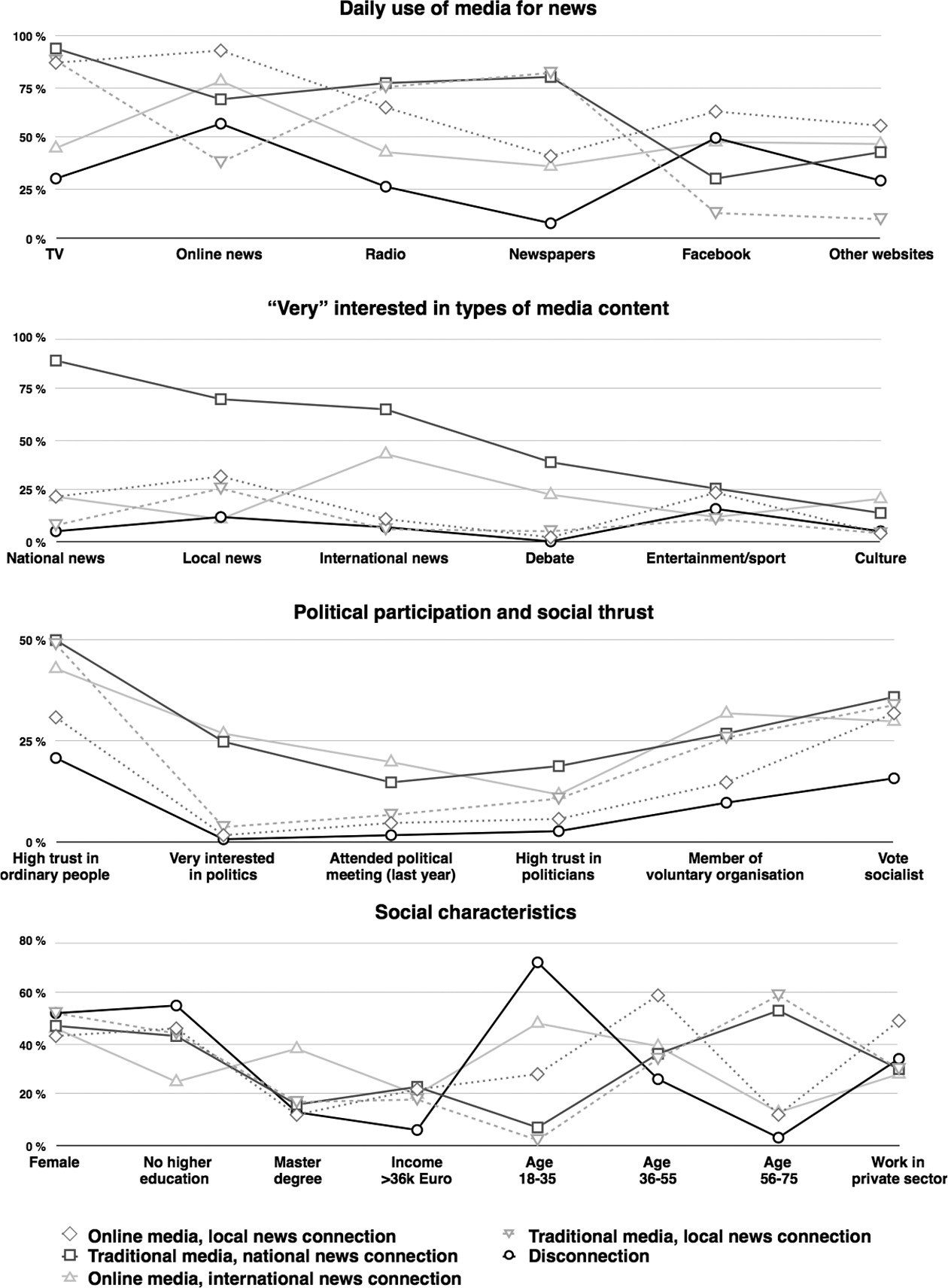
The citizen typology. Five classes (LCA). Selected conditional probabilities. LCA: latent class analysis.
Using this approach, we identify five groups of citizens, whose public connections comprise specific and different mixes of connections to the public, labelled as follows: traditional media, local news connection; traditional media, national news connection; online media, local news connection; online media, international news connection; and disconnection.
As the titles suggest, the five groups mainly differ along two dimensions, by traditional contra online media use, that is, the various degree of adopting online media, and by various degrees and forms of public connectedness, including not only local, national and international levels, but also involvement in political organizations and civil society. The first dimension is closely related to age; the second differs along a broader spectrum of social characteristics, in particular, appearing linked to educational level, but also to geography, gender and occupation.
The two first groups are mainly composed of older citizens (age 56–75) who depend on traditional media (TV, radio and newspapers) as a daily source of news. Those with a (1) traditional media, local news connection (22% of the sample) are unlikely to read news online daily, while those described as having a (2) traditional media, national news connection (19%) are somewhat more apt to also use online sources in their connection (see Figure 1). The latter also appears as likely to be interested in most kind of news, in particular on a national and international level (much more than any other group), and they are also the group most likely to be interested in mediated debates. In contrast, the first group appears much more likely to be interested in local than national news. While group 1 members are as likely to having joined a voluntary organization as group 2, the latter are more likely to have been involved in a political meeting and to describe themselves as politically interested. While there are suggestions of class differences (those connected to the traditional media, and national news more often have a university-level education and somewhat higher income), the data give us little information to explore these differences further.
The next group is characterized by an (3) online media, local news connection (25%). Members are predominantly middle-aged and liable to use online news sites daily, but few read print newspapers. This group also uses Facebook and other similar platforms for news. The members of the group have a relatively high interest in local news but are much less likely to exhibit signs of traditional political activity, and almost no one claimed interest in politics or current debates. The public connection, then, seems to be predominantly mediated.
Group 4, described by an online media, international news connection (16%), appears analogous to group 3 in important dimensions: it consists of younger citizens and displays an even higher dependency on online media as news sources. The members express political interest, but – unlike the former – primarily in international issues. This group also appears more cosmopolitan: much more likely to live in the capital city and to be most interested in reading about culture. Compared to those with a clearer local connection (group 3), it is not surprising that those with an online international connection are the most well-educated group.
The final group, labelled for their (5) disconnection (17%), is the youngest group of citizens (most are under 35) whose defining feature is a combination of online-dominated media use and low public connectedness in the traditional sense: half are likely to get daily news from online news sites or Facebook; a third are likely to get their daily news from radio or television (the lowest of all groups) and almost no one reads print newspapers daily. Very few are interested in mediated debates, and half the citizens in this group claim little interest in most kind of news categories – the most marked news avoiders of the five groups. They are also the least likely to have high trust in politicians or their fellow human and are very unlikely to have attended a political meeting or to be member of a voluntary organization. While a sizeable proportion is students, the group nonetheless appears to be characterized by many having only secondary education.
In addition, an LCA of the citizenry provides us with valuable insights into general ways that various forms of orientation towards the public are combined. Some groups appear more connected than others, which appears to be linked to some kind of class effect. Daily media use seems positively linked to public connection. The geographical level of news focus also appears as an important distinctive characteristic, in particular between the local and the international, where the latter also seems more often linked to high political interest and participation in traditional political channels (in which some groups are connected to other organizational activity, but some are not). The traditional versus more online-oriented use of media is also associated with all of the above factors, while simultaneously being closely linked to age differences.
The finding of a group defined by its disconnection should also be commented on. In the Norwegian population, only 0.04% say they do not use media as news sources at all (0.3% do not use media for news at least weekly and only 2.7% say they do not use it for this purpose daily). Of these 2.7%, two-thirds voted in the last general election, and four in five said they had an interest in cultural content in the media (Ivarsflaten, 2015). Such data are bound to be biased against the so-called disconnected, since participating in a national survey is in itself a form of public participation, which poses a methodical challenge for systematic studies of this phenomenon. Even so, profound public disconnection appears to be a very marginal phenomenon in Norway (cf. Blekesaune et al., 2012).
The analysis does have limitations. The data focus on hours spent and preferences for arguably quite broad categories and genres (e.g. television and national news). A more detailed discussion of genre variations and implications for democratic potential is not within the scope of such an analysis (e.g. if both are television drama, series such as The Wire and CSI provide us with very different resources for thinking about and engaging with the issue of crime in society). For such nuances, we need not only other data on media use but also on the use of expressive culture, both mediated as well as non-mediated. This limitation, widespread in studies of political participation, appears symptomatic of a lack of interest in the wider mechanisms of inclusion and exclusion in public participation, the importance of cultural resources in this regard and, fundamentally, the lack of an anthropological conception of the nature of social class in modern societies.
In developing our approach, the second step aims at grappling with these limitations, and to add culture and nuance but retain a detailed image of media use.
Adding culture, adding nuance and keeping media
Understanding the role of culture beyond the media is the strength of a strand of sociology that has the stratification of culture as its central concern. Bourdieu (1984) has been a central reference in this debate, in particular the relevance of his work for understanding culturally and technologically radically different societies 30 years on (Lahire, 2004; Lamont, 1992). Such studies offer a solid sociological framework for understanding the role of social resources for public connections. A focus on cultural stratification has, however, meant that media use receives little attention (e.g. Coulangeon and Duval, 2015).
We suggest an approach that combines Bourdieu’s anthropologically based approach to the study of social groups, their participation and general orientation in the social world, with a firm understanding of distinctions inside genres, or in the use of online media (cf. Gripsrud et al., 2011). We apply this empirical approach with a grounding in normative democratic theory, thereby addressing a problem shared with the different approaches reviewed above, which tend to operate with an implicit or unconceptualized idea of the normative dimensions of the practices they study or take an ideal (such as the informed citizen) for granted.
It is important to specify the nature of the connections we propose between normative democratic theory and Bourdieusian sociology. There are a number of inroads to arguing why such connections are problematic on a general, theoretical level (e.g. Ryfe, 2007). One common objection is that the fundamental ideas of universal pragmatics and discourse ethics – popularized in Habermas’ (1973) use of the concept of ‘ideal speech situations’ – are at odds with Bourdieu’s approach to language, where the perceived quality of arguments and the speaker’s ethos are seen as fundamentally infused by power relations (Bourdieu, 1991: 107; also Bourdieu, 2000). A less antagonistic reading of the two authors is however possible. Habermas’ early concern with the systematic distortion of communication (Habermas, 1970) and Bourdieu’s discussions of how the necessity of reason and universality is instituted in various degrees in social fields, with academia and the bureaucratic field as examples of agents with a greater interest in rationality and universalism (Bourdieu, 2000: 109) illustrate related concerns, if expressed via very different academic traditions (see also Crossley, 2004.
Some attempts have been made to draw on both traditions, but in different ways. Calhoun (2010) argues that the theory of the field of power can be mobilized to yield a better understanding of the actual workings of public spheres at certain historical moments. Others (e.g. Holdo, 2015) concentrate on deliberation, arguing that key concepts in Bourdieu’s theory offer not an opposing view of political debate but an alternative ‘vision of deliberative change’ (Holdo, 2015: 1103), which facilitate analyses of actual deliberative practices.
The connection we want to make is of a somewhat different kind. We use democratic theory to understand the normative expectations directed at citizens: through the public sphere, users should be informed about political issues, form their identities in engagement with various kinds of symbolic material and develop the capacity needed for democratic life. We use a Bourdieu-inspired analysis to understand how these expectations match empirical findings, in order to help us rethink the role of the citizen.
In Bourdieu’s anthropologically informed theory of action, public participation appears as a highly complex phenomenon (Bourdieu, 1984, 1991, 1993). In addition to concrete participation, such as the acts of voting, attending a political meeting or reading the news, Bourdieu directs our attention to the need for specific knowledge and resources. Such resources could include being easily able to express oneself in written and oral form, understanding bureaucratic and intellectual jargon, having time to read newspapers and so on. The approach also acknowledges the importance of having certain preferences (e.g. finding political news ‘genuinely enjoyable’ rather than something ‘one ought to read’) and having feelings of worth in public debate.
Public connection, following Bourdieu, will be systematically shaped by social position, via our mental and bodily dispositions (our habitus, which again is formed by our upbringing and social course), and by the resources we have accumulated and have available (our capital, in the form of money, educational papers, cultural and political knowledge, social acquaintances, etc.). In this way, certain kinds of upbringings and life-courses privilege some citizens for public participation.
The idea that our dispositions are never limited to one type of activity or social sphere (the unity of habitus) would entail that our relation to the public cannot be compartmentalized as a specific aspect of our life. Rather, public connection is interwoven with the rest of our lives and our relation to the world. Finally, Bourdieu reminds us that ‘the dominant class is defined precisely by the fact that it has a particular interest in affairs “of general interest” because the particular interests of its members are particularly bound up with those affairs’ (Bourdieu, 1984: 443). As such, the normative aspects and social stigma and charisma so closely bound up with ideas of a ‘good citizen’ are fundamentally linked to class interests and struggles.
When we now turn to our second empirical example, we aim to bring such insights to the analysis in order to obtain a better grasp of the variety of public connections.
Step two: Patterns of public connection among Norwegian students
The second empirical example is an analysis of higher education students in the second largest town of Norway, based on a 2008 survey (N = 1223). 5 The example serves three purposes. Methodologically, it serves to extend the analytical tools employed in the citizen sample example by projecting the groups made by a similar LCA into the social space via MCA. This facilitates a nuanced reading of the social profile of basic forms of public connection. Empirically, the example zooms in on one group in the general citizenry. Their age homogeneity allows us to move beyond the analysis of the citizen sample, where we found age to represent a dominant stratifying dimension. Third, the survey’s nuanced variables for cultural practices facilitate a detailed mapping of various groups’ public connection beyond the media.
While the age of the survey might appear at odds with the purpose of studying current practices of public connection, the data in fact depict a reasonably up-to-date media situation from a global perspective. This is due to two factors: the early and swift diffusion of Internet use in Norway, and the young age of students, making them more likely to use new technologies. In 2008, almost all (97%) of these students used the Internet, 90% of them read news online (an average of 0.5 h/day), 81% used social media (average: 1.7 h/day) and 28% had watched web television. Such figures are on a par with averages for adult populations in developed countries today: In the United Kingdom, for example, 62% had read online news and 61% had used social media on a typical day in 2015 (Office for National Statistics, 2016).
We will first employ an LCA similar to the previous example, mixing the use of different media, interest in different type of media content and political and organizational participation. 6 The analysis of the student sample differs somewhat from the citizen sample, due to the availability of variables. As such, the two examples are analogous in their logic but not directly comparable. We have selected a four-class model (selected indices and covariates shown in Figure 2), where the groups are:
traditional media, national news connection;
online media, non-news connection;
cross-media, international news connection; and
cross-media, non-news connection.
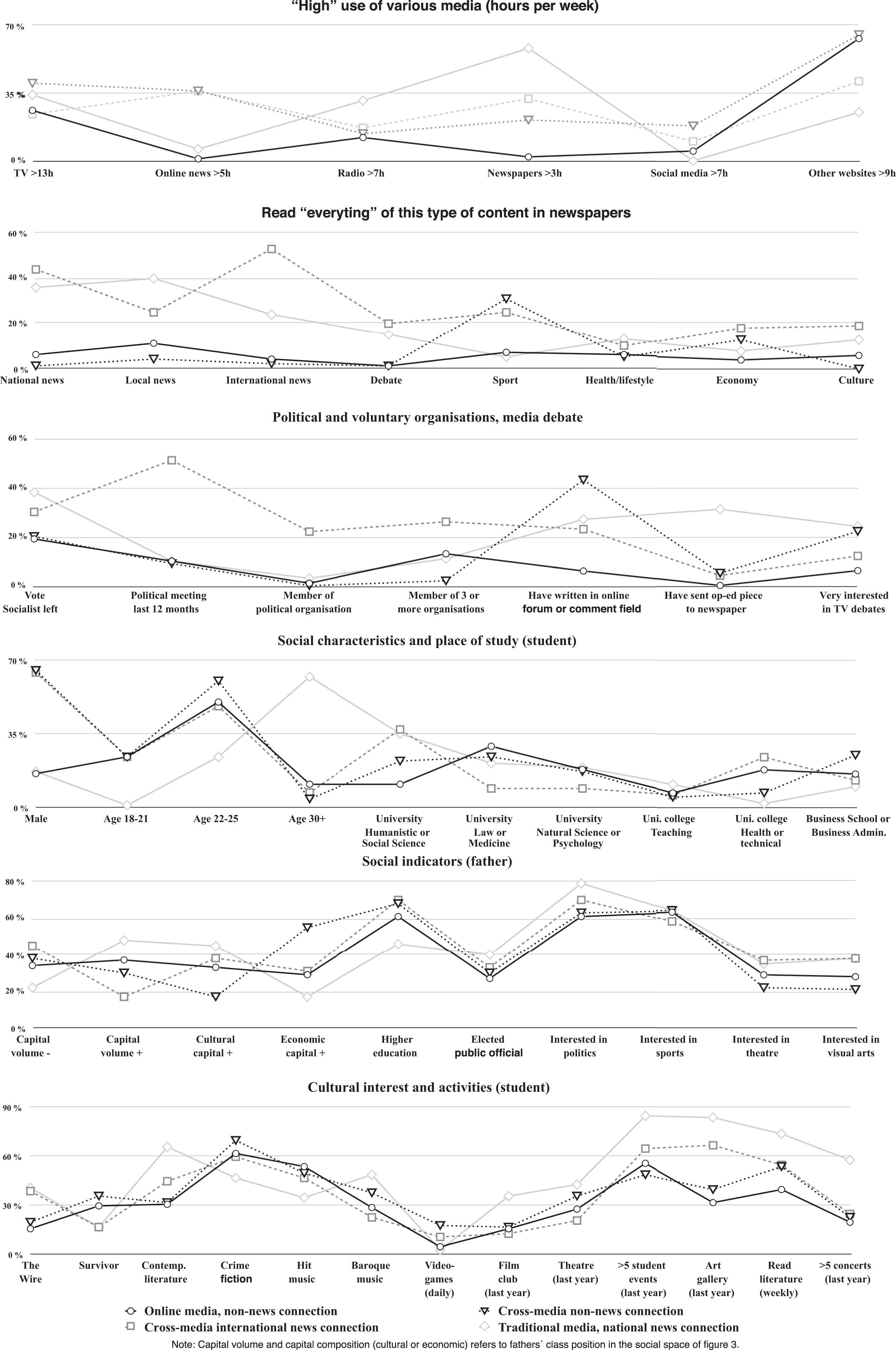
The student typology. Four classes (LCA). Selected conditional probabilities. LCA: latent class analysis.
The clearest division between the four groups is gender: Groups 1 and 2 mainly consist of female students (>80%), and Groups 3 and 4 are more often male (>65%). 7
Group 1, traditional media, national news connection (16% of the student population) is characterized by a strong interest in local and national news and debate. Their media use is strongly biased towards traditional media such as print newspapers, radio and television, with relatively low use of online media. The group members are markedly older (30+) than the other three groups, which might help explain their low uptake of online media by 2008. They have a weak connection to organized political life and civil society more generally but are the group most likely to have submitted an op-ed article. These are also the most active users of traditional cultural institutions (no other group attend concerts, art galleries, theatres, etc. as frequently), which is also related to a higher than average preference for the most legitimate and ‘advanced’ types of culture (e.g. contemporary literature, painting and theatre) combined with less tolerance for more accessible and widely used forms of popular culture (e.g. crime novels, current radio hits, sitcoms and reality TV series). At the same time, the group members appear to enjoy more complex popular forms of culture, such as The Wire. In other words, they combine access to the political sphere via news consumption (if not by participation in party political channels, to which their sympathies are usually with left-wing parties) with an active relationship with expressive culture, often with high social relevance. Finally, they are likely to be students of the social sciences or humanities and unlikely to study vocational subjects or educations ill-suited to the amassing of cultural capital (e.g. business administration or nursing).
The former group is most clearly contrasted with group 2, online media, non-news connection (38%). Although this is also mainly composed of female students, with few signs of participating in political or other kinds of organizations, group 2 displays many opposing characteristics: they are predominantly younger, display little interest in news and ‘serious’ mediated culture and seldom visit traditional cultural institutions. Very few read newspapers, and they are very unlikely to have participated in mediated debates. Their cultural profile is oriented towards popular forms and genres – crime or fantasy, RnB hits and less ‘realistic’ forms of drama and entertainment (e.g. Sex and the City, The Bachelor). They dislike (or, more often, are unable to recognize) celebrated classical and contemporary names in non-televised forms of culture (e.g. painters and sculptors). Politically, they are more liable to identify with conservative or right-wing parties, they are less prone to studying the humanities or social sciences and they are more likely to be enrolled in a vocational education at a university college. Their connection, then, appears marked by an interest in lifestyle content, which they find through online arenas outside news sites, and in popular television.
Characterized by a cross-media, international news connection, group 3 (21%) is the most clearly politically organized in the traditional sense, among the four groups. Those belonging to this group, in which male students are clearly overrepresented, are marked by a much higher likelihood than the others of being members of a political party and having attended a political meeting last year (in particular a leftist party meeting). They are also the most likely to be members of a civil society organization. The group consists of avid consumers of international news, preferably via online news sites and newspapers. Although they share an interest in national news with group 1, they appear less interested in local news. Their interest in news is combined with a higher than average interest in all forms of culture, displaying interest in both traditional and modern forms of legitimate culture (e.g. liking many music genres, including classical and jazz, and liking many different types of visual artists). Yet, they have a preference for overtly political forms of entertainment (e.g. The Daily Show) and display a less active use of traditional cultural institutions than their female counterparts in group 1. They are more likely to be studying social science or the humanities and have parents with a somewhat higher than average interest in culture but also high levels of economic capital.
Finally, those with a cross-media, non-news connection constitute group 4 (25%), and comprise the second ‘male’ group. It shares a somewhat higher than average use of online media with group 3, spending less time on newspapers and more time on television (the latter more than any other group). At the same time, the group shares a low interest in all types of news and debate with group 2 (online media, non-news connection). The exception is sports. Members of group 4 display low levels of participation in organized political life (with a leaning towards the right) but stand out as most likely to engage in online debates through discussion forums or comment fields. They share parents with less cultural capital than average with group 1 but average or higher economic capital. Compared to the other male group, they are more likely to be studying business administration or law and less likely to study humanities or social sciences. Culturally, they have a stronger preference for the most popular forms, including computer games and mainstream TV entertainment, but also show some interest in traditional legitimate forms, and appear somewhat more active in their use of cultural institutions.
In addition, the categorization into four groups of public connection based on the student sample brings out some nuances. First, the data set’s richness in cultural preferences and the uses of different cultural arenas help us identify not only connections between political and cultural interests but also potential channels to the public beyond news. For example, the group characterized by low interest in news (group 2) seems to rely on other genres in their mediated public connection. Rather than portraying them as disconnected, our approach makes us aware of other inroads that merit attention.
The student sample also reminds us of the importance of looking beyond the media when we study experiences of freedom of information. Not only political organizations but also civil society more generally as well as cultural arenas contribute when people connect with the public.
A third point to take from the example has to do with media use. The analysis clearly shows how we only get so far by sorting citizens in ‘traditional’ versus ‘online’ media boxes. The students demonstrate how uses of media mix and cross each other in different ways, and how dividing lines might as well be drawn between uses of different genres, and often, inside these genres, rather than between different technologies.
Fourth, we are alerted to the centrality of traditional social differences, gender in particular, but also social class. To explore this further, we can project the four groups into the social space of students – that is, the inherited capital resources and types of habitus suggested by indicators of their parents’ class characteristics (Figure 3).
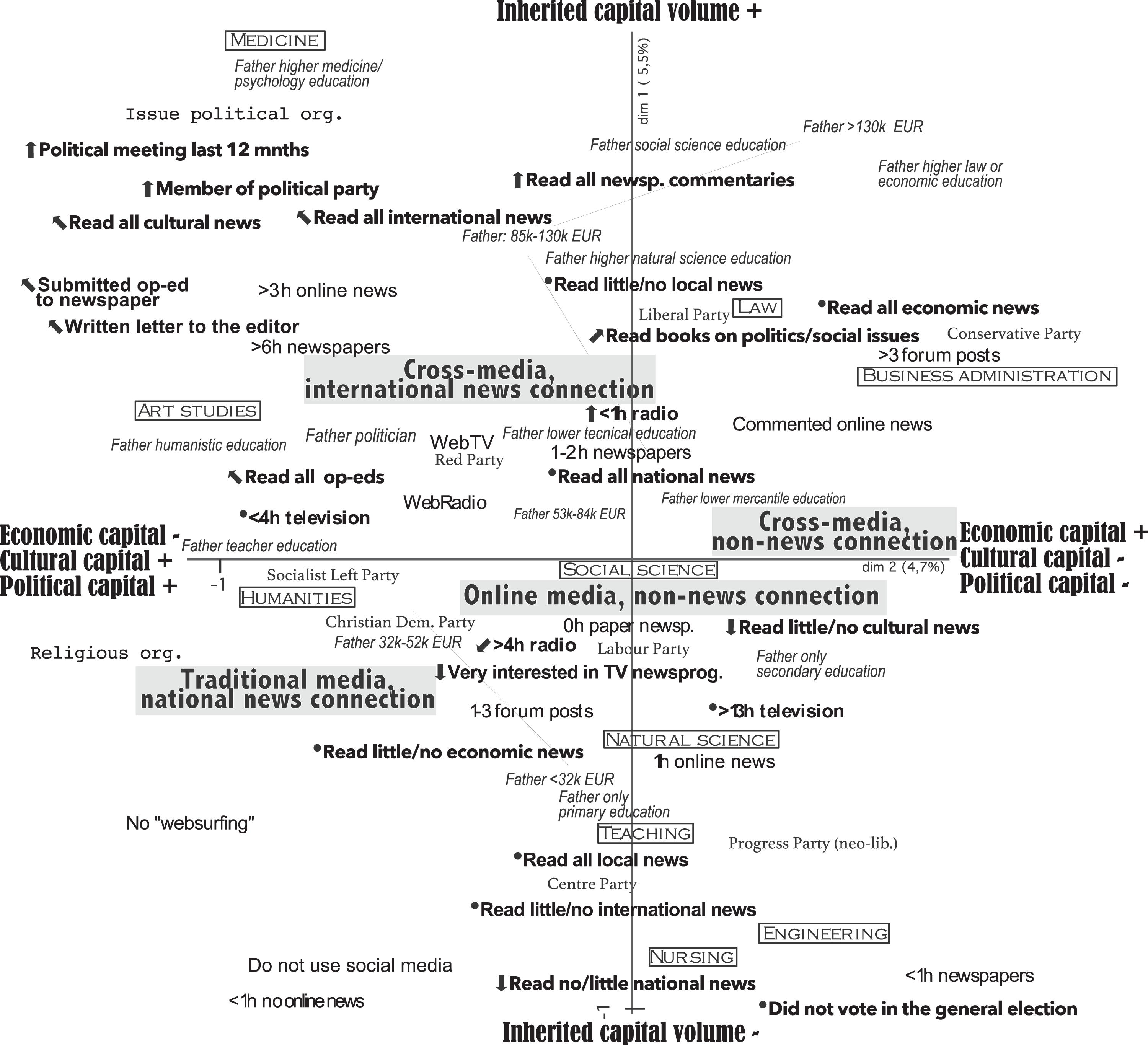
The four classes in the social space of students. Multiple correspondence analysis, axis 1–2. Note: The map reconstructs, using social indicators for their fathers (marked by italics where included), the 2008 students’ initial class position and inherited capital. Their subject/faculty of study is framed. For selected practices, changes in social position for the practice compared to 1998 are marked by an arrow (if no change, a bullet), indicating whether the practice has become more or less linked to having socially privileged backgrounds or more or less common for students with economically affluent fathers, and so forth.
The social backgrounds of the Bergen students in 2008 appear to follow a logic analogous to what Bourdieu (1984) found for France in Distinction: the first differentiating principle is capital volume, where students with more socially privileged parents (by income, education, cultural interest, occupation, etc.) tend to be placed towards the top, and those with less affluent parents in these respects towards the bottom. The second principle is capital composition, separating students with parents characterized by strong economic resources and jobs in the private sector (towards the right), from strong cultural resources and work in the public sector (towards the left).
As Figure 3 illustrates, the students’ educational careers have a tendency to reproduction. Students with lower social origins are quite likely to choose vocational studies but unlikely to study subjects which typically lead to elite professions and vice versa. 8 Looking closer at the distribution of various kinds of practices, we see that the probability of adhering to the ideal of an informed citizen by spending much time on newspapers, attending political meetings, reading commentaries, writing to the newspapers and so on tends to rise when one moves upwards in the social space (i.e. with social privilege). Conversely, watching a lot of television, reading little national news, not voting and so on increase with socially humbler backgrounds. This dimension of citizenship tends to go from lower right to higher left in this map, meaning that it appears to follow inherited cultural and political capital, not economic capital. Such an observation is in line with other analyses of Scandinavian societies, which argue for the importance of the capital composition principle for social differentiation (e.g. Rosenlund, 2015). We should here note that an interest in the local, by contrast, appears to follow the opposite direction: local and national/international public connection appears to some degree to be mutually exclusive.
If we consider the historic dimension of this social space, we can note that the general logic linking public connection and class background has been quite stable from pre-Internet days (compared with students in 1998). The digitalization and pluralization of society, if anything, appear to have strengthened this logic rather than diminished it. Reading the debate or culture section in the newspapers or attending political meetings is less equally distributed in 2008 than 10 years earlier (Gripsrud and Hovden, 2000). This finding seems, again, to resonate with other recent studies which find Norway (and Scandinavian societies in general) to be sites of growing social inequality (Gripsrud et al., 2011; Hjellbrekke and Korsnes, 2012; Rosenlund, 2015).
The placement of our fourfold typology of students in this space largely follows the logic indicated here: cross-media, international news connection (largely males, with high news consumption across media and high interest in foreign news) is characterized by higher social backgrounds and more inherited cultural capital than the other, more entertainment-oriented male group (cross-media, non-news connection). A similar relationship exists between the two ‘female’ groups, where those with a traditional media, national news connection are characterized by more inherited cultural capital than those with an online, non-news connection. As such, we see not only the importance of gender and class (in particular, the role of cultural capital) for forms and types of public connection but also the propensity to mix traditional with modern forms of media use for this purpose.
Conclusion
This article started with the challenge of understanding how different groups of citizens connect with the public in the cross-media reality of modern democracy. We have suggested that combining the normative aims of public sphere theory with the cultural sociology of Bourdieu is a viable approach for both theoretical consideration and empirical studies of this phenomenon. Empirically, our approach shares an interest with recent analysis of media repertoires as it allows us to expand concerns with the use of traditional media to a cross-media approach and move beyond the focus on news to a more inclusive and nuanced view of what kind of media and cultural products have potential as resources for people’s public connections. We have thus emphasized public connection as an integrated part of the lifestyles of citizens, not simply linked to news reading and participation in formal organizations. Via LCA, we have suggested typologies of public connection for two groups: national citizens in general and students as a subgroup of particular interest.
The ways in which people connect with a shared world are many and complex, and our data have limitations. Despite this, we do find some dominant profiles of public connection. In some of these, cross-media use is prominent, and such uses are further interwoven with very different forms of preferences, two important forms identified here being the varying attention to the local versus the national and transnational public sphere, and engagement via expressive forms of culture versus via political organizations. Crucially, we also find that such profiles vary both in regard to citizen’s social characteristics (in particular, age and gender) and their social resources (class and education), demonstrating that the role of cross-media in people’s use of their freedom of information is not simply a matter of varying technological adaption but is fundamentally linked to wider processes of sociocultural stratification.
Our analysis, in this way, reveals how cross-media use appears fundamentally similar in its social logic to other forms of omnivourism: cross media use is a form of double access (cf. Gripsrud, 1989) to the valuable resources of society. The ability to move effortlessly across media appears to be a strategic resource, a way to find meaning and enjoyment in life and a source of social distinction. It also appears bound up with other, and more overarching, forms of omnivourism, like combining mediated attachment with attachment through political and civil society, combining the use of traditional elite culture and popular culture (Peterson, 1992) and combining political culture with expressive culture.
To further advance the endeavour suggested here, more systematic comparisons of operationalized normative ideals for the citizen could be compared with data from different contexts to further offer empirical insights. The aim should be to yield a better understanding of the role of the citizen in our democracies, and the different ways that citizens move across media.