




Abstract
This article analyses how changing life situations affect media use, conceptualized as a question of how biographical disruption could destabilize media repertoires and public connection. To answer this question, the analysis draws on qualitative data from a comprehensive study of media use in Norway, with in-depth interviews and media diaries. The theoretical approach joins domestication and media repertoire theory with research on public connection, considering the ubiquity of digital media in contemporary society. Findings indicate that smartphone use is key to people’s reorientations in periods of change, and that intimate and emotional responses to mobile media warrant closer attention. The article contributes to debates on the transformation of media repertoires, a question of growing concern within research on cross-media use, and to long-standing interests in the role of media in everyday life and as central to public connection.
Keywords
Media use is a part of everyday life. And media use is central to people’s orientation towards society. As such, it seems only logical that when everyday life changes, media use does too, and with that societal orientations. Think of a couple moving in together in their first family home, starting a subscription to the local newspaper and becoming more concerned with what goes on in their community. Or of a person retiring, suddenly having time for television during the day, but missing the lunch conversations with colleagues about news and sports. Or of a temporary disruption – such as a period of illness, or a long vacation – changing everyday routines and one’s feeling of being in or out of touch with the rest of the world.
The two simply formulated tenets above – media use is a part of everyday life, and media use is central to people’s orientation to society – encompass key research interests in media use and audience research. We can learn from this research that connections between everyday life, media use and societal orientations are less straightforward than the simple stories above would indicate. Media in everyday life is a long-standing theoretical and empirical interest (Bausinger, 1984; Hermes, 1995; Moores, 2000; Couldry, 2003; Bakardijeva, 2005). Likewise, media use as societal orientation has been analysed through diverse conceptualizations of audiences as citizens (Schrøder, 2012; Murru and Stehling, 2016; Ytre-Arne and Moe, 2018). In the datafied media landscape, smartphones have become essential to keeping everyday life together (Thorhauge, 2016), while the ubiquity and intrusiveness of digital media (Mollen and Dhaenens, 2018; van Dijck, 2013) constitutes a changing context for societal orientation through media use.
However, even with claims that the construction of reality is mediated (Couldry and Hepp, 2017) or that we live in media (Deuze, 2012: x), it seems clear that biographical events continue to matter for how people use the media. Studies applying age as an indicator of media use build on expectations that interests and practices change over the life course, combined with the idea that the cultural and technological conditions in which different generations come of age could have long-lasting effects (Vittadini et al., 2014; Weibull and Westlund, 2013). The study of life courses is built on the idea that ‘aging is a sequence of life phases and transitions that is constructed in a reciprocal process of political, social and economic conditions’ (Heinz et al., 2009), implying that biographical events in the lives of individuals are connected to structural factors in society, potentially producing different resources, opportunities and priorities. Typical biographical events that are aligned with societal expectations could nevertheless be experienced as transformative or even disruptive to a range of everyday life practices, as everyday life is the space where social relations are enacted. This understanding draws on Lefebvre (1947) and emphasizes that everyday life ‘comprises all human activities situated in and across a multiplicity of spaces and contexts’ (Højholdt and Schraube, 2016: 2). The idea of biographical disruption, used in analysis of more dramatic life events such as severe illness (Bury, 1982; Orgad, 2005), highlights this destabilizing potential. Understanding biographical change in everyday life is therefore central to understand changing media use.
The research question for this article is how change in everyday life affects media use and societal orientation. As outlined below, this can be conceptualized as a question of how biographical disruption could destabilize media repertoires and public connection. The analysis focuses on life course transitions as experienced by individuals, and highlights the term destabilization to signal the potential impact of such events on media use in everyday life. The empirical material stems from a qualitative study of media use and public connection in Norway, encompassing two rounds of in-depth interviews and a media diary, analysed to highlight recollections of disruption as well as transformations occurring within the data collection period. Theoretically, the analysis combines the mentioned understandings of everyday life with three key concepts from media use and audience research: media repertoires, domestication and public connection, advancing empirically grounded conceptualizations of how these are connected.
Theoretical framework: Media repertoires, domestication and public connection
In the growing field of research on cross-media use (Bjur et al., 2014; Lomborg and Mortensen, 2017; Schrøder, 2011), one central concept is media repertoires, defined as the entirety of media a person regularly uses (Hasebrink and Domeyer, 2012: 758). Individual media repertoires can be connected to social domains through the concept figurations, drawing from Elias (1978; Couldry and Hepp, 2017), to encompass shared frames of relevance and communicative practices in, for instance, a family (Hasebrink and Hepp, 2017). Recently, Peters and Schrøder (2018) have posed the timely question of how media repertoires emerge and disappear in everyday life and across the life course. Joining together process-based perspectives such as sociology of time and domestication theory, they discuss spatiotemporal factors, material factors (including technological and financial aspects) and social, political and cultural factors. These factors thereby constitute a potential framework of categories in changing media repertoires.
Second, domestication theory is also key to the study of media in everyday life. Associated with a classic volume edited by Silverstone and Hirsch (1992), this theory considers stages such as appropriation, objectification, incorporation and conversion of media into the ‘moral economy of the household’ (p. X). As the notion of stages indicate, temporal change is central, but so is also spatial grounding in the home as the centre of the domestic sphere. Asking if the ubiquity of digital and mobile media could challenge this theory, Haddon (2016) evaluates the continued usefulness of domestication in media repertoire analysis, while Helles (2016: 41) discusses domestication as part of broader sociological and philosophical understandings of everyday life, pointing to the need for further empirical analysis. A different application of the theory is Karlsen and Syvertsen’s (2016) study of reverse domestication, demonstrating that domestication can be seen as a series of interlinked processes with tensions and ambivalences.
Third, to conceptualize media use as societal orientation, public connection is a key concept. Couldry et al. (2007) define this as ‘an orientation to a space where, in principle, problems about shared resources are or should be resolved’ (p. 7). Public connection is often but not always mediated, and media use is not always a form of public connection (Couldry et al., 2007). Further emphasizing the everyday life context, Swart et al. (2016) define inclusiveness, engagement, relevance and constructiveness as important dimensions of public connection. Nærland (2018) instead suggests three interdependent levels: observable orientations such as discussions or actions, everyday orientations such as media repertoires, and deep orientations such as values and sensibilities. These added layers of complexity signal the same argument as for media repertoires: These meaningful practices do not materialize out of thin air, but emerge within social, political, cultural and technological contexts, in the complexities of people’s everyday lives. This article analyses the more detailed factor of such processes of change.
Methodological and analytical approach
Empirical material for this analysis originates from a qualitative study of media use and public connection in Norway (Nærland, 2018; Ytre-Arne and Moe, 2018), where 50 informants were asked to participate in two rounds of in-depth interviews and a media diary. Informants were recruited to mirror the adult Norwegian population in terms of age, gender, occupations, education, minority representation and rural and urban areas. In a three-step data collection process, the first interview explored people’s media use and public connection through their everyday lives and interests, in keeping with the informant-centred approach of media repertoire studies (Hasebrink and Domeyer, 2012). Next, a media diary was conducted for a month, with a semi-open format that encouraged informants to write freely, but also asked a few questions (such as ‘What did you do today?’ or ‘Please mention any topics or news that caught your interest’). The second interview built on the diary of each informant, following up on what seemed important to them, and on themes shared in the informant group overall.
While this process produced extensive qualitative materials, this article employs two focused analytical strategies to answer the question of how biographical disruption affects media repertoires and public connection. First, a thematic analysis considers responses from a particular segment in the first interview: after talking of work, family, and an ordinary day in the life with media, informants were asked to reflect upon how this had changed in the past 5 years. Second, the analysis shifts from a thematic to a person-centred approach and develops portraits of two informants who experienced life course disruptions during the data collection period. The final discussion joins together key findings, situates these within the theoretical framework, and suggests further conceptual and empirical advancements.
Recollecting change: Technology, family, work
How did informants reply when asked about how their everyday lives with media had changed over the past 5 years? This question provides an entry-point for analysis of people’s recollections and interpretations of change in their media repertoires. Without prompts given by the interviewer, 1 most informants answered the question by referring to technological change, mentioning their first smartphone, increased social media use or the possibility of streaming. Biographical change was mentioned less frequently, but occurred in some responses, typically intertwined with technological change. These responses fell into two main categories, concerning fairly typical life course transitions pertaining to family or work.
The disruptive combination of children and smartphones
Most notably, the experience of having children stood out as a life course transition that deeply affected informants’ perceptions of change in their media repertoires. 2 Corresponding with other studies emphasizing gendered and culturally constructed narratives of motherhood (Sevón, 2011), this was particularly emphasized by mothers, and most strongly felt when the first baby arrived.
Sissel, a working mother of two, responded to the question of change in the past 5 years by trying to remember when she had bought her first smartphone, before she continued: ‘Five years, that was before we had children, and perhaps I watched more TV, watched more news, followed more series. But . . . I don’t do that anymore’. Asked if lack of time was the reason for this, she replied, I feel that it has to do with time . . . but maybe also what you feel like spending your energy and focus on. What matters in life. That perspective changes when you have children. That is why I have become more aware of how much I stare at a screen.
The follow-up question about time pressures thus produced a reply about values, concluding with moral norms for digital media use. Such normative dimensions, referring to central elements of domestication theory, also came up in other interviews. Synne, also a working mother of two, talked about how spending more time at home had led her to take greater interest in cooking, home-improvement and greener living, also as an expression of care for the future of her children. She distinctly remembered buying her first smartphone as a late adapter, after much doubt about whether she wanted the continuous media presence she felt it would give her. The decision to buy a smartphone, coinciding with first-time motherhood, had led to media repertoire changes lasting beyond the perinatal period: Before we had kids I always read a book in bed. I was not very good at reading much, but at nigh-time before sleep, there I would always read. Then we had a baby, and our eldest one was such a light sleeper [. . .] Turning on the light to read at night, that was something we could not do. [. . .] Then came the smartphone, I started using that instead and have not been able to stop . . .
She concludes that things have changed quite a lot, but ‘so subtly you hardly notice, in your everyday life’. Key to these replies are small mentions of how technological capacities of smartphones blend together with cultural norms concerning their use, so that tensions between these elements are played out within the changed rhythm of everyday life for new parents. The notion from domestication theory of a moral economy into which technology is integrated seems particularly apt to discerning such developments.
The integration of work and public connection
A different form of life course transition concerned the working lives of informants, with changes such as graduation, career changes, unemployment or retirement. Talking of their present-day media repertoires, many informants referred extensively to work as a structuring factor. Examples included a fisherman at sea for long periods without Internet access, healthcare workers with regulations on where and when they could use smartphones, or irregular work hours designating different varieties of what an ordinary media day would look like. Work appeared central not only to media repertoires, but also to public connection through and beyond media use. This took three distinct forms: first, work affected people’s interests in various sectors of society, second, colleagues were important sources of information on public matters and, third, the idea of contributing to society by working was central to experiences of being an engaged citizen.
For these reasons, it was striking that transitions in working life very rarely came up in conjunction with the specific question on change the past 5 years. One of the exceptions concerned graduation as a point of entry into more grown-up media repertoires, as mentioned by the informant Audun: [Five years ago] I had just finished my education [. . .] I was less into checking online newspapers, that has come later . . . as I gradually saw that it is important to know what goes on in the world, both locally and globally. That has become a bigger thing, and I have started to use online news more systematically, while my use of Facebook has really dropped to a minimum. [. . .] And I guess we subscribed to the local paper back then.
The informant articulates a notion of growing up to care about the news, hinting at the idea of public connection developing over the life course. He also conveys fairly conflicting notions of how media use facilitates public connection: He cares more about local news, but has stopped his subscription to the local paper, spends less time on Facebook but more time following online news. The keyword in the quote is systematically, indicating a more mature ideal of strategically overseeing the news, knowing where to go for information, but not necessarily spending more time on it.
Furthermore, some informants who had retired in the past 5 years described this as a significant adjustment, requiring a period to clear one’s head and find a different rhythm to everyday life. Kari, who had held an executive position in a big corporation, noted how smartphones and television had changed in the past 5 years, but stated clearly that The biggest difference is the life difference. I was working and it was busy. Reading was primarily a thing for holidays.
However, some emphasized stability and commitment to established routines, giving an impression of resilience to change: Now I am retired, but I try to get up at a decent hour . . . there are animals to attend to . . . and then I read the newspaper and relax a little . . . and then there is maintenance work to be done.
This informant, Arne, was a retired teacher with a small farm, and retiring from one line of work had strengthened the public connection he experienced through his second occupation. He said that the most significant change in his media use was increasing Internet use to administer farm work, and retiring from teaching had given him time to develop his computer skills. He expressed equal interest in agriculture as before, but less commitment to keep up with reforms in the education sector.
So far, the analysis has indicated that technology, family and work are intertwined themes in changing media repertoires and changing public connection, but that the life course event of first parenthood stands out as most explicitly experienced as disruptive to media repertoires. The next step of the analysis takes a different approach to work from these broad themes to more detailed factors of change.
Experiencing change: Two analytical portraits
Rather than relying on informants’ recollections of changes in the past, this next analytical step focuses on a few informants who happened to experience biographical disruption within the data collection period. Delving deeper into the themes suggested above, two different experiences – first-time motherhood and a work transition – are analysed, drawing consecutively on materials from the three phases of data collection (first interview, diary, second interview). 3
Becoming a first-time mother
When participating in the project Ana was in her early thirties, highly educated and working in a creative profession, and living with her partner. At the start of the data collection period, she was pregnant and about to give birth to their first child. In the first interview, Ana described her media repertoire: Listening to news on the radio while spending a long time in the bathroom, reading the local broadsheet newspaper on the iPad, and more print newspapers in the weekends, streaming documentaries and drama series with her partner, reading contemporary literature, and attending art exhibitions, experimental theatre and film festivals. As the media diary phase started a month later, Ana reported that her baby was 4 weeks old. She wrote of her new daily routine: My days are approximately like this: Get up around 8. Feed baby while watching tv [. . .]. Around 11-12 I go for a two-three hour long walk with the stroller. Afterwards I prepare dinner, or do other housework, if the baby is still asleep. My husband returns in the afternoon, we eat and he takes care of the baby while I do stuff: Call my mother, pay the bills, do laundry, or have time for myself. I go to bed with the baby at half past nine and feed her 2-3 times at night. I read newspapers, leaflets or books, about babies and other things, or watch tv while I feed the baby, also at night as it can take a long time. I feel that my concentration span and short-term memory is affected by the ‘haze’ of breastfeeding and the baby period.
Ana wrote repeatedly in the diary that she was in a ‘baby bubble’ and less engaged than she would normally be in news or local cultural events. Apart from her own statements on this matter, any attempted measure of her public connection (as expressed in the diary) would likely conclude that it was still strong and multidimensional. While she reported some new television preferences, her media repertoire encompassed many of the same elements as it did pre-baby: news, particularly on politics and culture, documentaries and series, music and radio.
In the second interview approximately a month later, Ana described the diary period as ‘all baby’. Talking about following the news, she expressed that she felt ‘a bit more vulnerable’, in need of ‘distance’, or ‘a pause from taking it all in’. She connected this feeling to the bodily experience she had been through: ‘Maybe it is a physical influence of actually changing physically’, but also mentioned distressing global events in the diary period, particularly the US 2016 presidential campaign. The second interview gave further indications of changing media repertoires: Getting up several times at night . . . I notice I just end up with the phone in my hand. There is little interaction when the baby is half-asleep with eyes closed, while feeding. So maybe I quickly check newspapers, or Facebook, or [names online marketplace service]. I have become hooked [laughs]. [. . .] I have started a home renovation project, but media, perhaps that demands a bit more concentration . . . and it is dark in the middle of the night so if I read it is a bit . . . so and so. When I get up . . . the past few days I have been watching Downton Abbey, of all things, because it was recommended in my maternity group. [. . .] I still listen to the radio, I have noticed what is happening with the government because of that. And then we eat and change diapers and play with the baby, who is starting to demand more attention, you have to have eye-contact . . . she will notice if I watch tv or the phone, so that is not an option . . . there will be loud complaining.
This quote gives a glimpse of intimate connections between changed everyday circumstances and media repertoires. First, it is evident that the bodily and physical dimensions of caring for a newborn has significant impact on the organization of media into domestic time and space. Second, this is closely intertwined with changes to cognitive and emotional modes of reception. Third, choices of televised entertainment and leisure projects seem affected by new influences in the new life situation, while the informant’s self-ironic approach to these choices signal ambivalence. When asked more directly if her interests had changed since having a baby, she replied affirmatively, mentioning that she was of course more interested in family politics. She further reported that her news use had become more sporadic and more dependent on headlines: I spend some time trying to figure out new ways to use the media, because the old way with the whole Saturday to myself with a cup of coffee and reading the newspaper as long as I bother, that is not going to happen anymore. So, I have to find new ways of keeping up with what is going on.
One such ‘new way’ was to listen to audio books from a smartphone app while taking long walks with the baby in the stroller. She also used social media more, as the new daily routine included small time-pockets suited to easy scrolling on the smartphone. The story Ana recounts can thus be understood as a biographical disruption leading to a phase of adaptation and reorientation (Sevón, 2011: 77). It signals how practices and routines in everyday life are served as context in which media repertoires and public connection is experienced and integrated.
From unemployment to work
When Lise participated in the project, she was in her early thirties, had two children, a lower university degree and had recently broken up with her partner. During the data collection period, she found and started work after a long period of unemployment. In the first interview, Lise’s daily routine seemed shaped by the children’s schedules: she was taking care of them mornings and evenings and applying for jobs in between. As she described her day, radio listening came up frequently – at breakfast, in the car, while cooking. Her use of digital media was closely intertwined with her ongoing job search. In the evenings, she watched television with her oldest child, a routine she described as a ‘framework’ for connecting with her son: There is something about kids who try to not say too much, to shut down a little . . . but when we sit there and eat supper and the tv is on, he really relaxes, and suddenly he will tell me something interesting about his life in school. So, it is that sort of frame.
Lise used TV and music streaming services, but was mostly fond of having books and records as physical objects, also to introduce old favourites to her children. A central topic in the first interview was her smartphone, which was too old, too slow and incompatible with social media apps she wanted to use. She had promised herself to buy a new phone if – but not before – she found a job. Lise participated in a couple of discussion groups on Facebook, but found the pressure to be opinionated a bit tiresome, while also wishing to feel more confident: When you are unemployed, you lose . . . integrity, I would say. Once you do not have that immediate usefulness for society ascribed to you, you become extra vulnerable if you are to voice an opinion.
In the media diary phase, Lise was not a very active informant. She only supplied one entry in the diary: Recently started work after a long time unemployed. Therefore, new iPhone and a lot of smartphone use. Photos, finding new compatible apps. Radio throughout the day. Online newspaper on the bus. Messenger with friends, sharing photos. No phone use on the bus home. Radio while cooking dinner. Reality tv with son. Zapped to news but turned off tv as had no brain capacity. Installed SnapChat after a long break, looked at friends’ pictures. Will read book in bed.
The short entry portrays a mixture of continuity and change in media use: radio-listening and television viewing remained as routines, with the new phone was a doorway to new forms of media use.
In the second interview, Lise talked happily about her new administrative position and revised daily routine. The most significant change was less time by the computer by herself at home during the day. Her morning and evenings were still devoted to caring for the children, and music and television choices adapted to their preferences. She said she had watched less news, and more reality TV with her son, finding that that also made for interesting conversations. Relaxing by herself at night had become more important to her now that she was less alone in daytime, and travel to and from work – while listening to music on the new phone – had become a highlight of her day. She felt too preoccupied to follow the news in any detail: It is kind of like when a big terrorist attack happened when I was pregnant and about to give birth . . . When you are in the middle of life-changing circumstances, they serve like a wall blocking you from . . . now when I had a new job, I have spent so much energy trying to do it well.
Protecting oneself from troubling images of terror seems like a different shielding mechanism than conserving one’s resources for work, but the parable Lise makes nevertheless signals the emotional energy that can be involved in news use. She was critical of her self-stated lack of in-depth attention to public issues, but had decided that her societal contribution through work should be prioritized.
Discussion: Discerning factors of change
The two stories of changes in conjunction with biographical disruption have provided insight into everyday experiences, and hinted towards the reciprocal negotiation of individual lives and structural conditions in change across the life course. To untangle these complex connections, this discussion will apply the theoretical concepts media repertoires, public connection and domestication to the analytical portraits above, to systematically discern between different factors that are changing and assess the usefulness of the theories to this particular problem.
First, let us consider media repertoires. The informant-centred approach of media repertoire analysis, and the attention to media use in everyday life and social figurations, is obviously valuable for understanding how biographical events could affect media use. However, this does not imply that the changing composition of media repertoires is always the most fruitful level of analysis. If we compare the elements composing the media repertoire of each of the two informants that were portrayed in the previous section, we find that these shifting compositions offer relatively superficial information: The informant Lise spent more time on social media and reality TV, the informant Ana on lifestyle journalism, TV drama and online marketplace services. At the very least, complimentary concepts such as social figurations (Hasebrink and Hepp, 2017) are needed to make sense of how these manifest changes relate to new social groupings (e.g. new colleagues, maternity groups) that again relates to more fundamental life changes (employment, motherhood). The media repertoires appear as relevant expressions of underlying processes of change, but do not in themselves offer substantial explanations of what these changes mean.
Second, conceptualizations of public connection are relevant to identify factors of change while emphasizing the societal orientations embedded in media use. Again, using the analytical portraits as examples, we are cautioned that measurements in terms of changing media use practices could, in isolation, provide limited analytical insight. Both informants self-report on diminishing news use, easily interpreted as a sign of weakening mediated public connection. However, considering public connection more broadly, it seems evident that the previously unemployed person’s return to the workforce strengthens her public connection, and plausible that the first-time mother’s self-declared ‘baby bubble’ will burst. It is therefore crucial to include both mediated and non-mediated public connection, but attention to both dimensions is not in itself enough to explain connections between them. The question of how work or parenthood impacts public connection in the long-term therefore merits closer investigation. Here, the idea of conceptualizing public connection at several levels (Nærland, 2018) is helpful, illuminating that deeper levels of public connection – such as values and sensibilities – are likely to be more stable than everyday manifestations.
What is needed in order to discern, more precisely, how biographical disruption destabilizes media repertoires and public connection, is analytical attention to everyday life as the context where this destabilization occurs. In the biography of individuals, transitions such as returning to work or having a baby are primarily considered as life course changes, not as events primarily pertaining to media use. However, the biographical events disrupt the structure of everyday life, and within that context, substantial changes to media repertoires or public connection can occur. In order to consider changing everyday life as the context where shifting expressions of media repertoires and public connection play out across the life course, structural factors in everyday life must be brought to the forefront. The analysis has pointed to numerous examples of shifting spatiotemporal factors concerning where people are and what they do on an ordinary day, conditioned by cultural norms and media technologies. One way of systematizing these factors is to consider the categories of domestication theory, or the theoretical framework suggested by Peters and Schrøder (2018) to study emergence and disappearance of media repertoires across the life span.
The matrix in Table 1 employs and develops these categories in order to discern factors of change within the two analytical portraits, identifying spatiotemporal factors (time and space), material factors (including technology and financial aspects) and social, political and cultural factors (including social figurations and norms). The different forms of change in the two analytical portraits above are placed within this framework in the matrix.
Matrix of the two analytical portraits of informants Ana and Lise, drawing on the initial framework proposed by Peters and Schrøder (2018).
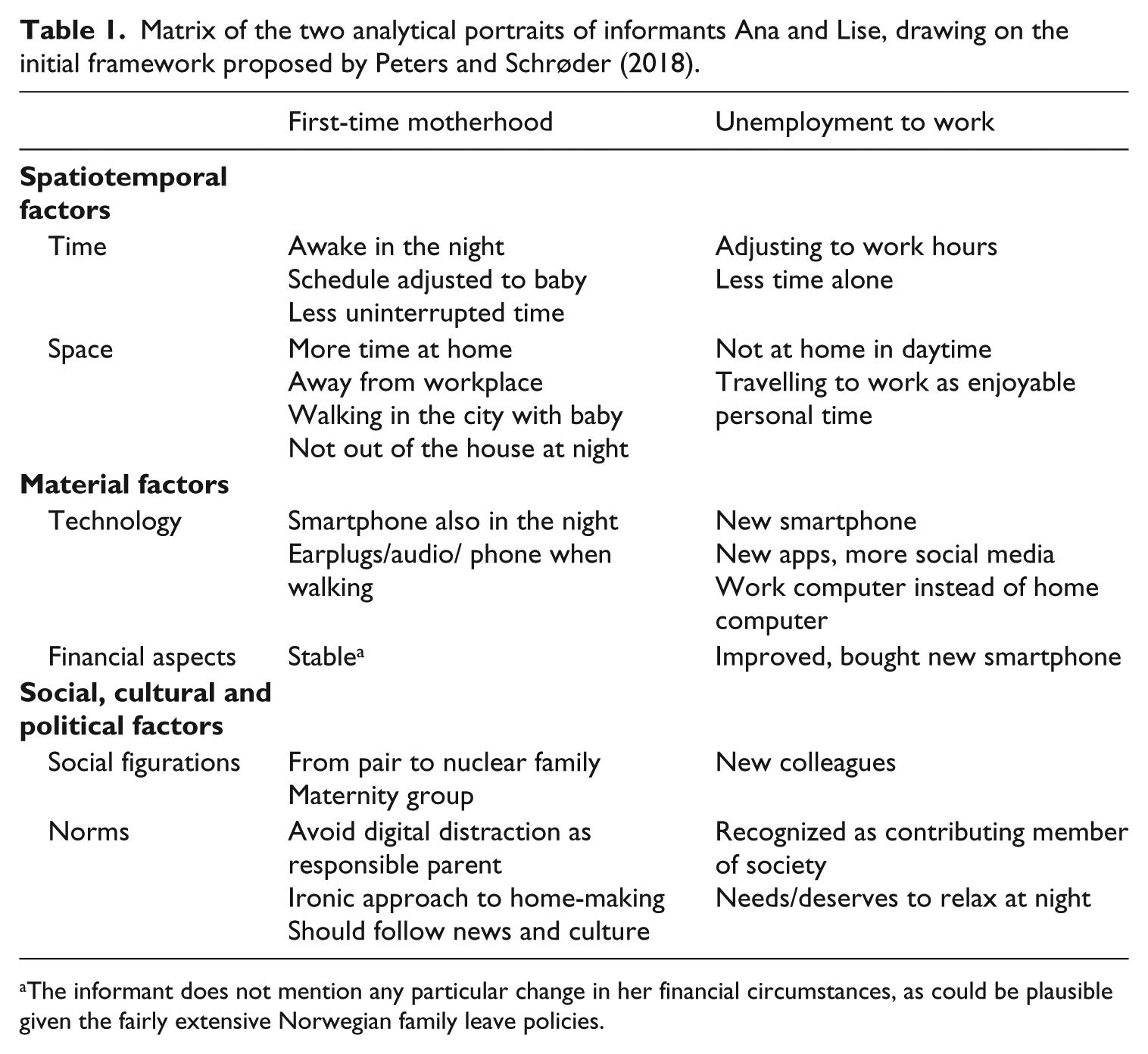
The informant does not mention any particular change in her financial circumstances, as could be plausible given the fairly extensive Norwegian family leave policies.
The factors called ‘social, cultural and political’ in the framework can also be conceptualized as media repertoires or public connection, as these are different analytical tools rather than entities in people’s lives. However, considering social and political factors in conjunction with material and spatiotemporal factors clearly helps to situate changes in media repertoires and public connection within the everyday life context. Thereby, new components in media repertoires – and their potential significance for public connection – do not appear suddenly or inexplicably, but rather as responses to biographical events that affect everyday life through multiple dimensions. The increase in smartphone use reported on by these informants, and by informants quoted previously, can most sufficiently be explained in this manner.
While most of the key elements in the two analytical portraits align well with the framework proposed by Peters and Schrøder (2018), some central aspects are difficult to place. This primarily concerns a dimension of personal wellbeing, so intimately connected to the bodily experiences of the individual that it is difficult to frame as a social factor. In the two portraits, one informant talks of how sleep deprivation affects media use, and the other of the need to conserve mental energy for a new job rather than follow the news. These dimensions appear central to understand how the biographical disruption actually affects media repertoires and public connection. One could ask why personal well-being emerges more clearly in this analysis compared to former research on these topics. A potential explanation is that such dimensions are likely to be more tangible to the individual, and central to the everyday experience, when they are destabilized by transformative biographical events. Sleep deprivation is obviously noted by the person experiencing it, but otherwise sleep is easily taken for granted and thereby not actively considered as a prerequisite for focusing more demanding media content. Again, a parable to illness as disruption is relevant, even if the sentiment of the experience is very different.
Last but not least, technology comes across as a particularly important cross-cutting dimension, intersecting with spatiotemporal, material and socio-cultural factors. Changing uses of technology, particularly smartphones, appears in the analytical portraits as active responses to changing circumstances. In the time/space organization of everyday life, smartphones seem immediately adaptable when established components of a media repertoire would have to give way to a new life situation. This has to do with the physical properties of the smartphone (how small it is, how portable) and with its multi-modality (audio in earplugs when walking, silent screen-use when the baby lightly sleeps). It also supports the idea of smartphones as an intimate technology (Frizzo-Barker and Chow-White, 2012; Hjorth and Lim, 2012), kept close to the body and used in the most private as well as public spaces. However, the adaptability of the smartphone produces urgent needs for re-negotiating cultural norms for the uses of digital media, intimately situated within the changing conditions of everyday life. As suggested in the first part of the analysis, increased smartphone use could first be considered a part of exceptional circumstances, but then continues to expand towards a new normality, in which the smartphone is experienced also as an impediment to other media use practices.
Conclusion
The research question for this article was how significant changes in everyday life could affect media use practices and societal orientations. Drawing on key debates in audience research, this has been conceptualized a process in which biographical disruption in everyday life destabilizes media repertoires and public connection. A key finding is that the nature of such changes can meaningfully be described as destabilization: It is not that media repertoires undergo complete upheavals, or that modes of public connection change overnight, but rather that they are profoundly or lightly disturbed, so that their integration in everyday life has to be actively reconsidered. Such reconsideration could take the form of struggles to find new routines or to follow established interests, but also as positive processes in which new opportunities emerge. The destabilization of individual components in a media repertoire can be temporary, or a pathway to more long-lasting change.
Of the different biographical disruptions that have been discussed, the experience of having children comes across as particularly significant, not merely as an important event in the life course, but as key to the particular question of changing media repertoires and changing public connection. A related finding is the central role of mobile media technologies, particularly smartphones, as interwoven in such changes. More than other forms of media use, the smartphone appears intimately connected with the physical, cognitive and emotional processes of dealing with biographical disruption in the context of everyday life. This suggests that factors such as well-being, and physical and psychological dimensions of using media technologies, should be studied along with the spatiotemporal, material and socio-political factors of change in media repertoires. It also speaks of the adaptability of smartphone use to subtly but persistently fill time-gaps and become part of different everyday situations, meriting further empirical and theoretical analysis. Not only does the combination of smartphones and babies seem to have a nearly explosive force in uprooting established media repertoires and modes of public connection. Smartphone use is also key to the reorientation that follows, and to new routines that are gradually established as the life course progresses.
Footnotes
Funding
The author disclosed receipt of the following financial support for the research, authorship, and/or publication of this article: The author received financial support for the research and authorship of this article from the Research Council of Norway (Grant 247617).
