




Abstract
Twitter has become a privileged data source for analyzing the behavior of users when interacting online. This research aims to explore the interactive behavior of users in political discussions and the changes in their behavior over time. Understanding the interactive functions of Twitter (retweeting, mentioning, and replying) as digital traces of users’ behavior, we analyze the patterns of interaction of politicians, media, and citizens in two political discussions in Spain during the 2015 and 2016 general elections. Our results confirm previous studies that prove the homophilic behavior of politicians and citizens in political discussions. The networks of interaction, in particular, the retweet network, resemble echo chambers. It also shows that media play the role of weak ties of the networks. The analysis also shows that the patterns of interaction remained stable after the repetition of the election, and only a meager part of the users participating in both discussions changed their behavior. This article aims to contribute to the use of Twitter as a source for understanding people’s interactions is political discussions in social media and their dynamics across time.
Introduction
Social networking sites (SNS) have become powerful and influential tools for political communication (Gibson, Cantijoch, & Ward, 2010). Politicians, media, journalists, and citizens increasingly use Twitter (Lefky, Brewer, & Habegger, 2015; Parmelee & Bichard, 2012) as a platform for content sharing, public communication, and interpersonal connection (Burgess, Marwick, & Poell, 2017). Politicians have increasingly adopted Twitter as a useful tool for political communication (Vergeer & Hermans, 2013). Taking advantage of the word-of-mouth-like nature of the microblogging site, politicians have adapted their messages to the characteristics of tweets and their 140, now 280, characters constraint. Research on the use of Twitter by politicians reveals contradictory results. On one hand, scholars have found that politicians do not make use of the interactive functions provided by the platform (i.e., retweets, responses, mentions, and likes) and tend to understand Twitter as a broadcasting media (Grant, Moon, & Grant, 2010). On the other hand, it has been shown that candidates can effectively use the platform as a tool for interacting with voters (Graham, Broersma, Hazelhoff, & van’t Haar, 2013; Graham, Jackson, & Broersma, 2016). However, as a general rule, there seems to be an agreement on the fact that politicians tend to interact with members of their own party (Plotkowiak & Stanoevska-Slabeva, 2013), a behavior that is linked to homophily, people’s tendency to establish relationships with people who resemble themselves (McPherson, Smith-Lovin, & Cook, 2001).
Twitter is also the leading social media platform for journalists to break news (Gil de Zúñiga, Diehl, & Ardèvol-Abreu, 2018). Journalists tend to be hard users and utilize people’s tweets for news stories (Kim, Kim, Lee, Oh, & Lee, 2015). Twitter has changed journalists’ daily routines at work (Parmelee, 2013) and has had an impact on journalists’ adherence to the norms of objectivity and gatekeeping (Lawrence, Molyneux, Coddington, & Holton, 2014; Molyneux, 2015). Scholars have also analyzed the dynamics of agenda setting between Twitter, politicians and the media (Skogerbø & Krumsvik, 2015), and media coverage of election campaigns including Twitter coverage (Lefky et al., 2015).
Conversely, the use of Twitter by citizens differs from that of media, journalists, and politicians. People use Twitter to satisfy their need for connecting with others (Chen, 2011), seeking information, or socializing, among others (Lee & Oh, 2013). In political debates, citizens tend to use the platform more as a way to express dissatisfaction rather than to campaign in favor or against parties or candidates (Hosch-Dayican, Amrit, Aarts, & Dassen, 2016). Citizens’ behavior tends also to be homophilic (Colleoni, Rozza, & Arvidsson, 2014), meaning that they generally interact with only one single party that is closest to their own political stance. It has been shown that such behavior leads to the formation of echo chambers (Morozov, 2011) in which messages are repeated and amplified in closed systems or clusters. As a consequence, people’s homophilic behavior facilitates the uncovering of political communities and users’ latent attributes in Twitter (Bruns & Highfield, 2013; Burgess & Bruns, 2012), in what has been described as a “living laboratory for studying contagion and homophily” (Bliss, Kloumann, Harris, Danforth, & Dodds, 2012, p. 388).
However, there is a lack of longitudinal studies in the academic literature on political discussions on Twitter. This article aims to fill this gap and to show how the behavior of users evolves through time. For that purpose, we analyze the patterns of interaction of users who participate in political discussions in terms of the functionalities provided by Twitter (retweet, mention and reply), as well as the follower–followee and retweet overlap networks (RONs) and their presumable changes across time. We use the data of the two consecutive general elections in Spain in December 2015 and June 2016 as a means to observe how Twitter users change their behavior in a relatively short time span.
Interaction in Social Networks
Interaction is the main defining feature of SNS. Through SNS, people can publish their own content, establish permanent connections with other users, spread others’ content, or express their attitudes toward messages using the like-type functions provided by the platforms. This interactive behavior is traceable (Peng, Liu, Wu, & Liu, 2016; Reigeluth, 2014). Therefore, scholars can analyze not only people’s activity online but also users’ in-network behavior in terms of spreading content and establishing discussions with other users by mentioning and replying (Boyd, Golder, & Lotan, 2010). Retweeting has been one of the main focuses in the analysis of Twitter users’ interactive behavior due to its consideration as a form of endorsement (Williams, McMurray, Kurz, & Hugo Lambert, 2015), especially when it comes to political discussions (Ceron & D’Adda, 2015; Guerrero-Solé, 2017). In fact, the US Justice Department considers retweets as endorsements in cases such as terrorism (Roberts, 2016). Nonetheless, there is no consensus regarding the interpretation of retweeting, with some scholars supporting the idea that the retweeting practice is often ambiguous, and its significance determined by numerous factors (Liu, Liu, & Li, 2012). A disclaimer in users’ descriptions that warns that retweets “may not be considered as endorsements” of other users’ contents is a common practice, in particular, among journalists (Molyneux, 2015). Altogether, regardless of the meaning of retweeting in different situations and contexts, evidence shows that, generally speaking, people’s behavior in political discussions tends to be homophilic, that is, they only spread the content that is consonant with their own views.
Users appear to behave differently when it comes to mentioning and replying (Williams et al., 2015). When mentioning, users highlight a message to a given user in what can be understood as an interpellation or an attempt to start a conversation with that user (Bruns & Moe, 2014). In these cases, users’ behavior does not follow a homophilic pattern (Conover et al., 2011). The structure of the mention network takes often the form of a single cluster or community in which users of different ideologies interact. The same applies to replies (Bruns, 2012). Replying is an alternative way to express interest in a tweet (Bliss et al., 2012) and to start and carry on a conversartion. Social aspects appear to be the main reason for replying (Sousa, Sarmento, & Mendes Rodrigues, 2010). Scholars have found that replies between like-minded individuals strengthen group identity, while those between different-minded individuals reinforce in-group and out-group affiliation (Yardi & Boyd, 2010).
Spanish Political Context in 2015 and 2016
In December 2015, Spain celebrated a general election to the Spanish Congress of Deputies to vote for the 350 members of the lower house of the General Courts. The election was marked by the political, social, and economic crisis that started in 2008, the burst of the 15-M movement, 1 and the rise of separatism in Catalonia (Casero-Ripollés, Feenstra, & Tormey, 2016). The emergence of new political parties in Spain (the left-wing party Podemos (We Can), and the liberal Ciudadanos (Citizens-Party of the Citizenry, Cs) anticipated the end of the old two-party system (Mico & Casero-Ripolles, 2014). The two main traditional parties, the conservative Popular Party (PP) and the social-democratic Socialist Party (PSOE), lost support, while the newcomers Podemos and Cs became the third and the fourth forces (Casal Bértoa, 2015). The general election in 2015 confirmed that no party would have a majority of seats in the Congress. The Spanish head of state, King Felipe VI, offered PP’s leader Mariano Rajoy to present his candidacy to the Congress, but the acting president rejected the offer. Cs and PSOE signed then an agreement to support Pedro Sánchez, PSOE’s Secretary-General, to become the Spanish president. However, PSOE’s leader lost first and second investiture debates, and Spain returned to polls in 26 June 2016. The results of the second general election in half a year followed the same pattern as in December (Table 1). This time, however, it was the acting prime minister and PP’s leader, Mariano Rajoy, who signed an agreement with Cs and presented his candidacy to the Spanish Congress. Rajoy lost the investiture debate (Jones, 2016), but finally was elected with the support of Cs and the abstention of PSOE.
Results of the Spanish Elections in December 2015 (20D) and June 2016 (26J).

Note. Columns show MPs obtained by party. Only national-level parties are included (i.e., regional parties excluded). Spanish lower house of Parliament comprises 350 members.
Spanish Politics in Twitter
Research on Twitter in Spain has been growing over the last years. One of the first studies on Spanish politics analyzed the dynamics of debates during the 2011 campaign (Aragón, Kappler, Kaltenbrunner, Laniado, & Volkovich, 2013). The research showed that interaction between users was highly polarized, and politicians tended to use Twitter as a broadcast medium without interacting with citizens. Later researches focused on the Catalan Parliamentary Elections showed the correlation between the overlaps of communities of retweeters in political discussions and the voters’ perception of the distances between parties (Guerrero-Solé, Corominas-Murtra, & López-González, 2014). Recent studies have analyzed the functions and communicative strategies of politicians (e.g., López-Meri, Marcos-García, & Casero-Ripollés, 2017) or the campaign strategies of new political parties in Spain (Casero-Ripollés et al., 2016).
Despite the growing pace of the body of literature on political communication in Twitter, there is a lack of studies focusing on the dynamics of the debate through time. An exception is a study conducted by Baviera (2018), who found that the retweeting networks in 2015 and 2016 of the Spanish political debate were highly clustered. The most compact cluster was that of Podemos, which had a central position in the retweet network. He also concluded that users akin to PSOE were close to those akin to Podemos, and users akin to PP were close to those akin to Ciudadanos. On the other hand, Gallego, Laniado, Kaltenbrunner, Gómez, and Aragón (2017) analyzed the differences between 2015 and 2016 in the structure of the retweet networks of Spanish left-wing parties.
However, these researches do not fully classify users who participate in political discussions, and their analyses are restricted to the identification of the structures of the retweet and mention networks. Consequently, they lack of a complex and comprehensive understanding of the interactions between users and their evolution in time. The main goal of this research is to examine the behavior of users in the two last electoral campaigns in Spain in 2015 and 2016. While Baviera’s (2018) work was focused on the community structure of the retweeting and mention networks, our research expands the interactive behavior to replies, follower–followee relationships, and the RON. In addition to this, we performed a systematic classification of the users by type (politicians, media, journalists, and citizens) and partisanship with the aim of showing what were the differences between their patterns of interactions in political discussions during electoral campaigns. Consequently, our research questions took the following form:
RQ1. What are the patterns of interaction (retweet, mention, reply, following–followee, and RON) of politicians, media and journalists, and citizens in electoral campaigns discussions in Spain and their evolution through time?
Drawing on the endorsement nature of retweet, we were interested in those users who changed their interactive behavior. Our second research question focused on the changes in the retweeting behavior of users between the two elections:
RQ2. How many users changed their retweeting behavior between 2015 and 2016?
Since literature shows a high level of homophily in political networks, and the formation of highly segregated communities, our last research question asked about the existence of users who, hypothetically, connect these communities acting as weak ties (Granovetter, 1973). Assuming the existence of these weak ties,
RQ3. What is the typology of the users who connect isolated ideological clusters?
Sample and Method
Data Collection
To answer to our research questions, we used two similarly sized samples of tweets and retweets collected during the two electoral campaigns in Spain in December 2015 and June 2016. We collected the posts containing the hashtags #20D for 2015 (N20D = 540,231, of which 430,326 were retweets), and #26J for 2016 (N26J = 576,842, of which 475,676 were retweets). These hashtags were considered to be politically neutral, not biased toward any of the parties involved. Twitter API Search was used for the collection of posts. For each tweet, we collected the Twitter handle and user id, the body of the message, the time it was posted, and the user location and description where available.
Data Processing and Variable Definition
After processing tweets and retweets, a record was created for each user participating in the discussions. In total, 180,238 single users participated in any of the two discussions: 44,072 participated in both discussions, 86,261 only in 20D, and 70,548 only in 26J. The following variables were then measured for each user in the two networks: (1) Activity—the number of original tweets and retweets posted by the user, (2) Retweet to (RT)—ids of the users retweeted by the user, (3) Retweeted by (RTb)—ids of the users who retweeted any of the tweets posted by the user, (4) Mentions to (M)—ids of the users mentioned by the user, (5) Mentioned by (Mb)—ids of the users who mention the user, (6) Reply to (RP)—ids of the users replied by the user, (7) Replied by (RPb)—ids of the users who reply to the user, and (8) Followers (F)—the number of followers of the user at the end of the collection process.
Type of User and Partisanship
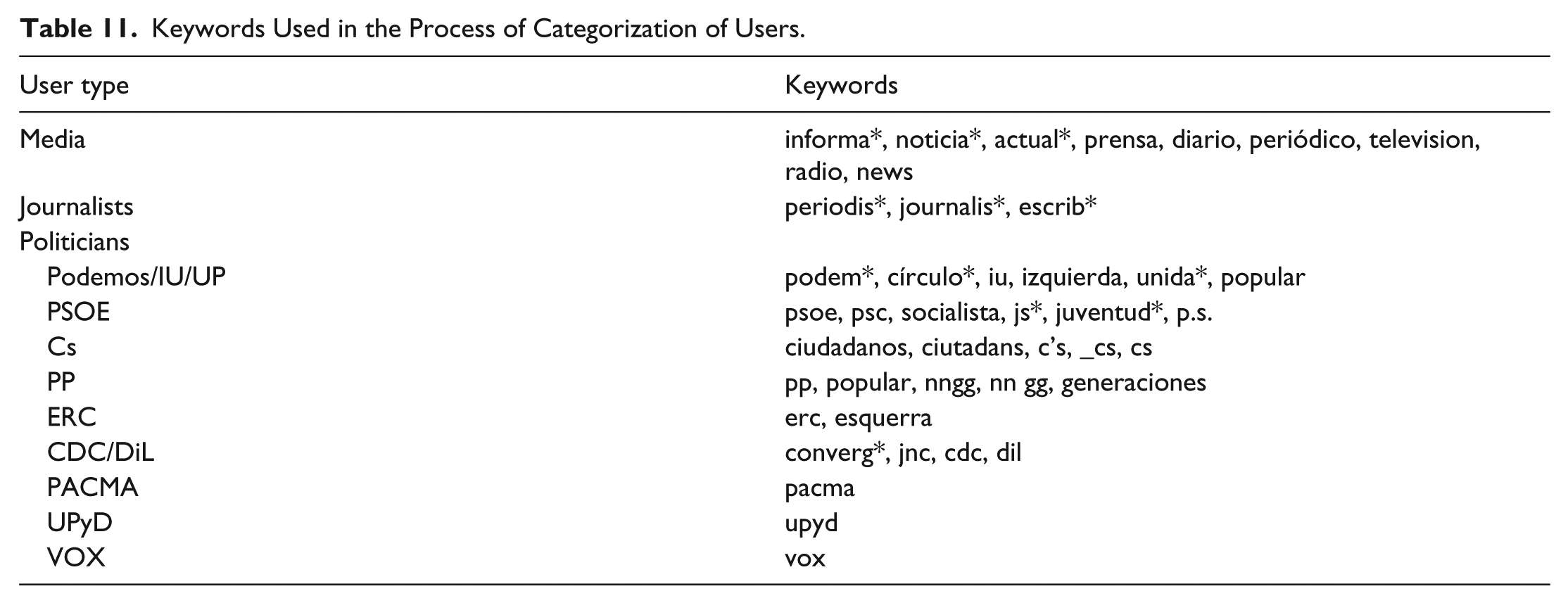
Users were classified by type and partisanship. For this purpose, a five-stage method for categorizing users was performed. First, by reading public Twitter profiles’ data (which included name, handle, description, and location), we manually identified the 1,000 most followed users in both discussions and categorized them as media outlets, journalists, politicians, and citizens, a general category for those users who did not belong to any of the previous three categories. Second, we read politicians’ public profile information for evidence of partisanship. When specific party names were included, we coded them accordingly. Third, and as a way of automatizing the manual identification process conducted on these 1,000 users, we identified the main keywords and letters used by them in their descriptions and handles. Fourth, such keywords and letters were used to identify the rest of the users (the comprehensive list of keywords is shown in Table 11 in Appendix). Finally, a randomly selected subset of 300 users was coded by a second coder to check whether the automatic procedure was consistent with the manual. The intercoder reliability index was .92 (Cohen’s kappa), which is typically considered a good coefficient of internal consistency (Lombard, Snyder-Duch, & Bracken, 2002). The total number of users identified by type and partisanship is shown in Table 2.
Number of Unique Users Who Participated in 20D and/or 26J by Type of User.

Network Analysis
Having measured the type and partisanship of users, we built the retweet, mention and reply networks for both discussions. These networks were created by linking each user (node) with those that the user retweets (RT), mentions (M), or replies to (RP; Bruns, 2012). Thus, two users are linked in each network if (at least) one of them retweets (mentions or replies), once (or more), the other. Tie strength (i.e., number of links) and interaction direction were not considered.
Since the research involved the comparison of the different networks built considering different types of interaction, we also collected the set of friends (followees) for the 5,000 most retweeted users in 20D and 26J to build the follower–followee network (Bruns, 2012; Peng et al., 2016).
A final complementary approach to users’ interactive behavior was done by building the RONs. RON is a method that has been proven efficient to estimate political homophily and polarization in Twitter (Guerrero-Solé, 2017; Guerrero-Solé & López-González, 2017). RON draws on the measurement of the overlaps between the communities of retweeters of the most influential (retweeted) users in a network. It has been also used to measure the distances in terms of similarity between political parties (Guerrero-Solé et al., 2014). This method shows how homophilically users behave in retweeting, and it is used as a starting point to uncover the community structure of social networks. Thresholds are used in the RON method as a means to obtain a series of nested subgraphs that make the structure of the network emerge. The no-threshold RON is the more conservative test for analyzing the structure of these networks, since two users of the network are linked when the overlap between their communities of retweeters is greater than 0. In other words, they are linked if at least one user has retweeted a post of both of them. Consequently, the no-threshold network is the one with the larger number of nodes and edges and with a less defined structure (see Guerrero-Solé, 2017 and Guerrero-Solé et al., 2014, for a more detailed account of the decomposition of RON networks).
Results
To answer RQ1, we first built the retweet networks for both 20D and 26J (Figure 1). Afterward, we calculated the number and the ratio of retweets between users by typology and partisanship. The number of retweets (NRT) posted by members of the parties, media and journalists, and citizens and the ratio of these retweets to users by typology are shown in Table 3.

Retweet networks in #20D and #26J (Profuse Directed Force). Red = PSOE, purple = Podemos/UP, orange = Cs, blue = PP, green = Media and Journalists, yellow and dark blue = Catalan Nationalist Parties.
Ratio of Retweets Between Users in 20D and 26J by Typology and Partisanship.

Note. NRT stands for the number of retweets to posts published by users.
As it is shown in Table 3, the majority of the retweets of members of a given party were to post of members of the same party. This fact is particularly acute in the case of the parties PSOE, Cs, and PP, while Podemos shows a relatively high rate of retweets to citizens in both 20D and 26J discussions. For their part, the retweeting behavior of media, journalists, and citizens was more balanced. In both discussions, media and journalists retweeted posts not only from users of their same category but also those posted by citizens and, to a lesser extent, those of members of political parties. An even more balanced behavior was observed in citizens, who retweeted almost indifferently tweets posted by any of the political parties, media, and journalists. In this case, it is worthy to mention the significant increase in the ratio of retweets to PSOE and PP from 2015 (.05 and .06, respectively) to 2016 (.12 and .11, respectively).
We carried out the same process for the mention (Jiang, Sha, & Wang, 2015) and the reply networks. As in the retweet network, two users are connected if one of them mentions or replies to the other (Figure 2).

Mention Network in #20D and #26J (Profuse Directed Force). Red = PSOE, purple = Podemos/UP, orange = Cs, blue = PP, green = Media and Journalists, yellow and dark blue = Catalan Nationalist Parties.
We also calculated the number of mentions of the members of the four main parties to any of these parties (Table 4).
Mentions Between Users in 20D and 26J.

Note. NM stands for the number of mentions to users by typology.
As it is shown in Table 4, the patterns of mentioning for political parties were similar to those of retweeting. The members of the parties tended to exclusively mention users who were also members of the same party. If not, they primarily mentioned citizens and, to a lesser extent, media and journalists. Again, media, journalists, and citizens showed a more balanced and heterogeneous behavior by mentioning almost in a similar proportion political parties, media, and citizens. Minor differences were observed between 2015 and 2016 discussions.
We finally created the reply network of all the users in the networks 20D and 26J (Figure 3).

Reply network of the all users in #20D and #26J (Profuse Directed Force). Red = PSOE, purple = Podemos/UP, orange = Cs, blue = PP, green = Media and Journalists, yellow and dark blue = Catalan Nationalist Parties.
We performed the same operations for replies, which were ostensibly fewer than retweets (Table 5).
Replies Between Users in 20D and 26J.

Note. NR stands for the number of replies to posts published by users.
As observed in Table 5, the behavior for replies was similar to that of retweeting. Political parties replied to members of their same party (with the exception of Podemos), while media, journalists, and citizens showed a more balanced and heterogeneous behavior.
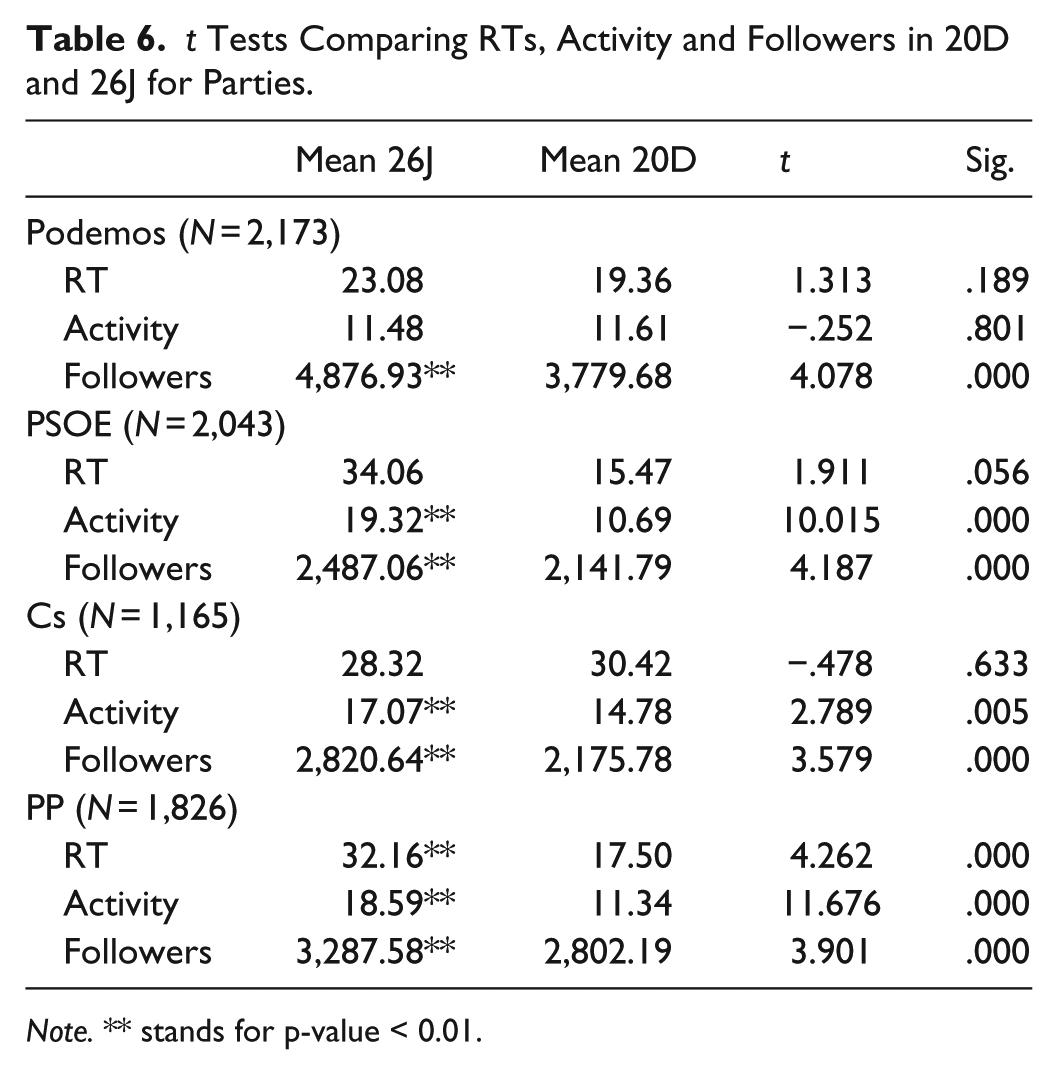
To help the comparison of the interactive behavior of politicians, we then calculated the means for activity, retweeting, and number of followers for those users who participated in both 20D and 26J (Table 6).
t Tests Comparing RTs, Activity and Followers in 20D and 26J for Parties.
Note. ** stands for p-value < 0.01.
Patterns of Interaction Between Citizens and Political Parties
Since the behavior of citizens could seem at a first glance different from that of the political actors (see Tables 4 and 5), we also calculated the distribution of the users in terms of their loyalty to any of the four main parties. We calculated how many users retweeted posts of members of only one of the four parties. Only those users who retweeted two or more posts were considered (Table 7). The results show the segregation of the users who participate in a political debate.
Ratio of Users Who Retweeted Only to One of the Four Main Parties.

Note. The total number of users who retweeted at least once the party is given in parenthesis.
Changes in Users’ Retweeting Behavior from 20D to 26J
The second research question to answer was related to the change in the retweeting behavior of users between 20D and 26J. As it was pointed out before, we consider here the retweeting behavior of users in political discussions as the most reliable interaction feature to identify endorsement and therefore party affiliation. On the contrary, and despite the results shown above, mentioning and replying, in particular, among media outlets, journalists and citizens can hardly be interpreted as endorsement or support.
From our sample, we identified those who participated in 20D and 26J changed their retweeting behavior, that is, they retweeted only one party’s members in 20D and another party’s members in 26J. As it is shown in Table 8, only 297 users (all of them categorized as citizens) changed their retweeting behavior between both elections (0.7% of the 44,072 total users who participated in 20D and 26J).
Number of Users Who Changed Their Retweeting Behavior Between 20D and 26J.

In terms of the absolute flow of users between parties, we can see that most of the changes were from PSOE to Podemos (+27) and PP to Cs (+36). In total, Podemos won 41 users, PSOE lost 9, Cs won 5, and PP lost 37. This flow of users has already been analyzed by Orriols and Cordero (2016), who found that vote transfers from old (PP and PSOE) to new (Cs and Podemos) parties could be explained by the Spanish political crisis and the lack of confidence in political institutions in Spain.
RON and Following–Followee Networks
We created the RON networks for the 1,000 most retweeted users in both 20D and 26J discussions. To make comparison easier, we first built the RON networks formed by those political actors who participated in both discussions, for a similarity threshold equal to 0 (no threshold) (Figure 4). The 20D no-threshold RON network was formed by 152 users (3,210 edges) and that of 26J by 196 users (5,204 edges). Then, we did the same for a similarity threshold of 0.01 (Figure 5).

RON networks formed by political actors among the top 1,000 retweeted users both in #20D and #26J. Red = PSOE, purple = Podemos/UP, orange = Cs, blue = PP, green = Media and Journalists, yellow and dark blue = Catalan Nationalist Parties.
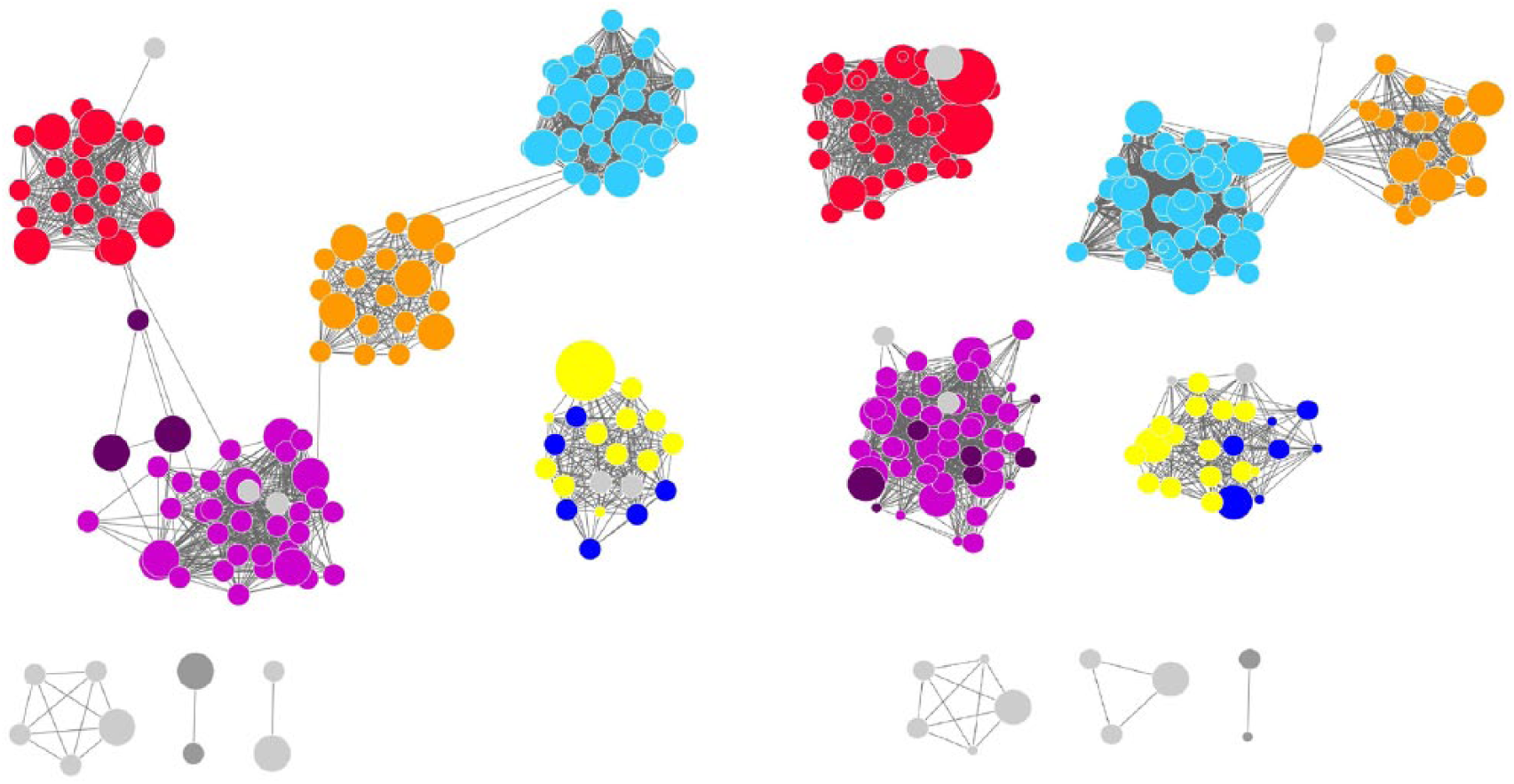
RON networks formed by political actors among the top 1,000 retweeted users both in #20D and #26J (threshold 0.01) (20D 150 users, 1,693 edges/26J 196 users, 3,022 edges). Red = PSOE, purple = Podemos/UP, orange = Cs, blue = PP, green = Media and Journalists, yellow and dark blue = Catalan Nationalist Parties.
As it is shown in Figures 4 and 5, the structures of the 20D and 26J RON networks were quite similar, with clearly defined political clusters for a threshold equal to 0.01. When media and journalists were added to the RON networks (Figure 6), they still appeared structured in political communities, with most of the media and journalists’ accounts acting as bridges between clusters.

RON networks formed by political actors and media among the top 1,000 retweeted users both in #20D and #26J (threshold 0.00 and 0.01). (20D 208 users 8,305 edges/26J 262 users 12,118 edges). Red = PSOE, purple = Podemos/UP, orange = Cs, blue = PP, green = Media and Journalists, yellow and dark blue = Catalan Nationalist Parties.
For comparison purposes, we finally built the following–followee network (Peng et al., 2016) for the 5,000 most retweeted politicians, media, journalists, and citizens in discussions 20D and 26J. Results are shown in Figure 7.

Follower–followee relationship between politicians, media, and journalists participating in #20D and #26J. Red = PSOE, purple = Podemos/UP, orange = Cs, blue = PP, green = Media and Journalists, yellow and dark blue = Catalan Nationalist Parties.
Patterns of Interaction Between Media and Political Parties
Finally, we analyzed the direct interaction between media and political parties in terms of the diffusion of information (retweet). As it is already shown in Table 3, there is a weak interaction between both actors. It may be added that the retweets of media and journalists to political messages are mainly done by the latter. Thus, in 20D, media and journalists retweeted 1,763 tweets from political parties, of which 1,718 (.97) were retweets of journalists. In 26J, 1,672 tweets were retweeted by media (147; .09) and journalists (1,525; .91).
Journalists retweeted 373 times to Podemos, 225 to PSOE, 310 to Cs, and 261 to PP, while 549 times to other parties (in 20D). In 26J, media retweeted 147 times political actors, while journalists did it 1,525 times, 416 to Podemos, 363 to PSOE, 186 to Cs, 249 to PP, and 311 to other political parties.
To answer to the last research question, we identified the users who were retweeted by the four main political parties in Spain. Both in 20D and 26J, the number of users was small (around 50 users). As shown in Tables 9 and 10, the majority of these users were media outlets.
Media Outlets Retweeted by the Four Main Spanish Political Parties in 20D.

Media Outlets Retweeted by the Four Main Spanish Political Parties in 26J.

Discussion
Interactive behavior of Twitter users in terms of digital traces is a privileged source for scholars in political communication. Despite the large amount of studies investigating Twitter interaction, to the best of our knowledge, few researches have analyzed the dynamics and evolution of such behavior in political debates. The two elections in a row in Spain in 2015 and 2016 offered us the opportunity to compare users’ interactive behavior in a relatively small period of time. The results of this article reinforce the perspective that Twitter users in political discussions behave homophilically. We found a strong segregation of users, in particular, in the retweet networks (Table 3) and a meager change in the retweeting behavior of users over time (Table 8). Users tend to spread messages of like-minded users (McPherson et al., 2001), as it has been shown elsewhere (Colleoni et al., 2014; Plotkowiak & Stanoevska-Slabeva, 2013). This has been commonly associated with the levels of polarization of political discussions (Guerrero-Solé et al., 2014) and of the political polarization (Fiorina & Abrams, 2008; Fiorina, Abrams, & Pope, 2006; Fisher, Waggle, & Leifeld, 2012) of societies, in general.
Mention and reply interactions did not follow the same pattern. However, detailed data on the behavior of political Twitter accounts showed that the mention/reply interaction between parties was also scarce (Tables 4 and 5). It means that not only those interactions that lead to a greater visibility of other parties’ messages are, in general, avoided but also the interactive functions that promote the dialogue and discussion with others are eluded. The only exception to this rule was the leftish party Podemos, whose members showed a significantly greater ratio of retweet, mention and reply to other types of users, in particular, to citizens. Beyond this exception, results lead us to the conclusion that Twitter was primarily used as a broadcasting (Aragón et al., 2013; Grant et al., 2010), echo chamber-like (Jacobson, Myung, & Johnson, 2016; Vaccari, 2013) media. Despite users’ interaction, they mainly interact with like-minded users, whatever the nature of the interaction is. This does not mean in any sense that political organizations and politicians are not aware of others’ messages. In fact, we found strong homophily in the retweet network, but higher levels of heterophily in the mention and reply networks. Notwithstanding this comparatively larger heterophily, politicians’ mention and reply networks still showed a great level of homophily. These results are consistent with those reported by Williams et al. (2015) in their analysis of the debates about climate change. Consequently, we can conclude that politicians do not only spread messages of like-minded users but also largely mention and dialogue with these same like-minded users, turning the network into a real echo chamber in which politicians and parties’ members only debate with those who already think alike. In addition, if any interparty interaction exists, it is only between politicians belonging to parties with similar ideologies (Aragón et al., 2013).
In general, the patterns of interaction were stable between 20D and 26J, and no major changes were observed for any of the groups of users and types of interaction. However, we observed several differences between parties. While the ratio of retweets, mentions, and replies for PSOE, Cs, and PP was, in general, greater than .80, as we have already observed the leftish party Podemos showed a different pattern, the ratio of retweets and replies were between .54 and .63, significantly lower than the ratio of the other three parties (Tables 3 to 5). However, the interactions were mainly with citizens, and those with the rest of the parties were also scarce. A number of conclusions can be drawn from these data. In particular, the fact that the leftish party Podemos has a greater number of grassroots militants who do not identify themselves as supporters of the party. In that sense, Podemos is the party with more unofficial partisans. The reasons may be in the infancy of the party (born in March, 2014), that may have impeded a full-fledged structuration of its members, or in the fact that precisely those who campaign and vote for them are stronger users of social networks than those of the traditional parties.
We also found some differences in terms of volume in the activity and retweeting of political parties between the two elections. In Table 6, we have shown that the two traditional parties (PSOE and PP) increased the number of posts and retweets between 20D and 26J. Those changes were, in particular, pronounced for PP, which almost doubled its activity in the neutral debate around 26J.
In general, these results are consistent with those obtained by Baviera (2018) in terms of clustering. However, some relevant differences must be considered. In particular, in our work, the structure of the networks was analyzed once the main actors of the discussions had been categorized by type, including not only politicians but also media and journalists, who play a specific and relevant role in the networks of interaction in political discussions. Besides certain methodological considerations, our results also lead to different conclusions than those of Baviera’s research. Baviera (2018) relied on the images of the graphs of mentions and retweets to conclude that in the retweet network, the proximity between PSOE and Podemos was “quite clear,” while the proximity between PSOE and Cs was “less clear” (p. 332). Besides this, the author found that in 2015, PP retweeted mainly posts from Cs, and in 2016 also retweeted posts from PSOE. On the other hand, PSOE retweeted posts from Podemos in 2015, “while in 2016, it retreated much more into itself” (Baviera, 2018, p. 334). Conversely, our results show that there was no proximity between the four main political parties in terms of retweeting: the ratio of retweets between parties was equal to 0 in all cases (Table 3). In the same line, Baviera found an intense interaction of mentions of users from different clusters and concluded that there were “few references” (Baviera, 2018, p. 333) between PSOE and Ciudadanos. On the contrary, our research shows that the ratio of mentions to other parties was scarce (between .01 and .02), with a small increase in the mentions from Podemos to PSOE in 2016. In this sense, our work complements that of Baviera by adding indicators of the intensity of the connections between political clusters.
RON and Following–Followee
We also found that the retweet overlap (RON) and the following–followee networks showed the same patterns, with a strong segregation in politically homogeneous clusters. RON networks, by which we can better understand the similarity between users’ strength of the interaction, showed that the links between parties are, in general, weak. It was confirmed even in the event of disregarding retweets by politicians, to avoid endogamy and the role-played by campaigners (Kreiss, 2014). Thus, the resulting networks in Figure 5 (threshold of similarity equal to 0) were almost the same as those in Figure 6 (threshold equal to 0.01). This result indicates that the community structures of the networks are already identifiable without the application of any threshold. These results confirm previous studies on the RON method (Guerrero-Solé, 2017; Guerrero-Solé et al., 2014) and reinforces the interpretation of the retweet in political discussions as a stable, coherent, and supporting behavior.
Data suggest that the retweeting behavior of citizens (Table 3) was much less polarized than that of politicians. However, a closer look at the retweeting of political messages (Table 7) showed that citizens tend to retweet only to one single party. The ratio of users who only retweet one party (independently of the number of posts retweeted) is near to .95 and rarely goes below .90. Thus, the number of users who spread the messages of two or more different parties is small. It shows that not only politicians but also citizens are polarized.
We also found that media and journalists rarely retweet political messages. Media and journalists only retweeted 1,763 (20D) and 1,672 (26J) posts from politicians, and more than 90% of the retweets were done by journalists. Since one of the main debates around the use of social networks by journalists is their adherence to the norms of objectivity and gatekeeping (Lawrence et al., 2014; Molyneux, 2015; Parmelee, 2013). We can conclude that the acritical spreading of the messages posted by politicians (that can be interpreted as an endorsement of the politician or party) is scarce among media and media professionals.
As in the case of retweets, media, journalists, and citizens mention politicians in their tweets, although politicians rarely mention them. This evidences the interactive behavior of these users, while politicians practically avoid or ignore the conversations citing media or citizens. While some scholars maintain that the democratic debate is reinforced by social networks (Larsson & Ihlen, 2015), our results show that this debate is highly unbalanced and mainly fostered by non-political users.
Media Outlets as Weak Ties
In a context of high segregation of the diffusion of information, another of the main conclusions of this study is that the users that are retweeted by all the political parties are, mainly, media outlets (Tables 9 and 10). Jacobson, Myung and Johnson (2016) already showed that liberal and conservative leaning audiences share a small number of information resources in Facebook. Their results indicate that political discussions in SNS are highly segregated by users’ political leaning. As a consequence, we may consider these media as the weak ties that cement the networks of diffusion and show that politicians from different ideological poles share the exposition to a certain group of media. Obviously, the exposition, and particularly the diffusion, is conditioned by the favorable content of the messages of media. Nevertheless, it is a proof that the isolation and the organization in echo chambers are not complete. This fact has a lot of implications that transcend the goal of this study. Media and journalists appear not only in the networks in relation to the process of diffusion of political messages (retweet and RON) but also in the following–followee network, as links between different parties. It is shown in Figures 1 and 7 that media and journalists play the role of weak ties (Granovetter, 1973) that link ideological clusters. This is of particular relevance if we consider that media and journalists are experiencing a crisis of legitimacy, and that as has been already mentioned, there is a strong debate around their adherence to the norms of objectivity and gatekeeping (Lawrence et al., 2014; Molyneux, 2015). Thus, while citizens and non-media sources are integrated into ideological clusters, media and journalists play, in general, the role of guardians of plurality and break the natural dynamics of resonance in political discussion in SNS. However, as it is also shown in Tables 9 and 10, the distribution of retweets of politicians to media is extremely unequal. Highly partisan conservative media outlets, such as ABC and La Razón, tend to be retweeted exclusively by accounts from conservative parties (Cs and PP), while non-partisan media outlets, such as El País or Elespanol.com , are retweeted by accounts from the four main parties studied.
Implications for Spanish politics
Spain has been experiencing an extreme polarization of politics that has led to a political stagnation of the country. The perceived distances between parties have increased, and only Cs is currently acting as a link between the left and the right wings. In Twitter, the four main political parties are almost isolated, with few links between each other. It has obviously severe consequences in terms of the richness of the political debate. The echo chamber–like structure of the diffusion, and also the mention and the reply, is putting in danger some of the main basis of democracy. Besides, this tendency is stable in time. Although new parties have broken the traditional two-party structure of Spanish politics, our study concludes that the ideological clusters of the new parties show few interactions with the traditional ones. Consequently, politicians and parties should be aware of the dangers of such an isolation and foster ways to avoid the exposition and diffusion exclusively to like-minded messages and users. Our results show that politicians interact to gratify their need to spread one’s party’s messages. And even the Twitter functionalities that were designed in the first place to discuss and to express disagreement (mention and reply) are also used as ways to strengthen the ideological isolation. In that sense, new ways to spread information that can penetrate the whole network (Barberá, Jost, Nagler, Tucker, & Bonneau, 2015) have to be found.
Limitations
A number of biases must be considered as limitations of this study. In particular, those linked to the collection method by using the Twitter Search API (González-Bailón, Wang, Rivero, Borge-Holthoefer, & Moreno, 2014; Morstatter, Pfeffer, Liu, & Carley, 2013; Tufekci, 2014), which does not guarantee that the sample of posts corresponds to the complete collection of messages posted in both discussions. Another limitation is associated with the sheer number of operations that were conducted to cleanse and process the collected data. Data preparation is an inevitable step in most network analyses, but it involves a constant post hoc manipulation of the results to evidence more clearly the intended aims. In addition, the results of this study are not generalizable to other political situations or networks, given the specificities of the Spanish context and politics.
Conclusion
Digital traces (Freelon, 2014; Milan, 2018; Reigeluth, 2014) in Twitter have shown the stable homophilic behavior of users in political campaigns in Spain and the strong polarization and segregation of political groups. The results of this work are consistent with the majority of works on Twitter and political communication. However, with more than 20,000 Twitter users classified as media, journalists, or politicians, more accurate conclusions have been taken about their interactive behavior and its evolution over time. We found that not only retweet interactions but also mention and reply were extremely homophilic. In addition, only meager changes were observed in the retweeting behavior of users over time. Among parties, the leftish Podemos was the only one that showed a high level of heterophily, with almost half of their interactions with users who were not members of the party. We also found that media and journalist did not retweet politicians, although they mentioned and replied to them. On the other hand, highly partisan conservative outlets were mostly retweeted by members of conservative parties. Finally, we also found that media and journalists appeared as the weak ties (Granovetter, 1973) that link the highly polarized networks we have analyzed (retweet, mention, reply, follower–followee, and RON). In definitive, the use of a categorized sample allowed us to go deeper in the analysis of the interactive behavior of users in political discussions and to find some relevant results than expand our knowledge in the nature and dynamics of this behavior. However, differences between our work and Baviera’s results suggest that more efforts have to be done to determine the impact of Twitter sampling on the interactive behaviors observed in political discussions.
Footnotes
Appendix
Keywords Used in the Process of Categorization of Users.
| User type | Keywords |
|---|---|
| Media | informa*, noticia*, actual*, prensa, diario, periódico, television, radio, news |
| Journalists | periodis*, journalis*, escrib* |
| Politicians | |
| Podemos/IU/UP | podem*, círculo*, iu, izquierda, unida*, popular |
| PSOE | psoe, psc, socialista, js*, juventud*, p.s. |
| Cs | ciudadanos, ciutadans, c’s, _cs, cs |
| PP | pp, popular, nngg, nn gg, generaciones |
| ERC | erc, esquerra |
| CDC/DiL | converg*, jnc, cdc, dil |
| PACMA | pacma |
| UPyD | upyd |
| VOX | vox |
Declaration of Conflicting Interests
The author(s) declared no potential conflicts of interest with respect to the research, authorship, and/or publication of this article.
Funding
The author(s) received no financial support for the research, authorship, and/or publication of this article.
