




Abstract
Following New York City’s recent regulations requiring hosts of short-term accommodations to obtain licenses, most hosts either exited the market or switched to monthly rentals. This raises the question of the implicit value of a short-term rental license—a topic that has not received much attention in the literature. To address this gap, we estimated several fixed-effect negative-binomial regressions using data on New York’s extant Airbnb listings from February 2023 to March 2024. We found that short-term licensed listings earn, on average, between 5.2 and 7.2 thousand dollars more per year than unlicensed ones.
Introduction
Facing a protracted housing shortage, often attributed to the proliferation of platforms like Airbnb and Vrbo (Lee and Kim, 2023), the City of New York (NYC) enacted Local Law 18 in September 2023. This law mandates that hosts offering stays shorter than 30 days must live with the guests and obtain a license (Nyc.gov, 2023).
Figure 1 illustrates the impact of this regulation on the number of entire-home Airbnb listings offering strictly short-term stays (29 nights or fewer) in NYC. The supply dropped dramatically from a steady 2600 properties to roughly 200 licensed ones. A similar trend occurred with those hosts also allowing for a month’s stay (31 nights or fewer), which we refer to as ‘short-month’ listings. An alternative to exiting the market was to switch to a month’s stay (strictly 30-31 days), allowing unlicensed hosts to remain on the fringes of the short-term market without infringing the regulations. Since September 2023, a maximum of 605 short-stay Airbnb listings have utilized that option, with 256 of them remaining by March 2024. Airbnb listings per length of stay (entire homes, NYC, Jul 23-Mar 24). Data source: insideairbnb.com.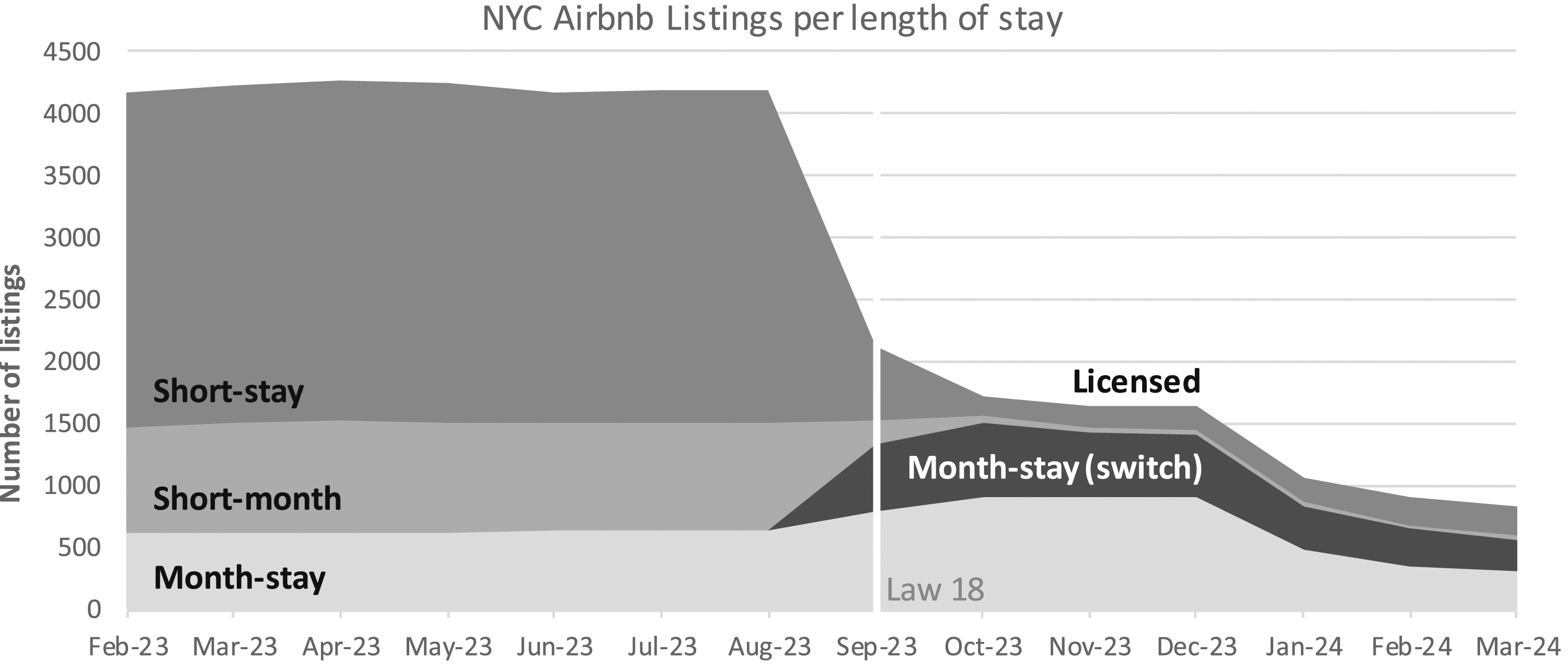
These high rates of market exit and switch to month-long stays raise questions about whether obtaining a license is worth the effort. What is the implicit value, in terms of gross revenue, of a short-term license for those hosts who obtained it?
While the effects of short-term rental (STR) regulations worldwide have been researched (Falk and Scaglione, 2024), the question of the monetary value of a license has not been widely addressed in the context of shared accommodations. Theoretical support for the benefits of a license can be inferred from the asymmetric information problems characteristic of peer-to-peer marketplaces (Benitez-Aurioles, 2022). The limited empirical evidence also supports this, with Boto-García et al. (2023) finding that licensed Airbnbs benefit from the added trust conferred by the host’s legal status, receiving, on average, 10% more reviews than unlicensed properties.
To address the existing gap, we estimated four fixed-effects negative-binomial regression models using data on short-stay bookings from NYC’s entire-home Airbnb listings around the period of Law 18 implementation. Our hypothesis is that, similar to past NYC regulations that had a detrimental effect on Airbnb incomes (Yeon et al., 2022), switching to month-long stays to circumvent the need for a short-stay license will reduce the number of bookings. The estimated difference between the bookings of licensed and switched properties would enable us to quantify the implicit value of an STR license in NYC.
Data and methodology
We compiled an unbalanced panel dataset of 3615 properties listed in NYC’s Airbnb market at any point between February 2023 and March 2024. Only entire homes offering stays of 31 days or fewer were selected. This approach was taken to focus on the listings most affected by the regulations (29 nights or fewer) while also including month-long stays on the fringes of the short-term market. Data was sourced from Insideairbnb.
Most listings are in Brooklyn (42.7%), followed by Manhattan (34%), and Queens (17.6%), although Manhattan remains the priciest area ($307/night), nearly 75% more expensive than Queens ($175). Since the value of an STR license might not be homogeneous across NYC, we estimate separate models for the major boroughs.
Similarly to past studies (Bernardi and Guidolin, 2023), we employ econometric methods to identify the determinants of Airbnb listings’ performance. After conducting a Hausman test, we favored a fixed-effects specification with robust standard errors (Equation (1)):

Our dependent variable booked_nights measures the number of nights booked at a given listing within a given month. We calculated this using the calendar availability data from Insideairbnb. Since booked_nights is a count variable, ranging from 0 to 30, we employ a negative-binomial regression due to the overdispersion in the data.
Our control variables are rooted in the Airbnb literature (Sainaghi, 2021), although we removed some time-invariant features (e.g., number of beds) that would be captured by the fixed effect. What remained were the host’s superhost badge (superhost) and their listing count, as well as the yearly availability of nights (avail_365) and the average monthly reviews over the listing’s lifetime (revpm). These variables account for aspects like the listing’s inherent popularity or the optimized revenue management techniques of professional hosts (Kwok and Xie, 2019).
The degree of local competition (comp) is expected to affect bookings negatively. For each month and listing, we measure the number of Airbnb rivals within the same neighborhood, considering the similarities in guest capacity and maximum/minimum length of stay.
The key variables to answer our research question are the three dummies labelling the sample listings according to their allowed length of stay. Considering the strictly short-stay listings as the reference category, short_month labels the hybrid listings that also allow for 30 and 31-days stays, month_noswitch denotes the listings that only allow month-long stays throughout the entire period, and month_switch denotes any month-long listings that previously allowed for short-term stays. The IRR of this last coefficient measures the proportional reduction in bookings for short-stay hosts who switched to month-long stays instead of getting a license.
Our specification is completed with a set of monthly dummies (date) to control for seasonal effects in Airbnb pricing, as well as the start of the post-regulation period.
We calculate borough-specific estimates for the implicit value of the STR license (Equation (2)). Starting with the average annualized bookings for a licensed listing (average monthly booked nights×12), we consider the bookings lost by switching (1–IRR
month_switch
) and, for the bookings retained, the forgone portion from the monthly discounts set by switching hosts (IRR
month_switch
× avg discount). The result is monetized using the post-regulation average daily rate.

Average monthly discounts for NYC’s Airbnb were collected for a subsample of 402 listings. The values were 14.3% for NYC, 13.7% for Manhattan, 15.4% for Brooklyn, and 12.1% for Queens.
Results and discussion
Regression results.
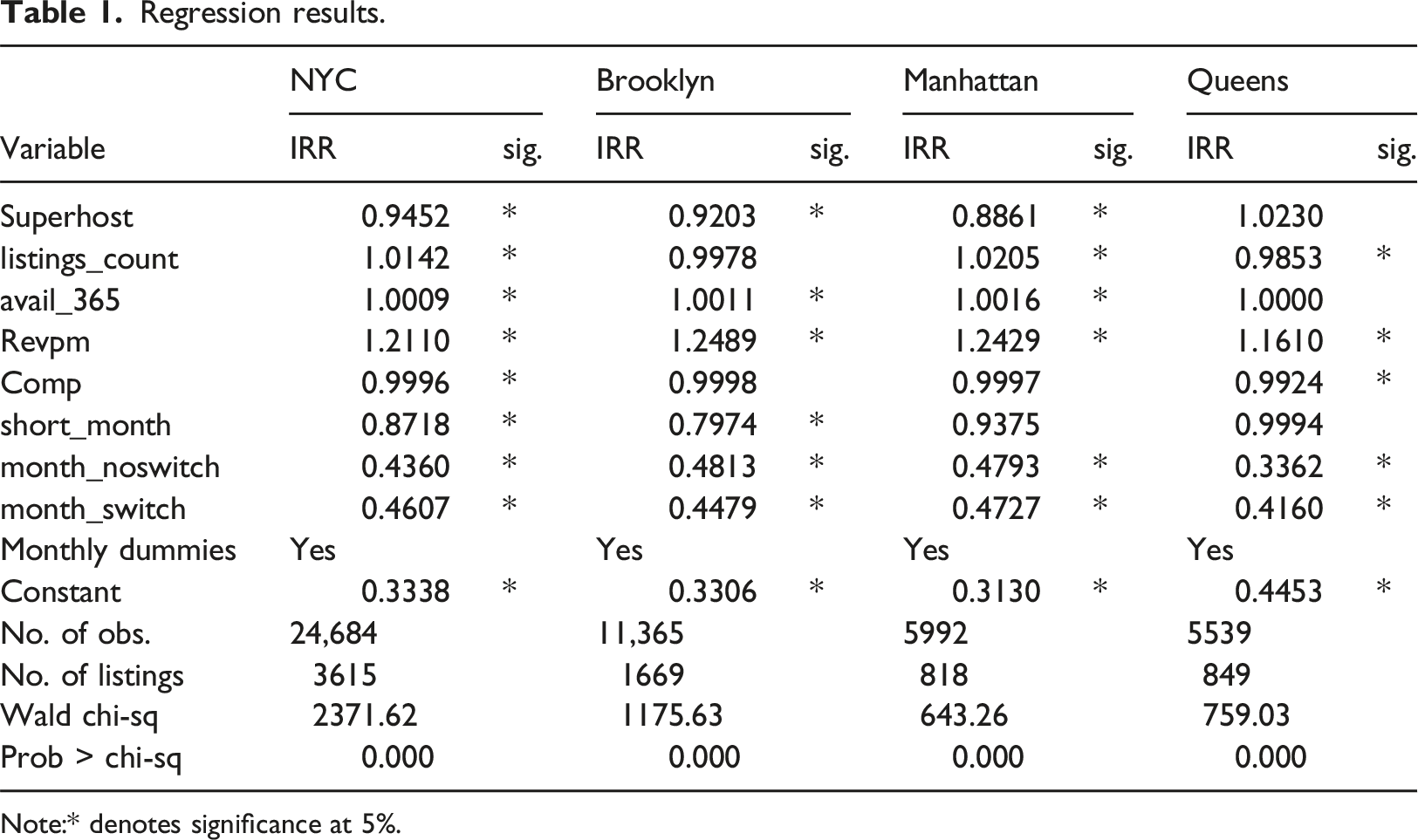
Note:* denotes significance at 5%.
Surprisingly, NYC superhosts receive about 5% fewer bookings than regular hosts—a drop that amounts to 12% in Manhattan. This is offset by the positive effect of listings_count, confirming the market dominance of professional hosts in city-center locations, especially in comparison with listings in Queens and Brooklyn. The availability, reviews, and competition coefficients are largely significant and have the expected impacts.
More interestingly, all ‘length-of-stay’ segments have fewer bookings than the strictly short-stay listings. The IRRs range between 75% and 87%, with switching hosts seeing 77.5% of the bookings that they could have achieved in the short-stay market. This result lends credence to our assumption that an STR license has an implicit value for the hosts who obtained it.
Estimated average lost annual gross revenue for month-switch Airbnb listings post-Law 18.
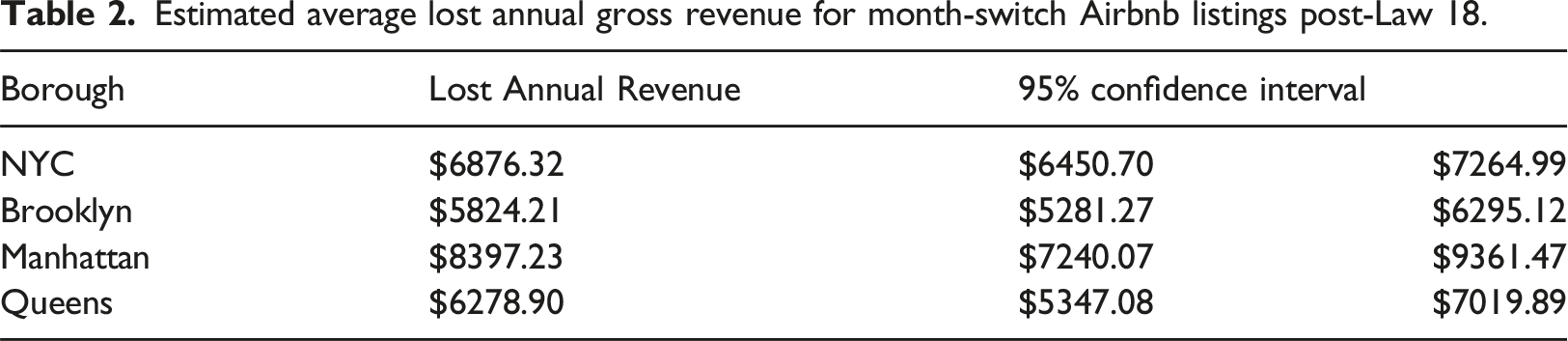
These values can serve as references for the maximum investment hosts should make to bring their properties up to the city’s licensing standards. Setting up fire detectors is just one of the regulatory requirements (Nyc.gov, 2023). In view of these upfront expenses, Airbnb should be aware of the monetary benefits of licensing and inform the hosts to prevent widespread market exit. From the municipality’s perspective, knowing the value of STR licenses could also be useful if the number of permits becomes capped, as other cities have considered (Bei and Celata, 2023), and a market-based mechanism to allocate them is implemented. Considering the differences across the boroughs, a blanket approach to pricing those permits would be discriminatory.
To conclude, we note some limitations of our method. First, our data cannot differentiate between booked nights and those blocked by the host—a pitfall of all studies using web-scraped information. Second, we exclude listings that allowed for both short and long stays, for which an STR license might have a different value. Our results are also NYC- and Airbnb-specific, so they should be interpreted in that context. With sufficient data, however, it should be possible to replicate our analysis for other cities and platforms. Alternative methods, such as difference-in-differences or propensity-score matching, could also be used.
Footnotes
Declaration of conflicting interests
The author(s) declared no potential conflicts of interest with respect to the research, authorship, and/or publication of this article.
Funding
The author(s) received no financial support for the research, authorship, and/or publication of this article.
