




Abstract
The adverse effects booming tourism activity and peer-to-peer platforms on housing markets are well known, while the influence of relative changes in tourism accommodation composition on housing prices are not well understood. To shed more light on the issue, this paper employs the data set on housing prices and its main tourism, economic, and demographic determinants, for cities and municipalities in a tourism-dependent country. The results suggest more intensive tourism demand and the conversion of housing stock into rentals boost housing prices. The increase in the share of short-term rentals depresses prices, while in destinations where hotels and campsites become more prevalent prices increase. These findings could be attributed to the pricing-in effects of an increased supply of tourism amenities developed as part of hotels’ and campsites‘ product mix that improve the quality of life, and lower quality of life experienced at destinations where rentals are becoming more prevalent.
Introduction
Recent years have witnessed the sharp expansion of short-term rentals (STRs) on the back of peer-to-peer accommodation platforms (P2Ps). Empirical evidence shows that the dynamic proliferation of technology-empowered STRs has acted as a disruptive force in global tourism (Katsinas, 2021; Celata and Romano, 2020; Cocola-Gant, 2016; Jover and Diaz-Para, 2019; Lopez-Gay et al., 2021; Sequera and Nofre, 2020). Many of the adverse effects of P2Ps are tied to housing markets and reflected in increased house prices and rents (Barron et al., 2021; Benitez-Aurioles and Tussyadiah, 2021; Chen et al., 2022; Franco and Santos, 2021; Garcia-López et al., 2020; Horn and Merante, 2017; Koster et al., 2021; Morales-Alonso and Núñez, 2022; Vizek et al., 2022) and related concerns about the affordability (Chen et al., 2022; Lee, 2016; Mikulić et al., 2021). Evidently, the impact of P2Ps on housing prices at destinations has attracted the attention of academic researchers over the recent period. At the same time, the question of how the changes in accommodation composition, both collective and individual, influence housing price formation, remains untackled by the literature, leaving a gap that our note aims to fill.
Two streams of existing literature set the ground for our analysis. Emergent literature focused mainly on tourist hotspots suggests that an increased supply of STRs boosts housing prices and rents. For example, Barron et al. (2021) reported a positive effect of STRs on housing prices after constructing a panel data set of all United States properties listed on Airbnb. Benitez-Aurioles and Tussyadiah (2021) estimated system generalized method of moments (GMM) regression models using London borough-level data, indicating that Airbnb’s presence has an ascendant effect on housing prices and rents, with the upward effect being stronger on the former. Similar results were reported by Garcia-López et al. (2020) when using several regression-based approaches for the city of Barcelona. While recognizing the contribution of this literature, we argue these findings need to be complemented by an inquiry into the effects of relative changes in the tourism accommodation composition on housing markets, as the changes in the supply of both collective and individual (STRs) accommodation may exhibit an effect on housing prices.
In this context, hedonic price models literature examining how amenities such as accoutered beaches, maintained parks, cultivated open spaces, golf courses, upscale water fronts, and promenades offered as a part of a product mix of collective accommodation such as hotels and campsites affects housing prices valuation could prove useful, as it captures how the increased quality of life in the proximity of these amenities is priced into the housing value. Studies such as Anderson and West (2006), Bolitzer and Netusil (2000), Do and Grudnitski (1995), Luttik (2000), and Nicholss and Crompton (2007) do indeed suggest such pricing-in effect exists. This in turn implies that if the composition of tourism accommodation is becoming more skewed toward hotels and campsites, or if it grows faster in absolute terms than that of STRs, it is likely that housing valuations at destinations could reflect the increasing supply of tourist amenities offered as part of a hotels’ and campsites’ product mix.
Opening a novel research area when analyzing the impact of the change in tourism accommodation composition on housing prices has been facilitated and motivated by the features of our sample, which allows us to explore regional and local data for Croatia, one of the most tourism-dependent countries in the world (UNWTO, 2022), with the highest share of STRs in accommodation capacities in the European Union. Several recent studies have pointed to the adverse effects of the Croatian tourism model on social sustainability and functioning of its cities and towns, such as lower housing affordability (Mikulić et al., 2021), higher housing prices in a tourist destination and neighboring areas (Vizek et al., 2022), lower business growth opportunities (Stojčić et al., 2022a), and diminishing educational outcomes (Kožić, 2019). The historical prevalence of STRs in Croatia is unusual in economies dependent on tourism but, at the same time, it offers a good starting point for our empirical research. Namely, we exploit this feature of the Croatian tourism sector to complement the existing literature by focusing on changes in the prevailing accommodation composition (hotels, hostels, campsites, STRs, and other accommodation), while at the same time controlling for the absolute changes in the intensity of both tourism demand and supply, along with other housing price determinants.
Our findings corroborate earlier literature by showing that more intensive tourism demand and the conversion of housing stock into STRs boost housing prices. At the same time, the increase in the share of STRs in total accommodation supply depresses housing prices, while in destinations where the share of hotels and campsites in total accommodation supply increases, housing prices tend to increase. We attribute the positive effect on housing price valuation of more intensive prevalence of hotels and campsites in accommodation composition to the increasing supply of amenities offered within the hotels’ and campsites’ product mix. Lower quality of life experienced at destinations where STRs are becoming more prevalent seems to associate with depressed housing price valuation.
Empirical setting
Our analysis uses the data set constructed for Croatian cities and municipalities for which median apartment prices are reported over the 2012–2021 period. Controls for accommodation composition consist of the data on the share of beds registered in hotels, hostels, campsites, STRs, and other accommodation in a total number of tourist beds, whereby other accommodation designates private properties used for nonprofit vacation purposes. Tourism demand intensity is proxied by the number of tourism arrivals per inhabitant of a city or municipality, while tourism supply intensity is represented by the number of housing units used as vacation rentals. Demand factors influencing housing prices are represented by the share of immigrants, vitality index, recorded property income, development index, and the number of housing purchases in a city or municipality, while supply factors are reflected by the number of new building permits in a city and municipality. We also control for population density and include several categorical variables constructed on the basis of locational and metropolitan characteristics of Croatian cities and municipalities (i.e., whether a city or municipality is situated on the Adriatic coast or on an island, and whether it represents a larger metropolitan area). Finally, by introducing an indicator variable which assumes the value 0 during the 2012–2019 period and the value 1 in 2020 and 2021, we control for the possible influences of COVID-19 pandemic on tourism demand and apartment prices.
To determine how changes in tourist accommodation composition affect housing prices, we employ a two-step system GMM. Dealing with “small T and large N″ panel form, the left-hand-side variable that is dynamic and dependent on its past realizations, independent variables that are not strictly exogenous, and fixed individual effects, the GMM is the appropriate choice of methodology.
Five baseline models, one for each type of tourist accommodation (hotels, hostels, campsites, STRs, and other accommodation) are estimated in order to investigate the effect that changing share of these accommodations in total accommodation supply may exert on housing prices. As a robustness check, two additional models were estimated with proxies for collective and individual accommodation. In the former, we added the shares in total accommodation of hotels, hostels, and campsites, while in the latter, we added the shares of STRs and other accommodation.
Empirical findings
Estimation results.
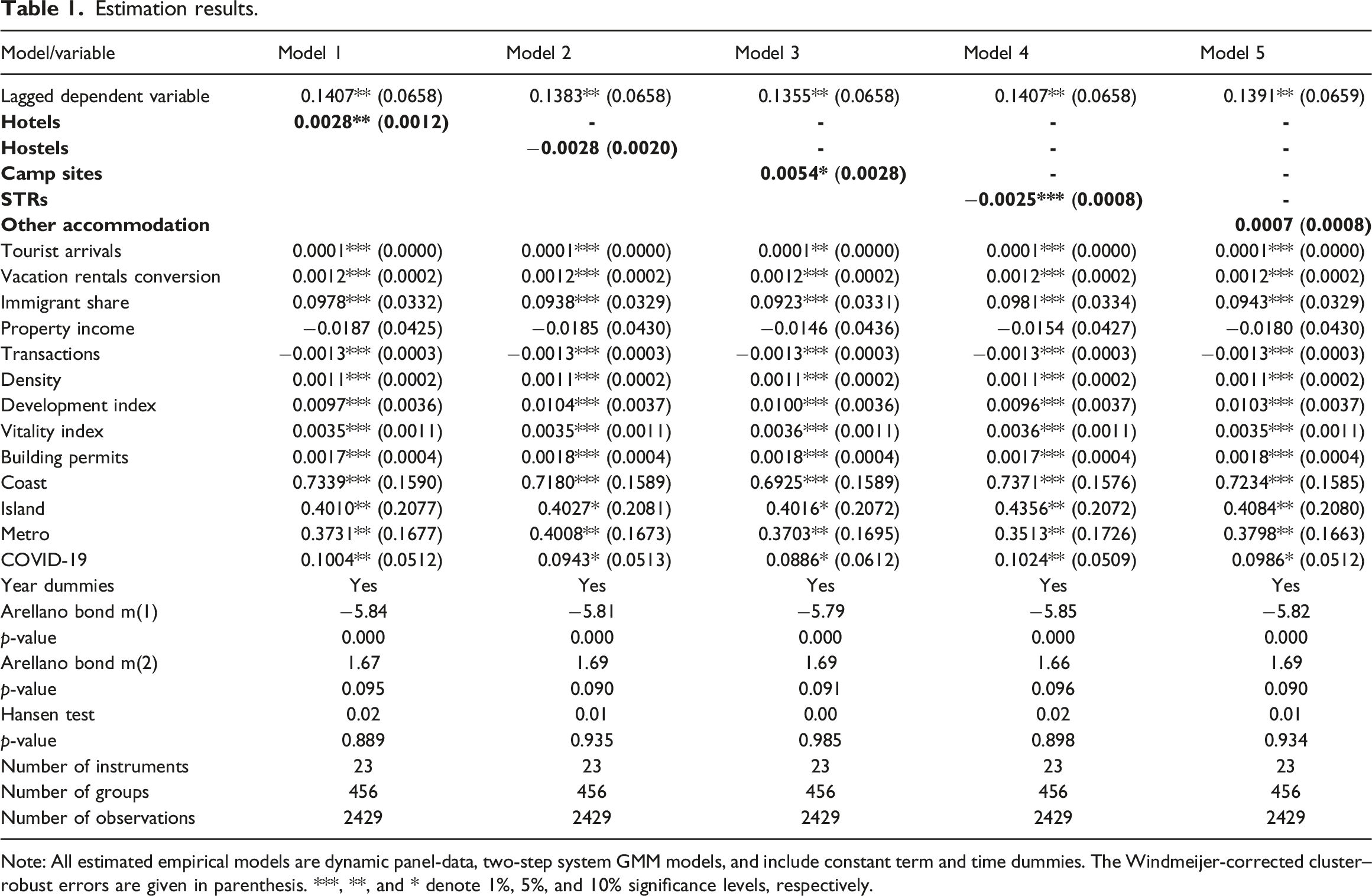
Note: All estimated empirical models are dynamic panel-data, two-step system GMM models, and include constant term and time dummies. The Windmeijer-corrected cluster–robust errors are given in parenthesis. ***, **, and * denote 1%, 5%, and 10% significance levels, respectively.
Robustness check.
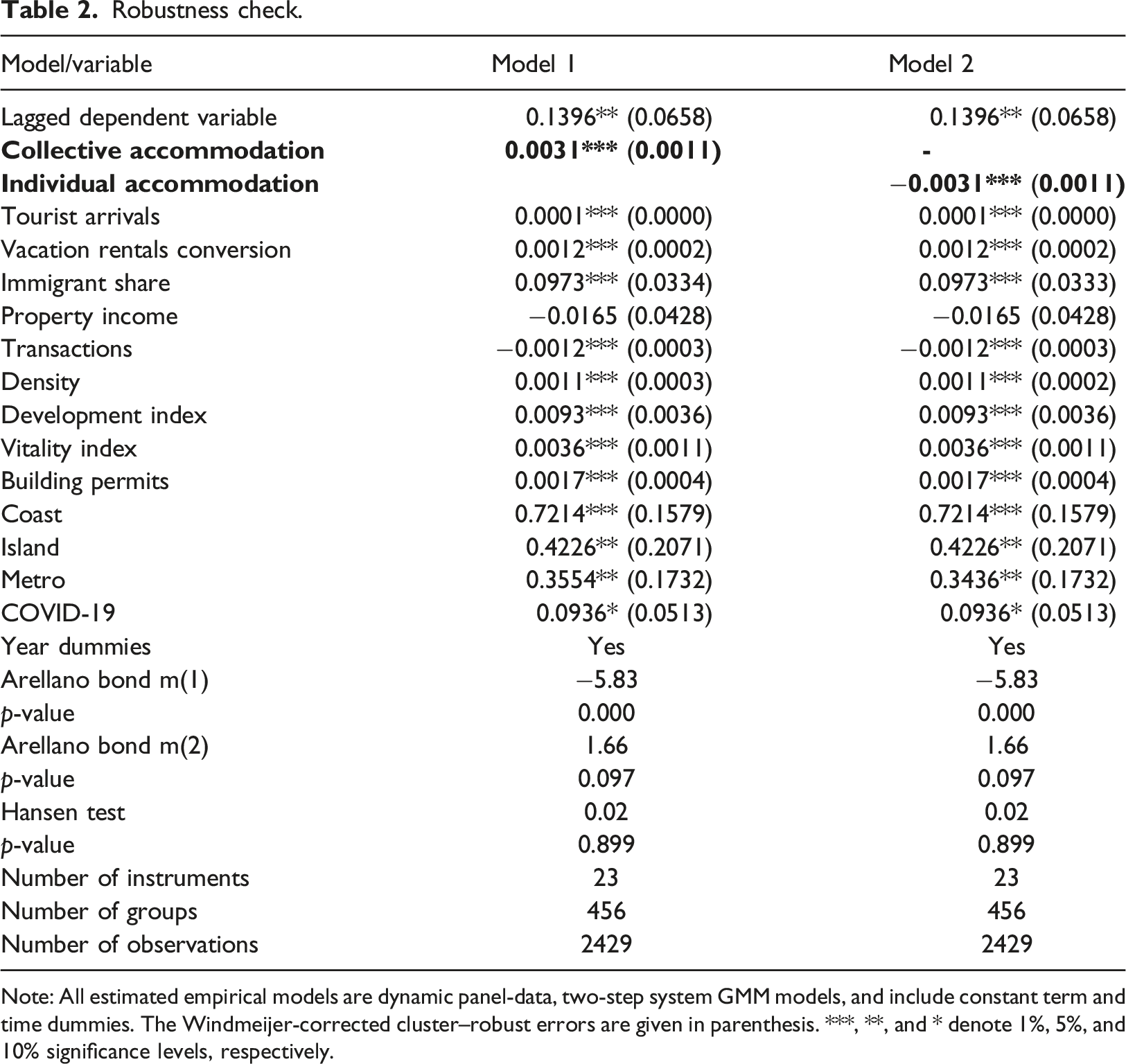
Note: All estimated empirical models are dynamic panel-data, two-step system GMM models, and include constant term and time dummies. The Windmeijer-corrected cluster–robust errors are given in parenthesis. ***, **, and * denote 1%, 5%, and 10% significance levels, respectively.
Conclusion
The results of the empirical analysis presented in this note paint a more nuanced picture of the influence tourism activity exerts on housing prices. They confirm the results of country-level studies associating the general rise in tourism activity with rising housing prices. They also confirm the findings of the growing literature on the strong positive effect of the STRs’ proliferation, which in this research is proxied by the number of housing units converted to vacation rentals, has on housing prices. In addition, our results also show that after controlling for these two tourism-related effects on housing markets, there seems to be an additional tourism-driven effect on housing prices stemming from the changes in the composition of tourism accommodation. Namely, a stronger prevalence of hotels, campsites, and overall collective accommodation seems to appreciate housing value at destinations, while a stronger prevalence of STRs and overall individual accommodation seems to produce the opposite effect.
We argue that this effect is associated with a pricing-in effect on housing units of amenities developed and offered as part of hotels’ and campsites’ product mix at destinations, such as accoutered beaches, maintained parks, cultivated open spaces, and upgraded waterfronts and promenades that increase the quality of life of residents inhabiting housing units in proximity of these amenities. On the other hand, the increasing prevalence of STRs at destinations likely reduces the quality of life for residents through their negative impact on urban functioning, infrastructure, and social sustainability, consequently depreciating the value of housing units in proximity to STRs. Further, more granular research employing hedonic price models is needed to describe the exact mechanism and amenities related to collective and individual accommodation which feed into changes in the valuation of housing at destinations undergoing changes in the composition of their tourism accommodation.
Footnotes
Declaration of conflicting interests
The author(s) declared no potential conflicts of interest with respect to the research, authorship, and/or publication of this article.
Funding
The author(s) disclosed receipt of the following financial support for the research, authorship, and/or publication of this article: This work has been fully supported by Croatian Science Foundation under the Project IP-2019-04-7386.
