




Abstract
Why is compromising information about misconduct in political parties leaked to the media by party insiders? Drawing on previous research and interviews with political and investigative journalists, we hypothesize that such media disclosures are made with political intent and thus more likely when (1) party list nominations take place and (2) when parties are losing popular support. Through an analysis of 349 newspaper articles of misconduct in political parties leaked by party insiders to Swedish print media between 2010 and 2024, we find support for both expectations. We therefore conclude that intra-party leaks are indeed likely to be made with political intent, at least indirectly. This paper contributes novel theoretical and empirical insights to research on political parties, political scandals, and leaks and whistleblowing by illustrating the role media disclosures made by party insiders play in internal party power struggles.
Introduction
Every fourth year when there is a fight about the [party candidate] lists, politicians use the measures available to discredit one another. That is something of which people are well aware. (Romina Pourmokhtari, then leader of the Liberal Youth Organization, quoted in Strömberg, 2021).
Acting as the link between the public and the formal political institutions, political parties are fundamental actors of representative democracy (e.g. Stokes, 1999). Not only do they constitute the main channel for public opinion to inform political action and policy; they also formulate and drive political visions and fill political positions. Yet we know from the literature on parties and corruption (Della Porta, 2004) and political scandals (Thompson, 2000) that parties and their representatives are not always well-functioning, nor trustworthy. Individual misbehaviour in party settings, deficient internal decision-making procedures and financial irregularities are a few examples of party-related misconduct that has been publicly exposed in developed democracies (Huberts et al., 2022).
The media plays a crucial part in these exposures. By bringing misconduct to public attention, political watchdog journalism deters bad behaviour and incentivizes politicians to perform better (Norris, 2014). However, to report on internal party matters, watchdog journalism often depends on access to reliable and willing sources inside the organisation (Allern and Pollack, 2012; Balan, 2011; Liebes and Blum-Kulka, 2004). Such insider disclosure is considered one of the most important tools for holding decision makers accountable for internal activities and for coming to terms with misconducts of different kinds (Ceva and Bocchiola, 2019; Culiberg and Mihelič, 2017).
Research on political parties has shown that members are willing to report corruption in their organisation (Balan, 2011; Feierherd et al., 2024; Invernizzi and Ceron, 2023), and the vast majority are reported internally (Niklasson et al., 2024). What is less known, however, is why party members sometimes take the critical step and provide outside actors, such as the media, with sensitive information about party related misconduct.
Studies on watchdog and investigative journalism tend to focus on the role of journalism as a mechanism of accountability, depending on the power balance between journalists and politicians (Davis, 2009) and across different political systems (Márquez-Ramírez et al., 2020; Tumber and Waisbord, 2004b) rather than the identity or intention of journalists’ sources (Malling, 2019). Work on leaks and whistleblowing has engaged with questions regarding the insider as a source, but only in the contexts of government agencies, private enterprises, or NGOs (e.g. Berndtsson et al., 2018; Brown, 2008; Levy, 2018). Insiders of political parties have so far been overlooked.
We argue that studying why insiders disclose information about organisational misconduct is likely to improve our understanding of the internal power struggles and accountability processes of organisations, which is particularly pertinent in the context of politics. In a time when media communication constitutes a pivotal part of political accountability (Djerf-Pierre et al., 2014), we find it quite surprising that the role of party members in those accountability processes has not been thoroughly scrutinized. We intend to address this gap by probing why party insiders make media disclosures (inclusive of leaks and whistleblowing) concerning internal party misconduct.
By media disclosure we refer to the overarching concept of making confidential information available to journalists who previously lacked access to that information. Whistleblowing and leaks are considered sub-categories of disclosure (e.g., Bovens et al., 1995). Whether the disclosure is initiated by the insider or the journalist is, for example, irrelevant to our study. However, we only focus on non-sanctioned disclosures to the media about potentially compromising information—as perceived by individuals or groups on the inside—not on deliberate and party-sanctioned leaks about, for instance, forthcoming policy-proposals with the aim of influencing public debate (Davis 2009).
Drawing on previous research and interviews with 13 investigative journalists, we assume that disclosures by insiders about party related misconduct are made strategically. This assumption leads us to hypothesize that disclosures should be more likely when (1) nominations to the party list are made and (2) the party is losing popular support. By observing when disclosures occur, we thus presume to say why they do so. The hypotheses are tested on quantitative data consisting of 349 newspaper articles based on 175 cases of misconduct reported in Swedish print media between 2010 and 2024. Our results indicate that media disclosures of political misconduct are affected by the election cycle. Specifically, we find the frequency of media disclosures more than doubles during the nomination period, when party members compete for a place on the ballot. Further, we show that members of parties in decline tend to disclose information about misconduct to the media more often than parties that are performing well in opinion polls.
This paper makes several important contributions by presenting evidence of political intent underlying insiders’ media disclosures of party-related misconduct. This insight speaks to the development of existing theoretical models on political scandals, party infighting, and whistleblowing, since scholars engaging with these topics have overlooked the phenomenon of disclosures of party related misconduct, and thus the reasons and implications of party insiders acting as media sources.
A theoretical model of disclosures and political scandals
Scandals springing from serious misconduct by parties or party representatives constitute a common feature in most liberal democracies since the 1960s (Pollack et al., 2018; Thompson, 2000). In their volume on political scandals and media across democracies, Tumber and Waisbord (2004b: 1031) observe that “[s]candals seem to be the norm rather than exceptional moments.” The transgressions have been categorised in various ways (see e.g. Johansson and Vigsø, 2020; Pollack et al., 2018; Thompson, 2000), but overall, they can be divided into those concerning the structural level (involving political institutions and organisations, decisions, and processes) and the individual level (involving individual politicians acting in party settings or in their role as public trustees).
All forms of misconduct do not, however, become scandals. The majority of misconducts within political parties remain unaddressed and, if reported at all, primarily done so through internal channels (Niklasson et al., 2024). This is also the case in other kinds of organisations (Berndtsson et al., 2018; Culiberg and Mihelič, 2017). For a scandal to arise, exposure of a norm transgression is required (Thompson, 2000; Tumber and Waisbord, 2004a).
Figure 1 illustrates the sequence of a political scandal based on Thompson’s (2000: 63–66) understanding of a political scandal as a result of media visibility. The model begins with what is termed a first-order norm transgression, which is a violation of norms that have the potential to become a scandal. In the context of a party, this can, for example, be an individual politician engaging in sexual harassment at party meetings, a nominee committee favouriting their personal friends, or party representatives striking a dubious deal with outside actors in the name of the party). These transgressions often take place in what Goffman (1956) refers to as the “back regions” of politics (i.e., internal settings shielded from public view). As long as violations remain hidden from the public, they do not escalate into scandals. If stories are picked up by the media, a scandal may emerge. External reporting as a part of the political scandal process.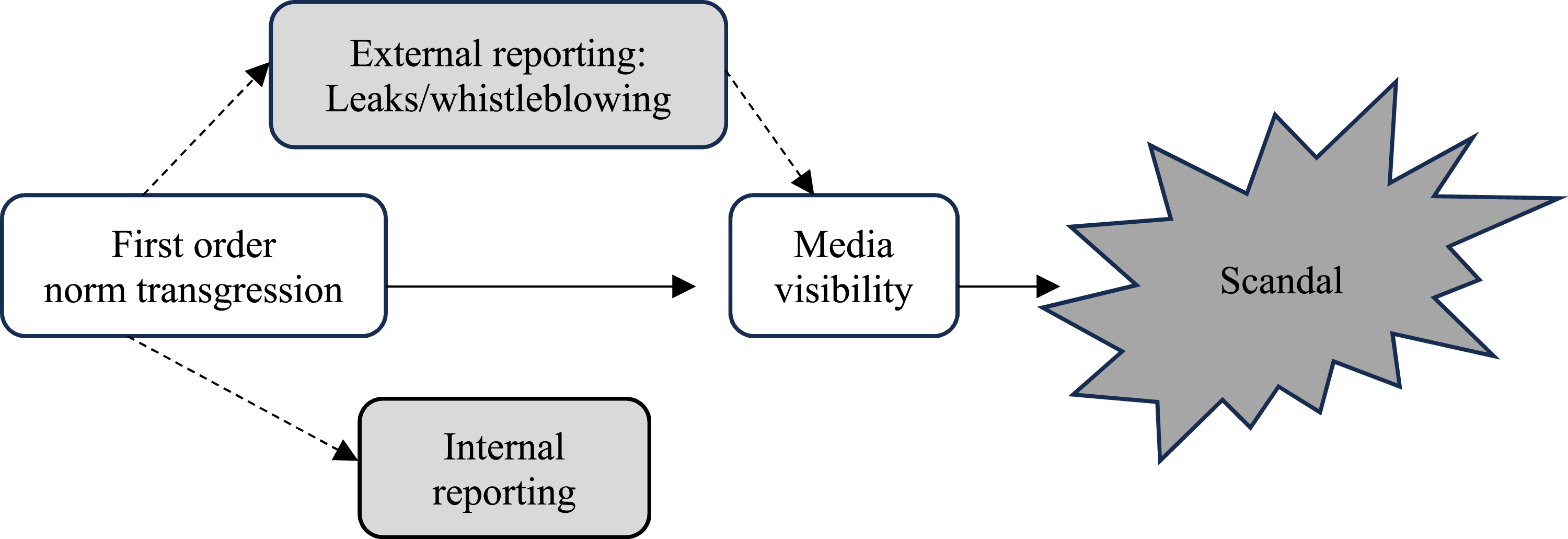
Missing from the initial model is how norm transgressions become known by the media in the first place. The model describes how information about back-region behaviour can leak into front regions, but it does so without recognising the actors and actions that make this happen. This gap has also been noted by Balan (2011: 460), who states that: “despite growing attention, it remains unclear how corruption scandals come to light”, something that Sherman (1989: 892) identifies as “one of the most important problems in understanding the process of scandal”.
In some cases, investigative journalists uncover misconduct independently through systemic, albeit random, reviews of financial statements, audits, etc. (see e.g. Sherman, 1989). In other cases, they may stumble upon incriminating evidence by chance. There are, however, instances where journalists only manage to pull incidents of misconduct out of the back regions of politics thanks to information provided by party insiders. We therefore develop the model of the political scandal process by adding external reporting: a stage in between the first-order norm transgression and media visibility.
The purpose of this study is to explore the external reporting branch of this modified political scandal process model. Asking the overarching question of why external reporting occur, the primary focus is on the link between first-order norm transgressions and media visibility, through the disclosure of information by an insider to an external actor. Notably, not all reported incidents develop into scandals (Busby, 2022: 19), but by exploring steps in the theoretical model that are typically out of sight, we add knowledge about a link that is vital for scandals to arise.
Hypotheses about external disclosures and media visibility
Since there are few studies on media disclosures by insiders about misconduct in political parties specifically, we draw on research from related fields. In addition, our theoretical assumptions are informed by 13 explorative interviews with Swedish political reporters providing first-hand experiences of party leaking. 1
Based on whistleblowing research, an insider may be motivated by least four different values (Liebes and Blum-Kulka, 2004): the public good, ethical ideals, personal satisfaction, and political gain. Our focus is related to the latter, which is when a disclosure serves to influence political decisions, such as nominations to leading party positions (Liebes and Blum-Kulka, 2004: 1158-1159). The disclosure may concern old transgressions that the whistleblower reveals at an opportune moment. The media is thus used instrumentally to “intervene in the world of politics” (Hallin, 2004: 37; see also Mancini, 2018).
Political gain is conceptually distinct from other drivers of disclosure, but although some individuals leak information to satisfy personal grievances or uphold moral principles (Liebes and Blum-Kulka, 2004: 1156–1158; Park and Lewis, 2019), these motivations may intersect with political aims. For instance, the most effective form of retaliation may be to reveal damaging information during an election campaign, thereby obstructing a candidate’s ascent to office. In such cases, timing becomes instrumental—not merely to influence politics, but to serve personal or ethical goals. Yet, political impact remains a central, if intermediate, objective. We therefore contend that the timing of disclosure can signal underlying political intent, though not necessarily that political gain is the only or primary motivation.
Political intent of disclosures has not received much attention by whistleblowing scholars, since their focus has been on non-political organisations. In the context of political parties, however, we expect political intent to be a highly relevant factor for the dynamics of media disclosures. The journalists we have interviewed are clearly convinced that this is the case: “No one leaks for altruistic reasons” (Journalist 8). Similarly, previous research has observed that although leaks may be used as an accountability mechanism (Culiberg and Mihelič, 2017), they also serve as a tool to make political points and rid oneself of political opponents (Allern and Pollack, 2012; Amick et al., 2022; Balan, 2011; Davis, 2009; Feierherd et al., 2024; Jenssen and Fladmoe, 2012; Tumber, 2004). That politicians’ denunciation of corruption in political parties can be politically motivated is also supported by Invernizzi and Ceron’s (2023) study on the sources of judicial investigations in Italy, as well as that of Balan (2011), who concludes that corruption scandals are triggered by competition among government actors who leak information about each other, including party colleagues. Neither of these studies have investigated why politicians turn to the media, but their results are in line with the experiences of several of our interviewees. An investigative journalist (6) says, for example, that: Some of those who get in touch with us may do so mainly because they want to put a spanner in the works for a competitor, or someone they don't like, or someone who belongs to a faction that they seek to undermine.
The hypotheses and expectations below therefore emanate from the assumption that media disclosures of misconduct in political parties are made with political intent. Our overarching argument is that insiders disclose information about misconduct in their party with the aim to influence politics.
The election cycle and disclosures of misconduct
Parties are political organizations whose primary goal is to win elections (Müller and Strøm, 1999; Strom, 1990). This makes the party context unique compared to that of other organisations usually studied in relation to leaks and whistleblowing; politicians must consider a temporal aspect when deciding to report externally, as the timing of a political scandal may affect both public perception and voter support (Pereira and Waterbury, 2019; Von Sikorski et al., 2020; Feierherd et al., 2024).
There is a growing body of research suggesting that political parties and politicians strive to maximize their electoral success through the strategic timing of actions and priorities (Aidt et al., 2011; Alesina et al., 1993; Schwalbach, 2022; Seeberg, 2022). Feierherd et al. (2024) observe, for example, that politicians in Argentina tend to file corruption lawsuits against opponents right before an election to maximize the effect, as voters’ attention span is short. Of particular interest to our study is their finding that this strategic measure is used towards adversaries inside the party, as well as against opponents in other parties.
Furthermore, there is evidence of the electoral cycle being correlated to media reports on political scandals (Feierherd et al., 2024; Garz and Sörensen, 2021; Le Moglie and Turati, 2019; Van Aelst and De Swert, 2009). Feierherd et al.’s (2024) study shows that newspapers are more likely to publish stories on corruption scandals close to elections, which may indicate that the media has a greater focus on covering such news then, but also that politicians are more inclined to leak incriminating information to the press in times of election for strategic reasons (see e.g. Adekeye, 2017; Put and Coffé, 2024). None of these studies can say whether it is the politicians or the media who drive this pattern.
Exactly when the internal power struggles peak arguably depends on the political system and context. In some systems, like Argentina, these struggles are the most intense right before the general elections (Feierherd et al., 2024). In others, like Sweden, they probably occur earlier when the candidates compete for party nominations and favourable positions on the ballot. Several of the journalists interviewed (3; 6; 15) note, for example, that it is during the nomination periods that party members start contacting them about misconduct: the nomination processes are /.../ the season when misconduct is at its worst. It can be about harassment /.../, bullying, power struggles. [The parties] are not beautiful, peaceful, and nice democratic organisations during nomination periods (Journalist 6).
Once the candidates are selected, however, politicians shift away from intra-party competition toward inter-party competition (Skjaeveland, 1999). We therefore hypothesise that:
Media disclosures by insiders of party-related misconduct are more likely during the nomination stage when party members compete for positions on the ballots.
Public party support and disclosures of misconduct
In addition to the electoral cycle, there are also good reasons to believe that public party support matters. Party infighting and political scandals are usually bad in terms of voter support, at least in the short run (Klingelhöfer and Müller, 2024; Pereira and Waterbury, 2019; Rienks, 2023). Party members thus have good reasons to keep quiet as long as the party is doing well in the opinion polls, so as not to jeopardize the party’s chances of electoral success. Why change a winning formula?
When the party is losing popular support, however, critical voices tend to be raised. Party members start calling for changes in the hope of turning public opinion around. The criticism usually concerns either the political agenda and direction, the party organisation, or the party leadership (Ennser-Jedenastik and Müller, 2015; Invernizzi, 2023).
This criticism is not only expressed internally, but also externally. Invernizzi and Ceron (2023) show, for instance, that when a party loses electoral support, politicians are more likely to leak information about corrupt MPs to outsiders. This information may originate from competing parties who perceive a chance of winning new voters, but the attacks may also come from party insiders (Golden and Chang, 2001). Such external reports from insiders can signal to the electorate that the party is taking action to address problems and misconduct that discourage people to cast their votes for them. That frustrated and disgruntled party members start leaking information about things they perceive to be amiss when the party is doing poorly in the opinion polls is also confirmed by journalists (Politikbyrån, 2024).
Disclosing information to the press in these situations can be either a strategic move by individuals who perceive the situation as an opportunity to secure a better position within the party, or a way for those who simply hope to save the party from demise. Regardless, the timing implies that such reports are made with political intent. We therefore hypothesise that:
Media disclosures by insiders of party related misconduct are more likely when parties are losing popular support.
Data and research approach
The Swedish case
Sweden and the other Nordic countries were for a long time considered relatively free of political scandals. Today, however, Pollack et al. (2018: 3087) conclude that “mediated scandals have become a standard feature of political life” in such contexts. This development is not surprising given that Norris (2014) has shown that watchdog journalism, of which reporting on misconduct in political parties is a central aspect, is perceived more important by journalists in liberal democracies.
As a low corrupt liberal democracy with a proportional election system, Sweden is an interesting case for studying party members’ disclosures. What happens in political parties matters in this context, as strong cohesive parties play a pivotal role in the political process. Party misconduct, if disclosed, may certainly harm a party’s electoral success, but there is also a general culture of loyalty to the party; party members are likely to think twice before leaking externally to the media.
At the same time, the prominent role of parties and the proportional election system imply strong intra-party competition (Boucek, 2002). Such competition can lead to leaking incriminating information to the press about internal competitors, in order to miscredit them and gain an advantage in the nomination race (Balán, 2011). Furthermore, Sweden, like most other EU countries, has a comprehensive protection of whistleblowers, although it does not yet extend to political parties (Terracol, 2023). Moreover, in line with most other European countries, Swedish media is strongly protected against attempts to make them reveal their sources (Briefing Paper on Protection of Journalists’ Sources, 1998), which facilitates for party insiders to disclose information anonymously.
Swedish journalism operates within a “Democratic Corporatist media system”, prevalent in Northwest Europe, marked by high professional standards and strong ethical norms (Hallin and Mancini, 2011). A strict separation between news and opinion, and adherence to rigorous self-regulation is therefore upheld. Consequently, outlets routinely publish politically damaging material when ethically warranted and deemed in the public interest. This view is echoed by Journalist 12, who emphasizes rigorous fact-checking and notes that misconduct must reach a certain threshold to warrant coverage. Thus, not all stories presented by party members are published; journalists receive far more tip-offs than what is published. The cases included in our media analysis reflect only those that journalists have verified as both accurate and newsworthy. Had we had access to all incoming tips, our expectations would be even stronger, given that journalists (3; 6; 15) claim to get contacted more frequently during the nomination period.
To summarise, Sweden presents a complex context, however not a unique one. The results from this study may thus apply to many West European countries, not least the Nordic ones. Given the lack of previous research on this topic, Sweden is as good a starting point as any other low corrupt liberal democracy with a proportional election system, a general whistleblower protection, and a high level of journalistic and critical professionalism.
Data collection: Media stories
To assemble data on media stories relating to leaks in political parties in Sweden, we conducted a systematic search process based on all local and national print media between 2010 and 2024. The search was conducted using Mediearkivet, a digital news archive that stores news stories and broadcasts from across the globe, which has comprehensive coverage of major Swedish daily newspapers from 2010. 2
As we are primarily interested in leaks due to misconduct from or inside political parties, we constructed a search string using boolean operators consisting of three criteria that needed to be met for the article to be considered relevant. Articles were only eligible if they contained words relating to: (a) misconduct or wrongdoing, (b) whistleblowing or related concepts, and (c) political parties. 3 We also sought to exclude some high-profile cases (e.g., stories relating to Frances Haugen or Julian Assange) that we knew to be irrelevant to our study, but generate a high number of hits, to make our search results more valid. 4 In total, the media search resulted in 11,337 hits.
Following the initial search process, an assessment of source credibility and relevance of all sampled articles was conducted. Op-eds, letters to the editors, etc. were excluded, since we only wanted cases where a professional journalist had assessed the credibility of the information leaked. We also excluded cases that had been picked up by the search string, but did not in fact fulfil all three criteria required (e.g., neither a politician nor a party were responsible or accused of misconduct, or the source was not from the party associated with the misconduct), as well as duplicates, corrupted files, and articles that did not contain enough information (e.g. “Year in review” articles that only referred to an incident in one sentence). 5 The sample was then supplemented with a few well-known and highly relevant cases that did not turn out in the media search, mostly because they did not fulfil all three search criteria; the articles may have mentioned misconduct and political parties, but not whistleblowing or any other related concepts, for example. 6 This validation process reduced the number of articles to 1304.
As several articles can refer to the same incident, we collapsed related articles into single case observations that contain the information of all stories relating to a given case. This approach enabled us to build a more comprehensive and reliable dataset, since different newspapers include different pieces of information in their accounts of the same incident. At this stage, the sample of articles was also subject to a further assessment of relevance to the study. For example, several articles referred to misconduct or whistleblowing in an abstract sense, whereas in this study we are interested in specific occurrences of these two features. We are also mindful of the source of the information, and exclude stories that clearly do not emanate from inside the party (e.g., from civil servants or members of other parties). 7 Our final sample consists of 349 news stories that relate to 175 cases of media disclosures from political parties. This sample of articles were then subject to a coding procedure that recorded article-level (e.g., the publication date and author) and story-level (e.g., the type of misconduct referred to, political party etc.) characteristics.
Measures
We follow Aberbach (1981) and Put and Coffé (2024) in identifying the nomination stage as a distinct period in the electoral cycle. Elections to all three levels (local, regional, and national) take place simultaneously in Sweden on the second Sunday in September every 4 years. The last election was in 2022. Electoral lists are typically finalized at the end of April in the same year of the election. We therefore consider the 6 months prior to this to be an appropriate period for when candidates are most likely to be competing with one another for position on the party lists. Specifically, we operationalise the nomination period as a dummy variable, equalling ‘1’ for the period from September 1 in the year prior to the election until April 30 in the year of the election. In robustness tests, we also vary the beginning of this period in alternative measures by 2 months in either direction (see Appendix A4). Results are largely robust to this alternative specification.
We measure poll performance by combining our monthly dataset with aggregated polling data in an approach similar to Pereira (2020), where we create monthly average poll results for each party for each month (with the exception of election months which are omitted). From this, we create a variable which, for each month, records the difference between current (average) poll percentage and the vote percentage received by the party at the previous election. Parties are therefore adjudged to be performing well (+) or poorly (−) relative to the last election. This measure is in line with Stiers et al. (2018), who show that supporters of small parties consider their parties to be successful if they perform better than in the previous election. As this measure does not take party size into consideration, however, we also consider a party’s raw monthly poll percentage in models using this variable. Descriptive statistics of each of these variables are available in Appendix A3.
Estimation approach
To test the determinants of misconduct disclosures in the electoral cycle, we transform our media stories dataset into a time series consisting of party-months. That is, we record for each month in the period from January 2010 to December 2024, the count of cases that occurred relating to each party as well as the characteristics of those cases. Given that several parties can be involved in the same case (for example, in local or national coalition contexts), this approach allows us to identify relationships that may be due to case- or party-specific factors, whilst also controlling for time-varying factors. In our main specifications we therefore utilise a series of zero-inflated poisson regression analyses that are well suited for event-count data where the dependent variable contains many zeros, as is the case for individual (and particularly smaller) parties. We also include party fixed effects to account for party-level variation regarding the frequency and timing of misconduct.
Results
Previous research suggests that political insiders are reluctant to pass on sensitive information about their parties to the media, and that issues concerning misconduct are primarily reported internally to other party members and/or the party leadership (Niklasson et al., 2024). Only a small share reaches the media, and even fewer stories are published, since journalists must consider the credibility of their sources, the quality of evidence, and the public interest (Journalists 1; 4; 6; 10). Thus, the misconducts presented here represent the tip of the iceberg of actual cases of misconduct that occur in political parties.
Misconduct type
Based on a content analysis of the final sample of articles, we develop a typology of misconduct related to the organisational or institutional context where the transgression took place. Specifically, we identify three different ‘types’ of misconduct that are theoretically pertinent to distinguish in this case: (a) intraparty misconduct (e.g., issues related to internal decision-making procedures, nominations, working environments, or faction-based conflict), (b) private or individual misconduct (e.g., sexual harassment or other criminal behaviour) and (c) public office misconduct (e.g., abuses of power or other corruption-related transgressions). While we do not develop differential expectations regarding these types – as we argue that misconduct can either directly or indirectly indicate intra-party competition between candidates – there may be some indication of the motivations lying behind the disclosure. For example, public office misconduct may be more harmful to the party than it is to an individual politician or faction within the party. Individuals or factions may be more culpable in the case of misconduct reported in the other two contexts.
We illustrate the frequency of these types of misconduct reported in our sample in Figure 2. The plot demonstrates that while there is relative parity regarding the type of reported misconduct, intraparty issues are the most frequent. Important to note, of the plurality of cases which cite intraparty misconduct (47.4%), only 5.1% refer explicitly to nomination procedures or electoral lists. If misconduct leaks are intended to affect electoral lists, it therefore seems that this is done indirectly rather than directly (i.e., not explicitly stating that individual’s place on the list is undeserved). Types cases of misconduct in political parties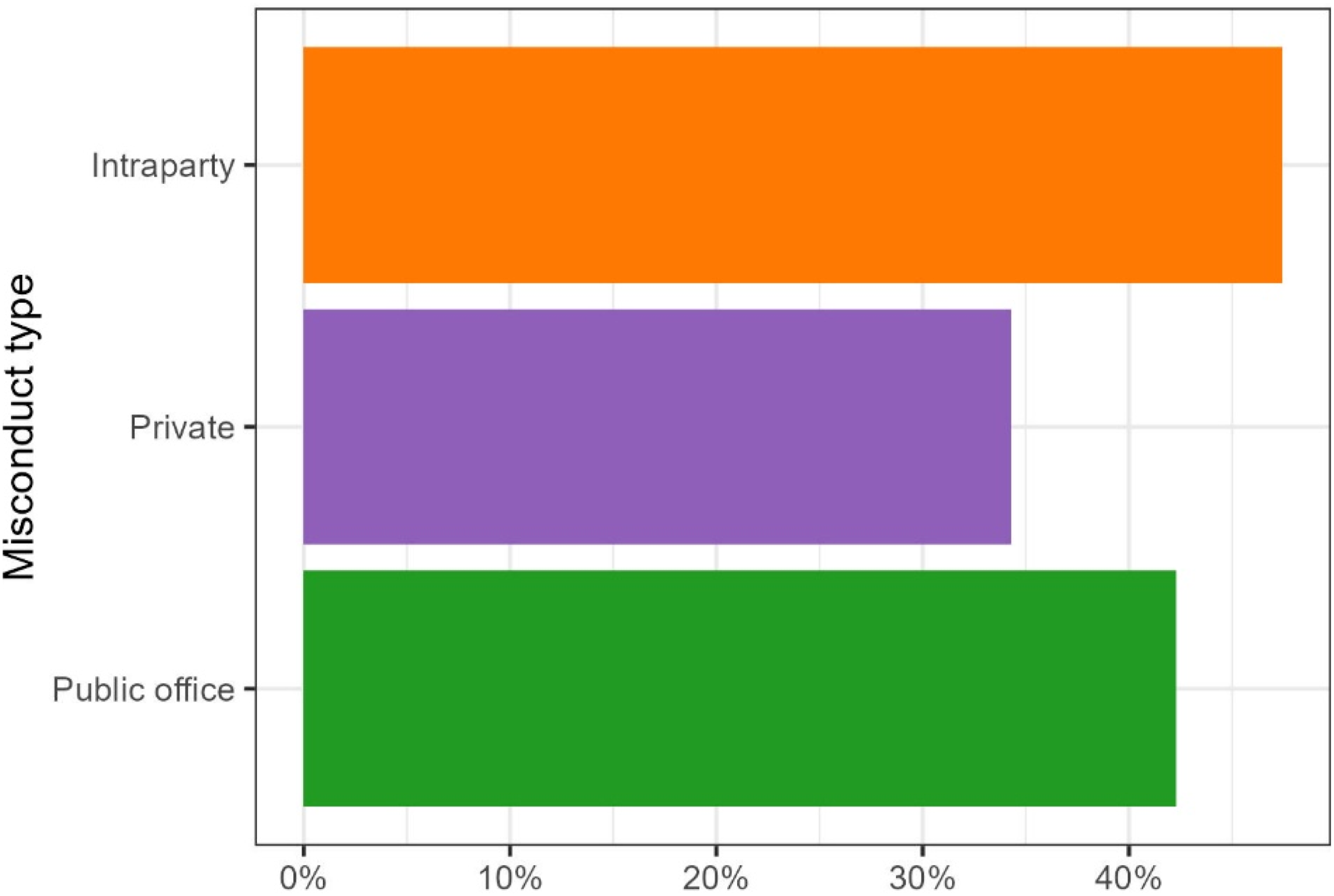
In a next step, Figure 3 plots the temporal nature of disclosures in political parties by considering the month of publication from cases of misconduct disclosures, contextualised by general elections (vertical dashed lines) and nomination periods (shaded areas). While this is only a descriptive plot of the data, there is initial indication of an increase in cases in approximately 1 year prior to the election. The timing of these spikes coincides with the periods leading to nominations to electoral lists. This appears particularly to be the case for reports relating to private misconduct. In a system where people primarily vote for parties and not individual candidates, this makes intuitive sense, since disclosing information about certain individuals may pass as an attempt to rid the party of a few bad apples. The party may thus run less risk of losing popular support due to the negative publicity and the bad apples can be replaced by other candidates, who the internal source may prefer. Timing of reports relating to different types of misconduct through the electoral cycle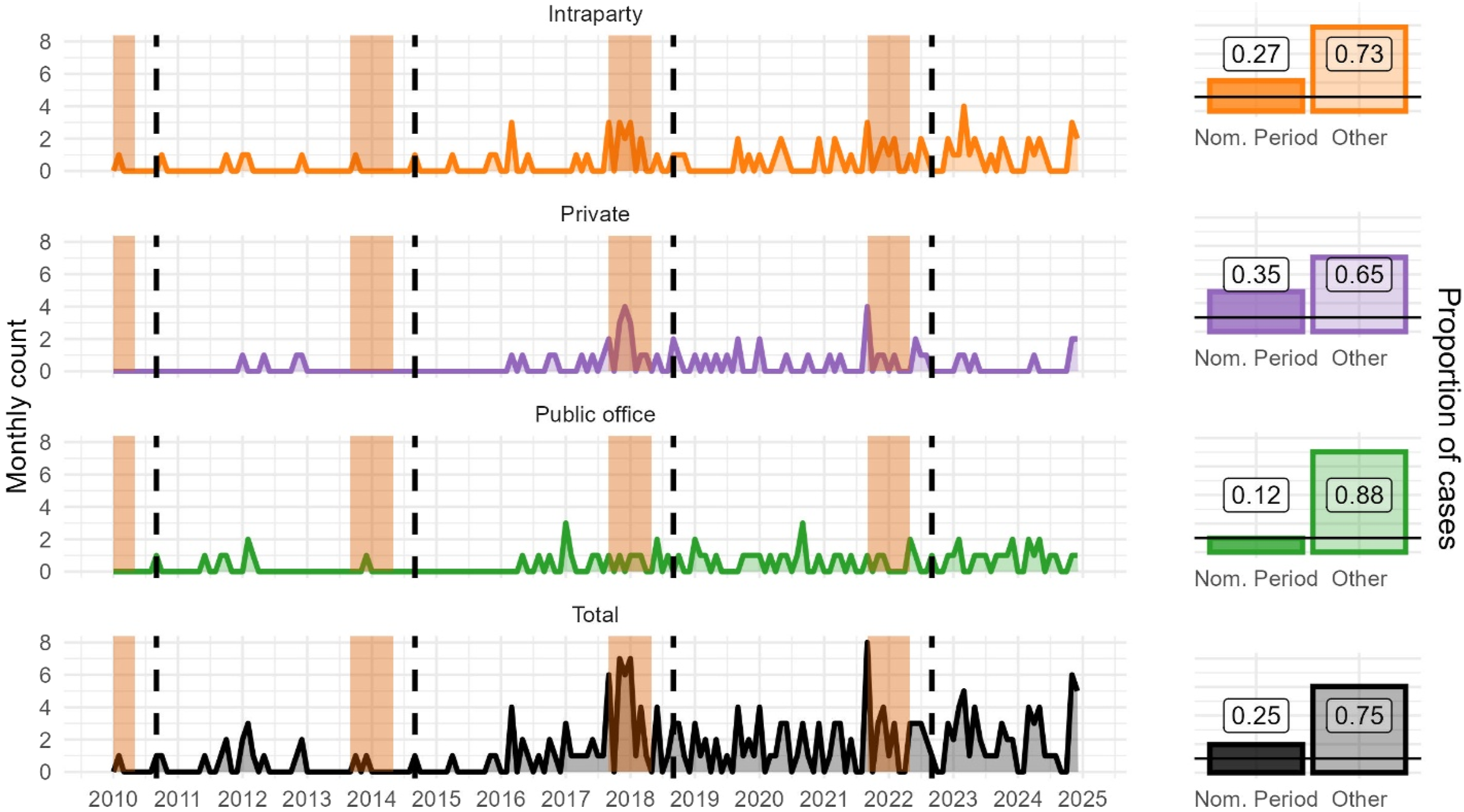
There is also some indication that the number of cases decreases in the election campaign period, which immediately follows the nomination period. We believe that a reasonable interpretation of this pattern is that politicians are more willing to leak information about party misconduct during the nomination period than during the election campaign. Otherwise, it is hard to understand the drop in media coverage, since journalists are likely as interested in publishing news on political scandals during the election campaign (see e.g. Feierherd et al., 2024; Van Aelst and De Swert, 2009).
Regression analysis
Zero-inflated poisson regression results for the monthly count of misconduct disclosures.
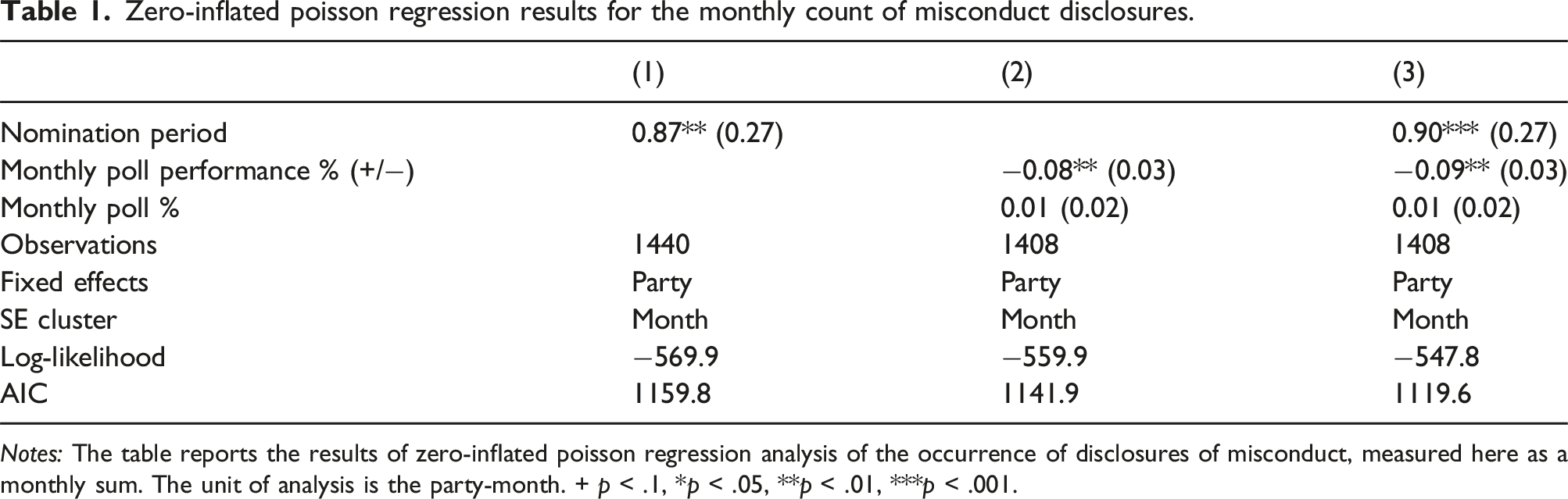
Notes: The table reports the results of zero-inflated poisson regression analysis of the occurrence of disclosures of misconduct, measured here as a monthly sum. The unit of analysis is the party-month. + p < .1, *p < .05, **p < .01, ***p < .001.
Results suggest a positive significant effect of nomination periods on reports of misconduct, which is in line with H1. Given that poisson regression coefficients represent the log change in the expected count (of news stories) in a given month for a party, we can convert coefficients into substantive effect sizes by comparing their exponentiated value with the baseline expected count of news stories in non-nomination periods. For instance, Model 1 indicates that during nomination periods, the expected occurrence of a story is 2.4 times higher than non-nomination periods. The baseline expected story count in a given month across parties is 0.12, meaning that in nomination periods this rises to 0.29. In large parties such as the Social Democrats, however, the expected count of a story related to individual misconduct in non-nomination periods is as high as 0.24, meaning that a 2.4 times increase in this expectation during nomination period months equates to 0.58. Thus, this table clearly demonstrates a strong temporal dynamic to the reporting of misconduct in nomination periods relative to other periods in the electoral cycle.
In robustness tests reported in Appendix A4, we vary our coding of the starting point of the nomination period by 2 months in either direction (July and November in the year before the election, respectively). Results are consistent across these alternative measures, though the association decreases in magnitude, suggesting the beginning of the nomination period to be particularly important for reports of this kind of misconduct.
Model 2 estimates the monthly count of cases for political parties as a function of their performance in the polls, relative to their vote tallies in the preceding election. A one-step increase in the poll performance variable therefore corresponds to a one percentage-point increase in polling figures relative to the preceding election tally. These models demonstrate a significant negative effect of relative poll performance on misconduct disclosures, which is in line with H2. This means that as poll performance increases, the likelihood of a misconduct story being published about a party decreases. Substantively, for each percentage point a party is better off in the polls relative to the previous election, the expected count of stories relating to misconduct for that party in a given month decreases by around 9.2%.
Conclusions
In this paper, we study media disclosures by insiders about misconduct in political parties, a context that has previously been largely overlooked by previous research. We argue that while there are many different motivations to disclosures—including self-interest and altruistic concerns—media disclosures within the context of political parties are likely driven by political intent. Building on this assumption, which is informed by related research as well as interviews with journalists, we formulate and test two hypotheses of how the election cycle (H1) and the current state of the public opinion (H2) influence the external reporting of party related misconduct by party insiders.
Our results indicate that such disclosures are indeed made with political intent. In line with H1, we find that media disclosures of misconduct more than double during the nomination process, when party members compete for a place on the ballot, and decrease during the following election period. These results clearly demonstrate a temporal dynamic to the reporting of misconduct, a dynamic, that in our interpretation, is likely driven by the politicians, rather than the journalists. Presumably, media and public interest in party-related misconduct is equally pronounced during election campaigns (see e.g. Feierherd et al., 2024; Van Aelst and De Swert, 2009) as during nomination periods. The politicians, however, have obvious reasons for shifting the focus away from intraparty struggles to interparty competition when the party lists have been set (Skjaeveland, 1999).
We also find, as suggested by H2, that members of parties in decline tend to disclose information about misconduct to the media more often than those belonging to parties that are doing well in the opinion polls. This is an interesting result as it relates to parties’—or party members’—strategies to set the party on a new course by remedying shortcomings and potentially changing policy positions. The reasons behind these disclosures may relate to political gain for the party, but also the personal benefit of the sources insofar as they may gain the upper hand in a subsequent internal struggle. Hence, studying media disclosures of party misconduct provides important insights of political power struggles and policy shifts in declining parties, insights that we trust will prove useful in the theory development and empirical studies of party research.
In conclusion, this study reveals temporal patterns—leaking seasons—that imply why party members choose to disclose incriminating information to the media. While such reports may also advance the public good or reflect ethical convictions, their timing suggests a deliberate intent to influence political decisions—at least indirectly—by using political impact as a means to pursue non-political motivations. This politically triggered transparency encourages voters to consider why information about party misconduct becomes available and whose purpose it serves.
These findings constitute a significant theoretical contribution to the research that takes an interest in the media logics and power relations that dictate the interactions between journalists and politicians. What is presented here is, to the best of our knowledge, the first study that focuses on media reporting based on internal leaks from political parties. There is thus a great need for further studies in other countries of various political systems and cultures. Due to the lack of previous research, it is hard to assess the scope conditions of the Swedish case, but we find it plausible that our results could be valid at least in some West European parliamentary democracies characterized by a “Democratic corporative” media system. For presidential systems, there is some evidence in support of our findings that there is a strategic timing of leaks (Adekeye, 2017; Feierherd et al., 2024), but many questions remain. For example, what other factors play a part in the calculations of party insiders’ political reasons to leak and how strong a driving force is political reasons compared to others? What considerations do politicians make before deciding to leak incriminating information about party misconduct in their own or in other parties to the media? We also encourage future research to look into the consequences of these disclosures by studying how parties and voters are affected by them and how they react. These are all questions waiting to be explored.
Supplemental material
Supplemental Material - Leaking season: An analysis of the timing of media disclosures from party insiders in Sweden 2010-2024
Supplemental Material for Leaking season: An analysis of the timing of media disclosures from party insiders in Sweden 2010-2024 by Andreas Bågenholm, Stephen Dawson, Birgitta Niklasson, Jenny De Fine Licht, Elsa Höök in Party Politics.
Footnotes
Acknowledgements
We would like to thank Anders Josephsson, Ann-Ida Gyllenspetz, and Salome Nordberg for collection and coding of media articles and the colleagues of the Party Research Group and the Quality of Government Institute for valuable comments. Finally we would like to thank our funder, the Swedish Research Council (Vetenskapsrådet).
Author contributions
All authors contributed equally to the idea, conceptualization, and design of the paper. Dawson and Niklasson were in charge of the data collection. Dawson ran the data analyses and was mainly responsible for the writing of the results section, whereas Niklasson, Bågenholm, and De Fine Licht were mainly responsible for the writing of the other parts. Höök did parts of the data coding and wrote parts of the section on H1 and the conclusion. The overall contribution to this paper was distributed in the following way: Andreas Bågenholm, 20%, Stephen Dawson, 35%, Birgitta Niklasson, 20%, Jenny De Fine Licht, 20%, Elsa Höök, 5%.
Declaration of conflicting interests
The authors declared no potential conflicts of interest with respect to the research, authorship, and/or publication of this article.
Funding
The author(s) disclosed receipt of the following financial support for the research, authorship, and/or publication of this article: the paper is written as a part of the research project “Misconduct and Whistleblowing in Political Parties”, which is funded by the Swedish Research Council (Project number: 2021-01814).
Ethical approval
The interview study has been approved by the Swedish Ethical Review Authority. Application number: Dnr 2022-03766-01
Consent to participate
Consent information was shared with the interviewees verbally, as well as in written form. The interviewees were asked to sign a participation consent form before the interview.
Consent for publication
The consent form that the interviewees were asked to sign before the interview also covered consent to publish the results from the interview study.

Data Availability Statement
The data will be available on request.
Supplemental material
Supplemental material for this article is available online.
Notes
Author biographies
References
Supplementary Material
Please find the following supplemental material available below.
For Open Access articles published under a Creative Commons License, all supplemental material carries the same license as the article it is associated with.
For non-Open Access articles published, all supplemental material carries a non-exclusive license, and permission requests for re-use of supplemental material or any part of supplemental material shall be sent directly to the copyright owner as specified in the copyright notice associated with the article.
