




Abstract
What is the nature of misconduct and whistleblowing in political parties? While there is a large literature on whistleblowing in other organisational settings, we are yet to understand how these accountability processes work in parties. Using a survey of 1165 Swedish politicians, we show that misconduct in parties primarily relates to serious structural organisational problems and inappropriate personal conduct. Witnessed misconduct is reported around half of the time and this is chiefly done through internal means, which are less costly for the party. We also test expectations derived from research on party unity and demonstrate that officials from incumbent parties with greater party discipline and loyalty blow the whistle to a lesser extent, though this pattern does not hold for the occurrence of negative consequences and is driven mainly by the Social Democrats. Our results suggest that whistleblowing presents politicians with a loyalty dilemma, the outcome of which is determined largely by party factors.
Introduction
[I]n the modern age of institutions, whistleblowing is now established as one of the most important processes – if not the single most important process – by which governments and corporations are kept accountable to the societies they are meant to serve and service (Lewis et al., 2014).
Whistleblowing – the disclosure made by an insider of illegal, immoral, or illegitimate practices to actors in, or outside the organization that may be able to take action (Near and Miceli, 1985) – is an important instrument of accountability. Scholars even claim that whistleblowing “may be the most immediate and effective way of exposing and controlling organizational crime” (Rothschild and Miethe, 1999: 127) and can play a crucial role in eradicating misconduct and wrongdoing within organisations (Culiberg and Mihelič, 2017). Yet whistleblowing also comes with significant risks. Since revealing misconduct can have adverse consequences for the organisation (Rothschild and Miethe, 1999), whistleblowing can be understood by colleagues and leadership as a lack of loyalty, thereby potentially resulting in negative professional and personal consequences for the whistleblower.
The decision to blow or not to blow the whistle in the event of experienced misconduct might be particularly complex in the context of political parties. As value-based organisations dependent on party unity, public trust, and electoral success to prosper, parties have strong incentives to keep public criticism of internal party matters down to a minimum (Crowe, 1983; Jensen, 2000; Kam, 2009: 130). Party members who are ideologically, professionally, and socially invested in the party may therefore hesitate to report misconduct, as doing so may harm ‘the cause’ and jeopardize their status in the party, as well as their political career (cf. Crowe, 1986; Kam, 2009: 130; Kernecker, 2017). What career options remain to the whistleblower if the negative sanctions force her to leave the party? There might be a possibility of securing a position in a rivalling political party (Sieberer, 2006), but the exit strategy is often the equivalent of ending one’s political career, whereas in other organisations alternative employment is likely more attainable. At the same time, as organizations that constitute a key channel between the public and the formal political arena, members may feel obligated to call out misconduct in their party because they perceive themselves as responsible to the public who would otherwise not be in the position to hold parties accountable (cf. Mitchell, 1999). Alternatively, members may fear that revealing misconduct will erode trust in the democratic system to an extent that it may be more responsible to keep quiet.
Despite a considerable amount of research on the accountability of parties and party unity, the interaction between these fields and whistleblowing is virtually non-existent. Research on whistleblowing has almost exclusively focused on public agencies or private corporations and has not considered the impact of sui generis organisational structures like that of parties. An exception is a recent study by Andersson and Larue (2022), which explores ethical management strategies in parties, including formal whistleblowing systems. However, this study is concerned with the formal processes rather than how misconduct is actually experienced and acted upon (or not) by party members.
Likewise, the role that whistleblowing may play in preventing misconduct in parties has not been a focus of party research. Research on the accountability of parties focuses on how parties are held accountable by their backbenchers and grassroots through internal democratic processes and by voters (Müller, 2000). Studies on political scandals and corruption testify to the occurrence of misconduct in political parties, but these scholars focus on the nature of the misconduct (Ekström and Johansson, 2008; Huberts et al., 2022; Pollack et al., 2018), or voters’ reactions to it when revealed (usually in the media) (Bågenholm, 2021). They rarely consider the role that whistleblowers play in this disclosure. Party research has considered the loyalty of party members, but this has almost exclusively been in relation to voting (Close, 2018; Kölln and Polk, 2017; Polk and Kölln, 2018). How loyalty may play into party members’ willingness to act as whistleblowers remains understudied, although there is research showing that the degree of party loyalty is likely to vary between different party families (Close, 2018; Cross and Katz, 2013), implying that whistleblowing may be more likely in some parties than in others.
This article provides the first study of the use of whistleblowing, in a broad sense, in the organizational context of political parties. We thus fill a gap in the literature on parties, as well as that on whistleblowing by posing the following research questions: (1) what kinds of misconduct occur in political parties and which of these trigger whistleblowing? (2) is whistleblowing more likely in some types of parties than others? (3) through which channels is misconduct reported? And (4) are there negative consequences for the whistleblower and how does this vary between parties?
By answering these questions, we develop new ways of understanding internal party accountability by extending the focus of party research to aspects not related to voting, but to another potential value conflict between being a good citizen—by exposing lack of fairness—and being a loyal party member (cf. Karlsson et al., 2018). We also contribute to the literature on whistleblowing by exploring how this phenomenon manifests in the so far understudied setting of political parties, where the stakes are high for both individuals and organisations, and where individuals can be expected to be particularly torn between conflicting loyalties and values when considering whistleblowing.
Our analysis is based on a survey of 1165 Swedish politicians on the local, regional, and national levels which asks about the nature of actual misconduct and whistleblowing in their parties. In addition to describing this novel data, we test two expectations derived from research on party unity that suggests that the tendency to report misconduct is similar to roll call voting and that politicians should be more likely to speak up if belonging to a party characterized by weak party loyalty and discipline.
The results show that just under half of the respondents have experienced at least one instance of misconduct in their party in the previous 2 years. The two primary types of misconduct experienced are serious structural organizational problems and inappropriate personal conduct. Misconduct is reported around half of the time, predominantly through internal channels. We also find that individuals from parties with higher discipline report to a lesser extent, and that the difference is particularly stark in the case of the Social Democrats. This result may suggest that the decision to report presents party members with a similar loyalty dilemma as that of dissent voting.
The paper is structured as follows: first, we review the literature on whistleblowing in general, as well as research on parties and misconduct, accountability, and party unity. Thereafter, we introduce the Swedish case before describing our methodological approach. The results section presents and discusses the responses to our survey and the final section concludes with some suggestions for future research.
Whistleblowing research
By its potential to reveal activities that are otherwise hidden, whistleblowing is considered a key instrument of accountability (Lewis et al., 2014), that is, a process by which those affected by the actions of authoritative actors have the right to evaluate and sanction such actions and ultimately remedy unwanted policies or behaviours (Grant and Keohane, 2005). A lack of accountability is generally associated with a low degree of transparency, misconduct, and potentially outright corruption (Brusca et al., 2018; Chen and Ganapati, 2023; Pavao, 2018).
While there is a considerable body of research that empirically investigates whistleblowing in the fields of business ethics and organisational theory, there is typically little focus on how the type of organisation– such as those that vary in terms of cultures of loyalty and discipline as do parties – can affect the willingness to whistleblow as well as the process thereof. The focus is rather on whistleblowing as a phenomenon and a process, and the actors involved in it (Culiberg and Mihelič, 2017).
One prominent and relevant strand of research focuses on what kinds of misconduct occur in organisations and how this relates to whistleblowing. The types of misconduct identified range significantly in their scope and severity from misdemeanours to public scandals (Culiberg and Mihelič, 2017; Thompson, 2000). Brown’s (2008) typology illustrates how organisational wrongdoing may be based on individual action or more structural issues – such as attempts to cover up individual misconduct, or perverting accountability processes generally. Whistleblowing tends to be closely related to the type of misconduct, especially when wrongdoing is perceived as more severe or more salient (Latan et al., 2019; Mesmer-Magnus and Viswesvaran, 2005).
A smaller strand of research considers the methods of reporting misconduct. Do whistleblowers report internally to somebody within the organisation (e.g., to a colleague or a superior), or externally to an outsider (e.g., a watchdog agency, the media, or the public)? All these channels are considered ways of blowing the whistle (Near and Miceli, 1985).
Another literature focuses on the whistleblower, especially on the consequences of blowing the whistle. One of the most prominent reasons for not blowing the whistle is a fear of reprisals. Calling out an illegitimate act within an organisation publicly may prove costly to that organisation (Barnett et al., 1993), a cost for which the organisation may well make the whistleblower pay. A number of studies and memoirs of whistleblowers testify to the severe work-related, as well as social consequences whistleblowers face (Burke and Cooper, 2009; Hedin and Månsson, 2012; Rothschild and Miethe, 1999; Snowden, 2019).
However, what is striking is that few studies consider the political realm outside of public agencies at all. The investigation of instances of whistleblowing in Norwegian municipalities carried out by Skivenes and Trygstad (2016) constitutes one exception, but this study considers politicians as the receivers of information rather than as whistleblowers themselves. To what extent and how whistleblowing works as an accountability mechanism in political parties remains unexplored.
Misconduct and whistleblowing in political parties
Ensuring efficient mechanisms for accountability in organizations aspiring for executive power, such as political parties, is crucial, since the elite’s behaviour strongly influences how ordinary people behave (Rothstein, 2013) - captured in the saying “the fish rots from the head down”. Like all organisations, parties are not free of rot (Thompson, 2000). In fact, scandals in political parties are rather common, not only in endemically corrupt countries, but occasionally also where corruption is less of a societal problem, e.g., the expense and party gate scandals in the UK, the benefit scandal in the Netherlands, and the Panama papers scandal in Iceland. Swedish parties are also occasionally accused of various forms of misconduct, such as cheating with government grants (Hjertqvist, 2014; Johansson-Murie, 2012), evading party financing regulations, and featuring discriminating nomination processes (Öhberg, 2015).
Such scandals are generally exposed to the public via media reports, which in turn oftentimes are based on information provided by whistleblowers. Whereas elections are the main mechanisms for citizens to hold parties accountable for their actions in parliament and government and party congresses for keeping the party leadership internally accountable to its members and representatives on policy issues, whistleblowing is a unique instrument for insiders of a party, i.e., party members (including the leadership and elected representatives), to hold other members and representatives to account for their behaviour, internally as well as publicly. The party members’ position as observers of the party machinery thus puts them in a pivotal position in the accountability process (Müller, 2000). Although many parties, at least in liberal democracies, have committed to increased transparency, the internal workings of parties often remain hidden from the public eye. By calling attention to misconduct and stopping inappropriate candidates, members can contribute both to much more reliable governance and a better working environment in parties. The latter is not only important for improving the situation for the people currently working in party organisations, but also for parties’ attractiveness as employers and securing recruitment pools of the most fair and talented future government and party officials. Whistleblowing in parties can thus serve a specific democratic function that few other available accountability tools can.
In practice, however, there are reasons to believe that party members are more hesitant to blow the whistle, at least externally, than actors belonging to other kinds of organisations. We know, for example, that parties willingly take a public stance against corruption, but this is almost exclusively directed against political opponents rather than their own party (Bågenholm and Charron, 2014). Niklasson et al. (2020) show that ministerial advisers (party loyalists) claim that they would be less likely to signal their concerns outside their ministry compared to civil servants, even if the government was about to make a policy decision that would damage the country severely. The fear of harming the party in the eyes of the public may thus trump the will to protect the prosperity of the state. The public popularity of the organisation is typically not something that would be much of a concern for a whistleblower in other kinds of organisations, but in politics, party members harbour a strong wish to see the goals of the party realized. Politicians may also experience particularly high personal exit costs, given the additional difficulty of finding an alternative organisation (party) should they be forced to leave after blowing the whistle.
All parties are, however, not the same. Indeed, there are likely differences between parties in approaches to the dilemma of whistleblowing. To consider how whistleblowing behaviour may deviate between parties, we use insights from the field of party unity (e.g., Andeweg and Thomassen, 2011; Sieberer, 2006). We suggest that the question of whether to remain loyal and vote with the party or break rank and vote with their constituency/personal interests or conviction is a conundrum that bears a helpful similarity to the dilemma faced by would-be whistleblowers. Just like whistleblowing, dissent voting may lead to negative publicity for the party; internal disagreement on policy issues reveals a lack of party unity, which may render the party unfit to rule in the eyes of the public (Kam, 2009: 130), thus resulting in severe consequences for the organisation, as well as the whistleblower.
Scholarship has shown that party unity can depend on several factors such as party loyalty – an individual’s feeling of solidarity toward her party and the internalisation of norms (Kam, 2009: 31; Close, 2018) – and party discipline – which is exercised through sanction and rewards controlled party leadership (Bowler et al., 1999; Giannetti and Laver, 2009; Sieberer, 2006; Stefuriuc, 2008). We suggest that both factors can influence the inclination of party members to report misconduct.
On the structural level, party loyalty and discipline tend to be higher in proportional parliamentary systems which emphasise the role of the party over the individual candidate (Depauw and Shane, 2008; Sieberer, 2006; Stefuriuc, 2008). Organisational structures that give the leadership control of nomination procedures and emphasise values such as hierarchy and law and order (i.e., Traditional-Authority-Nationalism) have also been associated with a strong loyalty and discipline within parties (Mudde, 2007). Although loyalty in left-wing parties may be contingent on their political tradition or roots (Close, 2018), Barrling (2013) finds that the Swedish Left Party is characterised by individualism and a weak belief in authority, which implies a low level of party loyalty. Additionally, research has demonstrated that party discipline tends to sharpen when a party is in power (Andeweg and Thomassen, 2011; Cordero and Coller, 2018; Giannetti and Laver, 2009). The electoral costs of the public scandals that reported misconduct can bring are likely heightened for governing parties.
In sum, while we have little empirical evidence on the nature of whistleblowing in political parties, insights from the literature on party unity indicate that reporting misconduct should be more likely in parties with lower party loyalty and discipline. We thus expect that (1) members of parties characterized by less hierarchical structures, a weak belief in authority, and individualism are more likely to blow the whistle, whereas (2) party members whose party is in power are less inclined to do so. These expectations will be tested in the context of the Swedish party system.
The Swedish case
This study focuses on the Swedish context, which is characterised by a generally low tolerance of corruption (EU_Commission, 2020). The protection of whistleblowers in Sweden is among the most comprehensive in the world (Bauhr and Grimes, 2017) and although the law (SFS, 2021: 890) primarily applies to employees in the private and public sector, it signals a general recognition of whistleblowing as an important accountability mechanism.
At the same time, Sweden has a proportional electoral system in which voters primarily vote for a party rather than a specific candidate, and the system is permeated by generally strong party cohesion and loyalty (Jensen, 2000). Cordero and Coller (2018) similarly find that Swedish MPs report the highest degree of party loyalty in their comparative study of candidate selection and party discipline in Europe. The structural political factors in Sweden thus make whistleblowing more difficult for politicians. According to societal norms, they should report, but the structural factors of the political system push them in the opposite direction. These conflicting forces make Sweden an intriguing case study.
So far, Swedish parties have been largely self-regulating (Larue, 2012), but in a recent study, Andersson and Larue (, 2022) map ethics management instruments for the eight parties that are at the time of writing represented in the Swedish parliament. They show that there has been an increased adoption of formal ethical codes and guidelines, but tools to reinforce ethical behaviour are rarely used. Two parties, the Centre Party and the Social Democrats, have anonymous whistleblowing functions, whereas others have processes for reporting with varying degrees of anonymity. The eight largest Swedish parties at the national level are also active at regional and local levels, which allows us to consider local grassroots networks as well as parties’ central administration. By international comparison, the Swedish local level governments are highly autonomous, as they have major responsibilities for welfare services and set their own tax rate (Sellers et al., 2020).
Research design
A survey of politicians
To investigate wrongdoing and whistleblowing in political parties, we conducted an original survey of Swedish politicians in October-November 2022 following the national election in September. Data was collected using the Politikerpanel, a panel of individuals with some kind of party-based political assignment in Sweden from the local, regional, and national levels. The panel was initiated in 2010 by the Laboratory of Opinion Research (LORE) and was administered by the SOM (Society, Opinion and Media) Institute, both at the University of Gothenburg. Subjects were recruited to the panel on an opt-in basis in response to emails, gathered from the websites of local, regional and national assemblies, asking politicians to take part in a recurring political science survey (Naurin and Öhberg, 2021). 1 The panel is largely representative of the population of Swedish politicians, albeit with a slight overrepresentation of men and underrepresentation members of the Sweden Democrats. The response rate to our survey was 46%, resulting in an initial sample of 1165 Swedish politicians.
As we are primarily interested in actual instances of misconduct rather than hypothetical scenarios, an initial question asking whether the respondent had experienced or become aware of an instance of misconduct within the party within the previous 2 years reduced the sample to 452 respondents who answered affirmatively. 2 3 We focus our research on these 452 individuals. 4
Measuring misconduct and whistleblowing
We aim to capture actual whistleblowing, not stated intention to do so, since previous research has shown that many who claim willingness to blow the whistle refrain from actually doing so (Bjørkelo and Bye, 2014; Krambia-Kapardis, 2020). However, we still rely on self-reported behaviour, which means that we may have problems with people overreporting whistleblowing and underreporting misconduct, because they want to portray themselves and their parties in a better light. The fact that the survey is anonymous mitigates this problem to some extent.
Similar to the approach taken by Skivenes and Trygstad (2016), the respondents were asked to indicate whether they had – during the two previous years (2020-2022)– experienced or become aware of the following in their party: improper financial favouring of either (a) the party or (b) an individual, (c) inappropriate personal conduct, or (d) serious structural organisational problems. 5 To increase the chances of receiving comparable responses, examples were provided for inappropriate behaviour (e.g. harassment, bullying) and organisational problems (e.g. discrimination, informal excluding networks, unreasonable demands on work effort). Respondents were also given the opportunity to elaborate on an alternative form of misconduct using a free-text option. For each of these categories, respondents indicated the level (local, national, or both) at which the misconduct occurred.
Following this, the respondents were asked if they had reported the misconduct, and, if the response was affirmative, through which channels. We deliberately avoided the term “whistleblowing”, since we wanted to capture not only reporting through formal whistleblowing functions, but also, in line with the definition provided in the introduction, more subtle forms of disclosures. The survey thus captured several ways in which the misconduct may have been reported: informally to another party member, informally to somebody on a leading party position, formally to the party leadership, anonymously through a whistleblowing function (administered by the party or another organization), formally to an external actor, to the media, or on social media. The respondents were also offered the possibility to describe other means through which they may have reported the misconduct. Respondents who had not reported the misconduct were asked about their reasons for not doing so.
Finally, the respondents were asked if there had been any negative consequences for themselves or for the whistleblower. They were also allowed to elaborate further in a free text format on what particular instances of misconduct they had had in mind when responding to the survey.
Analytical approach
The primary aim of this study is to uncover the nature, extent, and consequences of misconduct and whistleblowing in political parties. In the Result section below, we consider each of our research question in turn, considering (1) the kinds of misconduct that occur in parties and which of these are reported, (2) whether whistleblowing is more common in some parties than others, (3) the channels through which misconduct is reported in parties, and (4) the extent to which there are negative consequences for whistleblowers and whether this varies by party. The approach is mainly explorative, though we do formally investigate cross-party differences in (2) and (4) by analysing having reported misconduct and whether there were any negative consequences on party type in two logistic regression estimations.
Our expectations relating to cross-party differences are rooted in the literature on party loyalty and discipline – concepts which we operationalise along two logics. First, we consider parties that place less organisational emphasis on hierarchy and authority, and more on individualism. In the Swedish case, these include the Liberals, the Greens, and the Left Party (Barrling, 2013; Widfeldt, 2015: 210-213), in which we thus expect to find a stronger willingness to blow the whistle. Second, we consider members of the governing coalition during the period in question, as being in power can increase party loyalty and discipline (Andeweg and Thomassen, 2011; Cordero and Coller, 2018). This group consists of the Social Democrats and the Greens, in which we expect less inclination to report on misconduct.
Results
Experiences of misconduct and whistleblowing in political parties
Our first research question concerns what kinds of misconduct occur in political parties and which of these trigger whistleblowing. Figure 1 presents the frequency of different types of misconduct reported in our sample. For each category of misconduct mapped, the number of responses is broken down into where the misconduct is said to have taken place – on the local level (e.g., in the local government council or in local party infrastructure) or at the national level (e.g., in national parliament or in central party contexts). While the number of respondents represented in Figure 1 is 452, the number of total misconducts reported is 628, as respondents were able to select multiple options when responding to the initial question of misconduct experiences. The relative frequency of types of misconduct in political parties, by level at which they occurred. Note: Percentages refer to the percentage of misconducts rather than respondents (respondents could provide several answers to this question). N = 628.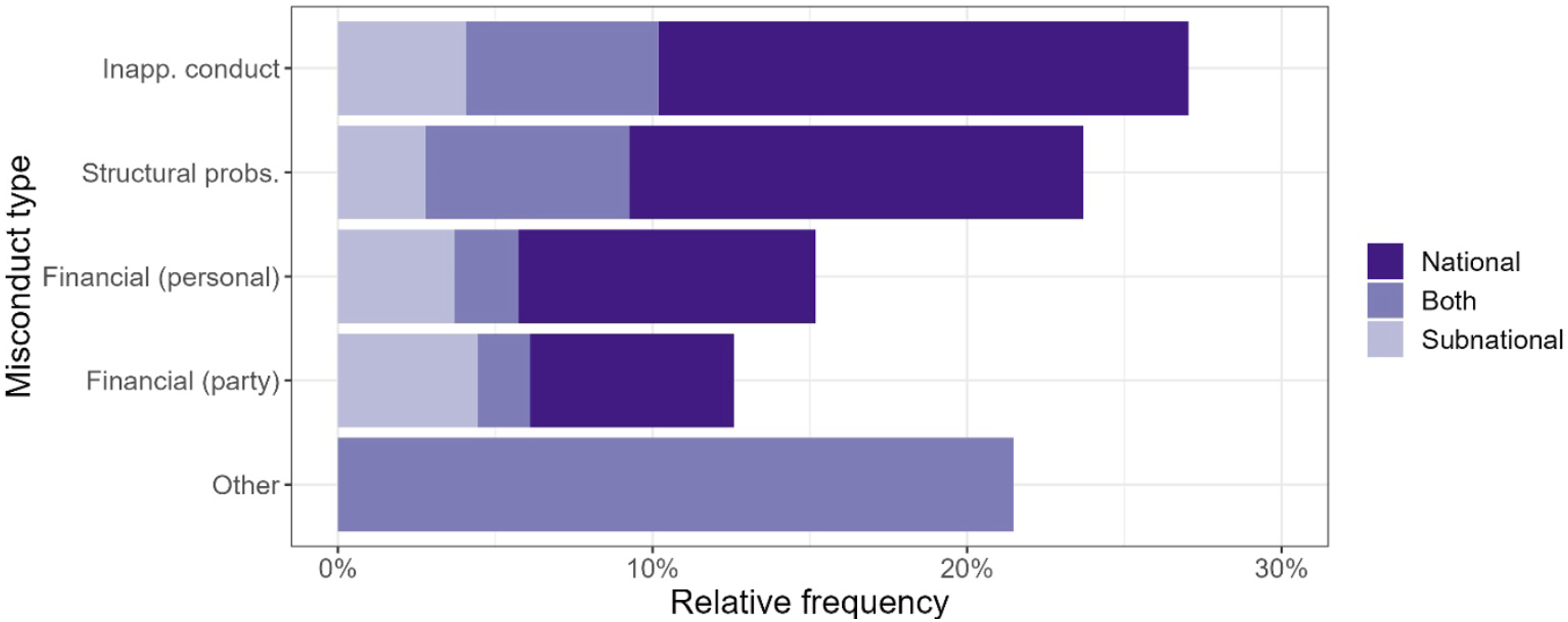
As illustrated in Figure 1, the most frequent types of misconduct experienced in Swedish political parties are inappropriate conduct and structural organisational problems. Out of the 628 cases of misconduct experienced by our respondents within the prior 2 years, 27% were instances of serious inappropriate behaviour by a party member and 24% concerned serious structural organisational problems. These represent both individual-level and party-level wrongdoing, suggesting that both occur in Swedish parties. Far less frequently experienced are issues relating to improper financial favouring of the party or the individual, which reflects the relatively low levels of corruption in general in Sweden.
The category “other” was chosen in to 21% of the misconduct cases. The free text specifications showed that instances of perceived undue favouring in appointments were behind many of these responses. In addition, some respondents revealed ideological concerns, for example referring to the party’s perceived deviation from its ideology or election manifesto in particular policy issues.
Although the sample is comprised of mainly local politicians, most of the misconduct is said to have taken place at the national level. This result is somewhat puzzling given that previous research indicates that corruption is probably more frequent at the local level than at the national level in Sweden (e.g. Bergh et al., 2016; Erlingsson et al., 2008). This reflects the fact that also in a country with highly independent local level governments, national politics is often the most prominent in people’s mind.
Reporting tendencies by misconduct type.

Note: The upper figures refer to the number of respondents who mentioned a specific misconduct category. Percentages refer to the outcome (reporting) relative to all cases in that misconduct category, akin to a reporting ‘rate’. The discrepancy in category % relative to total reported % is likely due to cases where reporting respondent selected more categories than those who do not report.
Those who did not report were subsequently asked why. The full results for this table can be found in Appendix A3. Although this subsample is limited to only 46 responses, 48% of these answered that they were worried about negative consequences for themselves if they were to report. At the same time, 26% of this group stated that they did not report due to a fear of appearing to be disloyal to the party. Two of the other more common answers given related to negative consequences for the party or a lack of evidence.
Whistleblowing and party type
Whistleblowing and party type.
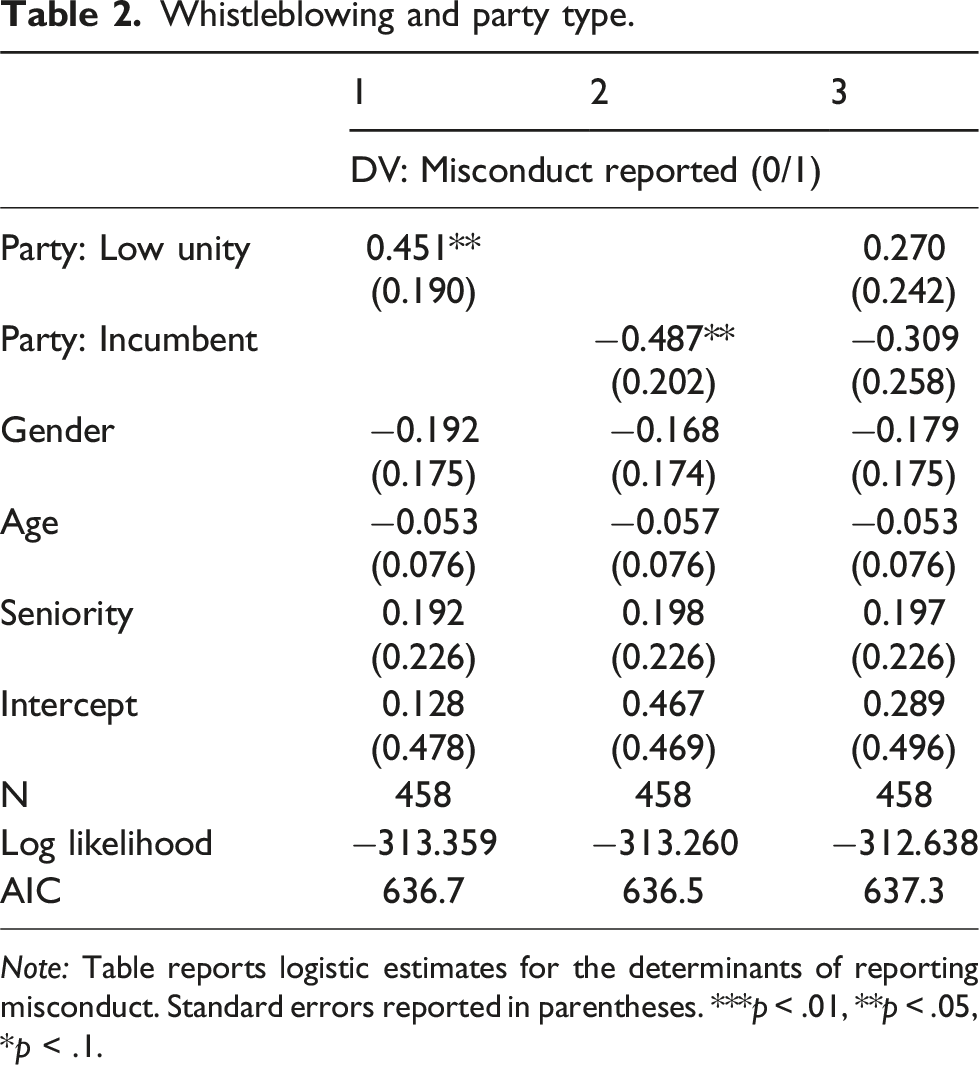
Note: Table reports logistic estimates for the determinants of reporting misconduct. Standard errors reported in parentheses. ***p < .01, **p < .05, *p < .1.
Results are consistent with the notion that parties with higher party loyalty and discipline report misconduct to a lesser extent. The magnitude of the effect is comparable across conceptualisations of party unity: being a politician in a party with high party loyalty and discipline decreases the likelihood of blowing the whistle on misconduct – either internally or externally – by 11%–12%. 6 7 However, neither of these variables return significant results in Model 3 when both measures are included, which may be suggestive of a conditionality in these relationships. Also interesting to note is the insignificance of the individual level factors controlled for, which seemingly matter far less for whistleblowing than organisational factors – a finding consistent beyond political parties (Vadera et al., 2009).
The channels of whistleblowing
The third research question concerns the channels through which misconducts are reported. The results show that reporting is done in several different ways, internally as well as externally. As illustrated in Figure 2, the three most common ways in which misconduct is reported in political parties are all internal. Informally reporting the issue to party leadership, to a fellow party member, making a formal report to the party leadership, and using internal whistleblowing functions collectively account for 75% of reported cases, or 37% when including those who did not report. One should view these results with some degree of caution, however. As with the question on the type of misconduct witnessed, respondents were able to give several answers to this question, which means that they may have taken several (possibly internal and external) steps to reporting the issue. Due to the relative rarity of external whistleblowing, we are also unable to effectively break questions down by party. Nevertheless, Figure 2 is a good indication that internal reporting channels are by far the most frequent in political parties, and particularly informal avenues, which is in line with findings in other kinds of organisations (Near and Miceli, 1985). Given that formal whistleblowing functions are so rare in political parties, it is not surprising to see so few took this route. The frequency of misconduct reporting methods in political parties.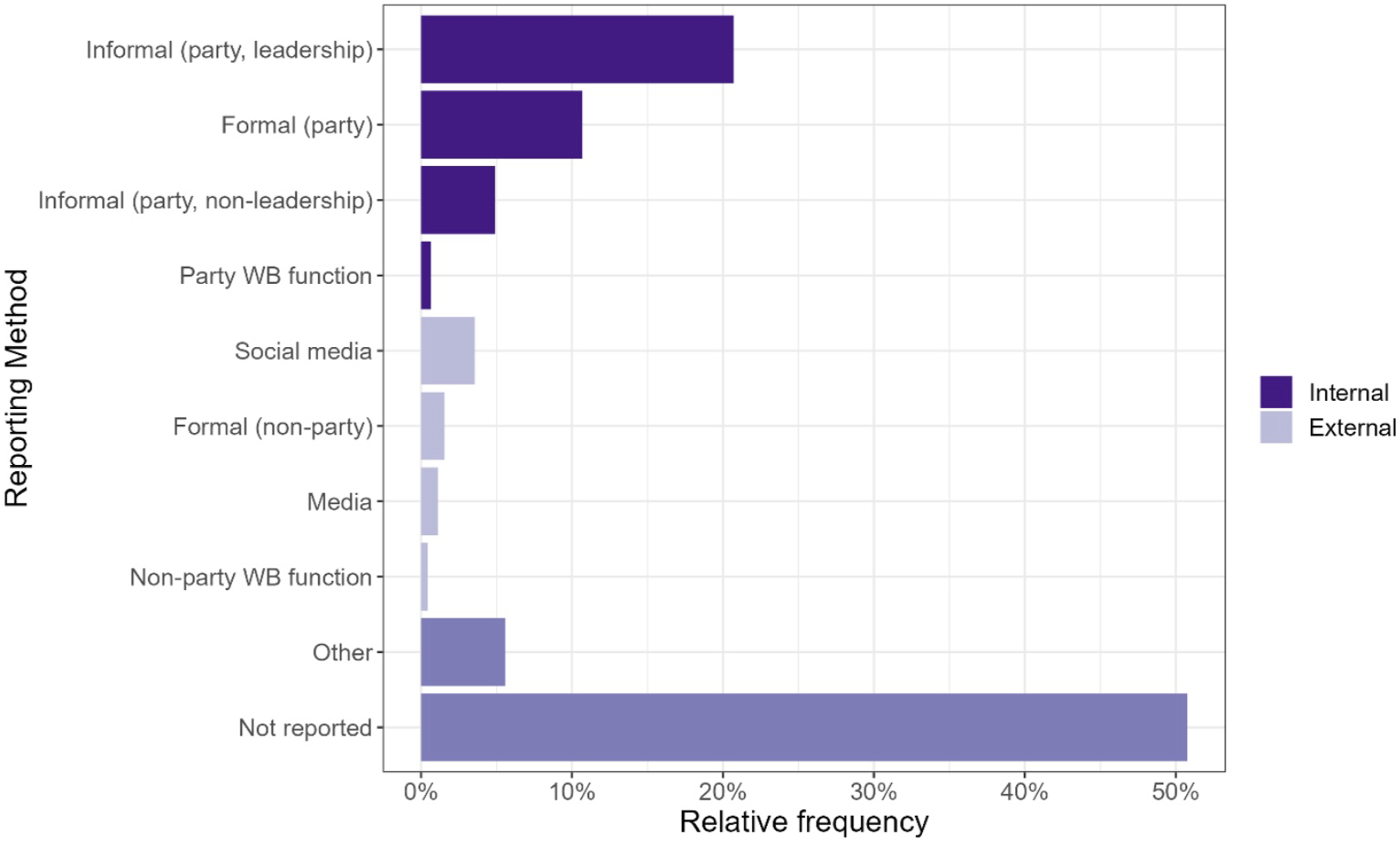
Consequences of whistleblowing
Finally, our fourth research question is about the occurrence of negative consequences for the whistleblower and, if there are such consequences, if they vary across parties. The results presented in Figure 3 show that a considerable majority (58%) of respondents reported no negative consequences for those who did report. This is perhaps surprising given the considerable body of literature testifying to the devastating consequences for whistleblowers in other organisational contexts (Burke and Cooper, 2009; Hedin and Månsson, 2012; Rothschild and Miethe, 1999; Snowden, 2019). However, this answer must be considered in combination with the frequency of reporting detailed in Figure 2, which shows that in the vast majority of cases, misconduct is not reported. It could therefore be the case that misconduct is more likely to be reported when the whistleblower does not fear serious (or any) repercussions. If they do, the would-be whistleblower may be more likely to keep quiet. Consequences of whistleblowing in political parties.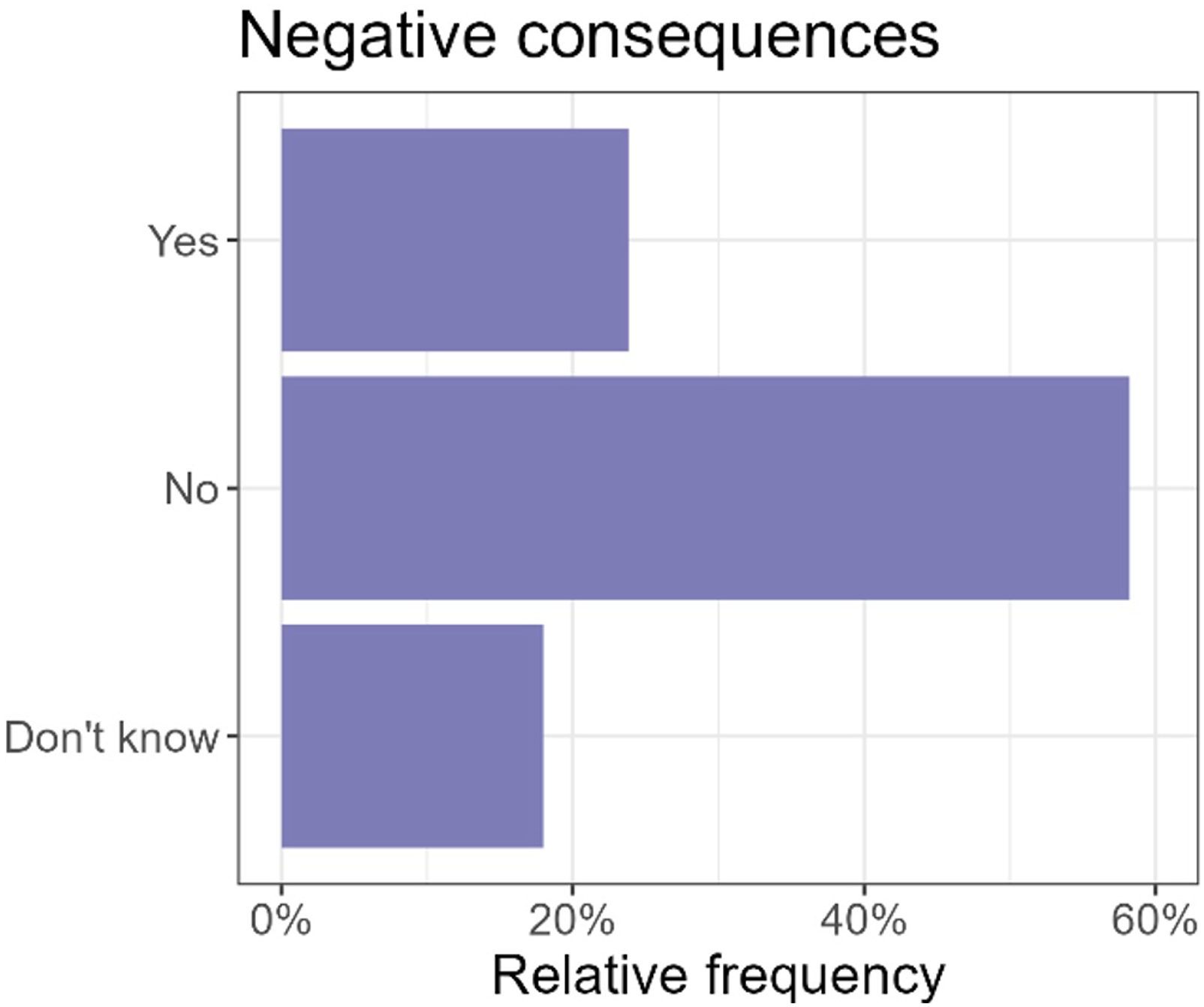
Those who did report negative consequences for the whistleblower were also given the opportunity in a free-text answer to elaborate the nature of the negative consequences. The most common of these seem to be internal disciplinary action regarding political career opportunities – specifically being removed from a political position, or being relegated down ballot list orders, which will have negative consequences for electoral prospects. Among the more common of other reported negative consequences is being excluded from party information and events.
Negative consequences and party type.
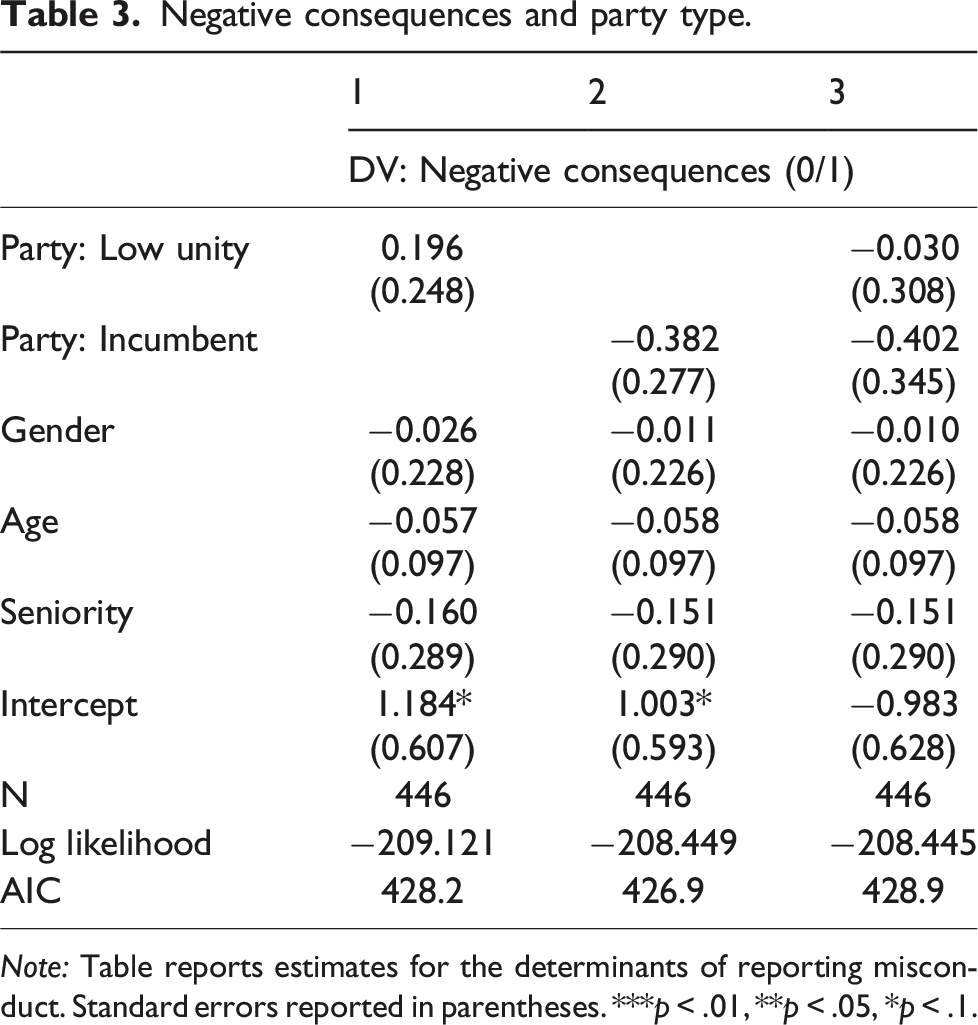
Note: Table reports estimates for the determinants of reporting misconduct. Standard errors reported in parentheses. ***p < .01, **p < .05, *p < .1.
Concluding discussion
In this first investigation of misconduct and whistleblowing in the context of political parties, we pose four research questions that consider the nature, determinants, channels, and consequences of misconduct and whistleblowing in and across parties. Our study of the Swedish case demonstrates that misconduct primarily relates to structural issues and inappropriate individual behaviour. Misconduct is only said to be reported around half the time though, and while most cases are not claimed to result in negative consequences for the whistleblower, a significant minority do, with punishments often relating to reduced political opportunities such as being removed from electoral lists.
This study also establishes that tendencies of reporting misconduct can and does differ across parties. Specifically, politicians from parties with high party unity seemingly blow the whistle on misconduct occurring within their organisation – internally or externally – to a lesser extent than other parties’ officials. However, this finding seems to be conditional on incumbency status and is largely driven by the Social Democrats in this case. Between the other incumbent party (the Greens) and the rest, there is no difference. Neither do members of the Left Party or the Liberal Party appear more willing to act whistleblowers. While the Social Democrats meet the requirements of both our expectations regarding party unity (such as being in power, being hierarchical, and having a strong emphasis on the collective), we are unable to eliminate the possibility that this result is party specific. This is a potentially fruitful route for future research.
This study makes several contributions. First, in relation to the whistleblowing literature, we extend the scope of whistleblowing to a type of organisation that this field has neglected so far despite its importance for the functioning of democratic countries: the political party. Second, we contribute to party research by identifying what types of misconduct occur in political parties, as well as through what channels these are revealed and with what consequences. Specifically, we contribute to the research on internal party organisation, by increasing our understanding of whistleblowing as an accountability mechanism in the party context. We reveal potential problems in the democratic accountability chain that party scholars, as well as parties need to pay greater attention to, theoretically, but also empirically. Third, we also contribute to the literature on party unity, by demonstrating a further dimension of the loyalty dilemma previously studied more or less exclusively through dissent voting. This paper will hopefully contribute to widening that scope, as the fact that our expectations are only partially met may indicate that the loyalty dilemma whistleblowing presents to party members is similar, but not quite the same as that of dissent voting.
The results of this study also have significant practical and policy implications. Although reporting can certainly hurt the party, the effects may be even more detrimental if improprieties are allowed to continue unchecked. This realisation should spark a policy discussion on the need to extend whistleblowing protection to party organisations. In current EU legislation (EU Whistleblowing Monitor), parties are not explicitly covered by protection rights. In effect, potential whistleblowers in parties do not only have to contemplate the potential damage to the party, but also to themselves when deciding whether to report misconduct.
That said, this study also has significant limitations. Notably, our results are based on perceptions of people stating that they have experienced misconduct; we have no possibility to evaluate whether the situations they refer to have indeed transpired, or how the situations are perceived by others involved. Therefore, while we should clearly not dismiss perceptions of misconduct, we should not take for granted that all reported instances are examples of mismanagement by the parties. Moreover, while our choice to rely on survey data gives us the opportunity to estimate the frequencies of misconduct and reporting, we do not gain the contextual depth that a more qualitative approach could provide. Further, we have explored party whistleblowing in the single country of Sweden. How party members balance norms and make decisions on appropriate actions is, however, likely to vary between countries.
Beyond this study, we see a need for more research in the field of misconduct and whistleblowing in parties – particularly comparative studies exploring how whistleblowing in parties varies between different political systems and levels of corruption. Moreover, qualitative research is required to delve deeper into the experiences and considerations of party members regarding misconduct and whistleblowing. Researchers should strive to expose the mechanisms of reporting and not reporting, as well as the considerations of individuals torn between different loyalties and/or moral values. In the long run, the aggregated knowledge supplied by this new field of research may change how scholars, as well as party members and citizens think about the need for transparency in party organisations, given their pivotal part in democratic accountability processes.
Supplemental Material
Supplemental Material - Misconduct and whistleblowing in political parties: A party loyalty dilemma
Supplemental Material for Misconduct and whistleblowing in political parties: A party loyalty dilemma by Birgitta Niklasson, Stephen Dawson and reas Bågenholm and Jenny De Fine Licht in Party Politics
Footnotes
Declaration of conflicting interests
The author(s) declared no potential conflicts of interest with respect to the research, authorship, and/or publication of this article.
Funding
The author(s) disclosed receipt of the following financial support for the research, authorship, and/or publication of this article: This work was supported by the Vetenskapsrådet (2021-01814).

Supplemental Material
Supplemental material for this article is available online.
Notes
Author biographies
References
Supplementary Material
Please find the following supplemental material available below.
For Open Access articles published under a Creative Commons License, all supplemental material carries the same license as the article it is associated with.
For non-Open Access articles published, all supplemental material carries a non-exclusive license, and permission requests for re-use of supplemental material or any part of supplemental material shall be sent directly to the copyright owner as specified in the copyright notice associated with the article.
