



Abstract
This study tests novel hypotheses on how gender affects candidates’ policy congruence with parties and voters. We argue that structural barriers lead female candidates to align more closely with their parties, while gendered ideological differences shape their congruence with voters across policy domains. Additionally, we examine whether candidates’ voter- or party-centric campaign focus mediates these gendered dynamics. Using data from the 2013 Austrian National Election Study (AUTNES) and blackbox scaling to estimate latent policy positions, we find no gender differences in candidate-party congruence. However, female candidates align more with female voters on the economic dimension but exhibit lower congruence with both female and male voters on socio-cultural issues. While voter-centric campaigns increase candidate-voter congruence on socio-cultural issues, campaign focus does not mediate gendered patterns of congruence. These findings shed new light on gender and policy congruence across dimensions, advancing our understanding of the dynamics between descriptive and substantive representation.
Introduction
Effective democratic representation hinges on congruence between citizens and their elected representatives (Rohrschneider and Whitefield 2012). However, while extensive research has explored the effects of electoral and party systems (e.g., André et al., 2017; Norris, 1997; Steiner and Mader, 2017; Wessels, 1999), and party-voter congruence (e.g., Kaltenegger et al., 2021; Lefkofridi, 2020; Mattila and Raunio, 2006; Powell and Bingham, 2004; Traber et al., 2018), limited attention has been paid to the congruence between candidates and voters. This gap is particularly significant in the context of increasingly personalized politics (Ferreira da Silva et al., 2019), as the positions of candidates may diverge from that of their parties (Steiner and Mader, 2017), highlighting the need to consider individual candidates’ perspectives within the black box of political parties.
This study investigates the influence of candidate gender on policy congruence with their parties and the electorate at large, as well as with female and male voters in particular. Research on politics and gender highlights structural barriers, gender biases, inequalities in resources as well as differences in issue positioning and behavior at elite and voter levels (e.g., Abendschön and Steinmetz, 2014; Crowder-Meyer, 2013; Gidengil et al., 2003; Lloren and Rosset, 2017; Martínez-Cantó and Verge, 2023; McDonnell et al., 2025). We argue that these factors may shape the candidates’ policy alignment with their parties and voters (H1): On the one hand, candidate gender may impact congruence because structural and resource inequalities incentivize female candidates to stick to the party line. On the other hand, congruence levels will be affected by the fact that female candidates tend to be, on average, more progressive – compared to their male counterparts and voters (e.g., Gidengil et al., 2003; Lloren and Rosset, 2017). Assuming that female candidates are more likely than male candidates to pursue policies that seek to improve women’s lives and render them equal to men (Hessami and da Fonseca (2020), and considering findings that female voters tend to be more left-leaning, we expect higher levels of congruence between candidates and voters of the same gender (H2). Finally, building on insights from electoral studies regarding structural incentives shaping candidates’ behavior, we additionally examine whether campaign focus (voter-centric vs party-centric) mediates the relationship between candidate gender and policy congruence (H3).
We test these hypotheses using data from the 2013 Austrian National Election Study (AUTNES) (Kritzinger et al., 2017; Müller et al., 2017), which has multiple advantages. The candidate and voter survey include identical questions and scales measuring policy positions, thus allowing us to estimate congruence precisely. Additionally, they capture policy congruence within a two-dimensional policy space on socio-cultural and economic issues rather than a general left-right dimension, thus better reflecting the complexity of party competition (e.g., Costello et al., 2012; Lefkofridi, 2020). Since previous research suggests that male and female voters differ primarily in their position on socio-cultural issues (Reher, 2018), examining both dimensions independently might also provide insights on gender-based representation.
We then leverage the advantages of blackbox scaling, a method that allows us to estimate the latent policy positions of candidates and voters, providing a reliable measure of congruence across multiple dimensions (Poole, 1998; Poole et al., 2016). Our empirical analyses generate mixed, yet interesting findings: Firstly, we find no significant differences in congruence between male and female candidates and their party organizations (H1a). Secondly, female candidates are more distant from voters than male candidates on socio-cultural issues but closer to voters than male candidates on economic issues (H1b). Thirdly, regarding gender-based representation (H2), we find that female candidates are further from both male and female voters on socio-cultural issues but closer to female voters on economic issues. While these effects are modest, they indicate a significant influence of candidate gender on representation across voter groups and policy domains. The effect of candidate gender is thus dependent on both the policy domain and voter gender. Finally, while voter-centric campaigns are associated with higher voter congruence on socio-cultural issues (H3a), campaign focus does not mediate gendered patterns in congruence (H3b, H3c). These findings highlight the complex interplay of candidate and voter gender, as well as policy domain in shaping policy representation.
Our results contribute to the understanding of candidates’ gender and its role for descriptive and substantive representation. They provide evidence that women’s descriptive representation translates into better substantive representation, thereby strengthening democratic representation overall. At the same time, they underscore the importance of differentiating between different policy domains, as female candidates are more aligned with female voters on economic issues but less so on socio-cultural issues. Our findings also challenge the idea that female candidates are necessarily more closely aligned with their parties. Overall, our study contributes to scholarly discussions on party politics, politics and gender, and electoral systems. The following sections detail our theoretical framework, methodology, results, and conclusions.
Candidate Gender, Campaign Focus, and Policy Congruence
Democratic political representation requires at least some alignment between the policy positions of voters and those who make policies on their behalf (for a discussion, see Lefkofridi, 2020). However, previous research on policy congruence has almost exclusively focused on congruence between parties and voters – and specifically on institutional and contextual factors, such as electoral systems and party dynamics (e.g., André et al., 2017; Norris, 1997; Steiner and Mader, 2017; Wessels, 1999) – while the role of individual candidates has been under-researched. This study contributes to addressing this lacuna in the literature. More specifically, we examine the role of candidate gender. Drawing on empirical inquiries in the field of politics and gender, we theorize why candidate gender should impact levels of congruence with parties and constituencies, whereby we distinguish between female and male voters. Additionally, building on studies of electoral systems and ballot structures, we explore how campaign focus – whether voter- or party-centric – affects policy congruence and consider its potential role in explaining observed gender differences.
Candidate gender and policy congruence
The structural barriers women face within party organizations are well-documented (e.g., Crowder-Meyer 2013; Martínez-Cantó and Verge 2023; Niven 1998; Verge and Astudillo 2019; Verge and Claveria 2018). Due to these disadvantages, as well as persistent gender biases and discrimination, female candidates often must be better partisans than their male peers to secure candidacies or favorable positions on party lists—a phenomenon referred to as the “Jackie Robinson Effect” (Anzia and Berry, 2011).
Indeed, a recent study on parliamentarians from 17 emerging democracies in Africa highlights the gendered selection criteria at work, which lead, for instance, to the selection of women with higher party discipline (Clayton and Zetterberg, 2021). Similarly, Papavero and Zucchini (2018) find that once other characteristics are accounted for, female MPs in the Italian parliament show higher party cohesion than male MPs, which they attribute to the selection processes. Situations of high competition for positions on party lists or uncertainty about the own professional future might further amplify this: Evidence from the German Bundestag shows that women are less likely to diverge from the party line in roll-call votes if the re-election probability is lower (Dingler and Ramstetter, 2021). These findings suggest that to be included in the candidate pool, female candidates must be more closely aligned with their party’s policy positions than their male counterparts. Consequently, we hypothesize that female candidates exhibit higher policy congruence with their parties than male candidates (H1a).
The challenge for women to break into male-dominated party networks and secure nominations as candidates (Dingler, 2019) also has implications for their policy congruence with voters. Compared to male candidates, female party members must invest significantly more resources to be selected, as they face higher barriers to proving their merit within party organizations. Female candidates often dedicate more time to party-related activities, yet, as women, they typically have fewer time resources available overall for political engagement (Burns et al., 2001; McDonnell et al., 2024; Stadelmann-Steffen and Koller, 2014). Additional demands related to family responsibilities disproportionately affect women in political networks, especially those with partners and children, placing further constraints on their time (e.g., Bernhard et al., 2021; Lawless and Fox, 2005). Consequently, the time female candidates can allocate to constituency work or voter engagement is more limited. As a result, due to resource constraints, female politicians may have fewer opportunities to exchange with voters, including persuading them about the positions they advocate for.
Given that resource constraints imply less time engaging with voters, they may affect candidates’ understanding of voters’ policy preferences. While politicians tend to have inaccurate perceptions of the electorate’s positions, including those of their own party’s voters (Walgrave et al., 2022), perceptions are more accurate among politicians, who engage directly with voters, such as through constituency work (Bundi et al., 2023). The more time candidates dedicate to understanding voter preferences, the better they align with their constituencies. Conversely, less time spent with voters is associated with lower policy congruence. If time constraints negatively impact levels of congruence and female candidates systematically face such constraints, it follows that they should underperform in policy congruence with voters compared to male candidates. We thus hypothesize that female candidates will exhibit lower levels of congruence than male candidates (H1b).
In sum, we hypothesize that gendered candidate selection mechanisms lead female candidates to exhibit higher congruence with their parties but lower congruence with voters due to resource constraints. However, ideological differences between male and female candidates may also shape their alignment with voters beyond these structural factors. Empirical research consistently finds that female candidates hold more progressive positions than their male counterparts, particularly on socio-cultural issues such as gender equality, LGBTQ+ rights and immigration (Gidengil et al., 2003; Lloren and Rosset, 2017). Given that electorates in many contexts tend to be more centrist or conservative on these issues (e.g., Czaika and Di Lillo, 2018; Gerhards et al., 2009), female candidates may experience lower levels of policy congruence with voters. Moreover, resource constraints may limit their ability to engage voters and persuade them of their positions. Yet, the extent to which candidate-voter congruence is shaped by ideological differences may also depend on voter gender. In the following section, we explore whether female candidates are better at representing female voters and male candidates at representing male voters.
Candidate gender, voter gender, and policy congruence
A substantial portion of the politics and gender literature focuses on descriptive and substantive representation, which pertain to similarity in demographic characteristics (descriptive representation) and alignment of policy preferences (substantive representation), respectively. Research on descriptive representation, which examines the extent to which elected parliaments are similar to their constituencies, often assumes that demographic correspondence implies shared experiences between representatives and the represented. These shared experiences are thought to enhance representatives’ understanding of citizens’ concerns and policy preferences. In line with this perspective, feminist scholars have advocated for institutional reforms such as quotas to improve the descriptive representation of women (e.g., Celis and Erzeel, 2013), assuming a link between women’s descriptive and substantive representation (Lowande et al., 2019; Wängnerud, 2009). This perspective implies that female politicians are better equipped to understand – and thereby represent – the preferences of female citizens due to shared characteristics and experiences. However, this raises the question of whether descriptive representation consistently leads to a closer match between voters’ policy preferences and policy outcomes (substantive representation).
Assuming that candidates are better at understanding the policy positions of voters of their own gender, and that they are pursuing gender-based representation, we expect variations in congruence based on voter gender (H2); in other words, we expect voter gender to impact variation in levels of congruence achieved by female and male candidates respectively. Against this backdrop, the existing empirical literature provides mixed evidence. At the party level, evidence from 16 countries suggests that parties with a higher share of elected women are closer to the policy positions of female voters, while parties with fewer women tend to be less congruent with female voters (Ferland, 2020). In contrast, a recent study on the congruence of individual legislators with male and female voters in Switzerland finds only a negligible gender difference in congruence, highlighting instead the importance of party alignment (Kläy et al., 2024). To our knowledge, no study has yet examined the congruence of male and female candidates with male and female voters.
To theorize the alignment of candidate and voter from a gender perspective, we synthesize work on gender differences in ideological and issue positioning of candidates with studies of gender differences in voters’ attitudes and behavior. It may be that female politicians’ progressive stances make them more congruent with female voters in particular. We know that there are attitudinal differences between male and female voters on socio-cultural issues (Langsæther and Knutsen, 2024; Reher, 2018) and that female voters, who until the 1970s supported conservative and center-right parties to a greater degree than male ones, are nowadays leaning more to the left in their voting decisions (Abendschön and Steinmetz, 2014) – which has been called the ‘modern gender gap’ (Giger, 2009). The synthesis of existing empirical findings (about women being more progressive on both elite and voter levels) leads us to hypothesize variation in congruence based on voter gender (H2). Pursuing the substantive representation of women, female candidates will exhibit greater congruence with female voters compared to their male counterparts (H2a), while being less congruent with male voters compared to male candidates (H2b).
Campaign focus and (gendered) policy congruence
Seeking to understand the underlying mechanism of the relationship between gender and policy congruence, in this section, we consider the incentives provided by ballot structures and how they might affect policy congruence by motivating different campaign foci. When running their electoral campaigns, candidates emphasize their party and/or their voters. However, their specific focus is strongly shaped by the ballot system in place.
Ballots can be closed, open, or flexible. In closed-list systems, where a preference vote is not provided, parties retain full control over candidates’ electoral success. Since this is the only way of being elected, candidates in this setting are incentivized to align with, and emphasize, their party in their campaigns. In other words, candidates running on 'closed’ ballots are likely to run party-centered campaigns. Where the option of the preference vote is provided, however, voters can express their own preferences among candidates nominated by the party. In open-list systems, where voters can directly affect who is elected, candidates have a stronger incentive to emphasize the demands of the voters to appeal to their constituency—that is, they are likely to be voter-centered in their campaigns. There is a third category, which mixes elements from both other types: flexible list proportional representation. Flexible ballots stand somewhere in-between the other two models (Shugart, 2005), and the incentive structure in this third category is less straightforward. Flexible-list systems generate different – often conflicting – motivations and loyalties, which might produce both voter-centered and party-centered candidates. As such, flexible-list systems are an ideal setting to test the role of campaign focus in policy congruence. We argue that campaign focus matters for policy congruence. Candidates who emphasize closeness to their voters in their campaigns might be more likely to understand their role as a delegate of their constituents and, therefore, adopt policy positions that are closer to the electorate. At the very least, candidates who focus on voters may develop a better understanding of citizens’ preferences, which in turn helps them represent those preferences more accurately.
On the other hand, we expect candidates who emphasize closeness to their party to adopt policy positions that align with the party’s. Candidates running campaigns that center on their organization might do so as an electoral strategy, as parties are likely to reward loyalty with promising positions on the ballot list in the future. As part of that strategy, we also expect candidates to adopt policy positions that align with the party. When the positions of the party and voters are not identical, candidates must decide whether to prioritize alignment with their voters or their party. As a result, we expect candidates running voter-centered campaigns to adopt policy positions closer to their voters, while candidates focusing on party-centered campaigns will align more closely with their party’s positions. If campaign focus shapes policy congruence, we should observe that being more voter-centered in the campaign is associated with higher policy congruence with voters, while running a more party-centered campaign is associated with higher levels of congruence with the party (H3a).
If candidates differ in their campaign focus (i.e., focusing on the organization or voters) and female politicians tend to be better partisans (see our reasoning for H1), we might expect female candidates to place a stronger focus on the organization (rather than voters) to secure a position on the ballot. In essence, it can be argued that female candidates are more likely to highlight their alignment with the party’s policy positions in their campaigns as a strategy to demonstrate their commitment to the party. Though limited related research has found no gender differences in campaign characteristics (including candidate effort, Eder et al., 2015), women are expected to have a stronger incentive to run campaigns centered on the organization, rather than the constituency. We thus hypothesize that female and male candidates will differ in their campaign foci, with female candidates being, on average, more party-centered in their campaigns compared to male candidates, while male candidates are likely to be more voter-centered (H3b).
If campaign focus influences policy congruence (H3a) and female candidates are more likely to run party-centered campaigns than their male counterparts (H3b), this, in turn, may explain why female candidates show stronger policy congruence with their party compared to male candidates (H3c). In other words, campaign focus could mediate the effect of gender (our independent variable) on policy congruence (our dependent variable) (H3c).
Research design
To test our hypotheses, we select the case of Austria, where flexible list representation is used (see Müller, 2005 for a description of the electorate system). While flexible-list systems constitute an ideal setting to test the role of campaign focus in policy congruence, we note that in 2013 the Austrian flexible system functioned effectively as a closed list system, given that candidates rarely surpassed the threshold required to advance to the top of the list. A situation where incentives for congruence with parties are strong for all candidates provides us with a harder setting for evaluating whether female candidates’ effort to be partisan impacts their congruence levels and whether campaign focus matter for female and male candidates’ congruence levels.
Moreover, the Austrian case offers data that are particularly useful for our types of analyses. We use data from the Austrian National Election Study (AUTNES) fielded for the 2013 parliamentary election. We combine individual candidate data from the Candidate Survey (Müller et al., 2017; henceforth: candidate survey) with individual voter data from the Pre- and Post-Panel Study (Kritzinger et al., 2017; hereafter: voter survey). Both surveys use the same issues and scales to measure the policy positioning of candidates and voters. Although it is possible that elites and masses might not understand the issue dimensions in the exact same way, which is a potential source of bias, using items with very similar or identical wording at the elite and mass levels approaches the ideal situation (Krosnick and Presser, 2010). AUTNES has thus collected data beyond the traditional left-right dimension, which is, arguably, a crude measure of congruence (Thomassen, 2012). Such data allows a comparison of the distribution of candidates’ and voters’ preferences on the same issues. We provide detailed information on all variables used in this study as well as their coding and operationalization in Tables A1 and A2 in the Appendix.
We analyze candidates and voters of the four biggest parties that entered parliament after the 2013 Austrian national parliamentary elections; the Social Democratic Party of Austria (Sozialdemokratische Partei Österreichs/SPÖ); the Austrian People’s Party (Österreichische Volkspartei/ÖVP), the Freedom Party of Austria (Freiheitliche Partei Österreichs/FPÖ), and the Austrian Green Party (Die Grünen/Greens) 1 . At the time of data collection, a stable governing coalition between the two mainstream parties (SPÖ and ÖVP) was in place: hence, candidates running for incumbent parties are SPÖ and ÖVP candidates. Table A3 in the Appendix shows the distribution of candidates by party affiliation after excluding respondents with missing values on the variables of interest described below.
As Table A3 illustrates, the Austrian sample includes a disproportionately high number of left-leaning candidates; candidates from the FPÖ, in particular, are underrepresented (lower response rates). This response bias may affect the representativeness of the candidate sample and, in turn, influence the observed patterns of ideological congruence. Given that response rates in candidate surveys often vary across parties, with candidates from mainstream or left-leaning parties being more likely to participate, this could lead to an overestimation of ideological proximity between candidates and voters in certain segments of the electorate. While this limitation is common in elite surveys, it should be considered when interpreting the results.
Measuring issue positioning in a two-dimensional policy space.
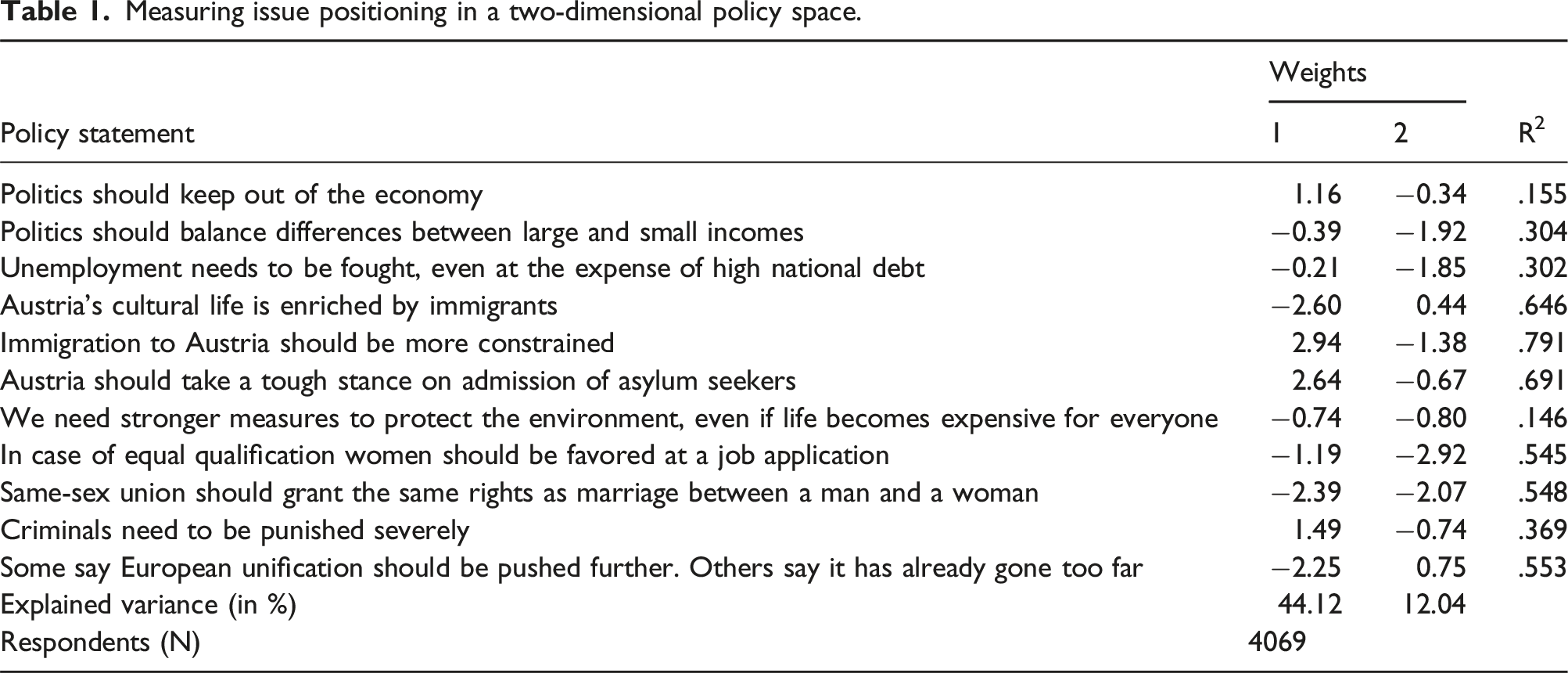
To estimate the latent policy positioning of candidates and voters, we apply blackbox scaling using the ‘basicspace’ package in R (Poole, 1998; Poole et al., 2016). Blackbox scaling is a method designed “to recover estimates of the underlying latent dimensions of issue scale data” (Poole et al., 2016: 1), allowing respondents to be positioned within an abstract policy space. This technique has the advantage that it allows for the inclusion of missing data and estimates ideal points on multiple dimensions from issue scales in an iterative process, thus not merely relying on a covariance matrix as traditional scaling methods (Armstrong et al., 2020).
Table 1 presents the results of the blackbox scaling for a two-dimensional policy space. While the issue-specific weights indicate how the items are related to each of the two dimensions, the R2 value provides information about how well the dimensions explain each issue position. We opt for a two-dimensional policy space as the economic policy statements are hardly explained by a one-dimensional approach (see Table A4 in the Appendix): While the first dimension explains about 45% of the total variance in responses to the issue scales, the second dimension adds another 12%. In line with others, who propose moving beyond a single left-right dimension in congruence research (Costello et al., 2012; Dolný and Baboš, 2015), we therefore argue that a two-dimensional policy space better covers the reality of political competition in Austria. 4
Based on the issue-specific weights, we label the first dimension as a socio-cultural left-right dimension that varies from green/alternative/liberal (GAL) to traditional/authoritarian/nationalist (TAN) positions, therefore also known as the GAL-TAN scale (Hooghe et al., 2002). Given that economic policy statements and those related to (economic) equality dominate the second dimension, we label it as an economic left-right dimension. To measure candidates’ policy distance from voters, we calculate the absolute difference between the candidates’ positioning and voters, whereby we consider (a) the median Austrian voter (‘the public’), (b) the median male Austrian voter, and (c) the median female Austrian voter. 5 Similarly, we measure the policy distance between each candidate and their party by taking the absolute difference between the candidate’s position and the median position of all party candidates. To adjust for their skewed distribution, we transform these variables by taking the square root so that positive values indicate greater distance from their party, the public, and the male and female voters.
The first independent variable is the candidate’s gender, coded as 0 for men and 1 for women. The second independent variable captures candidates’ party- and voter-centrism. Party-centered candidates are defined as those who emphasize their party during their campaign, while voter-centered candidates focus on the demands of their constituency. Candidates were asked to rate on a four-point scale from ‘not at all’ (0) to ‘very much’ (1.0) how much they emphasized specific aspects during their campaign. The results of the factor analysis summarized in Table A7 in the Appendix reveal two distinct dimensions of candidate orientations: party-centrism and voter-centrism. Party-centered orientation is characterized by an emphasis on the party’s manifesto, record, and top candidate, while voter-centered orientation is defined by a focus on the economic and social demands of the constituency and local ties. Based on these dimensions, we construct two additive indices for party-centrism and voter-centrism, with higher values indicating a stronger emphasis on either the party or the constituency during the campaign. We would like to explicitly emphasize that candidates can adopt both campaign foci, being both party-centered and voter-centered at the same time.
While the policy positions of candidates and voters calculated using blackbox scaling are arguably an objective measure, we also include subjective measures of how candidates perceive their ideological distance to their party and voters. This subjective distance is useful for assessing whether the distance measured with blackbox scaling aligns with candidates’ own perceptions. If candidates perceive voters’ positions correctly, they are more likely to address them in their campaigns and, once elected, incorporate them into policymaking. To measure the candidate’s perceived ideological distance to their party and voters, we use the individual left-right self-placement. Candidates were asked to place themselves, their party, and the typical voter in their constituency on an 11-point scale from ‘left’ (0) to ‘right’ (1.0). To measure the perceived ideological distance of the candidates to their party and to the voters in their constituency, we calculate the absolute difference between the respective two values.
Descriptive statistics of dependent and independent variables.
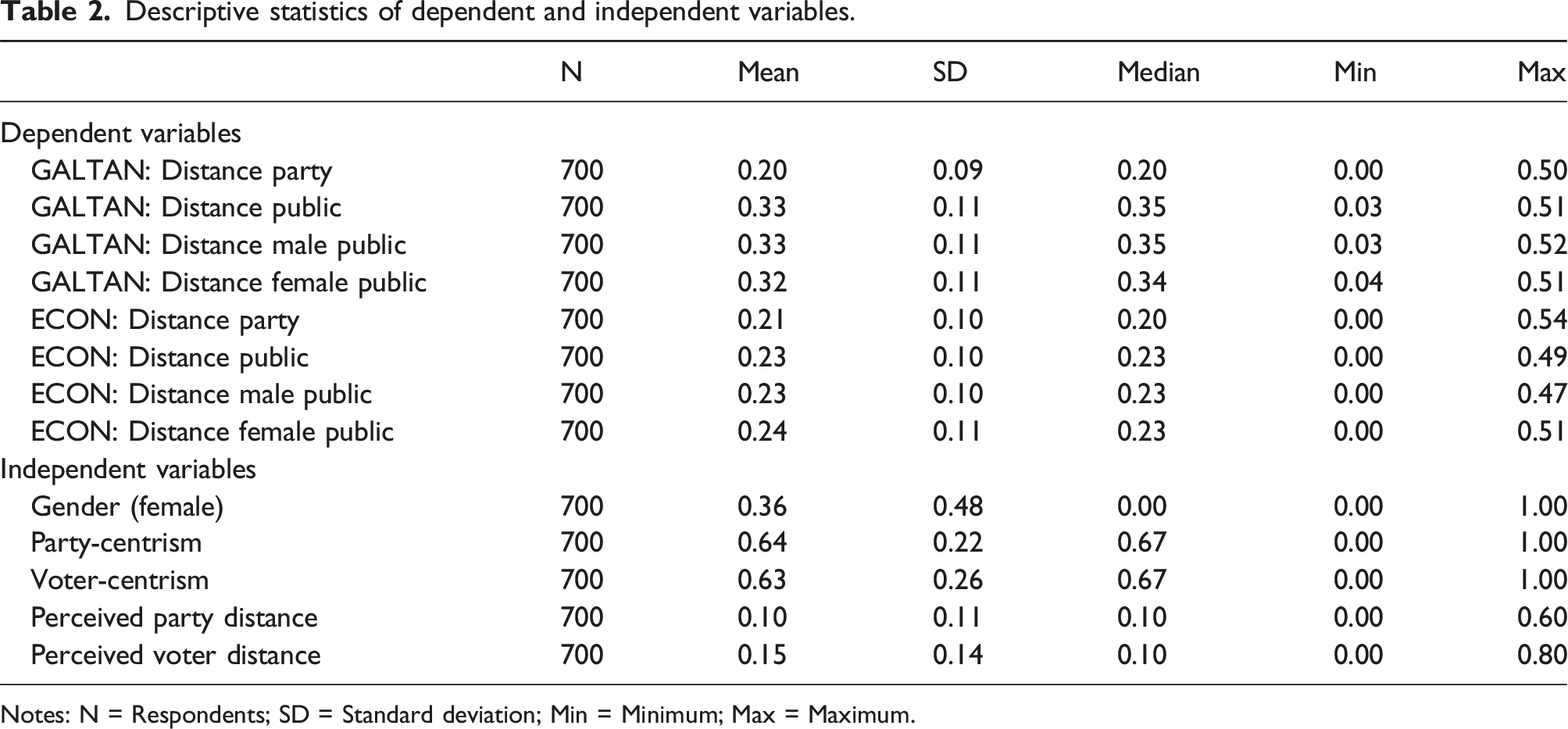
Notes: N = Respondents; SD = Standard deviation; Min = Minimum; Max = Maximum.
Analysis
Policy positions of candidates and voters
Figure 1 displays the distribution of candidates and voters across socio-cultural (GALTAN) and economic (ECON) dimensions. As expected, populist radical right (FPÖ) and Green party members occupy the far-right and far-left of the socio-cultural scale, respectively, while SPÖ and ÖVP candidates are positioned center-left and center-right. Greater intra-party variation is observed among ÖVP and SPÖ candidates compared to FPÖ and Green candidates, reflecting more ideologically coherent parties. Voters exhibit a more centrist distribution, particularly on the socio-cultural dimension, aligning with existing research on elite-mass ideological differences (Jennings, 1992). On the economic dimension, both candidates and voters display a centrist tendency, with voters leaning slightly leftward. The resulting two-dimensional policy space provides a valid representation of Austrian candidates’ and voters’ ideological preferences. Policy positions of candidates by parties and voters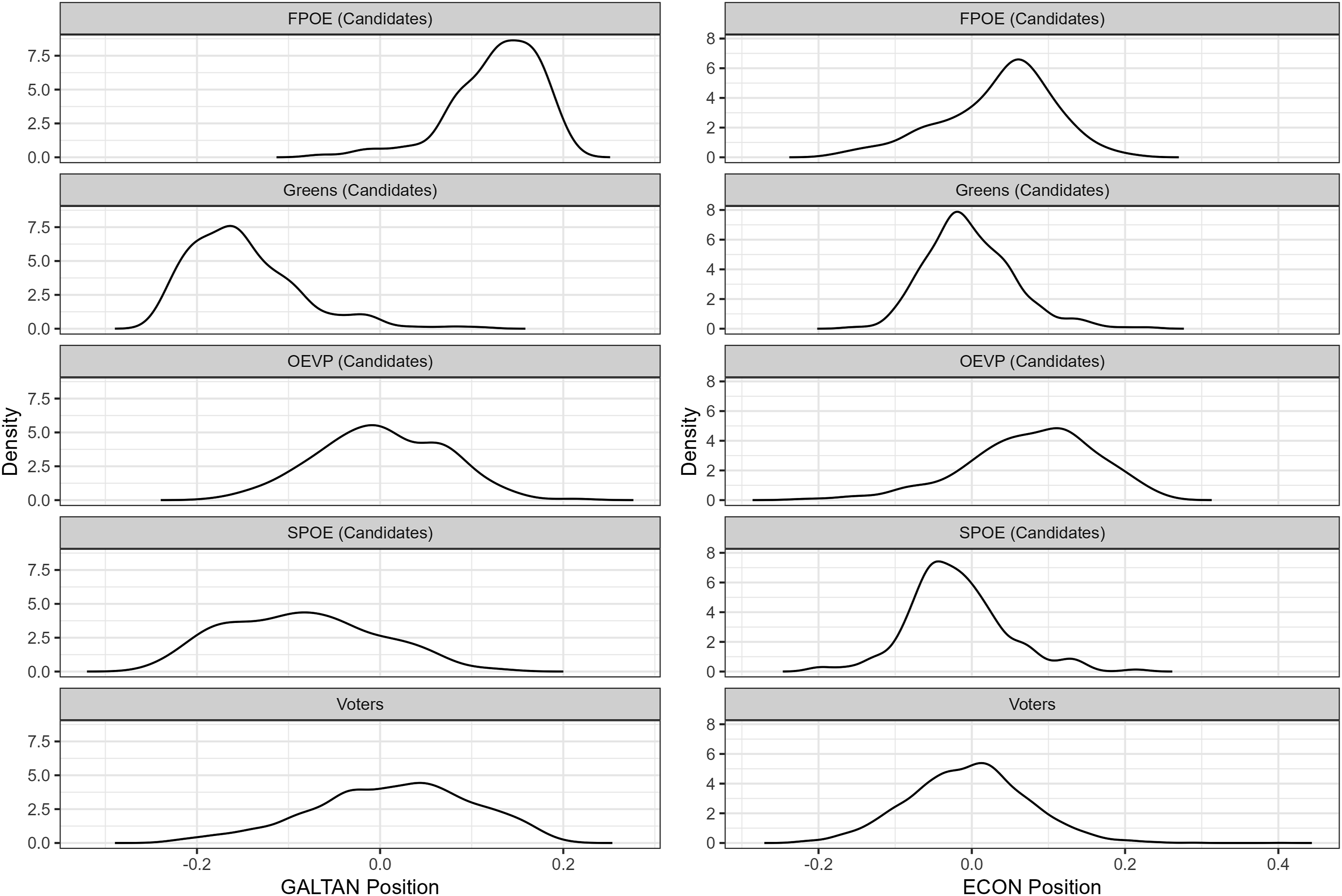
Figure 2 illustrates the distributions of candidates and voters by gender on the socio-cultural and economic dimensions. The Austrian picture of candidates and voters resembles international trends: Austrian female candidates are, on average, more progressive than their male counterparts on both dimensions, with female candidates scoring an average of −0.083 on the socio-cultural dimension compared to −0.036 for male candidates, and −0.012 versus 0.036 on the economic dimension. These differences are statistically significant, highlighting female candidates’ progressive stances. In contrast, Austrian voters, on average, lean toward the center or center-right on both dimensions, with only minor differences between male and female voters. That said, Austrian female voters are found to be more progressive than their male counterparts, scoring an average of 0.008 on the socio-cultural dimension compared to 0.019 for male voters, and −0.022 versus 0.014 on the economic dimension. These differences are statistically significant as well, reinforcing the trend that female voters are more progressive on both socio-cultural and economic dimensions. In anticipation of our analysis of policy congruence, an important takeaway from Figure 2 is that female candidates’ and female voters’ distributions resemble each other much more on the economic dimension compared to the socio-cultural dimension. Based on this visualization of our data, female voters and candidates are expected to exhibit higher levels of congruence on economic issues, as on the socio-cultural dimension voters seem more conservative than candidates. Policy positions of candidates and voters by gender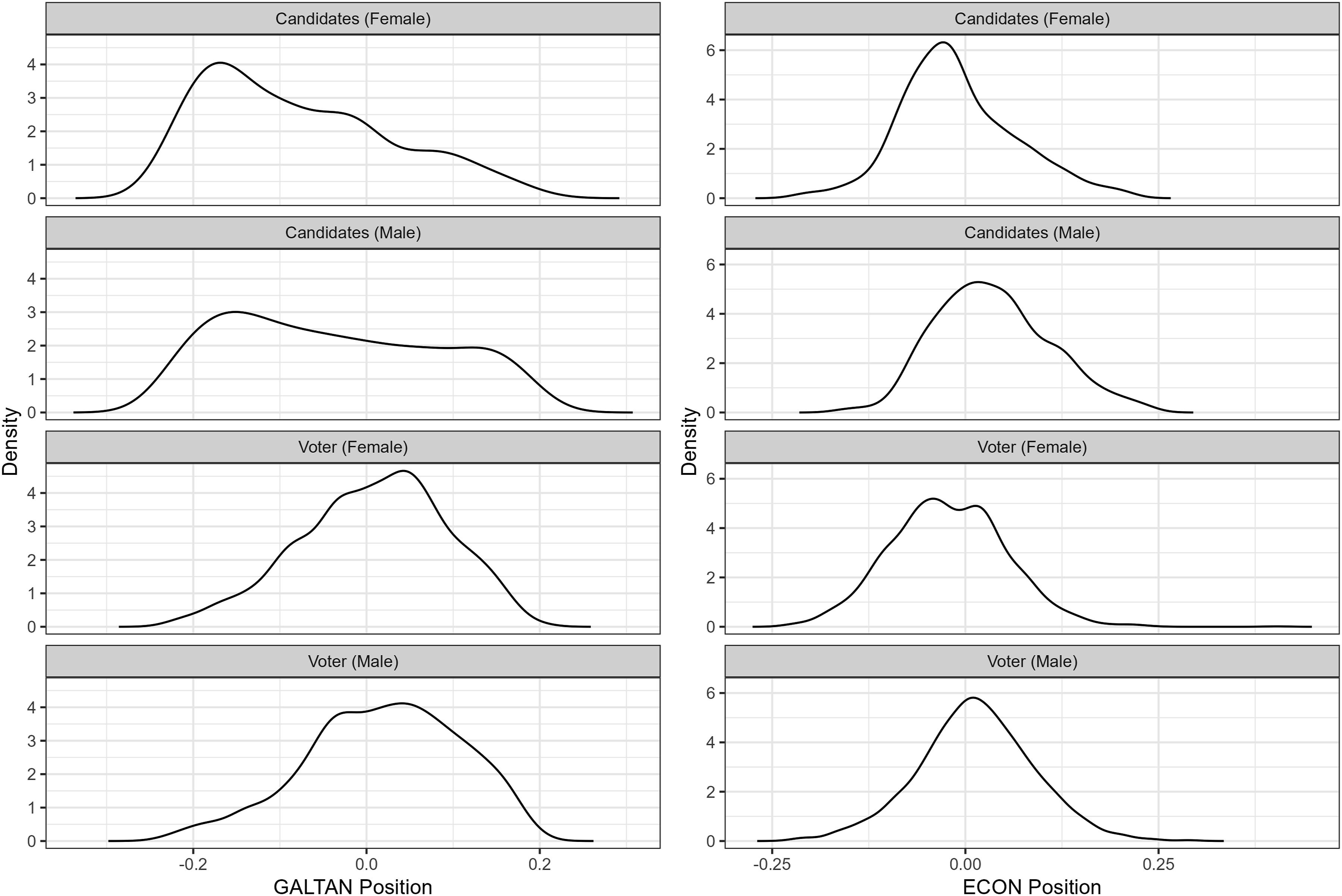
Explaining candidates’ policy congruence with their party and the electorate
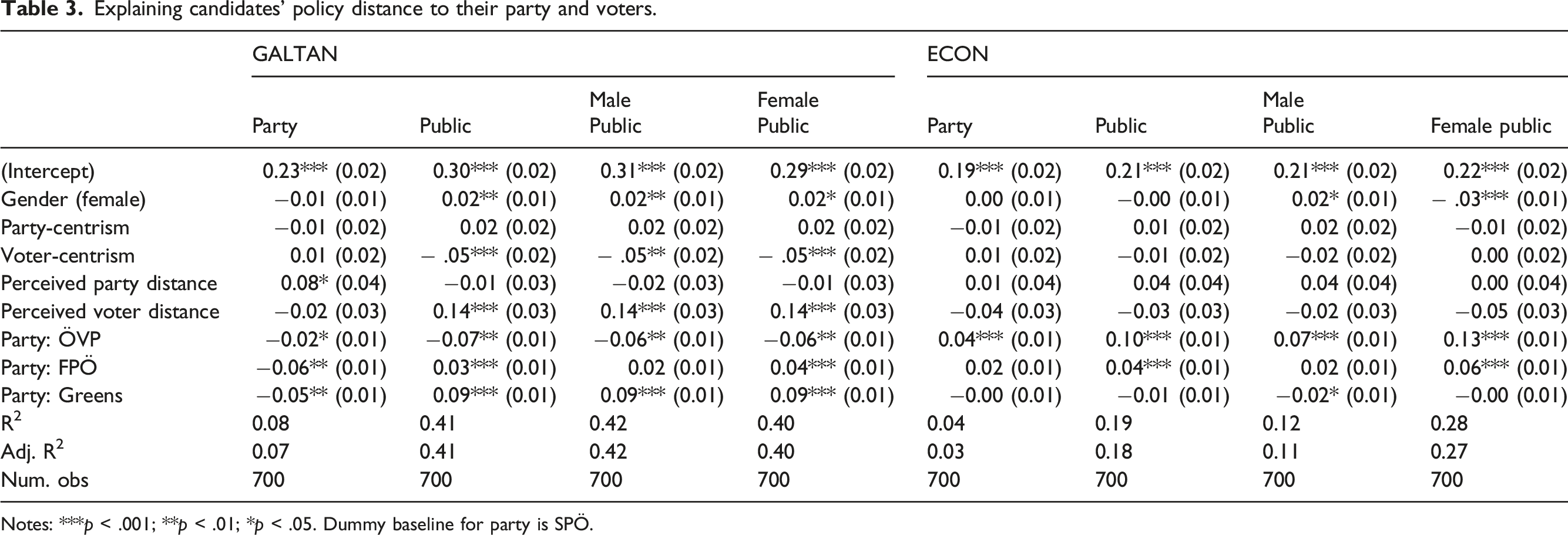
Explaining candidates’ policy distance to their party and voters.
Notes: ***p < .001; **p < .01; *p < .05. Dummy baseline for party is SPÖ.
Our first candidate gender-congruence hypothesis (H1) builds on evidence of structural barriers and resource inequalities and anticipates that: compared to their male counterparts, female candidates should exhibit higher policy congruence with their party (H1a) and lower congruence with voters (H1b). With regard to H1a, we find no significant effect of candidate gender on either the socio-cultural or the economic dimensions – in other words, though gendered structures faced by female candidates motivate higher loyalty to the party line, they do not translate in gender differences in congruence with their party. That said, we should note that the Austrian flexible-list system behaved more like a closed-list system in 2013, thus strengthening incentives for closeness to the party among all candidates.
However, we do find some evidence supporting H1b: on the socio-cultural dimension, female candidates are, on average, further away from the voters’ average position compared to their male counterparts. This negative effect, however, does not extend to the economic dimension. Gendered selection processes and the additional demands placed on female candidates to focus their time on their party seem to matter, but they do not fully explain what is going on, given variations across dimensions of political competition.
Our second hypothesis examines whether female and male candidates are better at voicing the political positions of voters of their own gender, thereby pursuing gender-based representation (H2). Specifically, we expected that female candidates, who are typically more left-leaning and progressive than their male counterparts because they pursue the substantive representation of women, will be closer to the positions of female voters compared to male candidates (H2a) and more distanced from the positions of male voters than their male counterparts (H2b). The results in Table 3 show that, on the socio-cultural dimension, female candidates are, on average, further from the positions of both male and female voters, although the latter effect is only weakly significant. This effect is perhaps little surprising, as we have found female candidates to be more progressive on socio-cultural issues than Austrian voters, both male and female. Indeed, in comparison to other EU countries, Austrian voters tend to hold rather conservative views on key socio-cultural issues, such as immigration or gender equality (e.g., Czaika and Di Lillo, 2018; Gerhards et al., 2009) which means more progressive candidates will be less congruent with voters, perhaps more so than in other countries. On the economic dimension, however, the results align with our expectations: female candidates are further from the positions of male voters (in support of H2b) but closer to the positions of female voters (in support of H2a).
To better understand the substantive significance of these effects, we visualized them in Figure 3. Figure 3 displays the average predicted effects for candidate gender (x-axis) on the predicted policy distance for the socio-cultural dimension (left panel) and the economic dimension (right panel). The different colors represent the models for the overall electorate (blue), male voters (green), and female voters (red). As shown in the left panel, female candidates are more distanced from the positions of all three voter groups compared to male candidates by approximately 0.02 points on a scale ranging from 0 to 0.50, corresponding to a difference of about 4%. In contrast, the right panel illustrates the gendered effects on policy distance for the economic dimension. While there is no significant effect for the overall electorate (blue), female candidates are approximately 0.02 points further from the positions of male voters but 0.03 points closer to the positions of female voters compared to male candidates. These differences correspond to about 4% and 6%, respectively. Although these are not large substantive effects, the results clearly indicate that candidate gender significantly influences representation across different voter groups. Predicted distance in policy congruence by candidate gender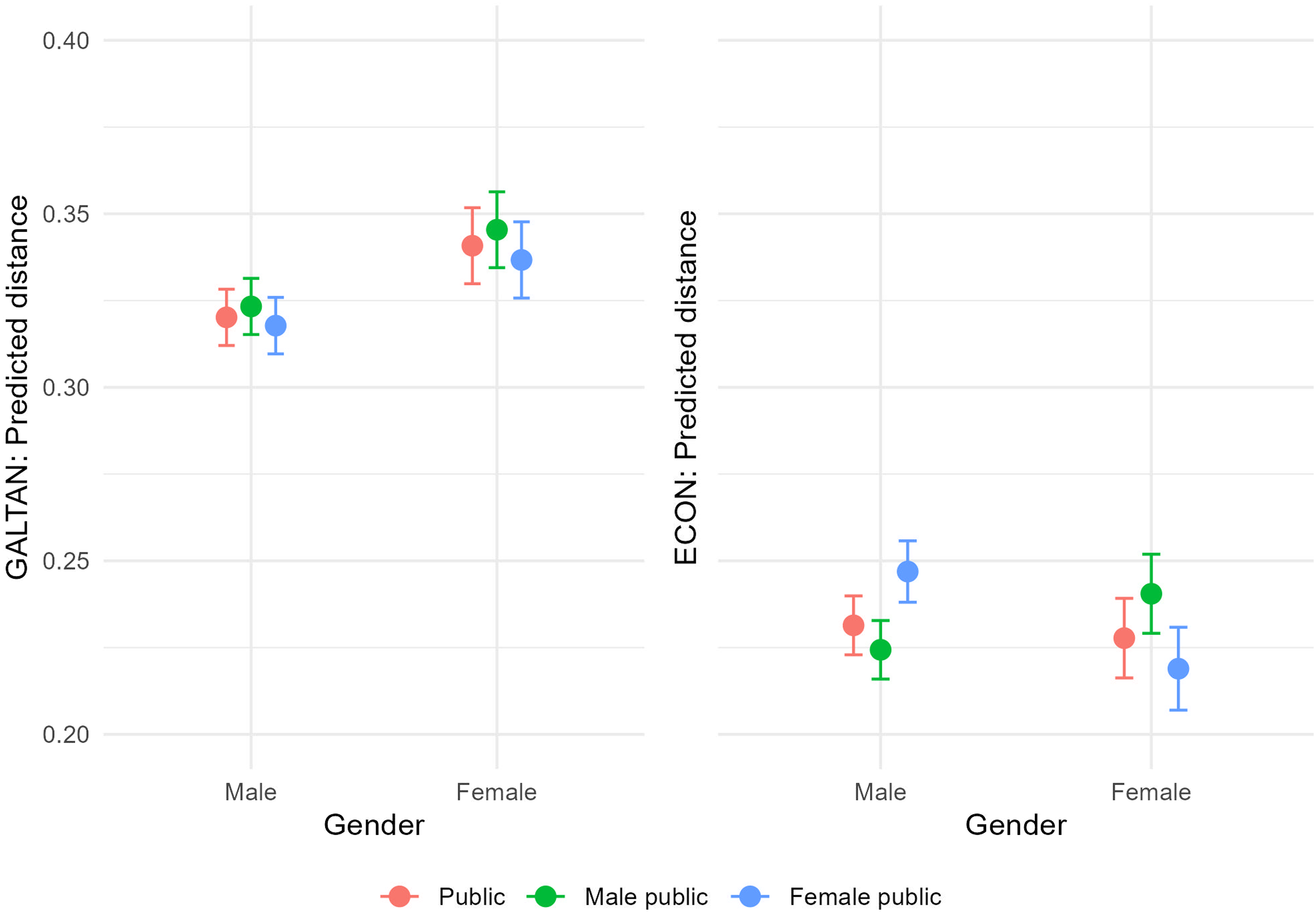
Our third hypothesis (H3) tests the effect of different campaign foci on policy congruence (H3a), gender differences in campaign foci (H3b) and whether these differences help explain the gender gap in policy congruence (H3c). The results regarding Hypothesis 3a reveal a nuanced relationship between campaign focus and policy congruence. While party-centrism shows no significant effect on policy distance for either socio-cultural or economic issues, voter-centrism is positively associated with closer alignment to voters, but primarily on socio-cultural issues. This suggests that focusing on voters improves representation, particularly concerning socio-cultural matters. The lack of effect on economic issues may be due to the increased influence of external constraints, such as EU membership, limiting the impact of constituency representation on economic issues. The finding that voter-centrism is more strongly linked to congruence on socio-cultural issues aligns with the observation that these issues are increasingly salient in electoral choices (Dassonneville et al., 2024).
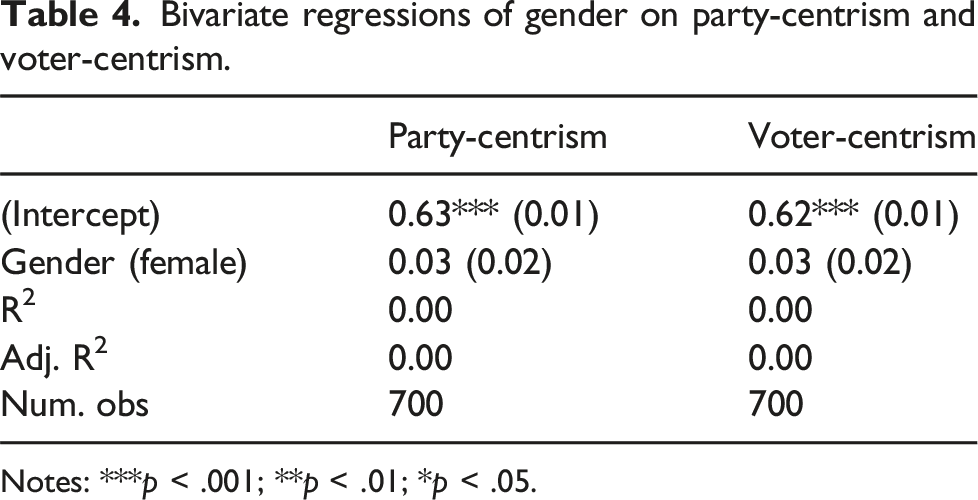
Bivariate regressions of gender on party-centrism and voter-centrism.
Notes: ***p < .001; **p < .01; *p < .05.
Finally, when examining how candidates perceive their ideological distance from the party and voters, our findings show that greater perceived distance on the left-right axis aligns with increased actual distance on the socio-cultural dimension, but no significant results for the economic dimension. This indicates that candidates’ perceptions are primarily influenced by the socio-cultural dimension, while the economic dimension is less significant.
Conclusion
Based on research on the biases and structural barriers female politicians encounter within party organizations (e.g., Crowder-Meyer, 2013; Martínez-Cantó and Verge, 2023; Niven, 1998; Verge and Astudillo, 2019; Verge and Claveria, 2018), we expected female and male candidates to differ in their congruence levels with parties. As female politicians need to be better partisans to be considered as candidates and placed on the ballot compared to their male counterparts, we expected women to show higher congruence with their parties than men (H1a). At the same time, the higher demands placed on women by their parties, together with the fewer resources they typically have (Butler et al., 2022; Johansson Sevä and Öun, 2019; Silbermann, 2015), implies that women generally have less time to spend with voters and fewer resources to understand voters’ interests and persuade them about their own policy positions. Assuming that party and voter positions are not identical, we thus expected female candidates to exhibit lower congruence with voters than male candidates (H1b). Combining knowledge on attitudinal (e.g., Langsæther and Knutsen, 2024; Reher, 2018) and behavioral gender gaps on the voter level (female voters tend to vote left, e.g., Giger, 2009; Abendschön and Steinmetz, 2014) with the gender gap on the elite level (female candidates and politicians tend to have more progressive positions than male ones, e.g., Gidengil et al., 2003; Lloren and Rosset, 2017; Slegten and Heyndels, 2020), we expected female candidates to be closer to female voters (H2a), than male voters (H2b) compared to their male counterparts. Finally, we explored whether gender differences in congruence could be explained by campaign focus (H3). We hypothesized that voter-centered campaigns would lead to higher voter congruence, while party-centered campaigns would correlate with higher party congruence (H3a). We also predicted that female candidates would adopt more party-centered campaigns than male candidates (H3b), potentially due to strategic considerations in overcoming selection barriers. Furthermore, we tested whether campaign focus partially explains gender differences in policy congruence, with female candidates’ stronger party focus potentially mitigating differences in congruence with voters (H3c).
Our empirical inquiry focused on congruence between candidates, parties, and voters in the context of Austria’s flexible-list proportional representation system. Using high-quality data from the Austrian National Election Study (AUTNES) we analyzed policy congruence in a two-dimensional policy space. Hypothesis 1a (higher party congruence for female candidates) was not supported; however, Hypothesis 1b (lower voter congruence for female candidates) received partial support, showing a significant difference only on socio-cultural issues. This suggests that while gendered selection processes may influence party alignment, their impact on voter congruence is contingent on the policy domain. Our analysis also examined whether female candidates would be better representatives of female voters, and male candidates of male voters, respectively (H2). On economic issues, Austrian female candidates were indeed closer to female voters than male voters, in line with our expectations (H2a, H2b). On socio-cultural issues, where female candidates were more progressive than the Austrian electorate, they appeared to be more distanced from both, male and female voters, compared to male candidates. These results underline the need to examine policy congruence on different dimensions (Lefkofridi, 2020). Our results showed little support for H3a, with only voter-centrism significantly correlating with voter congruence, primarily on socio-cultural issues. That said, Hypotheses 3b and 3c were rejected: no significant difference in campaign focus emerged between male and female candidates, and campaign focus did not mediate the relationship between candidate gender and congruence. The absence of a mediating effect from campaign focus points to the influence of factors beyond campaign strategy, such as differing issue prioritization in pursuit of substantive representation.
While this study provides important insights into the gendered dynamics of policy congruence, it also has certain limitations. First, the analysis relies on survey data from Austrian candidates and voters in a single election, which may limit the generalizability of the findings to other electoral contexts. Future research could extend this framework to different countries and electoral systems to examine whether similar patterns hold. Second, response biases in elite surveys, particularly the underrepresentation of candidates from certain parties, may affect the representativeness of the sample. More comprehensive data collection strategies could help address this issue. Third, while we focus on voter- and party-centric campaigns as potential moderators, additional factors—such as media exposure, party discipline, or constituency characteristics—may further shape gendered patterns of representation. Future studies could explore these dynamics and assess their impact on substantive representation across policy domains.
Overall, our research demonstrates the necessity of moving beyond aggregate-level party-voter congruence analyses to illuminate the nuanced relationships between candidate gender, party dynamics, and voter representation, even within strongly cohesive party systems, such as the Austrian one. Our study reveals a complex interplay between candidate gender, policy congruence with voters (both male and female), and campaign focus. Crucially, our findings demonstrate the importance of examining how gender interacts with party discipline and voter responsiveness to understand the unique challenges and opportunities women face in the process of representation. The results significantly contribute to our understanding of gender’s role in shaping political behavior and its effects on representing different segments of the population. Regarding the question of whether descriptive representation consistently leads to a closer match between voters’ policy preferences, our study provides evidence of a stronger link between the two types of representation on economic issues, while congruence levels are lower on the socio-cultural dimension, as female candidates are more progressive compared to the electorate. To be sure, economic issues are fundamental for women’s labor market participation and economic empowerment, but future work should examine whether the identified match extends to their substantive representation in terms of policy outcomes (e.g. Ceron and Zarra, 2021).
Supplemental Material
Supplemental Material - Gendered representation? Candidate-voter congruence in policy preferences
Supplemental Material for Gendered representation? Candidate-voter congruence in policy preferences by Zoe Lefkofridi, Carsten Wegscheider, Nadine Zwiener-Collins in Party Politics
Footnotes
Declaration of conflicting interests
The author(s) declared no potential conflicts of interest with respect to the research, authorship, and/or publication of this article.
Funding
This research was funded by the European Union (Grants No. 101061687, 2023–2025; No. 101094190, 2023–2026) and Land Salzburg (Grant “Politics & Gender, Diversity & Equality”, 2021–2024).

Supplemental Material
Supplemental material for this article is available online.
Notes
Author biographies
References
Supplementary Material
Please find the following supplemental material available below.
For Open Access articles published under a Creative Commons License, all supplemental material carries the same license as the article it is associated with.
For non-Open Access articles published, all supplemental material carries a non-exclusive license, and permission requests for re-use of supplemental material or any part of supplemental material shall be sent directly to the copyright owner as specified in the copyright notice associated with the article.
