




Abstract
Recent research has revealed a considerable representation gap disadvantaging the lower social class in the political process. However, we know little about the underlying mechanisms of this bias or the measures that could compensate for it. Combining cross-national data from a general population survey and an elite-level survey, the present article addresses this knowledge deficit by looking at one potential determinant of working-class underrepresentation: the unequal composition of parliaments. Building on arguments for descriptive representation, I argue that members of the working class experience similar living situations and life chances that form their preferences. Consequently, working-class politicians may be better suited to representing working-class views. The results confirm lower congruence levels between the political elite and working-class citizens. However, class-based preference gaps among politicians are relatively small, and politicians’ social class appears to have a limited impact on compensating for the representational inequality of the working class.
Keywords
Introduction
In representative democracies, elected representatives should act “in the interest of the represented, in a manner responsive to them” (Pitkin, 1972: 209). However, while legislatures should represent all citizens equally, a growing body of literature demonstrates that policy outputs often privilege the well-off (Bartels, 2016; Elsässer et al., 2018; Schakel, 2021). This bias might have serious consequences for democratic societies. For when citizens feel that their voices carry no weight, they increasingly withdraw from democratic participation (Gest and Gray, 2015). In the long term, constant neglect of the interests of an entire social group leads to lower political trust and to dissatisfaction with democracy in that group (Barnes and Saxton, 2019; Stecker and Tausendpfund, 2016). In addition, when citizens’ socioeconomic status determines their political say, this constitutes a failure of democracy and its self-imposed ideals.
To date, however, we know surprisingly little about the underlying mechanisms contributing to the observed political inequality. Advocates of descriptive representation identify the legislative underrepresentation of marginalized groups as one possible explanation. They argue that these groups share not only certain characteristics—such as gender, ethnicity, or working-class membership—but also common life experiences, and therefore a distinct set of preferences. Consequently, elected representatives from disadvantaged groups can understand the interests of other members of their group and ultimately incorporate these interests into their political decision-making (Mansbridge, 1999; Phillips, 1995; Williams, 1998).
Whereas much ink has been spilled on the effects of the number of women and members of racial and ethnic minority groups in parliament (e.g. Dingler et al., 2019; Schwindt-Bayer and Mishler, 2005; Sobolewska et al., 2018), the class 1 dimension remains under-researched (Pontusson, 2015), especially in a comparative European context. This lack of research attention is peculiar, as empirical evidence attests to the near absence of the working class in the makeup of legislatures in Europe (Best, 2007). Nevertheless, the theoretical foundations underlying calls for descriptive representation apply less strongly to the working class than to other disadvantaged groups (Mansbridge, 2015). Most importantly, the working class already possesses a powerful mouthpiece in the political arena, as labor parties and other parties on the left of the political spectrum have historically devoted themselves to defending working-class interests. By contrast, women and racial and ethnic minorities have lacked these dedicated advocates in legislatures. However, while women and racial and ethnic minorities have gained increasing political attention in recent years, for example, through the introduction of quotas on party lists, the issue of the representation of the working class has faded into the background. Moreover, the empirically reaffirmed political disadvantage of the lower social strata in current policy outputs raises the question whether the traditional class–party link still sufficiently ensures the inclusion of working-class interests in the political sphere.
The present article takes up this question and explores whether (1) preferences among politicians differ systematically according to their social class and (2) preferences of working-class politicians better reflect the preferences of working-class voters than do preferences of politicians from higher social classes. In addition, the analysis controls for ideological party orientation, and examines whether party affiliation amplifies or attenuates class-based preference and congruence gaps.
The article combines elite-level data from the Comparative Candidates Survey (CCS) and general population data from the European Social Survey (ESS) across seven Western European countries. The results reveal a modest class-based preference gap among parliamentary candidates. Moreover, working-class politicians demonstrate only slightly higher levels of preference congruence with working-class voters than do their counterparts from higher social classes. The analysis also shows that parliamentary candidates are generally less likely to represent the preferences of working-class voters than those of higher social classes. Thus, the present findings emphasize the need for new measures to better include working-class interests in the political process.
Is the Claim to Descriptive Representation Applicable to the Working Class?
In her seminal work, The Concept of Representation, Hanna Pitkin (1972: 11, emphasis in original) distinguishes between descriptive representation—“standing for”—and substantive representation—“acting for.” Substantive representation refers to legislators substantively representing their constituents’ interests; descriptive representation means that legislators resemble their constituents in specific characteristics. Advocates of descriptive representation contend that there is a link between descriptive and substantive representation, as the numerical presence of formerly marginalized groups likely enhances the implementation of their otherwise often overlooked interests (Mansbridge, 1999; Phillips, 1995; Williams, 1998).
This link rests on these groups’ shared history and their experience of similar life chances. Thus, elected representatives from marginalized groups are better equipped to understand these groups’ needs and to commit to advancing their positions in the legislative process. This mechanism is most relevant in the context of “uncrystallized interests,” that is, interests on issues “that have not been on the political agenda very long” and around which political parties are not yet organized (Mansbridge, 1999: 643). Here, descriptive representatives are able to anticipate the policy implications of these issues for a marginalized group and their standpoint on these issues. Thus, the more members of marginalized groups sit in the legislature, the more frequently these groups’ issues will find their way onto the political agenda, and the more public policy will reflect their needs. Based on this rationale, politicians who are working class ought to enhance the substantive representation of the working class. Accordingly, Butler (2014) shows that the information related to their sociodemographic experience that politicians bring to office determines what issues they focus on, because it requires less cost and effort to work on topics with which they are already familiar. By contrast, Carnes (2013) questions the significance of the informational bias based on legislators’ backgrounds, arguing that they have ample means at their disposal to obtain information about their constituents’ preferences. Instead, he presumes that legislators from privileged backgrounds simply possess different preferences and act on them.
However, the argument for descriptive representation was not devised initially for class, and leading scholars have even explicitly dismissed claims that it was (Phillips, 1995: 171–178; Williams, 1998: 201). On a more general level, it has been argued that social class has forfeited its predominance in structuring cleavages, new social conflicts have emerged, and class no longer exclusively determines life chances (Clark and Lipset, 1991; Pakulski and Waters, 1996). In contrast to gender or ethnicity, a working-class position may change during the life course, not least in the context of assuming political office. Nevertheless, it is reasonable to assume that years of experiencing being part of the working class continue to influence preferences and behaviors. Social classes still encounter similar economic situations and long-term life chances in present-day society. Working-class people face material insecurities, higher unemployment risks, and income poverty (Chan and Goldthorpe, 2007). This economic situation substantially affects other aspects of life, such as health (Shaw et al., 2014) and class-based differences in cultural consumption (Falk and Katz-Gerro, 2016). In addition, social mobility remains limited, and being born into a specific class still determines children’s future prospects (Lareau and Conley, 2008: 6–7).
A second argument questioning the claim of the working class to descriptive representation concerns group identity (Williams, 1998: 201). The perception of a shared identity is a prerequisite for the formulation of group interests and the acceptance of other members of the marginalized group as representatives. Whereas gender and color of skin are usually distinctive characteristics, self-assignment to a social class is more complex. However, empirical evidence shows that occupational positions do contribute to individualized identities, and people are mostly able to locate themselves correctly within the class structure (Heath et al., 2009; Robison and Stubager, 2018).
The most persuasive argument why the working class has barely featured in calls for descriptive representation is its already well-established political representation (Phillips, 1995: 171–178). Whereas one purpose of descriptive representation is to integrate unknown interests, the working class already possesses a powerful political mouthpiece. Historically, left-wing parties have portrayed themselves as the political representatives of the working class, which constitutes a reliable electoral base (Best, 2007; Lipset, 1981). Working-class interests are well articulated in the manifestos of left-wing parties and entrenched in their political agendas. Therefore, this begs the question: Why does the working class need additional representatives from its ranks?
Recent developments give reason to resume the debate. Left-wing parties no longer consider themselves exclusively as spokespersons for the shrinking working class, but rather are shifting toward the political center (Evans and Tilley, 2012). In addition, cultural issues, for example, minority rights, European integration, migration, and environmental protection, have become the focus of intense public and political debate, and supersede the formerly predominant socioeconomic cleavage (Volkens, 2004). While the left–right party structure is replicated on these cultural issues, with left-wing parties occupying liberal positions on these issues, too (Bakker et al., 2012), working-class citizens adopt an opposing stance. This opens up a representation gap, and leaves the working class without a party that represents both its conservative cultural and its leftist economic preferences (Rosset and Kurella, 2021; Thomassen, 2012). Consequently, parts of the working class turn away from the traditional labor parties and lean instead toward right-wing parties (Oesch and Rennwald, 2018). Accordingly, one could argue that the traditional party representation of the working class barely holds today, and that new measures are called for to include its interests. This argument carries all the more weight because not only do social classes differ in their political preferences, but also policy decisions often fail to reflect the preferences of the working class (Elsässer and Schäfer, 2022).
Existing studies yield first indications that politicians’ social class or socioeconomic background affect the substantive representation of the working class. Legislators from the working class more often sponsor leftist economic bills (Carnes and Lupu, 2015; Micozzi, 2018) and are more likely to vote in favor of worker-friendly policies (Carnes, 2012, 2013; Griffin and Anewalt-Remsburg, 2013) or to support such policies in their speeches (O’Grady, 2019). Moreover, public spending on social services increases with a higher share of cabinet ministers from nonprofit occupational backgrounds (Borwein, 2022), sociocultural professions (e.g. teachers, social workers), and the working class (Alexiadou, 2022), or when the head of government is from a poor socioeconomic background (Hayo and Neumeier, 2012).
Class-Based Preferences and Citizen–Elite Congruence
In this article, I assume that working-class politicians exhibit distinct policy preferences and closer preference congruence with working-class citizens. This assumption is based, first, on the fact that the literature on descriptive representation shows that citizens and political elites who share certain characteristics are connected by a mechanism of shared experiences—that is, similar living situations, challenges, and discrimination faced in everyday life (Mansbridge, 1999). For the working class, these shared experiences relate to economic conditions such as material deprivation, difficulties in making ends meet, and social exclusion. These conditions affect how individuals perceive social and political issues and ultimately define their personal preferences.
Second, self-categorization theory postulates that when individuals identify with a specific social group, they will accept that group’s positions as their own (Turner, 1987). In line with this argument, Dawson’s (1995) concept of “linked fate” states that what happens to a persons’ group is perceived to affect their own life chances. Therefore, individuals identifying as group members form their own preferences based on perceived group interests. Accordingly, studies on voting behavior show that the more working-class voters feel a sense of class identity, the more their voting behavior is in line with their economic and broad class interests (Campbell et al., 1980; Weakliem and Heath, 1994). This mechanism is particularly vital for working-class politicians, as continued class identification might yield worker-friendly preferences among elected representatives, although their socioeconomic position has changed.
Third, social networks and interactions evolve mainly within one class and establish relatively homogeneous class preferences. People discuss current affairs in their networks, with colleagues, in their neighborhood, with friends and family. As people in the same social network usually display somewhat similar socioeconomic characteristics (Baldassarri and Bearman, 2007), these interactions likely give “rise to higher levels of agreement within social groups” (Huckfeldt and Sprague, 1995: 52, emphasis in original). Existing networks of former workplace associates and other social contacts continue to inform working-class legislators about working-class needs and help them to maintain ties with their class background.
As previous studies demonstrate, public preferences are broadly structured along an at least two-dimensional issue space, consisting of an economic and a cultural dimension (Häusermann and Kriesi, 2015; Kitschelt and McGann, 2005). Class-based differences seem most plausible on the economic dimension, given that the working class generally earns lower wages and accumulates little wealth. As working-class citizens are the beneficiaries of greater government expenditure, they may be expected to hold more left-leaning preferences on the economic dimension (but see Bartels, 2005, for an alternative perspective). By contrast, individuals from higher social classes subject to high taxation are more likely to oppose government regulation (Meltzer and Richard, 1981). In addition, Kitschelt and Rehm (2014) demonstrate that individuals with advanced skill levels develop more positive attitudes toward individual achievements, which determine preferences for less regulation.
Related to their position in the workforce, individuals also differ on cultural issues. The growing internationalization of the economy has led to increased competition in the labor market. Because individuals from the lower stratum of society usually work in low-qualified jobs, they are the most affected by manufacturing plants relocating to low-wage countries or migrants competing for the same unskilled jobs. As a result, in the European Union, people from lower social classes perceive migration and continued European expansion as an economic threat (Gabel, 1998; Kriesi et al., 2005). Thus—and in line with ethnic competition theory—economically vulnerable groups are more inclined to develop a critical view of people from other countries (Dancygier and Walter, 2015; Gorodzeisky and Semyonov, 2016).
However, social class in itself is a weak predictor for preference differences on cultural issues beyond globalization and migration. Class-based differences on issues, such as traditional family values, minority rights, and law and order, relate rather to educational attainment. Higher levels of educational attainment foster more liberal attitudes toward cultural issues, primarily via socialization (Coenders and Scheepers, 2003; Stubager, 2008; Van de Werfhorst and De Graaf, 2004). Education fosters a better understanding of different ways of life and different perspectives by teaching about other cultures and values. As education is the primary driver of preferences on many cultural issues, the present article controls for this variable in order to identify the distinct effect of class, and it focuses specifically on topics on the cultural dimension pertaining to individuals’ economic situations.
Existing studies support the assumption of class-based preference differences on the cultural and economic dimensions within the general population (Elsässer and Schäfer, 2016; Gallego, 2007; Gilens, 2009; Rosset and Kurella, 2021). By contrast, similar empirical evidence for politicians is limited at best (but see Carnes and Lupu, 2015; Rosset, 2016). While it is plausible that the above arguments apply also to working-class politicians, the paucity of existing research raises some uncertainty. As outlined in the previous section, the virtual change of working-class candidates’ class membership on entering the legislature, the greater ambiguity of class as an identity marker, and the representation of working-class interests by left parties cast doubt on whether arguments for descriptive representation apply equally to class. To examine the justification of the claim to descriptive representation based on class, the following hypotheses are proposed:
H1: Parliamentary candidates differ in their preferences based on their social class, with candidates from the working class holding stronger left-leaning preferences on the economic dimension and expressing more conservative views on the cultural dimension than candidates from other social classes.
H2: The preferences of working-class citizens are more congruent with preferences of parliamentary candidates from the same social class on issues on both the economic and cultural dimensions.
The Impact of Parliamentary Candidates’ Party Affiliations
Although the focus of this study is the social class of individual politicians, parties are the primary entities of political representation (Sartori, 1979), and they affect politicians’ policy preferences. Parties organize election campaigns and nominate candidates, and they expect their candidates to represent the party position and follow party discipline. At the same time, politicians perceive themselves mainly as party delegates (Andeweg and Thomassen, 2005), and typically stand as a candidate for a party that matches their ideological position. Previous empirical research on the impact of MPs’ gender reveals that party affiliation outweighs personal characteristics in influencing policy preferences (Espírito-Santo et al., 2020; Heidar and Pedersen, 2006). Therefore, this article includes parties as a central predictor, and aims to understand how the ideological party position moderates class-based preference and congruence differences.
While a party’s political orientation is key in predicting politicians’ general policy preferences, politicians’ social class might carry more weight for issues outside the party’s ideological core values. Descriptive representation should exhibit the most significant effect in the context of uncrystallized interests (Mansbridge, 1999: 643–648). In the absence of a coherent party line, politicians draw on formative personal characteristics and related life experiences. Hence, they are more likely to be closer to citizens with a similar social background. This mechanism may be transferred to issues belonging to the core ideological values of parties and to issues over which parties have ownership. Issue ownership means that citizens perceive a party to be most competent in handling the issue. At the same time, parties convey a clear position on the topics concerned and emphasize them—albeit to different degrees—in their election campaigns (Wagner and Meyer, 2014). Thus, although issues might not necessarily be new on the political agenda, parties may not clearly position themselves on issues that are not part of their ideological core. Consequently, class-based preference and congruence differences within parties are likely to be smaller on core party issues.
Parties on the left have traditionally advocated expanding the welfare state and have ownership over social equality issues. By contrast, right-wing and, to some extent, conservative parties have ownership over issues on immigration and traditional values. Consequently, I expect smaller class-based preference and congruence gaps on these issues in the respective parties. In line with this rationale, previous studies demonstrate that gender-based differences within parties arise especially on issues that are not central to their ideological core (Heidar and Pedersen, 2006; Lloren and Rosset, 2017). However, these assumptions by no means imply that class-based preference and congruence gaps exist exclusively on issues on which parties have not formulated a coherent position. Previous research demonstrates that class-based differences in voting for worker-friendly policies exist in both the Democratic and Republican Party in the United States (Carnes, 2012). Moreover, in the British Labour Party, working-class politicians are more supportive of welfare policies than other co-partisans (O’Grady, 2019). Nevertheless, I expect parties’ ideological positions to attenuate or amplify differences depending on the issue under study, and propose the following hypotheses:
H3: Class-based preference differences among parliamentary candidates are greater on cultural issues if candidates are affiliated with left-leaning parties and greater on economic issues if they are affiliated with right-leaning parties.
H4: The impact of parliamentary candidates’ social class on preference congruence with working-class citizens is stronger in left-leaning parties than in right-leaning parties on cultural issues and stronger in right-leaning parties than in left-leaning parties on economic issues.
Research Strategy
Data and Case Selection
The present study uses a comparative descriptive research design. The analysis relies on data from the Comparative Candidates Survey (CCS) for the elite level (CCS, 2016, 2020) and uses European Social Survey (ESS) data (ESS ERIC, 2020) to capture the preferences of the general population. The article links CCS waves with ESS waves according to the respective fieldwork period (see Table A1 in Online Appendix A). The CCS surveys both successful and unsuccessful candidates who ran for election to the national parliament after the election, and therefore does not constitute a representative sample of parliamentarians. 2 Nevertheless, it still provides a valuable database for investigating descriptive representation. Candidates are strongly associated with their respective parties and ideologically affected by the party line. Thus, the CCS allows examining the influence of class affiliation when individuals simultaneously act as party representatives. However, as data for candidates’ occupational backgrounds are available for only 11 national elections, 3 the analysis is restricted to the following states and election years: Germany 2013 and 2017; Iceland 2013, 2016 and 2017; Italy 2013; Norway 2009; Portugal 2015; Switzerland 2007 and 2015; 4 the United Kingdom 2010.
Given the small number of working-class politicians in the parliaments of the included countries, this study pools data from the aforementioned elections. Consequently, the database does not allow for analysis at the country level or for consideration of time series. Thus, the approach potentially obscures relevant differences between countries and years. For example, the European sovereign debt crisis in 2010 or the refugee crisis in 2015 might have generated more polarizing preferences during this time, and in the countries most affected. Furthermore, citizens across different welfare states exhibit differing preferences overall and regarding class-based differences (Blekesaune and Quadagno, 2003; Kulin and Svallfors, 2013). Nevertheless, while Figure 1(a) and (b) reveals modest differences in preferences, similar patterns emerge across countries regarding the issue-specific distance between citizens and candidates. Thus, rather than focusing on finding a model that most comprehensively explains elite preferences or citizen–elite congruence, this study aims to determine whether the presence of the working class in the political process affects its substantive representation in the European context.
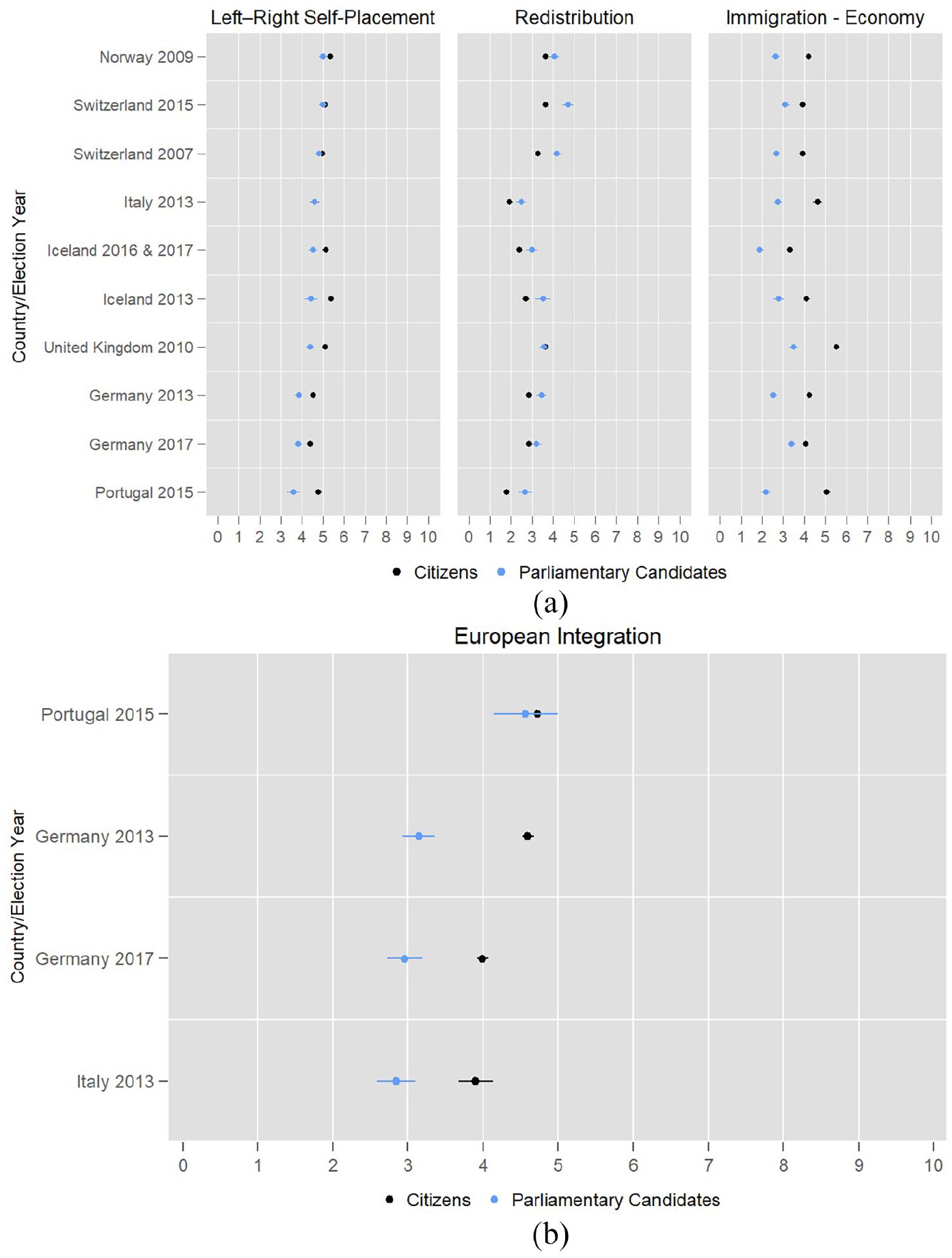
(a) Average Preferences of Parliamentary Candidates and Citizens on Left-Right Self-Placement, Redistribution and Immigration by Country and Election Year. (b) Mean Preferences of Parliamentary Candidates and Citizens on European Integration by Country and Election Year.
While the case selection ultimately represents a convenience sample, it constitutes an interesting and novel case. Ample evidence from the United States already confirms that working-class legislators better represent working-class interests (e.g. Carnes, 2012, 2013; Griffin and Anewalt-Remsburg, 2013). However, these findings are not simply transferable to the European context. For one thing, firmly anchored party affiliations and party discipline might cancel out the effect of politicians’ social class. In addition, the countries under study share a party system, including major labor or social democratic parties that historically represent the working class. Furthermore, they have more expanded welfare state regimes and less inequality than the United States. These aspects might render the representation of working-class interests by group representatives less crucial. While the country sample is limited to Western Europe and to seven countries, the case selection is diverse, for example, in terms of electoral system, geographic area, and party system fragmentation. 5 Accordingly, the sample allows inferring a certain degree of representativeness of the results, at least for the Western European context and for countries characterized by expanded welfare state regimes and party systems with a major left-wing party. In sum, investigating the impact of class-based descriptive representation using the seven-country sample at hand promises new insights beyond existing findings in the US and single-country studies in Europe.
Operationalization and Measurement
Previous research has employed different approaches to measure the impact of descriptive representation based on social class. Existing studies analyze either class-based differences in MPs’ legislative behavior, such as roll-call voting (Carnes, 2012, 2013; Griffin and Anewalt-Remsburg, 2013); sponsorship or drafting of bills (Carnes and Lupu, 2015; Micozzi, 2018); parliamentary speeches (O’Grady, 2019); and policy output, particularly public spending (Borwein, 2022; Hayo and Neumeier, 2012). By contrast, the present analysis focuses on citizen–elite congruence—specifically, whether the preferences of working-class politicians are more in line with those of working-class citizens. Previous studies have used this approach to link individual citizens and the political elite based on their level of educational attainment, and have found evidence for a closer preference alignment on cultural issues when citizens and elite shared an educational background (Boas and Smith, 2019; Hakhverdian, 2015).
Each of these approaches has different advantages and potential drawbacks. Although policy outputs matter primarily for redressing the political marginalization of the working class, analyzing observable legislative behavior would be ill-suited to this country sample. As MPs act as party representatives, they are not free to act according to their convictions. Instead, their legislative behavior is restricted by party discipline and reflects the general party position. By contrast, an anonymous survey offers politicians an opportunity to express their preferences without party constraints.
The drawbacks of the present approach are, first, that the survey questions cover a broad selection of key policy areas but do not capture specific bills or uncrystallized interests of particular relevance to the working class. Furthermore, the questions indicate only the general direction of preferences, but not the priority each of these issues holds. Thus, the approach is a conservative test of the effect of descriptive representation for the working class. If we see differences on these general issues, we should expect even deeper divisiveness on specific policy proposals or when considering issue priorities. Another drawback is that while politicians might express particular views in an anonymous survey, they most likely still reflect the party position when voting in the legislative process. This might call into question the relevance of analyzing personal preferences. However, MPs can influence policy proposals before they are put to a vote, namely, during agenda-setting or closed debates. Thus, the preferences of MPs will affect long-term politics and are therefore worth investigating.
In the first step of the analysis, the main dependent variables are the issue preferences of parliamentary candidates; in the subsequent steps, the dependent variable is the preference congruence between citizens and politicians. Both the ESS and the CCS include questions on left–right self-placement, redistribution, immigration as a threat or benefit to the economy, and European integration, 6 and can therefore be meaningfully combined on these issues. This selection is both methodologically and substantively motivated. Methodologically, these survey questions are either identical or deviate only slightly in their wording between the ESS and the CCS.7,8 Therefore, they are ideally suited to comparing preferences between the general population and politicians. From a substantive perspective, the selected issues—with the exception of the left–right self-placement scale, which constitutes a superordinate ideological position—are most relevant for the working class as they pertain to their shared economic position. This is also evident for the two selected issues on the cultural dimension—European integration and immigration—as they both imply greater competition in the workplace from outside.
However, combining these two different data sources also raises considerable methodological issues, as the scales for some items vary between the two surveys. Thus, it is uncertain which point on the scales in the CCS represents the exact position of citizens on the ESS scales. To address this issue, all items were recoded into the same polarity and rescaled to range from 0 (the most left) to 10 (most right). Still, it is disputable whether citizens and politicians interpret the survey questions in the same way, and whether their positions represent the same preferences. Thus, caution is warranted when interpreting the results. Nevertheless, previous empirical studies have scrutinized the approach of combining general population and expert survey data to measure citizen–government congruence, and have concluded that its merits outweigh its methodological shortcomings (Rosset and Stecker, 2019; Stecker and Tausendpfund, 2016). Despite the unavoidable data limitations, the approach allows for a novel investigation of how politicians’ social class determines their preferences and, by implication, what claim there is to descriptive representation based on class in a wider European context.
Individual-Level Explanatory Variables
Social class, measured as occupational background, serves as the main independent variable in the analysis. Thus, this article takes a Weberian approach, defining class as groups of people in the same labor market situation who share long-term life chances (Weber, 1968: 927). A person’s occupational position captures many aspects that determine their life chances, such as their current income, expected pay rises, job security, and training opportunities. In addition, members of the same occupational group are confronted with similar social and policy changes that shape their political views.
To measure social class based on occupation, I use a categorical approach that clusters occupations into a few broader classes based on their employment situation. Alternative continuous measures place occupations on a one-dimensional scale ordered by the status and prestige attributed to each job (e.g. Meraviglia et al., 2016). Using a categorical measure is most adequate for the research question at hand because (1) the claim to descriptive representation applies to broader social groups that face structural disadvantages (e.g. the working class) rather than to individual occupations or certain prestige statuses; and (2) categorical classes show a considerable degree of homogeneity, for example, in terms of social mobility (Ganzeboom et al., 1989) or their material situation (Erikson and Goldthorpe, 1992).
Based on the above rationale, I use the European Socio-economic Classification (ESeC) to measure social class (Rose and Harrison, 2007). ESeC assigns a person’s class position based on their employment status, organization size, and their occupation according to the International Standard Classification of Occupations (ISCO). To classify a parliamentary candidate’s occupational background, the CCS asks about their current occupation or, if the candidate is already a member of parliament or retired, about their former occupation. Due to data limitations in the CCS, candidates are categorized into classes using only ISCO codes and a binary employment status variable (employee, self-employed). The present analysis collapses the 10-class ESeC model to four classes (aggregated dummy variables): the salariat, intermediate employees, self-employed, and working class. 9
Figure 2 illustrates the composition of the general population and the sample of politicians in terms of their social class in each election. 10 Although the CCS sample is not a representative sample of national legislators, Figure 2 still indicates the socioeconomic bias in the composition of legislative bodies. In line with previous evidence, it reveals a substantial underrepresentation of candidates from the working class relative to its share of the general population.
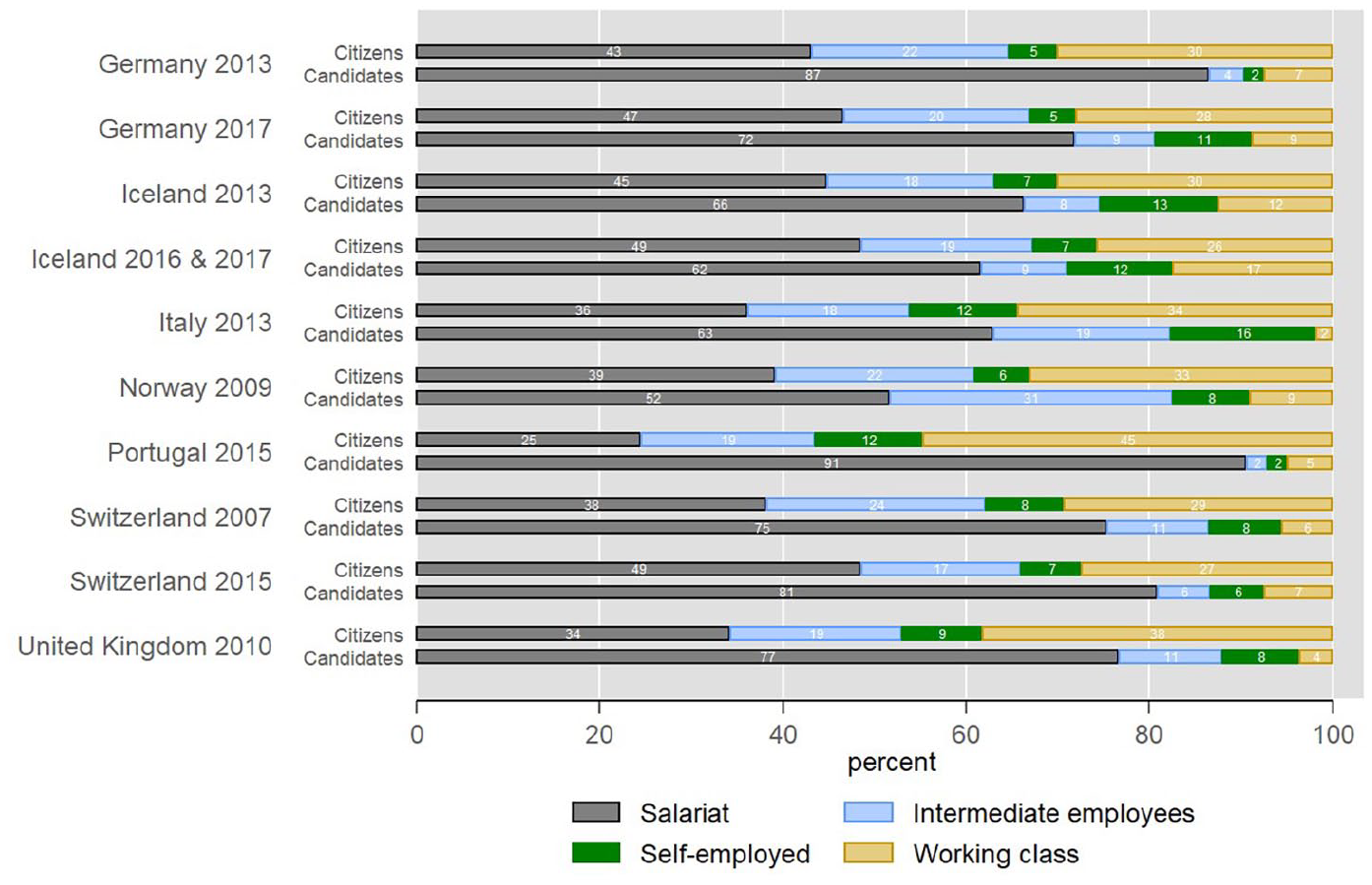
Citizens’ and Parliamentary Candidates’ Social Class According to the European Socio-economic Classification (ESeC).
The present study includes controls for several other individual characteristics, namely, education, gender, age, religiosity, and—for the sample of parliamentary candidates—political experience. 11 All continuous individual-level variables are normalized to range from 0 to 1. On the national-parties level, the analysis includes ideological party position on a left–right continuum as defined by the ParlGov database, which relies on party expert surveys (Döring and Manow, 2020).
Analytical Approach
The analysis comprises three steps. First, I examine how parliamentary candidates’ preferences differ based on their social class. Previous empirical studies have compared preferences within the general population and found a class-based preference gap (Elsässer and Schäfer, 2016; Gallego, 2007; Gilens, 2009; Rosset and Kurella, 2021). 12 In the present analysis, I replicate this comparison for politicians, and test whether parliamentary candidates’ social class predicts preferences on both the cultural and the economic dimensions. To this end, I compute a hierarchical linear regression model with random intercepts for each issue, where parliamentary candidates are nested in the national party for which they stood as a candidate.
In the second step, I link candidates and their respective party’s voters 13 to assess overall citizen–elite preference congruence. This step determines whether working-class voters display lower congruence levels overall with the political elite. In the third step, only working-class citizens are linked to parliamentary candidates to investigate whether working-class politicians improve citizen–elite congruence for their working-class constituents. 14
Whereas early studies captured congruence using the mean proximity between the preferences of citizens and elites or between citizens’ preferences and the overall party or government position, in recent years, scholars have developed a more elaborate measure—many-to-many congruence (Golder and Stramski, 2010; Lupu et al., 2017)—that generates a summary value that considers the distribution of preferences among citizens and the distribution of preferences among legislative representatives.
However, this summary measure does not allow any inferences to be drawn about the extent to which individual politicians represent the population or a specific group. Thus, to investigate how well politicians from different social classes represent working-class citizens, an alternative individual-level congruence measure linking each representative to each constituent is required. Therefore, I use a dyadic approach previously applied in Latin American studies (Boas and Smith, 2019; Lupu and Warner, 2017). The dyadic analysis pairs every candidate with every voter of their party in a given election and measures the absolute distance between the preference positions for each paired citizen and candidate. Because standard errors are likely correlated between dyads having either the citizen or politician in common, which leads to an underestimation of standard errors, I include dyadic cluster-robust standard errors (Cameron and Miller, 2014). The measure for citizen–elite congruence ranges from 0 to 10, where higher values indicate a larger representation gap and lower values indicate more congruent preferences.
Results
Figure 3 presents issue preferences of parliamentary candidates by social class compared with the reference category, working-class candidates. The class-based variation in parliamentary candidates’ preferences largely concurs with those previously found for the general population. Compared with their working-class counterparts, parliamentary candidates from higher classes exhibit more left-leaning preferences on cultural issues (i.e. immigration and European integration) and, with the exception of the self-employed, on the general left–right scale. By contrast, parliamentary candidates from higher classes are more conservative on the issue of redistribution. However, the results are significant on conventional statistical levels only for the salariat on redistribution and immigration and for the self-employed on immigration. The preferences of candidates assigned to the intermediate employees class do not differ significantly from those of their working-class counterparts. Therefore, H1 is only partly confirmed.
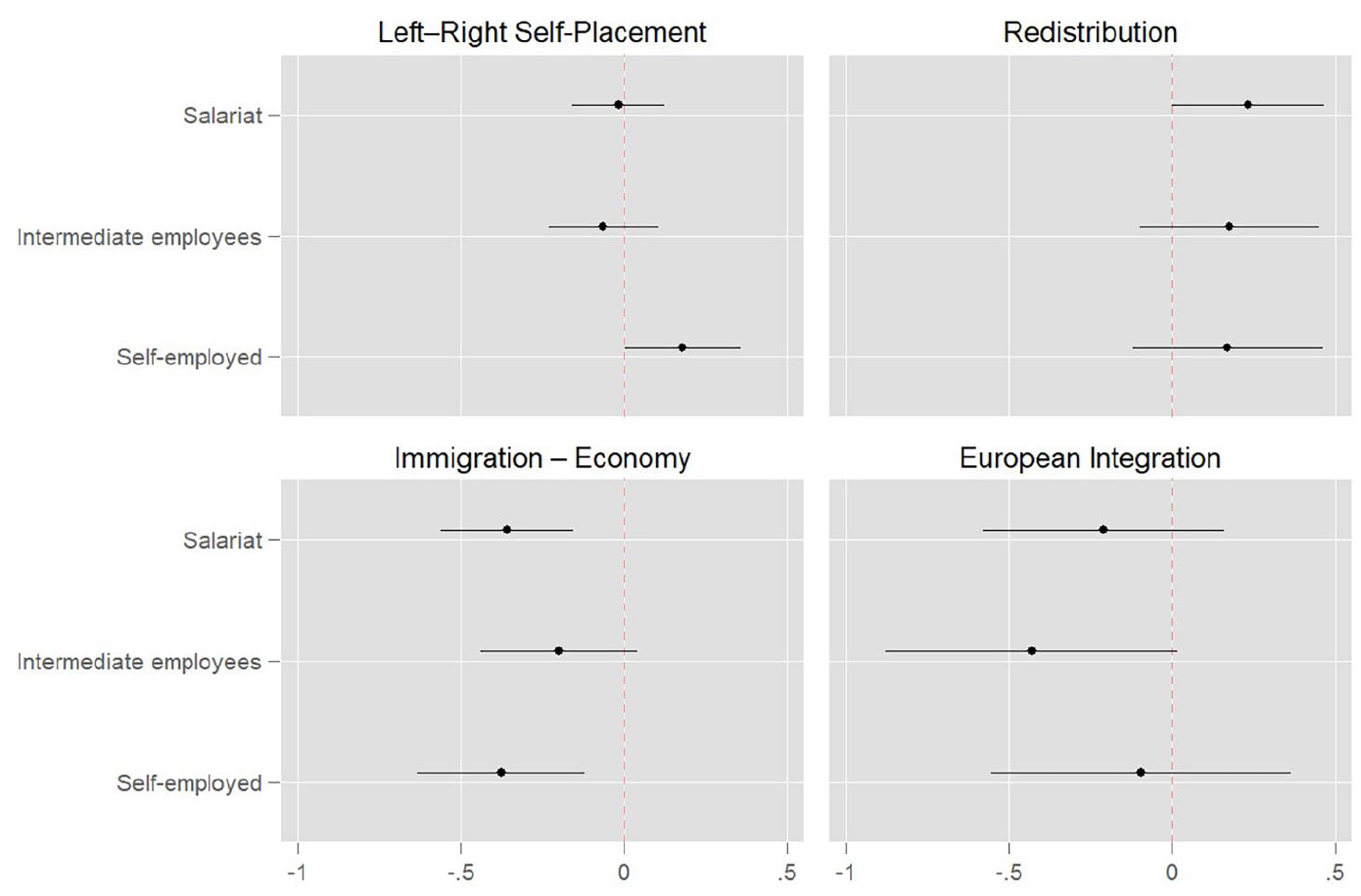
Differences in Parliamentary Candidates’ Preferences Based on their Social Class Compared with the Reference Category (Working-Class Candidates).
To investigate the impact of party affiliation, we turn to the moderating effect of ideological party position. Figure 4 displays the conditional effects of parliamentary candidates’ working-class membership for each issue across parties, with different ideological positions ranging from left to right. The plots reveal no significant difference in the effect of candidates’ working-class membership on preferences on the issues redistribution and European integration. Regarding preferences on immigration and self-placement on the left–right scale, Figure 4 demonstrates that differences between parliamentary candidates from the working class and those from the salariat increase the more right-leaning the ideological party position is. This finding contradicts H3: While there are no significant results for the economic dimension, class-based preference differences on the cultural dimension increase if parliamentary candidates are affiliated with right-leaning parties.
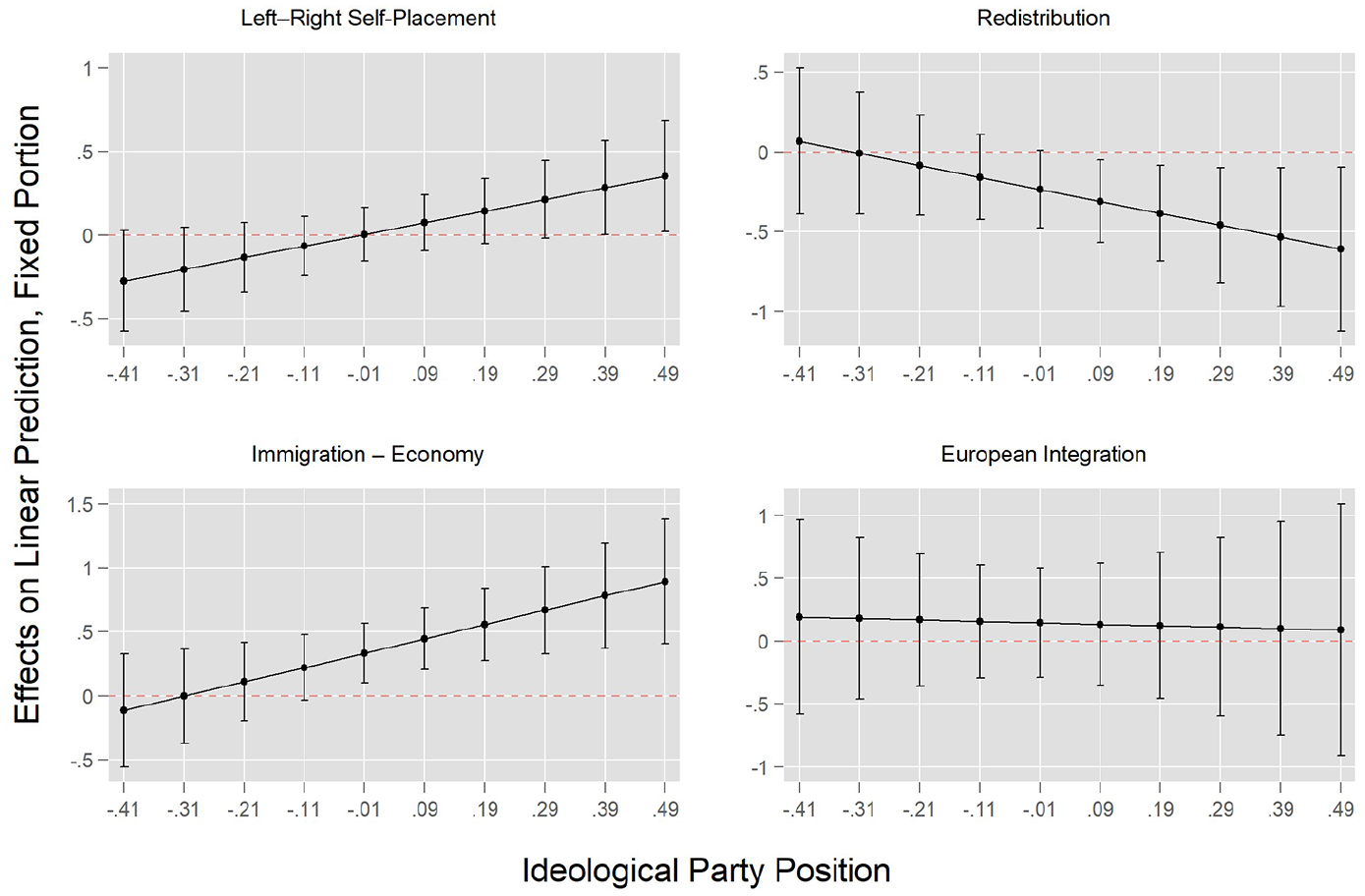
Marginal Effects of Parliamentary Candidates’ Working-Class Membership on Preferences, Conditional upon Ideological Party Position, with 95% Confidence Intervals (CIs).
Citizen–Elite Preference Congruence
In the second step in the analysis, I linked all individual parliamentary candidates to the voters of their respective parties—regardless of social class—and measured the absolute distance between the preferences of each individual candidate and each paired citizen. This measure of one-to-one citizen–elite congruence served as the dependent variable. To investigate whether working-class citizens display lower congruence levels with the political elite overall, citizens’ social class served as the main explanatory variable. The model includes additional citizen-, candidate-, and party-level variables as controls and to maintain consistency (see Table C4 in Online Appendix C). Figure 5 demonstrates the extent to which citizens’ social class predicts their preference congruence with the political elite. Note that a positive coefficient indicates greater distance, while negative values represent higher levels of congruence. The results demonstrate a representation gap at the expense of working-class citizens. Politicians’ preferences are generally closest to those of citizens from the salariat. Similarly, intermediate employees display significantly closer preferences with the political elite on immigration and European integration compared with the working class. The same applies to the self-employed on the issue of immigration. However, for preferences on redistribution, the effects do not reach significance.
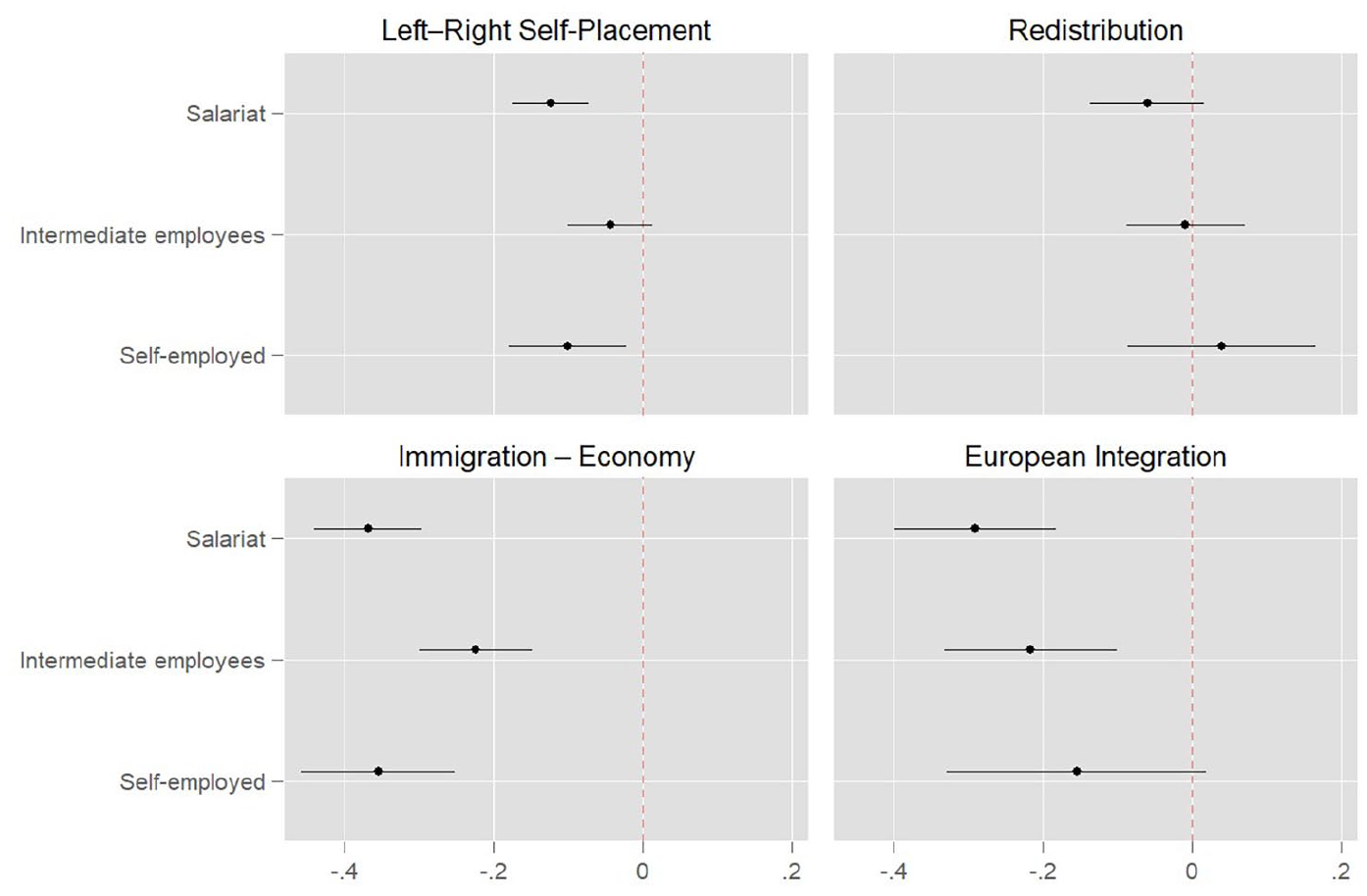
Citizens’ Class-Based Preference Congruence with Parliamentary Candidates Compared with the Reference Category (Working-Class Citizens).
In the final step of the analysis, I matched parliamentary candidates’ preferences only with the preferences of their working-class constituents to test whether the underrepresentation of working-class citizens might be attenuated by political representatives from the same social class (see Table 1).
Preference Congruence between Parliamentary Candidates and Working-Class Citizens.
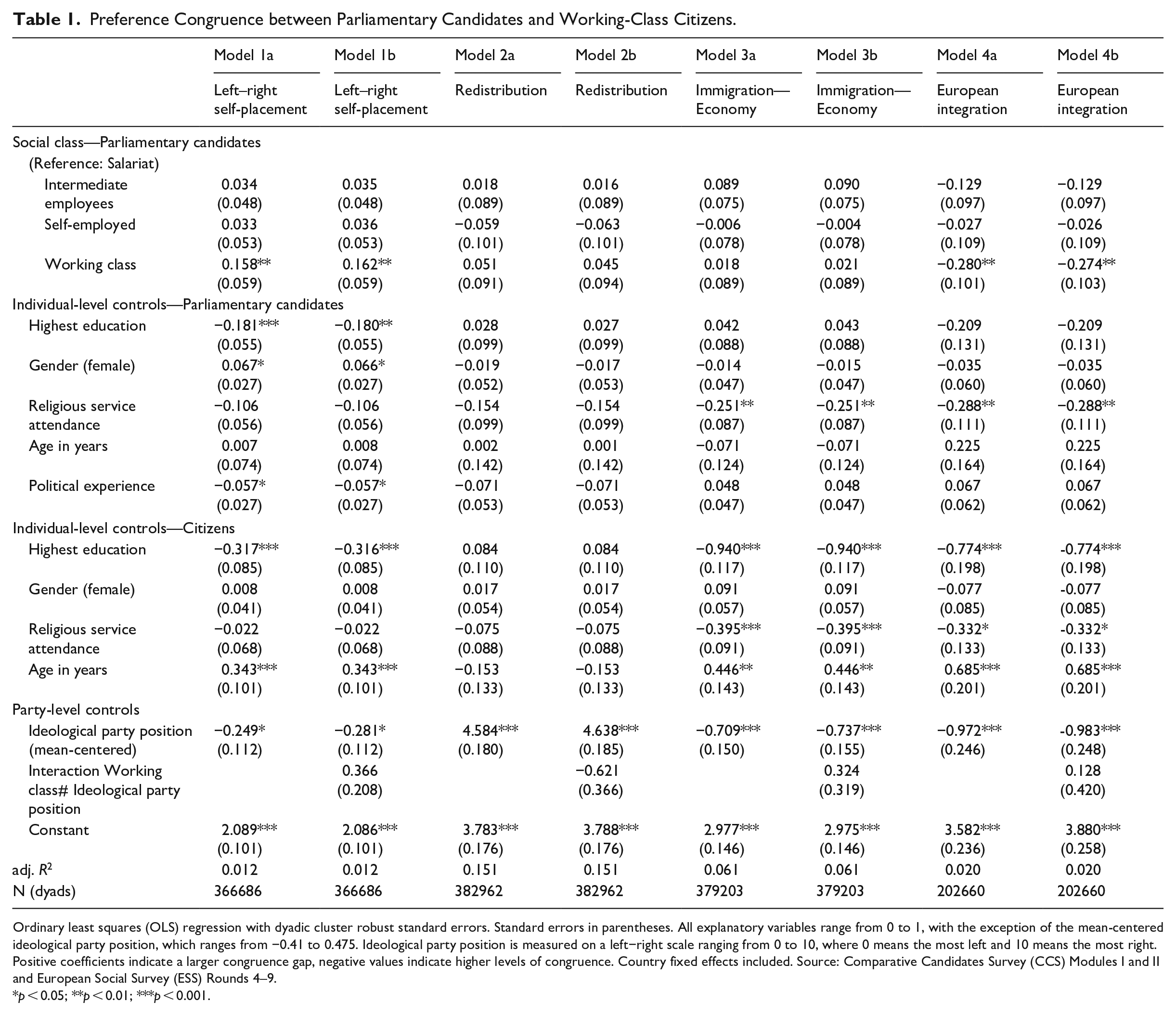
Ordinary least squares (OLS) regression with dyadic cluster robust standard errors. Standard errors in parentheses. All explanatory variables range from 0 to 1, with the exception of the mean-centered ideological party position, which ranges from −0.41 to 0.475. Ideological party position is measured on a left−right scale ranging from 0 to 10, where 0 means the most left and 10 means the most right. Positive coefficients indicate a larger congruence gap, negative values indicate higher levels of congruence. Country fixed effects included. Source: Comparative Candidates Survey (CCS) Modules I and II and European Social Survey (ESS) Rounds 4–9.
As Table 1 reveals, politicians’ working-class background only partly and inconsistently determines preference congruence with working-class citizens. For left–right self-placement, congruence between working-class citizens and working-class politicians is even lower compared with politicians from higher social classes. One possible explanation for this curious finding might be different interpretations of the left–right scale. As a measure of overarching ideological position, the left–right scale covers economic and cultural issues. As the working class displays diametrically opposed preferences on these two dimensions, self-positioning on the left–right scale might be skewed toward the left or right depending on which issue dimension dominates. By contrast, on the issue of European integration, a politician’s working-class background does foster closer preference congruence with their working-class voters. However, the results for redistribution and immigration are not significant on conventional statistical levels. Thus, although the results lend some support to H2, the findings are generally inconclusive.
Party affiliation, by contrast, is highly associated with citizen–elite congruence. As would be expected, the more ideologically right-wing a political party is, the closer the congruence with working-class voters on issues of the cultural dimension (i.e. immigration and European integration) and on the left–right scale are. Conversely, on the issue of redistribution, parties on the ideological left display higher congruence rates with working-class voters.
Finally, Models 1b, 2b, 3b, and 4b in Table 1 present the conditional effect of class on citizen–elite congruence across parties with different ideological positions. As the findings show that differences across parties are not significant, H4 has to be rejected.
Conclusion
This article set out to examine whether working-class politicians more accurately reflect the preferences of the working-class population. While the results reveal both class-based preference and congruence gaps, the differences between working-class politicians and their counterparts from higher classes appear weak and confined mainly to issues on the cultural dimension. Instead, the main driver of parliamentary candidates’ policy preferences and citizen–elite congruence with the working class is the candidates’ party affiliation.
In addition, the findings do not lend support to the established hypothesis on the moderating impact of parties’ ideological core values. Instead, the only significant results demonstrate that the class-based preference gap for left–right self-placement and immigration increases the more right-leaning the ideological party position is. This finding might be explained by the type of working-class voter who remains loyal to the left parties or turns to right-leaning parties. We might expect voters to defect from left-wing parties especially if they hold more conservative cultural views not covered by traditional working-class parties. On the contrary, working-class voters who remain loyal to the left might also share its more liberal cultural views, and thus class-based preference differences on cultural issues appear small.
Nevertheless, the results do reveal a representation bias at the expense of the working class, emphasizing the need to enhance the representation of their interests in the political process. Furthermore, this study highlights the gap between the political preferences of the working class and the ideological range of parties in European democracies. Party positions are relatively homogeneous along economic and cultural issue dimensions. By contrast, working-class citizens display diametrically opposed preferences, holding more leftist views on economic issues but being more conservative on cultural issues.
Despite the modest findings of the analysis, descriptive representation may still help offset the underrepresentation of the working class and may have a greater influence than the results suggest. Certain limitations in operationalizing citizen–elite congruence might, to some extent, account for the missing effects of politicians’ social class. The present study combines two data sources that differ for some questions in their exact question wording and the underlying response scales. Despite harmonization, this could explain why existing class-based preference differences do not translate into class-based citizen–elite congruence. In addition, and perhaps more importantly, the issues included in the analysis are rather general. As previous research suggests (Gilens, 2009), differences on concrete policy issues may be more pronounced. Accordingly, Gingrich and Häusermann (2015) show differences in liberal economic views, with the middle class favoring labor market activation policies and social investment policies, and industrial workers favoring income redistribution and support for the unemployed. These previous findings underline the need to measure preferences in a more policy-specific way. Accordingly, the CCS questionnaire (but not the ESS) includes an item on social security, the results for which reveal that working-class candidates have significantly more leftist views on this issue. 15
Instead of investigating the effect of descriptive representation by measuring preference congruence on a set of broad policy issues, other empirical strategies might yield more significant results. Although—as mentioned earlier in this article—examining legislative voting behavior is ill-suited in the European context, other measurement approaches might be better suited to revealing the impact of working-class self-representation. Such approaches might include looking at issue priorities, for example, by analyzing the committees on which MPs work or the topics they address in parliamentary speeches; or by investigating whether policy outputs are generally more worker-friendly when the share of working-class MPs in parliament is higher. As things stand, the verdict about the working class’s claim to descriptive representation is still out, and the question requires further investigation.
Supplemental Material
sj-docx-1-psx-10.1177_00323217221126668 – Supplemental material for The Voice of the Absent? The Link Between Descriptive and Substantive Representation of the Working Class in Western Europe
Supplemental material, sj-docx-1-psx-10.1177_00323217221126668 for The Voice of the Absent? The Link Between Descriptive and Substantive Representation of the Working Class in Western Europe by Caroline Hahn in Political Studies
Footnotes
Acknowledgements
I presented early versions of this paper at the ECPR General Conference 2018, the 5th Leuven-Montréal Winter School on Elections 2019, and the 9th Annual Conference of the European Political Science Association 2019 and would like to thank all participants for insightful comments and helpful criticism. Furthermore, I am grateful to Reinhard Pollak, Stephen Quinlan, and Harald Schoen for feedback on previous drafts of the manuscript. I also thank the anonymous reviewers and the journal editors for their helpful comments and suggestions.
Declaration of Conflicting Interests
The author(s) declared no potential conflicts of interest with respect to the research, authorship, and/or publication of this article.
Funding
The author(s) disclosed receipt of the following financial support for the research, authorship, and/or publication of this article: Funded by the Deutsche Forschungsgemeinschaft (DFG, German Research Foundation)—Project number 491156185.

Supplementary Information
Additional Supplementary Information may be found with the online version of this article.
Contents
Appendix A: Study Overview and Summary Statistics Table A1. Overview of Comparative Candidates Surveys (CCS) by Country and Election Year with Linked European Social Survey (ESS) Rounds. Table A2. Case Selection and Country-Level Political and Economic Indicators. Table A3. Summary Statistics of Comparative Candidates Survey (CCS) Variables Included in the Multivariate Models. Table A4. Parties Included in the Analysis and their Ideological Position. Table A5. Share of Party Members in Comparative Candidates Survey (CCS) Sample and Actual Seat Share in Parliament. Appendix B: Overview of Variable Operationalization Table B1. Dependent Variable—Issue Preferences. Appendix C: Additional Analysis Table C1. Citizens’ Class-Based Preferences. Table C2. Multilevel Analysis (MLA) of Parliamentary Candidates’ Class-Based Preferences. Table C3. Multilevel Analysis (MLA) of Parliamentary Candidates’ Class-Based Preferences, Including Interactions between Working Class and Ideological Party Position. Table C4. Ordinary Least Squares Regression, Citizen−Elite Congruence. Table C5. Multilevel Analysis (MLA) of Parliamentary Candidates’ Class-Based Preferences, Excluding Switzerland. Table C6. Multilevel Analysis (MLA) of Parliamentary Candidates’ Class-Based Preferences, Including Interactions between Working Class and Ideological Party Position, Excluding Switzerland. Table C7. Ordinary Least Squares Regression—Citizen-Elite Congruence, Excluding Switzerland. Table C8 Congruence between Parliamentary Candidates and Working-Class Citizens, Excluding Switzerland. Table C9. Ordinary Least Squares Regression (OLS)—Citizen−Elite Congruence Linking All Citizens to All Parliamentary Candidates Regardless of Party Affiliation. Table C10. Congruence between Parliamentary Candidates and Working-Class Citizens, Linking All Working-Class Citizens to All Parliamentary Candidates Regardless of Party Affiliation. Table C11. Congruence between Parliamentary Candidates and Citizens from the Salariat. Table C12. Congruence between Parliamentary Candidates and Citizens Belonging to the Intermediate Employees Class. Table C13. Congruence between Parliamentary Candidates and Citizens Belonging to the Self-Employed Class. Table C14. Congruence between Parliamentary Candidates and Working-Class Citizens on Redistribution, Including Only Comparative Candidates Survey (CCS) Module II.
Notes
Author Biography
References
Supplementary Material
Please find the following supplemental material available below.
For Open Access articles published under a Creative Commons License, all supplemental material carries the same license as the article it is associated with.
For non-Open Access articles published, all supplemental material carries a non-exclusive license, and permission requests for re-use of supplemental material or any part of supplemental material shall be sent directly to the copyright owner as specified in the copyright notice associated with the article.
