




Abstract
Under what conditions do politicians express their views on social media? How do politicians express their opinions around a given issue on social media? This paper contends that issue ownership and electoral accountability are critical factors that drive politicians’ attitudes toward a politically salient issue. It conducts a case study on the 2020 George Floyd protests in the United States, using an original, computationally-gathered dataset of posts on Twitter. The multi-level analysis results suggest that politicians’ race and party affiliation, in conjunction with their constituencies’ partisan orientation and racial composition, played significant roles in determining the frequency of Floyd-related Twitter posts they shared. Additionally, topic modeling results demonstrate a disparity in how the political movement is phrased between Democrats and Republicans. These findings shed light on the motivations behind social media posting behavior by public officials and carry significant implications for party polarization in contemporary democracies.
Introduction
In contemporary democracies, public officials across the political spectrum communicate their political views to compete for electoral support. With the rise of new technology, it has become increasingly prevalent for elected officials to use social media platforms to convey their stances on political issues, often times in campaigns and elections (Bichard, 2006; Stier et al., 2018). Social media can offer users the ease of sharing data and interacting with other users within an online sphere (Hoffmann et al., 2016). Contrary to traditional media, their distinctive characteristics (e.g., low entry barriers, user-generated content) can affect politicians’ behavior and voting (Zhuravskaya et al., 2020). Additionally, the more a voter is exposed to messages created by their political candidate, the more likely they will become aware of the narratives their candidate cumulatively constructs (McLaughlin et al., 2019). This cumulative process of identifying with the candidate, through information or opinions expressed by the candidate on social media, boosts voter support for the candidate (McLaughlin and Macafee, 2019). All of these arguments emphasize the strong relationship between politicians’ social media messaging and voter support.
Current political communication literature often discusses partisan interests and voter demand as critical factors influencing politicians’ behavior on social media (Bøggild, 2020; Harbridge and Malhotra, 2011). On one hand, politicians typically rely on party support in their political careers, especially during campaigns and elections. With partisan interests at stake, politicians are motivated to express their political views along party lines and emphasize issues that represent their parties’ core values (Esteve Del Valle et al., 2022). On the other hand, politicians face pressure from voters to address the issues they primarily care about (Ashworth, 2012; Ennser-Jedenastik et al., 2022; Holland 2015). Assuming their primary goal is to get reelected to office (Fenno, 1977; Mayhew, 1974), politicians are incentivized to communicate their views to their constituencies on important issues (Grimmer, 2013). Electoral concerns motivate officeholders to cater to their voters’ interests, not least their core supporters (Kam, 2005). Given these settings, this study examines two questions concerning politicians’ behavior on social media: under what conditions do politicians express their views on social media? With which words do they describe their opinions on social media?
This paper argues that issue ownership and electoral accountability play significant roles in politicians’ social media posting behavior, ultimately affecting their chances of reelection, by presenting the 2020 George Floyd protests in the U.S. as an empirical case study. We analyze 518 Senators and House of Representatives members and implement two empirical approaches to evaluate their political behavior on social media—more specifically, posting opinions about the Floyd protests on Twitter—from which we find differential attitudes by party affiliation.
Our findings have profound implications on political communication in modern democracies, as they signify factors that drive elected officials to communicate their views on politically salient issues. Moreover, they suggest that social media can operate as a double-edged sword in modern democracies: as a potential provider of both socially desirable outcomes and party polarization. 1 As effective as digital platforms can be in communicating public officials’ political messages to the electorate, they can run the risk of becoming echo chambers for like-minded partisans (Barbera, 2020). Amid the growing polarization, it is not uncommon to find ideologically extreme politicians using provocative language to address current issues through social media, which could exacerbate the lingering political conflicts, perhaps to the current levels of dysfunction and division in many democracies (Barton, 2023). Given that social media are undoubtedly an indispensable medium for political communication today, the way politicians choose to discuss certain salient issues and address political cleavages deserves attention as a likely contributing factor to the polarization.
Theoretical framework
Issue ownership, electoral accountability
Our expectations stem from the notion that members of Congress are single-minded reelection seekers (Mayhew, 1974) and the increased use of digital and social media platforms by politicians to convey campaign messages to their voters since the early 2000s (Lawson-Borders and Kirk, 2005; McGregor, 2020). The latter is already evident in the fact that almost all members from the Senate and the House of Representatives own at least one social media account (e.g., Twitter).
Political messages, especially during an election cycle, are designed for target voters that influence electoral outcomes (Sahly et al., 2019). In other words, messaging matters. In many ways, messaging is the most fundamental element of any campaign, requiring a significant investment of time and energy to persuade the electorate. It is often observed among insurgent candidates, particularly when they face a clarifying candidate, who tend to allocate their time and effort toward issues other than the state economy, focusing instead on issues where their opposing candidate is less popular (Vavreck, 2009). Related, “issue ownership” is deemed effective “when a candidate successfully frames the vote choice as a decision to be made in terms of problems facing the country that he [or she] is better able to ‘handle’ than his [or her] opponent” (Petrocik, 1996: 826). When dealing with a politically salient issue, and one party demonstrates superior capability in addressing it compared to their opponent (thus establishing ownership of the issue), politicians will strive to get the message across to their party base. Such issues are likely to resonate with their supporters and help consolidate partisan voter support.
On the premise that a politician's primary objective is to secure reelection, they are held electorally accountable to their voters for their policy and issue positions (Fenno, 1977). Electoral considerations give officeholders strong incentives to cater to their constituents' needs. As representatives of individual districts, they are motivated to address issues that matter most to their voters (Sevenans, 2021). In this respect, electoral accountability is a crucial element in the democratic process. Representation styles may vary depending on the issue agenda (Miller and Stokes, 1963), and voters expect members of Congress to not only provide constituent services in personal ways (Cain et al., 1987) but also to represent them on major national issues (Lapinski et al., 2016). On highly divided issues, particularly those split along party lines, members choosing to vote with their party have a higher likelihood of winning reelection (Carson et al., 2010).
Political communication and social media
Furthermore, the increasing use of social media may incentivize politicians to express their issue positions in the online sphere. The proliferation of social media platforms has accompanied an increasing demand for understanding the dynamics of political discussions within social media networks (Stieglitz and Dang-Xuan, 2013), including the extent to which online interactions could potentially impact echo chamber effects and polarization (Yarchi et al., 2021).
As seen in recent electoral campaigns, social media technologies have gained significance in the realm of communication and persuasion (Wattal et al., 2010). Studies have found that candidates view Twitter as a tool for self-promotion, using it mainly to share information about themselves (Golbeck et al., 2010). On Twitter, users often engage with others who hold similar opinions, but they also frequently interact with those who have opposing views. Conversations among individuals with aligned perspectives enhance group identity, whereas exchanges between those with differing opinions emphasize the distinction between in-group and out-group affiliations (Yardi and Boyd, 2010).
Moreover, voters perceive politicians they follow on social media as more honest (Enli and Rosenberg, 2018). Expressing one’s own, self-written opinions on social media can be perceived as more trustworthy than when filtered through traditional media, such as news interviews or talk shows. In this regard, politicians who post opinions on social media about socially salient issues will likely gain more support from the electorate with similar partisan views (Sahly et al., 2019).
As such, issue ownership, accompanied by electoral accountability, contributes to politicians’ attitudes toward a given political issue. If a politician is affiliated with a party that ‘owns' the issue, and if the constituents the politician represents are generally more supportive of it, the politician should be more willing to actively address the issue. Consequently, politicians will be more inclined to publicize their stance and create relevant posts on social media, with those posts more likely to frame the issue in line with the party's position. On the contrary, if a party does not own an issue, its politicians will be hesitant to express their opinions, as they do not want to give publicity to an issue that could potentially energize their political opponents. If their constituents are not particularly concerned about the issue, these politicians will lack incentives to voice their views in public spaces. Therefore, they are likely to display a less determined stance, which would be reflected by a lower tendency to create related posts on social media. Even when they do share their views, they would likely discuss the issues in ways that fit their parties’ narratives. Figure 1 illustrates our theoretical framework. Theoretical framework.
Issues of social justice in U.S. context
This paper examines a specific event in the U.S. that led to nationwide protests regarding social (in)justice. On May 25, 2020, an unarmed Black civilian George Floyd was killed by the Minneapolis police while being arrested on suspicion of using a counterfeit bill to purchase cigarettes. Shortly after the tragic incident, protests erupted across the country demanding racial justice for Floyd and accountability for police brutality, also known as the Black Lives Matter (BLM) Movement. The protests were described as both peaceful and, from media reports of vandalism and looting in some cities, violent (Taylor, 2021). As tensions between protesters and the police escalated, some protests faced violent responses by law enforcement, most notably the use of tear gas by the police and National Guard to disperse protesters near Lafayette Square in Washington, D.C., allowing President Trump to take a photo holding a Bible at the damaged St. John’s Episcopal Church (Rogers, 2020).
The event in Minneapolis became a significant flashpoint in the ongoing debate over policing and violence, capturing global attention and igniting widespread protests across the country, ultimately marking a pivotal moment in the history of the BLM movement. The Floyd protests drew significant attention from politicians and citizens to the political movement, highlighting the broader implications of police brutality and social justice on social media (Cowart et al., 2022).
Existing work on the politics of social justice protests discusses news media coverage over policing (Arora et al., 2019), racial messaging impact on public opinion (Jackson, 2019), media cartooning about racism (Vanaik et al., 2018), among others. Recent literature shifts focus to members of Congress and their use of social media as a means of direct communication on racial issues, yet to a limited extent (for example, see Tillery (2021) on African American members and their recent use of social media). This paper aims to bridge the gap between these studies and the heightened political tensions between major parties. We explore the use of social media by all members of Congress from both parties in the aftermath of Floyd’s death that served as a major catalyst for the nationwide protest movement, and delve deeper into their posting behaviors.
Considering the Floyd protests is a salient issue in American politics, we expect considerable variations with respect to politicians’ posting behavior over the movement. The Democratic Party has a reputation for addressing race-related issues, while the Republican Party has a reputation for expressing less concern about racial discrimination (Petrocik, 1996). Assuming that Democrats have an advantage in addressing, or “owning,” social justice issues, Democrats should dominate the debate. Therefore, Democrats should be more inclined than Republicans to express relevant attitudes toward the protests.
Hypotheses
Such dynamics are likely to result in dissimilar social media posting behavior between Democrats and Republicans. Democrats are more motivated to express their views on the social justice protests and are therefore expected to create Floyd-related posts more frequently. Thus, we first hypothesize that:
H1a. Democrats, on average, will post a higher number of Floyd-related messages on social media (than Republicans). In addition to party affiliation, the demographic variables of politicians themselves may affect the extent to which they express their thoughts on social media. We select two race variables—‘black’ and ‘non-white’
2
—and hypothesize that:
H1b. Politicians who are black, on average, will post a higher number of Floyd-related messages on social media (than those who are non-black).
H1c. Politicians who are non-white, on average, will post a higher number of Floyd-related messages on social media (than those who are white). Next, if public offices are held accountable to their voters, we also expect the demographic and partisan leanings of the constituencies to have an impact on their posts. Assuming people of color are more concerned about racial issues, we hypothesize that politicians representing constituencies with different proportions of black or non-white communities will show different attitudes toward the nationwide protests, as follows:
H2a. Politicians who represent constituencies with larger shares of black voters, on average, will post a higher number of Floyd-related messages on social media.
H2b. Politicians who represent constituencies with larger shares of non-white voters, on average, will post a higher number of Floyd-related messages on social media. Additionally, assuming that Democratic voters prioritize social justice issues, we anticipate that politicians representing Democratic-leaning districts will have a stronger stance about the protests; therefore:
H2c. Politicians who represent constituencies with larger shares of Democratic votes, on average, will post a higher number of Floyd-related messages on social media. Finally, we expect to observe a divergence in how politicians discuss the issue, including word use, delivery style, and relative emphasis. For example, out-party candidates may express more negative emotions around certain issues than the party in power (Enders et al., 2022). Given issue ownership and electoral accountability, Democratic politicians are incentivized to demonstrate their commitment to racial and social justice across the emotional spectrum to galvanize voter support. Emphasizing the causes of the protests, Democrats are likely to portray the protests as a public response against systemic racism. In contrast, Republicans are expected to highlight the violent aspects of the protests to discredit them. Thus, this study hypothesizes that:
H3. Concerning the Floyd-related social media posts, Democrats will be more likely to relate the protests to social justice issues, whereas Republicans will be more likely to highlight the violent aspects of the protests.
Data and method
We employ computational text analysis to examine politicians’ attitudes toward the Floyd protests. We constructed a novel dataset containing Twitter posts by all U.S. Senators and House of Representatives members, which pertained to George Floyd’s death and the subsequent protests. This study analyzes the first two weeks after Floyd’s killing: between May 26, 2020, and Floyd’s funeral on June 9, 2020. This period captures the most immediate and expressive attitudes from the Congress members as it “encompasses the time that protests were the heaviest and received the most news coverage” (Cowart et al., 2022).
Data collection and preprocessing
We employed Twitter’s Application Programming Interface (API) 3 to extract all Floyd-related Twitter posts by all Senators and House members who were holding office from May 26 to June 9, 2020. 4 In particular, we first extracted all posts from the lawmakers’ Twitter accounts that contained the keywords “George,” “Floyd,” and “protest.” We removed posts that were irrelevant to Floyd’s killing or the subsequent protests. 5 We then preprocessed the text data with Natural Language Processing through five specific steps. First, we removed the URLs, usernames, and hashtags from the texts. Second, we removed the special characters, punctuations, and numbers from the texts. Third, we converted all words into lowercase. Fourth, we compiled a list of stop words, including all stop words in Python’s nltk. corpus and gensim packages, as well as a custom list of stop words, 6 then removed all stop words from the texts. Finally, we stemmed the texts using textProcessor from R’s tm package.
In sum, we extracted Twitter data from a total of 518 Senators and House of Representatives members.
7
Our dataset consists of a total of 2,658 Floyd-related Twitter texts, 2,058 of which were from Democrats and 589 were from Republicans.
8
Figure 2 illustrates the daily numbers of Floyd-related Twitter posts conditional on the legislators’ party affiliations over the observed period. It indicates that Democrats were more motivated than Republicans to discuss the Floyd incident on Twitter, as evident in their considerably higher numbers of posts on all the days recorded.
9
(Focusing only on House members, Figure 9 in Supplemental Material visualizes the total number of posts by their respective districts) Daily numbers of Floyd-related Twitter posts by party.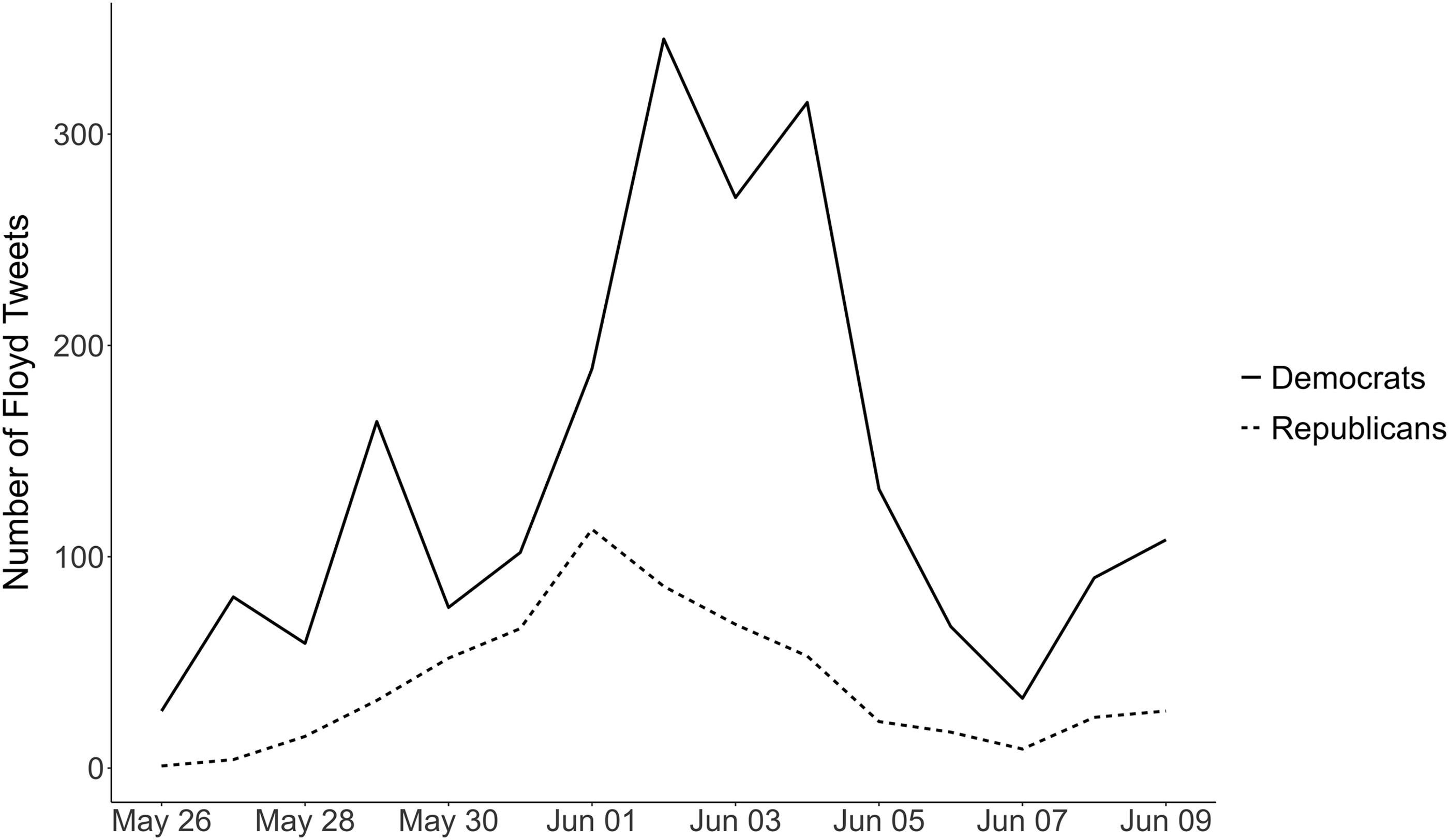
With our dataset, we devised two approaches to compare legislators’ posting behavior. First, through regression analyses, we examined how often individual Congress members posted on Twitter about Floyd-related events. We evaluated the effects of politician-specific factors (H1a, H1b, and H1c) and constituency-specific factors (H2a, H2b, and H2c) on lawmakers’ Twitter activity concerning social justice issues. Second, we applied Structural Topic Model (STM) to analyze how Congress members expressed their views and emphasized issues related to the Floyd protests in their Twitter posts (H3).
Posting frequency
We conducted Negative Binomial regression analysis to account for variations in the number of Floyd-related Twitter posts by individual members of Congress, considering the outcome variable is a count variable and that the data is over-dispersed. We included two sets of explanatory variables in the models. The first set, politician-specific variables, comprised party affiliation and race. Party affiliation acts as a key measurement of the aggregate party attitudes toward the Floyd protests, and therefore a proxy for how parties align on racial justice issues related to the Floyd protests; it was categorized as ‘Democrat,’ ‘Independent,’ or ‘Republican,’ with ‘Democrat’ as the reference group. Considering the Democratic Party owns the issue of social justice and protesting against Floyd’s killing fits its narratives, we hypothesized Democrats would upload more Floyd-related posts on Twitter than the Republican counterparts. The race variable indicated whether a politician was black or non-white. 10 Specifically, non-white entails the politician was not identified as White alone. Both black and non-white variables were treated as dichotomous, with ‘White alone’ as the reference group. Politicians of color were expected to be more engaged in posting about racially salient issues.
The second set of variables focused on constituency-specific factors, including the proportions of black and non-white populations, as well as the share of Hillary Clinton’s 2016 presidential vote in each constituency. 11 These factors reflect the demographic and partisan compositions of constituencies, crucial for understanding the electoral accountability of Senators and House members. More specifically, those representing a black-majority or white-minority district will have higher tendencies to explicitly express their views on social media about the Floyd protests to meet their constituents’ expectations. We used the 2020 U.S. Decennial Census Redistricting Data (P.L. 94-171) to determine these demographic proportions. 12 Additionally, we examined Clinton’s 2016 vote share using the congressional district lines drawn for the 2018 elections (Nir, 2022). We chose the 2016 presidential race, which was the most recent nationwide election preceding the Floyd protests.
Issue phrasing
To evaluate issue phrasing, we conducted topic modeling. Specifically, we adopted STM as a machine-learning based text analysis tool to extract topics in the preprocessed texts of Twitter posts. Topic models typically model documents as distributions of topics and topics as a distribution of words (Roberts et al., 2014). Building on the extant probabilistic topic models, including Latent Dirichlet Allocation (Blei et al., 2003) and Correlated Topic Model (Blei and Lafferty, 2007), STM incorporates document-level metadata into the topic model. This method allows us to extract topics from the text corpora, and most importantly, estimate the topics’ relationship to document-level metadata (Roberts et al., 2019).
We used Roberts et al.’s (2019) stm R package for topic modeling. Incorporating document-level metadata into the analysis of preprocessed Twitter texts, we demonstrated differences in how Democratic and Republican lawmakers framed their discourse around the Floyd protests. We identified the most frequent topics and examined the key representative words for each. We then explored whether Congress members from a certain party tended to view the protests through particular issue lenses.
Empirical Results
Regression analysis
Figure 3 presents the coefficient plot for the Negative Binomial regression models (the corresponding regression table is presented as Table 1 in Supplemental Material). All models include party affiliation as a politician-specific explanatory variable. Models 1 and 3 include black politician and black population as predictors, while Models 2 and 4 substitute these variables with non-white politician and non-white population, respectively. Models 3 and 4 also include Clinton’s 2016 vote share as an additional predictor. Coefficient plot for the Negative Binomial regression models.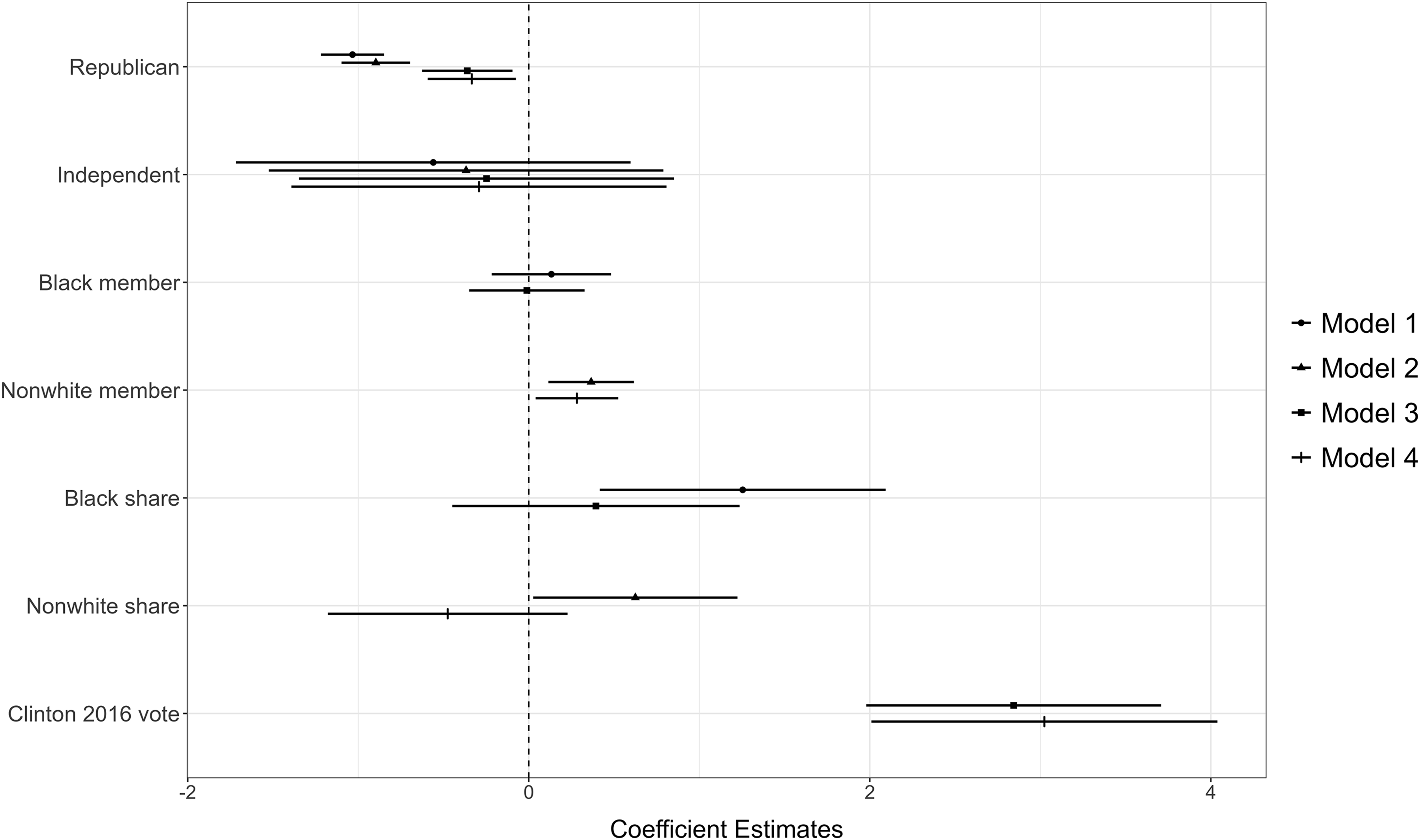
The regression results offer evidence that party affiliation plays a vital role in Floyd-related posting behavior. Across all models, Republicans were significantly less likely to upload Floyd-related posts on Twitter than Democrats. Independents did not show statistically significant differences from Democrats. Figure 4 displays a marginal plot for the effects of party affiliation on the number of Floyd-related Twitter posts. Democrats had a much higher tendency to discuss the events in relation to the broader racial issues. Considering the Democratic Party has traditionally owned the social justice issue, the results in Figure 4 support H1a. The Democratic Party’s attitudes toward the issues likely motivated their lawmakers to express opinions on the protests on Twitter. Marginal plot for the number of Floyd-related posts by party.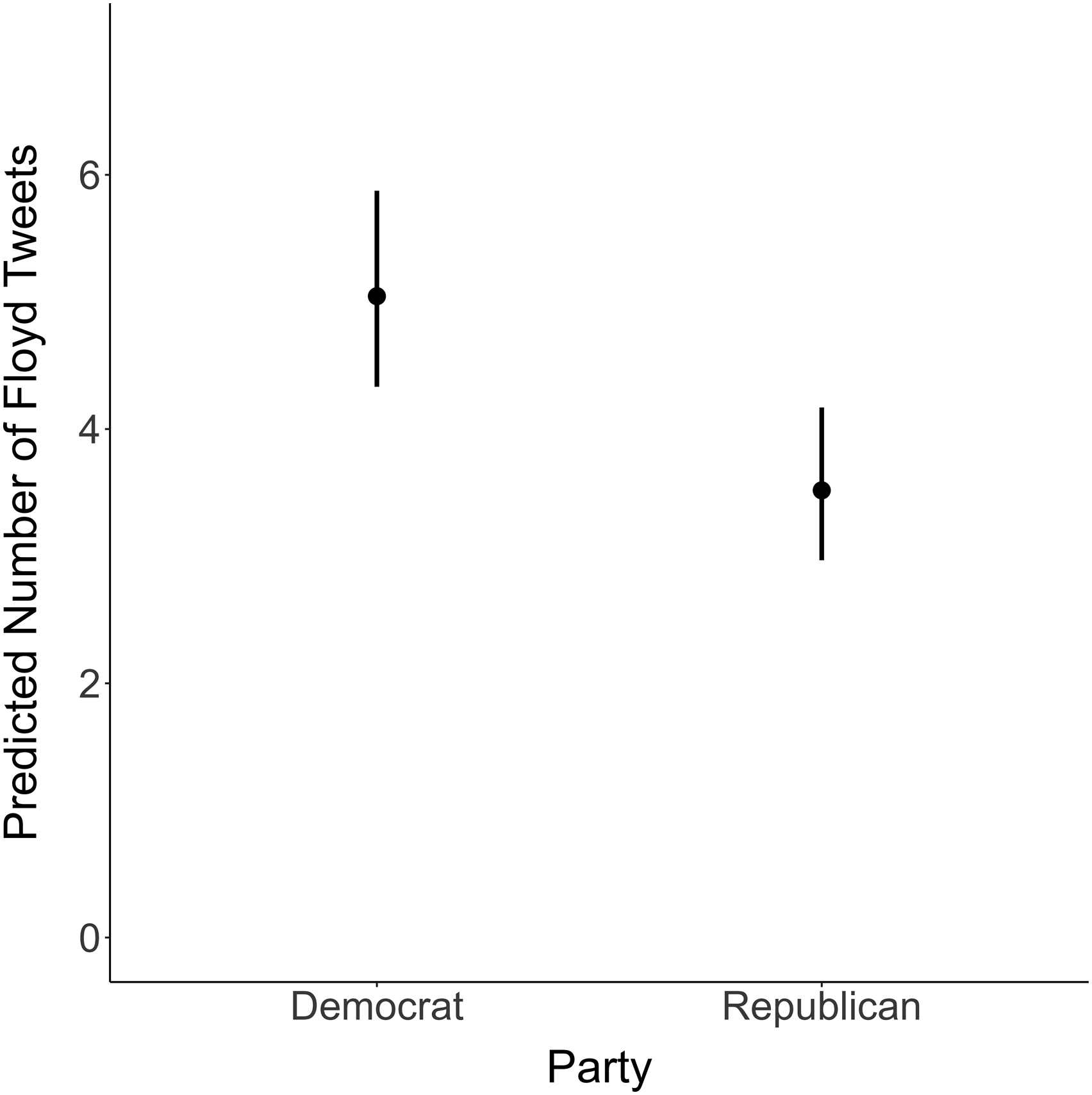
Moreover, findings from Figure 3 provide some support for the politician-specific race variables. While black politicians did not indicate statistical significance, non-white politicians showed positive effect on the number of Floyd-related posts, thus lending support to H1c but not H1b. Assessing the constituency-specific variables, Democratic vote share increased the number of Floyd-related Twitter posts. In Models 3 and 4, Clinton’s 2016 vote share showed significant positive effects (p < 0.001). In other words, the more Democratic-leaning a constituency, the higher the number of Floyd-related messages its representative posted on average, thereby supporting H2c. With respect to H2a and H2b, the sizes of black and non-white communities increased the count of posts to some extent. Models 1 and 2 indicate significant positive effects for the shares of black and non-white population, respectively, but these effects lost statistical significance once controlled for Clinton’s vote share.
It is apparent that the demographic and partisan compositions of the constituencies played crucial roles in shaping the politicians’ social media posting behavior. Congress members representing constituencies with higher black or non-white alone populations had stronger tendencies to express their views on the Floyd events on Twitter. Figure 5 illustrates a scatter plot for the number of Floyd-related posts by legislators against Clinton’s 2016 vote share, conditional on the share of black population within each constituency. Given the median share of black population, across all constituencies, was 12.1%, the lighter gray (circle) dots denote the constituencies with lower-than-median share of black population; the darker gray (triangle) dots denote the higher-than-median districts; black (rectangle) dots denote the black-majority districts. Scatter plot for the number of Floyd-related posts by politicians against Clinton’s 2016 vote share, conditional on the share of black population within each constituency.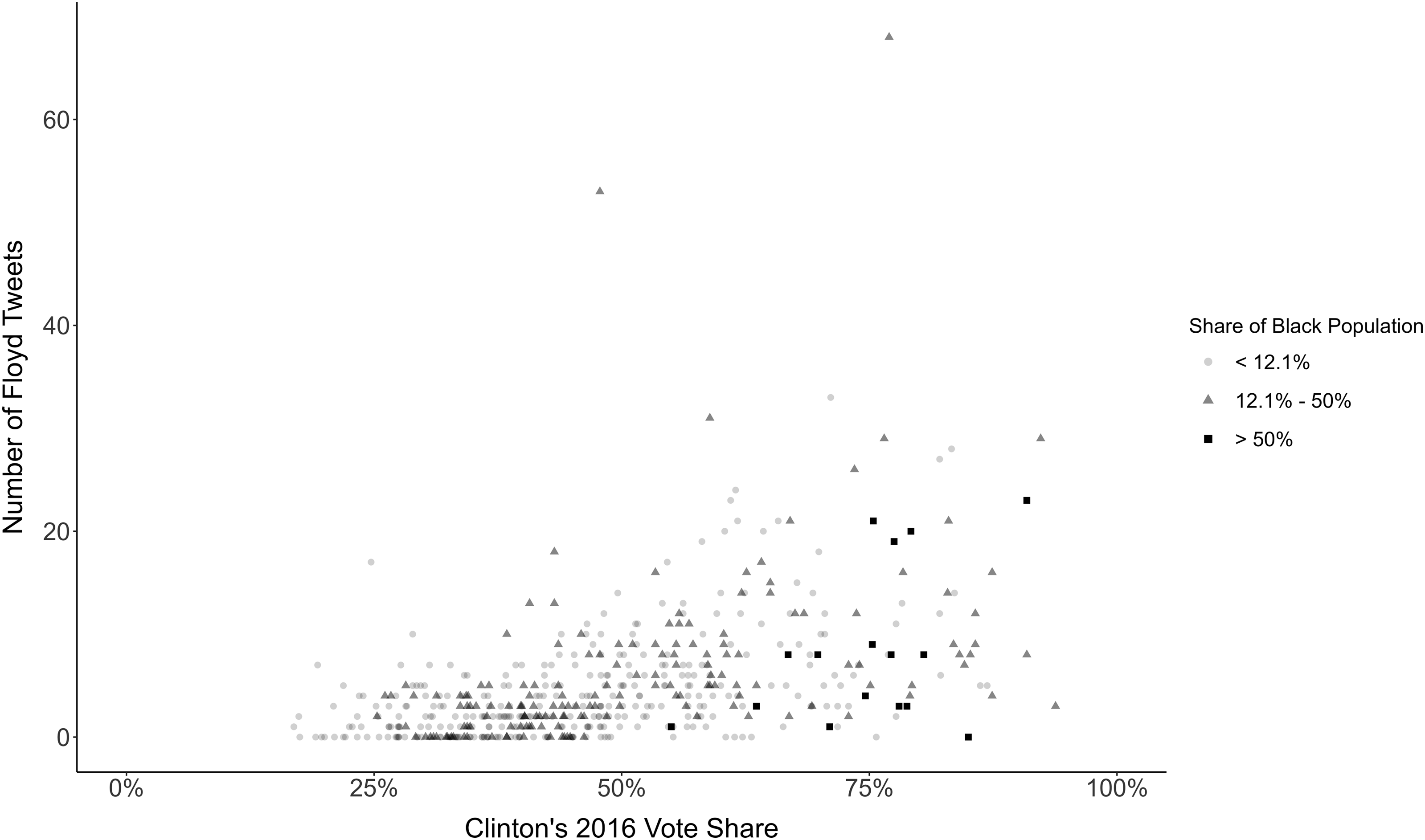
The plot in Figure 5 shows higher numbers of Floyd-related Twitter posts by lawmakers as the districts become more Democratic-leaning. Those more-posting, strong-Democrat constituencies are gravitated toward the higher-than-median districts as well as black-majority districts.
In summary, Democrats had a higher propensity to discuss the Floyd events in tandem with the broader societal issues on Twitter, partly due to their ownership of social justice issues. Democrats posted more about the protests than Republicans, aligning with their racial justice narratives. Constituencies’ demographic and partisan compositions also influenced the number of Floyd-related posts. Lawmakers aimed to meet voters’ demands, highlighting the role of electoral accountability in shaping their attitudes and social media behavior regarding the Floyd protests. Members anticipated that how they reacted to the protests might eventually prove electorally consequential (Mayhew, 1974).
Topic modeling analysis
Figure 6 demonstrates the ten most important topics extracted by STM, along with the three most representative words for each topic. If a topic has a higher expected topic proportion, it indicates a higher proportion of the corpus belonging to that topic. STM results of Top 10 topics.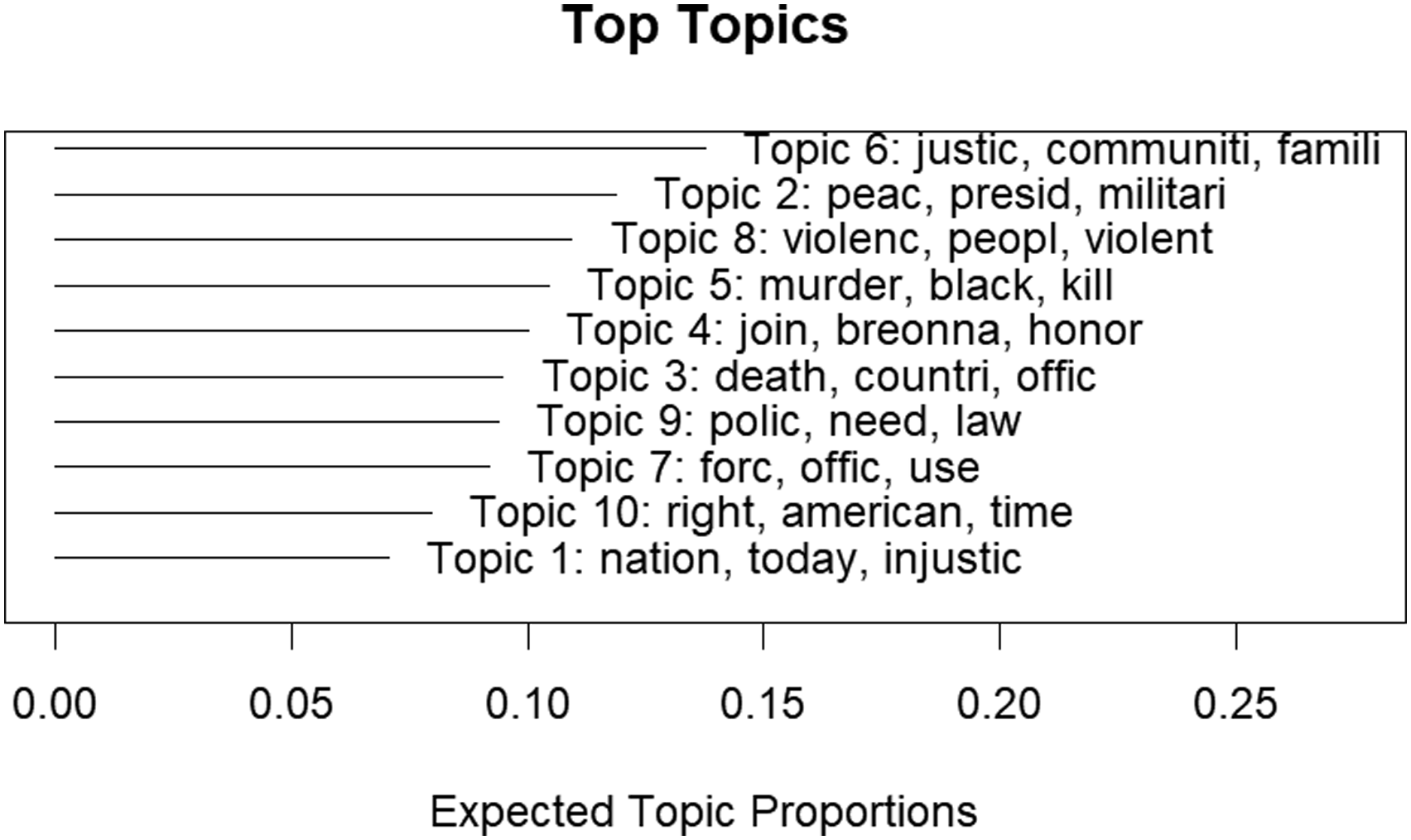
Examining Figure 6, we find that Topics 4, 5, and 6 share common themes. Topics 4 and 5 connect Floyd’s death to other cases of Black Americans killed by police, such as Breonna Taylor. Similarly, Topic 6 emphasizes systemic racism and calls for justice for the Black communities. Together, these topics underscore the pervasive racial inequality in the U.S. Topics 7 and 9 focus on law enforcement officers, specifically addressing the excessive force used against Floyd and calling for accountability for the responsible police officers.
Interestingly, Topics 2 and 8 reveal certain degrees of negative attitudes, signaling polarization in political narratives. Topic 2 expresses discontent toward President Trump’s decision to deploy troops and use tear gas to disperse protesters near the White House, whereas Topic 8 highlights negative behavior by protesters, including looting, rioting, and violence. The latter portrays the protests as riots and labels some protesters as rioters, indicating significant hostility toward the protests.
Next, we estimated the relationship between the topics and metadata, using politicians’ party affiliation as the covariate. We examined how the expected proportions of a Twitter post belonging to a topic varied between the two groups. Figure 7 plots the estimated change in topic proportions when shifting from Republicans to Democrats (Roberts et al., 2019). We observe statistically significant effects across four topics. Topic 8 was overwhelmingly used by Republicans compared to Democrats, while Topic 3 also leaned toward Republicans though to a lesser extent. In contrast, Topics 4 and 5 were strongly associated with Democrats. (For specific contexts for the four significant topics, see examples of Twitter texts in Table 2 in Supplemental Material) Change in topic proportion from Republican to Democrat, with 95% confidence intervals.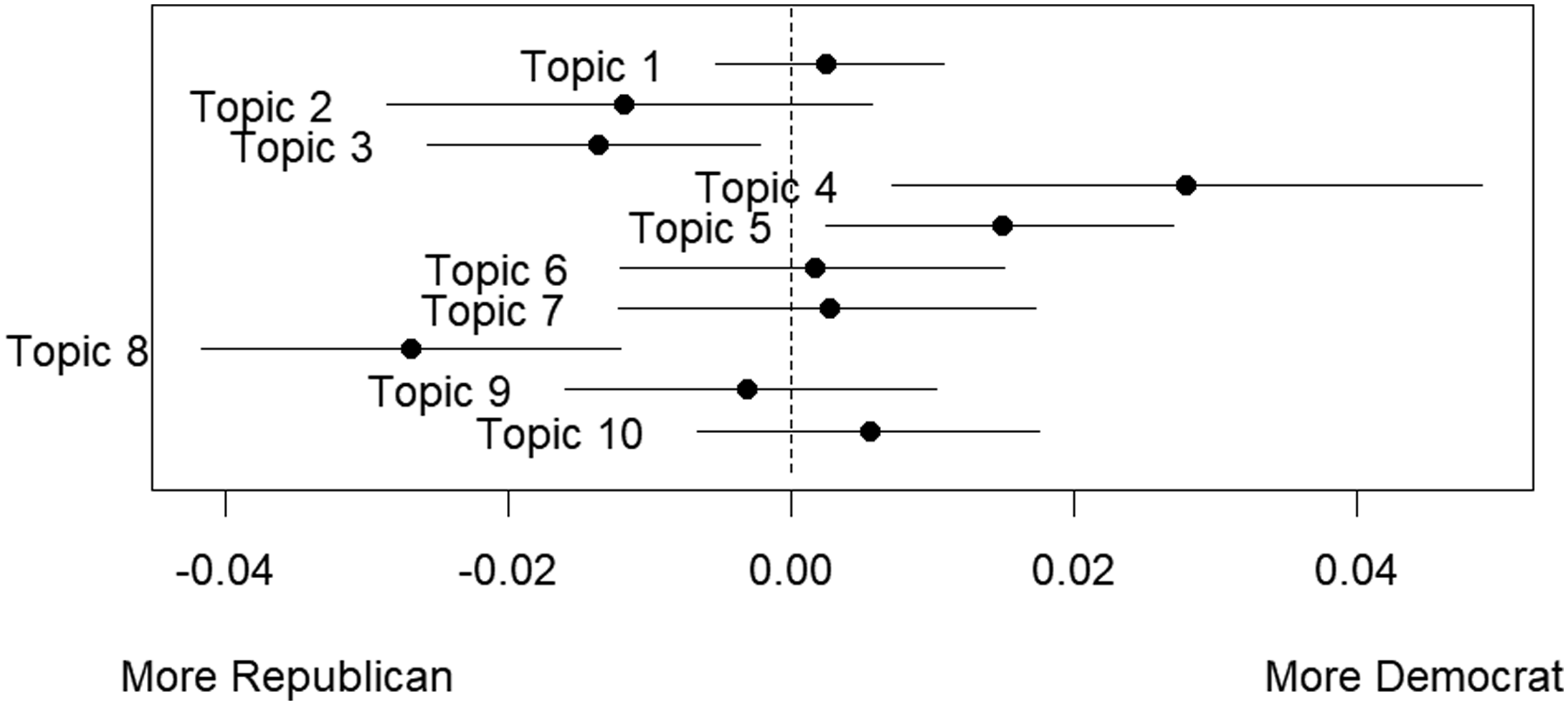
Figure 8(a) (Roberts et al., 2014) further illustrates the vocabulary differences between Topic 4 (racism) and Topic 8 (violence). Consistent with previous findings, Topic 4, which leans Democratic, conveys positive attitudes toward the protests, emphasizing terms like “honor” and mentioning Black victims of police brutality such as “Breonna Taylor” and “Ahmaud Arbery.” In contrast, Topic 8, which leans Republican, displays strong negative attitudes toward the protests, focusing on terms like “violence,” “riot,” and “looting” by protesters. (a) Topical contrast between Topic 4 (racism) and Topic 8 (violence). (b) Topical perspectives for Topic 3 by party.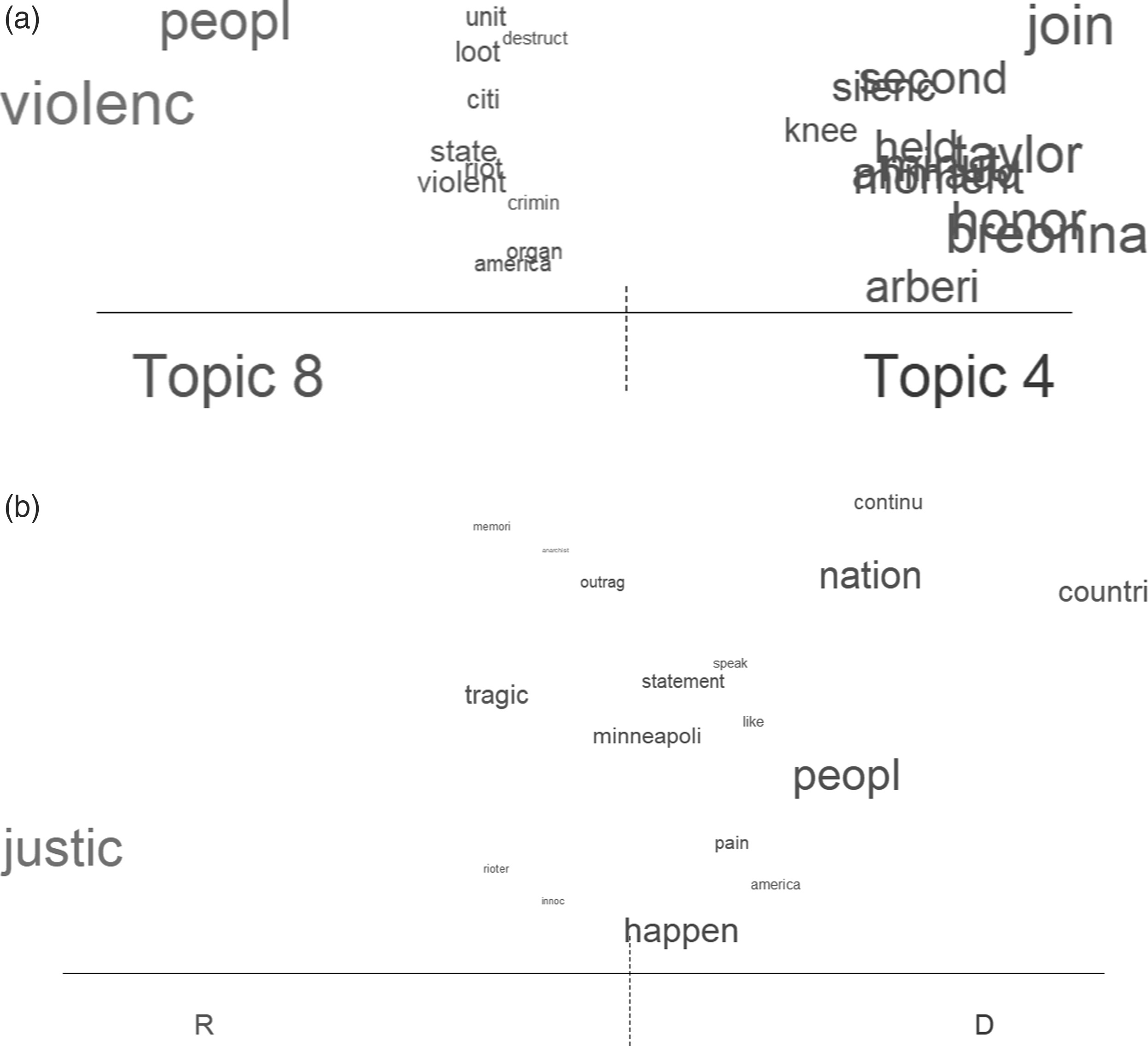
Compared to other topics, Topic 3 primarily includes emotionally charged words like anger, frustration, and pain, making it relatively less interpretable. To delve into this issue, we analyzed which words within this topic were more associated with Republicans versus Democrats (Roberts et al., 2019). Figure 8(b) illustrates the differences in how the two parties discuss Topic 3, with text on the left side representing Republicans' posts (or “R” in the figure) and text on the right representing Democratics' posts (or “D”). Democrats viewed the protests in a more positive light, using words like “pain” to express sympathy. Republicans, while acknowledging that many protesters were seeking “justice” for George Floyd, often described the protests with words like “riot” and “anarchist.”
While both major parties agreed that most protesters were demanding justice for George Floyd, they portrayed the issues in opposing ways. The discourse revolving around racism reflected growing polarization between the two sides. Democrats, owning the issue of social justice, were more inclined than Republicans to view Floyd’s killing as an emblematic of systemic racism. They had the incentive to convey their unwavering support for the BLM Movement to energize their party base. Public officials, electorally accountable to their voters, had strong incentives to speak out on the broader race-related issue, especially if they represented constituencies with sizable Black or minority populations. Republicans, on the other hand, who typically position themselves as the party of “law and order” (Pope and Woon, 2009), had the incentive to express solidarity with law enforcement. Hence, it is not surprising that Republicans tended to view the Floyd protests negatively, associating them with violence and domestic terrorism. This contrast in narratives supports H3.
As a robustness check, we applied BERTopic as an alternative topic modeling technique (Wang et al., 2023) 13 to our dataset. The results were largely consistent with those from the STMs. (Detailed findings, including Figures 10-14, are discussed in Supplemental Material).
Conclusion
In this study, we constructed a theoretical framework outlining the conditions under which elected officials would be inclined to express their viewpoints on social media, as well as how these elements might impact the way they present and characterize certain issues in contemporary democratic systems. We argue that issue ownership and electoral accountability drive politicians’ attitudes toward a given political issue, especially when the issue is politically salient. As politicians hold different attitudes on various issues, they should display different behavior on social media in terms of how frequently they express their views on a given issue and how they depict the issue.
The 2020 BLM movement makes a compelling case for our conceptual framework of politicians’ social media behavior. Revolving around a politically salient issue, the contentious social justice movement epitomizes the party polarization pervasive in American politics. Based on our data, the two major parties exhibited contrasting attitudes, as manifested in the frequency at which the legislators uploaded Floyd-related Twitter posts and the issue depiction of the events. Democrats, on average, shared higher numbers of Twitter posts and expressed solidarity with the protests. As much as Democrats saw the protests as a movement for social justice, Republicans took a diametrically opposite approach. While acknowledging the right to protest enshrined in the U.S. Constitution, many Republicans viewed the movement as an affront to law and order.
The George Floyd case is a representation of the deep-rooted political conflicts in the U.S. party system. Democrats and Republicans have clashed over not only the Floyd protests but also other prominent issues. For instance, Democrats fiercely opposed the Supreme Court’s 2022 decision to overturn Roe v. Wade, while Republicans strongly opposed the Biden administration’s continual military support for Ukraine and Israel, as well as its favorable policies on illegal immigration. To exert pressure on the White House, the Republican Party even repeatedly threatened to block government funding bill and force a government shutdown. Similar to what we saw in the Floyd case, politicians from both parties expressed opposing viewpoints on social media regarding these contentious issues, driven by pressure from party institutions and grassroots constituents.
Findings from this study allude to the impact of social media as a double-edged sword for the U.S. democratic norms. On the one hand, social media aid politicians in conveying their political messages, particularly in promoting socially desirable outcomes – specifically, in the given context, among Democrats, in the fight against systemic racism. On the other hand, social media could potentially contribute to the current levels of dysfunction and division within the U.S.
Amid rising polarization in democracies worldwide, our findings underscore the need for elected officials to prioritize partisan interests in their political communication. The manner in which politicians choose to discuss key issues and address political divides should be closely examined as a potential driver of the crippling polarization many democracies currently face. As public officials increasingly depend on their party base for reelection, they have fewer incentives to engage in bipartisan dialogue on issues owned by the opposing party. With social media becoming central to political communication, it is imperative that public offices leverage the new technologies to promote socially desirable goals.
Supplemental Material
Supplemental Material - Party polarization in digital fingerprints: Tracing politicians’ social media posts on the george floyd protests
Supplemental Material for Party polarization in digital fingerprints: Tracing politicians’ social media posts on the george floyd protests by Yul Min Parka and Theodore Charm in Party Politics.
Footnotes
Declaration of conflicting interests
The author(s) declared no potential conflicts of interest with respect to the research, authorship, and/or publication of this article.
Funding
The author(s) received no financial support for the research, authorship, and/or publication of this article.

Supplemental Material
Supplemental material for this article is available online.
Notes
Author biographies
References
Supplementary Material
Please find the following supplemental material available below.
For Open Access articles published under a Creative Commons License, all supplemental material carries the same license as the article it is associated with.
For non-Open Access articles published, all supplemental material carries a non-exclusive license, and permission requests for re-use of supplemental material or any part of supplemental material shall be sent directly to the copyright owner as specified in the copyright notice associated with the article.
