




Abstract
Political actors play an increasingly important role in the dissemination of political information on social media. However, relatively little is known about the mechanisms why specific news items are shared with the support base instead of others. For a timespan between December 2017 and the end of 2018, we combine the analysis of Facebook content from 1,022 politicians associated with 20 political parties from Germany, Spain, and the UK, with an automated content analysis of media coverage from 22 major online news outlets, and survey data in a multilevel binomial regression approach. By comparing news items that have been shared by one or several political parties with news items that have not been shared by any of them, we overcome the selection biases of previous studies in the field of news dissemination. Findings show that a news item's likelihood to be shared by a politician increases (1) if that politician's party is mentioned in the news item, (2) the more salient their party's owned issues are in the news item, and (3) the more party supporters tend to read the news outlet in which the news item is published. We contextualize these findings in light of political actors’ multi-faceted motivations for news sharing on social media and discuss how this process potentially reinforces an information bias that may contribute to the polarization and fragmentation of audiences.
Introduction
Social media platforms have become an essential part of citizens’ daily news diet (Newman et al. 2021), as they offer an additional channel to retrieve political information, either proactively or incidentally (Gil de Zúñiga et al. 2017). While private users generally rely on traditional news outlets’ social media accounts for political information (Sterrett et al. 2019), they also increasingly engage with the sources of political information directly, highlighting the role of political actors on social media in the political information dissemination process (Marquart et al. 2020; Ohme 2019).
Given the significance of political information as a prerequisite to political participation in a democracy (Delli Carpini and Keeter 1996), content published on social media by news media and political actors became a frequent subject of scholarly attention (Kalsnes and Larsson 2018; Kümpel et al. 2015). However, mainly focusing on traditional news media outlets’ activity on social media or analyzing original content published by political actors, studies usually neglect an important aspect of political information distribution on social media, namely the sharing of news articles by political actors. Adopting the role of additional gatekeepers (Shoemaker et al. 2017), political actors on social media can strategically disseminate news items, reaching people within and even beyond their primary audiences (Vaccari and Valeriani 2015) due to selective (Messing and Westwood 2014) or incidental exposure (Karnowski et al. 2017).
We argue that in order to better understand the dynamics of political information distribution on social media platforms, research also needs to look at political actors’ sharing of news items. We, therefore, ask what affects the likelihood of online news items to be shared by political actors on social media. Interested in the “universality” (McLeod and Lee 2012: 430) of our findings, we investigate these effects in three countries (Germany, Spain, and the UK) with different political and media systems according to the three models of media-politics relations as defined by Hallin and Mancini (2004).
This study looks at 276,405 Facebook posts from 1,022 political actors as well as 623,919 news items from 22 online news media outlets in Germany, Spain, and the UK for a period of 11 months spanning from December 2017 to November 2018. We enrich these content data with survey data and use computational methods and a multilevel binomial regression approach to examine content characteristics of online news articles (e.g., parties and policy issues mentioned), as well as characteristics that are party-issue-specific (i.e., associative issue ownership) and party-outlet-specific (i.e., partisanship of audiences) that might increase news items’ likelihood to be shared by political actors.
Scrutinizing the largely neglected aspect of political news sharing by politicians or their communications teams, this study applies a rigorous methodological approach and contributes to the understanding of political information dissemination on social media.
Political Information on Social Media
Inevitably confronted with political information in the form of shared news articles, either by actively self-selecting (Messing and Westwood 2014) or incidentally being exposed to it (Karnowski et al. 2017) through the various possibilities political content can wind up in one's timeline (i.e., by actively following a news outlet), research finds significant effects of political information from social media on its users. Exposure to political information on such platforms is relevant because it was shown to increase knowledge on the respective issue (Bode 2016; Feezell and Ortiz 2021) and to influence different types of political engagement and participation (Feezell et al. 2009; Gil de Zúñiga et al. 2012). For younger social media users, in particular, research has found that they increasingly get their political information from politicians’ and parties’ social media accounts, which ultimately can also influence their vote choice (Marquart et al. 2020; Ohme et al. 2018; 2019).
To better understand the role of political information on social media, research has focused on three groups of stakeholders, namely private users, media outlets, and political actors. Anspach (2017) shows, for example, that a friend or family member's endorsement of a news article may serve as a heuristic when deciding which content to consume, even outweighing partisan selectivity. Accounts by news media outlets and political actors are often perceived as more official and legitimate sources and are, thus, perceived to be trustworthy (Sterrett et al. 2019). Particularly in polarized political environments (e.g., the US), gathering political information directly from favored political actors’ accounts on social media becomes increasingly prominent, resulting in a continuing polarization of the electorate (Weeks et al. 2019). As political information might be perceived and processed differently depending on the source (Blassnig and Wirz 2019), it, therefore, becomes quite clear that the mechanisms that lead to the dissemination of political information on social media should not be understood as independent of its sender.
Sharing News Articles on Social Media
When it comes to investigating why accounts on social media provide political information in the form of shared news articles, research has, thus far, focused on only two of the three key actor groups, namely private users and media outlets.
Considering private users, studies find user motivations and user network characteristics to influence sharing behaviors. Importantly, content and context features of shared news items also affect the dissemination process (for an overview, see Kümpel et al. 2015; Karnowski et al. 2018). Adapting the concept of newsworthiness to news sharing determinants, Trilling et al. (2017) suggest that traditional news values are still a guiding principle. For example, news content that elicits positive feelings or arousal, irrespective of the valence, is more likely to be shared by users (Berger 2011). In an experimental study, Rudat and colleagues (2014) find that the decision to share a news item is strongly influenced by its perceived informational value. However, they find that users also tend to adapt these decisions in accordance with their followers’ interests. Finally, irrespective of the content, users will rather share news items that stem from the right context, namely a personally trusted and familiar news source (Bandari et al. 2012).
Very generally, mainstream news outlets have embraced platforms like Facebook or Twitter as additional channels to market their content (Tandoc Jr. and Vos 2016). In fact, of all citizens who use these platforms for news, a majority still get their news from mainstream news accounts (Newman et al. 2021). However, not all news items have an equal chance of being shared on social media. When it comes to the factors guiding selection processes on social media platforms specifically, Hanusch and Tandoc Jr. (2019) refer to the idea of audience feedback and to the increased importance of consumer orientation. In line with this argument, in a recent revision of the concept, Harcup and O’Neill (2017) recognize the importance of social media, adding “shareability” to the list of news values and emphasizing the significance of gaining traction on the platforms. Others still provide evidence that journalists follow conventional selection processes, in line with news value theory. News stories may still need to appeal to aspects like surprise, emotionality, social significance, proximity, or need to have a slant in line with a news organization's ideological agenda to actually be shared on the news outlet's social media channels (Al-Rawi 2017; Lischka 2018).
Turning to the third actor group, we observe that political actors (i.e., candidates or parties) have been increasingly influential in the dissemination of political information, especially during election times (Dimitrova and Matthes 2018). While various recent studies investigate content created and shared by political actors on social media platforms themselves (Egelhofer et al. 2021; Ernst et al. 2017; Heidenreich et al. 2022; Magin et al. 2017), we still know relatively little about general patterns regarding content from external pages that are shared by political actors on social media, especially when it comes to news content.
The Political Logic of Sharing News Articles on Social Media
Based on findings from political communication more generally (Hänggli and Kriesi 2010), there is a good reason to believe that political actors’ decisions about what to share on social media are at least in part strategic. Such strategic goals may be, for example, to influence their own perceived legitimacy or the perceived importance of a specific policy issue vis-à-vis their social media audiences, with an aim to ultimately influence social media users voting intentions (Kelm, Dohle, and Bernhard 2019).
Like decision processes guiding private users’ news sharing behaviors (Rudat et al. 2014), high informational value might be an important guiding factor. Political candidates or parties may want to share news stories in which they are mentioned to give private users additional opportunities to learn about candidate characteristics and party policy positions, making them ultimately more accessible to audiences and possibly influencing subsequent political judgments (Kiousis and McCombs 2004). Informing their followers about their visibility in the media may have an added advantage beyond information because voters tend to infer a party's political importance and legitimacy from that media salience (Miller and Krosnick 2000). Moreover, research on strongly partisan link sharing behaviors of right-wing alternative media in Sweden shows that media articles mentioning the politically favored party, the Sweden Democrats, witnessed increased engagement by users (Sandberg and Ihlebæk 2019), which may be a goal in and of itself when it comes to effective political communication on social media (Eberl et al. 2020; Vaccari and Valeriani 2015). To this end, we suggest political actors might want to showcase their media presence to their audiences thus influencing their decision on which news items to share. H1: A news item mentioning a specific political party will have an increased likelihood to be shared by a politician's social media account that is associated with that party.
Political actors may, furthermore, want to draw attention to policy issues that they are associated with, i.e. that they “own” (Hänggli and Kriesi 2010; Petrocik 1996). By showcasing the media salience of owned issues or the congruence between one's owned issues and the media agenda through sharing specific news items on social media, political actors may want to increase the salience of those issues on their followers’ agendas. Research in this regard has found, for example, that exposure to immigration-related news may increase support for anti-immigration parties that tend to be issue owners on that topic (Boomgaarden and Vliegenthart 2007). Moreover, increased congruence between a party's owned issues and the media agenda can influence party support, especially for partisans (Eberl et al. 2017). In the context of social media dynamics, research has furthermore shown that emphasizing issues that are linked to a party (i.e., identity or top issues) may be beneficial in terms of user engagement (Blassnig et al. 2021; Staender et al. 2019), thus increasing their reach on the platforms.
More specifically, associative issue ownership relates to a party's reputation of caring for and being committed to specific issues (Walgrave et al. 2012). By making associations between parties and issues more salient, media coverage, in particular, might play a pivotal role in creating, legitimizing, and thus reproducing perceptions of associative issue ownership (Tresch and Feddersen 2019). Therefore, we suggest that political parties may want to play to their strengths and increase the salience of owned issues on followers’ agendas as well as to strengthen the association it has with an owned issue, which may influence their decision on which news articles to share. H2: A news item mentioning a party’s owned issue will have an increased likelihood to be shared by a politician’s social media account that is associated with that party.
Finally, the question shouldn't only be what kinds of news items political actors like to share but also from which sources they will share them. In contrast to media outlets on social media, which typically share their own news content, political parties are quite free to share news items from various news sources. However, there are still boundaries to that freedom, since, as described above, source cues may influence how political information is processed by social media audiences. For example, studies on hostile media effects showed that partisans perceive news to be biased if it is attributed to a source affiliated with a rival (Hyun and Seo 2021). Of course, some news outlets may not only be perceived to be biased against one's own views but may actually produce some sort of politically biased content (Eberl et al. 2017), which makes them less appealing when it comes to sharing their articles. When Hallin and Mancini (2004: 8) argue that “political parallelism is also often manifested in the partisanship of audiences, with supporters of different parties or tendencies buying different newspapers or watching different TV channels,” they suggest that actual or perceived biases may result in the connections between some parties (and their voters) and some news outlets being much stronger than between others. Such relationships have been shown to be strengthened by the media through their news selection processes, as outlets are more likely to report on press releases from parties their readers favor (Haselmayer et al. 2017).
Similar to mechanisms described for sharing behaviors of private users and news outlets, we, therefore, suggest that political parties may also want to model their news-sharing decisions on their audiences’ interests and preferences, namely considering their news consumption preferences, which in turn are a good proxy for a media outlets’ actual or perceived bias.
1
H3: A news outlet having high partisanship of audiences connected to a specific party will have an increased likelihood for its content to be shared by a politician’s social media account that is associated with that party.
Generalizability of Effects Across Western European Democracies
Studying multiple countries avoids the arguably naive assumption of the universalism of empirical findings from single countries or contexts and tests the generalizability of theories across diverse settings (Esser and Vliegenthart 2017). We study the three proposed hypotheses in three different political and media system types as defined by Hallin and Mancini (2004): Spain/Polarized Pluralist Model, Germany/Democratic Corporatist Model, and the UK/Liberal Model. This selection allows us to maximize variability with respect to political and media systems at least within Western Europe.
While all three mechanisms seem plausible in all three political and media systems, it is unclear whether the strength of effects may differ between the countries. In relation to H2, for example, Han (2020: 658) argues that in a more polarized political system, political parties may aim to advertise clear positions on issues they are perceived to have issue ownership on. Furthermore, in relation to H3, there is a good reason to believe that partisanship of audiences might be a more relevant driver of political actors’ news sharing behavior in countries, in which political parallelism is strong. However, previous multi-country studies on mechanisms of political communication on social media tend to find that country differences only play a minor role (Bene et al. 2022; Ernst et al. 2019). We, therefore, formulate an open research question: How similar are the described mechanisms (H1-H3) across countries?
Data and Methods
As stated above, our study relies on a multi-country approach, involving three different countries, namely Germany, Spain, and the UK. When obtaining measures for all three countries, we tried to achieve functionally equivalent data and measurements (Esser and Vliegenthart 2017; Wirth and Kolb 2004) in the three countries, as detailed in the following sections.
Data
To investigate political actors’ news sharing behavior, we first queried the Facebook API to gather data from the social media accounts of politicians in Germany, Spain, and the UK. This platform was chosen since it is the largest mainly text-based social media, hence being an important dissemination channel for political information (Newman et al. 2021). We first collected the IDs of Facebook accounts of politicians (N = 1,022 accounts associated with 20 political parties across the three countries), who held a seat in the national parliaments or were members of the government as of November 2017. Subsequently, we retrieved all status posts published by these accounts from December 2017 to the end of 2018, leading to N = 276,405 Facebook posts. We then dropped all status posts from politicians associated with parties that did not share any news items of one of the most popular and/or important online news outlets in each country (seven in Germany, seven in Spain, and eight in the UK). 2 The remaining data is then aggregated on the party level for further analyses and associated with a total of fourteen parties (see Table A2 in the Supplementary Information file)—six from Germany, four from Spain, and four from the UK—and N = 272,473 status posts. 3 Out of these posts, 14,935 (5.5%) referred to one of the 22 media outlets mentioned above.
Overcoming Selection Bias
Studying news selection processes by only looking at the news items that actually have been shared (Al-Rawi 2017; Kalsnes and Larsson 2018) comes with a selection bias. The fact is, when selecting the dependent variable, analyses concerning mechanisms of news sharing will only have a very limited conceptual power (see also Geddes 1990). You may be able to learn about what news items political actors have shared at a given point in time, however, you may not learn about the characteristics that made these news items more shareworthy. For the latter, you would need to also look at the universe of non-shared news items.
To overcome this selection bias, we applied a multi-pronged strategy. First, to identify the universe of news items that political actors could have chosen to share, we gathered news content from online news outlets independently of the data collected through social media. This media data was collected by querying the landing pages (i.e., main pages) once per day at noon and consists of 623,919 unique news items from Germany (N = 135,772), Spain (N = 159,126), and the UK (N = 329,021), published between 1 December 2017 and 6 November 2018.
We thus generated a dataset of news items that approximates the universe of news items that have been on one of the news outlets’ main pages during our period of analysis. In the next step, we aimed at connecting these news items with the news items shared by politicians on Facebook. We, therefore, cross-referenced both data sources, matching the news items from the media data with the news items shared in politicians’ Facebook posts. By that procedure, we were able to match 6,030 (roughly 40%) of the news items shared by the politicians (for more information on the matching process, see Section A1, for the shares per outlet, see Table A1 in the Supplementary Information file). This also corresponds to 4,660 unique news items that have been shared by politicians’ Facebook accounts.
Continuing with the subsample of news items that have been shared by a least one member of the selected political parties on Facebook and that we were able to cross-reference with the media data (n = 6,030), we have stacked the dataset so that within each country and for every shared news item, cases are expanded by the number of parties present in the country. We have reorganized the data so that each observation is an article × party pair. The dependent variable is a binomial variable that denotes whether an article was shared or not (1/0). 4 This data expansion was the first step to allow us to overcome selection bias and to obtain information on which article characteristics are more likely to result in a “share” (i.e., publication) from a politician on Facebook, and, crucially, which characteristics do not result in a “share”. Our expanded dataset now contains 23,668 cases ( = 2,514 (unique German articles) * 6 (German parties) + 583 (unique Spanish articles) * 4 (Spanish parties) + 1,563 (unique UK articles) * 4 (UK parties)).
If we had stopped here, we would still only be looking at news items that have been shared by at least one politician, which would still systematically bias our sample selection. We tried to overcome this issue by also considering the remaining news items from our media data that have not been shared by any politician. However, due to the sheer number of non-shared news items, such an expansion using every single news item would have resulted in 2,767,220 cases ( = 135,772 * 6 (Germany) + 159,126 * 4 (Spain) + 329,021 * 4 (UK)), which would have been computationally intractable for further statistical modeling. Thus, for all news items in the data that were not shared by any politician (n = 619,259), we decided to take a stratified subsample of 5% per news outlet. This enables us to keep the analysis feasible while incorporating a composition of non-shared articles. The final stacked dataset thus has 160,794 cases and consists of 35,612 unique articles (4,660 have been shared at least once, and 30,952 have never been shared).
Dependent Variable
In the subsequent analyses, we focus on a dichotomous variable that reflects whether a specific news item has been “shared” (0/1) by at least one politician from a specific party or not. Our data include 4,989 “shared” = 1 and 155,805 “not shared” = 0 observations.
Independent Variables
To test our three hypotheses, we have generated three independent variables, namely “party mentioned” (H1), “owned issue mentioned” (H2), and “partisanship of audiences” (H3).
Proportion of Issues That Were Shared/not Shared in the Data.
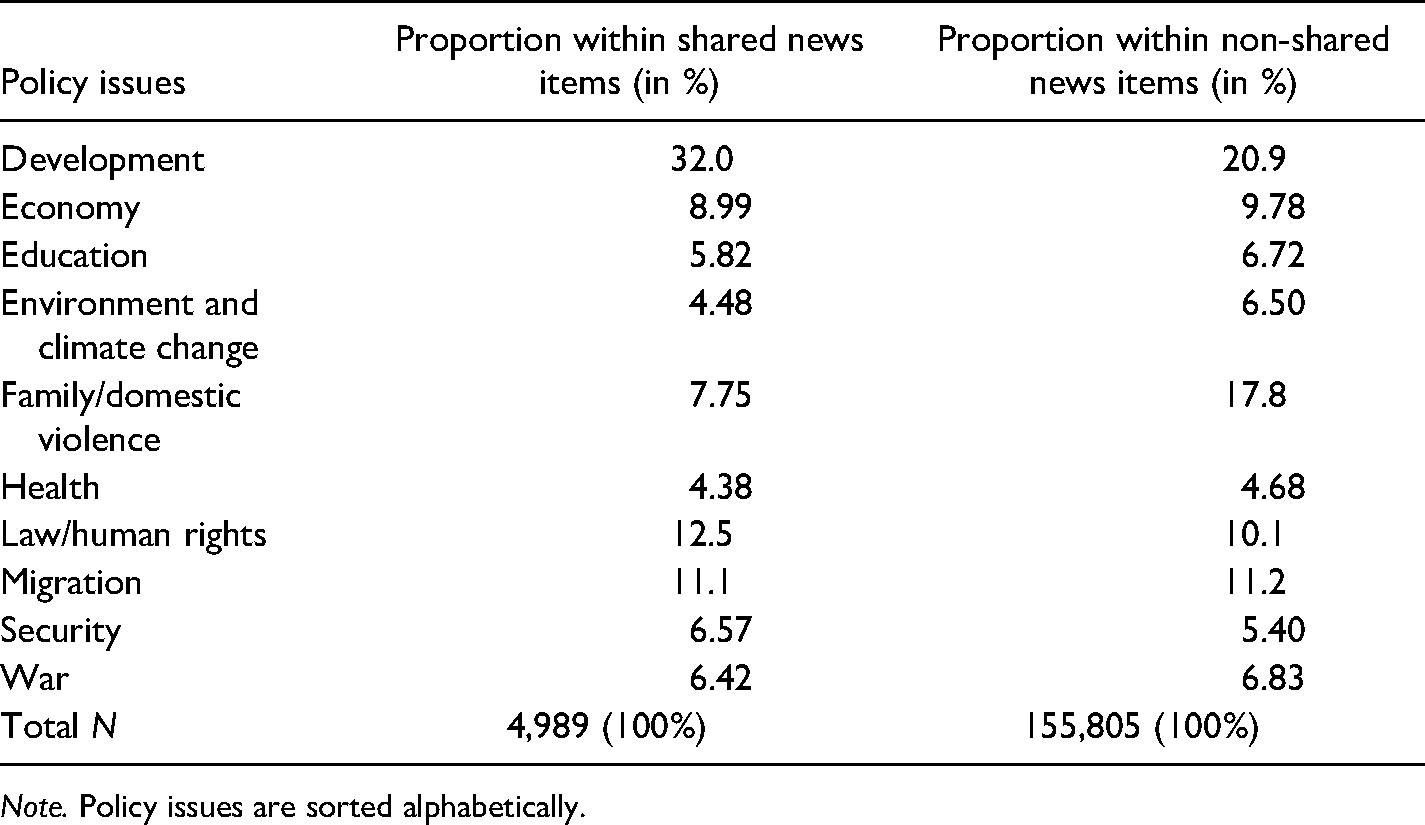
Note. Policy issues are sorted alphabetically.
Second, to know whether, in the media, these policy issues are more strongly associated with some parties than with others (Tresch and Feddersen 2019), we count the number of news items mentioning a party as well as each of the policy issues. The count is then normalized so that each party's propensity scores across the ten policy issues sum up to 1. Results from this procedure show face validity. For example, the policy issue of environment and climate change seems to be particularly associated with the German Greens and the Spanish Podemos. In Germany, the migration issue is particularly associated with the CDU/CSU as well as the AfD. In the UK, issue ownership is less pronounced on these issues. As to be expected, however, the Conservative Party and the Liberal Democrats have higher issue ownership on the Economy as compared to Labour or SNP.
Finally, we categorize each news item in the data by the policy issue with the highest probability score from the topic model (i.e., if a news item has 25% for the War policy issue and 75% for Migration, it is classified as Migration). For each observation in the data (i.e., news item × party), the propensity score of the party for a specific policy issue is then multiplied by the probability score of that issue within the news item (continuing the example from above, .75 is multiplied by the parties’ propensity score for the policy issue Migration). We call the resulting measure Owned Issue Mentioned. The variable was standardi
zed (M = 0; SD = 1) for further analysis.
Control Variables
Model
We used Stan (Carpenter et al. 2017) modeling language and brms r package (Bürkner 2017) for statistical modeling. Given the fact that the dependent variable is binary, we fit a binomial regression model with a logistic link. Because of the stacked nature of the dataset, the model is required to have varying intercepts (mixed effect) across the articles. Moreover, given that the observations are grouped within countries as well as within political parties in those countries, we add additional varying intercepts across countries, parties, and news outlets. We set weakly informative priors on population-level effects (Normal (0, 10)) (Gelman, Hill, and Vehtari 2020: p. 124). Nevertheless, given the amount of data, we expect the prior to be completely overpowered and have a negligible effect. The model converged with R hat values (Gelman and Rubin 1992) not exceeding 1 for any parameter, indicating good MCMC convergence. Trace plots for posterior MCMC draws of population-level parameters are presented in Figure A1 in the Supplementary Information file.
Descriptive Analysis
We first provide descriptive evidence to investigate our hypotheses. As is evident from Figure 1 below, the percentage of news items that mention a specific party is higher among the shared news items by that party than among non-shared items. This pattern is evident for all political parties and all countries in our sample but is more pronounced for the two largest and more established parties in the two electoral systems with proportional representation (Germany and Spain) as compared to the UK. Generally, accounts in the UK seem to be more willing to also share news articles that do not necessarily mention their own party.
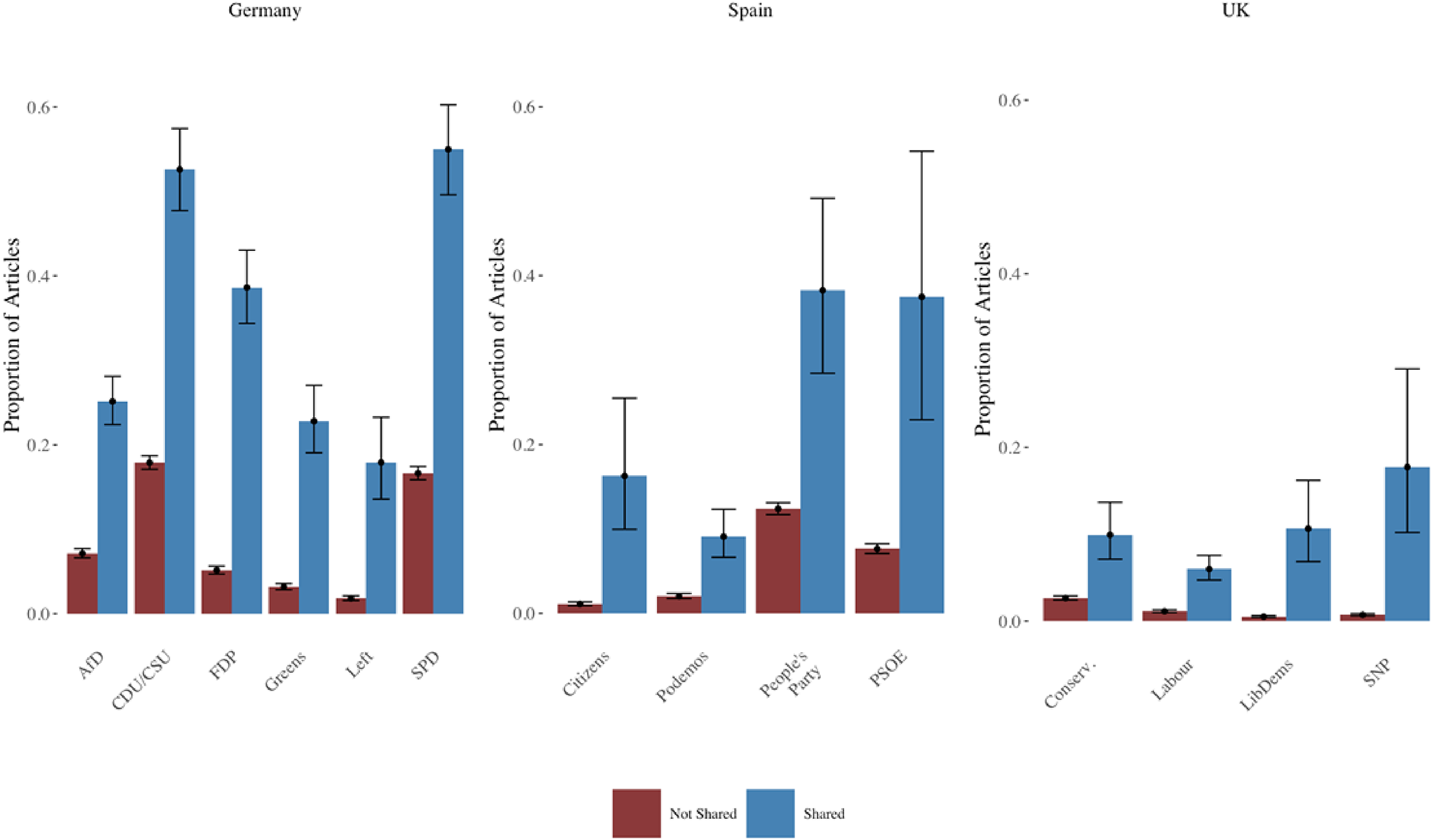
The proportion of news items that mention a party among that party's shared and non-shared news items (party mentioned). Error bars are showing 95% Wilson Score Interval for Binomial Proportion.
Figure 2 averages the Owned Issue Mentioned variable across shared and non-shared news items. Similar to the observation above, news items in which the main policy issue is one for which a party holds higher issue ownership indeed tend to be shared more often than those that do not. Again, this pattern is apparent across all countries and parties.
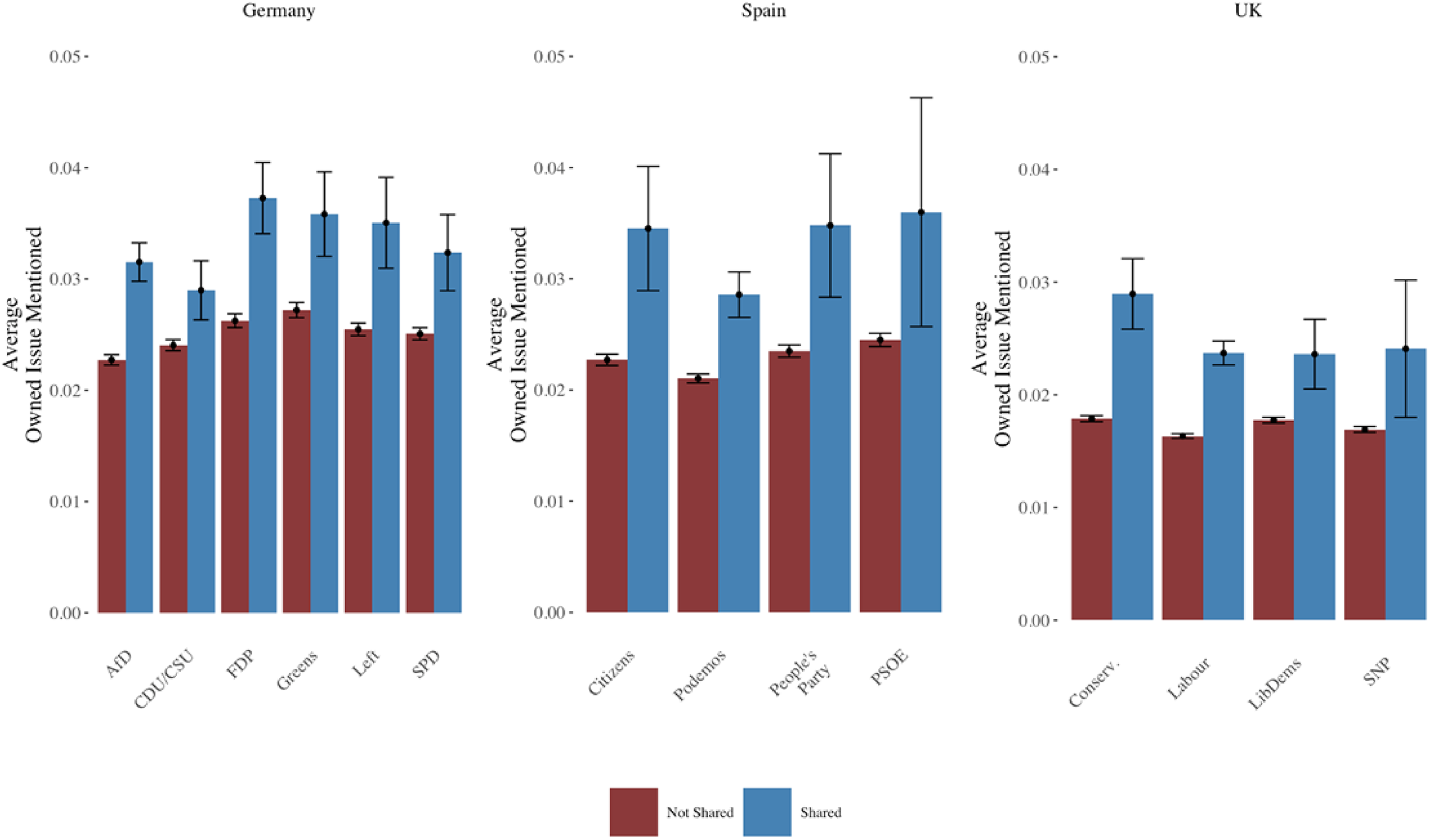
Average values for the own issue mentioned variable among shared and non-shared news items. Error bars are showing 95% confidence intervals.
Finally, Figure 3 shows the bivariate distribution of the proportion of news items and Partisanship of Audiences per news outlet for shared and non-shared news items. The y-axis shows the proportion of news items from a specific news outlet/party pair in the dataset, while the x-axis shows the proportion of party supporters that read that specific news source. Figure 3 shows that political parties are more likely to share news items that are published by media outlets that their support base actually prefers to read. Differences between countries seem negligible. Still, the effect tends to be stronger in Spain than in the other two countries.
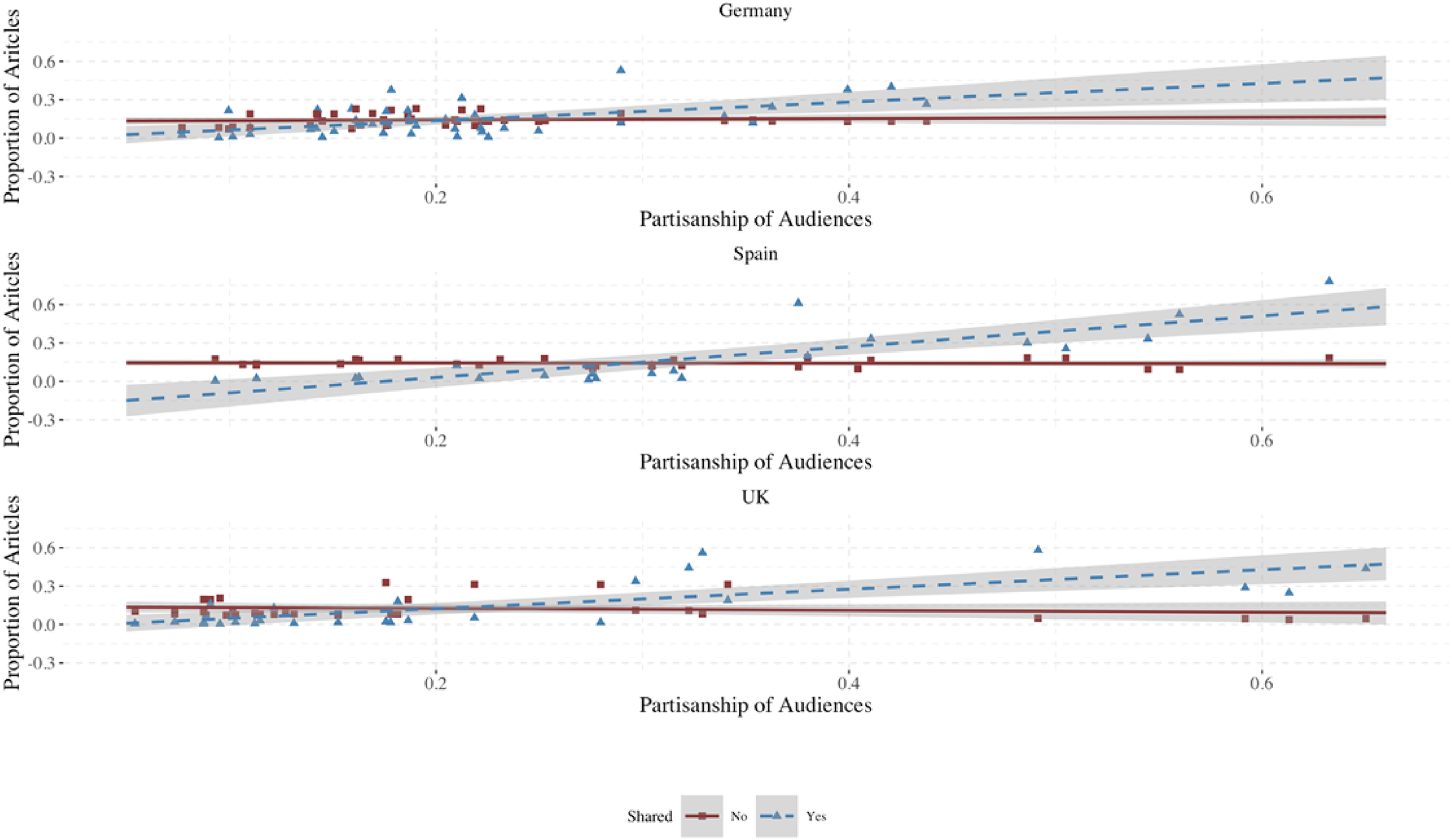
Bivariate distribution of the proportion of news items and partisanship of audiences per news outlet for shared and non-shared news items. Individual Countries.
Results
The population-level effects from the model posterior distribution are shown in Figure 4 below, while the exact coefficients can be found in Table A3 in the Supplementary Information file. First, considering the impact of media presence of parties, we look at whether a party is mentioned within a news item. The corresponding coefficient is positive
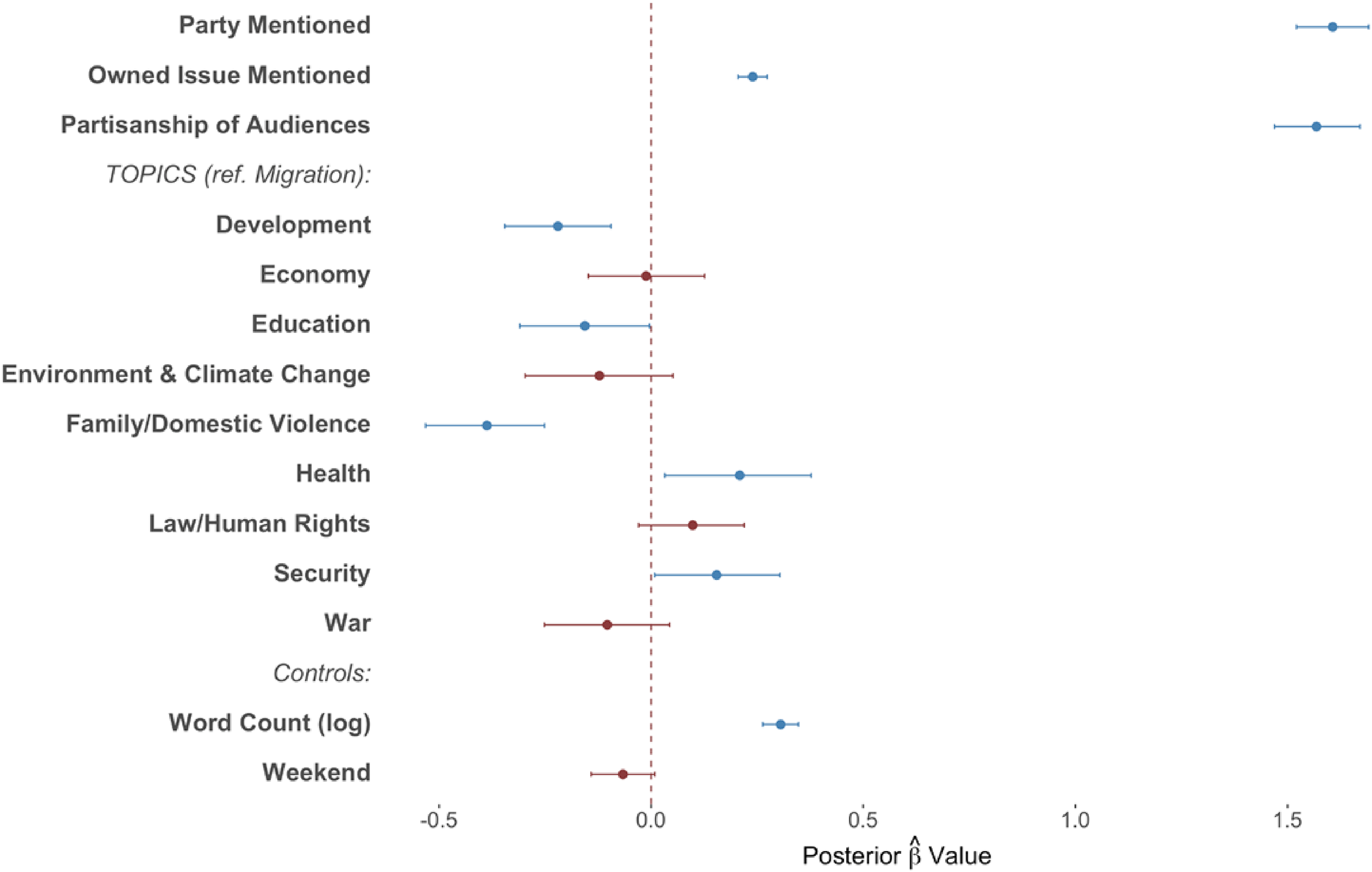
Posterior distribution of model parameters. Note: Posterior distribution of model coefficients. A dot represents the 2nd quartile (median), lines cover 95% of the posterior distribution. Only population-level effects are included. Full model is a multilevel model with 4 mixed effects—article level, country level, party within country level, and outlet within-country level.
In addition, we consider the impact of other contextual factors. We find that the policy issue (topic) of a news item by itself does not always play a significant role in the parties’ news-sharing behavior. Many policy issues do not elicit more/fewer shares than the reference category Migration, except for Development, Education, Family/Domestic Violence, Health, and Security. Moreover, it appears that longer news items are shared more often, the publication date (i.e., on a weekday or on the weekend), in turn, does not exhibit any effect.
Running the model for each country separately, the effects remain robust and effect sizes for the theorized mechanisms are substantially the same in all three cases. As to be expected, the importance of single topics, however, varies between countries (for details, please see Figures A2 to A4 in the Supplementary Information file).
Robustness Check
While we argue that our data does not contain structural zeros and, as such, theoretically all articles could be shared by political actors on social media, we have tested the robustness of our model by limiting the universe of (un-)shared items to political news only. We deleted 128,987 unique articles from our corpus (20%) that had topics relating for example to high arts or television with the highest probability score. By and large the results of the model with this limited universe of news items (n = 63,954 article × party pair) remain similar to the main model (see Figure A5 in the Supplementary Information file for the full model).
Discussion and Conclusion
In sum, our analyses demonstrate that the likelihood of a news item to be shared by a politician on social media will increase (H1) if that politician's party is mentioned in the news item, (H2) the more salient their party's owned issues are in the news item, and (H3) the more party supporters tend to read the news outlet in which the news item is published. Similar to the gratifications of quality news sharing for citizens (Thompson et al. 2020), political actors, therefore seem to try to legitimize themselves and their claims by sharing news items (Rasmussen 2017), making use of the trustworthiness and/or familiarity of specific news outlets and news media vis-à-vis their supporters more generally (Sterrett et al. 2019). These very strategic decisions in the dissemination of political information, however, may reinforce an information bias that political actors pass on to their audiences’ news diets. By doing so, these actors arguably contribute to the polarization and fragmentation of audiences (see Heiberger et al. 2021; Weeks et al. 2019).
Studying news sharing by political actors in three different European countries that correspond to three different media and political systems, we have followed an approach that challenges the naive assumption of universalism when it comes to political communication processes. We found the studied mechanisms to be robust in all three country settings and, therefore, expect the mechanisms to be generalizable to similar media and party contexts in other Western European countries. Still, bivariate analyses showed, for example, a tendency towards a stronger effect of partisanship of audiences in Spain, where media-party parallelism is strong as well. For a proper test of whether mechanisms found in the three countries may actually differ in strength depending on the degree of media-party parallelism, a much larger sample of countries also beyond Western European countries is needed (see, e.g., Bene et al. 2022).
There are several limitations to this study. First, while studying news dissemination processes on Facebook, we only focus on major national online news outlets, thereby neglecting smaller news media, alternative or partisan outlets, or other channels of traditional media (e.g., TV news clips shared as videos). Second, we gathered our data from the main pages of the major news outlets once per day at noon and might have thus missed news items that were not part of the main page at this certain point in time or that were published only in subsections (e.g., subpages for local news). Third, there are additional content characteristics that may prove to be relevant when it comes to political elites’ news sharing, for example, sentiment. While we considered incorporating such a measure, we eventually decided against it, mainly because of conceptual obstacles. In our case, measuring sentiment and salience on the article level at the same time would result in a structural zero when it comes to sentiment whenever salience is absent. Implementing sentiment, thus, would have limited our analysis to the subset of articles that mention a party, negating our efforts to create an unbiased sample in the first place. Fourth, while we identify some of the mechanisms that increase the likelihood of a news item to be shared by political accounts on social media, our study can only speculate on the motivations behind (e.g., self-legitimization, increasing visibility, supporter mobilization, mere exposure, etc.) and the effectiveness of these decisions (Kelm 2020). A more qualitative approach, for example, by interviewing politicians or their social media teams, may help shed some additional light on the (un-)conscious mechanisms behind elites’ news-sharing (Farkas and Schwartz 2018).
Notwithstanding the above limitations, and as the object of investigation as well as the data structure required, we used an innovative design, combining, and systematically investigating several unique and separate measures and data sources: politicians’ Facebook shares, media data, and survey data. Using such a complex methodology allowed us to overcome selection biases and limitations in the conceptual power of previous studies on this topic and we believe that the current study provides valuable insights into the mechanisms of political actors’ role in the dissemination of online news content that might increasingly affect younger social media users who prefer to get their political information from these actors directly (Marquart et al. 2020; Ohme 2019).
Supplemental Material
sj-docx-1-hij-10.1177_19401612221104740 - Supplemental material for My Voters Should See This! What News Items Are Shared by Politicians on Facebook?
Supplemental material, sj-docx-1-hij-10.1177_19401612221104740 for My Voters Should See This! What News Items Are Shared by Politicians on Facebook? by Tobias Heidenreich and Jakob-Moritz Eberl, Petro Tolochko, Fabienne Lind, Hajo G. Boomgaarden in The International Journal of Press/Politics
Footnotes
Disclosure Statement
The authors have no potential conflict of interest to report.
Declaration of Conflicting Interests
The authors declared no potential conflicts of interest with respect to the research, authorship, and/or publication of this article.
Funding
This work was supported by Horizon 2020 Framework Programme [grant number 727072].

Supplemental material
Supplemental material for this article is available online.
Notes
Biographical notes
References
Supplementary Material
Please find the following supplemental material available below.
For Open Access articles published under a Creative Commons License, all supplemental material carries the same license as the article it is associated with.
For non-Open Access articles published, all supplemental material carries a non-exclusive license, and permission requests for re-use of supplemental material or any part of supplemental material shall be sent directly to the copyright owner as specified in the copyright notice associated with the article.
