




Abstract
In many democratic societies, research has identified an increase in animosity between supporters of different political parties. While this phenomenon has been extensively examined among the general public, less research has explored the role of political elites in contributing to partisan hostility. This study aims to fill this research gap by analyzing instances where members of parliament (MPs) express negative sentiments toward representatives of opposing parties in legislative speeches. Specifically, we investigate which MPs within parties are driving elite rhetorical polarization. We hypothesize that MPs with less experience in parliament and less experience outside of party politics are more likely to contribute to polarizing speech due to stronger partisan identities. Analyzing Norwegian MPs’ speeches between 1998 and 2016, we find support for these hypotheses. Our findings highlight intra-party differences in polarization and contribute new insights into the characteristics that shape polarizing rhetoric among political elites.
Introduction
In recent decades, research has shown that citizens in many countries are increasingly hostile toward those who identify with opposing parties (Gidron et al., 2020; Iyengar et al., 2019). Studies of this pattern of affective polarization have described an intergroup distancing between partisans (Iyengar et al., 2019; Mason, 2018), often resulting from strengthening group identification aligned with lines of party conflict (Webster and Abramowitz, 2017). While political elites have received less attention in this literature, some recent work has shown the affective nature of polarization at the elite level (Ballard et al., 2023), which can be even greater than that of the public (Enders, 2021). Elite polarization and incivility can contribute to increasing affective polarization among voters and eroding political trust (Banda and Cluverius, 2018; Skytte, 2021). Elite polarization can furthermore undermine inter-party cooperation and policy compromise in multiparty parliamentary systems (Bäck and Carroll, 2018).
In this paper, we examine which members of parliament (MPs) drive elite rhetorical polarization by expressing negative sentiments toward other parties in their legislative speeches. To investigate what explains variation in MPs’ contributions to polarizing rhetoric, we examine the characteristics of MPs that may enhance their own partisanship, focusing on the role of parliamentary and pre-parliamentary careers, specifically on MPs’ occupational background and their seniority in parliament. Previous research has shown that career histories matter for MPs’ policy positions, responsiveness, and voting in the legislature (Binderkrantz et al., 2020; Heuwieser, 2018; Mai, 2022; O’Grady, 2019), and recent research has shown that MPs’ voting behavior is influenced by their length of party membership and age of joining the party (Rehmert, 2022). Drawing on such research, and mass-level research on partisan identity and affective polarization, we hypothesize that MPs with less experience in parliament and less experience outside of party politics are likely to contribute to polarizing speech due to stronger partisan identification.
Analyzing Norwegian MPs’ speeches in the Norwegian parliament, Stortinget, between 1998 and 2016, we apply a domain-specific sentiment dictionary to speech texts where MPs mention an outparty – that is, a party belonging to the opposite bloc or that is an unlikely coalition partner. This “minimally supervised” method (Rice and Zorn, 2021) captures the sentiments expressed in the specialized vocabulary of parliamentary discourse in the Norwegian context and allows us to measure the degree of negative rhetoric within speeches that explicitly address other parties and their members.
Our results show that more junior MPs are more likely to express negative sentiments toward outparties. We also find that those with little work experience outside party politics are more likely to use negative rhetoric. Considering the increasing number of MPs lacking experience outside party politics in Norway and elsewhere (Narud, 2011), and reduced experience within parliaments due to higher turnover (Gouglas et al., 2018), our findings suggest a mechanism that may contribute to an increasing use of language reinforcing affective polarization among political elites.
Theoretical framework
Literature on elite-level polarization in modern democracies primarily focuses on the escalating conflict observed in the US Congress (Barber and McCarty, 2015; Fleisher and Bond, 2004; Mann and Ornstein, 2012), mainly in terms of the ideological distance between parties (McCarty et al., 2016). Recent research has also demonstrated that rhetorical polarization between parties in the US Congress aligns with these trends (Gentzkow et al., 2019; Jensen et al., 2012).
However, limited attention has been given to polarization expressed in legislative speeches. Rheault et al. (2016) analyze the British House of Commons, measuring “emotional polarity” in parliamentary discourse, while Calvo et al. (2022) employ sentiment analysis of speeches in the Swedish Riksdag and identify speech targeting right-wing populists from mainstream party MPs. Similarly, Bantel and Kollberg (2022) measure elite polarization within German Bundestag speeches by detecting emotive rhetoric with part-of-speech tagging, enabling the identification of instances where party representatives rhetorically attack each other. This work shows that the rhetoric of MPs can be an important reflection of elite polarization, in which MPs express negative comments or attack opposing parties. However, these studies have focused on party-level dynamics rather than the role of individual MPs within parties in driving polarized rhetoric, which we do here.
The literature on mass affective polarisation offers some starting points for understanding why individual MPs may vary in their propensity for polarized speech. One of the key factors contributing to affective polarization among the mass public is the attachment individuals have to their respective groups. Social identity theory suggests that consciously identifying with a group, such as a political party, becomes a significant part of one's self-concept. This group identification elicits emotional connections and fosters a natural inclination to categorize fellow group members as part of a liked ingroup while viewing individuals outside the group as members of disliked outgroups (Tajfel and Turner, 1979). Consequently, groups need to maintain distinctiveness from other groups to sustain their identity and cohesion. As Brewer (1991: 478) describes, “to secure loyalty, groups must not only satisfy members’ needs for affiliation and belonging within the group, they must also maintain clear boundaries that differentiate them from other groups.”
In the political space, partisan identities are typically in focus and can become the basis for affective polarization (Iyengar and Westwood, 2015). At the mass level, the salience of partisan identities affects their level of affective polarization (Iyengar et al., 2019). People who strongly identify with a political party are more likely to feel positively toward fellow partisans and negatively toward non-partisans. Moreover, when partisan and other social identities – for example based on education or religion – overlap, affective polarization tends to be higher (Harteveld, 2021).
There is some evidence that these patterns also exist in elite settings, where partisan group identity has been shown to influence the enforcement of institutional norms in parliaments (Hjorth, 2016) and floor voting in the absence of discipline (Raymond and Overby, 2016). Further, Mollin (2018: 209) argues that “in parliamentary discourse, the construction and reinforcement of in- and out-group identities is particularly important and visible.” MPs, who aim to secure reselection to party positions (Strøm, 1997), may seek to differentiate themselves from fellow party members to demonstrate party loyalty (Sieberer and Müller, 2017). However, while the immediate environment influences MPs’ behaviour, partisan biases based on group identities can exist independently of formal incentives (Hjorth, 2016; Raymond and Overby, 2016). In the context of parliamentary speeches, contrasting policies is a natural part of a party strategy, but individual MPs can vary in the extent to which they employ negative rhetoric explicitly against other parties. Accordingly, research on negative campaigning and elite incivility have highlighted similar intra-party variance among politicians (Elmelund-Præstekær, 2008; Jenny et al., 2021; Stuckelberger, 2021).
Consistent with studies conducted at the mass level (Iyengar et al., 2019), we anticipate that a higher level of partisan attachment among elites will correspond to a greater degree of affective polarization demonstrated in parliamentary rhetoric. We argue that an MP’s identification with their party shapes their perception of other parties as potential outgroups, but the intensity of this identification will vary within the party. We propose that the extent to which an MP distances themselves from other parties hinges on a stronger and more exclusive identification with their own party as a social group, which, in turn, is associated with the nature of their careers within the party and parliament.
One reason why MPs develop group identities beyond their party that can overlap with those from other parties is due to their experiences, specifically their pre-parliamentary careers and their work in the legislature. Here we draw on the literature on political socialization, which suggests that representatives will, as they become more senior, become more familiar with their parliamentary roles (Dawson et al., 1977). More senior MPs – those with more time in the parliament – are more likely to become identified with their roles as MPs within parliament, and relatively less exclusively identified as partisans. As described by Mughan et al. (1997), focusing on “legislative socialization,” there is clear evidence that parliamentary membership moderates radicalism among politicians. The mechanism here is that established conventions and practices in parliaments become internalized by otherwise highly partisan MPs, contributing to moderating their political demands. 1
Furthermore, the level of experience MPs acquire in the legislature increases their opportunities for cross-party cooperation, particularly in activities like committee work. This experience enables MPs to engage in more frequent contact with members from opposing parties, ultimately reducing interpersonal and ideological distances. This intuition aligns with Allport’s (1954) influential contact hypothesis and intergroup contact theory, which propose that intergroup contact generally leads to reduced prejudice (Pettigrew et al., 2011). Intergroup contact has also been linked to decreased affective polarization (Levendusky and Stecula, 2021; Santoro and Broockman, 2022), primarily through the mechanism of perceiving commonalities between the self and the outgroup (Wojcieszak and Warner, 2020: 789).
Taking together these insights from the extant literature, we anticipate that MPs who have had more extensive experience interacting with members from other parties will exhibit lower levels of partisanship compared to their less experienced counterparts. Empirically, research has shown that legislative environments where term limits make longer careers impossible are more partisan overall (Olson and Rogowski, 2020) and, in the US House, more senior members have also been shown to engage less in partisan rhetoric (Morris, 2001). We predict that the more exposure MPs have to collaborative efforts with other parties in parliament, the less they perceive a sense of ingroup-outgroup distinction. Consequently, they are less likely to engage in negative partisan rhetoric toward other parties. Therefore, we hypothesize the following:
MPs with less experience working in parliament are more likely to express negativity toward outparties in their legislative speeches. MPs’ pre-parliamentary careers can also play a significant role in shaping their party identity (Mai and Wenzelburger, 2023; Rehmert, 2022). The occupational backgrounds of MPs are expected to influence the socialization processes they have undergone. Research suggests that MPs with limited work experience outside of politics undergo a distinct socialization process compared to those who enter politics after several years of non-political work (Binderkrantz et al., 2020; O’Grady, 2019). MPs with predominantly non-political experience are less likely to be more deeply socialized into their party’s norms and identity, and potentially more connected to other identities such as those of a teacher, lawyer, or farmer. Such cross-cutting identities that transcend partisan boundaries may reduce outgroup animosity. On the other hand, MPs with minimal non-political work experience outside of party politics may exhibit clearer ingroup and outgroup distinctions and thus contribute to polarization in rhetoric (Harteveld, 2021). Rehmert (2022) finds that longer previous party membership and joining the party at a younger age decrease the likelihood of MPs deviating from the party line. The study suggests that belonging to a group influences individuals to reassess their attitudes, norms, and values in line with the expectations set by significant others within the group (Rehmert, 2022: 1090). Similarly, Mai and Wenzelburger, (2023) find that German MPs who did not hold party offices prior to their mandate were more likely to defect in whipped votes, highlighting the impact of pre-parliamentary party socialization. These findings indicate that the level of party loyalty may vary among MPs based on their pre-parliamentary socialization experiences, which we argue can be relevant for understanding the dynamics of affectively polarizing rhetoric in the Norwegian parliament. Therefore, we expect that MPs who have exclusively pursued non-political occupations in pre-parliamentary careers will develop identities that are less intertwined with party socialization, leading to a reduced propensity to use rhetoric indicating hostility toward outgroup parties. We hypothesize that,
MPs with less pre-parliamentary experience outside party politics are more likely to express negativity toward outparties in their legislative speeches.
Research design and data
The Norwegian case
We study Norwegian MPs and their expression of negative sentiments toward outparties in their parliamentary speeches between 1998 and 2016 (Lapponi et al., 2018). The left-of-center parties we examine are the Labor Party (Ap), the Socialist Left Party (SV), the Center Party (Sp), and, from 2013, the Green Party (MDG). The right-of-center parties are the Progress Party (FrP), the Conservative Party (H), the Christian Democratic Party (KrF), and the Liberal Party (V). Between 1998 and 2016, all parties except the Green Party held office at some point (Stavenes and Strøm, 2021).
Norwegian MPs can to some extent decide how they express themselves in their speeches (Bäck et al., 2021), even though parties have a role in determining who takes the parliamentary floor. Focusing on the institutional setting of speechmaking in Stortinget, Søyland and Høyland (2021: 637) highlight that the Norwegian political system grants parties significant control over speechmaking in the plenary, with committee members and party elites being the most frequent speakers.
The Norwegian case is a multiparty democracy with a relatively average level of affective polarization at the mass level (Wagner, 2021: 6; see also Knudsen, 2021). Moreover, Stortinget is in some ways a least-likely case for affective polarization at the elite level with its historically consensus-oriented politics (Stavenes and Strøm, 2021). Jenny et al. (2014), for example, find that most members report frequent and positive cross-party interactions within parliament.
The parliamentary committees of Stortinget, in particular, are “consensus-forming structures” and important arenas where MPs from different parties work together on areas of shared background and interest and form a “committee community” (Rommetvedt, 2002: 57). As Rommetvedt describes, “recruitment as well as the socializing process contribute to the formation of common frames of reference in the committees, making it easier to reach common interpretations and solutions” (2002: 57). Committee activity may in this way form the basis for the development of a shared identity between MPs across parties.
At the same time, consensus-oriented institutions exist alongside highly disciplined parties (Rasch, 1999). Norwegian MPs are dependent on their local party branches for reselection, and while career paths vary, MPs have increasingly had careers in party work before recruitment (Narud, 2011).
Overall, the Norwegian parliament has features representative of many multiparty parliamentary democracies, yet the combination of party-centric features within a consensus-oriented political landscape creates an environment with the potential for MPs to vary in how their socialization in and out of parliament may impact the negativity of their speech.
Dependent variable – negativity in speech toward outparties
Our aim is to measure affectively polarizing rhetoric, understood as negativity and bias toward outparties and their members. At the mass level, there are several ways of getting at affective polarization that are difficult to employ at the elite level, including experiments and implicit tests of bias (Iyengar et al., 2019). One of the most common measures of affective polarization are feeling thermometers, where survey respondents indicate to what degree they (dis)like specific parties (Reiljan, 2020; Wagner, 2021). In this paper, we try to get at something similar to stated dislike, or negative feelings, by examining MPs’ rhetoric in their parliamentary speeches. We focus on MPs’ overt expression of negative sentiments toward outparties, meaning that we approximate MPs’ dislike of, or negative feelings toward, these parties.
Two types of approaches are typically used to analyze sentiment in text: machine learning using human-coded subsets or dictionaries applying pre-identified sentiment words. While dictionary methods can provide more reliability than applying human coding, due to standardized word-matching processes, generic dictionary methods are not ideal for specific political applications where context is important. Here, following Rice and Zorn (2021), we therefore use a domain-specific dictionary approach. We develop a domain-specific dictionary through an unsupervised algorithm to capture context-relevant political language and sentiments to encompass the nuanced vocabulary used by political elites. This approach has higher reliability than machine learning based on human judgment in coding and higher validity than generic dictionaries. The standardized word-matching process and dictionary tailored for political speech therefore allow us to classify sentiments in parliamentary speeches with greater reliability and validity compared to alternatives.
We first identify speeches that mention another party or a word that refers to a specific bloc, the government parties, or the opposition parties. 2 We extract ten words before and ten words after such a word or party name is mentioned. This limited window of words is chosen to increase the likelihood that the rhetoric concerns the party the MP mentions in the text. We then use a word-embedding approach to construct a dictionary with words that express negative sentiments (Rice and Zorn, 2021). To do this, we use a selection of common words with negative valence (e.g., bad, wrong, irresponsible). These words are fed to the unsupervised Global Vectors algorithm to detect words that MPs use in a similar context when they talk about other parties in their speeches. 3 Our dictionary contains algorithm-detected negative sentiment words. We furthermore iteratively sampled 500 observations without these words to identify missing terms (see Appendix A). The resulting dictionary was applied to the 20-word text sections mentioning other parties. 4 The words, listed in Appendix B, cover a range of types of negative emotions.
We are here interested in negative words in speeches that mention an outparty. In multiparty systems, certain parties are more likely to be disliked by a given MP than others. Previous findings in the negative campaign literature highlight that attacks on parties that share less of the attacker’s voter base and are more disliked by their partisans are more common (Stuckelberger, 2021). MPs may furthermore identify more with parties that are ideologically closer to their own party or with those they govern and hence collaborate closely with.
The operationalization of outparties is thus partly based on the parties’ left-right positions. For parties and blocs on the left (right), the parties and blocs on the right (left) are coded as their outparties. When parties are in government (opposition), the opposition and opposition parties (government and government parties) are coded as outparties (see Appendix C for coding details). It is generally much more common for MPs to talk about outparties than other “inparties” – parties in the same bloc or coalition partners. It is also more common to talk about outparties negatively than to talk about other inparties negatively (see Appendix D). Appendix E presents regression results for negativity toward inparties.
We manually validated a sample of 11,766 observations where an outparty and negative word appeared. Over 92% contained explicit negativity toward the outparty. Examining false negatives in non-negative samples also suggests low rates of missed negativity (see Appendix A). This provides confidence that MPs use negative words when expressing outparty hostility and that our dictionary captures terms commonly used for this purpose.
The negative rhetoric may concern traits of the outparties themselves – such as when an MP from the Socialist Left Party said in 2009, “I am so tired of the Progress Party being allowed to paint with a broad brush. Everyone else is wrong and we – that is, the Progress Party – are absolutely excellent. But the moment one starts asking questions about what the Progress Party actually thinks, they are completely unable to answer.” The negative rhetoric may also concern the outparty’s policy or issue positions, which also include explicit expressions of negative sentiments about the party. One example of this comes from a speech by an MP from the Conservative Party in 2010: “This type of privacy measure shows that the Labor Party is continuing its bad and long tradition of not caring about privacy.”
Typical examples of rhetoric classified as negative in this measure from MPs with less experience in parliament or outside of their party include a first-year MP in 2010 from the Labor Party, who said that she was “scared” of the Conservative Party’s “politics of inequality,” and a junior MP from the Progress Party who stated that “the Socialist Left Party … will be directly harmful to Norway as a nation.” A Conservative Party MP with one year of non-political work experience stated, “What scares me is the red-green parties’ reasoning in the debate on parental leave,” while a Labor Party MP who entered parliament at age 24 said in 2010, “The first thing we did when we entered office was to reverse the brutal changes … the right-wing bloc made the previous term that would weaken employees’ rights and brutalize working life.” Appendix F includes examples of the non-negative rhetoric more common among more experienced MPs.
Observations with negative outparty rhetoric are coded as 1, else 0. Since our dependent variable is binary, we run logistic regressions. Similar results are obtained using count models with the number of negative words (Appendix G). We cluster standard errors by MPs to handle potential data dependencies. Nearly all MPs (99.3%) spoke negatively about an outparty at least once. Figure 1 displays total outparty mentions and negative mentions per party. Total number of outparty mentions and negative outparty mentions, per party. Note: Ap = Labor Party, FrP = Progress Party, H = Conservative Party, KrF = Christian Democratic Party, MDG = Green Party, Sp = Center Party, SV = Socialist Left Party, V = Liberal Party.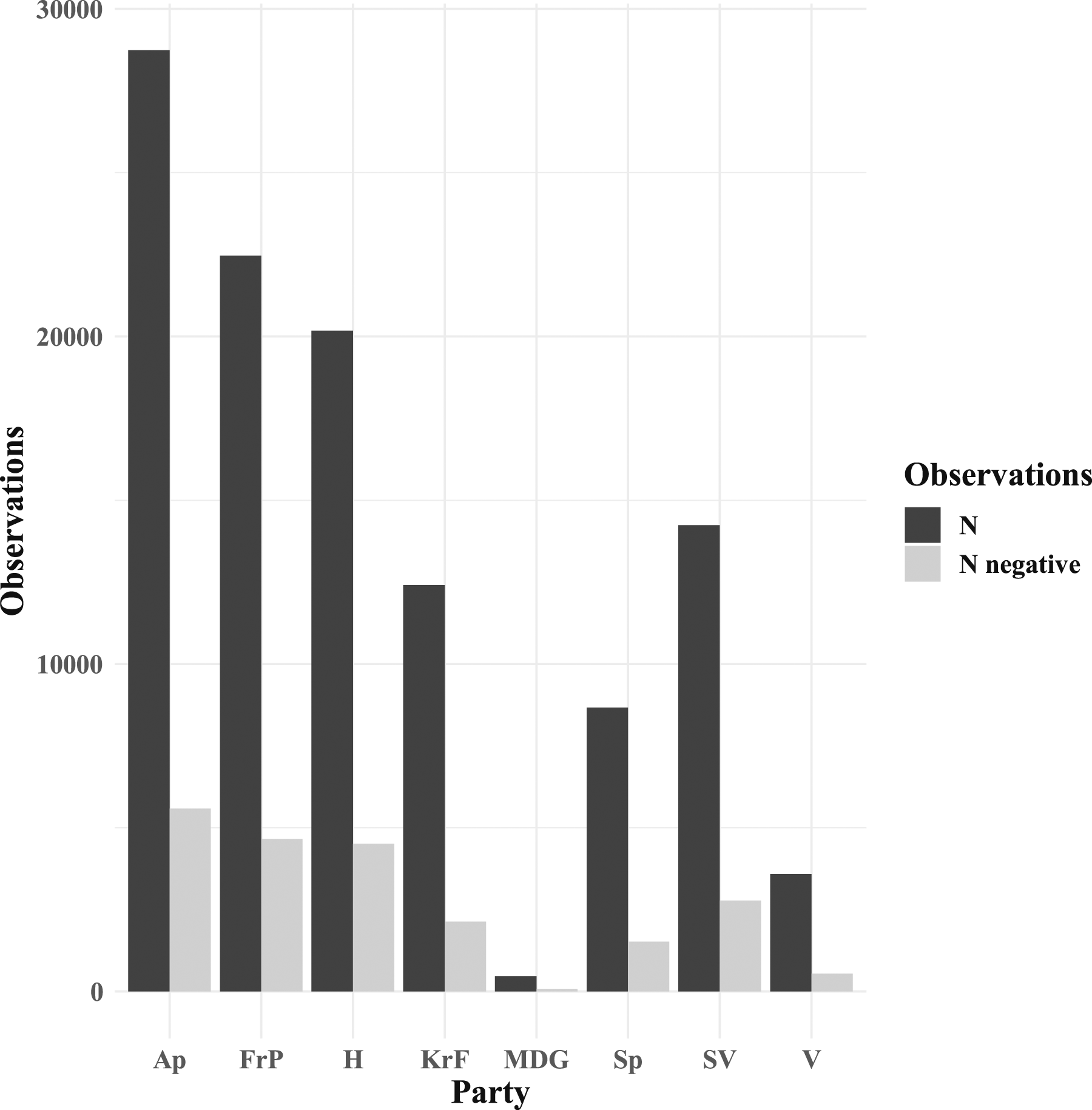
We next present a general overview of patterns in the data. Figure 2 shows the distribution of negative rhetoric among outparties per party. Much of the negative rhetoric concerns non-party mentions (e.g., the “government”, “opposition”, or specific blocs). Furthermore, negative speech typically targets larger or ideologically distant parties. For instance, MPs from the Labor Party, Socialist Left Party, and Center Party mainly criticize the right-wing Progress Party and Conservative Party, while these parties predominantly target left-wing parties. The main centrist parties express negativity mainly toward the largest left-wing party and the most ideologically extreme parties. Share of negative rhetoric directed at each outparty, per party. Note: NPM = non-party mention (e.g., “government”), Ap = Labor Party, FrP = Progress Party, H = Conservative Party, KrF = Christian Democratic Party, MDG = Green Party, Sp = Center Party, SV = Socialist Left Party, V = Liberal Party.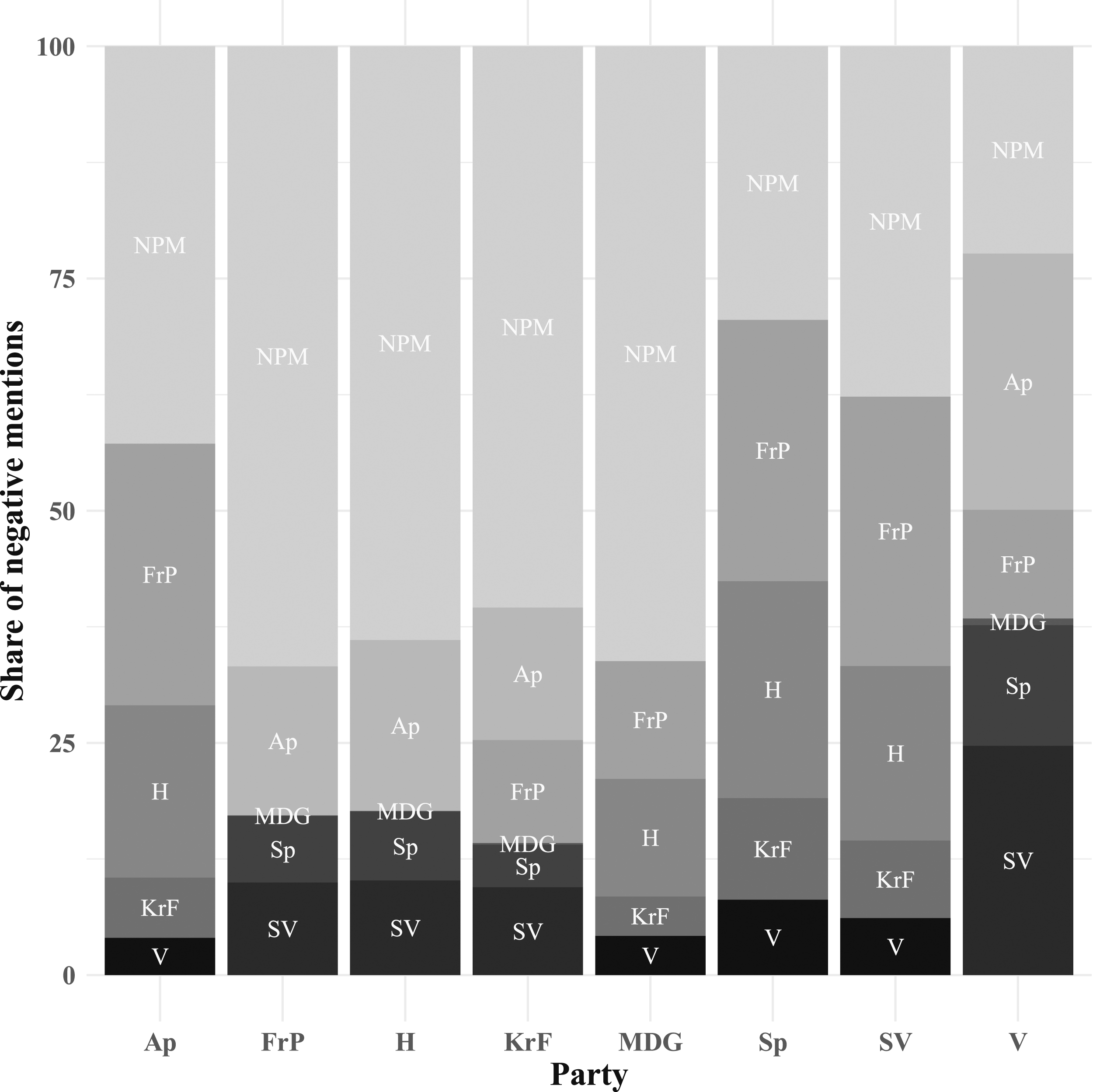
We examine the validity of party-level patterns in these data by comparing the patterns of negativity in MPs’ speeches to mass-level affective polarization using Comparative Study of Electoral Systems (CSES) data at the party level. The negativity MPs express toward specific parties closely mirrors the average “like-dislike” scores those parties’ partisans report in surveys from 1997 to 2013 (see Appendix H). The results suggest that partisans typically view inparties favorably and outparties less favorably. 5
Independent and control variables
To assess the extent of MPs’ experience within parliament, we use seniority, measured as years served at the time of delivering a speech, ranging from 0 to 32 (mean 7.26, SD 5.51). Entry data from official biographies allows calculating seniority at time of speech.
We evaluate MPs’ socialization into party norms and potential alternative identities by analyzing their pre-parliamentary work histories, specifically non-political work experience length and age at parliament entry (Allen et al., 2020). MPs with minimal non-political experience may lack alternative identities, limiting shared identities with MPs from other parties. We measure this feature using the number of years spent in non-political roles, excluding party work and local/regional representation, with data from MPs’ biographies. The measure spans 0 to 50 years (mean = 15.25, SD = 9.89).
Entering parliament at a younger age suggests less non-political work experience and likely indicates strong party involvement, providing a measure less dependent on MPs' biographical details. This ranges from 21 to 67 (mean = 40.26, SD = 9.53). It correlates strongly (r = 0.83, p < .001) with years of work outside politics, serving as alternative proxies for pre-parliamentary party socialization strength.
We control for institutional positions, sociodemographic traits, and contextual factors that prior research suggests may influence parliamentary behavior in general or rhetorical choices specifically. We account for party leader and committee chair positions, which confer status that affect partisan speech; gender, as research finds women exhibit different rhetorical styles, and education level, with greater education potentially influencing rhetorical approach. We also include proximity to upcoming elections, which may lead to more negative rhetoric to mobilize voters. Finally, we control for speech frequency/length to control for variation in the opportunity to use negative rhetoric. Appendix J includes further details on the controls.
Empirical results
MP characteristics and expression of negative sentiments toward outparties.
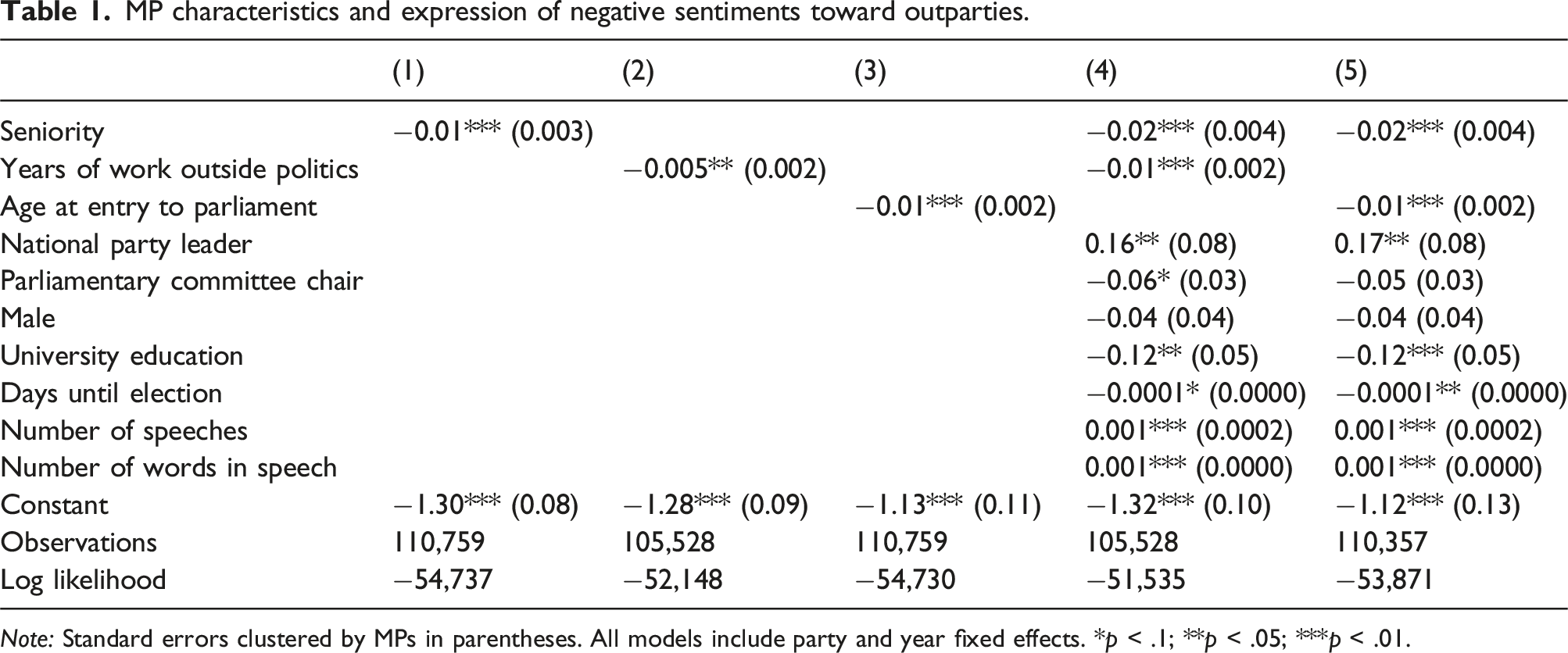
Note: Standard errors clustered by MPs in parentheses. All models include party and year fixed effects. *p < .1; **p < .05; ***p < .01.
The results also support the socialization hypothesis. The coefficient for years of non-political work is negative and significant – more experience outside politics is associated with less negative partisan speech. The predicted probability of negativity falls from 20.88 with no non-political experience to 18.55 with 30 years of such experience. Similarly, entering parliament at a younger age (age 21) has a 21.66 predicted probability of negativity versus 19.68 for those entering at the age of 40. These effects are somewhat smaller than that of seniority.
The effects of both proxies for pre-parliamentary experience are consistent with the expectation that MPs with less experience outside party politics are more likely to express negativity toward outparties in their legislative speeches. 6 This suggests that less experienced MPs may be more strongly socialized into the party’s culture and thus have a stronger partisan identity with potentially less basis for shared identities with representatives from other parties.
We control for election proximity because election campaigns may evoke a greater tendency to express negative statements. Partisan affinity among citizens rises and falls with electoral cycles (Singh and Thornton, 2019) and this has also been shown to be the case for elites (Öhberg and Cassel, 2023; Schwalbach, 2022). The electoral context may thus motivate MPs to speak negatively about outparties on average. As expected, we find that MPs are more negative in speeches referencing outparties as elections are closer.
This pattern raises the question of whether our main variables’ effects may themselves depend on the electoral context. Career characteristics associated with greater partisan identity may depend on the cyclical tendency for targeting electoral audiences. If so, the effects of seniority or pre-parliamentary careers could be more prominent in the pre-election period. We tested this possibility by interacting each career variable with days until the next election and find that this effect is not statistically significant (see Appendix N). 7 Hence, while parliamentary speech overall is influenced by the electoral cycle, the effect of these characteristics of MPs on the tendency to use negative rhetoric toward outparties does not seem to fluctuate significantly across time. This is consistent with the interpretation that our main independent variables are not only capturing motivations related to their party’s electoral campaign strategy in their effects on parliamentary speech, but instead reflect more consistent features of these MPs. 8
Conclusions
In this paper, we have aimed to examine polarizing rhetoric among political representatives by analyzing MPs’ parliamentary speeches. Drawing on social identity theory, we hypothesized that MPs who have little work experience outside the party or less experience in parliament are more likely to use negativity in legislative speech to distance themselves from other parties. We developed a domain-specific dictionary to evaluate these hypotheses in Norway and found that MPs are more likely to express negative sentiments when mentioning outparties if they are more junior or have little experience of work outside of the party.
These findings add to the emerging literature on affective polarization by highlighting the theoretical usefulness of applying social identity theory at the elite level to understand their affectively polarized rhetoric. A further theoretical contribution of this article is our focus on intra-party differences between MPs in their tendency to use polarizing rhetoric. By focusing on political elites, the study provides valuable insights into the behavior of key actors who may influence policy-making and drive mass affective polarization.
Furthermore, while much of the existing literature on elite polarization typically examines party-level concerns, such as ideological polarization between major parties, this study focuses on individual-level factors within parties that contribute to negative sentiment toward opposing parties. By exploring the drivers of negative elite rhetoric at the individual level, the study improves our understanding of the forces behind the broader issue of polarization in democratic politics.
Additionally, the study contributes to the literature on legislative behavior, shedding light on how political elites use floor speeches to engage in negative partisan rhetoric (Curini and Martelli, 2010; Haselmayer et al., 2022). Within this context, our results also speak to more general research on negative campaigning and attacks on other parties used by politicians (e.g., Lau and Rovner, 2009; Walter et al., 2014). We add to this literature by highlighting that MPs’ negative rhetoric and outparty attacks may be tied to the career circumstances that shape their group identification. In this way, our findings speak to the literature on the effects of MPs’ occupational backgrounds, which has focused primarily on policy positions, responsiveness, and legislative voting. We show that occupational backgrounds also have consequences for the affective qualities of MP speech and which MPs contribute to polarization.
Importantly, while the study provides evidence consistent with an identity explanation of contributions to affectively polarized rhetoric among MPs in the Norwegian parliament, it does not definitively establish whether the observed behavior is driven by strategic desire to demonstrate group differentiation or directly the result of a social identity-based bias independently of strategic incentives. Different seniority levels may, for example, lead to different incentives for party loyalty within the party that affect these outcomes. Some evidence suggests this is not the case in the case of Norway, as Bäck and Debus (2016) find in their parliamentary speech study that rhetorical ‘loyalty’ was not affected by seniority, in contrast to the correlation found here with affectively polarized rhetoric.
Nevertheless, we argue that both interpretations can coexist. MPs may well use negative rhetoric and express negativity toward outparties to distinguish themselves within their own party, demonstrate loyalty, and reinforce identification with their party among voters. Yet, social identity and group dynamics can still directly influence polarized speech among MPs and the choice of negative affect in rhetoric addressing other parties. Even though strategic considerations will play a role, MPs may hold sincere negative sentiments toward outparties due to stronger group identity and limited exposure to outgroups, as we argue.
Still, there is a need to disentangle the strategic motivations to attack other parties from expressions of identity-based conflict among MPs themselves that mirror the mass electorate. While we used comparison to mass survey results analyzing mass-level polarization to validate our measure of elite affective polarization, future work should seek alternative ways to validate measures of elite sentiment, such as by using MP surveys (see Bäck and Kokkonen, 2022).
Expressing negative sentiments regarding other parties can serve strategic purposes, even in the venue of speeches in parliament, which may not be highly visible. However, speaking negatively about other parties is not always strategically beneficial from the standpoint of party leaders, as it may mobilize the partisans of attacked parties or provoke sympathy from third-party partisans (Somer-Topcu and Weitzel, 2022). Further, in campaign environments, it has been observed that politicians attack other parties and their candidates even when they perceive the costs to be higher than the benefits (Maier et al., 2023), suggesting that partisan group identity may be especially important in explaining such behavior.
While our analysis has implications beyond this context, the influence of such factors as seniority on negative rhetoric may vary in other parliamentary systems with different baseline norms of party conflict, consensus-building, and institutionalization. Consensus-oriented parliaments, such as Norway’s, emphasize cooperation and compromise (see e.g., Stavenes and Strøm, 2021), and this context may be the reason why seniority in parliament reduces the likelihood of expressing negative rhetoric toward other parties. However, this may not be the case in legislative contexts that reinforce confrontational politics and foster negative rhetoric among all representatives. These contextual variations should be examined in future comparative studies of elite polarization and how legislative structures and opportunities for cross-party collaboration and relationship building shape how MPs develop. One might also investigate if junior parliamentarians in more personalized electoral systems use polarizing rhetoric in the legislature to the same extent, given the incentives to focus on one’s constituents.
A limitation of this study is that we have only focused on the negative side of MPs’ rhetoric. Having a strong partisan identity should theoretically relate to being positively biased toward one’s own party and its supporters. Here, an avenue for future research would be to explore MPs’ use of positivity toward their own party and other “inparties,” or to make use of alternative dictionaries that capture group differentiations.
There are several broader potential consequences of our findings. Trends toward more MPs having little experience outside party politics (Narud, 2011) as well as an increase in parliamentary turnover (Gouglas et al., 2018) may lead to an overall increase in expressions of negative sentiments toward other parties in parliaments. When prominent politicians use this type of targeted negative rhetoric, this can impact partisans in the public by encouraging distance from those who identify with outgroup parties (Gervais, 2017). At the elite level, frequent expressions of negative sentiments toward other parties might make inter-party collaboration more difficult with negative consequences for government formation and policy-making in multiparty parliamentary systems. As suggested by Bäck and Carroll (2018), this type of polarization may contribute to problems of governance, including a type of “parliamentary gridlock,” where parties in governments are unable to form stable governments and make policy to meet the demands of the public.
Supplemental Material
Supplemental Material - Who polarizes parliament? Partisan hostility in Norwegian legislative debates
Supplemental Material for Who polarizes parliament? Partisan hostility in Norwegian legislative debates by Maiken Røed, Hanna Bäck, Royce Carroll in Party Politics
Footnotes
Declaration of conflicting interests
The author(s) declared no potential conflicts of interest with respect to the research, authorship, and/or publication of this article.
Funding
The author(s) disclosed receipt of the following financial support for the research, authorship, and/or publication of this article: This study was supported by the Swedish Research Council Vetenskapsrådet (grant number 2020-01396) and The British Academy (MD\170055).

Supplemental Material
Supplemental material for this article is available online.
Notes
Author biographies
References
Supplementary Material
Please find the following supplemental material available below.
For Open Access articles published under a Creative Commons License, all supplemental material carries the same license as the article it is associated with.
For non-Open Access articles published, all supplemental material carries a non-exclusive license, and permission requests for re-use of supplemental material or any part of supplemental material shall be sent directly to the copyright owner as specified in the copyright notice associated with the article.
